EP0393373A2 - Récepteur hétérodyne optique - Google Patents
Récepteur hétérodyne optique Download PDFInfo
- Publication number
- EP0393373A2 EP0393373A2 EP90105377A EP90105377A EP0393373A2 EP 0393373 A2 EP0393373 A2 EP 0393373A2 EP 90105377 A EP90105377 A EP 90105377A EP 90105377 A EP90105377 A EP 90105377A EP 0393373 A2 EP0393373 A2 EP 0393373A2
- Authority
- EP
- European Patent Office
- Prior art keywords
- signal
- polarization
- optical
- mixer
- intermediate frequency
- Prior art date
- Legal status (The legal status is an assumption and is not a legal conclusion. Google has not performed a legal analysis and makes no representation as to the accuracy of the status listed.)
- Withdrawn
Links
Images
Classifications
-
- H—ELECTRICITY
- H04—ELECTRIC COMMUNICATION TECHNIQUE
- H04B—TRANSMISSION
- H04B10/00—Transmission systems employing electromagnetic waves other than radio-waves, e.g. infrared, visible or ultraviolet light, or employing corpuscular radiation, e.g. quantum communication
- H04B10/60—Receivers
- H04B10/61—Coherent receivers
- H04B10/614—Coherent receivers comprising one or more polarization beam splitters, e.g. polarization multiplexed [PolMux] X-PSK coherent receivers, polarization diversity heterodyne coherent receivers
-
- H—ELECTRICITY
- H04—ELECTRIC COMMUNICATION TECHNIQUE
- H04B—TRANSMISSION
- H04B10/00—Transmission systems employing electromagnetic waves other than radio-waves, e.g. infrared, visible or ultraviolet light, or employing corpuscular radiation, e.g. quantum communication
- H04B10/60—Receivers
- H04B10/61—Coherent receivers
- H04B10/64—Heterodyne, i.e. coherent receivers where, after the opto-electronic conversion, an electrical signal at an intermediate frequency [IF] is obtained
Definitions
- the invention relates to a device for heterodyne reception with an electronic intermediate frequency stage and with an optical mixer stage, in which a signal mixer is provided, which has an input for an at least approximately linearly polarized received signal at least one received signal frequency and a local oscillator for a circularly polarized local oscillator signal of a local oscillator frequency is connected, the signal mixer being connected to a polarization mixer via two mixed signal paths for optical mixed signals to be formed in the signal mixer, to an optical instrument in a mixed signal path.
- a frequency band to be received in the optical frequency range is transformed into an electronic intermediate frequency range.
- the received signal is superimposed on the signal from a local oscillator. This overlay is also called a mixture.
- the components at the so-called image frequency are also mixed down into the intermediate frequency range.
- BS Glance describes under the title "An Optical Heterodyne Mixer Providing Image-Frequency Rejection "in the journal” Journ. of Lightwave Technology ", booklet LT-4, No. 11, Nov. 1986, p. 1724 an optical heterodyne receiver with image frequency suppression and optimal use of the power of the local oscillator.
- this optical heterodyne receiver there is a beam splitter, an optically active plate for a 90 ° rotation of the polarization counterclockwise, a polarization beam splitter, two photodiodes, two intermediate frequency filters and an intermediate frequency coupler are provided, and a computational check of an optical heterodyne receiver is outlined and proposed.
- the object of the invention is to provide a device which, in particular, also enables optical heterodyne reception for a linearly polarized received signal over long distances with the smallest possible distance between the message channels in the optical spectral range and optimal use of the signal power.
- This object is achieved in that a change in polarization is provided in the optical instrument in accordance with a lamda half plate with an egg polarization direction corresponding to a linearly polarized signal component of the received signal provided in the mixed optical signal.
- This device according to the invention can advantageously be used for heterodyne transmission even over long distances. This is particularly due to the fact that a linearly polarized received signal is provided, which is advantageously easy to transmit even over larger distances when using polarization-maintaining light fibers. Even when using non-polarization-maintaining The intended linear polarization of the received signal can be produced in an advantageously simple manner by means of polarization actuators at the receiving location. At most, there is a slight resettlementity in the cases mentioned.
- the real polarization of the received signal that occurs in the application with its angular fluctuation and with its phase fluctuation, which is generally elliptical polarization, advantageously makes it possible to maintain calculable limit values for the image frequency suppression.
- a stable local oscillator supplies a circularly polarized local oscillator signal, the polarization fluctuations of which can advantageously be kept so small that they can be neglected.
- the input signal and the local oscillator signal are mixed in a signal mixer, and the mixed signal generated in this way is passed on in two mixed signal paths.
- the mixed signal generated in this way is passed on in two mixed signal paths.
- at least approximately the same signal power is required in each mixed signal path. This should be taken into account when selecting and arranging the signal mixer.
- a change in the polarization properties of the mixed signals is also to be prevented in the mixing.
- the mixed signals for the two mixed signal paths accordingly have a linearly polarized signal component with the received signal frequency which is the same except for insignificant phase differences and which is to be obtained from the received signal, and likewise has a circularly polarized signal component with the local oscillator frequency which is identical except for insignificant phase differences and which is to be obtained from the local oscillator signal.
- the polarization of this mixed signal is modified by a lamda half plate provided according to the invention or an equivalent optical device in a mixed signal path.
- the optical instrument provided according to a lamda half-plate can be tuned to the wavelength of the local be coordinated with the oscillator signal, in particular with properties of the optical instrument that are not frequency-isotropic in the intended frequency range of the input signal.
- a known easy-to-manufacture lamda half-plate can advantageously be used as an optical instrument.
- the lamda half-plate or an equivalent optical instrument is arranged in the beam path of the mixed signal path concerned in such a way that its direction of polarization coincides with the linearly polarized signal component of the mixed signal to be obtained from the intended received signal with the received signal frequency.
- a circularly polarized signal component of the mixed signal with the local oscillator frequency which is circularly polarized in the opposite direction of rotation, is formed from the circularly polarized signal component of the mixed signal concerned, which is to be obtained from the local oscillator signal.
- the linearly polarized signal component of the mixed signal with the received signal frequency to be obtained from the intended received signal does not change its polarization, since its direction of polarization coincides with the intrinsic polarization direction of the lamda half-plate or the equivalent optical instrument. If the linear polarization of the input signal deviates, however, there is a slight change in the polarization of the signal component of the mixed signal obtained from the input signal with the received signal frequency.
- a coordination of the path lengths of both mixed signal paths between the signal mixer and the polarization mixer is advantageous for achieving an optimal signal power of the intermediate frequency output signal.
- This tuning is based on a medium intermediate frequency.
- a special design or arrangement of the polarization mixer is advantageous for optimal evaluation of an intermediate frequency generated in the signal mixer.
- the polarization mixer mixes or superimposes two optical signals obtained from the two mixed signal paths because of their polarization components with respect to orthogonal polarization directions.
- the polarization mixed signals obtained after passing through the polarization mixer contain a linear polarization component of a polarization direction of a mixed signal and the orthogonal polarization component of the orthogonal polarization direction of the respective other mixed signal.
- the polarization mixer is advantageously to be arranged in such a way that the linearly polarized signal component of a mixed signal to be obtained from the intended received signal of the mixed signal with the received signal frequency is at least approximately equally divided by the polarized mixer through the two mixed polarized signals. This is the case when the intended direction of polarization of the linearly polarized signal component of the mixed signal to be obtained from the received signal at the received signal frequency includes the same angle with both self-polarizing directions of the polarizing mixer. This applies to both mixed signals or both mixed signal paths.
- An approximately coordinated arrangement of the polarization mixer in this regard already provides advantages for the image frequency suppression.
- the polarization mixed signals are then detected.
- This conversion to electronic signals means that electronic intermediate frequency bandpass filters can be used.
- the quality and selectivity of electronic bandpass filters are known to achieve very good and affordable values.
- the use of an electronic intermediate frequency stage has advantages. These are the advantages an improved separation and processing of signals in an intermediate frequency range for the use of a heterodyne transmission is crucial and often decisive for alternative solutions.
- the quality of an optical filter for the direct separation of optical frequency signals should be orders of magnitude higher.
- the intermediate frequency coupler couples both intermediate frequency mixed signals obtained from the intermediate frequency bandpass filters to form intermediate frequency output signals.
- an equal signal component is coupled or mixed into both intermediate frequency output signals. If the signal component is at least approximately the same, this results in advantages for an improved evaluation of image frequency signals that have occurred for image frequency suppression.
- a polarization beam splitter is advantageously easy to manufacture as a polarization mixer.
- a lamda half-plate which is known to be easy to manufacture, in the optical instrument of the one mixed signal path. It is also possible to use an equivalent optical instrument, in particular with regard to a structure made from fiber optics or from integrated component optics or waveguide optics. Particular advantages result when using a known 3dB optical fiber coupler as well as when using a known one ten optical fiber polarization coupler in that the light beams are guided in signal paths made of optical fibers, so that an adjustment during construction is not very important. In this application, an exact adjustment or coordination of the linear polarization of the received signal with the intrinsic polarization direction of the optical instrument according to the lamda half plate is required, which can also be produced and used from known means of fiber optics.
- Signal mixers, polarization mixers and optical instruments according to the lama half plate can be produced in a known manner from means of the integrated optics on an integrated optical component.
- An advantageously small structure for the electronic intermediate frequency stage can be achieved using known means.
- Optical signal detectors, intermediate frequency bandpass filters and intermediate frequency couplers can be produced in a known manner from integrated electronic components.
- An advantageously small structure can be achieved for the entire device for heterodyne reception on an integrated optoelectronic component using known means for the production of optoelectronic components.
- an adjustment or adjustment of the linear polarization of the received signal is required.
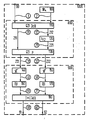
- the optical heterodyne receiver 1000 consists of an optical mixer 800, an electronic one Intermediate frequency stage 900, a local oscillator 100, an input 90, for the received signal 1, and two outputs 91 and 92 for the intermediate frequency output signals 81 and 82.
- the exemplary embodiment a device with an arrangement according to the classic beam optics is described, which has the particular advantage that the device is constructed from means that are simple to manufacture, which means that an experimental check of the functioning can be carried out at any time.
- the optical mixing stage consists of a 3dB beam splitter 110, a polarization beam splitter 130 and a first and direct mixed signal path 211 and a second mixed signal path 212 and 221 with a lamda half plate 120 arranged in this mixed signal path 212 and 221.
- the electronic intermediate frequency stage 900 consists of two photodiodes 140 and 150 for the detection of the polarization mixed signals 31 and 32 from both polarization mixed signal paths 231 and 232, each with a downstream intermediate frequency bandpass filter 160 and 170 and an intermediate frequency coupler 180, which is a 90 ° hybrid coupler, in a 3dB -Embodiment.
- the local oscillator 100 consists of a laser diode, which emits a frequency-stable optical signal, which is subsequently shaped into an exactly left-hand circularly polarized light signal of a light beam with the aid of a linear polarization filter and a lambda quarter plate.
- a stable local oscillator signal 2 is thus available for further processing. Particular care must be taken to ensure that the intended polarization state is maintained precisely and stably.
- the optical receive signal 1 is introduced at input 90. It has an at least approximately linear polarization. It is assumed that the temporal fluctuations or deviations from an intended and aimed are linear polarization within measurable or specifiable limit values of a received elliptical polarization that is actually present on a case-by-case basis, the maximum angular deviation or angular fluctuation and maximum phase deviation or phase fluctuation can be expected to a limited extent. These fluctuations and deviations relate to a direction of linear polarization of the received signal 1 which is provided for optimal reception.
- this direction of linear polarization forms an angle of 45 ° with a plane in which this heterodyne receiver 1000 is constructed and on which the signals 11, 12 and 21 of the optical signal paths 211, 212, 221, 231 and 232 are related.
- the optical reception signal 1 and the optical local oscillator signal 2 are introduced into the beam splitter 110.
- these two optical signal paths form a right angle with one another and an angle of 45 ° each with the dividing surface of the beam splitter 110.
- the beam splitter 110 is designed as a 3dB beam splitter.
- the arrangement of the dividing surface of the beam splitter 110 takes place perpendicular to the plane in which the heterodyne receiver 1000 is constructed and at the point of intersection of the received signal 1 with the local oscillator signal 2, the transmitted signal component of the received signal 1 becomes one with the reflected signal component of the local oscillator signal 2 Mixed signal 11 is superimposed or mixed and is contained in mixed signal path 211. Just as the reflected signal component of the received signal 1 is superimposed or mixed with the transmitted signal component of the local oscillator signal 2 to form a mixed signal 12 in the mixed signal path 212.
- a lamda half plate 120 is arranged in the mixed signal path 212, in such a way that it is its own direction of polarization with the plane in which the heterodyne receiver 1000 is constructed includes an angle of 45 °, which is identical to the angle which the direction of linear polarization of the intended received signal 1 with this plane includes.
- the intended signal portion of the mixed signal 12, which is obtained from the received signal 1 is not changed in its linear polarization.
- the left circularly polarized signal component of the mixed signal 12 obtained from the local oscillator signal is changed to a right circularly polarized signal component of the mixed signal 21 in the mixed signal path 221 as it passes the lamda half plate.
- the lambda half-plate 120 is especially adapted to the fact that the signal component of the mixed signal 12 which is polarized exactly to the left in a circular shape and which is received by the local oscillator signal 2 is changed to a signal component of the mixed signal 21 which is polarized exactly to the right in a circular shape.
- Both mixed signals 11 and 21 are introduced into the polarization beam splitter 130.
- the optical path lengths 212 and 221 for the mixed signal 12 and 21 are in total at least approximately 5 cm longer than the path length 211 for the mixed signal 11. This corresponds to half a wavelength of an intermediate frequency signal of 3 GHz.
- the heterodyne receiver 1000 of this exemplary embodiment is therefore designed for an intermediate frequency range in the vicinity of an average intermediate frequency of 3 GHz in order to achieve optimal signal performance.
- the polarization beam splitter 130 separates orthogonal polarization components of both mixed signals 11 and 21 from the two mixed signal paths 211 and 221. These two mixed signals are introduced into the polarization beam splitter 130 in such a way that their mixed signal paths 211 and 221 form a right angle with one another and with the polarization separating surface of the polarization beam splitter 130 an angle of 45 ° each.
- the polarization beam splitter 130 is designed and arranged so that a linear polarization component of the mixed signal 11 parallel to the plane in which the heterodyne receiver 1000 is built up, is completely transmitted, and an orthogonal polarization component of the mixed signal 11 is completely reflected. Likewise, a linear polarization component of the mixed signal 21 is completely transmitted parallel to the plane in which the heterodyne receiver 1000 is constructed, and a polarization component of the mixed signal 21 that is orthogonal to this is completely reflected.
- the polarization separating surface of the polarization beam splitter 130 is arranged perpendicular to the plane in which the heterodyne receiver 1000 is built and at a crossing point of the two introduced mixed signals 11 and 21, so that the transmitted polarization component of the mixed signal 11 and the reflected polarization component of the mixed signal 21 become one Polarization mixed signal 31 is superimposed or mixed in polarization mixed signal 231, just as the reflected polarization component of mixed signal 11 is overlaid or mixed in polarization mixed signal path 232 with the transmitted polarization component of mixed signal 21 to form a polarization mixed signal 32.
- the polarized mixed signals 31 and 32 are led to photodioders 140 and 150 for the detection of the detection signals 41 and 51.
- the intermediate frequency mixed signals 61 and are separated from these detection signals 41 and 51 by a downstream intermediate frequency bandpass filter 160 and 170 71 filtered.
- both intermediate frequency mixed signals 61 and 71 are coupled in an intermediate frequency coupler 180 to form the intermediate frequency output signals 81 and 82, which are available at the outputs 91 and 92 for processing.
- the intermediate frequency coupler is a 90 ° hybrid coupler in an embodiment of a 3dB coupler.
- the optical heterodyne receiver 1000 achieves a power quotient, the signal powers relating to image frequency suppression in the intermediate frequency output signals 81 and 82, which depends on the extent to which a linear polarization provided for the received signal 1 is maintained.
- the power quotient Q is also is equal to 0.0003, which also corresponds to an image rejection of -35 dB.
- a polarization of the received signal 1 on the Poincaré sphere deviating from the intended linear polarization lies on a circle, the center of which determines is due to the linear polarization of an angle of 45 ° to the plane in which the heterodyne receiver 1000 is constructed for the received signal 1.
- the requirements for image rejection are exceeded, and smaller values of the power quotient Q regarding image rejection are achieved.
Landscapes
- Physics & Mathematics (AREA)
- Electromagnetism (AREA)
- Engineering & Computer Science (AREA)
- Computer Networks & Wireless Communication (AREA)
- Signal Processing (AREA)
- Optical Communication System (AREA)
Applications Claiming Priority (2)
| Application Number | Priority Date | Filing Date | Title |
|---|---|---|---|
| DE3913241 | 1989-04-21 | ||
| DE3913241 | 1989-04-21 |
Publications (2)
| Publication Number | Publication Date |
|---|---|
| EP0393373A2 true EP0393373A2 (fr) | 1990-10-24 |
| EP0393373A3 EP0393373A3 (fr) | 1992-03-11 |
Family
ID=6379200
Family Applications (1)
| Application Number | Title | Priority Date | Filing Date |
|---|---|---|---|
| EP19900105377 Withdrawn EP0393373A3 (fr) | 1989-04-21 | 1990-03-21 | Récepteur hétérodyne optique |
Country Status (2)
| Country | Link |
|---|---|
| EP (1) | EP0393373A3 (fr) |
| JP (1) | JPH02296227A (fr) |
Family Cites Families (1)
| Publication number | Priority date | Publication date | Assignee | Title |
|---|---|---|---|---|
| US4723317A (en) * | 1986-05-08 | 1988-02-02 | American Telephone And Telegraph Company, At&T Bell Laboratories | Optical heterodyne mixers providing image-frequency rejection |
-
1990
- 1990-03-21 EP EP19900105377 patent/EP0393373A3/fr not_active Withdrawn
- 1990-04-18 JP JP2104377A patent/JPH02296227A/ja active Pending
Also Published As
| Publication number | Publication date |
|---|---|
| EP0393373A3 (fr) | 1992-03-11 |
| JPH02296227A (ja) | 1990-12-06 |
Similar Documents
| Publication | Publication Date | Title |
|---|---|---|
| EP0087101B1 (fr) | Prisme polariseur optique sans réflexion | |
| DE69207102T2 (de) | Ausrichtungsfehlertoleranter, durch Beugungsgitter abgestimmter Laser mit externem Resonator | |
| DE2443166C3 (de) | Systemweiche zur Trennung zweier Signale, die aus je zwei doppelt polarisierten Frequenzbändern bestehen | |
| DE69027378T2 (de) | Optisches Übertragungssystem | |
| DE68911780T2 (de) | Nicht-reziproke optische Anordnung. | |
| DE2706331A1 (de) | Optischer entzerrer fuer die signaluebertragung ueber optische mehrmoden-wellenleiter | |
| DE69005038T2 (de) | Polarisationserhaltender Koppler. | |
| DE2706373C3 (de) | Mischstufe | |
| DE69013265T2 (de) | Gepulstes parametrisches Lasersystem. | |
| DE68915964T2 (de) | Optische Mischer-Anordnung. | |
| DE3006373A1 (de) | Stereomikroskop | |
| EP0121661B1 (fr) | Appareil laser pour le traitement de matériaux | |
| DE69017359T2 (de) | Verfahren und Vorrichtung zur Übertragung eines elektromagnetischen Signals in einer optischen Faser. | |
| DE68918426T2 (de) | Doppelfrequenz strahlende Vorrichtung. | |
| DE3716247C2 (de) | Optisches Nachrichtenübertragungssystem mit Wellenlängen- und Polarisations-Multiplex | |
| DE102005028131A1 (de) | Lasersystem | |
| EP0262435A2 (fr) | Emetteur laser à bande étroite comprenant un résonateur externe dans lequel la puissance de sortie peut-être extraite du résonateur | |
| DE60218624T2 (de) | Vorrichtung zur Abstimmung der Wellenlänge einer Lichtquelle | |
| DE60115525T2 (de) | Polarisierendes doppelbrechendes Filter mit Doppeldurchgang | |
| DE2459045B2 (de) | Ankopplungs-Vorrichtung | |
| EP0393373A2 (fr) | Récepteur hétérodyne optique | |
| EP0141771A2 (fr) | Résonateur optique ayant une fibre monomode en guise d'anneau de cavité et application de tels résonateurs | |
| DE2932626C2 (de) | Viertornetzwerk zur Trennung zweier aus doppelt polarisierten Frequenzbändern bestehenden Signalen | |
| DE69219969T2 (de) | Übertragungssystem für die polarisationsunabhängige Übertragung von Signalen | |
| DE60100877T2 (de) | Optische Anordnung zum Auskoppeln von Licht |
Legal Events
| Date | Code | Title | Description |
|---|---|---|---|
| PUAI | Public reference made under article 153(3) epc to a published international application that has entered the european phase |
Free format text: ORIGINAL CODE: 0009012 |
|
| AK | Designated contracting states |
Kind code of ref document: A2 Designated state(s): DE FR GB NL |
|
| 17P | Request for examination filed |
Effective date: 19901205 |
|
| PUAL | Search report despatched |
Free format text: ORIGINAL CODE: 0009013 |
|
| AK | Designated contracting states |
Kind code of ref document: A3 Designated state(s): DE FR GB NL |
|
| STAA | Information on the status of an ep patent application or granted ep patent |
Free format text: STATUS: THE APPLICATION IS DEEMED TO BE WITHDRAWN |
|
| 18D | Application deemed to be withdrawn |
Effective date: 19941001 |