EP0394209A2 - Schleifmaschinen - Google Patents
Schleifmaschinen Download PDFInfo
- Publication number
- EP0394209A2 EP0394209A2 EP90850142A EP90850142A EP0394209A2 EP 0394209 A2 EP0394209 A2 EP 0394209A2 EP 90850142 A EP90850142 A EP 90850142A EP 90850142 A EP90850142 A EP 90850142A EP 0394209 A2 EP0394209 A2 EP 0394209A2
- Authority
- EP
- European Patent Office
- Prior art keywords
- tables
- upper table
- engagement
- lower table
- grinding machine
- Prior art date
- Legal status (The legal status is an assumption and is not a legal conclusion. Google has not performed a legal analysis and makes no representation as to the accuracy of the status listed.)
- Granted
Links
Images


Classifications
-
- B—PERFORMING OPERATIONS; TRANSPORTING
- B23—MACHINE TOOLS; METAL-WORKING NOT OTHERWISE PROVIDED FOR
- B23Q—DETAILS, COMPONENTS, OR ACCESSORIES FOR MACHINE TOOLS, e.g. ARRANGEMENTS FOR COPYING OR CONTROLLING; MACHINE TOOLS IN GENERAL CHARACTERISED BY THE CONSTRUCTION OF PARTICULAR DETAILS OR COMPONENTS; COMBINATIONS OR ASSOCIATIONS OF METAL-WORKING MACHINES, NOT DIRECTED TO A PARTICULAR RESULT
- B23Q1/00—Members which are comprised in the general build-up of a form of machine, particularly relatively large fixed members
- B23Q1/25—Movable or adjustable work or tool supports
- B23Q1/26—Movable or adjustable work or tool supports characterised by constructional features relating to the co-operation of relatively movable members; Means for preventing relative movement of such members
- B23Q1/30—Movable or adjustable work or tool supports characterised by constructional features relating to the co-operation of relatively movable members; Means for preventing relative movement of such members controlled in conjunction with the feed mechanism
-
- B—PERFORMING OPERATIONS; TRANSPORTING
- B23—MACHINE TOOLS; METAL-WORKING NOT OTHERWISE PROVIDED FOR
- B23Q—DETAILS, COMPONENTS, OR ACCESSORIES FOR MACHINE TOOLS, e.g. ARRANGEMENTS FOR COPYING OR CONTROLLING; MACHINE TOOLS IN GENERAL CHARACTERISED BY THE CONSTRUCTION OF PARTICULAR DETAILS OR COMPONENTS; COMBINATIONS OR ASSOCIATIONS OF METAL-WORKING MACHINES, NOT DIRECTED TO A PARTICULAR RESULT
- B23Q5/00—Driving or feeding mechanisms; Control arrangements therefor
-
- B—PERFORMING OPERATIONS; TRANSPORTING
- B24—GRINDING; POLISHING
- B24B—MACHINES, DEVICES, OR PROCESSES FOR GRINDING OR POLISHING; DRESSING OR CONDITIONING OF ABRADING SURFACES; FEEDING OF GRINDING, POLISHING, OR LAPPING AGENTS
- B24B47/00—Drives or gearings; Equipment therefor
- B24B47/22—Equipment for exact control of the position of the grinding tool or work at the start of the grinding operation
-
- B—PERFORMING OPERATIONS; TRANSPORTING
- B24—GRINDING; POLISHING
- B24B—MACHINES, DEVICES, OR PROCESSES FOR GRINDING OR POLISHING; DRESSING OR CONDITIONING OF ABRADING SURFACES; FEEDING OF GRINDING, POLISHING, OR LAPPING AGENTS
- B24B47/00—Drives or gearings; Equipment therefor
- B24B47/26—Accessories, e.g. stops
Definitions
- the present invention relates to a method of making computer-controlled adjustments to the settings of grinding machines, and particularly to cylindrical grinding machines, when grinding workpieces of varying dimensions, and more specifically to a method of the kind set forth in the preamble of Claim 1.
- the invention also relates to a computer-controlled grinding machine, and particularly, but not exclusively, to a computer-controlled grinding machine, and more particularly, but not exclusively, to a cylindrical grinding machine of the kind set forth in the preamble of Claim 4.
- Such machines normally include two or more machine members supported respectively on upper and lower tables, these machine members possibly comprising measuring apparatus, grindstone sharpening devices and internal-grinding devices, in addition to a work head, steady rest or tailstock.
- GB,A,2.153.270 (Schaudt) teaches a computer-controlled grinding machine which includes a facility for releasably locking a center-point tailstock.
- the tailstock is not carried by an upper table, however, and there is a danger that dirt, cutting fluid, etc. will collect in the region of the locking devices and clamping surfaces.
- US,A,4.221.080 (Favrot) teaches a twin-table machine comprising an upper and a lower table for a work spindle and a center-point tailstock respectively, these members being mounted for movement on one and the same slide.
- the relative movement between the tables for the purpose of clamping and releasing a workpiece is effected hydraulically.
- the tables are moved in unison with the aid of servo motors.
- US,A,2.356.839 also teaches a grinding machine construction in which the work head and tailstock can be moved relative to one another.
- the work head and tailstock spindle can also be locked together and are arranged to move axially in unison.
- the construction is relatively complicated, however, and is not intended to permit automated resetting of the machine.
- DE,A,1.602.934 (Okuma Machinery Works) describes an engine lathe in which the axial position of a centerpoint tailstock can be reset automatically. This positional resetting of the tailstock spindle is controlled by a measuring device operative to detect the length of the workpiece concerned. The tailstock spindle and the work head do not move in unison. Instead, the lathe tool moves axially, as is normal with engine lathes.
- one object of this invention is to provide a method and an arrangement of the aforesaid kind by means of which adjustments can be made to the settings of a grinding machine in a reliable manner, with the aid of computerized control means, even when grinding workpieces of varying sizes, thereby enabling the entire grinding cycle or "machine-setup" to be preprogrammed.
- the operator need only select from the alternatives available on the computer button-bank that alternative or those alternatives which corresponds or correspond to the workpiece concerned, whereupon the entire working operation, including adjustments to machine alignment settings? when grinding workpieces of varying dimensions takes place automatically and is computer-controlled in accordance with the program selected.
- the invention also relates to a computer-controlled grinding machine, the main characteristic features of which are set forth in the characterizing clause of Claim 4.
- One important member of the inventive grinding machine is the releasable locking device by means of which the upper and lower tables are held together.
- a suitable configuration of this locking device is disclosed in Claim 5.
- the elements forming from which the locking device is formed will not give rise to oblique or asymetric engagement forces liable to cause one table to move laterally relative to the other and therewith impair grinding.
- the locking elements of said locking device are disposed symmetrically and engage an elongated element, e.g. a straight edge, mounted on the other of said tables, on mutually opposite sides of the straight edge.
- Locking shoulders of the kind stated and carried on excentric shafts make possible accurate locking engagement in any relative position and also enable the locking device to be released immediately and quickly when so desired.
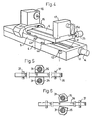
- Figure 1 illustrates a cylindrical grinding machine 1 and a cabinet 2 which houses computer and control equipment.
- a lower table or work platen 5 is mounted in V-guides and plain guides for axial movement on the bed-slide 4.
- the lower table 5 is provided in turn with V-guides 5a and plain guides 5b for guiding an upper table 6.
- the upper table 6 is joined mechanically to the lower table 5 by means of a specially designed locking device, hereinafter described with reference to Figures 5-8.
- the lower table is driven by means of a drive arrangement comprising a so-called ball screw 8 which engages in a nut 9 (shown for instance in Figure 2) mounted on the upper table.
- the ball screw 8 is driven by a motor 11 with the aid of a toothed belt 12 passing around a spocket wheel 13.
- a pulse emitter 14 connected to the screw 8 generates pulses in response to rotation of the screw. These pulses are sent to an arithmetic or counter mechanism in the control system, so that the exact position of the lower table, and therewith also the upper table, can be determined at any given moment to an accuracy of 1/1000 mm.
- the work head is adjusted to those grinding operations for which the machine is intended.
- the work head has a rigid, non-rotating spindle. This type of spindle provides the best stability for grinding operations between the work head and tailstock.
- the machine illustrated in Figure 1 may be provided with other types of stocks, measuring equipment, grinding-wheel-sharpening means or internal-grinding means, in addition to the illustrated work head and tailstock.
- the grinding wheel is referenced 20
- a grinding wheel guard is referenced 21
- a nozzle for delivering cutting fluid is referenced 22.
- a channel system for electric cables extending between the cabinet 2 and the grinding machine 1 is referenced 23.
- a table-engagement device 25 having an engagement member 25a which is operative to engage a recess 6a provided in the upper table 6 for this purpose.
- the engagement device 25 is biased by a spring towards its position of engagement and is so configured as to accurately determine the position of the upper table. Movement towards and away from the release position is effected under the influence of a pressure fluid.
- the engagement means 25a will hold the upper table in a predetermined position, provided that the locking device hereinafter described and acting between the two tables is released.
- FIG. 7 The configuration of the locking device is shown in Figures 7 and 8.
- a plate 30 which carries journals 34 for two excentric shafts 31.
- the upper part of each of the shafts 31 engages, via a respective gear wheel 32, a rack-part 33a of a piston rod 33.
- Each of the excentric shafts 31 carries on its lower end a locking shoulder 35. These locking shoulders engage an elongated straight edge 36 connected to the lower table 5 from mutually opposite sides of said straight edge.
- the straight edge 36 is guided on guide keys 37 disposed between the lower table 5 and the straight edge.
- Displacement of the piston rod 33 for the purpose of releasing the locking shoulders 35 is effected by means of a piston-cylinder device 38, which moves the piston rod towards a pack of cup springs 39.
- the arrangement is such that the spring pack 39 will always return the locking shoulders 35 into locking engagement, should the drive means 38 malfunction.
- Figure 1 illustrates a workpiece 40 clamped between the work head 16 and a center-point tailstock 17.
- the workpiece is machined by the grinding wheel 20.
- the workpiece 40 comprises a shaft which exhibits several diameters. Small numbers of such shafts of varying dimensions are to be ground in the machine, which necessitates a new setup, i.e. relative movement between the work head 16 and the tailstock 17 to a new working position, in addition to removing a workpiece and inserting a new workpiece.
- This adjustment to the machine settings can be achieved by means of the computer and control system of the machine, when practicing the inventive method.
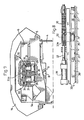
- Figures 2-4 illustrate the general procedure carried-out when effecting adjustments to machine settings.
- the ball screw 8 then begins to rotate in an opposite direction, so as to move the lower table to the left.
- the upper table 6 moves together with the lower table - despite the fact that the locking device has been released - as a result of the friction acting between the tables.
- the engagement member 25a engages and holds the upper table 6.
- the lower table 5 continues to move to the left.
- the lower table then reaches a terminal position in which the direction of table-movement is reversed.
- the table continues to move to the right through a given distance, until the lower table is in a position in which the work head 16 and the tailstock 17 are located at a predetermined distance apart.
- the lower table 5 is stopped in this position, and the locking device is returned to its locking position, whereas the engagement member 25a moves to its released position, so that the upper table can pass the engagement means without coming into engagement therewith.
- the lower and upper tables have therewith been set to desired relative positions.
- Figure 4 illustrates two position indicators 42 and 43 which, in co-action with blocks or corresponding projections 44 and 45 respectively produce 0-position signals representative of the relative movement between the bed 4 and the lower table 5 and between the lower table 5 and the upper table 6 respectively.
- the machine control equipment is then able to position the upper table 6 in relation to the lower table 5 very accurately with the aid of these 0-position signals and the pulse emitter 14.
- the lower table may be optionally moved immediately to its predetermined, new position, i.e. without first passing a terminal position when the direction of movement is reversed. Passage of the lower table through terminal positions of the kind stated, however, will afford certain advantages which facilitate the guidance of table movement via the computer-control arrangement.
Landscapes
- Engineering & Computer Science (AREA)
- Mechanical Engineering (AREA)
- Constituent Portions Of Griding Lathes, Driving, Sensing And Control (AREA)
- Finish Polishing, Edge Sharpening, And Grinding By Specific Grinding Devices (AREA)
- Jigs For Machine Tools (AREA)
Applications Claiming Priority (2)
| Application Number | Priority Date | Filing Date | Title |
|---|---|---|---|
| SE8901421A SE463447B (sv) | 1989-04-19 | 1989-04-19 | Saett vid datorstyrd omstaellning av slipmaskin samt datorstyrd slipmaskin, skaerskilt rundslipmaskin |
| SE8901421 | 1989-04-19 |
Publications (3)
| Publication Number | Publication Date |
|---|---|
| EP0394209A2 true EP0394209A2 (de) | 1990-10-24 |
| EP0394209A3 EP0394209A3 (de) | 1991-08-14 |
| EP0394209B1 EP0394209B1 (de) | 1995-03-08 |
Family
ID=20375728
Family Applications (1)
| Application Number | Title | Priority Date | Filing Date |
|---|---|---|---|
| EP19900850142 Expired - Lifetime EP0394209B1 (de) | 1989-04-19 | 1990-04-18 | Schleifmaschinen |
Country Status (3)
| Country | Link |
|---|---|
| EP (1) | EP0394209B1 (de) |
| ES (1) | ES2071084T3 (de) |
| SE (1) | SE463447B (de) |
Cited By (4)
| Publication number | Priority date | Publication date | Assignee | Title |
|---|---|---|---|---|
| WO1995003920A1 (en) * | 1993-07-30 | 1995-02-09 | Western Atlas U.K. Limited | Radial force compensation in 2-axis machine tool |
| GB2294226A (en) * | 1993-07-30 | 1996-04-24 | Western Atlas Uk Ltd | Radial force compensation in 2-axis machine tool |
| EP0799676A1 (de) * | 1996-04-02 | 1997-10-08 | Danobat, S. Coop | Kopfstück von einer Schleifmaschine mit automatischer Linearfortbewegung |
| CN113681461A (zh) * | 2021-07-28 | 2021-11-23 | 彩虹(合肥)液晶玻璃有限公司 | 一种玻璃基板研磨工作台 |
Families Citing this family (1)
| Publication number | Priority date | Publication date | Assignee | Title |
|---|---|---|---|---|
| CN109590830A (zh) * | 2018-10-29 | 2019-04-09 | 泉州智驰自动化机械有限公司 | 一种高效陶瓷产品内孔打磨设备 |
Family Cites Families (3)
| Publication number | Priority date | Publication date | Assignee | Title |
|---|---|---|---|---|
| FR2409131A1 (fr) * | 1977-11-22 | 1979-06-15 | Clichy Const Sa | Perfectionnement aux tables porte-pieces de machines a rectifier |
| CH666215A5 (de) * | 1984-01-13 | 1988-07-15 | Schaudt Maschinenbau Gmbh | Verfahren zum einstellen der laengsposition einer werkstueckstuetzeinheit oder eines aehnlichen maschinenelementes einer rundschleifmaschine. |
| JPS60172455A (ja) * | 1984-02-17 | 1985-09-05 | Toyoda Mach Works Ltd | クランク軸の研削方法 |
-
1989
- 1989-04-19 SE SE8901421A patent/SE463447B/sv not_active IP Right Cessation
-
1990
- 1990-04-18 ES ES90850142T patent/ES2071084T3/es not_active Expired - Lifetime
- 1990-04-18 EP EP19900850142 patent/EP0394209B1/de not_active Expired - Lifetime
Cited By (7)
| Publication number | Priority date | Publication date | Assignee | Title |
|---|---|---|---|---|
| WO1995003920A1 (en) * | 1993-07-30 | 1995-02-09 | Western Atlas U.K. Limited | Radial force compensation in 2-axis machine tool |
| GB2294226A (en) * | 1993-07-30 | 1996-04-24 | Western Atlas Uk Ltd | Radial force compensation in 2-axis machine tool |
| GB2294226B (en) * | 1993-07-30 | 1997-04-09 | Western Atlas Uk Ltd | Radial force compensation in 2-axis machine tool |
| EP0799676A1 (de) * | 1996-04-02 | 1997-10-08 | Danobat, S. Coop | Kopfstück von einer Schleifmaschine mit automatischer Linearfortbewegung |
| ES2141637A1 (es) * | 1996-04-02 | 2000-03-16 | Danobat | Cabezal pieza con desplazamiento lineal automatico para una rectificadora. |
| CN113681461A (zh) * | 2021-07-28 | 2021-11-23 | 彩虹(合肥)液晶玻璃有限公司 | 一种玻璃基板研磨工作台 |
| CN113681461B (zh) * | 2021-07-28 | 2023-10-20 | 彩虹(合肥)液晶玻璃有限公司 | 一种玻璃基板研磨工作台 |
Also Published As
| Publication number | Publication date |
|---|---|
| ES2071084T3 (es) | 1995-06-16 |
| EP0394209A3 (de) | 1991-08-14 |
| SE8901421L (sv) | 1990-10-20 |
| SE8901421D0 (sv) | 1989-04-19 |
| EP0394209B1 (de) | 1995-03-08 |
| SE463447B (sv) | 1990-11-26 |
Similar Documents
| Publication | Publication Date | Title |
|---|---|---|
| EP0562232B1 (de) | Werkzeugmaschine | |
| EP1663573B1 (de) | Schleifmaschine mit rundlaufkorrektur | |
| DE3941756C2 (de) | ||
| DE10314199B4 (de) | Numerisch gesteuerte Schleifmaschine | |
| EP0093288A1 (de) | Vorrichtung zur automatischen Verstellung der Radialposition eines Planschiebers eines Planverstellkopfes an einer Zerspanungsmaschine | |
| US4813311A (en) | Center drive machine | |
| EP0789221A2 (de) | Verfahren zur koordinatenmassigen Vermessung von Werkstücken auf Bearbeitungsmaschinen | |
| JPH0698562B2 (ja) | 円筒研削盤およびこの円筒研削盤において工作物テーブル上で工作物固定ユニットを位置決めするための方法 | |
| DE4125654A1 (de) | Topfschleifmaschine, insbesondere zum schleifen von scherenteilen | |
| US6480757B1 (en) | Method of locating a workpiece on a computer numeric controlled machining system | |
| EP0394209B1 (de) | Schleifmaschinen | |
| DE19851411B4 (de) | Verfahren und Vorrichtung zum Vermessen von Fräs- oder Bohrwerkzeugen und zur Geometriekompensation im Automatikbetrieb an Werkzeugmaschinen | |
| DE19514054B4 (de) | Mehrfachspindel-Werkzeugmaschine, sowie Verfahren zum Kompensieren von Positionsänderungen einer Werkstück-Trägerspindel | |
| EP0346288B1 (de) | Verfahren und Einrichtung zum berührungslosen Ausmessen eines Werkstückes | |
| DE112016003837T5 (de) | Werkzeugmaschine | |
| DE19825922A1 (de) | Verfahren zum Zentrieren optischer Linsen und Vorrichtung mit CNC-Steuerung zur Durchführung des Verfahrens | |
| KR100356406B1 (ko) | 가공장치 | |
| DE19738818B4 (de) | Verfahren und Vorrichtung zur formgeregelten Feinstbearbeitung eines Werkstücks | |
| EP0315575A1 (de) | Verfahren und Messvorrichtung zur Durchmesserermittlung von Walzen | |
| US5435360A (en) | Method for positioning a machine element having a reference point relative to a reference point provided at an abutment | |
| US2575945A (en) | Machine tool positioning mechanism | |
| JPH05185304A (ja) | 自動旋盤 | |
| JP2792909B2 (ja) | 内面切削工具の測定装置 | |
| JP3669730B2 (ja) | Nc工作機械の工具交換装置 | |
| JPS5877450A (ja) | アンギユラ研削盤における砥石修正装置 |
Legal Events
| Date | Code | Title | Description |
|---|---|---|---|
| PUAI | Public reference made under article 153(3) epc to a published international application that has entered the european phase |
Free format text: ORIGINAL CODE: 0009012 |
|
| 17P | Request for examination filed |
Effective date: 19900427 |
|
| AK | Designated contracting states |
Kind code of ref document: A2 Designated state(s): BE ES FR GB NL |
|
| PUAL | Search report despatched |
Free format text: ORIGINAL CODE: 0009013 |
|
| AK | Designated contracting states |
Kind code of ref document: A3 Designated state(s): BE ES FR GB NL |
|
| 17Q | First examination report despatched |
Effective date: 19930514 |
|
| RAP1 | Party data changed (applicant data changed or rights of an application transferred) |
Owner name: UVA INTERNATIONAL AB |
|
| GRAA | (expected) grant |
Free format text: ORIGINAL CODE: 0009210 |
|
| AK | Designated contracting states |
Kind code of ref document: B1 Designated state(s): BE ES FR GB NL |
|
| REG | Reference to a national code |
Ref country code: ES Ref legal event code: FG2A Ref document number: 2071084 Country of ref document: ES Kind code of ref document: T3 |
|
| ET | Fr: translation filed | ||
| PLBE | No opposition filed within time limit |
Free format text: ORIGINAL CODE: 0009261 |
|
| STAA | Information on the status of an ep patent application or granted ep patent |
Free format text: STATUS: NO OPPOSITION FILED WITHIN TIME LIMIT |
|
| 26N | No opposition filed | ||
| REG | Reference to a national code |
Ref country code: GB Ref legal event code: IF02 |
|
| PGFP | Annual fee paid to national office [announced via postgrant information from national office to epo] |
Ref country code: ES Payment date: 20090420 Year of fee payment: 20 |
|
| PGFP | Annual fee paid to national office [announced via postgrant information from national office to epo] |
Ref country code: NL Payment date: 20090427 Year of fee payment: 20 Ref country code: FR Payment date: 20090430 Year of fee payment: 20 |
|
| PGFP | Annual fee paid to national office [announced via postgrant information from national office to epo] |
Ref country code: BE Payment date: 20090427 Year of fee payment: 20 |
|
| PGFP | Annual fee paid to national office [announced via postgrant information from national office to epo] |
Ref country code: GB Payment date: 20090429 Year of fee payment: 20 |
|
| REG | Reference to a national code |
Ref country code: NL Ref legal event code: V4 Effective date: 20100418 |
|
| BE20 | Be: patent expired |
Owner name: *UVA INTERNATIONAL A.B. Effective date: 20100418 |
|
| REG | Reference to a national code |
Ref country code: GB Ref legal event code: PE20 Expiry date: 20100417 |
|
| REG | Reference to a national code |
Ref country code: ES Ref legal event code: FD2A Effective date: 20100419 |
|
| PG25 | Lapsed in a contracting state [announced via postgrant information from national office to epo] |
Ref country code: ES Free format text: LAPSE BECAUSE OF EXPIRATION OF PROTECTION Effective date: 20100419 Ref country code: NL Free format text: LAPSE BECAUSE OF EXPIRATION OF PROTECTION Effective date: 20100418 |
|
| PG25 | Lapsed in a contracting state [announced via postgrant information from national office to epo] |
Ref country code: GB Free format text: LAPSE BECAUSE OF EXPIRATION OF PROTECTION Effective date: 20100417 |