EP0394538B1 - Hefezellen der Gattung-Schwanniomyces - Google Patents
Hefezellen der Gattung-Schwanniomyces Download PDFInfo
- Publication number
- EP0394538B1 EP0394538B1 EP89107780A EP89107780A EP0394538B1 EP 0394538 B1 EP0394538 B1 EP 0394538B1 EP 89107780 A EP89107780 A EP 89107780A EP 89107780 A EP89107780 A EP 89107780A EP 0394538 B1 EP0394538 B1 EP 0394538B1
- Authority
- EP
- European Patent Office
- Prior art keywords
- dna sequence
- process according
- schwanniomyces
- gene
- yeast
- Prior art date
- Legal status (The legal status is an assumption and is not a legal conclusion. Google has not performed a legal analysis and makes no representation as to the accuracy of the status listed.)
- Expired - Lifetime
Links
- 241000311088 Schwanniomyces Species 0.000 title claims abstract description 42
- 210000005253 yeast cell Anatomy 0.000 title claims abstract description 36
- 108090000623 proteins and genes Proteins 0.000 claims abstract description 97
- 230000014509 gene expression Effects 0.000 claims abstract description 70
- 108091028043 Nucleic acid sequence Proteins 0.000 claims abstract description 69
- 102000004169 proteins and genes Human genes 0.000 claims abstract description 36
- 108010076504 Protein Sorting Signals Proteins 0.000 claims abstract description 21
- 102000004190 Enzymes Human genes 0.000 claims abstract description 18
- 108090000790 Enzymes Proteins 0.000 claims abstract description 18
- 230000003625 amylolytic effect Effects 0.000 claims abstract description 10
- 239000012634 fragment Substances 0.000 claims description 66
- 238000000034 method Methods 0.000 claims description 47
- 108010073178 Glucan 1,4-alpha-Glucosidase Proteins 0.000 claims description 45
- 241001123650 Schwanniomyces occidentalis Species 0.000 claims description 42
- 108090000637 alpha-Amylases Proteins 0.000 claims description 40
- 240000004808 Saccharomyces cerevisiae Species 0.000 claims description 38
- 235000014680 Saccharomyces cerevisiae Nutrition 0.000 claims description 34
- 102000004139 alpha-Amylases Human genes 0.000 claims description 32
- 229940024171 alpha-amylase Drugs 0.000 claims description 31
- 230000008569 process Effects 0.000 claims description 30
- 102100022624 Glucoamylase Human genes 0.000 claims description 28
- 108090000765 processed proteins & peptides Proteins 0.000 claims description 22
- 239000013598 vector Substances 0.000 claims description 20
- 102000004196 processed proteins & peptides Human genes 0.000 claims description 19
- 229940088598 enzyme Drugs 0.000 claims description 17
- 229920001184 polypeptide Polymers 0.000 claims description 16
- 241000235648 Pichia Species 0.000 claims description 15
- 229920002472 Starch Polymers 0.000 claims description 14
- 238000003780 insertion Methods 0.000 claims description 14
- 230000037431 insertion Effects 0.000 claims description 14
- 239000008107 starch Substances 0.000 claims description 14
- 235000019698 starch Nutrition 0.000 claims description 14
- FQVLRGLGWNWPSS-BXBUPLCLSA-N (4r,7s,10s,13s,16r)-16-acetamido-13-(1h-imidazol-5-ylmethyl)-10-methyl-6,9,12,15-tetraoxo-7-propan-2-yl-1,2-dithia-5,8,11,14-tetrazacycloheptadecane-4-carboxamide Chemical compound N1C(=O)[C@@H](NC(C)=O)CSSC[C@@H](C(N)=O)NC(=O)[C@H](C(C)C)NC(=O)[C@H](C)NC(=O)[C@@H]1CC1=CN=CN1 FQVLRGLGWNWPSS-BXBUPLCLSA-N 0.000 claims description 13
- 102100034035 Alcohol dehydrogenase 1A Human genes 0.000 claims description 13
- 101000892220 Geobacillus thermodenitrificans (strain NG80-2) Long-chain-alcohol dehydrogenase 1 Proteins 0.000 claims description 13
- 101000780443 Homo sapiens Alcohol dehydrogenase 1A Proteins 0.000 claims description 13
- 108010059892 Cellulase Proteins 0.000 claims description 12
- 241000235070 Saccharomyces Species 0.000 claims description 12
- 229940106157 cellulase Drugs 0.000 claims description 11
- 238000004519 manufacturing process Methods 0.000 claims description 9
- 239000002773 nucleotide Substances 0.000 claims description 9
- 125000003729 nucleotide group Chemical group 0.000 claims description 9
- 230000009466 transformation Effects 0.000 claims description 9
- OWEGMIWEEQEYGQ-UHFFFAOYSA-N 100676-05-9 Natural products OC1C(O)C(O)C(CO)OC1OCC1C(O)C(O)C(O)C(OC2C(OC(O)C(O)C2O)CO)O1 OWEGMIWEEQEYGQ-UHFFFAOYSA-N 0.000 claims description 8
- GUBGYTABKSRVRQ-PICCSMPSSA-N Maltose Natural products O[C@@H]1[C@@H](O)[C@H](O)[C@@H](CO)O[C@@H]1O[C@@H]1[C@@H](CO)OC(O)[C@H](O)[C@H]1O GUBGYTABKSRVRQ-PICCSMPSSA-N 0.000 claims description 8
- 239000003550 marker Substances 0.000 claims description 8
- 241001138401 Kluyveromyces lactis Species 0.000 claims description 7
- 230000010076 replication Effects 0.000 claims description 7
- 101150069554 HIS4 gene Proteins 0.000 claims description 6
- 238000002744 homologous recombination Methods 0.000 claims description 6
- 230000006801 homologous recombination Effects 0.000 claims description 6
- 101150094690 GAL1 gene Proteins 0.000 claims description 5
- 102100028501 Galanin peptides Human genes 0.000 claims description 5
- 101100121078 Homo sapiens GAL gene Proteins 0.000 claims description 5
- 230000001276 controlling effect Effects 0.000 claims description 5
- 238000012423 maintenance Methods 0.000 claims description 5
- 230000000063 preceeding effect Effects 0.000 claims description 5
- 230000008827 biological function Effects 0.000 claims description 4
- 238000012217 deletion Methods 0.000 claims description 4
- 230000037430 deletion Effects 0.000 claims description 4
- 108020004445 glyceraldehyde-3-phosphate dehydrogenase Proteins 0.000 claims description 4
- NOESYZHRGYRDHS-UHFFFAOYSA-N insulin Chemical compound N1C(=O)C(NC(=O)C(CCC(N)=O)NC(=O)C(CCC(O)=O)NC(=O)C(C(C)C)NC(=O)C(NC(=O)CN)C(C)CC)CSSCC(C(NC(CO)C(=O)NC(CC(C)C)C(=O)NC(CC=2C=CC(O)=CC=2)C(=O)NC(CCC(N)=O)C(=O)NC(CC(C)C)C(=O)NC(CCC(O)=O)C(=O)NC(CC(N)=O)C(=O)NC(CC=2C=CC(O)=CC=2)C(=O)NC(CSSCC(NC(=O)C(C(C)C)NC(=O)C(CC(C)C)NC(=O)C(CC=2C=CC(O)=CC=2)NC(=O)C(CC(C)C)NC(=O)C(C)NC(=O)C(CCC(O)=O)NC(=O)C(C(C)C)NC(=O)C(CC(C)C)NC(=O)C(CC=2NC=NC=2)NC(=O)C(CO)NC(=O)CNC2=O)C(=O)NCC(=O)NC(CCC(O)=O)C(=O)NC(CCCNC(N)=N)C(=O)NCC(=O)NC(CC=3C=CC=CC=3)C(=O)NC(CC=3C=CC=CC=3)C(=O)NC(CC=3C=CC(O)=CC=3)C(=O)NC(C(C)O)C(=O)N3C(CCC3)C(=O)NC(CCCCN)C(=O)NC(C)C(O)=O)C(=O)NC(CC(N)=O)C(O)=O)=O)NC(=O)C(C(C)CC)NC(=O)C(CO)NC(=O)C(C(C)O)NC(=O)C1CSSCC2NC(=O)C(CC(C)C)NC(=O)C(NC(=O)C(CCC(N)=O)NC(=O)C(CC(N)=O)NC(=O)C(NC(=O)C(N)CC=1C=CC=CC=1)C(C)C)CC1=CN=CN1 NOESYZHRGYRDHS-UHFFFAOYSA-N 0.000 claims description 4
- 230000001105 regulatory effect Effects 0.000 claims description 4
- 230000003362 replicative effect Effects 0.000 claims description 4
- 238000006467 substitution reaction Methods 0.000 claims description 4
- 102100034044 All-trans-retinol dehydrogenase [NAD(+)] ADH1B Human genes 0.000 claims description 3
- 101710193111 All-trans-retinol dehydrogenase [NAD(+)] ADH4 Proteins 0.000 claims description 3
- 102100033770 Alpha-amylase 1C Human genes 0.000 claims description 3
- 101100074137 Arabidopsis thaliana IRX12 gene Proteins 0.000 claims description 3
- 101100351264 Candida albicans (strain SC5314 / ATCC MYA-2876) PDC11 gene Proteins 0.000 claims description 3
- 229920001353 Dextrin Polymers 0.000 claims description 3
- 239000004375 Dextrin Substances 0.000 claims description 3
- 101000779871 Homo sapiens Alpha-amylase 1A Proteins 0.000 claims description 3
- 101000779870 Homo sapiens Alpha-amylase 1B Proteins 0.000 claims description 3
- 101000779869 Homo sapiens Alpha-amylase 1C Proteins 0.000 claims description 3
- 101000746367 Homo sapiens Granulocyte colony-stimulating factor Proteins 0.000 claims description 3
- 241000235649 Kluyveromyces Species 0.000 claims description 3
- 101150022713 LAC4 gene Proteins 0.000 claims description 3
- 102000007651 Macrophage Colony-Stimulating Factor Human genes 0.000 claims description 3
- 108010046938 Macrophage Colony-Stimulating Factor Proteins 0.000 claims description 3
- 101150050255 PDC1 gene Proteins 0.000 claims description 3
- 102100038583 Secreted Ly-6/uPAR-related protein 1 Human genes 0.000 claims description 3
- 235000019425 dextrin Nutrition 0.000 claims description 3
- 230000001976 improved effect Effects 0.000 claims description 3
- 108010027322 single cell proteins Proteins 0.000 claims description 3
- 230000003612 virological effect Effects 0.000 claims description 3
- 239000004382 Amylase Substances 0.000 claims description 2
- 108010039627 Aprotinin Proteins 0.000 claims description 2
- 102100030981 Beta-alanine-activating enzyme Human genes 0.000 claims description 2
- 239000002028 Biomass Substances 0.000 claims description 2
- 101000893906 Fowl adenovirus A serotype 1 (strain CELO / Phelps) Protein GAM-1 Proteins 0.000 claims description 2
- 101150009006 HIS3 gene Proteins 0.000 claims description 2
- 101100246753 Halobacterium salinarum (strain ATCC 700922 / JCM 11081 / NRC-1) pyrF gene Proteins 0.000 claims description 2
- 102000007625 Hirudins Human genes 0.000 claims description 2
- 108010007267 Hirudins Proteins 0.000 claims description 2
- 101000773364 Homo sapiens Beta-alanine-activating enzyme Proteins 0.000 claims description 2
- 102000004877 Insulin Human genes 0.000 claims description 2
- 108090001061 Insulin Proteins 0.000 claims description 2
- 108090000723 Insulin-Like Growth Factor I Proteins 0.000 claims description 2
- 102000014150 Interferons Human genes 0.000 claims description 2
- 108010050904 Interferons Proteins 0.000 claims description 2
- 241001149698 Lipomyces Species 0.000 claims description 2
- 108010025020 Nerve Growth Factor Proteins 0.000 claims description 2
- 102000015336 Nerve Growth Factor Human genes 0.000 claims description 2
- 101100394989 Rhodopseudomonas palustris (strain ATCC BAA-98 / CGA009) hisI gene Proteins 0.000 claims description 2
- 101150050575 URA3 gene Proteins 0.000 claims description 2
- 239000000427 antigen Substances 0.000 claims description 2
- 108091007433 antigens Proteins 0.000 claims description 2
- 102000036639 antigens Human genes 0.000 claims description 2
- 229960004405 aprotinin Drugs 0.000 claims description 2
- 229960001212 bacterial vaccine Drugs 0.000 claims description 2
- 239000003114 blood coagulation factor Substances 0.000 claims description 2
- 239000003102 growth factor Substances 0.000 claims description 2
- 208000002672 hepatitis B Diseases 0.000 claims description 2
- 229940006607 hirudin Drugs 0.000 claims description 2
- WQPDUTSPKFMPDP-OUMQNGNKSA-N hirudin Chemical compound C([C@@H](C(=O)N[C@@H](CCC(O)=O)C(=O)N[C@@H](CCC(O)=O)C(=O)N[C@@H]([C@@H](C)CC)C(=O)N1[C@@H](CCC1)C(=O)N[C@@H](CCC(O)=O)C(=O)N[C@@H](CCC(O)=O)C(=O)N[C@@H](CC=1C=CC(OS(O)(=O)=O)=CC=1)C(=O)N[C@@H](CC(C)C)C(=O)N[C@@H](CCC(N)=O)C(O)=O)NC(=O)[C@H](CC(O)=O)NC(=O)CNC(=O)[C@H](CC(O)=O)NC(=O)[C@H](CC(N)=O)NC(=O)[C@H](CC=1NC=NC=1)NC(=O)[C@H](CO)NC(=O)[C@H](CCC(N)=O)NC(=O)[C@H]1N(CCC1)C(=O)[C@H](CCCCN)NC(=O)[C@H]1N(CCC1)C(=O)[C@@H](NC(=O)CNC(=O)[C@H](CCC(O)=O)NC(=O)CNC(=O)[C@@H](NC(=O)[C@@H](NC(=O)[C@H]1NC(=O)[C@H](CCC(N)=O)NC(=O)[C@H](CC(N)=O)NC(=O)[C@H](CCCCN)NC(=O)[C@H](CCC(O)=O)NC(=O)CNC(=O)[C@H](CC(O)=O)NC(=O)[C@H](CO)NC(=O)CNC(=O)[C@H](CC(C)C)NC(=O)[C@H]([C@@H](C)CC)NC(=O)[C@@H]2CSSC[C@@H](C(=O)N[C@@H](CCC(O)=O)C(=O)NCC(=O)N[C@@H](CO)C(=O)N[C@@H](CC(N)=O)C(=O)N[C@H](C(=O)N[C@H](C(NCC(=O)N[C@@H](CCC(N)=O)C(=O)NCC(=O)N[C@@H](CC(N)=O)C(=O)N[C@@H](CCCCN)C(=O)N2)=O)CSSC1)C(C)C)NC(=O)[C@H](CC(C)C)NC(=O)[C@H]1NC(=O)[C@H](CC(C)C)NC(=O)[C@H](CC(N)=O)NC(=O)[C@H](CCC(N)=O)NC(=O)CNC(=O)[C@H](CO)NC(=O)[C@H](CCC(O)=O)NC(=O)[C@H]([C@@H](C)O)NC(=O)[C@@H](NC(=O)[C@H](CC(O)=O)NC(=O)[C@@H](NC(=O)[C@H](CC=2C=CC(O)=CC=2)NC(=O)[C@@H](NC(=O)[C@@H](N)C(C)C)C(C)C)[C@@H](C)O)CSSC1)C(C)C)[C@@H](C)O)[C@@H](C)O)C1=CC=CC=C1 WQPDUTSPKFMPDP-OUMQNGNKSA-N 0.000 claims description 2
- 229940088597 hormone Drugs 0.000 claims description 2
- 239000005556 hormone Substances 0.000 claims description 2
- ZPNFWUPYTFPOJU-LPYSRVMUSA-N iniprol Chemical compound C([C@H]1C(=O)NCC(=O)NCC(=O)N[C@H]2CSSC[C@H]3C(=O)N[C@@H](CCCCN)C(=O)N[C@@H](C)C(=O)N[C@@H](CCCNC(N)=N)C(=O)N[C@H](C(N[C@H](C(=O)N[C@@H](CCCNC(N)=N)C(=O)N[C@@H](CC=4C=CC(O)=CC=4)C(=O)N[C@@H](CC=4C=CC=CC=4)C(=O)N[C@@H](CC=4C=CC(O)=CC=4)C(=O)N[C@@H](CC(N)=O)C(=O)N[C@@H](C)C(=O)N[C@@H](CCCCN)C(=O)N[C@@H](C)C(=O)NCC(=O)N[C@@H](CC(C)C)C(=O)N[C@@H](CSSC[C@H](NC(=O)[C@H](CC(O)=O)NC(=O)[C@H](CCC(O)=O)NC(=O)[C@H](C)NC(=O)[C@H](CO)NC(=O)[C@H](CCCCN)NC(=O)[C@H](CC=4C=CC=CC=4)NC(=O)[C@H](CC(N)=O)NC(=O)[C@H](CC(N)=O)NC(=O)[C@H](CCCNC(N)=N)NC(=O)[C@H](CCCCN)NC(=O)[C@H](C)NC(=O)[C@H](CCCNC(N)=N)NC2=O)C(=O)N[C@@H](CCSC)C(=O)N[C@@H](CCCNC(N)=N)C(=O)N[C@@H]([C@@H](C)O)C(=O)N[C@@H](CSSC[C@H](NC(=O)[C@H](CC=2C=CC=CC=2)NC(=O)[C@H](CC(O)=O)NC(=O)[C@H]2N(CCC2)C(=O)[C@@H](N)CCCNC(N)=N)C(=O)N[C@@H](CC(C)C)C(=O)N[C@@H](CCC(O)=O)C(=O)N2[C@@H](CCC2)C(=O)N2[C@@H](CCC2)C(=O)N[C@@H](CC=2C=CC(O)=CC=2)C(=O)N[C@@H]([C@@H](C)O)C(=O)NCC(=O)N2[C@@H](CCC2)C(=O)N3)C(=O)NCC(=O)NCC(=O)N[C@@H](C)C(O)=O)C(=O)N[C@@H](CCC(N)=O)C(=O)N[C@H](C(=O)N[C@@H](CC=2C=CC=CC=2)C(=O)N[C@H](C(=O)N1)C(C)C)[C@@H](C)O)[C@@H](C)CC)=O)[C@@H](C)CC)C1=CC=C(O)C=C1 ZPNFWUPYTFPOJU-LPYSRVMUSA-N 0.000 claims description 2
- 229940125396 insulin Drugs 0.000 claims description 2
- 229940079322 interferon Drugs 0.000 claims description 2
- 229940053128 nerve growth factor Drugs 0.000 claims description 2
- 229960004854 viral vaccine Drugs 0.000 claims description 2
- 102000013142 Amylases Human genes 0.000 claims 1
- 108010065511 Amylases Proteins 0.000 claims 1
- 102100031181 Glyceraldehyde-3-phosphate dehydrogenase Human genes 0.000 claims 1
- 102000015696 Interleukins Human genes 0.000 claims 1
- 108010063738 Interleukins Proteins 0.000 claims 1
- 102000013275 Somatomedins Human genes 0.000 claims 1
- 235000019418 amylase Nutrition 0.000 claims 1
- 230000004071 biological effect Effects 0.000 claims 1
- 230000000717 retained effect Effects 0.000 claims 1
- 230000028327 secretion Effects 0.000 abstract description 23
- 239000013612 plasmid Substances 0.000 description 55
- 101150022010 gam gene Proteins 0.000 description 41
- 101100522841 Drosophila melanogaster pygo gene Proteins 0.000 description 28
- 230000004927 fusion Effects 0.000 description 21
- 108020004414 DNA Proteins 0.000 description 18
- WQZGKKKJIJFFOK-GASJEMHNSA-N Glucose Natural products OC[C@H]1OC(O)[C@H](O)[C@@H](O)[C@@H]1O WQZGKKKJIJFFOK-GASJEMHNSA-N 0.000 description 13
- 239000008103 glucose Substances 0.000 description 13
- 101710156500 Endoglucanase D Proteins 0.000 description 12
- 101710147478 Probable endo-beta-1,4-glucanase D Proteins 0.000 description 12
- 101150072511 celD gene Proteins 0.000 description 12
- 238000003776 cleavage reaction Methods 0.000 description 11
- 230000007017 scission Effects 0.000 description 11
- 238000010276 construction Methods 0.000 description 10
- 230000000694 effects Effects 0.000 description 10
- 108091026890 Coding region Proteins 0.000 description 8
- 238000001727 in vivo Methods 0.000 description 8
- 238000005215 recombination Methods 0.000 description 8
- 230000006798 recombination Effects 0.000 description 8
- 241000588724 Escherichia coli Species 0.000 description 7
- 150000001413 amino acids Chemical class 0.000 description 7
- 238000003556 assay Methods 0.000 description 7
- 101500018099 Apis mellifera ARMGFHGMR-amide Proteins 0.000 description 6
- 101100399280 Bacillus subtilis (strain 168) licH gene Proteins 0.000 description 6
- 101100113310 Escherichia coli (strain K12) chbR gene Proteins 0.000 description 6
- 102000003621 TRPC5 Human genes 0.000 description 6
- 230000015572 biosynthetic process Effects 0.000 description 6
- 101150072516 cbhA gene Proteins 0.000 description 6
- 210000004027 cell Anatomy 0.000 description 6
- IQFVPQOLBLOTPF-HKXUKFGYSA-L congo red Chemical compound [Na+].[Na+].C1=CC=CC2=C(N)C(/N=N/C3=CC=C(C=C3)C3=CC=C(C=C3)/N=N/C3=C(C4=CC=CC=C4C(=C3)S([O-])(=O)=O)N)=CC(S([O-])(=O)=O)=C21 IQFVPQOLBLOTPF-HKXUKFGYSA-L 0.000 description 6
- 239000000047 product Substances 0.000 description 6
- 108010002350 Interleukin-2 Proteins 0.000 description 5
- 108091092724 Noncoding DNA Proteins 0.000 description 5
- 239000002253 acid Substances 0.000 description 5
- 150000007513 acids Chemical class 0.000 description 5
- 230000013595 glycosylation Effects 0.000 description 5
- 238000006206 glycosylation reaction Methods 0.000 description 5
- 239000001963 growth medium Substances 0.000 description 5
- 230000001939 inductive effect Effects 0.000 description 5
- 238000002741 site-directed mutagenesis Methods 0.000 description 5
- 230000035897 transcription Effects 0.000 description 5
- 238000013518 transcription Methods 0.000 description 5
- 108010087967 type I signal peptidase Proteins 0.000 description 5
- 102000000588 Interleukin-2 Human genes 0.000 description 4
- 101150007280 LEU2 gene Proteins 0.000 description 4
- 101710137500 T7 RNA polymerase Proteins 0.000 description 4
- 239000013604 expression vector Substances 0.000 description 4
- 230000006870 function Effects 0.000 description 4
- 238000002703 mutagenesis Methods 0.000 description 4
- 231100000350 mutagenesis Toxicity 0.000 description 4
- OKTJSMMVPCPJKN-UHFFFAOYSA-N Carbon Chemical compound [C] OKTJSMMVPCPJKN-UHFFFAOYSA-N 0.000 description 3
- 108020004705 Codon Proteins 0.000 description 3
- 125000001429 N-terminal alpha-amino-acid group Chemical group 0.000 description 3
- 241000320412 Ogataea angusta Species 0.000 description 3
- 102000011755 Phosphoglycerate Kinase Human genes 0.000 description 3
- 101150024785 TRP5 gene Proteins 0.000 description 3
- 101001099217 Thermotoga maritima (strain ATCC 43589 / DSM 3109 / JCM 10099 / NBRC 100826 / MSB8) Triosephosphate isomerase Proteins 0.000 description 3
- 108700009124 Transcription Initiation Site Proteins 0.000 description 3
- 230000008901 benefit Effects 0.000 description 3
- 229910052799 carbon Inorganic materials 0.000 description 3
- 238000005516 engineering process Methods 0.000 description 3
- 238000002474 experimental method Methods 0.000 description 3
- 102000006602 glyceraldehyde-3-phosphate dehydrogenase Human genes 0.000 description 3
- 230000012010 growth Effects 0.000 description 3
- -1 interleukine Proteins 0.000 description 3
- 239000000463 material Substances 0.000 description 3
- 239000002609 medium Substances 0.000 description 3
- 238000012163 sequencing technique Methods 0.000 description 3
- 238000010186 staining Methods 0.000 description 3
- 238000012360 testing method Methods 0.000 description 3
- 238000013519 translation Methods 0.000 description 3
- 238000001262 western blot Methods 0.000 description 3
- BOFRXDMCQRTGII-UHFFFAOYSA-N 619-08-9 Chemical compound OC1=CC=C([N+]([O-])=O)C=C1Cl BOFRXDMCQRTGII-UHFFFAOYSA-N 0.000 description 2
- 101150083191 AMY1 gene Proteins 0.000 description 2
- 229920001817 Agar Polymers 0.000 description 2
- 101100309712 Arabidopsis thaliana SD11 gene Proteins 0.000 description 2
- IJGRMHOSHXDMSA-UHFFFAOYSA-N Atomic nitrogen Chemical compound N#N IJGRMHOSHXDMSA-UHFFFAOYSA-N 0.000 description 2
- 229920002134 Carboxymethyl cellulose Polymers 0.000 description 2
- 108010059378 Endopeptidases Proteins 0.000 description 2
- 102000005593 Endopeptidases Human genes 0.000 description 2
- 241001131785 Escherichia coli HB101 Species 0.000 description 2
- 101150037782 GAL2 gene Proteins 0.000 description 2
- 101150000489 GAM1 gene Proteins 0.000 description 2
- 102100021735 Galectin-2 Human genes 0.000 description 2
- JGSARLDLIJGVTE-MBNYWOFBSA-N Penicillin G Chemical compound N([C@H]1[C@H]2SC([C@@H](N2C1=O)C(O)=O)(C)C)C(=O)CC1=CC=CC=C1 JGSARLDLIJGVTE-MBNYWOFBSA-N 0.000 description 2
- 241000193448 Ruminiclostridium thermocellum Species 0.000 description 2
- 108091058545 Secretory proteins Proteins 0.000 description 2
- 102000040739 Secretory proteins Human genes 0.000 description 2
- 108091081024 Start codon Proteins 0.000 description 2
- 108700005078 Synthetic Genes Proteins 0.000 description 2
- 239000008272 agar Substances 0.000 description 2
- 238000004458 analytical method Methods 0.000 description 2
- 230000033228 biological regulation Effects 0.000 description 2
- 239000000872 buffer Substances 0.000 description 2
- AIYUHDOJVYHVIT-UHFFFAOYSA-M caesium chloride Chemical compound [Cl-].[Cs+] AIYUHDOJVYHVIT-UHFFFAOYSA-M 0.000 description 2
- 235000010948 carboxy methyl cellulose Nutrition 0.000 description 2
- 108010085318 carboxymethylcellulase Proteins 0.000 description 2
- 238000012512 characterization method Methods 0.000 description 2
- 210000000349 chromosome Anatomy 0.000 description 2
- 239000012228 culture supernatant Substances 0.000 description 2
- 239000000499 gel Substances 0.000 description 2
- 125000001475 halogen functional group Chemical group 0.000 description 2
- 230000006698 induction Effects 0.000 description 2
- 230000010354 integration Effects 0.000 description 2
- 238000002955 isolation Methods 0.000 description 2
- 230000004048 modification Effects 0.000 description 2
- 238000012986 modification Methods 0.000 description 2
- 108020004707 nucleic acids Proteins 0.000 description 2
- 102000039446 nucleic acids Human genes 0.000 description 2
- 150000007523 nucleic acids Chemical class 0.000 description 2
- 238000012545 processing Methods 0.000 description 2
- 238000000746 purification Methods 0.000 description 2
- HEMHJVSKTPXQMS-UHFFFAOYSA-M sodium hydroxide Inorganic materials [OH-].[Na+] HEMHJVSKTPXQMS-UHFFFAOYSA-M 0.000 description 2
- 230000014621 translational initiation Effects 0.000 description 2
- LWIHDJKSTIGBAC-UHFFFAOYSA-K tripotassium phosphate Chemical compound [K+].[K+].[K+].[O-]P([O-])([O-])=O LWIHDJKSTIGBAC-UHFFFAOYSA-K 0.000 description 2
- 239000002023 wood Substances 0.000 description 2
- 108020005065 3' Flanking Region Proteins 0.000 description 1
- BTJIUGUIPKRLHP-UHFFFAOYSA-N 4-nitrophenol Chemical compound OC1=CC=C([N+]([O-])=O)C=C1 BTJIUGUIPKRLHP-UHFFFAOYSA-N 0.000 description 1
- 108020005029 5' Flanking Region Proteins 0.000 description 1
- ZCYVEMRRCGMTRW-UHFFFAOYSA-N 7553-56-2 Chemical compound [I] ZCYVEMRRCGMTRW-UHFFFAOYSA-N 0.000 description 1
- 229930024421 Adenine Natural products 0.000 description 1
- GFFGJBXGBJISGV-UHFFFAOYSA-N Adenine Chemical compound NC1=NC=NC2=C1N=CN2 GFFGJBXGBJISGV-UHFFFAOYSA-N 0.000 description 1
- 108010052875 Adenine deaminase Proteins 0.000 description 1
- 229920000936 Agarose Polymers 0.000 description 1
- 101710187573 Alcohol dehydrogenase 2 Proteins 0.000 description 1
- 101710133776 Alcohol dehydrogenase class-3 Proteins 0.000 description 1
- 241000024188 Andala Species 0.000 description 1
- 101100490566 Arabidopsis thaliana ADR2 gene Proteins 0.000 description 1
- QOJJMJKTMKNFEF-ZKWXMUAHSA-N Asp-Val-Ser Chemical compound OC[C@@H](C(O)=O)NC(=O)[C@H](C(C)C)NC(=O)[C@@H](N)CC(O)=O QOJJMJKTMKNFEF-ZKWXMUAHSA-N 0.000 description 1
- 240000006439 Aspergillus oryzae Species 0.000 description 1
- 102400000748 Beta-endorphin Human genes 0.000 description 1
- 101800005049 Beta-endorphin Proteins 0.000 description 1
- 101000583080 Bunodosoma granuliferum Delta-actitoxin-Bgr2a Proteins 0.000 description 1
- 101100327917 Caenorhabditis elegans chup-1 gene Proteins 0.000 description 1
- 101100402795 Caenorhabditis elegans mtl-1 gene Proteins 0.000 description 1
- WQZGKKKJIJFFOK-QTVWNMPRSA-N D-mannopyranose Chemical compound OC[C@H]1OC(O)[C@@H](O)[C@@H](O)[C@@H]1O WQZGKKKJIJFFOK-QTVWNMPRSA-N 0.000 description 1
- 101100364969 Dictyostelium discoideum scai gene Proteins 0.000 description 1
- 101710093617 Dihydroxyacetone synthase Proteins 0.000 description 1
- 241000196324 Embryophyta Species 0.000 description 1
- 241000701867 Enterobacteria phage T7 Species 0.000 description 1
- 108700039887 Essential Genes Proteins 0.000 description 1
- 102000048120 Galactokinases Human genes 0.000 description 1
- 108700023157 Galactokinases Proteins 0.000 description 1
- 108700007698 Genetic Terminator Regions Proteins 0.000 description 1
- OREPWMPAUWIIAM-ZPFDUUQYSA-N Gln-Pro-Ile Chemical compound CC[C@H](C)[C@@H](C(=O)O)NC(=O)[C@@H]1CCCN1C(=O)[C@H](CCC(=O)N)N OREPWMPAUWIIAM-ZPFDUUQYSA-N 0.000 description 1
- 229920001503 Glucan Polymers 0.000 description 1
- 108010050375 Glucose 1-Dehydrogenase Proteins 0.000 description 1
- 108090000288 Glycoproteins Proteins 0.000 description 1
- 102000003886 Glycoproteins Human genes 0.000 description 1
- 102000014429 Insulin-like growth factor Human genes 0.000 description 1
- 102000006992 Interferon-alpha Human genes 0.000 description 1
- 108010047761 Interferon-alpha Proteins 0.000 description 1
- 108091092195 Intron Proteins 0.000 description 1
- QIVBCDIJIAJPQS-VIFPVBQESA-N L-tryptophane Chemical compound C1=CC=C2C(C[C@H](N)C(O)=O)=CNC2=C1 QIVBCDIJIAJPQS-VIFPVBQESA-N 0.000 description 1
- 102000013460 Malate Dehydrogenase Human genes 0.000 description 1
- 108010026217 Malate Dehydrogenase Proteins 0.000 description 1
- 108010090665 Mannosyl-Glycoprotein Endo-beta-N-Acetylglucosaminidase Proteins 0.000 description 1
- 101100364971 Mus musculus Scai gene Proteins 0.000 description 1
- 230000004988 N-glycosylation Effects 0.000 description 1
- 229910019142 PO4 Inorganic materials 0.000 description 1
- 101100226950 Pichia angusta FMDH gene Proteins 0.000 description 1
- 108020005091 Replication Origin Proteins 0.000 description 1
- 101100269260 Saccharomyces cerevisiae (strain ATCC 204508 / S288c) ADH2 gene Proteins 0.000 description 1
- 101001014025 Saccharomyces cerevisiae (strain ATCC 204508 / S288c) Copper metallothionein 1-1 Proteins 0.000 description 1
- 101001014027 Saccharomyces cerevisiae (strain ATCC 204508 / S288c) Copper metallothionein 1-2 Proteins 0.000 description 1
- 241000235346 Schizosaccharomyces Species 0.000 description 1
- 241000235347 Schizosaccharomyces pombe Species 0.000 description 1
- 241000235005 Schwanniomyces occidentalis var. occidentalis Species 0.000 description 1
- 238000002105 Southern blotting Methods 0.000 description 1
- 108091023040 Transcription factor Proteins 0.000 description 1
- 102000040945 Transcription factor Human genes 0.000 description 1
- 206010051956 Trichorhinophalangeal syndrome Diseases 0.000 description 1
- QIVBCDIJIAJPQS-UHFFFAOYSA-N Tryptophan Natural products C1=CC=C2C(CC(N)C(O)=O)=CNC2=C1 QIVBCDIJIAJPQS-UHFFFAOYSA-N 0.000 description 1
- 239000006096 absorbing agent Substances 0.000 description 1
- 239000008351 acetate buffer Substances 0.000 description 1
- 239000000654 additive Substances 0.000 description 1
- 229960000643 adenine Drugs 0.000 description 1
- 102000005840 alpha-Galactosidase Human genes 0.000 description 1
- 108010030291 alpha-Galactosidase Proteins 0.000 description 1
- 238000004135 animal tissue culture Methods 0.000 description 1
- 230000001580 bacterial effect Effects 0.000 description 1
- WOPZMFQRCBYPJU-NTXHZHDSSA-N beta-endorphin Chemical compound C([C@@H](C(=O)N[C@@H](CCCCN)C(=O)N[C@@H](CC(N)=O)C(=O)N[C@@H](C)C(=O)N[C@@H]([C@@H](C)CC)C(=O)N[C@@H]([C@@H](C)CC)C(=O)N[C@@H](CCCCN)C(=O)N[C@@H](CC(N)=O)C(=O)N[C@@H](C)C(=O)N[C@@H](CC=1C=CC(O)=CC=1)C(=O)N[C@@H](CCCCN)C(=O)N[C@@H](CCCCN)C(=O)NCC(=O)N[C@@H](CCC(N)=O)C(O)=O)NC(=O)[C@H](CC(C)C)NC(=O)[C@@H](NC(=O)[C@@H](NC(=O)[C@H](CC(C)C)NC(=O)[C@H]1N(CCC1)C(=O)[C@@H](NC(=O)[C@H](CCC(N)=O)NC(=O)[C@H](CO)NC(=O)[C@H](CCCCN)NC(=O)[C@H](CCC(N)=O)NC(=O)[C@H](CO)NC(=O)[C@@H](NC(=O)[C@H](CCSC)NC(=O)[C@H](CC=1C=CC=CC=1)NC(=O)CNC(=O)CNC(=O)[C@@H](N)CC=1C=CC(O)=CC=1)[C@@H](C)O)[C@@H](C)O)C(C)C)[C@@H](C)O)C1=CC=CC=C1 WOPZMFQRCBYPJU-NTXHZHDSSA-N 0.000 description 1
- 239000001768 carboxy methyl cellulose Substances 0.000 description 1
- 239000008112 carboxymethyl-cellulose Substances 0.000 description 1
- 230000015556 catabolic process Effects 0.000 description 1
- 238000005119 centrifugation Methods 0.000 description 1
- 230000008859 change Effects 0.000 description 1
- 238000006243 chemical reaction Methods 0.000 description 1
- 239000003795 chemical substances by application Substances 0.000 description 1
- 239000007979 citrate buffer Substances 0.000 description 1
- 238000010367 cloning Methods 0.000 description 1
- 239000000287 crude extract Substances 0.000 description 1
- XUJNEKJLAYXESH-UHFFFAOYSA-N cysteine Natural products SCC(N)C(O)=O XUJNEKJLAYXESH-UHFFFAOYSA-N 0.000 description 1
- 230000034994 death Effects 0.000 description 1
- 230000003247 decreasing effect Effects 0.000 description 1
- 238000006731 degradation reaction Methods 0.000 description 1
- 230000000593 degrading effect Effects 0.000 description 1
- 238000013461 design Methods 0.000 description 1
- 230000001747 exhibiting effect Effects 0.000 description 1
- 238000000605 extraction Methods 0.000 description 1
- 230000002068 genetic effect Effects 0.000 description 1
- 238000000338 in vitro Methods 0.000 description 1
- 238000011534 incubation Methods 0.000 description 1
- 238000009776 industrial production Methods 0.000 description 1
- 229910052740 iodine Inorganic materials 0.000 description 1
- 239000011630 iodine Substances 0.000 description 1
- 125000001449 isopropyl group Chemical group [H]C([H])([H])C([H])(*)C([H])([H])[H] 0.000 description 1
- 230000002101 lytic effect Effects 0.000 description 1
- 238000013507 mapping Methods 0.000 description 1
- 238000002844 melting Methods 0.000 description 1
- 230000008018 melting Effects 0.000 description 1
- MYWUZJCMWCOHBA-VIFPVBQESA-N methamphetamine Chemical compound CN[C@@H](C)CC1=CC=CC=C1 MYWUZJCMWCOHBA-VIFPVBQESA-N 0.000 description 1
- 244000005700 microbiome Species 0.000 description 1
- 238000010369 molecular cloning Methods 0.000 description 1
- 230000035772 mutation Effects 0.000 description 1
- 229930027945 nicotinamide-adenine dinucleotide Natural products 0.000 description 1
- BOPGDPNILDQYTO-NNYOXOHSSA-N nicotinamide-adenine dinucleotide Chemical compound C1=CCC(C(=O)N)=CN1[C@H]1[C@H](O)[C@H](O)[C@@H](COP(O)(=O)OP(O)(=O)OC[C@@H]2[C@H]([C@@H](O)[C@@H](O2)N2C3=NC=NC(N)=C3N=C2)O)O1 BOPGDPNILDQYTO-NNYOXOHSSA-N 0.000 description 1
- 229910052757 nitrogen Inorganic materials 0.000 description 1
- 229940056360 penicillin g Drugs 0.000 description 1
- 210000001322 periplasm Anatomy 0.000 description 1
- NBIIXXVUZAFLBC-UHFFFAOYSA-K phosphate Chemical compound [O-]P([O-])([O-])=O NBIIXXVUZAFLBC-UHFFFAOYSA-K 0.000 description 1
- 239000010452 phosphate Substances 0.000 description 1
- 238000005375 photometry Methods 0.000 description 1
- 229920002401 polyacrylamide Polymers 0.000 description 1
- 230000008488 polyadenylation Effects 0.000 description 1
- 229910000160 potassium phosphate Inorganic materials 0.000 description 1
- 235000011009 potassium phosphates Nutrition 0.000 description 1
- 101150059159 proA2 gene Proteins 0.000 description 1
- 238000012205 qualitative assay Methods 0.000 description 1
- 230000037425 regulation of transcription Effects 0.000 description 1
- 230000022532 regulation of transcription, DNA-dependent Effects 0.000 description 1
- 238000011160 research Methods 0.000 description 1
- 108091008146 restriction endonucleases Proteins 0.000 description 1
- 230000003248 secreting effect Effects 0.000 description 1
- 150000003384 small molecules Chemical class 0.000 description 1
- PVFDPMYXCZLHKY-MLLWLMKGSA-M sodium [(1R,2R,4aR,8aS)-2-hydroxy-5-[(2E)-2-[(4S)-4-hydroxy-2-oxooxolan-3-ylidene]ethyl]-1,4a,6-trimethyl-2,3,4,7,8,8a-hexahydronaphthalen-1-yl]methyl sulfate Chemical compound [Na+].C([C@@H]1[C@](C)(COS([O-])(=O)=O)[C@H](O)CC[C@]11C)CC(C)=C1C\C=C1/[C@H](O)COC1=O PVFDPMYXCZLHKY-MLLWLMKGSA-M 0.000 description 1
- 238000011895 specific detection Methods 0.000 description 1
- 239000006228 supernatant Substances 0.000 description 1
- 210000001519 tissue Anatomy 0.000 description 1
- 230000005030 transcription termination Effects 0.000 description 1
- 238000011144 upstream manufacturing Methods 0.000 description 1
Images












Classifications
-
- C—CHEMISTRY; METALLURGY
- C12—BIOCHEMISTRY; BEER; SPIRITS; WINE; VINEGAR; MICROBIOLOGY; ENZYMOLOGY; MUTATION OR GENETIC ENGINEERING
- C12N—MICROORGANISMS OR ENZYMES; COMPOSITIONS THEREOF; PROPAGATING, PRESERVING, OR MAINTAINING MICROORGANISMS; MUTATION OR GENETIC ENGINEERING; CULTURE MEDIA
- C12N15/00—Mutation or genetic engineering; DNA or RNA concerning genetic engineering, vectors, e.g. plasmids, or their isolation, preparation or purification; Use of hosts therefor
- C12N15/09—Recombinant DNA-technology
- C12N15/63—Introduction of foreign genetic material using vectors; Vectors; Use of hosts therefor; Regulation of expression
- C12N15/79—Vectors or expression systems specially adapted for eukaryotic hosts
- C12N15/80—Vectors or expression systems specially adapted for eukaryotic hosts for fungi
- C12N15/81—Vectors or expression systems specially adapted for eukaryotic hosts for fungi for yeasts
- C12N15/815—Vectors or expression systems specially adapted for eukaryotic hosts for fungi for yeasts for yeasts other than Saccharomyces
Definitions
- the present invention relates to yeast cells of the genus Schwanniomyces and a process for the production of polypeptides.
- eukaryotic proteins For expression of eukaryotic proteins of biotechnogical relevance there exists a variety of host systems, which are selected in compliance with the specific requirements.
- the most frequently used host organism is Escherichia coli , being the best known representative of prokaryotic host organisms; Saccharomyces cerevisiae and animal tissue cultures are used as eukaryotic host cells.
- Saccharomyces cerevisiae and animal tissue cultures are used as eukaryotic host cells.
- expression in E.coli or other prokaryotic organisms is not appropriate, since same lack any glycosylation capability.
- the mass production of protein in tissue cultures still is cumbersome and expensive; therefore, the organism of choice in many instances is yeast of the well characterized genus Saccharomyces . S.
- cerevisiae is able to secrete efficiently small proteins, e.g. polypeptides like MG1 (Kurjan and Herskowitz, 1982), ⁇ -endorphin or ⁇ -interferon (Bitter et al., 1984), however proteins of higher molecular weight are captured in the periplasmic space (Emr et al, 1981) or the cytoplasma, thus causing decreased growth rates or even death of the cell.
- polypeptides like MG1 Kerjan and Herskowitz, 1982
- ⁇ -endorphin or ⁇ -interferon proteins of higher molecular weight are captured in the periplasmic space (Emr et al, 1981) or the cytoplasma, thus causing decreased growth rates or even death of the cell.
- yeast cell of the genus Schwanniomyces contains at least one expression cassette comprising :
- the yeast cell according to the present invention is characterized by containing an expression cassette which in turn is composed of three to four different components, being arranged in operable linkage in order to ensure efficient expression of a desired polypeptide, optionally followed by secretion of same.
- These components are defined to be the following :
- the four components are combined with each other using known techniques.
- the proper fusion will be verified for example by sequencing the boundaries.
- the yeast cell according to the present invention contains at least one expression cassette comprising some or all of the above mentioned DNA sequences. It provides a convenient tool for the industrial expression of any desired protein.
- said first and/or second and/or fourth DNA sequence are derived from a gene coding for an amylolytic enzyme, for example ⁇ -amylase or glucoamylase, which enzymes in most organisms are induced upon contact with starch.
- the DNA sequences may be derived from a yeast of a member of one of the genera Debariomyces , Saccharomyces , Lipomyces , Pichia , or Saccharomyces , but yeast of the genus Schwanniomyces are preferred.
- Yeast species of the genus Schwanniomyces have an efficient expression and secretion apparatus, enabling them to grow on starch as a sole carbon source.
- Starch is hydrolysed to glucose by two amylolytic enzymes, secreted into the supernatant, namely ⁇ -amylase ( ⁇ - 1,4-glucan 4-glucanohydrolase E.C.3.2.1.1) and glucoamylase (syn. amyloglucosidase) ( ⁇ -1,4-glucanglucohydrolase, E.C.3.2.1.3.; with debranching activity E.C.3.2.1.9.).
- a first DNA sequence part or all of a 1.8 kb BglII--XhoI fragment which preceeds the structural gene coding for the Schwanniomyces ⁇ -amylase, or part or all of a 1.3 kb BamHI-PvuII fragment preceeding the structural gene coding for the Schwanniomyces occidentalis glucoamylase.
- DNA sequence comprising part or all of the DNA sequence corresponding to bases -1 to -540 of the region preceeding the structural gene coding for ⁇ -amylase or part or all of the of DNA sequence corresponding to bases -1 to -320 of the region preceding the structural gene coding for glucoamylase.
- the respective DNA fragments are fully active as promoters, inducible by starch, dextrin, maltose.
- yeast cells of the genus Schwanniomyces it is also possible to use promoters derived from yeast genes obtained from many other yeast genera. Preferred are regulons involved in the expression of ADH1, ADH2, PDC1, GAL1/10, PGK and GAPDH, or LAC4 which are obtained from Saccharomyces cerevisiae , Kluyveromyces Lactis or Schwanniomyces occidentalis .
- viral regulons and/or terminators for example regulons and terminators obtained from E.coli T-phages.
- the phages possess extraordinarily strong functional sequences for performance of their lytic functions.
- sequences of phage T7 are used, which are regulated by expression of T7 RNA polymerase.
- polypeptides are secreted into the culture medium.
- the present invention provides signal sequences having the invaluable advantage of being derived from genes of amylolytic and thus inducible enzymes, which upon induction have to be secreted very efficiently.
- a further advantage is, that induction of amylolytic enzymes does not require complicated media, lacking for example a specific amino acid or phosphate, but only require the culture to be transferred to a starch containing medium.
- Signal sequences, which are preferably used for secretion of large proteins include part or all of at least one of the following peptides:
- peptides are coded for by DNA sequences, which correspond to all or part of the following DNA sequences:
- the polypeptide to be expressed in a yeast cell according to the present invention is coded for by a third DNA sequence.
- Said third DNA sequence may comprise natural or synthetic DNA, even DNA containing intervening sequences.
- proteins being expressed by the yeast cell according to the present invention comprise proteins of enormous importance for scientific or medical purposes, for example cellulase, interleukine, interferon, insulin like growth factor, lymphokine, human growth factor, nerve growth factor, aprotinin, insulin, hirudin, hormones, blood clotting factors, hepatitis B surface or core antigens, viral or bacterial vaccines or human granulocyte/macrophage colony stimulating factor.
- the yeast cell according to the present invention may optionally comprise a terminator as component of said expression cassette.
- Preferred terminators are derived from genes of one of the following genera :
- Saccharomyces Pichia , Hansenula , but preferably Schwanniomyce .
- preferred terminators are those derived from Schwanniomyces ⁇ -amylase gene or Schwanniomyces glucoamylase gene, part or all of which my be used. Such terminators are comprised by nucleotides 1537 to 1740 of the Schwanniomyces ⁇ -amylase gene or nucleotides 2875 to 3320 of the Schwanniomyces glucoamylase gene.
- the yeast cell according to the present invention carrying an expression cassette composed of the above discussed components, may be carried by a circular or linear vector, which optionally comprises one or more selective marker genes.
- the present inventors demonstrated, that a lot of marker genes so far used for transformation of Saccharomyces , for example TRP5, LEU2, ADE1, ADE2, HIS3, HIS4, URA3, LYS2, which may be obtained from Saccharomyces , Hansenula , Pichia or Schwanniomyces , are functional in Schwanniomyces occidentalis .
- the amylolytic properties of ⁇ -amylase or glucoamylase in order to select transformed organisms.
- the corresponding genes have been isolated and characterized.
- AMY1 and GAM1 are preferably obtained from Schwanniomyces .
- the yeast cell according to the present invention may contain the expression cassette as an insert into one of the endogenous yeast chromosomes. Furthermore, there is however the possibility, that a DNA sequence capable of controlling autonomous replication and even also stable maintenance of the vector in the host organism, is introduced into the yeast cell. Said DNA sequences are the so called ARS sequences, capable of controlling autonomous replication and stable maintenance in the respective host organism. Said DNA sequences are preferably derived from Saccharomyces , Pichia Hansenula or Kluyveromyces , most preferred from Schwanniomyces .
- an ARS derived from the respective host organism.
- the present invention provides one new SwARS sequence.
- the DNA sequence SwARS2 is capable of controlling autonomous replication and stable maintenance of the vector in a Schwanniomyces yeast cell.
- the detailed sequence of SwARS has not yet been determined.
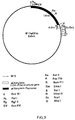
- SwARS2 is localised in the Schwanniomyces genome in the 3′ region of the glucoamylase gene, as shown for example in Fig. 10.
- SwARS2 is easy to identify and efficiently allows autonomous replication of any plasmid, exhibiting this sequence.
- the so far known Schwanniomyces autonomously replicating sequences, SwARS1 and SwARS2 are comprised on a ClaI-BamHI fragment (SwARS1) adjacent to the EcoRI-fragment shown in Fig 2a (see Fig. 10) and/or an EcoRI-BglII fragment contained in the EcoRI fragment shown in Fig 2a (SwARS2).
- the yeast cell according to the present invention comprises a DNA sequence, which is homologous to genomic Schwanniomyces DNA. Provision of structures of homologous DNA enable the DNA fragment flanked by such homologous sequences to be inserted by homologous recombination. It is thus preferred to have homologous sequences, which do not represent any essential gene of the Schwanniomyces genomic DNA, but rather any gene, whose expression product may be supplemented by additives to the respective medium or were lack of the respective expression product does not have any serious impact on the transformed yeast cell.
- the expression cassette can be used without an autonomously replicating agent.
- the expression cassette tends to integrate into the genome, for example via homologous recombination.
- yeast cell according to the present invention is derived from a yeast of the genus Schwanniomyces the polypeptide products observed following expression of the respective foreign gene in said yeast cells exhibit glycosylation patterns, which closely resemble or even match those of the desired eucaryotic protein. Yeast cells of the genus Schwanniomyces are thus preferred for expression of eucaryotic proteins.
- the above discussed yeast cell according to the present invention can be used in a process for the production of a polypeptide, wherein a yeast host organism is cultivated under suitable conditions and the polypeptide is recovered in a manner known per se .
- the conditions of cultivation depend on the respective host organism used. Examples for cultivation conditions for yeast of the genus Schwanniomyces are provided in the examples below.
- the polypeptide, produced by the yeast according to the present invention is recovered by conventional purification methods, which depend on the properties of the expressed protein, the availability of specific absorbing agents and so on.
- yeast cells of the species Schwanniomyces occidentalis are used as a host organism and are cultivated on starch,dextrin, maltose and/or plant biomass as the respective carbon source. As commonly known, these carbon sources are available at low costs.
- the polypeptide produced in a process according to the present invention is an amylolytic enzyme, for example an ⁇ -amylase or glucoamylase.
- amylolytic enzymes for example an ⁇ -amylase or glucoamylase.
- These enzymes are commercially used to debranch and degrade starch, which thereupon may be further processed, for example in brewery or baking processes. There is a high need for the provision of starch degrading enzymes.
- production of a polypeptide may be achieved by providing expression cassettes as discussed above containing a yeast ⁇ -amylase or glucoamylase signal sequence and inserting the respective expression cassette into a yeast of one of the genera Saccharomyces , Kluyveromyces , Hansenula , Pichia or Schizosaccharomyces .
- Production and secretion of foreign proteins in the respective yeast host organism is obtained by applying the appropriate inductive measure, whereupon the produced protein is secreted due to the presence of the yeast ⁇ -amylase or glucoamylase signal sequence.
- the ⁇ -amylase or glucoamylase signal sequences may be applied in many different yeast with success. Also in this case, it is preferred, to use the ⁇ -amylase or glucoamylase signal sequences derived from the respective genes of Schwanniomyces occidentalis.
- yeast cells according to the present invention are well suited for transformation and expression of any desired foreign gene .
- expression of procaryotic as well as eucaryotic genes is possible.
- yeast cells of the genus Schwanniomyces containing some or all of the DNA sequences mentioned above are the most preferred yeast cells.
- the N-termini of the deduced amino acid sequences of the ⁇ -amylase gene (Fig.1B) and glucoamylase gene (Fig.2B) exhibit the features of typical leader sequences of secretory proteins (Von Heijne 1983, Perlman and Halvorsson 1983).
- the N-terminal amino acids of mature ⁇ -amylase secreted by S. occidentalis are determined to be AspValser. This indicates processing between Arg33 and Asp31 which is unusual and not according to the Von Heijnes model of site specificity for signal peptidase cleavage. This putative cleavage site was confirmed also for ⁇ -amylase expressed in S. cerevisiae , Pichia stipidis , K. lactis , S. pombe and H. polymorpha . However, in these yeast species processing is also found to occur between Ala 25 and Gln 26, resulting in the N-terminal sequence GlnProIle.
- ⁇ -amylase isolated from a culture of S. occidentalis migrates as a single band of 55 kDa on SDS polyacrylamide gels: following Endoglucosidase H treatment and subsequent gel electrophoreses a single band of 54 kDa is observed, indicating that only one of the two potential N-glycosylation sites of the protein is used for glycosylation. It is noteworthy that high mannose glycosylation, as very often found by proteins secreted in S. cerevisiae is not accompanying secretion in S. occidentalis .
- the transcription initiation site of the ⁇ -amylase gene could be localised to be in the region of -42 to -30 (indicated by an interrupted line above the relevant sequence in Fig.1B) and the transcription initiation site of the glucoamylase gene was determined to be in the region -7 to -10 (underlined in Fig.28).
- both the ⁇ -amylase promoter and the structural glucoamylase gene can be isolated from plasmid M13 ⁇ Xho and pMaGAM-B/S as suitable DNA fragments.
- the GAM gene was isolated from pMaGam B/S as a 3.2 kb SalI fragment and ligated into the Xhoi site of M13 ⁇ ho.
- the BglII fragment harbouring the ⁇ -amylase promoter/GAM gene fusion was ligated into the single BamHI site of the S. cerevisiae vector YRp7 (Struhl et al., 1979) resulting in plasmid YRp7 ⁇ GAM (Fig 5).
- Expression of the ⁇ -amylase and glucoamylase gene and secretion of the gene products can be detected in K.lactis under control of the promoter of the ⁇ -galactosidase (LAC4) gene (Breunig et al., 1984). Expression of the ⁇ -amylase and glucoamylase gene and secretion of the both proteins can also be detected in S. pombe under control of the ADH1 promoter (Russel et al., 1983) or of the GAL1/10 promoters (Johnston and Davis 1984).
- LAC4 ⁇ -galactosidase
- DHAS promoter Janowicz et al., 1985
- MOX promoter Ledeboer et al., 1985
- FMDH promoter EP 87 110 417.0 expression of the ⁇ -amylase and glucoamylase gene and secretion of both proteins can be detected in Hansenula polymorpha .
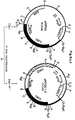
- Plasmids were constructed containing a replicon from S. occidentalis (SwARS1) (EP 87110370.1) the TRP5 gene from S. cerevisiae (Zalkin and Yanowski,1982) as a selective marker and, in addition, a GAM/celD gene fusion under the control of different promoters.
- SwARS1 S. occidentalis
- the TRP5 gene from S. cerevisiae (Zalkin and Yanowski,1982)
- GAM/celD gene fusion under the control of different promoters.
- the 4.0 kb EcoRI-PvuII fragment from plasmid pBRSwARSGAM (Fig. 6a) was isolated and inserted into the 2296 bp pBR322 EcoRI-PvuII fragment, containing the amp gene and the bacterial origin, resulting in plasmid pBRPGAM (Fig.6a).
- this plasmid carries 3.6 kb from the 5′ non coding region of the GAM gene and the first 208 bp coding for the N-terminal part (including the signal sequence) of the glucoamylase.
- CMCase Carboxymethylcellulase activity
- Both plasmids share an in frame fusion of GAM/celD but differ in the length of the 5′ upstream region of the GAM gene.
- S. occidentalis strain NGA58 isolated after UV mutagenesis of strain NGA23 was transformed with these plasmids and transformants selected for tryptophan prototrophy and analyzed by means of congo red assay for cellulase activity. Transformants produced active EGD when grown under inducing conditions in 2% maltose (Fig 7a). By analysis with the congo red assay no activity could be detected under repressed conditions in 4% glucose (Fig. 7b).
- NGA58:pMPGC1-1 and NGA58:pMPGC1-2 transformants secrete active EGD into the culture supernatant when grown in maltose under induced conditions.
- the intact or complete glucoamylase promoter resides on plasmid pMPGC1-2 as shown by 20 times higher activity compared to the shorter promoter fragment in gene fusion of pMPGC1-1 (table 1).
- the 0.3 kb promoter fragment still harbours regulatory units which lead to catabolite repression by glucose (Fig.7b).
- the ADH1 promoter (Hitzeman et al., 1981) was isolated as a 1.45 kb BamHI-SalI fragment from plasmid pFM2-1 (Müller et al., 1987) and ligated into plasmid pCJD5-1 (EP 87 110370.1) after cleavage with BamHI and SalI resulting in pMPADH1 (Fig.8a).
- the GAM gene was excised as a SalI fragment from pJDcg-15 (see below) and inserted into the single SalI site of pMPADH1 (Fig. 8b) resulting in plasmid pMPAG (Fig. 8b).
- pMPPG was cleaved with ClaI and used together with BamHI linearized pMPGC1-2 for transformation of NGA58.
- Homologous recombination results in plasmid pMPPGC (Fig. 9b) harbouring a GAM-celD fusion under control of the PDC promoter.
- This construction leads to an expression in Schwanniomyces occidentalis NGA58 inducible by glucose and partly repressable by maltose (Table 1).
- Transformants were analysed for expression of active EGD using the qualitative congo red assay (Fig. 7).
- plasmids can be constructed by in vivo recombination is a proof for homologous recombination and hence offers the possibility for stable site directed integration into the genome of S. occidentalis , a prerequisite for the industrial production of foreign proteins.
- PGK phosphoglycerate kinase
- GPDH glyceraldehyde-3-phosphate dehydrogenase
- CUP1 copperchelatin
- ADR2 or ADH2 alcoholdehydrogenase 2
- the GAM gene was isolated as a 3.2 kb BamHI-SalI DNA fragment from plasmid pMaGAM B/S (Fig.4) and inserted into the respective restriction sites of plasmid pBM272 Johnston & Davis, 1984).
- the PDC promoter was isolated from plasmid pCP202 (Kellermann & Hollenberg, 1988) as a SalI-SphI fragment and ligated into the respective single sites of vector YRp7 (Struhl et al., 1979).
- the 3.2 kb SalI fragment of PMaGAM B/S containing the GAM gene was fused to the PDC promoter via the single SalI site.
- the resulting BamHI fragment containing the PDC-promoter was ligated into the single BamHI site of pBM272 containing the GAM gene.
- the final plasmid is called pJDcg-15 (Fig. 8b).
- hGM-CSF human et al., 1985
- the gene coding for hGM-CSF was obtained from British Biotechnology Ltd. as a HindIII-EcoRI fragment.
- Position +52 of hGM-CSF gene was fused to position + 102 of the GAM signal sequence under control of the ADH1 or GAM promoter. This fusion results in a hybrid protein in which the endopeptidase cleavage site of the GAM signal sequence is linked with a Met included in the synthetic gene offered by British Biotechnology Ltd., followed by the first amino acid of mature hGM-CSF (Ala 18).
- This fusion was inserted into a S. occidentalis expression vector and transformed into NGA58, Western blot analysis revealed secretion of hGM-CSF protein.
- the gene coding for IL-2 (Taniguchi et al., 1983) was obtained from British Biotechnology Ltd., as a EcoRI-HindIII fragment. Position +61 of IL-2 gene was fused to position + 102 of the GAM signal sequence under control of the ADH1 or GAM promoter. This fusion results in a hybrid protein in which the endopeptidase cleavage site of the GAM signal sequence is linked with a Met included in the synthetic gene offered by British Biotechnology Ltd., followed by the first amino acid of mature IL-2 (Ala 21). This fusion was inserted into a S. occidentalis expression vector and transformed into NGA58. Western blot analysis revealed secretion of IL-2 protein.
- SwARS2 SwARS2
- Trps gene Trps gene
- SwARS2 pBR322
- pMPTS2-A pMPTS2-B
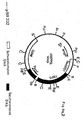
- pMPTS2-A and pMPTS2-B For the construction of pMPTS2-A and pMPTS2-B the 5.5 kb BamHI - BgII fragment of pBRSwARSGAM, constructed by insertion of the EcoRI-fragment shown in Fig.2a into the single EcoRI site of plasmid pBRSwARS1, (disclosed in EP 87 110370.1), was isolated and ligated with 3.2 kb BamHI TRP5 fragment obtained from YRpJD2. High frequency transformation of S. occidentalis is obtained using this plasmid.
- LEU2 gene of S. occidentalis was isolated.
- the LEU2 gene was found to reside on a 9 kb EcoRI fragment of Schwanniomyces genomic DNA; it's function could be abolished by insertion of the TRP5 gene of S. cerevisiae .
- the disrupted LEU2 gene was integrated into the genome of NGA58 by homologous recombination resulting in a new strain NGA581 (TRP5, LEU2, and ADE).
- T7 RNA polymerase (Fuerst et al., 1986) can be expressed in S. occidentalis after fusion of the structural gene (Dunn and Studier, 1984) using the BamHI restriction site near the translation initation codon with suitable promoters as ⁇ -amylase, GAM (0.3 kb fragment) or PDC and homologous integration into the genome via any homologous cloned gene, e.g. HIS4, LEU2, AMY1 and GAM.
- a suitable fragment, containing the fusion flanked by homologous cloned sequences can be isolated and used together with pCJD5-1 (Fig. 6c) for co-transformation of NGA58, selecting on YNB containing 0.5% casaminoacids.
- Colonies containing the integrated T7 RNA polymerase gene can be identified by Southern analysis after isolation of transformants mutated in the target gene.
- a S.occidentalis expression vector was constructed containing SwARS2, the ColE replication origin of E.coli , a suitable selective marker for S. occidentalis (e.g. TRPS, HIS4, LEU2) and a cassette containing the T7 polymerase promoter and terminator sequences isolated from plasmid pAR2529 (Fuerst et al., 1986), separated by the polylinker sequence from M13mp19.
- a suitable selective marker for S. occidentalis e.g. TRPS, HIS4, LEU2
- T7 polymerase promoter and terminator sequences isolated from plasmid pAR2529 (Fuerst et al., 1986), separated by the polylinker sequence from M13mp19.
- GAM/celD fusion GAM signal sequence and structural celD gene obtained as a BamHI-Asp 718 fragment from pMPGC1-2
- microorganisms used are as follows :
- the Escherichia coli strain used is as follows E. coli HB101 F-. hsd S20 (r B - m B -), recA13 , ara-14 , proA2 , lacY1 , galK2 , rpsL20 (Sm r ), xyl-5 , mtl-1 , supE44)
- Schwanniomyces occidentalis strain NGA58 isolated by UV mutagenesis of strain NGA23 was grown at 30°C in YNB (0.67% yeast nitrogen base without amino acids) supplemented with appropriate amino acids and with 2% of soluble starch when indicated.
- S. cerevisiae strain YNN27 URA3-52 , TRP1-289 , GAL2 ) (Stinchomb et al 1980); K. lactis strain SD11 TRP1 (Das and Hollenberg, 1982); S. pombe strains LEU1-32, HIS5-303 (obtained from W.D. Heyer): These strains were grown under conditions as described above for Schwanniomyces occidentalis with the replacement of 2% soluble starch by 2% glucose, where indicated.
- the culture media for S. occidentalis and Hansenula polymorpha were buffered with 0.2 M NaP0 4 buffer pH 6.2; those for S. cerevisiae and K. lactis were buffered with 0.1 M citrate buffer pH 6 and those for S. pombe with 0.05 M acetate buffer pH 6.
- E. coli HB101 (Bolivar et al., 1977) was grown in LB medium (Maniatis et al., 1982) with penicillin G (150 ug/ml).
- Plasmid DNA was purified either by CsCl gradient centrifugation (Maniatis et al., 1982) or by rapid alkaline extraction of plasmid DNA described by Birnboim and Doly (1979).
- Yeast crude extracts were prepared by the method of Schatz (1979).
- Yeast minilysates were prepared by the method of Sherman et al., (1983).
- DNA fragments were isolated by the "low melting agarose” procedure as described by Gafner et al., (1983). Southern hybridization was carried out as described by Southern (1975).
- Yeast transformation was performed according to Klebe et al. (1983) or Ito et al. (1983).
- the transformants or integrants were tested for expression and secretion of cellulase using either the qualitative congo red assay (Teather and Wood, 1982: halo formation on carboxymethylcellulose agar plates) or a quantitative cellulase assay according to Joliff et al. (1986a).
- One unit (U) is defined as the amount of enzyme that released 1 umol para-nitrophenol per min at 60°C.
- Western analysis was performed as described by Towbin et al. (1979).
- the transformants or integrants were tested for expression and secretion of ⁇ -amylase using either a standardized ⁇ -amylase enzyme test from Merck, W. Germany or a qualitative starch degradation test (halo formation on starch agar plates after staining with iodine), as follows : in this test the rate of formation of 2-chloro-4-nitrophenol is determined by photometry at 405 nm in 0.1 M potassium phosphate at 37°C.
- the enzyme unit (U) is defined as the amount of enzyme catalysing the formation of 1 umol 2-chloro-4-nitrophenol per min at 37°C.
- Glucoamylase activity was measured by a stop assay method: After incubation of the sample in 10% soluble starch in 0.05M KH 2 PO 4 -NaOH (pH 5.0) at 50°C the amount of glucose produced is determined by the glucose dehydrogenase method (system glucose Merck). The quantity of NADH formed is proportional to the glucose concentration.
- the enzyme unit (U) is defined as the amount of enzyme catalysing the formation of 1 umol glucose/min at 50°C.
Landscapes
- Life Sciences & Earth Sciences (AREA)
- Health & Medical Sciences (AREA)
- Genetics & Genomics (AREA)
- Engineering & Computer Science (AREA)
- Bioinformatics & Cheminformatics (AREA)
- Wood Science & Technology (AREA)
- Biomedical Technology (AREA)
- Organic Chemistry (AREA)
- Biotechnology (AREA)
- General Engineering & Computer Science (AREA)
- Chemical & Material Sciences (AREA)
- Zoology (AREA)
- Mycology (AREA)
- Microbiology (AREA)
- Physics & Mathematics (AREA)
- Plant Pathology (AREA)
- Molecular Biology (AREA)
- Biochemistry (AREA)
- General Health & Medical Sciences (AREA)
- Biophysics (AREA)
- Micro-Organisms Or Cultivation Processes Thereof (AREA)
- Preparation Of Compounds By Using Micro-Organisms (AREA)
- Enzymes And Modification Thereof (AREA)
- Peptides Or Proteins (AREA)
Claims (27)
- Verfahren zum Herstellen einer Hefezelle, die Fremdprotein exprimieren kann, dadurch gekennzeichnet, daß mindestens eine Expressionskassette in eine Hefezelle der Gattung Schwanniomyces insertiert wird, wobei die Expressionskassette umfaßt:a) eine erste DNA-Sequenz, die als Regulon dient,b) gegebenenfalls eine zweite DNA-Sequenz, die für ein Signalpeptid kodiert,c) eine dritte DNA-Sequenz, die für ein Fremdprotein kodiert, undd) gegebenenfalls eine vierte DNA-Sequenz, die als Terminator dient,wobei die erste, zweite und vierte DNA-Sequenz von Hefe abgeleitet sind.
- Verfahren nach Anspruch 1, dadurch gekennzeichnet, daß die erste und/oder zweite und/oder vierte DNA-Sequenz von einem für ein amylolytisches Enzym kodierenden Gen abgeleitet sind.
- Verfahren nach Anspruch 2, dadurch gekennzeichnet, daß das amylolytische Enzym eine α-Amylase oder Glucoamylase ist.
- Verfahren nach einem der Ansprüche 1 bis 3, dadurch gekennzeichnet, daß die ersten und/oder zweiten und/oder vierten DNA-Sequenzen von einer Hefe eines Angehörigen der Gattungen Debariomyces, Saccharomycopses, Lipomyces, Pichia oder Saccharomyces, bevorzugt Schwanniomyces, abgeleitet sind.
- Verfahren nach Anspruch 4, dadurch gekennzeichnet, daß die Hefe Schwanniomyces occidentalis ist.
- Verfahren nach einem der Ansprüche 1 bis 5, dadurch gekennzeichnet, daß die erste DNA-Sequenz von einem 1,8 kb BglII-XhoI-Fragment umfaßt ist, wenn sie vom Schwanniomyces occidentalis-α-Amylasegen abgeleitet ist, oder von einem 1,3 kb BamHI-PvuII-Fragment umfaßt ist, wenn sie vom Schwanniomyces occidentalis-Glucoamylasegen abgeleitet ist.
- Verfahren nach Anspruch 5, dadurch gekennzeichnet, daß die erste DNA-Sequenz von einem Teil oder der Gesamtheit der DNA-Sequenz umfaßt ist, die den Basen -1 bis -540 des Bereiches entspricht, der dem für α-Amylase kodierenden Strukturgen vorangeht, oder einem Teil oder der Gesamtheit der DNA-Sequenz, die den Basen -1 bis -320 des Bereichs entspricht, der dem für Glucoamylase kodierenden Strukturgen vorangeht.
- Verfahren nach einem der Ansprüche 1 bis 5, dadurch gekennzeichnet, daß die erste DNA-Sequenz einem der Regulons entspricht, die die Expression regulieren vona) ADH1, ADH2, PDC1, GAL1/10, PGK, GAPDH, wobei das Regulon bevorzugt von Saccharomyces cerevisiae erhalten ist,b) LAC4, wobei das Regulon bevorzugt von Klyveromyces lactis erhalten ist, oderc) korrespondierenden Regulons, bevorzugt von Schwanniomyces erhalten.
- Verfahren nach einem der Ansprüche 1 bis 8, dadurch gekennzeichnet, daß die zweite DNA-Sequenz für die Gesamtheit oder einen Teil mindestens eines der folgenden Peptide kodiert:


- Verfahren nach Anspruch 9, dadurch gekennzeichnet, daß die für das Peptid kodierende DNA-Sequenz einem Teil oder der Gesamtheit einer der folgenden DNA-Sequenzen entspricht:




- Verfahren nach einem der Ansprüche 1 bis 10, dadurch gekennzeichnet, daß die dritte DNA-Sequenz, die für ein Fremdprotein kodiert, eine natürliche oder synthetische DNA-Sequenz ist, die für eine Zellulase, Interleukin, insulinähnlichen Wachstumsfaktor, Interferon, Lymphokin, menschlichen Wachstumsfaktor, Nervenwachstumsfaktor, Aprotinin, Insulin, Hirudin, Hormone, Blutgerinnungsfaktoren, Hepatitis-B-Oberflächen- oder -Kernantigene, virale oder bakterielle Impfstoffe oder humanen Granulocyten/Makrophagen-Kolonie-stimulierenden Faktor kodiert.
- Verfahren nach einem der Ansprüche 1 bis 11, dadurch gekennzeichnet, daß die vierte DNA-Sequenz von einer Hefe eines Angehörigen der Gattungen Saccharomyces, Pichia, Hansenula, bevorzugt Schwanniomyces, stammt.
- Verfahren nach Anspruch 12, dadurch gekennzeichnet, daß die vierte DNA-Sequenz einem Teil oder der Gesamtheit des Terminators entspricht, der von den Nukleotiden 1537 bis 1740 des Schwanniomyces-α-Amylasegenes umfaßt ist, oder einem Teil oder der Gesamtheit des Terminators, der von den Nukleotiden 2875 bis 3320 des Schwanniomyces-Glucoamylasegenes umfaßt ist.
- Verfahren nach einem der Ansprüche 1 bis 13, dadurch gekennzeichnet, daß die erste und/oder zweite und/oder dritte und/oder vierte DNA-Sequenz durch Insertion oder Deletion oder Substitution eines oder mehrerer Nukleotide modifiziert worden ist, während die biologische Aktivität der DNA-Sequenz beibehalten oder verbessert wird.
- Verfahren nach einem der Ansprüche 1 bis 14, dadurch gekennzeichnet, daß die Expressionskassette von einem zirkulären oder linearen Vektor getragen wird, der gegebenenfalls ein oder mehrere selektive Markergene umfaßt.
- Verfahren nach Anspruch 15, dadurch gekennzeichnet, daß der Vektor eines der folgenden selektiven Markergene umfaßt:
TRP5, LEU2, ADE1, ADE2, HIS3, HIS4, URA3, LYS2, bevorzugt erhalten von Saccharomyces, Hansenula, Pichia oder Schwanniomyces, AMY1 oder GAM1, bevorzugt erhalten von Schwanniomyces. - Verfahren nach einem der Ansprüche 15 und 16, dadurch gekennzeichnet, daß der Vektor weiter eine DNA-Sequenz umfaßt, die die autonome Replikation und stabile Beibehaltung des Vektors in dem Wirtsorganismus steuern kann.
- Verfahren nach Anspruch 17, dadurch gekennzeichnet, daß die DNA-Sequenz von dem Genom eines Angehörigen der Gattungen Saccharomyces, Pichia, Hansenula oder Kluyveromyces abgeleitet ist, bevorzugt Schwanniomyces.
- Verfahren nach einem der Ansprüche 17 oder 18, dadurch gekennzeichnet, daß die DNA-Sequenz aus den autonom replizierenden Sequenzen ARS, bevorzugt einer ARS, die von dem jeweiligen Wirtsorganismus abgeleitet ist, ausgewählt wird.
- Verfahren nach Anspruch 19, dadurch gekennzeichnet, daß die DNA-Sequenz SwARS1 oder SwARS2 ist, die die autonome Replikation und stabile Beibehaltung des Vektors in Schwanniomyces steuern können, wobei SwARS1 von einem ClaI-BamHI-Fragment umfaßt ist, das dem in Figur 2a gezeigten EcoRI-Fragment benachbart ist, und SwARS2 von einem EcoRI-BglII-Fragment umfaßt ist, das in dem in Figur 2a gezeigten EcoRI-Fragment enthalten ist.
- Verfahren nach einem der Ansprüche 17 bis 20, dadurch gekennzeichnet, daß die DNA-Sequenz durch Deletion, Insertion oder Substitution eines oder mehrerer Nukleotide modifiziert worden ist, während ihre biologische Funktion beibehalten oder verbessert wird.
- Verfahren nach einem der Ansprüche 1 bis 21, dadurch gekennzeichnet, daß die Expressionskassette in das Genom integriert ist, gegebenenfalls in mehrfachen Kopien, bevorzugt über homologe Rekombination.
- Verfahren zum Erzeugen eines Polypeptides, wobei ein Hefewirtsorganismus unter geeigneten Bedingungen kultiviert und das Polypeptid in an sich bekannter Weise gewonnen wird, dadurch gekennzeichnet, daß der Hefewirtsorganismus eine Hefezelle gemäß einem der Ansprüche 1 bis 22 ist.
- Verfahren nach Anspruch 23, dadurch gekennzeichnet, daß Hefezellen der Art Schwanniomyces occidentalis als ein Wirtsorganismus verwendet werden und bevorzugt auf Stärke, Dextrin, Maltose und/oder Pflanzenbiomasse kultiviert werden.
- Verfahren nach einem der Ansprüche 23 oder 24, dadurch gekennzeichnet, daß Hefezellen der Gattung Schwanniomyces für die Erzeugung von Einzelzellprotein verwendet werden.
- Verfahren nach einem der Ansprüche 23 bis 25, dadurch gekennzeichnet, daß das Polypeptid Amylase oder Glycoamylase ist.
- Verwendung einer Hefezelle gemäß einem der Ansprüche 1 bis 22 zur Transformation und Expression von Fremdgenen.
Priority Applications (9)
| Application Number | Priority Date | Filing Date | Title |
|---|---|---|---|
| EP89107780A EP0394538B1 (de) | 1989-04-28 | 1989-04-28 | Hefezellen der Gattung-Schwanniomyces |
| DE198989107780T DE394538T1 (de) | 1989-04-28 | 1989-04-28 | Hefezellen der schwanniomyces-gattung. |
| ES89107780T ES2038579T3 (es) | 1989-04-28 | 1989-04-28 | Celulas de levadura del genero schwanniomyces. |
| DE68927344T DE68927344T2 (de) | 1989-04-28 | 1989-04-28 | Hefezellen der Gattung-Schwanniomyces |
| AT89107780T ATE144281T1 (de) | 1989-04-28 | 1989-04-28 | Hefezellen der gattung-schwanniomyces |
| CA002015077A CA2015077C (en) | 1989-04-28 | 1990-04-20 | A yeast cell of the genus schwanniomyces |
| JP2114966A JPH03143385A (ja) | 1989-04-28 | 1990-04-27 | 酵母細胞 |
| GR91300058T GR910300058T1 (en) | 1989-04-28 | 1991-11-15 | A yeast cell of the genus schwanniomyces |
| GR960403559T GR3022124T3 (en) | 1989-04-28 | 1996-12-20 | A yeast cell of the genus schwanniomyces |
Applications Claiming Priority (1)
| Application Number | Priority Date | Filing Date | Title |
|---|---|---|---|
| EP89107780A EP0394538B1 (de) | 1989-04-28 | 1989-04-28 | Hefezellen der Gattung-Schwanniomyces |
Publications (2)
| Publication Number | Publication Date |
|---|---|
| EP0394538A1 EP0394538A1 (de) | 1990-10-31 |
| EP0394538B1 true EP0394538B1 (de) | 1996-10-16 |
Family
ID=8201308
Family Applications (1)
| Application Number | Title | Priority Date | Filing Date |
|---|---|---|---|
| EP89107780A Expired - Lifetime EP0394538B1 (de) | 1989-04-28 | 1989-04-28 | Hefezellen der Gattung-Schwanniomyces |
Country Status (7)
| Country | Link |
|---|---|
| EP (1) | EP0394538B1 (de) |
| JP (1) | JPH03143385A (de) |
| AT (1) | ATE144281T1 (de) |
| CA (1) | CA2015077C (de) |
| DE (2) | DE68927344T2 (de) |
| ES (1) | ES2038579T3 (de) |
| GR (2) | GR910300058T1 (de) |
Cited By (2)
| Publication number | Priority date | Publication date | Assignee | Title |
|---|---|---|---|---|
| US7575893B2 (en) | 2003-01-23 | 2009-08-18 | Genentech, Inc. | Methods for producing humanized antibodies and improving yield of antibodies or antigen binding fragments in cell culture |
| US7705195B2 (en) | 2002-06-07 | 2010-04-27 | Genentech, Inc. | Screening method |
Families Citing this family (100)
| Publication number | Priority date | Publication date | Assignee | Title |
|---|---|---|---|---|
| ATE155816T1 (de) | 1992-06-03 | 1997-08-15 | Genentech Inc | Varianten des gewebeplasminogenaktivators mit verbesserter therapeutischer wirkung |
| ES2202469T5 (es) | 1995-09-08 | 2011-06-06 | Genentech, Inc. | Proteína relacionada con el vegf. |
| AU721129B2 (en) | 1996-01-08 | 2000-06-22 | Genentech Inc. | WSX receptor and ligands |
| US5851984A (en) * | 1996-08-16 | 1998-12-22 | Genentech, Inc. | Method of enhancing proliferation or differentiation of hematopoietic stem cells using Wnt polypeptides |
| US6159462A (en) * | 1996-08-16 | 2000-12-12 | Genentech, Inc. | Uses of Wnt polypeptides |
| US6265186B1 (en) | 1997-04-11 | 2001-07-24 | Dsm N.V. | Yeast cells comprising at least two copies of a desired gene integrated into the chromosomal genome at more than one non-ribosomal RNA encoding domain, particularly with Kluyveromyces |
| JP2001520885A (ja) | 1997-10-29 | 2001-11-06 | ジェネンテック・インコーポレーテッド | Wnt−1誘導遺伝子 |
| DK1027437T3 (da) | 1997-10-29 | 2008-11-24 | Genentech Inc | Anvendelse af det WNT-1 inducerede udskilte polypeptid WISP-1 |
| NZ525914A (en) | 1998-03-10 | 2004-03-26 | Genentech Inc | Novel polypeptides and nucleic acids encoding the same |
| AU740405B2 (en) | 1998-05-15 | 2001-11-01 | Genentech Inc. | IL-17 homologous polypeptides and therapeutic uses thereof |
| EP1865061A3 (de) | 1998-05-15 | 2007-12-19 | Genentech, Inc. | IL-17-homologe Polypeptide und ihre therapeutische Verwendung |
| EP3112468A1 (de) | 1998-05-15 | 2017-01-04 | Genentech, Inc. | Il-17-homologe polypeptide und therapeutische verwendung davon |
| US20020172678A1 (en) | 2000-06-23 | 2002-11-21 | Napoleone Ferrara | EG-VEGF nucleic acids and polypeptides and methods of use |
| EP2075335A3 (de) | 1998-12-22 | 2009-09-30 | Genentech, Inc. | Verfahren und Zusammensetzungen zur Hemmung des neoplastischen Zellenwachstums |
| DE60043367D1 (de) | 1999-06-15 | 2009-12-31 | Genentech Inc | Sekretierte und Transmembran-Polypeptide sowie Nukleinsäuren zu deren Kodierung |
| CA2491433A1 (en) | 1999-12-01 | 2001-06-07 | Genentech, Inc. | Secreted and transmembrane polypeptides and nucleic acids encoding the same |
| DK1897945T3 (da) | 1999-12-23 | 2012-05-07 | Genentech Inc | IL-17 homologe polypeptider og terapeutiske anvendelser deraf. |
| CA2397207C (en) | 2000-01-13 | 2013-12-03 | Genentech, Inc. | Novel stra6 polypeptides |
| WO2004043361A2 (en) | 2002-11-08 | 2004-05-27 | Genentech, Inc. | Compositions and methods for the treatment of natural killer cell related diseases |
| EP2275549A1 (de) | 2000-06-23 | 2011-01-19 | Genentech, Inc. | Zusammensetzungen und Verfahren zur Diagnose und Behandlung von Erkrankungen in Verbindung mit Angiogenese |
| CA2648046A1 (en) | 2000-06-23 | 2002-01-03 | Genentech, Inc. | Compositions and methods for the diagnosis and treatment of disorders involving angiogenesis |
| ATE412009T1 (de) | 2000-08-24 | 2008-11-15 | Genentech Inc | Methode zur inhibierung von il-22 induziertem pap1 |
| EP1944317A3 (de) | 2000-09-01 | 2008-09-17 | Genentech, Inc. | Sekretierte und Transmembran-Polypeptide sowie Nukleinsäure zu deren Kodierung |
| US6673580B2 (en) | 2000-10-27 | 2004-01-06 | Genentech, Inc. | Identification and modification of immunodominant epitopes in polypeptides |
| US20070160576A1 (en) | 2001-06-05 | 2007-07-12 | Genentech, Inc. | IL-17A/F heterologous polypeptides and therapeutic uses thereof |
| PT2000545E (pt) | 2001-06-20 | 2011-12-21 | Genentech Inc | Composições e métodos para o diagnóstico e tratamento do tumor pulmonar |
| EP2311960A3 (de) | 2001-08-29 | 2011-06-01 | Genentech, Inc. | Bv8-Nukleinsäuren und Polypeptide mit mitogener Aktivität |
| DE60238143D1 (de) | 2001-09-18 | 2010-12-09 | Genentech Inc | Zusammensetzungen und verfahren für die diagnose von tumoren |
| ES2411007T3 (es) | 2001-10-10 | 2013-07-04 | Novo Nordisk A/S | Remodelación y glicoconjugación de péptidos |
| AU2002367318B2 (en) | 2002-01-02 | 2007-07-12 | Genentech, Inc. | Compositions and methods for the diagnosis and treatment of tumor |
| EP1575480A4 (de) | 2002-02-22 | 2008-08-06 | Genentech Inc | Zusammensetzungen und verfahren zur behandlung von immunbedingten erkrankungen |
| JP2005536190A (ja) | 2002-04-16 | 2005-12-02 | ジェネンテック・インコーポレーテッド | 腫瘍の診断と治療のための組成物と方法 |
| EP2305710A3 (de) | 2002-06-03 | 2013-05-29 | Genentech, Inc. | Synthetische Antikörperphagenbibliotheken |
| WO2004004649A2 (en) | 2002-07-08 | 2004-01-15 | Genentech, Inc. | Compositions and methods for the treatment of immune related diseases |
| JP5401001B2 (ja) | 2002-09-11 | 2014-01-29 | ジェネンテック, インコーポレイテッド | 免疫関連疾患の治療のための新規組成物と方法 |
| EP1578373A4 (de) | 2002-09-11 | 2007-10-24 | Genentech Inc | Neue zusammensetzungen und verfahren zur behandlung von erkrankungen des immunsystems |
| AU2003255988A1 (en) * | 2002-09-13 | 2004-04-30 | Edupuganti B. Raju | Yeast protein expression secretion system |
| US20070010434A1 (en) | 2002-09-16 | 2007-01-11 | Genetech, Inc. | Novel compositions and methods for the treatment of immune related diseases |
| CA2499843A1 (en) | 2002-09-25 | 2004-04-08 | Genentech, Inc. | Novel compositions and methods for the treatment of psoriasis |
| EP2322200A3 (de) | 2002-10-29 | 2011-07-27 | Genentech, Inc. | Gestaltungen und Methoden für die Behandlung von immune verwandte Krankheiten |
| JP2011516026A (ja) | 2002-11-26 | 2011-05-26 | ジェネンテック・インコーポレーテッド | 免疫関連疾患の治療のための組成物と方法 |
| JP4912144B2 (ja) | 2003-03-12 | 2012-04-11 | ジェネンテック, インコーポレイテッド | 造血促進のためのbv8及び/又はeg−vegfの使用 |
| MXPA05010555A (es) | 2003-04-04 | 2006-03-09 | Genentech Inc | Formulaciones de proteina y anticuerpo de alta concentracion. |
| PL1615945T3 (pl) | 2003-04-09 | 2012-03-30 | Ratiopharm Gmbh | Sposoby glikopegylacji i białka/peptydy wytwarzane tymi sposobami |
| DK1641823T3 (da) | 2003-06-12 | 2011-12-12 | Lilly Co Eli | GLP-1-analog fusionsproteiner |
| EP2784084B2 (de) | 2003-07-08 | 2023-10-04 | Novartis Pharma AG | Heterologe IL-17A/F-Polypeptide und deren therapeutische Verwendungen |
| WO2005019258A2 (en) | 2003-08-11 | 2005-03-03 | Genentech, Inc. | Compositions and methods for the treatment of immune related diseases |
| DK2295073T3 (da) | 2003-11-17 | 2014-07-28 | Genentech Inc | Antistof mod cd22 til behandling af tumor af hæmatopoietisk oprindelse |
| WO2006132788A2 (en) | 2005-06-06 | 2006-12-14 | Genentech, Inc. | Transgenic models for different genes and their use for gene characterization |
| EP1922410A2 (de) | 2005-08-15 | 2008-05-21 | Genentech, Inc. | Genunterbrechungen, zusammensetzungen und verfahren in verbindung damit |
| EP1962584A2 (de) | 2005-11-21 | 2008-09-03 | Genentech, Inc. | Neuartige genunterbrechung, dazugehörige zusammensetzungen und verfahren |
| EP2050335A1 (de) | 2006-02-17 | 2009-04-22 | Genentech, Inc. | Genunterbrechungen, dazugehörige Zusammensetzungen und Verfahren in Zusammenhang damit |
| RU2008141912A (ru) | 2006-03-23 | 2010-04-27 | Новартис АГ (CH) | Противоопухолевые лекарства на основе антител к клеточным антигенам |
| AU2007243946B2 (en) | 2006-04-05 | 2012-11-29 | Curis, Inc. | Method for using BOC/CDO to modulate hedgehog signaling |
| CA2649387A1 (en) | 2006-04-19 | 2008-03-27 | Genentech, Inc. | Novel gene disruptions, compositions and methods relating thereto |
| WO2007134327A2 (en) | 2006-05-15 | 2007-11-22 | Sea Lane Biotechnologies, Llc. | Neutralizing antibodies to influenza viruses |
| US7759304B2 (en) | 2006-06-21 | 2010-07-20 | Regents Of The University Of Colorado | Targeting complement factor H for treatment of diseases |
| KR20090105913A (ko) | 2006-11-02 | 2009-10-07 | 다니엘 제이 카폰 | 이동 부분을 갖는 하이브리드 면역글로불린 |
| AU2008218199B2 (en) | 2007-02-22 | 2013-10-31 | Genentech, Inc. | Methods for detecting inflammatory bowel disease |
| KR102055873B1 (ko) | 2007-07-09 | 2019-12-13 | 제넨테크, 인크. | 폴리펩티드의 재조합 생산 동안의 디술피드 결합 환원의 방지 |
| EP2176295B1 (de) | 2007-07-16 | 2014-11-19 | Genentech, Inc. | Humanisierte anti-cd79b-antikörper und immunkonjugate und anwendungsverfahren |
| PE20090943A1 (es) | 2007-07-16 | 2009-08-05 | Genentech Inc | Anticuerpos anti-cd79b e inmunoconjugados |
| CN101361968B (zh) | 2007-08-06 | 2011-08-03 | 健能隆医药技术(上海)有限公司 | 白介素-22在治疗脂肪肝中的应用 |
| KR101607346B1 (ko) | 2008-01-31 | 2016-03-29 | 제넨테크, 인크. | 항-cd79b 항체 및 면역접합체 및 사용 방법 |
| JP2011516423A (ja) | 2008-03-28 | 2011-05-26 | シー レーン バイオテクノロジーズ, エルエルシー | ウイルス抗原に対する中和分子 |
| SG10202112838YA (en) | 2008-04-09 | 2021-12-30 | Genentech Inc | Novel compositions and methods for the treatment of immune related diseases |
| US8937046B2 (en) | 2008-09-22 | 2015-01-20 | The Regents Of The University Of Colorado, A Body Corporate | Modulating the alternative complement pathway |
| ES2610356T3 (es) | 2009-02-03 | 2017-04-27 | Amunix Operating Inc. | Polipéptidos recombinantes extendidos y composiciones que comprenden los mismos |
| RU2587621C2 (ru) | 2009-04-01 | 2016-06-20 | Дженентек, Инк. | АНТИТЕЛА К FcRH5, ИХ ИММУНОКОНЪЮГАТЫ И СПОСОБЫ ИХ ПРИМЕНЕНИЯ |
| WO2010144508A1 (en) | 2009-06-08 | 2010-12-16 | Amunix Operating Inc. | Glucose-regulating polypeptides and methods of making and using same |
| KR101813727B1 (ko) | 2009-06-08 | 2018-01-02 | 아뮤닉스 오퍼레이팅 인코포레이티드 | 성장 호르몬 폴리펩타이드 및 이를 제조하고 사용하는 방법 |
| KR101952453B1 (ko) | 2009-10-15 | 2019-02-26 | 제넨테크, 인크. | 수용체 특이성이 변경된 키메라 섬유모세포 성장 인자 |
| JP5819308B2 (ja) | 2009-10-22 | 2015-11-24 | ジェネンテック, インコーポレイテッド | マクロファージ刺激タンパク質のヘプシン活性化を調節するための方法及び組成物 |
| WO2011056494A1 (en) | 2009-10-26 | 2011-05-12 | Genentech, Inc. | Activin receptor-like kinase-1 antagonist and vegfr3 antagonist combinations |
| WO2011056502A1 (en) | 2009-10-26 | 2011-05-12 | Genentech, Inc. | Bone morphogenetic protein receptor type ii compositions and methods of use |
| WO2011056497A1 (en) | 2009-10-26 | 2011-05-12 | Genentech, Inc. | Activin receptor type iib compositions and methods of use |
| US20110110942A1 (en) | 2009-11-12 | 2011-05-12 | Genentech, Inc. | Method of promoting dendritic spine density |
| PH12012500982A1 (en) | 2009-11-30 | 2019-07-10 | Genentech Inc | Antibodies for treating and diagnosing tumors expressing slc34a2 (tat211=seqid2) |
| MA34057B1 (fr) | 2010-02-23 | 2013-03-05 | Genentech Inc | Compositions et methodes pour le diagnostic et le traitement d'une tumeur |
| ES2993140T3 (en) | 2010-04-02 | 2024-12-23 | Amunix Pharmaceuticals Inc | Binding fusion proteins, binding fusion protein-drug conjugates, xten-drug conjugates and methods of making and using same |
| SG185027A1 (en) | 2010-05-03 | 2012-11-29 | Genentech Inc | Compositions and methods for the diagnosis and treatment of tumor |
| BR112012033121B1 (pt) | 2010-06-25 | 2019-08-20 | Institut Pasteur De Lille | Métodos e composições farmacêuticas para o tratamento de infecções do trato respiratório. |
| CN102380091A (zh) | 2010-08-31 | 2012-03-21 | 健能隆医药技术(上海)有限公司 | 白介素-22在治疗病毒性肝炎中的应用 |
| JP2014506115A (ja) | 2010-09-15 | 2014-03-13 | アリグナ テクノロジーズ,インク. | リグニン由来の化合物からの芳香族化学物質のバイオプロダクション |
| EP2640831A1 (de) | 2010-11-17 | 2013-09-25 | Sea Lane Biotechnologies,llc. | Die bindungsstelle eines influenzaneutralisierenden antikörpers nachahmende influenzavirusneutralisierungsmittel |
| PT3611180T (pt) | 2013-03-15 | 2022-03-15 | Biomolecular Holdings Llc | Imunoglobulina híbrida que contém uma ligação não peptídica |
| CN104623637A (zh) | 2013-11-07 | 2015-05-20 | 健能隆医药技术(上海)有限公司 | Il-22二聚体在制备静脉注射药物中的应用 |
| WO2015116902A1 (en) | 2014-01-31 | 2015-08-06 | Genentech, Inc. | G-protein coupled receptors in hedgehog signaling |
| KR102587838B1 (ko) | 2014-03-14 | 2023-10-12 | 바이오몰레큘러 홀딩스 엘엘씨 | 비-펩티드 결합을 함유하는 하이브리드 면역글로불린 |
| US11510966B2 (en) | 2016-04-15 | 2022-11-29 | Evive Biotechnology (Shanghai) Ltd | Use of IL-22 in treating necrotizing enterocolitis |
| US11007254B2 (en) | 2016-10-17 | 2021-05-18 | Musc Foundation For Research Development | Compositions and methods for treating central nervous system injury |
| WO2018152496A1 (en) | 2017-02-17 | 2018-08-23 | The Usa, As Represented By The Secretary, Dept. Of Health And Human Services | Compositions and methods for the diagnosis and treatment of zika virus infection |
| EP3615569A1 (de) | 2017-04-25 | 2020-03-04 | The U.S.A. As Represented By The Secretary, Department Of Health And Human Services | Antikörper und verfahren zur diagnose und behandlung von epstein-barr-virus-infektionen |
| WO2019018629A1 (en) | 2017-07-19 | 2019-01-24 | The Usa, As Represented By The Secretary, Dept. Of Health And Human Services | ANTIBODIES AND METHODS FOR DIAGNOSING AND TREATING INFECTION WITH HEPATITIS B VIRUS |
| CN107653261A (zh) * | 2017-10-19 | 2018-02-02 | 昆明理工大学 | 利用啤酒酵母MF‑α介导重组蛋白分泌的植物表达载体 |
| US11339221B2 (en) | 2017-11-01 | 2022-05-24 | Tufts Medical Center, Inc. | Bispecific antibody constructs and methods of use |
| WO2019213416A1 (en) | 2018-05-02 | 2019-11-07 | The Usa, As Represented By The Secretary, Dept. Of Health And Human Services | Antibodies and methods for the diagnosis, prevention, and treatment of epstein barr virus infection |
| EP4106794A4 (de) | 2020-02-19 | 2024-03-20 | Evive Biotechnology (Shanghai) Ltd | Verfahren zum behandeln der transplant-und-wirts-krankheit |
| WO2021211493A1 (en) | 2020-04-15 | 2021-10-21 | Genentech, Inc. | Copper loss mitigation |
| EP4577578A1 (de) | 2022-08-22 | 2025-07-02 | Abdera Therapeutics Inc. | Dll3-bindende moleküle und verwendungen davon |
Family Cites Families (3)
| Publication number | Priority date | Publication date | Assignee | Title |
|---|---|---|---|---|
| IL82935A0 (en) * | 1986-08-12 | 1987-12-20 | Phillips Petroleum Co | Secretion of heterologous proteins from yeast |
| EP0257115A1 (de) * | 1986-08-21 | 1988-03-02 | Heineken Technisch Beheer B.V. | Durch rekombinante DNS-Technologie konstruierte amylolytische enzymproduzierende Mikroorganismen und ihre Verwendung in Gärungsverfahren |
| EP0260404B1 (de) * | 1986-08-21 | 1995-05-31 | VAN DEN BERG, Robert | Durch rekombinante DNS-Technologie konstruierte amylolytische enzymproduzierende Mikroorganismen und ihre Verwendung in Gärungsverfahren |
-
1989
- 1989-04-28 ES ES89107780T patent/ES2038579T3/es not_active Expired - Lifetime
- 1989-04-28 EP EP89107780A patent/EP0394538B1/de not_active Expired - Lifetime
- 1989-04-28 DE DE68927344T patent/DE68927344T2/de not_active Expired - Fee Related
- 1989-04-28 AT AT89107780T patent/ATE144281T1/de not_active IP Right Cessation
- 1989-04-28 DE DE198989107780T patent/DE394538T1/de active Pending
-
1990
- 1990-04-20 CA CA002015077A patent/CA2015077C/en not_active Expired - Fee Related
- 1990-04-27 JP JP2114966A patent/JPH03143385A/ja active Pending
-
1991
- 1991-11-15 GR GR91300058T patent/GR910300058T1/el unknown
-
1996
- 1996-12-20 GR GR960403559T patent/GR3022124T3/el unknown
Cited By (2)
| Publication number | Priority date | Publication date | Assignee | Title |
|---|---|---|---|---|
| US7705195B2 (en) | 2002-06-07 | 2010-04-27 | Genentech, Inc. | Screening method |
| US7575893B2 (en) | 2003-01-23 | 2009-08-18 | Genentech, Inc. | Methods for producing humanized antibodies and improving yield of antibodies or antigen binding fragments in cell culture |
Also Published As
| Publication number | Publication date |
|---|---|
| DE394538T1 (de) | 1991-04-11 |
| ES2038579T3 (es) | 1997-02-16 |
| GR3022124T3 (en) | 1997-03-31 |
| GR910300058T1 (en) | 1991-11-15 |
| CA2015077C (en) | 2000-07-25 |
| DE68927344D1 (de) | 1996-11-21 |
| ES2038579T1 (es) | 1993-08-01 |
| EP0394538A1 (de) | 1990-10-31 |
| JPH03143385A (ja) | 1991-06-18 |
| ATE144281T1 (de) | 1996-11-15 |
| DE68927344T2 (de) | 1997-02-20 |
| CA2015077A1 (en) | 1990-10-28 |
Similar Documents
| Publication | Publication Date | Title |
|---|---|---|
| EP0394538B1 (de) | Hefezellen der Gattung-Schwanniomyces | |
| CA1340547C (en) | Novel secretory leader sequences for yeasts | |
| JP3437850B2 (ja) | ピキア・パストリスの酸ホスファターゼ遺伝子 | |
| KR970007024B1 (ko) | 숙주 균주로서의 클루이베로마이세스 | |
| Gatignol et al. | Cloning of Saccharomyces cerevisiae promoters using a probe vector based on phleomycin resistance | |
| WO1987002670A1 (en) | Method of using bar1 for secreting foreign proteins | |
| JPH04117291A (ja) | ヘテロDNA配列およびその配列を用いた工業用酵母ヤロウイア属(Yarrowia)の形質転換 | |
| Lang et al. | Efficient expression and secretion of Aspergillus niger RH5344 polygalacturonase in Saccharomyces cerevisiae | |
| Strasser et al. | Analysis of the α‐amylase gene of Schwanniomyces occidentalis and the secretion of its gene product in transformants of different yeast genera | |
| WO1988002779A1 (en) | Composite yeast vectors | |
| US5627046A (en) | Yeast promoter and its use | |
| JP3009679B2 (ja) | ペクチンリアーゼ発現系 | |
| EP0220689B1 (de) | Verfahren zur Verwendung von BAR1 für die Fremdproteinsekretion | |
| Laing et al. | Synthesis and secretion of an Erwinia chrysanthemi pectate lyase in Saccharomyces cerevisiae regulated by different combinations of bacterial and yeast promoter and signal sequences | |
| JP3359341B2 (ja) | 酵母プロモーター | |
| Hilkka et al. | Cloning, sequence and chromosomal location of a MEL gene from Saccharomyces carlsbergensis NCYC396 | |
| JPH08500014A (ja) | K.ラクチス(K.lactis)トランスアルドラーゼ遺伝子のプロモーターおよびその使用 | |
| AU5304286A (en) | Dna sequence useful for the production and secretion from yeast of peptides and proteins | |
| JPH08500007A (ja) | K.ラクチス(K.lactis)のピルビン酸デカルボキシラーゼ遺伝子のプロモーターおよびその使用 | |
| IE922007A1 (en) | Cloning and/or expression vectors, preparation and use | |
| Southgate et al. | Expression and secretion of Bacillus amyloliquefaciens alpha-amylase by using the yeast pheromone alpha-factor promoter and leader sequence in Saccharomyces cerevisiae | |
| CA1263617A (en) | Recombinant saccharomyces | |
| Nonato et al. | α-factor-directed synthesis of Bacillus stearothermophilus α-amylase in Saccharomyces cerevisiae | |
| JPH08500008A (ja) | K.ラクチス(K.lactis)リボソームタンパク質RP28の遺伝子のプロモーターおよびその使用 | |
| WO1991002057A1 (en) | Polypeptide production in fungi |
Legal Events
| Date | Code | Title | Description |
|---|---|---|---|
| PUAI | Public reference made under article 153(3) epc to a published international application that has entered the european phase |
Free format text: ORIGINAL CODE: 0009012 |
|
| AK | Designated contracting states |
Kind code of ref document: A1 Designated state(s): AT BE CH DE ES FR GB GR IT LI LU NL SE |
|
| ITCL | It: translation for ep claims filed |
Representative=s name: GIUGNI S.R.L. |
|
| TCNL | Nl: translation of patent claims filed | ||
| TCAT | At: translation of patent claims filed | ||
| DET | De: translation of patent claims | ||
| 17P | Request for examination filed |
Effective date: 19910430 |
|
| 17Q | First examination report despatched |
Effective date: 19930511 |
|
| REG | Reference to a national code |
Ref country code: ES Ref legal event code: BA2A Ref document number: 2038579 Country of ref document: ES Kind code of ref document: T3 |
|
| GRAH | Despatch of communication of intention to grant a patent |
Free format text: ORIGINAL CODE: EPIDOS IGRA |
|
| RAP1 | Party data changed (applicant data changed or rights of an application transferred) |
Owner name: RHEIN BIOTECH GESELLSCHAFT FUR NEUE BIOTECHNOLOGIS |
|
| GRAH | Despatch of communication of intention to grant a patent |
Free format text: ORIGINAL CODE: EPIDOS IGRA |
|
| GRAA | (expected) grant |
Free format text: ORIGINAL CODE: 0009210 |
|
| AK | Designated contracting states |
Kind code of ref document: B1 Designated state(s): AT BE CH DE ES FR GB GR IT LI LU NL SE |
|
| REF | Corresponds to: |
Ref document number: 144281 Country of ref document: AT Date of ref document: 19961115 Kind code of ref document: T |
|
| REG | Reference to a national code |
Ref country code: CH Ref legal event code: NV Representative=s name: BOVARD AG PATENTANWAELTE |
|
| REF | Corresponds to: |
Ref document number: 68927344 Country of ref document: DE Date of ref document: 19961121 |
|
| ITF | It: translation for a ep patent filed | ||
| ET | Fr: translation filed | ||
| REG | Reference to a national code |
Ref country code: ES Ref legal event code: FG2A Ref document number: 2038579 Country of ref document: ES Kind code of ref document: T3 |
|
| REG | Reference to a national code |
Ref country code: GR Ref legal event code: FG4A Free format text: 3022124 |
|
| PLBE | No opposition filed within time limit |
Free format text: ORIGINAL CODE: 0009261 |
|
| STAA | Information on the status of an ep patent application or granted ep patent |
Free format text: STATUS: NO OPPOSITION FILED WITHIN TIME LIMIT |
|
| 26N | No opposition filed | ||
| REG | Reference to a national code |
Ref country code: GB Ref legal event code: IF02 |
|
| PGFP | Annual fee paid to national office [announced via postgrant information from national office to epo] |
Ref country code: GB Payment date: 20040330 Year of fee payment: 16 |
|
| PGFP | Annual fee paid to national office [announced via postgrant information from national office to epo] |
Ref country code: ES Payment date: 20040412 Year of fee payment: 16 |
|
| PGFP | Annual fee paid to national office [announced via postgrant information from national office to epo] |
Ref country code: FR Payment date: 20040421 Year of fee payment: 16 |
|
| PGFP | Annual fee paid to national office [announced via postgrant information from national office to epo] |
Ref country code: NL Payment date: 20040423 Year of fee payment: 16 |
|
| PGFP | Annual fee paid to national office [announced via postgrant information from national office to epo] |
Ref country code: AT Payment date: 20040426 Year of fee payment: 16 |
|
| PGFP | Annual fee paid to national office [announced via postgrant information from national office to epo] |
Ref country code: LU Payment date: 20040427 Year of fee payment: 16 Ref country code: BE Payment date: 20040427 Year of fee payment: 16 |
|
| PGFP | Annual fee paid to national office [announced via postgrant information from national office to epo] |
Ref country code: SE Payment date: 20040428 Year of fee payment: 16 |
|
| PGFP | Annual fee paid to national office [announced via postgrant information from national office to epo] |
Ref country code: CH Payment date: 20040429 Year of fee payment: 16 |
|
| PGFP | Annual fee paid to national office [announced via postgrant information from national office to epo] |
Ref country code: DE Payment date: 20040528 Year of fee payment: 16 |
|
| PGFP | Annual fee paid to national office [announced via postgrant information from national office to epo] |
Ref country code: GR Payment date: 20050412 Year of fee payment: 17 |
|
| PG25 | Lapsed in a contracting state [announced via postgrant information from national office to epo] |
Ref country code: LU Free format text: LAPSE BECAUSE OF NON-PAYMENT OF DUE FEES Effective date: 20050428 Ref country code: IT Free format text: LAPSE BECAUSE OF NON-PAYMENT OF DUE FEES;WARNING: LAPSES OF ITALIAN PATENTS WITH EFFECTIVE DATE BEFORE 2007 MAY HAVE OCCURRED AT ANY TIME BEFORE 2007. THE CORRECT EFFECTIVE DATE MAY BE DIFFERENT FROM THE ONE RECORDED. Effective date: 20050428 Ref country code: GB Free format text: LAPSE BECAUSE OF NON-PAYMENT OF DUE FEES Effective date: 20050428 Ref country code: AT Free format text: LAPSE BECAUSE OF NON-PAYMENT OF DUE FEES Effective date: 20050428 |
|
| PG25 | Lapsed in a contracting state [announced via postgrant information from national office to epo] |
Ref country code: SE Free format text: LAPSE BECAUSE OF NON-PAYMENT OF DUE FEES Effective date: 20050429 Ref country code: ES Free format text: LAPSE BECAUSE OF NON-PAYMENT OF DUE FEES Effective date: 20050429 |
|
| PG25 | Lapsed in a contracting state [announced via postgrant information from national office to epo] |
Ref country code: LI Free format text: LAPSE BECAUSE OF NON-PAYMENT OF DUE FEES Effective date: 20050430 Ref country code: CH Free format text: LAPSE BECAUSE OF NON-PAYMENT OF DUE FEES Effective date: 20050430 Ref country code: BE Free format text: LAPSE BECAUSE OF NON-PAYMENT OF DUE FEES Effective date: 20050430 |
|
| BERE | Be: lapsed |
Owner name: *RHEIN BIOTECH G.- FUR NEUE BIOTECHNOLOGISCHE PROZ Effective date: 20050430 |
|
| PG25 | Lapsed in a contracting state [announced via postgrant information from national office to epo] |
Ref country code: NL Free format text: LAPSE BECAUSE OF NON-PAYMENT OF DUE FEES Effective date: 20051101 Ref country code: DE Free format text: LAPSE BECAUSE OF NON-PAYMENT OF DUE FEES Effective date: 20051101 |
|
| EUG | Se: european patent has lapsed | ||
| REG | Reference to a national code |
Ref country code: CH Ref legal event code: PL |
|
| GBPC | Gb: european patent ceased through non-payment of renewal fee |
Effective date: 20050428 |
|
| PG25 | Lapsed in a contracting state [announced via postgrant information from national office to epo] |
Ref country code: FR Free format text: LAPSE BECAUSE OF NON-PAYMENT OF DUE FEES Effective date: 20051230 |
|
| NLV4 | Nl: lapsed or anulled due to non-payment of the annual fee |
Effective date: 20051101 |
|
| REG | Reference to a national code |
Ref country code: FR Ref legal event code: ST Effective date: 20051230 |
|
| REG | Reference to a national code |
Ref country code: ES Ref legal event code: FD2A Effective date: 20050429 |
|
| BERE | Be: lapsed |
Owner name: *RHEIN BIOTECH G.- FUR NEUE BIOTECHNOLOGISCHE PROZ Effective date: 20050430 |
|
| PG25 | Lapsed in a contracting state [announced via postgrant information from national office to epo] |
Ref country code: GR Free format text: LAPSE BECAUSE OF NON-PAYMENT OF DUE FEES Effective date: 20061102 |