EP0394628A2 - Rechnerverfahren zur Durchführung von Umwandlungsregeln - Google Patents
Rechnerverfahren zur Durchführung von Umwandlungsregeln Download PDFInfo
- Publication number
- EP0394628A2 EP0394628A2 EP90102774A EP90102774A EP0394628A2 EP 0394628 A2 EP0394628 A2 EP 0394628A2 EP 90102774 A EP90102774 A EP 90102774A EP 90102774 A EP90102774 A EP 90102774A EP 0394628 A2 EP0394628 A2 EP 0394628A2
- Authority
- EP
- European Patent Office
- Prior art keywords
- rules
- rule
- string
- character
- input
- Prior art date
- Legal status (The legal status is an assumption and is not a legal conclusion. Google has not performed a legal analysis and makes no representation as to the accuracy of the status listed.)
- Withdrawn
Links
Images
Classifications
-
- G—PHYSICS
- G06—COMPUTING OR CALCULATING; COUNTING
- G06F—ELECTRIC DIGITAL DATA PROCESSING
- G06F40/00—Handling natural language data
- G06F40/10—Text processing
- G06F40/166—Editing, e.g. inserting or deleting
-
- G—PHYSICS
- G06—COMPUTING OR CALCULATING; COUNTING
- G06F—ELECTRIC DIGITAL DATA PROCESSING
- G06F40/00—Handling natural language data
- G06F40/20—Natural language analysis
- G06F40/279—Recognition of textual entities
- G06F40/284—Lexical analysis, e.g. tokenisation or collocates
-
- G—PHYSICS
- G06—COMPUTING OR CALCULATING; COUNTING
- G06F—ELECTRIC DIGITAL DATA PROCESSING
- G06F40/00—Handling natural language data
- G06F40/40—Processing or translation of natural language
- G06F40/55—Rule-based translation
-
- G—PHYSICS
- G06—COMPUTING OR CALCULATING; COUNTING
- G06F—ELECTRIC DIGITAL DATA PROCESSING
- G06F8/00—Arrangements for software engineering
- G06F8/30—Creation or generation of source code
- G06F8/31—Programming languages or programming paradigms
- G06F8/311—Functional or applicative languages; Rewrite languages
Definitions
- the invention disclosed broadly relates to computer methods and more particular relates to a computer method to interpret rules to transform an input string into an output string.
- a "rewrite mechanism” is a process that applies transformations or rewrite rules to an input string to transform it into a new string. Although the idea seems very simple on the surface, there are complications which make it necessary to define resolution of ambiguities and guarantee termination. These problems may be appreciated through some examples. Suppose that we have the rewrite rules 1) a -J x 2) b -J y.
- LEX a Lexical Analyzer Generator
- This article describes a pattern matching program where the patterns are associated with program statements which perform actions when the patterns are matched.
- LEX is not a complete language; it operates in association with a host compiler.
- SNOBOL 4 is a programming language that offers many string matching capabilities which are relevant to rewrite mechanisms. The strategy for matching strings is of interest because the generality of SNOBOL precludes efficient matching. Although SNOBOL is a very powerful computer language, it is notorious for executing slowly.
- This methodology places restrictions on how the rules are defined to make it possible to organize the rules so that they can be indexed efficiently.
- the body of the rules is not allowed to be defined in generic terms, whereas this restriction is not applied to the left and right context of the rules.
- the rules are scanned so that the first rule that matches the body and its context is the one that applies. Ordering the rules into a hierarchy makes it possible to have exceptions to any particular rule.
- Part of the methodology for this invention encompasses a model where the rules are applied to any input string to create an output string while the body of any rule that matches is skipped in the input string.
- a default rule to copy the string is applied. This guarantees that the process will always terminate and that it will be loop-free.
- Rules for the hyphenation of words can be expressed as rewrite rules.
- Text-to-speech rules can be used to drive a speech synthesizer.
- Converting the characters of one language into another language can be accomplished through rewrite rules.
- Rules are organized by the body for efficient matching. Once a rule applies, the portion matching the body is skipped to avoid reprocessing and to guarantee termination.
- the rules apply to an input string to create an output string. Rules can be organized into a hierarchy. A default rule to copy characters for which no rules match guarantees termination.
- Body consists of terminal strings only. Generic symbols are only used outside the body of a rule. States can be used to provide additional flexibility. Multiple passes allowed, but controlled by the rules to guarantee termination. Notation is clear compared with other finite state systems.
- the rewrite rule mechanism addresses the problem of transforming one string to another by application of a set of rules.
- Two tasks that can benefit from this approach are the hyphenation of words or the transliteration of text tokens into phonetic strings.
- Dictionary lookup is inadequate because it only copes with a fixed number of cases.
- Computer programs can apply rules to an infinite number of cases, but require specialized knowledge of computer programming in order to update the rules.
- Rewrite rule mechanisms make it possible to create a set of rules that can be modified without knowledge of computer programming.
- most rewrite rule systems are quite complex in order to achieve the power of Turing machines (which theoretically can solve any computable problem). See for example: Woods, W. A., "Transition Network Grammars for Natural Language Analysis", Comm. of the ACM 13, No. 10, 591-606 (1970).
- These powerful systems suffer from the same defect as computer programs: It is possible to write rules which will cause the system to loop forever.
- the subject invention addresses the problem of transforming one string into another, but it introduces constraints that guarantee the termination of the process.
- the conventions used for describing the rules make it possible to specify the sequence in which the transformations are applied and to execute the rules efficiently in a computer system.
- This methodology places restrictions on how the rules are defined to make it possible to organize the rules so that they can be indexed efficiently.
- the body of the rules is not allowed to be defined in generic terms, whereas this restriction is not applied to the left and right context of the rules.
- the rules are scanned so that the first rule that matches the body and its context is the one that applies. Ordering the rules into a hierarchy makes it possible to have exceptions to any particular rule.
- Part of the methodology for this invention encompasses a model where the rules are applied to any input string to create an output string while the body of any rule that matches is skipped in the input string.
- a default rule to copy the string is applied. This guarantees that the process will always terminate and that it will be loop-free.
- Requirements for algorithmic hyphenation can be expressed as rules that define character sequences, the context of the characters and the action to be performed when the components of the rule match against a word.
- This document describes the format of algorithmic hyphenation rules and their interpretation by the computer.
- the rule tables contain COMMENTS, DECLARATIONS and RULES.
- the file containing the hyphenation rules must consist of variable length records.
- Declarations are used to define sets of characters or strings. The identifiers of these sets can be used to reduce the number of rules to describe the hyphenation requirements. All declarations must precede the rules.
- the characters or strings comprising the set are any non-reserved characters which are separated from each other by a single blank.
- Single upper-case alphabetics or numerics can be used if they are not used as set identifiers.
- a string may not exceed a length of 5, and there may not be more than 60 members in a set. Special conventions are used to represent accented characters.
- the first pass card defines the initial state to be used for the first pass through the input string.
- the card is optional; if omitted, the initial state for the first pass is zero.
- the format is the following: *PASS1 IS Where "IS" is an optional two-digit number specifying the initial state.
- a second application of the rules to the string produced by the first pass is specified by including a Second Pass card with the following format: *PASS2 IS Where "IS" is an optional two-digit number specifying the initial state for the second pass.
- the card is omitted only a single pass is made through the input string.
- Rules represent patterns that have to be matched against a word that is to be hyphenated.
- the left side of a rule is the PATTERN, and the right side represents the REPLACEMENT string.
- the string Y is called the BODY of the rules and is enclosed in parentheses to separate it from the context.
- X and Z are strings consisting of zero or more non-reserved characters or Set Identifiers.
- the string Y consists only of non-reserved characters which must be found within a word for the rule to apply. Sets cannot be used within the body of the rule.
- the replacement string R is enclosed in parentheses and may contain any character or it may be null "()".
- the rules may specify states over which they are valid, and they may reset the value of the current state.
- states are optional.
- the two-digit number "NS" preceded by one blank following the replacement string is the NEW STATE which becomes the current state after execution of the rule.
- Rules which do not specify a new state do not change the value of the current state. Execution of the rules always starts with an initial state of 00. A different initial state may be specified for the optional second pass through the *PASS2 card.
- An underscore character "_" used as part of the context of a rule represents a DELIMITER. When used as the first character of X or the last character of Z, it will match against the beginning or end of a word, respectively.
- the underscore character need not be the first or last character of the context; it will also match against internal punctuation characters in the word (as in: “can't, "mother-in-law”).
- a period ".” used as part of the context of a rule will match against any character, including punctuation, but it will not match an end-of-field.
- the rules Since the rules are indexed by the first character of the Y string, the rules should be grouped by the first character of the Y string. The first rule which successfully meets the conditions expressed by the XYZ pattern is the one that is used. Otherwise, the next rule in the group is examined; this is why the rules must be ordered not only by the first character of the Y string, but also in decreasing priority order.
- Input strings are scanned from left to right while a search is made for rules that match.
- the portion of the input string corresponding to Y is skipped, and an output string R is concatenated to any previous output string.
- Rules may be viewed as examining an input string and generating a new output string.
- a dot ".” representing a generic character matches more efficiently than a set.
- the first rule recognizes the prefix "sub” and sets the current state to 03.
- the second rule executes ONLY when the current state is 03; therefore, it would not execute for a word such as "ring”.
- the *PASS2 card specifies an initial state of 50 for the second pass.
- leading hyphens can be avoided by coding hyphenation rules that specify a generic ".” character as part of the left context.
- the two generic characters insure that there are at least two characters in front of the string "proj”. This will avoid the leading hyphen problem and also a single letter followed by a hyphen.
- a hyphenation program may have a dynamic debugging facility.
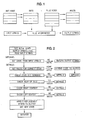
- the Rule Interpreter applies rule tables to an input string to generate a transformed output string, as shown in the general flow diagram of Fig. 1.
- This output string may be processed with the same rule tables in subsequent passes by using the output of one pass as input for the next pass.
- indices are built for the sets and for the rules.
- the rule tables consist of a Set Index, a Rule Index, Sets of strings, Rewrite Rules, and global variables containing the initial state to be used for each pass.
- Appendix A shows an example of Spanish hyphenation rules and Appendix B shows an example of English text-to-sound transformation rules, in accordance with the invention.
- the resulting invention provides a simplified mechanism for rewrite rules that makes it possible to organize and interpret the rules efficiently.
- the computer method invention disclosed herein can be executed on any conventional data processor.
- a suitable processing system is disclosed in the U. S. patent 4,731,735 entitled “Multilingual Processing for Screen Image Build and Command Decode in a Word Processor, With Full Command, Message and Help Support," by K. W. Borgendale, et al., assigned to IBM Corporation.
- the figures and specification of the Borgendale, et al. patent are incorporated herein by reference, as an example of a data processing system within which the subject invention herein can be applied.
Landscapes
- Engineering & Computer Science (AREA)
- Theoretical Computer Science (AREA)
- General Engineering & Computer Science (AREA)
- Physics & Mathematics (AREA)
- General Physics & Mathematics (AREA)
- Computational Linguistics (AREA)
- General Health & Medical Sciences (AREA)
- Health & Medical Sciences (AREA)
- Audiology, Speech & Language Pathology (AREA)
- Artificial Intelligence (AREA)
- Software Systems (AREA)
- Computing Systems (AREA)
- Machine Translation (AREA)
Applications Claiming Priority (2)
| Application Number | Priority Date | Filing Date | Title |
|---|---|---|---|
| US344344 | 1982-02-01 | ||
| US07/344,344 US5113342A (en) | 1989-04-26 | 1989-04-26 | Computer method for executing transformation rules |
Publications (2)
| Publication Number | Publication Date |
|---|---|
| EP0394628A2 true EP0394628A2 (de) | 1990-10-31 |
| EP0394628A3 EP0394628A3 (de) | 1991-05-08 |
Family
ID=23350152
Family Applications (1)
| Application Number | Title | Priority Date | Filing Date |
|---|---|---|---|
| EP19900102774 Withdrawn EP0394628A3 (de) | 1989-04-26 | 1990-02-13 | Rechnerverfahren zur Durchführung von Umwandlungsregeln |
Country Status (3)
| Country | Link |
|---|---|
| US (1) | US5113342A (de) |
| EP (1) | EP0394628A3 (de) |
| JP (1) | JPH02299067A (de) |
Cited By (1)
| Publication number | Priority date | Publication date | Assignee | Title |
|---|---|---|---|---|
| WO1999001829A1 (en) * | 1997-06-30 | 1999-01-14 | Lernout & Hauspie Speech Products N.V. | Command parsing and rewrite system |
Families Citing this family (16)
| Publication number | Priority date | Publication date | Assignee | Title |
|---|---|---|---|---|
| US5317509A (en) * | 1992-01-21 | 1994-05-31 | Hewlett-Packard Company | Regular expression factoring for scanning multibyte character sets with a single byte automata machine |
| US5410475A (en) * | 1993-04-19 | 1995-04-25 | Mead Data Central, Inc. | Short case name generating method and apparatus |
| US5432948A (en) * | 1993-04-26 | 1995-07-11 | Taligent, Inc. | Object-oriented rule-based text input transliteration system |
| US5721938A (en) * | 1995-06-07 | 1998-02-24 | Stuckey; Barbara K. | Method and device for parsing and analyzing natural language sentences and text |
| US6032164A (en) * | 1997-07-23 | 2000-02-29 | Inventec Corporation | Method of phonetic spelling check with rules of English pronunciation |
| US5991539A (en) * | 1997-09-08 | 1999-11-23 | Lucent Technologies, Inc. | Use of re-entrant subparsing to facilitate processing of complicated input data |
| US7120638B1 (en) * | 1999-09-21 | 2006-10-10 | International Business Machines Corporation | Method, system, program, and data structure for cleaning a database table |
| US6965888B1 (en) * | 1999-09-21 | 2005-11-15 | International Business Machines Corporation | Method, system, program, and data structure for cleaning a database table using a look-up table |
| US6920558B2 (en) * | 2001-03-20 | 2005-07-19 | Networks Associates Technology, Inc. | Method and apparatus for securely and dynamically modifying security policy configurations in a distributed system |
| US20030046060A1 (en) * | 2001-09-04 | 2003-03-06 | Juergen Roeck | Rule-based document composing |
| US7308363B2 (en) * | 2002-01-23 | 2007-12-11 | Sri International | Modeling and evaluation metabolic reaction pathways and culturing cells |
| US7065745B2 (en) * | 2002-12-16 | 2006-06-20 | Sun Microsystems, Inc. | System and method for evaluating and executing hierarchies of rules |
| US7617091B2 (en) * | 2003-11-14 | 2009-11-10 | Xerox Corporation | Method and apparatus for processing natural language using tape-intersection |
| US8996994B2 (en) * | 2008-01-16 | 2015-03-31 | Microsoft Technology Licensing, Llc | Multi-lingual word hyphenation using inductive machine learning on training data |
| WO2011087391A1 (en) * | 2010-01-18 | 2011-07-21 | Google Inc. | Automatic transliteration of a record in a first language to a word in a second language |
| US10204083B2 (en) | 2016-10-20 | 2019-02-12 | Microsoft Technology Licensing, Llc | Computer systems and methods using multiple neutral type characters as delimiters between segments in structured, multi-segment data values |
Family Cites Families (5)
| Publication number | Priority date | Publication date | Assignee | Title |
|---|---|---|---|---|
| US4028677A (en) * | 1975-07-16 | 1977-06-07 | International Business Machines Corporation | Digital reference hyphenation matrix apparatus for automatically forming hyphenated words |
| US4092729A (en) * | 1976-12-28 | 1978-05-30 | International Business Machines Corporation | Apparatus for automatically forming hyphenated words |
| US4456969A (en) * | 1981-10-09 | 1984-06-26 | International Business Machines Corporation | System for automatically hyphenating and verifying the spelling of words in a multi-lingual document |
| US4574363A (en) * | 1982-07-13 | 1986-03-04 | International Business Machines Corporation | Mixed mode enhanced resolution hyphenation function for a text processing system |
| JPH0821030B2 (ja) * | 1986-12-29 | 1996-03-04 | ブラザー工業株式会社 | 文書処理装置 |
-
1989
- 1989-04-26 US US07/344,344 patent/US5113342A/en not_active Expired - Fee Related
-
1990
- 1990-02-13 EP EP19900102774 patent/EP0394628A3/de not_active Withdrawn
- 1990-04-20 JP JP2103259A patent/JPH02299067A/ja active Pending
Cited By (2)
| Publication number | Priority date | Publication date | Assignee | Title |
|---|---|---|---|---|
| WO1999001829A1 (en) * | 1997-06-30 | 1999-01-14 | Lernout & Hauspie Speech Products N.V. | Command parsing and rewrite system |
| US6138098A (en) * | 1997-06-30 | 2000-10-24 | Lernout & Hauspie Speech Products N.V. | Command parsing and rewrite system |
Also Published As
| Publication number | Publication date |
|---|---|
| US5113342A (en) | 1992-05-12 |
| JPH02299067A (ja) | 1990-12-11 |
| EP0394628A3 (de) | 1991-05-08 |
Similar Documents
| Publication | Publication Date | Title |
|---|---|---|
| US5113342A (en) | Computer method for executing transformation rules | |
| Nix | Editing by example | |
| JP2609093B2 (ja) | ソフトウエアプログラムを生成するための装置及びその方法 | |
| US6330530B1 (en) | Method and system for transforming a source language linguistic structure into a target language linguistic structure based on example linguistic feature structures | |
| US5915259A (en) | Document schema transformation by patterns and contextual conditions | |
| US20030036898A1 (en) | Method and system to analyze, transfer and generate language expressions using compiled instructions to manipulate linguistic structures | |
| EP0204942A2 (de) | Kompilator für ein Quellprogramm, Verfahren zur Konstruktion desselben und dessen Verwendung | |
| US5317509A (en) | Regular expression factoring for scanning multibyte character sets with a single byte automata machine | |
| JPH07244661A (ja) | 未知のキャラクタのグリフを発生するシステム及び方法 | |
| JPH1083289A (ja) | プログラミング・エイド | |
| Campesato | Google Gemini for Python: Coding with Bard | |
| US20030033135A1 (en) | Method and apparatus for extracting infinite ambiguity when factoring finite state transducers | |
| US20030037027A1 (en) | Text stream filter | |
| Hutton | Parsing using combinators | |
| Lunney et al. | Syntax-directed editing | |
| Kipps | Analysis of Tomita’s algorithm for general context-free parsing | |
| Bongulielmi et al. | On the usefulness of deterministic grammars for simulation languages | |
| US20020198702A1 (en) | Method and apparatus for factoring finite state transducers with unknown symbols | |
| JPH02183338A (ja) | プログラム言語トランスレータ生成装置および方法 | |
| Fisher | Practical LL (1)-based parsing of van Wijngaarden grammars | |
| Roche et al. | Finite-state representation of geometric transductions | |
| Klint | A survey of three language-independent programming environments | |
| JP3417960B2 (ja) | 文章校正支援方法および装置 | |
| Carson | The practical implementation of structured programming languages. | |
| Petrone | Reusing batch parsers as incremental parsers |
Legal Events
| Date | Code | Title | Description |
|---|---|---|---|
| PUAI | Public reference made under article 153(3) epc to a published international application that has entered the european phase |
Free format text: ORIGINAL CODE: 0009012 |
|
| AK | Designated contracting states |
Kind code of ref document: A2 Designated state(s): DE FR GB |
|
| 17P | Request for examination filed |
Effective date: 19901213 |
|
| PUAL | Search report despatched |
Free format text: ORIGINAL CODE: 0009013 |
|
| AK | Designated contracting states |
Kind code of ref document: A3 Designated state(s): DE FR GB |
|
| 17Q | First examination report despatched |
Effective date: 19940411 |
|
| STAA | Information on the status of an ep patent application or granted ep patent |
Free format text: STATUS: THE APPLICATION IS DEEMED TO BE WITHDRAWN |
|
| 18D | Application deemed to be withdrawn |
Effective date: 19940823 |