EP0395985A2 - 3(2H)-Pyridazinonderivate, Verfahren zu ihrer Herstellung und ihre Verwendung zur Bekämpfung von Schädlingen - Google Patents
3(2H)-Pyridazinonderivate, Verfahren zu ihrer Herstellung und ihre Verwendung zur Bekämpfung von Schädlingen Download PDFInfo
- Publication number
- EP0395985A2 EP0395985A2 EP90107708A EP90107708A EP0395985A2 EP 0395985 A2 EP0395985 A2 EP 0395985A2 EP 90107708 A EP90107708 A EP 90107708A EP 90107708 A EP90107708 A EP 90107708A EP 0395985 A2 EP0395985 A2 EP 0395985A2
- Authority
- EP
- European Patent Office
- Prior art keywords
- alkyl
- pyridazinone
- pyridazinone derivatives
- halogen
- pests
- Prior art date
- Legal status (The legal status is an assumption and is not a legal conclusion. Google has not performed a legal analysis and makes no representation as to the accuracy of the status listed.)
- Withdrawn
Links
- 0 *C(C(N(*)N=C1)=O)=C1N Chemical compound *C(C(N(*)N=C1)=O)=C1N 0.000 description 1
Classifications
-
- C—CHEMISTRY; METALLURGY
- C07—ORGANIC CHEMISTRY
- C07D—HETEROCYCLIC COMPOUNDS
- C07D237/00—Heterocyclic compounds containing 1,2-diazine or hydrogenated 1,2-diazine rings
- C07D237/02—Heterocyclic compounds containing 1,2-diazine or hydrogenated 1,2-diazine rings not condensed with other rings
- C07D237/06—Heterocyclic compounds containing 1,2-diazine or hydrogenated 1,2-diazine rings not condensed with other rings having three double bonds between ring members or between ring members and non-ring members
- C07D237/10—Heterocyclic compounds containing 1,2-diazine or hydrogenated 1,2-diazine rings not condensed with other rings having three double bonds between ring members or between ring members and non-ring members with hetero atoms or with carbon atoms having three bonds to hetero atoms with at the most one bond to halogen, e.g. ester or nitrile radicals, directly attached to ring carbon atoms
-
- C—CHEMISTRY; METALLURGY
- C07—ORGANIC CHEMISTRY
- C07D—HETEROCYCLIC COMPOUNDS
- C07D231/00—Heterocyclic compounds containing 1,2-diazole or hydrogenated 1,2-diazole rings
- C07D231/02—Heterocyclic compounds containing 1,2-diazole or hydrogenated 1,2-diazole rings not condensed with other rings
- C07D231/10—Heterocyclic compounds containing 1,2-diazole or hydrogenated 1,2-diazole rings not condensed with other rings having two or three double bonds between ring members or between ring members and non-ring members
- C07D231/12—Heterocyclic compounds containing 1,2-diazole or hydrogenated 1,2-diazole rings not condensed with other rings having two or three double bonds between ring members or between ring members and non-ring members with only hydrogen atoms, hydrocarbon or substituted hydrocarbon radicals, directly attached to ring carbon atoms
-
- A—HUMAN NECESSITIES
- A01—AGRICULTURE; FORESTRY; ANIMAL HUSBANDRY; HUNTING; TRAPPING; FISHING
- A01N—PRESERVATION OF BODIES OF HUMANS OR ANIMALS OR PLANTS OR PARTS THEREOF; BIOCIDES, e.g. AS DISINFECTANTS, AS PESTICIDES OR AS HERBICIDES; PEST REPELLANTS OR ATTRACTANTS; PLANT GROWTH REGULATORS
- A01N43/00—Biocides, pest repellants or attractants, or plant growth regulators containing heterocyclic compounds
- A01N43/48—Biocides, pest repellants or attractants, or plant growth regulators containing heterocyclic compounds having rings with two nitrogen atoms as the only ring hetero atoms
- A01N43/58—1,2-Diazines; Hydrogenated 1,2-diazines
-
- A—HUMAN NECESSITIES
- A01—AGRICULTURE; FORESTRY; ANIMAL HUSBANDRY; HUNTING; TRAPPING; FISHING
- A01N—PRESERVATION OF BODIES OF HUMANS OR ANIMALS OR PLANTS OR PARTS THEREOF; BIOCIDES, e.g. AS DISINFECTANTS, AS PESTICIDES OR AS HERBICIDES; PEST REPELLANTS OR ATTRACTANTS; PLANT GROWTH REGULATORS
- A01N43/00—Biocides, pest repellants or attractants, or plant growth regulators containing heterocyclic compounds
- A01N43/64—Biocides, pest repellants or attractants, or plant growth regulators containing heterocyclic compounds having rings with three nitrogen atoms as the only ring hetero atoms
- A01N43/647—Triazoles; Hydrogenated triazoles
- A01N43/653—1,2,4-Triazoles; Hydrogenated 1,2,4-triazoles
-
- A—HUMAN NECESSITIES
- A01—AGRICULTURE; FORESTRY; ANIMAL HUSBANDRY; HUNTING; TRAPPING; FISHING
- A01N—PRESERVATION OF BODIES OF HUMANS OR ANIMALS OR PLANTS OR PARTS THEREOF; BIOCIDES, e.g. AS DISINFECTANTS, AS PESTICIDES OR AS HERBICIDES; PEST REPELLANTS OR ATTRACTANTS; PLANT GROWTH REGULATORS
- A01N43/00—Biocides, pest repellants or attractants, or plant growth regulators containing heterocyclic compounds
- A01N43/72—Biocides, pest repellants or attractants, or plant growth regulators containing heterocyclic compounds having rings with nitrogen atoms and oxygen or sulfur atoms as ring hetero atoms
- A01N43/74—Biocides, pest repellants or attractants, or plant growth regulators containing heterocyclic compounds having rings with nitrogen atoms and oxygen or sulfur atoms as ring hetero atoms five-membered rings with one nitrogen atom and either one oxygen atom or one sulfur atom in positions 1,3
-
- A—HUMAN NECESSITIES
- A01—AGRICULTURE; FORESTRY; ANIMAL HUSBANDRY; HUNTING; TRAPPING; FISHING
- A01N—PRESERVATION OF BODIES OF HUMANS OR ANIMALS OR PLANTS OR PARTS THEREOF; BIOCIDES, e.g. AS DISINFECTANTS, AS PESTICIDES OR AS HERBICIDES; PEST REPELLANTS OR ATTRACTANTS; PLANT GROWTH REGULATORS
- A01N43/00—Biocides, pest repellants or attractants, or plant growth regulators containing heterocyclic compounds
- A01N43/72—Biocides, pest repellants or attractants, or plant growth regulators containing heterocyclic compounds having rings with nitrogen atoms and oxygen or sulfur atoms as ring hetero atoms
- A01N43/82—Biocides, pest repellants or attractants, or plant growth regulators containing heterocyclic compounds having rings with nitrogen atoms and oxygen or sulfur atoms as ring hetero atoms five-membered rings with three ring hetero atoms
-
- C—CHEMISTRY; METALLURGY
- C07—ORGANIC CHEMISTRY
- C07D—HETEROCYCLIC COMPOUNDS
- C07D233/00—Heterocyclic compounds containing 1,3-diazole or hydrogenated 1,3-diazole rings, not condensed with other rings
- C07D233/54—Heterocyclic compounds containing 1,3-diazole or hydrogenated 1,3-diazole rings, not condensed with other rings having two double bonds between ring members or between ring members and non-ring members
- C07D233/56—Heterocyclic compounds containing 1,3-diazole or hydrogenated 1,3-diazole rings, not condensed with other rings having two double bonds between ring members or between ring members and non-ring members with only hydrogen atoms or radicals containing only hydrogen and carbon atoms, attached to ring carbon atoms
-
- C—CHEMISTRY; METALLURGY
- C07—ORGANIC CHEMISTRY
- C07D—HETEROCYCLIC COMPOUNDS
- C07D249/00—Heterocyclic compounds containing five-membered rings having three nitrogen atoms as the only ring hetero atoms
- C07D249/02—Heterocyclic compounds containing five-membered rings having three nitrogen atoms as the only ring hetero atoms not condensed with other rings
- C07D249/08—1,2,4-Triazoles; Hydrogenated 1,2,4-triazoles
-
- C—CHEMISTRY; METALLURGY
- C07—ORGANIC CHEMISTRY
- C07D—HETEROCYCLIC COMPOUNDS
- C07D403/00—Heterocyclic compounds containing two or more hetero rings, having nitrogen atoms as the only ring hetero atoms, not provided for by group C07D401/00
- C07D403/02—Heterocyclic compounds containing two or more hetero rings, having nitrogen atoms as the only ring hetero atoms, not provided for by group C07D401/00 containing two hetero rings
- C07D403/12—Heterocyclic compounds containing two or more hetero rings, having nitrogen atoms as the only ring hetero atoms, not provided for by group C07D401/00 containing two hetero rings linked by a chain containing hetero atoms as chain links
-
- C—CHEMISTRY; METALLURGY
- C07—ORGANIC CHEMISTRY
- C07D—HETEROCYCLIC COMPOUNDS
- C07D413/00—Heterocyclic compounds containing two or more hetero rings, at least one ring having nitrogen and oxygen atoms as the only ring hetero atoms
- C07D413/02—Heterocyclic compounds containing two or more hetero rings, at least one ring having nitrogen and oxygen atoms as the only ring hetero atoms containing two hetero rings
- C07D413/12—Heterocyclic compounds containing two or more hetero rings, at least one ring having nitrogen and oxygen atoms as the only ring hetero atoms containing two hetero rings linked by a chain containing hetero atoms as chain links
-
- C—CHEMISTRY; METALLURGY
- C07—ORGANIC CHEMISTRY
- C07D—HETEROCYCLIC COMPOUNDS
- C07D417/00—Heterocyclic compounds containing two or more hetero rings, at least one ring having nitrogen and sulfur atoms as the only ring hetero atoms, not provided for by group C07D415/00
- C07D417/02—Heterocyclic compounds containing two or more hetero rings, at least one ring having nitrogen and sulfur atoms as the only ring hetero atoms, not provided for by group C07D415/00 containing two hetero rings
- C07D417/12—Heterocyclic compounds containing two or more hetero rings, at least one ring having nitrogen and sulfur atoms as the only ring hetero atoms, not provided for by group C07D415/00 containing two hetero rings linked by a chain containing hetero atoms as chain links
Definitions
- the present invention relates to new 3 (2H) -pyridazinone derivatives of the general formula I.
- substituents have the following meaning: R1 C1-C8 alkyl, R2 is hydrogen or C1-C4 alkyl, X halogen, W oxygen or sulfur and Q is a 5- or 6-membered heterocycle with 2 to 4 heteroatoms from the group nitrogen, oxygen or sulfur, which is unsubstituted or substituted one to three times with halogen, C1-C8-alkyl, C2-C6-alkenyl, C2-C4 Alkynyl, C1-C4-haloalkyl, C1-C8-alkoxy, C2-C8-alkoxyalkyl, C3-C8-cycloalkyl, cyano, nitro, aryl and C7-C20-aralkyl, which are unsubstituted, or one to three times by halogen, C1-C8-alkyl, C1-C8-
- the invention also relates to the preparation of the compounds I, pesticides which comprise the compounds I as active compounds and a process for controlling pests.
- EP-A-199 281 discloses numerous hetarylically substituted 3 (2H) -pyridazinones which, however, contain only pyrrole, furan, thiophene, pyridine and pyridazine as hetaryl radicals.
- EP-A-302 346 numerous hetarylically substituted 3 (2H) -pyridazinones are also described, but they do not contain a C1-C8alkyl radical as the radical R1.
- the object of the invention was to provide new hetarylically substituted 3 (2H) -pyridazinone derivatives with improved activity.
- R1 unbranched or branched C1-C8-alkyl, preferably C1-C6-alkyl, particularly preferably C1-C4-alkyl such as methyl, ethyl, n-propyl, iso-propyl, n-butyl, iso-butyl, sec-butyl and tert-butyl
- R2 is hydrogen, unbranched or branched C1-C4 alkyl as listed for R1, preferably C1-C2 alkyl, particularly preferably methyl
- Q is a 5- or 6-membered heterocycle having 2 to 4, in particular 2 to 3, heteroatoms such as nitrogen, oxygen or sulfur, which is unsubstituted or mono- to trisubstituted, preferably pyrazole, imidazole, 1,2,4-triazole, isothiazole
- the aryl radical and the C7-C20 aralkyl radical are unsubstituted or substituted one to three times with: Halogen, preferably fluorine, chlorine and bromine, particularly preferably fluorine and chlorine, C1-C8-alkyl, preferably C1-C6-alkyl, particularly preferably C1-C4-alkyl, such as methyl, ethyl, n-propyl, iso-propyl, n-butyl, iso-butyl, sec-butyl and tert.- Butyl, C1-C8-alkoxy, preferably C1-C6-alkoxy, particularly preferably C1-C4-alkoxy, such as methoxy, ethoxy, n-propyloxy, iso-propyloxy, n-butyloxy, iso-butyloxy, sec.-butyloxy and tert.- Butyloxy, C1-C4-haloalkyl,
- the compounds I can be obtained by the following method:
- reaction takes place between a 3 (2H) -pyridazinone of the general formula II and a compound of the general formula III in the presence of a base in the temperature range from (-20) to 250 ° C., preferably from 20 to 120 ° C., according to the following reaction equation:
- the heterocycles are either known and some are commercially available or can be prepared by known chemical processes. Processes for the preparation of pyrazoles can be found, for example, in: Heterocyclic Nitrogen Compounds, The Azoles, pp. 31 ff, Cambridge University Press, 1976; Processes for the preparation of imidazoles, for example in: Advances in Heterocyclic Chem., Vol. 27, pp. 242 ff, 1980; Processes for the preparation of triazoles, for example in: Comprehensive Heterocyclic Chemistry, AR Katritzky and CW Rees, Vol. 5, pp.
- the radical Y denotes a leaving group such as a sulfonic acid residue or a halogen.
- sulfonic acid residues are methanesulfonyl, trifluoromethanesulfonyl, benzenesulfonyl and p-toluenesulfonyl, among the halogens chlorine and bromine are preferred, chlorine is particularly preferred.
- the starting materials are usually used in a stoichiometric ratio.
- An excess of one or the other component can be advantageous.
- the reactions usually proceed above -20 o C at sufficient speeds. In general, 120 o C do not have to be exceeded. As they develop heat in some cases, it can be advantageous to provide cooling options.
- Suitable bases are, for example, hydroxides of alkali and alkaline earth metals, such as sodium hydroxide, potassium hydroxide and calcium hydroxide, alcoholates of alkali and alkaline earth metals, such as sodium methylate, sodium ethylate, calcium methoxide or potassium tert-butoxide; Alkali or alkaline earth metal hydrides, such as sodium hydride, potassium hydride or calcium hydride; Alkali or alkaline earth carbonates, such as sodium carbonate, potassium carbonate or calcium carbonate; aliphatic amines such as dimethylamine, triethylamine or diisopropylamine; heterocyclic amines such as piperidine, piperazine or pyrrolidine; aromatic amines, such as pyridine or pyrrole.
- alkali and alkaline earth metals such as sodium hydroxide, potassium hydroxide and calcium hydroxide
- alcoholates of alkali and alkaline earth metals such as sodium methylate, sodium
- Aliphatic hydrocarbons such as n-pentane, n-hexane, the hexane-isomer mixture and petroleum ether are suitable for this purpose, for example; halogenated hydrocarbons such as chlorobenzene, methylene chloride, ethylene chloride, chloroform, tetrachlorethylene; aromatic hydrocarbons, such as benzene, toluene, the xylenes and their isomer mixtures, gasoline; Alcohols such as methanol, ethanol, n-propanol and isopropanol; Ethers such as diethyl, di-n-butyl ether, methyl tert-butyl ether, tetrahydrofuran and dioxane; Ketones such as acetone, methyl ethyl ketone and methyl isopropyl ketone; Nitriles such as acetonitrile and
- the 3 (2H) -pyridazinone of the general formula II is expediently introduced in a diluent or solvent, followed by the addition of the starting material III.
- the usual methods are used to isolate the new compounds.
- the resulting products can be purified by recrystallization, extraction or chromatography.
- the corresponding 3 (2H) -pyridazinones I can be used with commonly used salt formers, e.g. Hydrochloric acid, hydrobromic acid, hydroiodic acid, sulfuric acid, phosphoric acid, formic acid, acetic acid, oxalic acid, benzenesulfonic acid, p-toluenesulfonic acid, dodecylbenzenesulfonic acid, methyl chloride, methyl bromide, methyl iodide, ethyl chloride, ethyl bromide, ethyl iodide, n-propyl sulfate, n-propyl sulfate, and temperature range from n-propyl sulfate, n 0 to 150 ° C, preferably from 20 to 120 ° C are implemented.
- salt formers e.g. Hydrochloric acid, hydrobromic acid, hydroiodic acid, sulfuric acid, phospho
- the reaction is advantageously carried out in a solvent or diluent.
- aliphatic hydrocarbons such as n-pentane, n-hexane, the hexane isomer mixture and petroleum ether are suitable; aromatic hydrocarbons such as benzene, toluene, the xylenes and their isomer mixtures, gasoline; Ethers such as diethyl ether, di-n-butyl ether, methyl tert-butyl ether, tetrahydrofuran and dioxane; Ketones such as acetone, methyl ethyl ketone and methyl isopropyl ketone; halogenated hydrocarbons such as chlorobenzene, methylene chloride, ethylene chloride, chloroform and tetrachlorethylene. Mixtures of these substances can also be used as solvents.
- the starting materials are usually used in a stoichiometric ratio.
- an excess of one or the other component can be an advantage.
- the reactions usually proceed above 0 ° C at sufficient speeds. In general, 120 ° C do not have to be exceeded. As they develop heat in some cases, it can be advantageous to provide cooling options.
- the isolation of the salts of the compounds I according to the invention is carried out by customary methods.
- the resulting products can be purified by recrystallization, extraction or chromatography.
- the 3 (2H) -pyridazinone derivatives of the formula I are suitable for effectively controlling pests from the class of the insects, arachnids and nematodes. They can be used as pesticides in crop protection as well as in the hygiene, storage protection and veterinary sectors.
- the harmful insects include, for example, Agrotis ypsilon, Agrotis segetum, Alabama argillacea, Anticarsia gemmatalis, Argyresthia conjugella, Autographa gamma, Bupalus piniarius, Cacoecia murinana, Capua reticulana, Cheimatobisturaumumone, Cheimatobisturaumumone Cirphis unipuncta, Cydia pomonella, Dendrolimus pini, Diaphania nitidalis, Diatraea grandiosella, Earias insulana, Elasmopalpus lignosellus, Eupoecilia ambiguella, Evetria bouliana, Feltia subterranea, Galleria mellonella, Heliothiothiisi, Heliolithiothi, Grapholita funebranais, Grapholita funebrabranais, Grapholita fun
- Diptera From the order of the two-winged plants (Diptera), for example, Aedes aegypti, Aedes vexans, Anastrepha ludens, Anopheles maculipennis, Ceratitis capitata, Chrysomya bezziana, Chrysomya hominivorax, Chrysomya macellaria, Contarinia sorghicola, Cordylobia anthropucitae, Cordylobia anthropucita, brassylaciaacropucine, Brassylaciaacropacine, Cylobia anthropuca , Fannia canicularis, Gasterophilus intestinalis, Glossia morsitans, Haematobia irritans, Haplodiplosis equestris, Hylemyia platura, Hypoderma lineata, Liriomyza sativae, Liriomyza trifolii, Lucilia caprina, Lucilia
- Thrips for example Frankliniella fusca, Frankliniella occidentalis, Frankliniella tritici, Scirtothrips citri, Thrips oryzae, Thrips palmi, Thrips tabaci.
- From the order of the hymenoptera for example Athalia rosae, Atta cephalotes, Atta sexdens, Atta texana, Hoplocampa minuta, Hoplocampa testudinea, Monomorium pharaonis, Solenopsis geminata, Solenopsis invicta.
- Heteroptera From the order of the bugs (Heteroptera), for example, Acrosternum hilare, Blissus leucopterus, Cyrtopeltis notatus, Dysdercus cingulatus, Dysdercus intermedius, Eurygaster integriceps, Euchistus impictiventris, Leptoglossus phyllopus, Lygus lineolaris, Lygus pratidularis, Parsma viralisea, Pies .
- bugs Heteroptera
- Acrosternum hilare Blissus leucopterus
- Cyrtopeltis notatus Dysdercus cingulatus
- Dysdercus intermedius Eurygaster integriceps
- Euchistus impictiventris Leptoglossus phyllopus
- Lygus lineolaris Lygus pratidularis
- Parsma viralisea Pies .
- Orthoptera From the order of the straight winged wing (Orthoptera), for example Forficula auricularia, Acheta domestica, Gryllotalpa gryllotalpa, tachycines asynamorus, Locusta migratoria, Stauronotus meroccanus, Schistocerca peregrina, Nomadacris septemfasciata, Melanoplus spretus-america, Rubicoplana, Rubanoplana, Melanoplana, Melanoplana Blabera gigantes.
- Orthoptera for example Forficula auricularia, Acheta domestica, Gryllotalpa gryllotalpa, tachycines asynamorus, Locusta migratoria, Stauronotus meroccanus, Schistocerca peregrina, Nomadacris septemfasciata, Melanoplus spretus-america, Rubicoplana, Rubano
- the arachnoid class includes arachnids (Acarina), for example Ixodes ficinus, Ornithodorus moubata, Amblyomma americanum, Dermacentor silvarum, Boophilus microplus, Tetranychus telarius, Tetranychus pacificus, Paratetranychus pilosus, Bryobia praetiosa.
- Acarina arachnids
- Ixodes ficinus for example Ixodes ficinus, Ornithodorus moubata, Amblyomma americanum, Dermacentor silvarum, Boophilus microplus, Tetranychus telarius, Tetranychus pacificus, Paratetranychus pilosus, Bryobia praetiosa.
- the class of nematodes includes, for example, root gall nematodes, e.g. Meloidogyne hapla, Meloidogyne incognita, Meloidogyne javanica, cyst-forming nematodes, e.g. Globodera rostochiensis, Heterodera avenae, Heterodera glycinae, Heterodera schachtii, Heterodera trifolii, stick and leaf wholes, e.g.
- root gall nematodes e.g. Meloidogyne hapla, Meloidogyne incognita, Meloidogyne javanica, cyst-forming nematodes, e.g. Globodera rostochiensis, Heterodera avenae, Heterodera glycinae, Heterodera schachtii, Heterodera trifolii, stick and leaf wholes,
- Belonolaimus longicaudatus Ditylenchus destructor, Ditylenchus dipsaci, Heliocotylenchus multicinctus, Longidorus elongatus, Radopholus similis, Rotylenchus robustus, Trichodorus primitivus, Tylenchorhynchus claytoni, Tylenchorhynchususususususususususususususususus, Paratylenate, Paratylene.
- the active ingredients as such in the form of their formulations or the use forms prepared therefrom, e.g. in the form of directly sprayable solutions, powders, suspensions or dispersions, emulsions, oil dispersions, pastes, dusts, scattering agents, granules by spraying, atomizing, dusting, scattering or pouring.
- the application forms depend entirely on the purposes; in any case, they should ensure that the active substances according to the invention are distributed as finely as possible.
- Aqueous application forms can be prepared from emulsion concentrates, pastes or wettable powders (wettable powders, oil dispersions) by adding water.
- emulsions, pastes or oil dispersions the substances as such or dissolved in an oil or solvent can be homogenized in water by means of wetting agents, adhesives, dispersants or emulsifiers. But it can also be made from effective substance Wetting agents, adhesives, dispersants or emulsifiers and possibly solvents or oils are used to produce concentrates that are suitable for dilution with water.
- Suitable surfactants are alkali metal, alkaline earth metal and ammonium salts of lignosulfonic acid, naphthalenesulfonic acid, phenolsulfonic acid, alkylarylsulfonates, alkyl sulfates, alkyl sulfonates, alkali metal and alkaline earth metal salts of dibutylnaphthalenesulfonic acid, fatty alcohol sulfates, fatty acid alkali and alkaline earth metal salts, salts of sulfated hexadecanols, heptadecanols, and octadecanols, salts of sulfated fatty alcohol glycol ethers, condensates of sulfonated naphthalene and naphthalene derivatives with formaldehyde, condensates of naphthalene or of naphthalenesulfonic acid with phenol and formaldehy
- Powders, materials for broadcasting and dusts can be prepared by mixing or grinding the active substances together with a solid carrier.
- Granules e.g. Coating, impregnation and homogeneous granules can be produced by binding the active ingredients to solid carriers.
- Solid carriers are e.g. Mineral soils, such as silica gel, silicas, silica gels, silicates, talc, kaolin, Attaclay, limestone, lime, chalk, bolus, loess, clay, dolomite, diatomaceous earth, calcium and magnesium sulfate, magnesium oxide, ground plastics, fertilizers such as e.g. Ammonium sulfate, ammonium phosphate, ammonium nitrate, ureas and vegetable products such as cereal flour, tree bark, wood and nutshell flour, cellulose powder and other solid carriers.
- Mineral soils such as silica gel, silicas, silica gels, silicates, talc, kaolin, Attaclay, limestone, lime, chalk, bolus, loess, clay, dolomi
- the formulations generally contain between 0.1 and 95% by weight of active compound, preferably between 0.5 and 90% by weight.
- the active ingredient concentrations in the ready-to-use preparations can be varied over a wide range.
- they are between 0.0001 and 10%, preferably between 0.01 and 1%.
- the active ingredients can also be used with great success in the ultra-low-volume process (ULV), it being possible to apply formulations with more than 95% by weight of active ingredient or even the active ingredient without additives.
- UUV ultra-low-volume process
- the amount of active ingredient applied under field conditions is 0.02 to 10, preferably 0.1 to 2.0 kg / ha.
- compositions according to the invention also have pronounced molluscicidal properties in both nude and shell snails and are outstandingly suitable for controlling snails in agricultural and horticultural crops.
- an anti-snail e.g. Preparation that can be formulated as a scattering agent by using 3 (2H) -pyridazinone derivatives I in an effective amount.
- Suitable formulations are e.g. in GB-A-2 087 723 and EP-A-190 595. They generally contain a feed, a binder, preservatives, dyes, attractants, fillers, repellents, water, organic solvents, surfactants and the active ingredient.
- feed substances can be contained as feeding substances.
- Ground cereals such as e.g. Wheat flour, wheat and barley meal, also soybean meal, bran, rice starch, fish meal, meat meal and molasses. Either only one feed substance or a mixture of several feed substances can be present.
- binders Methyl cellulose, sugar, dextrin, starch, alginates, glycols, polyvinylpyrrolidone, lingine sulfonate, gum arabic, polyvinyl alcohol and polyvinyl acetate are preferred.
- One or more binders can be included.
- preservatives examples include 2-hydroxibiphenyl, sorbic acid, p-hydroxybenzaldehyde, methyl p-hydroxybenzoate, benzaldehyde, benzoic acid, propyl p-hydroxybenzoate and p-nitrophenol.
- Dyes which can be considered as additives are inorganic pigments, such as iron oxide, titanium dioxide and ferrocyan blue, and organic dyes, such as anthraquinone, azo and metal phthalocyanine dyes.
- Kaolins, clays, talc, chalk and quartz powder are preferred.
- repellents which have a repellent effect on warm-blooded creatures such as dogs and hedgehogs.
- An example is nonyl acid vanillylamide.
- Suitable organic solvents are all organic solvents which can usually be used for the production of baits. Low-boiling organic solvents such as methanol, ethanol, butanol and methylene chloride are preferred.
- Suitable surfactants are non-ionic agents, such as condensation products of polyalkylene oxides and alkylphenols and fatty acid polyoxyalkylene esters, e.g. Octylphenoxypolyoxyethanol; cationic agents such as quaternary ammonium salts, e.g. Cetyltrimethylammonium chloride or cetylpyridinium chloride and anionic agents such as the sodium salts of long chain alkyl sulfates, e.g. Sodium lauryl sulfate, salts of alkylaryl sulfates, the sodium salt of deoxycholic acid, the sodium salt of taurocholic acid, the sodium salt of tauroglycocholic acid.
- non-ionic agents such as condensation products of polyalkylene oxides and alkylphenols and fatty acid polyoxyalkylene esters, e.g. Octylphenoxypolyoxyethanol
- cationic agents such as quaternary ammonium salts, e.g. Cety
- Another preferred application is seed dressing with a formulation customary for dressings.
- the active substance content in the individual application forms can vary within wide limits, e.g. in the range from 0.001 to 90, in particular 0.5 to 50, preferably 1 to 10% by weight in the case of grain formulations and 10 to 90% by weight in the case of seed dressings.
- the molluscicidal action of the agents according to the invention extends to land-dwelling and amphibious snails, for example those of the genera Deroceras (Agriolimax), Limax, Helix, Helicogona, Cepaea, Milax, Lymnaea (Galba), Achatina, Theba, Cochlicella, Helicarion, Vaginulus.
- the harmful snails include, for example, the slugs Arion ater, A. lusitanicus, A. hortenis, Agriolimax reticulatus, Limax flavus, L.
- a seed dressing To produce a seed dressing, the following were mixed: 480 g compound no.10 20 g of commercially available phenolsulfonic acid-urea-formaldehyde condensate 40 g of ethylene-propylene block copolymer with a molecular weight of 10,000 2 g xanthan gum 0.5 g rhodamine FB 80 g 1,2-propylene glycol 5 g silicone antifoam and made up to 1 liter with water.
- Oils of various types, herbicides, fungicides, other pesticides, bactericides can be added to the active compounds, if appropriate also only immediately before use (tank mix). These agents can be added to the agents according to the invention in a weight ratio of 1:10 to 10: 1.
- the compounds described in the following table can be prepared in accordance with these manufacturing instructions.
- the substitution sites on the heterocycles are each identified by a dash.
- concentrations at which the compounds cause 100% mortality or inhibition are the respective minimum concentrations. At least 2 experiments were carried out at each concentration.
- the purity of the active ingredients is> 95%.
- the concentrations given in the examples were obtained by diluting the formulated active ingredient with water.
- Potted bush beans which show the second pair of leaves, are sprayed to runoff point in the spray booth with the aqueous active ingredient preparation.
- the plants are placed on the turntable and are sprayed from all sides with a total of 50 ml of spray mixture. The plants must be heavily infested with mites and abundant egg laying.
- the effect is rated after 5 days using a binocular. Care is taken to ensure that all stages are recorded evenly. During this time, the plants are under normal greenhouse conditions.
- 0.5 ml of the 0.1% acetone active ingredient solution is added to the surface of a culture medium (5 ml in plastic petri dishes ⁇ 25 mm, height 10 mm). After the acetone has evaporated, one infects with 30 ml of E-Coli bacteria and 50 ml of nematode suspension.
- Leaves of young cabbage plants are immersed in the aqueous active ingredient emulsion for 3 seconds and, after a short drop, placed on a moistened filter in a petri dish. The sheet is then covered with 10 caterpillars of the 4th stage. Mortality is assessed after 48 hours.
- Stick-on labels are stuck to the top with pieces of adhesive tape (approx. 0.8 cm).
- the eggs are attached to the adhesive strip edge by immersing them in the "collecting vessel".
- the eggs are immersed in the aqueous active ingredient preparation for about 5 seconds, after which they are allowed to drain on filter paper.
- the cut labels are placed in plastic pallets with adhesive strips facing up. Half a cotton roll soaked in water is placed in the cup to prevent drying out and the pallet is covered with a glass plate. After approx. 8 days, a rating is made. (The larvae must have hatched during the control.)
Landscapes
- Chemical & Material Sciences (AREA)
- Organic Chemistry (AREA)
- Life Sciences & Earth Sciences (AREA)
- Agronomy & Crop Science (AREA)
- Pest Control & Pesticides (AREA)
- Plant Pathology (AREA)
- Health & Medical Sciences (AREA)
- Engineering & Computer Science (AREA)
- Dentistry (AREA)
- General Health & Medical Sciences (AREA)
- Wood Science & Technology (AREA)
- Zoology (AREA)
- Environmental Sciences (AREA)
- Agricultural Chemicals And Associated Chemicals (AREA)
- Plural Heterocyclic Compounds (AREA)
Abstract

R¹ C₁-C₈-Alkyl,
R² Wasserstoff oder C₁-C₄-Alkyl,
X Halogen,
W Sauerstoff oder Schwefel und
Q einen gegebenenfalls substituierten 5- oder 6-gliedrigen Heterocyclus mit 2 bis 4 Heteroatomen aus der Gruppe Stickstoff, Sauerstoff oder Schwefel,
mit der Maßgabe, daß Q keinen Isoxazolyl- oder Pyridazinylrest bedeutet,
sowie Verfahren zur Herstellung der Verbindungen I und ihre Verwendung als Schädlingsbekämpfungsmittel.
Description
- Die vorliegende Erfindung betrifft neue 3(2H)-Pyridazinonderivate der allgemeinen Formel I

R¹ C₁-C₈-Alkyl,
R² Wasserstoff oder C₁-C₄-Alkyl,
X Halogen,
W Sauerstoff oder Schwefel und
Q einen 5- oder 6-gliedrigen Heterocyclus mit 2 bis 4 Heteroatomen aus der Gruppe Stickstoff, Sauerstoff oder Schwefel, der unsubstituiert oder ein- bis dreifach substiuiert ist mit Halogen, C₁-C₈-Alkyl, C₂-C₆-Alkenyl, C₂-C₄-Alkinyl, C₁-C₄-Halogenalkyl, C₁-C₈-Alkoxy, C₂-C₈-Alkoxyalkyl, C₃-C₈-Cycloalkyl, Cyano, Nitro, Aryl und C₇-C₂₀-Aralkyl, welche unsubstiuiert, oder ein- bis dreifach durch Halogen, C₁-C₈-Alkyl, C₁-C₈-Alkoxy, C₁-C₄-Halogenalkyl, C₁-C₄-Halogenalkoxy, Cyano oder Nitro substituiert sind,
mit der Maßgabe, daß Q keinen Isoxazolyl- und Pyridazinylrest bedeutet,
sowie pflanzenverträgliche Salze der 3(2H)-Pyridazinonderivate I. - Außerdem betrifft die Erfindung die Herstellung der Verbindungen I, Schädlingsbekämpfungsmittel, die die Verbindungen I als Wirkstoffe enthalten sowie ein Verfahren zur Bekämpfung von Schädlingen.
- In den älteren deutschen Patentanmeldungen P 37 42 266.9 (EP-A-320 733) und P 38 44 227.2 sind 5-Isoxazolylmethyl-3(2H)-pyridazinone beschrieben. Weiterhin sind aus EP-A-199 281 zahlreiche hetarylisch substituierte 3(2H)-Pyridazinone bekannt, die als Hetarylreste aber nur Pyrrol, Furan, Thiophen, Pyridin und Pyridazin enthalten. In der Patentanmeldung EP-A-302 346 sind ebenfalls zahlreiche hetarylisch substituierte 3(2H)-Pyridazinone beschrieben, die aber als Rest R¹ keinen C₁-C₈-Alkylrest enthalten.
- Da die insektizide und akarizide Wirkung der vorbeschriebenen Verbindungen nicht immer befriedigend ist, lag der Erfindung die Aufgabe zugrunde, neue hetarylisch substituierte 3(2H)-Pyridazinonderivate mit verbesserter Wirkung bereitzustellen.
- Demgemäß wurden die eingangs definierten neuen 3(2H)-Pyridazinonderivate der allgemeinen Formel I, sowie ein Verfahren zu ihrer Herstellung gefunden. Ferner wurde gefunden, daß sich die Verbindungen I bei sehr guter Pflanzenverträglichkeit hervorragend zur Bekämpfung von Schädlingen eignen.
- Die Substituenten in Formel I haben im einzelnen folgende Bedeutungen:
R¹ unverzweigtes oder verzweigtes C₁-C₈-Alkyl, bevorzugt C₁-C₆-Alkyl, besonders bevorzugt C₁-C₄-Alkyl wie Methyl, Ethyl, n-Propyl, iso-Propyl, n-Butyl, iso-Butyl, sec.-Butyl und tert.-Butyl,
R² Wasserstoff, unverzweigtes oder verzweigtes C₁-C₄-Alkyl wie für R¹ aufgeführt, bevorzugt C₁-C₂-Alkyl, besonders bevorzugt Methyl,
X Halogen, bevorzugt Chlor oder Brom, besonders bevorzugt Chlor,
W Sauerstoff oder Schwefel, besonders bevorzugt Schwefel,
Q einen 5- oder 6-gliedrigen Heterocyclus mit 2 bis 4, insbesondere 2 bis 3 Heteroatomen wie Stickstoff, Sauerstoff oder Schwefel, der unsubstituiert oder ein bis dreifach substituiert ist, wobei bevorzugt Pyrazol, Imidazol, 1,2,4-Triazol, Isothiazol, Oxazol, Thiazol, 1,3,4-Oxadiazol, 1,3,4-Thiadiazol, 1,2,4-Oxadiazol, Pyrimidin, Pyrazin, 1,3,5-Triazin, 1,2,3-Triazin und 1,2,4-Triazin, besonders bevorzugt Pyrazol, Imidazol, 1,2,4-Triazol, Isothiazol, Oxazol, Thiazol, 1,3,4-Oxadiazol, 1,3,4-Thiadiazol, 1,2,4-Oxadiazol, 1,2,4-Thiadiazol, Pyrimidin und Pyrazin zu nennen sind und folgende Substituenten in Betracht kommen:
Halogen bevorzugt Fluor, Chlor und Brom, besonders bevorzugt Fluor und Chlor,
C₁-C₈-Alkyl, bevorzugt C₁-C₄-Alkyl, besonders bevorzugt Methyl, Ethyl, iso-Propyl, tert.-Butyl,
C₂-C₈-Alkenyl, bevorzugt C₂-C₄-Alkenyl, besonders bevorzugt Ethenyl, 1-Methyl-ethenyl, Propenyl, 2-Methyl-propenyl,
C₁-C₄-Halogenalkyl, bevorzugt mit Fluor und/oder Chlor substituiertes C₁-C₂-Halogenalkyl, besonders bevorzugt Trifluormethyl, 2,2,2-Trifluorethyl, Trichlormethyl,
C₁-C₈-Alkoxy, bevorzugt C₁-C₃-Alkoxy, besonders bevorzugt Methoxy, Ethoxy, n-Propyloxy und iso-Propyloxy,
C₂-C₈-Alkoxyalkyl, bevorzugt C₂-C₄-Alkoxyalkyl, besonders bevorzugt Methoxymethyl, 1-Methoxyethyl, 2-Methoxyethyl, 1-Methoxy-propyl,
C₃-C₈-Cycloalkyl, bevorzugt C₃-C₅-Cycloalkyl wie Cyclopropyl, Cyclobutyl und Cyclopentyl,
Cyano,
Nitro,
Aryl, bevorzugt Phenyl und Naphthyl, besonders bevorzugt Phenyl,
C₇-C₂₀-Aralkyl, bevorzugt C₇-C₁₂-Phenylalkyl, besonders bevorzugt Benzyl und Phenethyl. - Der Arylrest und der C₇-C₂₀-Aralkylrest sind unsubstituiert oder ein bis dreifach substituiert mit:
Halogen, bevorzugt Fluor, Chlor und Brom, besonders bevorzugt Fluor und Chlor,
C₁-C₈-Alkyl, bevorzugt C₁-C₆-Alkyl, besonders bevorzugt C₁-C₄-Alkyl, wie Methyl, Ethyl, n-Propyl, iso-Propyl, n-Butyl, iso-Butyl, sec.-Butyl und tert.-Butyl,
C₁-C₈-Alkoxy, bevorzugt C₁-C₆-Alkoxy, besonders bevorzugt C₁-C₄-Alkoxy, wie Methoxy, Ethoxy, n-Propyloxy, iso-Propyloxy, n-Butyloxy, iso-Butyloxy, sec.-Butyloxy und tert.-Butyloxy,
C₁-C₄-Halogenalkyl, bevorzugt C₁-C₃-Fluor- und/oder Chloralkyl, besonders bevorzugt C₁-C₂-Fluor- und/oder Chloralkyl, wie Fluormethyl, Difluormethyl, Trifluormethyl, Chlormethyl, Dichlormethyl, Trichlormethyl, Chlorfluormethyl, Chlordifluormethyl, Dichlorfluormethyl, 1,1,2,2-Tetrafluorethyl, 1,2,2,2-Tetrafluorethyl, 1,1,2,2-Tetrachlorethyl und 1,2,2,2-Tetrachlorethyl,
C₁-C₄-Halogenalkoxy, bevorzugt C₁-C₃-Fluor- und/oder Chloralkoxy, besonders bevorzugt C₁-C₂-Fluor- und/oder Chloralkoxy, wie Fluormethoxy, Difluormethoxy, Trifluormethoxy, Chlormethoxy, Dichlormethoxy, Trichlormethoxy, Chlorfluormethoxy, Chlordifluormethoxy, Dichlorfluormethoxy, 1,1,2,2-Tetrafluorethoxy, 1,2,2,2-Tetrafluorethoxy, 1,1,2,2-Tetrachloroethoxy, 1,2,2,2-Tetrachlorethoxy,
Cyano und
Nitro. - Die Verbindungen I sind nach folgender Methode erhältlich:
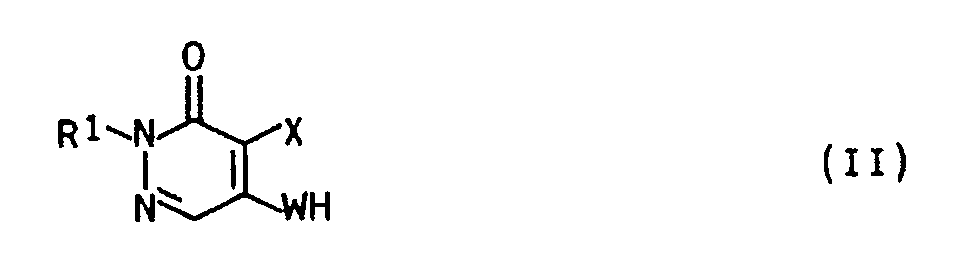
- Die Umsetzung erfolgt zwischen einem 3(2H)-Pyridazinon der allgemeinen Formel II und einer Verbindung der allgemeinen Formel III in Gegenwart einer Base im Temperaturbereich von (-20) bis 250oC, vorzugsweise von 20 bis 120oC nach folgender Reaktionsgleichung:

- Die 3(2H)-Pyridazinone der allgemeinen Formel II sind zum Teil in dem belgischen Patent 607 934; in EP-A-134 439, in Angew. Chem. 72, 864 ff (1960) und Chem. Pharm. Bull. 18, 147 ff (1970) beschrieben oder können nach den dort beschriebenen Methoden hergestellt werden.
- Die Heterocyclen sind entweder bekannt und teilweise kommerziell erhältlich oder lassen sich nach bekannten chemischen Verfahren herstellen. Verfahren zur Herstellung von Pyrazolen finden sich beispielsweise in: Heterocyclic Nitrogen Compounds, The Azoles, S. 31 ff, Cambridge University Press, 1976; Verfahren zur Herstellung von Imidazolen beispielsweise in: Advances in Heterocyclic Chem., Vol. 27, S. 242 ff, 1980; Verfahren zur Herstellung von Triazolen beispielsweise in: Comprehensive Heterocyclic Chemistry, A.R. Katritzky und C.W. Rees, Vol. 5, S. 669 ff, Pergamon Press, 1984; Verfahren zur Herstellung von Isothiazolen, Oxazolen, Thiazolen, Oxadiazolen und Thiadiazolen beispielsweise in: Comprehensive Heterocyclic Chemistry, A.R. Katritzky und C.W. Rees, Vol. 6, S. 131, 177, 235, 365, 447 ff, Pergamon Press, 1984.
- Der Rest Y bedeutet eine Abgangsgruppe wie beispielsweise einen Sulfonsäurerest oder ein Halogen. Unter den Sulfonsäureresten sind Methansulfonyl, Trifluormethansulfonyl, Benzolsulfonyl und p-Toluolsulfonyl, unter den Halogenen sind Chlor und Brom bevorzugt, besonders bevorzugt wird Chlor.
- Zur Herstellung der erfindungsgemäßen Verbindungen I nach der vorstehend beschriebenen Methode setzt man die Ausgangsstoffe üblicherweise in stöchiometrischem Verhältnis ein. Ein Überschuß der einen oder anderen Komponente kann von Vorteil sein.
- Die Umsetzungen verlaufen gewöhnlich oberhalb von -20oC mit ausreichenden Geschwindigkeiten. 120oC müssen im allgemeinen nicht überschritten werden. Da sie in einigen Fällen unter Wärmeentwicklung verlaufen, kann es von Vorteil sein, Kühlmöglichkeiten vorzusehen.
- Man setzt normalerweise mindestens äquivalente Mengen einer Base zu II und/oder III zu, kann aber diese auch im Überschuß oder gegebenenfalls auch als Lösungsmittel verwenden. Als Basen eignen sich beispielsweise Hydroxide von Alkali- und Erdalkalimetallen, wie Natriumhydroxid, Kaliumhydroxid und Calciumhydroxid, Alkoholate von Alkali- und Erdalkalimetallen, wie Natriummethylat, Natriumethylat, Calciummethanolat oder Kalium-tert.-butylat; Alkali- oder Erdalkalimetallhydride, wie Natriumhydrid, Kaliumhydrid oder Calciumhydrid; Alkali- oder Erdalkalicarbonate, wie Natriumcarbonat, Kaliumcarbonat oder Calciumcarbonat; aliphatische Amine, wie Dimethylamin, Triethylamin oder Diisopropylamin; heterocyclische Amine, wie Piperidin, Piperazin oder Pyrrolidin; aromatische Amine, wie Pyridin oder Pyrrol.
- Die Umsetzung wird zweckmäßigerweise in einem Lösungs- oder Verdünnungsmittel durchgeführt. Hierzu eignen sich bespielsweise aliphatische Kohlenwasserstoffe, wie n-Pentan, n-Hexan, das Hexan-Isomerengemisch und Petrolether; halogenierte Kohlenwasserstoffe wie Chlorbenzol, Methylenchlorid, Ethylenchlorid, Chloroform, Tetrachlorethylen; aromatische Kohlenwasserstoffe, wie Benzol, Toluol, die Xylole und deren Isomerengemische, Benzin; Alkohole, wie Methanol, Ethanol, n-Propanol und Isopropanol; Ether, wie Diethyl-, Di-n-butylether, Methyl-tert.-butylether, Tetrahydrofuran und Dioxan; Ketone, wie Aceton, Methylethylketon und Methylisopropylketon; Nitrile, wie Acetonitril und Propionitril; aprotische dipolare Lösungsmittel wie Dimethylformamid, Dimethylsulfoxid oder Pyridin. Auch Gemische dieser Stoffe können als Lösungs- und Verdünnungsmittel verwendet werden.
- Zweckmäßigerweise wird das 3(2H)-Pyridazinon der allgemeinen Formel II in einem Verdünnungs- oder Lösungsmittel vorgelegt, unter anschließender zugabe des Ausgangsstoffes III. Zur Isolierung der neuen Verbindungen wird nach üblichen Methoden vorgegangen. Die anfallenden Produkte können durch Umkristallisieren, Extrahieren oder Chromatographieren gereinigt werden.
- Zur Darstellung von pflanzenverträglichen Salzen können die entsprechenden 3(2H)-Pyridazinone I mit üblicherweise verwendeten Salzbildnern, wie z.B. Chlorwasserstoffsäure, Bromwasserstoffsäure, Jodwasserstoffsäure, Schwefelsäure, Phosphorsäure, Ameisensäure, Essigsäure, Oxalsäure, Benzolsulfonsäure, p-Toluolsulfonsäure, Dodecylbenzolsulfonsäure, Methylchlorid, Methylbromid, Methyljodid, Ethylchlorid, Ethylbromid, Ethyljodid, n-Propylchlorid, n-Propylbromid, Dimethylsulfat und Diethylsulfat im Temperaturbereich von 0 bis 150°C, vorzugsweise von 20 bis 120°C umgesetzt werden.
- Die Umsetzung wird zweckmäßigerweise in einem Lösungs- oder Verdünnungsmittel durchgeführt. Hierzu eignen sich beispielsweise aliphatische Kohlenwasserstoffe wie n-Pentan, n-Hexan, das Hexan-Isomerengemisch und Petrolether; aromatische Kohlenwasserstoffe wie Benzol, Toluol, die Xylole und deren Isomerengemische, Benzin; Ether wie Diethylether, Di-n-butylether, Methyl-tert.-butylether, Tetrahydrofuran und Dioxan; Ketone wie Aceton, Methylethylketon und Methylisopropylketon; halogenierte Kohlenwasserstoffe wie Chlorbenzol, Methylenchlorid, Ethylenchlorid, Chloroform und Tetrachlorethylen. Auch Gemische dieser Stoffe können als Lösungsmittel verwendet werden.
- Zur Herstellung der Salze geeigneter Verbindungen I nach der vorstehend beschriebenen Methode setzt man die Ausgangsstoffe üblicherweise in stöchiometrischem Verhältnis ein. Ein Überschuß der einen oder anderen Komponente kann aber durchaus von Vorteil sein.
- Die Umsetzungen verlaufen gewöhnlich oberhalb von 0°C mit ausreichenden Geschwindigkeiten. 120°C müssen im allgemeinen nicht überschritten werden. Da sie in einigen Fällen unter Wärmeentwicklung verlaufen, kann es von Vorteil sein, Kühlmöglichkeiten vorzusehen.
- Zur Isolierung der Salze der erfindungsgemäßen Verbindungen I wird nach üblichen Methoden vorgegangen. Die anfallenden Produkte können durch Umkristallisieren, Extrahieren oder Chromatographieren gereinigt werden.
- Die 3(2H)-Pyridazinonderivate der Formel I sind geeignet, Schädlinge aus der Klasse der Insekten, Spinnentiere und Nematoden wirksam zu bekämpfen. Sie können im Pflanzenschutz sowie auf dem Hygiene-, Vorratsschutz- und Veterinärsektor als Schädlingsbekämpfungsmittel eingesetzt werden.
- Zu den schädlichen Insekten gehören aus der Ordnung der Schmetterlinge (Lepidoptera) beispielsweise Agrotis ypsilon, Agrotis segetum, Alabama argillacea, Anticarsia gemmatalis, Argyresthia conjugella, Autographa gamma, Bupalus piniarius, Cacoecia murinana, Capua reticulana, Cheimatobia brumata, Choristoneura fumiferana, Choristoneura occidentalis, Cirphis unipuncta, Cydia pomonella, Dendrolimus pini, Diaphania nitidalis, Diatraea grandiosella, Earias insulana, Elasmopalpus lignosellus, Eupoecilia ambiguella, Evetria bouliana, Feltia subterranea, Galleria mellonella, Grapholita funebrana, Grapholita molesta, Heliothis armigera, Heliothis virescens, Heliothis zea, Hellula undalis, Hibernia defoliaria, Hyphantria cunea, Hyponomeuta malinellus, Keifferia lycopersicella, Lambdina fiscellaria, Laphygma exigua, Leucoptera coffeella, Leucoptera scitella, Lithocolletis blancardella, Lobesia botrana, Loxostege sticticalis, Lymantria dispar, Lymantria monacha, Lyonetia clerkella, Malacosoma neustria, Mamestra brassicae, Orgyia pseudotsugata, Ostrinia nubilalis, Panolis flamea, Pectinophora gossypiella, Peridroma saucia, Phalera bucephala, Phthorimaea operculella, Phyllocnistis citrella, Pieris brassicae, Plathypena scarbra, Plutella xylostella, Pseudoplusia includens, Phyacionia frustrana, Scrobipalpula absoluta, Sitotroga cerelella, Sparganothis pilleriana, Spodoptera frugiperda, Spodoptera littoralis, Spodoptera litura, Thaumatopoea pityocampa, Tortrix viridana, Trichoplusia ni, Zeiraphera canadensis.
- Aus der Ordnung der Käfer (Coleoptera) beispielsweise Agrilus sinuatus, Agriotes lineatus, Agriotes obscurus, Amphimallus solstitialis, Anisandrus dispar, Anthonomus grandis, Anthonomus pomorum, Atomaria linearis, Blastophagus piniperda, Blitophaga undata, Bruchus rufimanus, Bruchus pisorum, Bruchus lentis, Byctiscus betulae, Cassida nebulosa, Cerotoma trifurcata, Ceuthorrhynchus assimilis, Ceuthorrynchus napi, Chaetocnema tibialis, Conoderus vespertinus, Crioceris asparagi, Diabrotica longicornis, Diabrotica 12-punctata, Diabrotica virgifera, Epilachna varivestis, Epitrix hirtipennis, Eutinobothrus brasiliensis, Hylobius abietis, Hypera brunneipennis, Hypera postica, Ips typographus, Lema bilineata, Lema melanopus, Leptinotarsa decemlineata, Limonius californicus, Lissorhoptrus oryzophilus, Melanotus communis, Meligethes aeneus, Melolontha hippocastani, Melolontha melolontha, Onlema oryzae, Ortiorrhynchus sulcatus, Ortiorrhynchus ovatus, Phaedon cochleariae, Phyllotreta chrysocephala, Phyllophaga sp., Phyllopertha horticola, Phyllotreta nemorum, Phyllotreta striolata, Popillia japonica, Sitona lineatus, Sitophilus granaria.
- Aus der Ordnung der Zweiflügler (Diptera) beispielsweise Aedes aegypti, Aedes vexans, Anastrepha ludens, Anopheles maculipennis, Ceratitis capitata, Chrysomya bezziana, Chrysomya hominivorax, Chrysomya macellaria, Contarinia sorghicola, Cordylobia anthropophaga, Culex pipiens, Dacus cucurbitae, Dacus oleae, Dasineura brassicae, Fannia canicularis, Gasterophilus intestinalis, Glossia morsitans, Haematobia irritans, Haplodiplosis equestris, Hylemyia platura, Hypoderma lineata, Liriomyza sativae, Liriomyza trifolii, Lucilia caprina, Lucilia cuprina, Lucilia sericata, Lycoria pectoralis, Mayetiola destructor, Musca domestica, Muscina stabulans, Oestrus ovis, Oscinella frit, Pegomya hysocyami, Phorbia antiqua, Phorbia brassicae, Phorbia coarctata, Rhagoletis cerasi, Rhagoletis pomonella, Tabanus bovinus, Tipula oleracea, Tipula paludosa.
- Aus der Ordnung der Thripse (Thysanoptera) beispielsweise Frankliniella fusca, Frankliniella occidentalis, Frankliniella tritici, Scirtothrips citri, Thrips oryzae, Thrips palmi, Thrips tabaci.
- Aus der Ordnung der Hautflügler (Hymenoptera) beispielsweise Athalia rosae, Atta cephalotes, Atta sexdens, Atta texana, Hoplocampa minuta, Hoplocampa testudinea, Monomorium pharaonis, Solenopsis geminata, Solenopsis invicta.
- Aus der Ordnung der Wanzen (Heteroptera) beispielsweise Acrosternum hilare, Blissus leucopterus, Cyrtopeltis notatus, Dysdercus cingulatus, Dysdercus intermedius, Eurygaster integriceps, Euchistus impictiventris, Leptoglossus phyllopus, Lygus lineolaris, Lygus pratensis, Nezara viridula, Piesma quadrata, Solubea insularis, Thyanta perditor.
- Aus der Ordnung der Geradflügler (Orthoptera) beispielsweise Forficula auricularia, Acheta domestica, Gryllotalpa gryllotalpa, tachycines asynamorus, Locusta migratoria, Stauronotus meroccanus, Schistocerca peregrina, Nomadacris septemfasciata, Melanoplus spretus, Melanoplus femur-rubrum, Blatta orientalis, Blattella germanica, Periplaneta americana, Blabera gigantes.
- Zur Klasse der Arachnoidea gehören Spinnentiere (Acarina) beispielsweise Ixodes ficinus, Ornithodorus moubata, Amblyomma americanum, Dermacentor silvarum, Boophilus microplus, Tetranychus telarius, Tetranychus pacificus, Paratetranychus pilosus, Bryobia praetiosa.
- Zur Klasse der Nematoden zählen beispielsweise Wurzelgallennematoden, z.B. Meloidogyne hapla, Meloidogyne incognita, Meloidogyne javanica, Zysten bildende Nematoden, z.B. Globodera rostochiensis, Heterodera avenae, Heterodera glycinae, Heterodera schachtii, Heterodera trifolii, Stock- und Blattälchen, z.B. Belonolaimus longicaudatus, Ditylenchus destructor, Ditylenchus dipsaci, Heliocotylenchus multicinctus, Longidorus elongatus, Radopholus similis, Rotylenchus robustus, Trichodorus primitivus, Tylenchorhynchus claytoni, Tylenchorhynchus dubius, Paratylenchus neglectus, Paratylenchus penetrans, Paratylenchus curvitatus, Paratylenchus goodeyi.
- Die Wirkstoffe können als solche, in Form ihrer Formulierungen oder den daraus bereiteten Anwendungsformen, z.B. in Form von direkt versprühbaren Lösungen, Pulvern, Suspensionen oder Dispersionen, Emulsionen, Öldispersionen, Pasten, Stäubemitteln, Streumitteln, Granulaten durch Versprühen, Vernebeln, Verstäuben, Verstreuen oder Gießen angewendet werden. Die Anwendungsformen richten sich ganz nach den Verwendungszwecken; sie sollten in jedem Fall eine möglichst feine Verteilung der erfindungsgemäßen Wirkstoffe gewährleisten.
- Zur Herstellung von direkt versprühbaren Lösungen, Emulsionen, Pasten oder Öldispersionen kommen Mineralölfraktionen von mittlerem bis hohem Siedepunkt, wie Kerosin oder Dieselöl, ferner Kohlenteeröle sowie Öle pflanzlichen oder tierischen Ursprungs, aliphatische, cyclische und aromatische Kohlenwasserstoffe, z.B. Benzol, Toluol, Xylol, Paraffin, Tetrahydronaphthalin, alkylierte Naphthaline oder deren Derivate, Methanol, Ethanol, Propanol, Butanol, Chloroform, Tetrachlorkohlenstoff, Cyclohexanol, Cyclohexanon, Chlorbenzol, Isophoron, stark polare Lösungsmittel, z.B. Dimethylformamid, Dimethylsulfoxid, N-Methylpyrrolidon, Wasser, in Betracht.
- Wäßrige Anwendungsformen können aus Emulsionskonzentraten, Pasten oder netzbaren Pulvern (Spritzpulver, Öldispersionen) durch Zusatz von Wasser bereitet werden. Zur Herstellung von Emulsionen, Pasten oder Öldispersionen können die Substanzen als solche oder in einem Öl oder Lösungsmittel gelöst, mittels Netz-, Haft-, Dispergier- oder Emulgiermitttel in Wasser homogenisiert werden. Es können aber auch aus wirksamer Substanz Netz-, Haft-, Dispergier- oder Emulgiermittel und eventuell Lösungsmittel oder Öl bestehende Konzentrate hergestellt werden, die zur Verdünnung mit Wasser geeignet sind.
- Als oberflächenaktive Stoffe kommen Alkali-, Erdalkali-, Ammoniumsalze von Ligninsulfonsäure, Naphthalinsulfonsäure, Phenolsulfonsäure, Alkylarylsulfonate, Alkylsulfate, Alkylsulfonate, Alkali- und Erdalkalisalze der Dibutylnaphthalinsulfonsäure, Fettalkoholsulfate, fettsaure Alkali-und Erdalkalisalze, Salze sulfatierter Hexadecanole, Heptadecanole, Octadecanole, Salze von sulfatiertem Fettalkoholglykolether, Kondensationsprodukte von sulfoniertem Naphthalin und Naphthalinderivaten mit Formaldehyd, Kondensationsprodukte des Naphthalins bzw. der Naphtalinsulfonsäure mit Phenol und Formaldehyd, Polyoxyethylenoctylphenolether, ethoxyliertes Isooctylphenol, Octylphenol, Nonylphenol, Alkylphenolpolyglykolether, Tributylphenylpolyglykolether, Alkylarylpolyetheralkohole, Isotridecylalkohol, Fettalkoholethylenoxid-Kondensate, ethoxyliertes Rizinusöl, Polyoxyethylenalkylether, ethoxyliertes Polyoxypropylen, Laurylalkoholpolyglykoletheracetal, Sorbitester, Lignin-Sulfitablaugen und Methylcellulose in Betracht.
- Pulver-, Streu- und Stäubemittel können durch Mischen oder gemeinsames Vermahlen der wirksamen Substanzen mit einem festen Trägerstoff hergestellt werden.
- Beispiele für Formulierungen sind:
- I. 5 Gew.-Teile der Verbindung Nr. 10 werden mit 95 Gew.-Teilen feinteiligem Kaolin innig vermischt. Man erhält auf diese Weise ein Stäubemittel, das 5 Gew.-% des Wirkstoffs enthält.
- II. 30 Gew.-Teile der Verbindung Nr. 50 werden mit einer Mischung aus 92 Gew.-Teilen pulverförmigem Kieselsäuregel und 8 Gew.-Teilen Paraffinöl, das auf die Oberfläche dieses Kieselsäuregels gesprüht wurde, innig vermischt. Man erhält auf diese Weise eine Aufbereitung des Wirkstoffs mit guter Haftfähigkeit.
- III. 10 Gew.-Teile der Verbindung Nr. 83 werden in einer Mischung gelöst, die aus 90 Gew.-Teilen Xylol, 6 Gew.-Teilen des Anlagerungsproduktes von 8 bis 10 Mol Ethylenoxid an 1 Mol Ölsäure-N-monoethanolamid, 2 Gew.-Teilen Calciumsalz der Dodecylbenzolsulfonsäure und 2 Gew.-Teilen des Anlagerungsproduktes von 40 Mol Ethylenoxid an 1 Mol Ricinusöl besteht.
- IV. 20 Gew.-Teile der Verbindung Nr. 10 werden in einer Mischung gelöst, die aus 60 Gew.-Teilen Cyclohexanon, 30 Gew.-Teilen Isobutanol, 5 Gew.-Teilen des Anlagerungsproduktes von 7 Mol Ethylenoxid an 1 Mol Isooctylphenol und 5 Gew.-Teilen des Anlagerungsproduktes von 40 Mol Ethylenoxid an 1 Mol Ricinusöl besteht.
- V. 80 Gew.-Teile der Verbindung Nr. 50 werden mit 3 Gew.-Teilen des Natriumsalzes der Diisobutylnaphthalin-alpha-sulfonsäure, 10 Gew.-Teilen des Natriumsalzes einer Ligninsulfonsäure aus einer Sulfit-Ablauge und 7 Gew.-Teilen pulverförmigem Kieselsäuregel gut vermischt und in einer Hammermühle vermahlen.
- Granulate, z.B. Umhüllungs-, Imprägnierungs- und Homogengranulate, können durch Bindung der Wirkstoffe an feste Trägerstoffe hergestellt werden. Feste Trägerstoffe sind z.B. Mineralerden, wie Silicagel, Kieselsäuren, Kieselgele, Silikate, Talkum, Kaolin, Attaclay, Kalkstein, Kalk, Kreide, Bolus, Löß, Ton, Dolomit, Diatomeenerde, Calcium- und Magnesiumsulfat, Magnesiumoxid, gemahlene Kunststoffe, Düngemittel, wie z.B. Ammoniumsulfat, Ammoniumphosphat, Ammoniumnitrat, Harnstoffe und pflanzliche Produkte, wie Getreidemehl, Baumrinden-, Holz- und Nußschalenmehl, Cellulosepulver und andere feste Trägerstoffe.
- Die Formulierungen enthalten im allgemeinen zwischen 0,1 und 95 Gew.% Wirkstoff, vorzugsweise zwischen 0,5 und 90 Gew.%.
- Die Wirkstoffkonzentrationen in den anwendungsfertigen Zubereitungen können in größeren Bereichen variiert werden.
- Im allgemeinen liegen sie zwischen 0,0001 und 10 %, vorzugsweise zwischen 0,01 und 1 %.
- Die Wirkstoffe können auch mit gutem Erfolg im Ultra-Low-Volume-Verfahren (ULV) verwendet werden, wobei es möglich ist, Formulierungen mit mehr als 95 Gew.% Wirkstoff oder sogar den Wirkstoff ohne Zusätze auszubringen.
- Die Aufwandmenge an Wirkstoff beträgt unter Freilandbedingungen 0,02 bis 10, vorzugsweise 0,1 bis 2,0 kg/ha.
- Die erfindungsgemäßen Mittel besitzen ebenfalls ausgeprägte molluskizide Eigenschaften sowohl bei Nackt- als auch bei Gehäuseschnecken und eignen sich hervorragend zur Schneckenbekämpfung in landwirtschaftlichen und gärtnerischen Pflanzenkulturen.
- Erfindungsgemäß erhält man ein gegen Schnecken wirksames, z.B. als Streumittel formulierbares Präparat durch Verwendung von 3(2H)-Pyridazinonderivaten I in einer wirksamen Menge.
- Geeignete Formulierungen sind z.B. in GB-A-2 087 723 und EP-A-190 595 beschrieben. Sie enthalten im allgemeinen einen Fraßstoff, ein Bindemittel, Konservierungsmittel, Farbstoffe, Lockstoffe, Füllmittel, Repellents, Wasser, organische Solventien, oberflächenaktive Stoffe und den Wirkstoff.
- Als Fraßstoffe können alle üblichen in derartigen Ködern verwendbaren Futtersubstanzen enthalten sein. Vorzugsweise in Betracht kommen gemahlenes Getreide, wie z.B. Weizenmehl, Weizenschrot und Gerstenschrot, ferner Sojaschrot, Kleie, Reisstärke, Fischmehl, Fleischmehl und Melasse. Es kann entweder nur ein Fraßstoff oder auch ein Gemisch aus mehreren Fraßstoffen vorhanden sein.
- Als Bindemittel können alle üblichen für derartige Zwecke verwendbaren Kleber vorhanden sein. Vorzugsweise infrage kommen Methylcellulose, Zucker, Dextrin, Stärke, Alginate, Glycole, Polyvinylpyrrolidon, Lingninsulfonat, Gummiarabicum, Polyvinylalkohol und Polyvinylacetat. Es können ein oder mehrere Bindemittel enthalten sein.
- Als Beispiele für gegebenenfalls vorhandene Konservierungsstoffe seien 2-Hydroxibiphenyl, Sorbinsäure, p-Hydroxybenzaldehyd, p-Hydroxybenzoesäuremethylester, Benzaldehyd, Benzoesäure, p-Hydroxybenzoesäurepropylester und p-Nitrophenol genannt.
- Als Farbstoffe, die als Zusatzstoffe in Betracht kommen, seien anorganische Pigmente, wie Eisenoxid, Titandioxid und Ferrocyanblau und organische Farbstoffe, wie Anthrachinon-, Azo- und Metallphthalocyaninfarbstoffe genannt.
- Als Stoffe, die einen Lockreiz auf Bodenschädlinge ausüben, können alle üblichen für diesen Zweck geeigneten Komponenten verwendet werden. Beispielhaft genannt seien Anis und Anisöl.
- Als Füllmittel kommen alle üblichen für diesen Zweck verwendbaren Stoffe in Betracht. Vorzugsweise genannt seien Kaoline, Tonerden, Talkum, Kreide und Quarzpulver.
- Als Repellents, die eine abweisende Wirkung auf warmblütige Lebewesen wie Hund und Igel ausüben, können alle üblichen für diesen Zweck geeigneten Komponenten eingesetzt werden. Beispielhaft genannt sei Nonylsäurevanillylamid.
- Als organische Solventien kommen alle üblicherweise für die Herstellung von Ködern verwendbaren organischen Lösungsmittel in Frage. Vorzugsweise in Betracht kommen niedrig siedende organische Solventien, wie Methanol, Ethanol, Butanol und Methylenchlorid.
- Als geeignete oberflächenaktive Stoffe kommen in Betracht nicht-ionische Wirkstoffe, wie Kondensationsprodukte von Polyalkylenoxiden und Alkylphenolen und Fettsäurepolyoxyalkylenestern, z.B. Octylphenoxypolyoxyethanol; kationische Wirkstoffe wie quartäre Ammoniumsalze, z.B. Cetyltrimethylammoniumchlorid oder Cetylpyridiniumchlorid und anionische Wirkstoffe, wie die Natriumsalze von langkettigen Alkylsulfaten, z.B. Natriumlaurylsulfat, Salze von Alkylarylsulfaten, das Natriumsalz der Desoxycholsäure, das Natriumsalz der Taurocholsäure, das Natriumsalz der Tauroglykocholsäure.
- Eine andere bevorzugte Anwendungsform ist die Saatgutbeizung mit einer für Beizungen üblichen Formulierung.
- Der Wirkstoffgehalt in den einzelnen Anwendungsformen kann in weiten Grenzen variieren, z.B. im Bereich von 0,001 bis 90, insbesondere 0,5 bis 50, vorzugsweise 1 bis 10 Gew.% bei Kornformulierungen und 10 bis 90 Gew.% bei Saatgutbeizen.
- Die molluskizide Wirkung der erfindungsgemäßen Mittel erstreckt sich auf landbewohnende und amphibische Schnecken, z.B. solche der Gattungen Deroceras (Agriolimax), Limax, Helix, Helicogona, Cepaea, Milax, Lymnaea (Galba), Achatina, Theba, Cochlicella, Helicarion, Vaginulus. Zu den Schadschnecken gehören z.B. die Nacktschnecken (slugs) Arion ater, A. lusitanicus, A. hortenis, Agriolimax reticulatus, Limax flavus, L. maximus, Milax gagates, Mariella dursumierei, Herlicarion salius, Vaginula hedleyi, Pamarion pupillaris sowie die Gehäuseschnecken (snails) Helix aspersa spp., Cepaea nemoralis, Theba pisana, Achatina fulica, Achatina zanzibarica, Bradybaena spp., Cochlodina spp., Helicella spp., Euomphalia spp.
- In einem Mischer wurden 2 kg Verbindung Nr. 10, 8 kg Calciumstearat, 0,2 kg Natriumbenzoat, 20 kg Kreide, 0,5 kg blauer Farbstoff und 63,3 kg Weizenkleie gemischt. Diese Mischung wurde anschließend in einem Kneter mit ausreichend Wasser befeuchtet und geknetet. Danach wurde die feuchte Mischung in einem Extruder zu Schneckenködergranulat mit einem Durchmesser von 3 mm geformt und bei maximal 60°C getrocknet.
- Zur Herstellung einer Saatgutbeize wurden gemischt:
480 g Verbindung Nr. 10
20 g handelsübliches Phenolsulfonsäure-Harnstoff-Formaldehyd-Kondensat
40 g Ethylen-Propylen-Blockcopolymerisat mit einem Molgewicht von 10.000
2 g Xanthan-Gummi
0,5 g Rhodamin FB
80 g 1,2-Propylenglykol
5 g Silikon-Antischaummittel
und mit Wasser auf 1 Liter aufgefüllt. - Zu den Wirkstoffen können Öle verschiedenen Typs, Herbizide, Fungizide, andere Schädlingsbekämpfungsmittel, Bakterizide, gegebenenfalls auch erst unmittelbar vor der Anwendung (Tankmix), zugesetzt werden. Diese Mittel können zu den erfindungsgemäßen Mitteln im Gewichtsverhältnis 1:10 bis 10:1 zugemischt werden.
- Zu 8,3 g (0,038 mol) 2-tert.-Butyl-4-chlor-5-mercapto-3(2H)pyridazin-3-on und 5,2 g (0,038 mol) Kaliumcarbonat in 50 ml trockenem Dimethylformamid tropft man bei Raumtemperatur (ca. 20oC) 7 g (0,038 mol) 1-Chlormethyl-4,5-dichlorimidazol in 30 ml trockenem Dimethylformamid. Anschließend rührt man 4 Stunden bei 60oC und über Nacht bei Raumtemperatur (ca. 20oC) nach. Zur Aufarbeitung gießt man in 200 ml Eiswasser und saugt den ausgefallenen Feststoff ab. Nach Umkristallisation aus n-Hexan/Essigester (10/1) erhält man 10,8 g (77,5 % der Theorie) 2-tert.-Butyl-4-chlor-5-[(4,5-dichlorimidazol-1-yl)-methylthio] -3(2H)pyridazin-3-on als helles Pulver mit Fp.: 161-164oC.
- Zu 12 g (0,055 mol) 2-tert.-Butyl-4-chlor-5-mercapto-3(2H)pyridazin-3-on und 7,6 g (0,055 mol) Kaliumcarbonat in 100 ml trockenem Dimethylformamid tropft man bei Raumtemperatur (ca. 20oC) 8,17 g (0,055 mol) 2-Chlormethyl-5-methyl-1,3,4-thiadiazol in 50 ml trockenem Dimethylformamid. Anschließend wird 2 Stunden bei 80oC und über Nacht bei Raumtemperatur (ca. 20oC) nachgerührt. Zur Aufarbeitung gießt man in 300 ml Eiswasser und extrahiert anschließend 3 mal mit je 100 ml Essigester. Die vereinigten Essigesterphasen werden über Magnesiumsulfat getrocknet. Nach dem Verdampfen des Lösungsmittels wird der Rückstand aus n-Hexan/Essigester (6/1) umkristallisiert. Man erhält 8,4 g (46,2 % der Theorie) 2-tert.-Butyl-4-chlor-5[(5-methyl-1,3,4-thiadiazol-2-yl)-methyl-thio]-3(2H )pyridazin-3-on als farbloses Pulver mit Fp.: 163-165oC.
- Zu 5,1 g (0,023 mol) 2-tert.-Butyl-4-chlor-5-mercapto-3(2H)pyridazin-3-on und 3,17 g (0,023 mol) Kaliumcarbonat in 50 ml trockenem Dimethylformamid tropft man bei Raumtemperatur (ca. 20oC) 4,5 g (0,023 mol) 5-Chlormethyl-3-phenyl-1,2,4-oxadiazol in 30 ml trockenem Diemthylformamid. Anschließend rührt man 2 Stunden bei 80oC und über Nacht bei Raumtemperatur (ca. 20°C) nach. Zur Aufarbeitung gießt man in 200 ml Eiswasser und extrahiert 3 mal mit je 100 ml Essigester. Die organischen Phasen werden über Magnesiumsulfat getocknet und anschließend das Lösungsmittel im Vakuum verdampft. Nach Umkristallisation aus n-Hexan/Essigester (6/1) erhält man 5,7 g (66 % der Theorie) 2-tert.-Butyl-4-chlor-5-[(3-phenyl-1,2,4-oxadiazol-5-yl)-methyl-thio]-3(2H )pyridazin-3-on als farbloses Pulver mit Fp.: 141-143oC.
- Entsprechend dieser Herstellvorschriften können die in der folgenden Tabelle beschriebenen Verbindungen hergestellt werden. Die Substitutionsstellen an den Heterocyclen sind jeweils durch einen Strich gekennzeichnet.
- Die ohne Angabe physikalischer Kenngrößen in der nachstehenden Tabelle aufgeführten Verbindungen I können aus den entsprechenden Vorprodukten ohne weiteres erhalten werden und lassen eine gleichartige Wirkung erwarten.


- In den folgenden Beispielen wurden die erfindungsgemäßen Verbindungen bzw. sie enthaltende Mittel hinsichtlich ihrer Wirkung auf Tetranychus telarius, Caenorhabditis elegans, Plutella maculipennis und Dysdercus intermedius untersucht.
- Die Konzentrationen, bei denen die Verbindungen eine 100 %ige Mortalität bzw. Hemmung bewirken, sind die jeweiligen Minimalkonzentrationen. Bei jeder Konzentration wurden mindestens 2 Versuche durchgeführt.
- Die Reinheit der Wirkstoffe liegt >95 %. Als Formulierung wurde eine 0,1 %ige acetonische Lösung oder ein 10 gew.-%iges wäßriges Emulsionskonzentrat gewählt, das durch Emulgieren des Wirkstoffes in einer Mischung aus 70 Gew.-% Cyclohexanon, 20 Gew.-% Nekanil LN® (=̂ Lutensol AP6, Netzmittel mit Emulgier- und Dispergierwirkung auf Basis ethoxylierter Alkylphenole) und 10 Gew.% Emulphor EL® (=̂ Emulan EL®), Emulgator auf Basis ethoxylierter Fettalkohole) erhalten wurde. Die in den Beispielen angegebenen Konzentrationen wurden durch Verdünnen des formulierten Wirkstoffes mit Wasser erhalten.
- Getopfte Buschbohnen, die das zweite Folgeblattpaar zeigen, werden in der Spritzkabine mit der wäßrigen Wirkstoffaufbereitung tropfnaß gespritzt. Die Pflanzen kommen dazu auf den Drehteller und werden von allen Seiten mit insgesamt 50 ml Spritzbrühe besprüht. Die Pflanzen müssen einen starken Milbenbefall und reichliche Eiablage aufweisen.
- Die Wirkung wird nach 5 Tagen mittels Binokular bonitiert. Dabei wird darauf geachtet, ob alle Stadien gleichmäßig erfaßt sind. Die Pflanzen stehen während dieser Zeit unter normalen Gewächshausbedingungen.
- In diesem Versuch wurde mit den Verbindungen 34 und 101 eine gute Wirkung erzielt.
- Auf die Oberfläche eines Nährbodens (5 ml in Kunststoffpetrischälchen ⌀ 25 mm, Höhe 10 mm) gibt man 0,5 ml der 0,1 %igen acetonischen Wirkstofflösung. Nach Verdunsten des Acetons infiziert man mit 30 ml E-Coli-Bakterien und 50 ml Nematodensuspension.
- Nach 48 Stunden ermittelt man die Kontaktwirkung in % Mortalität. Dabei zeigten die Verbindungen 34, 35 und 101 eine gute Wirkung.
- Blätter von jungen Kohlpflanzen werden 3 Sekunden in die wäßrige Wirkstoffemulsion getaucht und nach kurzem Abtropfen auf einen angefeuchteten Filter in eine Petrischale gelegt. Das Blatt wird darauf mit 10 Raupen des 4. Stadiums belegt. Nach 48 Stunden beurteilt man die Mortalität.
- In diesem Versuch zeigten die Verbindungen 20, 35 und 83 eine gute Wirkung.
- Stecketiketten werden am oberen Rand mit Klebestreifenstücken (ca. 0,8 cm) beklebt.
- 24 Stunden vor Versuchsbeginn werden die Eier durch Eintauchen in das "Sammelgefäß" an dem Klebestreifenrand befestigt. Die Eier werden für ca. 5 Sekunden in die wäßrige Wirkstoffaufbereitung getaucht, anschließend läßt man auf Filterpapier abtropfen.
- Die zurechtgeschnittenen Etiketten werden in Plastikpaletten gestellt, Klebestreifen nach oben. Eine halbe mit Wasser durchfeuchtete Watterolle wird in den Becher gelegt, um Austrocknung zu vermeiden und die Palette mit einer Glasplatte abgedeckt. Nach ca. 8 Tagen wird bonitiert. (Bei der Kontrolle müssen die Larven geschlüpft sein.)
- In diesem Versuch zeigten die Verbindungen 14, 21 und 34 eine gute Wirkung.
Claims (10)

R¹ C₁-C₈-Alkyl,
R² Wasserstoff oder C₁-C₄-Alkyl,
X Halogen,
W Sauerstoff oder Schwefel und
Q einen 5- oder 6-gliedrigen Heterocyclus mit 2 bis 4 Heteroatomen aus der Gruppe Stickstoff, Sauerstoff oder Schwefel, der unsubstituiert oder ein- bis dreifach substituiert ist mit Halogen, C₁-C₈-Alkyl, C₂-C₆-Alkenyl, C₂-C₄-Alkinyl, C₁-C₄-Halogenalkyl, C₁-C₈-Alkoxy, C₂-C₈-Alkoxyalkyl, C₃-C₈-Cycloalkyl, Cyano, Nitro, Aryl und C₇-C₂₀-Aralkyl, welche unsubstiuiert, oder ein- bis dreifach durch Halogen, C₁-C₈-Alkyl, C₁-C₈-Alkoxy, C₁-C₄-Halogenalkyl, C₁-C₄-Halogenalkoxy, Cyano oder Nitro substituiert sind,
mit der Maßgabe, daß Q keinen Isoxazolyl- oder Pyridazinylrest bedeutet,
sowie pflanzenverträgliche Salze der 3(2H)-Pyridazinonderivate I.


R¹ C₁-C₈-Alkyl,
R² Wasserstoff oder C₁-C₄-Alkyl,
X Halogen,
W Sauerstoff oder Schwefel und
Q einen 5- oder 6-gliedrigen Heterocyclus mit 2 bis 4 Heteroatomen aus der Gruppe Stickstoff, Sauerstoff oder Schwefel, der unsubstituiert oder ein- bis dreifach substituiert ist mit Halogen, C₁-C₈-Alkyl, C₂-C₆-Alkenyl, C₂-C₄-Alkinyl, C₁-C₄-Halogenalkyl, C₁-C₈-Alkoxy, C₂-C₈-Alkoxyalkyl, C₃-C₈-Cycloalkyl, Cyano, Nitro, Aryl und C₇-C₂₀-Aralkyl, welche unsubstiuiert, oder ein- bis dreifach durch Halogen, C₁-C₈-Alkyl, C₁-C₈-Alkoxy, C₁-C₄-Halogenalkyl, C₁-C₄-Halogenalkoxy, Cyano oder Nitro substituiert sind,
sowie pflanzenverträgliche Salze der 3(2H)-Pyridazinonderivate I zur Herstellung von Schneckenbekämpfungsmitteln.
Applications Claiming Priority (2)
| Application Number | Priority Date | Filing Date | Title |
|---|---|---|---|
| DE3914337A DE3914337A1 (de) | 1989-04-29 | 1989-04-29 | 3(2h)-pyridazinonderivate, verfahren zu ihrer herstellung und ihre verwendung zur bekaempfung von schaedlingen |
| DE3914337 | 1989-04-29 |
Publications (2)
| Publication Number | Publication Date |
|---|---|
| EP0395985A2 true EP0395985A2 (de) | 1990-11-07 |
| EP0395985A3 EP0395985A3 (de) | 1991-07-24 |
Family
ID=6379839
Family Applications (1)
| Application Number | Title | Priority Date | Filing Date |
|---|---|---|---|
| EP19900107708 Withdrawn EP0395985A3 (de) | 1989-04-29 | 1990-04-24 | 3(2H)-Pyridazinonderivate, Verfahren zu ihrer Herstellung und ihre Verwendung zur Bekämpfung von Schädlingen |
Country Status (6)
| Country | Link |
|---|---|
| US (1) | US5112823A (de) |
| EP (1) | EP0395985A3 (de) |
| JP (1) | JPH03128372A (de) |
| KR (1) | KR900016148A (de) |
| CA (1) | CA2014668A1 (de) |
| DE (1) | DE3914337A1 (de) |
Cited By (1)
| Publication number | Priority date | Publication date | Assignee | Title |
|---|---|---|---|---|
| EP0552974A1 (de) * | 1992-01-24 | 1993-07-28 | ROUSSEL MORISHITA Co., Ltd. | 1-Aryl-2-(1H-1,2-4-triazol-1-yl)ethanolderivat und dieses enthaltende fungizide Zusammensetzung |
Families Citing this family (4)
| Publication number | Priority date | Publication date | Assignee | Title |
|---|---|---|---|---|
| US5453433A (en) * | 1994-05-13 | 1995-09-26 | Sterling Winthrop Inc. | Thiadiazoles and antipicornaviral compositions |
| AU2595695A (en) * | 1994-05-18 | 1995-12-05 | Nurture, Inc. | Sprayable particulate derived from seed |
| DE102004004900B4 (de) * | 2004-01-30 | 2009-04-16 | Freie Universität Berlin | Verwendung einer Zusammensetzung als Attraktans für Gartenlaubkäfer (Phyllopertha horticola) |
| CN107964007B (zh) * | 2016-10-20 | 2021-02-12 | 沈阳中化农药化工研发有限公司 | 哒嗪酮类化合物及其应用 |
Family Cites Families (6)
| Publication number | Priority date | Publication date | Assignee | Title |
|---|---|---|---|---|
| US4837217A (en) * | 1985-04-19 | 1989-06-06 | Nissan Chemical Industries, Ltd. | Pyridazinone derivatives, preparation thereof, and insecticidal, acaricidal, nematicidal, fungicidal compositions |
| YU134686A (en) * | 1985-07-30 | 1988-02-29 | Nissan Chemical Ind Ltd | Process for preparing new derivatives 3-(2h)-pyridazinone |
| JPS63275569A (ja) * | 1987-05-07 | 1988-11-14 | Nissan Chem Ind Ltd | ピリダジノン誘導体および害虫防除剤 |
| US4945091A (en) * | 1987-07-30 | 1990-07-31 | Nissan Chemical Industries, Ltd. | 3(2H)-pyridazinone compounds derivatives and compositions for controlling and/or preventing insect pests intermediates for such compounds, and a process for their manufacture |
| DE3742266A1 (de) * | 1987-12-12 | 1989-06-22 | Basf Ag | 2-tert.-butyl-5-isoxazolylmethylthio-3(2h)-pyridazin-3-on-derivate |
| DE3838432A1 (de) * | 1988-11-12 | 1990-05-17 | Bayer Ag | 2,5-disubstituierte 1,3,4-thiadiazol-derivate, ein verfahren zu ihrer herstellung und ihre verwendung in schaedlingsbekaempfungsmitteln |
-
1989
- 1989-04-29 DE DE3914337A patent/DE3914337A1/de not_active Withdrawn
-
1990
- 1990-04-12 US US07/508,206 patent/US5112823A/en not_active Expired - Lifetime
- 1990-04-17 CA CA002014668A patent/CA2014668A1/en not_active Abandoned
- 1990-04-23 JP JP2105482A patent/JPH03128372A/ja active Pending
- 1990-04-24 EP EP19900107708 patent/EP0395985A3/de not_active Withdrawn
- 1990-04-27 KR KR1019900005967A patent/KR900016148A/ko not_active Withdrawn
Cited By (2)
| Publication number | Priority date | Publication date | Assignee | Title |
|---|---|---|---|---|
| EP0552974A1 (de) * | 1992-01-24 | 1993-07-28 | ROUSSEL MORISHITA Co., Ltd. | 1-Aryl-2-(1H-1,2-4-triazol-1-yl)ethanolderivat und dieses enthaltende fungizide Zusammensetzung |
| US5312815A (en) * | 1992-01-24 | 1994-05-17 | Roussel Morishita Co., Ltd. | Fungicidal (+)-2-(2,4-difluorophenyl)-3-methyl-1-(1H-1,2,4-triazol-1-yl)3-(6-(1H-1,2,4-triazol-1-yl)pyridazin-3-ylthio) butan-2-ol |
Also Published As
| Publication number | Publication date |
|---|---|
| US5112823A (en) | 1992-05-12 |
| CA2014668A1 (en) | 1990-10-29 |
| EP0395985A3 (de) | 1991-07-24 |
| DE3914337A1 (de) | 1990-10-31 |
| JPH03128372A (ja) | 1991-05-31 |
| KR900016148A (ko) | 1990-11-12 |
Similar Documents
| Publication | Publication Date | Title |
|---|---|---|
| DE4008726A1 (de) | Thieno(2,3-d)pyrimidinderivate | |
| EP0672347A1 (de) | Substituierte Oximether und ihre Verwendung zur Bekämpfung von Schädlingen | |
| EP0407873B1 (de) | Verfahren zur Schädlingsbekämpfung mit Hilfe von Pyrimidinen | |
| EP0478974B1 (de) | N-Heteroaryl-2-nitroaniline | |
| EP0377892B1 (de) | 3(2H)-Pyridazinonderivate, Verfahren zu ihrer Herstellung und ihre Verwendung zur Bekämpfung von Schädlingen | |
| EP0320733B1 (de) | 2-tert.-Butyl-5-isoxazolylmethylthio-3(2H)-pyridazin-3-on-derivate | |
| US5112823A (en) | 3(2h)-pyridazinone derivatives and the use thereof for controlling pests | |
| EP0457023B1 (de) | Hydrochinondiether, ihre Herstellung und ihre Verwendung | |
| EP0469425B1 (de) | 2,2'-Thienyl-benzothiophene, ihre Herstellung und ihre Verwendung zur Bekämpfung von Schädlingen | |
| EP0388665B1 (de) | Substituierte N-Hydroxypyrazole und N-Hydroxytriazole, Verfahren zu ihrer Herstellung und ihre Verwendung zur Bekämpfung von Schädlingen | |
| EP0386572B1 (de) | Substituierte 2-Phenyl-alk(en)-1-yl-cyclopropancarbonsäurebenzylester, Verfahren zu ihrer Herstellung und ihre Verwendung zur Bekämpfung von Schädlingen | |
| EP0372330B1 (de) | Speziell substituierte Cyclopropancarboxamide, Verfahren zu ihrer Herstellung und ihre Verwendung zur Bekämpfung von Schädlingen | |
| US5132326A (en) | Cyclopropanethiocarboxamides | |
| DE3900275A1 (de) | Substituierte cyclopropancarbonsaeurepropargylester, verfahren zu ihrer herstellung und ihre verwendung zur bekaempfung von schaedlingen | |
| EP0585477A1 (de) | 1,2,4-Triazolderivate, Verfahren und Zwischenprodukte zu ihrer Herstellung und ihre Verwendung zur Schädlingsbekämpfung | |
| DE3906772A1 (de) | Substituierte n-hydroxypyrazole, verfahren zu ihrer herstellung und ihre verwendung zur bekaemfpung von schaedlingen | |
| DE3941296A1 (de) | Substituierte n-hydroxytriazole, verfahren zu ihrer herstellung und ihre verwendung als schaedlingsbekaempfungsmittel | |
| EP0473041A1 (de) | 2,3-Dihydrobenzofurylmethylester, ihre Herstellung und sie enthaltende Mittel zur Bekämpfung von Schädlingen | |
| HU213375B (en) | Insecticidal composition comprising 1-alkoxi-1,3-diazacycloalkane derivative, process for producing the active ingredients and method for controlling of insects | |
| DE4210281A1 (de) | 1,2,4-triazol-5-yl-phosphorsaeuren bzw. -phosphonsaeuren, verfahren zu ihrer herstellung und ihre verwendung zur schaedlingsbekaempfung |
Legal Events
| Date | Code | Title | Description |
|---|---|---|---|
| PUAI | Public reference made under article 153(3) epc to a published international application that has entered the european phase |
Free format text: ORIGINAL CODE: 0009012 |
|
| AK | Designated contracting states |
Kind code of ref document: A2 Designated state(s): AT BE CH DE DK ES FR GB IT LI NL SE |
|
| 17P | Request for examination filed |
Effective date: 19901227 |
|
| PUAL | Search report despatched |
Free format text: ORIGINAL CODE: 0009013 |
|
| AK | Designated contracting states |
Kind code of ref document: A3 Designated state(s): AT BE CH DE DK ES FR GB IT LI NL SE |
|
| 17Q | First examination report despatched |
Effective date: 19930603 |
|
| STAA | Information on the status of an ep patent application or granted ep patent |
Free format text: STATUS: THE APPLICATION HAS BEEN WITHDRAWN |
|
| 18W | Application withdrawn |
Withdrawal date: 19960123 |