EP0395992B1 - Strahlungsempfindliche Polymere und positiv arbeitendes Aufzeichnungsmaterial - Google Patents
Strahlungsempfindliche Polymere und positiv arbeitendes Aufzeichnungsmaterial Download PDFInfo
- Publication number
- EP0395992B1 EP0395992B1 EP90107724A EP90107724A EP0395992B1 EP 0395992 B1 EP0395992 B1 EP 0395992B1 EP 90107724 A EP90107724 A EP 90107724A EP 90107724 A EP90107724 A EP 90107724A EP 0395992 B1 EP0395992 B1 EP 0395992B1
- Authority
- EP
- European Patent Office
- Prior art keywords
- radiation
- units
- sensitive polymer
- polymer
- iii
- Prior art date
- Legal status (The legal status is an assumption and is not a legal conclusion. Google has not performed a legal analysis and makes no representation as to the accuracy of the status listed.)
- Expired - Lifetime
Links
- 229920000642 polymer Polymers 0.000 title claims description 43
- 239000000463 material Substances 0.000 title claims description 6
- 230000005855 radiation Effects 0.000 claims description 24
- -1 phenylene, substituted phenylene Chemical group 0.000 claims description 19
- 125000001997 phenyl group Chemical group [H]C1=C([H])C([H])=C(*)C([H])=C1[H] 0.000 claims description 12
- 125000000217 alkyl group Chemical group 0.000 claims description 10
- 238000000034 method Methods 0.000 claims description 10
- 238000004519 manufacturing process Methods 0.000 claims description 8
- 239000004065 semiconductor Substances 0.000 claims description 8
- 229910052736 halogen Inorganic materials 0.000 claims description 7
- 239000002798 polar solvent Substances 0.000 claims description 6
- 239000000178 monomer Substances 0.000 claims description 5
- RWSOTUBLDIXVET-UHFFFAOYSA-O sulfonium group Chemical group [SH3+] RWSOTUBLDIXVET-UHFFFAOYSA-O 0.000 claims description 5
- 125000002947 alkylene group Chemical group 0.000 claims description 4
- 229910017048 AsF6 Inorganic materials 0.000 claims description 3
- 229910001914 chlorine tetroxide Inorganic materials 0.000 claims description 3
- 125000001624 naphthyl group Chemical group 0.000 claims description 3
- VLTRZXGMWDSKGL-UHFFFAOYSA-M perchlorate Chemical group [O-]Cl(=O)(=O)=O VLTRZXGMWDSKGL-UHFFFAOYSA-M 0.000 claims description 3
- 125000000843 phenylene group Chemical group C1(=C(C=CC=C1)*)* 0.000 claims description 3
- 239000000758 substrate Substances 0.000 claims description 3
- 150000001338 aliphatic hydrocarbons Chemical class 0.000 claims description 2
- 125000005587 carbonate group Chemical group 0.000 claims description 2
- 230000005670 electromagnetic radiation Effects 0.000 claims description 2
- 125000005843 halogen group Chemical group 0.000 claims description 2
- 125000004957 naphthylene group Chemical group 0.000 claims description 2
- RWSOTUBLDIXVET-UHFFFAOYSA-N Dihydrogen sulfide Chemical class S RWSOTUBLDIXVET-UHFFFAOYSA-N 0.000 description 10
- 229920000515 polycarbonate Polymers 0.000 description 6
- 239000004417 polycarbonate Substances 0.000 description 6
- 150000002367 halogens Chemical group 0.000 description 5
- 235000012431 wafers Nutrition 0.000 description 5
- XUIMIQQOPSSXEZ-UHFFFAOYSA-N Silicon Chemical compound [Si] XUIMIQQOPSSXEZ-UHFFFAOYSA-N 0.000 description 4
- 230000015572 biosynthetic process Effects 0.000 description 4
- IISBACLAFKSPIT-UHFFFAOYSA-N bisphenol A Chemical compound C=1C=C(O)C=CC=1C(C)(C)C1=CC=C(O)C=C1 IISBACLAFKSPIT-UHFFFAOYSA-N 0.000 description 4
- JHIVVAPYMSGYDF-UHFFFAOYSA-N cyclohexanone Chemical compound O=C1CCCCC1 JHIVVAPYMSGYDF-UHFFFAOYSA-N 0.000 description 4
- 125000002496 methyl group Chemical group [H]C([H])([H])* 0.000 description 4
- 229920002120 photoresistant polymer Polymers 0.000 description 4
- 238000006068 polycondensation reaction Methods 0.000 description 4
- 150000003839 salts Chemical class 0.000 description 4
- 238000003786 synthesis reaction Methods 0.000 description 4
- JPLLXIVWOCUMTA-UHFFFAOYSA-N C1(=O)OC(C(C(C(C)(C)OC(O1)=O)C1=CC=C(C=C1)[N+](=O)[O-])C1=CC=C(C=C1)[N+](=O)[O-])(C)C Chemical compound C1(=O)OC(C(C(C(C)(C)OC(O1)=O)C1=CC=C(C=C1)[N+](=O)[O-])C1=CC=C(C=C1)[N+](=O)[O-])(C)C JPLLXIVWOCUMTA-UHFFFAOYSA-N 0.000 description 3
- YMWUJEATGCHHMB-UHFFFAOYSA-N Dichloromethane Chemical compound ClCCl YMWUJEATGCHHMB-UHFFFAOYSA-N 0.000 description 3
- 125000004432 carbon atom Chemical group C* 0.000 description 3
- 150000004649 carbonic acid derivatives Chemical class 0.000 description 3
- 150000002009 diols Chemical class 0.000 description 3
- XMBWDFGMSWQBCA-UHFFFAOYSA-N hydrogen iodide Chemical class I XMBWDFGMSWQBCA-UHFFFAOYSA-N 0.000 description 3
- 125000001037 p-tolyl group Chemical group [H]C1=C([H])C(=C([H])C([H])=C1*)C([H])([H])[H] 0.000 description 3
- 230000035945 sensitivity Effects 0.000 description 3
- 229910052710 silicon Inorganic materials 0.000 description 3
- 239000010703 silicon Substances 0.000 description 3
- 239000002904 solvent Substances 0.000 description 3
- BLDLRWQLBOJPEB-UHFFFAOYSA-N 2-(2-hydroxyphenyl)sulfanylphenol Chemical compound OC1=CC=CC=C1SC1=CC=CC=C1O BLDLRWQLBOJPEB-UHFFFAOYSA-N 0.000 description 2
- 125000004172 4-methoxyphenyl group Chemical group [H]C1=C([H])C(OC([H])([H])[H])=C([H])C([H])=C1* 0.000 description 2
- BVKZGUZCCUSVTD-UHFFFAOYSA-L Carbonate Chemical compound [O-]C([O-])=O BVKZGUZCCUSVTD-UHFFFAOYSA-L 0.000 description 2
- RTZKZFJDLAIYFH-UHFFFAOYSA-N Diethyl ether Chemical compound CCOCC RTZKZFJDLAIYFH-UHFFFAOYSA-N 0.000 description 2
- KFZMGEQAYNKOFK-UHFFFAOYSA-N Isopropanol Chemical compound CC(C)O KFZMGEQAYNKOFK-UHFFFAOYSA-N 0.000 description 2
- YGYAWVDWMABLBF-UHFFFAOYSA-N Phosgene Chemical compound ClC(Cl)=O YGYAWVDWMABLBF-UHFFFAOYSA-N 0.000 description 2
- RAHZWNYVWXNFOC-UHFFFAOYSA-N Sulphur dioxide Chemical compound O=S=O RAHZWNYVWXNFOC-UHFFFAOYSA-N 0.000 description 2
- 239000002253 acid Substances 0.000 description 2
- 239000012670 alkaline solution Substances 0.000 description 2
- 125000003545 alkoxy group Chemical group 0.000 description 2
- GRSTVVGJSKHCCS-UHFFFAOYSA-N bis(1h-imidazol-2-yl)methanone Chemical compound N=1C=CNC=1C(=O)C1=NC=CN1 GRSTVVGJSKHCCS-UHFFFAOYSA-N 0.000 description 2
- 238000009833 condensation Methods 0.000 description 2
- OPQARKPSCNTWTJ-UHFFFAOYSA-L copper(ii) acetate Chemical compound [Cu+2].CC([O-])=O.CC([O-])=O OPQARKPSCNTWTJ-UHFFFAOYSA-L 0.000 description 2
- 125000000113 cyclohexyl group Chemical group [H]C1([H])C([H])([H])C([H])([H])C([H])(*)C([H])([H])C1([H])[H] 0.000 description 2
- 238000005516 engineering process Methods 0.000 description 2
- 150000002148 esters Chemical class 0.000 description 2
- 125000001495 ethyl group Chemical group [H]C([H])([H])C([H])([H])* 0.000 description 2
- FFUAGWLWBBFQJT-UHFFFAOYSA-N hexamethyldisilazane Chemical compound C[Si](C)(C)N[Si](C)(C)C FFUAGWLWBBFQJT-UHFFFAOYSA-N 0.000 description 2
- 230000000269 nucleophilic effect Effects 0.000 description 2
- NFBAXHOPROOJAW-UHFFFAOYSA-N phenindione Chemical class O=C1C2=CC=CC=C2C(=O)C1C1=CC=CC=C1 NFBAXHOPROOJAW-UHFFFAOYSA-N 0.000 description 2
- 210000002381 plasma Anatomy 0.000 description 2
- BWHMMNNQKKPAPP-UHFFFAOYSA-L potassium carbonate Chemical compound [K+].[K+].[O-]C([O-])=O BWHMMNNQKKPAPP-UHFFFAOYSA-L 0.000 description 2
- 150000003254 radicals Chemical class 0.000 description 2
- LOVPHSMOAVXQIH-UHFFFAOYSA-N (4-nitrophenyl) hydrogen carbonate Chemical class OC(=O)OC1=CC=C([N+]([O-])=O)C=C1 LOVPHSMOAVXQIH-UHFFFAOYSA-N 0.000 description 1
- 125000001140 1,4-phenylene group Chemical group [H]C1=C([H])C([*:2])=C([H])C([H])=C1[*:1] 0.000 description 1
- WJFKNYWRSNBZNX-UHFFFAOYSA-N 10H-phenothiazine Chemical compound C1=CC=C2NC3=CC=CC=C3SC2=C1 WJFKNYWRSNBZNX-UHFFFAOYSA-N 0.000 description 1
- XEZNGIUYQVAUSS-UHFFFAOYSA-N 18-crown-6 Chemical compound C1COCCOCCOCCOCCOCCO1 XEZNGIUYQVAUSS-UHFFFAOYSA-N 0.000 description 1
- GLCXPXMITONDGY-UHFFFAOYSA-N 2,2-bis(4-nitrophenyl)-9,11,12,14-tetraoxatricyclo[6.3.3.23,6]hexadeca-3(16),4,6(15)-triene-10,13-dione Chemical compound C1(OC2CC3=CC=C(C=C3)C(C(O1)OC(O2)=O)(C1=CC=C(C=C1)[N+](=O)[O-])C1=CC=C(C=C1)[N+](=O)[O-])=O GLCXPXMITONDGY-UHFFFAOYSA-N 0.000 description 1
- SVONRAPFKPVNKG-UHFFFAOYSA-N 2-ethoxyethyl acetate Chemical compound CCOCCOC(C)=O SVONRAPFKPVNKG-UHFFFAOYSA-N 0.000 description 1
- CCTFMNIEFHGTDU-UHFFFAOYSA-N 3-methoxypropyl acetate Chemical compound COCCCOC(C)=O CCTFMNIEFHGTDU-UHFFFAOYSA-N 0.000 description 1
- DJHGAFSJWGLOIV-UHFFFAOYSA-K Arsenate3- Chemical compound [O-][As]([O-])([O-])=O DJHGAFSJWGLOIV-UHFFFAOYSA-K 0.000 description 1
- 229910017008 AsF 6 Inorganic materials 0.000 description 1
- 0 CC(C)c1c(C)cc(C)c(*)c1 Chemical compound CC(C)c1c(C)cc(C)c(*)c1 0.000 description 1
- VYZAMTAEIAYCRO-UHFFFAOYSA-N Chromium Chemical compound [Cr] VYZAMTAEIAYCRO-UHFFFAOYSA-N 0.000 description 1
- 229910020366 ClO 4 Inorganic materials 0.000 description 1
- 206010034960 Photophobia Diseases 0.000 description 1
- 239000004642 Polyimide Substances 0.000 description 1
- 229910018286 SbF 6 Inorganic materials 0.000 description 1
- 239000004809 Teflon Substances 0.000 description 1
- 229920006362 Teflon® Polymers 0.000 description 1
- CIUQDSCDWFSTQR-UHFFFAOYSA-N [C]1=CC=CC=C1 Chemical compound [C]1=CC=CC=C1 CIUQDSCDWFSTQR-UHFFFAOYSA-N 0.000 description 1
- 150000001241 acetals Chemical class 0.000 description 1
- 239000002318 adhesion promoter Substances 0.000 description 1
- 125000001931 aliphatic group Chemical group 0.000 description 1
- 229910001854 alkali hydroxide Inorganic materials 0.000 description 1
- 150000008044 alkali metal hydroxides Chemical class 0.000 description 1
- 150000001412 amines Chemical class 0.000 description 1
- 239000007864 aqueous solution Substances 0.000 description 1
- 238000000149 argon plasma sintering Methods 0.000 description 1
- 125000002029 aromatic hydrocarbon group Chemical group 0.000 description 1
- 229940000489 arsenate Drugs 0.000 description 1
- QVGXLLKOCUKJST-UHFFFAOYSA-N atomic oxygen Chemical compound [O] QVGXLLKOCUKJST-UHFFFAOYSA-N 0.000 description 1
- 230000005494 condensation Effects 0.000 description 1
- 238000006482 condensation reaction Methods 0.000 description 1
- 229920001577 copolymer Polymers 0.000 description 1
- 238000009826 distribution Methods 0.000 description 1
- 238000010894 electron beam technology Methods 0.000 description 1
- 238000000921 elemental analysis Methods 0.000 description 1
- 150000002170 ethers Chemical class 0.000 description 1
- 125000002887 hydroxy group Chemical group [H]O* 0.000 description 1
- MGFYSGNNHQQTJW-UHFFFAOYSA-N iodonium Chemical compound [IH2+] MGFYSGNNHQQTJW-UHFFFAOYSA-N 0.000 description 1
- 208000013469 light sensitivity Diseases 0.000 description 1
- 238000001459 lithography Methods 0.000 description 1
- 238000001393 microlithography Methods 0.000 description 1
- 239000000203 mixture Substances 0.000 description 1
- JRZJOMJEPLMPRA-UHFFFAOYSA-N olefin Natural products CCCCCCCC=C JRZJOMJEPLMPRA-UHFFFAOYSA-N 0.000 description 1
- 150000002905 orthoesters Chemical class 0.000 description 1
- 229910052760 oxygen Inorganic materials 0.000 description 1
- 239000001301 oxygen Substances 0.000 description 1
- 125000002080 perylenyl group Chemical group C1(=CC=C2C=CC=C3C4=CC=CC5=CC=CC(C1=C23)=C45)* 0.000 description 1
- CSHWQDPOILHKBI-UHFFFAOYSA-N peryrene Natural products C1=CC(C2=CC=CC=3C2=C2C=CC=3)=C3C2=CC=CC3=C1 CSHWQDPOILHKBI-UHFFFAOYSA-N 0.000 description 1
- 229950000688 phenothiazine Drugs 0.000 description 1
- 238000000206 photolithography Methods 0.000 description 1
- 229920001721 polyimide Polymers 0.000 description 1
- 239000011148 porous material Substances 0.000 description 1
- 229910000027 potassium carbonate Inorganic materials 0.000 description 1
- 238000006862 quantum yield reaction Methods 0.000 description 1
- 239000010453 quartz Substances 0.000 description 1
- 239000011541 reaction mixture Substances 0.000 description 1
- 230000035484 reaction time Effects 0.000 description 1
- 238000010992 reflux Methods 0.000 description 1
- VYPSYNLAJGMNEJ-UHFFFAOYSA-N silicon dioxide Inorganic materials O=[Si]=O VYPSYNLAJGMNEJ-UHFFFAOYSA-N 0.000 description 1
- 238000004611 spectroscopical analysis Methods 0.000 description 1
- 239000007858 starting material Substances 0.000 description 1
- 125000004434 sulfur atom Chemical group 0.000 description 1
- 150000005622 tetraalkylammonium hydroxides Chemical class 0.000 description 1
- 238000007669 thermal treatment Methods 0.000 description 1
- 239000010409 thin film Substances 0.000 description 1
Classifications
-
- G—PHYSICS
- G03—PHOTOGRAPHY; CINEMATOGRAPHY; ANALOGOUS TECHNIQUES USING WAVES OTHER THAN OPTICAL WAVES; ELECTROGRAPHY; HOLOGRAPHY
- G03F—PHOTOMECHANICAL PRODUCTION OF TEXTURED OR PATTERNED SURFACES, e.g. FOR PRINTING, FOR PROCESSING OF SEMICONDUCTOR DEVICES; MATERIALS THEREFOR; ORIGINALS THEREFOR; APPARATUS SPECIALLY ADAPTED THEREFOR
- G03F7/00—Photomechanical, e.g. photolithographic, production of textured or patterned surfaces, e.g. printing surfaces; Materials therefor, e.g. comprising photoresists; Apparatus specially adapted therefor
- G03F7/004—Photosensitive materials
- G03F7/039—Macromolecular compounds which are photodegradable, e.g. positive electron resists
Definitions
- the invention relates to radiation-sensitive polymers which contain acid-labile groups and onium salts in the main polymer chain, which are broken down by the action of light and subsequent thermal treatment to give low molecular weight products which can be removed in vacuo or by treatment with alkaline or polar solvents, so that they can be removed suitable for photoresists.
- Radiation sensitive, positive working polymers are known.
- poly (alkyl methacrylates) in particular are used as photoresists, since they undergo a reduction in molecular weight under the action of light and therefore have a higher solubility than the high-molecular, unexposed areas.
- poly (olefin sulfones) which also degrade under radiation and release sulfur dioxide.
- radiation-sensitive polymers which contain sulfonium salt units in the polymer side chain (cf. H. Tagoshi and T. Endo, J. Polym. Sci., Part C: Polym. Lett., Vol. 26, 77-81 (1988); however these polymers do not contain acid labile groups, but spiro orthoesters that crosslink under the influence of light.
- Photosensitive polymers are also known which contain aryl-onium salts, such as iodonium or sulfonium salts, in the main polymer chain (cf. JV Crivello, and JHW Lam, J. Polym. Sci., Chem. Ed., 17, 3845-3858 (1979) and JV Crivello, JL Lee and DA Conlon, Makromol. Chem., Macromol. Symp. 13/14, 145-160 (1988)).
- These onium salts are built into polyimide chains and cleave on exposure to the onium unit, so that a reduction in the molecular weight is achieved. Since the quantum yield of the onium salts is ⁇ 1, the sensitivity that can be achieved is relatively low.
- the object of the present invention is to provide photoresist materials which ensure a homogeneous distribution of the photoactive groups in the resist layer, show high sensitivity and optionally dry, i.e. can be developed without the use of solvents.
- the radiation-sensitive polymers according to the invention which contain both acid-labile, in particular carbonate, groups and sulfonium salt groups with non-nucleophilic counterions in the main polymer chain.
- the present invention relates to radiation-sensitive polymers which are characterized in that they contain both acid-labile groups and sulfonium salt groups with non-nucleophilic counterions in the polymer main chain.
- the present invention also relates to a positive-working recording material in which the exposed areas are removed with an alkaline developer or polar solvent or in vacuo, radiation-sensitive polymers according to one of the preceding claims being used.
- the present invention also relates to a method for producing semiconductor components, wherein a radiation-sensitive polymer according to the invention is applied to a substrate containing a semiconductor material, and the radiation-sensitive layer is irradiated with electromagnetic radiation in a desired pattern, optionally at temperatures from 60 ° C. to 120 ° C. heated, the pattern developed and the manufacture of the semiconductor component is completed in the usual way.
- the sulfonium salt units of the general formula (I) can be incorporated into the polycondensate via the hydroxyl groups.
- R9 H, alkyl, halogen, alkoxy (C1-C6).
- sulfonium salts are preferred, it is also possible to use those monomer units in which the condensable groups are located on a phenyl radical.
- those groups are incorporated into the copolymer which are easily cleaved by acid.
- groups of such groupings are ethers, acetals, orthoesters, carbonates and others.
- Carbonate groups are preferably produced as the acid-labile group, so that aliphatic or aromatic diols are suitable as cocondensation components.
- diols are:
- the polycondensation reactions can be carried out by known methods by condensing with the aid of carbonic acid derivatives such as phosgene, carbonyl-bis-imidazole or other suitable derivatives. In special cases, it proves to be advantageous to convert the diol components with carbonic acid derivatives before the actual condensation reaction to give active ester compounds of the following structure:
- n 1-100
- the polycondensation reactions can be carried out according to known methods for the synthesis of polycarbonates with phosgene (cf. D. Braun, H. Cherdron and W. Kern, Internship in Macromolecular Organic Chemistry, p. 257), carbonyl-bis-imidazole (cf. H. Staab , Angew. Chem., 74, 407, (1962) or active esters, such as 4-nitrophenyl carbonates (cf. J. Frechet, Makromol. Chem., Rapid Comm. 7, 121-126 (1986)).
- the hydroxy-functional sulfonium salts are condensed in appropriate amounts with the corresponding diols or the active ester derivatives in a suitable solvent.
- the molecular weights of the polymers according to the invention are generally between 5,000 and 200,000, preferably between 10,000 and 80,000 (molecular weight determined by light scattering).
- the polymers according to the invention are generally dissolved in a suitable solvent, for example cyclohexanone, ethylene glycol ethyl ether acetate or methyl propylene glycol acetate, as a thin film of about 1 to 2 ⁇ m applied to a substrate, for example a silicon wafer, under controlled conditions Eg heated between 60 ° C and 120 ° C, exposed imagewise and again heated under controlled conditions, between 40 ° C and 120 ° C.
- the exposed areas can then be removed with an alkaline or polar solvent. If necessary, the exposed areas which have disintegrated into the monomer units can also be removed in vacuo and, if necessary with the aid of a brief rinsing process with a polar solvent, cleanly formed structures can be produced.
- Suitable developers are alkaline solutions in the pH range above 11, e.g. aqueous solutions of alkali hydroxides, tetraalkylammonium hydroxides or amines, or polar solvents such as isopropanol.
- the polymers according to the invention are suitable for exposure in the short-wave UV range below 300 nm, with X-rays and electron beams and with a suitable choice of monomer units, ie those which absorb in the longer-wave UV range, or with the addition of sensitizers such as phenothiazine or perylene , also for exposure in the near UV range above 300 nm.
- the radiation-sensitive polymers according to the invention are suitable for the production of photoresists, in particular for the production of resists for microlithography and as printed circuit board resists. They are particularly characterized by high sensitivity, high resolution, good etch stability, high resistance to plasmas, in particular oxygen plasmas when using siloxanes in the polymer chain, and, if appropriate, dry developability.
- the wafers are baked on a hot plate at 90 ° C for 1 minute and then developed by placing them in an aqueous alkaline solution, e.g. Microposit® MF 319 (Shipley). Neatly developed structures with a resolution of 1 ⁇ m are obtained.
- an aqueous alkaline solution e.g. Microposit® MF 319 (Shipley). Neatly developed structures with a resolution of 1 ⁇ m are obtained.
- Example 1 The procedure is as in Example 1, but instead of the polycarbonate from pure bis (hydroxyphenyl) sulfide, a polycarbonate from a 1: 1 mixture of bisphenol A and bis (hydroxyphenyl) sulfide is used.
- the exposure times are between 10 and 20 seconds, otherwise the procedure is as in Example 1 and you also get cleanly developed 1 ⁇ m structures.
- Example 2 The procedure is as in Example 1, but the polycarbonate from Example 2 is reacted with diphenyliodonium hexafluorophosphate instead of the arsenate.
- the light sensitivity of this polymer is much lower, exposure times of approx. 50 seconds are required.
- the starting compounds for the polycondensation reaction are phenyl bis (4-hydroxiphenyl) sulfonium hexafluoroarsenate according to Example 2 in DE-OS-37 21 740 and bis (4-nitrophenyl) -1,1,4,4-tetramethyltetramethylene dicarbonate according to the instructions in Makromol. Chem., Rapid Comm. 7, 123 (1986).
- a radiation-sensitive polymer is obtained by condensation of 4.84 parts of phenyl-bis (hydroxyphenyl) sulfonium hexafluoroarsenate with 4.76 parts of bis (4-nitrophenyl) -1,1,4,4-tetramethyltetramethylene dicarbonate in the presence of 12 parts of dry potassium carbonate, 1 , 2 parts of crown ether 18-crown-6 and 40 parts of dichloromethane were obtained by refluxing for a reaction time of 72 hours.
- the yield of pure white polymer is: 2.8 parts. The spectroscopic analysis agrees with the expected structure.
- Example 4 The procedure is as in Example 4, but bis- (4-nitrophenyl) -1,4-phenylenediethylidene dicarbonate is used instead of bis (4-nitrophenyl) -1,1,4,4-tetramethyltetramethylene dicarbonate. Yield: 46%.
- Test result The tests are carried out as in Example 1. With an exposure time of 25 seconds, developed structures are contained.
- Example 5 The procedure is as in Example 5, but instead of phenyl bis (hydroxyphenyl) sulfonium hexafluoroarsenate, phenyl methyl 2,5-dihydroxyphenyl sulfonium hexafluorophosphate is used. Yield: 23%.
Landscapes
- Physics & Mathematics (AREA)
- Spectroscopy & Molecular Physics (AREA)
- General Physics & Mathematics (AREA)
- Materials For Photolithography (AREA)
- Polymers With Sulfur, Phosphorus Or Metals In The Main Chain (AREA)
- Exposure And Positioning Against Photoresist Photosensitive Materials (AREA)
- Addition Polymer Or Copolymer, Post-Treatments, Or Chemical Modifications (AREA)
Description
- Die Erfindung betrifft strahlungsempfindliche Polymere, die säurelabile Gruppen und Oniumsalze in der Polymerhauptkette enthalten, die durch Einwirkung von Licht und anschließende thermische Behandlung zu niedermolekularen Produkten abgebaut werden, die im Vakuum oder durch Behandlung mit alkalischen oder polaren Lösungsmitteln entfernt werden können, so daß sie sich für Photoresists eignen.
- Strahlungsempfindliche, positiv arbeitende Polymere sind bekannt. So werden besonders Poly(alkyl-methacrylate) als Photoresists eingesetzt, da sie unter der Einwirkung von Licht einen Abbau des Molekulargewichts erleiden und dadurch eine höhere Löslichkeit als die hochmolekularen, nicht belichteten Bereiche aufweisen.
- Als weitere Klasse sind Poly-(olefinsulfone) zu nennen, die bei Bestrahlung ebenfalls abbauen und Schwefeldioxid freisetzen.
- Auch eine Reihe von polymergebundenen Sulfoniumsalzen, wie z.B.


- R, R′, R˝ =
- Alkyl
- X =
- Halogen
- n >
- 5 sind,
- Weiterhin sind strahlungsempfindliche Polymere bekannt, welche Sulfoniumsalzeinheiten in der Polymerseitenkette enthalten (vgl. H. Tagoshi und T. Endo, J. Polym. Sci., Part C: Polym. Lett., Vol. 26, 77-81 (1988); jedoch enthalten diese Polymeren keine säurelabilen Gruppen, sondern Spiroorthoester, die unter der Einwirkung von Licht vernetzen.
- Ebenfalls sind photosensitive Polymere bekannt, die Aryl-Onium-Salze, wie Iodonium- oder Sulfoniumsalze, in der Polymerhauptkette enthalten (vgl. J.V. Crivello, and J.H.W. Lam, J. Polym. Sci., Chem. Ed., 17, 3845-3858 (1979) und J.V. Crivello, J. L. Lee and D.A. Conlon, Makromol. Chem., Macromol. Symp. 13/14, 145-160 (1988)). Diese Oniumsalze sind in Polyimidketten eingebaut und spalten bei Belichtung an der Oniumeinheit, so daß eine Reduktion des Molekulargewichts erreicht wird. Da die Quantenausbeute der Oniumsalze <1 ist, ist die erreichbare Empfindlichkeit relativ gering.
- Aufgabe der vorliegenden Erfindung ist es, Photoresistmaterialien zur Verfügung zu stellen, die eine homogene Verteilung der photoaktiven Gruppen in der Resistschicht gewährleisten, hohe Empfindlichkeit zeigen und gegebenenfalls trocken, d.h. ohne Anwendung von Lösungsmitteln entwickelbar sind.
- Diese Aufgabe läßt sich überraschenderweise durch die erfindungsgemäßen strahlungsempfindlichen Polymeren lösen, die in der Polymerhauptkette sowohl säurelabile, insbesondere Carbonatgruppierungen als auch Sulfoniumsalzgruppen, mit nichtnucleophilen Gegenionen enthalten.
- Gegenstand der vorliegenden Erfindung sind strahlungsempfindliche Polymere, die dadurch gekennzeichnet sind, daß sie in der Polymerhauptkette sowohl säurelabile Gruppen, als auch Sulfoniumsalzgruppierungen mit nichtnucleophilen Gegenionen enthalten.
- Die erfindungsgemäßen Strahlungsempfindlichen Polymeren enthalten vorzugsweise Einheiten der allgemeinen Formel (I) und (III) oder (II) und (III)

- R¹ und R
- untereinander gleich oder verschieden sind und Alkylen, beispielsweise mit 1 bis 9 Kohlenstoffatomen, wie -CH₂-CH₂- oder -CH₂-CH₂-CH₂- Phenylen, Naphthylen oder substituiertes Phenylen, wie z.B.

- R³
- Alkyl, beispielsweise mit 1 bis 9 Kohlenstoffatomen, wie z.B. Methyl, Ethyl, Cyclohexyl, Phenyl, Naphthyl oder subst. Phenyl, wie z.B. 4-tert.-Butylphenyl, 4-Methyl-phenyl oder 4-Methoxyphenyl,
- R⁴
- dreibindiger aliphatischer oder aromatischer Kohlenwasserstoffrest, wie z.B.

- R⁵ und R⁶
- untereinander gleich oder verschieden sind und Alkyl oder Phenyl bedeuten oder R⁵ und R⁶ miteinander zu einem 5- oder 6-gliedrigen Ring geschlossen sind, wie z.B. Methyl, Phenyl, 4-Methylphenyl- oder -CH₂-CH₂-CH₂-CH₂-.
- R⁷
- Alkylen, beispielsweise mit 2 bis 10 Kohlenstoffatomen, Phenylen oder 1,4-Phenylendialkylen, wie z.B.


- X
- Halogen, wie z.B. I, Br, ClO₄, F-SO₃, CF₃-SO₃, BF₄, PF₆, AsF₆ oder SbF₆
- Die erfindungsgemäßen strahlungsempfindlichen Polymeren enthalten im allgemeinen zwischen 2 und 50, vorzugsweise zwischen 5 und 25 Mol.% Monomereinheiten mit Sulfoniumsalzgruppierungen einkondensiert.
- Sie bestehen vorzugsweise aus kondensierten Einheiten,
- mindestens einer der unter (I) angegebenend Einheiten mit
- mindestens einer der unter (III) angegebenend Einheiten
- oder
- mindestens einer der unter (II) angegebenen Einheiten mit
- mindestens einer der unter (III) angegebenen Einheiten

- Gegenstand der vorliegenden Erfindung ist auch ein positiv arbeitendes Aufzeichnungsmaterial, bei dem die belichteten Bereiche mit einem alkalischen Entwickler oder polaren Lösungsmittel oder im Vakuum entfernt werden, wobei strahlungsempfindliche Polymere gemäß einem der vorhergehenden Ansprüche eingesetzt werden.
- Gegenstand der vorliegenden Erfindung ist außerdem ein Verfahren zur Herstellung von Halbleiterbauelementen, wobei ein erfindungsgemäßes strahlungsempfindliches Polymer auf ein, ein Halbleitermaterial enthaltendes Substrat aufgebracht, die strahlungsempfindliche Schicht in einem gewünschten Muster mit elektromagnetischer Strahlung bestrahlt, gegebenenfalls auf Temperaturen von 60°C bis 120°C aufgeheizt, das Muster entwickelt und die Herstellung des Halbleiterbauelementes in üblicher Weise zu Ende geführt wird.
- Zu den Aufbaukomponten des erfindungsgemäßen Polymeren ist folgendes auszuführen:
- Werden die erfindungsgemäßen Polymeren durch Polykondensationsreaktionen aufgebaut, so können die Sulfoniumsalzeinheiten der allgemeinen Formel (I) über die Hydroxylgruppen in das Polykondensat eingebaut werden. Beispiele für solche Sulfoniumsalze sind:


R⁹ = H, Alkyl, Halogen, Alkoxy (C₁-C₆). - Obwohl diese Sulfoniumsalze bevorzugt sind, können auch solche Monomerbausteine verwendet werden, bei denen die einkondensierbaren Gruppen an einem Phenylrest lokalisiert sind. Beispiele derartiger geeigneter Sulfoniumsalze sind:

- Im Sinne der Erfindung werden in das Copolymerisat solche Gruppierungen eingebaut, welche durch Säure leicht spaltbar sind. Beispiele solcher Gruppierungen sind Ether, Acetale, Orthoester, Carbonate und andere.
- Bevorzugt werden als säurelabile Gruppe Carbonatgruppierungen erzeugt, so daß als Cokondensationskomponenten aliphatische oder aromatische Diole in Frage kommen. Beispiele für derartige Diole sind:
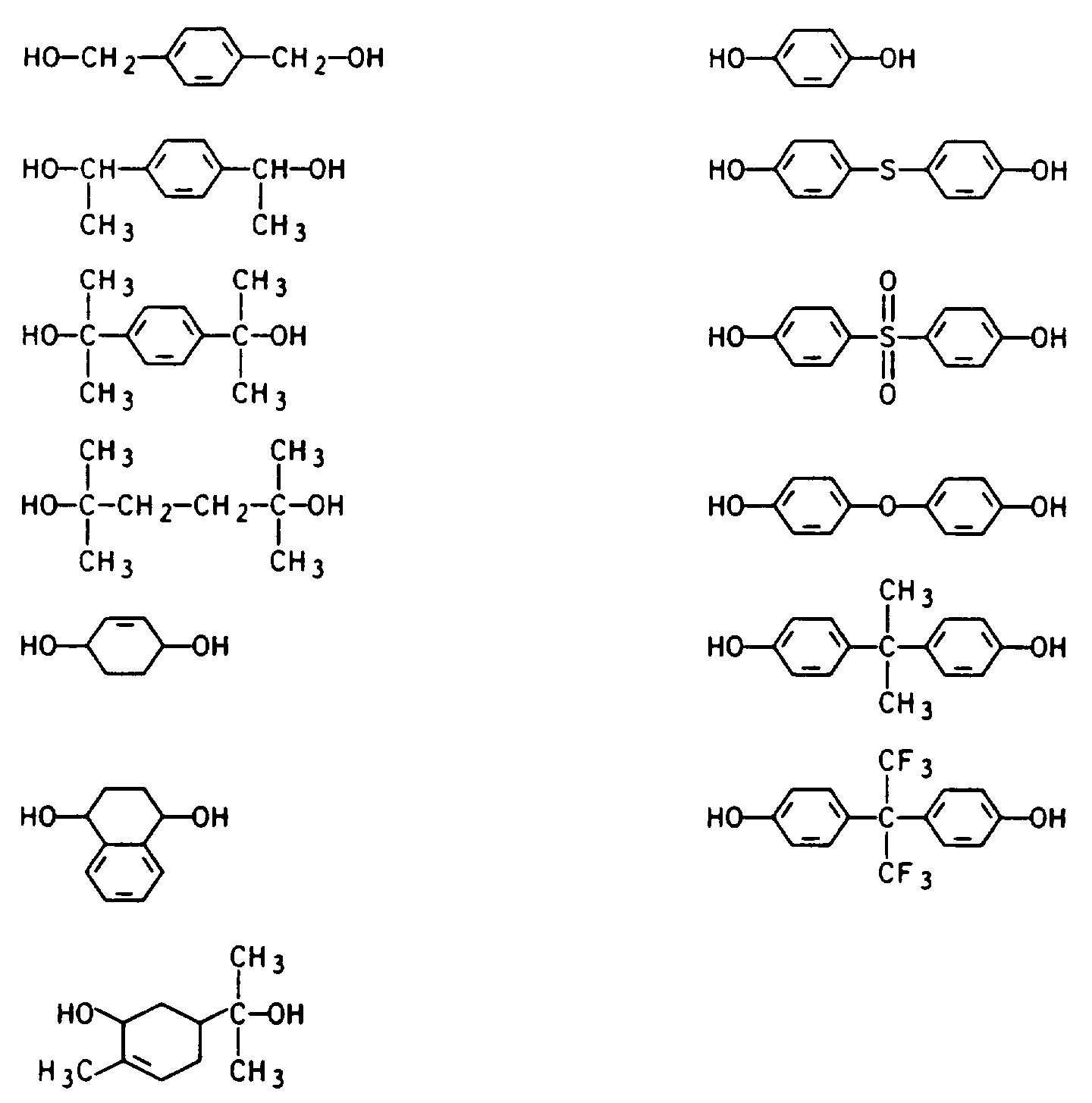

- Weiterhin kommen auch eine Reihe von hydroxylterminierten Siloxanen folgender Strukturformeln in Betracht:

- Die Polykondensationsreaktionen lassen sich nach bekannten Methoden zur Synthese von Polycarbonaten mit Phosgen (vgl. D. Braun, H. Cherdron und W. Kern, Praktikum der makromolekularen organischen Chemie, S. 257), Carbonyl-bis-imidazol (vgl. H. Staab, Angew. Chem., 74, 407, (1962) bzw. aktiven Estern, wie 4-Nitrophenyl-carbonaten (vgl. J. Frechet, Makromol. Chem., Rapid Comm. 7, 121-126 (1986), durchführen. Dabei werden die hydroxyfunktionellen Sulfoniumsalze in entsprechenden Mengen mit den entsprechenden Diolen bzw. den aktiven Esterderivaten in einem geeigneten Lösungsmittel kondensiert.
- Eine weitere Möglichkeit der Synthese der erfindungsgemäßen strahlungsempfindlichen Polymeren ist die Herstellung eines Polykondensats, welches Schwefelatome in der Hauptkette enthält und anschließend mit einem Iodoniumsalz gemäß folgender Gleichung umgesetzt wird:



- Zur Synthese von Sulfoniumsalzen über Iodoniumsalze vgl. J. Crivello, Advances in Polymer Science 62, Springer Verlag Heidelberg 1984, S. 9 und darin angegebene Literatur.
- Die Molekulargewichte der erfindungsgemäßen Polymeren liegen im allgemeinen zwischen 5.000 und 200.000, vorzugsweise zwischen 10.000 und 80.000 (Molekulargewicht ermittelt nach Lichtstreuung).
- Für die Weiterverarbeitung und Verwendung werden die erfindungsgemäßen Polymeren im allgemeinen in einem geeigneten Lösungsmittel, z.B. Cyclohexanon, Ethylenglykol-ethylether-acetat oder Methylpropylenglykolacetat gelöst, als dünner Film von ca. 1 bis 2 µm auf ein Substrat, beispielsweise einen Siliziumwafer aufgebracht, unter kontrollierten Bedingungen z.B. zwischen 60°C und 120°C ausgeheizt, bildmäßig belichtet und nochmals unter kontrollierten Bedingungen, zwischen 40°C und 120°C ausgeheizt. Danach können die belichteten Bereiche mit einem alkalischen oder polaren Lösungsmittel entfernt werden. Gegebenenfalls können die in die Monomerbausteine zerfallenen belichteten Bereiche auch im Vakuum entfernt und, gegebenenfalls mit Hilfe eines kurzen Nachspülvorganges mit einem polaren Lösungsmittel, somit sauber ausgebildete Strukturen erzeugt werden.
- Geeignete Entwickler sind alkalische Lösungen im pH-Wertbereich oberhalb 11, z.B. wäßrige Lösungen von Alkalihydroxiden, Tetraalkylammoniumhydroxiden oder Aminen, oder polare Lösungsmittel wie beispielsweise Isopropanol.
- Die erfindungsgemäßen Polymeren eignen sich für die Belichtung im kurzwelligen UV-Bereich unterhalb 300 nm, mit Röntgen- und Elektronenstrahlen sowie bei geeigneter Wahl der Monomerbausteine, d.h., solche die im längerwelligen UV-Bereich absorbieren, oder bei Zusatz von Sensibilisatoren, wie Phenothiazin oder Perylen, auch für die Belichtung im nahen UV-Breich oberhalb 300 nm.
- Die erfindungsgemäßen strahlungsempfindlichen Polymeren eignen sich zur Herstellung von Photoresists, inbesondere zur Herstellung von Resists für die Mikrolithographie sowie als Leiterplattenresiste. Sie zeichnen sich insbesondere durch hohe Empfindlichkeit, hohe Auflösung, gute Ätzstabilität, hohe Beständigkeit gegen Plasmen, insbesondere Sauerstoffplasmen bei Verwendung von Siloxanen in der Polymerkette sowie gegebenenfalls Trockenentwickelbarkeit aus.
- Die Herstellung von Halbleiterbauelementen unter Verwendung der erfindungsgemäßen strahlungsempfindlichen Polymeren erfolgt in üblicher Weise mit Hilfe der Photolithographietechnik, wie sie beispielsweise in "Peter Kästner, Halbleitertechnologie", Vogel-Verlag, Würzburg 1980, Seiten 75 bis 117 beschrieben ist.
- Die in den Beispielen genannten Teile und Prozente sind, soweit nicht anders angegeben, Gewichtsteile bzw. Gewichtsprozente.
- Es wird ein Polycarbonat analog der Vorschrift in D. Braun, H. Cherdron und W. Kern, Praktikum der makromolekularen organischen Chemie, Hüthig-Verlag, S. 257, dargestellt, indem anstatt Bisphenol A die analoge Schwefelverbindung Bis-(hydroxyphenyl)-sulfid eingesetzt wird.
- 2,44 Teile dieses Polycarbonats (Poly-oxycarbonyloxy-1,4-phenylenthio-1,4-phenylen), 4,7 Teile Diphenyliodonium-hexafluoroarsenat und 0,2 Teile Kupfer(II)acetat werden in einem Kolben zusammengegeben und 3 Stunden bei 120°C gerührt. Das Reaktionsgemisch wird in ein Becherglas gegeben und dreimal miit Ether extrahiert. Es sind 3,0 Teile eines strahlungsempfindlichen Polymeren entstanden, welches Carbonat (IR: 1730 cm⁻¹) und Sulfoniumhexafluoroarsenat-gruppierungen (IR: 700 cm⁻¹) enthält.
Elementaranalyse: C: 48,8 H: 3,9 S: 6,4 As: 12,1 F: 18,7 J: < 0,5 - 2,0 Teile dieses Polymeren werden in 8,0 Teilen Cyclohexanon gelöst, durch ein Teflonfilter mit der Porenweite 0,2 µm filtriert und in einer Schichtdicke von ca. 1,0 µm auf Siliziumwafer aufgeschleudert, die vorher mit Hexamethyldisilazan als Haftvermittler behandelt wurden. Die beschichteten Wafer wurden 5 Minuten bei 90°C auf einer Heizplatte ausgeheizt. Die Wafer wurden dann in einem "Süss MA56 Kontakt/Proximity-Belichter" im Kontaktverfahren mit Excimer-Laserlicht der Wellenlänge 248 nm durch eine chrombeschichtete Quarzmaske bildmäßig belichtet. Optimale Belichtungszeiten liegen zwischen 5 und 10 Sekunden. Nach der Belichtung werden die Wafer 1 Minute bei 90°C auf einer Heizplatte ausgeheizt und anschließend entwickelt, indem sie 1 Minute in eine wäßrig alkalische Lösung, z.B. Microposit® MF 319 (Shipley), getaucht werden. Es werden sauber entwickelte Strukturen mit einer Auflösung von 1 µm erhalten.
- Es wird wie in Beispiel 1 verfahren, jedoch wird anstatt des Polycarbonates aus reinem Bis-(hydroxyphenyl)sulfid ein Polycarbonat aus einer 1:1 Mischung Bisphenol A und Bis-(hydroxyphenyl)-sulfid eingesetzt. Die Belichtungszeiten liegen zwischen 10 und 20 Sekunden, ansonsten wird wie in Beispiel 1 verfahren und man erhält ebenfalls sauber ausentwickelte 1 µm Strukturen.
- Es wird wie in Beispiel 1 verfahren, jedoch wird das Polycarbonat aus Beispiel 2 mit Diphenyliodonium-hexafluorophosphat anstatt dem Arsenat umgesetzt. Die Lichtempfindlichkeit dieses Polymeren ist wesentlich geringer, es werden Belichtungszeiten von ca. 50 Sekunden benötigt.
- Als Ausgangsverbindungen für die Polykondensationsreaktion werden Phenyl-bis-(4-hydroxiphenyl-)sulfoniumhexafluoroarsenat gemäß Beispiel 2 in DE-OS-37 21 740 und Bis-(4-nitrophenyl)-1,1,4,4-tetramethyltetramethylen-dicarbonat gemäß Vorschrift in Makromol. Chem., Rapid Comm. 7, 123 (1986) synthetisiert.
- Ein strahlungsempfindliches Polymer wird durch Kondensation von 4,84 Teilen Phenyl-bis-(hydroxyphenyl)sulfoniumhexafluoroarsenat mit 4,76 Teilen Bis-(4-nitrophenyl)-1,1,4,4-tetramethyltetramethylendicarbonat in Gegenwart von 12 Teilen trockenem Kaliumcarbonat, 1,2 Teilen Kronenether 18-crown-6 und 40 Teilen Dichlormethan durch Erhitzen am Rückfluß während einer Reaktionszeit von 72 Stunden erhalten. Die Ausbeute an rein weißem Polymer beträgt: 2,8 Teile. Die spektroskopische Analyse stimmt mit der erwarteten Struktur überein.
- Molekulargewicht (LS): 57.500 g/mol
- Die lithographischen Untersuchungen werden wie in Beispiel 1 durchgeführt. Es resultieren Belichtungszeiten zwischen 0,5 und 1,5 Sekunden bei ebenfalls sauber ausentwickelten 1 µm Stukturen.
- Es wird wie in Beispiel 4 verfahren, jedoch wird anstatt Bis-(4-nitrophenyl)-1,1,4,4-tetramethyltetramethylen-dicarbonat Bis-(4-nitrophenyl)-1,4-phenylendiethyliden-dicarbonat verwendet. Ausbeute: 46 %. Testergebnis: Die Untersuchungen werden wie in Beispiel 1 durchgeführt. Bei einer Belichtungszeit von 25 Sekunden werden ausentwickelte Strukturen enthalten.
- Es wird wie in Beispiel 5 verfahren, jedoch wird anstatt Phenyl-bis-(hydroxyphenyl)sulfoniumhexafluoroarsenat Phenyl-methyl-2,5-dihydroxyphenyl-sulfoniumhexafluorophosphat verwendet. Ausbeute: 23 %. Testergebnis: Die lithographischen Untersuchungen werden wie in Beispiel 1 durchgeführt und es resultieren ebenfalls sauber entwickelte Strukturen, wenn man 10 Sekunden belichtet.
Claims (7)
- Strahlungsempfindliche Polymere, dadurch gekennzeichnet, daß sie in der Polymerhauptkette sowohl säurelabile Gruppen, als auch Sulfoniumsalzgruppen mit nichtnucleophilen Gegenionen enthalten.
- Strahlungsempfindliche Polymere nach Anspruch 1, dadurch gekennzeichnet, daß sie Einheiten der allgemeinen Formel (I) und (III) oder (II) und (III)
 R¹ und R untereinander gleich oder verschieden sind und Alkylen, Phenylen, substituiertes Phenylen oder Naphthylen bedeuten,R³ = Alkyl, Phenyl, substituiertes Phenyl oder Naphthyl-,R⁴ = dreibindiger aliphatischer oder aromatischer Kohlenwasserstoffrest,R⁵ und R⁶ untereinander gleich oder verschieden sind und Alkyl oder Phenyl bedeuten oder R5 und R6 miteinander zu einem 5- oder 6-gliedrigen Ring geschlossen sind,R⁷ = Alkylen, Phenylen, 1,4-Phenylen-dialkylen, oder zweiwertige Si-enthaltende ResteundX = Halogen, ClO₄, F-SO₃, CF₃-SO₃, BF₄, PF₆, AsF₆ oder SbF₆sein kann.
 - Strahlungsempfindliche Polymere nach einem der Ansprüche 1 oder 2, dadurch gekennzeichnet, daß sie als säurelabile Gruppen Carbonatgruppen enthalten.
- Strahlungsempfindliche Polymere nach einem der Ansprüche 1 bis3 , dadurch gekennzeichnet, daß sie zwischen 2 und 50 mol% Monomereinheiten mit Sulfoniumsalzgruppierungen einkondensiert enthalten.
- Strahlungsempfindliche Polymere nach einem der Ansprüche 2 bis 4, dadurch gekennzeichnet, daß sie aus kondensierten Einheiten mindestens einer der unter (I) angegebenen Einheiten mit mindestens einer der unter (III) angegebenen Einheiten oder mindestens einer der unter (II) angegebenen Einheiten mit mindestens einer der unter (III) angegebenen Einheiten

- Positiv arbeitendes Aufzeichnungsmaterial, bei dem die belichteten Bereiche mit einem alkalischen Entwickler oder polaren Lösungsmittel oder im Vakuum entfernt werden, dadurch gekennzeichnet, daß strahlungsempfindliche Polymere gemäß einem der vorhergehenden Ansprüche eingesetzt werden.
- Verfahren zur Herstellung von Halbleiterbauelementen, dadurch gekennzeichnet, daß man ein strahlungsempfindliches Polymer gemäß einem der Ansprüche 1 bis 6 auf ein ein Halbleitermaterial enthaltendes Substrat aufbringt, die strahlungsempfindliche Schicht in einem gewünschten Muster mit elektromagnetischer Strahlung bestrahlt, gegebenenfalls auf Temperaturen von 60°C bis 120°C aufheizt, das Muster entwickelt und die Herstellung des Halbleiterbauelementes in üblicher Weise zu Ende führt.
Applications Claiming Priority (2)
| Application Number | Priority Date | Filing Date | Title |
|---|---|---|---|
| DE3914407A DE3914407A1 (de) | 1989-04-29 | 1989-04-29 | Strahlungsempfindliche polymere und positiv arbeitendes aufzeichnungsmaterial |
| DE3914407 | 1989-04-29 |
Publications (3)
| Publication Number | Publication Date |
|---|---|
| EP0395992A2 EP0395992A2 (de) | 1990-11-07 |
| EP0395992A3 EP0395992A3 (de) | 1991-11-06 |
| EP0395992B1 true EP0395992B1 (de) | 1996-03-13 |
Family
ID=6379891
Family Applications (1)
| Application Number | Title | Priority Date | Filing Date |
|---|---|---|---|
| EP90107724A Expired - Lifetime EP0395992B1 (de) | 1989-04-29 | 1990-04-24 | Strahlungsempfindliche Polymere und positiv arbeitendes Aufzeichnungsmaterial |
Country Status (3)
| Country | Link |
|---|---|
| EP (1) | EP0395992B1 (de) |
| JP (1) | JP2848669B2 (de) |
| DE (2) | DE3914407A1 (de) |
Families Citing this family (179)
| Publication number | Priority date | Publication date | Assignee | Title |
|---|---|---|---|---|
| US5334699A (en) * | 1992-06-29 | 1994-08-02 | Xerox Corporation | Polymeric initiator compounds |
| JP2606653B2 (ja) * | 1993-04-06 | 1997-05-07 | 日本電気株式会社 | 珪素含有スルホニウム塩及びフォトレジスト組成物 |
| JPH0954437A (ja) | 1995-06-05 | 1997-02-25 | Fuji Photo Film Co Ltd | 化学増幅型ポジレジスト組成物 |
| US7192681B2 (en) | 2001-07-05 | 2007-03-20 | Fuji Photo Film Co., Ltd. | Positive photosensitive composition |
| DE10135246B4 (de) | 2001-07-19 | 2005-10-20 | Infineon Technologies Ag | Neue, auf Polykondensaten basierende Resists mit gesteigertem Auflösungsvermögen für den Einsatz in der 157 nm Lithografie |
| US7521168B2 (en) | 2002-02-13 | 2009-04-21 | Fujifilm Corporation | Resist composition for electron beam, EUV or X-ray |
| DE10245128A1 (de) | 2002-09-27 | 2004-04-08 | Infineon Technologies Ag | Fotoempfindlicher Lack zum Beschichten eines Substrates und Verfahren zum Belichten des mit dem Lack beschichteten Substrates |
| US7771915B2 (en) | 2003-06-27 | 2010-08-10 | Fujifilm Corporation | Two-photon absorbing optical recording material and two-photon absorbing optical recording and reproducing method |
| JP4448705B2 (ja) | 2004-02-05 | 2010-04-14 | 富士フイルム株式会社 | 感光性組成物及び該感光性組成物を用いたパターン形成方法 |
| JP4524154B2 (ja) | 2004-08-18 | 2010-08-11 | 富士フイルム株式会社 | 化学増幅型レジスト組成物及びそれを用いたパターン形成方法 |
| EP1637927A1 (de) | 2004-09-02 | 2006-03-22 | Fuji Photo Film Co., Ltd. | Positiv arbeitende Resistzusammensetzung und Verfahren zur Herstellung von Mustern unter Verwendung dieser Zusammensetzung |
| JP4469692B2 (ja) | 2004-09-14 | 2010-05-26 | 富士フイルム株式会社 | 感光性組成物、該感光性組成物に用いられる化合物及び該感光性組成物を用いたパターン形成方法 |
| JP4597655B2 (ja) * | 2004-12-20 | 2010-12-15 | 東京応化工業株式会社 | レジストパターン形成方法 |
| JP4452632B2 (ja) | 2005-01-24 | 2010-04-21 | 富士フイルム株式会社 | 感光性組成物、該感光性組成物に用いる化合物及び該感光性組成物を用いたパターン形成方法 |
| JP4562537B2 (ja) | 2005-01-28 | 2010-10-13 | 富士フイルム株式会社 | 感光性組成物、該感光性組成物に用いる化合物及び該感光性組成物を用いたパターン形成方法 |
| JP4439409B2 (ja) | 2005-02-02 | 2010-03-24 | 富士フイルム株式会社 | レジスト組成物及びそれを用いたパターン形成方法 |
| US7541131B2 (en) | 2005-02-18 | 2009-06-02 | Fujifilm Corporation | Resist composition, compound for use in the resist composition and pattern forming method using the resist composition |
| US20060204732A1 (en) | 2005-03-08 | 2006-09-14 | Fuji Photo Film Co., Ltd. | Ink composition, inkjet recording method, printed material, method of producing planographic printing plate, and planographic printing plate |
| JP4579019B2 (ja) | 2005-03-17 | 2010-11-10 | 富士フイルム株式会社 | ポジ型レジスト組成物及び該レジスト組成物を用いたパターン形成方法 |
| JP4724465B2 (ja) | 2005-05-23 | 2011-07-13 | 富士フイルム株式会社 | 感光性組成物及び該感光性組成物を用いたパターン形成方法 |
| JP4861767B2 (ja) | 2005-07-26 | 2012-01-25 | 富士フイルム株式会社 | ポジ型レジスト組成物およびそれを用いたパターン形成方法 |
| JP4580841B2 (ja) | 2005-08-16 | 2010-11-17 | 富士フイルム株式会社 | ポジ型レジスト組成物及びそれを用いたパターン形成方法 |
| JP4695941B2 (ja) | 2005-08-19 | 2011-06-08 | 富士フイルム株式会社 | 液浸露光用ポジ型レジスト組成物及びそれを用いたパターン形成方法 |
| US20070049651A1 (en) | 2005-08-23 | 2007-03-01 | Fuji Photo Film Co., Ltd. | Curable composition, ink composition, inkjet recording method, printed material, method of producing planographic printing plate, planographic printing plate, and oxcetane compound |
| JP4757574B2 (ja) | 2005-09-07 | 2011-08-24 | 富士フイルム株式会社 | インク組成物、インクジェット記録方法、印刷物、平版印刷版の製造方法、及び、平版印刷版 |
| TWI403843B (zh) | 2005-09-13 | 2013-08-01 | Fujifilm Corp | 正型光阻組成物及使用它之圖案形成方法 |
| EP2103639A1 (de) | 2005-11-04 | 2009-09-23 | Fujifilm Corporation | Härtbare polyzyklische Epoxidzusammensetzung, Tinte und Tintenstrahldruckverfahren damit |
| EP1795960B1 (de) | 2005-12-09 | 2019-06-05 | Fujifilm Corporation | Positive Resistzusammensetzung, Verfahren zur Musterbildung unter Verwendung der positiven Resistzusammensetzung, Verwendung der positiven Resistzusammensetzung |
| EP1829684B1 (de) | 2006-03-03 | 2011-01-26 | FUJIFILM Corporation | Härtbare Zusammensetzung, Tintenzusammensetzung, Tintenstrahlaufzeichnungsverfahren und Flachdruckplatte |
| JP4911456B2 (ja) | 2006-11-21 | 2012-04-04 | 富士フイルム株式会社 | ポジ型感光性組成物、該ポジ型感光性組成物に用いられる高分子化合物、該高分子化合物の製造方法及びポジ型感光性組成物を用いたパターン形成方法 |
| JP4554665B2 (ja) | 2006-12-25 | 2010-09-29 | 富士フイルム株式会社 | パターン形成方法、該パターン形成方法に用いられる多重現像用ポジ型レジスト組成物、該パターン形成方法に用いられるネガ現像用現像液及び該パターン形成方法に用いられるネガ現像用リンス液 |
| JP2008189776A (ja) | 2007-02-02 | 2008-08-21 | Fujifilm Corp | 活性放射線硬化型重合性組成物、インク組成物、インクジェット記録方法、印刷物、平版印刷版の作製方法、及び平版印刷版 |
| JP4905786B2 (ja) | 2007-02-14 | 2012-03-28 | 富士フイルム株式会社 | レジスト組成物及びそれを用いたパターン形成方法 |
| EP1962139A1 (de) | 2007-02-23 | 2008-08-27 | FUJIFILM Corporation | Negative Resistzusammensetzung und Verfahren zur Strukturformung damit |
| JP2008208266A (ja) | 2007-02-27 | 2008-09-11 | Fujifilm Corp | インク組成物、インクジェット記録方法、印刷物、平版印刷版の製造方法、および平版印刷版 |
| JP5162290B2 (ja) | 2007-03-23 | 2013-03-13 | 富士フイルム株式会社 | レジスト組成物及びそれを用いたパターン形成方法 |
| US8088566B2 (en) | 2007-03-26 | 2012-01-03 | Fujifilm Corporation | Surface-treating agent for pattern formation and pattern-forming method using the surface-treating agent |
| US7592118B2 (en) | 2007-03-27 | 2009-09-22 | Fujifilm Corporation | Positive resist composition and pattern forming method using the same |
| US7635554B2 (en) | 2007-03-28 | 2009-12-22 | Fujifilm Corporation | Positive resist composition and pattern forming method |
| EP1975714A1 (de) | 2007-03-28 | 2008-10-01 | FUJIFILM Corporation | Positive Resistzusammensetzung und Verfahren zur Strukturformung |
| US8182975B2 (en) | 2007-03-28 | 2012-05-22 | Fujifilm Corporation | Positive resist composition and pattern forming method using the same |
| EP1978408B1 (de) | 2007-03-29 | 2011-10-12 | FUJIFILM Corporation | Negative Resistzusammensetzung und Verfahren zur Strukturformung damit |
| JP5159141B2 (ja) | 2007-03-30 | 2013-03-06 | 富士フイルム株式会社 | インク組成物、インクジェット記録方法、印刷物、平版印刷版の作製方法及び平版印刷版 |
| JP5039622B2 (ja) | 2007-03-30 | 2012-10-03 | 富士フイルム株式会社 | ポジ型レジスト組成物及びこれを用いたパターン形成方法 |
| JP4982228B2 (ja) | 2007-03-30 | 2012-07-25 | 富士フイルム株式会社 | ポジ型レジスト組成物及びこれを用いたパターン形成方法 |
| KR100990106B1 (ko) | 2007-04-13 | 2010-10-29 | 후지필름 가부시키가이샤 | 패턴형성방법, 이 패턴형성방법에 사용되는 레지스트 조성물, 현상액 및 린스액 |
| EP1980911A3 (de) | 2007-04-13 | 2009-06-24 | FUJIFILM Corporation | Strukturformungsverfahren, in dem Strukturformungsverfahren zu verwendende Harzzusammensetzung, in dem Strukturformungsverfahren zu verwendende negative Entwicklungslösung und in dem Strukturformungsverfahren zu verwendende Spüllösung |
| JP4617337B2 (ja) | 2007-06-12 | 2011-01-26 | 富士フイルム株式会社 | パターン形成方法 |
| JP2008311474A (ja) | 2007-06-15 | 2008-12-25 | Fujifilm Corp | パターン形成方法 |
| WO2008153155A1 (ja) | 2007-06-15 | 2008-12-18 | Fujifilm Corporation | パターン形成用表面処理剤、及び該処理剤を用いたパターン形成方法 |
| JP2009009047A (ja) | 2007-06-29 | 2009-01-15 | Fujifilm Corp | パターン形成方法 |
| JP2009053688A (ja) | 2007-07-30 | 2009-03-12 | Fujifilm Corp | ポジ型レジスト組成物及びパターン形成方法 |
| JP5066405B2 (ja) | 2007-08-02 | 2012-11-07 | 富士フイルム株式会社 | 電子線、x線又はeuv用レジスト組成物及び該組成物を用いたパターン形成方法 |
| TWI470345B (zh) | 2007-08-03 | 2015-01-21 | Fujifilm Corp | 含新穎化合物之光阻組成物、使用該光阻組成物之圖案形成方法、及新穎化合物 |
| EP2177952A4 (de) | 2007-08-10 | 2011-05-04 | Fujifilm Corp | Positiv arbeitende resistzusammensetzung und strukturbildungsverfahren mit der positiv arbeitenden resistzusammensetzung |
| JP5449675B2 (ja) | 2007-09-21 | 2014-03-19 | 富士フイルム株式会社 | 感光性組成物、該感光性組成物を用いたパターン形成方法及び該感光性組成物に用いられる化合物 |
| JP5111039B2 (ja) | 2007-09-27 | 2012-12-26 | 富士フイルム株式会社 | 重合性化合物、重合開始剤、および染料を含有する光硬化性組成物 |
| JP4911469B2 (ja) | 2007-09-28 | 2012-04-04 | 富士フイルム株式会社 | レジスト組成物及びこれを用いたパターン形成方法 |
| US8240838B2 (en) | 2007-11-29 | 2012-08-14 | Fujifilm Corporation | Ink composition for inkjet recording, inkjet recording method, and printed material |
| JP5150296B2 (ja) | 2008-02-13 | 2013-02-20 | 富士フイルム株式会社 | 電子線、x線またはeuv用ポジ型レジスト組成物及びこれを用いたパターン形成方法 |
| US9046773B2 (en) | 2008-03-26 | 2015-06-02 | Fujifilm Corporation | Actinic ray-sensitive or radiation-sensitive resin composition, pattern forming method using the same, polymerizable compound and polymer compound obtained by polymerizing the polymerizable compound |
| JP5244711B2 (ja) | 2008-06-30 | 2013-07-24 | 富士フイルム株式会社 | 感活性光線性または感放射線性樹脂組成物及びそれを用いたパターン形成方法 |
| JP5997873B2 (ja) | 2008-06-30 | 2016-09-28 | 富士フイルム株式会社 | 感光性組成物及びそれを用いたパターン形成方法 |
| JP5746818B2 (ja) | 2008-07-09 | 2015-07-08 | 富士フイルム株式会社 | 感活性光線性または感放射線性樹脂組成物及びそれを用いたパターン形成方法 |
| JP5841707B2 (ja) | 2008-09-05 | 2016-01-13 | 富士フイルム株式会社 | ポジ型レジスト組成物、該組成物を用いたパターン形成方法及び該組成物に用いられる樹脂 |
| JP5383133B2 (ja) | 2008-09-19 | 2014-01-08 | 富士フイルム株式会社 | インク組成物、インクジェット記録方法及び印刷物成形体の製造方法 |
| EP2169018B1 (de) | 2008-09-26 | 2012-01-18 | Fujifilm Corporation | Tintenzusammensetzung und Tintenaufzeichnungsverfahren |
| JP5461809B2 (ja) | 2008-09-29 | 2014-04-02 | 富士フイルム株式会社 | インク組成物、及び、インクジェット記録方法 |
| EP2196462B1 (de) | 2008-12-12 | 2011-09-28 | Fujifilm Corporation | Polymerisierbare Verbindung, lactonhaltige Verbindung, Verfahren zur Herstellung der lactonhaltigen Verbindung und durch Polymerisierung der polymerisierbaren Verbindung erhaltene Polymerverbindung |
| JP5417150B2 (ja) | 2008-12-18 | 2014-02-12 | 富士フイルム株式会社 | 感活性光線性又は感放射線性樹脂組成物、レジスト膜、それを用いたパターン形成方法、及び樹脂 |
| JP2010235911A (ja) | 2009-03-11 | 2010-10-21 | Konica Minolta Ij Technologies Inc | 活性エネルギー線硬化型インクジェットインク、インクジェット記録方法及び印刷物 |
| JP5964007B2 (ja) | 2009-04-02 | 2016-08-03 | コニカミノルタ株式会社 | 活性エネルギー線硬化型インクジェットインク、インクジェット記録方法及び印刷物 |
| JP5783687B2 (ja) | 2009-06-23 | 2015-09-24 | 住友化学株式会社 | 樹脂及びレジスト組成物 |
| KR101726444B1 (ko) | 2009-08-31 | 2017-04-12 | 스미또모 가가꾸 가부시키가이샤 | 수지, 레지스트 조성물 및 레지스트 패턴의 제조 방법 |
| JP2011074365A (ja) | 2009-09-02 | 2011-04-14 | Sumitomo Chemical Co Ltd | 化合物、樹脂、レジスト組成物及びレジストパターンの製造方法 |
| KR101841000B1 (ko) | 2010-07-28 | 2018-03-22 | 스미또모 가가꾸 가부시키가이샤 | 포토레지스트 조성물 |
| JP6195692B2 (ja) | 2010-08-30 | 2017-09-13 | 住友化学株式会社 | レジスト組成物及びレジストパターンの製造方法並びに新規化合物及び樹脂 |
| JP2012087294A (ja) | 2010-09-21 | 2012-05-10 | Sumitomo Chemical Co Ltd | 樹脂、レジスト組成物及びレジストパターン製造方法 |
| JP5824321B2 (ja) | 2010-10-26 | 2015-11-25 | 住友化学株式会社 | レジスト組成物及びレジストパターンの製造方法 |
| JP5824320B2 (ja) | 2010-10-26 | 2015-11-25 | 住友化学株式会社 | レジスト組成物及びレジストパターンの製造方法 |
| JP5879834B2 (ja) | 2010-11-15 | 2016-03-08 | 住友化学株式会社 | 塩、レジスト組成物及びレジストパターンの製造方法 |
| JP6088133B2 (ja) | 2010-12-15 | 2017-03-01 | 住友化学株式会社 | レジスト組成物及びレジストパターンの製造方法 |
| JP5898521B2 (ja) | 2011-02-25 | 2016-04-06 | 住友化学株式会社 | レジスト組成物及びレジストパターンの製造方法 |
| JP5898520B2 (ja) | 2011-02-25 | 2016-04-06 | 住友化学株式会社 | レジスト組成物及びレジストパターンの製造方法 |
| JP5829939B2 (ja) | 2011-02-25 | 2015-12-09 | 住友化学株式会社 | レジスト組成物及びレジストパターンの製造方法 |
| JP6034025B2 (ja) | 2011-02-25 | 2016-11-30 | 住友化学株式会社 | レジスト組成物及びレジストパターンの製造方法 |
| JP5947053B2 (ja) | 2011-02-25 | 2016-07-06 | 住友化学株式会社 | レジスト組成物及びレジストパターンの製造方法 |
| JP5829941B2 (ja) | 2011-02-25 | 2015-12-09 | 住友化学株式会社 | レジスト組成物及びレジストパターンの製造方法 |
| JP5947051B2 (ja) | 2011-02-25 | 2016-07-06 | 住友化学株式会社 | レジスト組成物及びレジストパターンの製造方法 |
| JP5829940B2 (ja) | 2011-02-25 | 2015-12-09 | 住友化学株式会社 | レジスト組成物及びレジストパターンの製造方法 |
| JP6034026B2 (ja) | 2011-02-25 | 2016-11-30 | 住友化学株式会社 | レジスト組成物及びレジストパターンの製造方法 |
| JP5934536B2 (ja) | 2011-04-07 | 2016-06-15 | 住友化学株式会社 | レジスト組成物及びレジストパターンの製造方法 |
| JP5852490B2 (ja) | 2011-04-07 | 2016-02-03 | 住友化学株式会社 | レジスト組成物及びレジストパターンの製造方法 |
| JP6022788B2 (ja) | 2011-04-07 | 2016-11-09 | 住友化学株式会社 | レジスト組成物及びレジストパターンの製造方法 |
| JP6005964B2 (ja) | 2011-04-07 | 2016-10-12 | 住友化学株式会社 | レジスト組成物及びレジストパターンの製造方法 |
| JP6013797B2 (ja) | 2011-07-19 | 2016-10-25 | 住友化学株式会社 | レジスト組成物及びレジストパターンの製造方法 |
| JP5990041B2 (ja) | 2011-07-19 | 2016-09-07 | 住友化学株式会社 | レジスト組成物及びレジストパターンの製造方法 |
| JP5977594B2 (ja) | 2011-07-19 | 2016-08-24 | 住友化学株式会社 | レジスト組成物及びレジストパターンの製造方法 |
| JP5886696B2 (ja) | 2011-07-19 | 2016-03-16 | 住友化学株式会社 | レジスト組成物及びレジストパターンの製造方法 |
| JP6013799B2 (ja) | 2011-07-19 | 2016-10-25 | 住友化学株式会社 | レジスト組成物及びレジストパターンの製造方法 |
| JP6130631B2 (ja) | 2011-07-19 | 2017-05-17 | 住友化学株式会社 | レジスト組成物及びレジストパターンの製造方法 |
| JP6189020B2 (ja) | 2011-07-19 | 2017-08-30 | 住友化学株式会社 | レジスト組成物及びレジストパターンの製造方法 |
| JP6013798B2 (ja) | 2011-07-19 | 2016-10-25 | 住友化学株式会社 | レジスト組成物及びレジストパターンの製造方法 |
| JP6130630B2 (ja) | 2011-07-19 | 2017-05-17 | 住友化学株式会社 | レジスト組成物及びレジストパターンの製造方法 |
| JP5977593B2 (ja) | 2011-07-19 | 2016-08-24 | 住友化学株式会社 | レジスト組成物及びレジストパターンの製造方法 |
| JP5996944B2 (ja) | 2011-07-19 | 2016-09-21 | 住友化学株式会社 | レジスト組成物及びレジストパターンの製造方法 |
| JP5985898B2 (ja) | 2011-07-19 | 2016-09-06 | 住友化学株式会社 | レジスト組成物及びレジストパターンの製造方法 |
| JP5912912B2 (ja) | 2011-07-19 | 2016-04-27 | 住友化学株式会社 | レジスト組成物及びレジストパターンの製造方法 |
| JP2015038534A (ja) * | 2011-12-16 | 2015-02-26 | 日産化学工業株式会社 | レジスト下層膜形成組成物及びそれを用いたレジストパターンの形成方法 |
| JP6576162B2 (ja) | 2014-08-25 | 2019-09-18 | 住友化学株式会社 | レジスト組成物及びレジストパターンの製造方法 |
| JP6541508B2 (ja) | 2014-08-25 | 2019-07-10 | 住友化学株式会社 | 塩、樹脂、レジスト組成物及びレジストパターンの製造方法 |
| JP6615536B2 (ja) | 2014-08-25 | 2019-12-04 | 住友化学株式会社 | レジスト組成物及びレジストパターンの製造方法 |
| JP6507065B2 (ja) | 2014-08-25 | 2019-04-24 | 住友化学株式会社 | 化合物、樹脂、レジスト組成物及びレジストパターンの製造方法 |
| JP6595255B2 (ja) | 2014-08-25 | 2019-10-23 | 住友化学株式会社 | レジスト組成物及びレジストパターンの製造方法 |
| JP6596263B2 (ja) | 2014-08-25 | 2019-10-23 | 住友化学株式会社 | 化合物、樹脂、レジスト組成物及びレジストパターンの製造方法 |
| US9519218B2 (en) | 2014-09-16 | 2016-12-13 | Sumitomo Chemical Company, Limited | Resin, resist composition and method for producing resist pattern |
| US9869929B2 (en) | 2014-09-16 | 2018-01-16 | Sumitomo Chemical Company, Limited | Resin, resist composition and method for producing resist pattern |
| JP6533724B2 (ja) | 2014-09-16 | 2019-06-19 | 住友化学株式会社 | 樹脂、レジスト組成物及びレジストパターンの製造方法 |
| US9671691B2 (en) | 2014-09-16 | 2017-06-06 | Sumitomo Chemical Company, Limited | Resin, resist composition and method for producing resist pattern |
| JP6541525B2 (ja) | 2014-09-16 | 2019-07-10 | 住友化学株式会社 | 樹脂、レジスト組成物及びレジストパターンの製造方法 |
| JP6541526B2 (ja) | 2014-09-16 | 2019-07-10 | 住友化学株式会社 | 樹脂、レジスト組成物及びレジストパターンの製造方法 |
| JP6670591B2 (ja) | 2014-11-11 | 2020-03-25 | 住友化学株式会社 | レジスト組成物及びレジストパターンの製造方法 |
| JP6585471B2 (ja) | 2014-11-11 | 2019-10-02 | 住友化学株式会社 | レジスト組成物及びレジストパターンの製造方法 |
| JP6684075B2 (ja) | 2014-11-11 | 2020-04-22 | 住友化学株式会社 | 樹脂、レジスト組成物及びレジストパターンの製造方法 |
| JP6688041B2 (ja) | 2014-11-11 | 2020-04-28 | 住友化学株式会社 | レジスト組成物及びレジストパターンの製造方法 |
| JP6664932B2 (ja) | 2014-11-14 | 2020-03-13 | 住友化学株式会社 | 樹脂、レジスト組成物及びレジストパターンの製造方法 |
| JP6782070B2 (ja) | 2014-11-26 | 2020-11-11 | 住友化学株式会社 | レジスト組成物及びレジストパターンの製造方法 |
| JP6721319B2 (ja) | 2014-11-26 | 2020-07-15 | 住友化学株式会社 | ノニオン性化合物、樹脂、レジスト組成物及びレジストパターンの製造方法 |
| US9740097B2 (en) | 2015-03-31 | 2017-08-22 | Sumitomo Chemical Company, Limited | Resist composition and method for producing resist pattern |
| US9946157B2 (en) | 2015-03-31 | 2018-04-17 | Sumitomo Chemical Company, Limited | Resist composition and method for producing resist pattern |
| US10365560B2 (en) | 2015-03-31 | 2019-07-30 | Sumitomo Chemical Company, Limited | Resist composition and method for producing resist pattern |
| US10101657B2 (en) | 2015-03-31 | 2018-10-16 | Sumitomo Chemical Company, Limited | Resin, resist composition and method for producing resist pattern |
| JP6769735B2 (ja) | 2015-05-12 | 2020-10-14 | 住友化学株式会社 | 塩、酸発生剤、樹脂、レジスト組成物及びレジストパターンの製造方法 |
| JP6883954B2 (ja) | 2015-06-26 | 2021-06-09 | 住友化学株式会社 | レジスト組成物 |
| JP6864994B2 (ja) | 2015-06-26 | 2021-04-28 | 住友化学株式会社 | レジスト組成物 |
| JP6782102B2 (ja) | 2015-06-26 | 2020-11-11 | 住友化学株式会社 | レジスト組成物 |
| JP6963979B2 (ja) | 2016-12-14 | 2021-11-10 | 住友化学株式会社 | 樹脂、レジスト組成物及びレジストパターンの製造方法 |
| JP7042598B2 (ja) | 2016-12-14 | 2022-03-28 | 住友化学株式会社 | 樹脂、レジスト組成物及びレジストパターンの製造方法 |
| KR102461271B1 (ko) | 2017-02-08 | 2022-10-31 | 스미또모 가가꾸 가부시키가이샤 | 화합물, 수지, 레지스트 조성물 및 레지스트 패턴의 제조 방법 |
| JP7283883B2 (ja) | 2017-11-09 | 2023-05-30 | 住友化学株式会社 | 塩、酸発生剤、レジスト組成物及びレジストパターンの製造方法 |
| US11820735B2 (en) | 2018-04-12 | 2023-11-21 | Sumitomo Chemical Company, Limited | Salt, acid generator, resist composition and method for producing resist pattern |
| US11378883B2 (en) | 2018-04-12 | 2022-07-05 | Sumitomo Chemical Company, Limited | Salt, acid generator, resist composition and method for producing resist pattern |
| JP7269093B2 (ja) | 2018-05-29 | 2023-05-08 | 住友化学株式会社 | 塩、酸発生剤、レジスト組成物及びレジストパターンの製造方法 |
| JP2020029451A (ja) | 2018-08-17 | 2020-02-27 | 住友化学株式会社 | 塩、酸発生剤、レジスト組成物及びレジストパターンの製造方法 |
| JP7341787B2 (ja) | 2018-08-27 | 2023-09-11 | 住友化学株式会社 | 樹脂、レジスト組成物及びレジストパターンの製造方法 |
| JP7389622B2 (ja) | 2018-11-20 | 2023-11-30 | 住友化学株式会社 | 塩、クエンチャー、レジスト組成物及びレジストパターンの製造方法 |
| JP7412186B2 (ja) | 2019-01-18 | 2024-01-12 | 住友化学株式会社 | 樹脂、レジスト組成物及びレジストパターンの製造方法 |
| JP7471828B2 (ja) | 2019-01-18 | 2024-04-22 | 住友化学株式会社 | レジスト組成物及びレジストパターンの製造方法 |
| BE1027107B1 (fr) | 2019-03-25 | 2021-02-15 | Sumitomo Chemical Co | Compose, resine, composition de photoresist et procede de production de motif de photoresist |
| JP7488102B2 (ja) | 2019-05-17 | 2024-05-21 | 住友化学株式会社 | 塩、クエンチャー、レジスト組成物及びレジストパターンの製造方法 |
| JP7499071B2 (ja) | 2019-06-04 | 2024-06-13 | 住友化学株式会社 | 塩、クエンチャー、レジスト組成物及びレジストパターンの製造方法並びに塩の製造方法 |
| JP7537913B2 (ja) | 2019-06-04 | 2024-08-21 | 住友化学株式会社 | 塩、クエンチャー、レジスト組成物及びレジストパターンの製造方法 |
| JP7607416B2 (ja) | 2019-08-29 | 2024-12-27 | 住友化学株式会社 | 塩、クエンチャー、レジスト組成物及びレジストパターンの製造方法 |
| JP7545834B2 (ja) | 2019-08-29 | 2024-09-05 | 住友化学株式会社 | 塩、クエンチャー、レジスト組成物及びレジストパターンの製造方法 |
| JP7790865B2 (ja) | 2019-12-18 | 2025-12-23 | 住友化学株式会社 | レジスト組成物及びレジストパターンの製造方法 |
| JP7614850B2 (ja) | 2020-02-06 | 2025-01-16 | 住友化学株式会社 | カルボン酸塩、カルボン酸発生剤、レジスト組成物及びレジストパターンの製造方法 |
| JP7659395B2 (ja) | 2020-02-06 | 2025-04-09 | 住友化学株式会社 | 塩、酸発生剤、レジスト組成物及びレジストパターンの製造方法 |
| US11681220B2 (en) | 2020-03-05 | 2023-06-20 | Sumitomo Chemical Company, Limited | Resist composition and method for producing resist pattern |
| US11740555B2 (en) | 2020-03-05 | 2023-08-29 | Sumitomo Chemical Company, Limited | Resist composition and method for producing resist pattern |
| US11675267B2 (en) | 2020-03-23 | 2023-06-13 | Sumitomo Chemical Company, Limited | Resist composition and method for producing resist pattern |
| TWI858248B (zh) | 2020-04-22 | 2024-10-11 | 日商住友化學股份有限公司 | 抗蝕劑組成物及抗蝕劑圖案的製造方法 |
| JP7689013B2 (ja) | 2020-05-15 | 2025-06-05 | 住友化学株式会社 | カルボン酸塩、クエンチャー、レジスト組成物及びレジストパターンの製造方法 |
| JP7758475B2 (ja) | 2020-05-15 | 2025-10-22 | 住友化学株式会社 | 酸発生剤、レジスト組成物及びレジストパターンの製造方法 |
| TWI877361B (zh) | 2020-05-21 | 2025-03-21 | 日商住友化學股份有限公司 | 鹽、酸產生劑、抗蝕劑組成物及抗蝕劑圖案的製造方法 |
| TWI849314B (zh) | 2020-06-01 | 2024-07-21 | 日商住友化學股份有限公司 | 化合物、樹脂、抗蝕劑組成物及抗蝕劑圖案的製造方法 |
| JP7789494B2 (ja) | 2020-06-01 | 2025-12-22 | 住友化学株式会社 | 化合物、樹脂、レジスト組成物及びレジストパターンの製造方法 |
| JP2022008152A (ja) | 2020-06-25 | 2022-01-13 | 住友化学株式会社 | 塩、酸発生剤、レジスト組成物及びレジストパターンの製造方法 |
| JP7758480B2 (ja) | 2020-07-01 | 2025-10-22 | 住友化学株式会社 | 塩、酸発生剤、レジスト組成物及びレジストパターンの製造方法 |
| JP7696275B2 (ja) | 2020-11-06 | 2025-06-20 | 住友化学株式会社 | 塩、酸発生剤、レジスト組成物及びレジストパターンの製造方法 |
| JP7748854B2 (ja) | 2020-11-11 | 2025-10-03 | 住友化学株式会社 | カルボン酸塩、レジスト組成物及びレジストパターンの製造方法 |
| JP7714438B2 (ja) | 2020-11-12 | 2025-07-29 | 住友化学株式会社 | 塩、酸発生剤、レジスト組成物及びレジストパターンの製造方法 |
| JP7790991B2 (ja) | 2021-02-12 | 2025-12-23 | 住友化学株式会社 | 塩、酸発生剤、レジスト組成物及びレジストパターンの製造方法 |
| JP2022164585A (ja) | 2021-04-15 | 2022-10-27 | 住友化学株式会社 | 塩、酸発生剤、レジスト組成物及びレジストパターンの製造方法 |
| JP7848027B2 (ja) | 2021-04-15 | 2026-04-20 | 住友化学株式会社 | 塩、酸発生剤、レジスト組成物及びレジストパターンの製造方法 |
| US12566375B2 (en) | 2021-05-06 | 2026-03-03 | Sumitomo Chemical Company, Limited | Salt, acid generator, resist composition and method for producing resist pattern |
| JP2022183074A (ja) | 2021-05-28 | 2022-12-08 | 住友化学株式会社 | 塩、酸発生剤、レジスト組成物及びレジストパターンの製造方法 |
| JP2022183077A (ja) | 2021-05-28 | 2022-12-08 | 住友化学株式会社 | 塩、酸発生剤、レジスト組成物及びレジストパターンの製造方法 |
| JP2023024363A (ja) | 2021-08-06 | 2023-02-16 | 住友化学株式会社 | レジスト組成物及びレジストパターンの製造方法 |
| US20240264530A1 (en) * | 2022-12-28 | 2024-08-08 | Intel Corporation | Light responsive photoresists and methods |
Citations (1)
| Publication number | Priority date | Publication date | Assignee | Title |
|---|---|---|---|---|
| DE3628046A1 (de) * | 1985-08-19 | 1987-02-19 | Fuji Photo Film Co Ltd | Photosolubilisierbare zusammensetzung |
Family Cites Families (10)
| Publication number | Priority date | Publication date | Assignee | Title |
|---|---|---|---|---|
| US3804797A (en) * | 1972-09-13 | 1974-04-16 | Dow Chemical Co | Coating compositions comprising cyclic sulfonium zwitterions with carboxy containing polymers |
| JPS5525409B2 (de) * | 1973-05-26 | 1980-07-05 | ||
| DE3248246A1 (de) * | 1982-12-28 | 1984-06-28 | Basf Ag, 6700 Ludwigshafen | Positiv arbeitendes verfahren zur herstellung von relief- und druckformen |
| US4469774A (en) * | 1983-03-28 | 1984-09-04 | E. I. Du Pont De Nemours And Company | Positive-working photosensitive benzoin esters |
| GB8333901D0 (en) * | 1983-12-20 | 1984-02-01 | Minnesota Mining & Mfg | Radiationsensitive compositions |
| DE3542778A1 (de) * | 1985-12-04 | 1987-06-11 | Basf Ag | Vollaromatische mesomorphe polyetherester, deren herstellung und verwendung |
| CA1338575C (en) * | 1987-12-08 | 1996-09-03 | Naozumi Iwasawa | Curable resin composition |
| GB2213487B (en) * | 1987-12-08 | 1992-01-08 | Kansai Paint Co Ltd | Method of forming a cured coating film |
| DE3817010A1 (de) * | 1988-05-19 | 1989-11-30 | Basf Ag | Strahlungsempfindliches gemisch und verfahren zur herstellung von reliefmustern |
| DE3902115A1 (de) * | 1989-01-25 | 1990-08-02 | Basf Ag | Strahlungsempfindliche polymere |
-
1989
- 1989-04-29 DE DE3914407A patent/DE3914407A1/de not_active Withdrawn
-
1990
- 1990-04-23 JP JP2105481A patent/JP2848669B2/ja not_active Expired - Lifetime
- 1990-04-24 EP EP90107724A patent/EP0395992B1/de not_active Expired - Lifetime
- 1990-04-24 DE DE59010186T patent/DE59010186D1/de not_active Expired - Lifetime
Patent Citations (1)
| Publication number | Priority date | Publication date | Assignee | Title |
|---|---|---|---|---|
| DE3628046A1 (de) * | 1985-08-19 | 1987-02-19 | Fuji Photo Film Co Ltd | Photosolubilisierbare zusammensetzung |
Also Published As
| Publication number | Publication date |
|---|---|
| JP2848669B2 (ja) | 1999-01-20 |
| DE3914407A1 (de) | 1990-10-31 |
| JPH02302758A (ja) | 1990-12-14 |
| DE59010186D1 (de) | 1996-04-18 |
| EP0395992A2 (de) | 1990-11-07 |
| EP0395992A3 (de) | 1991-11-06 |
Similar Documents
| Publication | Publication Date | Title |
|---|---|---|
| EP0395992B1 (de) | Strahlungsempfindliche Polymere und positiv arbeitendes Aufzeichnungsmaterial | |
| US5260410A (en) | Radiation-sensitive polymer having acid labile groups and onium salt groups | |
| US5453341A (en) | Radiation-sensitive polymers and positive-working recording materials | |
| EP0297443B1 (de) | Strahlungsempfindliches Gemisch für lichtempfindliche Beschichtungsmaterialien | |
| JP4680915B2 (ja) | 過フッ素化多官能性アニオンを有する光酸発生剤 | |
| EP0342498B1 (de) | Positiv und negativ arbeitende strahlungsempfindliche Gemische sowie Verfahren zur Herstellung von Reliefmustern | |
| DE10063066B4 (de) | Iodoniumsalze als latente Säurespender | |
| KR100320773B1 (ko) | 포토레지스트 조성물 | |
| DE10046891A1 (de) | Photoresistzusammensetzung, die einen Photobase-Bildner und einen Photosäure-Bildner enthält | |
| EP0553737B1 (de) | Strahlungsempfindliches Gemisch | |
| EP0342494B1 (de) | Strahlungsempfindliches Gemisch und Verfahren zur Herstellung von Reliefmustern | |
| DE3751745T2 (de) | Hochempfindliche Resiste mit Selbstzersetzungstemperatur grösser als etwa 160 Grad Celsius | |
| US6399792B2 (en) | Photoresist cross-linker and photoresist composition comprising the same | |
| EP0510443B1 (de) | Negativ arbeitendes strahlungsempfindliches Gemisch und damit hergestelltes strahlungsempfindliches Aufzeichnungsmaterial | |
| EP0508174A1 (de) | Strahlungsempfindliches Gemisch, enthaltend säurelabile Gruppierungen und Verfahren zur Herstellung von Reliefmustern und Reliefbildern | |
| DE69626898T2 (de) | Strahlungsempfindliche Zusammensetzung | |
| EP0510440A1 (de) | Positiv arbeitendes strahlungsempfindliches Gemisch und Damit hergestelltes strahlungsempfindliches Aufzeichnungsmaterial | |
| JP2975315B2 (ja) | 3成分系化学増幅型フォトレジスト組成物 | |
| DE3935876A1 (de) | Strahlungsempfindliches gemisch | |
| EP0510445A1 (de) | Säurespaltbare strahlungsempfindliche Verbindungen, diese enthaltendes strahlungsempfindliches Gemisch und daraus hergestelltes strahlungsempfindliches Aufzeichnungsmaterial | |
| EP0372408A2 (de) | Strahlungsempfindliches Gemisch | |
| EP0443415A2 (de) | Strahlungsempfindliches Gemisch | |
| DE4207263A1 (de) | Niedermolekulare saeurespaltbare verbindungen mit 2,2-bis-trifluormethyl-oxaethano-brueckengliedern und deren verwendung | |
| DE3940965A1 (de) | Strahlungsempfindliches gemisch und verfahren zur herstellung von reliefstrukturen | |
| EP0510444A1 (de) | Säurespaltbare, strahlungsempfindliche Verbindungen, diese enthaltendes strahlungsempfindliches Gemisch und daraus hergestelltes strahlungsempfindliches Aufzeichnungsmaterial |
Legal Events
| Date | Code | Title | Description |
|---|---|---|---|
| PUAI | Public reference made under article 153(3) epc to a published international application that has entered the european phase |
Free format text: ORIGINAL CODE: 0009012 |
|
| AK | Designated contracting states |
Kind code of ref document: A2 Designated state(s): BE CH DE FR GB IT LI NL |
|
| 17P | Request for examination filed |
Effective date: 19901227 |
|
| PUAL | Search report despatched |
Free format text: ORIGINAL CODE: 0009013 |
|
| AK | Designated contracting states |
Kind code of ref document: A3 Designated state(s): BE CH DE FR GB IT LI NL |
|
| 17Q | First examination report despatched |
Effective date: 19940518 |
|
| GRAA | (expected) grant |
Free format text: ORIGINAL CODE: 0009210 |
|
| AK | Designated contracting states |
Kind code of ref document: B1 Designated state(s): BE CH DE FR GB IT LI NL |
|
| PG25 | Lapsed in a contracting state [announced via postgrant information from national office to epo] |
Ref country code: NL Free format text: LAPSE BECAUSE OF FAILURE TO SUBMIT A TRANSLATION OF THE DESCRIPTION OR TO PAY THE FEE WITHIN THE PRESCRIBED TIME-LIMIT Effective date: 19960313 Ref country code: BE Effective date: 19960313 |
|
| REF | Corresponds to: |
Ref document number: 59010186 Country of ref document: DE Date of ref document: 19960418 |
|
| PG25 | Lapsed in a contracting state [announced via postgrant information from national office to epo] |
Ref country code: LI Effective date: 19960430 Ref country code: CH Effective date: 19960430 |
|
| GBT | Gb: translation of ep patent filed (gb section 77(6)(a)/1977) |
Effective date: 19960329 |
|
| ITF | It: translation for a ep patent filed | ||
| ET | Fr: translation filed | ||
| NLV1 | Nl: lapsed or annulled due to failure to fulfill the requirements of art. 29p and 29m of the patents act | ||
| REG | Reference to a national code |
Ref country code: CH Ref legal event code: PL |
|
| PLBE | No opposition filed within time limit |
Free format text: ORIGINAL CODE: 0009261 |
|
| STAA | Information on the status of an ep patent application or granted ep patent |
Free format text: STATUS: NO OPPOSITION FILED WITHIN TIME LIMIT |
|
| 26N | No opposition filed | ||
| PGFP | Annual fee paid to national office [announced via postgrant information from national office to epo] |
Ref country code: FR Payment date: 19980312 Year of fee payment: 9 |
|
| PGFP | Annual fee paid to national office [announced via postgrant information from national office to epo] |
Ref country code: GB Payment date: 19980415 Year of fee payment: 9 |
|
| PGFP | Annual fee paid to national office [announced via postgrant information from national office to epo] |
Ref country code: DE Payment date: 19980427 Year of fee payment: 9 |
|
| PG25 | Lapsed in a contracting state [announced via postgrant information from national office to epo] |
Ref country code: GB Free format text: LAPSE BECAUSE OF NON-PAYMENT OF DUE FEES Effective date: 19990424 |
|
| PG25 | Lapsed in a contracting state [announced via postgrant information from national office to epo] |
Ref country code: DE Free format text: LAPSE BECAUSE OF THE APPLICANT RENOUNCES Effective date: 19990428 |
|
| GBPC | Gb: european patent ceased through non-payment of renewal fee |
Effective date: 19990424 |
|
| PG25 | Lapsed in a contracting state [announced via postgrant information from national office to epo] |
Ref country code: FR Free format text: LAPSE BECAUSE OF NON-PAYMENT OF DUE FEES Effective date: 19991231 |
|
| REG | Reference to a national code |
Ref country code: FR Ref legal event code: ST |
|
| PG25 | Lapsed in a contracting state [announced via postgrant information from national office to epo] |
Ref country code: IT Free format text: LAPSE BECAUSE OF NON-PAYMENT OF DUE FEES;WARNING: LAPSES OF ITALIAN PATENTS WITH EFFECTIVE DATE BEFORE 2007 MAY HAVE OCCURRED AT ANY TIME BEFORE 2007. THE CORRECT EFFECTIVE DATE MAY BE DIFFERENT FROM THE ONE RECORDED. Effective date: 20050424 |