EP0397079A2 - Paralleler Pseudo-Zufallsgenerator zur Emulierung eines seniellen Pseudo-Zufallsgenerators und Verfahren zu dessen Ausführung - Google Patents
Paralleler Pseudo-Zufallsgenerator zur Emulierung eines seniellen Pseudo-Zufallsgenerators und Verfahren zu dessen Ausführung Download PDFInfo
- Publication number
- EP0397079A2 EP0397079A2 EP90108555A EP90108555A EP0397079A2 EP 0397079 A2 EP0397079 A2 EP 0397079A2 EP 90108555 A EP90108555 A EP 90108555A EP 90108555 A EP90108555 A EP 90108555A EP 0397079 A2 EP0397079 A2 EP 0397079A2
- Authority
- EP
- European Patent Office
- Prior art keywords
- serial
- output
- exclusive
- inputs connected
- pseudo
- Prior art date
- Legal status (The legal status is an assumption and is not a legal conclusion. Google has not performed a legal analysis and makes no representation as to the accuracy of the status listed.)
- Withdrawn
Links
Images



Classifications
-
- H—ELECTRICITY
- H04—ELECTRIC COMMUNICATION TECHNIQUE
- H04L—TRANSMISSION OF DIGITAL INFORMATION, e.g. TELEGRAPHIC COMMUNICATION
- H04L25/00—Baseband systems
- H04L25/02—Details ; arrangements for supplying electrical power along data transmission lines
- H04L25/03—Shaping networks in transmitter or receiver, e.g. adaptive shaping networks
- H04L25/03828—Arrangements for spectral shaping; Arrangements for providing signals with specified spectral properties
- H04L25/03866—Arrangements for spectral shaping; Arrangements for providing signals with specified spectral properties using scrambling
- H04L25/03872—Parallel scrambling or descrambling
Definitions
- the present invention relates to a circuit and associated method for emulating the output of a serial pseudo-random generator (PRG) or scrambler by a parallel implementation comprising a plurality of outputs which represent successive serial outputs of the serial PRG.
- PRG serial pseudo-random generator
- the invention has particular use in telecommunications, where high speed data streams are combined with a serial PRG so as to insure proper clocking and for potential security of the data stream. Due to the high-speed nature of such telecommunication data, serial PRG's cannot be implemented using complimentary metal oxide silicon (CMOS) circuitry. Thus there is a need for emulating the serial PRG so that the clock rate of the circuitry is within the operating frequency of CMOS circuitry.
- CMOS complimentary metal oxide silicon
- the serial PRG has to be implemented using high speed fabrication techniques, such as discrete emitter coupled logic (ECL) circuitry, ECL application specific integrated circuitry (ECL ASIC) or gallium arsenide (GaAs) circuitry, rather than the preferable CMOS circuitry which is less expensive to fabricate and operates at lower power than corresponding ECL or gallium arsenide circuitry.
- ECL discrete emitter coupled logic
- ECL ASIC ECL application specific integrated circuitry
- GaAs gallium arsenide
- the additional fabrication costs and power requirements of ECL and GaAs circuitry also require more printed circuit board area in order to dissipate the additional heat, again making CMOS circuitry and especially CMOS application specific integrated circuitry (CMOS ASIC) preferable.
- CMOS circuitry cannot typically operate at clock speeds greater than 50 megahertz, it is necessary that a technique be used to effectively reduce the clock frequency of the serial pseudo-random generator.
- the present invention describes such a technique and circuit which is operable for any serial PRG generating polynomial, as well as for any size parallel output word larger than the length of the equivalent serial shift register, representing the successive outputs from the serial PRG.
- CMOS circuitry can be used to fabricate a parallel PRG which emulates the output of a serial PRG.
- a parallel pseudo-random generator which emulates a serial pseudo-random generator which in turn operates upon a feedback arrangement wherein the next input value of the serial PRG is equal to the Exclusive-OR (XOR) combination of previous outputs of the serial PRG.
- XOR Exclusive-OR
- a typical scrambling polynomial is 1 + x 6 + X 7. This polynomial means that the next input value of the serial PRG is equal to the output of the sixth preceding value of the generator, exclusively ORed with the seventh preceding value of the generator.
- the output of the seventh preceding value of the generator is also typically exclusive ORed with the data to be scrambled.
- the serial PRG has a clock rate of f s
- the parallel PRG has a clock rate (fp) of f/W, where W is the number of outputs of the parallel PRG.
- the parallel PRG can be extended to any number of outputs (any size W) by choosing feedback paths which effectively emulate the serial PRG.
- the feedback paths are based upon the serial generating polynomial and the output size of the parallel PRG implementation.
- W equals 8 and 16 respectively
- corresponding numbers of D type flip-flops (FF) are used with Exclusive OR (XOR) gates which provide the necessary feedback for determining the values of the next W outputs corresponding to the next W successive values of the simulated serial PRG.
- FF D type flip-flops
- XOR Exclusive OR
- Another object of the present invention is to provide a parallel PRG of the above description, wherein the value of W can be made arbitrarily large so that the resulting parallel clock frequency can be set arbitrarily low and therefore provide for implementation of a parallel PRG using CMOS fabrication techniques.
- a still further object of the present invention is to provide a parallel PRG of the above description incorporating D type flip-flops in association with exclusive OR gates for providing the necessary feedback from the W outputs so as to determine the next W outputs.
- a still further object of the present invention is to provide a parallel PRG of the above description which is implementable for any serial PRG generating polynomial.
- serial pseudo-random generator 20 incorporates a plurality of stages arranged as a shift register 22 such that the value in each stage is transferred to the next stage until the last stage is encountered.
- the value in the last stage is typically Exclusive ORed (XOR) with one bit of the telecommunication data stream with the result of the XOR operation actually transmitted in the telecommunication application.
- XOR Exclusive ORed
- An Exclusive OR operation is defined such that if both inputs are logic 1 or logic 0, then the output is logic 0 and if the inputs are respectively logic 1 and logic 0, or vice-versa, then the output is logic 1.
- Table 1 A truth table representing an Exclusive OR operation is shown in Table 1.
- the purpose of the pseudo-random generator in most telecommunication applications is to insure that regardless of the telecommunication bit stream pattern, the actual information transmitted will comprise approximately the same number of 1's and 0's. This result facilitates maintaining clocking information in the telecommunication bit stream which otherwise would be more difficult if, for instance, the telecommunication bit stream contained long, consecutive patterns of 1's or 0's. Such scrambling is also useful for data encryption.
- the polynomial is 1 + X 6 + X 7 .
- this polynomial means that the value in shift register 6 is Exclusive ORed with the value in register 7 with the result being the next value in stage #1 of the P stage shift register.
- Table 4 shows the values in the seven stages where the starting value for each of the seven shift registers is logic 1. This starting value is typically called a "seed".
- the seed is typically all 1's for a serial PRG.
- the values generated for stage 1 successively move down the stages of the shift register.
- the output from stage 7 is also used for Exclusive ORing with the serial telecommunication bit stream.
- pseudo-random generator The reason such a generator is called a pseudo-random generator is that the bit stream generated is always the same for the same starting seed and same polynomial.
- maximal length polynomials are used, that is, polynomials that repeat themselves after a maximum number of counts (clock cycles).
- the maximum number of counts is 2" -1 for an nth order polynomial.
- a maximal polynomial is 1 + X 2 + X 3
- a non-maximal polynomial is 1 + X' + X 2 + X 3 .
- the maximal length polynomial repeats after seven outputs, while the non-maximal length polynomial repeats after four outputs.
- the present invention is applicable with any serial polynomial, whether maximal or not.
- serial pseudo-random generator presents problems in integrated circuit implementation when the transmission rate of the telecommunication bit stream exceeds approximately 50 megabits per second. At speeds in excess of 50 megahertz per second, the fabrication of complimentary metal oxide silicon (CMOS) integrated circuitry becomes impractical. In fact CMOS fabrication at usable speeds exceeding approximately 75 megahertz is virtually impossible. As a result, for high transmission speeds such as those used in the SONET standard (such as 155 megabits per second), it is necessary if such a serial pseudo-random generator is to be used, that it be fabricated using emitter coupled logic (ECL) or gallium arsenide (GaAs) technology.
- ECL emitter coupled logic
- GaAs gallium arsenide
- the present invention provides a general solution to the generation of high-speed pseudo-random bit patterns by providing a parallel pseudo-random generator having a plurality of parallel outputs whose values represent successive outputs of the serial pseudo-random generator.
- a parallel pseudo-random generator 24 may have any desired number of parallel outputs with the example shown in Figure 2 having 8 outputs and that shown in Figure 4 having 16 outputs.
- the size of the parallel pseudo-random generator can be set to whatever value is best suited for a particular application, as long as the parallel word size is equal to or greater than the order of the scrambling polynomial.
- the number of outputs generally has a value equal to a multiple of 2, such as 8 outputs, 16 outputs, etc.
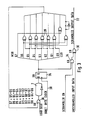
- the pseudo-random generator comprises eight latches 26, which may be D type flip-flops, whose outputs (QO through Q7) represent eight successive output values of the emulated serial pseudo-random generator.
- the output of the serial pseudo-random generator is serial stage #7, it is seen that this seventh stage has logic value 1 for the first seven serial clock cycles (serial clock cycles 0 - 6) and has logic value 0 for the next clock cycle (serial clock cycle 7).
- Outputs Q7 through QO of the 8 bit parallel PRG therefore can represent these eight successive output values of stage 7 in the serial PRG as shown in Table 5.
- next eight outputs of the parallel PRG from Q7 through Q0 have values 00000100. These values for Q7 through Q0 represent the next eight time sequential outputs of serial stage 7 as seen by comparing time outputs eight through fifteen of stage 7 presented in Table 4 with the parallel outputs for parallel clock cycle 1 (see Table 5). It is therefore seen that the initial (Zeroth) frame of the parallel PRG corresponds to the first eight sequential outputs (serial clock cycles) of stage 7 of the serial PRG, that frame 1 of the parallel PRG corresponds to the next eight sequential outputs of stage 7 (serial clock cycles 8 through 15), etc.
- the initial parallel frame is the parallel seed input to the generator in order to start its operation in emulating the serial PRG which itself has a particular starting sequence or seed.
- the parallel PRG further incorporates a plurality of Exclusive OR gates 28 which combine various outputs of the latches for presentation as inputs to the latches for generating the next outputs on the latches.
- Figure 3 is a schematic diagram corresponding to Figure 2 showing additional logic circuitry for enabling the generator (AND gates 34), for loading the parallel seed (OR gates 36), and for presentation of a parallel clock signal 38.
- outputs QO through Q7 of the parallel pseudo-random generator in turn are presented to a corresponding number of data stream output Exclusive OR gates 30 where the second input to each Exclusive OR gate is one bit of the serial data stream, such that the input to the Q7 Exclusive OR output gate 30' is Exclusive ORed with the first bit of the serial data, output Q6 is Exclusive ORed with the next serial bit of data, etc., through QO which is Exclusive ORed with the eight bit of serial data.
- the output signals on output lines 32 therefore represent the scrambled output data which can then be converted back to a serial bit stream through use of an 8 bit multiplexer (not shown).
- the determination of the Exclusive OR gate arrangement for presentation as an input to each of the parallel pseudo-random generator latch is determined in a manner so as to emulate the serial pseudo-random generator output bit stream.
- a particular Exclusive OR gate arrangement is shown in Figure 2, there are in fact many implementations which are possible.
- the present invention is particularly advantageous when the minimum number of Exclusive OR gates are used for each input. This arrangement minimizes the requirements for serial gates and consequently minimizes the gate delays associated with each serial gate.
- n 0 (Q(0) becomes Q(1) after the next serial clock cycle, and in general Q-(n-1) becomes Q(n) after the next serial clock cycle).
- next value for Q7 is equal to Q-1 which is equal to the Exclusive OR of Q5 and Q6, that is:
- the essence of the procedure for determining the Exclusive OR gate arrangement is to . determine through the serial generating polynomial, the inter-relationship between the serial stages. Since the parallel relationship merely displays a plurality of serial stages at the same time, then the serial polynomial is used to compute the next parallel output for each of the parallel outputs after W serial clock cycles, where W is equal to the width (i.e. number) of parallel outputs. Since only the present values of the parallel output stages are available for computing the next values of these same stages, if an output value is required from one or more of the next outputs (next word as shown in Table 6) of the parallel PRG, then the serial polynomial is again used for that particular output to determine the present outputs which represent that next output value. This procedure can be used with any parallel word size and for any serial generating polynomial.
- next Q13 can be defined by a plurality of Exclusive OR operations such as shown by equations (2a) and (2b). In general such multiple representations can be shown for the outputs.
- One optimization criterion can be to use the minimum number of gate inputs, which is shown by equation (2b) for output Q3.
- the above analysis can be used for any width parallel PRG provided that the width of the parallel PRG is at least equal to the maximum number of serial stages used in the feedback arrangement for the emulated serial PRG.
- the value of P equals 7 and thus, the width of the parallel PRG must at least equal 7, although it may be any size greater.
- serial polynomial was equal to the Exclusive OR of two serial stages
- present invention is applicable to any serial polynomial, regardless of the number of serial stages Exclusively ORed used to compute the next input.
- the characteristic polynomial is 1 + X2 + X5 + X9.
- This polynomial is non-maximal (see Table 2 and 3 above) and is presented to demonstrate that the parallel PRG implementing methodology is general in application.
- Figure 8 diagrammatically shows this serial pseudo-random generator in terms regarding stage n, such that
- Table 8 shows the serial stage values for the nine stages comprising the serial pseudo-random generator corresponding to this polynomial over 36 clock cycles (clock cycles 0 - 35).
- Table 9 shows the output values of the parallel pseudo-random generator for four parallel clock cycles corresponding to serial clock cycles 0 through 35. It is seen that these outputs correspond to the serial pseudo-random generator output stage 9 for the first 36 serial clock cycles.
- the parallel pseudo-random generator is implementable. It is further seen that the minimum number of Exclusive OR gates necessary for implementing the parallel PRG is not necessarily equal to the number of Exclusive OR gates used in the corresponding serial PRG, at least when the parallel PRG has a width equal to the serial PRG.
- a parallel pseudo-random generator is analyzed to replace a classical serial PRG generator built with shift registers. Both the parallel and serial generators are represented by the schematics diagrams shown in Figure 5A and 5B respectively.
- P(Z) is the characteristic polynomial of S and may be considered a 'generator' of S.
- the sequence generated by the system will be a pseudo-random generator of period 2 P -1.
- the parallel generator consists of a multi-output latch (e.g. a plurality of flip-flops), the input signals of which are computed by a network of XOR gates, this network being fed by the output signals of the latch.
- a multi-output latch e.g. a plurality of flip-flops
- the matrix (the elements of which are A 1,j ) is the transition matrix between two successive states m-1 and m of the latch. These coefficients are 1 or 0, following output j is linked or not to input i, generally through XOR circuits.
- equation i corresponds to:
- Equation i may be written:
- Ri is a polynomial, the coefficients of which are the elements of row i of the transition matrix.
- S' n+5 is the following sample of S.
- T(Z) is such that only its first coefficient (always equal to 1), and its N last coefficients (those of R 1 ), may be different than zero. Therefore, the needed seed is limited to the samples contained in the latch.
- the latch be loaded with a section of the sequence generated by P(Z). Every polynomial T i (Z) generates a sample of the following series of bits of the latch, and for each clock time, the series of N bits located in the left part of the figure (state m) becomes the series located in the right part (state m-1), etc.
- Figure 6 gives a picture of the coefficients of polynomials T i (Z).
- the coefficients equal to 1 are noted 'X', the others being equal to 0.
- the coefficients of R; which are the elements of the transition matrix, are inside a parallelogram, and we see that our problem is to find polynomials which:
- a very simple method to find the 'good' polynomials is to 'try and see': for each line of the matrix, polynomials with two non-null coefficients included in the parallelogram. These polynomials are tested as generators of the sequence S and the first one being found is used and, if possible, reused for the next rows of the matrix. If searching with two coefficients fails, we look for three coefficients or more, etc.
- N is equivalent to W; i.e., number of parallel outputs.
- Such a parallel generator may be represented by two successive states of the latch, linked by a transition matrix, the elements of which are 0 or 1, 1 meaning an XOR operation. So, each signal of the second state depends on, the signals of the first one by:
- N is the number of bits contained in the latch and a series of N (N is equivalent to W as presented earlier) bits of the PRG are delivered for each parallel clock cycle instead of one bit with the shift register solution per serial clock cycle.
- N-i we may replace (8) by:
- Rk ⁇ k Bkj Z i is a polynomial of the (N-1 )th degree with Bkj coefficients and the kth (or N-i)th) row of the matrix.
- the equation Sk(Z) 0 is a characteristic equation which must be fulfilled for every row k of the transition matrix, with 1 ⁇ k ⁇ N.
- the successive powers of the p roots of P(Z) are solutions of equation (4).
- the signals Sn are linear combinations of these powers, and are symmetrical functions of the roots of P(Z).
- the roots of Sk(Z) must include the roots of P(Z), and: where Qk(Z) is a polynomial which must have at least a Z O term, since Sk and P have such a term.
- Sn + 1 will be a bit of the same PRG, and if Sn + 1, Sn, Sn-1,...are a segment of the PRG, then Sn + 2 will be a bit of the PRG...., etc.
- Every polynomial Sk(Z) must be a multiple of P(Z), starting with Z O.
- Such a polynomial has other terms only between Z k and Z k+N-1 (the terms of Rk), and conversely, such a polynomial is convenient for a parallel generator.
- the only condition is that degrees of Rk1 and Rk2 both be less than N.
- the polynomial (Sk1 - Sk2) is divided by P(Z).
- Sk1 and Sk2 are said to be 'congruent modulo P-(Z)'. It means that Sk2 may be obtained by replacing terms of Sk1, with reference to P(Z).
- a and B can be found with a very simple algorithm, (derived from the Euclidean algorithm) and the degree of B is smaller than the degree of P.
- the heuristic solutions consist of searching systematically for the multiples of P(Z) having two, three, or more non-constant terms. If a two coefficient solution is found for the row k, it is used as much as possible for k+1,... If three or more coefficients are needed, they are used only for the row k, because we may hope that the following row will accept less coefficients, and we start again with two coefficients.
- P(Z) To test we divide by P(Z) and look to see if the null polynomial. It may become expansive in computing time for high values of P and N, but it leads sooner or later to an optimum solution (there may be several solutions). We take the first one we find, at least at the present time.
- the problem is to know the multiples of P having a minimum of coefficients and pick among them those whose non-constant terms fall in the range of the Rk polynomials.
- the PRG sequence corresponding to P(Z) is generated (Seq1), in order to:
- a file of subroutines is used with these programs. It contains all of the operations in modulo-2 algebra needed for our purpose.
- Table 12 is a sample terminal listing from execution of the GPSA-E program.
- Table 13 contains several printouts for 8, 16, 24, 32, and 64 bit parallel word widths of the SONET polynomial (1 + X 6 + X7 ) .
- Rn HCF(a,b) - 1. If a and b are coprime ('premiers entre eux' in french), Rn - HCF(a,b) - 1. If a and b are polynomials, Rn is a constant, which, if the coefficients are in F(0,1), is equal to 1, and we obtain:
Landscapes
- Engineering & Computer Science (AREA)
- Physics & Mathematics (AREA)
- Spectroscopy & Molecular Physics (AREA)
- Power Engineering (AREA)
- Computer Networks & Wireless Communication (AREA)
- Signal Processing (AREA)
- Tests Of Electronic Circuits (AREA)
- Time-Division Multiplex Systems (AREA)
- Error Detection And Correction (AREA)
Applications Claiming Priority (2)
| Application Number | Priority Date | Filing Date | Title |
|---|---|---|---|
| US351175 | 1989-05-12 | ||
| US07/351,175 US5031129A (en) | 1989-05-12 | 1989-05-12 | Parallel pseudo-random generator for emulating a serial pseudo-random generator and method for carrying out same |
Publications (2)
| Publication Number | Publication Date |
|---|---|
| EP0397079A2 true EP0397079A2 (de) | 1990-11-14 |
| EP0397079A3 EP0397079A3 (de) | 1992-06-10 |
Family
ID=23379883
Family Applications (1)
| Application Number | Title | Priority Date | Filing Date |
|---|---|---|---|
| EP19900108555 Withdrawn EP0397079A3 (de) | 1989-05-12 | 1990-05-07 | Paralleler Pseudo-Zufallsgenerator zur Emulierung eines seniellen Pseudo-Zufallsgenerators und Verfahren zu dessen Ausführung |
Country Status (5)
| Country | Link |
|---|---|
| US (1) | US5031129A (de) |
| EP (1) | EP0397079A3 (de) |
| JP (1) | JPH0368022A (de) |
| AU (1) | AU629933B2 (de) |
| CA (1) | CA2016635A1 (de) |
Cited By (6)
| Publication number | Priority date | Publication date | Assignee | Title |
|---|---|---|---|---|
| EP0488325A3 (en) * | 1990-11-28 | 1993-05-19 | Siemens Aktiengesellschaft | Parallel scrambler used in sonet data transmission |
| EP0535357A3 (de) * | 1991-09-30 | 1993-06-02 | Alcatel Standard Electrica, S.A. | Synchrones Verfahren für parallele Datenverschlüsslung |
| ES2070719A2 (es) * | 1993-03-17 | 1995-06-01 | Consejo Superior Investigacion | Estructura no lineal para la generacion de secuencias pseudoaleatorias. |
| WO1999009668A1 (de) * | 1997-08-14 | 1999-02-25 | Siemens Aktiengesellschaft | Verfahren und einrichtung zur erzeugung einer zufallszahlensequenz für trägerfrequenzen einer mobilfunkübertragung |
| WO2004028104A1 (en) * | 2002-09-18 | 2004-04-01 | Icefyre Semiconductor Corporation | Parallel scrambler/descrambler |
| US10673662B2 (en) | 2018-05-11 | 2020-06-02 | Keysight Technologies, Inc. | Methods and circuits for generating parallel pseudorandom binary sequences |
Families Citing this family (27)
| Publication number | Priority date | Publication date | Assignee | Title |
|---|---|---|---|---|
| US5228045A (en) * | 1990-08-06 | 1993-07-13 | Ncr Corporation | Test driver for connecting a standard test port integrated circuit chip to a controlling computer |
| JPH04317229A (ja) * | 1991-04-17 | 1992-11-09 | Mitsubishi Electric Corp | スクランブル方式 |
| US5202694A (en) * | 1991-09-10 | 1993-04-13 | Trimble Navigation | P-code generation |
| US5216714A (en) * | 1991-12-13 | 1993-06-01 | 3Com Corporation | Method and apparatus for controlling the spectral content of a data stream |
| DE4202682A1 (de) * | 1992-01-31 | 1993-08-05 | Sel Alcatel Ag | Paralleler additiver scrambler und descrambler |
| KR940009843B1 (ko) * | 1992-02-07 | 1994-10-17 | 이병기 | 병렬 스크램블링 시스템 |
| US5220606A (en) * | 1992-02-10 | 1993-06-15 | Harold Greenberg | Cryptographic system and method |
| US5574673A (en) * | 1993-11-29 | 1996-11-12 | Board Of Regents, The University Of Texas System | Parallel architecture for generating pseudo-random sequences |
| US5680583A (en) * | 1994-02-16 | 1997-10-21 | Arkos Design, Inc. | Method and apparatus for a trace buffer in an emulation system |
| US5920712A (en) * | 1994-05-13 | 1999-07-06 | Quickturn Design Systems, Inc. | Emulation system having multiple emulator clock cycles per emulated clock cycle |
| US5923653A (en) * | 1995-04-21 | 1999-07-13 | Tektronix, Inc. | SONET/SDH receiver processor |
| US5923865A (en) * | 1995-06-28 | 1999-07-13 | Quickturn Design Systems, Inc. | Emulation system having multiple emulated clock cycles per emulator clock cycle and improved signal routing |
| US5819065A (en) * | 1995-06-28 | 1998-10-06 | Quickturn Design Systems, Inc. | System and method for emulating memory |
| KR100219481B1 (ko) * | 1996-05-23 | 1999-09-01 | 윤종용 | 시디롬 디코더의 디스크램블링 데이타 생성방법 및그장치와이를이용한디스크램블러 |
| US5822564A (en) * | 1996-06-03 | 1998-10-13 | Quickturn Design Systems, Inc. | Checkpointing in an emulation system |
| JP3566007B2 (ja) * | 1996-11-12 | 2004-09-15 | 富士通株式会社 | デスクランブル回路、スクランブルパターン生成回路及びスクランブルパターン生成方法 |
| US5960191A (en) | 1997-05-30 | 1999-09-28 | Quickturn Design Systems, Inc. | Emulation system with time-multiplexed interconnect |
| US5970240A (en) | 1997-06-25 | 1999-10-19 | Quickturn Design Systems, Inc. | Method and apparatus for configurable memory emulation |
| JP3329705B2 (ja) * | 1997-09-02 | 2002-09-30 | 松下電器産業株式会社 | Pn符号発生装置及び移動無線通信システム |
| JPH11109859A (ja) * | 1997-10-06 | 1999-04-23 | Nec Corp | 擬似乱数発生方法および装置 |
| KR100611955B1 (ko) | 1999-07-20 | 2006-08-11 | 삼성전자주식회사 | 스크램블러 |
| US20030044005A1 (en) * | 2001-08-15 | 2003-03-06 | Lee Eugene W. | Data scrambler |
| US7194496B2 (en) * | 2003-05-02 | 2007-03-20 | Spirent Communications Of Rockville, Inc. | System and method for producing functions for generating pseudo-random bit sequences |
| US7082557B2 (en) * | 2003-06-09 | 2006-07-25 | Lsi Logic Corporation | High speed serial interface test |
| WO2005114415A2 (en) * | 2004-05-11 | 2005-12-01 | North Dakota State University | Parallel architecture for low power linear feedback shift registers |
| US8949493B1 (en) * | 2010-07-30 | 2015-02-03 | Altera Corporation | Configurable multi-lane scrambler for flexible protocol support |
| WO2012141680A1 (en) | 2011-04-11 | 2012-10-18 | Hewlett-Packard Development Company, L.P. | Mass serialization |
Family Cites Families (11)
| Publication number | Priority date | Publication date | Assignee | Title |
|---|---|---|---|---|
| US3920894A (en) * | 1974-03-11 | 1975-11-18 | Bell Telephone Labor Inc | Pseudo-random parallel word generator |
| US4355366A (en) * | 1980-11-28 | 1982-10-19 | Ncr Corporation | Circuitry for minimizing auto-correlation and bias in a random number generator |
| US4511988A (en) * | 1981-07-17 | 1985-04-16 | Urien Michel | Electronic event or bit generator having a predetermined occurrence rate with a predetermined event or bit distribution |
| US4769777A (en) * | 1986-06-25 | 1988-09-06 | General Electric Company | Unpredictable bit stream generator |
| US4864525A (en) * | 1986-07-11 | 1989-09-05 | Clarion Co., Ltd. | Maximum length shift register sequence generator |
| JP2577894B2 (ja) * | 1986-09-25 | 1997-02-05 | クラリオン株式会社 | 擬似ランダム雑音符号発生回路 |
| JP2620069B2 (ja) * | 1986-10-09 | 1997-06-11 | クラリオン株式会社 | スペクトラム拡散通信方式 |
| JP2577914B2 (ja) * | 1987-06-11 | 1997-02-05 | クラリオン株式会社 | m系列符号発生器 |
| JP2577923B2 (ja) * | 1987-07-31 | 1997-02-05 | クラリオン株式会社 | 擬似ランダム雑音符号発生器 |
| US4959832A (en) * | 1988-12-09 | 1990-09-25 | International Business Machines | Parallel pseudorandom pattern generator with varying phase shift |
| US4965881A (en) * | 1989-09-07 | 1990-10-23 | Northern Telecom Limited | Linear feedback shift registers for data scrambling |
-
1989
- 1989-05-12 US US07/351,175 patent/US5031129A/en not_active Expired - Fee Related
-
1990
- 1990-05-07 EP EP19900108555 patent/EP0397079A3/de not_active Withdrawn
- 1990-05-11 CA CA002016635A patent/CA2016635A1/en not_active Abandoned
- 1990-05-11 JP JP2122861A patent/JPH0368022A/ja active Pending
- 1990-05-11 AU AU54956/90A patent/AU629933B2/en not_active Ceased
Cited By (9)
| Publication number | Priority date | Publication date | Assignee | Title |
|---|---|---|---|---|
| EP0488325A3 (en) * | 1990-11-28 | 1993-05-19 | Siemens Aktiengesellschaft | Parallel scrambler used in sonet data transmission |
| EP0535357A3 (de) * | 1991-09-30 | 1993-06-02 | Alcatel Standard Electrica, S.A. | Synchrones Verfahren für parallele Datenverschlüsslung |
| ES2038912A2 (es) * | 1991-09-30 | 1993-08-01 | Alcatel Standard Electrica | Sistema sincrono de aleatorizacion de datos en paralelo. |
| US5267316A (en) * | 1991-09-30 | 1993-11-30 | Alcatel Standard Electrica S.A. | Synchronous system for parallel data scrambling |
| ES2070719A2 (es) * | 1993-03-17 | 1995-06-01 | Consejo Superior Investigacion | Estructura no lineal para la generacion de secuencias pseudoaleatorias. |
| WO1999009668A1 (de) * | 1997-08-14 | 1999-02-25 | Siemens Aktiengesellschaft | Verfahren und einrichtung zur erzeugung einer zufallszahlensequenz für trägerfrequenzen einer mobilfunkübertragung |
| WO2004028104A1 (en) * | 2002-09-18 | 2004-04-01 | Icefyre Semiconductor Corporation | Parallel scrambler/descrambler |
| US7415112B2 (en) | 2002-09-18 | 2008-08-19 | Zarbana Digital Fund Llc | Parallel scrambler/descrambler |
| US10673662B2 (en) | 2018-05-11 | 2020-06-02 | Keysight Technologies, Inc. | Methods and circuits for generating parallel pseudorandom binary sequences |
Also Published As
| Publication number | Publication date |
|---|---|
| US5031129A (en) | 1991-07-09 |
| AU5495690A (en) | 1990-11-15 |
| JPH0368022A (ja) | 1991-03-25 |
| AU629933B2 (en) | 1992-10-15 |
| EP0397079A3 (de) | 1992-06-10 |
| CA2016635A1 (en) | 1990-11-12 |
Similar Documents
| Publication | Publication Date | Title |
|---|---|---|
| EP0397079A2 (de) | Paralleler Pseudo-Zufallsgenerator zur Emulierung eines seniellen Pseudo-Zufallsgenerators und Verfahren zu dessen Ausführung | |
| US6072873A (en) | Digital video broadcasting | |
| KR100267009B1 (ko) | 고속 암호화 처리를 위한 어레이 구조를 가지는 모듈러 곱셈장치 | |
| Campobello et al. | Parallel CRC realization | |
| US8401180B2 (en) | Non-linear data converter, encoder and decoder | |
| DE69434422T2 (de) | Verfahren und Anordnung zur Verschlüsselung/Entschlüsselung auf der Basis des Montgomery-Verfahrens unter Verwendung von effizienter modularer Multiplikation | |
| EP0431629A2 (de) | Gegenseitige Divisionsschaltung | |
| US7480687B2 (en) | Pseudorandom number generator for a stream cipher | |
| US20050097153A1 (en) | Pseudorandom number generator | |
| EP0480621B1 (de) | Gerät und Verfahren zur Parallelgeneration von zyklischen redundanten Prüfungskoden | |
| US5079733A (en) | Pseudo-random sequence generator arrangement | |
| KR0153758B1 (ko) | 입출력 변화 공격과 선형 공격에 안전한 대치회로 생성기 및 생성방법 | |
| US5905664A (en) | Circuit for determining, in parallel, the terms of a remainder that results from dividing two binary polynomials | |
| US7480691B2 (en) | Arithmetic device for multiple precision arithmetic for Montgomery multiplication residue arithmetic | |
| Braun et al. | Parallel CRC computation in FPGAs | |
| Jacobson Jr et al. | The MAGENTA Block Cipher Algorithm | |
| US6442747B1 (en) | Method of synthesizing a cycle redundancy code generator circuit using hardware description language | |
| Fúster-Sabater et al. | On the linear complexity of nonlinearly filtered PN-sequences | |
| KR100413947B1 (ko) | 모듈라 지수승 연산 방식을 이용한 rsa 암호 장치 | |
| US6526427B1 (en) | Method of mask calculation for generation of shifted pseudo-noise (PN) sequence | |
| KR100200566B1 (ko) | Atm 교환기의 crc 생성 회로 | |
| PL175567B1 (pl) | Urządzenie do wyznaczania granic komórek w strumieniu bitowym | |
| US20060161610A1 (en) | Device and method for generating a sequence of numbers | |
| Cho et al. | Design of GF (2 m) multiplier using its subfields | |
| JP2822928B2 (ja) | Crc符号演算方法および回路 |
Legal Events
| Date | Code | Title | Description |
|---|---|---|---|
| PUAI | Public reference made under article 153(3) epc to a published international application that has entered the european phase |
Free format text: ORIGINAL CODE: 0009012 |
|
| AK | Designated contracting states |
Kind code of ref document: A2 Designated state(s): AT BE CH DE ES FR GB IT LI NL SE |
|
| PUAL | Search report despatched |
Free format text: ORIGINAL CODE: 0009013 |
|
| AK | Designated contracting states |
Kind code of ref document: A3 Designated state(s): AT BE CH DE ES FR GB IT LI NL SE |
|
| STAA | Information on the status of an ep patent application or granted ep patent |
Free format text: STATUS: THE APPLICATION IS DEEMED TO BE WITHDRAWN |
|
| 18D | Application deemed to be withdrawn |
Effective date: 19921211 |