EP0397628A1 - Procédé pour le positionnement des impulsions d'excitation dans un codeur à prédiction linéaire pour signal vocal - Google Patents
Procédé pour le positionnement des impulsions d'excitation dans un codeur à prédiction linéaire pour signal vocal Download PDFInfo
- Publication number
- EP0397628A1 EP0397628A1 EP90850119A EP90850119A EP0397628A1 EP 0397628 A1 EP0397628 A1 EP 0397628A1 EP 90850119 A EP90850119 A EP 90850119A EP 90850119 A EP90850119 A EP 90850119A EP 0397628 A1 EP0397628 A1 EP 0397628A1
- Authority
- EP
- European Patent Office
- Prior art keywords
- phase
- pulse
- excitation
- positions
- frame
- Prior art date
- Legal status (The legal status is an assumption and is not a legal conclusion. Google has not performed a legal analysis and makes no representation as to the accuracy of the status listed.)
- Granted
Links
- 230000005284 excitation Effects 0.000 title claims abstract description 64
- 238000000034 method Methods 0.000 title claims abstract description 28
- 239000013598 vector Substances 0.000 claims description 14
- 238000004364 calculation method Methods 0.000 claims description 9
- 230000005540 biological transmission Effects 0.000 claims description 7
- 238000012360 testing method Methods 0.000 claims description 6
- FGUUSXIOTUKUDN-IBGZPJMESA-N C1(=CC=CC=C1)N1C2=C(NC([C@H](C1)NC=1OC(=NN=1)C1=CC=CC=C1)=O)C=CC=C2 Chemical compound C1(=CC=CC=C1)N1C2=C(NC([C@H](C1)NC=1OC(=NN=1)C1=CC=CC=C1)=O)C=CC=C2 FGUUSXIOTUKUDN-IBGZPJMESA-N 0.000 claims 3
- 208000037516 chromosome inversion disease Diseases 0.000 claims 1
- 238000011835 investigation Methods 0.000 claims 1
- 238000010586 diagram Methods 0.000 description 6
- 230000002596 correlated effect Effects 0.000 description 3
- 230000000875 corresponding effect Effects 0.000 description 3
- 230000004044 response Effects 0.000 description 3
- 239000011159 matrix material Substances 0.000 description 2
- 206010001497 Agitation Diseases 0.000 description 1
- 238000006243 chemical reaction Methods 0.000 description 1
- 238000010276 construction Methods 0.000 description 1
- 238000012937 correction Methods 0.000 description 1
- 230000007812 deficiency Effects 0.000 description 1
- 238000001514 detection method Methods 0.000 description 1
- 230000000694 effects Effects 0.000 description 1
- 238000012545 processing Methods 0.000 description 1
- 238000010845 search algorithm Methods 0.000 description 1
- 230000035945 sensitivity Effects 0.000 description 1
- 238000012546 transfer Methods 0.000 description 1
- 230000001702 transmitter Effects 0.000 description 1
Images



Classifications
-
- G—PHYSICS
- G10—MUSICAL INSTRUMENTS; ACOUSTICS
- G10L—SPEECH ANALYSIS TECHNIQUES OR SPEECH SYNTHESIS; SPEECH RECOGNITION; SPEECH OR VOICE PROCESSING TECHNIQUES; SPEECH OR AUDIO CODING OR DECODING
- G10L19/00—Speech or audio signals analysis-synthesis techniques for redundancy reduction, e.g. in vocoders; Coding or decoding of speech or audio signals, using source filter models or psychoacoustic analysis
- G10L19/04—Speech or audio signals analysis-synthesis techniques for redundancy reduction, e.g. in vocoders; Coding or decoding of speech or audio signals, using source filter models or psychoacoustic analysis using predictive techniques
- G10L19/08—Determination or coding of the excitation function; Determination or coding of the long-term prediction parameters
- G10L19/10—Determination or coding of the excitation function; Determination or coding of the long-term prediction parameters the excitation function being a multipulse excitation
Definitions
- the present invention relates to a method of positioning excitation pulses in a linear predictive speech coder which operates according to the multi-pulse principle.
- a speech coder may be incorporated, for instance, in a mobile telephone system, for the purpose of compressing speech signals prior to transmission from a mobile.
- Linear predictive speech coders which operate according to the aforesaid multi-pulse principle are known to the art, from, for instance, US-PS 3,624,302, which describes linear predictive coding of speech signals, and also from US-PS 3,740,476 which teaches how predictive parameters and predictive residue signals can be formed in such a speech coder.
- each such interval there is formed a given number of pulses of varying amplitude and phase position (time position), on the one hand in dependence on the prediction parameters a k , and on the other hand in dependence on the predictive residue d k between the speech input pattern and the speech copy.
- Each of the pulses is permitted to influence the speech pattern copy, so that the predictive residue will be as small as possible.
- the excitation pulses generated have a relatively low bit-rate and can therefore be coded and transmitted in a narrow band, as can also the prediction parameters. This results in an improvement in the quality of the regenerated speech signal.
- the excitation pulses are generated within each frame interval of the speech input pattern, by weighting the residue signal d k and by feeding-back and weighting the generated values of the excitation pulses, each in a separate predictive filter.
- the output signals from the two filters are then correlated. This is followed by maximization of the correlation of a number of signal elements from the correlated signal, therewith forming the parameters (amplitude and phase position) of the excitation pulses.
- the advantage of this multi-pulse algorithm for generating excitation pulses is that various types of sound can be generated with a small number of pulses (e.g. 8 pulses per frame interval).
- the pulse searching algorithm is general with respect to the positioning of pulses in the frame. It is possible to recreate non-accentuated sounds (consonants), which normally require randomly positioned pulses, and accentuated sounds (vowels), which require more collected positioning of the pulses.
- One drawback with the known pulse positioning method is that the coding effected subsequent to defining the pulse positions is complex with respect to both calculation and storage. Furthermore, the method requires a large number of bits for each pulse position in the frame interval. The bits in the code words obtained from the optimal combinatory pulse-coding algorithms are also prone to bit-error. A bit-error in the code word being transmitted from transmitter to receiver can have a disastrous consequence with regard to pulse positioning when decoding the code word in the receiver.
- the present invention is based on the fact that the number of pulse positions for the excitation pulses within a frame interval is so large as to make it possible to forego exact positioning of one or more excitation pulses within the frame and still obtain a regenerated speech signal of acceptable quality subsequent to coding and transmission.
- the correct phase positions are calculated for the excitation pulses within one frame and following frames of the speech signal and positioning of the pulses is effected solely in dependence on complex processing of speech signal parameters (predictive residue, residue signal and the parameters of the excitation pulses in preceding frames).
- phase position limitations are introduced when positioning the pulses, by denying a given number of previously determined phase positions to those pulses which follow the phase position of an excitation pulse that has already been calculated. Subsequent to calculating the position of a first pulse within the frame and subsequent to placing this pulse in the calculated phase position, said phase position is denied to following pulses within the frame.
- This rule will preferably apply to all pulse positions in the frame.
- the object of the present invention is to provide a method for determining the positions of the excitation pulses within a frame interval and following frame intervals of a speech-input pattern to a linear predictive coder which requires a less complex coder and a smaller bandwidth and which will reduce the risk of bit-error in the subsequent recoding prior to transmission.
- the inventive method is characterized by the features set forth in the characterizing clause of Claim 1.
- the proposed method can be applied with a speech coder which operates according to the multi-pulse principle with correlation of an original speech signal and the impulse response of an LPC-synthesized signal.
- the method can also be applied, however, with a so-called RPE-speech coder in which several excitation pulses are positioned in the frame interval simultaneously.
- Figure 1 is a simplified block schematic of a known LPC-speech-coder which operates according to the multi-pulse principle.
- One such coder is described in detail in US-PS 4,472,832 (SE-A-456618).
- An analogue speech signal from, for instance, a microphone occurs on the input of a prediction analyzer 110.
- the prediction analyzer 110 also includes an LPC-computer and a residue-signal generator, which form prediction parameters a k and a residue- signal d k respectively.
- the prediction parameters characterize the synthesized signal, whereas the residue signal shows the error between the synthesized signal and the original speech signal across the input of the analyzer.
- An excitation processor 120 receives the two signals a k and d k and operates under one of a number of mutually sequential frame intervals determined by the frame signal FC, such as to emit a given number of excitation pulses during each of said intervals. Each of said pulses is determined by its amplitude A mp and its time position, m p within the frame.
- the excitation-pulse parameters A mp , m p are led to a coder 131 and are thereafter multiplexed with the prediction parameters a k , prior to transmission from a radio transmitter for instance.
- the excitation processor 120 includes two predictive filters having the same impulse response for weighting the signals d k and A i , m i in dependence on the prediction parameters a k during a given computing or calculating stage p. Also included is a correlation signal generator which is operative to effect correlation between the weighted original signal (y) and the weighted synthesized signal (y) each time an excitation pulse is to be generated. For each correlation there is obtained a number q of "candidates" of pulse elements A i , m i (0 ⁇ i ⁇ I), of which one gives the smallest quadratic error or smallest absolute value. The amplitude A mp and time position m p for the selected "candidate" are calculated in the excitation signal generator.
- Figure 2 is a time diagram over speech input signals, predictive residues d k and excitation pulses.
- the number of excitation pulses in this case is also eight (8), of which the pulse A ml , m l was selected first (gave the smallest error), and thereafter pulse A m2 , m2, etc. within the frame.
- the index p signifies the stage under which calculation of an excitation pulse according to the above takes place.
- n n f .
- the inventive method implies limiting the pulse search to positions which do not belong to an occupied phase f p for those excitation pulses whose positions n have been calculated in preceding stages.
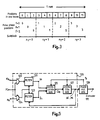
- FIGS 4a and 4b are diagrams which illustrate the proposed method.
- Figure 4a illustrates the excitation pulses (A m1 , m1), (A m2 , m2) etc., obtained.
- phase positions n f1 ,..., n fp are each coded per se prior to transmission.
- Combinatory coding can be employed for coding the phases.
- Each of the phase positions is coded with a code word per se .
- the known speech-processor circuit can be modified in the manner illustrated in Figure 5, which illustrates that part of the speech processor which includes the excitation-signal generating circuits 120.
- Each of the predictive residue-signals d k and the excitation generator 127 are applied to a respective filter 121 and 123 in time with a frame signal FC, via the gates 122, 124.
- the filters 121, 123 produce the signals y n and ⁇ n which are correlated in the correlation generator 125.
- the signal y n represents the true speech signal
- ⁇ n represents the synthesized speech signal.
- the excitation pulse parameters m p , A mp produced by the excitation generator 127 are sent to a phase generator 129.
- the phase generator 129 may consist in a processor which includes a read memory operative to store instructions for calculating the phases and the phase positions in accordance with the above relationship.
- Phase and phase position are then supplied to the coder 131.
- This coder is of the same principle construction as the known coder, but is operative to code phase and phase position instead of the pulse positions m p .
- the phase f p is also supplied to the correlation generator 125 and to the excitation generator 127.
- the correlation generator stores this phase and takes into account that this phase f p is occupied. No values of the signal C iq are calculated where q is included in those positions which belong to all preceding f p calculated for an analyzed sequence.
- the excitation generator 127 takes into account the occupied phases when making a comparison between the signals C iq and C iq *.
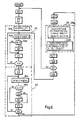
- Figure 6 illustrates a flow chart which constitutes the flow chart illustrated in Figure 3 of the aforesaid US-patent specification which has been modified to include the phase limitation.
- Those blocks which are not accompanied with explanatory text are described in more detail with reference to Figure 7.
- a block 328a which concerns the calculations to be carried out in the phase generator, and thereafter a block 328b which concerns the application of an output signal on the coder 131 and the generators 125 and 127.
- f p and n fp are calculated in accordance with the above relationship (1).
- This test is carried in blocks 308a, 308b, 308c (between the blocks 307 and 309) and in the blocks 318a, 318b (between the blocks 317, 319).
- the instructions given by the blocks 308a, b and c are carried out in the correlation generator 125, whereas the instructions given by the blocks 318a, b are carried out in the excitation generator 127.
- the signal f i.e. the phase
- the occupied phases shall remain during all calculated sequencies relating to a full frame interval, but shall be vacant at the beginning of a new frame interval. Consequently, subsequent to block 307 the vector u i is set to zero prior to each new frame analysis.
- both the phase position n fp and the phase f p shall be coded. Coding of the positions is thus divided up into two separate code words having mutually different significance. In this case, the bits in the code words obtain mutually different significance, and consequently the sensitivity to bit-error will also be different. This dissimilarity is advantageous with regard to error correction or error detection channel-coding.
- the aforedescribed limitation in the positioning of the excitation pulses means that coding of the pulse positions takes place at a lower bit-rate than when coding the positions in multi-pulse without said limitation. This also means that the search algorithm will be less complex than without this limitation. Admittedly, the inventive method involves certain limitations when positioning the pulses. A precise pulse position is not always possible, however, for instance according to Figure 4b. This limitation, however, shall be weighed against the aforesaid advantages.
- the inventive method has been described in the aforegoing with reference to a speech coder in which positioning of the excitation pulses is carried out one pulse at a time until a frame interval has been filled.
- Another type of speech coder described in EP-A-195 487 operates with positioning of a pulse pattern in which the time distance t a between the pulses is constant instead of a single pulse.
- the inventive method can also be applied with a speech coder of this kind.
- the forbidden positions in a frame (compare for instance Figures 4a, 4b above) therewith coincide with the positions of the pulses in a pulse pattern.
Landscapes
- Engineering & Computer Science (AREA)
- Computational Linguistics (AREA)
- Signal Processing (AREA)
- Health & Medical Sciences (AREA)
- Audiology, Speech & Language Pathology (AREA)
- Human Computer Interaction (AREA)
- Physics & Mathematics (AREA)
- Acoustics & Sound (AREA)
- Multimedia (AREA)
- Compression, Expansion, Code Conversion, And Decoders (AREA)
- Analogue/Digital Conversion (AREA)
- Radar Systems Or Details Thereof (AREA)
- Numerical Control (AREA)
- Control Of Stepping Motors (AREA)
- Paper (AREA)
- Saccharide Compounds (AREA)
- Turbine Rotor Nozzle Sealing (AREA)
- Measurement Of Velocity Or Position Using Acoustic Or Ultrasonic Waves (AREA)
- Output Control And Ontrol Of Special Type Engine (AREA)
- Transmission Systems Not Characterized By The Medium Used For Transmission (AREA)
- Traffic Control Systems (AREA)
- Road Signs Or Road Markings (AREA)
- Character Spaces And Line Spaces In Printers (AREA)
- Control Of Position Or Direction (AREA)
- Position Fixing By Use Of Radio Waves (AREA)
- Transmission And Conversion Of Sensor Element Output (AREA)
Applications Claiming Priority (3)
| Application Number | Priority Date | Filing Date | Title |
|---|---|---|---|
| SE8901697 | 1989-05-11 | ||
| SE8901697A SE463691B (sv) | 1989-05-11 | 1990-03-09 | Foerfarande att utplacera excitationspulser foer en lineaerprediktiv kodare (lpc) som arbetar enligt multipulsprincipen |
| SG163394A SG163394G (en) | 1989-05-11 | 1994-11-14 | Excitation pulse prositioning method in a linear predictive speech coder |
Publications (2)
| Publication Number | Publication Date |
|---|---|
| EP0397628A1 true EP0397628A1 (fr) | 1990-11-14 |
| EP0397628B1 EP0397628B1 (fr) | 1994-09-14 |
Family
ID=26660505
Family Applications (1)
| Application Number | Title | Priority Date | Filing Date |
|---|---|---|---|
| EP90850119A Expired - Lifetime EP0397628B1 (fr) | 1989-05-11 | 1990-03-28 | Procédé pour le positionnement des impulsions d'excitation dans un codeur à prédiction linéaire pour signal vocal |
Country Status (22)
| Country | Link |
|---|---|
| US (1) | US5193140A (fr) |
| EP (1) | EP0397628B1 (fr) |
| JP (1) | JP3054438B2 (fr) |
| CN (1) | CN1020975C (fr) |
| AT (1) | ATE111625T1 (fr) |
| AU (1) | AU629637B2 (fr) |
| BR (1) | BR9006761A (fr) |
| CA (1) | CA2032520C (fr) |
| DE (1) | DE69012419T2 (fr) |
| DK (1) | DK0397628T3 (fr) |
| ES (1) | ES2060132T3 (fr) |
| FI (1) | FI101753B (fr) |
| HK (1) | HK147594A (fr) |
| IE (1) | IE66681B1 (fr) |
| NO (1) | NO302205B1 (fr) |
| NZ (1) | NZ233100A (fr) |
| PH (1) | PH27161A (fr) |
| PT (1) | PT93999B (fr) |
| SE (1) | SE463691B (fr) |
| SG (1) | SG163394G (fr) |
| TR (1) | TR24559A (fr) |
| WO (1) | WO1990013891A1 (fr) |
Cited By (5)
| Publication number | Priority date | Publication date | Assignee | Title |
|---|---|---|---|---|
| EP0721180A1 (fr) * | 1995-01-06 | 1996-07-10 | Matra Communication | Procédé de codage de parole à analyse par synthèse |
| US5963898A (en) * | 1995-01-06 | 1999-10-05 | Matra Communications | Analysis-by-synthesis speech coding method with truncation of the impulse response of a perceptual weighting filter |
| US5974377A (en) * | 1995-01-06 | 1999-10-26 | Matra Communication | Analysis-by-synthesis speech coding method with open-loop and closed-loop search of a long-term prediction delay |
| EP1132893A3 (fr) * | 2000-02-15 | 2002-10-16 | Lucent Technologies Inc. | Contrôle de position d'impulsion pour un codeur de parole type CELP |
| EP1112625A4 (fr) * | 1998-09-11 | 2004-06-16 | Motorola Inc | Procede et appareil de codage d'un signal d'informations |
Families Citing this family (19)
| Publication number | Priority date | Publication date | Assignee | Title |
|---|---|---|---|---|
| US5701392A (en) * | 1990-02-23 | 1997-12-23 | Universite De Sherbrooke | Depth-first algebraic-codebook search for fast coding of speech |
| US5754976A (en) * | 1990-02-23 | 1998-05-19 | Universite De Sherbrooke | Algebraic codebook with signal-selected pulse amplitude/position combinations for fast coding of speech |
| DE69434514T2 (de) * | 1993-12-24 | 2006-06-22 | Seiko Epson Corp. | Tintenstrahlaufzeichnungskopf |
| JPH08123494A (ja) * | 1994-10-28 | 1996-05-17 | Mitsubishi Electric Corp | 音声符号化装置、音声復号化装置、音声符号化復号化方法およびこれらに使用可能な位相振幅特性導出装置 |
| JP3328080B2 (ja) * | 1994-11-22 | 2002-09-24 | 沖電気工業株式会社 | コード励振線形予測復号器 |
| DE4446558A1 (de) * | 1994-12-24 | 1996-06-27 | Philips Patentverwaltung | Digitales Übertragungssystem mit verbessertem Decoder im Empfänger |
| SE506379C3 (sv) * | 1995-03-22 | 1998-01-19 | Ericsson Telefon Ab L M | Lpc-talkodare med kombinerad excitation |
| SE508788C2 (sv) * | 1995-04-12 | 1998-11-02 | Ericsson Telefon Ab L M | Förfarande att bestämma positionerna inom en talram för excitationspulser |
| DE19641619C1 (de) * | 1996-10-09 | 1997-06-26 | Nokia Mobile Phones Ltd | Verfahren zur Synthese eines Rahmens eines Sprachsignals |
| JP3063668B2 (ja) | 1997-04-04 | 2000-07-12 | 日本電気株式会社 | 音声符号化装置及び復号装置 |
| JPH10303252A (ja) * | 1997-04-28 | 1998-11-13 | Nec Kansai Ltd | 半導体装置 |
| CA2254620A1 (fr) * | 1998-01-13 | 1999-07-13 | Lucent Technologies Inc. | Vocodeur avec codage du vecteur d'excitation tolerant aux pannes |
| JP3199020B2 (ja) * | 1998-02-27 | 2001-08-13 | 日本電気株式会社 | 音声音楽信号の符号化装置および復号装置 |
| US8036886B2 (en) * | 2006-12-22 | 2011-10-11 | Digital Voice Systems, Inc. | Estimation of pulsed speech model parameters |
| US11270714B2 (en) | 2020-01-08 | 2022-03-08 | Digital Voice Systems, Inc. | Speech coding using time-varying interpolation |
| US12254895B2 (en) | 2021-07-02 | 2025-03-18 | Digital Voice Systems, Inc. | Detecting and compensating for the presence of a speaker mask in a speech signal |
| US11990144B2 (en) | 2021-07-28 | 2024-05-21 | Digital Voice Systems, Inc. | Reducing perceived effects of non-voice data in digital speech |
| US12451151B2 (en) | 2022-04-08 | 2025-10-21 | Digital Voice Systems, Inc. | Tone frame detector for digital speech |
| US12462814B2 (en) | 2023-10-06 | 2025-11-04 | Digital Voice Systems, Inc. | Bit error correction in digital speech |
Citations (3)
| Publication number | Priority date | Publication date | Assignee | Title |
|---|---|---|---|---|
| US4472832A (en) * | 1981-12-01 | 1984-09-18 | At&T Bell Laboratories | Digital speech coder |
| EP0195487A1 (fr) * | 1985-03-22 | 1986-09-24 | Koninklijke Philips Electronics N.V. | Codeur à prédiction linéaire pour signal vocal avec excitation par impulsions multiples |
| GB2173679A (en) * | 1985-04-03 | 1986-10-15 | British Telecomm | Speech coding |
Family Cites Families (4)
| Publication number | Priority date | Publication date | Assignee | Title |
|---|---|---|---|---|
| NL8302985A (nl) * | 1983-08-26 | 1985-03-18 | Philips Nv | Multipulse excitatie lineair predictieve spraakcodeerder. |
| CA1255802A (fr) * | 1984-07-05 | 1989-06-13 | Kazunori Ozawa | Codage et decodage de signaux a faible debit binaire utilisant un nombre restreint d'impulsions d'excitation |
| FR2579356B1 (fr) * | 1985-03-22 | 1987-05-07 | Cit Alcatel | Procede de codage a faible debit de la parole a signal multi-impulsionnel d'excitation |
| GB8621932D0 (en) * | 1986-09-11 | 1986-10-15 | British Telecomm | Speech coding |
-
1990
- 1990-03-09 SE SE8901697A patent/SE463691B/sv not_active IP Right Cessation
- 1990-03-09 WO PCT/SE1990/000153 patent/WO1990013891A1/fr not_active Ceased
- 1990-03-09 AU AU55490/90A patent/AU629637B2/en not_active Expired
- 1990-03-09 JP JP2506712A patent/JP3054438B2/ja not_active Expired - Lifetime
- 1990-03-09 BR BR909006761A patent/BR9006761A/pt not_active IP Right Cessation
- 1990-03-09 IE IE146790A patent/IE66681B1/en not_active IP Right Cessation
- 1990-03-09 CA CA002032520A patent/CA2032520C/fr not_active Expired - Lifetime
- 1990-03-27 NZ NZ233100A patent/NZ233100A/en unknown
- 1990-03-28 DE DE69012419T patent/DE69012419T2/de not_active Expired - Lifetime
- 1990-03-28 ES ES90850119T patent/ES2060132T3/es not_active Expired - Lifetime
- 1990-03-28 DK DK90850119.0T patent/DK0397628T3/da active
- 1990-03-28 EP EP90850119A patent/EP0397628B1/fr not_active Expired - Lifetime
- 1990-03-28 AT AT90850119T patent/ATE111625T1/de not_active IP Right Cessation
- 1990-03-30 US US07/501,767 patent/US5193140A/en not_active Expired - Lifetime
- 1990-04-18 PH PH40385A patent/PH27161A/en unknown
- 1990-05-10 PT PT93999A patent/PT93999B/pt not_active IP Right Cessation
- 1990-05-11 CN CN90103654A patent/CN1020975C/zh not_active Expired - Lifetime
- 1990-06-04 TR TR90/0426A patent/TR24559A/xx unknown
- 1990-12-19 NO NO905471A patent/NO302205B1/no not_active IP Right Cessation
-
1991
- 1991-01-02 FI FI910021A patent/FI101753B/sv active
-
1994
- 1994-11-14 SG SG163394A patent/SG163394G/en unknown
- 1994-12-30 HK HK147594A patent/HK147594A/en not_active IP Right Cessation
Patent Citations (3)
| Publication number | Priority date | Publication date | Assignee | Title |
|---|---|---|---|---|
| US4472832A (en) * | 1981-12-01 | 1984-09-18 | At&T Bell Laboratories | Digital speech coder |
| EP0195487A1 (fr) * | 1985-03-22 | 1986-09-24 | Koninklijke Philips Electronics N.V. | Codeur à prédiction linéaire pour signal vocal avec excitation par impulsions multiples |
| GB2173679A (en) * | 1985-04-03 | 1986-10-15 | British Telecomm | Speech coding |
Cited By (9)
| Publication number | Priority date | Publication date | Assignee | Title |
|---|---|---|---|---|
| EP0721180A1 (fr) * | 1995-01-06 | 1996-07-10 | Matra Communication | Procédé de codage de parole à analyse par synthèse |
| WO1996021219A1 (fr) * | 1995-01-06 | 1996-07-11 | Matra Communication | Procede de codage de parole a analyse par synthese |
| FR2729244A1 (fr) * | 1995-01-06 | 1996-07-12 | Matra Communication | Procede de codage de parole a analyse par synthese |
| US5899968A (en) * | 1995-01-06 | 1999-05-04 | Matra Corporation | Speech coding method using synthesis analysis using iterative calculation of excitation weights |
| US5963898A (en) * | 1995-01-06 | 1999-10-05 | Matra Communications | Analysis-by-synthesis speech coding method with truncation of the impulse response of a perceptual weighting filter |
| US5974377A (en) * | 1995-01-06 | 1999-10-26 | Matra Communication | Analysis-by-synthesis speech coding method with open-loop and closed-loop search of a long-term prediction delay |
| EP1112625A4 (fr) * | 1998-09-11 | 2004-06-16 | Motorola Inc | Procede et appareil de codage d'un signal d'informations |
| EP1132893A3 (fr) * | 2000-02-15 | 2002-10-16 | Lucent Technologies Inc. | Contrôle de position d'impulsion pour un codeur de parole type CELP |
| US6539349B1 (en) | 2000-02-15 | 2003-03-25 | Lucent Technologies Inc. | Constraining pulse positions in CELP vocoding |
Also Published As
| Publication number | Publication date |
|---|---|
| DE69012419T2 (de) | 1995-02-16 |
| EP0397628B1 (fr) | 1994-09-14 |
| CN1020975C (zh) | 1993-05-26 |
| FI101753B1 (fi) | 1998-08-14 |
| SG163394G (en) | 1995-04-28 |
| ES2060132T3 (es) | 1994-11-16 |
| PT93999B (pt) | 1996-08-30 |
| NO905471L (no) | 1990-12-19 |
| DK0397628T3 (da) | 1995-01-16 |
| AU629637B2 (en) | 1992-10-08 |
| SE8901697L (sv) | 1990-11-12 |
| NO905471D0 (no) | 1990-12-19 |
| JPH03506079A (ja) | 1991-12-26 |
| CA2032520A1 (fr) | 1990-11-12 |
| AU5549090A (en) | 1990-11-29 |
| ATE111625T1 (de) | 1994-09-15 |
| CA2032520C (fr) | 1996-09-17 |
| PT93999A (pt) | 1991-01-08 |
| SE463691B (sv) | 1991-01-07 |
| SE8901697D0 (sv) | 1989-05-11 |
| JP3054438B2 (ja) | 2000-06-19 |
| CN1047157A (zh) | 1990-11-21 |
| US5193140A (en) | 1993-03-09 |
| TR24559A (tr) | 1992-01-01 |
| FI101753B (sv) | 1998-08-14 |
| IE901467L (en) | 1990-11-11 |
| PH27161A (en) | 1993-04-02 |
| NO302205B1 (no) | 1998-02-02 |
| HK147594A (en) | 1995-01-06 |
| IE66681B1 (en) | 1996-01-24 |
| NZ233100A (en) | 1992-04-28 |
| WO1990013891A1 (fr) | 1990-11-15 |
| BR9006761A (pt) | 1991-08-13 |
| FI910021A0 (fi) | 1991-01-02 |
| DE69012419D1 (de) | 1994-10-20 |
Similar Documents
| Publication | Publication Date | Title |
|---|---|---|
| EP0397628B1 (fr) | Procédé pour le positionnement des impulsions d'excitation dans un codeur à prédiction linéaire pour signal vocal | |
| US5327519A (en) | Pulse pattern excited linear prediction voice coder | |
| KR0143076B1 (ko) | 다중-요소 신호 코딩 방법 및 장치 | |
| CA1181854A (fr) | Codeur de paroles numerique | |
| US4771465A (en) | Digital speech sinusoidal vocoder with transmission of only subset of harmonics | |
| CA1338387C (fr) | Codeur de paroles ou de signaux audio a excitation vectorielle pour la transmission ou le stockage d'informations | |
| KR0127901B1 (ko) | 음성 인코딩 장치 및 그 방법 | |
| US4912764A (en) | Digital speech coder with different excitation types | |
| USRE32580E (en) | Digital speech coder | |
| HK128896A (en) | Speech coding | |
| EP0232456A1 (fr) | Processeur numérique de la parole utilisant un codage d'excitation arbitraire | |
| US4890328A (en) | Voice synthesis utilizing multi-level filter excitation | |
| US5513297A (en) | Selective application of speech coding techniques to input signal segments | |
| US5937376A (en) | Method of coding an excitation pulse parameter sequence | |
| US4873723A (en) | Method and apparatus for multi-pulse speech coding | |
| EP0483882B1 (fr) | Méthode de codage de paramètres de parole permettant de transmettre un paramètre spectral sur un nombre de bits de réduits | |
| GB2280576A (en) | Speech signal encoding system | |
| EP0753841A2 (fr) | Procédé de codage d'un paramètre de parole capable de transmettre à débit réduit un paramètre spectral |
Legal Events
| Date | Code | Title | Description |
|---|---|---|---|
| PUAI | Public reference made under article 153(3) epc to a published international application that has entered the european phase |
Free format text: ORIGINAL CODE: 0009012 |
|
| AK | Designated contracting states |
Kind code of ref document: A1 Designated state(s): AT BE CH DE DK ES FR GB GR IT LI LU NL SE |
|
| 17P | Request for examination filed |
Effective date: 19910408 |
|
| 17Q | First examination report despatched |
Effective date: 19920814 |
|
| GRAA | (expected) grant |
Free format text: ORIGINAL CODE: 0009210 |
|
| AK | Designated contracting states |
Kind code of ref document: B1 Designated state(s): AT BE CH DE DK ES FR GB GR IT LI LU NL SE |
|
| REF | Corresponds to: |
Ref document number: 111625 Country of ref document: AT Date of ref document: 19940915 Kind code of ref document: T |
|
| REF | Corresponds to: |
Ref document number: 69012419 Country of ref document: DE Date of ref document: 19941020 |
|
| REG | Reference to a national code |
Ref country code: ES Ref legal event code: FG2A Ref document number: 2060132 Country of ref document: ES Kind code of ref document: T3 |
|
| REG | Reference to a national code |
Ref country code: GR Ref legal event code: FG4A Free format text: 3013381 |
|
| ET | Fr: translation filed | ||
| ITF | It: translation for a ep patent filed | ||
| PG25 | Lapsed in a contracting state [announced via postgrant information from national office to epo] |
Ref country code: SE Effective date: 19941214 |
|
| REG | Reference to a national code |
Ref country code: DK Ref legal event code: T3 |
|
| PLBE | No opposition filed within time limit |
Free format text: ORIGINAL CODE: 0009261 |
|
| STAA | Information on the status of an ep patent application or granted ep patent |
Free format text: STATUS: NO OPPOSITION FILED WITHIN TIME LIMIT |
|
| 26N | No opposition filed | ||
| PGFP | Annual fee paid to national office [announced via postgrant information from national office to epo] |
Ref country code: CH Payment date: 20010305 Year of fee payment: 12 |
|
| PGFP | Annual fee paid to national office [announced via postgrant information from national office to epo] |
Ref country code: AT Payment date: 20010306 Year of fee payment: 12 |
|
| PGFP | Annual fee paid to national office [announced via postgrant information from national office to epo] |
Ref country code: LU Payment date: 20010313 Year of fee payment: 12 |
|
| PGFP | Annual fee paid to national office [announced via postgrant information from national office to epo] |
Ref country code: GR Payment date: 20010329 Year of fee payment: 12 |
|
| PGFP | Annual fee paid to national office [announced via postgrant information from national office to epo] |
Ref country code: BE Payment date: 20010410 Year of fee payment: 12 |
|
| REG | Reference to a national code |
Ref country code: GB Ref legal event code: IF02 |
|
| PGFP | Annual fee paid to national office [announced via postgrant information from national office to epo] |
Ref country code: DK Payment date: 20020306 Year of fee payment: 13 |
|
| PG25 | Lapsed in a contracting state [announced via postgrant information from national office to epo] |
Ref country code: LU Free format text: LAPSE BECAUSE OF NON-PAYMENT OF DUE FEES Effective date: 20020328 Ref country code: AT Free format text: LAPSE BECAUSE OF NON-PAYMENT OF DUE FEES Effective date: 20020328 |
|
| PG25 | Lapsed in a contracting state [announced via postgrant information from national office to epo] |
Ref country code: BE Free format text: LAPSE BECAUSE OF NON-PAYMENT OF DUE FEES Effective date: 20020331 Ref country code: CH Free format text: LAPSE BECAUSE OF NON-PAYMENT OF DUE FEES Effective date: 20020331 Ref country code: LI Free format text: LAPSE BECAUSE OF NON-PAYMENT OF DUE FEES Effective date: 20020331 |
|
| BERE | Be: lapsed |
Owner name: TELEFONAKTIEBOLAGET L M *ERICSSON Effective date: 20020331 |
|
| PG25 | Lapsed in a contracting state [announced via postgrant information from national office to epo] |
Ref country code: GR Free format text: LAPSE BECAUSE OF NON-PAYMENT OF DUE FEES Effective date: 20021007 |
|
| REG | Reference to a national code |
Ref country code: CH Ref legal event code: PL |
|
| PG25 | Lapsed in a contracting state [announced via postgrant information from national office to epo] |
Ref country code: DK Free format text: LAPSE BECAUSE OF NON-PAYMENT OF DUE FEES Effective date: 20030331 |
|
| PGFP | Annual fee paid to national office [announced via postgrant information from national office to epo] |
Ref country code: ES Payment date: 20090326 Year of fee payment: 20 |
|
| PGFP | Annual fee paid to national office [announced via postgrant information from national office to epo] |
Ref country code: NL Payment date: 20090324 Year of fee payment: 20 |
|
| PGFP | Annual fee paid to national office [announced via postgrant information from national office to epo] |
Ref country code: IT Payment date: 20090331 Year of fee payment: 20 Ref country code: DE Payment date: 20090327 Year of fee payment: 20 |
|
| PGFP | Annual fee paid to national office [announced via postgrant information from national office to epo] |
Ref country code: FR Payment date: 20090317 Year of fee payment: 20 |
|
| PGFP | Annual fee paid to national office [announced via postgrant information from national office to epo] |
Ref country code: GB Payment date: 20090403 Year of fee payment: 20 |
|
| REG | Reference to a national code |
Ref country code: NL Ref legal event code: V4 Effective date: 20100328 |
|
| REG | Reference to a national code |
Ref country code: GB Ref legal event code: PE20 Expiry date: 20100327 |
|
| REG | Reference to a national code |
Ref country code: ES Ref legal event code: FD2A Effective date: 20100329 |
|
| PG25 | Lapsed in a contracting state [announced via postgrant information from national office to epo] |
Ref country code: GB Free format text: LAPSE BECAUSE OF EXPIRATION OF PROTECTION Effective date: 20100327 |
|
| PG25 | Lapsed in a contracting state [announced via postgrant information from national office to epo] |
Ref country code: NL Free format text: LAPSE BECAUSE OF EXPIRATION OF PROTECTION Effective date: 20100328 Ref country code: ES Free format text: LAPSE BECAUSE OF EXPIRATION OF PROTECTION Effective date: 20100329 |
|
| PG25 | Lapsed in a contracting state [announced via postgrant information from national office to epo] |
Ref country code: DE Free format text: LAPSE BECAUSE OF EXPIRATION OF PROTECTION Effective date: 20100328 |