EP0398691A2 - Système de distribution d'énergie électrique - Google Patents
Système de distribution d'énergie électrique Download PDFInfo
- Publication number
- EP0398691A2 EP0398691A2 EP90305302A EP90305302A EP0398691A2 EP 0398691 A2 EP0398691 A2 EP 0398691A2 EP 90305302 A EP90305302 A EP 90305302A EP 90305302 A EP90305302 A EP 90305302A EP 0398691 A2 EP0398691 A2 EP 0398691A2
- Authority
- EP
- European Patent Office
- Prior art keywords
- electrical
- distribution system
- power
- power distribution
- switch
- Prior art date
- Legal status (The legal status is an assumption and is not a legal conclusion. Google has not performed a legal analysis and makes no representation as to the accuracy of the status listed.)
- Granted
Links
Images




Classifications
-
- H—ELECTRICITY
- H02—GENERATION; CONVERSION OR DISTRIBUTION OF ELECTRIC POWER
- H02J—ELECTRIC POWER NETWORKS; CIRCUIT ARRANGEMENTS OR SYSTEMS FOR SUPPLYING OR DISTRIBUTING ELECTRIC POWER; SYSTEMS FOR STORING ELECTRIC ENERGY
- H02J1/00—Circuit arrangements for DC mains or DC distribution networks
- H02J1/14—Balancing load and power generation in DC networks
-
- H—ELECTRICITY
- H02—GENERATION; CONVERSION OR DISTRIBUTION OF ELECTRIC POWER
- H02J—ELECTRIC POWER NETWORKS; CIRCUIT ARRANGEMENTS OR SYSTEMS FOR SUPPLYING OR DISTRIBUTING ELECTRIC POWER; SYSTEMS FOR STORING ELECTRIC ENERGY
- H02J7/00—Circuit arrangements for charging or discharging batteries or for supplying loads from batteries
- H02J7/14—Circuit arrangements for charging or discharging batteries or for supplying loads from batteries for charging batteries from dynamo-electric generators driven at varying speed, e.g. on vehicle
-
- H—ELECTRICITY
- H02—GENERATION; CONVERSION OR DISTRIBUTION OF ELECTRIC POWER
- H02J—ELECTRIC POWER NETWORKS; CIRCUIT ARRANGEMENTS OR SYSTEMS FOR SUPPLYING OR DISTRIBUTING ELECTRIC POWER; SYSTEMS FOR STORING ELECTRIC ENERGY
- H02J7/00—Circuit arrangements for charging or discharging batteries or for supplying loads from batteries
- H02J7/60—Circuit arrangements for charging or discharging batteries or for supplying loads from batteries including safety or protection arrangements
- H02J7/64—Circuit arrangements for charging or discharging batteries or for supplying loads from batteries including safety or protection arrangements against overvoltage
-
- Y—GENERAL TAGGING OF NEW TECHNOLOGICAL DEVELOPMENTS; GENERAL TAGGING OF CROSS-SECTIONAL TECHNOLOGIES SPANNING OVER SEVERAL SECTIONS OF THE IPC; TECHNICAL SUBJECTS COVERED BY FORMER USPC CROSS-REFERENCE ART COLLECTIONS [XRACs] AND DIGESTS
- Y02—TECHNOLOGIES OR APPLICATIONS FOR MITIGATION OR ADAPTATION AGAINST CLIMATE CHANGE
- Y02T—CLIMATE CHANGE MITIGATION TECHNOLOGIES RELATED TO TRANSPORTATION
- Y02T10/00—Road transport of goods or passengers
- Y02T10/60—Other road transportation technologies with climate change mitigation effect
- Y02T10/70—Energy storage systems for electromobility, e.g. batteries
Definitions
- the present invention relates to electrical power distribution systems. It has particular but not sole application to automotive starting, lighting and ignition systems, and power distribution thereto from automotive batteries, hereinafter referred to as SLI batteries.
- the conventional automotive SLI Battery consists generally of six 2.2 volt Lead Acid cells connected in series. It is a primary function of the automotive battery and associated power distribution system to provide sufficient high electric current at short intervals to crank the internal combustion engine in order that it may start. The distribution system must also provide current to the coil in order to achieve engine ignition.
- Another important function which must also be provided is that of reserve current to provide lighting and ignition for the vehicle if the vehicle's generator is not operating.
- the electrical current requirements of the starter motor are vastly different form those of the vehicle's auxiliaries, such as lighting and ignition.
- cranking requires large amounts of current for a relatively short duration as the starter motor cranks the internal combustion engine against the compression of the cylinders.
- Ignition and other vehicle auxiliaries require lower current rates but for long periods of time.
- the conventional SLI battery and associated distribution system is therefore designed first to provide sufficient cranking power, and secondly to provide current to the vehicle's auxiliaries whilst the generator is not working.
- One other function is to act as a voltage load leveller as part of the vehicle's electrical circuits whilst the generator is operating.
- the conventional SLI battery is primarily a starting battery.
- the need to cater to increased auxiliary power demands has placed extra demands on the SLI battery, resulting in the possibility of frequent accidental discharge through the auxiliary circuits.
- SLI batteries contain cell structures having multiples of thin plates as opposed to thicker plates in order to provide sufficient high current discharge for cranking.
- Positive plates used in conventional SLI constructions also utilize a paste mixture of active material which increases the ability of the plate to dump current (rapid discharge) but also limits the plate's abilities to recover from the effects of deep discharge.
- US Patent 406,822 in the name of Dey shows a battery which is divided into two cell groups by an internal dividing plate.
- US Patent 1,924,959 in the name of Patterson shows four cells, two of which are in series and two of which can be configured either in parallel or series by the throwing of a switch. The cells are totally separate.
- US Patent 3,029,301 in the name of Strider shows a construction in which two battery parts are provided in series so that six and twelve volt voltage sources can be provided.
- US Patent 3,242,009 in the name of Schilke shows the construction in which two battery parts are provided, but these are used to provide a number of different voltages.
- US Patent 3,475,221 in the name of Jordan shows two separate batteries in one container.
- US Patent 3,758,345 in the name of Toth shows a construction in which a small auxiliary battery is provided in a shaped recess formed in the main plate.
- US Patent 3,883,368 in the name of Kordesch shows a construction in which two or more current rates are provided by the use of different types of electrodes
- US Patent 4,684,580 in the name of Cramer shows a construction wherein the casing for the battery has a pocket or recess into which a second or auxiliary battery can be provided.
- Double battery systems have been designed to overcome inconvenience to the vehicle user caused by accidental battery discharge. These include the placement of dual or multiple batteries in vehicles, thereby increasing available capacity. Double battery systems have also been developed. These double battery systems are based on the two-batteries-in-one concept whereby a main battery and a reserve battery are contained within a single structure, and a heavy switch and blocking diode system are incorporated between the main and the backup reserve battery. The blocking diode is used to prevent discharge of the backup reserve battery, while simultaneously providing charge current to that backup reserve battery. These batteries also require a switch between the two batteries, which switch must be capable of carrying the load required to crank the vehicle. Accordingly, the switch is heavy and requires manual operation to place the two batteries into electrical parallel.
- the present invention overcomes the problem of the differing current demands placed on the same battery by the modern automobile.
- the present invention includes an electrical power distribution scheme which allows for discharge and recharge management of cells within the battery structure without requiring heavy duty switches or major electrical alterations to the electrical architecture. While it is possible to overcome the problem of variation in current requirements within an automobile by installation of two or more batteries, the cost to the consumer is a disadvantage, and space constraints in many automobiles make this impractical.
- one aspect of the invention utilizes a battery including a container, one or more cells in the container, each said cell having therein at least one positive plate and at least one negative plate, at least some said plates comprising multiple layers of electrode material.
- a battery configuration that can be used in the power distribution system of the present invention is disclosed in U.S. Patent No. 4,883,728 to Witehira, which reference is hereby incorporated herein by reference.
- the batteries disclosed by Witehira provide at least two separate positive terminals or two separate negative terminals, with each separate terminal and its related terminal of opposing polarity comprising a power source.
- more than one separate battery may be used, with each such battery comprising a separate power source.
- a battery disclosed in U.S. Patent No. 4,883,728 and suitable for use in the system of the present invention is a battery comprising a single housing having a plurality of electrochemical cells therein, the plurality of cells including a first set of cells electrically connected in series to a first positive terminal cell and associated first positive terminal, a second set of cells electrically connected in series to a second positive terminal cell and associated second positive terminal, and a common negative terminal cell and associated terminal to which both the first and second sets of cells are connected in parallel, each such cell having a plurality of positive and negative electrode plates therein and an electrolyte in contact with the plates.
- the first set of cells has different discharge characteristics than the second set of cells. This can be accomplished, e.g., where the plates in the first set of cells are thicker than the plates in the second set of cells.
- the plates comprise active material of a density compatible with deep cycle abilities, that is to say, the active material is of a higher density than that used for plates designed for rapid discharge.
- the electrical power distribution system of the present invention comprises a battery such as that described above, in an automobile having a cranking circuit and an auxiliary circuit, wherein the negative terminal of the battery is electrically connected to the chassis of the automobile as ground, the first positive terminal is electrically connected to the cranking circuit, and the second positive terminal is electrically connected to the auxiliary circuit, so that for at least one mode of operation of the auxiliary circuit, the second positive terminal is connected only to the auxiliary circuit and not to the cranking circuit. Also, there is preferably a switch for electrically connecting the first positive terminal to the auxiliary circuit.
- the switch is operable in response to depression of the accelerator of the automobile, or other indication that the vehicle is or will soon be started, such as vibration noise, opening of the vehicle door, or pressure on the driver's seat.
- a current overload circuit breaking switch between the positive terminals is also provided.
- the circuit includes a starter relay for energizing the cranking circuit, and the circuit is adapted to supply the relay with current from both the first and second positive terminals.
- the electrical system includes an ignition switch, and the ignition switch includes a switch position that is adapted to provide a connection between the first and second positive terminals.
- the invention provides an automobile electrical system comprising a battery with a first heavy current conductor cable connected to the battery negative terminal and earthed to said automobile, a second current conductor cable connected to one or more positive terminals of said battery and connected to a current first switch, said current switch being connected to the electric starter motor of said automobile, a third current conductor cable connected to one or more more of the battery's positive terminals and to the auxiliary circuits of said automobile, a fourth current electrical conductor cable connected to one positive terminal not engaged by said second current connector cable, said fourth current conductor cable being in common circuit with the generator circuit line of said automobile, then to a second switch, a fifth current conductor cable from said second switch connected to said terminal engaged by said second current conductor cable.
- the invention comprises an automobile electrical system including a battery with a negative terminal grounded to the automobile, and a first positive terminal that is connected to a series of cells which are capable of slower, deeper discharge and recharge as opposed to a second positive terminal, which is capable of rapid discharge and recharge.
- a low resistance, heavy current conductor cable is connected from the first terminal to a starter relay. When operated, the relay connects the heavy current conductor to the starter motor.
- a higher resistance, lighter conductor cable is connected from the first terminal to the vehicle's ignition and auxiliary circuits.
- a medium duty switch is connected via a pair of low resistance conductors between the first and second terminals. This switch is activated by an electrical circuit which is responsive to an indication that the vehicle is or will soon be started, such as vibration, or noise.
- the circuit causes the switch to close, connecting the first and second terminals together to provide current for cranking purposes, as well as to provide current for the auxiliary and ignition systems.
- the switch remains closed until after the vehicle is turned off, and after the vibration, noise or other source which influences the circuit has stopped for a specified period of time.
- the switch then opens, isolating the first and second terminals from each other, so that the second terminal is not discharged by continued supply of power through the high resistance conductor to the ignition and auxiliary systems.
- the invention comprises a battery such as that described above, wherein a high resistance, low current cable connects the first, slow, deep discharge terminal to the auxiliary and ignition systems.
- a low resistance, high current conductor is connected from the rapid discharge terminal of the battery to the starter relay, and then to the starter motor upon closing of the starter relay.
- a switch is connected between the high resistance and low resistance conductors, and is responsive to an electrical circuit for trying those two conductors together upon sensing that the vehicle is or will soon be started, by detecting conditions such as vibration, or noise.
- the electronic circuit for detecting the vibration or other external indication continues to maintain the switch in a closed position until after the engine has been turned off, and, preferably, after the operator has left the vehicle. Upon expiration of a predetermined time, the circuit causes the switch to open, so as to segregate the first and second terminals.
- the circuit for closing the switch between the high and low resistance conductors is sensitive to a drop in voltage produced on the high resistance cable serving the auxiliary circuits, the voltage drop is produced by a condition such as the ignition switch being turned to the start position.
- the switch between the high and low resistance conductors is closed, tieing the first and second terminals of the battery together for a period of time to permit cranking of the engine.
- the switch is again opened and remains open until another voltage or current detection indicates that the electrical system is in condition for charging of both power sources through the first and second terminals. At that point, the switch is again closed and remains closed until charging is completed, or until the engine is turned off.
- the sensing portion of this switch can also be sensitive to physical conditions as opposed to a voltage drop, such as vibration, tilt, acceleration or any other motion of the vehicle resulting from a driver getting into it or shutting the door, or moving within the vehicle.
- the circuit would continue to use the sensor for detecting when charging of both terminals can commence.
- An important feature of any or all of the above preferred embodiments is a circuit that isolates the first and second terminals of the battery when the second (rapid discharge) terminal is drawing a significant current, e.g. more than 20 amps, from the first (slower, deep discharge) terminal, such as during cranking of the engine by the starter motor when the first terminal battery which is connected to the auxiliary circuits has not been discharged.
- the operation of this circuit ensures that the voltage supplied to the auxiliaries via terminal one is not reduced by the electrical load presented to the second terminal as a result of operating the starter motor (or equivalent high current demand circuit).
- This feature which may be incorporated in the circuit, or by means of a separate electrical circuit breaker (self-resetting), ensures easier starting and optimum power supply to all auxiliaries, such as the ignition system and engine management computer system, during the engine starting process.
- circuit configurations described above can be responsive to a sensor positioned at a location on the vehicle, or on the engine itself.
- the circuit and sensor can be stored within the housing of the battery itself, so as to permit ease in battery installation, with minimal change to the vehicle or its electrical system.
- the present invention also can use a Lead-Acid Battery comprising a container having a plurality of cells including positive and negative terminal cells, each cell containing a plurality of alternating positive and negative electrode plates separated by means of a separator and constituting a cell element stack. Each of the plates is comprised of a grid having active material pasted thereon.
- the positive electrode plates of the cells are connected electrically.
- the negative electrode plates of the cells are connected electrically.
- the electrode plates of each cell are electrically connected in series parallel. That is, a number of cells are connected in series, parallel to another like number of cells also connected in series but sharing the same negative electrical connection at the negative terminal.
- Half of the cells preferably contain thicker positive electrode plates made up by layers of thinner plates, whilst the other half have thinner positive electrode plates. All negative electrode plates may be of the same thinner size.
- This invention therefore provides for a battery having two sets of cells arranged in series parallel, thus providing dual or multi current variations at the positive terminals. That series of cells having the thinner positive plates provide high current from the connected positive terminal for short durations.
- the other series of cells, having thicker layered positive plates, have less plates per volume space, however the current capacity is equal to the cells having thinner plates, during longer slower discharges of the battery.
- the mass of the active material in the thicker plates is preferably greater than that of the corresponding material in the thinner plates.
- the present invention therefore provides the vehicle manufacturers and owner with a dual or multi current power supply system that for cranking purposes will provide high current flows through the cells having thin positive plates with this high current available for shorter durations. A lower but longer current flow is also available from the cells having thicker layered positive plates. Both sets of cells can be connected electrically for cranking purposes while, optionally, only the cells having the thicker layered plates can be connected electrically to the automobile's auxiliary circuits, thus providing for slower and longer discharge periods.
- the present invention therefore sets out to overcome the problem of longer, slower discharges in feeding an automobile auxiliary system, for example, using up the available high discharge capacity required for cranking operations.
- the present invention minimizes loss of cranking capacity through use of a slow discharge power source that is electrically separate from a fast discharge power source so that, by electrical switching, it is possible to obtain full use of all active material within the power source for usual day to day use as, for example, a conventional SLI battery.
- electrical circuit design it is also possible to isolate that section of the battery characterized by plate design that is best suited for slower and longer current draw off than cranking requires.
- switch or circuit design the present invention also prevents depletion of the cranking capacity by the auxiliary circuits within an automobile.
- Figure 1 refers to a battery 1 of the type described in United States patent No. 4,883,728.
- Figure 1 refers to a battery 1 of the type described in United States patent No. 4,883,728.
- FIG 1 refers to a battery 1 of the type described in United States patent No. 4,883,728.
- other battery configurations could be substituted without departing from the spirit or essential characteristics of the invention.
- the battery is earthed or grounded through earth connector 18.
- the battery provides two positive leads 19 and 20.
- Positive lead 19 is applied to the common terminal 21 of ignition switch 22.
- the ignition switch 22 may provide a spare terminal 23 which can be contacted by, for example, a reverse turn of the key from which extends electrical conductor 25 which may be used, for example, to allow a ratio to play while the key is out. That is to say it can provide an electrical connection when the key is in an unlocked position.
- Lead 36 extending from terminal 26 is utilized for the auxiliaries and ignition circuits of the motor vehicle in which the battery 1 is to be used.
- the generator is connected directly to lead 19.
- Terminal 27 provides current through lead 28 to the solenoid 31 which is then activated to provide current to the starter motor 30 through lead 38.
- Lead 32 is an optional and further high current lead from the second positive terminal. If this lead is provided, it effectively connects the two parts of the battery in parallel, thereby providing additional current capacity to the starter motor 30.
- a terminal cut-off switch 33 is desirably provided.
- a solenoid switch can be provided in lead 34 which extends between a further terminal 35 in the ignition switch 22 and the positive lead 20.
- a generator, alternator or similar charging source 40 is connected via a lead 41 to the battery terminal that serves the auxiliary circuits.
- a trip switch 39 may be provided which is able to be operated by, for example, movement of the accelerator of the vehicle, the oil pressure switch, the voltage regulator, or some other item with the desired item being the accelerator so that the switch becomes closed as the accelerator is pressed.
- Switch 39 electrically connects the charging source 40 to the battery terminal serving the starter motor 30, and must be provided to allow for recharging of the battery in use, eliminating the need for a diode in the circuit.
- Lead 24 is the general accessory lead which supplies current to vehicle accessories independent of the ignition switch.
- FIG 2 shows the construction of the battery 1 being provided in substantially the same manner along with ignition switch 22 and positive leads 19 and 20. Between the positive leads 19 and 20 is connected a diode 37 which allows for recharging of the two parts of the battery during standard use in substantially the known manner and without the need to provide switch 36 or lead 32 of Figure 1.
- a battery 50 is illustrated as being constructed in substantially the same manner as the battery 1 described above.
- battery 50 has two positive terminals 52 and 54, respectively, and a grounded negative terminal 56.
- the power distribution system of Figure 3 is configured such that all positive electrical connections from the battery 50 to the various loads can be made through conductors connected to a single terminal. Accordingly, the distribution system of Figure 3 could employ a power source having a single positive terminal, such as a conventional automotive battery.
- the battery 50 is preferably constructed such that typically half of the cells in the battery consist of electrode plate structures capable of multiple deep discharge and recharge cycles, while the remaining half of the cells consist of electrode plate structures and conductor connections capable of rapid discharge.
- Terminal 56 is connected to the negative terminal cell of the battery and is a low electrical resistance terminal, which is connected to a grounded location such as on the vehicle frame.
- Terminal 54 is a positive terminal that is preferable connected to that series of cells which are capable of deep discharge, while terminal 52 is a positive terminal which is preferably connected to those cells that are capable of rapid discharge.
- An electrical conductor cable 58 having a resistance typical of those conductor cables used in automobiles to conduct current from the battery to the vehicle's auxiliary system, is connected between the terminal 54 and the auxiliary systems and common terminal 21 of the ignition switch 22, in substantially the same manner as the embodiment illustrated in Figure 1.
- a low resistance electrical conductor cable 60 is connected at one end to the positive terminal 54, so as to provide current therethrough to the solenoid 31, which, when activated, provides current to the starter motor 30 through lead 38.
- Conductor 60 has a resistance typical of those conductors used in automobile electrical systems for conducting current from the battery to the vehicle's starter motor.
- Positive terminal 54 is also connected via a low resistance electrical conductor cable 62 to a terminal of a switch 64.
- the switch 64 is also connected at another terminal, via another low resistance electrical conductor cable 66 to the positive terminal 52.
- switch 64 is normally open when the vehicle is not operating, but is closed to connect positive terminals 52 and 54 during vehicle operation. With medium duty switch 64 closed, the low resistance conductors are capable of carrying up to 600 amps of current between the positive terminals 52 and 54.
- switch 64 Operation of switch 64 is accomplished by means of a switch control circuit generally indicated at 68.
- the switch control circuit 68 operates to bring medium duty switch 64 into the closed position before engagement of the vehicle's starter motor, and to permit return of switch 64 to the closed position at some time after engagement of the vehicle's starter motor.
- the closing of switch 64 prior to starter motor engagement, and opening thereof after such engagement allows for the switch 64 to be of medium capacity as opposed to the heavy capacity conventionally used to activate the starter motor. More specifically, because switch 64 is not used to activate or break the current to the starter motor, pressure at the contact points of switch 64 can be lower than the contact points of the starter solenoid switch 31, and yet the contact points of switch 64 are equivalent to the conductivity capacity of the solenoid switch.
- a switch generally indicated at 74 comprises a movement sensor, vibrator, trembler or similar type of switch which, in the illustrated embodiment, is normally closed.
- the switch 74 comprises a vibrator switch vibration detector identified as a "Safe House” TM model, catalog number 49521, which is available in the United States from Radio Shack stores.
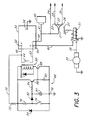
- switch 74 When switch 74 opens for a short period of time, such as when the vehicle moves as a result of someone opening the door, a 16 volt, 47 ⁇ F capacitor is charged via resistors 72 and 76, through a diode 82. Current from the capacitor 80 flows through a 330k ohm resistor 84 to the base of a transistor 86. Because of the presence of the resistor 84, current from the capacitor 11 flows for an extended time, which may typically be 30 seconds for appropriately chosen values of the capacitor 80 and resistor 84.
- the current flowing into the base of the transistor 86 causes a much larger current to flow from the emitter of transistor 86 into the base of a transistor 88.
- This current is amplified by transistor 88 so that a current sufficient to operate a relay generally indicated at 90 is carried through the transistor 88, operating as a switch.
- a 15K ohm resistor 92 is used to hold the base voltage of the transistor 88 at zero potential when that transistor is off, thereby enhancing its breakdown voltage as against spike voltages.
- the resistor 72 and an 18 volt zener diode 94 define one form of spike protection that may be used to protect the transistors 86 and 88. Alternatively, the zener diode may be replaced by a metal oxide varistor or capacitor.
- a diode 96 connected in parallel with the relay 90 is used to bypass reverse voltages generated by the coil of relay 90, when the transistor 88 stops conducting, thereby protecting the transistor 88.
- the switch control circuit 68 will respond to an outside stimulus such as a vibration of the car upon entry of the operator, and will accordingly close the switch 64, connecting the terminals 52 and 54. Continued movement in the vehicle will continue to hold switch 74 in the open state, thereby causing the switch control circuit to continue to hold medium duty switch 64 in the closed position. Upon cessation of external stimuli, such as after the departure of the operator, the switch control circuit 68 will maintain the switch 64 in the closed position until expiration of the time delay period created by the flow of current from the capacitor 80 through the resistor 84.
- the switch 64 will be allowed to open, thereby separating the terminals 52 and 54, so that any continued auxiliary circuit operation (such as lights left on accidentally) will drain power only from the slow discharge positive terminal 54 of the battery 50, while maintaining the rapid discharge portion of the battery 50 fully charged, for later use in providing starting power to the vehicle.
- switch control circuit 68 comprises merely one of numerous embodiments of a circuit that can control the switch 64 in response to detection of selected conditions.
- a power distribution system which includes a battery 50, of the type previously described with respect to Figures 1 - 3.
- the configuration of the distribution system substantially corresponds to the system of Figure 1, with the exception that the optional lead 32 is replaced by a switch system generally located at 100, which is electrically connected between positive leads 19 and 20, so as to connect those leads in response to detection of selected conditions.
- the trip switch 39 of Figure 1 has been replaced by the diode 37 of Figure 2, to demonstrate interchangeability of these types of recharging controls.
- other methods for controlling the recharging of the rapid discharge portion of battery 50, via terminal 52 will be appreciated by those skilled in the technology.
- the illustrated embodiment comprises a vibration sensitive switching system for interconnecting the terminal leads 19 and 20 upon detection of a vibration, and prior to cranking of the starter motor 30.
- the rapid and slow discharge terminals of the battery can be connected together to provide initial cranking current.
- the leads continue to be tied together during vehicle operation, to permit recharging of the battery and to provide power to the auxiliary systems.
- the switch system 100 will continue to maintain the tie between leads 19 and 20 until the monitored condition no longer exists, which would indicate vehicle operation has ceased. Following this, the leads are again separated to prevent discharge of the rapid discharge portion of the battery, by auxiliary load demands.
- the illustrated switch system 100 comprises only one embodiment of a system which would be sensitive to any of numerous conditions such as vibration, motion, tilt, acceleration or any other condition that would result from a person entering or leaving the vehicle.
- lead 19 is a high resistances line of the type typically used for supplying auxiliary circuits in automobiles.
- lead 20 is a low resistance circuit designed for carrying a high amount of current, of the type typically used in automobiles for supplying power to cranking circuits.
- the relative resistances of the leads 19 and 20 are such that during cranking, the voltage at terminal 52 may be drawn down from approximately 13.1 volts to approximately 8 volts, while the voltage at terminal 54 is drawn from 13.1 volts only to about 12 volts.
- the voltage drop at terminal 54 is acceptable for maintaining continued operation and integrity of computer circuits and the like which are typically included in the auxiliary circuit portion of the automobile electronics configuration.
- the switch system 100 includes a resistor 102 and diode 104 connected in series with the lead 19, so as to permit a small amount of current to flow from lead 19 through those components in order to maintain power to the circuit.
- the current flowing through resistor 102 and diode 104 is not sufficient to cause the closing of any switches.
- a sensor device 106 comprises, for example, a vibrator switch such as a "Safe House” TM model vibration detector identified as catalog number 49521 from Radio Shack in the United States. Sensor device 106 detects vibration caused by conditions such as an operator entering the vehicle. Upon detection of vibration, current is communicated from lead 20 via a line 108, through the contacts of the sensor 106 to a relay coil 110.
- the relay coil acts in response to the receipt of current to close a low current switch 112, thereby permitting current to flow from the terminal 52 via lead 20 and line 108, across the switch 112 to another coil 114 on a high current relay.
- coil 114 acts to close a normally open switch 116, completing a connection between leads 19 and 20.
- Switch 116 will remain closed until after vibration detection has ceased, at which time the current flow through sensor 106 to the coil 110 will cease, opening switch 112, which will then cause the opening of switch 116.
- the resistor 102 and diode 104 combination prevents overloading of the switch system, by permitting the through flow of current when the voltage across coil 114 exceeds 13.1 volts. Operation of the switch system 100 can also be terminated by means of a timer 118 associated with the coil 110.
- the timer can be a heat sensitive device, which would prevent the flow of current through coil 110 under certain thermal conditions.
- sensor 106 can switch through a normal 555 timer circuit, which is not heat sensitive, and which would produce a timeout signal preventing current flow through the coil 110 at a predetermined time following cessation of the sensing of vibration. In this way, connection between the leads 19 and 20 is achieved prior to operation of the starter motor, with the connection being maintained until after the engine operation has ceased.
- the switch 116 can comprise a medium duty switch that is sufficiently small to permit its packaging and operation within the housing of the battery 50.
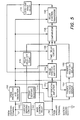
- Figure 5 illustrates a block diagram of another control circuit that can be interposed between leads 19 and 20 in the circuit of Figure 4, replacing, for example, the switch system 100 of Figure 4.
- the control circuit of Figure 5 is one which functions in response to detected electrical conditions within the system, as opposed to the mechanical conditions such as vibration discussed in connection with the circuits of Figures 3 and 4. Nevertheless, the circuit accomplishes the same purposes, in that it detects a condition such as the turning on of the engine ignition key, that occurs prior to cranking of the starter motor. In response to detection of the selected condition, the circuit responds in the manner described with respect to the circuits of Figures 3 and 4, and electrically connects the terminals 52 and 54 of the battery 50.
- the circuit also provides for detection of voltage of current levels within the power distribution system that are outside of acceptable limits, and responds by electrically connecting or separating the terminals 52 and 54 of the battery as appropriate. For example, if current drawn to the starter motor during cranking is causing the voltage to the auxiliaries to drop below acceptable levels, the circuit of Figure 5 will disconnect the terminals 52 and 54, thereby allowing the auxiliaries to be fed from a power source which is electrically separated from the cranking starter so that its voltage level is not influenced by the starter system. Likewise, after cranking, with the engine running and the alternator being capable of charging both portions of the battery 50, the circuit detects this situation and provides for connection of the terminals 52 and 54 to allow charging of both battery cell structures. The circuit of Figure 5 also provides for time delay operation in the separation of terminals 52 and 54 after engine operation has ended.
- the pulse stretch amplifier 154 amplifies and stretches the signal so as to be large and long enough to operate a time delay circuit 156, producing a voltage output that is held for about 30 seconds. That voltage output is converted into a two level switching voltage by a comparator 158 which provides additional power to the base of a relay control transistor 160. This causes an increase of current flow through that transistor, and thereby energizes a main control relay 162, causing that relay to close the switch between the terminals 52 and 54. The result is, that a load increase on the auxiliary terminal 54 causes the main control relay 162 to close for a time period of about 30 seconds, subject to control by other parts of the circuit.
- a change voltage sensor 164 will detect that voltage change, and will generate an output voltage which is communicated to a change hold-on delay circuit 166.
- the delay circuit 166 provides an output signal that is "held on” for about 10 seconds. This hold signal is fed from circuit 166 into comparator 158 from whence it is transmitted to the relay control transistor 160 for operating the main control relay 162 so as to close the switch 116 between terminals 52 and 54 and for at least the period of the "hold-on” signal, thereby allowing charging of both sides of the battery.
- the purpose for the change hold-on delay circuit 166 is more readily apparent when one understands that if the voltage at the cranking terminal 52 is low prior to closing the relay 162, then closing that main control relay 162 so as to close switch 116, would possibly cause the voltage at the auxiliary terminal 54 to drop well below the 13.6 volt level discussed above. This would cause the circuit to operate as described above in response to a low voltage detection on terminal 52, opening the main control relay 162 and the switch 116. This would thereby prevent charging of the cranking portion of the battery through terminal 52.
- this problem is resolved by use of the change hold-on delay circuit 166 which functions to hold the main control relay 162 closed for approximately 10 seconds. This cycle will repeat when the main control relay 162 opens, subject to over-ride by other parts of the circuit.
- the lockout hold delay circuit 172 is provided to insure that when the main control relay 162 opens and disconnects terminals 52 and 54, that any pulses or voltage drops generated thereby cannot cause the circuit to recycle, by preventing the pulse stretch amplifier 154 from passing or amplifying any signals for a period of one second after the main control relay 162 opens.
- the load sensing resistor 174 is provided to supply a bleed current of around 5 milliamps to the auxiliary terminal 54, from the cranking terminal 52. This is done so that even if the battery connected at the auxiliary terminal 54 is completely discharged, current and voltage are made available to allow a load increase at the auxiliary terminal 54 to still cause a small but adequate negative pulse to be generated and transmitted to the differential amplifier 162, to operate the circuit.
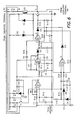
- FIG. 6 One presently preferred embodiment of a circuit that corresponds both in configuration and operation to the circuit of Figure 5 is illustrated in Figure 6.
- the correspondence between the circuit blocks defined in Figure 5 and the elements of the circuit of Figure 6 can best be understood by reference to Table 1 below.
- the letters representing the components generally designate the type of device as follows: R is a resistor; C is a capacitor; D is a diode; T is a transistor; RX is a relay; VR is a variable resistor or potentiometer; and IC is an amplifier.
- elements R5 and D7 in the circuit of Figure 6 are optional, and are primarily used for indicating operation of the circuit.
- the amplifiers IC1A-IC1D are designated as CA324. All resistors except R23 are 1/4 WATT resistors. R23 is formed of 60 millimeters of 1.5 millimeter diameter resistance wire to get 0.02 ohms with 50 amp current capacity.
- the component VR1 may be replaced by two resistors with their values adjusted in conjunction with the zener diode (D6) to insure relay closure at a voltage level on the auxiliary terminal 54 which is greater than or equal to 13.6 volts (plus or minus .3 volts).
- the relay coil resistance in the circuit of Figure 6 is 155 ohms.
- Figure 7 illustrates a block diagram of another control circuit which can be substituted for the circuit 100 of Figure 4, in controlling the switch 116 between terminals 52 and 54.
- the circuit of Figure 7 is similar to the one discussed in Figure 5, in that it uses the same method of sensing when the auxiliary voltage at terminal 54 exceeds a level such as 13.5 volts for closing the main control relay and, thereby, closing switch 116, to connect the auxiliary terminal 54, and the cranking terminal 52 for charging of the cranking battery cells.
- the circuit of Figure 7 closes the main relay in response to a momentary change in an electrical contact of a sensor switch, such as a temporary change from open to closed or from closed to open.
- This circuit also incorporates a hold on delay time, after the sensor switch has stopped detecting momentary changes to maintain electrical contact between terminals 52 and 54 for a delay time typically on the order of about 30 seconds.
- the sensor contacts used for operation of this circuit can be sensitive to physical conditions such vibration, tilt, acceleration, or any other motion of the vehicle such as that resulting from an operator getting into the vehicle or shutting the door, or moving within the vehicle.
- Sensors which may be used with this circuit include small simple or multiple or compound pendulums, light springs, or a ball or drop of mercury rolling in a hollow dish having a grid of inter-digital contacts that are made as the ball or drop rolls across them.
- a make or break motion sensor 202 comprised of sensor elements such as those described above, is configured such that if its switch changes from make to break, or vice-versa, a voltage pulse is generated therein.
- This pulse is transmitted to an AC amplifier and pulse stretcher 204, where the pulse is amplified and stretched.
- the signal from the block 204 is transmitted to a time delay hold-on circuit 206, which further amplifies and stretches the signal so as to be large enough and long enough to produce a voltage output that is held for about 30 seconds.
- This voltage is supplied to a comparator 208, which detects the presence of the voltage and passes a signal to a relay control transistor 210 that then causes the main relay 212 to close the switch 116 of Figure 4. Because of the time delay hold-on circuit 206, the main relay 212 will be closed for about 30 seconds.
- a charging voltage sensor 214 After cranking, and during engine operation, if the charging voltage applied to the auxiliary terminal 54 by the alternator exceeds a preset voltage level such as 13.6 volts, then a charging voltage sensor 214 will detect that high voltage level, and will cause an output voltage to be generated and communicated to a charging hold-on delay 216.
- the charging hold-on delay circuit 216 produces an output signal which is communicated into the comparator 208 and is held for a period of about 10 seconds by the charging hold- on delay circuit. This signal is fed through the comparator 208 to the relay control transistor 210, causing the main relay 212 to close and thereby close the switch 116 of Figure 4. This condition allows charging to occur on both the auxiliary and cranking portions of the battery.
- the reason that the charging hold-on delay circuit 216 is provided is that, if the cranking battery voltage on terminal 52 were low, closing the main relay 212 would cause a corresponding drop in voltage at the auxiliary terminal 54, which drop would likely be well below the selected minimum voltage, and would result in the system immediately opening the main relay 212 and preventing charging. However, by the charging hold-on delay circuit 216 holding the relay 212 closed for 10 seconds, charging is permitted to occur. This cycle will repeat when the main relay 212 opens, subject to over-ride by other parts of the circuit.
- Delay circuit 220 provides a signal to comparator 208 which is sufficiently large to over-ride the influence of other parts of the circuit by causing comparator 208 to transmit a signal to the relay control transistor 210 that causes the main relay 212 to stay open for 10 seconds and, accordingly, to maintain the terminals 52 and 54 in electrically separate condition for a period of 10 seconds. If appropriate, this cycle will repeat.
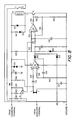
- Figure 8 illustrates one presently preferred embodiment of the circuit described in Figure 7.
- the circuit of Figure 8 corresponds both in component organization and in function to the circuit described in Figure 7.
- An understanding of the relationship between the elements of Figure 7, as identified in the blocks, and the corresponding elements of Figure 8 can be achieved by reference to table 3 below.
- FIG. 9 illustrates another preferred embodiment of a sensor and switching circuit configuration for use in the system, wherein the switching circuit and a sensor are secured separate from the battery and, in the illustrated embodiment, secured upon a cable in the engine compartment.
- the switch arrangement illustrated in Figure 9 comprises a housing 250 which encases a switch circuit.
- the switch itself is surrounded by an insulator material 252, within the housing.
- a sensor such as a vibrator 254 includes vibrating members 255 and 257, which respond to movement of the surrounding device by coming into contact with a conductive plate 259 such that current is momentarily communicated from the plate through the members 255 and 257 to a switch configuration such as that illustrated at 110 and 112 in Figure 4.
- the housing 250 can be opened or separated at its center before being applied to a component of the automobile engine.
- the housing is secured by clipping it over an accelerator cable 253, and securing the two sides together so as to maintain its position on that cable.
- the accelerator cable 253 was selected since it will likely experience vibration before many of the other components in the engine compartment. This is because the operator will typically place his foot on the accelerator peddle and pump it prior to turning on the starter motor. Such movement of the accelerator peddle will be relayed through the accelerator cable to the sensor 254.
- a power connector 256 is connected to terminal 52 while another power connector 258 is connected to terminal 54, so that the switch electrically connecting those two terminals can achieve its connection through the connectors 256 and 258.
- a power connector 260 comprises the connection for supplying power from one of the battery terminals to the switch circuit within housing 250. Accordingly, the connector 260 is preferably connected to the cranking terminal 52 so that the switching circuit is housing 250 may be provided with power even power is not being provided through the auxiliary terminal 54 as a result of inadvertent discharging of that portion of the battery.
- the power distribution system of the present invention comprises a significant improvement in the technology by overcoming the long standing problems associated with the providing of a battery system useful in automobile and similar applications, wherein a high current, rapid discharge power source is desirable for cranking purposes, while a low current, slow discharge power source is desirable for serving automobile auxiliary equipment.
- the present invention comprises a system wherein both types of power source are made available, preferably in a single battery configuration, and with an electrical circuit arrangement which maximizes efficiency in power distribution from the battery to the engine components, while also providing protection to sensitive auxiliary circuits.
- the power distribution system can be secured within a single housing in a manner which permits battery installation in a vehicle with virtually negligible change to the vehicle or its wiring system.
- the system additionally permits the storage of cranking power, even when auxiliary systems such as vehicle lights have been inadvertently left on, and the auxiliary portion of the battery has become discharged.
- the switching between power sources for purposes of providing cranking power, as well as for system charging, is all accomplished automatically and without operator intervention.
Landscapes
- Engineering & Computer Science (AREA)
- Power Engineering (AREA)
- Charge And Discharge Circuits For Batteries Or The Like (AREA)
- Supply And Distribution Of Alternating Current (AREA)
- Optical Communication System (AREA)
- Secondary Cells (AREA)
- Cable Transmission Systems, Equalization Of Radio And Reduction Of Echo (AREA)
- Control Of Charge By Means Of Generators (AREA)
- Control Of Vehicles With Linear Motors And Vehicles That Are Magnetically Levitated (AREA)
Applications Claiming Priority (2)
| Application Number | Priority Date | Filing Date | Title |
|---|---|---|---|
| NZ229179 | 1989-05-17 | ||
| NZ229179A NZ229179A (en) | 1989-05-17 | 1989-05-17 | Dual battery power distribution system for cars |
Publications (3)
| Publication Number | Publication Date |
|---|---|
| EP0398691A2 true EP0398691A2 (fr) | 1990-11-22 |
| EP0398691A3 EP0398691A3 (fr) | 1992-02-12 |
| EP0398691B1 EP0398691B1 (fr) | 1995-11-29 |
Family
ID=19922860
Family Applications (1)
| Application Number | Title | Priority Date | Filing Date |
|---|---|---|---|
| EP90305302A Expired - Lifetime EP0398691B1 (fr) | 1989-05-17 | 1990-05-16 | Système de distribution d'énergie électrique |
Country Status (9)
| Country | Link |
|---|---|
| EP (1) | EP0398691B1 (fr) |
| JP (1) | JPH0349539A (fr) |
| AT (1) | ATE130975T1 (fr) |
| AU (1) | AU5509090A (fr) |
| CA (1) | CA2016990C (fr) |
| DE (1) | DE69023809T2 (fr) |
| ES (1) | ES2081930T3 (fr) |
| GR (1) | GR3018908T3 (fr) |
| NZ (1) | NZ229179A (fr) |
Cited By (10)
| Publication number | Priority date | Publication date | Assignee | Title |
|---|---|---|---|---|
| US5204610A (en) * | 1991-02-15 | 1993-04-20 | Globe-Union, Inc. | Long lived dual battery with automatic latching switch |
| US5316868A (en) * | 1992-07-21 | 1994-05-31 | Globe-Union, Inc. | Dual battery switch circuit |
| GB2292274B (en) * | 1994-08-11 | 1999-07-07 | Iain Wallace Waugh | A battery controller |
| FR2776854A1 (fr) * | 1998-03-26 | 1999-10-01 | Renault | Architecture modulable de resistances thermiques connectees a un reseau serie/parallele comprenant au moins un accumulateur de puissance |
| GB2302622B (en) * | 1995-06-22 | 2000-03-29 | Glorywin Int Group Ltd | Battery controller |
| DE4302809B4 (de) * | 1992-02-13 | 2005-03-24 | Volkswagen Ag | Verfahren zum Regeln oder Steuern der Bordnetz-Spannung in Kraftfahrzeugen sowie Vorrichtung zur Durchführung des Verfahrens |
| CN103692982A (zh) * | 2013-12-13 | 2014-04-02 | 东风柳州汽车有限公司 | 汽车电器负载控制装置及其控制方法 |
| CN106585529A (zh) * | 2015-10-16 | 2017-04-26 | 福特全球技术公司 | 车辆电气系统 |
| CN108028534A (zh) * | 2015-09-25 | 2018-05-11 | 奥迪股份公司 | 机动车中电压跌落的预测 |
| CN110391464A (zh) * | 2019-07-22 | 2019-10-29 | 深圳市精实机电科技有限公司 | 一种锂电池化成分容设备及其换型方法 |
Families Citing this family (4)
| Publication number | Priority date | Publication date | Assignee | Title |
|---|---|---|---|---|
| GB2415839B (en) * | 2004-06-29 | 2007-08-29 | Ford Global Tech Llc | Dual battery vehicle electrical systems |
| CN108528227B (zh) * | 2018-03-23 | 2024-04-30 | 苏州弗尔赛能源科技股份有限公司 | 一种电动汽车增程器控制系统、控制方法及电动汽车 |
| DE102021202191A1 (de) * | 2021-03-08 | 2022-09-08 | EWAKE GERMANY GmbH | Wake- oder Surfboard |
| CN113500941B (zh) * | 2021-08-19 | 2022-11-15 | 盾石磁能科技有限责任公司 | 充电装置及充电桩 |
Family Cites Families (5)
| Publication number | Priority date | Publication date | Assignee | Title |
|---|---|---|---|---|
| US3883368A (en) * | 1972-10-26 | 1975-05-13 | Union Carbide Corp | Alkaline aluminum-air/zinc-manganese dioxide hybrid battery |
| US4056764A (en) * | 1974-06-03 | 1977-11-01 | Nissan Motor Company, Limited | Power supply system having two different types of batteries and current-limiting circuit for lower output battery |
| US3949289A (en) * | 1974-07-25 | 1976-04-06 | Day Oliver E | Dual battery ignition and start system for a vehicle |
| US4082992A (en) * | 1977-01-18 | 1978-04-04 | Day Oliver E | Twin ignition and twin electrical start system for a vehicle |
| US4883728A (en) * | 1987-03-03 | 1989-11-28 | Pita Witehira | Battery systems |
-
1989
- 1989-05-17 NZ NZ229179A patent/NZ229179A/en unknown
-
1990
- 1990-05-16 AT AT90305302T patent/ATE130975T1/de active
- 1990-05-16 EP EP90305302A patent/EP0398691B1/fr not_active Expired - Lifetime
- 1990-05-16 DE DE69023809T patent/DE69023809T2/de not_active Expired - Fee Related
- 1990-05-16 ES ES90305302T patent/ES2081930T3/es not_active Expired - Lifetime
- 1990-05-16 AU AU55090/90A patent/AU5509090A/en not_active Abandoned
- 1990-05-17 JP JP2128109A patent/JPH0349539A/ja active Pending
- 1990-05-17 CA CA002016990A patent/CA2016990C/fr not_active Expired - Fee Related
-
1996
- 1996-02-07 GR GR960400314T patent/GR3018908T3/el unknown
Cited By (11)
| Publication number | Priority date | Publication date | Assignee | Title |
|---|---|---|---|---|
| US5204610A (en) * | 1991-02-15 | 1993-04-20 | Globe-Union, Inc. | Long lived dual battery with automatic latching switch |
| DE4302809B4 (de) * | 1992-02-13 | 2005-03-24 | Volkswagen Ag | Verfahren zum Regeln oder Steuern der Bordnetz-Spannung in Kraftfahrzeugen sowie Vorrichtung zur Durchführung des Verfahrens |
| US5316868A (en) * | 1992-07-21 | 1994-05-31 | Globe-Union, Inc. | Dual battery switch circuit |
| GB2292274B (en) * | 1994-08-11 | 1999-07-07 | Iain Wallace Waugh | A battery controller |
| GB2302622B (en) * | 1995-06-22 | 2000-03-29 | Glorywin Int Group Ltd | Battery controller |
| FR2776854A1 (fr) * | 1998-03-26 | 1999-10-01 | Renault | Architecture modulable de resistances thermiques connectees a un reseau serie/parallele comprenant au moins un accumulateur de puissance |
| CN103692982A (zh) * | 2013-12-13 | 2014-04-02 | 东风柳州汽车有限公司 | 汽车电器负载控制装置及其控制方法 |
| CN108028534A (zh) * | 2015-09-25 | 2018-05-11 | 奥迪股份公司 | 机动车中电压跌落的预测 |
| CN106585529A (zh) * | 2015-10-16 | 2017-04-26 | 福特全球技术公司 | 车辆电气系统 |
| CN110391464A (zh) * | 2019-07-22 | 2019-10-29 | 深圳市精实机电科技有限公司 | 一种锂电池化成分容设备及其换型方法 |
| CN110391464B (zh) * | 2019-07-22 | 2024-03-29 | 深圳市精实机电科技有限公司 | 一种锂电池化成分容设备及其换型方法 |
Also Published As
| Publication number | Publication date |
|---|---|
| GR3018908T3 (en) | 1996-05-31 |
| JPH0349539A (ja) | 1991-03-04 |
| NZ229179A (en) | 1992-09-25 |
| DE69023809D1 (de) | 1996-01-11 |
| ATE130975T1 (de) | 1995-12-15 |
| EP0398691B1 (fr) | 1995-11-29 |
| CA2016990C (fr) | 1996-12-17 |
| EP0398691A3 (fr) | 1992-02-12 |
| AU5509090A (en) | 1990-11-22 |
| ES2081930T3 (es) | 1996-03-16 |
| DE69023809T2 (de) | 1996-06-13 |
| CA2016990A1 (fr) | 1990-11-17 |
Similar Documents
| Publication | Publication Date | Title |
|---|---|---|
| US5175484A (en) | Electrical power distribution | |
| CA2016990C (fr) | Systeme de distribution d'energie electrique | |
| US7339347B2 (en) | Apparatus and method for reliably supplying electrical energy to an electrical system | |
| US5146095A (en) | Low discharge capacitor motor starter system | |
| EP3079221B1 (fr) | Dispositif de démarrage d' urgence et méthode de démarrage d' urgence | |
| US5552642A (en) | Protection system with voltage switching | |
| US5260637A (en) | Electrical system for a motor vehicle, including at least one supercapacitor | |
| US6888266B2 (en) | Vehicle with switched supplemental energy storage system for engine cranking | |
| WO2015074108A1 (fr) | Dispositif d'amélioration de système électrique | |
| US20050003710A1 (en) | Power module for motor vehicles | |
| JPH05199673A (ja) | 車両用2回路給電回路装置 | |
| US6121750A (en) | Two terminal battery | |
| US20030222501A1 (en) | Vehicle with switched supplemental energy storage system for engine cranking | |
| US11043723B2 (en) | Low voltage protector for systems battery | |
| GB2364452A (en) | Auxiliary battery control for a starter motor | |
| EP0389059B1 (fr) | Appareil de commutation pour fournir du courant, à partir d'une batterie d'un véhicule alimentée par une dynamo, à un réfrigérateur transportable | |
| JPH05300660A (ja) | 自動車用電源装置 | |
| AU709324B2 (en) | A switch for a battery charging system | |
| JP2909326B2 (ja) | 小型電動車の充電装置 | |
| WO2025144428A2 (fr) | Source d'énergie isolée pour applications de démarrage de moteur | |
| CA3225203A1 (fr) | Source d'energie isolee pour des applications de demarrage de moteur | |
| CA3273953A1 (en) | A Multiple Energy Source System | |
| AU3047699A (en) | Two terminal battery | |
| KR950026052A (ko) | 3극 배터리 스위치(3-Pole battery switches) | |
| JPH08250157A (ja) | バッテリパックおよびバッテリパック充放電システム |
Legal Events
| Date | Code | Title | Description |
|---|---|---|---|
| PUAI | Public reference made under article 153(3) epc to a published international application that has entered the european phase |
Free format text: ORIGINAL CODE: 0009012 |
|
| AK | Designated contracting states |
Kind code of ref document: A2 Designated state(s): AT BE CH DE DK ES FR GB GR IT LI LU NL SE |
|
| PUAL | Search report despatched |
Free format text: ORIGINAL CODE: 0009013 |
|
| AK | Designated contracting states |
Kind code of ref document: A3 Designated state(s): AT BE CH DE DK ES FR GB GR IT LI LU NL SE |
|
| 17P | Request for examination filed |
Effective date: 19920807 |
|
| 17Q | First examination report despatched |
Effective date: 19931028 |
|
| GRAA | (expected) grant |
Free format text: ORIGINAL CODE: 0009210 |
|
| AK | Designated contracting states |
Kind code of ref document: B1 Designated state(s): AT BE CH DE DK ES FR GB GR IT LI LU NL SE |
|
| PG25 | Lapsed in a contracting state [announced via postgrant information from national office to epo] |
Ref country code: DK Effective date: 19951129 Ref country code: AT Effective date: 19951129 |
|
| REF | Corresponds to: |
Ref document number: 130975 Country of ref document: AT Date of ref document: 19951215 Kind code of ref document: T |
|
| REF | Corresponds to: |
Ref document number: 69023809 Country of ref document: DE Date of ref document: 19960111 |
|
| ITF | It: translation for a ep patent filed | ||
| REG | Reference to a national code |
Ref country code: CH Ref legal event code: NV Representative=s name: CABINET ROLAND NITHARDT CONSEILS EN PROPRIETE INDU |
|
| ET | Fr: translation filed | ||
| REG | Reference to a national code |
Ref country code: ES Ref legal event code: FG2A Ref document number: 2081930 Country of ref document: ES Kind code of ref document: T3 |
|
| REG | Reference to a national code |
Ref country code: GR Ref legal event code: FG4A Free format text: 3018908 |
|
| PLBE | No opposition filed within time limit |
Free format text: ORIGINAL CODE: 0009261 |
|
| STAA | Information on the status of an ep patent application or granted ep patent |
Free format text: STATUS: NO OPPOSITION FILED WITHIN TIME LIMIT |
|
| 26N | No opposition filed | ||
| PGFP | Annual fee paid to national office [announced via postgrant information from national office to epo] |
Ref country code: GB Payment date: 19970514 Year of fee payment: 8 |
|
| PG25 | Lapsed in a contracting state [announced via postgrant information from national office to epo] |
Ref country code: GB Free format text: LAPSE BECAUSE OF NON-PAYMENT OF DUE FEES Effective date: 19980516 |
|
| PGFP | Annual fee paid to national office [announced via postgrant information from national office to epo] |
Ref country code: SE Payment date: 19981110 Year of fee payment: 9 Ref country code: BE Payment date: 19981110 Year of fee payment: 9 |
|
| PGFP | Annual fee paid to national office [announced via postgrant information from national office to epo] |
Ref country code: CH Payment date: 19981112 Year of fee payment: 9 |
|
| PGFP | Annual fee paid to national office [announced via postgrant information from national office to epo] |
Ref country code: LU Payment date: 19981113 Year of fee payment: 9 |
|
| PGFP | Annual fee paid to national office [announced via postgrant information from national office to epo] |
Ref country code: NL Payment date: 19981116 Year of fee payment: 9 |
|
| PGFP | Annual fee paid to national office [announced via postgrant information from national office to epo] |
Ref country code: FR Payment date: 19981124 Year of fee payment: 9 |
|
| PGFP | Annual fee paid to national office [announced via postgrant information from national office to epo] |
Ref country code: GR Payment date: 19981126 Year of fee payment: 9 Ref country code: ES Payment date: 19981126 Year of fee payment: 9 |
|
| PGFP | Annual fee paid to national office [announced via postgrant information from national office to epo] |
Ref country code: DE Payment date: 19981127 Year of fee payment: 9 |
|
| GBPC | Gb: european patent ceased through non-payment of renewal fee |
Effective date: 19980516 |
|
| PG25 | Lapsed in a contracting state [announced via postgrant information from national office to epo] |
Ref country code: LU Free format text: LAPSE BECAUSE OF NON-PAYMENT OF DUE FEES Effective date: 19990516 |
|
| PG25 | Lapsed in a contracting state [announced via postgrant information from national office to epo] |
Ref country code: SE Free format text: LAPSE BECAUSE OF NON-PAYMENT OF DUE FEES Effective date: 19990517 Ref country code: ES Free format text: LAPSE BECAUSE OF NON-PAYMENT OF DUE FEES Effective date: 19990517 |
|
| PG25 | Lapsed in a contracting state [announced via postgrant information from national office to epo] |
Ref country code: LI Free format text: LAPSE BECAUSE OF NON-PAYMENT OF DUE FEES Effective date: 19990531 Ref country code: GR Free format text: LAPSE BECAUSE OF NON-PAYMENT OF DUE FEES Effective date: 19990531 Ref country code: CH Free format text: LAPSE BECAUSE OF NON-PAYMENT OF DUE FEES Effective date: 19990531 Ref country code: BE Free format text: LAPSE BECAUSE OF NON-PAYMENT OF DUE FEES Effective date: 19990531 |
|
| BERE | Be: lapsed |
Owner name: BYDDER EVAN LLOYD Effective date: 19990531 Owner name: WITEHIRA PITA Effective date: 19990531 |
|
| PG25 | Lapsed in a contracting state [announced via postgrant information from national office to epo] |
Ref country code: NL Free format text: LAPSE BECAUSE OF NON-PAYMENT OF DUE FEES Effective date: 19991201 |
|
| REG | Reference to a national code |
Ref country code: CH Ref legal event code: PL |
|
| EUG | Se: european patent has lapsed |
Ref document number: 90305302.3 |
|
| PG25 | Lapsed in a contracting state [announced via postgrant information from national office to epo] |
Ref country code: FR Free format text: LAPSE BECAUSE OF NON-PAYMENT OF DUE FEES Effective date: 20000131 |
|
| NLV4 | Nl: lapsed or anulled due to non-payment of the annual fee |
Effective date: 19991201 |
|
| PG25 | Lapsed in a contracting state [announced via postgrant information from national office to epo] |
Ref country code: DE Free format text: LAPSE BECAUSE OF NON-PAYMENT OF DUE FEES Effective date: 20000301 |
|
| REG | Reference to a national code |
Ref country code: FR Ref legal event code: ST |
|
| REG | Reference to a national code |
Ref country code: ES Ref legal event code: FD2A Effective date: 20000610 |
|
| PG25 | Lapsed in a contracting state [announced via postgrant information from national office to epo] |
Ref country code: IT Free format text: LAPSE BECAUSE OF NON-PAYMENT OF DUE FEES;WARNING: LAPSES OF ITALIAN PATENTS WITH EFFECTIVE DATE BEFORE 2007 MAY HAVE OCCURRED AT ANY TIME BEFORE 2007. THE CORRECT EFFECTIVE DATE MAY BE DIFFERENT FROM THE ONE RECORDED. Effective date: 20050516 |