EP0398757A2 - Überzugsmittel auf Basis von zusammengesetztem Anstrichfilm - Google Patents
Überzugsmittel auf Basis von zusammengesetztem Anstrichfilm Download PDFInfo
- Publication number
- EP0398757A2 EP0398757A2 EP90305441A EP90305441A EP0398757A2 EP 0398757 A2 EP0398757 A2 EP 0398757A2 EP 90305441 A EP90305441 A EP 90305441A EP 90305441 A EP90305441 A EP 90305441A EP 0398757 A2 EP0398757 A2 EP 0398757A2
- Authority
- EP
- European Patent Office
- Prior art keywords
- paint film
- resin
- amine
- compound
- film coating
- Prior art date
- Legal status (The legal status is an assumption and is not a legal conclusion. Google has not performed a legal analysis and makes no representation as to the accuracy of the status listed.)
- Granted
Links
- 239000003973 paint Substances 0.000 title claims abstract description 153
- 239000007888 film coating Substances 0.000 title claims abstract description 38
- 238000009501 film coating Methods 0.000 title claims abstract description 38
- 239000002131 composite material Substances 0.000 title claims abstract description 35
- 229920005989 resin Polymers 0.000 claims abstract description 72
- 239000011347 resin Substances 0.000 claims abstract description 72
- 238000004070 electrodeposition Methods 0.000 claims abstract description 57
- 239000000203 mixture Substances 0.000 claims abstract description 47
- 150000001875 compounds Chemical class 0.000 claims abstract description 38
- 125000002091 cationic group Chemical group 0.000 claims abstract description 32
- 239000007787 solid Substances 0.000 claims abstract description 23
- 229920001187 thermosetting polymer Polymers 0.000 claims abstract description 21
- 229910000831 Steel Inorganic materials 0.000 claims abstract description 18
- 239000010959 steel Substances 0.000 claims abstract description 18
- 239000002245 particle Substances 0.000 claims abstract description 11
- 125000002924 primary amino group Chemical group [H]N([H])* 0.000 claims abstract description 8
- 229920000642 polymer Polymers 0.000 claims abstract description 7
- -1 ketimine compound Chemical class 0.000 claims description 33
- 239000003822 epoxy resin Substances 0.000 claims description 18
- 229920000647 polyepoxide Polymers 0.000 claims description 18
- 238000006243 chemical reaction Methods 0.000 claims description 15
- ZWEHNKRNPOVVGH-UHFFFAOYSA-N 2-Butanone Chemical compound CCC(C)=O ZWEHNKRNPOVVGH-UHFFFAOYSA-N 0.000 claims description 9
- 239000005062 Polybutadiene Substances 0.000 claims description 9
- 229920002857 polybutadiene Polymers 0.000 claims description 9
- 239000007795 chemical reaction product Substances 0.000 claims description 8
- CSCPPACGZOOCGX-UHFFFAOYSA-N Acetone Chemical compound CC(C)=O CSCPPACGZOOCGX-UHFFFAOYSA-N 0.000 claims description 6
- NTIZESTWPVYFNL-UHFFFAOYSA-N Methyl isobutyl ketone Chemical compound CC(C)CC(C)=O NTIZESTWPVYFNL-UHFFFAOYSA-N 0.000 claims description 6
- UIHCLUNTQKBZGK-UHFFFAOYSA-N Methyl isobutyl ketone Natural products CCC(C)C(C)=O UIHCLUNTQKBZGK-UHFFFAOYSA-N 0.000 claims description 6
- 229940043265 methyl isobutyl ketone Drugs 0.000 claims description 6
- 150000003335 secondary amines Chemical class 0.000 claims description 5
- 238000007259 addition reaction Methods 0.000 claims description 4
- 125000003277 amino group Chemical group 0.000 claims description 4
- 230000018044 dehydration Effects 0.000 claims description 4
- 238000006297 dehydration reaction Methods 0.000 claims description 4
- XNLICIUVMPYHGG-UHFFFAOYSA-N pentan-2-one Chemical compound CCCC(C)=O XNLICIUVMPYHGG-UHFFFAOYSA-N 0.000 claims description 4
- 229920000768 polyamine Polymers 0.000 claims description 4
- RPNUMPOLZDHAAY-UHFFFAOYSA-N Diethylenetriamine Chemical compound NCCNCCN RPNUMPOLZDHAAY-UHFFFAOYSA-N 0.000 claims description 3
- 150000001732 carboxylic acid derivatives Chemical class 0.000 claims description 3
- 125000003700 epoxy group Chemical group 0.000 claims description 3
- CABDEMAGSHRORS-UHFFFAOYSA-N oxirane;hydrate Chemical compound O.C1CO1 CABDEMAGSHRORS-UHFFFAOYSA-N 0.000 claims description 3
- 229920001281 polyalkylene Polymers 0.000 claims description 3
- ZCYVEMRRCGMTRW-UHFFFAOYSA-N 7553-56-2 Chemical compound [I] ZCYVEMRRCGMTRW-UHFFFAOYSA-N 0.000 claims description 2
- 238000006482 condensation reaction Methods 0.000 claims description 2
- 230000007062 hydrolysis Effects 0.000 claims description 2
- 238000006460 hydrolysis reaction Methods 0.000 claims description 2
- 229910052740 iodine Inorganic materials 0.000 claims description 2
- 239000011630 iodine Substances 0.000 claims description 2
- 125000005496 phosphonium group Chemical group 0.000 claims description 2
- 229920005862 polyol Polymers 0.000 claims description 2
- 150000003077 polyols Chemical class 0.000 claims description 2
- 239000004814 polyurethane Substances 0.000 claims description 2
- 229920002635 polyurethane Polymers 0.000 claims description 2
- 150000003141 primary amines Chemical class 0.000 claims description 2
- RWSOTUBLDIXVET-UHFFFAOYSA-O sulfonium group Chemical group [SH3+] RWSOTUBLDIXVET-UHFFFAOYSA-O 0.000 claims description 2
- XDTMQSROBMDMFD-UHFFFAOYSA-N Cyclohexane Chemical compound C1CCCCC1 XDTMQSROBMDMFD-UHFFFAOYSA-N 0.000 claims 1
- 238000004519 manufacturing process Methods 0.000 description 35
- XLYOFNOQVPJJNP-UHFFFAOYSA-N water Substances O XLYOFNOQVPJJNP-UHFFFAOYSA-N 0.000 description 19
- 230000007797 corrosion Effects 0.000 description 16
- 238000005260 corrosion Methods 0.000 description 16
- QTBSBXVTEAMEQO-UHFFFAOYSA-N Acetic acid Chemical compound CC(O)=O QTBSBXVTEAMEQO-UHFFFAOYSA-N 0.000 description 15
- 239000006185 dispersion Substances 0.000 description 15
- 239000007788 liquid Substances 0.000 description 15
- 238000003756 stirring Methods 0.000 description 12
- 239000000049 pigment Substances 0.000 description 10
- 239000003981 vehicle Substances 0.000 description 10
- 238000000034 method Methods 0.000 description 9
- 238000010422 painting Methods 0.000 description 9
- GWEVSGVZZGPLCZ-UHFFFAOYSA-N Titan oxide Chemical compound O=[Ti]=O GWEVSGVZZGPLCZ-UHFFFAOYSA-N 0.000 description 8
- 239000002966 varnish Substances 0.000 description 8
- 239000008367 deionised water Substances 0.000 description 7
- 229910021641 deionized water Inorganic materials 0.000 description 7
- 229920001225 polyester resin Polymers 0.000 description 7
- 239000004645 polyester resin Substances 0.000 description 7
- 239000000243 solution Substances 0.000 description 7
- 230000000052 comparative effect Effects 0.000 description 6
- BDAGIHXWWSANSR-UHFFFAOYSA-N methanoic acid Natural products OC=O BDAGIHXWWSANSR-UHFFFAOYSA-N 0.000 description 6
- 239000007864 aqueous solution Substances 0.000 description 5
- 239000006229 carbon black Substances 0.000 description 5
- 238000004132 cross linking Methods 0.000 description 5
- 238000010438 heat treatment Methods 0.000 description 5
- 125000002887 hydroxy group Chemical group [H]O* 0.000 description 5
- 238000002360 preparation method Methods 0.000 description 5
- 239000000126 substance Substances 0.000 description 5
- OGIDPMRJRNCKJF-UHFFFAOYSA-N titanium oxide Inorganic materials [Ti]=O OGIDPMRJRNCKJF-UHFFFAOYSA-N 0.000 description 5
- POAOYUHQDCAZBD-UHFFFAOYSA-N 2-butoxyethanol Chemical compound CCCCOCCO POAOYUHQDCAZBD-UHFFFAOYSA-N 0.000 description 4
- 239000004593 Epoxy Substances 0.000 description 4
- 229920000877 Melamine resin Polymers 0.000 description 4
- 239000004640 Melamine resin Substances 0.000 description 4
- WYURNTSHIVDZCO-UHFFFAOYSA-N Tetrahydrofuran Chemical compound C1CCOC1 WYURNTSHIVDZCO-UHFFFAOYSA-N 0.000 description 4
- 239000002253 acid Substances 0.000 description 4
- 239000011248 coating agent Substances 0.000 description 4
- 238000000576 coating method Methods 0.000 description 4
- JHIVVAPYMSGYDF-UHFFFAOYSA-N cyclohexanone Chemical compound O=C1CCCCC1 JHIVVAPYMSGYDF-UHFFFAOYSA-N 0.000 description 4
- 125000000524 functional group Chemical group 0.000 description 4
- 238000006116 polymerization reaction Methods 0.000 description 4
- 239000002994 raw material Substances 0.000 description 4
- 238000010992 reflux Methods 0.000 description 4
- ZNQVEEAIQZEUHB-UHFFFAOYSA-N 2-ethoxyethanol Chemical compound CCOCCO ZNQVEEAIQZEUHB-UHFFFAOYSA-N 0.000 description 3
- OSWFIVFLDKOXQC-UHFFFAOYSA-N 4-(3-methoxyphenyl)aniline Chemical compound COC1=CC=CC(C=2C=CC(N)=CC=2)=C1 OSWFIVFLDKOXQC-UHFFFAOYSA-N 0.000 description 3
- IJGRMHOSHXDMSA-UHFFFAOYSA-N Atomic nitrogen Chemical compound N#N IJGRMHOSHXDMSA-UHFFFAOYSA-N 0.000 description 3
- UFHFLCQGNIYNRP-UHFFFAOYSA-N Hydrogen Chemical compound [H][H] UFHFLCQGNIYNRP-UHFFFAOYSA-N 0.000 description 3
- 238000012644 addition polymerization Methods 0.000 description 3
- 230000006866 deterioration Effects 0.000 description 3
- ZBCBWPMODOFKDW-UHFFFAOYSA-N diethanolamine Chemical compound OCCNCCO ZBCBWPMODOFKDW-UHFFFAOYSA-N 0.000 description 3
- 229940043237 diethanolamine Drugs 0.000 description 3
- 235000019253 formic acid Nutrition 0.000 description 3
- 238000001879 gelation Methods 0.000 description 3
- LNEPOXFFQSENCJ-UHFFFAOYSA-N haloperidol Chemical class C1CC(O)(C=2C=CC(Cl)=CC=2)CCN1CCCC(=O)C1=CC=C(F)C=C1 LNEPOXFFQSENCJ-UHFFFAOYSA-N 0.000 description 3
- 239000001257 hydrogen Substances 0.000 description 3
- 229910052739 hydrogen Inorganic materials 0.000 description 3
- LDHBWEYLDHLIBQ-UHFFFAOYSA-M iron(3+);oxygen(2-);hydroxide;hydrate Chemical compound O.[OH-].[O-2].[Fe+3] LDHBWEYLDHLIBQ-UHFFFAOYSA-M 0.000 description 3
- JEIPFZHSYJVQDO-UHFFFAOYSA-N iron(III) oxide Inorganic materials O=[Fe]O[Fe]=O JEIPFZHSYJVQDO-UHFFFAOYSA-N 0.000 description 3
- 238000002156 mixing Methods 0.000 description 3
- 239000004848 polyfunctional curative Substances 0.000 description 3
- 238000011160 research Methods 0.000 description 3
- 239000002904 solvent Substances 0.000 description 3
- 238000012360 testing method Methods 0.000 description 3
- ARXJGSRGQADJSQ-UHFFFAOYSA-N 1-methoxypropan-2-ol Chemical compound COCC(C)O ARXJGSRGQADJSQ-UHFFFAOYSA-N 0.000 description 2
- 239000005995 Aluminium silicate Substances 0.000 description 2
- ROSDSFDQCJNGOL-UHFFFAOYSA-N Dimethylamine Chemical compound CNC ROSDSFDQCJNGOL-UHFFFAOYSA-N 0.000 description 2
- QIGBRXMKCJKVMJ-UHFFFAOYSA-N Hydroquinone Chemical compound OC1=CC=C(O)C=C1 QIGBRXMKCJKVMJ-UHFFFAOYSA-N 0.000 description 2
- OPKOKAMJFNKNAS-UHFFFAOYSA-N N-methylethanolamine Chemical compound CNCCO OPKOKAMJFNKNAS-UHFFFAOYSA-N 0.000 description 2
- BPQQTUXANYXVAA-UHFFFAOYSA-N Orthosilicate Chemical compound [O-][Si]([O-])([O-])[O-] BPQQTUXANYXVAA-UHFFFAOYSA-N 0.000 description 2
- WNLRTRBMVRJNCN-UHFFFAOYSA-N adipic acid Chemical compound OC(=O)CCCCC(O)=O WNLRTRBMVRJNCN-UHFFFAOYSA-N 0.000 description 2
- 235000012211 aluminium silicate Nutrition 0.000 description 2
- IISBACLAFKSPIT-UHFFFAOYSA-N bisphenol A Chemical compound C=1C=C(O)C=CC=1C(C)(C)C1=CC=C(O)C=C1 IISBACLAFKSPIT-UHFFFAOYSA-N 0.000 description 2
- 239000000919 ceramic Substances 0.000 description 2
- 239000003795 chemical substances by application Substances 0.000 description 2
- 230000000593 degrading effect Effects 0.000 description 2
- 238000011161 development Methods 0.000 description 2
- 230000018109 developmental process Effects 0.000 description 2
- JGFBRKRYDCGYKD-UHFFFAOYSA-N dibutyl(oxo)tin Chemical compound CCCC[Sn](=O)CCCC JGFBRKRYDCGYKD-UHFFFAOYSA-N 0.000 description 2
- HPNMFZURTQLUMO-UHFFFAOYSA-N diethylamine Chemical compound CCNCC HPNMFZURTQLUMO-UHFFFAOYSA-N 0.000 description 2
- 238000010790 dilution Methods 0.000 description 2
- 239000012895 dilution Substances 0.000 description 2
- JBKVHLHDHHXQEQ-UHFFFAOYSA-N epsilon-caprolactam Chemical compound O=C1CCCCCN1 JBKVHLHDHHXQEQ-UHFFFAOYSA-N 0.000 description 2
- 150000002148 esters Chemical class 0.000 description 2
- 230000001747 exhibiting effect Effects 0.000 description 2
- 238000002474 experimental method Methods 0.000 description 2
- NAQMVNRVTILPCV-UHFFFAOYSA-N hexane-1,6-diamine Chemical compound NCCCCCCN NAQMVNRVTILPCV-UHFFFAOYSA-N 0.000 description 2
- QQVIHTHCMHWDBS-UHFFFAOYSA-N isophthalic acid Chemical compound OC(=O)C1=CC=CC(C(O)=O)=C1 QQVIHTHCMHWDBS-UHFFFAOYSA-N 0.000 description 2
- NLYAJNPCOHFWQQ-UHFFFAOYSA-N kaolin Chemical compound O.O.O=[Al]O[Si](=O)O[Si](=O)O[Al]=O NLYAJNPCOHFWQQ-UHFFFAOYSA-N 0.000 description 2
- JVTAAEKCZFNVCJ-UHFFFAOYSA-N lactic acid Chemical compound CC(O)C(O)=O JVTAAEKCZFNVCJ-UHFFFAOYSA-N 0.000 description 2
- 238000005259 measurement Methods 0.000 description 2
- 229920000728 polyester Polymers 0.000 description 2
- 230000000630 rising effect Effects 0.000 description 2
- 239000007858 starting material Substances 0.000 description 2
- YLQBMQCUIZJEEH-UHFFFAOYSA-N tetrahydrofuran Natural products C=1C=COC=1 YLQBMQCUIZJEEH-UHFFFAOYSA-N 0.000 description 2
- 238000005292 vacuum distillation Methods 0.000 description 2
- HXKKHQJGJAFBHI-UHFFFAOYSA-N 1-aminopropan-2-ol Chemical compound CC(O)CN HXKKHQJGJAFBHI-UHFFFAOYSA-N 0.000 description 1
- VILCJCGEZXAXTO-UHFFFAOYSA-N 2,2,2-tetramine Chemical compound NCCNCCNCCN VILCJCGEZXAXTO-UHFFFAOYSA-N 0.000 description 1
- SMZOUWXMTYCWNB-UHFFFAOYSA-N 2-(2-methoxy-5-methylphenyl)ethanamine Chemical compound COC1=CC=C(C)C=C1CCN SMZOUWXMTYCWNB-UHFFFAOYSA-N 0.000 description 1
- NIXOWILDQLNWCW-UHFFFAOYSA-N 2-Propenoic acid Natural products OC(=O)C=C NIXOWILDQLNWCW-UHFFFAOYSA-N 0.000 description 1
- NIXOWILDQLNWCW-UHFFFAOYSA-M Acrylate Chemical compound [O-]C(=O)C=C NIXOWILDQLNWCW-UHFFFAOYSA-M 0.000 description 1
- 229920003275 CYMEL® 325 Polymers 0.000 description 1
- GAWIXWVDTYZWAW-UHFFFAOYSA-N C[CH]O Chemical group C[CH]O GAWIXWVDTYZWAW-UHFFFAOYSA-N 0.000 description 1
- LFQSCWFLJHTTHZ-UHFFFAOYSA-N Ethanol Chemical compound CCO LFQSCWFLJHTTHZ-UHFFFAOYSA-N 0.000 description 1
- CERQOIWHTDAKMF-UHFFFAOYSA-N Methacrylic acid Chemical compound CC(=C)C(O)=O CERQOIWHTDAKMF-UHFFFAOYSA-N 0.000 description 1
- CTQNGGLPUBDAKN-UHFFFAOYSA-N O-Xylene Chemical compound CC1=CC=CC=C1C CTQNGGLPUBDAKN-UHFFFAOYSA-N 0.000 description 1
- 239000004743 Polypropylene Substances 0.000 description 1
- ZJCCRDAZUWHFQH-UHFFFAOYSA-N Trimethylolpropane Chemical compound CCC(CO)(CO)CO ZJCCRDAZUWHFQH-UHFFFAOYSA-N 0.000 description 1
- 239000001361 adipic acid Substances 0.000 description 1
- 235000011037 adipic acid Nutrition 0.000 description 1
- 125000001931 aliphatic group Chemical group 0.000 description 1
- 229920000180 alkyd Polymers 0.000 description 1
- 150000001412 amines Chemical class 0.000 description 1
- 239000011230 binding agent Substances 0.000 description 1
- 229910052799 carbon Inorganic materials 0.000 description 1
- 229940072282 cardura Drugs 0.000 description 1
- 238000004040 coloring Methods 0.000 description 1
- 238000001816 cooling Methods 0.000 description 1
- JXCHMDATRWUOAP-UHFFFAOYSA-N diisocyanatomethylbenzene Chemical compound O=C=NC(N=C=O)C1=CC=CC=C1 JXCHMDATRWUOAP-UHFFFAOYSA-N 0.000 description 1
- 229910001873 dinitrogen Inorganic materials 0.000 description 1
- RUZYUOTYCVRMRZ-UHFFFAOYSA-N doxazosin Chemical compound C1OC2=CC=CC=C2OC1C(=O)N(CC1)CCN1C1=NC(N)=C(C=C(C(OC)=C2)OC)C2=N1 RUZYUOTYCVRMRZ-UHFFFAOYSA-N 0.000 description 1
- 238000011156 evaluation Methods 0.000 description 1
- 239000005002 finish coating Substances 0.000 description 1
- 239000007789 gas Substances 0.000 description 1
- 239000011521 glass Substances 0.000 description 1
- 125000004435 hydrogen atom Chemical group [H]* 0.000 description 1
- 239000012948 isocyanate Substances 0.000 description 1
- 150000002513 isocyanates Chemical class 0.000 description 1
- 229940102253 isopropanolamine Drugs 0.000 description 1
- 150000002576 ketones Chemical class 0.000 description 1
- 239000004310 lactic acid Substances 0.000 description 1
- 235000014655 lactic acid Nutrition 0.000 description 1
- QOHMWDJIBGVPIF-UHFFFAOYSA-N n',n'-diethylpropane-1,3-diamine Chemical compound CCN(CC)CCCN QOHMWDJIBGVPIF-UHFFFAOYSA-N 0.000 description 1
- SLCVBVWXLSEKPL-UHFFFAOYSA-N neopentyl glycol Chemical compound OCC(C)(C)CO SLCVBVWXLSEKPL-UHFFFAOYSA-N 0.000 description 1
- 229940117969 neopentyl glycol Drugs 0.000 description 1
- 230000003472 neutralizing effect Effects 0.000 description 1
- 229910052757 nitrogen Inorganic materials 0.000 description 1
- 150000007524 organic acids Chemical class 0.000 description 1
- 230000003647 oxidation Effects 0.000 description 1
- 238000007254 oxidation reaction Methods 0.000 description 1
- 230000000704 physical effect Effects 0.000 description 1
- 229920001155 polypropylene Polymers 0.000 description 1
- 230000002265 prevention Effects 0.000 description 1
- 238000010526 radical polymerization reaction Methods 0.000 description 1
- 239000011541 reaction mixture Substances 0.000 description 1
- 239000011342 resin composition Substances 0.000 description 1
- 239000011369 resultant mixture Substances 0.000 description 1
- 150000003839 salts Chemical class 0.000 description 1
- 238000007592 spray painting technique Methods 0.000 description 1
- 238000005507 spraying Methods 0.000 description 1
- 230000001629 suppression Effects 0.000 description 1
- 230000003746 surface roughness Effects 0.000 description 1
- 229960001124 trientine Drugs 0.000 description 1
- 229920002554 vinyl polymer Polymers 0.000 description 1
- 239000008096 xylene Substances 0.000 description 1
- LRXTYHSAJDENHV-UHFFFAOYSA-H zinc phosphate Chemical compound [Zn+2].[Zn+2].[Zn+2].[O-]P([O-])([O-])=O.[O-]P([O-])([O-])=O LRXTYHSAJDENHV-UHFFFAOYSA-H 0.000 description 1
- 229910000165 zinc phosphate Inorganic materials 0.000 description 1
Images
Classifications
-
- C—CHEMISTRY; METALLURGY
- C09—DYES; PAINTS; POLISHES; NATURAL RESINS; ADHESIVES; COMPOSITIONS NOT OTHERWISE PROVIDED FOR; APPLICATIONS OF MATERIALS NOT OTHERWISE PROVIDED FOR
- C09D—COATING COMPOSITIONS, e.g. PAINTS, VARNISHES OR LACQUERS; FILLING PASTES; CHEMICAL PAINT OR INK REMOVERS; INKS; CORRECTING FLUIDS; WOODSTAINS; PASTES OR SOLIDS FOR COLOURING OR PRINTING; USE OF MATERIALS THEREFOR
- C09D5/00—Coating compositions, e.g. paints, varnishes or lacquers, characterised by their physical nature or the effects produced; Filling pastes
- C09D5/44—Coating compositions, e.g. paints, varnishes or lacquers, characterised by their physical nature or the effects produced; Filling pastes for electrophoretic applications
- C09D5/4473—Mixture of polymers
-
- Y—GENERAL TAGGING OF NEW TECHNOLOGICAL DEVELOPMENTS; GENERAL TAGGING OF CROSS-SECTIONAL TECHNOLOGIES SPANNING OVER SEVERAL SECTIONS OF THE IPC; TECHNICAL SUBJECTS COVERED BY FORMER USPC CROSS-REFERENCE ART COLLECTIONS [XRACs] AND DIGESTS
- Y10—TECHNICAL SUBJECTS COVERED BY FORMER USPC
- Y10T—TECHNICAL SUBJECTS COVERED BY FORMER US CLASSIFICATION
- Y10T428/00—Stock material or miscellaneous articles
- Y10T428/31504—Composite [nonstructural laminate]
- Y10T428/31678—Of metal
-
- Y—GENERAL TAGGING OF NEW TECHNOLOGICAL DEVELOPMENTS; GENERAL TAGGING OF CROSS-SECTIONAL TECHNOLOGIES SPANNING OVER SEVERAL SECTIONS OF THE IPC; TECHNICAL SUBJECTS COVERED BY FORMER USPC CROSS-REFERENCE ART COLLECTIONS [XRACs] AND DIGESTS
- Y10—TECHNICAL SUBJECTS COVERED BY FORMER USPC
- Y10T—TECHNICAL SUBJECTS COVERED BY FORMER US CLASSIFICATION
- Y10T428/00—Stock material or miscellaneous articles
- Y10T428/31504—Composite [nonstructural laminate]
- Y10T428/31678—Of metal
- Y10T428/31681—Next to polyester, polyamide or polyimide [e.g., alkyd, glue, or nylon, etc.]
-
- Y—GENERAL TAGGING OF NEW TECHNOLOGICAL DEVELOPMENTS; GENERAL TAGGING OF CROSS-SECTIONAL TECHNOLOGIES SPANNING OVER SEVERAL SECTIONS OF THE IPC; TECHNICAL SUBJECTS COVERED BY FORMER USPC CROSS-REFERENCE ART COLLECTIONS [XRACs] AND DIGESTS
- Y10—TECHNICAL SUBJECTS COVERED BY FORMER USPC
- Y10T—TECHNICAL SUBJECTS COVERED BY FORMER US CLASSIFICATION
- Y10T428/00—Stock material or miscellaneous articles
- Y10T428/31504—Composite [nonstructural laminate]
- Y10T428/31786—Of polyester [e.g., alkyd, etc.]
Definitions
- This invention relates to a composite paint film coating which may be coated on steel plate for the purpose of improving the rust resistance of the steel plate and the glass and brightness character of the coated paint film coating, and more particularly to a composite paint film coating to be coated on an outer panel of an automotive vehicle.
- a composite paint film coating for an automotive vehicle outer panel is constituted by an electrodeposition paint film for the purpose of rust prevention, an intermediate coat paint film for the purpose of increasing the thickness of the composite film coating, and a finish coat paint film for the purpose of colouring.
- the automotive vehicle outer panel coated with such a composite paint film coating is required to have high smoothness, gloss and the like. Total evaluation of such characteristics has been usually accomplished with a so-called PGD value which is measured by a PGD (Portable Gloss and Distinction) meter.
- This PGD meter is, for example, a PGD-3 type one produced by the Japan Colour Research Institute. It is known to those skilled in the art that the PGD value becomes higher as the smoothness and gloss of the finish coating film is higher.
- the gloss (or a gloss and brightness character) of the composite paint film coating depends on the performance of the finish coat paint film and seems to be an independent function of a finish coat paint. Concerning the smoothness, it is largely affected by the smoothness of under-coat films and therefore the electrodeposition paint film is eagerly required to have a high smoothness.
- Oscillated Pendulum Analysis with an oscillated pendulum type viscoelasticity measuring device, as a method of measuring the fluidity of an electrodeposition film during baking.
- the degree of the fluidity can be represented with a minimum melt viscosity ( ⁇ min) determined by the measuring method.
- Conventional electrodeposition paints have a minimum melt viscosity ( ⁇ min) of 0.15 or lower according to the above measuring method.
- intermediate coat paints are so designed as to harden for as short a time as possible in order to ensure the smoothness of the coated paint film on a horizontal plane and to prevent deterioration of the smoothness of the same film on a vertical plane which smoothness deterioration is caused by run of the coated paint film during baking.
- conventional intermediate coat paints have a hardening starting time, measured by the Oscillated Pendulum Analysis (OPA), from 2 to 15 minutes.
- OPA Oscillated Pendulum Analysis
- the conventional composite paint film coatings are expressed to be formed by coating the intermediate coat paint film having a hardening starting time shorter than 15 minutes (according to OPA) on the electrodeposition paint film having a minimum melt viscosity ( ⁇ min) of 0.15 or lower (according to OPA).
- the edge corrosion resistance is intended to be improved in the conventional composite paint film coatings, it may be proposed to increase the viscosity of the electrodeposition paint film in a molten condition.
- a measure to increase the concentration of pigment in the electrodeposition paint i.e., P(pigment)/B(binder) ratio
- a measure to add non-molten type cross-linking resin particles i.e., a reology control agent
- a measure to lower the hardening temperature to suppress flowing of the electrodeposition paint in a molten state under a cross-linking reaction are disclosed, for example, in Japanese Patent Provisional Publication Nos. 63-62897.
- a composite paint film coating of the present invention comprises a first paint film (I) and second paint film (II) coated on the first paint film.
- the first paint film (I) is formed of cationic electrodeposition paint composition and has a minimum melt viscosity not less than 0.2 during hardening. The minimum melt viscocity is determined according to a logarithmic decrement of viscoelasticity of the first paint film and by an oscillated pendulum type viscoelasticity measuring device.
- the cathodic electrodepostion paint composition includes a cationic thermosetting resin (1) and an already cross-linked particulate resin (2).
- the particulate resin is an addition-polymer formed between a first compound (A) having at least two primary amino groups in a molecule and a second compound (B) having at least two ⁇ , ⁇ -ethylenic unsaturated groups.
- the addition-polymer has a cationic group.
- the particulate resin has an average particle size ranging from 0.01 to 1 ⁇ m.
- the weight ratio ((2)/(1)) in solid content between the cationic thermosetting resin and the particulate resin is within a range from 0.03 to 0.15.
- the second paint film (II) has a hardening starting time ranging from 15 to 20 minutes. The hardening starting time is determined according to a logarithmic decrement of viscoelasticity of the second film and by the oscillated pendulum type viscoelasticity measuring device.
- the thus configurated composite paint film coating of the present invention can offer significant advantages of greatly improving both the edge corrosion resistance of a steel plate and the external appearance (or the gloss and brightness character) of the coated paint film after application of the finish coat paint.
- a composite paint film coating comprises a first paint film (I) and a second paint film (II) coated on the first paint film.
- the first paint film (I) is coated on the surface of a steel plate or sheet forming part of an automoive vehicle body outer panel.
- the first paint film (I) is formed of cationic electrodeposition paint composition and has a minimum melt viscosity not less than 0.2 during hardening.
- the minimum melt viscosity is determined according to a logarithmic decrement of viscoelasticity of the first paint film and by an oscillated pendulum type viscoelasticity measuring device.
- the cathodic electrodeposition paint composition includes a cationic thermosetting resin (1) and an already cross-linked particulate resin (2).
- the particulate resin is an addition-polymer formed by a reaction between a first compound (A) having at least two primary amino groups in a molecule and a second compound (B) having at least two ⁇ , ⁇ -ethylenic unsaturated groups in a molecule.
- the addition-polymer has cationic groups.
- the particulate resin has an average particle size ranging from 0.01 to 1 ⁇ m.
- the weight ratio ((2)/(1)) in solid content between the cationc thermosetting resin and the particulate resin is within a range from 0.03 to 0.15.
- the second paint film (II) has a hardening starting time ranging from 15 to 20 minutes.
- the hardening starting time is determined according to a logarithmic decrement of viscoelasticity of the second film and by said oscillated pendulum type viscoelasticity measuring device.
- the minimum melt viscosity of the first or electrodeposition paint film (I) is required to be not less than 0.2. This is because the edge corrosion resistance is inferior if the minimum melt viscosity is less than 0.2. Additionally, in order to achieve the minimum melt viscosity not less than 0.2, the electrodeposition paint composition is required to include the cationic thermosetting resin (1) and the already cross-linked particulate resin (2), in which the weight ratio ((2)/(1)) in solid content between the cationic thermosetting resin (1) and the particulate resin (2) is within a range from 0.03 to 0.15.
- This weight ratio range is determined for the following reasons: If the weight ratio is less than 0.03, the edge corrosion resistance of the vehicle body outer panel is insufficient while the external appearance of the vehicle body outer panel is generally equal to that in conventional composite paint film coatings, so that no balance is established between the edge corrosion resistance and the external appearance. If the weight ratio is larger than 0.15, the edge corrosion resistance is impoved while the smoothness of the coated composite paint film coating is extremely inferior, so that both the edge corrosion resistance and the external appearance cannot be satisfied.
- the above-mentioned cationic thermosetting resin (1) of the electrodeposition paint film (I) is neutralized with acid and thereafter is diluted with water, thereby to provide a cationic water dispersion liquid (the resin dispersed in water) or an aqueous solution (the resin dissolved in water).
- a dispersion liquid or an aqueous solution is coated on the automotive vehicle body outer panel steel plate under electrodeposition painting to provide a wet paint film.
- the resin composition in the dispersion liquid or the aqueous solution makes its hardening reaction in which the functional groups contributing to hardening of the cationic thermosetting resin react.
- the cationic thermosetting resin (1) contains cationic groups which are introduced thereinto under the action of basic nitrogen. Introduction of the cationic groups is carried out, for example, by reacting primary or secondary amine with an epoxy group-containing resin.
- the above-mentioned functional groups contributing to hardening of the cationic thermosetting resin is chemicaly bonded with a base component of the cationic thermosetting resin. Otherwise, the functional groups may be independent from the base component to serve as a hardener. Examples of the functional groups are unsaturated double bond tending to contribute to oxidation polymerization, vinyl double bond tending to contribute to radical polymerization, a combination of active hydrogen and a blocked isocyanate, a combination of hydroxyl group and a melamine resin, and a combination of hydroxyl group and a polyester having an ester interchanging ability.
- Examples of the cationic thermosetting resin (1) are amino group-containing resins such as amine-modified epoxy resins as disclosed in Japanese Patent Publication Nos. 54-4978 and 53-47143, and Japanese Patent Provisional Publication Nos. 54-93024, 53-8673, 55-80436,and 59-206442, amine-modified polyurethane polyol resins as disclosed in Japanese Patent Provisional Publication Nos. 54-15449 and 55-115476, and amine-modified polybutadiene resins as disclosed in Japanese Patent Provisional Publication Nos. 53-16048, 53-142444, and 60-90273; resins containing sulfonium group; and resins containing phosphonium group.
- amino group-containing resins such as amine-modified epoxy resins as disclosed in Japanese Patent Publication Nos. 54-4978 and 53-47143, and Japanese Patent Provisional Publication Nos. 54-93024, 53-8673, 55-80436,and 59-206442, amine-modified polyure
- the above-mentioned already cross-linked particulate resin (2) in the electrodeposition paint film (I) is obtained by an addition-polymerization carried out between the first compound (A) having at least two primary amino groups in a molecule and the second compound (B) having at least two ⁇ , ⁇ -ethylenic unsaturated groups.
- the first compound (A) as a raw material of the already cross-linked particulate resin (2) is obtained by carrying out an addition reaction of a ketimine compound to an epoxy resin to form an addition reaction product and thereafter by carrying out a hydrolysis of the addition reaction product thereby to regenerate primary amino group.
- the ketimine compound is obtained by a dehydration condensation reaction between a ketone compound and an amine compound having at least one secondary amine and at least one amino group in a molecule.
- Examples of the first compound (A) are disclosed in Japanese Patent Provisional Publication Nos. 54-93024 and 59-129270.
- the first compound has at least one primary amino group in a molecule, in which water dispersion stability of the first compound is inferior if the primary amino group is less than one in a molecule so that cationic groups are insufficient.
- Examples of the above-mentioned amine compound as a starting material of the first compound (A) are monoalkyl aminoalkyl amines such as monomethyl aminoethyl amine, monoethyl aminoethyl amine, monomethyl aminopropyl amine, and monoethyl aminopropyl amine; and polyalkylene polyamines such as diethylene triamine, dibutylene triamine, and triethylene tetramine.
- Examples of the ketone compound as a starting material of the first compound (A) are acetone, methylethyl ketone, methylisobutyl ketone, methylpropyl ketone, and cyclohexanone.
- the second compound (B) as a raw material of the already cross-linked particulate resin (2) is obtained by reacting a carboxylic acid having at least two ⁇ , ⁇ -ethylenic unsaturated groups in a molecule with an epoxidated polytutadiene which contains at least two epoxy groups in a molecule.
- the second compoud (B) may be obtained by reacting the ⁇ , ⁇ -ethylenic unsaturated carboxylic acid with the epoxidated polybutadiene after reacting a secondary amine as disclosed in Japanese Patent Provisional Publication No. 63-39972.
- the second compound (B) may be obtained by reacting a reaction product formed between a diisocyanate compound and a ⁇ , ⁇ -ethylenic unsaturated compound containing hydroxyl group in a mol ratio of 1 : 1, with a secondary amine-added epoxidated polybutadiene.
- the second compound (B) is required to have at least two ⁇ , ⁇ -ethylenic unsaturated groups in a molecule for the following reason: If the ⁇ , ⁇ -ethylenic unsaturated groups in a molecule is less than two, a fine cross-linking structure or network cannot be formed in the coated electrodeposition paint film, thereby providing a degraded edge corrosion resistance.
- the above mentioned epoxidated polybutadiene as a raw material of the compound (B) has a molecular weight ranging from 500 to 10000, unsaturated double bonds contributing to an iodine value ranging from 50 to 500, and 3 to 12% by weight of oxirane oxygen.
- the above-mentioned ⁇ , ⁇ -ethylenic unsaturated group may be introduced into a compound such as the epoxidated polybutadiene, for example, by using (meth) acrylic acid, hydroxyethyl (meth) acrylate.
- Examples of the above-mentioned secondary amine for preparation of the compound (B) are aliphatic amines such as dimethyl amine and diethyl amine, and alkanol amines such as methylethanol amine and diethanol amine.
- the already cross-linked particulate resin (2) is prepared by addition-polymerization between the first compound (A) and the second compound (B).
- the addition-polymerization is carried out as follows: The first and second compounds (A), (B) are mixed with each other to obtain a mixture. A solvent such as alcohol, ester and/or ketone and an organic acid such as formic acid, acetic acid and/or lactic acid are added to the mixture. Thereafter the mixture is heated at about 40 to 100°C under vigorous stirring thereby to accomplish partial addition (polymerization) reaction. Further, water or an aqueous dilution liquid of the cationic thermosetting resin is added to the mixture.
- the mixture is heated at about 40 to about 80°C thereby causing the addition (polymerization) reaction to progress so that cross-linking is accomplished in a particulate resin.
- addition (polymerization) reaction it will be understood that it is preferable to suitably select the kind and the amount of solvent, the concentration of a neutralizing agent, the degree of stirring, the temperature and the time of reaction, the supply rate of water or the aqueous dilution liquid in order to control the degree (gelation degree) of the cross-linking in the particulate resin and the average particle size of the particulate resin.
- the average particle size of the already cross-linked particulate resin (2) is required to be within a range from 0.01 ⁇ m to 1 ⁇ m for the following reasons: If it exceeds 1 ⁇ m, a stable water dispersion liquid of the particulate resin (2) is difficult to be obtained. If it is smaller than 0.01 ⁇ m, the flowability suppression effect for the paint film at the edge section of the steel plate is lower during baking of the coated paint film, so that a so-called edge covering ability is insufficient.
- An intermediate or second coat paint film (II) is coated on the first or electrodeposition paint film (I) of the electrodeposition paint composition.
- the intermediate coat film is formed by coating an intermediate coat paint composition having the hardening starting time ranging from 15 to 20 minutes, determined according to the logarithmic decrement of viscoelasticity measured by the oscillated pendulum type viscoelasticity measured by the oscillated pendulum type viscoelasticity measuring device.
- the range of the hardening starting time has been determined for the reasons set forth below. If the time is less than 15 minutes, it is difficult to smoothen the unevenness of the surface of the electrodeposition paint film. If the time exceeds 20 minutes, smoothening the surface of the electrodeposition paint film is sufficiently achieved on a horizontal plane; however, run of the intermediate coat paint occurs on a vertical plane, thereby degrading the external appearance of the coated paint film coating.
- the viscoelasticity of the electrodeposition paint was measured according to Oscillated Pendulum Analysis (OPA) or by an oscillated pendulum type viscoelasticity measuring device (the trade name "Rheo-Vibron DDV-OPA") produced by Orientic Corporation in Japan, under conditions of weight: 22 g, moment of inertia: 859 g.cm2, and temperature rising rate: 20°C/min.
- OPA Oscillated Pendulum Analysis
- Rheo-Vibron DDV-OPA oscillated pendulum type viscoelasticity measuring device
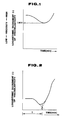
- ⁇ min the most lowered logarithmic decrement
- Fig. 1 illustrates a method for determining the minimum melt viscosity ( ⁇ min) for the electrodeposition paint.
- the viscoelasticity of the intermediate coat paint was measured according to Oscillated Pendulum Analysis (OPA) or by the oscillated pendulum type viscoelasticity measuring device (the trade name "Rheo-Vibron DDV-OPA") produced by Orientic Corporation in Japan, under conditions of weight: 22 g, moment of inertia: 859 g.cm2, and heating schedule: heating at 40°C for 5 minutes ⁇ temperature rising at a rate of 10°C/min and for 10 minutes ⁇ keeping heating at 140°C.
- a time duration (t) between a time point of starting heating and a time point of starting in rise of a logarithmic decrement of viscoelasticity as shown in Fig. 2 was determined to obtain the hardening starting time (t).
- Fig. 2 illustrates a method for determining the hardening starting time (t) for the intermediate coat paint.
- MIBK methylisobutyl ketone
- the pigment dispersing resin was supplied into a premixing tank equipped with a stirrer, and neutralized with acetic acid and diluted with deionized water. Subsequently, the carbon black, the titanium oxide, the kaolin, the basic lead silicate, and the dibutyl tinoxide were supplied in the above-mentioned amounts into the premixing tank. The mixture in the premixing tank was vigorously stirred and previously dispersed. Thereafter, sufficient dispersion was made by a neograin mill dispersion machine, thereby obtaining a pigment dispersed liquid having a solid content of 52%.
- the diketimine was obtained by dehydration polymerization (under heating) between 2 mols of methylethyl ketone and 1 mol of diethylene triamine.
- an aqueous solution containing 2500 parts by weight of deionized water and 17 parts by weight of 90% acetic acid had been provided. 621 parts by weight of the above reaction product was gradually added to the aqueous solution under vigorous stirring and kept at 60°C for 3 hours, thereby obtaining an aqueous dispersion liquid of an already cross-linked particulate resin which had a solid content of 20%, a cationic amine value of 1.7 milliequivalent/g in solid content, an average particle size of 0.1 ⁇ m b) and a gelation degree of 95% c) .
- the geleration degree is a weight percentage of a content which is insoluble in tetrahydrofuran, relative to the whole solid content in the aqueous dispersion liquid.
- the insoluble content in tegrahydrofuran was determined by sufficiently mixing 100 parts by weight of the aqueous dispersion liquid and 200 parts by weight of tetrahydrofuran and thereafter by settling insoluble substance under centrifugal separaton, the insoluble substance being weighed as the insoluble content.
- an aqueous dispersion liquid of an already cross-linked particulate resin having a solid content of 20%, a cationic amine value of 2.9 milliequivalent/g in solid content, an average particle size of 0.3 ⁇ m, and a gelation degree of 88%.
- Cationic electrodeposition paints of Productions 7 to 15 were prepared by blending the components in ratios (part by weight) shown in Table 1.
- Components shown in Table 2A were supplied in blended ratios shown in Table 2A into a reactor vessel equipped with a stirrer, a thermometer , a reflux condenser attached with a pipe for removing water of reaction, and a nitrogen gas introduction pipe. The components were mixed with each other in the reactor vessel.
- the resultant mixture in the reactor vessel was heated to 120°C to be dissolved, and thereafter the temperature of the mixture was raised to 160°C under stirring. After the temperature of the mixture was gradually raised to 230°C during lapse of 3 hours (i.e., temperature raising rate: 70°C/3 hrs.). Then reaction of the mixture was continued upon keeping the temperature at 230°C, in which the acid value of the mixture was being measured after the temperature had reached 230°C. When the acid value had reached 5, the reaction of the mixture was terminated and then the mixture was cooled.
- the amount of water of reaction was 12 parts by weight.
- the resultant polyester resin varnish had a non-volatile content of 60% and a viscosity of L to M, measured by a Gardner-Holdt bubble viscometer.
- the physical properties of the resultant polyester is shown in Table 2B.
- Table 2A Component Part by weight Cyclohexane-1,4-dimethylol 10.0 Neopentylglycol 27.9 Trimethylolpropane 5.8 Adipic acid 6.3 Isophthalic acid 50.0
- Table 2B Item Value Dehydration amount (ml) 12 Designed acid value 5 Designed hydroxyl value 78.6 Designed number average molecular weight 2000 Average number of hydroxyl groups in a molecule 2.8 Viscosity in 60% concentration (according to Gardner-Holdt bubble viscometer) L - M
- An intermediate coat paint was prepared with the following blending ratio of components and according to the following manner:
- Uban 21R is the trade name of Mitsui Toatsu Chemical Inc. in Japan and is a melamine resin varnish having a solid content of 50%.
- the polyester resin varnish, rutile titanium oxide, Mapico yellow, and carbon black were supplied into the vessel of a ball mill dispersion machine and mixed with each other for 48 hours under action of ceramic balls so as to disperse the solid contents. After dispersion, the ceramic balls were filtered out by using a sieve. Then, Uban 21R was added to the dispersion mixture and mixed by a dissolver, thus preparing an intermediate coat paint.
- An electrodeposition painting with the electrodeposition paints of Productions 7 to 15 was carried out onto an automotive steel sheet treated with zinc phosphate, under such conditions that the average film thickness of the coated electrodeposition film after baking became 20 ⁇ m. The baking was taken place at 175°C for 30 minutes. Thus, nine kinds of plates coated with different electrodeposition paints were prepared.
- the automotive steel sheet was used as a cathode in the electrodeposition painting and produced by Nippon Test Panel Industry Co., Ltd. in Japan.
- the automotive steel sheet had an average surface roughness of 0.9 ⁇ m.
- the above-mentioned intermediate paints of Production Nos. 17 to 21 were coated on the above nine kinds of electrodeposition paint coated-steel sheet by spray-painting to have a coat film thickness of 30 to 40 ⁇ m. After allowing to stand for a predetermined time, baking was made at 140°C for 30 minutes. Subsequently, the respective steel plates coated with the intermediate paints were further coated with an alkyd resin finish coat paint (Melami No. 1500 black: the trade name of Nihon Oil & Fats Co., Ltd.) to have a paint film thickness of 35 to 40 ⁇ m. Then baking was made for each steel plate with the finish coat.
- an alkyd resin finish coat paint (Melami No. 1500 black: the trade name of Nihon Oil & Fats Co., Ltd.)
- Flow intermediate coat is an intermediate coat using an intermediate coat paint which has a good flowability during hardening under baking.
- the edge corrosion resistance in Table 4 was measured by the following method: A steel cutter knife blade (LB-10: trade name of OLFA Corporation in Japan) was chemically treated with PBL3020 (the trade name of Nihon Parkerizing Co., Ltd in Japan). Each of the above mentioned nine kinds of electrodeposition paints was coated on the chemically treated knife blake and thereafter coated with the electrodeposition paint. Then, the coated electrodeposition paint was baked at 175°C for 30 minutes. Thereafter the knife blades coated with the electrodeposition paints were subjected to a salt water spraying test of 168 hours. After the test, the number of rusted points at the edge section was counted as shown in Table 4.
Landscapes
- Life Sciences & Earth Sciences (AREA)
- Chemical & Material Sciences (AREA)
- Health & Medical Sciences (AREA)
- Molecular Biology (AREA)
- Engineering & Computer Science (AREA)
- Materials Engineering (AREA)
- Wood Science & Technology (AREA)
- Organic Chemistry (AREA)
- Paints Or Removers (AREA)
- Application Of Or Painting With Fluid Materials (AREA)
- Laminated Bodies (AREA)
Applications Claiming Priority (2)
| Application Number | Priority Date | Filing Date | Title |
|---|---|---|---|
| JP1122820A JP2793253B2 (ja) | 1989-05-18 | 1989-05-18 | 複合塗膜 |
| JP122820/89 | 1989-05-18 |
Publications (3)
| Publication Number | Publication Date |
|---|---|
| EP0398757A2 true EP0398757A2 (de) | 1990-11-22 |
| EP0398757A3 EP0398757A3 (de) | 1992-04-15 |
| EP0398757B1 EP0398757B1 (de) | 1994-08-03 |
Family
ID=14845445
Family Applications (1)
| Application Number | Title | Priority Date | Filing Date |
|---|---|---|---|
| EP90305441A Expired - Lifetime EP0398757B1 (de) | 1989-05-18 | 1990-05-18 | Überzugsmittel auf Basis von zusammengesetztem Anstrichfilm |
Country Status (4)
| Country | Link |
|---|---|
| US (1) | US5132180A (de) |
| EP (1) | EP0398757B1 (de) |
| JP (1) | JP2793253B2 (de) |
| DE (1) | DE69011201T2 (de) |
Cited By (2)
| Publication number | Priority date | Publication date | Assignee | Title |
|---|---|---|---|---|
| WO1995008597A1 (de) * | 1993-09-21 | 1995-03-30 | Basf Lacke + Farben Ag | Elektrotauchlacke und verfahren zum lackieren elektrisch leitfähiger substrate |
| US5759372A (en) * | 1993-06-22 | 1998-06-02 | Basf Lacke + Farben Ag | Electrodeposition coating materials and method of coating electrically conductive substracts |
Families Citing this family (8)
| Publication number | Priority date | Publication date | Assignee | Title |
|---|---|---|---|---|
| US5378798A (en) * | 1992-07-10 | 1995-01-03 | Shell Oil Company | Composition and process for coating metallic substrates |
| US5362772A (en) * | 1993-07-09 | 1994-11-08 | E. I. Du Pont De Nemours And Company | Crosslinked microgel for cathodic electrocoating compositions |
| US5371120A (en) * | 1993-07-19 | 1994-12-06 | E. I. Du Pont De Nemours And Company | Crosslinked microgel for cathodic electrocoating compositions |
| US6423425B1 (en) | 1998-05-26 | 2002-07-23 | Ppg Industries Ohio, Inc. | Article having a chip-resistant electrodeposited coating and a process for forming an electrodeposited coating |
| US6248225B1 (en) | 1998-05-26 | 2001-06-19 | Ppg Industries Ohio, Inc. | Process for forming a two-coat electrodeposited composite coating the composite coating and chip resistant electrodeposited coating composition |
| US20130196144A1 (en) * | 2012-01-31 | 2013-08-01 | David H. Roberts | Laser Engraveable Compositions for Relief Image Printing Elements |
| JP7161335B2 (ja) * | 2018-08-01 | 2022-10-26 | 神東アクサルタコーティングシステムズ株式会社 | カチオン性電着塗料の塗装方法 |
| EP4170690B1 (de) * | 2020-06-17 | 2025-02-26 | Nippon Steel Corporation | Elektrisches stahlblech, laminierter kern und elektrische drehmaschine |
Family Cites Families (18)
| Publication number | Priority date | Publication date | Assignee | Title |
|---|---|---|---|---|
| CA986639A (en) * | 1971-10-28 | 1976-03-30 | Robert R. Zwack | Cationic electrodepositable compositions |
| JPS538673A (en) * | 1976-07-13 | 1978-01-26 | Nitto Electric Ind Co | Method of surface treatment of molded product |
| JPS6025466B2 (ja) * | 1976-07-29 | 1985-06-18 | 日石三菱株式会社 | 陰極析出型電着塗料組成物の製造方法 |
| DE2646021C3 (de) * | 1976-10-12 | 1979-05-23 | Hans Zollikerberg Zuerich Maurer (Schweiz) | Unterdusche für Klosetts |
| JPS53142444A (en) * | 1977-05-19 | 1978-12-12 | Nippon Oil Co Ltd | Cathode deposition-type electrodeposition coating composition |
| JPS544978A (en) * | 1977-06-14 | 1979-01-16 | Mitsubishi Gas Chem Co Inc | Device for solvent removal |
| JPS5415449A (en) * | 1977-07-06 | 1979-02-05 | Osaka Transformer Co Ltd | Method and apparatus for nonconsumable electrode arc welding |
| EP0012463B1 (de) * | 1978-12-11 | 1982-06-30 | Shell Internationale Researchmaatschappij B.V. | Zusammensetzungen auf der Basis hitzehärtbarer harzartiger Bindemittel, deren Herstellung und deren Verwendung als Überzugsmittel |
| JPS5937029B2 (ja) * | 1979-02-26 | 1984-09-07 | 三菱化学株式会社 | 陰極電着塗装法 |
| JPS59129270A (ja) * | 1983-01-17 | 1984-07-25 | Nippon Oil & Fats Co Ltd | カチオン電着塗料用組成物 |
| DE3315469A1 (de) * | 1983-04-28 | 1984-10-31 | Hoechst Ag, 6230 Frankfurt | Haertungskomponente fuer kunstharze, die zur amid- oder esterbildung mit carbonsaeuren befaehigte gruppen enthalten |
| JPH0246069B2 (ja) * | 1983-10-22 | 1990-10-12 | Nippon Sekyu Kk | Inkyokusekishutsugatadenchakutoryososeibutsu |
| JPH0699652B2 (ja) * | 1986-01-28 | 1994-12-07 | 関西ペイント株式会社 | 複層膜形成用カチオン電着塗料組成物 |
| JPH0629371B2 (ja) * | 1986-08-05 | 1994-04-20 | 日産自動車株式会社 | カチオン電着塗装用塗料組成物 |
| JPS6362897A (ja) * | 1986-09-01 | 1988-03-19 | Kansai Paint Co Ltd | 塗装法 |
| AU590960B2 (en) * | 1986-09-04 | 1989-11-23 | Nippon Paint Co., Ltd. | Electrodeposition coating composition |
| JPS6363761A (ja) * | 1986-09-04 | 1988-03-22 | Nippon Paint Co Ltd | 電着塗料組成物 |
| JP2686635B2 (ja) * | 1989-02-03 | 1997-12-08 | 神東塗料株式会社 | カチオン電着塗料組成物 |
-
1989
- 1989-05-18 JP JP1122820A patent/JP2793253B2/ja not_active Expired - Fee Related
-
1990
- 1990-05-11 US US07/521,966 patent/US5132180A/en not_active Expired - Lifetime
- 1990-05-18 DE DE69011201T patent/DE69011201T2/de not_active Expired - Fee Related
- 1990-05-18 EP EP90305441A patent/EP0398757B1/de not_active Expired - Lifetime
Cited By (4)
| Publication number | Priority date | Publication date | Assignee | Title |
|---|---|---|---|---|
| US5759372A (en) * | 1993-06-22 | 1998-06-02 | Basf Lacke + Farben Ag | Electrodeposition coating materials and method of coating electrically conductive substracts |
| WO1995008597A1 (de) * | 1993-09-21 | 1995-03-30 | Basf Lacke + Farben Ag | Elektrotauchlacke und verfahren zum lackieren elektrisch leitfähiger substrate |
| US5728283A (en) * | 1993-09-21 | 1998-03-17 | Basf Lacke + Farben, Ag | Electrocoating compositions and a process for coating electrically conductive substrates |
| CN1046304C (zh) * | 1993-09-21 | 1999-11-10 | 巴斯福涂料股份公司 | 涂覆导电基材的电涂组合物和方法 |
Also Published As
| Publication number | Publication date |
|---|---|
| US5132180A (en) | 1992-07-21 |
| EP0398757A3 (de) | 1992-04-15 |
| JP2793253B2 (ja) | 1998-09-03 |
| JPH02303831A (ja) | 1990-12-17 |
| DE69011201D1 (de) | 1994-09-08 |
| DE69011201T2 (de) | 1995-03-23 |
| EP0398757B1 (de) | 1994-08-03 |
Similar Documents
| Publication | Publication Date | Title |
|---|---|---|
| EP0415594B1 (de) | Kationische Elektrotauchlackierung-Anstrichzusammensetzung | |
| JPS59223759A (ja) | 熱硬化性塗料 | |
| CA2404930A1 (en) | Photodegradation-resistant electrodepositable coating compositions and processes related thereto | |
| US8426500B2 (en) | Cathodic electrodeposition paint containing a vinylpyrrolidone copolymer | |
| US5075165A (en) | Composite paint film | |
| EP0398757B1 (de) | Überzugsmittel auf Basis von zusammengesetztem Anstrichfilm | |
| US5066758A (en) | Carrier resin for pigment pastes, and its preparation and use | |
| KR20140007384A (ko) | 다층 코팅 필름 | |
| DE4125459A1 (de) | Verfahren zur herstellung steinschlagresistenter mehrschichtlackierungen und hierzu verwendbare fuellermassen | |
| WO2020218215A1 (ja) | カチオン電着塗料組成物 | |
| JP6836024B1 (ja) | カチオン電着塗料組成物 | |
| US20030096906A1 (en) | An Improved Method for making an aqueous dispersion | |
| JP7516699B2 (ja) | カチオン電着塗料組成物 | |
| JP2686635B2 (ja) | カチオン電着塗料組成物 | |
| EP0586853A1 (de) | Kationisch elektroabscheidbare feine Partikeln und Farbzusammensetzung die sie enthalten | |
| US7314900B2 (en) | Aqueous dispersions and aqueous electrodepositable primers | |
| CN116234883A (zh) | 包含烷氧基化聚乙烯亚胺的电沉积涂料组合物 | |
| DE69911311T2 (de) | Kathodische Elektrotauchlackierungszusammensetzung die ein mit primärem Amin kettenverlängertes Epoxydharz enthält | |
| JP3513665B2 (ja) | ブロックイソシアネート成分およびカチオン性基を結合した変性エポキシ樹脂、その製法およびその使用 | |
| JP6714752B1 (ja) | カチオン電着塗料組成物 | |
| JP2843052B2 (ja) | 複合塗膜 | |
| JP2022003121A (ja) | カチオン電着塗料組成物 | |
| JP5558653B2 (ja) | カチオン性電着塗料組成物 | |
| JPH0657184A (ja) | カチオン電着塗料組成物 | |
| JP7744882B2 (ja) | カチオン電着塗料組成物、カチオン電着塗膜および塗装方法 |
Legal Events
| Date | Code | Title | Description |
|---|---|---|---|
| PUAI | Public reference made under article 153(3) epc to a published international application that has entered the european phase |
Free format text: ORIGINAL CODE: 0009012 |
|
| 17P | Request for examination filed |
Effective date: 19900530 |
|
| AK | Designated contracting states |
Kind code of ref document: A2 Designated state(s): DE GB |
|
| PUAL | Search report despatched |
Free format text: ORIGINAL CODE: 0009013 |
|
| AK | Designated contracting states |
Kind code of ref document: A3 Designated state(s): DE GB |
|
| 17Q | First examination report despatched |
Effective date: 19930316 |
|
| GRAA | (expected) grant |
Free format text: ORIGINAL CODE: 0009210 |
|
| AK | Designated contracting states |
Kind code of ref document: B1 Designated state(s): DE GB |
|
| REF | Corresponds to: |
Ref document number: 69011201 Country of ref document: DE Date of ref document: 19940908 |
|
| PLBE | No opposition filed within time limit |
Free format text: ORIGINAL CODE: 0009261 |
|
| STAA | Information on the status of an ep patent application or granted ep patent |
Free format text: STATUS: NO OPPOSITION FILED WITHIN TIME LIMIT |
|
| 26N | No opposition filed | ||
| REG | Reference to a national code |
Ref country code: GB Ref legal event code: IF02 |
|
| REG | Reference to a national code |
Ref country code: GB Ref legal event code: 732E |
|
| REG | Reference to a national code |
Ref country code: GB Ref legal event code: 732E |
|
| REG | Reference to a national code |
Ref country code: GB Ref legal event code: 732E |
|
| PGFP | Annual fee paid to national office [announced via postgrant information from national office to epo] |
Ref country code: DE Payment date: 20080522 Year of fee payment: 19 |
|
| PGFP | Annual fee paid to national office [announced via postgrant information from national office to epo] |
Ref country code: GB Payment date: 20080521 Year of fee payment: 19 |
|
| GBPC | Gb: european patent ceased through non-payment of renewal fee |
Effective date: 20090518 |
|
| PG25 | Lapsed in a contracting state [announced via postgrant information from national office to epo] |
Ref country code: GB Free format text: LAPSE BECAUSE OF NON-PAYMENT OF DUE FEES Effective date: 20090518 |
|
| PG25 | Lapsed in a contracting state [announced via postgrant information from national office to epo] |
Ref country code: DE Free format text: LAPSE BECAUSE OF NON-PAYMENT OF DUE FEES Effective date: 20091201 |