EP0399155A1 - Bandschleifmaschine - Google Patents
Bandschleifmaschine Download PDFInfo
- Publication number
- EP0399155A1 EP0399155A1 EP90104263A EP90104263A EP0399155A1 EP 0399155 A1 EP0399155 A1 EP 0399155A1 EP 90104263 A EP90104263 A EP 90104263A EP 90104263 A EP90104263 A EP 90104263A EP 0399155 A1 EP0399155 A1 EP 0399155A1
- Authority
- EP
- European Patent Office
- Prior art keywords
- belt
- collecting chamber
- grinding
- shaft
- grinding machine
- Prior art date
- Legal status (The legal status is an assumption and is not a legal conclusion. Google has not performed a legal analysis and makes no representation as to the accuracy of the status listed.)
- Granted
Links
- 239000000428 dust Substances 0.000 claims abstract description 36
- 239000002775 capsule Substances 0.000 claims description 15
- 210000005069 ears Anatomy 0.000 claims description 2
- 238000011109 contamination Methods 0.000 abstract 1
- 230000003068 static effect Effects 0.000 abstract 1
- 230000000694 effects Effects 0.000 description 2
- 238000010521 absorption reaction Methods 0.000 description 1
- 238000009825 accumulation Methods 0.000 description 1
- 230000015572 biosynthetic process Effects 0.000 description 1
- 238000012423 maintenance Methods 0.000 description 1
- 230000007257 malfunction Effects 0.000 description 1
- 239000002245 particle Substances 0.000 description 1
- 230000000149 penetrating effect Effects 0.000 description 1
Images
Classifications
-
- B—PERFORMING OPERATIONS; TRANSPORTING
- B24—GRINDING; POLISHING
- B24B—MACHINES, DEVICES, OR PROCESSES FOR GRINDING OR POLISHING; DRESSING OR CONDITIONING OF ABRADING SURFACES; FEEDING OF GRINDING, POLISHING, OR LAPPING AGENTS
- B24B55/00—Safety devices for grinding or polishing machines; Accessories fitted to grinding or polishing machines for keeping tools or parts of the machine in good working condition
- B24B55/06—Dust extraction equipment on grinding or polishing machines
- B24B55/08—Dust extraction equipment on grinding or polishing machines specially designed for belt grinding machines
Definitions
- the invention relates to a belt sander of the type specified in the preamble of claim 1.
- a collecting chamber open to the sanding belt is provided in the capsule housing below the access opening provided in the work area.
- the base of the capsule housing on which the grinding dust settles can also be used to collect the grinding dust.
- the disadvantage here is that during operation a large part of the grinding dust is whirled out of the collecting chamber again by the air flow and flies around in the capsule housing. The whirled up grinding dust tends to attach itself to the bearings of the rollers and to the rollers inside. This can lead to considerable grinding dust accumulation on the rollers and unbalance, which can result in bearing damage.
- a vacuum source can be connected to the capsule housing. The effect of the suction is limited, however, because the grinding dust is still fixed inside the capsule housing and on the rollers.
- the invention has for its object to provide a belt grinder of the type mentioned, in which malfunctions due to the grinding dust are avoided.
- the air flow occurring during operation is used to convey the grinding dust that arises through the inlet opening into the collecting chamber.
- the top wall prevents the sanding dust in the collecting chamber from penetrating past the sanding belt or the lower run of the sanding belt loop to the rollers and from settling there and in the capsule housing in an undesirable manner.
- the inlet opening nestled on the roll prevents sanding dust to a significant degree from the inlet can sneak past the opening.
- the top wall of the collecting chamber running below the lower run which on the one hand prevents the grinding dust from whirling out, on the other hand forms an effective shield in the area in which the grinding dust tries to bypass the inlet opening to the collecting chamber.
- the rollers run with the sanding belt in the capsule housing practically unaffected by the sanding dust. Bearing damage from unbalance caused by adhering grinding dust is avoided. The functionality and service life of the belt grinder are increased.
- the embodiment of claim 2 is expedient because the elongated shaft has a large grinding dust holding capacity and only requires a small overall height.
- the elongated shaft also effectively shields the lower run of the sanding belt loop so that no sanding dust is carried away and gets to the rollers.
- the embodiment of claim 3 is also important because the nozzle channel is used to effectively remove the grinding dust with the air flow generated by the running grinding belt and the rollers.
- the grinding dust travels solely under the influence of the flow, so that the collecting chamber has a large absorption capacity.
- the nozzle effect in the shaft is increased in the embodiment according to claim 4.
- a lot of sanding dust can be accommodated in the rear part of the gradually widening shaft without the inlet opening being closed.
- the most reliable way of getting the grinding dust into the chute-like collecting chamber is if the edge of the collecting chamber adjacent to the roller is designed in a cutting-like manner, because the cutting-like edge favors the formation of a largely laminar flow into the collecting chamber without flow obstacles and also keeps the gap to the grinding belt as small as possible , so that grinding dust only passes through to a negligible extent.
- the measure according to claim 7 is also advantageous because the ears prevent the grinding dust from flowing sideways past the inlet opening.
- the training creates a safe entry opening into which the dust is virtually sucked in.
- a suction fan is connected to the collecting chamber, which promotes the removal of the finest dust particles.
- the embodiment according to claim 9 is also important because the full collection chamber can be easily emptied without the contents being spilled.
- this bracket allows easy pulling out, which can be designed both backwards and forwards.
- the bottom front part can be folded down, because the foldable front part not only enables the collection chamber to be pulled out easily, but also allows access from the front into the collection chamber when the inlet opening is moved.
- the sanding dust can be relieved more easily when the front part of the floor is folded down.
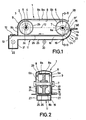
- a belt grinder 1 contains a roller 2 which is fastened on a drive shaft 4 with a wedge 5 and which is connected to a drive 3 indicated by a broken line.
- a second roller 6 is mounted parallel to the roller 2 at a distance on an axis 7.
- the rollers 2, 6 are wrapped in a loop 8 of an abrasive belt so that the two strands 8a, 8b run approximately horizontally.
- a tensioning device (not shown) for the loop 8 can be provided between the two rollers 2, 6. It is also conceivable to apply the roller 6 or the roller 2 by means of a tensioning device, so that the loop is always tensioned.
- Each roller 2, 6 has a hub part 2a, 6a, which is mounted on the shaft 4 or the axis 7, and a running ring 2b or 6b, on which the grinding belt loop 8 rests.
- the hub part is connected to the tread by a web or spokes.
- the two rollers 2, 6 are accommodated in a capsule housing 9, consisting of an upper part 9a and a lower part 9b, in accordance with the safety regulations.
- the capsule housing 9 has an access opening 29 in the working area, in front of which a grinding block 30 is expediently attached.
- the parting line of the capsule housing 9 is indicated by 10.
- a collecting chamber 11 is attached, which is designed as an elongated shaft.
- the collecting chamber 11 is suspended with a rear, hook-shaped holding part 12 on a holding part 13 of the lower part 9b.
- the collecting chamber 11 hangs on a hook-shaped holding part 14 of the grinding block 30 by means of an opening 15.
- the collecting chamber 11 forms a kind of nozzle channel 16, which extends from an inlet opening 17 which clings to the circumference of the roller 6 to a separating chamber 21 in the rear end.
- a suction fan 22 is optionally connected there.
- the inlet opening 17 follows the contour of the roller 6 and begins at the lower edge of the grinding block 30. Its lower edge is designated by 24.
- the edge 24 is expediently designed like a knife.
- an ear 18 from a shaft side wall could be present in the area of the inlet opening 17 (as indicated at 17 ') on each side of the roller 6.
- the collecting chamber 11 also has a bottom wall 25 which has a front part 23 which can be folded down by means of a hinge 19 and which runs upward in an arc shape, gradually approaching the circumference of the roller 6.
- a guide roller 20 is indicated, which supports the pulling out of the collecting chamber 11 for emptying or for maintenance work. If the guide roller 20 is not provided, the collecting chamber 11 can be detached from the hook-like holding element 14 by pushing forward and then pulled away to the rear or folded down. It is also conceivable to mount the collecting chamber 11 firmly and to attach the separating chamber 21 to the collecting chamber 11 in a detachable manner. It would also be conceivable to pull the collection chamber away in the forward direction, so that no front part 23 which can be folded down is then required.
- the top wall 26 of the collecting chamber 11 is located in the immediate vicinity of the lower run 8b of the grinding belt loop 8.
Landscapes
- Engineering & Computer Science (AREA)
- Mechanical Engineering (AREA)
- Finish Polishing, Edge Sharpening, And Grinding By Specific Grinding Devices (AREA)
- Grinding-Machine Dressing And Accessory Apparatuses (AREA)
Abstract
Description
- Die Erfindung betrifft eine Bandschleifmaschine der im Oberbegriff des Patentanspruchs 1 angegebenen Art.
- Bei derartigen, aus der Praxis bekannten Bandschleifmaschinen ist im Kapselgehäuse unterhalb der im Arbeitsbereich vorgesehenen Zugriffsöffnung eine zum Schleifband hin offene Sammelkammer vorgesehen. Zum Sammeln des Schleifstaubs kann auch der Boden des Kapselgehäuses benutzt werden, auf dem sich der Schleifstaub absetzt. Nachteilig ist dabei, daß im Betrieb durch die Luftströmung ein Großteil des Schleifstaubs wieder aus der Sammelkammer herausgewirbelt wird und im Kapselgehäuse herum fliegt. Der hochgewirbelte Schleifstaub hat die Neigung, sich bei den Lagerstellen der Rollen und an den Rollen innen festzulegen. Dies kann zu beträchtlichen Schleifstaub-Ansammlungen an den Rollen und zu Unwuchten führen, aus denen Lagerschäden resultieren. Um diesen Nachteil zumindest zu mindern, kann an das Kapselgehäuse eine Unterdruckquelle angeschlossen werden. Die Wirkung der Absaugung ist aber beschränkt, weil sich der Schleifstaub trotzdem innerhalb des Kapselgehäuses und an den Rollen festlegt.
- Der Erfindung liegt die Aufgabe zugrunde, eine Bandschleifmaschine der eingangs genannten Art zu schaffen, bei der Funktionsstörungen aufgrund des Schleifstaubes vermieden sind.
- Die gestellte Aufgabe wird erfindungsgemäß mit den im kennzeichnenden Teil des Patentanspruchs 1 angegebenen Merkmalen gelöst.
- Bei dieser Ausbildung wird die im Betrieb auftretende Luftströmung dazu benutzt, den entstehenden Schleifstaub durch die Eintrittsöffnung in die Sammelkammer zu befördern. Die Deckwand hindert den Schleifstaub in der Sammelkammer daran, am Schleifband bzw. dem unteren Trum der Schleifband-Schlaufe vorbei bis zu den Rollen vorzudringen, und sich dort und im Kapselgehäuse in unerwünschter Weise festzusetzen. Die an die Rolle angeschmiegte Eintrittsöffnung verhindert, daß sich Schleifstaub in nennenswertem Maß an der Ein trittsöffnung vorbeischleichen kann. Die unterhalb des unteren Trums verlaufende Deckwand der Sammelkammer, die einerseits das Herauswirbeln des Schleifstaubs verhindert, bildet andererseits eine wirksame Abschirmung in dem Bereich, in dem der Schleifstaub die Eintrittsöffnung zur Sammelkammer zu umgehen sucht. Die Rollen laufen dadurch mit dem Schleifband im Kapselgehäuse praktisch unbeeinflußt vom Schleifstaub. Lagerschäden aus Unwuchten durch anhaftenden Schleifstaub werden vermieden. Die Funktionsfähigkeit und die Standzeit der Bandschleifmaschine werden erhöht.
- Zweckmäßig ist die Ausführungsform von Anspruch 2, weil der langgestreckte Schacht eine große Schleifstaub-Aufnahmekapazität hat und dabei nur geringe Bauhöhe beansprucht. Der langgestreckte Schacht schirmt zudem das untere Trum der Schleifband-Schlaufe wirkungsvoll ab, so daß kein Schleifstaub mehr mitgerissen wird und zu den Rollen gelangt.
- Wichtig ist ferner die Ausführungsform von Anspruch 3, weil der Düsenkanal zu einem wirkungsvollen Abfördern des Schleifstaubs mit der durch das laufende Schleifband und die Rollen erzeugten Luftströmung eingesetzt wird. Der Schleifstaub wandert allein unter dem Einfluß der Strömung weiter, so daß die Sammelkammer eine große Aufnahmekapazität hat.
- Die Düsenwirkung im Schacht wird bei der Ausführungsform gemäß Anspruch 4 verstärkt. Im hinteren Teil des allmählich weiter werdenden Schachtes läßt sich viel Schleifstaub unterbringen, ohne daß die Eintrittsöffnung zugelegt würde. Der Schleifstaub gelangt am sichersten in die schachtartige Sammelkammer, wenn zumindest der der Rolle benachbarte Rand der Sammelkammer schneidenartig ausgebildet ist, denn der schneidenartige Rand begünstigt die Ausbildung einer weitgehend laminaren Strömung ohne Strömungshindernis in die Sammelkammer und hält zudem den Spalt zum Schleifband so klein wie möglich, so daß dort Schleifstaub nur mehr in vernachlässigbarem Maß durchtritt.
- Um auch bei starkem Schleifstaubanfall eine vollständige Entsorgung sicherstellen zu können, hat sich die aus Anspruch 5 entnehmbare Bemessung der Eintrittsöffnung bewährt. Über diesen Umfangsbereich wird der Schleifstaub - teils durch die Strömung und teils durch die Zentrifugalkraft - zuverlässig zum Eintreten in die Sammelkammer gezwungen. Es entsteht ein Sog, der auch im Arbeitsbereich vorliegende Schleifstaubwolken in die Sammelkammer zieht.
- Eine weitere, vorteilhafte Ausführungsform, bei der in der Zugriffsöffnung ein Schleifbock angeordnet ist, geht aus Anspruch 6 hervor. Da der Schachtbodenvorderteil bis zum Schleifbock verläuft, hat der Schleifstaub auch dort keine Möglichkeit, nach außen wegzufliegen. Der sich allmählich, d.h. mit einer harmonischen Krümmung zum Schleifbock erstreckende Vorderteil des Bodens begünstigt es, den eintretenden Schleifstaub möglichst weit und mit einer laminaren Strömung in die Sammelkammer zu fördern, so daß dieser vorneliegende Bereich nicht zuwächst.
- Günstig ist auch die Maßnahme gemäß Anspruch 7, weil die Ohren das seitliche Vorbeiströmen des Schleifstaubs an der Eintrittsöffnung verhindern. Man schafft mit der Ausbildung eine sichere Eintrittsöffnung, in die der Staub geradezu eingesogen wird.
- Als gegebenenfalls zusätzliche Maßnahme ist gemäß Anspruch 8 ein Sauggebläse an die Sammelkammer angeschlossen, die das Abfördern feinster Staubpartikel begünstigt.
- Wichtig ist weiterhin die Ausführungsform gemäß Anspruch 9, weil sich die volle Sammelkammer leicht entleeren läßt, ohne daß vom Inhalt etwas verschüttet wird. Außerdem läßt diese Halterung ein einfaches Herausziehen zu, das sowohl nach hinten wie nach vorn ausgelegt sein kann. In dem Zusammenhang ist es besonders vorteilhaft, wenn der Boden-Vorderteil abklappbar ist, weil der abklappbare Vorderteil nicht nur das leichte Herausziehen der Sammelkammer nach hinten ermöglicht, sondern auch bei einem Verlegen der Eintrittsöffnung einen Zugriff von vorne in die Sammelkammer ermöglicht. Außerdem läßt sich der Schleifstaub bei einem abgeklappten Boden-Vorderteil leichter entlasten.
- Eine baulich einfache Lösung geht ferner aus Anspruch 10 hervor.
- Eine Ausführungsform der Erfindung wird anhand der Zeichnung erläutert.
- Es zeigen:
- Fig. 1 einen Längsschnitt durch eine Bandschleifmaschine und
- Fig. 2 einen Querschnitt in der Ebene II-II von Fig. 1.
- Eine Bandschleifmaschine 1 enthält eine auf einer Antriebswelle 4 mit einem Keil 5 befestigte Rolle 2, die mit einem strichliert angedeuteten Antrieb 3 in Verbindung steht. Achsparallel zur Rolle 2 ist in einem Abstand auf einer Achse 7 eine zweite Rolle 6 gelagert. Die Rollen 2, 6 werden von einer Schlaufe 8 eines Schleifbandes so umschlungen, daß die beiden Trume 8a, 8b annähernd horizontal verlaufen. Zwischen den beiden Rollen 2, 6 kann eine nicht-dargestellte Spanneinrichtung für die Schlaufe 8 vorgesehen sein. Denkbar ist es auch, die Rolle 6 oder die Rolle 2 durch eine Spanneinrichtung zu beaufschlagen, so daß die Schlaufe stets gespannt ist. Jede Rolle 2, 6 besitzt einen Nabenteil 2a, 6a, der auf der Welle 4 bzw. der Achse 7 gelagert ist, und einen Laufkranz 2b bzw. 6b, auf dem die Schleifband-Schlaufe 8 aufliegt. Der Nabenteil ist jeweils mit dem Laufkranz durch einen Steg oder über Speichen verbunden.
- Die beiden Rollen 2, 6 sind in einem Kapselgehäuse 9, bestehend aus einem Oberteil 9a und einem Unterteil 9b, den Sicherheitsvorschriften entsprechend untergebracht. Das Kapselgehäuse 9 besitzt im Arbeitsbereich eine Zugriffsöffnung 29, vor der zweckmäßigerweise ein Schleifbock 30 angebracht ist. Die Trennfuge des Kapselgehäuses 9 ist mit 10 angedeutet.
- Unten im Kapselgehäuse 9 oder in einem das Kapselgehäuse tragenden, nicht gezeigten Rahmen ist eine Sammelkammer 11 angebracht, die als langgezogener Schacht ausgebildet ist. Beispielsweise ist die Sammelkammer 11 mit einem hintenliegenden, hakenförmigen Halteteil 12 auf ein Halteteil 13 des Unterteils 9b aufgehängt. Vorne hängt die Sammelkammer 11 mittels einer Öffnung 15 an einem hakenförmigen Halteteil 14 des Schleifbocks 30.
- Die Sammelkammer 11 bildet eine Art Düsenkanal 16, der sich von einer sich an den Umfang der Rolle 6 anschmiegenden Eintrittsöffnung 17 bis zu einer Abscheidekammer 21 im hinteren Ende erstreckt. Dort ist gegebenenfalls ein Sauggebläse 22 angeschlossen. Die Eintrittsöffnung 17 folgt der Kontur der Rolle 6 und beginnt an der Unterkante des Schleifbocks 30. Ihr unterer Rand ist mit 24 bezeichnet. Der Rand 24 ist zweckmäßigerweise schneidenartig ausgebildet.
- Alternativ könnte in Bereich der Eintrittsöffnung 17 (wie bei 17′ angedeutet) an jeder Seite der Rolle 6 ein Ohr 18 von einer Schachtseitenwand vorliegen.
- Die Sammelkammer 11 besitzt ferner eine Bodenwand 25, die einen über ein Scharnier 19 abklappbaren Vorderteil 23 besitzt, der bogenförmig unter allmählicher Annäherung an den Umfang der Rolle 6 nach oben verläuft. Unterhalb der Bodenwand 25 ist eine Führungsrolle 20 angedeutet, die das Herausziehen der Sammelkammer 11 zum Entleeren oder zu Wartungsarbeiten unterstützt. Ist die Führungsrolle 20 nicht vorgesehen, dann läßt sich die Sammelkammer 11 durch Schieben nach vorne vom hakenartigen Halteelement 14 lösen und dann nach hinten wegziehen oder nach unten abklappen. Denkbar ist es auch, die Sammelkammer 11 fest zu montieren und dafür die Abscheidekammer 21 abnehmbar an der Sammelkammer 11 zu befestigen. Es wäre auch denkbar, die Sammelkammer in Richtung nach vorne wegzuziehen, so daß dann kein abklappbarer Vorderteil 23 benötigt wird. Die Deckwand 26 der Sammelkammer 11 liegt in unmittelbarer Nachbarschaft zum unteren Trum 8b der SchleifbandSchlaufe 8.
- Aus Fig. 2 ist im Detail erkennbar, daß der Schleifstaub beim Arbeiten mit der Bandschleifmaschine durch die entstehende Luftströmung und die Fliehkraft direkt zum Eintreten in die Eintrittsöffnung 17 gezwungen wird. Gegebenenfalls ist die Breite der Eintrittsöffnung 17 genau auf die Bandbreite abgestimmt.
Claims (10)
Applications Claiming Priority (2)
| Application Number | Priority Date | Filing Date | Title |
|---|---|---|---|
| DE8906512U | 1989-05-26 | ||
| DE8906512U DE8906512U1 (de) | 1989-05-26 | 1989-05-26 | Bandschleifmaschine |
Publications (2)
| Publication Number | Publication Date |
|---|---|
| EP0399155A1 true EP0399155A1 (de) | 1990-11-28 |
| EP0399155B1 EP0399155B1 (de) | 1993-10-06 |
Family
ID=6839588
Family Applications (1)
| Application Number | Title | Priority Date | Filing Date |
|---|---|---|---|
| EP19900104263 Expired - Lifetime EP0399155B1 (de) | 1989-05-26 | 1990-03-06 | Bandschleifmaschine |
Country Status (3)
| Country | Link |
|---|---|
| EP (1) | EP0399155B1 (de) |
| DE (2) | DE8906512U1 (de) |
| DK (1) | DK0399155T3 (de) |
Cited By (3)
| Publication number | Priority date | Publication date | Assignee | Title |
|---|---|---|---|---|
| US5377916A (en) * | 1988-07-01 | 1995-01-03 | Koolmill Systems Limited | Surface abrasive treatment of small objects |
| CN108544343A (zh) * | 2018-05-29 | 2018-09-18 | 江苏盖之宝包装科技有限公司 | 带有封闭罩壳的磨床及吸尘装置 |
| WO2019104615A1 (zh) * | 2017-11-30 | 2019-06-06 | 陈金泉 | 一种静电除尘砂轮机 |
Families Citing this family (2)
| Publication number | Priority date | Publication date | Assignee | Title |
|---|---|---|---|---|
| CN106217191B (zh) * | 2016-08-12 | 2018-08-21 | 卓达新材料科技集团威海股份有限公司 | 一种打磨样块工装 |
| CN114851035A (zh) * | 2022-04-25 | 2022-08-05 | 大连橡胶塑料机械有限公司 | 一种密炼机转子自动抛光数控集成设备及加工方法 |
Citations (2)
| Publication number | Priority date | Publication date | Assignee | Title |
|---|---|---|---|---|
| CH536694A (de) * | 1971-04-16 | 1973-05-15 | Herzog Ernst | Staubabsaugvorrichtung an einer Bandschleifmaschine |
| DE2502806A1 (de) * | 1974-02-07 | 1975-08-14 | Timesavers Inc | Entstaubungsvorrichtung fuer schleifmaschinen |
-
1989
- 1989-05-26 DE DE8906512U patent/DE8906512U1/de not_active Expired
-
1990
- 1990-03-06 DE DE90104263T patent/DE59002971D1/de not_active Expired - Lifetime
- 1990-03-06 DK DK90104263T patent/DK0399155T3/da active
- 1990-03-06 EP EP19900104263 patent/EP0399155B1/de not_active Expired - Lifetime
Patent Citations (2)
| Publication number | Priority date | Publication date | Assignee | Title |
|---|---|---|---|---|
| CH536694A (de) * | 1971-04-16 | 1973-05-15 | Herzog Ernst | Staubabsaugvorrichtung an einer Bandschleifmaschine |
| DE2502806A1 (de) * | 1974-02-07 | 1975-08-14 | Timesavers Inc | Entstaubungsvorrichtung fuer schleifmaschinen |
Cited By (3)
| Publication number | Priority date | Publication date | Assignee | Title |
|---|---|---|---|---|
| US5377916A (en) * | 1988-07-01 | 1995-01-03 | Koolmill Systems Limited | Surface abrasive treatment of small objects |
| WO2019104615A1 (zh) * | 2017-11-30 | 2019-06-06 | 陈金泉 | 一种静电除尘砂轮机 |
| CN108544343A (zh) * | 2018-05-29 | 2018-09-18 | 江苏盖之宝包装科技有限公司 | 带有封闭罩壳的磨床及吸尘装置 |
Also Published As
| Publication number | Publication date |
|---|---|
| DE8906512U1 (de) | 1989-07-27 |
| DK0399155T3 (da) | 1993-11-15 |
| EP0399155B1 (de) | 1993-10-06 |
| DE59002971D1 (de) | 1993-11-11 |
Similar Documents
| Publication | Publication Date | Title |
|---|---|---|
| DE3532377C2 (de) | ||
| DE602004003623T2 (de) | Bandsäge mit Saugvorrichtung | |
| DE2502806C3 (de) | Enteisungsvorrichtung für Breitbandschleifmaschinen | |
| DE69221517T2 (de) | Rasenmäher | |
| DE3636182C2 (de) | Spinnaggregat einer OE-Rotorspinnmaschine | |
| DE1928576A1 (de) | Verfahren und Vorrichtung zum Abscheiden von Textilfasern u.dgl. aus einem Luftstrom | |
| DE2356180A1 (de) | Vorrichtung zum abscheiden von verunreinigungen aus fasermaterial | |
| CH626511A5 (de) | ||
| EP0497736B1 (de) | Vorrichtung zum Schleifen von Garnituren beispielsweise einer Karden- oder Reinigungstrommel | |
| DE2616450C2 (de) | Maschine zum Ausbessern, Reinigen und Polieren von Schuhen | |
| DE2926261A1 (de) | Vorrichtung zum reinigen der umlaufenden deckel einer karde | |
| DE1510227A1 (de) | Vorrichtung zum Ausscheiden und Absaugen von Faserverunreinigungen an Walzenkarden | |
| EP0399155B1 (de) | Bandschleifmaschine | |
| EP0566908A2 (de) | Flüssigkeitsfilter | |
| DE29600972U1 (de) | Mobile Vorrichtung zum Ansaugen von Laub o.dgl. Gut | |
| EP0175072A2 (de) | Kannenstock | |
| DE1510590A1 (de) | Vorrichtung zum Absaugen von Faserflug und Fadenabfaellen an Textilmaschinen | |
| EP0391010A1 (de) | Kehrmaschine | |
| DE2528756B2 (de) | Verfahren und Vorrichtung zum Entfernen von Abfällen unter einer Karde | |
| DE9420899U1 (de) | Kehrgerät | |
| EP0437860B1 (de) | Schwerkraftbandfilter | |
| DE1219367B (de) | Deckelkrempel mit Absaugeinrichtungen fuer Staub- und Abfallteilchen | |
| DE3626759A1 (de) | Entstaubungsvorrichtung fuer flachstrickmaschinen | |
| DE3343762A1 (de) | Oe-friktionsspinnmaschine | |
| DE102006017671B4 (de) | Drahtziehvorrichtung |
Legal Events
| Date | Code | Title | Description |
|---|---|---|---|
| PUAI | Public reference made under article 153(3) epc to a published international application that has entered the european phase |
Free format text: ORIGINAL CODE: 0009012 |
|
| AK | Designated contracting states |
Kind code of ref document: A1 Designated state(s): DE DK FR GB IT NL |
|
| 17P | Request for examination filed |
Effective date: 19901105 |
|
| 17Q | First examination report despatched |
Effective date: 19920616 |
|
| GRAA | (expected) grant |
Free format text: ORIGINAL CODE: 0009210 |
|
| RAP1 | Party data changed (applicant data changed or rights of an application transferred) |
Owner name: BAUGERAETE-UNION GMBH & CO., MASCHINENHANDELS KG Owner name: SUEDHARZER MASCHINENBAU GMBH |
|
| AK | Designated contracting states |
Kind code of ref document: B1 Designated state(s): DE DK FR GB IT NL |
|
| REF | Corresponds to: |
Ref document number: 59002971 Country of ref document: DE Date of ref document: 19931111 |
|
| ET | Fr: translation filed | ||
| REG | Reference to a national code |
Ref country code: DK Ref legal event code: T3 |
|
| ITF | It: translation for a ep patent filed | ||
| GBT | Gb: translation of ep patent filed (gb section 77(6)(a)/1977) |
Effective date: 19931021 |
|
| PLBE | No opposition filed within time limit |
Free format text: ORIGINAL CODE: 0009261 |
|
| STAA | Information on the status of an ep patent application or granted ep patent |
Free format text: STATUS: NO OPPOSITION FILED WITHIN TIME LIMIT |
|
| 26N | No opposition filed | ||
| PGFP | Annual fee paid to national office [announced via postgrant information from national office to epo] |
Ref country code: GB Payment date: 19950227 Year of fee payment: 6 |
|
| PG25 | Lapsed in a contracting state [announced via postgrant information from national office to epo] |
Ref country code: GB Effective date: 19960306 |
|
| GBPC | Gb: european patent ceased through non-payment of renewal fee |
Effective date: 19960306 |
|
| PGFP | Annual fee paid to national office [announced via postgrant information from national office to epo] |
Ref country code: DK Payment date: 20080312 Year of fee payment: 19 |
|
| PGFP | Annual fee paid to national office [announced via postgrant information from national office to epo] |
Ref country code: NL Payment date: 20080331 Year of fee payment: 19 Ref country code: IT Payment date: 20080320 Year of fee payment: 19 |
|
| PGFP | Annual fee paid to national office [announced via postgrant information from national office to epo] |
Ref country code: FR Payment date: 20080320 Year of fee payment: 19 |
|
| PGFP | Annual fee paid to national office [announced via postgrant information from national office to epo] |
Ref country code: DE Payment date: 20090520 Year of fee payment: 20 |
|
| REG | Reference to a national code |
Ref country code: DK Ref legal event code: EBP |
|
| NLV4 | Nl: lapsed or anulled due to non-payment of the annual fee |
Effective date: 20091001 |
|
| REG | Reference to a national code |
Ref country code: FR Ref legal event code: ST Effective date: 20091130 |
|
| PG25 | Lapsed in a contracting state [announced via postgrant information from national office to epo] |
Ref country code: NL Free format text: LAPSE BECAUSE OF NON-PAYMENT OF DUE FEES Effective date: 20091001 |
|
| PG25 | Lapsed in a contracting state [announced via postgrant information from national office to epo] |
Ref country code: FR Free format text: LAPSE BECAUSE OF NON-PAYMENT OF DUE FEES Effective date: 20091123 Ref country code: DK Free format text: LAPSE BECAUSE OF NON-PAYMENT OF DUE FEES Effective date: 20090331 |
|
| PG25 | Lapsed in a contracting state [announced via postgrant information from national office to epo] |
Ref country code: IT Free format text: LAPSE BECAUSE OF NON-PAYMENT OF DUE FEES Effective date: 20090306 |
|
| PG25 | Lapsed in a contracting state [announced via postgrant information from national office to epo] |
Ref country code: DE Free format text: LAPSE BECAUSE OF EXPIRATION OF PROTECTION Effective date: 20100306 |