EP0399334A2 - Verfahren zum Herstellen von Kontaktspitzen - Google Patents
Verfahren zum Herstellen von Kontaktspitzen Download PDFInfo
- Publication number
- EP0399334A2 EP0399334A2 EP90109105A EP90109105A EP0399334A2 EP 0399334 A2 EP0399334 A2 EP 0399334A2 EP 90109105 A EP90109105 A EP 90109105A EP 90109105 A EP90109105 A EP 90109105A EP 0399334 A2 EP0399334 A2 EP 0399334A2
- Authority
- EP
- European Patent Office
- Prior art keywords
- tip body
- core
- tip
- contact tip
- contact
- Prior art date
- Legal status (The legal status is an assumption and is not a legal conclusion. Google has not performed a legal analysis and makes no representation as to the accuracy of the status listed.)
- Withdrawn
Links
Images





Classifications
-
- B—PERFORMING OPERATIONS; TRANSPORTING
- B23—MACHINE TOOLS; METAL-WORKING NOT OTHERWISE PROVIDED FOR
- B23K—SOLDERING OR UNSOLDERING; WELDING; CLADDING OR PLATING BY SOLDERING OR WELDING; CUTTING BY APPLYING HEAT LOCALLY, e.g. FLAME CUTTING; WORKING BY LASER BEAM
- B23K9/00—Arc welding or cutting
- B23K9/24—Features related to electrodes
- B23K9/28—Supporting devices for electrodes
- B23K9/282—Electrode holders not supplying shielding means to the electrode
Definitions
- the present invention relates to a method of producing a contact tip for use in a consumable electrode type arc welding torch.
- Fig. 1 shows a known contact tip 5.
- the contact tip 5 is formed with a central through-hole 3 for receiving a consumable electrode, e.g. a wire.
- the contact tip 5 has a guide function of feeding the wire to a welding spot via the through-hole 3 and a power supply function of supplying welding current to the wire.
- the contact tip 5 has a threaded portion 6 so as to be mounted on a welding torch through engagement of the threaded portion 6 with the welding torch.
- the contact tip 5 supplies welding current to the wire through its contact with the wire and a portion of the wire held in contact with the contact tip 5 is heated to high temperatures at the time of supply of welding current to the wire, the through-hole 3 is worn excessively by feeding the wire through the through-hole 3, so that the contact tip 5 may not be able to exercise the guide function and the power supply function referred to above.
- the contact tip 5 is wholly made of chromium-copper alloy having excellent abrasion resistance at high temperatures.
- Figs. 2(a) and 2(b) show another prior art contact tip 5′ having the through-hole 3.
- the through-hole 3 of the contact tip 5′ has diameters of 0.9 mm, 1.0 mm, 1.2 mm, 1.4mm, 1.6 mm, etc. for wires 4 having various diameters, respectively such that a proper wire 4 and the corresponding contact tip 5′ are selected in accordance with materials to be welded.
- an identification sign indicative of a diameter of the through-hole 3 for example, "M 12" representing 1.2 mm is marked on each of the contact tips 5′ so as to enable an operator to discriminate the contact tips 5′ from each other.
- a plurality of flat faces 5a are formed on an outer periphery of the contact tip 5′ such that the contact tip 5′ is fastened to the welding torch through engagement of the threaded portion 6 with the welding torch by gripping the flat faces 5a with a wrench.
- the prior art contact tip 5′ is obtained from a hexagonal rod by machining the hexagonal rod.
- the threaded portion 6 is obtained by threading by the round die a portion of the hexagonal rod, which is machined to a diameter of the threaded portion 6. At this time, rotations imparted to the contact tip 5′ become unstable and it is impossible to mark the identification sign simultaneously with threading of the threaded portion 6. Meanwhile, in case the identification sign is marked on each of all the six flat faces of the hexagonal rod, the marking process is required to be performed six times.
- the contact tip is divided into a core and a tip body.
- the core is formed with the through-hole for receiving the wire and the tip body is formed with a bore for press fitting the core thereinto.
- the through-hole of the core and the bore of the tip body are formed by drilling.
- the tip body has the threaded portion for fastening the tip body to the welding torch and the threaded portion is worked to the diameter of the threaded portion by machining. Accordingly, loss of material of the contact tip reaches about 25 wt.% of whole material of the contact tip.
- since fracture of a drill may happen during drilling about 8 sec. is required for drilling.
- an essential object of the present invention is to provide, with a view to eliminating the above described disadvantages inherent in conventional production methods, a method of producing a contact tip divided functionally into a core and a tip body, which comprises the steps of: working the core and the tip body by forging; press fitting the core into the tip body or preliminarily press fitting the core into the tip body; and pressure welding the core and the tip body by forging.
- threading of a threaded portion of the tip body and marking of an identification sign indicative of a diameter of a through-hole of the core, on the tip body are performed simultaneously in a subsequent rolling process by rolling the contact tip.
- the minimum portion (core) including the through-hole for guiding a wire and supplying welding current to the wire is made of hard and electrically conductive metal having excellent heat resistance and abrasion resistance, while the tip body is made of inexpensive and electrically conductive metal. Since the tip body occupies a major portion of the contact tip, material cost of the contact tip as a whole can be reduced greatly.
- the through-hole for receiving the wire and a bore for press fitting the core thereinto are, respectively, formed on the core and the tip body by forging. Therefore, loss of material of the contact tip can be reduced to less than 1 wt.% of whole material of the contact tip. Further technically, since forging is employed in place of drilling in order to form the through-hole and the bore on the core and the tip body, respectively, so that fracture of a drill during drilling of the through-hole and the bore does not take place and thus, experiments reveal that only 0.5-0.8 sec. is required to form the through-hole and the bore on the core and the tip body, respectively by forging.
- the contact tip 5 includes a core 1 and a tip body 2 and has a threaded portion 6 for fastening the tip body 2 to a welding torch (not shown).
- the core 1 is formed with a through-hole 3, while the tip body 2 is formed with a bore 2a for pressing fitting the core 1 thereinto.
- a diameter of the through-hole 3 of the core 1 is so set as to be about 0.2 mm larger than that of the wire 4.
- the core 1 and the tip body 2 are fastened to each other quite securely by press fitting of the core 1 into the tip body 2. Therefore, at the time of feed of the wire 4, the core 1 is fixed to the tip body 2 without being axially thrusted out of the tip body 2. Meanwhile, even in case a large welding current is applied to the contact tip 5, heat is scarcely generated at a press contact portion between the core 1 and the tip body 2.
- the contact tip 5 is fastened to the welding torch by the threaded portion 6.
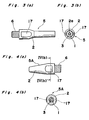
- two flat faces 17 are formed on an outer periphery of the tip body 2 such that the contact tip 5 is fastened to the welding torch through engagement of the threaded portion 6 with the welding torch by gripping the flat faces 17 with a wrench.
- the flat faces 17 have been hitherto formed by machining. However, in the present invention, the flat faces 17 are formed by forging simultaneously with forging of the tip body without producing chips.
- Figs. 4(a) and 4(b) show a contact tip 5A which is a modification of the contact tip 5.
- Figs. 5(a) to 5(d) show various constructions employed in the contact tip 5A.
- the bore 2a axially extends through a portion of the tip body 2 such that the core 1 extends axially through the portion of the tip body 2.
- the bore 2a extends through the tip body 2 such that the core 1 extends through the tip body 2.
- Figs. 4(a) and 4(b) show a contact tip 5A which is a modification of the contact tip 5.
- Figs. 5(a) to 5(d) show various constructions employed in the contact tip 5A.
- the bore 2a axially extends through a portion of the tip body 2 such that the core 1 extends axially through the portion of the tip body 2.
- the bore 2a extends through the tip body 2 such that the core 1 extends through the tip body 2.
- a step portion 7 for preventing the core 1 from slipping out of the tip body 2 is formed at a front end and a rear end of the core 1, respectively so as to strengthen mechanical coupling between the core 1 and the tip body 2.
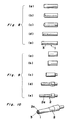
- a blank is cut off from a round bar as shown in Fig. 6(a). Then, one end of the blank undergoes forming as shown in Fig. 6(b) and a recess is formed at the other end of the blank as shown in Fig. 6(c). Subsequently, piercing is performed at the one end of the blank gradually deeply into the blank as shown in Figs. 6(d) to 6(g). Finally, piercing is performed on the recess at the other end of the blank so as to form the through-hole 3 and an outer periphery of the blank undergoes forming, whereby the core 1 is obtained as shown in Fig. 6(h).
- a blank is cut off from a round bar as shown in Fig. 7(a). Then, one end of the blank undergoes forming as shown in Fig. 7(b). Subsequently, an outer periphery of the blank undergoes forming such that a portion to be used for the threaded portion 6 is formed at the one end of the blank as shown in Fig. 7(c). Then, a recess is formed at the one end of the blank and piercing is performed at the other end of the blank as shown in Fig. 7(d).
- piercing is further performed at both the ends of the blank as shown in Fig. 7(e).
- the opposite flat faces 17 are formed on the outer periphery of the blank as shown in Fig. 7(f).
- piercing is further performed at both the ends of the blank so as to form the bore 2a extending through the blank, while the outer periphery of the blank undergoes forming, whereby the tip body 2 which is not formed with the threaded portion 6 is obtained as shown in Fig. 7(g).
- the flat faces 17 are formed in the forging process of Fig. 7(f) as described above but may also be formed in a subsequent forging process performed after preliminary press fitting of the core 1 into the tip body 2. Furthermore, the two flat faces 17 are formed in Fig. 7(f) but the flat faces 17 may be more than two in number.
- Figs. 8(a) to 8(e) show processes for forging the core 1 of the contact tip 5 in a production method according to a second embodiment of the present invention.
- a blank is cut off from a round bar as shown in Fig. 8(a).
- one end of the blank undergoes forming as shown in Fig. 8(b).
- a recess is formed at the one end of the blank and piercing is performed at the other end of the blank as shown in Fig. 8(c).
- piercing is further performed at the other end of the blank as shown in Fig. 8(d).
- piercing is performed at the one end of the blank so as to form the through-hole 3 and an outer periphery of the blank undergoes forming, whereby the core 1 is obtained as shown in Fig. 8(e).
- Figs. 9(a) to 9(e) show processes for forging the tip body 2 of the contact tip 5 of Figs. 8(a) to 8(e).
- a blank is cut off from a round bar as shown in Fig. 9(a).
- one end of the blank undergoes forming as shown in Fig. 9(b).
- an outer periphery of the blank undergoes forming such that a portion to be used for the threaded portion 6 is formed at the other end of the blank as shown in Fig. 9(c).
- piercing is performed at both the ends of the blank as shown in Fig. 9(d) until the bore 2a extending through the blank is formed as shown in Fig. 9(e).
- the core 1 of Fig. 8(e) is preliminarily press fitted into the bore 2a of the tip body 2 of Fig. 9(e) as shown in Fig. 10. Then, the core 1 and the tip body 2 are subjected to pressure welding as shown in Fig. 11(a). Then, the flat faces 17 are formed on the outer periphery of the tip body 2 as shown in Fig. 11(b). Subsequently, the tip body 2 is subjected to staking such that coupling between the core 1 and the tip body 2 is further strengthened as shown in Fig. 11(c).
- Figs. 12(a) and 12(b) show opposed movable and fixed die members 51 and 52 for performing thread rolling of the threaded portion 6 and marking on the tip body 2 having the core 1 press fitted thereinto.
- the movable die member 51 has a threading die 51a and a base portion 51b having a marking die 60.
- the fixed die 52 has a threading die 52a and a base portion 52b. Initially, the tip body 2 is gripped between the movable and fixed die members 51 and 52 at the point A of the movable die member 51 in Fig. 12(b).
- the movable die member 51 is displaced relative to the fixed die member 52 such that the rolling tip body 2 travels in the direction of the arrow C from the point A to the point B in Fig. 12(b).
- the threaded portion 6 is formed on the tip body 2 by the threading dies 51a and 52a, while an identification sign indicative of a diameter of the through-hole 3 of the core 1 of the contact tip 5, for example, "M 12" representing 1.2 mm is marked on the tip body 2 by the marking die 60 of the movable die member 51 as shown in Fig. 12(a), whereby the contact tip 5 can be obtained. If marking is performed by using a marking-off pin, marking is restricted to the flat faces 17.
- marking is performed with the use of the marking die 60 by rolling the tip body 2
- marking is not restricted to the flat faces 17 but can be performed at any location, e.g. a cylindrical portion of the tip body 2.
- area of marking can be easily expanded from a portion of an outer periphery of the tip body 2 to a whole outer periphery of the tip body 2.
Landscapes
- Engineering & Computer Science (AREA)
- Physics & Mathematics (AREA)
- Plasma & Fusion (AREA)
- Mechanical Engineering (AREA)
- Spark Plugs (AREA)
- Arc Welding In General (AREA)
- Manufacture Of Switches (AREA)
- Forging (AREA)
Applications Claiming Priority (4)
| Application Number | Priority Date | Filing Date | Title |
|---|---|---|---|
| JP1129605A JPH02307641A (ja) | 1989-05-23 | 1989-05-23 | 溶接用コンタクトチップの製造方法 |
| JP1129606A JPH02307680A (ja) | 1989-05-23 | 1989-05-23 | 溶接用コンタクトチップの製造方法 |
| JP129606/89 | 1989-05-23 | ||
| JP129605/89 | 1989-05-23 |
Publications (2)
| Publication Number | Publication Date |
|---|---|
| EP0399334A2 true EP0399334A2 (de) | 1990-11-28 |
| EP0399334A3 EP0399334A3 (de) | 1991-02-06 |
Family
ID=26464950
Family Applications (1)
| Application Number | Title | Priority Date | Filing Date |
|---|---|---|---|
| EP19900109105 Withdrawn EP0399334A3 (de) | 1989-05-23 | 1990-05-15 | Verfahren zum Herstellen von Kontaktspitzen |
Country Status (2)
| Country | Link |
|---|---|
| EP (1) | EP0399334A3 (de) |
| CN (1) | CN1015697B (de) |
Cited By (10)
| Publication number | Priority date | Publication date | Assignee | Title |
|---|---|---|---|---|
| DE4404802C1 (de) * | 1994-02-16 | 1995-08-03 | Zentrum Fuer Material Und Umwe | Kontaktrohr für Lichtbogenschweißbrenner |
| CN1041290C (zh) * | 1996-04-12 | 1998-12-23 | 清华大学 | 碳陶瓷复合材料焊接导电嘴 |
| WO1999011417A1 (de) * | 1997-08-30 | 1999-03-11 | Alexander Binzel Gmbh & Co. Kg | Stromdüse |
| DE19631091C2 (de) * | 1996-08-01 | 2001-06-07 | Binzel Alexander Gmbh Co Kg | Führungs-und Kontakthülse |
| CN1080161C (zh) * | 1995-10-03 | 2002-03-06 | 株式会社Smk | 焊接导电嘴 |
| RU2220036C2 (ru) * | 2002-01-28 | 2003-12-27 | Открытое акционерное общество "АВТОВАЗ" | Токопроводящий наконечник для дуговой сварки плавящимся электродом и способ его изготовления |
| RU2220037C2 (ru) * | 2002-01-28 | 2003-12-27 | Открытое акционерное общество "АВТОВАЗ" | Токопроводящий наконечник для дуговой сварки плавящимся электродом и способ его изготовления |
| DE102009008250A1 (de) * | 2009-02-03 | 2010-08-05 | Kjellberg Finsterwalde Plasma Und Maschinen Gmbh | Brenner für das Wolfram-Inertgas-Schweißen, Elektrodeneinheit für und Verfahren zum Betreiben des Brenners |
| DE102018102143B4 (de) * | 2018-01-31 | 2020-11-05 | CEP - Compound Extrusion Products GmbH | Herstellungsverfahren für ein verschleißarmes Rohrhalbzeug, Rohrhalbzeug und Verwendung |
| US12103122B2 (en) | 2019-03-07 | 2024-10-01 | Tipman Co., Ltd. | Contact chip regenerating device |
Families Citing this family (2)
| Publication number | Priority date | Publication date | Assignee | Title |
|---|---|---|---|---|
| CN105328312A (zh) * | 2014-08-06 | 2016-02-17 | 张建生 | 导电嘴 |
| CN115401296A (zh) * | 2022-06-09 | 2022-11-29 | 陆万全 | 一种高强度导电嘴及生产方法 |
-
1990
- 1990-05-15 EP EP19900109105 patent/EP0399334A3/de not_active Withdrawn
- 1990-05-23 CN CN90103889.XA patent/CN1015697B/zh not_active Expired
Cited By (12)
| Publication number | Priority date | Publication date | Assignee | Title |
|---|---|---|---|---|
| DE4404802C1 (de) * | 1994-02-16 | 1995-08-03 | Zentrum Fuer Material Und Umwe | Kontaktrohr für Lichtbogenschweißbrenner |
| CN1080161C (zh) * | 1995-10-03 | 2002-03-06 | 株式会社Smk | 焊接导电嘴 |
| CN1041290C (zh) * | 1996-04-12 | 1998-12-23 | 清华大学 | 碳陶瓷复合材料焊接导电嘴 |
| DE19631091C2 (de) * | 1996-08-01 | 2001-06-07 | Binzel Alexander Gmbh Co Kg | Führungs-und Kontakthülse |
| WO1999011417A1 (de) * | 1997-08-30 | 1999-03-11 | Alexander Binzel Gmbh & Co. Kg | Stromdüse |
| US6429406B1 (en) | 1997-08-30 | 2002-08-06 | Alexander Binzel Schweisstechnik Gmbh & Co. Kg | Contact tip |
| RU2220036C2 (ru) * | 2002-01-28 | 2003-12-27 | Открытое акционерное общество "АВТОВАЗ" | Токопроводящий наконечник для дуговой сварки плавящимся электродом и способ его изготовления |
| RU2220037C2 (ru) * | 2002-01-28 | 2003-12-27 | Открытое акционерное общество "АВТОВАЗ" | Токопроводящий наконечник для дуговой сварки плавящимся электродом и способ его изготовления |
| DE102009008250A1 (de) * | 2009-02-03 | 2010-08-05 | Kjellberg Finsterwalde Plasma Und Maschinen Gmbh | Brenner für das Wolfram-Inertgas-Schweißen, Elektrodeneinheit für und Verfahren zum Betreiben des Brenners |
| DE102009008250B4 (de) * | 2009-02-03 | 2011-03-17 | Kjellberg Finsterwalde Plasma Und Maschinen Gmbh | Brenner für das Wolfram-Inertgas-Schweißen, Elektrodeneinheit für und Verfahren zum Betreiben des Brenners |
| DE102018102143B4 (de) * | 2018-01-31 | 2020-11-05 | CEP - Compound Extrusion Products GmbH | Herstellungsverfahren für ein verschleißarmes Rohrhalbzeug, Rohrhalbzeug und Verwendung |
| US12103122B2 (en) | 2019-03-07 | 2024-10-01 | Tipman Co., Ltd. | Contact chip regenerating device |
Also Published As
| Publication number | Publication date |
|---|---|
| CN1015697B (zh) | 1992-03-04 |
| EP0399334A3 (de) | 1991-02-06 |
| CN1047465A (zh) | 1990-12-05 |
Similar Documents
| Publication | Publication Date | Title |
|---|---|---|
| EP0399334A2 (de) | Verfahren zum Herstellen von Kontaktspitzen | |
| CA1186874A (en) | Method of making a male resistance welding electrode | |
| JP3315988B2 (ja) | スペード型穿孔バイト | |
| US4760235A (en) | Male spot welding electrode | |
| EP0324088A1 (de) | Kontaktende für Lichtbogenschweissen des Typs mit verzehrender Elektrode | |
| US6200076B1 (en) | Cutting tool and method for producing the same | |
| EP0958093B1 (de) | Widerstandschweisselektrode und verfahren zur herstellung derselben | |
| US6039237A (en) | Heating tip and method of manufacturing the same | |
| JP2500225B2 (ja) | ピアシング成形方法および装置 | |
| CN110076434A (zh) | 易于加工的耐用焊接导电嘴及其制造方法 | |
| EP0814931B1 (de) | Verfahren zur Herstellung eines Spannbackens für einen Spannfutter | |
| US6429406B1 (en) | Contact tip | |
| US20020060206A1 (en) | Method of joining a sintered hard alloy member to a stainless steel member and method of making a cutting tool therefrom | |
| JP3710876B2 (ja) | アーク溶接用チップの製造方法 | |
| JP3768588B2 (ja) | アーク溶接用チップの製造方法 | |
| JPH10113742A (ja) | Tigトーチ用コレットの製造方法 | |
| JPH07290247A (ja) | アーク溶接用コンタクトチップ及びその製造方法 | |
| JPH0256993B2 (de) | ||
| JP3472350B2 (ja) | アーク溶接用コンタクトチップ及びその製造方法 | |
| DE4217995C2 (de) | Schmelzschweißkontaktdüse | |
| JP3461025B2 (ja) | 溶接用チップの製造方法 | |
| CN116690156B (zh) | 一种两端铜套同步压装工装及压装工艺 | |
| JPH0647552A (ja) | 溶接用チップの製造方法 | |
| GB2144360A (en) | Production of hollow bodies | |
| JPH10113743A (ja) | Tigトーチ用コレットボディの製造方法 |
Legal Events
| Date | Code | Title | Description |
|---|---|---|---|
| PUAI | Public reference made under article 153(3) epc to a published international application that has entered the european phase |
Free format text: ORIGINAL CODE: 0009012 |
|
| 17P | Request for examination filed |
Effective date: 19900515 |
|
| AK | Designated contracting states |
Kind code of ref document: A2 Designated state(s): DE GB |
|
| PUAL | Search report despatched |
Free format text: ORIGINAL CODE: 0009013 |
|
| RHK1 | Main classification (correction) |
Ipc: B23K 9/26 |
|
| AK | Designated contracting states |
Kind code of ref document: A3 Designated state(s): DE GB |
|
| 17Q | First examination report despatched |
Effective date: 19920203 |
|
| STAA | Information on the status of an ep patent application or granted ep patent |
Free format text: STATUS: THE APPLICATION IS DEEMED TO BE WITHDRAWN |
|
| 18D | Application deemed to be withdrawn |
Effective date: 19921104 |