EP0399792A2 - Textiles de polypropylène à bas fluage - Google Patents
Textiles de polypropylène à bas fluage Download PDFInfo
- Publication number
- EP0399792A2 EP0399792A2 EP90305564A EP90305564A EP0399792A2 EP 0399792 A2 EP0399792 A2 EP 0399792A2 EP 90305564 A EP90305564 A EP 90305564A EP 90305564 A EP90305564 A EP 90305564A EP 0399792 A2 EP0399792 A2 EP 0399792A2
- Authority
- EP
- European Patent Office
- Prior art keywords
- polypropylene
- blend
- textile
- ribbon
- glass transition
- Prior art date
- Legal status (The legal status is an assumption and is not a legal conclusion. Google has not performed a legal analysis and makes no representation as to the accuracy of the status listed.)
- Ceased
Links
- -1 polypropylene Polymers 0.000 title claims abstract description 88
- 239000004743 Polypropylene Substances 0.000 title claims abstract description 75
- 229920001155 polypropylene Polymers 0.000 title claims abstract description 75
- 239000004753 textile Substances 0.000 title claims abstract description 30
- 239000000203 mixture Substances 0.000 claims abstract description 44
- 239000013032 Hydrocarbon resin Substances 0.000 claims abstract description 20
- 229920006270 hydrocarbon resin Polymers 0.000 claims abstract description 20
- 230000009477 glass transition Effects 0.000 claims abstract description 16
- 239000000835 fiber Substances 0.000 claims description 12
- 239000004744 fabric Substances 0.000 claims description 4
- 239000000155 melt Substances 0.000 claims description 4
- HECLRDQVFMWTQS-RGOKHQFPSA-N 1755-01-7 Chemical compound C1[C@H]2[C@@H]3CC=C[C@@H]3[C@@H]1C=C2 HECLRDQVFMWTQS-RGOKHQFPSA-N 0.000 claims description 3
- 238000010622 cold drawing Methods 0.000 claims description 2
- 230000001747 exhibiting effect Effects 0.000 claims description 2
- 238000001125 extrusion Methods 0.000 claims description 2
- 229920005989 resin Polymers 0.000 abstract description 30
- 239000011347 resin Substances 0.000 abstract description 30
- 239000000178 monomer Substances 0.000 abstract description 5
- 238000005120 petroleum cracking Methods 0.000 abstract description 3
- 238000000034 method Methods 0.000 description 6
- 239000004677 Nylon Substances 0.000 description 5
- 238000005984 hydrogenation reaction Methods 0.000 description 5
- 229920001778 nylon Polymers 0.000 description 5
- 229920000728 polyester Polymers 0.000 description 5
- 229920000139 polyethylene terephthalate Polymers 0.000 description 5
- 239000005020 polyethylene terephthalate Substances 0.000 description 5
- 229920000642 polymer Polymers 0.000 description 5
- 239000000654 additive Substances 0.000 description 4
- 230000002411 adverse Effects 0.000 description 4
- 239000010408 film Substances 0.000 description 4
- 238000002156 mixing Methods 0.000 description 4
- 239000000126 substance Substances 0.000 description 4
- 239000004215 Carbon black (E152) Substances 0.000 description 3
- 239000004831 Hot glue Substances 0.000 description 3
- 230000000052 comparative effect Effects 0.000 description 3
- 238000005520 cutting process Methods 0.000 description 3
- 229930195733 hydrocarbon Natural products 0.000 description 3
- 150000002430 hydrocarbons Chemical class 0.000 description 3
- 239000004698 Polyethylene Substances 0.000 description 2
- PPBRXRYQALVLMV-UHFFFAOYSA-N Styrene Chemical compound C=CC1=CC=CC=C1 PPBRXRYQALVLMV-UHFFFAOYSA-N 0.000 description 2
- 239000003963 antioxidant agent Substances 0.000 description 2
- 210000000988 bone and bone Anatomy 0.000 description 2
- 239000012760 heat stabilizer Substances 0.000 description 2
- 238000002347 injection Methods 0.000 description 2
- 239000007924 injection Substances 0.000 description 2
- 239000004611 light stabiliser Substances 0.000 description 2
- 229920000573 polyethylene Polymers 0.000 description 2
- 238000006116 polymerization reaction Methods 0.000 description 2
- 239000010409 thin film Substances 0.000 description 2
- ZCYVEMRRCGMTRW-UHFFFAOYSA-N 7553-56-2 Chemical compound [I] ZCYVEMRRCGMTRW-UHFFFAOYSA-N 0.000 description 1
- WKBOTKDWSSQWDR-UHFFFAOYSA-N Bromine atom Chemical compound [Br] WKBOTKDWSSQWDR-UHFFFAOYSA-N 0.000 description 1
- 229920013683 Celanese Polymers 0.000 description 1
- 229920001153 Polydicyclopentadiene Polymers 0.000 description 1
- 229920002367 Polyisobutene Polymers 0.000 description 1
- 230000000996 additive effect Effects 0.000 description 1
- 239000000853 adhesive Substances 0.000 description 1
- 230000001070 adhesive effect Effects 0.000 description 1
- 150000001336 alkenes Chemical class 0.000 description 1
- XYLMUPLGERFSHI-UHFFFAOYSA-N alpha-Methylstyrene Chemical compound CC(=C)C1=CC=CC=C1 XYLMUPLGERFSHI-UHFFFAOYSA-N 0.000 description 1
- 229920006125 amorphous polymer Polymers 0.000 description 1
- GDTBXPJZTBHREO-UHFFFAOYSA-N bromine Substances BrBr GDTBXPJZTBHREO-UHFFFAOYSA-N 0.000 description 1
- 229910052794 bromium Inorganic materials 0.000 description 1
- 230000003197 catalytic effect Effects 0.000 description 1
- 239000003795 chemical substances by application Substances 0.000 description 1
- 238000013329 compounding Methods 0.000 description 1
- 230000002950 deficient Effects 0.000 description 1
- 150000001993 dienes Chemical class 0.000 description 1
- 238000000113 differential scanning calorimetry Methods 0.000 description 1
- 239000006185 dispersion Substances 0.000 description 1
- 238000009826 distribution Methods 0.000 description 1
- 238000005227 gel permeation chromatography Methods 0.000 description 1
- 229910052740 iodine Inorganic materials 0.000 description 1
- 239000011630 iodine Substances 0.000 description 1
- 239000000463 material Substances 0.000 description 1
- 239000005026 oriented polypropylene Substances 0.000 description 1
- 238000005453 pelletization Methods 0.000 description 1
- 239000003208 petroleum Substances 0.000 description 1
- 230000000704 physical effect Effects 0.000 description 1
- 238000002360 preparation method Methods 0.000 description 1
- 230000002040 relaxant effect Effects 0.000 description 1
- 230000000391 smoking effect Effects 0.000 description 1
- 239000007787 solid Substances 0.000 description 1
- 150000003505 terpenes Chemical class 0.000 description 1
- 235000007586 terpenes Nutrition 0.000 description 1
- 238000009827 uniform distribution Methods 0.000 description 1
- XLYOFNOQVPJJNP-UHFFFAOYSA-N water Substances O XLYOFNOQVPJJNP-UHFFFAOYSA-N 0.000 description 1
Images

Classifications
-
- D—TEXTILES; PAPER
- D01—NATURAL OR MAN-MADE THREADS OR FIBRES; SPINNING
- D01F—CHEMICAL FEATURES IN THE MANUFACTURE OF ARTIFICIAL FILAMENTS, THREADS, FIBRES, BRISTLES OR RIBBONS; APPARATUS SPECIALLY ADAPTED FOR THE MANUFACTURE OF CARBON FILAMENTS
- D01F6/00—Monocomponent artificial filaments or the like of synthetic polymers; Manufacture thereof
- D01F6/44—Monocomponent artificial filaments or the like of synthetic polymers; Manufacture thereof from mixtures of polymers obtained by reactions only involving carbon-to-carbon unsaturated bonds as major constituent with other polymers or low-molecular-weight compounds
- D01F6/46—Monocomponent artificial filaments or the like of synthetic polymers; Manufacture thereof from mixtures of polymers obtained by reactions only involving carbon-to-carbon unsaturated bonds as major constituent with other polymers or low-molecular-weight compounds of polyolefins
-
- Y—GENERAL TAGGING OF NEW TECHNOLOGICAL DEVELOPMENTS; GENERAL TAGGING OF CROSS-SECTIONAL TECHNOLOGIES SPANNING OVER SEVERAL SECTIONS OF THE IPC; TECHNICAL SUBJECTS COVERED BY FORMER USPC CROSS-REFERENCE ART COLLECTIONS [XRACs] AND DIGESTS
- Y10—TECHNICAL SUBJECTS COVERED BY FORMER USPC
- Y10T—TECHNICAL SUBJECTS COVERED BY FORMER US CLASSIFICATION
- Y10T442/00—Fabric [woven, knitted, or nonwoven textile or cloth, etc.]
- Y10T442/60—Nonwoven fabric [i.e., nonwoven strand or fiber material]
- Y10T442/697—Containing at least two chemically different strand or fiber materials
Definitions
- This invention relates to low creep polypropylene textiles, and more particularly to fibers made from a blend of polypropylene and hydrogenated hydrocarbon resins.
- Isotactic polypropylene is an essentially linear, highly crystalline polymer. It is well known commercially for its high tensile strength, stiffness and hardness. An important use of polypropylene commercially is as filament, e.g., rope, cordage, webbing and carpeting. Relative to textiles made from nylon or polyester, however, polypropylene is deficient in resiliency and creep resistance. Resiliency is the ability of a fiber to recover from having been bent over, for example, the ability of carpet filament or staple to return to its original shape after being under a piece of furniture. Unfortunately, polypropylene fibers accept a permanent set under such conditions and are generally unacceptable in anything except very dense carpets.
- Creep is the continuous elongation over an extended period of time under a load.
- the creep of polypropylene is generally such that the fabric will undergo dimensional deformation with time.
- polypropylenes used in textile applications the same creep can lead to a loss of fabric strength.
- Nylon and polyester are often favored over polypropylene in applications requiring resiliency and creep resistance.
- Nylon and polyester like polypropylene, are crystalline polymers which, in their solid state, have both crystalline and amorphous phases.
- nylon and polyester In contrast to polypropylene, however, nylon and polyester have considerably higher glass transition temperatures, generally about 100°C and 150°C, respectively. Therefore, at normal, ambient use temperatures, the amorphous phase in polyester and nylon is effectively "frozen" and the molecular chains therein are generally prevented from stress relaxing.
- Polypropylene has a glass transition temperature of about 0°C. At ambient temperatures it is above its glass transition temperature. Thus chains in the amorphous phase are able to move, with the result that creep and poor resiliency are manifested.
- Example 12 of this patent there is described a film made from 80 parts of isotactic polypropylene and 20 parts of a hydrogenated hydrocarbon polymer having a softening point of 105°C, an average molecular weight of about 1170, and iodine value of 25, and prepared by hydrogenating the resinous catalytic polymerization product of unsaturated monomers derived from cracked petroleum and composed essentially of dienes and reactive olefins.
- Hot melt adhesive blends made from polyethylene, polypropylene, and a tackifying agent are known from U. S. Patent 4,076,670 to Godfrey. These adhesives are stated to have creep resistance as evaluated over the temperature range of 0°F to 35°F.
- the present invention provides a polypropylene textile with improved resiliency and resistance to creep at ambient temperatures.
- the improved properties of the polypropylene textile are obtained by forming the textile from isotactic polypropylene blended with a minor proportion of a hydrogenated hydrocarbon resin.
- the hydrogenated hydrocarbon resin has properties which are essential to obtaining the improved resiliency and creep resistance of the polypropylene blend. These essential properties include a weight average molecular weight of from 500 to 1000 as measured by gel permeation chromatography using polyisobutylene standards and a glass transition temperature as measured by differential scanning calorimetry of from 40°C to 90°C. Desirably, the ratio of weight average molecular weight to number average molecular weight should be about 2 to 3.
- the hydrogenated hydrocarbon resin is, for example, the hydrogenated product of polymerized cyclic diolefins.
- the invention provides a textile which includes an intimate blend of isotactic polypropylene and from 10 to 30 weight percent hydrogenated hydrocarbon resin.
- the hydrogenated hydrocarbon resin is compatible with the polypropylene.
- the hydrogenated hydrocarbon resin has a weight average molecular weight of from 500 to 1000 and a glass transition temperature of from 40°C to 90°C and is obtained by the hydrogenation of polymerized olefinically unsaturated monomers derived from petroleum cracking.
- the blend exhibits creep resistance and resiliency at ambient temperatures, i.e., 10°C - 30°C, and has a glass transition temperature greater than 20°C, preferably greater than 25°C.
- the invention provides a polypropylene ribbon yarn exhibiting resiliency and resistance to creep.
- the yarn comprises an intimate blend of isotactic polypropylene and preferably from 15-20 parts by weight of a hydrogenated hydrocarbon resin per 100 parts by weight of the polypropylene.
- the hydrogenated hydrocarbon resin comprises the hydrogenated product of polymerized cyclic diolefin, and has a weight average molecular weight of from 500 to 1000, and a glass transition temperature of from 40° to 90°C.
- the blend has a glass transition temperature of at least 20°C and a melt flow ratio of from 0.1 to 10.
- the blend is formed into ribbon yarn from split sheet or thin ribbon extrusion and is drawn at a draw ratio of from 1:1 to 20:1.
- the polypropylene used in the textile according to the present invention is any conventional isotactic polypropylene suitable for use in textiles.
- Textile grade polypropylenes typically have a melt-flow ratio of from about 0.1 to about 10, a weight average molecular weight of from about 600,000 to about 250,000, and a ratio of weight average to number average molecular weight of from about 4 to about 10.
- melt flow rate is determined according to the procedures of ASTM D1238, condition 230°C, 2.160 kg (condition L).
- the polypropylene will typically also contain conventional additives such as antioxidants, light and heat stabilizers, and the like.
- the hydrogenated hydrocarbon resin employed in the textile blend of the present invention is a hydrogenated amorphous polymer of one or more hydrocarbon monomers.
- the resin has a higher glass transition temperature (Tg) than the polypropylene and is compatible therewith in the proportions employed so as to be miscible on a molecular scale.
- Tg glass transition temperature
- the higher Tg of the hydrogenated hydrocarbon resin serves to elevate the Tg of the amorphous regions of the polypropylene in the textile, essentially without adversely affecting the tensile properties of the polypropylene in the crystalline phase.
- the resulting polypropylene and resin blend has improved resiliency and creep resistance and equivalent tensile strength and stiffness relative to polypropylene not containing the hydrogenated hydrocarbon resin.
- the properties of the hydrogenated hydrocarbon resin necessary to obtain this result include the glass transition temperature and the molecular weight distribution.
- the Tg of the resin must be between 40°C and 90°C and the weight average molecular weight (Mw) must be between 500 and 1000. If the Tg is too low, the resulting resiliency and creep resistance of the textile blend is not adequately enhanced. Also, if the weight average molecular weight is too low, "smoking" during blending with the polypropylene at the elevated temperatures required to obtain the necessary dispersion during the forming of the blend into textiles fibers can occur. On the other hand, if Mw is too high, the resin may not be sufficiently miscible with the polypropylene. Immiscibility of the resin with the polypropylene will tend to adversely affect the desirable properties of the polypropylene, e.g., tensile strength and hardness.
- Hydrogenation of the resin is also important because excessively unsaturated resins will have a yellow color, and will not be resistant to heat and light.
- the resin should have a bromine number of less than 150 mg/100 gm as measured by ASTM D1159-84.
- the hydrocarbon resin is prepared by the hydrogenation of polymerized olefinically unsaturated monomers derived from petroleum cracking, preferably cyclic diolefin, such as, for example, dicyclopentadiene, styrene, alpha-methylstyrene and the like.
- cyclic diolefin such as, for example, dicyclopentadiene, styrene, alpha-methylstyrene and the like.
- Such resins, their preparation and hydrogenation are well known in the art and are commercially available under the trade designations, for example, Escorez, Arkon and the like. Particularly preferred are resins obtained in the trade under the designation Escorez 5000 series.
- the resins are formed by the polymerization of dicyclopentadiene followed by hydrogenation.
- the resin and the polypropylene are blended in a proportion of from about 10 to 30 weight percent resin. At least about 10 parts by weight of the resin is required to obtain an improvement in ambient temperature creep resistance and resiliency. An excessive proportion of the resin will generally adversely affect the tensile strength of the textile.
- the resin and polypropylene along with any conventional additives are blended together using conventional equipment and techniques.
- Conventional additives may include antioxidants, heat stabilizers, light stabilizers and the like in relatively minor proportions.
- the blend should, however, be essentially free of added blend components such as polyethylene, atactic polypropylene and the like so that the desirable physical and mechanical properties of the polypropylene/resin blend are not adversely affected thereby.
- the desired proportions of the resin and polypropylene may be blended, for example, in mixing extruders, roll mills, Banbury mixers and the like.
- the blend should be sufficiently mixed to ensure uniform distribution of the resin throughout the polypropylene.
- the blend is then subsequently processed into textile form, for example, spun fibers or ribbon yarn.
- Ribbon yarn may be prepared, for example, by extruding the blend into the form of a thin film and subsequently cutting the film into thin strips to form ribbon or by directly extruding the blend into thin ribbon shapes.
- the fibers are preferably drawn at a draw ratio of up to 20:1, preferably 4:1 to 7:1, to orient the fibers. Although any suitable drawing temperature may be employed, cold drawing at a temperature from 120° to 220°C is preferred.
- the fibers can then be processed into conventional textile products such as rope, carpet staple, carpet fiber, fabrics and the like.
- Ribbon yarn was prepared from polypropylene blended with Escorez 5340 resin at 12 weight percent of resin.
- the polypropylene was obtained from Exxon Chemical Company and had a melt flow rate (MFR) of 0.5 (condition 230°C, 2.160 kg) and a Mw of 500,000.
- the Escorez resin was obtained commercially from Exxon Chemical Company and is a hydrogenated polydicyclopentadiene flake having a Mw of 810 and a Tg of 85°C.
- the polypropylene/resin blend was prepared by dry blending the two components and then melt compounding using a Werner Pfleiderer extruder with a twin co-rotating, intermeshing screw 1460 mm in length.
- the temperature of the later zones of the screw was 220°C.
- the blend was extruded through a 24 hole die which discharged into a water bath and strand cutting system for pelletizing.
- the resulting blend had a MFR of 1.5 and a Tg of approximately 27°C as measured at the peak in a plot of loss modulus versus temperature determined using a Polymers Laboratories' dynamic mechanical thermal analyzer (DMTA).
- DMTA dynamic mechanical thermal analyzer
- the pelletized blend was formed into ribbon yarn by extruding the blend into the form of thin film and then cutting the film into thin strips to form ribbon.
- the ribbon was then drawn 7:1 at approximately 180°C.
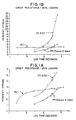
- the ribbon yarn was evaluated for creep resistance using weights that were equal to 20% and 40% of the breaking force of the yarn at room temperature.
- the comparative polypropylene was obtained from Exxon Chemical Company under the designation PD2152 and had a MFR of 2.3 and a Mw of approximately 360,000.
- the PET was a typical textile grade fiber produced by Celanese.
- the resulting data seen in Figs. 1A and 1B show that the Escorez resin-modified polypropylene exhibited a much greater creep resistance than the unmodified polypropylene.
- the creep resistance of the resin-modified polypropylene was comparable to that of the PET and initially superior thereto.
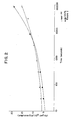
- Fig. 2 is a plot of creep compliance vs. time where the compliance is the strain e at some time divided by the stress ⁇ on the sample.
- the neat polypropylene exhibited a greater creep compliance, i.e., lower creep resistance, than the polypropylene/resin blend over the first hour.
- the PD020 polypropylene/Escorez ECR563B blend exhibits tensile strength and stiffness equivalent to that of the unmodified PD020 polypropylene as shown in the table below.
- Property ASTM PDO2O Polypropylene 80/20 Blend PD020/ECR356B Tensile strength @ yield, psi D-638 4900 5000 Tensile strength @ break, psi D-638 1600 1900 Secant Flexural Modulus, psi D-790 166,000 220,000
- the 80/20 PD020/Escorez ECR356B blend of Example 2 was prepared into ribbon yarn using the procedure of Example 1.
- the ribbon yarn was evaluated for creep resistance using a weight that was equal to 20% of the breaking force of the ribbon yarn at room temperature.
- the procedure was repeated for the PD020 polypropylene without resin for comparative purposes.
- the results are illustrated in Fig. 3 which plots the creep compliance as a function of time where the compliance is the strain e at some time divided by the stress ⁇ on the sample.
- Fig. 3 clearly shows the oriented polypropylene/resin ribbon yarn to have lower creep compliance, i.e., greater creep resistance, relative to ribbon yarn made from the unmodified polypropylene.
Landscapes
- Chemical & Material Sciences (AREA)
- Chemical Kinetics & Catalysis (AREA)
- General Chemical & Material Sciences (AREA)
- Engineering & Computer Science (AREA)
- Textile Engineering (AREA)
- Compositions Of Macromolecular Compounds (AREA)
- Addition Polymer Or Copolymer, Post-Treatments, Or Chemical Modifications (AREA)
- Artificial Filaments (AREA)
Applications Claiming Priority (2)
| Application Number | Priority Date | Filing Date | Title |
|---|---|---|---|
| US357146 | 1989-05-25 | ||
| US07/357,146 US5171628A (en) | 1989-05-25 | 1989-05-25 | Low creep polypropylene textiles |
Publications (2)
| Publication Number | Publication Date |
|---|---|
| EP0399792A2 true EP0399792A2 (fr) | 1990-11-28 |
| EP0399792A3 EP0399792A3 (fr) | 1991-03-13 |
Family
ID=23404483
Family Applications (1)
| Application Number | Title | Priority Date | Filing Date |
|---|---|---|---|
| EP19900305564 Ceased EP0399792A3 (fr) | 1989-05-25 | 1990-05-22 | Textiles de polypropylène à bas fluage |
Country Status (2)
| Country | Link |
|---|---|
| US (1) | US5171628A (fr) |
| EP (1) | EP0399792A3 (fr) |
Cited By (2)
| Publication number | Priority date | Publication date | Assignee | Title |
|---|---|---|---|---|
| US6531212B2 (en) | 2001-02-14 | 2003-03-11 | 3M Innovative Properties Company | Retroreflective article and method |
| US6531214B2 (en) | 2001-02-14 | 2003-03-11 | 3M Innovative Properties Company | Replacement for plasticized polyvinyl chloride |
Families Citing this family (34)
| Publication number | Priority date | Publication date | Assignee | Title |
|---|---|---|---|---|
| US5858140A (en) * | 1994-07-22 | 1999-01-12 | Minnesota Mining And Manufacturing Company | Nonwoven surface finishing articles reinforced with a polymer backing layer and method of making same |
| CN100345896C (zh) | 2002-08-12 | 2007-10-31 | 埃克森美孚化学专利公司 | 增塑聚烯烃组合物 |
| US7271209B2 (en) | 2002-08-12 | 2007-09-18 | Exxonmobil Chemical Patents Inc. | Fibers and nonwovens from plasticized polyolefin compositions |
| US7998579B2 (en) | 2002-08-12 | 2011-08-16 | Exxonmobil Chemical Patents Inc. | Polypropylene based fibers and nonwovens |
| US8003725B2 (en) | 2002-08-12 | 2011-08-23 | Exxonmobil Chemical Patents Inc. | Plasticized hetero-phase polyolefin blends |
| US7531594B2 (en) | 2002-08-12 | 2009-05-12 | Exxonmobil Chemical Patents Inc. | Articles from plasticized polyolefin compositions |
| US6984696B2 (en) * | 2003-03-28 | 2006-01-10 | Exxonmobil Chemical Patents Inc. | Elastic blends of semicrystalline propylene polymers and high glass transition temperature materials |
| US8192813B2 (en) | 2003-08-12 | 2012-06-05 | Exxonmobil Chemical Patents, Inc. | Crosslinked polyethylene articles and processes to produce same |
| CN1918228B (zh) * | 2004-02-12 | 2010-12-01 | 埃克森美孚化学专利公司 | 适合纤维和无纺布的聚丙烯树脂 |
| CN1997786A (zh) * | 2004-04-16 | 2007-07-11 | 优质无纺布公司 | 塑性可变形无纺网幅 |
| ES2328611T3 (es) * | 2004-12-17 | 2009-11-16 | Exxonmobil Chemical Patents Inc. | Peliculas de mezclas de polimeros. |
| US7476710B2 (en) * | 2004-12-17 | 2009-01-13 | Exxonmobil Chemical Patents Inc. | Heterogeneous polymer blends and molded articles therefrom |
| US8389615B2 (en) | 2004-12-17 | 2013-03-05 | Exxonmobil Chemical Patents Inc. | Elastomeric compositions comprising vinylaromatic block copolymer, polypropylene, plastomer, and low molecular weight polyolefin |
| US7619038B2 (en) * | 2004-12-17 | 2009-11-17 | Exxonmobil Chemical Patents Inc. | Homogeneous polymer blend and articles therefrom |
| CN101080461B (zh) * | 2004-12-17 | 2010-09-22 | 埃克森美孚化学专利公司 | 多相聚合物共混物和由此制备的模制品 |
| WO2007011530A2 (fr) | 2005-07-15 | 2007-01-25 | Exxonmobil Chemical Patents, Inc. | Compositions élastomères |
| WO2007047657A1 (fr) | 2005-10-20 | 2007-04-26 | Exxonmobil Chemical Patents Inc. | Traitement du residu d'hydrocarbure |
| US7985802B2 (en) | 2008-04-18 | 2011-07-26 | Exxonmobil Chemical Patents Inc. | Synthetic fabrics, components thereof, and methods for making the same |
| PT2467441E (pt) | 2009-08-20 | 2014-06-11 | Henkel Corp | Adesivo termofusível com baixa temperatura de aplicação |
| MX2013002214A (es) | 2010-08-26 | 2013-05-09 | Henkel Corp | Adhesivo de poli-alfa-olefina amorfa de temperatura de aplicacion baja. |
| US9376597B2 (en) | 2010-11-19 | 2016-06-28 | Henkel Ag & Co. Kgaa | Adhesive composition and use thereof |
| CN103459533B (zh) | 2011-02-18 | 2016-03-09 | 汉高知识产权控股有限责任公司 | 用于一次性制品的具有高抗蠕变性的低温热熔性粘合剂 |
| KR101510240B1 (ko) | 2011-08-04 | 2015-04-10 | 헨켈 아이피 앤드 홀딩 게엠베하 | 접착제 및 그의 용도 |
| US9272795B2 (en) | 2012-05-17 | 2016-03-01 | Henkel IP & Holding GmbH | Integral hot melt adhesive packaging films and use thereof |
| US9364985B2 (en) | 2012-05-24 | 2016-06-14 | Henkel IP & Holding GmbH | Process for preparing flowable amorphous poly-alpha olefin adhesive pellets |
| US9127153B2 (en) | 2012-11-02 | 2015-09-08 | Henkel IP & Holding GmbH | Molding and overmolding compositions for electronic devices |
| JP6443634B2 (ja) | 2013-01-24 | 2018-12-26 | ヘンケル・アクチェンゲゼルシャフト・ウント・コムパニー・コマンディットゲゼルシャフト・アウフ・アクチェンHenkel AG & Co. KGaA | 発泡性ホットメルト接着剤組成物およびその使用 |
| US10494551B2 (en) | 2013-03-12 | 2019-12-03 | Henkel IP & Holding GmbH | Adhesive compostions with wide service temperature window and use thereof |
| CN103865174A (zh) * | 2014-03-19 | 2014-06-18 | 安徽电缆股份有限公司 | 一种超薄壁绝缘城市轨道用电缆料 |
| TWI679259B (zh) | 2014-08-11 | 2019-12-11 | 德商漢高智慧財產控股公司 | 光學透明的熱熔黏著劑及其用途 |
| CN107001882A (zh) | 2014-10-23 | 2017-08-01 | 汉高股份有限及两合公司 | 用于聚烯烃膜的热熔性粘合剂 |
| MX384008B (es) | 2015-03-02 | 2025-03-14 | Henkel Ag & Co Kgaa | Laminados extensibles. |
| WO2016153663A1 (fr) | 2015-03-20 | 2016-09-29 | Henkel IP & Holding GmbH | Composition adhésive thermofusible et son utilisation |
| CA2982756A1 (fr) | 2015-04-17 | 2016-10-20 | Henkel IP & Holding GmbH | Adhesifs thermofusibles et utilisations associees |
Family Cites Families (5)
| Publication number | Priority date | Publication date | Assignee | Title |
|---|---|---|---|---|
| US3361849A (en) * | 1963-08-27 | 1968-01-02 | Hercules Inc | Blends of isotactic propylene polymer and hydrogenated terpene polymer |
| US3341626A (en) * | 1965-03-10 | 1967-09-12 | Sun Oil Co | Hot melt adhesive comprising polypropylene and a polyterpene |
| US4076670A (en) * | 1977-01-27 | 1978-02-28 | Eastman Kodak Company | Hot-melt adhesives having improved properties at elevated temperatures |
| FR2529563B1 (fr) * | 1982-06-30 | 1986-01-24 | Charbonnages Ste Chimique | Compositions de polypropylene et de copolymeres ethylene/a-olefine et leur application a la fabrication de fils mono-orientes |
| GB8613162D0 (en) * | 1986-05-30 | 1986-07-02 | Exxon Chemical Patents Inc | Sealable films |
-
1989
- 1989-05-25 US US07/357,146 patent/US5171628A/en not_active Expired - Fee Related
-
1990
- 1990-05-22 EP EP19900305564 patent/EP0399792A3/fr not_active Ceased
Cited By (2)
| Publication number | Priority date | Publication date | Assignee | Title |
|---|---|---|---|---|
| US6531212B2 (en) | 2001-02-14 | 2003-03-11 | 3M Innovative Properties Company | Retroreflective article and method |
| US6531214B2 (en) | 2001-02-14 | 2003-03-11 | 3M Innovative Properties Company | Replacement for plasticized polyvinyl chloride |
Also Published As
| Publication number | Publication date |
|---|---|
| EP0399792A3 (fr) | 1991-03-13 |
| US5171628A (en) | 1992-12-15 |
Similar Documents
| Publication | Publication Date | Title |
|---|---|---|
| US5171628A (en) | Low creep polypropylene textiles | |
| US6436534B1 (en) | Elastic fibers, fabrics and articles fabricated therefrom | |
| US6248851B1 (en) | Fabrics fabricated from elastic fibers | |
| CN102791913B (zh) | 新的双组分纤维 | |
| US4839228A (en) | Biconstituent polypropylene/polyethylene fibers | |
| EP0859073B1 (fr) | Fibres bicomposants avec au moins un composant élastique, tissus et articles les utilisant | |
| US4904731A (en) | Polymeric composition | |
| AU641147B2 (en) | Biconstituent polypropylene/polyethylene bonded fibers | |
| EP0696329B1 (fr) | Fibres et tissus elastiques et articles produits a partir de ceux-ci | |
| CA1296498C (fr) | Fibres a deux constituants polypropylene-polyethylene | |
| US6248835B1 (en) | Polypropylene/polystyrene polymer blend, improved fibers produced from the blend and method of manufacturing | |
| EP0308001B1 (fr) | Composition polymère | |
| KR100225886B1 (ko) | 카페트용 고감성 폴리프로필렌 섬유의 제조방법 | |
| EP4034595B1 (fr) | Compositions de polypropylène pour tissus nontissés doux | |
| KR100468911B1 (ko) | 카페트용폴리프로필렌섬유의제조방법 | |
| KR0169887B1 (ko) | 카페트용 폴리프로필렌 섬유의 제조방법 | |
| JPH0226915A (ja) | 超高分子量ポリオレフィン繊維の製造方法 | |
| KR19980017270A (ko) | 변성된 폴리프로필렌 수지 조성물 및 이를 이용한 카페트용 폴리프로필렌 섬유의 제조방법 | |
| DE19821369A1 (de) | Verwendung von Modifikatoren auf Basis von Ethylenen oder amorphen Olefinelastomeren zur Reduktion der Oberflächenklebrigkeit von amorphen Polypropylenen |
Legal Events
| Date | Code | Title | Description |
|---|---|---|---|
| PUAI | Public reference made under article 153(3) epc to a published international application that has entered the european phase |
Free format text: ORIGINAL CODE: 0009012 |
|
| 17P | Request for examination filed |
Effective date: 19900612 |
|
| AK | Designated contracting states |
Kind code of ref document: A2 Designated state(s): BE DE FR GB SE |
|
| PUAL | Search report despatched |
Free format text: ORIGINAL CODE: 0009013 |
|
| AK | Designated contracting states |
Kind code of ref document: A3 Designated state(s): BE DE FR GB SE |
|
| 17Q | First examination report despatched |
Effective date: 19940725 |
|
| STAA | Information on the status of an ep patent application or granted ep patent |
Free format text: STATUS: THE APPLICATION HAS BEEN REFUSED |
|
| 18R | Application refused |
Effective date: 19960516 |