EP0399810A2 - Méthode de transfert d'une matière visqueuse et méthode de formation d'une image utilisant celle-ci - Google Patents
Méthode de transfert d'une matière visqueuse et méthode de formation d'une image utilisant celle-ci Download PDFInfo
- Publication number
- EP0399810A2 EP0399810A2 EP90305627A EP90305627A EP0399810A2 EP 0399810 A2 EP0399810 A2 EP 0399810A2 EP 90305627 A EP90305627 A EP 90305627A EP 90305627 A EP90305627 A EP 90305627A EP 0399810 A2 EP0399810 A2 EP 0399810A2
- Authority
- EP
- European Patent Office
- Prior art keywords
- viscous substance
- electrode
- roller
- voltage
- pattern
- Prior art date
- Legal status (The legal status is an assumption and is not a legal conclusion. Google has not performed a legal analysis and makes no representation as to the accuracy of the status listed.)
- Ceased
Links
- 239000011345 viscous material Substances 0.000 title claims abstract description 188
- 238000000034 method Methods 0.000 title claims abstract description 36
- 239000000463 material Substances 0.000 claims description 25
- 239000000758 substrate Substances 0.000 claims description 4
- 230000005684 electric field Effects 0.000 claims 1
- 239000002245 particle Substances 0.000 description 32
- 229920000642 polymer Polymers 0.000 description 23
- BASFCYQUMIYNBI-UHFFFAOYSA-N platinum Chemical compound [Pt] BASFCYQUMIYNBI-UHFFFAOYSA-N 0.000 description 20
- 229910001220 stainless steel Inorganic materials 0.000 description 20
- 239000010935 stainless steel Substances 0.000 description 20
- 239000002904 solvent Substances 0.000 description 19
- 239000007788 liquid Substances 0.000 description 18
- 238000012546 transfer Methods 0.000 description 18
- 239000000853 adhesive Substances 0.000 description 16
- 230000001070 adhesive effect Effects 0.000 description 16
- 239000010419 fine particle Substances 0.000 description 14
- LFQSCWFLJHTTHZ-UHFFFAOYSA-N Ethanol Chemical compound CCO LFQSCWFLJHTTHZ-UHFFFAOYSA-N 0.000 description 13
- 239000007789 gas Substances 0.000 description 13
- XLYOFNOQVPJJNP-UHFFFAOYSA-N water Substances O XLYOFNOQVPJJNP-UHFFFAOYSA-N 0.000 description 13
- 239000002609 medium Substances 0.000 description 11
- 229910052751 metal Inorganic materials 0.000 description 11
- 239000002184 metal Substances 0.000 description 11
- 238000007747 plating Methods 0.000 description 11
- -1 zinc sulfide ZnS Chemical compound 0.000 description 11
- 229920002472 Starch Polymers 0.000 description 10
- 239000002612 dispersion medium Substances 0.000 description 10
- 229910052697 platinum Inorganic materials 0.000 description 10
- 239000008107 starch Substances 0.000 description 10
- 235000019698 starch Nutrition 0.000 description 10
- 239000000126 substance Substances 0.000 description 9
- 230000008961 swelling Effects 0.000 description 9
- LYCAIKOWRPUZTN-UHFFFAOYSA-N Ethylene glycol Chemical compound OCCO LYCAIKOWRPUZTN-UHFFFAOYSA-N 0.000 description 8
- PEDCQBHIVMGVHV-UHFFFAOYSA-N Glycerine Chemical compound OCC(O)CO PEDCQBHIVMGVHV-UHFFFAOYSA-N 0.000 description 8
- 230000002093 peripheral effect Effects 0.000 description 8
- 230000008859 change Effects 0.000 description 7
- 230000007246 mechanism Effects 0.000 description 7
- 229920005989 resin Polymers 0.000 description 7
- 239000011347 resin Substances 0.000 description 7
- DNIAPMSPPWPWGF-UHFFFAOYSA-N Propylene glycol Chemical compound CC(O)CO DNIAPMSPPWPWGF-UHFFFAOYSA-N 0.000 description 6
- 239000003086 colorant Substances 0.000 description 6
- 239000000203 mixture Substances 0.000 description 6
- 230000007423 decrease Effects 0.000 description 5
- 230000003247 decreasing effect Effects 0.000 description 5
- 238000005868 electrolysis reaction Methods 0.000 description 5
- WCUXLLCKKVVCTQ-UHFFFAOYSA-M Potassium chloride Chemical compound [Cl-].[K+] WCUXLLCKKVVCTQ-UHFFFAOYSA-M 0.000 description 4
- VYPSYNLAJGMNEJ-UHFFFAOYSA-N Silicium dioxide Chemical compound O=[Si]=O VYPSYNLAJGMNEJ-UHFFFAOYSA-N 0.000 description 4
- FAPWRFPIFSIZLT-UHFFFAOYSA-M Sodium chloride Chemical compound [Na+].[Cl-] FAPWRFPIFSIZLT-UHFFFAOYSA-M 0.000 description 4
- 235000010443 alginic acid Nutrition 0.000 description 4
- 229920000615 alginic acid Polymers 0.000 description 4
- 239000000783 alginic acid Substances 0.000 description 4
- 229960001126 alginic acid Drugs 0.000 description 4
- 239000011248 coating agent Substances 0.000 description 4
- 238000000576 coating method Methods 0.000 description 4
- 229910052802 copper Inorganic materials 0.000 description 4
- 239000010949 copper Substances 0.000 description 4
- 235000011187 glycerol Nutrition 0.000 description 4
- 238000005259 measurement Methods 0.000 description 4
- 239000010445 mica Substances 0.000 description 4
- 229910052618 mica group Inorganic materials 0.000 description 4
- 239000000843 powder Substances 0.000 description 4
- 238000011160 research Methods 0.000 description 4
- RYGMFSIKBFXOCR-UHFFFAOYSA-N Copper Chemical compound [Cu] RYGMFSIKBFXOCR-UHFFFAOYSA-N 0.000 description 3
- 239000004375 Dextrin Substances 0.000 description 3
- 229920001353 Dextrin Polymers 0.000 description 3
- 241000196324 Embryophyta Species 0.000 description 3
- UFHFLCQGNIYNRP-UHFFFAOYSA-N Hydrogen Chemical compound [H][H] UFHFLCQGNIYNRP-UHFFFAOYSA-N 0.000 description 3
- OKKJLVBELUTLKV-UHFFFAOYSA-N Methanol Chemical compound OC OKKJLVBELUTLKV-UHFFFAOYSA-N 0.000 description 3
- ZMXDDKWLCZADIW-UHFFFAOYSA-N N,N-Dimethylformamide Chemical compound CN(C)C=O ZMXDDKWLCZADIW-UHFFFAOYSA-N 0.000 description 3
- 239000002202 Polyethylene glycol Substances 0.000 description 3
- YXFVVABEGXRONW-UHFFFAOYSA-N Toluene Chemical compound CC1=CC=CC=C1 YXFVVABEGXRONW-UHFFFAOYSA-N 0.000 description 3
- 238000010521 absorption reaction Methods 0.000 description 3
- 229910052782 aluminium Inorganic materials 0.000 description 3
- XAGFODPZIPBFFR-UHFFFAOYSA-N aluminium Chemical compound [Al] XAGFODPZIPBFFR-UHFFFAOYSA-N 0.000 description 3
- 230000015572 biosynthetic process Effects 0.000 description 3
- 239000000084 colloidal system Substances 0.000 description 3
- 150000001875 compounds Chemical class 0.000 description 3
- 235000019425 dextrin Nutrition 0.000 description 3
- 235000014113 dietary fatty acids Nutrition 0.000 description 3
- MTHSVFCYNBDYFN-UHFFFAOYSA-N diethylene glycol Chemical compound OCCOCCO MTHSVFCYNBDYFN-UHFFFAOYSA-N 0.000 description 3
- 230000000694 effects Effects 0.000 description 3
- 229920001971 elastomer Polymers 0.000 description 3
- 239000000194 fatty acid Substances 0.000 description 3
- 229930195729 fatty acid Natural products 0.000 description 3
- XPFVYQJUAUNWIW-UHFFFAOYSA-N furfuryl alcohol Chemical compound OCC1=CC=CO1 XPFVYQJUAUNWIW-UHFFFAOYSA-N 0.000 description 3
- 229910052737 gold Inorganic materials 0.000 description 3
- 239000010931 gold Substances 0.000 description 3
- 125000002887 hydroxy group Chemical group [H]O* 0.000 description 3
- 229910052744 lithium Inorganic materials 0.000 description 3
- 229920001223 polyethylene glycol Polymers 0.000 description 3
- 150000003839 salts Chemical class 0.000 description 3
- RMAQACBXLXPBSY-UHFFFAOYSA-N silicic acid Chemical compound O[Si](O)(O)O RMAQACBXLXPBSY-UHFFFAOYSA-N 0.000 description 3
- 239000007787 solid Substances 0.000 description 3
- 241000894007 species Species 0.000 description 3
- 229920001059 synthetic polymer Polymers 0.000 description 3
- 229920002554 vinyl polymer Polymers 0.000 description 3
- LNAZSHAWQACDHT-XIYTZBAFSA-N (2r,3r,4s,5r,6s)-4,5-dimethoxy-2-(methoxymethyl)-3-[(2s,3r,4s,5r,6r)-3,4,5-trimethoxy-6-(methoxymethyl)oxan-2-yl]oxy-6-[(2r,3r,4s,5r,6r)-4,5,6-trimethoxy-2-(methoxymethyl)oxan-3-yl]oxyoxane Chemical compound CO[C@@H]1[C@@H](OC)[C@H](OC)[C@@H](COC)O[C@H]1O[C@H]1[C@H](OC)[C@@H](OC)[C@H](O[C@H]2[C@@H]([C@@H](OC)[C@H](OC)O[C@@H]2COC)OC)O[C@@H]1COC LNAZSHAWQACDHT-XIYTZBAFSA-N 0.000 description 2
- ZNQVEEAIQZEUHB-UHFFFAOYSA-N 2-ethoxyethanol Chemical compound CCOCCO ZNQVEEAIQZEUHB-UHFFFAOYSA-N 0.000 description 2
- SVTBMSDMJJWYQN-UHFFFAOYSA-N 2-methylpentane-2,4-diol Chemical compound CC(O)CC(C)(C)O SVTBMSDMJJWYQN-UHFFFAOYSA-N 0.000 description 2
- YEJRWHAVMIAJKC-UHFFFAOYSA-N 4-Butyrolactone Chemical compound O=C1CCCO1 YEJRWHAVMIAJKC-UHFFFAOYSA-N 0.000 description 2
- 244000215068 Acacia senegal Species 0.000 description 2
- DLFVBJFMPXGRIB-UHFFFAOYSA-N Acetamide Chemical compound CC(N)=O DLFVBJFMPXGRIB-UHFFFAOYSA-N 0.000 description 2
- 102000009027 Albumins Human genes 0.000 description 2
- 108010088751 Albumins Proteins 0.000 description 2
- 241000416162 Astragalus gummifer Species 0.000 description 2
- QFOHBWFCKVYLES-UHFFFAOYSA-N Butylparaben Chemical compound CCCCOC(=O)C1=CC=C(O)C=C1 QFOHBWFCKVYLES-UHFFFAOYSA-N 0.000 description 2
- 102000011632 Caseins Human genes 0.000 description 2
- 108010076119 Caseins Proteins 0.000 description 2
- VYZAMTAEIAYCRO-UHFFFAOYSA-N Chromium Chemical compound [Cr] VYZAMTAEIAYCRO-UHFFFAOYSA-N 0.000 description 2
- 102000008186 Collagen Human genes 0.000 description 2
- 108010035532 Collagen Proteins 0.000 description 2
- IAZDPXIOMUYVGZ-UHFFFAOYSA-N Dimethylsulphoxide Chemical compound CS(C)=O IAZDPXIOMUYVGZ-UHFFFAOYSA-N 0.000 description 2
- 229920005682 EO-PO block copolymer Polymers 0.000 description 2
- 239000001856 Ethyl cellulose Substances 0.000 description 2
- ZZSNKZQZMQGXPY-UHFFFAOYSA-N Ethyl cellulose Chemical compound CCOCC1OC(OC)C(OCC)C(OCC)C1OC1C(O)C(O)C(OC)C(CO)O1 ZZSNKZQZMQGXPY-UHFFFAOYSA-N 0.000 description 2
- 108010010803 Gelatin Proteins 0.000 description 2
- 229920002907 Guar gum Polymers 0.000 description 2
- 229920000084 Gum arabic Polymers 0.000 description 2
- 229920001479 Hydroxyethyl methyl cellulose Polymers 0.000 description 2
- XEEYBQQBJWHFJM-UHFFFAOYSA-N Iron Chemical compound [Fe] XEEYBQQBJWHFJM-UHFFFAOYSA-N 0.000 description 2
- WHXSMMKQMYFTQS-UHFFFAOYSA-N Lithium Chemical compound [Li] WHXSMMKQMYFTQS-UHFFFAOYSA-N 0.000 description 2
- 229920000161 Locust bean gum Polymers 0.000 description 2
- 229920000057 Mannan Polymers 0.000 description 2
- PXHVJJICTQNCMI-UHFFFAOYSA-N Nickel Chemical compound [Ni] PXHVJJICTQNCMI-UHFFFAOYSA-N 0.000 description 2
- 239000004962 Polyamide-imide Substances 0.000 description 2
- 239000004372 Polyvinyl alcohol Substances 0.000 description 2
- HDSBZMRLPLPFLQ-UHFFFAOYSA-N Propylene glycol alginate Chemical compound OC1C(O)C(OC)OC(C(O)=O)C1OC1C(O)C(O)C(C)C(C(=O)OCC(C)O)O1 HDSBZMRLPLPFLQ-UHFFFAOYSA-N 0.000 description 2
- 229920002125 Sokalan® Polymers 0.000 description 2
- 229920001615 Tragacanth Polymers 0.000 description 2
- 235000010489 acacia gum Nutrition 0.000 description 2
- 239000000205 acacia gum Substances 0.000 description 2
- 239000002253 acid Substances 0.000 description 2
- 239000000654 additive Substances 0.000 description 2
- 230000000996 additive effect Effects 0.000 description 2
- 150000004781 alginic acids Chemical class 0.000 description 2
- 239000006229 carbon black Substances 0.000 description 2
- 125000002057 carboxymethyl group Chemical group [H]OC(=O)C([H])([H])[*] 0.000 description 2
- 239000005018 casein Substances 0.000 description 2
- BECPQYXYKAMYBN-UHFFFAOYSA-N casein, tech. Chemical compound NCCCCC(C(O)=O)N=C(O)C(CC(O)=O)N=C(O)C(CCC(O)=N)N=C(O)C(CC(C)C)N=C(O)C(CCC(O)=O)N=C(O)C(CC(O)=O)N=C(O)C(CCC(O)=O)N=C(O)C(C(C)O)N=C(O)C(CCC(O)=N)N=C(O)C(CCC(O)=N)N=C(O)C(CCC(O)=N)N=C(O)C(CCC(O)=O)N=C(O)C(CCC(O)=O)N=C(O)C(COP(O)(O)=O)N=C(O)C(CCC(O)=N)N=C(O)C(N)CC1=CC=CC=C1 BECPQYXYKAMYBN-UHFFFAOYSA-N 0.000 description 2
- 235000021240 caseins Nutrition 0.000 description 2
- 229920002678 cellulose Polymers 0.000 description 2
- 239000001913 cellulose Substances 0.000 description 2
- 229910052804 chromium Inorganic materials 0.000 description 2
- 239000011651 chromium Substances 0.000 description 2
- 229920001436 collagen Polymers 0.000 description 2
- 230000000052 comparative effect Effects 0.000 description 2
- 239000004020 conductor Substances 0.000 description 2
- XXJWXESWEXIICW-UHFFFAOYSA-N diethylene glycol monoethyl ether Chemical compound CCOCCOCCO XXJWXESWEXIICW-UHFFFAOYSA-N 0.000 description 2
- POULHZVOKOAJMA-UHFFFAOYSA-N dodecanoic acid Chemical compound CCCCCCCCCCCC(O)=O POULHZVOKOAJMA-UHFFFAOYSA-N 0.000 description 2
- 239000003792 electrolyte Substances 0.000 description 2
- 235000010944 ethyl methyl cellulose Nutrition 0.000 description 2
- 239000012530 fluid Substances 0.000 description 2
- 239000008273 gelatin Substances 0.000 description 2
- 229920000159 gelatin Polymers 0.000 description 2
- 235000019322 gelatine Nutrition 0.000 description 2
- 235000011852 gelatine desserts Nutrition 0.000 description 2
- PCHJSUWPFVWCPO-UHFFFAOYSA-N gold Chemical compound [Au] PCHJSUWPFVWCPO-UHFFFAOYSA-N 0.000 description 2
- 239000004519 grease Substances 0.000 description 2
- 235000010417 guar gum Nutrition 0.000 description 2
- 239000000665 guar gum Substances 0.000 description 2
- 229960002154 guar gum Drugs 0.000 description 2
- 229910000271 hectorite Inorganic materials 0.000 description 2
- IPCSVZSSVZVIGE-UHFFFAOYSA-N hexadecanoic acid Chemical compound CCCCCCCCCCCCCCCC(O)=O IPCSVZSSVZVIGE-UHFFFAOYSA-N 0.000 description 2
- 239000011810 insulating material Substances 0.000 description 2
- 238000011835 investigation Methods 0.000 description 2
- 150000002500 ions Chemical class 0.000 description 2
- 238000004898 kneading Methods 0.000 description 2
- 235000010420 locust bean gum Nutrition 0.000 description 2
- 239000000711 locust bean gum Substances 0.000 description 2
- HQKMJHAJHXVSDF-UHFFFAOYSA-L magnesium stearate Chemical compound [Mg+2].CCCCCCCCCCCCCCCCCC([O-])=O.CCCCCCCCCCCCCCCCCC([O-])=O HQKMJHAJHXVSDF-UHFFFAOYSA-L 0.000 description 2
- 229920000609 methyl cellulose Polymers 0.000 description 2
- 125000002496 methyl group Chemical group [H]C([H])([H])* 0.000 description 2
- 235000010981 methylcellulose Nutrition 0.000 description 2
- 239000001923 methylcellulose Substances 0.000 description 2
- 229920003087 methylethyl cellulose Polymers 0.000 description 2
- 244000005700 microbiome Species 0.000 description 2
- 229910052901 montmorillonite Inorganic materials 0.000 description 2
- 239000000123 paper Substances 0.000 description 2
- 229920001277 pectin Polymers 0.000 description 2
- 235000010987 pectin Nutrition 0.000 description 2
- 239000001814 pectin Substances 0.000 description 2
- 229920001495 poly(sodium acrylate) polymer Polymers 0.000 description 2
- 229920002432 poly(vinyl methyl ether) polymer Polymers 0.000 description 2
- 229920006122 polyamide resin Polymers 0.000 description 2
- 229920002312 polyamide-imide Polymers 0.000 description 2
- 229920001282 polysaccharide Polymers 0.000 description 2
- 239000005017 polysaccharide Substances 0.000 description 2
- 150000004804 polysaccharides Chemical class 0.000 description 2
- 229920002451 polyvinyl alcohol Polymers 0.000 description 2
- 239000001103 potassium chloride Substances 0.000 description 2
- 235000011164 potassium chloride Nutrition 0.000 description 2
- 230000008569 process Effects 0.000 description 2
- 235000010409 propane-1,2-diol alginate Nutrition 0.000 description 2
- 239000000770 propane-1,2-diol alginate Substances 0.000 description 2
- 239000000377 silicon dioxide Substances 0.000 description 2
- 239000011780 sodium chloride Substances 0.000 description 2
- NNMHYFLPFNGQFZ-UHFFFAOYSA-M sodium polyacrylate Chemical compound [Na+].[O-]C(=O)C=C NNMHYFLPFNGQFZ-UHFFFAOYSA-M 0.000 description 2
- 238000001179 sorption measurement Methods 0.000 description 2
- 235000010487 tragacanth Nutrition 0.000 description 2
- 239000000196 tragacanth Substances 0.000 description 2
- 229940116362 tragacanth Drugs 0.000 description 2
- XOOUIPVCVHRTMJ-UHFFFAOYSA-L zinc stearate Chemical class [Zn+2].CCCCCCCCCCCCCCCCCC([O-])=O.CCCCCCCCCCCCCCCCCC([O-])=O XOOUIPVCVHRTMJ-UHFFFAOYSA-L 0.000 description 2
- 229910052984 zinc sulfide Inorganic materials 0.000 description 2
- FMZUHGYZWYNSOA-VVBFYGJXSA-N (1r)-1-[(4r,4ar,8as)-2,6-diphenyl-4,4a,8,8a-tetrahydro-[1,3]dioxino[5,4-d][1,3]dioxin-4-yl]ethane-1,2-diol Chemical compound C([C@@H]1OC(O[C@@H]([C@@H]1O1)[C@H](O)CO)C=2C=CC=CC=2)OC1C1=CC=CC=C1 FMZUHGYZWYNSOA-VVBFYGJXSA-N 0.000 description 1
- UCTWMZQNUQWSLP-VIFPVBQESA-N (R)-adrenaline Chemical compound CNC[C@H](O)C1=CC=C(O)C(O)=C1 UCTWMZQNUQWSLP-VIFPVBQESA-N 0.000 description 1
- CYSGHNMQYZDMIA-UHFFFAOYSA-N 1,3-Dimethyl-2-imidazolidinon Chemical compound CN1CCN(C)C1=O CYSGHNMQYZDMIA-UHFFFAOYSA-N 0.000 description 1
- RRQYJINTUHWNHW-UHFFFAOYSA-N 1-ethoxy-2-(2-ethoxyethoxy)ethane Chemical compound CCOCCOCCOCC RRQYJINTUHWNHW-UHFFFAOYSA-N 0.000 description 1
- ARXJGSRGQADJSQ-UHFFFAOYSA-N 1-methoxypropan-2-ol Chemical compound COCC(C)O ARXJGSRGQADJSQ-UHFFFAOYSA-N 0.000 description 1
- IVPQUZBLDWBQHR-UHFFFAOYSA-N 1-methylpyrrolidin-2-one;methylsulfinylmethane Chemical compound CS(C)=O.CN1CCCC1=O IVPQUZBLDWBQHR-UHFFFAOYSA-N 0.000 description 1
- OAYXUHPQHDHDDZ-UHFFFAOYSA-N 2-(2-butoxyethoxy)ethanol Chemical compound CCCCOCCOCCO OAYXUHPQHDHDDZ-UHFFFAOYSA-N 0.000 description 1
- SBASXUCJHJRPEV-UHFFFAOYSA-N 2-(2-methoxyethoxy)ethanol Chemical compound COCCOCCO SBASXUCJHJRPEV-UHFFFAOYSA-N 0.000 description 1
- XNWFRZJHXBZDAG-UHFFFAOYSA-N 2-METHOXYETHANOL Chemical compound COCCO XNWFRZJHXBZDAG-UHFFFAOYSA-N 0.000 description 1
- WFSMVVDJSNMRAR-UHFFFAOYSA-N 2-[2-(2-ethoxyethoxy)ethoxy]ethanol Chemical compound CCOCCOCCOCCO WFSMVVDJSNMRAR-UHFFFAOYSA-N 0.000 description 1
- POAOYUHQDCAZBD-UHFFFAOYSA-N 2-butoxyethanol Chemical compound CCCCOCCO POAOYUHQDCAZBD-UHFFFAOYSA-N 0.000 description 1
- 229940093475 2-ethoxyethanol Drugs 0.000 description 1
- KXGFMDJXCMQABM-UHFFFAOYSA-N 2-methoxy-6-methylphenol Chemical compound [CH]OC1=CC=CC([CH])=C1O KXGFMDJXCMQABM-UHFFFAOYSA-N 0.000 description 1
- FGLBSLMDCBOPQK-UHFFFAOYSA-N 2-nitropropane Chemical compound CC(C)[N+]([O-])=O FGLBSLMDCBOPQK-UHFFFAOYSA-N 0.000 description 1
- 239000004925 Acrylic resin Substances 0.000 description 1
- 229920000178 Acrylic resin Polymers 0.000 description 1
- BTBUEUYNUDRHOZ-UHFFFAOYSA-N Borate Chemical compound [O-]B([O-])[O-] BTBUEUYNUDRHOZ-UHFFFAOYSA-N 0.000 description 1
- 229910000906 Bronze Inorganic materials 0.000 description 1
- OKTJSMMVPCPJKN-UHFFFAOYSA-N Carbon Chemical compound [C] OKTJSMMVPCPJKN-UHFFFAOYSA-N 0.000 description 1
- MYMOFIZGZYHOMD-UHFFFAOYSA-N Dioxygen Chemical compound O=O MYMOFIZGZYHOMD-UHFFFAOYSA-N 0.000 description 1
- KMTRUDSVKNLOMY-UHFFFAOYSA-N Ethylene carbonate Chemical compound O=C1OCCO1 KMTRUDSVKNLOMY-UHFFFAOYSA-N 0.000 description 1
- MBMLMWLHJBBADN-UHFFFAOYSA-N Ferrous sulfide Chemical compound [Fe]=S MBMLMWLHJBBADN-UHFFFAOYSA-N 0.000 description 1
- YCKRFDGAMUMZLT-UHFFFAOYSA-N Fluorine atom Chemical compound [F] YCKRFDGAMUMZLT-UHFFFAOYSA-N 0.000 description 1
- 229920002153 Hydroxypropyl cellulose Polymers 0.000 description 1
- 239000005639 Lauric acid Substances 0.000 description 1
- 229910015451 Mo2S3 Inorganic materials 0.000 description 1
- OHLUUHNLEMFGTQ-UHFFFAOYSA-N N-methylacetamide Chemical compound CNC(C)=O OHLUUHNLEMFGTQ-UHFFFAOYSA-N 0.000 description 1
- 235000021314 Palmitic acid Nutrition 0.000 description 1
- OAICVXFJPJFONN-UHFFFAOYSA-N Phosphorus Chemical compound [P] OAICVXFJPJFONN-UHFFFAOYSA-N 0.000 description 1
- 239000004698 Polyethylene Substances 0.000 description 1
- 229930006000 Sucrose Natural products 0.000 description 1
- UCKMPCXJQFINFW-UHFFFAOYSA-N Sulphide Chemical compound [S-2] UCKMPCXJQFINFW-UHFFFAOYSA-N 0.000 description 1
- 239000004809 Teflon Substances 0.000 description 1
- 229920006362 Teflon® Polymers 0.000 description 1
- UWHCKJMYHZGTIT-UHFFFAOYSA-N Tetraethylene glycol, Natural products OCCOCCOCCOCCO UWHCKJMYHZGTIT-UHFFFAOYSA-N 0.000 description 1
- GWEVSGVZZGPLCZ-UHFFFAOYSA-N Titan oxide Chemical compound O=[Ti]=O GWEVSGVZZGPLCZ-UHFFFAOYSA-N 0.000 description 1
- GSEJCLTVZPLZKY-UHFFFAOYSA-N Triethanolamine Chemical compound OCCN(CCO)CCO GSEJCLTVZPLZKY-UHFFFAOYSA-N 0.000 description 1
- 239000005083 Zinc sulfide Substances 0.000 description 1
- RJDOZRNNYVAULJ-UHFFFAOYSA-L [O--].[O--].[O--].[O--].[O--].[O--].[O--].[O--].[O--].[O--].[F-].[F-].[Mg++].[Mg++].[Mg++].[Al+3].[Si+4].[Si+4].[Si+4].[K+] Chemical compound [O--].[O--].[O--].[O--].[O--].[O--].[O--].[O--].[O--].[O--].[F-].[F-].[Mg++].[Mg++].[Mg++].[Al+3].[Si+4].[Si+4].[Si+4].[K+] RJDOZRNNYVAULJ-UHFFFAOYSA-L 0.000 description 1
- 229920000180 alkyd Polymers 0.000 description 1
- WNROFYMDJYEPJX-UHFFFAOYSA-K aluminium hydroxide Chemical compound [OH-].[OH-].[OH-].[Al+3] WNROFYMDJYEPJX-UHFFFAOYSA-K 0.000 description 1
- CEGOLXSVJUTHNZ-UHFFFAOYSA-K aluminium tristearate Chemical compound [Al+3].CCCCCCCCCCCCCCCCCC([O-])=O.CCCCCCCCCCCCCCCCCC([O-])=O.CCCCCCCCCCCCCCCCCC([O-])=O CEGOLXSVJUTHNZ-UHFFFAOYSA-K 0.000 description 1
- 229940063655 aluminum stearate Drugs 0.000 description 1
- 230000002421 anti-septic effect Effects 0.000 description 1
- 239000003125 aqueous solvent Substances 0.000 description 1
- 229940063013 borate ion Drugs 0.000 description 1
- 239000010974 bronze Substances 0.000 description 1
- JGIATAMCQXIDNZ-UHFFFAOYSA-N calcium sulfide Chemical compound [Ca]=S JGIATAMCQXIDNZ-UHFFFAOYSA-N 0.000 description 1
- 229910052799 carbon Inorganic materials 0.000 description 1
- 238000006243 chemical reaction Methods 0.000 description 1
- 239000003795 chemical substances by application Substances 0.000 description 1
- INPLXZPZQSLHBR-UHFFFAOYSA-N cobalt(2+);sulfide Chemical compound [S-2].[Co+2] INPLXZPZQSLHBR-UHFFFAOYSA-N 0.000 description 1
- 238000007796 conventional method Methods 0.000 description 1
- KUNSUQLRTQLHQQ-UHFFFAOYSA-N copper tin Chemical compound [Cu].[Sn] KUNSUQLRTQLHQQ-UHFFFAOYSA-N 0.000 description 1
- OMZSGWSJDCOLKM-UHFFFAOYSA-N copper(II) sulfide Chemical compound [S-2].[Cu+2] OMZSGWSJDCOLKM-UHFFFAOYSA-N 0.000 description 1
- 238000004132 cross linking Methods 0.000 description 1
- 239000003431 cross linking reagent Substances 0.000 description 1
- 239000013078 crystal Substances 0.000 description 1
- 230000002542 deteriorative effect Effects 0.000 description 1
- IJKVHSBPTUYDLN-UHFFFAOYSA-N dihydroxy(oxo)silane Chemical compound O[Si](O)=O IJKVHSBPTUYDLN-UHFFFAOYSA-N 0.000 description 1
- 229960001760 dimethyl sulfoxide Drugs 0.000 description 1
- 229910001882 dioxygen Inorganic materials 0.000 description 1
- SZXQTJUDPRGNJN-UHFFFAOYSA-N dipropylene glycol Chemical compound OCCCOCCCO SZXQTJUDPRGNJN-UHFFFAOYSA-N 0.000 description 1
- 239000006185 dispersion Substances 0.000 description 1
- 239000000806 elastomer Substances 0.000 description 1
- 239000003822 epoxy resin Substances 0.000 description 1
- 239000004744 fabric Substances 0.000 description 1
- 150000004665 fatty acids Chemical class 0.000 description 1
- 239000000945 filler Substances 0.000 description 1
- 239000011737 fluorine Substances 0.000 description 1
- 229910052731 fluorine Inorganic materials 0.000 description 1
- 239000000499 gel Substances 0.000 description 1
- GNOIPBMMFNIUFM-UHFFFAOYSA-N hexamethylphosphoric triamide Chemical compound CN(C)P(=O)(N(C)C)N(C)C GNOIPBMMFNIUFM-UHFFFAOYSA-N 0.000 description 1
- OUPKXHORJFHYAV-UHFFFAOYSA-N hexane-1,2,6-triol;4-methyl-1,3-dioxolan-2-one Chemical compound CC1COC(=O)O1.OCCCCC(O)CO OUPKXHORJFHYAV-UHFFFAOYSA-N 0.000 description 1
- 229940051250 hexylene glycol Drugs 0.000 description 1
- WGCNASOHLSPBMP-UHFFFAOYSA-N hydroxyacetaldehyde Natural products OCC=O WGCNASOHLSPBMP-UHFFFAOYSA-N 0.000 description 1
- 235000010977 hydroxypropyl cellulose Nutrition 0.000 description 1
- 239000001863 hydroxypropyl cellulose Substances 0.000 description 1
- 230000000977 initiatory effect Effects 0.000 description 1
- 229910001410 inorganic ion Inorganic materials 0.000 description 1
- 229910052742 iron Inorganic materials 0.000 description 1
- 235000014413 iron hydroxide Nutrition 0.000 description 1
- NCNCGGDMXMBVIA-UHFFFAOYSA-L iron(ii) hydroxide Chemical compound [OH-].[OH-].[Fe+2] NCNCGGDMXMBVIA-UHFFFAOYSA-L 0.000 description 1
- 235000019359 magnesium stearate Nutrition 0.000 description 1
- 230000014759 maintenance of location Effects 0.000 description 1
- 150000002739 metals Chemical class 0.000 description 1
- 239000002480 mineral oil Substances 0.000 description 1
- 235000010446 mineral oil Nutrition 0.000 description 1
- CWQXQMHSOZUFJS-UHFFFAOYSA-N molybdenum disulfide Chemical compound S=[Mo]=S CWQXQMHSOZUFJS-UHFFFAOYSA-N 0.000 description 1
- QVZZOQYGVUGLSI-UHFFFAOYSA-N n,n-dimethylformamide;formamide Chemical compound NC=O.CN(C)C=O QVZZOQYGVUGLSI-UHFFFAOYSA-N 0.000 description 1
- WQEPLUUGTLDZJY-UHFFFAOYSA-N n-Pentadecanoic acid Natural products CCCCCCCCCCCCCCC(O)=O WQEPLUUGTLDZJY-UHFFFAOYSA-N 0.000 description 1
- 229920005615 natural polymer Polymers 0.000 description 1
- 229910052759 nickel Inorganic materials 0.000 description 1
- MCSAJNNLRCFZED-UHFFFAOYSA-N nitroethane Chemical compound CC[N+]([O-])=O MCSAJNNLRCFZED-UHFFFAOYSA-N 0.000 description 1
- 239000003921 oil Substances 0.000 description 1
- 239000003960 organic solvent Substances 0.000 description 1
- 238000000059 patterning Methods 0.000 description 1
- 229920001568 phenolic resin Polymers 0.000 description 1
- 239000005011 phenolic resin Substances 0.000 description 1
- 230000000704 physical effect Effects 0.000 description 1
- 239000000049 pigment Substances 0.000 description 1
- 229920003023 plastic Polymers 0.000 description 1
- 239000004033 plastic Substances 0.000 description 1
- 229920003055 poly(ester-imide) Polymers 0.000 description 1
- 229920001083 polybutene Polymers 0.000 description 1
- 229920000867 polyelectrolyte Polymers 0.000 description 1
- 229920000647 polyepoxide Polymers 0.000 description 1
- 229920001225 polyester resin Polymers 0.000 description 1
- 239000004645 polyester resin Substances 0.000 description 1
- 229920000573 polyethylene Polymers 0.000 description 1
- 229920001296 polysiloxane Polymers 0.000 description 1
- 229920005749 polyurethane resin Polymers 0.000 description 1
- DPLVEEXVKBWGHE-UHFFFAOYSA-N potassium sulfide Chemical compound [S-2].[K+].[K+] DPLVEEXVKBWGHE-UHFFFAOYSA-N 0.000 description 1
- 235000011962 puddings Nutrition 0.000 description 1
- 238000001454 recorded image Methods 0.000 description 1
- 239000011369 resultant mixture Substances 0.000 description 1
- 230000000717 retained effect Effects 0.000 description 1
- 229910052703 rhodium Inorganic materials 0.000 description 1
- 239000010948 rhodium Substances 0.000 description 1
- MHOVAHRLVXNVSD-UHFFFAOYSA-N rhodium atom Chemical compound [Rh] MHOVAHRLVXNVSD-UHFFFAOYSA-N 0.000 description 1
- 238000007790 scraping Methods 0.000 description 1
- 235000012239 silicon dioxide Nutrition 0.000 description 1
- 229920002050 silicone resin Polymers 0.000 description 1
- 229910052709 silver Inorganic materials 0.000 description 1
- 239000010944 silver (metal) Substances 0.000 description 1
- 239000000344 soap Substances 0.000 description 1
- 239000011734 sodium Substances 0.000 description 1
- 229910052708 sodium Inorganic materials 0.000 description 1
- 229910052950 sphalerite Inorganic materials 0.000 description 1
- 229910052959 stibnite Inorganic materials 0.000 description 1
- IAHFWCOBPZCAEA-UHFFFAOYSA-N succinonitrile Chemical compound N#CCCC#N IAHFWCOBPZCAEA-UHFFFAOYSA-N 0.000 description 1
- 239000005720 sucrose Substances 0.000 description 1
- YPMOSINXXHVZIL-UHFFFAOYSA-N sulfanylideneantimony Chemical compound [Sb]=S YPMOSINXXHVZIL-UHFFFAOYSA-N 0.000 description 1
- VDNSGQQAZRMTCI-UHFFFAOYSA-N sulfanylidenegermanium Chemical compound [Ge]=S VDNSGQQAZRMTCI-UHFFFAOYSA-N 0.000 description 1
- CADICXFYUNYKGD-UHFFFAOYSA-N sulfanylidenemanganese Chemical compound [Mn]=S CADICXFYUNYKGD-UHFFFAOYSA-N 0.000 description 1
- HXJUTPCZVOIRIF-UHFFFAOYSA-N sulfolane Chemical compound O=S1(=O)CCCC1 HXJUTPCZVOIRIF-UHFFFAOYSA-N 0.000 description 1
- 230000003746 surface roughness Effects 0.000 description 1
- TUNFSRHWOTWDNC-HKGQFRNVSA-N tetradecanoic acid Chemical compound CCCCCCCCCCCCC[14C](O)=O TUNFSRHWOTWDNC-HKGQFRNVSA-N 0.000 description 1
- TXEYQDLBPFQVAA-UHFFFAOYSA-N tetrafluoromethane Chemical compound FC(F)(F)F TXEYQDLBPFQVAA-UHFFFAOYSA-N 0.000 description 1
- AFNRRBXCCXDRPS-UHFFFAOYSA-N tin(ii) sulfide Chemical compound [Sn]=S AFNRRBXCCXDRPS-UHFFFAOYSA-N 0.000 description 1
- OGIDPMRJRNCKJF-UHFFFAOYSA-N titanium oxide Inorganic materials [Ti]=O OGIDPMRJRNCKJF-UHFFFAOYSA-N 0.000 description 1
- ZIBGPFATKBEMQZ-UHFFFAOYSA-N triethylene glycol Chemical compound OCCOCCOCCO ZIBGPFATKBEMQZ-UHFFFAOYSA-N 0.000 description 1
- JLGLQAWTXXGVEM-UHFFFAOYSA-N triethylene glycol monomethyl ether Chemical compound COCCOCCOCCO JLGLQAWTXXGVEM-UHFFFAOYSA-N 0.000 description 1
- 239000001993 wax Substances 0.000 description 1
- 229910052727 yttrium Inorganic materials 0.000 description 1
- DRDVZXDWVBGGMH-UHFFFAOYSA-N zinc;sulfide Chemical compound [S-2].[Zn+2] DRDVZXDWVBGGMH-UHFFFAOYSA-N 0.000 description 1
Images


Classifications
-
- B—PERFORMING OPERATIONS; TRANSPORTING
- B41—PRINTING; LINING MACHINES; TYPEWRITERS; STAMPS
- B41F—PRINTING MACHINES OR PRESSES
- B41F31/00—Inking arrangements or devices
- B41F31/02—Ducts, containers, supply or metering devices
-
- B—PERFORMING OPERATIONS; TRANSPORTING
- B41—PRINTING; LINING MACHINES; TYPEWRITERS; STAMPS
- B41C—PROCESSES FOR THE MANUFACTURE OR REPRODUCTION OF PRINTING SURFACES
- B41C1/00—Forme preparation
- B41C1/10—Forme preparation for lithographic printing; Master sheets for transferring a lithographic image to the forme
- B41C1/105—Forme preparation for lithographic printing; Master sheets for transferring a lithographic image to the forme by electrocoagulation, by electro-adhesion or by electro-releasing of material, e.g. a liquid from a gel
-
- Y—GENERAL TAGGING OF NEW TECHNOLOGICAL DEVELOPMENTS; GENERAL TAGGING OF CROSS-SECTIONAL TECHNOLOGIES SPANNING OVER SEVERAL SECTIONS OF THE IPC; TECHNICAL SUBJECTS COVERED BY FORMER USPC CROSS-REFERENCE ART COLLECTIONS [XRACs] AND DIGESTS
- Y10—TECHNICAL SUBJECTS COVERED BY FORMER USPC
- Y10S—TECHNICAL SUBJECTS COVERED BY FORMER USPC CROSS-REFERENCE ART COLLECTIONS [XRACs] AND DIGESTS
- Y10S101/00—Printing
- Y10S101/37—Printing employing electrostatic force
Definitions
- the present invention relates to a method of transferring a viscous substance and an image forming method utilizing such a transfer method.
- the viscous substance is transferred by scooping it with a container, by applying a pressure thereto to be moved in a pipe, or by causing it to successively adhere to the surfaces of plural rotating rollers.
- the technique using such a viscous substance may for example include printing.
- Our research group has proposed a printing process wherein a voltage is applied to an ink so as to change its adhesiveness, whereby a recording is effected (U.S. Patent Application Serial No. 301,146).
- Our research group has also proposed a printing process wherein an ink remaining in the device used therefor is easily removed (U.S. Patent Application Serial No. 325,986).
- Our research group has further proposed a printing method wherein a voltage is applied to an ink while the physical property of the ink is not substantially changed even for a long printing time (Japanese Patent Application Nos. 90827/1989, 122749/1989 and 190947/1989).
- An object of the present invention is to provide a method of transferring a viscous substance at a high transfer speed wherein the viscous substance is transferred without a loss thereof and the removal of the viscous substance attached to a member used therefor may be omitted.
- Another object of the present invention is to provide an image forming method and an image forming apparatus which are capable of providing recorded images at a high image formation speed by utilizing the above-mentioned transfer method.
- a method for transferring a viscous substance comprising the steps of:
- the present invention also provides an image forming method comprising the steps of: providing a recording material capable of changing its adhesiveness corresponding to the polarity of a voltage applied thereto; supplying the recording material between a pair of electrodes at least one of which has a pattern comprising an electroconductive portion and an insulating portion; and applying a voltage plural times to the recording material thereby to attach the recording material to the electrode having the pattern corresponding to the pattern thereof.
- the present invention further provides an image forming apparatus, comprising: a pair of electrodes at least one of which has a pattern comprising an electroconductive portion and an insulating portion; at least one auxiliary electrode disposed opposite to the electrode having the pattern; means for supplying a recording material between the pair of electrodes; means for applying a voltage between the pair of electrodes; means for applying a voltage between the auxiliary electrode and the electrode having the pattern; and pressure application means for transferring to a transfer-receiving medium the recording material attached to the electrode having the pattern corresponding to the pattern thereof under application of the voltage.
- the viscous substance-transferring method utilizes a phenomenon such that when a voltage is applied to a viscous substance by means of a pair of electrodes, the viscous substance reduces its adhesiveness to one of the pair of electrodes. Further, the present invention is based on a property of the viscous substance such that a decrease in the adhesiveness (or non-adhesiveness) of the viscous substance may occur when a current is passed through the viscous substance and the total charge amount flowing through the viscous substance exceeds a predetermined charge amount. According to our investigation, it is considered that the adhesion between the viscous substance and the electrode is gradually (or stepwise) changed and the resultant adhesion exceeds a predetermined value at a certain charge amount.
- the present invention utilizes a phenomenon such that when a voltage is applied to a viscous substance plural times, the viscous substance first loses its adhesiveness to one electrode at the time of certain number of voltage applications.
- a viscous substance 100 may successively be transferred from a roller 11 to rollers 12 through 16.
- a viscous substance 100 is first supplied between a first roller 11 rotating in the arrow A direction and a second roller 12 rotating in the arrow B direction.
- Each of the first roller 11 to the sixth roller 16 shown in Figure 1 functions as an electrode, and power supplies 21 - 25 are provided so that a voltage is applied between each pair of the adjacent rollers.
- pairs of auxiliary rollers 110 and 111, 120 and 121, 130 and 131, 140 and 141, and 150 and 151, as auxiliary electrodes, are respectively disposed movably so that the distances between these auxiliary rollers and the rollers 11 to 15 are respectively variable.
- Each of the auxiliary rollers 110 to 151 shown in Figure 1 functions as an electrode, and power supplies 210, 211, 220, 221, 230, 231, 240, 241, 250 and 251 are provided so that a voltage is applied to each of the auxiliary rollers.
- the first roller 11 becomes a cathode and the second roller 12 and the auxiliary rollers 110 and 111 become anodes, and simultaneously, the auxiliary rollers 110 and 111 are moved toward the first roller 11 so that they contact the viscous substance (layer) 100 disposed on the first roller 11.
- the viscous substance 100 disposed on the first roller 11 is first supplied with a voltage between the first roller 11 and the auxiliary roller 110, then supplied with a voltage between the first roller 11 and the auxiliary roller 111, and finally supplied with a voltage between the first roller 11 and the second roller 12, whereby the adhesiveness of the viscous substance 100 is decreased on the first roller 11 side. Accordingly, as shown in Figure 2, the viscous substance 100 is selectively attached to the second roller 12. After the entirely of the viscous substance 100 is substantially transferred (or moved) to the second roller 12, the auxiliary rollers 110 and 111 are moved so that they become more distant from the first roller 11.
- the viscous substance used in the present invention may have a property such that when the total amount of electric charges passing through the viscous substance exceeds a predetermined charge amount, the viscous substance decreases its adhesiveness.
- the viscous substance 100 when the viscous substance 100 is supplied with a voltage between the first roller 11 and the second roller 12 by means of the power supply 21 after the voltage applications thereto based on each of the auxiliary rollers 110 and 111, the total amount of electric charges passing through the viscous substance 100 exceeds a predetermined charge amount.
- the viscous substance 100 disposed on the second roller 12 is separated from the first roller 11 while the application of the voltage based on the power supply 21 is continued, and the viscous substance 100 disposed on the second roller 12 is caused to contact a third roller 13 rotating in the arrow C direction.
- the viscous substance 100 attached to the third roller 13 is separated from the second roller 12, and is caused to contact a fourth roller 14 rotating in the arrow D direction.
- a predetermined amount of charges may be passed through the viscous substance, even when a period of time corresponding to one voltage application become short. As a result, the speed or velocity of the viscous substance transfer may be increased.
- the voltage to be applied between the above-mentioned respectively electrodes may preferably be a DC voltage of 3 - 50 V, more preferably 5 - 40 V. If the voltage is lower than 3 V, the change from an adhesive state to a non-adhesive state may be insufficient. If the voltage is higher than 50 V, the power consumption may be undesirably large.
- auxiliary rollers 110, 111, 120, 121, 130, 131, 140, 141, 150 and 151 it is possible to provide the above-mentioned auxiliary rollers 110, 111, 120, 121, 130, 131, 140, 141, 150 and 151 so that the clearances or gaps between the auxiliary rollers and the rollers 11 to 15 become constant, but the auxiliary rollers are not movable toward the rollers 11 to 15.
- each auxiliary roller in order to cause each auxiliary roller to sufficiently contact the viscous substance 100, it is preferred to dispose the auxiliary rollers 110 to 151 so that the clearances between these auxiliary rollers and the rollers 11 to 16, respectively, are gradually decreased along the direction of the the viscous substance transfer, e.g., the clearance between the first roller 11 and the auxiliary roller 111 is smaller than the clearance between the first roller 11 and the auxiliary roller 110.
- the clearance or gap between each pair of adjacent rollers may be either constant or variable.
- the clearance between the second and third electrodes is variable. More specifically, it is preferred to control the clearance between the second and third electrodes so that substantially the whole amount of the viscous substance is once transferred to the second electrode (at this time, the viscous substance disposed on the second electrode does not contact the third electrode), and then the viscous substance disposed on the second electrode is caused to contact the third electrode.
- the total amount of electric charges passing through a viscous substance to cause a decrease in the adhesiveness of the viscous substance may vary depending on the property of the viscous substance, material or surface characteristics of a roller to be used in combination with the viscous substance, etc., but may be considered as about 0.1 - 0.3 coulomb/cm2.
- the adhesiveness of a viscous substance is reduced corresponding to three voltage application.
- the adhesiveness of the viscous substance is reduced corresponding to two or at least four voltage applications.
- an apparatus used therefor may be more complicated. From such a viewpoint, the number of voltage applications may preferably be 2 to 7, more preferably 2 to 5.
- rollers i.e., electrode
- a roller comprising a metal such as copper coated with plating of another metal such as gold and platinum; or a roller comprising an electroconductive elastomer such as rubber.
- the contact time between the viscous substance and the electrode may be lengthened, whereby the viscous substance may be transferred by using a lower voltage.
- the adhesiveness of a viscous substance disposed on the cathode side is reduced.
- the adhesiveness of a viscous substance disposed on the anode side may also be reduced depending on the kind or composition of the viscous substance.
- the viscous substance is caused to generate a gas in the neighborhood of one electrode under voltage application, whereby the viscous substance becomes non-adhesive to the electrode due to the gas.
- the viscous substance may be subjected to electrolysis to generate a gas.
- the electric resistance of the viscous substance may preferably be as low as possible. More specifically, the volume resistivity of the viscous substance may preferably be 109 ohm.cm or below, more preferably 104 ohm.cm or below, particularly preferably 102 ohm.cm or below. If the volume resistivity exceeds 109 ohm.cm, the quantity of electric conduction becomes too small, or a high voltage is required in order to prevent a decrease in the quantity of electric conduction.
- the generation of a gas in a hydroxyl (-OH) group-containing solvent based on electrolysis due to electric conduction may be considered as follows: On the cathode side : 2ROH+ + 2e ⁇ ⁇ H2 ⁇ + 2RO ⁇ (One mole of hydrogen gas is generated.) (In the case of water): 2H+ + 2e ⁇ ⁇ H2 ⁇ (One mole of hydrogen gas is generated) On the anode side : 2ROH ⁇ 2RCHO + 2H+ + 2e ⁇ (In the case of water): 2OH ⁇ ⁇ H2O + 1/2O2 + 2e ⁇ (1/2 mole of oxygen gas is generated.)
- the amount of the generated gas is proportional to the amount of electrons (e ⁇ ), i.e., the magnitude of an electric current, and the gas is generated only on the cathode side (in the case of the hydroxyl group-containing solvent other than water), or the gas is generated on the cathode side in an amount which is two times that of the gas generated on the anode side.
- the difference in the amount of the generated gas is not smaller than a certain value, the viscous substance becomes non-adhesive to either one electrode (e.g., cathode in the case expressed by the above-mentioned formulas).
- a viscous substance basically comprising inorganic or organic fine particles and a liquid dispersion medium is used, and the viscous substance is converted from an adhesive state to a non-adhesive state by utilizing a difference in chargeability of the fine particles.
- the viscous substance on the cathode side becomes non-adhesive to the cathode when a voltage is applied to the viscous substance.
- the viscous substance on the anode side becomes non-adhesive to the anode when a voltage is applied to the viscous substance.
- Examples of such a viscous substance capable of changing its viscosity or cohesion due to a change in pH value, etc., in the vicinity of an electrode due to electric conduction may include one utilizing a change in the crosslinked structure of a gel comprising a polymer, as described in Japanese Laid-Open Patent Application (KOKAI) No. 30279/1988 (corresponding to U.S. Patent Application Serial No. 075,045).
- KKAI Japanese Laid-Open Patent Application
- the viscous substance shows such a property that its viscosity is remarkably decreased and its cohesion is extremely decreased in the vicinity of one electrode. Accordingly, such a viscous substance is difficult to be used in the present invention. More specifically, it is preferred that the cohesion of the viscous substance is larger than the adhesiveness thereof on one electrode side to which the viscous substance becomes non-adhesive under voltage application.
- the mechanism by which a viscous substance is converted from an adhesive state to a non-adhesive state under voltage application is any one of the above-mentioned three mechanisms (1), (2) and (3). It is possible that the mechanism of such a conversion is a combination of two or more of the above-mentioned three mechanisms.
- the viscous substance used in the present invention is a liquid having a low viscosity similar to that of water and alcohol, the cohesive force thereof is weak, whereby it is difficult to obtain a suitable adhesiveness.
- the viscous substance used in the present invention may preferably satisfy at least one of the following properties.
- a sample viscous substance is caused to adhere to a stainless steel plate of 1 cm x 1 cm in size coated with platinum plating which is vertically disposed, so that a 1 mm-thick ink layer is formed on the stainless steel plate, and is left standing as it is for 5 sec. in an environment of a temperature of 25 °C and a moisture of 60 %. Then, the height of the viscous substance is measured. Through the measurement, the viscous substance used in the present invention may preferably be held on the stainless steel plate substantially. More specifically, the above-mentioned height of the viscous substance layer may preferably be 50 % or more, more preferably 80 % or more, based on the original height thereof.
- a 2 mm-thick layer of a sample viscous substance is sandwiched between two stainless steel plates each of 1 cm x 1 cm in size coated with platinum plating which are vertically disposed, and the stainless steel plates are separated from each other at a peeling speed of 5 cm/sec under no voltage application. Then, the areas of both plates covered with the viscous substance are respectively measured.
- the respective plates may preferably show substantially the same adhesion amount of the viscous substance. More specifically, each plate may preferably show an area proportion of 0.7 - 1.0, in terms of the proportion of the area measured above to the area of the plate which has originally been covered with the above-mentioned 2 mm-thick viscous substance layer.
- a sample viscous substance is applied onto a stainless steel plate of 1 cm x 1 cm coated with platinum plating to form an about 2 mm-thick viscous substance layer, and another stainless steel plate coated with platinum plating having the same size as described above is disposed on the viscous substance layer, and these two stainless steel plates are vertically disposed. Then, a voltage of +30 V is applied between the above-mentioned two stainless steel plates sandwiching the 2 mm-thick viscous substance layer, while one of the stainless steel plate is used as a cathode (earth) and the other is used as an anode.
- a cathode earth
- the stainless steel plates are separated from each other at a peeling speed of 5 cm/sec in an environment of a temperature of 25 °C and a moisture of 60 %, while applying the voltage in the above-mentioned manner, and then the weight of the viscous substance attached to each of the stainless steel plates is measured.
- the weight of the viscous substance attached to one electrode is 800 times or more, more preferably 1000 times or more, that of the viscous substance attached to the other electrode.
- a sample viscous substance is supplied between a pair of stainless steel rollers coated with rhodium plating which have a diameter of 34 mm and a length of 34 mm and are disposed opposite to each other with a clearance of about 150 microns.
- the two rollers used herein are horizontally disposed so that they are parallel to each other, and are rotated at 600 rpm in a direction counter to each other.
- a somewhat excess of the viscous substance is supplied between the above-mentioned rollers so that the viscous substance may be attached to both rollers to form a uniform layer on the surfaces thereof.
- an excess of viscous substance is spontaneously dropped from the both ends of the rollers along with the rotations thereof under no voltage application.
- a DC voltage of 15 V is applied between the rollers.
- the viscous substance used in the present invention is substantially attached to either one of the above-mentioned rollers for the first time, after two or seven revolutions (more preferably two to five revolutions) of the roller counted from the initiation of the above-mentioned DC voltage application.
- a viscous substance contains a solvent capable of being electrolyzed to generate a gas
- the change thereof from an adhesive state to a non-adhesive state may occur at an electrode of one side.
- the solvent may preferably comprise: water, an alcohol such as methanol and ethanol; a solvent having a hydroxyl group such as glycerin, ethylene glycol and propylene glycol; or a solvent containing an electrolyte such as sodium chloride and potassium chloride dissolved therein.
- the solvent content may preferably be 40 - 95 wt. parts, more preferably 60 - 85 wt. parts, per 100 wt. parts of the viscous substance.
- the water content may preferably be 1 wt. part or more, more preferably 5 - 99 wt. parts, per 100 wt. parts of the viscous substance.
- charged or chargeable fine particles may be used as the entirety or a part of the above-mentioned fine particles and may preferably be mixed or kneaded in a liquid dispersion medium as described hereinafter, e.g., by means of a homogenizer, a colloid mill or an ultrasonic dispersing means, whereby charged particles are obtained.
- the “charged particle” used herein refers to a particle which has a charge prior to the kneading.
- the “chargeable particle” refers to a particle which can easily be charged by triboelectrification.
- Examples of the particles to be supplied with a positive charge may include: particles of a metal such as Au, Ag and Cu; particles of a sulfide such as zinc sulfide ZnS, antimony sulfide Sb2S3, potassium sulfide K2S, calcium sulfide CaS, germanium sulfide GeS, cobalt sulfide CoS, tin sulfide SnS, iron sulfide FeS, copper sulfide Cu2S, manganese sulfide MnS, and molybdenum sulfide Mo2S3; particles of a silicic acid or salt thereof such as orthosilicic acid H4SiO4, metasilicic acid H2Si2O5, mesortisilicic acid H4Si3O3, mesotetrasilicic acid H6Si4O11; polyamide resin particles; polyamide-imide resin particles; etc.
- a metal such as Au, Ag and Cu
- Examples of the particles to be supplied with a negative charge may include: iron hydroxide particles, aluminum hydroxide particles, fluorinated mica particles, polyethylene particles, motmorillonite particles, fluorine-containing resin particles, etc.
- polymer particles containing various charge-controlling agents used as electrophotographic toners may be used for such a purpose.
- the above-mentioned fine particles may generally have an average particle size of 100 microns or smaller, preferably 0.1 - 20 microns, more preferably 0.1 - 10 microns.
- the fine particles may generally be contained in the viscous substance in an amount of 1 wt. part or more, preferably 3 - 90 wt. parts, more preferably 5 - 60 wt. parts, per 100 wt. parts of the viscous substance.
- Examples of the solvent to be contained in the viscous substance together with the above-mentioned fine particles may include: ethylene glycol, propylene glycol, diethylene glycol, triethylene glycol, tetraethylene glycol, polyethylene glycol (weight-average molecular weight: about 100 - 1,000), ethylene glycol monomethyl ether, ethylene glycol monoethyl ether, ethylene glycol monobutyl ether, methyl carbitol, ethyl carbitol, butyl carbitol, ethyl carbitol acetate, diethyl carbitol, triethylene glycol monomethyl ether, triethylene glycol monoethyl ether, propylene glycol monomethyl ether, glycerin, triethanolamine, formamide dimethylformamide, dimethylsulfoxide N-methyl-2-pyrrolidone, 1,3-dimethylimidazolidinone, N-methylacetamide, ethylene carbonate, acetamide, succinon
- the solvent may preferably be contained in an amount of 40 - 95 wt. parts, more preferably 60 - 85 wt. parts, per 100 wt. parts of the viscous substance.
- the viscous substance capable of generating a gas due to electrolysis can contain fine particles such as silica, carbon fluoride, titanium oxide or carbon black, in addition to those as described hereinabove.
- the entirety or a part of the fine particles comprise swelling particles (i.e., particles capable of being swelled) which are capable of retaining the above-mentioned solvent therein.
- the "swelling particles” used herein refers to particles having a property such that when they are mixed with a solvent, they incorporate the solvent in their internal structure (e.g., between crystal layers) to be swelled.
- the swelling particles used in the present invention may preferably show "liquid absorption" as defined below, in the range of 5 ml - 1000 ml, more preferably 50 ml - 500 ml.
- the liquid adsorption may be measured in the following manner.
- a liquid dispersion medium or solvent such as water used in the viscous substance is gradually added to 1 g of powder of the above-mentioned swelling particles while kneading the resultant mixture.
- the state of the powder is observed and there is found an amount (or a range of amount) of the liquid dispersion medium in which the powder is converted from a dispersed state into the state of a mass, and the mass substantially retains the liquid dispersion medium.
- the amount of the liquid dispersion medium added to the powder is the "liquid absorption".
- the liquid absorption of the swelling particles may remarkably be decreased when a salt is dissolved in the liquid dispersion medium. Accordingly, if the liquid adsorption as defined above is less than 5 ml, the effect thereof is a little.
- swelling particles may include: fluorinated mica such as Na-montmorillonite, Ca-montmorillonite, 3-octahedral synthetic smectites, Na-hectorite, Li-hectorite, Na-taeniolite, Na-tetrasilicic mica and Li-taeniolite; synthetic mica, silica, etc.
- fluorinated mica such as Na-montmorillonite, Ca-montmorillonite, 3-octahedral synthetic smectites, Na-hectorite, Li-hectorite, Na-taeniolite, Na-tetrasilicic mica and Li-taeniolite
- synthetic mica silica, etc.
- the above-mentioned fluorinated mica may be represented by the following general formula (1).
- W denotes Na or Li
- X and Y respectively denote an ion having a coordination number of 6, such as Mg2+, Fe2+, Ni2, Mn2+, Al3+, and Li+
- Z denotes a positive ion having a coordination number of 4 such as Al3+, Si4+, Ge4+, Fe3+, B3+ or a combination of these including, e.g., (Al3+/Si4+).
- the swelling particles in their dry state, may preferably have an average particle size of 0.1 - 20 microns, more preferably 0.8 - 15 microns, particularly preferably 0.8 - 8 microns.
- the swelling particle content can be the same as described above with respect to the fine particles, but may more preferably be 8 - 60 wt. parts per 100 wt. parts of the viscous substance. It is also preferred to use swelling particles having a charge on their surfaces.
- a polymer soluble in the above-mentioned solvent may be contained in the viscous substance in an amount of 1 - 90 wt. parts, more preferably 1 - 50 wt. parts, particularly preferably 1 - 20 wt. parts, per 100 wt. parts of the viscous substance.
- polystyrene resin examples include: plant polymers, such as guar gum, locust bean gum, gum arabic, tragacanth, carrageenah, pectin, mannan, and starch; microorganism polymers, such as xanthane gum, dextrin, succinoglucan, and curdran; animal polymers, such as gelatin, casein, albumin, and collagen; cellulose polymers such as methyl cellulose, ethyl cellulose, and hydroxyethyl cellulose; starch polymers, such as soluble starch, carboxymethyl starch, and methyl starch; alginic acid polymers, such as propylene glycol alginate, and alginic acid salts; other semisynthetic polymers, such as derivatives of polysaccharides; vinyl polymers, such as polyvinyl alcohol, polyvinylpyrolidone, polyvinyl methyl ether, carboxyvinyl polymer, and sodium polyacrylate; and other synthetic polymers
- a solvent and fine particles as mentioned above may for example be mixed in an ordinary manner.
- the viscous substance used in such an embodiment may comprise a crosslinked substance (inclusive of polyelectrolyte) impregnated with a liquid dispersion medium.
- crosslinked substance refers to a single substance which per se can assume a crosslinked structure, or a mixture of a substance capable of assuming a crosslinked structure with the aid of an additive such as a crosslinking agent for providing an inorganic ion such as borate ion, and the additive.
- crosslinked structure refers to a three-dimensional structure having a crosslinkage or crosslinking bond.
- crosslinked substance examples include: plant polymers, such as guar gum, locust bean gum, gum arabic, tragacanth, carrageenah, pectin, mannan, and starch; microorganism polymers, such as xanthane gum, dextrin, succinoglucan, and curdran; animal polymers, such as gelatin, casein, albumin, and collagen; cellulose polymers such as methyl cellulose, ethyl cellulose, and hydroxyethyl cellulose; starch polymers, such as soluble starch, carboxymethyl starch, and methyl starch; alginic acid polymers, such as propylene glycol alginate, and alginic acid salts; other semisynthetic polymers, such as derivatives of polysaccharides; vinyl polymers, such as polyvinyl alcohol, polyvinylpyrolidone, polyvinyl methyl ether, carboxyvinyl polymer, and sodium polyacrylate; and other synthetic polymers, such as
- a viscous substance containing the crosslinked substance in a proportion of 0.2 - 50 wt. parts, particularly 0.5 - 30 wt. parts, with respect to 100 wt. parts of the liquid dispersion medium.
- the crosslinked substance may be composed of or from one or a mixture of two or more compounds selected from metallic soaps inclusive or metal stearates, such as aluminum stearate, magnesium stearate, and zinc stearate, and, similar metal salts of other fatty acids, such as palmitic acid, myristic acid, and lauric acid; or organic substances such as hydroxypropyl cellulose derivative, dibenzylidene-D-sorbitol, sucrose fatty acid esters, and dextrin fatty acid esters.
- metallic soaps inclusive or metal stearates such as aluminum stearate, magnesium stearate, and zinc stearate
- other fatty acids such as palmitic acid, myristic acid, and lauric acid
- organic substances such as hydroxypropyl cellulose derivative, dibenzylidene-D-sorbitol, sucrose fatty acid esters, and dextrin fatty acid esters.
- the viscous substance used in the present invention is a liquid having a low viscosity similar to that of water and alcohol, the cohesive force thereof is weak, whereby it is difficult to effect the above-mentioned bulk transfer.
- the viscous substance is a perfect solid, it is difficult to obtain a suitable adhesiveness. From such a viewpoint, it is preferred to use a viscous substance having a viscoelasticity as a non-Newtonian fluid, in order to effect suitable bulk transfer.
- the viscosity may change depending on shear rate
- the viscosity may preferably be 104 to 1011 poise (more preferably 106 to 109 poise) at a shear rate of 0.1 rad/s used in the measurement thereof; and the viscosity may preferably be 102 to 109 poise (more preferably 104 to 107) at a shear rate of 10 rad/s.
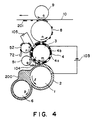
- an ink-carrying roller 1 is a cylindrical member rotating in the arrow l direction.
- the roller 1 may preferably comprise an electroconductive material such as aluminum, copper and stainless steel.
- an ink 2 is supplied by means of a coating roller 6 rotating in the arrow p direction to be formed into a layer having a uniform thickness.
- the ink 1 used herein may comprise a viscous substance as described above, and a colorant comprising a dye or pigment contained therein which is generally used in the field of printing or recording, such as carbon black, as desired.
- the colorant content may preferably be 0.1 - 40 wt. parts, more preferably 1 - 20 wt. parts, per 100 wt. parts of the ink.
- a color-forming compound capable of generating a color under voltage application can be contained in the ink. It is also possible to cause the above-mentioned fine particles per se to function as a colorant.
- the cylindrical ink-carrying surface of the roller 1 may be composed of any material, as far as it is possible to form a desired layer of the ink 2 when it is rotated in the arrow l direction. More specifically, the roller surface may preferably be composed of a conductive material such as metal including stainless steel.
- the ink-carrying roller 1 is connected to one of the terminals of a DC power supply 103.
- a printing plate 4 wound about a plate roller 3 is disposed.
- the plate roller 3 rotates in the arrow m direction which is counter to that of the roller 1.
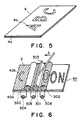
- the printing plate 4 may for example comprise a substrate 4a comprising an electroconductive material such as metal, and a desired pattern 4b disposed thereon comprising an insulating material, as shown in Figure 5.
- the material constituting the substrate 4a may include: metals such as aluminum, copper, stainless steel, platinum, gold, chromium, nickel, phosphor bronze, and carbon; electroconductive polymers; and dispersions obtained by dispersing metal filler, etc., in various polymers.
- the material constituting the pattern 4b may include: materials for thermal transfer recording mainly comprising waxes or resins, electrophotographic toners; natural or synthetic polymers such as vinyl polymer.
- a voltage is applied between the printing plate 4 and the ink-carrying roller 1 by means of the power supply 103; a voltage is applied between the ink-carrying roller 1 and an auxiliary roller (auxiliary electrode) 51, by means of a power supply 104; and a voltage is applied between the ink-carrying roller 1 and an auxiliary roller (auxiliary electrode) 52, by means of a power supply 105 so that the printing plate becomes a cathode and the ink-carrying roller 1, and auxiliary rollers 51 and 52 become anodes.
- auxiliary rollers 51 and 52 are anodes in Figure 4, but the printing plate 4 may be an anode and the ink-carrying roller 1, and auxiliary rollers 51 and 52 may be cathodes depending on the property or state of an ink used in combination therewith. In another embodiment, it is sufficient to dispose one auxiliary roller. In still another embodiment, three or more auxiliary rollers may be provided.
- the voltage from the power supplies 103, 104 and 105 is applied between the rotation axis of the plate roller 3, and those of the ink-carrying roller 1, and auxiliary rollers 51 and 52.
- the thickness of the layer of the ink 2 formed on the ink-carrying roller 1 can vary depending on various factors including the gap between the ink-carrying roller 1 and the coating roller 6, the fluidity or viscosity of the ink 2, the surface material and roughness thereof of the ink-carrying roller 1, and the rotational speed of the roller 1, but may preferably be about 0.001 - 1 mm as measured at an ink transfer position where the roller 1 is disposed opposite to the pattern plate 4 on the plate roller 3.
- the layer thickness of the ink 2 is below 0.001 mm, it is difficult to form a uniform ink layer on the ink-carrying roller 1.
- the ink layer thickness exceeds 1 mm, it becomes difficult to convey the ink 2 while keeping a uniform peripheral speed of the surface portion on the side contacting the printing plate 4, and further it becomes difficult to pass a current between the pattern plate 4 and the ink-carrying roller 1.
- the ink 2 attached to the voltage application roller 52 is scraped off with an ink-scraping blade 72 comprising a plastic or metal, and the thus scraped ink is returned to an ink reservoir 200 to be reused.
- the ink pattern formed on the printing plate 4 is then transferred to a blanket cylinder 8, as an intermediate transfer medium, which rotates in the arrow n direction while contacting the printing plate 4 under pressure. Further, the ink pattern disposed on the blanket cylinder 8 is transferred to a recording medium (or a medium to be recorded) 10 such as a sheet of paper, cloth or metal, passing between the blanket cylinder 8 and an impression cylinder 9, as a pressure-applying means, which rotates in the arrow o direction while contacting the blanket cylinder 8 under pressure, whereby an image 201 corresponding to the above-mentioned ink pattern is formed on the recording medium 10.
- a recording medium or a medium to be recorded
- the ink pattern formed on the printing plate 4 is directly transferred to the recording medium 10 in some cases without providing the blanket cylinder 8 as an intermediate transfer medium.
- the printing plate 4 may be prevented from wearing or deteriorating on the basis of the material constituting the blanket cylinder 8, and an image 201 having the same pattern as that of the printing plate 4 may be obtained on the recording medium 10.
- the printing plate 4 is wound about the cylindrical plate roller 3 and used for recording.
- the printing plate 4 in a flat plate form is used as such, it is also possible to form an ink pattern on the printing plate. More specifically, as shown in Figure 6, when a printing plate 40 in a flat plate form and a plurality of rollers 300, 301 and 302 are used, an ink pattern (or image) may be formed on the flat printing plate 40.
- the flat printing plate 40 used herein may comprise a substrate 40a comprising an electroconductive material, and a desired pattern 40b disposed thereon comprising an insulating material, in the same manner as in the printing plate shown in Figure 5.
- One surface of the flat printing plate 40 provided with the pattern 40b is entirely coated with a layer of an ink 2 having a substantially uniform thickness.
- the rollers 300, 301 and 302 are rotatably mounted on an insulating frame 303 so that these rollers are parallel to each other.
- voltage application means 304, 305 and 306 are provided so that they apply a voltage between the rollers 300, 301 and 302, and the printing plate 40, respectively.
- the printing plate is a cathode and the rollers 300, 301 and 302 are anodes, but the printing plate 40 can be an anode in some cases depending on the kind of an ink used in combination therewith.
- the rollers 300, 301 and 302 are moved in the arrow s direction in contact with the printing plate 40, the total amount of charge passing through the ink 2 exceeds a predetermined amount at a position where the roller 302 confronts the printing plate 40, whereby the ink 2 disposed on the electroconductive portion of the printing plate 40 is transferred to the roller 302.
- the ink 2 selectively remains on the insulating portion of the printing plate 40, and a pattern or image of the ink 2 is formed on the printing plate 40.
- the ink pattern thus formed on the printing plate 40 may further be transferred to a transfer-receiving medium such as paper, as desired.
- the image forming method according to the present invention utilize a phenomenon such that when a specific ink is supplied between an electrode (or printing plate) having a desired insulating pattern, and a counter electrode disposed opposite to such an electrode, and a DC voltage is applied plural times between at least the above-mentioned one pair of electrode, the adhesiveness of the ink is changed corresponding to the pattern of the electrode.
- the viscous substance prepared above was transferred by using a method as shown in Figures 1 - 3.
- each of the first roller 11 to the sixth roller 16 comprised a stainless steel roller of which peripheral surface was coated with platinum plating, and had a diameter of 34 mm and a width of 8 cm.
- the clearance between each pair of adjacent rollers (of the first roller 11 to sixth roller 16) was set to about 0.1 mm at minimum, and each of the first roller 11 to the sixth roller 16 was rotated at 600 rpm.
- each of the auxiliary rollers 110, 111, 120, 121, 130, 131, 140, 141, 150 and 151 comprised a stainless steel roller having a diameter of 17 mm and a width of 8 cm of which peripheral surface was coated with platinum plating. All of these auxiliary rollers were rotated at 1,200 rpm.
- the viscous substance 100 was supplied to the clearance between the first roller 11 rotating in the arrow A direction and the second roller 12 rotating in the arrow B direction, whereby the viscous substance 100 was attached to both of the first and second rollers 11 and 12.
- a power supplies 21, 210 and 211 were turned on by means of a power supply controller 31 so that a DC voltage of 15 V was applied between the first roller 11 as a cathode, and the second roller 12, and auxiliary rollers 110 and 111 as anodes.
- the viscous substance 100 was transferred onto the second roller 12.
- a power supplies 22, 220 and 221 were turned on by means of the power supply controller 31 so that a DC voltage of 15 V was applied between the second roller 12 as a cathode and the third roller 13, and auxiliary rollers 120 and 121 as anodes. As a result, the viscous substance 3 was transferred onto the third roller 13.
- image formation was effected by means of a printing apparatus as shown in Figure 4, which used an ink-carrying roller 1 comprising a cylindrical roller of 34 mm in diameter having a stainless steel surface coated with platinum plating (surface roughness: 1S) and a plate roller 3 comprising an iron cylindrical roller of 34 mm in diameter having a surface coated with hard chromium plating.
- a printing plate 4 comprising an aluminum plate which had been subjected to patterning by using a vinyl-type resin was wound about the plate roller 3, and the above-mentioned ink material was disposed between the ink-carrying roller 1 and a coating roller 6.
- the ink-carrying roller 1 was rotated in the arrow l direction at a peripheral speed of 1000 mm/sec, and the gap between the ink-carrying roller 1 and the coating roller 6 comprising a cylindrical roller having a teflon rubber surface and rotating in the arrow p direction at a peripheral speed of 1000 mm/sec was controlled so that a 0.1 mm-thick ink layer was formed on the ink-carrying roller 1.
- the plate roller 3 was rotated in the arrow m direction at a peripheral speed of 1000 mm/sec in contact with the ink layer formed on the ink-carrying roller 1.
- the resultant pattern of the ink 2 remaining on the printing plate 4 was then transferred to a blanket roller 8 and further transferred to a recording medium 10, whereby a clear image 201 was obtained on the recording medium 10.
- Image formation was attempted in the same manner as in Example 2 except that no voltage was applied between the auxiliary rollers 51 and 52, and the plate roller 3. As a result, transfer of the ink 2 disposed on the electroconductive portion 4a of the plate 4 did not occur, thereby to provide no image.
- Example 2 when the respective rollers were rotated so that their rotation speeds were 1/10 times those used in Example 2, the ink 2 was selectively transferred from the ink-carrying roller 1 to the insulating portion 4b of the printing plate 4, whereby an image was obtained in the same manner as in Example 2.
Landscapes
- Chemical & Material Sciences (AREA)
- Dispersion Chemistry (AREA)
- Engineering & Computer Science (AREA)
- Manufacturing & Machinery (AREA)
- Printing Methods (AREA)
- Inking, Control Or Cleaning Of Printing Machines (AREA)
- Non-Mechanical Conveyors (AREA)
- Electrostatic Charge, Transfer And Separation In Electrography (AREA)
- Printers Or Recording Devices Using Electromagnetic And Radiation Means (AREA)
Applications Claiming Priority (4)
| Application Number | Priority Date | Filing Date | Title |
|---|---|---|---|
| JP128763/89 | 1989-05-24 | ||
| JP12876389 | 1989-05-24 | ||
| JP142898/89 | 1989-06-07 | ||
| JP14289889 | 1989-06-07 |
Publications (2)
| Publication Number | Publication Date |
|---|---|
| EP0399810A2 true EP0399810A2 (fr) | 1990-11-28 |
| EP0399810A3 EP0399810A3 (fr) | 1991-06-05 |
Family
ID=26464348
Family Applications (1)
| Application Number | Title | Priority Date | Filing Date |
|---|---|---|---|
| EP19900305627 Ceased EP0399810A3 (fr) | 1989-05-24 | 1990-05-23 | Méthode de transfert d'une matière visqueuse et méthode de formation d'une image utilisant celle-ci |
Country Status (4)
| Country | Link |
|---|---|
| US (1) | US5151712A (fr) |
| EP (1) | EP0399810A3 (fr) |
| JP (1) | JPH0775906B2 (fr) |
| CA (1) | CA2017167A1 (fr) |
Families Citing this family (4)
| Publication number | Priority date | Publication date | Assignee | Title |
|---|---|---|---|---|
| DE19823468C1 (de) * | 1998-05-26 | 1999-10-28 | Windmoeller & Hoelscher | Digitale Flexodruckmaschine |
| WO2005000585A1 (fr) * | 2003-06-30 | 2005-01-06 | Kba-Giori S.A. | Machine d'impression |
| US8487970B2 (en) * | 2008-10-03 | 2013-07-16 | Palo Alto Research Center Incorporated | Digital imaging of marking materials by thermally induced pattern-wise transfer |
| US8040364B2 (en) * | 2009-07-14 | 2011-10-18 | Palo Alto Research Center Incorporated | Latent resistive image layer for high speed thermal printing applications |
Family Cites Families (9)
| Publication number | Priority date | Publication date | Assignee | Title |
|---|---|---|---|---|
| US4368669A (en) * | 1981-01-02 | 1983-01-18 | Milliken Research Corporation | Method and apparatus for non-impact printing on barrier coated substrate |
| US4504138A (en) * | 1981-10-27 | 1985-03-12 | Coulter Systems Corporation | Method and apparatus for developing electrostatic latent images |
| US4881084A (en) * | 1986-07-25 | 1989-11-14 | Canon Kabushiki Kaisha | Image recording method using fluid ink electrochemically imparted with adhesiveness |
| JPS6330279A (ja) * | 1986-07-25 | 1988-02-08 | Canon Inc | 画像記録方法、画像記録用インクおよび画像記録装置 |
| US4838940A (en) * | 1987-02-21 | 1989-06-13 | Canon Kabushiki Kaisha | Image recording ink |
| US4920361A (en) * | 1987-06-26 | 1990-04-24 | Canon Kabushiki Kaisha | Image recording method and apparatus therefor |
| JPH01242254A (ja) * | 1988-03-24 | 1989-09-27 | Canon Inc | 画像形成装置及び方法 |
| US5032849A (en) * | 1988-10-04 | 1991-07-16 | Canon Kabushiki Kaisha | Method for transferring a viscous substance whose adhesiveness is reduced when a voltage is applied thereto by disposing the viscous substance between and applying a voltage to first and second electrodes |
| US5132706A (en) * | 1989-04-12 | 1992-07-21 | Canon Kabushiki Kaisha | Transferring ink with an adhesive characteristic changed by applied voltage and replacing component loss of ink in response to determined changes of ink |
-
1990
- 1990-05-18 CA CA002017167A patent/CA2017167A1/fr not_active Abandoned
- 1990-05-23 US US07/527,178 patent/US5151712A/en not_active Expired - Fee Related
- 1990-05-23 EP EP19900305627 patent/EP0399810A3/fr not_active Ceased
- 1990-05-24 JP JP2135874A patent/JPH0775906B2/ja not_active Expired - Fee Related
Also Published As
| Publication number | Publication date |
|---|---|
| JPH0775906B2 (ja) | 1995-08-16 |
| EP0399810A3 (fr) | 1991-06-05 |
| CA2017167A1 (fr) | 1990-11-24 |
| JPH0396384A (ja) | 1991-04-22 |
| US5151712A (en) | 1992-09-29 |
Similar Documents
| Publication | Publication Date | Title |
|---|---|---|
| US5017223A (en) | Recording material | |
| CA1325550C (fr) | Methode et appareil d'imagerie | |
| EP0280214A2 (fr) | Encre pour l'enregistrement d'images | |
| US5132706A (en) | Transferring ink with an adhesive characteristic changed by applied voltage and replacing component loss of ink in response to determined changes of ink | |
| EP0437318A1 (fr) | Matériel pour l'enregistrement | |
| EP0326115B1 (fr) | Procédé pour l'enregistrement de l'image, matériau et appareil | |
| EP0363148A2 (fr) | Appareil et méthode pour l'enregistrement de l'image | |
| US5138345A (en) | Method and apparatus for supplying a substance between electrodes, the viscous adhesiveness of which is reduced at one electrode to attach a variable amount of substance to the other electrode according to the duration of an applied pulse voltage | |
| US5151712A (en) | Method of transferring viscous substance by applying plural voltages to reduce its adhesiveness | |
| US5032849A (en) | Method for transferring a viscous substance whose adhesiveness is reduced when a voltage is applied thereto by disposing the viscous substance between and applying a voltage to first and second electrodes | |
| US5041843A (en) | Method and apparatus for transferring an adhesive viscous substance corresponding to the ratio of the area of an electroconduction portion of a pattern on one electrode to the area of an insulating portion of the pattern of the electrode | |
| JPH0298482A (ja) | 画像形成方法および装置 | |
| EP0322816A2 (fr) | Procédé pour l'impression | |
| JPH02299878A (ja) | 画像記録用インク | |
| JPH0355244A (ja) | 画像形成方法および画像形成装置 | |
| CA2033631A1 (fr) | Materiau d'enregistrement | |
| JPH04250090A (ja) | 画像形成装置 | |
| JPH02282761A (ja) | 印刷方法および装置 | |
| JPH0355279A (ja) | 画像形成方法および画像形成装置 | |
| JPH02192980A (ja) | 画像形成装置及び画像形成方法 | |
| JPH0459384A (ja) | 画像形成方法および画像形成装置 | |
| JPH02215617A (ja) | 粘着物の移動方法及び粘着物の製造方法 | |
| JPH02192981A (ja) | 粘着物の供給方法 | |
| JPH044183A (ja) | 画像形成方法及びその装置 | |
| JPH0452179A (ja) | 印刷方法 |
Legal Events
| Date | Code | Title | Description |
|---|---|---|---|
| PUAI | Public reference made under article 153(3) epc to a published international application that has entered the european phase |
Free format text: ORIGINAL CODE: 0009012 |
|
| AK | Designated contracting states |
Kind code of ref document: A2 Designated state(s): DE FR GB |
|
| 17P | Request for examination filed |
Effective date: 19901231 |
|
| PUAL | Search report despatched |
Free format text: ORIGINAL CODE: 0009013 |
|
| AK | Designated contracting states |
Kind code of ref document: A3 Designated state(s): DE FR GB |
|
| 17Q | First examination report despatched |
Effective date: 19930616 |
|
| STAA | Information on the status of an ep patent application or granted ep patent |
Free format text: STATUS: THE APPLICATION HAS BEEN REFUSED |
|
| 18R | Application refused |
Effective date: 19931210 |