EP0400228A1 - Décyclisation et isomérisation simultanées d'une charge de paraffines normales contenant des hydrocarbures cycliques - Google Patents
Décyclisation et isomérisation simultanées d'une charge de paraffines normales contenant des hydrocarbures cycliques Download PDFInfo
- Publication number
- EP0400228A1 EP0400228A1 EP89305425A EP89305425A EP0400228A1 EP 0400228 A1 EP0400228 A1 EP 0400228A1 EP 89305425 A EP89305425 A EP 89305425A EP 89305425 A EP89305425 A EP 89305425A EP 0400228 A1 EP0400228 A1 EP 0400228A1
- Authority
- EP
- European Patent Office
- Prior art keywords
- zone
- isomerization
- hydrocarbons
- stream
- feed
- Prior art date
- Legal status (The legal status is an assumption and is not a legal conclusion. Google has not performed a legal analysis and makes no representation as to the accuracy of the status listed.)
- Granted
Links
- 238000006317 isomerization reaction Methods 0.000 title claims abstract description 102
- 125000004122 cyclic group Chemical group 0.000 title description 12
- 238000007142 ring opening reaction Methods 0.000 title description 11
- 239000012188 paraffin wax Substances 0.000 title description 9
- 229930195733 hydrocarbon Natural products 0.000 claims abstract description 81
- 150000002430 hydrocarbons Chemical class 0.000 claims abstract description 81
- 239000003054 catalyst Substances 0.000 claims abstract description 62
- 238000000034 method Methods 0.000 claims abstract description 55
- 230000008569 process Effects 0.000 claims abstract description 51
- 125000000753 cycloalkyl group Chemical group 0.000 claims abstract description 44
- 238000005194 fractionation Methods 0.000 claims abstract description 32
- 238000009835 boiling Methods 0.000 claims abstract description 27
- TVMXDCGIABBOFY-UHFFFAOYSA-N octane Chemical compound CCCCCCCC TVMXDCGIABBOFY-UHFFFAOYSA-N 0.000 claims abstract description 22
- PNEYBMLMFCGWSK-UHFFFAOYSA-N aluminium oxide Inorganic materials [O-2].[O-2].[O-2].[Al+3].[Al+3] PNEYBMLMFCGWSK-UHFFFAOYSA-N 0.000 claims abstract description 9
- 230000002950 deficient Effects 0.000 claims abstract description 4
- 238000006243 chemical reaction Methods 0.000 claims description 54
- BASFCYQUMIYNBI-UHFFFAOYSA-N platinum Chemical compound [Pt] BASFCYQUMIYNBI-UHFFFAOYSA-N 0.000 claims description 29
- 239000004215 Carbon black (E152) Substances 0.000 claims description 23
- VEXZGXHMUGYJMC-UHFFFAOYSA-M Chloride anion Chemical compound [Cl-] VEXZGXHMUGYJMC-UHFFFAOYSA-M 0.000 claims description 21
- 229910052697 platinum Inorganic materials 0.000 claims description 14
- AFABGHUZZDYHJO-UHFFFAOYSA-N 2-Methylpentane Chemical compound CCCC(C)C AFABGHUZZDYHJO-UHFFFAOYSA-N 0.000 claims description 12
- 238000001035 drying Methods 0.000 claims description 4
- UHOVQNZJYSORNB-UHFFFAOYSA-N Benzene Chemical compound C1=CC=CC=C1 UHOVQNZJYSORNB-UHFFFAOYSA-N 0.000 abstract description 30
- 239000007788 liquid Substances 0.000 abstract description 10
- 239000001257 hydrogen Substances 0.000 description 32
- 229910052739 hydrogen Inorganic materials 0.000 description 32
- UFHFLCQGNIYNRP-UHFFFAOYSA-N Hydrogen Chemical compound [H][H] UFHFLCQGNIYNRP-UHFFFAOYSA-N 0.000 description 31
- 238000002407 reforming Methods 0.000 description 16
- 239000000203 mixture Substances 0.000 description 13
- 238000000926 separation method Methods 0.000 description 12
- 239000003381 stabilizer Substances 0.000 description 12
- XLYOFNOQVPJJNP-UHFFFAOYSA-N water Substances O XLYOFNOQVPJJNP-UHFFFAOYSA-N 0.000 description 11
- VSCWAEJMTAWNJL-UHFFFAOYSA-K aluminium trichloride Chemical compound Cl[Al](Cl)Cl VSCWAEJMTAWNJL-UHFFFAOYSA-K 0.000 description 10
- VEXZGXHMUGYJMC-UHFFFAOYSA-N Hydrochloric acid Chemical compound Cl VEXZGXHMUGYJMC-UHFFFAOYSA-N 0.000 description 9
- NINIDFKCEFEMDL-UHFFFAOYSA-N Sulfur Chemical compound [S] NINIDFKCEFEMDL-UHFFFAOYSA-N 0.000 description 9
- 229910052717 sulfur Inorganic materials 0.000 description 9
- 239000011593 sulfur Substances 0.000 description 9
- 230000000694 effects Effects 0.000 description 8
- 229910052751 metal Inorganic materials 0.000 description 8
- 239000002184 metal Substances 0.000 description 8
- VLKZOEOYAKHREP-UHFFFAOYSA-N n-Hexane Chemical compound CCCCCC VLKZOEOYAKHREP-UHFFFAOYSA-N 0.000 description 8
- 150000001875 compounds Chemical class 0.000 description 7
- 238000007086 side reaction Methods 0.000 description 7
- OFBQJSOFQDEBGM-UHFFFAOYSA-N Pentane Chemical compound CCCCC OFBQJSOFQDEBGM-UHFFFAOYSA-N 0.000 description 6
- 239000002585 base Substances 0.000 description 6
- 230000008901 benefit Effects 0.000 description 6
- 239000012876 carrier material Substances 0.000 description 6
- 239000007789 gas Substances 0.000 description 6
- 239000003502 gasoline Substances 0.000 description 6
- GDOPTJXRTPNYNR-UHFFFAOYSA-N methylcyclopentane Chemical compound CC1CCCC1 GDOPTJXRTPNYNR-UHFFFAOYSA-N 0.000 description 6
- XDTMQSROBMDMFD-UHFFFAOYSA-N Cyclohexane Chemical compound C1CCCCC1 XDTMQSROBMDMFD-UHFFFAOYSA-N 0.000 description 5
- 238000005336 cracking Methods 0.000 description 5
- 238000012545 processing Methods 0.000 description 5
- 238000004064 recycling Methods 0.000 description 5
- 239000000243 solution Substances 0.000 description 5
- 238000001179 sorption measurement Methods 0.000 description 5
- 239000002131 composite material Substances 0.000 description 4
- QWTDNUCVQCZILF-UHFFFAOYSA-N isopentane Chemical compound CCC(C)C QWTDNUCVQCZILF-UHFFFAOYSA-N 0.000 description 4
- 239000000463 material Substances 0.000 description 4
- -1 platinum group metals Chemical class 0.000 description 4
- 238000011084 recovery Methods 0.000 description 4
- 239000002253 acid Substances 0.000 description 3
- 150000001335 aliphatic alkanes Chemical class 0.000 description 3
- 229910052782 aluminium Inorganic materials 0.000 description 3
- XAGFODPZIPBFFR-UHFFFAOYSA-N aluminium Chemical compound [Al] XAGFODPZIPBFFR-UHFFFAOYSA-N 0.000 description 3
- 230000003197 catalytic effect Effects 0.000 description 3
- 150000001805 chlorine compounds Chemical class 0.000 description 3
- 238000013461 design Methods 0.000 description 3
- 238000007323 disproportionation reaction Methods 0.000 description 3
- 230000009977 dual effect Effects 0.000 description 3
- 230000002349 favourable effect Effects 0.000 description 3
- 229910000041 hydrogen chloride Inorganic materials 0.000 description 3
- IXCSERBJSXMMFS-UHFFFAOYSA-N hydrogen chloride Substances Cl.Cl IXCSERBJSXMMFS-UHFFFAOYSA-N 0.000 description 3
- 230000006872 improvement Effects 0.000 description 3
- 230000002829 reductive effect Effects 0.000 description 3
- 241000894007 species Species 0.000 description 3
- ZFFMLCVRJBZUDZ-UHFFFAOYSA-N 2,3-dimethylbutane Chemical compound CC(C)C(C)C ZFFMLCVRJBZUDZ-UHFFFAOYSA-N 0.000 description 2
- HEDRZPFGACZZDS-UHFFFAOYSA-N Chloroform Chemical compound ClC(Cl)Cl HEDRZPFGACZZDS-UHFFFAOYSA-N 0.000 description 2
- RGSFGYAAUTVSQA-UHFFFAOYSA-N Cyclopentane Chemical compound C1CCCC1 RGSFGYAAUTVSQA-UHFFFAOYSA-N 0.000 description 2
- KDLHZDBZIXYQEI-UHFFFAOYSA-N Palladium Chemical compound [Pd] KDLHZDBZIXYQEI-UHFFFAOYSA-N 0.000 description 2
- 230000002411 adverse Effects 0.000 description 2
- 239000007864 aqueous solution Substances 0.000 description 2
- 230000009286 beneficial effect Effects 0.000 description 2
- 150000001555 benzenes Chemical class 0.000 description 2
- 230000015572 biosynthetic process Effects 0.000 description 2
- 125000004432 carbon atom Chemical group C* 0.000 description 2
- 230000007717 exclusion Effects 0.000 description 2
- 239000002737 fuel gas Substances 0.000 description 2
- 229910052736 halogen Inorganic materials 0.000 description 2
- 150000002367 halogens Chemical class 0.000 description 2
- 238000005470 impregnation Methods 0.000 description 2
- NNPPMTNAJDCUHE-UHFFFAOYSA-N isobutane Chemical compound CC(C)C NNPPMTNAJDCUHE-UHFFFAOYSA-N 0.000 description 2
- 238000004519 manufacturing process Methods 0.000 description 2
- 238000002156 mixing Methods 0.000 description 2
- CLSUSRZJUQMOHH-UHFFFAOYSA-L platinum dichloride Chemical compound Cl[Pt]Cl CLSUSRZJUQMOHH-UHFFFAOYSA-L 0.000 description 2
- 239000000376 reactant Substances 0.000 description 2
- 230000009467 reduction Effects 0.000 description 2
- VZGDMQKNWNREIO-UHFFFAOYSA-N tetrachloromethane Chemical compound ClC(Cl)(Cl)Cl VZGDMQKNWNREIO-UHFFFAOYSA-N 0.000 description 2
- VFWCMGCRMGJXDK-UHFFFAOYSA-N 1-chlorobutane Chemical compound CCCCCl VFWCMGCRMGJXDK-UHFFFAOYSA-N 0.000 description 1
- VBWYZPGRKYRKNV-UHFFFAOYSA-N 3-propanoyl-1,3-benzoxazol-2-one Chemical compound C1=CC=C2OC(=O)N(C(=O)CC)C2=C1 VBWYZPGRKYRKNV-UHFFFAOYSA-N 0.000 description 1
- QGZKDVFQNNGYKY-UHFFFAOYSA-O Ammonium Chemical compound [NH4+] QGZKDVFQNNGYKY-UHFFFAOYSA-O 0.000 description 1
- ZAMOUSCENKQFHK-UHFFFAOYSA-N Chlorine atom Chemical compound [Cl] ZAMOUSCENKQFHK-UHFFFAOYSA-N 0.000 description 1
- XEEYBQQBJWHFJM-UHFFFAOYSA-N Iron Chemical group [Fe] XEEYBQQBJWHFJM-UHFFFAOYSA-N 0.000 description 1
- GRYLNZFGIOXLOG-UHFFFAOYSA-N Nitric acid Chemical compound O[N+]([O-])=O GRYLNZFGIOXLOG-UHFFFAOYSA-N 0.000 description 1
- KJTLSVCANCCWHF-UHFFFAOYSA-N Ruthenium Chemical compound [Ru] KJTLSVCANCCWHF-UHFFFAOYSA-N 0.000 description 1
- 229910021536 Zeolite Inorganic materials 0.000 description 1
- 238000010521 absorption reaction Methods 0.000 description 1
- 239000000654 additive Substances 0.000 description 1
- 125000002723 alicyclic group Chemical group 0.000 description 1
- 125000001931 aliphatic group Chemical group 0.000 description 1
- 150000001336 alkenes Chemical class 0.000 description 1
- GIGQFSYNIXPBCE-UHFFFAOYSA-N alumane;platinum Chemical compound [AlH3].[Pt] GIGQFSYNIXPBCE-UHFFFAOYSA-N 0.000 description 1
- WNROFYMDJYEPJX-UHFFFAOYSA-K aluminium hydroxide Chemical compound [OH-].[OH-].[OH-].[Al+3] WNROFYMDJYEPJX-UHFFFAOYSA-K 0.000 description 1
- 150000001491 aromatic compounds Chemical class 0.000 description 1
- 150000004945 aromatic hydrocarbons Chemical class 0.000 description 1
- 238000005899 aromatization reaction Methods 0.000 description 1
- 125000003118 aryl group Chemical group 0.000 description 1
- QVGXLLKOCUKJST-UHFFFAOYSA-N atomic oxygen Chemical compound [O] QVGXLLKOCUKJST-UHFFFAOYSA-N 0.000 description 1
- 229940038926 butyl chloride Drugs 0.000 description 1
- 229910052799 carbon Inorganic materials 0.000 description 1
- 150000001721 carbon Chemical group 0.000 description 1
- 238000001833 catalytic reforming Methods 0.000 description 1
- 239000003518 caustics Substances 0.000 description 1
- 239000000460 chlorine Substances 0.000 description 1
- 229910052801 chlorine Inorganic materials 0.000 description 1
- 238000003776 cleavage reaction Methods 0.000 description 1
- 239000000571 coke Substances 0.000 description 1
- 238000005097 cold rolling Methods 0.000 description 1
- 238000005094 computer simulation Methods 0.000 description 1
- 238000001816 cooling Methods 0.000 description 1
- 150000001923 cyclic compounds Chemical class 0.000 description 1
- 150000001924 cycloalkanes Chemical class 0.000 description 1
- 230000009849 deactivation Effects 0.000 description 1
- HNPSIPDUKPIQMN-UHFFFAOYSA-N dioxosilane;oxo(oxoalumanyloxy)alumane Chemical compound O=[Si]=O.O=[Al]O[Al]=O HNPSIPDUKPIQMN-UHFFFAOYSA-N 0.000 description 1
- 238000007598 dipping method Methods 0.000 description 1
- 238000004821 distillation Methods 0.000 description 1
- 238000009826 distribution Methods 0.000 description 1
- 230000008030 elimination Effects 0.000 description 1
- 238000003379 elimination reaction Methods 0.000 description 1
- 230000007613 environmental effect Effects 0.000 description 1
- 238000001704 evaporation Methods 0.000 description 1
- 230000008020 evaporation Effects 0.000 description 1
- 239000012634 fragment Substances 0.000 description 1
- 239000000446 fuel Substances 0.000 description 1
- 229910052732 germanium Inorganic materials 0.000 description 1
- GNPVGFCGXDBREM-UHFFFAOYSA-N germanium atom Chemical compound [Ge] GNPVGFCGXDBREM-UHFFFAOYSA-N 0.000 description 1
- PCHJSUWPFVWCPO-UHFFFAOYSA-N gold Chemical compound [Au] PCHJSUWPFVWCPO-UHFFFAOYSA-N 0.000 description 1
- 229910052737 gold Inorganic materials 0.000 description 1
- 239000010931 gold Substances 0.000 description 1
- 150000004820 halides Chemical class 0.000 description 1
- DMEGYFMYUHOHGS-UHFFFAOYSA-N heptamethylene Natural products C1CCCCCC1 DMEGYFMYUHOHGS-UHFFFAOYSA-N 0.000 description 1
- 150000002431 hydrogen Chemical class 0.000 description 1
- 238000005984 hydrogenation reaction Methods 0.000 description 1
- 229910052741 iridium Inorganic materials 0.000 description 1
- GKOZUEZYRPOHIO-UHFFFAOYSA-N iridium atom Chemical compound [Ir] GKOZUEZYRPOHIO-UHFFFAOYSA-N 0.000 description 1
- 239000001282 iso-butane Substances 0.000 description 1
- 230000000670 limiting effect Effects 0.000 description 1
- 239000007791 liquid phase Substances 0.000 description 1
- 150000002739 metals Chemical class 0.000 description 1
- 229910017604 nitric acid Inorganic materials 0.000 description 1
- 231100000989 no adverse effect Toxicity 0.000 description 1
- 229910000510 noble metal Inorganic materials 0.000 description 1
- 229910052762 osmium Inorganic materials 0.000 description 1
- SYQBFIAQOQZEGI-UHFFFAOYSA-N osmium atom Chemical compound [Os] SYQBFIAQOQZEGI-UHFFFAOYSA-N 0.000 description 1
- 239000001301 oxygen Substances 0.000 description 1
- 229910052760 oxygen Inorganic materials 0.000 description 1
- 238000012856 packing Methods 0.000 description 1
- 229910052763 palladium Inorganic materials 0.000 description 1
- 230000036961 partial effect Effects 0.000 description 1
- 238000005504 petroleum refining Methods 0.000 description 1
- 231100000572 poisoning Toxicity 0.000 description 1
- 230000000607 poisoning effect Effects 0.000 description 1
- 238000002360 preparation method Methods 0.000 description 1
- 238000011027 product recovery Methods 0.000 description 1
- 230000002441 reversible effect Effects 0.000 description 1
- 238000012552 review Methods 0.000 description 1
- 229910052703 rhodium Inorganic materials 0.000 description 1
- 239000010948 rhodium Substances 0.000 description 1
- MHOVAHRLVXNVSD-UHFFFAOYSA-N rhodium atom Chemical compound [Rh] MHOVAHRLVXNVSD-UHFFFAOYSA-N 0.000 description 1
- 238000003385 ring cleavage reaction Methods 0.000 description 1
- 229910052707 ruthenium Inorganic materials 0.000 description 1
- 229920006395 saturated elastomer Polymers 0.000 description 1
- 230000007017 scission Effects 0.000 description 1
- 238000004904 shortening Methods 0.000 description 1
- 229910052709 silver Inorganic materials 0.000 description 1
- 239000004332 silver Substances 0.000 description 1
- 150000003464 sulfur compounds Chemical class 0.000 description 1
- 239000012808 vapor phase Substances 0.000 description 1
- 239000010457 zeolite Substances 0.000 description 1
Images
Classifications
-
- C—CHEMISTRY; METALLURGY
- C10—PETROLEUM, GAS OR COKE INDUSTRIES; TECHNICAL GASES CONTAINING CARBON MONOXIDE; FUELS; LUBRICANTS; PEAT
- C10G—CRACKING HYDROCARBON OILS; PRODUCTION OF LIQUID HYDROCARBON MIXTURES, e.g. BY DESTRUCTIVE HYDROGENATION, OLIGOMERISATION, POLYMERISATION; RECOVERY OF HYDROCARBON OILS FROM OIL-SHALE, OIL-SAND, OR GASES; REFINING MIXTURES MAINLY CONSISTING OF HYDROCARBONS; REFORMING OF NAPHTHA; MINERAL WAXES
- C10G35/00—Reforming naphtha
- C10G35/04—Catalytic reforming
- C10G35/06—Catalytic reforming characterised by the catalyst used
- C10G35/085—Catalytic reforming characterised by the catalyst used containing platinum group metals or compounds thereof
Definitions
- This invention relates generally to the isomerization of hydrocarbons. This invention relates more specifically to the processing of C6 to C8 hydrocarbon feeds, the isomerization of light paraffins, and the opening of cyclic hydrocarbon rings.
- High octane gasoline is required for modern gasoline engines. Formerly it was common to accomplish octane number improvement by the use of various lead-containing additives. As lead is phased out of gasoline for environmental reasons, it has become increasingly necessary to rearrange the structure of the hydrocarbons used in gasoline blending in order to achieve high octane ratings. Catalytic reforming and catalytic isomerization are two widely used processes for this upgrading.
- a gasoline blending pool is usually derived from naphtha feedstocks and includes C4 and heavier hydrocarbons having boiling points of less than 205 ⁇ C (395°F) at atmospheric pressure.
- This range of hydrocarbon includes C4-C9 paraffins, cycloparaffins and aromatics.
- C5 and C6 normal paraffins which have relatively low octane numbers.
- the C4-C6 hydrocarbons have the greatest susceptibility to octane improvement by lead addition and were formerly upgraded in this manner.
- Octane improvement can also be obtained by catalytically isomerizing the paraffinic hydrocarbons to rearrange the structure of the paraffinic hydrocarbons into branch-chained paraffins or reforming to convert the C6 and heavier hydrocarbons to aromatic compounds.
- Normal C5 hydrocarbons are not readily converted into aromatics, therefore, the common practice has been to isomerize these lighter hydrocarbons into corresponding branch-chained isoparaffins.
- the non-cyclic C6 and heavier hydrocarbons can be upgraded into aromatics through hydrocyclization, the conversion of C6's to aromatics creates higher density species and increases gas yields with both effects leading to a reduction in liquid volume yields.
- C6 cycloparaffins and other higher boiling cyclic hydrocarbons are converted to benzene and benzene derivatives. Since benzene and these derivatives have a relatively high octane value, the aromatization of these naphthenic hydrocarbons has been the preferred processing route. However, many countries are contemplating or have enacted legislation to restrict the benzene concentration of motor fuels. A process that can readily convert naphthenes to high octane isoparaffins will offer a needed alternative to upgrading the octane of the gasoline pool with benzene. In addition, due to the lower density of C6 isoparaffins compared to benzene, such a process would not impose a significant penalty in terms of octane barrels.
- U.S. Patent 4,457,832 uses reforming and isomerization in combination to upgrade a naphtha feedstock by first reforming the feedstock, separating a C5-C6 paraffin fraction from the reformate product, isomerizing the C5-C6 fraction to upgrade the octane number of these components and recovering a C5-C6 isomerate liquid which may be blended with the reformate product.
- U.S. Patent 4,457,832 uses reforming and isomerization in combination to upgrade a naphtha feedstock by first reforming the feedstock, separating a C5-C6 paraffin fraction from the reformate product, isomerizing the C5-C6 fraction to upgrade the octane number of these components and recovering a C5-C6 isomerate liquid which may be blended with the reformate product.
- Patents 4,181,599 and 3,761,392 show a combination isomerization-reforming process where a full range naphtha boiling feedstock enters a first distillation zone which splits the feedstock into a lighter fraction that enters an isomerization zone and a heavier fraction that is charged as feed to a reforming zone.
- reformate from one or more reforming zones undergoes additional separation and conversion, the separation including possible aromatics recovery, which results in additional C5-C6 hydrocarbons being charged to the isomerization zone.
- Schemes for recycling the effluent from an isomerization zone include return of at least a portion of the isomerization effluent to the separation facilities for initially splitting a straight-run naphtha feed into light and heavy fractions for the isomerization and reforming zone, respectively.
- U.S. Patent 3,018,244 shows such an arrangement where a pentane fraction is recycled and combined with the fresh feed entering a series of fractionation columns for removing light components from the feed and separating the feed into light and heavy fractions for the isomerization and reforming sections.
- Patent 2,946,736 shows a process flow scheme for an isomerization-reforming combination where at least a portion of the isomerization zone effluent is combined with a hydrotreated naphtha feed and the reforming zone effluent then enters a fractionation column for splitting the entering components into light and heavy fractions. The light fraction then undergoes further separation to remove isoparaffins and higher octane components from the normal paraffin hydrocarbons which are charged as feed to isomerization zone.
- the isomerization of paraffins is a reversible first order reaction.
- the reaction is limited by thermodynamic equilibrium.
- the basic types of catalyst systems that are used in effecting the reaction are a hydrochloric acid promoted aluminum chloride system and a supported aluminum chloride catalyst.
- Either catalyst is very reactive and can generate undesirable side reactions such as disproportionation and cracking. These side reactions not only decrease the product yield but can form olefinic fragments that combine with the catalyst and shorten its life.
- One commonly practiced method of controlling these undesired reactions has been to carry out the reaction in the presence of hydrogen.
- C4-C6 paraffin fractions that are available as feedstocks for C4-C6 isomerization processes include cyclic hydrocarbons. These cyclic hydrocarbons tend to be absorbed on the isomerization catalysts. Absorption of the cyclic compounds blocks active sites on the catalyst and thereby excludes the isomerizable paraffins from the catalyst. This exclusion diminishes the overall conversion of the process. As a result, removal of cyclic hydrocarbons from an isomerization process has been generally practiced to increase conversion of the paraffins to more highly branched paraffins. Complete removal of cyclic hydrocarbons by ordinary separation cannot be achieved due to the boiling points of the C6 paraffins and many of the cyclic hydrocarbons, in particular, normal hexane and methylcyclopentane.
- U.S. Patent 2,915,571 teaches the reduction of naphthenes in an isomerization feed fraction by contact with a ring opening catalyst containing an iron group metal in a first reaction zone, and subsequent isomerization of the feed fraction by contact with a different catalyst in an isomerization zone. Opening of the cyclic hydrocarbons has the two fold advantage of eliminating the cyclic hydrocarbons that can cause catalyst fouling and increasing the volume of lower density isomerizable hydrocarbons that in turn increases product yields.
- the use of different catalysts for ring opening and isomerization imposes a major drawback on the process of U.S. Patent 2,915,571 since it requires at least one additional reaction zone.
- Patent 3,631,117 describes a process for the hydro-isomerization of cyclic hydrocarbons that uses a zeolite supported Group VIII metal as a ring opening catalyst at high severity conditions and as an isomerization catalyst at low severity conditions to obtain cyclic isomers having at least one less carbon atom per ring than the unconverted cyclic hydrocarbons.
- a zeolite supported Group VIII metal as a ring opening catalyst at high severity conditions and as an isomerization catalyst at low severity conditions to obtain cyclic isomers having at least one less carbon atom per ring than the unconverted cyclic hydrocarbons.
- a hydrocarbon feed containing C6 paraffins, cycloparaffins and higher boiling hydrocarbons can be split in a single fractionation zone that delivers the C6 paraffins and cycloparaffins to an isomerization zone, receives an effluent from the isomerization zone having a reduced concentration of cycloparaffins, provides a product stream of C6 isoparaffins and a feed stream of C7 and higher boiling hydrocarbons for a reforming zone.
- the isomerization zone of this process uses a single catalyst system at low severity conditions to convert cyclic hydrocarbons and normal paraffins to branched chain paraffins.
- Another object of this invention is the cleavage of cyclic hydrocarbons and conversion to branch chain paraffins without reducing the carbon atoms in the resulting paraffins.
- a yet further object of this invention is the isomerization of C6 paraffins and the conversion of cyclic hydrocarbons to branch paraffins with a single catalyst system.
- This invention is a process for converting a feedstock comprising normal and cyclic paraffins having 6 carbon atoms and higher boiling hydrocarbon that achieves high conversion and good stability using an isomerization zone to open the rings of the C6 cyclic hydrocarbons without appreciable chain shortening.
- the invention includes recycling the isomerization zone effluent to a fractionation zone and with-drawing a C6 and lighter isomerate product and a reformer feed from the fractionation zone.
- the invention uses a highly active chlorided platinum/aluminum catalyst in the isomerization reaction which has been discovered to selectively open the rings of cyclic hydrocarbons at temperatures at or slightly greater than typical isomerization temperatures without generating light gases by subsequent cracking of opened rings. Eliminating the cyclic hydrocarbons by ring cleavage offers the dual advantages of increasing the activity and stability of the catalyst while also raising the liquid volume yields.
- the invention is a process for increasing the octane and volume of a hydrocarbon feedstock comprising C6 normal paraffins, C6 cycloparaffins and higher boiling hydrocarbons.
- the feedstream and a hereinafter defined recycle stream enters a fractionation zone.
- the fractionation zone provides a sidecut stream containing a majority of the C6 cyclic hydrocarbons.
- the sidecut enters an isomerization zone where contact of the stream with an alumina catalyst containing from 0.1 to 0.25 wt.% platinum and from 2 to about 10 wt.% of chloride at a temperature of 40-260°C (500°F), a pressure of 7 to 70 barsg, and a space velocity of 0.5 to 12 increases the degree of hydrocarbon branching and opens cyclic hydrocarbon rings.
- At least a portion of the effluent of the isomerization zone enters the fractionation zone as the aforementioned recycle stream.
- a higher boiling hydrocarbon stream comprising C7 and higher boiling hydrocarbons is recovered from the fractionation zone.
- the fractionation zone also delivers a product stream consisting essentially of C6 and lighter hydrocarbons that is deficient in cyclic hydrocarbons and rich in isohexane.
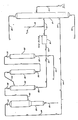
- a feed stream containing C6 paraffins and cycloparaffins and higher boiling hydrocarbons passes from line 10 into fractionation zone 12.
- a C6 sidecut taken above the boiling point of cyclohexane or benzene passes from fractionation into a line 14.
- Additional relatively low octane C5 paraffins may also be charged to the process through a line 16 that empties into line 14.
- the entire content of line 14 passes into a drying zone 18 for removing water from the isomerization feed before it contacts the water sensitive isomerization catalyst. Dry feed leaves zone 18 through line 20 where it is combined with recycle hydrogen from line 22 and makeup hydrogen from line 24.
- a line 26 carries the combined feed to a first isomerization reactor 28. After initial reaction, a line 30 carries the partially converted feed to a second isomerization reactor 32.
- Isomerization zone effluent passes from the outlet of reactor 32 through a line 34 and into a product separator 36 that removes hydrogen and other light hydrocarbons from the product stream as an overhead stream that provides the recycle hydrogen of line 22. The remainder of the isomerization zone effluent passes through a line 38 and into a stabilizer 40.
- Stabilizer 40 separates the C3 and lighter hydrocarbons from the isomerization zone effluent and these light materials exit the top of the stabilizer through a line 42. Stabilizer 40 provides a stabilized bottoms stream of the remaining heavier hydrocarbons that pass through line 44 and back to column 12 as a recycle stream.
- Column 12 separates the feed from line 10 and the recycle from line 44 into the previously described sidecut of line 14, an overhead stream 46 of lighter hydrocarbons taken at a cut point in the boiling range methyl pentane, and a bottoms stream 48 containing primarily C7 and heavier hydrocarbons.
- Suitable feedstocks for this invention will include C4 plus hydrocarbons up to an end boiling point of about 205°C (400°F).
- the feedstocks that are used in this invention will typically include hydrocarbon fractions rich in C4-C6 normal paraffins.
- the term "rich” is defined to mean a stream having more than 50% of the mentioned component.
- the feedstock will include cyclic hydrocarbons.
- the concentration of cyclics in the feedstock will at least equal that which would reduce the activity of an isomerization catalyst by adsorption of the cyclics thereon or which, due to its higher density in contrast to branched chain paraffins, would represent a significant loss of liquid volume yield.
- the minimum concentration is 2 wt.%.
- concentration of cyclic hydrocarbons in the feed there is no upper limit on the concentration of cyclic hydrocarbons in the feed since the process of this invention can be used to process feedstocks composed primarily of cyclic hydrocarbons.
- the feedstock will usually contain from 3 to 35 wt.% of cyclic hydrocarbons.
- Possible types of cyclic hydrocarbons in the feed include alicyclic and aromatic hydrocarbons. If unsaturated cyclic hydrocarbons including benzene or benzene derivatives enter the process, they are rapidly saturated therein and effectively serve as additional cycloalkane components.
- the feed components will usually comprise C4-C9 cyclic and paraffinic hydrocarbons with normal and isohexane providing most of the paraffinic components.
- the feed will normally be debutanized and depentanized so these species may be separated into higher and lower octane components optionally returning the higher octane components returned to the isomerate product of the fractionator overhead.
- Hydrotreatment of the feed, prior to entering the fractionation zone, may also be desirable since the isomerization zone catalyst and the catalyst of any downstream reforming zone are often susceptible to sulfur deactivation.
- the separation zone 12 of this invention has primarily two inputs, the feed and isomerization zone recycle; and three outputs, an isomerate product stream, an isomerization feed fraction and a heavy hydrocarbon stream.
- One or more fractionation columns can be included in the separation zone. It is expected that the sum of the trays in these columns will total 60 or more.
- the full range naphtha feed is introduced at or near the column midpoint at a location selected to provide a good split between the feed components.
- the fractionation zone initially splits the feed into a heavy hydrocarbon stream principally containing C7 and higher boiling hydrocarbons and lighter hydrocarbon fractions boiling above the boiling point of cyclohexane.
- the heavy stream is typically withdrawn from the fractionation zone as a bottom stream and may contain small amounts of aliphatic and aromatic C6 hydrocarbons which will not detract from the operation of the process.
- the isomerization zone feed fraction is a relatively lighter boiling fraction that is removed as a sidecut from the fractionation zone.
- Sidecut location is selected to maximize cyclohexane concentration while limiting withdrawal of dimethylbutane and lower boiling hydrocarbons.
- the sidecut may be withdrawn as a liquid or vapor phase. Typically, this criteria results in a sidecut location above the feed inlet point.
- At least a portion of the effluent from the isomerization zone returns to fractionation zone 12 as a recycle stream.
- the recycle stream is rich in C6 isoparaffins and may contain lesser amounts of higher and lower boiling hydrocarbon species. It is, therefore, introduced at a column location above the sidecut withdrawal point so that the isoparaffins will go overhead and the C6 normals will drop.
- Those skilled in the art will be able to optimize the recycle entry point to minimize C6 normals and maximize C6 isoparaffins in the isomerate product stream 46.
- fractionation zone 12 The upper end of fractionation zone 12 is designed to drop normal C6's from the isomerization zone product stream. Normally, the isomerization zone product stream is withdrawn from the column as an overhead stream.
- the components of the isomerization product stream include C6 isoparaffins and lighter boiling materials from both the feed stream and isomerization recycle stream.
- Additional low octane paraffins may be added to fractionation zone sidecut 14 to increase the volume of the isomerization zone feed stream and provide a location for isomerizing other low octane paraffins.
- C5 hydrocarbons will offer the most benefit.
- Conditions within the isomerization zone usually promote favorable equilibrium distribution of both C5 and C6 paraffins. Therefore, substantial C5 conversion can be obtained without any significant loss of C6 conversion.
- C4 hydrocarbons can be added, a higher severity, as compared to C5 and C6 paraffins, is required to obtain high yields of isobutane.
- the presence of appreciable C4's may present additional carryover problems in the product stabilizer for the isomerization zone. Therefore, the addition of C4 hydrocarbons to the isomerization zone feed is not as beneficial as C5 paraffin addition.
- the isomerization zone catalyst of this invention is highly water sensitive. In order to keep water content within acceptable levels, all of the isomerization zone feed passes first through a drying zone.
- the drying zone may be of any design that will reduce water content to 0.1 ppm or less. Suitable adsorption processes for this purpose are well known in the art.
- the isomerization zone Downstream of the dryers hydrogen entering through line 24 is admixed with the feed in an amount that will provide a hydrogen to hydrocarbon ratio of from 0.01:1 to 10:11 in the effluent from the isomerization zone.
- the hydrogen to hydrocarbon ratio is in the range of 0.05:1 to 5:1.
- the isomerization zone will have a net consumption of hydrogen often referred to as the stoichiometric hydrogen requirement which is associated with a number of side reactions that occur. These side reactions include saturation of olefins and aromatics, cracking and disproportionation.
- Hydrogen may be added to the feed mixture in any manner that provides the necessary control for the addition of the hydrogen quantities.
- the hydrogen and hydrocarbon feed mixture is contacted in the reaction zone with an isomerization catalyst.
- the isomerization catalyst consists of a high chloride catalyst on an alumina base containing platinum.
- the alumina is preferably an anhydrous gamma-alumina with a high degree of purity.
- the catalyst may also contain other platinum group metals.
- platinum group metals refers to noble metals excluding silver and gold which are selected from the group consisting of platinum, palladium, germanium, ruthenium, rhodium, osmium, and iridium. These metals demonstrate differences in activity and selectivity such that platinum has now been found to be the most suitable for this process.
- the catalyst will contain from about 0.1 to 0.25 wt.% of platinum.
- platinum group metals may be present in a concentration of from 0.1 to 0.25 wt.%.
- the platinum component may exist within the final catalytic composite as an oxide or halide or as an elemental metal. The presence of the platinum component in its reduced state has been found most suitable for this process.
- the catalyst also contains a chloride component.
- the chloride component termed in the art "a combined chloride” is present in an amount from about 2 to about 10 wt.% based upon the dry support material. The use of chloride in amounts greater than 5 wt.% have been found to be the most beneficial for this process.
- the method that has shown the best results in this invention prepares the catalyst by impregnating the carrier material through contact with an aqueous solution of a water-soluble decomposable compound of the platinum group metal.
- the impregnation is carried out by dipping the carrier material in a solution of chloroplatinic acid. Additional solutions that may be used include ammonium chloroplatinate, bromoplatinic acid or platinum dichloride.
- Use of the platinum chloride compound serves the dual function of incorporating the platinum component and at least a minor quantity of the chloride into the catalyst.
- Additional amounts of the chloride must be incorporated into the catalyst by the addition or formation of aluminum chloride to or on the platinum-aluminum catalyst base.
- An alternate method of increasing the chloride concentration in the final catalyst composite is to use an aluminum hydrosol to form the aluminum carrier material such that the carrier material also contains at least a portion of the chloride.
- Halogen may also be added to the carrier material by contacting the calcined carrier material with an aqueous solution of the halogen acid such as hydrogen chloride.
- the feedstock may be treated by any method that will remove water and sulfur compounds. Sulfur may be removed from the feedstream by hydrotreating. A variety of commercial dryers are available to remove water from the feed components. Adsorption processes for the removal of sulfur and water from hydrocarbon streams are also well known to those skilled in the art.
- cyclic hydrocarbons especially C6 cyclics such as benzene, cyclohexane and methylcyclopentane adversely affect the degree of paraffin isomerization.
- the adverse effect is believed to be caused by preferential adsorption of the cyclic hydrocarbons on the catalyst surface and the resulting exclusion of the paraffinic hydrocarbons.
- the process of this invention uses the aforementioned catalyst at selected operating conditions to eliminate the cyclics by their contact therewith while converting the cyclics to provide additional isomerization product. It is not necessary to achieve a complete elimination of the rings in order to enjoy the benefits of this invention.
- Conversion of only a small wt.% of the rings in the entering feed will provide a substantial increase in the isoparaffin yield.
- the process will be operated to open at least 40 wt.% of the rings in the entering feed.
- a greater degree of ring opening may be sought such that the cyclic hydrocarbon concentration in the effluent from the reaction zone is kept below 5 wt.%.
- Temperature and pressure conditions directly affect the degree of ring opening. Operating conditions within the isomerization zone are selected to maximize the production of isoalkane product from the feed components. Temperatures within the reaction zone will usually range from about 40-260°C (105-500°F).
- the most suitable operating temperatures for ring opening and isoalkane equilibrium coincide and are in the range from 145-225°C.
- the reaction zone may be maintained over a wide range of pressures. Pressure conditions in the isomerization of C4-C6 paraffins range from 7 barsg to 70 barsg. Higher pressures favor ring opening, therefore, the preferred pressures for this process are in the range of from 25 barsg to 60 barsg.
- the feed rate to the reaction zone can also vary over a wide range. These conditions include liquid hourly space velocities ranging from 0.5 to 12 hr. ⁇ 1, however, space velocities between 0.5 and 3 hr. ⁇ 1 are preferred.
- Operation of the reaction zone also requires the presence of a small amount of an organic chloride promoter.
- the organic chloride promoter serves to maintain a high level of active chloride on the catalyst as small amounts of chloride are continuously stripped off the catalyst by the hydrocarbon feed.
- the concentration of promoter entering the reaction zone is maintained at an amount equivalent to 30 to 300 wt. ppm of the hydrocarbon stream charged to the isomerization zone.
- the preferred promoter compound is carbon tetrachloride.
- Other suitable promoter compounds include oxygen-free decomposable organic chlorides such as propyldichloride, butylchloride, and chloroform to name only a few of such compounds.
- the need to keep the reactants dry is reinforced by the presence of the organic chloride compound which may convert, in part, to hydrogen chloride. As long as the process streams are kept dry, there will be no adverse effect from the presence of small amounts of hydrogen chloride.
- a preferred manner of operating the process is in a two-reactor or reaction zone system.
- the catalyst used in the process can be distributed equally or in varying proportions between the two reactors.
- the use of two reaction zones permits a variation in the operating conditions between the two reaction zones to enhance cyclic hydrocarbon conversion in one reaction zone and normal paraffin isomerization in the other.
- the first reaction zone operates at higher temperature and pressure conditions that favor ring opening and performs only a portion of the normal to isoparaffin conversion.
- the likelihood of exothermic reactions, such as the hydrogenation of unsaturates, occurring in the initial portion of the reaction zone facilitates the use of higher temperatures therein.
- the final reactor stage may operate at temperature conditions that are more favorable for isoalkane equilibrium.
- Another benefit of using two reactors is that it allows partial replacement of the catalyst system without taking the isomerization unit off stream. For short periods of time, during which the replacement of catalyst may be necessary, the entire flow of reactants may be processed through only one reaction vessel while catalyst is replaced in the other.
- the effluent of the process will enter separation facilities in the recovery of an isoalkane product.
- the separation facilities divide the reaction zone effluent into a product stream comprising C4 and heavier hydrocarbons and a gas stream which is made up of lighter hydrocarbons and hydrogen. Suitable designs for rectification columns and separator vessels are well known to those skilled in the art.
- the separation facilities consist of a product separator 36 and a stabilizer 40.
- the product separator operates as a simple flash separator that produces a vapor stream rich in hydrogen with the remainder of its volume principally comprising C1 and C2 hydrocarbons.
- the vapor stream serves primarily as a source of recycle hydrogen which is usually returned directly to the isomerization process.
- the separator may contain packing or other liquid vapor separation devices to limit the carryover of hydrocarbons. The presence of C1 and C2 hydrocarbons in the vapor stream do not interfere with the isomerization process, therefore, some additional mass flow for these components is accepted in exchange for a simplified column design.
- the remainder of the isomerization effluent leaves the separator as a liquid which passes on to stabilizer 40.
- Stabilizer 40 is a trayed column containing approximately 40 trays.
- the column will ordinarily contain condensing and reboiler loops for the withdrawal of a light gas stream 42 comprising at least a majority of the remaining C4 hydrocarbons from the effluent stream and a liquid bottoms stream 44 comprising C5 and heavier hydrocarbons.
- a light gas stream 42 comprising at least a majority of the remaining C4 hydrocarbons from the effluent stream and a liquid bottoms stream 44 comprising C5 and heavier hydrocarbons.
- the C4's are withdrawn with the light gas stream.
- the light gas stream will ordinarily serve as a fuel gas.
- the stabilizer liquid which represents the remainder of the isomerization zone effluent passes back to fractionation zone 12 as recycle via line 44.
- a C6 plus naphtha feed stream having the composition given in Table 1 enters fractionation column 12 through line 10 (the stream Nos. in Table 1 refer to the line No. in the drawing through which the stream is flowing) at a temperature of 129°C (265°F) and a pressure of 2.4 barsg.
- Fractionation column 12 has 67 trays and the feed enters above tray 13.
- a recycle stream 44 having the composition given in the table enters column 12 above tray 49 at a temperature of 93°C (200°F) and a pressure of 3.4 barsg.
- the column splits the two inputs into a bottoms stream 48 and overhead stream 46 and a sidecut stream 14, taken from the column at a location above tray 32.
- the combined feed enters the reactor train 28 and 29 at a temperature of 171°C (340°F) and a pressure of 33.1 barsg.
- the isomerization zone feed contacts an alumina catalyst having 0.25 wt.% platinum and 5.5 wt.% chlorine which was prepared by vacuum impregnating an alumina base in a solution of chloroplatinic acid, 2% hydrochloric acid, and 3.5% nitric acid in a volume ratio of 9 parts solution to 10 parts base to obtain a peptized base material having a platinum to base ratio of approximately 0.9.
- the preparation also included cold-rolling the catalyst for approximately 1 hour followed by evaporation until dry.
- the catalyst was oxidized and the chloride content adjusted by contact with a 1M hydrochloric acid solution at 525°C (975°F) at a rate of 45 cc/hr for 2 hours.
- the catalyst was then reduced in electrolytic hydrogen at 565°C (1050°F for 1 hour and was found to contain approximately 0.25 wt.% Pt and approximately 1 wt.% chloride.
- Impregnation of active chloride to a level of approximately 5.5 wt.% was accomplished by sublimating aluminum chloride with hydrogen and contacting the catalyst with the sublimated aluminum chloride for approximately 45 minutes at 550°C (1020°F).
- the converted isomerization zone feed passed out of the reactor train at a temperature of 204°C (400°F) and a pressure of 31 barsg and has the composition listed under stream 34 in the table.
- the isomerization effluent passed into a product recovery section for the recovery of a recycle stream.
- the isomerization zone effluent entered a product separator 36 from where a bottoms stream 38 is recovered and an overhead stream 22 containing 1241 kmol/hr of hydrogen is withdrawn.
- the overhead stream 22 is combined with make-up hydrogen entering via line 24 to provide the previously mentioned recycle hydrogen.
- Bottoms stream 38 entered stabilizer 40 at a temperature of 125°C (245°F) and a pressure of 18 barsg.
- the stabilizer was a trayed column having 30 trays with the bottoms stream 38 entering the stabilizer above tray 15.
- a fuel gas stream 42 having the composition given in the Table was withdrawn overhead while the bottoms stream, representing the remainder of the isomerization effluent was returned to column 12 via line 44.
- Table 1 Stream Composition in kmol/hr Stream Number 10 44 48 46 14 34 42 Component hydrogen 0 -- -- -- -- 1190 12 C1-C4 0 9 0 9 -- 452 94 isopentane 3 68 0 70 1 79 -- normal pentane 7 24 0 30 2 27 0 cyclopentane -- 4 0 4 -- 4 0 dimethyl butane 4 131 0 114 20 141 0 methyl pentane 47 198 0 83 163 210 0 normal hexane 41 47 -- 3 84 49 0 methyl cyclopentane 67 41 2 -- 106 42 0 cyclohexane 70 41 22 -- 88 42 0 benzene 9 -- -- -- 9 0 0 C7 and higher hydrocarbons 679 5 661 1 24 5
- This example demonstrates the ability of the process to separate the feed and recycle components entering the fractionation column into an isomerization product containing highly branched C6 and lower paraffins and a reformer feed deficient in C6 cyclic hydrocarbons. Only one quarter of the 228 kmol/hr of C6 cyclic hydrocarbon that entered column 12 were withdrawn with the reformer feed. The majority of these C6 cyclic hydrocarbons were converted to isoparaffins and make up part of the isomerate taken from the top of column 12. The high conversion of cyclic C6 isoparaffins is demonstrated by the composition of the column overhead and bottoms streams that show almost 90% of the C6 hydrocarbons leave the process as C6 isoparaffins. Thus, the process is highly useful in its ability to produce large quantities of C6 isoparaffins from C6 cycloparaffins and normal paraffin feeds.
Landscapes
- Chemical & Material Sciences (AREA)
- Oil, Petroleum & Natural Gas (AREA)
- Engineering & Computer Science (AREA)
- Chemical Kinetics & Catalysis (AREA)
- General Chemical & Material Sciences (AREA)
- Organic Chemistry (AREA)
- Production Of Liquid Hydrocarbon Mixture For Refining Petroleum (AREA)
- Low-Molecular Organic Synthesis Reactions Using Catalysts (AREA)
- Organic Low-Molecular-Weight Compounds And Preparation Thereof (AREA)
- Catalysts (AREA)
Priority Applications (1)
| Application Number | Priority Date | Filing Date | Title |
|---|---|---|---|
| DE1989614827 DE68914827T2 (de) | 1989-05-30 | 1989-05-30 | Decyklisierung und Isomerierung von cyklische Kohlenwasserstoffe enthaltenden Normalparaffinen. |
Applications Claiming Priority (1)
| Application Number | Priority Date | Filing Date | Title |
|---|---|---|---|
| US07/176,135 US4834866A (en) | 1988-03-31 | 1988-03-31 | Process for converting normal and cyclic paraffins |
Publications (2)
| Publication Number | Publication Date |
|---|---|
| EP0400228A1 true EP0400228A1 (fr) | 1990-12-05 |
| EP0400228B1 EP0400228B1 (fr) | 1994-04-20 |
Family
ID=22643123
Family Applications (1)
| Application Number | Title | Priority Date | Filing Date |
|---|---|---|---|
| EP89305425A Expired - Lifetime EP0400228B1 (fr) | 1988-03-31 | 1989-05-30 | Décyclisation et isomérisation simultanées d'une charge de paraffines normales contenant des hydrocarbures cycliques |
Country Status (3)
| Country | Link |
|---|---|
| US (1) | US4834866A (fr) |
| EP (1) | EP0400228B1 (fr) |
| ES (1) | ES2051356T3 (fr) |
Cited By (2)
| Publication number | Priority date | Publication date | Assignee | Title |
|---|---|---|---|---|
| WO2010151452A3 (fr) * | 2009-06-25 | 2011-04-07 | Uop Llc | Isomérisation des paraffines légères avec purification de charge améliorée |
| US10351788B1 (en) | 2018-02-28 | 2019-07-16 | Uop Llc | Processes and apparatus for isomerizing hydrocarbons |
Families Citing this family (27)
| Publication number | Priority date | Publication date | Assignee | Title |
|---|---|---|---|---|
| US4834866A (en) * | 1988-03-31 | 1989-05-30 | Uop | Process for converting normal and cyclic paraffins |
| US4975179A (en) * | 1989-08-24 | 1990-12-04 | Mobil Oil Corporation | Production of aromatics-rich gasoline with low benzene content |
| US5003118A (en) * | 1989-12-29 | 1991-03-26 | Uop | Isomerization of benzene-containing feedstocks |
| GB9013566D0 (en) * | 1990-06-18 | 1990-08-08 | Shell Int Research | Process for producing gasoline components |
| US5138112A (en) * | 1990-08-31 | 1992-08-11 | Uop | Process for converting a C2 -C6 aliphatic hydrocarbon to high octane transportable fuel |
| US5256277A (en) * | 1991-07-24 | 1993-10-26 | Mobil Oil Corporation | Paraffin isomerization process utilizing a catalyst comprising a mesoporous crystalline material |
| AU665965B2 (en) * | 1991-10-25 | 1996-01-25 | Mobil Oil Corporation | Combined paraffin isomerization/ring opening process |
| US5246567A (en) * | 1992-02-10 | 1993-09-21 | Amoco Corporation | Benzene removal in an isomerization process |
| US5334792A (en) * | 1992-10-09 | 1994-08-02 | Mobil Oil Corporation | Combined paraffin isomerization/ring opening process for c5+naphtha |
| US5946480A (en) * | 1993-01-04 | 1999-08-31 | Phillips Petroleum Company | Method and apparatus for computer simulation of pentane isomerization reactions |
| US5770042A (en) * | 1993-11-15 | 1998-06-23 | Uop | Upgrading of cyclic naphthas |
| US5625579A (en) * | 1994-05-10 | 1997-04-29 | International Business Machines Corporation | Stochastic simulation method for processes containing equilibrium steps |
| DE69624730T2 (de) * | 1995-09-05 | 2003-09-11 | Exxonmobil Res & Eng Co | Verfahren zur selektiven spaltung von naphthalin-ringen |
| US5773383A (en) * | 1995-09-15 | 1998-06-30 | Suciu; George Dan | Method of making solid acid catalysts with metal cores |
| US5826065A (en) * | 1997-01-13 | 1998-10-20 | International Business Machines Corporation | Software architecture for stochastic simulation of non-homogeneous systems |
| US6589416B2 (en) | 2000-07-21 | 2003-07-08 | Exxonmobil Research And Engineering Company | Method and catalyst for opening naphthenic rings of naphthenic ring-containing compounds |
| US6623625B2 (en) | 2000-07-21 | 2003-09-23 | Exxonmobil Research And Engineering Company | Naphthene ring opening over group VIII metal catalysts containing cracking moderators |
| US6586650B2 (en) | 2000-07-21 | 2003-07-01 | Exxonmobil Research And Engineering Company | Ring opening with group VIII metal catalysts supported on modified substrate |
| US6623626B2 (en) | 2000-07-21 | 2003-09-23 | Exxonmobil Research And Engineering Company | Naphthene ring opening over a ring opening catalyst combination |
| US6683020B2 (en) | 2000-07-21 | 2004-01-27 | Exxonmobil Research And Engineering Company | Naphthene ring opening over an iridium ring opening catalyst |
| US6652737B2 (en) | 2000-07-21 | 2003-11-25 | Exxonmobil Research And Engineering Company | Production of naphtha and light olefins |
| JP2009516659A (ja) * | 2005-11-22 | 2009-04-23 | ハルドール・トプサー・アクチエゼルスカベット | 炭化水素供給材料を異性化する方法 |
| US7531704B2 (en) * | 2007-05-18 | 2009-05-12 | Uop Llc | Isomerization of benzene-containing feedstocks |
| US20080286173A1 (en) * | 2007-05-18 | 2008-11-20 | Shecterle David J | Isomerization of Benzene-Containing Feedstocks |
| US20080286172A1 (en) * | 2007-05-18 | 2008-11-20 | David J Shecterle | Isomerization of Benzene-Containing Feedstocks |
| US7534925B2 (en) * | 2007-05-18 | 2009-05-19 | Uop Llc | Isomerization of benzene-containing feedstocks |
| US20160311732A1 (en) | 2015-04-27 | 2016-10-27 | Uop Llc | Processes and apparatuses for isomerizing hydrocarbons |
Citations (4)
| Publication number | Priority date | Publication date | Assignee | Title |
|---|---|---|---|---|
| US3250816A (en) * | 1963-05-24 | 1966-05-10 | Phillips Petroleum Co | Reforming of a natural cyclohexanecontaining fraction |
| US4747933A (en) * | 1987-03-27 | 1988-05-31 | Uop Inc. | Isomerization unit with integrated feed and product separation facilities |
| US4804803A (en) * | 1987-12-07 | 1989-02-14 | Uop Inc. | Isomerization with once-through hydrogen |
| US4834866A (en) * | 1988-03-31 | 1989-05-30 | Uop | Process for converting normal and cyclic paraffins |
Family Cites Families (2)
| Publication number | Priority date | Publication date | Assignee | Title |
|---|---|---|---|---|
| US4457832A (en) * | 1983-01-19 | 1984-07-03 | Chevron Research Company | Combination catalytic reforming-isomerization process for upgrading naphtha |
| US4783575A (en) * | 1987-12-17 | 1988-11-08 | Uop Inc. | Isomerization with cyclic hydrocarbon conversion |
-
1988
- 1988-03-31 US US07/176,135 patent/US4834866A/en not_active Expired - Lifetime
-
1989
- 1989-05-30 EP EP89305425A patent/EP0400228B1/fr not_active Expired - Lifetime
- 1989-05-30 ES ES89305425T patent/ES2051356T3/es not_active Expired - Lifetime
Patent Citations (4)
| Publication number | Priority date | Publication date | Assignee | Title |
|---|---|---|---|---|
| US3250816A (en) * | 1963-05-24 | 1966-05-10 | Phillips Petroleum Co | Reforming of a natural cyclohexanecontaining fraction |
| US4747933A (en) * | 1987-03-27 | 1988-05-31 | Uop Inc. | Isomerization unit with integrated feed and product separation facilities |
| US4804803A (en) * | 1987-12-07 | 1989-02-14 | Uop Inc. | Isomerization with once-through hydrogen |
| US4834866A (en) * | 1988-03-31 | 1989-05-30 | Uop | Process for converting normal and cyclic paraffins |
Cited By (3)
| Publication number | Priority date | Publication date | Assignee | Title |
|---|---|---|---|---|
| WO2010151452A3 (fr) * | 2009-06-25 | 2011-04-07 | Uop Llc | Isomérisation des paraffines légères avec purification de charge améliorée |
| US8314281B2 (en) | 2009-06-25 | 2012-11-20 | Uop Llc | Light paraffin isomerization with improved feed purification |
| US10351788B1 (en) | 2018-02-28 | 2019-07-16 | Uop Llc | Processes and apparatus for isomerizing hydrocarbons |
Also Published As
| Publication number | Publication date |
|---|---|
| EP0400228B1 (fr) | 1994-04-20 |
| US4834866A (en) | 1989-05-30 |
| ES2051356T3 (es) | 1994-06-16 |
Similar Documents
| Publication | Publication Date | Title |
|---|---|---|
| EP0400228B1 (fr) | Décyclisation et isomérisation simultanées d'une charge de paraffines normales contenant des hydrocarbures cycliques | |
| US5003118A (en) | Isomerization of benzene-containing feedstocks | |
| US4783575A (en) | Isomerization with cyclic hydrocarbon conversion | |
| US5360534A (en) | Isomerization of split-feed benzene-containing paraffinic feedstocks | |
| EP0381881B1 (fr) | Procédé pour l'isomérisation d'hydrocarbures C4-C6 en présence d'hydrogène qui n'est pas recyclée | |
| US7223898B2 (en) | Isomerization process | |
| US7531704B2 (en) | Isomerization of benzene-containing feedstocks | |
| US6927314B1 (en) | Fractionation and treatment of full boiling range gasoline | |
| CA2628361C (fr) | Isomerisation de charges d'alimentation contenant du benzene | |
| US4747933A (en) | Isomerization unit with integrated feed and product separation facilities | |
| US7638665B2 (en) | Isomerization of benzene-containing feedstocks | |
| CA2625905C (fr) | Isomerisation de charges d'alimentation contenant du benzene | |
| US5227554A (en) | Isomerization process | |
| US5026950A (en) | Hydrotreatment-isomerization without hydrogen recycle | |
| EP0520100B1 (fr) | Procédé intégré à deux zones de réaction pour l'isomérisation d'hydrocarbures en C4, C5 et C6 | |
| US20080286173A1 (en) | Isomerization of Benzene-Containing Feedstocks | |
| US5135639A (en) | Production of reformulated gasoline | |
| US5326926A (en) | Isomerization with improved RVP and C4 recovery | |
| US4929794A (en) | Hydrotreatment-isomerization without hydrogen recycle | |
| US4877919A (en) | Butane isomerization in the presence of C5 and C6 hydrocarbons | |
| US5763713A (en) | Process for the isomerization of benzene containing feed streams | |
| US20080286172A1 (en) | Isomerization of Benzene-Containing Feedstocks | |
| US5962755A (en) | Process for the isomerization of benzene containing feed streams | |
| CA1301201C (fr) | Procede de production, a partir de la paraffine, d'isomeres c _et c _alimentation integree et d'une zone de fractionnement de la production |
Legal Events
| Date | Code | Title | Description |
|---|---|---|---|
| PUAI | Public reference made under article 153(3) epc to a published international application that has entered the european phase |
Free format text: ORIGINAL CODE: 0009012 |
|
| AK | Designated contracting states |
Kind code of ref document: A1 Designated state(s): BE DE ES FR GB IT NL |
|
| 17P | Request for examination filed |
Effective date: 19901205 |
|
| 17Q | First examination report despatched |
Effective date: 19910610 |
|
| RAP1 | Party data changed (applicant data changed or rights of an application transferred) |
Owner name: UOP |
|
| GRAA | (expected) grant |
Free format text: ORIGINAL CODE: 0009210 |
|
| AK | Designated contracting states |
Kind code of ref document: B1 Designated state(s): BE DE ES FR GB IT NL |
|
| PG25 | Lapsed in a contracting state [announced via postgrant information from national office to epo] |
Ref country code: BE Effective date: 19940420 |
|
| PGFP | Annual fee paid to national office [announced via postgrant information from national office to epo] |
Ref country code: GB Payment date: 19940523 Year of fee payment: 6 |
|
| REF | Corresponds to: |
Ref document number: 68914827 Country of ref document: DE Date of ref document: 19940526 |
|
| REG | Reference to a national code |
Ref country code: ES Ref legal event code: FG2A Ref document number: 2051356 Country of ref document: ES Kind code of ref document: T3 |
|
| ET | Fr: translation filed | ||
| PGFP | Annual fee paid to national office [announced via postgrant information from national office to epo] |
Ref country code: BE Payment date: 19940711 Year of fee payment: 6 |
|
| ITF | It: translation for a ep patent filed | ||
| PLBE | No opposition filed within time limit |
Free format text: ORIGINAL CODE: 0009261 |
|
| STAA | Information on the status of an ep patent application or granted ep patent |
Free format text: STATUS: NO OPPOSITION FILED WITHIN TIME LIMIT |
|
| 26N | No opposition filed | ||
| PG25 | Lapsed in a contracting state [announced via postgrant information from national office to epo] |
Ref country code: GB Effective date: 19950530 |
|
| GBPC | Gb: european patent ceased through non-payment of renewal fee |
Effective date: 19950530 |
|
| PGFP | Annual fee paid to national office [announced via postgrant information from national office to epo] |
Ref country code: FR Payment date: 19970513 Year of fee payment: 9 |
|
| PGFP | Annual fee paid to national office [announced via postgrant information from national office to epo] |
Ref country code: NL Payment date: 19970529 Year of fee payment: 9 |
|
| PGFP | Annual fee paid to national office [announced via postgrant information from national office to epo] |
Ref country code: ES Payment date: 19970530 Year of fee payment: 9 |
|
| PGFP | Annual fee paid to national office [announced via postgrant information from national office to epo] |
Ref country code: DE Payment date: 19970606 Year of fee payment: 9 |
|
| PG25 | Lapsed in a contracting state [announced via postgrant information from national office to epo] |
Ref country code: FR Free format text: LAPSE BECAUSE OF NON-PAYMENT OF DUE FEES Effective date: 19980531 |
|
| PG25 | Lapsed in a contracting state [announced via postgrant information from national office to epo] |
Ref country code: ES Free format text: LAPSE BECAUSE OF NON-PAYMENT OF DUE FEES Effective date: 19980601 |
|
| PG25 | Lapsed in a contracting state [announced via postgrant information from national office to epo] |
Ref country code: NL Free format text: LAPSE BECAUSE OF NON-PAYMENT OF DUE FEES Effective date: 19981201 |
|
| NLV4 | Nl: lapsed or anulled due to non-payment of the annual fee |
Effective date: 19981201 |
|
| PG25 | Lapsed in a contracting state [announced via postgrant information from national office to epo] |
Ref country code: DE Free format text: LAPSE BECAUSE OF NON-PAYMENT OF DUE FEES Effective date: 19990302 |
|
| REG | Reference to a national code |
Ref country code: FR Ref legal event code: ST |
|
| REG | Reference to a national code |
Ref country code: ES Ref legal event code: FD2A Effective date: 20000403 |
|
| PG25 | Lapsed in a contracting state [announced via postgrant information from national office to epo] |
Ref country code: IT Free format text: LAPSE BECAUSE OF NON-PAYMENT OF DUE FEES;WARNING: LAPSES OF ITALIAN PATENTS WITH EFFECTIVE DATE BEFORE 2007 MAY HAVE OCCURRED AT ANY TIME BEFORE 2007. THE CORRECT EFFECTIVE DATE MAY BE DIFFERENT FROM THE ONE RECORDED. Effective date: 20050530 |