EP0400534B1 - Vorrichtung für die Schwenk-Kipp-Öffnung eines Fensters oder Türfensters - Google Patents
Vorrichtung für die Schwenk-Kipp-Öffnung eines Fensters oder Türfensters Download PDFInfo
- Publication number
- EP0400534B1 EP0400534B1 EP90110072A EP90110072A EP0400534B1 EP 0400534 B1 EP0400534 B1 EP 0400534B1 EP 90110072 A EP90110072 A EP 90110072A EP 90110072 A EP90110072 A EP 90110072A EP 0400534 B1 EP0400534 B1 EP 0400534B1
- Authority
- EP
- European Patent Office
- Prior art keywords
- window
- pin
- cable
- tilt
- box
- Prior art date
- Legal status (The legal status is an assumption and is not a legal conclusion. Google has not performed a legal analysis and makes no representation as to the accuracy of the status listed.)
- Expired - Lifetime
Links
Images


Classifications
-
- E—FIXED CONSTRUCTIONS
- E05—LOCKS; KEYS; WINDOW OR DOOR FITTINGS; SAFES
- E05D—HINGES OR SUSPENSION DEVICES FOR DOORS, WINDOWS OR WINGS
- E05D15/00—Suspension arrangements for wings
- E05D15/48—Suspension arrangements for wings allowing alternative movements
- E05D15/52—Suspension arrangements for wings allowing alternative movements for opening about a vertical as well as a horizontal axis
- E05D15/5214—Corner supports
-
- E—FIXED CONSTRUCTIONS
- E05—LOCKS; KEYS; WINDOW OR DOOR FITTINGS; SAFES
- E05C—BOLTS OR FASTENING DEVICES FOR WINGS, SPECIALLY FOR DOORS OR WINDOWS
- E05C9/00—Arrangements of simultaneously actuated bolts or other securing devices at well-separated positions on the same wing
-
- E—FIXED CONSTRUCTIONS
- E05—LOCKS; KEYS; WINDOW OR DOOR FITTINGS; SAFES
- E05D—HINGES OR SUSPENSION DEVICES FOR DOORS, WINDOWS OR WINGS
- E05D15/00—Suspension arrangements for wings
- E05D15/48—Suspension arrangements for wings allowing alternative movements
- E05D15/52—Suspension arrangements for wings allowing alternative movements for opening about a vertical as well as a horizontal axis
-
- E—FIXED CONSTRUCTIONS
- E05—LOCKS; KEYS; WINDOW OR DOOR FITTINGS; SAFES
- E05D—HINGES OR SUSPENSION DEVICES FOR DOORS, WINDOWS OR WINGS
- E05D15/00—Suspension arrangements for wings
- E05D15/48—Suspension arrangements for wings allowing alternative movements
- E05D15/52—Suspension arrangements for wings allowing alternative movements for opening about a vertical as well as a horizontal axis
- E05D15/526—Safety devices
-
- E—FIXED CONSTRUCTIONS
- E05—LOCKS; KEYS; WINDOW OR DOOR FITTINGS; SAFES
- E05B—LOCKS; ACCESSORIES THEREFOR; HANDCUFFS
- E05B53/00—Operation or control of locks by mechanical transmissions, e.g. from a distance
- E05B53/003—Operation or control of locks by mechanical transmissions, e.g. from a distance flexible
-
- E—FIXED CONSTRUCTIONS
- E05—LOCKS; KEYS; WINDOW OR DOOR FITTINGS; SAFES
- E05Y—INDEXING SCHEME ASSOCIATED WITH SUBCLASSES E05D AND E05F, RELATING TO CONSTRUCTION ELEMENTS, ELECTRIC CONTROL, POWER SUPPLY, POWER SIGNAL OR TRANSMISSION, USER INTERFACES, MOUNTING OR COUPLING, DETAILS, ACCESSORIES, AUXILIARY OPERATIONS NOT OTHERWISE PROVIDED FOR, APPLICATION THEREOF
- E05Y2900/00—Application of doors, windows, wings or fittings thereof
- E05Y2900/10—Application of doors, windows, wings or fittings thereof for buildings or parts thereof
- E05Y2900/13—Type of wing
- E05Y2900/146—Shutters
-
- E—FIXED CONSTRUCTIONS
- E05—LOCKS; KEYS; WINDOW OR DOOR FITTINGS; SAFES
- E05Y—INDEXING SCHEME ASSOCIATED WITH SUBCLASSES E05D AND E05F, RELATING TO CONSTRUCTION ELEMENTS, ELECTRIC CONTROL, POWER SUPPLY, POWER SIGNAL OR TRANSMISSION, USER INTERFACES, MOUNTING OR COUPLING, DETAILS, ACCESSORIES, AUXILIARY OPERATIONS NOT OTHERWISE PROVIDED FOR, APPLICATION THEREOF
- E05Y2900/00—Application of doors, windows, wings or fittings thereof
- E05Y2900/10—Application of doors, windows, wings or fittings thereof for buildings or parts thereof
- E05Y2900/13—Type of wing
- E05Y2900/148—Windows
-
- Y—GENERAL TAGGING OF NEW TECHNOLOGICAL DEVELOPMENTS; GENERAL TAGGING OF CROSS-SECTIONAL TECHNOLOGIES SPANNING OVER SEVERAL SECTIONS OF THE IPC; TECHNICAL SUBJECTS COVERED BY FORMER USPC CROSS-REFERENCE ART COLLECTIONS [XRACs] AND DIGESTS
- Y10—TECHNICAL SUBJECTS COVERED BY FORMER USPC
- Y10T—TECHNICAL SUBJECTS COVERED BY FORMER US CLASSIFICATION
- Y10T292/00—Closure fasteners
- Y10T292/08—Bolts
- Y10T292/0801—Multiple
- Y10T292/0834—Sliding
- Y10T292/0836—Operating means
- Y10T292/0841—Flexible
Definitions
- the present invention relates to a device for the shutter-like and tilt-down opening of a window.
- a device which comprises a rod which is mounted on an upright and is usually termed "cremone bolt"; said rod, actuated by a handle, acts by means of adapted devices on the arm of the upper supporting hinge and on a tilt-down abutment which is applied to the lower corner of the window and is adapted to allow shutter-like and tilt-down rotations.
- This known kind of device is structurally very complicated, since it is composed of a plurality of parts which can be mutually assembled; said device must furthermore be adapted according to the specific dimensions of the windows, so that some of its components must be shaped to size during assembly.
- composition of this known system is further complicated by the fact that if it is to be applied on irregular or "vaulted” windows it is necessary to further adapt its components to the specific shape of said window.
- Said devices are made of galvanized steel: the zinc plating wears at the points of contact between the fixed points and the movable points, allowing the forming of rust which compromises operation in the course of time.
- DE-A-3402780 shows a device which prevents a window from escaping out of its frame when it is in a tilt-down opening condition.
- This device comprises a lower hinge formed by a cylindrical male element which is accommodated in a bushing inserted in a seat. The terminal end of this male element has a smaller diameter section which terminates in an enlarged portion.
- the seat presents, at the bottom, a cylindrical cavity provided with a protrusion. When the window is in its tilt-down opening position, this enlarged portion engages with said protrusion, preventing said male element from escaping out of its seat.
- CH-A-421 746 shows a device as defined in the preamble of the appended claim 1.
- the aim of the subject of the present application is therefore to eliminate the disadvantages described above in known kinds by providing a device which, when applied to a window, allows to achieve the optimum shutter-like and tilt-down opening thereof.
- Another important object is to provide a device which is structurally simple so as to allow rapid assembly thereof onto windows.
- Another important object is to provide a device which can be applied to windows of different sizes in a rapid and easy manner, without forcing the installer to keep in stock a considerable number of parts according to the specific installation to be performed.
- Another important object is to provide a device which has a structurally simple safety against incorrect shutter-like opening maneuver starting from the tilt-down opening condition.
- Not least object is to provide a device which associates the preceding characteristics with that of having modest costs and of being reliable and safe in use and in the course of time.
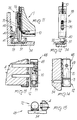
- the reference numeral 1 indicates a window or door-window comprised of an upper cross-member 2 and a lower cross-member 3 connected by a pair of uprights indicated by the numerals 4 and 5.
- an upper hinge 52 at least temporarily connects the upper portion of the upright 4 of the window to a fixed frame 34.
- This upper hinge 52 is adapted, as will be described hereafter, to allow the window to open in a shutter-like fashion, in which the upright 4 remains vertical and the window rotates about an axis which is parallel to the extension of the upright 4, or to allow the window to open in a tilt-down manner, in which the window 1 rotates about an axis which is parallel to the extension of the lower cross member 3.
- a lower hinge 68 which connects the lower portion of the upright 4 to the fixed frame 34 is adapted, as will be described hereafter, to allow the window to achieve both the shutter-like and tilt-down opening as described above.
- Connection means 37,45 and 51 between the lower, middle and upper portions respectively of the upright 5 and the fixed frame 34 are also provided which are adapted to allow for the shutter-like or tilt-down opening of the window, and such connection means will be described in detail hereafter.
- the device for selecting and activating the shutter-like and tilt-down opening of the window 1 comprises a box 6 composed of a first and a second half-shell, indicated by the reference numerals 7 and 8, which are mutually associable.
- Said box is arranged at the upright 5, and a handle 9 is associated therewith and can be actuated by the user.
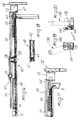
- Means are provided within said box 6 for the tensioning of at least one traction element which, in the illustrated embodiment, is constituted by a first cable 10 and by a second cable 11 preferably made of steel.
- Such cables 10 and 11 are associated with the upper hinge 52, the lower hinge 68, and the connection means 37 and 51 in such a manner so as to allow the shutter-like or tilt-down opening of the window, depending upon the degree of tensioning of said cables.
- Said means for tensioning the cables are constituted by a cam 12 which has an actuation means seat in which the handle 9 is inserted; upon rotation of the handle 9, the cam 12 interacts simultaneously with a first dowel 13 and with a second dowel 14 which have an essentially cylindrical shape.
- the cam 12 has a thickness approximately equal to the interspace between said first and said second half-shell and has, at said half-shells, profiles with a substantially mutually inverted configuration.
- the cam 12 advantageously has a first side profile which interacts at the first half-shell 7 with the first dowel 13 and a second side profile which interacts at the second half-shell 8 with the second dowel 14.
- the first side cam profile and the second side cam profile of the cam 12 are substantially mutually inverted, and this configuration, as will be shown hereafter, allows for the shutter-like opening or the tilt-down opening of the window, depending upon the degree of rotation of the cam 12 itself.
- the cam 12 has, at its first side profile, a first planar region 15 on which the first dowel 13 rests when the window is closed; one end of said dowel 13 is accommodated at an adapted seat provided in the first half-shell 7, whereas the other one interacts with a first wing 16 of a first slider 17 which has an essentially L-shaped configuration.
- An adapted first pawl 18 is provided at the first wing 16 and protrudes from the opposite side with respect to the one which interacts with the first dowel 13; a first cylindrical-helix compression spring 19 is arranged at said pawl.
- the first slider 17 slides at an adapted longitudinal seat provided on the first half shell 7, and securing means for the first cable 10, such as first Allen screws 21, are associated with the second wing 20 of the first slider 17 thereof.
- the cam 12 is furthermore provided, at its first side profile, with a second region 22 which is elliptical and is offset by 90 degrees clockwise with respect to the first region 15; said second region is followed, upon a rotation of another 90 degrees clockwise, by a third circular region 23 with constant radius.
- the cam 12 has, at its second side profile, a fourth planar region 24, which is also planar, at the second half-shell 8; said fourth planar region rests at the facing second dowel 14 when the window is closed.
- a fifth circular region 25 with constant radius is provided on the cam 12 at its second side profile after a 90-degree clockwise rotation with respect to said fourth region and is followed, after another clockwise 90-degree rotation, by a sixth elliptical region 26.
- one end of the second dowel 14 is accommodated, on the opposite side with respect to said first pin relative to the cam, in an adapted seat provided on said second half-shell; the other end interacts with a third wing 27 of a second slider 28 which has an L-shaped configuration and is slidably associated at an adapted seat provided on said second half-shell 8.
- a second pawl 29 protrudes at the third wing 27 in the opposite direction with respect to said second dowel 14 and interacts with an adapted second cylindrical-helix compression spring 30.
- Fixing means such as second Allen screws 32 for the second cable 11, which protrudes on the opposite side with respect to said first cable 10, are furthermore provided in the second slider 28 at the fourth wing 31.
- adapted access openings for said first and second Allen screws are naturally provided on said first and on said second half-shells.
- the cam 12 imparts a maximum upward movement to the first slider 17, which is connected to the first cable 10, and simultaneously imparts an intermediate downward movement to the second slider 28 which is connected to the second cable 11.
- the first cable 10 is in fact connected to a first pin 33 for the temporary closure of the window onto the fixed frame 34; said first pin is partially hollow for the passage of said first cable and has adapted coupling means for said cable, constituted by third Allen screws 35.
- the first pin 33 is therefore adjacent to the upright 5, and its end, which is partially removed toward the lower cross-member 3, is forced to protrude, when the window is closed, beyond said cross-member by means of an adapted third cylindrical-helix spring 36, within a first abutment 37 associated with said fixed frame 34.
- Said third spring 36 and said first pin 33 are slidably associated in an adapted seat provided longitudinally on a first box-like body 38 which can be rigidly associated with the upright 5 and is upwardly perforated for the passage of the first cable 10.
- a maximum movement imparted to the first slider 17 corresponds to a 90-degree counterclockwise rotation of the handle 9 and allows the disengagement of the end of said first pin 33 from said abutment 37.
- Said abutment is internally provided with a first inclined surface 39 adapted to facilitate the tilt-down opening of the window.
- the cam 12 interacts with the first dowel 13 at the third region 23 which places said first dowel in an intermediate position which is in any case sufficient to allow the partial protrusion of the free end of the first pin 33 from the first box-like body 38.
- Said box-like body furthermore comprises a means adapted to prevent the window from being lifted in the tilt-down condition, said means being constituted by a lug 40 which protrudes on the opposite side with respect to said upright 5 and is accommodated inside an adapted cavity 41 provided on a plate 42 rigidly associated with said fixed frame 34.
- the cam 12 interacts with the second dowel 14 at the fifth region 25 with constant radius, thus forcing the second slider 28 to perform an intermediate movement with respect to the maximum movement which can be achieved with a further 90-degree rotation.
- a movement of the second slider 28 toward the lower cross-member 3 therefore entails the tensioning of the cable 11, to which the end of a second intermediate closure pin 43 is pivoted.
- Said closure pin has an essentially L-shaped configuration, and its other free end protrudes transversely to the upright 5 toward the facing fixed frame 34 within an adapted second abutment 44.
- the second pin 43 is accommodated within a second box-like body 45 which is perforated above and below for the passage of the second cable 11, and said second pin 43 is slidably associable therein; its position with respect to the second cable 11 can be determined by means of adapted fourth Allen screws 46 and forced in its positioning by means of an adapted fourth cylindrical-helix compression spring 47 adapted to force said second pin toward the upper cross-member 2.
- a further pin with a configuration similar to that of the first pin 33 and of the first box like body 38 with which it is associated, except for the presence of a lug which performs the function of the lug indicated by the numeral 40, must be applied at the corner between the upper cross-member and the upright 5.
- Said further pin in order to perform the upper closure, is naturally connected to the first cable 10 and can be accommodated, upon a counterclockwise 90-degree rotation from the condition in which the window is closed to the condition in which it is open shutter-like, entirely within its own box-like body.
- This condition is in any case also achieved upon a further 90-degree rotation of the handle to pass from the condition in which the door is open shutter like to the condition in which it is open in a tilt-down manner.
- the device is furthermore constituted by means for coupling to an upper hinge 52 which is adapted to couple the fixed frame 34 at the corner formed by the upper cross-member 2 and by the upright 4.
- Said hinge 52 is coupled, by means of a C-shaped plate, to the end of a first rod 54 which constitutes a compass-like arm 57 together with a second rod 55 which is associated with said first rod by means of an adapted fulcrum 56.
- the rod 54 is rigidly associated with the plate 53, i.e., preferably by welding.
- the third pin 64 does not interact with the plate 53 since it is caused to enter the seat by compressing the spring 66.
- the rod 54 constitutes the only interconnection element acting between the fixed frame which is coupled to the upper hinge 52 and the window.
- the plate 53 is connected to the upper hinge 52 and rotates together therewith.
- the above-mentioned compass arm is movable in a per se known manner and thus will be no further described herein.
- Said compass-like arm has, in the interspace between the fulcrum 56 and the plate 53, an articulation 58 which is rotatably associated, at one end, at an adapted support 59 which protrudes from a third box-like body 60 rigidly associated at the upper crosspiece 2.
- Said articulation 58 supports the entire window when it is open shutter-like.
- a slider 61 is instead provided at the free end of the second rod 55 and is slidable within an adapted longitudinal groove 62 provided on said third box-like body 60, which has adapted holes for the passage of the second cable 11.
- a pair of undulated springs 63 is advantageously provided inside the longitudinal groove 62; said springs are adapted to allow a certain movement of the slider 61 within said longitudinal groove 62.
- the third box-like body 60 is provided, proximate to the end adjacent to the plate 53, with a seat for a third pin 64 which is shaped like the first pin 33 and is therefore provided with fifth Allen screws 65 which can be accessed from the outside to secure the second cable 11 which is transmitted at the upright 2, said third pin 64 being partially hollowed out.
- a fifth cylindrical-helix spring 66 is furthermore provided and is adapted to force said third pin toward a facing hole 67 provided on a wing of said plate 53.
- the function of the third pin 64 is as follows: when the window is closed, it connects the upright 2 to the plate 53 and protrudes into the hole 67 toward the hinge 52.
- the cam 12 imparts a movement to the second dowel 14 which imparts a first slight downward movement to the second slider 28, and this causes the partial backward motion of the third slider 64, but said third slider maintains its engagement with the hole 67 provided on the wing of the plate 63: it is thus still possible to perform a shutter-like opening.
- the third pin 64 no longer affects the hole 67 of the wing of the plate 53, allowing to tilt down the window by virtue of the presence of the compass-like arm 57.
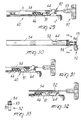
- Figures 29, 30, 31, 32 and 33 illustrate a further embodiment of the coupling to the upper hinge 52, and therefore to the first rod 54, of the third box-like body 60 which is rigidly associated at the upper crosspiece 2.
- the third box-like body 60 has, proximate to the end adjacent to the plate 53, which is hollow and rigidly associated with the upper hinge 52, a seat for a hook 91 which is connected to the second cable 11 and is slidable axially to said seat in contrast with an adapted fifth spring 66.
- Said hook 91 interacts with a third pivot 64 which is shaped similarly to the second pivot 43 and can therefore be accommodated within the seat for said hook 91 or be pushed out of it toward the overlying first rod 54 to position itself within an adapted slot 92 defined longitudinally to said first rod 54.
- the configuration of the mutually interacting ends of the hook 91 and of the third pivot 64 is such that a first rotation of the handle through ninety degrees obtains an axial sliding of the hook 91 without imparting any movement to said third pivot 64.
- the hook 91 Upon a subsequent rotation through ninety degrees imparted to the handle, the hook 91 imparts a movement to the third pivot 64, as seen from figure 32, forcing it to disengage from the slot 92 and arrange itself within the seat defined on the third box-like body 60.
- Tilt down opening is thus allowed.
- a sixth screw 93 which is rotatably associated at the plate 53 and controls the axial movement of a square element 94 which is slidably associable at said plate 53.
- the device finally comprises a lower hinge 68 which is axially aligned with the upper hinge 52.
- Said lower hinge 68 is advantageously inverted, in that it comprises a male element 69, constituted by a pin 70 of adjustable height, which is provided, at its outer end, with a ball 71 which can be accommodated in a countershaped seat provided on the female element 72 which is coupled to the fixed frame 34.
- Said lower hinge 68 is therefore a spherical hinge 30 advantageously made of synthetic material, provided with sliding action for shutter-like opening and articulated action for tilt-down opening: the use of the ball 71 thus allows to prevent the window from assuming, when open, a certain preset position on one hand and, on the other, to achieve the optimum inclination of the pin 70 in the tilt-down opening condition, even in case of incorrect maneuvers such as for example simultaneous shutter-like and tilt-down opening.
- the pin 70 follows the inclination of the window without leading to breakage or damage of the hardware.
- Said lower hinge 68 can advantageously be adjustable both vertically and laterally and be reversible.
- FIGS 27 and 28 illustrate a further embodiment of the lower hinge 168, which is again constituted by a pin 170 the outer end whereof has a first cylindrical portion 188 followed by a second portion 189 in the shape of a spherical dome.
- the seat for said first and second portions defined on the female element 172 is essentially cylindrical, with a seventh region 190 in the shape of a truncated cone with its vertex directed opposite to the pin 170 proximate to the upper opening for the insertion of said first and second portions.
- an anular tang 200 adapted to prevent the pin 170 from escaping out of this region.
- this configuration allows to locate the first and second portions of the pin 170 within the seat defined on the female element 172, preventing mutual extraction if the window is placed in the tilt-down condition.
- the first portion 188 arranges itself at the seventh frustum-shaped region 190, against said anular tang 200, and thus interacts in abutment with said female element 172 if extraction thereof is attempted.
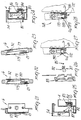
- the device is furthermore constituted by means adapted to prevent the rotation of the handle 9 from the tilt-down opening condition to the shutter-like one, said means being constituted, as shown in figures 6,7 and 8, by an adapted pendulum 73 which is articulated at one end within an adapted seat provided above the cam 12 at the second half-shell 8 and is arranged adjacent, at the other end, to said second half-shell 8 when the window is arranged vertically and therefore in the shutter-like closure and opening conditions.
- the free end of the pendulum 73 can therefore be positioned at an adapted recess 74 provided transversely to the cam 12.
- the device can furthermore have, for example at the upper cross member 2 and at the lower cross-member 3, further pins having the same configuration as the second pin 43 which is not movable perpendicular to the respective cross-member so as to affect a fourth abutment 75 and a fifth abutment 76 associated with the facing fixed frame 34.
- the means suitable for preventing the rotation of the handle from the tilt-down opening condition to the shutter-like one can again be constituted by a suitable pendulum 173 which has an essentially triangular configuration and is arranged outside the box 6 at the front surface 79 from which the first Allen screws 21 and the second Allen screws 32 slightly advantageously protrude.
- the pendulum 173 is pivoted, at its vertex, perpendicular to the front surface 79 in a region adjacent to the second Allen screws 32, and a T-shaped seat 80, with its stem directed toward said vertex, is defined at the other end of the pendulum 173.
- the pendulum 173 arranges itself as shown in figure 22, and the seat 80 allows the axial sliding, with respect to the seat itself, of the first Allen screws 21 which protrude beyond the front surface 79 which is arranged on a plane which is parallel to that of said pendulum 73.
- Figures 24, 25 and 26 illustrate a further embodiment for the means suitable for preventing the rotation of the handle from the tilt-down opening condition to the shutter-like one: said means are constituted by a wedge-like element 81 associable at the fixed frame 34 and by a hook 82 eccentrically pivoted at a wing of a support 83 which has an essentially U-shaped configuration and is associated with the upright 4 or with both uprights.
- Said support 83 is arranged longitudinally to said uprights.
- the first cable 10 can slide within the support 83; a cylinder 84 is advantageously rigidly coupled to said cable and can slide along said support 83.
- the hook 82 is pivoted to a wing of the support 83 and is forced, by means of an adapted sixth spring 85, so as to arrange itself adjacent at the first cable 10 and therefore on the opposite side with respect to the wedge-like element 81.
- the first cable 10 arranges itself at an adapted cavity 86 defined on the hook 82.
- said hook has a wall 87 which is slightly curved proximate to the axis of pivoting to the support 83 so that said hook 82 disengages from the cylinder 84 by interacting with the wedge-like element 81 when the window is closed.
- said cylinder 84 is arranged below said hook 82 so that when the window opens in a tilt-down manner the first cable 10 is prevented from sliding axially due to the interaction of the cylinder 84 with said hook 82, which is forced by the sixth spring 85 adjacent to said first cable 10.
- the invention has achieved the proposed aim and objects, a device having been provided which allows to achieve the optimum shutter-like and tilt-down opening of a window while having a very simple structure and being rapidly mountable on said windows.
- the device is furthermore manufactured with corrosion-resistant, oxidation-resistant and wear-resistant materials such as brass and thermoplastic materials, whereas the cables are preferably made of galvanized or stainless steel so to be used for example even in a particularly oxidizing or corrosive atmosphere such as for example proximate to the sea.
- the box used can furthermore be applied both for rightward and leftward openings, making the amount of stockable material very small, since the use of the cables and pin is independent of the specific configuration of the window.
- the device is furthermore provided with a safety against the incorrect shutter-like opening movement starting from the tilt-down opening condition.
- figures 19 and 20 illustrate a different embodiment for the means adapted to prevent the window from being lifted or opened in the tilt-down condition; said means again comprises a plate 142 with which a cylindrical bush 177 is rotatably associated, said bush having a diametrical groove 178 toward the first box-like body 138 which acts as the temporary seat for the lug 140 which protrudes therefrom.
- the lug imparts a rotation to the bush which therefore locks said window against possible lifting or opening of the lower cross-member.
- the materials and dimensions of the individual components of the device can be the most pertinent according to the specific requirements.
Landscapes
- Engineering & Computer Science (AREA)
- Mechanical Engineering (AREA)
- Wing Frames And Configurations (AREA)
- Operating, Guiding And Securing Of Roll- Type Closing Members (AREA)
- Closing And Opening Devices For Wings, And Checks For Wings (AREA)
- Window Of Vehicle (AREA)
Claims (34)
- Vorrichtung für die Schwenk-Kipp-Öffnung eines Fensters oder Türfensters (1) gegenüber einem Blendrahmen (34) um eine Vertikal- und eine Horizontalachse, wobei sich das Fenster aus einem oberen und einem unteren Horizontalprofil (2, 3) sowie aus zwei diese miteinander verbindenden Vertikalprofilen (4, 5) zusammensetzt;die Vorrichtung weist einen drehbar an einem der Vertikalprofile gelagerten Griff (9) sowie einen an einem der Vertikalprofile angeordneten Schloßkasten (6) auf, der ein von dem Griff (9) beaufschlagbares Element (12) umfaßt zum Spannen zumindest eines Zugelementes (10, 11), das mehrere Schließelemente (33, 43, 64) betätigt zum zeitweiligen Schließen am Blendrahmen (34) und zur Kupplung mit einem oberen Scharnier (52) zum öffnen um entweder eine vertikale oder horizontale Achse;die Vorrichtung umfaßt ferner ein unteres Scharnier (168), das einen mit dem Fenster verbundenen, mit seinem äußeren Ende das Fenster überragenden Bolzen (170) sowie ein nach oben weisendes Gegenstück (172) aufweist, das am Blendrahmen festgelegt und mit einem Sitz versehen ist, der das äußere Ende des Bolzens (170) aufnimmt,dadurch gekennzeichnet, daß das äußere Ende des Bolzens (170) einen ersten zylindrischen Abschnitt (188) aufweist, dem sich ein zweiter Abschnitt (189) in Form eines balligen Ansatzes anschließt, unddaß der Sitz des Gegenstücks (172) im wesentlichen zylindrisch ist und einen oberen Bereich (190) in Form eines Kegelstumpfes aufweist, der dem ersten zylindrischen Abschnitt (188) des äußeren Endes des Bolzens (170) benachbart ist und an seinem oberen Ende eine Ringschulter (200) aufweist, um ein Lösen des Bolzens (170) aus dem genannten oberen Bereich (190) zu verhindern, wenn sich das Fenster in Kippöffnungsstellung befindet.
- Vorrichtung nach Anspruch 1, dadurch gekennzeichnet, daß der Schloßkasten (6) aus einem einteiligen Gehäuse oder aus einer ersten (7) und einer zweiten (8) miteinander verbindbaren Halbschale besteht, mit dem durch den Benutzer zu betätigenden Griff (9) verbunden ist und das Spannelement zum Spannen zumindest eines Zugelementes wie z.B. eines ersten (10) und eines zweiten (11), vorzugsweise aus Stahl bestehenden Zugseils umschließt.
- Vorrichtung nach Anspruch 1 und 2, dadurch gekennzeichnet, daß das Spannelement ein Nocken (12) ist, der eine Aufnahme für die Betätigung durch den Griff (9) aufweist und mit einem ersten (13) und einem zweiten (14) Stift zusammenwirkt, die eine im wesentlichen zylindrische Form aufweisen, wobei der Nocken (12) eine etwa dem Abstand zwischen den beiden Halbschalen (7, 8) entsprechende Breite und den Halbschalen gegenüber Profile unterschiedlicher Konfiguration aufweist.
- Vorrichtung nach Anspruch 1 und 3, dadurch gekennzeichnet, daß der Nocken (12) an der ersten Halbschale (7) einen ersten flachen Abschnitt (15) aufweist, an dem der erste Stift (13) bei geschlossenem Fenster (1) anliegt, wobei ein Ende des ersten Stiftes (13) von einem angepaßten, an dieser Halbschale (7) vorgesehenen Sitz aufgenommen wird, während sein anderes Ende mit einer ersten Zunge (16) eines ersten Schiebers (17) zusammenwirkt, der angenähert L-förmig ausgebildet und in einer in der ersten Halbschale (7) vorgesehenen Längsführung verschiebbar geführt ist.
- Vorrichtung nach Anspruch 1 und 4, dadurch gekennzeichnet, daß an der ersten Zunge (16) des ersten Schiebers (17) eine erste Klinke (18) vorgesehen ist, die auf der dem ersten Stift (13) abgewandten Seite liegt,daß sich eine erste zylindrische Spiraldruckfeder (19) an der ersten Klinke (18) abstützt, unddaß für das erste Zugseil vorgesehene Anschlußmittel - z.B. erste Inbusschrauben (21) - an einer zweiten Zunge (20) des ersten Schiebers angeordnet sind.
- Vorrichtung nach Anspruch 1 und 5, dadurch gekennzeichnet, daß der Nocken (12) einen zweiten, elliptisch geformten Abschnitt (22) aufweist, der gegenüber dem ersten Abschnitt (15) im Uhrzeigersinn um 90° versetzt ist, und dem im Uhrzeigersinn um weitere 90° versetzt ein dritter Abschnitt (23) mit konstantem Radius folgt.
- Vorrichtung nach Anspruch 1 und 6, dadurch gekennzeichnet, daß der Nocken (12) an der zweiten Halbschale (8) einen vierten Abschnitt (24) aufweist, der ebenfalls flach ausgebildet ist und bei geschlossenem Fenster (1) an dem zugeordneten zweiten Stift (14) anliegt, und daß sich auf dem Nocken (12) an den vierten Abschnitt (24) im Uhrzeigersinn um 90° versetzt ein fünfter Abschnitt (25) mit konstantem Radius anschließt, dem im Uhrzeigersinn um weitere 90° versetzt ein sechster Abschnitt (26) elliptischer Form folgt.
- Vorrichtung nach Anspruch 1 und 7, dadurch gekennzeichnet, daß das eine Ende des zweiten Stiftes (14) auf der dem ersten Stift (13) gegenüberliegenden Seite des Nokkens (12) in einem entsprechenden Sitz in der zweiten Halbschale (8) aufgenommen ist, während sein anderes Ende mit einer dritten Zunge (27) eines zweiten Schiebers (28) zusammenwirkt, der angenähert L-förmig ausgebildet und in einer ebenfalls in der zweiten Halbschale (8) vorgesehenen Längsführung verschiebbar geführt ist.
- Vorrichtung nach Anspruch 1 und 8, dadurch gekennzeichnet, daß sich an der dritten Zunge (27) des zweiten Schiebers (28) auf der dem zweiten Stift (14) abgewandten Seite eine zweite Klinke (29) befindet, die mit einer zweiten zylindrischen Spiraldruckfeder (30) zusammenwirkt, und
daß der zweite Schieber (28) eine vierte Zunge (31) aufweist, die mit Anschlußmitteln, z.B. zweiten Inbusschrauben (32), für das zweite Zugseil (11) versehen ist, das sich auf der dem ersten Zugseil (10) gegenüberliegenden Seite erstreckt. - Vorrichtung nach Anspruch 1 und 9, dadurch gekennzeichnet, daß für die ersten (21) und zweiten (32) Inbusschrauben in beiden Halbschalen (7, 8) Zugriffsöffnungen vorgesehen sind.
- Vorrichtung nach Anspruch 1 und 9, dadurch gekennzeichnet, daß bei einer entgegen dem Uhrzeigersinn durchgeführten 90°-Drehung des am linken Vertikalprofil gelagerten Griffes (9) der mit ihm in Drehverbindung stehende Nocken (12) dem ersten, mit dem ersten Zugseil (10) verbundenen Schieber (17) eine maximale Aufwärtsbewegung und gleichzeitig dem zweiten, mit dem zweiten Zugseil (11) verbundenen Schieber (28) eine mittlere Abwärtsbewegung erteilt, um so eine Schwenköffnung des Fensters (1) zu ermöglichen.
- Vorrichtung nach Anspruch 1 und 11, dadurch gekennzeichnet, daß zum zeitweiligen Schließen des Fensters (1) am Blendrahmen (34) das erste Zugseil (10) mit einem ersten Verriegelungszapfen (33) verbunden ist, der zur Durchleitung des ersten Zugseils (10) teilweise hohl ist, zur Verbindung mit dem ersten Zugseil (10) Anschlußmittel in Form von dritten Inbusschrauben (35) aufweist, neben dem einen oder beiden Vertikalprofilen angeordnet ist und mit seinem teilweise in Richtung auf das untere Horizontalprofil (3) zurückgezogenen Ende bei geschlossenem Fenster unter Einwirkung einer dritten zylindrischen Spiralfeder (36) über das untere Horizontalprofil (3) hinaus in ein erstes, am Blendrahmen (34) vorgesehenes Widerlager (37) gedrückt wird.
- Vorrichtung nach Anspruch 1 und 12, dadurch gekennzeichnet, daß die dritte Feder (36) und der erste Verriegelungszapfen (33) verschiebbar geführt sind in einer entsprechenden Längsführung eines ersten kastenförmigen Gehäuses (38), das an einem der Vertikalprofile festlegbar und oben zum Durchtritt des ersten Zugseils (10) durchbrochen ist.
- Vorrichtung nach Anspruch 1 und 13, dadurch gekennzeichnet, daß eine maximale, dem ersten Schieber (17) erteilte Verschiebung zum Aushub des freien Endes des ersten Verriegelungszapfens (33) aus dem ersten Widerlager (37) einer entgegen dem Uhrzeigersinn durchgeführten 90°-Drehung des Griffes (9) entspricht, wobei dieses Widerlager (37) innen mit einer ersten Schräge (39) zum Kippen des Fensters (1) versehen ist, und wobei der Nocken (12) in dieser letzten Stellung, die einer 180°-Drehung des Griffes (9) ausgehend von der Schließstellung entspricht, mit dem ersten Stift (13) am dritten Abschnitt (23) zusammenwirkt, um den ersten Stift (13) in eine Zwischenstellung zu bringen, die in jedem Fall ausreicht, um das teilweise Herausragen des freien Endes des ersten Verriegelungszapfens (33) aus dem ersten kastenförmigen Gehäuse (38) zu ermöglichen.
- Vorrichtung nach Anspruch 1 und 14, dadurch gekennzeichnet, daß das erste kastenförmige Gehäuse (38) ferner eine Nase (40) aufweist, die ein Ausheben des Fensters aus seiner Kippstellung verhindert, sich zu der dem Vertikalprofil abgewandten Seite erstreckt und in eine Ausnehmung (41) ragt, die in einem fest mit dem Blendrahmen (34) verbundenen Schließblech (42) vorgesehen ist.
- Vorrichtung nach Anspruch 1 und 15, dadurch gekennzeichnet, daß ein zweiter Zwischenverriegelungszapfen (43) mit seinem einen Ende an dem zweiten Zugseil (11) angelenkt und angenähert L-förmig ausgebildet ist, mit seinem freien, quer von dem einen Vertikalprofil (5) ab- und dem Blendrahmen (34) zugewandten Ende in ein angepaßtes zweites Widerlager (44) ragt, in einem zweiten kastenförmigen Gehäuse (45), das oben und unten zum Durchtritt des zweiten Zugseils (11) durchbrochen ist und vierte Inbusschrauben (46) zur Befestigung des zweiten Zugseils (11) aufweist, verschiebbar geführt ist und von einer vierten zylindrischen Spiraldruckfeder (47) in Richtung des oberen Horizontalprofils (2) gedrückt wird.
- Vorrichtung nach Anspruch 1 und 16, dadurch gekennzeichnet, daß das freie Ende des zweiten Verriegelungszapfens (43) eine Bewegung ausführt, die etwa senkrecht zum kastenförmigen Gehäuse (45) verläuft, das oben eine zweite Schräge (48) aufweist, die mit dem oberen Ende des zweiten Verriegelungszapfens (43) zusammenwirkt während der Verschwenkung des Griffes (9) aus der Stellung, in der sich das Fenster (1) in seiner offenen Schwenkstellung befindet, in die Stellung, in der das Fenster (1) unter Einwirkung der vierten Feder (47) geschlossen ist.
- Vorrichtung nach Anspruch 1 und 17, dadurch gekennzeichnet, daß eine dritte, an dem zweiten Verriegelungszapfen (43) vorgesehene, mit einer unter ihr liegenden Steuerkante (50) des zweiten kastenförmigen Gehäuses (50) zusammenwirkende Schräge (49) die Querbewegung des freien Endes des zweiten Verriegelungszapfens (43) während der 90°-Drehung des Griffes (9) entgegen dem Uhrzeigersinn aus der Stellung, in der das Fenster (1) geschlossen ist, in die Stellung, in der das Fenster (1) in offener Schwenkstellung ist, ermöglicht.
- Vorrichtung nach Anspruch 1 und 18, gekennzeichnet durch eine Kupplung mit dem oberen Scharnier (52) in einem vom oberen Horizontalprofil (2) und einem Vertikalprofil (4) gebildeten Eckbereich des Blendrahmens (34), wobei das Scharnier (52) über ein C-förmiges Blechteil (53) mit dem Ende einer ersten Stange (54) gekuppelt wird, die zusammen mit einer zweiten Stange (55), die über einen Drehpunkt (56) mit der ersten Stange (54) verbunden ist, einen Führungsarm (57) bildet, der zwischen Drehpunkt (56) und Blechteil (53) eine Gelenkverbindung (58) aufweist, die mit einem Ende in einem Lager (59) drehbar gelagert ist, das ein drittes, am oberen Horizontalprofil (2) festgelegtes kastenförmiges Gehäuse (16) überragt.
- Vorrichtung nach Anspruch 1 und 19, dadurch gekennzeichnet, daß am freien Ende der zweiten Stange (55) ein Gleitstück (61) vorgesehen ist, das in einer Längsnut (62) verschiebbar geführt ist, die am dritten kastenförmigen Gehäuse (60) vorgesehen ist, das Löcher zum Durchtritt des zweiten Zugseils (11) aufweist.
- Vorrichtung nach Anspruch 1 und 20, dadurch gekennzeichnet, daß in der Längsnut (62) zwei gewellte Federn (63) angeordnet sind, die eine bestimmte Verschiebung des Gleitstückes (61) in der Längsnut (62) zulassen.
- Vorrichtung nach Anspruch 1 und 21, dadurch gekennzeichnet, daß das dritte kastenförmige Gehäuse (60) dicht an seinem dem Blechteil (53) benachbarten Ende einen Sitz für einen dritten Verriegelungszapfen (64) aufweist, der mit von außen zugänglichen fünften Inbusschrauben (65) zur Verbindung mit dem zweiten Zugseil (11) versehen ist, für die Durchführung des zweiten Zugseils (11) am Vertikalprofil (4) teilweise hohl ausgebildet ist, durch eine fünfte Feder (66) in Richtung eines Außenloches (67) in einem Schenkel des Blechteils (53) gedrückt wird und in Schließstellung des Fensters (1) das Vertikalprofil (4) mit dem Blechteil (53) verbindet, wobei der dritte Verriegelungszapfen (64) in das Außenloch (67) in Richtung auf das Scharnier (52) ragt.
- Vorrichtung nach Anspruch 1 und 22, dadurch gekennzeichnet, daß der dritte Verriegelungszapfen (64) im Eingriff bleibt mit dem Außenloch (67) in dem Schenkel des genannten Blechteils (53) während einer entgegen dem Uhrzeigersinn durchgeführten 90°-Drehung des Griffes (9), um in die Stellung zu gelangen, in der sich das Fenster (1) in seiner offenen Schwenkstellung befindet.
- Vorrichtung nach Anspruch 1 und 23, dadurch gekennzeichnet, daß der dritte Verriegelungszapfen (64) außer Eingriff kommt mit dem Außenloch (67) in dem Schenkel des genannten Blechteils (53) nach einer Drehung von 180° aus der Schließstellung in die Kippstellung.
- Vorrichtung nach Anspruch 1 und 24, dadurch gekennzeichnet, daß das untere Scharnier (168) mit dem oberen Scharnier (52) axial fluchtet, sowohl vertikal als auch seitlich justierbar und vorzugsweise umgedreht ist, so daß der Drehpunkt ohne Belastung des ersten Verriegelungszapfens (33) abgesenkt werden kann.
- Vorrichtung nach einem oder mehreren der vorhergehenden Ansprüche, gekennzeichnet durch eine Sperre (73), die eine Drehung des Griffes (9) aus der Kipp-Öffnungsstellung in die Schwenkstellung verhindert und aus einem Pendel (73) besteht, das an seinem oberen Ende in einem oberhalb des Nockens (12) in der zweiten Halbschale (8) angeordneten Sitz angelenkt ist und mit seinem anderen Ende neben der Rückwandung der zweiten Halbschale (8) liegt, wenn sich das Fenster (1) in seiner Vertikalstellung und somit in seiner Schwenk-Öffnungs- und Schließstellung befindet.
- Vorrichtung nach Anspruch 1 und 26, dadurch gekennzeichnet, daß das freie Ende des Pendels (73) in eine angepaßte, quer zum Nocken (12) angeordnete Ausnehmung (74) eintauchen kann, wenn das Fenster (1) in seine Kipp-Öff-nungsstellung gebracht ist, wodurch der Nocken (12) in dieser Stellung an einer weiteren Drehung in beiden Richtungen gehindert ist, soweit nicht das Fenster (1) zuvor in seine Vertikalstellung zurückgebracht wird.
- Vorrichtung nach einem oder mehreren der vorhergehenden Ansprüche, gekennzeichnet durch eine Verriegelung, die ein Anheben oder Öffnen des Fensters (1) in seiner Kipp-Öffnungsstellung verhindert und aus einer zylindrischen Buchse (177) besteht, die an einem am Blendrahmen (34) befestigten Blechteil (142) drehbar gelagert ist und eine Radialnut (178) aufweist, die zeitweilig einen Sitz für eine Nase (140) darstellt, die aus dem ersten kastenförmigen Gehäuse (138) herausragt.
- Vorrichtung nach einem oder mehreren der vorhergehenden Ansprüche, dadurch gekennzeichnet, daß die die Drehung des Griffes (9) aus der Kipp-Öffnungsstellung in die Schwenkstellung verhindernde Sperre ein Dreieckpendel (173) ist, das in seinem Scheitel außerhalb von und parallel zu dem genannten Schloßkasten (6) an dessen Stirnseite (79), aus der die ersten (21) und zweiten (32) Inbusschrauben ragen, neben den zweiten Inbusschrauben (32) frei schwenkbar angelenkt ist und an seinem gegenüberliegenden Ende einen T-förmigen Sitz (80) aufweist, dessen zum Scheitel gerichteter Fuß eine Axialverschiebung der ersten Inbusschrauben (21) zuläßt, wenn sich das Fenster (1) in seiner offenen Schwenkstellung befindet, während die Schenkel des genannten Sitzes (80) eine Verschiebung der ersten Inbusschrauben (21) verhindern, wenn sich das Fenster (1) in seiner offenen Kippstellung befindet.
- Vorrichtung nach einem oder mehreren der vorhergehenden Ansprüche, dadurch gekennzeichnet, daß die die Drehung des Griffes (9) aus der Kipp-Öffnungsstellung in die Schwenkstellung verhindernde Sperre aus einen am Blendrahmen (34) festlegbaren und von ihm abstehenden Keilelement (81) sowie aus einem Haken (82) besteht, der exzentrisch an einem Schenkel eines Lagers (83) angelenkt ist, das U-förmig ausgebildet und an einem oder beiden Vertikalprofilen festlegbar ist, wobei das Keilelement (81) in der Schließstellung des Fensters (1) in den Haken (82) eingreift.
- Vorrichtung nach Anspruch 1 und 30, dadurch gekennzeichnet, daß zumindest das erste Zugseil (10) am Lager (83) axial entlang gleitet, und daß mit diesem Zugseil (10) zumindest ein Zylinder (84) fest verbunden ist, der in der Kipp-Öffnungsstellung des Fensters (1) an dem darüberliegenden Haken (82) anliegt, der mit einer an ihm vorgesehenen Ausnehmung (86) durch eine sechste Feder (85) an das erste Zugseil (10) gedrückt wird.
- Vorrichtung nach Anspruch 1 und 31, dadurch gekennzeichnet, daß die mit dem Keilelement (81) zusammenwirkende Fläche (87) des Hakens (82) neben der ihn am Lager (83) festlegenden Schwenkachse leicht gekrümmt ist, um in der Schließstellung des Fensters (1) ein Lösen des Hakens (82) von dem genannten Zugseil (10) und dem Zylinder (84) zu ermöglichen, der bei Beaufschlagung durch das erste Zugseil (10) gegenüber dem Lager (83) frei verschiebbar ist.
- Vorrichtung nach einem oder mehreren der vorhergehenden Ansprüche, dadurch gekennzeichnet, daß das dritte kastenförmige Gehäuse (60) neben seinem dem hohlen und fest mit dem oberen Scharnier (52) verbundenen Blechteil (53) benachbarten Ende einen Sitz für einen Haken (91) aufweist, der am zweiten Zugseil (11) befestigt und in diesem Sitz gegen die Wirkung der fünften Feder (66) axial verschiebbar ist und wahlweise mit dem dritten Verriegelungszapfen (64) zusammenwirkt, der ähnlich dem zweiten Verriegelungszapfen (43) geformt ist und vollständig in den Sitz eintauchen kann, wenn sich das Fenster (1) in seiner Kipp-Öffnungsstellung befindet, oder aber in einen länglichen Schlitz in der darüberliegenden ersten Stange (54) eingreifen kann, wenn sich das Fenster (1) in seiner Schließ- oder Schwenk-Öffnungsstellung befindet.
- Vorrichtung nach Anspruch 1 und 33, dadurch gekennzeichnet, daß das obere Scharnier (52) an dem Blechteil (53) eine frei in ihm drehbare sechste Schraube (93) aufweist, die zur Betätigung der Axialverschiebung eines viereckigen Elementes (94) dient, das in dem Blechteil (53) verschiebbar angeordnet und mit der ersten Stange (54) verbunden ist, um dadurch eine seitliche Justierung des Flügels zu ermöglichen.
Applications Claiming Priority (2)
| Application Number | Priority Date | Filing Date | Title |
|---|---|---|---|
| IT8255289 | 1989-06-01 | ||
| IT8982552A IT1235293B (it) | 1989-06-01 | 1989-06-01 | Dispositivo per l'apertura ad anta e a ribalta di una finestra o di una porta finestra. |
Publications (2)
| Publication Number | Publication Date |
|---|---|
| EP0400534A1 EP0400534A1 (de) | 1990-12-05 |
| EP0400534B1 true EP0400534B1 (de) | 1996-07-24 |
Family
ID=11318739
Family Applications (1)
| Application Number | Title | Priority Date | Filing Date |
|---|---|---|---|
| EP90110072A Expired - Lifetime EP0400534B1 (de) | 1989-06-01 | 1990-05-28 | Vorrichtung für die Schwenk-Kipp-Öffnung eines Fensters oder Türfensters |
Country Status (7)
| Country | Link |
|---|---|
| US (1) | US5076015A (de) |
| EP (1) | EP0400534B1 (de) |
| AT (1) | ATE140757T1 (de) |
| DE (1) | DE69027893T2 (de) |
| ES (1) | ES2091210T3 (de) |
| IT (1) | IT1235293B (de) |
| RU (1) | RU1822457C (de) |
Families Citing this family (65)
| Publication number | Priority date | Publication date | Assignee | Title |
|---|---|---|---|---|
| US5533798A (en) * | 1993-10-15 | 1996-07-09 | Steelcase Inc. | Lock system for casegoods |
| US5398447A (en) * | 1994-02-28 | 1995-03-21 | Morse; Allen D. | Centrally located tilt-in window handle |
| US6679002B2 (en) | 1994-07-28 | 2004-01-20 | 420820 Ontario Limited | Retractable screen system |
| GB9605462D0 (en) * | 1996-03-15 | 1996-05-15 | Murray Brian | Lock |
| GB2325700A (en) * | 1996-03-15 | 1998-12-02 | Latch Developments Limited | Lock |
| FR2752010B1 (fr) * | 1996-07-31 | 1998-10-16 | Ferco Int Usine Ferrures | Ferrure d'articulation notamment un support d'angle, pour porte, fenetre ou analogue |
| FR2756863B1 (fr) * | 1996-12-06 | 1999-01-22 | Ferco Int Usine Ferrures | Dispositif de securite de type antifausse manoeuvre pour une ferrure de verrouillage d'un vantail |
| AU8620298A (en) * | 1997-08-05 | 1999-03-01 | Her Majesty The Queen as represented by The Minister of Nati onal Defence of Her Majesty's Canadian G | Emergency exit system |
| US5881498A (en) * | 1997-09-27 | 1999-03-16 | Thermo-Roll Window Corp. | Tilt and turn window lock system |
| DE19817108A1 (de) * | 1998-04-17 | 1999-10-21 | Molitor Elektrotechnik Gmbh | Schließvorrichtung für Flügelfenster und Flügeltüren |
| US5992907A (en) * | 1998-04-27 | 1999-11-30 | Truth Hardware Corporation | Lock and tilt latch for sliding windows |
| DE20002467U1 (de) * | 2000-02-11 | 2000-05-04 | Gretsch-Unitas GmbH Baubeschläge, 71254 Ditzingen | Drehkippbeschlag |
| US6421960B1 (en) * | 2000-03-16 | 2002-07-23 | Francis Manzella | Safety-lock for multi-position tilt and turn window |
| CA2359523A1 (en) | 2000-10-20 | 2002-04-20 | Amesbury Group, Inc. | Methods and apparatus for a single lever tilt lock latch window |
| US6568723B2 (en) | 2001-09-24 | 2003-05-27 | Ashland Paroducts, Inc. | Sash lock for a sash window |
| US7017957B2 (en) | 2001-09-24 | 2006-03-28 | Ashland Products, Inc. | Sash lock for a sash window |
| US6536163B1 (en) * | 2001-10-12 | 2003-03-25 | First Years Inc. | Operating child safety barriers |
| US8020904B2 (en) | 2001-11-07 | 2011-09-20 | Newell Operating Company | Integrated tilt/sash lock assembly |
| US6957513B2 (en) | 2001-11-07 | 2005-10-25 | Newell Operating Company | Integrated tilt/sash lock assembly |
| US6983963B2 (en) | 2002-01-29 | 2006-01-10 | Newell Operating Company | Forced entry resistance device for sash lock |
| US6607221B1 (en) | 2002-08-01 | 2003-08-19 | Gordon W. Elliott | Window latch system |
| GB2393476A (en) * | 2002-08-02 | 2004-03-31 | Maple & Son Ltd J | Door locking mechanism with secondary bolt |
| US7607262B2 (en) | 2002-11-07 | 2009-10-27 | Newell Operating Company | Integrated tilt/sash lock assembly |
| US6925758B2 (en) * | 2003-05-06 | 2005-08-09 | Newell Operating Company | Forced entry resistance device for sash window assembly |
| CA2534384C (en) * | 2005-01-26 | 2011-12-13 | Truth Hardware Corporation | Integrated lock and tilt-latch mechanism for a sliding window |
| BE1016457A3 (nl) * | 2005-02-17 | 2006-11-07 | Parys Remi E Van | Vergrendelmechanisme voor een raam of dergelijke. |
| US7806287B2 (en) * | 2005-07-26 | 2010-10-05 | Bart Rouns | Bear-proof latch for a refuse container |
| US7976077B2 (en) | 2005-07-28 | 2011-07-12 | Newell Operating Company | Integrated tilt/sash lock assembly |
| US7510221B2 (en) | 2006-02-09 | 2009-03-31 | Newell Operating Company | Sash lock assembly having forced entry resistance |
| US8235430B2 (en) | 2006-03-28 | 2012-08-07 | Vision Industries, Inc. | Window vent stop with flexible side engagement pieces |
| US10107021B1 (en) | 2006-03-28 | 2018-10-23 | Vision Industries Group, Inc. | Window vent stop with plastic spring member for bi-directional biasing of the tumbler |
| US11047157B1 (en) | 2006-03-28 | 2021-06-29 | Vision Industries Group, Inc. | Vent stop |
| ITTO20060434A1 (it) * | 2006-06-15 | 2007-12-16 | Savio Spa | "gruppo di azionamento per serramenti" |
| USD553950S1 (en) | 2006-07-26 | 2007-10-30 | Newell Operating Company | Sash lock housing |
| USD553947S1 (en) | 2006-07-26 | 2007-10-30 | Newell Operating Company | Integrated tilt/sash lock assembly |
| USD554971S1 (en) | 2006-07-26 | 2007-11-13 | Newell Operating Company | Sash lock handle |
| USD554473S1 (en) | 2006-07-26 | 2007-11-06 | Newell Operating Company | Tilt-latch |
| USD554973S1 (en) | 2006-07-26 | 2007-11-13 | Newell Operating Company | Sash lock housing |
| US7963577B2 (en) * | 2007-09-25 | 2011-06-21 | Truth Hardware Corporation | Integrated lock and tilt-latch mechanism for a sliding window |
| USD575627S1 (en) | 2007-11-16 | 2008-08-26 | Newell Operating Company | Sash lock housing |
| BE1017949A5 (nl) * | 2008-01-17 | 2010-01-12 | Parys Remi E Van | Beslag van een raam en onderdelen daarvoor. |
| US8205920B2 (en) | 2008-04-28 | 2012-06-26 | Newell Operating Company | Sash lock with forced entry resistance |
| US8205919B2 (en) | 2008-04-28 | 2012-06-26 | Newell Operating Company | Sash lock with forced entry resistance |
| US8215685B2 (en) * | 2009-04-17 | 2012-07-10 | Newfrey, Llc | Double draw bar spring mechanism |
| US9840860B2 (en) | 2009-05-29 | 2017-12-12 | Vision Industries Group, Inc. | Double-action, adjustable, after-market sash stop |
| TW201237808A (en) * | 2011-02-11 | 2012-09-16 | Chandler Partners International Ltd | Autonomous door defense system and method |
| TWI451829B (zh) * | 2011-04-25 | 2014-09-01 | Compal Electronics Inc | 電子裝置及卡扣機構 |
| WO2013028865A1 (en) | 2011-08-23 | 2013-02-28 | Von Duprin Llc | Exit device assembly |
| DE102012002960B4 (de) * | 2012-02-16 | 2014-08-21 | Assa Abloy Sicherheitstechnik Gmbh | Montagebaugruppe zur Montage einer Verriegelungseinrichtung |
| ES2524215B1 (es) * | 2013-06-04 | 2015-07-31 | Industrias E. Díaz, S.A. | Ventana extraíble, recambiable y sustituible de doble apertura |
| CN103556907A (zh) * | 2013-11-20 | 2014-02-05 | 王博 | 一种单扇双开柜门 |
| US10865592B2 (en) | 2014-03-06 | 2020-12-15 | Vision Industries Group, Inc. | Sash lock and tilt latch also functioning as a window vent stop, with automatic locking upon closure |
| US10570652B2 (en) | 2014-03-06 | 2020-02-25 | Vision Industries Group, Inc. | Integrated sash lock and tilt latch combination using one lock for two tilt latches |
| US10844642B2 (en) | 2014-03-06 | 2020-11-24 | Vision Industries Group, Inc. | Combination four-position sash lock and tilt latch also functioning as a window opening control device |
| US10119310B2 (en) | 2014-03-06 | 2018-11-06 | Vision Industries Group, Inc. | Combination sash lock and tilt latch with improved interconnection for blind mating of the latch to the lock |
| US10704297B2 (en) | 2014-03-06 | 2020-07-07 | Vision Industries, Inc. | Impact resistant lock and tilt latch combination for a sliding sash window |
| US11168492B1 (en) | 2017-02-16 | 2021-11-09 | Vision Industries Group, Inc. | Tamper resistant sash lock |
| US10633897B2 (en) | 2017-02-16 | 2020-04-28 | Vision Industries Group, Inc. | Tamper-resistant lock |
| US10844636B2 (en) | 2017-05-23 | 2020-11-24 | Vision Industries Group, Inc. | Combination forced entry resistant sash lock and tilt latch, also functioning as a window opening control device |
| US11118376B1 (en) | 2017-10-18 | 2021-09-14 | Vision Industries Group, Inc. | Combination sash lock and tilt latch and slidable window vent stop |
| US11168495B1 (en) | 2018-08-01 | 2021-11-09 | Vision Industries Group, Inc. | Automatically resetting window vent stop with dual safety features |
| US11187010B1 (en) | 2019-09-19 | 2021-11-30 | Vision Industries, Inc. | Forced-entry-resistant sash lock |
| US12359477B1 (en) | 2022-06-16 | 2025-07-15 | Vision Industries Group, Inc. | Window sash lock configured for screwless snap-in installation onto a meeting rail |
| US12428886B1 (en) | 2022-06-16 | 2025-09-30 | Vision Industries Group, Inc. | Forced entry resistant sash lock also configured to snap into the meeting rail of the sash window |
| US12467297B1 (en) | 2023-07-18 | 2025-11-11 | Vision Industries Group, Inc. | Window balance assembly with improved brake arrangement |
Citations (4)
| Publication number | Priority date | Publication date | Assignee | Title |
|---|---|---|---|---|
| DE2701583A1 (de) * | 1977-01-15 | 1978-07-20 | Bilstein August Fa | Beschlag fuer fenster, tueren o.dgl. |
| DE2836412A1 (de) * | 1978-08-19 | 1980-02-28 | Bilstein August Fa | Ecklager fuer kipp-schwenkfluegel von fenstern, tueren o.dgl. |
| DE3402780A1 (de) * | 1983-01-28 | 1984-08-02 | SLIM Società Lavorazioni Industriali Metalli S.p.A., Cisterna di Latina | Unteres kippschwenkscharnier von fenster, tuerfluegeln und aehnlichen |
| DE3503814A1 (de) * | 1985-02-05 | 1986-08-07 | SCHÜCO Heinz Schürmann GmbH & Co, 4800 Bielefeld | Drehkipp-ecklager fuer fenster oder tueren, insbesondere fuer kunststoffenster oder kunststofftueren |
Family Cites Families (39)
| Publication number | Priority date | Publication date | Assignee | Title |
|---|---|---|---|---|
| DE4749C (de) * | A. reitze in Hannover | Betriebsmechanismus für kleinere Maschinen | ||
| US913269A (en) * | 1908-06-30 | 1909-02-23 | Louis C Dalhousie | Door. |
| FR810435A (fr) * | 1936-08-31 | 1937-03-22 | Crémone perfectionnée pour la fermeture des fenêtres et des portes | |
| DE855509C (de) * | 1950-12-03 | 1952-11-13 | Ver Baubeschlag Gretsch Co | Hebefenster |
| DE1113162B (de) * | 1958-02-25 | 1961-08-24 | Ver Baubeschlag Gretsch Co | Bedienungsvorrichtung mit einem zugleich dreh- und kippbaren Bedienungshebel fuer Fenster- und Tuerfluegel od. dgl. |
| US2976070A (en) * | 1959-07-13 | 1961-03-21 | Fred W Gollbach | Latching mechanism |
| FR1261587A (fr) * | 1960-06-23 | 1961-05-19 | Crémone semi-automatique à entraînement par câble souple pour fenêtres ou autres applications | |
| US3027188A (en) * | 1961-01-26 | 1962-03-27 | Elmer C Eichstadt | Removable and reversible vehicle tailgate mounting |
| BE649653A (de) * | 1963-06-26 | |||
| FR1397254A (fr) * | 1964-02-10 | 1965-04-30 | Commissariat Energie Atomique | Porte étanche |
| DE1559999A1 (de) * | 1964-02-11 | 1970-04-02 | Ver Baubeschlag Gretsch Co | Bedienungsvorrichtung fuer Schwenk-Kipp-Fluegel |
| CH404453A (fr) * | 1964-03-13 | 1965-12-15 | Marguelisch Arthur | Dispositif d'articulation d'un vantail sur son cadre |
| DE1525271A1 (de) * | 1965-01-07 | 1970-01-02 | Schunk & Ebe Gmbh | Sinterlager mit erhoehter Lebensdauer |
| CH436024A (de) * | 1965-04-23 | 1967-05-15 | Kuentz & Cie Ag | Fenster |
| DE1509684A1 (de) * | 1965-07-28 | 1969-11-06 | Mathes Kg Heinz | Aus einem Metall- oder Kunststoffprofil hergestelltes Fenster |
| US3406483A (en) * | 1967-03-16 | 1968-10-22 | Ford Motor Co | Combination hinge-latch device |
| BE758371A (fr) * | 1969-11-19 | 1971-05-03 | Boussois Souchon Neuvesel Sa | Fenetre a vantail du genre oscillo-battant |
| DE2059185B2 (de) * | 1970-12-02 | 1976-03-25 | Fa. Carl Fuhr, 5628 Heiligenhaus | Treibstangenverschluss fuer tueren, fenster oder dergleichen |
| DE2143979A1 (de) * | 1971-09-02 | 1973-03-08 | Bilstein August Fa | Betaetigungshebel mit rosette und darin eingebauter sperreinrichtung |
| FR2166636A5 (de) * | 1971-12-31 | 1973-08-17 | Guerrini Jacques | |
| DE2206764A1 (de) * | 1972-02-12 | 1973-08-16 | Heinr Strenger Fa | Kipplager fuer schwenk- und kippbare fluegelrahmen von fenstern oder tueren |
| US3834747A (en) * | 1972-03-24 | 1974-09-10 | Cleveland Hardware & Forging | Multiple latch lock assembly and method |
| US3910611A (en) * | 1972-03-24 | 1975-10-07 | Cleveland Hardware & Forging | Multiple latch lock assembly and method |
| DE2231092A1 (de) * | 1972-06-24 | 1974-01-03 | Goldschmidt Geb | Betaetigungsvorrichtung fuer einen fensterbeschlag |
| DE2240345A1 (de) * | 1972-08-17 | 1974-02-28 | Frank Gmbh Wilh | Zugelement fuer fenster, tueren od.dgl. |
| US3911621A (en) * | 1973-10-23 | 1975-10-14 | Extrudart Metal Products Inc | Multi-purpose window |
| US4074462A (en) * | 1976-12-06 | 1978-02-21 | Extrudart Metal Products, Inc. | Multi-position window |
| DE2706013C2 (de) * | 1977-02-12 | 1984-05-30 | Siegenia-Frank Kg, 5900 Siegen | Treibstangenbeschlag an Fenstern, Türen od.dgl. aus Metall- oder Kunststoffprofilen |
| DE2734317C3 (de) * | 1977-07-29 | 1980-09-04 | Fa. Aug. Winkhaus, 4404 Telgte | Ecklager für Drehkippfenster |
| US4461160A (en) * | 1979-05-03 | 1984-07-24 | Brammall, Inc. | Self-latching, semi-automatic door lock and opener |
| US4339892A (en) * | 1980-10-09 | 1982-07-20 | Flour City Architectural Metals | Safety window of the tilt and turn type |
| DE3177257D1 (de) * | 1980-11-03 | 1991-10-24 | Winkhaus Fa August | Fenster. |
| US4392329A (en) * | 1980-12-11 | 1983-07-12 | Nippon Elumin Sash Co., Ltd. | Pivotable window moved between locked and opened positions by means of a single operating handle |
| DE3222678C2 (de) * | 1982-06-16 | 1986-05-22 | Josef Gartner & Co, 8883 Gundelfingen | Drehkippbeschlag |
| AT386040B (de) * | 1983-08-13 | 1988-06-27 | Rsb Holding & Management Ag | Einhand-drehkipp-beschlag fuer ein fenster |
| DE3462168D1 (en) * | 1984-01-25 | 1987-02-26 | Ferco Int Usine Ferrures | Fitting for a wing having two kinds of movement, the fitting being provided with a locking device for one of the two kinds of movement |
| GB2161201A (en) * | 1984-07-04 | 1986-01-08 | Hardware & Systems Patents Ltd | Fastening mechanism for doors or windows |
| GB2190704A (en) * | 1986-03-26 | 1987-11-25 | Smith Wallis & Company Limited | Window assemblies |
| DE3906794A1 (de) * | 1989-03-03 | 1990-09-06 | Bilstein August Gmbh Co Kg | Fenster mit einem drehbeweglichen, insbesondere drehkippbeweglichen fensterfluegel |
-
1989
- 1989-06-01 IT IT8982552A patent/IT1235293B/it active
-
1990
- 1990-05-28 DE DE69027893T patent/DE69027893T2/de not_active Expired - Fee Related
- 1990-05-28 ES ES90110072T patent/ES2091210T3/es not_active Expired - Lifetime
- 1990-05-28 AT AT90110072T patent/ATE140757T1/de not_active IP Right Cessation
- 1990-05-28 EP EP90110072A patent/EP0400534B1/de not_active Expired - Lifetime
- 1990-05-29 US US07/529,428 patent/US5076015A/en not_active Expired - Fee Related
- 1990-05-31 RU SU904830233A patent/RU1822457C/ru active
Patent Citations (4)
| Publication number | Priority date | Publication date | Assignee | Title |
|---|---|---|---|---|
| DE2701583A1 (de) * | 1977-01-15 | 1978-07-20 | Bilstein August Fa | Beschlag fuer fenster, tueren o.dgl. |
| DE2836412A1 (de) * | 1978-08-19 | 1980-02-28 | Bilstein August Fa | Ecklager fuer kipp-schwenkfluegel von fenstern, tueren o.dgl. |
| DE3402780A1 (de) * | 1983-01-28 | 1984-08-02 | SLIM Società Lavorazioni Industriali Metalli S.p.A., Cisterna di Latina | Unteres kippschwenkscharnier von fenster, tuerfluegeln und aehnlichen |
| DE3503814A1 (de) * | 1985-02-05 | 1986-08-07 | SCHÜCO Heinz Schürmann GmbH & Co, 4800 Bielefeld | Drehkipp-ecklager fuer fenster oder tueren, insbesondere fuer kunststoffenster oder kunststofftueren |
Also Published As
| Publication number | Publication date |
|---|---|
| RU1822457C (ru) | 1993-06-15 |
| EP0400534A1 (de) | 1990-12-05 |
| IT8982552A0 (it) | 1989-06-01 |
| US5076015A (en) | 1991-12-31 |
| DE69027893T2 (de) | 1996-12-12 |
| ES2091210T3 (es) | 1996-11-01 |
| IT1235293B (it) | 1992-06-26 |
| ATE140757T1 (de) | 1996-08-15 |
| DE69027893D1 (de) | 1996-08-29 |
Similar Documents
| Publication | Publication Date | Title |
|---|---|---|
| US5076015A (en) | Device for the sutter-like and tilt-down opening of a window or door-window | |
| CA2210026C (en) | Pick-resistant lock actuator | |
| US5873199A (en) | Locking device for full tilt windows | |
| US6042156A (en) | Overcenter double jaw latch mechanism | |
| US6119398A (en) | Tilt window balance shoe assembly with three directional locking | |
| AU639631B2 (en) | A window operator and hinge structure | |
| KR102010377B1 (ko) | 회동식 창호시스템의 창호스테이바 유닛 | |
| CA1178309A (en) | Automatic flush bolt | |
| US4880261A (en) | Remote latch mechanism | |
| AU679842B2 (en) | Draw latch with catch having kick-out action | |
| CA2303055C (en) | Improved hinge for furniture and the like, with movable arm arranged inside the fixed arm | |
| US5148629A (en) | Right-handed and left-handed openable door device | |
| EP4006277B1 (de) | Vorrichtung zur begrenzung der öffnung von türen oder fenstern | |
| US5620214A (en) | Sash latch | |
| CA2351190C (en) | Pivot connection adjustment assembly | |
| CA2147306A1 (en) | Security grill lock assembly | |
| EP1522667B1 (de) | Vorrichtung zum verankern an einem klappladen eines freien endes eines einem ladenantrieb zugeordneten biegsamen elementes | |
| IL42653A (en) | A hinge for cabinet doors and the like | |
| JPS5915336Y2 (ja) | ドア等の下部構造 | |
| AU6387194A (en) | A window stay | |
| JP3054382B2 (ja) | トリガ−機構付き扉用ロック装置 | |
| US20260036233A1 (en) | Fluid connector | |
| EP0450626B1 (de) | Zweiteiliges Scharnier für eine Klappe vorzugsweise an einem Möbelteil | |
| KR950007544Y1 (ko) | 도어 잠금장치 | |
| EP0894925A1 (de) | Kraftfahrzeugtürschloss |
Legal Events
| Date | Code | Title | Description |
|---|---|---|---|
| PUAI | Public reference made under article 153(3) epc to a published international application that has entered the european phase |
Free format text: ORIGINAL CODE: 0009012 |
|
| AK | Designated contracting states |
Kind code of ref document: A1 Designated state(s): AT BE CH DE DK ES FR GB GR IT LI NL SE |
|
| 17P | Request for examination filed |
Effective date: 19910507 |
|
| 17Q | First examination report despatched |
Effective date: 19930504 |
|
| GRAH | Despatch of communication of intention to grant a patent |
Free format text: ORIGINAL CODE: EPIDOS IGRA |
|
| GRAH | Despatch of communication of intention to grant a patent |
Free format text: ORIGINAL CODE: EPIDOS IGRA |
|
| GRAA | (expected) grant |
Free format text: ORIGINAL CODE: 0009210 |
|
| AK | Designated contracting states |
Kind code of ref document: B1 Designated state(s): AT BE CH DE DK ES FR GB GR IT LI NL SE |
|
| PG25 | Lapsed in a contracting state [announced via postgrant information from national office to epo] |
Ref country code: GR Free format text: LAPSE BECAUSE OF FAILURE TO SUBMIT A TRANSLATION OF THE DESCRIPTION OR TO PAY THE FEE WITHIN THE PRESCRIBED TIME-LIMIT Effective date: 19960724 Ref country code: DK Effective date: 19960724 |
|
| REF | Corresponds to: |
Ref document number: 140757 Country of ref document: AT Date of ref document: 19960815 Kind code of ref document: T |
|
| REG | Reference to a national code |
Ref country code: CH Ref legal event code: NV Representative=s name: ROTTMANN, ZIMMERMANN + PARTNER AG |
|
| ET | Fr: translation filed | ||
| REF | Corresponds to: |
Ref document number: 69027893 Country of ref document: DE Date of ref document: 19960829 |
|
| ITF | It: translation for a ep patent filed | ||
| PG25 | Lapsed in a contracting state [announced via postgrant information from national office to epo] |
Ref country code: SE Effective date: 19961024 |
|
| REG | Reference to a national code |
Ref country code: ES Ref legal event code: FG2A Ref document number: 2091210 Country of ref document: ES Kind code of ref document: T3 |
|
| PGFP | Annual fee paid to national office [announced via postgrant information from national office to epo] |
Ref country code: CH Payment date: 19970501 Year of fee payment: 8 |
|
| PGFP | Annual fee paid to national office [announced via postgrant information from national office to epo] |
Ref country code: ES Payment date: 19970505 Year of fee payment: 8 |
|
| PGFP | Annual fee paid to national office [announced via postgrant information from national office to epo] |
Ref country code: GB Payment date: 19970516 Year of fee payment: 8 |
|
| PLBE | No opposition filed within time limit |
Free format text: ORIGINAL CODE: 0009261 |
|
| STAA | Information on the status of an ep patent application or granted ep patent |
Free format text: STATUS: NO OPPOSITION FILED WITHIN TIME LIMIT |
|
| PGFP | Annual fee paid to national office [announced via postgrant information from national office to epo] |
Ref country code: NL Payment date: 19970531 Year of fee payment: 8 |
|
| PGFP | Annual fee paid to national office [announced via postgrant information from national office to epo] |
Ref country code: BE Payment date: 19970604 Year of fee payment: 8 |
|
| 26N | No opposition filed | ||
| PGFP | Annual fee paid to national office [announced via postgrant information from national office to epo] |
Ref country code: AT Payment date: 19980526 Year of fee payment: 9 |
|
| PGFP | Annual fee paid to national office [announced via postgrant information from national office to epo] |
Ref country code: DE Payment date: 19980527 Year of fee payment: 9 |
|
| PG25 | Lapsed in a contracting state [announced via postgrant information from national office to epo] |
Ref country code: GB Free format text: LAPSE BECAUSE OF NON-PAYMENT OF DUE FEES Effective date: 19980528 |
|
| PGFP | Annual fee paid to national office [announced via postgrant information from national office to epo] |
Ref country code: FR Payment date: 19980528 Year of fee payment: 9 |
|
| PG25 | Lapsed in a contracting state [announced via postgrant information from national office to epo] |
Ref country code: ES Free format text: LAPSE BECAUSE OF EXPIRATION OF PROTECTION Effective date: 19980529 |
|
| PG25 | Lapsed in a contracting state [announced via postgrant information from national office to epo] |
Ref country code: LI Free format text: LAPSE BECAUSE OF NON-PAYMENT OF DUE FEES Effective date: 19980531 Ref country code: CH Free format text: LAPSE BECAUSE OF NON-PAYMENT OF DUE FEES Effective date: 19980531 Ref country code: BE Free format text: LAPSE BECAUSE OF NON-PAYMENT OF DUE FEES Effective date: 19980531 |
|
| BERE | Be: lapsed |
Owner name: OTLAV S.P.A. Effective date: 19980531 |
|
| PG25 | Lapsed in a contracting state [announced via postgrant information from national office to epo] |
Ref country code: NL Free format text: LAPSE BECAUSE OF NON-PAYMENT OF DUE FEES Effective date: 19981201 |
|
| REG | Reference to a national code |
Ref country code: CH Ref legal event code: PL |
|
| GBPC | Gb: european patent ceased through non-payment of renewal fee |
Effective date: 19980528 |
|
| NLV4 | Nl: lapsed or anulled due to non-payment of the annual fee |
Effective date: 19981201 |
|
| PG25 | Lapsed in a contracting state [announced via postgrant information from national office to epo] |
Ref country code: AT Free format text: LAPSE BECAUSE OF NON-PAYMENT OF DUE FEES Effective date: 19990528 |
|
| PG25 | Lapsed in a contracting state [announced via postgrant information from national office to epo] |
Ref country code: FR Free format text: LAPSE BECAUSE OF NON-PAYMENT OF DUE FEES Effective date: 20000131 |
|
| PG25 | Lapsed in a contracting state [announced via postgrant information from national office to epo] |
Ref country code: DE Free format text: LAPSE BECAUSE OF NON-PAYMENT OF DUE FEES Effective date: 20000301 |
|
| REG | Reference to a national code |
Ref country code: FR Ref legal event code: ST |
|
| REG | Reference to a national code |
Ref country code: ES Ref legal event code: FD2A Effective date: 20000201 |
|
| PG25 | Lapsed in a contracting state [announced via postgrant information from national office to epo] |
Ref country code: IT Free format text: LAPSE BECAUSE OF NON-PAYMENT OF DUE FEES Effective date: 20050528 |