EP0400769A2 - Simulation en temps réel de la signature à distance d'une matrice de sources acoustiques sismiques - Google Patents
Simulation en temps réel de la signature à distance d'une matrice de sources acoustiques sismiques Download PDFInfo
- Publication number
- EP0400769A2 EP0400769A2 EP90300154A EP90300154A EP0400769A2 EP 0400769 A2 EP0400769 A2 EP 0400769A2 EP 90300154 A EP90300154 A EP 90300154A EP 90300154 A EP90300154 A EP 90300154A EP 0400769 A2 EP0400769 A2 EP 0400769A2
- Authority
- EP
- European Patent Office
- Prior art keywords
- source
- signatures
- signature
- array
- seismic
- Prior art date
- Legal status (The legal status is an assumption and is not a legal conclusion. Google has not performed a legal analysis and makes no representation as to the accuracy of the status listed.)
- Withdrawn
Links
- 238000004088 simulation Methods 0.000 title claims 2
- 238000000034 method Methods 0.000 claims abstract description 19
- 238000010304 firing Methods 0.000 claims description 16
- 230000001934 delay Effects 0.000 claims description 10
- 230000007613 environmental effect Effects 0.000 claims description 9
- 238000012545 processing Methods 0.000 claims description 6
- 239000011159 matrix material Substances 0.000 claims description 5
- XLYOFNOQVPJJNP-UHFFFAOYSA-N water Substances O XLYOFNOQVPJJNP-UHFFFAOYSA-N 0.000 abstract description 14
- 238000005259 measurement Methods 0.000 abstract description 2
- 230000000694 effects Effects 0.000 description 5
- 239000002131 composite material Substances 0.000 description 4
- 230000001960 triggered effect Effects 0.000 description 3
- 238000007654 immersion Methods 0.000 description 2
- 238000013459 approach Methods 0.000 description 1
- 238000003491 array Methods 0.000 description 1
- 230000007812 deficiency Effects 0.000 description 1
- 238000010891 electric arc Methods 0.000 description 1
- 238000010892 electric spark Methods 0.000 description 1
- 238000002474 experimental method Methods 0.000 description 1
- 239000002360 explosive Substances 0.000 description 1
- 238000013213 extrapolation Methods 0.000 description 1
- 230000003993 interaction Effects 0.000 description 1
- 230000007257 malfunction Effects 0.000 description 1
- 238000012544 monitoring process Methods 0.000 description 1
- 230000010355 oscillation Effects 0.000 description 1
Images
Classifications
-
- G—PHYSICS
- G01—MEASURING; TESTING
- G01V—GEOPHYSICS; GRAVITATIONAL MEASUREMENTS; DETECTING MASSES OR OBJECTS; TAGS
- G01V1/00—Seismology; Seismic or acoustic prospecting or detecting
- G01V1/003—Seismic data acquisition in general, e.g. survey design
- G01V1/006—Seismic data acquisition in general, e.g. survey design generating single signals by using more than one generator, e.g. beam steering or focusing arrays
-
- G—PHYSICS
- G01—MEASURING; TESTING
- G01V—GEOPHYSICS; GRAVITATIONAL MEASUREMENTS; DETECTING MASSES OR OBJECTS; TAGS
- G01V1/00—Seismology; Seismic or acoustic prospecting or detecting
- G01V1/38—Seismology; Seismic or acoustic prospecting or detecting specially adapted for water-covered areas
- G01V1/3861—Seismology; Seismic or acoustic prospecting or detecting specially adapted for water-covered areas control of source arrays, e.g. for far field control
-
- G—PHYSICS
- G01—MEASURING; TESTING
- G01V—GEOPHYSICS; GRAVITATIONAL MEASUREMENTS; DETECTING MASSES OR OBJECTS; TAGS
- G01V13/00—Manufacturing, calibrating, cleaning, or repairing instruments or devices covered by groups G01V1/00 – G01V11/00
Definitions
- a sound source is towed behind a ship beneath the surface of a body of water.
- the sound may be generated by a small explosive charge, an electric spark or arc, a vibrator or, preferably, an array of several air guns.
- the air guns each contain a volume of air compressed to about 14000 kPa or more.
- the guns abruptly release their volumes of compressed air to create a thunderous sound wave in the water.
- the resulting pressure wavefield propagates downwardly, into the earth beneath the sea floor, to the sub-bottom strata, whence the wavefield is reflected back up towards the water surface.
- the reflected wavefield is detected by a hydrophone array that is towed behind the ship just beneath the water surface.
- the hydrophone array may extend three thousand meters or more behind the ship and may include several thousand hydrophones.
- the detected reflected wavefields are recorded on time-scale recordings or seismograms.
- the seismic source When the seismic source is triggered or fired, it produces a complex output pressure pulse.
- the hydrophones feel that pressure pulse and convert the pressure variations to an electrical wave train.
- the electrical wave train consists of a short, initial, fast positive rise in amplitude, followed by several rapidly-decaying oscillations.
- the wavetrain might be 150 to 200 milliseconds (ms) long and is termed the "signature" of the sound source.
- the wavefield generated by the sound source radiates by spherical spreading in all directions. There is a downwardly-travelling component as well as an up-going component.
- the air-water interface is an excellent reflecting surface with a reflection coefficient that may approach -1.
- the up-going component of the wavefield is reflected from the water surface, is reversed in polarity and becomes another downwardly-travelling wavefield, popularly known as the ghost.
- the seismic sound source array is usually towed about 6 to 10 meters beneath the sea surface. Assuming a water velocity of 1500 meters per second (mps), the vertical two-way lag time between the direct primary wavefield and the ghost will be about 8 to 14 ms.
- the ghost interferes, in opposite polarity, with the direct wavefield to create a complex source signature. That circumstance is termed the ghost effect.
- the ghost is an integral part of the source signature.
- the references required special source and receiver arrangements to make the near-field measurements. Furthermore, in the references, it was assumed that environmental and firing conditions such as sea state, source power output and fire-time delays remained ideal and/or constant. The alleged far-field signature derived by the prior art was applied willy-nilly in all data processing algorithms as though it were Gospel but without regard to the changing operating conditions that are inevitably present during a routine geophysical survey.
- a preferred embodiment of the invention provides a method for deriving the far-field signature of an array of sound sources in real (or near real) time, without use of specialized equipment.
- the method takes into consideration the instantaneous firing and environmental conditions, including immersion depth, air pressure, firing time, fire time delays, that exist for each of the individual units of the array at the time the array as a whole is triggered.
- an array of seismic sound sources Prior to the beginning of an assigned line of survey, we provide an array of seismic sound sources. Each of the respective sound sources is individually fired and the resulting near-field signatures are measured. The measured signatures are scaled to compensate for differences in source power outputs and are corrected for erratic fire-time delays. The signatures are then deghosted and stored in a matrix, as a function of the source location in the array, to provide a library of elemental source signatures for that line.
- the source array is fired at each station to produce a seismogram.
- Each signature is then re-ghosted, re-scaled and corrected for the known fire-time delays in accordance with the measured instantaneous local firing and environmental parameters.
- the so-processed signatures are composited to create a simulated far-field signature appropriate for that seismic station.
- the simulated far-field signature is recorded, for archival retrieval, on the seismogram.
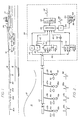
- Streamer cable 12 includes a plurality of hydrophones 20, 20a, 20b, 20n of which four are shown but as many as 1000 such instruments may be provided.
- Sound source array 14 is shown to include four elements or sources 26, which may be air guns, but 32 to 64 such sources are not uncommon.
- the spacing between elements in the array is greater than one wavelength of the seismic wavefields of interest to inhibit wavefield interaction between elements.
- Air supply hoses and electrical control and data lines are contained within a cable assembly 22, which is connected to gun-control and data-handling interface 24 mounted aboard ship 10.
- source array tow cable assembly 22 is coupled to the respective sound sources 26, 26a, 26b, 26n by takeouts 28, 28a, 28b, 28n.
- a depth sensor 30, 30a, 30b, 30n To each sound source, there is coupled a signature hydrophone such as 32, 32a, 32b, 32n, that may also serve as a fire-time detector.
- the signature hydrophones are mounted 10 or 15 centimeters from the gun exhaust ports.
- Air supply to the guns is provided through an air line 34, that is part of tow cable assembly 22, from air supply manifold P.
- Air supply P also includes a suitable pressure sensor (not shown) that will monitor the air pressure provided to the guns. It is assumed, for all practical purposes, that the air pressure is equalized between the manifold and the individual guns. At each gun, some of the air is tapped off and fed to the gun through the takeouts such as 28.
- a trigger or firing signal is transmitted to the guns over line 36 from fire control module F, through tow cable 22 and takeouts 28. Although only one firing line is shown, it should be understood that the guns may be fired individually or in unison as desired.
- Depth information for the respective guns, as measured by the depth sensors such as 30, is transmitted through takeouts 28 and cable 22 to depth-parameter register 40 over line 38 to inputs D1, D2, D3, D n . Only one line is shown to avoid confusing the drawing, but as many lines as there are guns may be provided. Alternatively, a single, time-sharing, digital telemetric link could be used which might be a fiber-optic link or a wireline.
- Depth-parameter register 40 which may be analog or digital, receives and stores the depth of each element of the array at the instant the array is triggered; that is, register 40 records the instantaneous measured local gun depth which is the essential parameter needed for deghosting. Although depth information is always available at the inputs to register 40, the register is preferably enabled, over line 41, to receive fresh depth data only when fire controller F emits a trigger signal to the guns. Old depth data is shifted out.
- the sources do not necessarily all fire at the same instant; relative variations in fire time of one or two milliseconds or less between guns are not uncommon.
- the signature hydrophones such as 32 measure both the signature of the corresponding gun and the instant that the gun actually fired. Usually, the relative fire-time delays between guns is consistent.
- the outputs from the respective signature hydrophones 32, 32a, 32b, 32n are sent through line 42 to gun controller 44 at inputs TD1, TD2, TD3, TD n .
- gun controller 44 of any well-known type, measures the relative fire-time delays by monitoring the first arrival times of the gun signatures. It then applies, over line 43, a corrective time offset to the trigger pulses that are emitted by fire-control module F to the respective guns, so that all of the guns will effectively fire simultaneously.
- a data processor 46 is provided which is preferably a digital computer or the like.
- Data processor 46 receives as its inputs, the air pressure existing in air supply manifold P, the fire time instant from fire control module F, the respective instantaneous depth readings from depth parameter register 40, and the relative gun fire-time delay data from gun controller 44.
- switch 48 is closed so that the signatures from the individual guns may be recorded and stored for further processing. Otherwise, during routine operations, switch 48 is open.
- each gun is fired individually.
- Switch 48 is closed.
- the measured air pressure is entered into data processor 46 as is also the appropriate gun depth from depth parameter register 40.
- the signature as measured by a signature hydrophone 32 is received by processor 46. If a recent delay-time history is available for the gun under consideration, that too may be entered from gun controller 44.
- the amplitude of the measured signature is scaled to compensate for variations in the power output level of the gun with respect to a reference.
- the applied air pressure is a measure of the power output level of an air gun. In that matter, we differ from Ziolkowski, who considers that the air gun volume constitutes such a measure.
- a reference pressure such 14,000 kPa.
- the scaling coefficient is the difference, raised to the third power, between the actual pressure and the reference pressure.
- the scaled measured signature may now be corrected for fire-time delay as required.
- the measured, scaled, time-corrected signature must now be deghosted.
- the signature hydrophone is quite close to the air gun exhaust ports relative to the depth of the gun beneath the water surface. In the near field, the primary pulse will be considerably stronger than the later-arriving ghost. Since the gun depth and the water velocity are known, it is a simple matter for the processor to compute the ghost lag time. It looks for a negative-going pulse centered around the computed lag time and then simply zeros out that negative-going pulse.
- the deghosted signature is stored in a matrix 50 as a function of the gun location as part of a library of elemental signatures such as E1, E2, E3, E n , in the form of an essentially positive-going pulse such as 52. The steps supra are repeated for all of the guns in the array. Since instrumental artifacts may distort the signature, we prefer to deconvolve the elemental signatures prior to storage in matrix 50.
- switch 48 is open so that the inputs to processor 46 will be pressure, fire time, depth readouts and relative fire-time delays between sources.
- the readouts will be the instantaneous values of the firing and environmental parameters existing locally at each gun at the time of the shot.
- the sound source array taken as a whole is fired.
- the hydrophones in streamer cable 12 receive and record the reflected wavefields as a seismogram 58 by use of a recording system 60 that is part of control and data handling interface 24.
- a recording system 60 that is part of control and data handling interface 24.
- the elemental signature corresponding to that location we extract from matrix 50, the elemental signature corresponding to that location and place it in processor 46.
- the elemental signature is re-scaled in proportion to the measured power output of that source as described above.
- the re-scaled elemental signature is time-shifted in accordance with the known fire-time delay stored in gun controller 44.
- the elemental signature is reghosted in proportion to the measured instantaneous depth of the corresponding source.
- That step is done using the method described in US patent 4,658,384 that was earlier cited.
- the elemental signature is inverted; the inverted pulse is then time shifted in proportion to twice the measured gun depth divided by the velocity of sound in water.
- the process is repeated for all of the guns of the array and the resulting processed elemental signatures are composited by simple summation.
- the processing steps recited supra may be performed in any convenient order.
- the ocean surface 18 is shown as a large undulating swell. Since the sound sources are at depth, they remain fairly stable. With the gun depth sound source at 26n much greater than the depth at sound source 26, the individual simulated far-field signatures 58n through 58 show significantly different delays between the primary and the ghost. Unquestionably, the composite far field signature continuously changes character during an operation, an effect that must be continuously monitored.
- the composite signature is convolved for instrument response and sent to signature register 54 as far-field signature 56.
- Far-field signature 56 may now be recorded on seismogram 59 in real time, for the seismic station that was just occupied.
- one or more guns may malfunction to become drop-outs. In that case, only the elemental signatures for the guns that actually fired are used in the composite signature.
Landscapes
- Life Sciences & Earth Sciences (AREA)
- Physics & Mathematics (AREA)
- Engineering & Computer Science (AREA)
- Geophysics (AREA)
- General Life Sciences & Earth Sciences (AREA)
- General Physics & Mathematics (AREA)
- Remote Sensing (AREA)
- Acoustics & Sound (AREA)
- Environmental & Geological Engineering (AREA)
- Geology (AREA)
- Manufacturing & Machinery (AREA)
- Oceanography (AREA)
- Measurement Of Velocity Or Position Using Acoustic Or Ultrasonic Waves (AREA)
- Measurement Of Mechanical Vibrations Or Ultrasonic Waves (AREA)
Applications Claiming Priority (2)
| Application Number | Priority Date | Filing Date | Title |
|---|---|---|---|
| US358435 | 1989-05-30 | ||
| US07/358,435 US4908801A (en) | 1989-05-30 | 1989-05-30 | Real-time simulation of the far-field signature of a seismic sound source array |
Publications (2)
| Publication Number | Publication Date |
|---|---|
| EP0400769A2 true EP0400769A2 (fr) | 1990-12-05 |
| EP0400769A3 EP0400769A3 (fr) | 1991-09-04 |
Family
ID=23409641
Family Applications (1)
| Application Number | Title | Priority Date | Filing Date |
|---|---|---|---|
| EP19900300154 Withdrawn EP0400769A3 (fr) | 1989-05-30 | 1990-01-05 | Simulation en temps réel de la signature à distance d'une matrice de sources acoustiques sismiques |
Country Status (3)
| Country | Link |
|---|---|
| US (1) | US4908801A (fr) |
| EP (1) | EP0400769A3 (fr) |
| NO (1) | NO900063L (fr) |
Cited By (11)
| Publication number | Priority date | Publication date | Assignee | Title |
|---|---|---|---|---|
| EP0555148A1 (fr) * | 1992-02-06 | 1993-08-11 | Compagnie Generale De Geophysique | Procédé pour déterminer une signature en champ lointain d'une pluralité de sources sismiques |
| WO1997022892A1 (fr) * | 1995-12-20 | 1997-06-26 | Antoni Marjan Ziolkowski | Signatures de sources sismiques marines |
| GB2323669A (en) * | 1995-12-20 | 1998-09-30 | Antoni Marjan Ziolkowski | Signatures of marine seismic sources |
| WO2004102223A3 (fr) * | 2003-05-16 | 2005-04-21 | Schlumberger Technology Bv | Procedes et appareils pour controler des sources sismiques |
| US7551515B2 (en) | 2005-05-03 | 2009-06-23 | Westerngeco Llc | Source signature deconvolution method |
| US7974150B2 (en) | 2003-05-16 | 2011-07-05 | Schlumberger Technology Corporation | Methods and apparatus of source control for sequential firing of staggered air gun arrays in borehole seismic |
| US8553492B2 (en) | 2004-10-14 | 2013-10-08 | Schlumberger Technology Corporation | Seismic source controller and display system |
| US8687460B2 (en) | 2003-05-16 | 2014-04-01 | Schlumberger Technology Corporation | Methods and apparatus of source control for synchronized firing of air gun arrays with receivers in a well bore in borehole seismic |
| WO2015153602A1 (fr) * | 2014-04-01 | 2015-10-08 | Westerngeco Llc | Déparasitage après imagerie |
| US9411062B2 (en) | 2012-02-07 | 2016-08-09 | Pgs Geophysical As | Method and system for determining source signatures after source ghost removal |
| US10977396B2 (en) | 2012-01-13 | 2021-04-13 | Schlumberger Technology Corporation | Determining an elastic model for a geologic region |
Families Citing this family (18)
| Publication number | Priority date | Publication date | Assignee | Title |
|---|---|---|---|---|
| US5052222A (en) * | 1990-11-05 | 1991-10-01 | Teledyne Exploration | Multiple-unit water depth sensor system |
| FR2682774B1 (fr) * | 1991-10-17 | 1996-02-16 | Geophysique Cie Gle | Dispositif d'emission acoustique pour sismique marine. |
| NO176227C (no) * | 1992-10-23 | 1995-02-22 | Statoil As | Fremgangsmåte for bestemmelse av fjernfeltsignaturen for en marin, seismisk kildeoppstilling |
| GB2328017B (en) * | 1997-08-07 | 2001-11-14 | Geco As | Signature estimation of a seismic source |
| CA2744084C (fr) * | 2002-03-14 | 2018-05-01 | Ion Geophysical Corporation | Procede et dispositif permettant d'etablir des diagnostics sur des sour es maritimes et interface graphique permettant leur mise en oeuvre |
| GB2433594B (en) * | 2005-12-23 | 2008-08-13 | Westerngeco Seismic Holdings | Methods and systems for determining signatures for arrays of marine seismic sources for seismic analysis |
| ATE551604T1 (de) * | 2008-05-05 | 2012-04-15 | Abbott Gmbh & Co Kg | Verfahren zur beurteilung der löslichkeit eines kristallinen stoffes in einem polymer |
| US8270255B2 (en) * | 2008-05-30 | 2012-09-18 | Lockheed Martin Corporation | System for measuring acoustic signature of an object in water |
| GB0905261D0 (en) | 2009-03-27 | 2009-05-13 | Geco Technology Bv | Processing seismic data |
| GB2479299B (en) * | 2009-03-27 | 2011-11-16 | Geco Technology Bv | Processing seismic data |
| US8427901B2 (en) * | 2009-12-21 | 2013-04-23 | Pgs Geophysical As | Combined impulsive and non-impulsive seismic sources |
| WO2013137974A1 (fr) | 2012-03-12 | 2013-09-19 | Exxonmobil Upstream Research Company | Estimations de signatures d'arrivées directes |
| EP2679210B1 (fr) | 2012-06-28 | 2015-01-28 | The Procter & Gamble Company | Articles absorbants avec noyau amélioré |
| US10359528B2 (en) * | 2013-03-15 | 2019-07-23 | Pgs Geophysical As | Systems and methods for randomizing firing times of simultaneous sources in marine surveys |
| US9250338B2 (en) | 2013-05-20 | 2016-02-02 | Teledyne Instruments, Inc. | Multilayer jacket for marine acoustic array applications |
| US10101480B2 (en) | 2014-10-20 | 2018-10-16 | Pgs Geophysical As | Methods and systems to separate seismic data associated with impulsive and non-impulsive sources |
| WO2016113589A1 (fr) * | 2015-01-13 | 2016-07-21 | Cgg Services Sa | Procédé de suppression d'écho et de désignature côté source pour le traitement de données acquises à l'aide d'une source multi-dimensionnelle |
| CN109507720A (zh) * | 2018-10-30 | 2019-03-22 | 山西晋煤集团技术研究院有限责任公司 | 一种用于槽波探测的延时校正装置和方法 |
Family Cites Families (8)
| Publication number | Priority date | Publication date | Assignee | Title |
|---|---|---|---|---|
| DE3015323A1 (de) * | 1979-04-23 | 1980-11-06 | Antoni Marjan Ziolkowski | Verfahren und vorrichtung zur lagebestimmung unterirdischer grenzflaechen |
| US4500978A (en) * | 1980-04-23 | 1985-02-19 | Seismograph Service Corporation | Seismographic method and apparatus using scaled sound sources |
| ATE14941T1 (de) * | 1980-08-29 | 1985-08-15 | British National Oil Corp | Bestimmung der kennzeichen auf abstand von, zum beispiel, seismischen quellen. |
| DE3277988D1 (en) * | 1981-05-29 | 1988-02-18 | Britoil Plc | Method of determining the signatures of arrays of marine seismic sources, and of accumulating data for use in such methods |
| JPS59501174A (ja) * | 1982-06-28 | 1984-07-05 | ブリトイル ピ−エルシ− | 水中地震探査における音源特性のスケ−リング |
| US4648080A (en) * | 1984-06-15 | 1987-03-03 | Western Geophysical Company | Method for determining the far field signature of a marine seismic source from near-field measurements |
| US4658384A (en) * | 1985-01-07 | 1987-04-14 | Western Geophysical Co. Of America | Method for determining the far-field signature of an air gun array |
| FR2582107B1 (fr) * | 1985-05-17 | 1988-07-15 | Inst Francais Du Petrole | Procede et dispositif pour la determination de la signature d'emission a grande distance d'un ensemble d'emission sismique |
-
1989
- 1989-05-30 US US07/358,435 patent/US4908801A/en not_active Expired - Fee Related
-
1990
- 1990-01-05 EP EP19900300154 patent/EP0400769A3/fr not_active Withdrawn
- 1990-01-08 NO NO90900063A patent/NO900063L/no unknown
Cited By (18)
| Publication number | Priority date | Publication date | Assignee | Title |
|---|---|---|---|---|
| EP0555148A1 (fr) * | 1992-02-06 | 1993-08-11 | Compagnie Generale De Geophysique | Procédé pour déterminer une signature en champ lointain d'une pluralité de sources sismiques |
| FR2687227A1 (fr) * | 1992-02-06 | 1993-08-13 | Geophysique Cie Gle | Procede pour determiner une signature en champ lointain d'une pluralite de sources sismiques. |
| WO1997022892A1 (fr) * | 1995-12-20 | 1997-06-26 | Antoni Marjan Ziolkowski | Signatures de sources sismiques marines |
| GB2323669A (en) * | 1995-12-20 | 1998-09-30 | Antoni Marjan Ziolkowski | Signatures of marine seismic sources |
| GB2323669B (en) * | 1995-12-20 | 1999-09-29 | Antoni Marjan Ziolkowski | Signatures of marine seismic sources |
| US6081765A (en) * | 1995-12-20 | 2000-06-27 | Ziolkowski; Antoni Marjan | Signatures of marine seismic sources |
| CN100410685C (zh) * | 2003-05-16 | 2008-08-13 | 施蓝姆伯格海外股份有限公司 | 用于井眼地震的源控制方法及设备 |
| US7359282B2 (en) | 2003-05-16 | 2008-04-15 | Schlumberger Technology Corporation | Methods and apparatus of source control for borehole seismic |
| WO2004102223A3 (fr) * | 2003-05-16 | 2005-04-21 | Schlumberger Technology Bv | Procedes et appareils pour controler des sources sismiques |
| US7974150B2 (en) | 2003-05-16 | 2011-07-05 | Schlumberger Technology Corporation | Methods and apparatus of source control for sequential firing of staggered air gun arrays in borehole seismic |
| US8687460B2 (en) | 2003-05-16 | 2014-04-01 | Schlumberger Technology Corporation | Methods and apparatus of source control for synchronized firing of air gun arrays with receivers in a well bore in borehole seismic |
| NO338124B1 (no) * | 2003-05-16 | 2016-08-01 | Schlumberger Technology Bv | System og fremgangsmåte for styring av kildene ved borehullseismikk omfattende en batymetrisensor |
| US8553492B2 (en) | 2004-10-14 | 2013-10-08 | Schlumberger Technology Corporation | Seismic source controller and display system |
| US7551515B2 (en) | 2005-05-03 | 2009-06-23 | Westerngeco Llc | Source signature deconvolution method |
| US10977396B2 (en) | 2012-01-13 | 2021-04-13 | Schlumberger Technology Corporation | Determining an elastic model for a geologic region |
| US9411062B2 (en) | 2012-02-07 | 2016-08-09 | Pgs Geophysical As | Method and system for determining source signatures after source ghost removal |
| WO2015153602A1 (fr) * | 2014-04-01 | 2015-10-08 | Westerngeco Llc | Déparasitage après imagerie |
| US9964655B2 (en) | 2014-04-01 | 2018-05-08 | Schlumberger Technology Corporation | Deghosting after imaging |
Also Published As
| Publication number | Publication date |
|---|---|
| US4908801A (en) | 1990-03-13 |
| EP0400769A3 (fr) | 1991-09-04 |
| NO900063L (no) | 1990-12-03 |
| NO900063D0 (no) | 1990-01-08 |
Similar Documents
| Publication | Publication Date | Title |
|---|---|---|
| US4908801A (en) | Real-time simulation of the far-field signature of a seismic sound source array | |
| EP0534648B1 (fr) | Procédé d'exploration sismique maritime | |
| US5235554A (en) | Method for correcting impulse response differences of hydrophones and geophones as well as geophone coupling to the water-bottom in dual-sensor, bottom-cable seismic operations | |
| US6903998B2 (en) | Method for acquiring and processing seismic survey data using ocean bottom cables and streamers | |
| US7948825B2 (en) | Method to acquire simultaneously seismic data with source arrays designed for specific targets | |
| EP2802904B1 (fr) | Acquisition sismique marine à sources simultanées | |
| EP0680616B1 (fr) | Procede de determination de la reflexion d'un fond d'un corps d'eau dans des etudes sismiques realisees avec deux detecteurs | |
| US4693336A (en) | Underwater seismic testing | |
| Nakamura et al. | Large-offset seismic surveying using ocean-bottom seismographs and air guns; instrumentation and field technique | |
| AU2009230788B2 (en) | Method of wavefield extrapolation for single-station, dual-sensor towed streamer signals | |
| EP0414344A2 (fr) | Prospection géophysique sous-marine utilisant des réflexions sismiques | |
| EP0515188B1 (fr) | Procédé de la suppression de données de multiples | |
| US20110096625A1 (en) | Methods to Process Seismic Data Contaminated By Coherent Energy Radiated From More Than One Source | |
| US4953140A (en) | Method of subterranean mapping | |
| US6018494A (en) | Signature estimation of a seismic source | |
| US6961284B2 (en) | Source array for use in marine seismic exploration | |
| US8811113B2 (en) | Method of summing dual-sensor towed streamer signals using seismic reflection velocities | |
| US5384752A (en) | Method for correcting a seismic source pulse waveform | |
| CA2405068A1 (fr) | Source sismique, agencement d'etude sismique marine, procede de commande d'une source sismique marine et procede de suppression du dedoublement de donnees sismiques | |
| NO319270B1 (no) | Fremgangsmate for a utlede overflaterelatert reflektivitetskart fra to-sensor seismiske data | |
| Ziolkowski et al. | Marine seismic sources: QC of wavefield computation from near‐field pressure measurements [Link] | |
| US4797860A (en) | Method for shot point analysis of seismic reflection signals | |
| Durend et al. | Far-field phase extrapolation for marine source signatures |
Legal Events
| Date | Code | Title | Description |
|---|---|---|---|
| PUAI | Public reference made under article 153(3) epc to a published international application that has entered the european phase |
Free format text: ORIGINAL CODE: 0009012 |
|
| AK | Designated contracting states |
Kind code of ref document: A2 Designated state(s): BE DE DK ES FR GB IT NL SE |
|
| PUAL | Search report despatched |
Free format text: ORIGINAL CODE: 0009013 |
|
| AK | Designated contracting states |
Kind code of ref document: A3 Designated state(s): BE DE DK ES FR GB IT NL SE |
|
| 17P | Request for examination filed |
Effective date: 19920225 |
|
| STAA | Information on the status of an ep patent application or granted ep patent |
Free format text: STATUS: THE APPLICATION HAS BEEN WITHDRAWN |
|
| 18W | Application withdrawn |
Withdrawal date: 19921123 |