EP0401009A1 - Dispositif de suspension pour un véhicule - Google Patents
Dispositif de suspension pour un véhicule Download PDFInfo
- Publication number
- EP0401009A1 EP0401009A1 EP90305917A EP90305917A EP0401009A1 EP 0401009 A1 EP0401009 A1 EP 0401009A1 EP 90305917 A EP90305917 A EP 90305917A EP 90305917 A EP90305917 A EP 90305917A EP 0401009 A1 EP0401009 A1 EP 0401009A1
- Authority
- EP
- European Patent Office
- Prior art keywords
- vehicle
- wheel
- damper
- vibration
- electric field
- Prior art date
- Legal status (The legal status is an assumption and is not a legal conclusion. Google has not performed a legal analysis and makes no representation as to the accuracy of the status listed.)
- Granted
Links
Images




Classifications
-
- B—PERFORMING OPERATIONS; TRANSPORTING
- B60—VEHICLES IN GENERAL
- B60G—VEHICLE SUSPENSION ARRANGEMENTS
- B60G17/00—Resilient suspensions having means for adjusting the spring or vibration-damper characteristics, for regulating the distance between a supporting surface and a sprung part of vehicle or for locking suspension during use to meet varying vehicular or surface conditions, e.g. due to speed or load
- B60G17/015—Resilient suspensions having means for adjusting the spring or vibration-damper characteristics, for regulating the distance between a supporting surface and a sprung part of vehicle or for locking suspension during use to meet varying vehicular or surface conditions, e.g. due to speed or load the regulating means comprising electric or electronic elements
- B60G17/018—Resilient suspensions having means for adjusting the spring or vibration-damper characteristics, for regulating the distance between a supporting surface and a sprung part of vehicle or for locking suspension during use to meet varying vehicular or surface conditions, e.g. due to speed or load the regulating means comprising electric or electronic elements characterised by the use of a specific signal treatment or control method
-
- B—PERFORMING OPERATIONS; TRANSPORTING
- B60—VEHICLES IN GENERAL
- B60G—VEHICLE SUSPENSION ARRANGEMENTS
- B60G2202/00—Indexing codes relating to the type of spring, damper or actuator
- B60G2202/20—Type of damper
- B60G2202/24—Fluid damper
-
- B—PERFORMING OPERATIONS; TRANSPORTING
- B60—VEHICLES IN GENERAL
- B60G—VEHICLE SUSPENSION ARRANGEMENTS
- B60G2400/00—Indexing codes relating to detected, measured or calculated conditions or factors
- B60G2400/10—Acceleration; Deceleration
- B60G2400/102—Acceleration; Deceleration vertical
-
- B—PERFORMING OPERATIONS; TRANSPORTING
- B60—VEHICLES IN GENERAL
- B60G—VEHICLE SUSPENSION ARRANGEMENTS
- B60G2400/00—Indexing codes relating to detected, measured or calculated conditions or factors
- B60G2400/10—Acceleration; Deceleration
- B60G2400/104—Acceleration; Deceleration lateral or transversal with regard to vehicle
-
- B—PERFORMING OPERATIONS; TRANSPORTING
- B60—VEHICLES IN GENERAL
- B60G—VEHICLE SUSPENSION ARRANGEMENTS
- B60G2400/00—Indexing codes relating to detected, measured or calculated conditions or factors
- B60G2400/10—Acceleration; Deceleration
- B60G2400/106—Acceleration; Deceleration longitudinal with regard to vehicle, e.g. braking
-
- B—PERFORMING OPERATIONS; TRANSPORTING
- B60—VEHICLES IN GENERAL
- B60G—VEHICLE SUSPENSION ARRANGEMENTS
- B60G2400/00—Indexing codes relating to detected, measured or calculated conditions or factors
- B60G2400/20—Speed
-
- B—PERFORMING OPERATIONS; TRANSPORTING
- B60—VEHICLES IN GENERAL
- B60G—VEHICLE SUSPENSION ARRANGEMENTS
- B60G2400/00—Indexing codes relating to detected, measured or calculated conditions or factors
- B60G2400/20—Speed
- B60G2400/202—Piston speed; Relative velocity between vehicle body and wheel
-
- B—PERFORMING OPERATIONS; TRANSPORTING
- B60—VEHICLES IN GENERAL
- B60G—VEHICLE SUSPENSION ARRANGEMENTS
- B60G2400/00—Indexing codes relating to detected, measured or calculated conditions or factors
- B60G2400/25—Stroke; Height; Displacement
- B60G2400/252—Stroke; Height; Displacement vertical
-
- B—PERFORMING OPERATIONS; TRANSPORTING
- B60—VEHICLES IN GENERAL
- B60G—VEHICLE SUSPENSION ARRANGEMENTS
- B60G2400/00—Indexing codes relating to detected, measured or calculated conditions or factors
- B60G2400/25—Stroke; Height; Displacement
- B60G2400/256—Stroke; Height; Displacement horizontal
- B60G2400/257—Stroke; Height; Displacement horizontal transversal with regard to vehicle
-
- B—PERFORMING OPERATIONS; TRANSPORTING
- B60—VEHICLES IN GENERAL
- B60G—VEHICLE SUSPENSION ARRANGEMENTS
- B60G2400/00—Indexing codes relating to detected, measured or calculated conditions or factors
- B60G2400/25—Stroke; Height; Displacement
- B60G2400/256—Stroke; Height; Displacement horizontal
- B60G2400/258—Stroke; Height; Displacement horizontal longitudinal with regard to vehicle
-
- B—PERFORMING OPERATIONS; TRANSPORTING
- B60—VEHICLES IN GENERAL
- B60G—VEHICLE SUSPENSION ARRANGEMENTS
- B60G2500/00—Indexing codes relating to the regulated action or device
- B60G2500/10—Damping action or damper
- B60G2500/102—Damping action or damper stepwise
-
- B—PERFORMING OPERATIONS; TRANSPORTING
- B60—VEHICLES IN GENERAL
- B60G—VEHICLE SUSPENSION ARRANGEMENTS
- B60G2600/00—Indexing codes relating to particular elements, systems or processes used on suspension systems or suspension control systems
- B60G2600/70—Computer memory; Data storage, e.g. maps for adaptive control
-
- F—MECHANICAL ENGINEERING; LIGHTING; HEATING; WEAPONS; BLASTING
- F16—ENGINEERING ELEMENTS AND UNITS; GENERAL MEASURES FOR PRODUCING AND MAINTAINING EFFECTIVE FUNCTIONING OF MACHINES OR INSTALLATIONS; THERMAL INSULATION IN GENERAL
- F16F—SPRINGS; SHOCK-ABSORBERS; MEANS FOR DAMPING VIBRATION
- F16F2224/00—Materials; Material properties
- F16F2224/02—Materials; Material properties solids
- F16F2224/0258—Shape-memory metals, e.g. Ni-Ti alloys
Definitions
- the present invention relates to a suspension device for a vehicle.
- a suspension device in a vehicle is usually provided with a shock absorber to prevent the transmission of vibration occurring at the wheels in accordance with road conditions to the vehicle body.
- a shock absorber is usually arranged between the wheel and a vehicle body, and comprises a spring and a damper arranged in a parallel relationship to each other.
- the prior art shock absorber suffers from a drawback in that an adjustment of the damping ratio ⁇ after the unit is mounted on the vehicle is difficult, since the spring coefficient k and the damping factor c of the damper have a fixed value obtained when the vehicle is assembled. It should be noted that the damping ratio is not constant and changes with a lapse of time and use, but it has been impossible in the prior art to obtain a damping effect over a wide range of vibration frequencies.
- An improved shock absorber has been proposed wherein a damper is provided with a piston defining an orifice(s) having a dimension which can be varied by a drive means such as a stepper motor, so that the damping factor ⁇ can be adjusted.
- This improved device suffers from another drawback in that the construction thereof is complex, and the response speed thereof when controlling the damping factor in accordance with changes in the vibration conditions is slow, and thus it is difficult to obtain a desired damping characteristic during a transient state wherein a damping ratio must be quickly changed in accordance with a lapse of time.
- An object of the present invention is to provide a damping device having a simplified construction, a damping characteristic which is easily adjusted, and having a high speed response by which vibration at the vehicle wheels is quickly suppressed.
- a damper device for a suspension for a vehicle having a body and a wheel, the damper device comprising a first member connected to the body and a second member connected to the wheel, the first and second member being moved relative to each other, first and second chambers being formed between the first and second members and being connected with each other via at least one passageway, an electro-viscosity fluid being filled in the first and second chambers, means for generating an electric field in the fluid flowing through the passageway, means for detecting a parameter representing at least one vibration condition at the wheel, and means responsive to the detected vibration parameter for controlling the strength of the electric field applied for imparting a required damping of vibration transmitted to the vehicle body from the wheel.
- FIG. 1 is a schematic representation of a suspension device according to the present invention, which is provided with a shock absorber at each of the wheels 2 of a vehicle.
- the shock absorber 1 is arranged between a wheel 2 as a vibrating body having a mass (main mass) of M and a spring rate of K and a vehicle body 3 having a mass (auxiliary mass) of m .
- the shock absorber 1 is constructed by a spring k and damper 5 arranged in a parallel relationship to each other.
- FIG. 2 is a diagrammatic view of a vehicle employing the suspension device shown in Fig. 1.
- the body 3 is provided with four wheels 2-1, 2-2, 2-3 and 3-4.
- the wheels 2-1, 2-2, 2-3 and 2-4 each of which has a mass M-1, M-2, M-3, and M-4, respectively, and springs K-1, K-2, K-3 and K-4, are connected to the vehicle body 3 via respective shock absorbers 1-1, 1-2, 1-3, and 1-4.
- the shock absorbers 1-1, 1-2, 1-3 and 1-4 are constructed by springs 4-1, 4-2, 4-3, and 4-4 and dampers 5-1, 5-2, 5-3, and 5-4, respectively.
- springs 4-1, 4-2, 4-3, and 4-4 dampers 5-1, 5-2, 5-3, and 5-4, respectively.
- the vibration parameters such as an acceleration rate at each of the wheels 2-1, 2-2, 2-3, and 2-4 are independently detected by respective sensors (21 in Fig. 1), and the control circuit 22 outputs signals to the dampers 5-1, 5-2, 5-3, and 5-4 of the shock absorbers 1-1, 1-2, 1-3, and 1-4, respectively, for controlling the damping characteristic of the respective dampers.
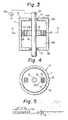
- the damper 5 or 5-1 to 5-4 in Figs. 1 and 2 of the shock absorber 1 or 1-1 to 1-4 has a construction as shown, for example, in Figs. 3 and 4.
- the damper 5 has a cylindrical damper casing 11, and a piston 12 arranged in the damper case 11 in such a manner that fluid chambers 13A and 13B are formed on the upper and lower sides of the piston 12, respectively, in the casing 11.
- the piston 12 has openings defining passageways 14 having a rectangular shape, for connecting the chambers 13A and 13B.
- An operating shaft 15 is fixedly connected to the piston 12 and extends axially out of axial end walls 5A and 5B, respectively, of the casing 5.
- An annular seal ring 16 is fixed along the outer periphery of the piston 12, and thus the piston 12 is slidable against the inner surface of the casing 5 but the fluid cannot pass through a clearance between the inner surface of the casing 5 and the outer periphery of the piston 12.
- Seal rings 17 are fixed to inner surface of openings in the end walls 5A and 5B of the casings through which the shaft 15 is inserted, to seal the oil in the chambers 13A and 13B, respectively.
- the damper 5 is further provided with pairs of facing electrodes 18 and 19 provided for each respective communication passageway 14.
- the electrodes 18 and 19 in each pair are fixed, via respective insulation members 100, on facing inner surfaces of the opening defining each respective passageway 14, and an electric-viscosity fluid, i.e., Winslow fluid, is charged in the space inside the casing 5.
- a tubular slit can be formed between the inner surface of the damper case 11 and the outer surface of the piston 12, for communicating the chambers 13A and 13B with each other, and electrodes facing each other can be formed on the inner surface of the casing 11 and the outer surface of the piston 12, via the tubular slit.
- An electric power supply 20 is connected to the electrodes 18 and 19, so that an electric voltage can be applied across the facing electrodes 18 and 19.
- the shaft 15 is provided therein with an electric wire system (not shown) for obtaining an electrical connection between the electric power supply and the electrodes 18 and 19. It should be noted that the electric power supply device 20 can be mounted in the piston 12 or at the operating shaft 15.
- the arrangement of the damper 5 having the above-mentioned construction, wherein the facing electrodes 18 and 19 are arranged on facing inner surfaces of the connection passageway 14 and the electro-viscosity fluid is provided for obtaining the Winslow effect inside the damper casing 11, allows an electric field to be created which has a direction transverse to the direction of the fluid flow from the chamber 13A to the chamber 13B, or vice versa, and thus the viscosity of the electro-viscosity fluid located between the facing electrodes 18 and 19 can be changed.
- This control of the viscosity of the fluid passing through the connection passageway 14 allows the throttling resistance of the fluid in the connection passageway 14 to be controlled, and thus allows the damping ratio ⁇ of the damper to be controlled.
- the suspension device As shown in Fig. 1, the suspension device according to the present invention is provided with a device 21 for detecting vibration generated at each of the suspension device 1, and a control circuit 22 such as a microcomputer unit 22.
- the control circuit 22 comprises an input-output unit 23, CPU 24, ROM 25, and RAM 26.
- the vibration detecting device 21 which detects vibration at each of the suspensions 1, is constructed by a first sensor for detecting a rate of acceleration or speed or displacement of each of the wheels in a vertical direction Z (Fig. 2), a second sensor for detecting a rate of acceleration or speed or displacement of each of the wheels in a transverse direction X, with respect to the direction of the movement of the vehicle, and a third sensor for detecting a rate of acceleration or speed or displacement of each of the wheels in a direction Y parallel to the direction of the movement of the vehicle.
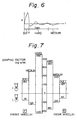
- the vibration detector device 21 detects the vibration, and thus an acceleration, as shown in Fig. 6, with a lapse of time can be obtained.
- the control circuit 22 is provided with a predetermined setting of the damping factor c of the damper 5, as shown in Figs. 6 and 7, necessary to obtain a damping ratio ⁇ of the shock absorber 1 for controlling vibration of the vehicle.
- the damping factor c of the damper 5 of each shock absorber 1 has (a) a low level (SOFT) just before the occurrence of an an undulation of the road surface, (b) a high level (HARD) for one second after the acceleration rate has once attained the peak value, and (c) a medium level (MEDIUM) after the period (b).
- SOFT low level
- HARD high level
- MEDIUM medium level
- the damping factor c during the upward travel of the front wheel has a value of 150 (kg.s/m) corresponding to a low (SOFT) level damping factor, a value of 250 (kg.s/m) corresponding to a medium (MEDIUM) level damping factor, and a value of 450 (kg.s/m) corresponding to a high level (HARD) damping factor.
- the damping factor c during the downward travel of the front wheel has a value of 75 (kg.s/m) corresponding to a low level (SOFT) damping factor, a value of 125 (kg.s/m) corresponding to a medium (MEDIUM) level damping factor, and a value of 225 (kg.s/m) corresponding to a high level (HARD) damping factor.
- SOFT low level
- MEDIUM medium
- HARD high level
- the control circuit 22 receives a signal from the vibration detecting device 21, calculates the values of the damping factor c of each of the dampers 5 which correspond to the vibration at each of the wheels 2, which corresponds to the degree of acceleration ⁇ , and calculates the value of the electric voltage V to be applied to the electrodes 18 and 19 for obtaining the calculated damping factor c .
- the control circuit 22 then outputs a signal at a calculated electric voltage level V to the electric voltage applying device 20, and the device 20 applies this voltage V to the electrodes 18 and 19 of the damper 5 to obtain a value of the damping factor c , i.e., damping ratio, which matches the vibration condition ( ⁇ ) at each of the wheels 2.
- FIGs. 8(a) to (d) show the results of a simulation when a step-like displacement, as shown by a step-like displacement w in Fig. 8(a), is encountered by the suspension of the present invention.
- an acceleration as shown by Fig. 8(c) is detected by the acceleration sensor, such as the sensor 21 in Fig. 1, and the damping factor of the damper 5 of the wheel is controlled as shown by Fig. 8(c).
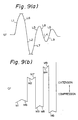
- a portion circled by q in Figs. 8(c) and 8(d) is shown on an enlarged scale by Figs. 9(a) and (b), respectively.
- step 200 an acceleration rate is detected, and at step 202, it is determined whether or not acceleration rate ⁇ as detected is higher than a threshold value. When it is determined that the detected acceleration rate ⁇ is higher than the threshold value, the routine goes to step 204 and it is determined if a flag F is set. When it is determined that the flag F is not set, the routine goes to step 206 and the flag F is set. Then, at step 208, a transient state control of the damping factor is carried out.
- the routine goes to step 210 if a predetermined time has lapsed from the start of the transient control of the damping factor. If it is determined that the predetermined time has not lapsed, the routine returns to the step 206. When it is determined that the predetermined time has lapsed, the routine goes to step 212 to clear the flag F , and then to step 220 to execute the control of the damping factor for the steady state condition.
- Figures 9(a) and (b) illustrate an example of the control of the damping factor during the transient state.
- the control of the damping factor is such that a positive value of the acceleration rate ⁇ gives the damping factor a compression side value, and a negative value of the acceleration rate ⁇ gives the damping factor an extension side value.
- the value of the acceleration rate is changed from zero to a extreme value as shown by lines 11, 12, 13, and 14 in Fig. 9(a)
- the value of the damping factor is lowered as shown by lines m1, m2, m3, and m4 in Fig. 9(b).
- the value of the damping factor is raised as shown by lines m6, m7, m8, and m9 in Fig. 9(b). Note, the more time that has lapsed, the higher the value of the damping factor.
- the steady state control at step 220 is shown in Fig. 10 after the initial time ⁇ (Fig. 8(d) has lapsed. In this area, the damping factor is changed between the hard value at the extension side and at the compression side, in accordance with the velocity.
- This control of the damping factor whereby, at the initial stage the damping factor is controlled in accordance with the acceleration rate ⁇ , and at the later stage, the damping factor is fixed at a high or hard value, allows the displacement, velocity and acceleration to be quickly reduced while maintaining a soft shock absorbing operation at the initial stage and increasing the speed of the damping response.
Landscapes
- Engineering & Computer Science (AREA)
- Mechanical Engineering (AREA)
- Vehicle Body Suspensions (AREA)
- Fluid-Damping Devices (AREA)
Applications Claiming Priority (2)
| Application Number | Priority Date | Filing Date | Title |
|---|---|---|---|
| JP1136173A JPH034047A (ja) | 1989-05-31 | 1989-05-31 | 車輌の懸架装置 |
| JP136173/89 | 1989-05-31 |
Publications (2)
| Publication Number | Publication Date |
|---|---|
| EP0401009A1 true EP0401009A1 (fr) | 1990-12-05 |
| EP0401009B1 EP0401009B1 (fr) | 1994-12-21 |
Family
ID=15169033
Family Applications (1)
| Application Number | Title | Priority Date | Filing Date |
|---|---|---|---|
| EP90305917A Expired - Lifetime EP0401009B1 (fr) | 1989-05-31 | 1990-05-31 | Dispositif de suspension pour un véhicule |
Country Status (4)
| Country | Link |
|---|---|
| US (1) | US5100166A (fr) |
| EP (1) | EP0401009B1 (fr) |
| JP (1) | JPH034047A (fr) |
| DE (1) | DE69015258T2 (fr) |
Cited By (5)
| Publication number | Priority date | Publication date | Assignee | Title |
|---|---|---|---|---|
| FR2683184A1 (fr) * | 1991-11-04 | 1993-05-07 | Fichtel & Sachs Ag | Procede et dispositif destines a influencer, suivant les conditions de fonctionnement, les ensembles d'amortissement d'un vehicule. |
| EP0557010A1 (fr) * | 1992-02-21 | 1993-08-25 | Canon Kabushiki Kaisha | Appareil et procédé pour amortir les vibrations pendant la fabrication de semi-conducteurs |
| DE19820570A1 (de) * | 1998-05-08 | 1999-11-11 | Schenck Ag Carl | Schwingungsdämpfer auf Basis elektrorheologischer und/oder magnetorheologischer Flüssigkeiten |
| US6068249A (en) * | 1998-04-22 | 2000-05-30 | Trw Inc. | Controllable vehicle strut |
| DE10352176A1 (de) * | 2003-11-05 | 2005-06-02 | Fludicon Gmbh | Schwingungsdämpfer auf Basis elektrorheologischer und/oder magnetorheologischer Flüssigkeiten |
Families Citing this family (15)
| Publication number | Priority date | Publication date | Assignee | Title |
|---|---|---|---|---|
| EP0459723B1 (fr) * | 1990-05-30 | 1996-01-17 | Hitachi, Ltd. | Capteur d'accélération à semi-conducteur et système de commande de véhicule utilisant celui-ci |
| JPH0587189A (ja) * | 1991-09-26 | 1993-04-06 | Nissan Motor Co Ltd | 振動吸収装置 |
| EP0552568B1 (fr) * | 1991-12-27 | 1997-07-16 | Bridgestone Corporation | Méthode et dispositif pour commander la force d'oscillation amortie dans un amortisseur de vibration |
| US5398785A (en) * | 1993-01-11 | 1995-03-21 | Regeants Of The University Of California | Semiactive control apparatus for damping vibrations of a body |
| US5992582A (en) * | 1994-04-19 | 1999-11-30 | Lou; Zheng | Electrorheological rotary pure-shear damping devices |
| US5505281A (en) * | 1994-05-03 | 1996-04-09 | Lee; W. Ken | Cylinder with remote control resistance |
| US6491291B1 (en) | 2000-05-08 | 2002-12-10 | Meritor Light Vehicle Systems, Inc. | Suspension characteristic control using shape memory alloy materials |
| KR20020084387A (ko) * | 2001-04-30 | 2002-11-07 | 현대자동차주식회사 | 차량의 엔진 헤드커버 마운팅 제어장치 및 방법 |
| US6892864B2 (en) * | 2001-10-16 | 2005-05-17 | Delphi Technologies, Inc. | Temperature compensation for magnetorheological fluid dampers |
| DE10318110A1 (de) * | 2003-04-22 | 2004-11-11 | Continental Aktiengesellschaft | Verfahren zur Regelung einer Dämpfung |
| JP4273908B2 (ja) * | 2003-10-01 | 2009-06-03 | 株式会社ジェイテクト | 電動パワーステアリング装置 |
| US20050205364A1 (en) * | 2004-03-12 | 2005-09-22 | Browne Alan L | Variable resistance strut assemblies and articles containing the same |
| JP5320813B2 (ja) * | 2008-05-16 | 2013-10-23 | トヨタ自動車株式会社 | 車両用サスペンションシステム |
| DE102016123420B4 (de) * | 2016-12-05 | 2024-02-15 | Dr. Ing. H.C. F. Porsche Aktiengesellschaft | Verfahren und Steuerungseinrichtung zur Einstellung der Dämpfkraft eines Stoßdämpfers |
| WO2020066624A1 (fr) * | 2018-09-25 | 2020-04-02 | 日立オートモティブシステムズ株式会社 | Appareil de commande de suspension |
Citations (3)
| Publication number | Priority date | Publication date | Assignee | Title |
|---|---|---|---|---|
| DE3518503C1 (de) * | 1985-05-23 | 1986-10-23 | Daimler-Benz Ag, 7000 Stuttgart | Vorrichtung zur rechnergestuetzten,fahrbahnabhaengigen Steuerung von Daempfern einer Fahrzeugfederung |
| US4729459A (en) * | 1984-10-01 | 1988-03-08 | Nippon Soken, Inc. | Adjustable damping force type shock absorber |
| DE3808521C1 (en) * | 1988-03-15 | 1989-04-13 | August Bilstein Gmbh & Co Kg, 5828 Ennepetal, De | Controllable shock absorber, in particular for motor vehicles |
Family Cites Families (5)
| Publication number | Priority date | Publication date | Assignee | Title |
|---|---|---|---|---|
| GB1282568A (en) * | 1968-12-11 | 1972-07-19 | Laser Engineering Developments | Improvements in or relating to dampers |
| DE3443183A1 (de) * | 1984-11-27 | 1986-05-28 | Robert Bosch Gmbh, 7000 Stuttgart | Verfahren und vorrichtung zum steuern der daempferhaerte eines stossdaempfers fuer fahrzeuge |
| US4896752A (en) * | 1988-02-12 | 1990-01-30 | Trw Inc. | Vehicle strut |
| US4869476A (en) * | 1988-08-09 | 1989-09-26 | Trw Inc. | Electrically controlled viscous elastic spring |
| US4942947A (en) * | 1989-04-14 | 1990-07-24 | Trw Inc. | Rotary shock absorber with a controlled damping rate |
-
1989
- 1989-05-31 JP JP1136173A patent/JPH034047A/ja active Pending
-
1990
- 1990-05-31 EP EP90305917A patent/EP0401009B1/fr not_active Expired - Lifetime
- 1990-05-31 DE DE69015258T patent/DE69015258T2/de not_active Expired - Fee Related
-
1991
- 1991-02-28 US US07/663,271 patent/US5100166A/en not_active Expired - Fee Related
Patent Citations (3)
| Publication number | Priority date | Publication date | Assignee | Title |
|---|---|---|---|---|
| US4729459A (en) * | 1984-10-01 | 1988-03-08 | Nippon Soken, Inc. | Adjustable damping force type shock absorber |
| DE3518503C1 (de) * | 1985-05-23 | 1986-10-23 | Daimler-Benz Ag, 7000 Stuttgart | Vorrichtung zur rechnergestuetzten,fahrbahnabhaengigen Steuerung von Daempfern einer Fahrzeugfederung |
| DE3808521C1 (en) * | 1988-03-15 | 1989-04-13 | August Bilstein Gmbh & Co Kg, 5828 Ennepetal, De | Controllable shock absorber, in particular for motor vehicles |
Cited By (6)
| Publication number | Priority date | Publication date | Assignee | Title |
|---|---|---|---|---|
| FR2683184A1 (fr) * | 1991-11-04 | 1993-05-07 | Fichtel & Sachs Ag | Procede et dispositif destines a influencer, suivant les conditions de fonctionnement, les ensembles d'amortissement d'un vehicule. |
| EP0557010A1 (fr) * | 1992-02-21 | 1993-08-25 | Canon Kabushiki Kaisha | Appareil et procédé pour amortir les vibrations pendant la fabrication de semi-conducteurs |
| US5579084A (en) * | 1992-02-21 | 1996-11-26 | Canon Kabushiki Kaisha | Apparatus and method for manufacturing semiconductors |
| US6068249A (en) * | 1998-04-22 | 2000-05-30 | Trw Inc. | Controllable vehicle strut |
| DE19820570A1 (de) * | 1998-05-08 | 1999-11-11 | Schenck Ag Carl | Schwingungsdämpfer auf Basis elektrorheologischer und/oder magnetorheologischer Flüssigkeiten |
| DE10352176A1 (de) * | 2003-11-05 | 2005-06-02 | Fludicon Gmbh | Schwingungsdämpfer auf Basis elektrorheologischer und/oder magnetorheologischer Flüssigkeiten |
Also Published As
| Publication number | Publication date |
|---|---|
| US5100166A (en) | 1992-03-31 |
| DE69015258T2 (de) | 1995-05-11 |
| EP0401009B1 (fr) | 1994-12-21 |
| JPH034047A (ja) | 1991-01-10 |
| DE69015258D1 (de) | 1995-02-02 |
Similar Documents
| Publication | Publication Date | Title |
|---|---|---|
| EP0401009B1 (fr) | Dispositif de suspension pour un véhicule | |
| KR0169183B1 (ko) | 차량 현가 시스템의 감쇄력 특성 제어 장치 및 방법 | |
| EP0538965B1 (fr) | Procédé pour atténuer des vibrations au moyen d'un amortisseur semi-actif à réglage continu | |
| US4722548A (en) | Computer optimized adaptive suspension system having combined shock absorber/air spring unit | |
| EP0133589B1 (fr) | Système de suspension à régulation optimale par ordinateur | |
| US4634142A (en) | Computer optimized adaptive suspension system | |
| US6311110B1 (en) | Adaptive off-state control method | |
| US4989148A (en) | Apparatus for the computer-assisted control of vibration dampers of a vehicular suspension system as a function of the roadway | |
| US5454451A (en) | Process for controlling vibration damping force in a vibration damping device | |
| US5638275A (en) | Apparatus and method for controlling damping force characteristic of vehicular shock absorber | |
| US5721681A (en) | Arrangement for control of a chassis vibration damping device | |
| EP0382479B1 (fr) | Procédé de fonctionnement d'un système pour atténuer les vibrations au moyen d'un amortisseur semi-actif | |
| KR100204407B1 (ko) | 서스펜션제어장치 | |
| US5276623A (en) | System for controlling suspension deflection | |
| EP0127094B1 (fr) | Dispositif de suspension active | |
| EP0739766A2 (fr) | Procédé de contrÔle d'un mouvement utilisant un amortisseur réglable | |
| EP0752331A2 (fr) | Commande pour suspension de véhicule automobile | |
| JPH071940A (ja) | 適応形サスペンションシステム | |
| US5979885A (en) | Damping coefficient control apparatus for damping mechanism in vehicle suspension system | |
| US5445405A (en) | Suspension control apparatus | |
| US6115658A (en) | No-jerk semi-active skyhook control method and apparatus | |
| KR100254126B1 (ko) | 반 능동적 서스펜션의 조절방법 | |
| EP0162818B1 (fr) | Dispositif pour le réglage d'amortisseurs de suspension, particulièrement pour véhicules à moteur | |
| US5429384A (en) | Control for shock absorber | |
| US6105420A (en) | Electro-rheological fluid damper control system |
Legal Events
| Date | Code | Title | Description |
|---|---|---|---|
| PUAI | Public reference made under article 153(3) epc to a published international application that has entered the european phase |
Free format text: ORIGINAL CODE: 0009012 |
|
| AK | Designated contracting states |
Kind code of ref document: A1 Designated state(s): DE FR GB |
|
| 17P | Request for examination filed |
Effective date: 19901228 |
|
| 17Q | First examination report despatched |
Effective date: 19920826 |
|
| GRAA | (expected) grant |
Free format text: ORIGINAL CODE: 0009210 |
|
| AK | Designated contracting states |
Kind code of ref document: B1 Designated state(s): DE FR GB |
|
| REF | Corresponds to: |
Ref document number: 69015258 Country of ref document: DE Date of ref document: 19950202 |
|
| ET | Fr: translation filed | ||
| PLBE | No opposition filed within time limit |
Free format text: ORIGINAL CODE: 0009261 |
|
| STAA | Information on the status of an ep patent application or granted ep patent |
Free format text: STATUS: NO OPPOSITION FILED WITHIN TIME LIMIT |
|
| 26N | No opposition filed | ||
| PGFP | Annual fee paid to national office [announced via postgrant information from national office to epo] |
Ref country code: FR Payment date: 19960510 Year of fee payment: 7 |
|
| PGFP | Annual fee paid to national office [announced via postgrant information from national office to epo] |
Ref country code: GB Payment date: 19960522 Year of fee payment: 7 |
|
| PGFP | Annual fee paid to national office [announced via postgrant information from national office to epo] |
Ref country code: DE Payment date: 19960528 Year of fee payment: 7 |
|
| PG25 | Lapsed in a contracting state [announced via postgrant information from national office to epo] |
Ref country code: GB Effective date: 19970531 |
|
| GBPC | Gb: european patent ceased through non-payment of renewal fee |
Effective date: 19970531 |
|
| PG25 | Lapsed in a contracting state [announced via postgrant information from national office to epo] |
Ref country code: FR Free format text: LAPSE BECAUSE OF NON-PAYMENT OF DUE FEES Effective date: 19980130 |
|
| PG25 | Lapsed in a contracting state [announced via postgrant information from national office to epo] |
Ref country code: DE Free format text: LAPSE BECAUSE OF NON-PAYMENT OF DUE FEES Effective date: 19980203 |
|
| REG | Reference to a national code |
Ref country code: FR Ref legal event code: ST |