EP0401587A2 - Monolithischer Nulldurchgangstreiber für einen Triac - Google Patents
Monolithischer Nulldurchgangstreiber für einen Triac Download PDFInfo
- Publication number
- EP0401587A2 EP0401587A2 EP90109645A EP90109645A EP0401587A2 EP 0401587 A2 EP0401587 A2 EP 0401587A2 EP 90109645 A EP90109645 A EP 90109645A EP 90109645 A EP90109645 A EP 90109645A EP 0401587 A2 EP0401587 A2 EP 0401587A2
- Authority
- EP
- European Patent Office
- Prior art keywords
- coupled
- gate
- field effect
- effect transistor
- zero
- Prior art date
- Legal status (The legal status is an assumption and is not a legal conclusion. Google has not performed a legal analysis and makes no representation as to the accuracy of the status listed.)
- Withdrawn
Links
Images
Classifications
-
- H—ELECTRICITY
- H03—ELECTRONIC CIRCUITRY
- H03K—PULSE TECHNIQUE
- H03K17/00—Electronic switching or gating, i.e. not by contact-making and –breaking
- H03K17/51—Electronic switching or gating, i.e. not by contact-making and –breaking characterised by the components used
- H03K17/78—Electronic switching or gating, i.e. not by contact-making and –breaking characterised by the components used using opto-electronic devices, i.e. light-emitting and photoelectric devices electrically- or optically-coupled
- H03K17/79—Electronic switching or gating, i.e. not by contact-making and –breaking characterised by the components used using opto-electronic devices, i.e. light-emitting and photoelectric devices electrically- or optically-coupled controlling bipolar semiconductor switches with more than two PN-junctions, or more than three electrodes, or more than one electrode connected to the same conductivity region
-
- H—ELECTRICITY
- H03—ELECTRONIC CIRCUITRY
- H03K—PULSE TECHNIQUE
- H03K17/00—Electronic switching or gating, i.e. not by contact-making and –breaking
- H03K17/13—Modifications for switching at zero crossing
- H03K17/136—Modifications for switching at zero crossing in thyristor switches
Definitions
- This invention relates, in general, to switching circuits and, more particularly, to an optically triggered thyristor which is triggerable only near the zero crossing point.
- Triac drivers are monolithic devices designed for use with an external triac in the interface of logic systems to equipment powered from high voltage AC lines, such as solid state relays, industrial controls, motors, solenoids, and consumer appliances.
- a triac driver is itself a triac, or thyristors connected in inverse parallel, and may be triggered by either a single gate terminal or by the application of light.
- a triac driver is placed in series with the gate of the external triac, and couples current from the high voltage line to trigger the gate of the external triac.
- triac drivers are often optically triggered by providing an LED or similar device in the same package as the triac driver.
- a light signal is used to trigger the thyristors by generating a bias current in a junction of the thyristors. This optically generated bias current will latch the thyristors on, thus providing a trigger current to the external triac.
- Zero crossing triac driver circuits comprise a zero crossing circuit which shorts out the optically generated bias current of the thyristor when the AC main terminal voltage is outside of a predetermined window.
- the zero crossing circuit is formed on the same chip as the thyristors, however, it is itself sensitive to optically generated currents when a light signal is present. In the past it has been difficult to achieve proper function of the zero crossing circuit in both illuminated and dark conditions.
- Another zero crossing circuit which has been used in the past is a modified version of the Alonas circuit.
- a high voltage photodiode was coupled between one of the AC terminals and the gate of the field effect transistor and a zener diode was coupled between the gate and the other AC terminal.
- the voltage on the gate of the field effect transistor could be maintained in the range of 10-20 volts so that a thin gate oxide could be used.
- This circuit allowed improved control over the threshold voltage of the field effect transistor and thus provided a smaller, less variable, window around the zero point at which the thyristor would trigger. Also, since the gate electrode of the field effect transistor was not connected to high voltage, the gate wire bond was eliminated.
- This circuit relied on leakage current through the photodiode to charge the gate input capacitance of the shunting field effect transistor when the AC main terminal voltage was outside of the predetermined window. While the photodiode leakage current was sufficient when the diode was illuminated, in order to provide sufficient leakage current in the dark state a large area diode was required. Also, because leakage current in the photodiode was difficult to control, the shunting field effect transistor occasionally could not be turned on, resulting a sensitivity to noise on the AC main terminal when the device was in a dark state..
- Another object of the present invention is to provide a triac driver with improved reliability.
- Still another object of the present invention is to provide a triac driver with more predictable performance in the dark state.
- a triac driver having a resistor network coupled between two AC terminals which provides a leakage current to the gate of a shunting field effect transistor, thereby ensuring the shunting transistor is fully turned on when there is an AC voltage on the terminals, regardless of whether or not a light signal is applied to the circuit.
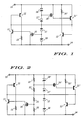
- FIG. 1 illustrates a schematic of a prior art zero crossing triac driver described in the background of the invention.
- Transistor 11 with transistor 12 and transistor 11′ together with transistor 12′ respectively formed two thyristors in the back-to-back or inverse parallel configuration.
- the thyristors may each be a single PNPN device, but are represented by two transistors, each having a collector, a base and an emitter, for ease of description. Only the connections and operation for the thyristor including transistors 11 and 12 will be described herein; however, the other thyristor bearing the prime designations will be connected and operated in a similar fashion.
- the collector and base of transistor 11 are connected to the base and collector of transistor 12 respectively.
- the emitter of transistor 11, which is also the cathode of the thyristor, is connected to main terminal 14.
- the base of transistor 11 forms the gate of the thyristor.
- Resistor 15 is coupled between the base of transistor 11 and main terminal 14 for shunting transistor 11 in order to reduce the sensitivity of the thyristor and preclude triggering by unwanted signals.
- Field effect transistor 16 has its drain connected to both the base of transistor 11 and the collector of transistor 12, and its source connected to main terminal 14 for shunting the base to emitter junction of transistor 11.
- the gate of field effect transistor 16 is coupled to the anode of photodiode 17 and the cathode of zener diode 18.
- the cathode of photodiode 17 is coupled to both the collector of transistor 11 and the base of transistor 12.
- the anode of zener diode 18 is coupled to main terminal 14.
- Field effect transistor 16 is preferably an enhancement type field effect transistor which does not conduct when the voltage across the gate to source is below a predetermined threshold voltage.
- the breakdown voltage of zener diode 18 is chosen to be higher that the threshold voltage of field effect transistor 16, and the blocking voltage of photodiode 17 is chosen to be as high as the blocking voltage of the switching thyristor.
- a significant portion of the leakage current through photodiode 17 when the AC voltage on main terminal 13 and 14 is high is due to optically generated charge carriers in the diode.
- insufficient leakage current flows through diode 17 to keep field effect transistor 16 turned on even when the voltage on main terminals 13 and 14 is several hundred volts.
- the thyristor comprising transistors 11 and 12 can inadvertently be turned on, and latch on, while no activating signal is present.
- FIG. 2 illustrates a schematic of a the preferred embodiment of the present invention. Elements 11-18 of FIG. 2 correspond to elements 11-18 of FIG. 11 and function in the same manner as described in reference to FIG. 11.
- a resistor network comprising resistors 21, 22 and 21′, 22′ is formed between the two main terminals 13 and 14.
- the resistor network serves only as a leakage path to couple charge from the main terminals 13 and 14 to the gate of transistors 16 and 16′ so the exact value of the resistors is not important. Of course, a lower value of resistors allows more charge to flow between the main terminals and increases power loss in the circuit.
- One end of resistor 21 is coupled to the collector of transistor 11 and the base of transistor 12, and the other end of resistor 21 is coupled to the gate of field effect transistor 16.
- resistor 22 One end of resistor 22 is coupled to the gate of field effect transistor 16, and the other end of resistor 22 is coupled to main terminal 14. In this manner a voltage divider is set up which will provide current to the gate of field effect transistor 16 as long as the voltage on main terminals 13 and 14 is high. The current thus provided will be present in both the light and dark conditions.
- Zener diode 18 serves to clamp the voltage between the gate and source of field effect transistor 16 regardless of the values of resistors 21 and 22.
- resistors 21 and 22 are formed of a high resistivity film and the resistor values for each of the resistors is in the order of 1 to 2 Megaohm. It is been found that charge coupled to the gate of field effect transistor 16 by resistors of this magnitude is sufficient to guarantee that field effect transistor 16 is in the on condition whenever a high voltage is present between main terminals 13 and 14.
- the circuit shown in FIG. 2 is formed monolithically on a semiconductor substrate.
- the interconnection from the gate of field effect transistor 16 to the blocking diode and the zener diode is formed by a patterned metal layer formed on the surface of the device.
- Resistors 21 and 22 then can be formed by applying a high resistivity amorphous silicon film covering the patterned metal layer, thereby forming resistors between discontinuous areas in the patterned metal layer. Resistors formed in this manner will be on the order of 1-2 Megaohms and have a wide distribution of actual values, but the ratio of resistor 21 to resistor 22 will remain fixed by the geometry of the discontinuities in the metal layer.
- the amorphous silicon film serves to create a controlled leakage path between main terminals 13, 14 and the gate of field effect transistor 16 as described hereinbefore.
- Amorphous silicon is commonly used as a passivation material on top of patterned metal layers. Properties of amorphous silicon such as mechanical strength and chemical resistance are well known. Amorphous silicon film are also used as field plates to stabilize and improve junction breakdown of semiconductor diodes. In the preferred embodiment, the amorphous silicon film replaces a passivation layer, so that no additional processing steps are required to form resistors 21 and 22.
- an improved zero crossing triac driver comprising a field effect transistor which is coupled to shunt the gate of an optically triggerable thyristor.
- the gate of the field effect transistor is coupled to a high value resistor formed between the main terminals of the triac driver. In this manner a voltage divider is formed so that the gate of the field effect transistor can be maintained in an on state when the voltage on the main terminals is high, regardless of whether or not the device is illuminated.
Landscapes
- Electronic Switches (AREA)
- Power Conversion In General (AREA)
Applications Claiming Priority (2)
| Application Number | Priority Date | Filing Date | Title |
|---|---|---|---|
| US36107189A | 1989-06-05 | 1989-06-05 | |
| US361071 | 1989-06-05 |
Publications (2)
| Publication Number | Publication Date |
|---|---|
| EP0401587A2 true EP0401587A2 (de) | 1990-12-12 |
| EP0401587A3 EP0401587A3 (de) | 1991-12-18 |
Family
ID=23420529
Family Applications (1)
| Application Number | Title | Priority Date | Filing Date |
|---|---|---|---|
| EP19900109645 Withdrawn EP0401587A3 (de) | 1989-06-05 | 1990-05-21 | Monolithischer Nulldurchgangstreiber für einen Triac |
Country Status (2)
| Country | Link |
|---|---|
| EP (1) | EP0401587A3 (de) |
| JP (1) | JPH0324816A (de) |
Cited By (1)
| Publication number | Priority date | Publication date | Assignee | Title |
|---|---|---|---|---|
| EP0563633A1 (de) * | 1992-04-02 | 1993-10-06 | TEMIC TELEFUNKEN microelectronic GmbH | Schaltungsanordnung zur Phasen-Abschnitt-Steuerung |
Family Cites Families (4)
| Publication number | Priority date | Publication date | Assignee | Title |
|---|---|---|---|---|
| US3816763A (en) * | 1972-10-02 | 1974-06-11 | Gen Electric | Zero voltage switching photon coupled relay |
| DE3318607A1 (de) * | 1983-05-21 | 1984-11-22 | Brown, Boveri & Cie Ag, 6800 Mannheim | Festkoerper-relais |
| DE3344476A1 (de) * | 1983-12-08 | 1985-06-20 | Siemens AG, 1000 Berlin und 8000 München | Schaltungsanordnung zum ansteuern eines thyristors mit licht |
| US4634883A (en) * | 1984-02-09 | 1987-01-06 | Fuji Electric Company Ltd. | Image sensor comprising a plurality of photosensors and switches |
-
1990
- 1990-05-21 EP EP19900109645 patent/EP0401587A3/de not_active Withdrawn
- 1990-06-01 JP JP2141753A patent/JPH0324816A/ja active Pending
Cited By (2)
| Publication number | Priority date | Publication date | Assignee | Title |
|---|---|---|---|---|
| EP0563633A1 (de) * | 1992-04-02 | 1993-10-06 | TEMIC TELEFUNKEN microelectronic GmbH | Schaltungsanordnung zur Phasen-Abschnitt-Steuerung |
| US5331270A (en) * | 1992-04-02 | 1994-07-19 | Temic Telefunken Microelectronic Gmbh | Circuit array for limiting a load current by reverse phase angle control |
Also Published As
| Publication number | Publication date |
|---|---|
| EP0401587A3 (de) | 1991-12-18 |
| JPH0324816A (ja) | 1991-02-01 |
Similar Documents
| Publication | Publication Date | Title |
|---|---|---|
| US4158150A (en) | Solid state relay with zero crossover feature | |
| US5210479A (en) | Drive circuit for an insulated gate transistor having overcurrent detecting and adjusting circuits | |
| US4224634A (en) | Externally controlled semiconductor devices with integral thyristor and bridging FET components | |
| US5883401A (en) | Monolithic semiconductor switch and supply circuit component | |
| US3694670A (en) | Easily switched silicon controlled rectifier | |
| US3614474A (en) | Semiconductor power-switching apparatus | |
| US6963087B2 (en) | Pulsed bistable bidirectional electronic switch | |
| US5118963A (en) | Symmetrical controlled switching circuit | |
| US5657195A (en) | Overcurrent protection device | |
| US6326648B1 (en) | Power switch with a controlled DI/DT | |
| US6323718B1 (en) | Normally-on bidirectional switch | |
| US4939564A (en) | Gate-controlled bidirectional semiconductor switching device with rectifier | |
| EP0401587A2 (de) | Monolithischer Nulldurchgangstreiber für einen Triac | |
| US4827497A (en) | Electronic trigger switch for maintenance termination unit | |
| US4339670A (en) | Zero voltage switching AC relay circuit | |
| JPH077400A (ja) | 一体的な保護機能をもつソリッドステートスイッチ | |
| US4322637A (en) | Solid state switch | |
| EP0224645B1 (de) | Elektronischer Triggerschalter für Prüfabschlusseinheit | |
| US4654543A (en) | Thyristor with "on" protective circuit and darlington output stage | |
| US3931632A (en) | Switching device equipped with a semiconductor memory element | |
| US5027020A (en) | Zero voltage switching AC relay circuit | |
| EP0141926B1 (de) | Lichtgesteuerter monolitischer Nulldurchgangstreiber für einer Triac | |
| US4107552A (en) | Semiconductor switch | |
| US5440440A (en) | High current solid state AC relay with low EMI emission | |
| EP0224644B1 (de) | Elektronischer Triggerschalter |
Legal Events
| Date | Code | Title | Description |
|---|---|---|---|
| PUAI | Public reference made under article 153(3) epc to a published international application that has entered the european phase |
Free format text: ORIGINAL CODE: 0009012 |
|
| AK | Designated contracting states |
Kind code of ref document: A2 Designated state(s): DE FR GB IT |
|
| PUAL | Search report despatched |
Free format text: ORIGINAL CODE: 0009013 |
|
| AK | Designated contracting states |
Kind code of ref document: A3 Designated state(s): DE FR GB IT |
|
| STAA | Information on the status of an ep patent application or granted ep patent |
Free format text: STATUS: THE APPLICATION IS DEEMED TO BE WITHDRAWN |
|
| 18D | Application deemed to be withdrawn |
Effective date: 19920619 |