EP0401625A2 - Alternierende Copolymere, Verfahren zu ihrer Herstellung sowie deren Verwendung - Google Patents
Alternierende Copolymere, Verfahren zu ihrer Herstellung sowie deren Verwendung Download PDFInfo
- Publication number
- EP0401625A2 EP0401625A2 EP90110028A EP90110028A EP0401625A2 EP 0401625 A2 EP0401625 A2 EP 0401625A2 EP 90110028 A EP90110028 A EP 90110028A EP 90110028 A EP90110028 A EP 90110028A EP 0401625 A2 EP0401625 A2 EP 0401625A2
- Authority
- EP
- European Patent Office
- Prior art keywords
- coor5
- alternating copolymers
- carbon atoms
- alkyl
- alkyl radical
- Prior art date
- Legal status (The legal status is an assumption and is not a legal conclusion. Google has not performed a legal analysis and makes no representation as to the accuracy of the status listed.)
- Granted
Links
Classifications
-
- C—CHEMISTRY; METALLURGY
- C08—ORGANIC MACROMOLECULAR COMPOUNDS; THEIR PREPARATION OR CHEMICAL WORKING-UP; COMPOSITIONS BASED THEREON
- C08G—MACROMOLECULAR COMPOUNDS OBTAINED OTHERWISE THAN BY REACTIONS ONLY INVOLVING UNSATURATED CARBON-TO-CARBON BONDS
- C08G18/00—Polymeric products of isocyanates or isothiocyanates
- C08G18/06—Polymeric products of isocyanates or isothiocyanates with compounds having active hydrogen
- C08G18/70—Polymeric products of isocyanates or isothiocyanates with compounds having active hydrogen characterised by the isocyanates or isothiocyanates used
- C08G18/72—Polyisocyanates or polyisothiocyanates
- C08G18/728—Polymerisation products of compounds having carbon-to-carbon unsaturated bonds and having isocyanate or isothiocyanate groups or groups forming isocyanate or isothiocyanate groups
-
- A—HUMAN NECESSITIES
- A61—MEDICAL OR VETERINARY SCIENCE; HYGIENE
- A61K—PREPARATIONS FOR MEDICAL, DENTAL OR TOILETRY PURPOSES
- A61K47/00—Medicinal preparations characterised by the non-active ingredients used, e.g. carriers or inert additives; Targeting or modifying agents chemically bound to the active ingredient
- A61K47/30—Macromolecular organic or inorganic compounds, e.g. inorganic polyphosphates
- A61K47/32—Macromolecular compounds obtained by reactions only involving carbon-to-carbon unsaturated bonds, e.g. carbomers, poly(meth)acrylates, or polyvinyl pyrrolidone
-
- C—CHEMISTRY; METALLURGY
- C08—ORGANIC MACROMOLECULAR COMPOUNDS; THEIR PREPARATION OR CHEMICAL WORKING-UP; COMPOSITIONS BASED THEREON
- C08F—MACROMOLECULAR COMPOUNDS OBTAINED BY REACTIONS ONLY INVOLVING CARBON-TO-CARBON UNSATURATED BONDS
- C08F226/00—Copolymers of compounds having one or more unsaturated aliphatic radicals, each having only one carbon-to-carbon double bond, and at least one being terminated by a single or double bond to nitrogen or by a heterocyclic ring containing nitrogen
-
- C—CHEMISTRY; METALLURGY
- C08—ORGANIC MACROMOLECULAR COMPOUNDS; THEIR PREPARATION OR CHEMICAL WORKING-UP; COMPOSITIONS BASED THEREON
- C08L—COMPOSITIONS OF MACROMOLECULAR COMPOUNDS
- C08L63/00—Compositions of epoxy resins; Compositions of derivatives of epoxy resins
Definitions
- the present invention relates to alternating copolymers of alkenyl isocyanates and electron-deficient olefins, a process for their preparation and their use.
- the task was to provide polymers from alkenyl isocyanates with a high degree of polymerization, which may have differently reactive groups which can react independently of one another.
- Copolymers of the abovementioned unsaturated isocyanates with maleic anhydride are very particularly preferred.
- Another object of the invention is a process for the preparation of these alternating copolymers, wherein at a temperature between 0 and 100 ° C alkenyl isocyanates of the formula
- R H, alkyl radical with 1 to 6 carbon atoms or alkyl alkane carboxylate with an alkane chain and an alkyl ester of 1 to 4 carbon atoms with electron-deficient olefins of the formula
- the copolymerization is preferably carried out in bulk, in solution or as precipitation polymerization.
- the copolymerization is carried out at temperatures between 0 ° C. and 80 ° C.
- Aliphatic azo compounds, peroxides or redox initiators are preferably used as initiators.
- alternating copolymers can include can be used as crosslinkers for epoxies, polyhydroxy compounds and diamines.
- the alternating copolymers can be used as carriers for medicaments.
- the copolymerization for example of isopropenyl isocyanate, of 4-isocyanato-4-pentenoic acid methyl ester or of vinyl isocyanate with maleic anhydride leads in high yields to alternating copolymers with high reduced Vis costs.
- the molar ratio of the monomers in the reaction mixture can vary widely, for example from 1: 5 to 5: 1, and the reaction can be carried out up to high conversions (ie almost complete incorporation of the monomer present in smaller amounts) without the alternating sequence is influenced in the polymer.
- the copolymerization in an equimolar ratio of the two monomers is preferred.
- the polymerization can be carried out, for example, in bulk, in solution or as precipitation polymerization from a 10% strength solution in benzene.
- the two reactive groups of the unsaturated monomers are stable under the reaction conditions and in the isolated polymers. This is surprising in that it was to be expected that the known reaction between the isocyanate and anhydride group would take place at least to a certain extent, which would have resulted in crosslinked products.
- Example 1 The procedure is as described in Example 1.
- the comonomers and azoisobutyronitrile (AIBN), 0.5 mol%, based on the maximum polymerizable substance, are weighed in the molar ratio given (Tables 1-4) and dissolved in benzene, the solution is degassed and polymerized at 60.degree. After the time specified in the tables, the precipitated polymer is suctioned off in a protective gas frit. The product is stirred again in benzene and then dried in an oil pump vacuum.
- AIBN azoisobutyronitrile
- the polymers are soluble in acetone, in 2-butanone (methyl ethyl ketone), N, N-dimethylformamide and N, N-dimethylacetamide.
Landscapes
- Chemical & Material Sciences (AREA)
- Health & Medical Sciences (AREA)
- Medicinal Chemistry (AREA)
- Chemical Kinetics & Catalysis (AREA)
- Organic Chemistry (AREA)
- Polymers & Plastics (AREA)
- Pharmacology & Pharmacy (AREA)
- Animal Behavior & Ethology (AREA)
- General Health & Medical Sciences (AREA)
- Public Health (AREA)
- Veterinary Medicine (AREA)
- Life Sciences & Earth Sciences (AREA)
- Epidemiology (AREA)
- Inorganic Chemistry (AREA)
- Addition Polymer Or Copolymer, Post-Treatments, Or Chemical Modifications (AREA)
- Polyurethanes Or Polyureas (AREA)
- Compositions Of Macromolecular Compounds (AREA)
- Epoxy Resins (AREA)
- Treatments For Attaching Organic Compounds To Fibrous Goods (AREA)
Abstract
Description
- Die vorliegende Erfindung betrifft alternierende Copolymere aus Alkenylisocyanaten und elektronenarmen Olefinen, ein Verfahren zu deren Herstellung sowie deren Verwendung.
- Alternierende Copolymere von Alkenylisocyanaten und elektronenarmen Olefinen sind in der Literatur bisher nicht beschrieben worden. Die Homopolymerisation von höheren Alkenylisocyanaten ergibt lediglich Polymere mit niedrigem Polymerisationsgrad.
- Aufgabe war es, Polymere aus Alkenylisocyanaten mit hohem Polymerisationsgrad zur Verfügung zu stellen, die gegebenenfalls unterschiedlich reaktive Gruppen aufweisen, welche unabhängig voneinander in Reaktion treten können.
- Gegenstand der Erfindung sind alternierende Copolymere

- a) Alkenylisocyanaten der Formel

R = Wasserstoff, einen Alkylrest mit 1 bis 6 Kohlenstoffatomen oder einen Alkancarbonsäurealkylesterrest bedeutet, wobei die Alkankette aus 1 bis 6 Kohlenstoffatomen und der Alkylester aus 1 bis 6 Kohlenstoffatomen besteht, und - b) elektronenarmen Olefinen der Formel

R¹ = H, R² = CN oder COOR⁵ und R³ = CN oder COOR⁵
oder
R¹ = CN oder COOR⁵, R² = CN oder COOR⁵ und R³ = H
oder
R¹ = CN oder COOR⁵, R² = H und R³ = CN oder COOR⁵
und
R⁴ = (O)C-O-C(O) oder (O)C-N(H)-C(O)
und
R⁵ = Alkylrest mit 1 bis 8 Kohlenstoffatomen
bedeuten. - Besonders bevorzugt sind alternierende Copolymere, bei denen als Alkenylisocyanatkomponente Isopropenylisocyanat, Vinylisocyanat oder 4-Isocyanato-4-pentensäurealkylester eingesetzt werden.
- Alternierende Copolymere mit Maleinsäureanhydrid, Maleinsäureimid, Fumarsäuredinitril, Maleinsäuredinitril, Maleinsäureester, Fumarsäureester oder Cyanacrylat als elektronenarme Olefinkomponente sind bevorzugte Ausführungsformen.
- Ganz besonders bevorzugt sind Copolymere der oben genannten ungesättigten Isocyanate mit Maleinsäureanhydrid.
- Ein weiterer Gegenstand der Erfindung ist ein Verfahren zur Herstellung dieser alternierenden Copolymeren, wobei bei einer Temperatur zwischen 0 und 100° C Alkenylisocyanate der Formel

R = H, Alkylrest mit 1 bis 6 Kohlenstoffatomen oder Alkancarbonsäurealkylesterrest mit einer Alkankette und einem Alkylester aus 1 bis 4 Kohlenstoffatomen mit elektronenarmen Olefinen der Formel
R¹ = H, R² = CN oder COOR⁵ und R³ = CN oder COOR⁵
oder
R¹ = CN oder COOR⁵, R² = CN oder COOR⁵ und R³ = H
oder
R¹ = CN oder COOR⁵, R² = H und R³ = CN oder COOR⁵
und
R⁴ = (O)-C-OC(O) oder (O)C-N(H)-C(O)
und
R⁵ = Alkylrest mit 1 bis 8 Kohlenstoffatomen
unter Zusatz von Initiatoren copolymerisiert werden. - Bevorzugt wird die Copolymerisation in Substanz, in Lösung oder als Fällungspolymerisation durchgeführt.
- In einer besonderen Ausführungsform wird die Copolymerisation bei Temperaturen zwischen 0° C und 80° C durchgeführt.
- Als Initiatoren werden vorzugsweise aliphatische Azoverbindungen, Peroxide oder Redoxinitiatoren eingesetzt.
- Diese alternierenden Copolymere können u.a. als Vernetzer für Epoxide, Polyhydroxyverbindungen und Diamine verwendet werden.
- Des weiteren können die alternierenden Copolymere als Träger für Arzneimittel verwendet werden.
- Die Copolymerisation z.B. von Isopropenylisocyanat, von 4-Isocyanato-4-pentensäuremethylester oder von Vinylisocyanat mit Maleinsäureanhydrid führt in hohen Ausbeuten zu alternierenden Copolymeren mit hohen reduzierten Vis kositäten. Das molare Verhältnis der Monomeren im Reaktionsgemisch kann dabei in weitem Rahmen, z.B. von 1:5 bis 5:1 variiert und die Reaktion bis zu hohen Umsätzen (d.h. fast vollständigen Einbau des in geringerer Menge vorhandenen Monomeren) geführt werden, ohne daß die alternierende Sequenz im Polymeren beeiflußt wird. Bevorzugt ist die Copolymerisation in äquimolarem Verhältnis der beiden Monomeren. Die Polymerisation kann z.B. in Substanz, in Lösung oder als Fällungspolymerisation aus einer 10 %igen Lösung in Benzol durchgeführt werden.
- Die beiden reaktiven Gruppen der ungesättigten Monomeren sind unter den Reaktionsbedingungen und in den isolierten Polymeren stabil. Die ist insofern überraschend, als zu erwarten war, daß die bekannte Reaktion zwischen Isocyanat- und Anhydridgruppe wenigstens zu einem gewissen Anteil stattfindet, was vernetzte Produkte zur Folge gehabt hätte.
- Die Erfindung soll anhand der folgenden Beispiele näher erläutert werden.
- In einem im Vakuum ausgeheizten und unter Argon abgekühlten 50 ml Kolben werden 20 ml Benzol, 1,04 g (12,5 mmol) Isopropenylisocyanat, 1,19 g (12,5 mmol) Maleinsäureanhydrid und 20,4 mg (0,12 mol) Azodiisobuttersäurenitril 10 Stunden bei 60° C gerührt. Aus der schwach gelb gefärbten Lösung beginnt nach etwa einer Stunde das Polymer auszufallen. Nach zehn Stunden saugt man den Niederschlag über eine Schutzgasfritte ab, wäscht mit Benzol nach und trocknet bei 40° C im Ölpumpenvakuum.
Ausbeute: 1,96 g (88 %)
IR (Film aus Aceton): 2270, 1850 und 1780 cm⁻¹
Elementaranalyse: C, H, N Abweichung vom berechneten Wert < 0,1 %
Inhärente Viskosität: 0,44 dl/g gemessen in Aceton bei 0,264 g/dl - Man verfährt wie unter Beispiel 1 beschrieben. Die Comonomeren und Azoisobutyronitril (AIBN), 0,5 Mol%, bezogen auf die maximal polymerisierbare Substanz werden im angegebenen Molverhältnis (Tabellen 1-4) eingewogen und in Benzol gelöst, die Lösung wird entgast und bei 60° C polymerisiert. Nach der in den Tabellen angegebenen Zeit wird das ausgefallene Polymer in einer Schutzgasfritte abgesaugt. Das Produkt wird nochmals in Benzol ausgerührt und anschließend im Ölpumpenvakuum getrocknet.
- Die Polymere sind in Aceton, in 2-Butanon (Methylethylketon), N,N-Dimethylformamid und N,N-Dimethylacetamid löslich.
- Aus einer Acetonlösung werden klare Filme der Polymeren erhalten, die sich bei längerem Stehen an der Luft (15-30 min) trüben Die IR-Spektren dieser Filme zeigen die Banden der jeweils enthaltenen charakteristischen Strukturelemente:
Isocyanat 2270 cm⁻¹
Methylester 1740 cm⁻¹
Anhydrid 1780 cm⁻¹, 1850 cm⁻¹
Nitril 2270 cm⁻¹ (überdeckt vom Isocyanat).


Claims (9)
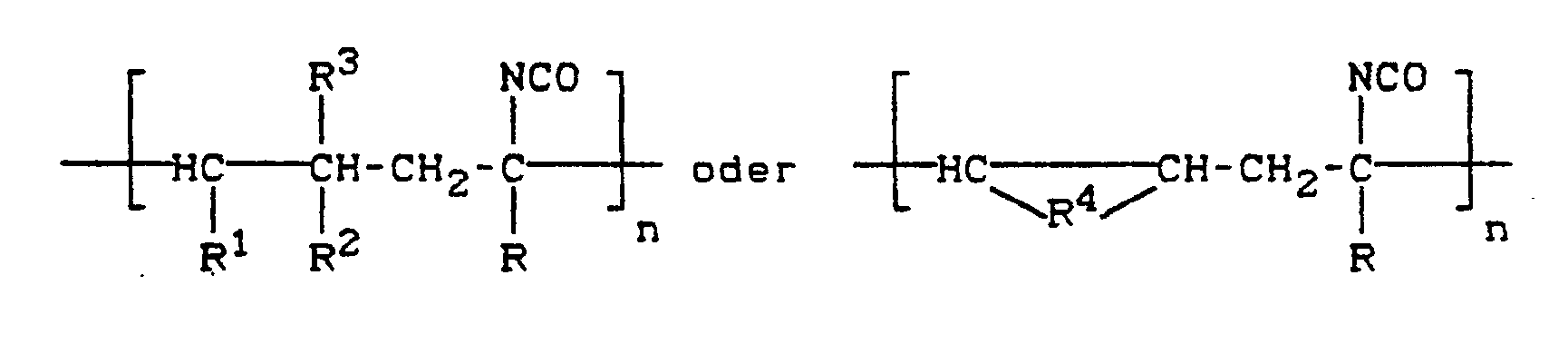
a) Alkenylisocyanate folgender Formel

b) elektronenarme Olefine

R¹ = H, R² = CN oder COOR⁵ und R³ = CN oder COOR⁵
oder
R¹ = CN oder COOR⁵, R² = CN oder COOR⁵ und R³ = H
oder
R¹ = CN oder COOR⁵, R² = H und R³ = CN oder COOR⁵
und
R⁴ = (O)C-O-C(O) oder (O)C-N(H)-C(O)
und
R⁵ = Alkylrest mit 1 bis 8 Kohlenstoffatomen
und
R = Wasserstoff, Alkylrest mit 1 bis 6 Kohlenstoffatomen oder Alkancarbonsäurealkylesterrest mit Alkankette aus 1 bis 6 Kohlenstoffatomen und einem Alkylester aus 1 bis 6 Kohlenstoffatomen bedeuten.

R = H, Alkylrest mit 1 - 6 C-Atomen, Alkancarbonsäure-alkylesterrest mit 1-6 C-Atomen im Alkanrest und im Alkylrest
mit
elektronenarmen Olefinen der Formel

R¹ = H, R² = CN oder COOR⁵ und R³ = CN oder COOR⁵
oder
R¹ = CN oder COOR⁵, R² = CN oder COOR⁵ und R³ = H
oder
R¹ = CN oder COOR⁵, R² = H und R³= CN oder COOR⁵
und
R⁴ = (O)-C-OC(O) oder (O)C-N(H)-C(O)
und
R⁵ = Alkylrest mit 1 bis 8 Kohlenstoffatomen
unter Zusatz von Initiatoren copolymerisiert werden.
Applications Claiming Priority (2)
| Application Number | Priority Date | Filing Date | Title |
|---|---|---|---|
| DE3918893 | 1989-06-09 | ||
| DE3918893A DE3918893A1 (de) | 1989-06-09 | 1989-06-09 | Alternierende copolymere, verfahren zu ihrer herstellung sowie deren verwendung |
Publications (3)
| Publication Number | Publication Date |
|---|---|
| EP0401625A2 true EP0401625A2 (de) | 1990-12-12 |
| EP0401625A3 EP0401625A3 (de) | 1991-11-06 |
| EP0401625B1 EP0401625B1 (de) | 1994-06-29 |
Family
ID=6382439
Family Applications (1)
| Application Number | Title | Priority Date | Filing Date |
|---|---|---|---|
| EP90110028A Expired - Lifetime EP0401625B1 (de) | 1989-06-09 | 1990-05-26 | Alternierende Copolymere, Verfahren zu ihrer Herstellung sowie deren Verwendung |
Country Status (7)
| Country | Link |
|---|---|
| US (1) | US4988787A (de) |
| EP (1) | EP0401625B1 (de) |
| JP (1) | JPH0350210A (de) |
| AT (1) | ATE107933T1 (de) |
| CA (1) | CA2017986A1 (de) |
| DE (2) | DE3918893A1 (de) |
| ES (1) | ES2055220T3 (de) |
Families Citing this family (4)
| Publication number | Priority date | Publication date | Assignee | Title |
|---|---|---|---|---|
| JPH0460548A (ja) * | 1990-06-29 | 1992-02-26 | Fuji Photo Film Co Ltd | パターン形成用組成物及び微細パターン形成方法 |
| DE4408199A1 (de) * | 1994-03-11 | 1995-09-14 | Basf Ag | Copolymerisate auf der Basis von Dicarbonsäureimiden, Alkenylisocyanaten und/oder Alkenylurethanen |
| WO2002092660A2 (en) * | 2001-05-14 | 2002-11-21 | Omnova Soltions Inc | Polymeric surfactants derived from cyclic monomers having pendant fluorinated carbon groups |
| JP2005078375A (ja) | 2003-08-29 | 2005-03-24 | Sony Corp | 方向認識装置、方向認識方法、方向認識システム及びロボット装置 |
Family Cites Families (10)
| Publication number | Priority date | Publication date | Assignee | Title |
|---|---|---|---|---|
| US2326287A (en) * | 1940-09-04 | 1943-08-10 | Du Pont | Copolymer of unsaturated isocyanates |
| US2334476A (en) * | 1940-09-04 | 1943-11-16 | Du Pont | Unsaturated isocyanate |
| US2606892A (en) * | 1946-08-30 | 1952-08-12 | American Cyanamid Co | Polymerizable and polymerized isocyanate compositions |
| US3943112A (en) * | 1971-08-31 | 1976-03-09 | E. I. Du Pont De Nemours And Company | Copolymers of polyhalogenated isocyanates |
| US3965074A (en) * | 1974-01-22 | 1976-06-22 | E. I. Du Pont De Nemours And Company | Homopolymers of polyfluorinated vinyl isocyanates |
| US4351755A (en) * | 1979-06-29 | 1982-09-28 | E. I. Du Pont De Nemours And Company | Isocyanate-functional polymers containing a terminal monosulfide group |
| US4436855A (en) * | 1982-05-12 | 1984-03-13 | The Lubrizol Corporation | Two-component urethane coating system |
| DE3245297A1 (de) * | 1982-12-08 | 1984-06-14 | Basf Ag, 6700 Ludwigshafen | Isocyanatgruppen enthaltendes mischpolymerisat |
| DE3245298A1 (de) * | 1982-12-08 | 1984-06-14 | Basf Ag, 6700 Ludwigshafen | Isocyanatgruppen enthaltendes mischpolymerisat |
| ATE111923T1 (de) * | 1988-04-04 | 1994-10-15 | American Cyanamid Co | Bei raumtemperatur vernetzende alternierende copolymere des isopropenyldimethylbenzylisocyanats mit einem hohen gehalt an isocyanatgruppen. |
-
1989
- 1989-06-09 DE DE3918893A patent/DE3918893A1/de not_active Withdrawn
-
1990
- 1990-05-26 DE DE59006283T patent/DE59006283D1/de not_active Expired - Fee Related
- 1990-05-26 EP EP90110028A patent/EP0401625B1/de not_active Expired - Lifetime
- 1990-05-26 ES ES90110028T patent/ES2055220T3/es not_active Expired - Lifetime
- 1990-05-26 AT AT90110028T patent/ATE107933T1/de not_active IP Right Cessation
- 1990-05-31 CA CA002017986A patent/CA2017986A1/en not_active Abandoned
- 1990-06-04 US US07/532,426 patent/US4988787A/en not_active Expired - Fee Related
- 1990-06-07 JP JP2147545A patent/JPH0350210A/ja active Pending
Also Published As
| Publication number | Publication date |
|---|---|
| DE3918893A1 (de) | 1990-12-13 |
| CA2017986A1 (en) | 1990-12-09 |
| DE59006283D1 (de) | 1994-08-04 |
| US4988787A (en) | 1991-01-29 |
| ATE107933T1 (de) | 1994-07-15 |
| EP0401625B1 (de) | 1994-06-29 |
| ES2055220T3 (es) | 1994-08-16 |
| JPH0350210A (ja) | 1991-03-04 |
| EP0401625A3 (de) | 1991-11-06 |
Similar Documents
| Publication | Publication Date | Title |
|---|---|---|
| US3780092A (en) | Monomeric emulsion stabilizers | |
| EP0087392B1 (de) | Cyanacylamidverbindungen und Verfahren zu ihrer Herstellung | |
| EP0193721A2 (de) | Polyimide und Verfahren zu ihrer Herstellung | |
| EP0166693A2 (de) | Substituierte ungesättigte, hydroxylgruppenhaltige bicyclische Imide und deren Polymere | |
| EP0444508B1 (de) | Ethylenisch ungesättigte, fluorhaltige Urethanderivate und Verfahren zu ihrer Herstellung | |
| EP0401625B1 (de) | Alternierende Copolymere, Verfahren zu ihrer Herstellung sowie deren Verwendung | |
| US3864357A (en) | Acrylic Acid Esters Containing a N,N-Heterocyclic Ring | |
| US3936492A (en) | Monomeric emulsion stabilizers | |
| DE2709782C2 (de) | Verfahren zur Herstellung von löslichen, hydroxylgruppenenthaltenden, mit organischen Polyisocyanaten vernetzbaren Mischpolymerisaten | |
| DE2709784C2 (de) | Verfahren zur Herstellung von löslichen, Hydroxylgruppen enthaltenden, mit organischen Polyisocyanaten vernetzbaren Mischpolymerisaten | |
| DE2058879C2 (de) | Cyclocopolymerisate | |
| US3928423A (en) | Monomeric emulsion stabilizers | |
| DE2852431C2 (de) | Ungesättigte Sulfitobetaine und Verfahren zu deren Herstellung | |
| EP0275014B1 (de) | Neue Triazolopyrimidine und ihre Verwendung als Initiatoren | |
| US4672098A (en) | Bicyclic acrylic monomers | |
| DE69308100T2 (de) | Verfahren zur Herstellung von Gluratimid-Copolymeren und Zwischenprodukte dafür | |
| EP0226544B1 (de) | Allyl-bicyclo[2.2.1]hept-5-en-2-carbonsäure(derivate) | |
| DE2535660A1 (de) | Verfahren zur herstellung vernetzbarer polymerisate und copolymerisate | |
| EP0681567B1 (de) | Diacylperoxidester | |
| DE69823186T2 (de) | Ein Verfahren zur Herstellung eines polykondensierbaren Makromonomeren | |
| DE3851731T2 (de) | Alternierende Copolymere. | |
| EP0008403B1 (de) | Polymerisate, die primäre aliphatische Carbonamid- und/oder N-Methylolderivate der Carbonamidgruppen enthalten sowie ihre Herstellung und Verwendung | |
| US4386192A (en) | Process for the preparation of polymers of definite viscosities | |
| EP0757062A2 (de) | Als Phasenvermittler geeignete, 2-oxazolinylterminierte Polymere und Oligomere | |
| EP0714886B1 (de) | Copolymerisierbare Oximether |
Legal Events
| Date | Code | Title | Description |
|---|---|---|---|
| PUAI | Public reference made under article 153(3) epc to a published international application that has entered the european phase |
Free format text: ORIGINAL CODE: 0009012 |
|
| 17P | Request for examination filed |
Effective date: 19900531 |
|
| AK | Designated contracting states |
Kind code of ref document: A2 Designated state(s): AT BE CH DE ES FR GB IT LI NL SE |
|
| PUAL | Search report despatched |
Free format text: ORIGINAL CODE: 0009013 |
|
| AK | Designated contracting states |
Kind code of ref document: A3 Designated state(s): AT BE CH DE ES FR GB IT LI NL SE |
|
| 17Q | First examination report despatched |
Effective date: 19930521 |
|
| GRAA | (expected) grant |
Free format text: ORIGINAL CODE: 0009210 |
|
| AK | Designated contracting states |
Kind code of ref document: B1 Designated state(s): AT BE CH DE ES FR GB IT LI NL SE |
|
| REF | Corresponds to: |
Ref document number: 107933 Country of ref document: AT Date of ref document: 19940715 Kind code of ref document: T |
|
| ITF | It: translation for a ep patent filed | ||
| REF | Corresponds to: |
Ref document number: 59006283 Country of ref document: DE Date of ref document: 19940804 |
|
| REG | Reference to a national code |
Ref country code: ES Ref legal event code: FG2A Ref document number: 2055220 Country of ref document: ES Kind code of ref document: T3 |
|
| ET | Fr: translation filed | ||
| GBT | Gb: translation of ep patent filed (gb section 77(6)(a)/1977) |
Effective date: 19940914 |
|
| EAL | Se: european patent in force in sweden |
Ref document number: 90110028.9 |
|
| PGFP | Annual fee paid to national office [announced via postgrant information from national office to epo] |
Ref country code: DE Payment date: 19950413 Year of fee payment: 6 |
|
| PGFP | Annual fee paid to national office [announced via postgrant information from national office to epo] |
Ref country code: SE Payment date: 19950420 Year of fee payment: 6 |
|
| PGFP | Annual fee paid to national office [announced via postgrant information from national office to epo] |
Ref country code: FR Payment date: 19950426 Year of fee payment: 6 |
|
| PLBE | No opposition filed within time limit |
Free format text: ORIGINAL CODE: 0009261 |
|
| STAA | Information on the status of an ep patent application or granted ep patent |
Free format text: STATUS: NO OPPOSITION FILED WITHIN TIME LIMIT |
|
| PGFP | Annual fee paid to national office [announced via postgrant information from national office to epo] |
Ref country code: CH Payment date: 19950512 Year of fee payment: 6 |
|
| PGFP | Annual fee paid to national office [announced via postgrant information from national office to epo] |
Ref country code: GB Payment date: 19950515 Year of fee payment: 6 |
|
| PGFP | Annual fee paid to national office [announced via postgrant information from national office to epo] |
Ref country code: ES Payment date: 19950517 Year of fee payment: 6 Ref country code: BE Payment date: 19950517 Year of fee payment: 6 |
|
| PGFP | Annual fee paid to national office [announced via postgrant information from national office to epo] |
Ref country code: AT Payment date: 19950522 Year of fee payment: 6 |
|
| PGFP | Annual fee paid to national office [announced via postgrant information from national office to epo] |
Ref country code: NL Payment date: 19950531 Year of fee payment: 6 |
|
| 26N | No opposition filed | ||
| PG25 | Lapsed in a contracting state [announced via postgrant information from national office to epo] |
Ref country code: GB Effective date: 19960526 Ref country code: AT Effective date: 19960526 |
|
| PG25 | Lapsed in a contracting state [announced via postgrant information from national office to epo] |
Ref country code: SE Effective date: 19960527 Ref country code: ES Free format text: LAPSE BECAUSE OF EXPIRATION OF PROTECTION Effective date: 19960527 |
|
| PG25 | Lapsed in a contracting state [announced via postgrant information from national office to epo] |
Ref country code: LI Effective date: 19960531 Ref country code: CH Effective date: 19960531 Ref country code: BE Effective date: 19960531 |
|
| BERE | Be: lapsed |
Owner name: BAYER A.G. Effective date: 19960531 |
|
| PG25 | Lapsed in a contracting state [announced via postgrant information from national office to epo] |
Ref country code: NL Effective date: 19961201 |
|
| GBPC | Gb: european patent ceased through non-payment of renewal fee |
Effective date: 19960526 |
|
| REG | Reference to a national code |
Ref country code: CH Ref legal event code: PL |
|
| PG25 | Lapsed in a contracting state [announced via postgrant information from national office to epo] |
Ref country code: FR Effective date: 19970131 |
|
| PG25 | Lapsed in a contracting state [announced via postgrant information from national office to epo] |
Ref country code: DE Effective date: 19970201 |
|
| EUG | Se: european patent has lapsed |
Ref document number: 90110028.9 |
|
| NLV4 | Nl: lapsed or anulled due to non-payment of the annual fee |
Effective date: 19961201 |
|
| REG | Reference to a national code |
Ref country code: FR Ref legal event code: ST |
|
| REG | Reference to a national code |
Ref country code: ES Ref legal event code: FD2A Effective date: 19990601 |
|
| PG25 | Lapsed in a contracting state [announced via postgrant information from national office to epo] |
Ref country code: IT Free format text: LAPSE BECAUSE OF NON-PAYMENT OF DUE FEES;WARNING: LAPSES OF ITALIAN PATENTS WITH EFFECTIVE DATE BEFORE 2007 MAY HAVE OCCURRED AT ANY TIME BEFORE 2007. THE CORRECT EFFECTIVE DATE MAY BE DIFFERENT FROM THE ONE RECORDED. Effective date: 20050526 |