EP0401629B1 - Mélanges de polycarbonate/ABS à haute stabilité thermique - Google Patents
Mélanges de polycarbonate/ABS à haute stabilité thermique Download PDFInfo
- Publication number
- EP0401629B1 EP0401629B1 EP90110032A EP90110032A EP0401629B1 EP 0401629 B1 EP0401629 B1 EP 0401629B1 EP 90110032 A EP90110032 A EP 90110032A EP 90110032 A EP90110032 A EP 90110032A EP 0401629 B1 EP0401629 B1 EP 0401629B1
- Authority
- EP
- European Patent Office
- Prior art keywords
- alkyl
- weight
- parts
- mixtures
- bis
- Prior art date
- Legal status (The legal status is an assumption and is not a legal conclusion. Google has not performed a legal analysis and makes no representation as to the accuracy of the status listed.)
- Expired - Lifetime
Links
- 239000000203 mixture Substances 0.000 title claims description 46
- PPBRXRYQALVLMV-UHFFFAOYSA-N Styrene Chemical compound C=CC1=CC=CC=C1 PPBRXRYQALVLMV-UHFFFAOYSA-N 0.000 claims description 45
- 229920000515 polycarbonate Polymers 0.000 claims description 37
- 239000004417 polycarbonate Substances 0.000 claims description 37
- 229920001577 copolymer Polymers 0.000 claims description 25
- 229920000578 graft copolymer Polymers 0.000 claims description 25
- -1 C1-C8-alkyl methacrylate Chemical class 0.000 claims description 22
- NLHHRLWOUZZQLW-UHFFFAOYSA-N Acrylonitrile Chemical compound C=CC#N NLHHRLWOUZZQLW-UHFFFAOYSA-N 0.000 claims description 19
- 125000003118 aryl group Chemical group 0.000 claims description 16
- 238000004519 manufacturing process Methods 0.000 claims description 15
- XYLMUPLGERFSHI-UHFFFAOYSA-N alpha-Methylstyrene Chemical compound CC(=C)C1=CC=CC=C1 XYLMUPLGERFSHI-UHFFFAOYSA-N 0.000 claims description 13
- 125000004209 (C1-C8) alkyl group Chemical group 0.000 claims description 11
- GYCMBHHDWRMZGG-UHFFFAOYSA-N Methylacrylonitrile Chemical compound CC(=C)C#N GYCMBHHDWRMZGG-UHFFFAOYSA-N 0.000 claims description 10
- FPYJFEHAWHCUMM-UHFFFAOYSA-N maleic anhydride Chemical compound O=C1OC(=O)C=C1 FPYJFEHAWHCUMM-UHFFFAOYSA-N 0.000 claims description 10
- 150000003440 styrenes Chemical class 0.000 claims description 10
- 229920003244 diene elastomer Polymers 0.000 claims description 9
- 238000000034 method Methods 0.000 claims description 9
- 125000000217 alkyl group Chemical group 0.000 claims description 7
- 125000004429 atom Chemical group 0.000 claims description 7
- 229910052799 carbon Inorganic materials 0.000 claims description 7
- 239000002245 particle Substances 0.000 claims description 7
- 229910052736 halogen Inorganic materials 0.000 claims description 6
- 150000002367 halogens Chemical class 0.000 claims description 6
- 229910052739 hydrogen Inorganic materials 0.000 claims description 6
- 239000001257 hydrogen Substances 0.000 claims description 6
- UFHFLCQGNIYNRP-UHFFFAOYSA-N Hydrogen Chemical compound [H][H] UFHFLCQGNIYNRP-UHFFFAOYSA-N 0.000 claims description 5
- OKTJSMMVPCPJKN-UHFFFAOYSA-N Carbon Chemical compound [C] OKTJSMMVPCPJKN-UHFFFAOYSA-N 0.000 claims description 4
- BVKZGUZCCUSVTD-UHFFFAOYSA-L Carbonate Chemical compound [O-]C([O-])=O BVKZGUZCCUSVTD-UHFFFAOYSA-L 0.000 claims description 4
- 230000001588 bifunctional effect Effects 0.000 claims description 4
- 150000002432 hydroperoxides Chemical class 0.000 claims description 4
- 239000003999 initiator Substances 0.000 claims description 4
- JRKICGRDRMAZLK-UHFFFAOYSA-L persulfate group Chemical group S(=O)(=O)([O-])OOS(=O)(=O)[O-] JRKICGRDRMAZLK-UHFFFAOYSA-L 0.000 claims description 4
- 125000004169 (C1-C6) alkyl group Chemical group 0.000 claims description 3
- 125000000041 C6-C10 aryl group Chemical group 0.000 claims description 3
- 150000002431 hydrogen Chemical class 0.000 claims description 3
- 238000002156 mixing Methods 0.000 claims description 3
- 239000000049 pigment Substances 0.000 claims description 2
- 238000002360 preparation method Methods 0.000 claims description 2
- 239000003381 stabilizer Substances 0.000 claims description 2
- 125000004178 (C1-C4) alkyl group Chemical group 0.000 claims 2
- 239000003795 chemical substances by application Substances 0.000 claims 2
- 239000004415 thermoplastic moulding composition Substances 0.000 claims 2
- IISBACLAFKSPIT-UHFFFAOYSA-N bisphenol A Chemical compound C=1C=C(O)C=CC=1C(C)(C)C1=CC=C(O)C=C1 IISBACLAFKSPIT-UHFFFAOYSA-N 0.000 description 19
- YMWUJEATGCHHMB-UHFFFAOYSA-N Dichloromethane Chemical compound ClCCl YMWUJEATGCHHMB-UHFFFAOYSA-N 0.000 description 15
- 239000000178 monomer Substances 0.000 description 15
- 238000000465 moulding Methods 0.000 description 14
- 150000001875 compounds Chemical class 0.000 description 12
- MVPPADPHJFYWMZ-UHFFFAOYSA-N chlorobenzene Chemical compound ClC1=CC=CC=C1 MVPPADPHJFYWMZ-UHFFFAOYSA-N 0.000 description 10
- 229920001971 elastomer Polymers 0.000 description 7
- 239000005060 rubber Substances 0.000 description 7
- VVQNEPGJFQJSBK-UHFFFAOYSA-N Methyl methacrylate Chemical compound COC(=O)C(C)=C VVQNEPGJFQJSBK-UHFFFAOYSA-N 0.000 description 6
- ZMXDDKWLCZADIW-UHFFFAOYSA-N N,N-Dimethylformamide Chemical compound CN(C)C=O ZMXDDKWLCZADIW-UHFFFAOYSA-N 0.000 description 6
- HEMHJVSKTPXQMS-UHFFFAOYSA-M Sodium hydroxide Chemical compound [OH-].[Na+] HEMHJVSKTPXQMS-UHFFFAOYSA-M 0.000 description 6
- 229920000642 polymer Polymers 0.000 description 6
- 239000000243 solution Substances 0.000 description 6
- 125000005250 alkyl acrylate group Chemical group 0.000 description 5
- 238000010559 graft polymerization reaction Methods 0.000 description 5
- 229920001169 thermoplastic Polymers 0.000 description 5
- 239000004416 thermosoftening plastic Substances 0.000 description 5
- VEORPZCZECFIRK-UHFFFAOYSA-N 3,3',5,5'-tetrabromobisphenol A Chemical compound C=1C(Br)=C(O)C(Br)=CC=1C(C)(C)C1=CC(Br)=C(O)C(Br)=C1 VEORPZCZECFIRK-UHFFFAOYSA-N 0.000 description 4
- UMPGNGRIGSEMTC-UHFFFAOYSA-N 4-[1-(4-hydroxyphenyl)-3,3,5-trimethylcyclohexyl]phenol Chemical compound C1C(C)CC(C)(C)CC1(C=1C=CC(O)=CC=1)C1=CC=C(O)C=C1 UMPGNGRIGSEMTC-UHFFFAOYSA-N 0.000 description 4
- ODJUOZPKKHIEOZ-UHFFFAOYSA-N 4-[2-(4-hydroxy-3,5-dimethylphenyl)propan-2-yl]-2,6-dimethylphenol Chemical compound CC1=C(O)C(C)=CC(C(C)(C)C=2C=C(C)C(O)=C(C)C=2)=C1 ODJUOZPKKHIEOZ-UHFFFAOYSA-N 0.000 description 4
- SDDLEVPIDBLVHC-UHFFFAOYSA-N Bisphenol Z Chemical compound C1=CC(O)=CC=C1C1(C=2C=CC(O)=CC=2)CCCCC1 SDDLEVPIDBLVHC-UHFFFAOYSA-N 0.000 description 4
- BAPJBEWLBFYGME-UHFFFAOYSA-N Methyl acrylate Chemical class COC(=O)C=C BAPJBEWLBFYGME-UHFFFAOYSA-N 0.000 description 4
- YGYAWVDWMABLBF-UHFFFAOYSA-N Phosgene Chemical compound ClC(Cl)=O YGYAWVDWMABLBF-UHFFFAOYSA-N 0.000 description 4
- KYPYTERUKNKOLP-UHFFFAOYSA-N Tetrachlorobisphenol A Chemical compound C=1C(Cl)=C(O)C(Cl)=CC=1C(C)(C)C1=CC(Cl)=C(O)C(Cl)=C1 KYPYTERUKNKOLP-UHFFFAOYSA-N 0.000 description 4
- 125000002496 methyl group Chemical group [H]C([H])([H])* 0.000 description 4
- 239000012071 phase Substances 0.000 description 4
- ISWSIDIOOBJBQZ-UHFFFAOYSA-N phenol group Chemical group C1(=CC=CC=C1)O ISWSIDIOOBJBQZ-UHFFFAOYSA-N 0.000 description 4
- 229920002857 polybutadiene Polymers 0.000 description 4
- WEVYAHXRMPXWCK-UHFFFAOYSA-N Acetonitrile Chemical compound CC#N WEVYAHXRMPXWCK-UHFFFAOYSA-N 0.000 description 3
- UHOVQNZJYSORNB-UHFFFAOYSA-N Benzene Chemical compound C1=CC=CC=C1 UHOVQNZJYSORNB-UHFFFAOYSA-N 0.000 description 3
- QIGBRXMKCJKVMJ-UHFFFAOYSA-N Hydroquinone Chemical compound OC1=CC=C(O)C=C1 QIGBRXMKCJKVMJ-UHFFFAOYSA-N 0.000 description 3
- ZMANZCXQSJIPKH-UHFFFAOYSA-N Triethylamine Chemical compound CCN(CC)CC ZMANZCXQSJIPKH-UHFFFAOYSA-N 0.000 description 3
- 125000004432 carbon atom Chemical class C* 0.000 description 3
- 239000003054 catalyst Substances 0.000 description 3
- 125000001495 ethyl group Chemical group [H]C([H])([H])C([H])([H])* 0.000 description 3
- 125000002887 hydroxy group Chemical group [H]O* 0.000 description 3
- 239000003960 organic solvent Substances 0.000 description 3
- 239000000047 product Substances 0.000 description 3
- GHMLBKRAJCXXBS-UHFFFAOYSA-N resorcinol Chemical compound OC1=CC=CC(O)=C1 GHMLBKRAJCXXBS-UHFFFAOYSA-N 0.000 description 3
- KAKZBPTYRLMSJV-UHFFFAOYSA-N vinyl-ethylene Natural products C=CC=C KAKZBPTYRLMSJV-UHFFFAOYSA-N 0.000 description 3
- YIYBRXKMQFDHSM-UHFFFAOYSA-N 2,2'-Dihydroxybenzophenone Chemical compound OC1=CC=CC=C1C(=O)C1=CC=CC=C1O YIYBRXKMQFDHSM-UHFFFAOYSA-N 0.000 description 2
- VPVTXVHUJHGOCM-UHFFFAOYSA-N 2,4-bis[2-(4-hydroxyphenyl)propan-2-yl]phenol Chemical compound C=1C=C(O)C(C(C)(C)C=2C=CC(O)=CC=2)=CC=1C(C)(C)C1=CC=C(O)C=C1 VPVTXVHUJHGOCM-UHFFFAOYSA-N 0.000 description 2
- UIAFKZKHHVMJGS-UHFFFAOYSA-N 2,4-dihydroxybenzoic acid Chemical compound OC(=O)C1=CC=C(O)C=C1O UIAFKZKHHVMJGS-UHFFFAOYSA-N 0.000 description 2
- MAQOZOILPAMFSW-UHFFFAOYSA-N 2,6-bis[(2-hydroxy-5-methylphenyl)methyl]-4-methylphenol Chemical compound CC1=CC=C(O)C(CC=2C(=C(CC=3C(=CC=C(C)C=3)O)C=C(C)C=2)O)=C1 MAQOZOILPAMFSW-UHFFFAOYSA-N 0.000 description 2
- VXHYVVAUHMGCEX-UHFFFAOYSA-N 2-(2-hydroxyphenoxy)phenol Chemical compound OC1=CC=CC=C1OC1=CC=CC=C1O VXHYVVAUHMGCEX-UHFFFAOYSA-N 0.000 description 2
- BLDLRWQLBOJPEB-UHFFFAOYSA-N 2-(2-hydroxyphenyl)sulfanylphenol Chemical compound OC1=CC=CC=C1SC1=CC=CC=C1O BLDLRWQLBOJPEB-UHFFFAOYSA-N 0.000 description 2
- XSVZEASGNTZBRQ-UHFFFAOYSA-N 2-(2-hydroxyphenyl)sulfinylphenol Chemical compound OC1=CC=CC=C1S(=O)C1=CC=CC=C1O XSVZEASGNTZBRQ-UHFFFAOYSA-N 0.000 description 2
- QUWAJPZDCZDTJS-UHFFFAOYSA-N 2-(2-hydroxyphenyl)sulfonylphenol Chemical compound OC1=CC=CC=C1S(=O)(=O)C1=CC=CC=C1O QUWAJPZDCZDTJS-UHFFFAOYSA-N 0.000 description 2
- XBQRPFBBTWXIFI-UHFFFAOYSA-N 2-chloro-4-[2-(3-chloro-4-hydroxyphenyl)propan-2-yl]phenol Chemical compound C=1C=C(O)C(Cl)=CC=1C(C)(C)C1=CC=C(O)C(Cl)=C1 XBQRPFBBTWXIFI-UHFFFAOYSA-N 0.000 description 2
- YMTYZTXUZLQUSF-UHFFFAOYSA-N 3,3'-Dimethylbisphenol A Chemical compound C1=C(O)C(C)=CC(C(C)(C)C=2C=C(C)C(O)=CC=2)=C1 YMTYZTXUZLQUSF-UHFFFAOYSA-N 0.000 description 2
- PYSRRFNXTXNWCD-UHFFFAOYSA-N 3-(2-phenylethenyl)furan-2,5-dione Chemical compound O=C1OC(=O)C(C=CC=2C=CC=CC=2)=C1 PYSRRFNXTXNWCD-UHFFFAOYSA-N 0.000 description 2
- SUCTVKDVODFXFX-UHFFFAOYSA-N 4-(4-hydroxy-3,5-dimethylphenyl)sulfonyl-2,6-dimethylphenol Chemical compound CC1=C(O)C(C)=CC(S(=O)(=O)C=2C=C(C)C(O)=C(C)C=2)=C1 SUCTVKDVODFXFX-UHFFFAOYSA-N 0.000 description 2
- AZZWZMUXHALBCQ-UHFFFAOYSA-N 4-[(4-hydroxy-3,5-dimethylphenyl)methyl]-2,6-dimethylphenol Chemical compound CC1=C(O)C(C)=CC(CC=2C=C(C)C(O)=C(C)C=2)=C1 AZZWZMUXHALBCQ-UHFFFAOYSA-N 0.000 description 2
- BRPSWMCDEYMRPE-UHFFFAOYSA-N 4-[1,1-bis(4-hydroxyphenyl)ethyl]phenol Chemical compound C=1C=C(O)C=CC=1C(C=1C=CC(O)=CC=1)(C)C1=CC=C(O)C=C1 BRPSWMCDEYMRPE-UHFFFAOYSA-N 0.000 description 2
- BWCAVNWKMVHLFW-UHFFFAOYSA-N 4-[1-(4-hydroxy-3,5-dimethylphenyl)cyclohexyl]-2,6-dimethylphenol Chemical compound CC1=C(O)C(C)=CC(C2(CCCCC2)C=2C=C(C)C(O)=C(C)C=2)=C1 BWCAVNWKMVHLFW-UHFFFAOYSA-N 0.000 description 2
- XJGTVJRTDRARGO-UHFFFAOYSA-N 4-[2-(4-hydroxyphenyl)propan-2-yl]benzene-1,3-diol Chemical compound C=1C=C(O)C=C(O)C=1C(C)(C)C1=CC=C(O)C=C1 XJGTVJRTDRARGO-UHFFFAOYSA-N 0.000 description 2
- RQTDWDATSAVLOR-UHFFFAOYSA-N 4-[3,5-bis(4-hydroxyphenyl)phenyl]phenol Chemical compound C1=CC(O)=CC=C1C1=CC(C=2C=CC(O)=CC=2)=CC(C=2C=CC(O)=CC=2)=C1 RQTDWDATSAVLOR-UHFFFAOYSA-N 0.000 description 2
- OBZFGWBLZXIBII-UHFFFAOYSA-N 4-[3-(4-hydroxy-3,5-dimethylphenyl)-3-methylbutyl]-2,6-dimethylphenol Chemical compound CC1=C(O)C(C)=CC(CCC(C)(C)C=2C=C(C)C(O)=C(C)C=2)=C1 OBZFGWBLZXIBII-UHFFFAOYSA-N 0.000 description 2
- NIRYBKWMEWFDPM-UHFFFAOYSA-N 4-[3-(4-hydroxyphenyl)-3-methylbutyl]phenol Chemical compound C=1C=C(O)C=CC=1C(C)(C)CCC1=CC=C(O)C=C1 NIRYBKWMEWFDPM-UHFFFAOYSA-N 0.000 description 2
- CIEGINNQDIULCT-UHFFFAOYSA-N 4-[4,6-bis(4-hydroxyphenyl)-4,6-dimethylheptan-2-yl]phenol Chemical compound C=1C=C(O)C=CC=1C(C)CC(C)(C=1C=CC(O)=CC=1)CC(C)(C)C1=CC=C(O)C=C1 CIEGINNQDIULCT-UHFFFAOYSA-N 0.000 description 2
- IQNDEQHJTOJHAK-UHFFFAOYSA-N 4-[4-[2-[4,4-bis(4-hydroxyphenyl)cyclohexyl]propan-2-yl]-1-(4-hydroxyphenyl)cyclohexyl]phenol Chemical compound C1CC(C=2C=CC(O)=CC=2)(C=2C=CC(O)=CC=2)CCC1C(C)(C)C(CC1)CCC1(C=1C=CC(O)=CC=1)C1=CC=C(O)C=C1 IQNDEQHJTOJHAK-UHFFFAOYSA-N 0.000 description 2
- LIDWAYDGZUAJEG-UHFFFAOYSA-N 4-[bis(4-hydroxyphenyl)-phenylmethyl]phenol Chemical compound C1=CC(O)=CC=C1C(C=1C=CC(O)=CC=1)(C=1C=CC(O)=CC=1)C1=CC=CC=C1 LIDWAYDGZUAJEG-UHFFFAOYSA-N 0.000 description 2
- CSCPPACGZOOCGX-UHFFFAOYSA-N Acetone Chemical compound CC(C)=O CSCPPACGZOOCGX-UHFFFAOYSA-N 0.000 description 2
- ZAMOUSCENKQFHK-UHFFFAOYSA-N Chlorine atom Chemical compound [Cl] ZAMOUSCENKQFHK-UHFFFAOYSA-N 0.000 description 2
- 238000012696 Interfacial polycondensation Methods 0.000 description 2
- 239000005062 Polybutadiene Substances 0.000 description 2
- JUJWROOIHBZHMG-UHFFFAOYSA-N Pyridine Chemical compound C1=CC=NC=C1 JUJWROOIHBZHMG-UHFFFAOYSA-N 0.000 description 2
- 229920000147 Styrene maleic anhydride Polymers 0.000 description 2
- DKGAVHZHDRPRBM-UHFFFAOYSA-N Tert-Butanol Chemical compound CC(C)(C)O DKGAVHZHDRPRBM-UHFFFAOYSA-N 0.000 description 2
- 239000002253 acid Substances 0.000 description 2
- QMKYBPDZANOJGF-UHFFFAOYSA-N benzene-1,3,5-tricarboxylic acid Chemical compound OC(=O)C1=CC(C(O)=O)=CC(C(O)=O)=C1 QMKYBPDZANOJGF-UHFFFAOYSA-N 0.000 description 2
- 125000001797 benzyl group Chemical group [H]C1=C([H])C([H])=C(C([H])=C1[H])C([H])([H])* 0.000 description 2
- VCCBEIPGXKNHFW-UHFFFAOYSA-N biphenyl-4,4'-diol Chemical group C1=CC(O)=CC=C1C1=CC=C(O)C=C1 VCCBEIPGXKNHFW-UHFFFAOYSA-N 0.000 description 2
- 238000012662 bulk polymerization Methods 0.000 description 2
- 239000006227 byproduct Substances 0.000 description 2
- 239000000460 chlorine Substances 0.000 description 2
- AOGYCOYQMAVAFD-UHFFFAOYSA-N chlorocarbonic acid Chemical class OC(Cl)=O AOGYCOYQMAVAFD-UHFFFAOYSA-N 0.000 description 2
- 125000000113 cyclohexyl group Chemical group [H]C1([H])C([H])([H])C([H])([H])C([H])(*)C([H])([H])C1([H])[H] 0.000 description 2
- 239000000839 emulsion Substances 0.000 description 2
- 238000007720 emulsion polymerization reaction Methods 0.000 description 2
- 150000002148 esters Chemical class 0.000 description 2
- 238000010528 free radical solution polymerization reaction Methods 0.000 description 2
- 125000004464 hydroxyphenyl group Chemical group 0.000 description 2
- 238000001746 injection moulding Methods 0.000 description 2
- 229920000126 latex Polymers 0.000 description 2
- 230000005501 phase interface Effects 0.000 description 2
- 150000002989 phenols Chemical class 0.000 description 2
- 125000001997 phenyl group Chemical group [H]C1=C([H])C([H])=C(*)C([H])=C1[H] 0.000 description 2
- 229960001755 resorcinol Drugs 0.000 description 2
- 150000003839 salts Chemical class 0.000 description 2
- 239000002904 solvent Substances 0.000 description 2
- 239000000725 suspension Substances 0.000 description 2
- 238000009757 thermoplastic moulding Methods 0.000 description 2
- OEVVKKAVYQFQNV-UHFFFAOYSA-N 1-ethenyl-2,4-dimethylbenzene Chemical compound CC1=CC=C(C=C)C(C)=C1 OEVVKKAVYQFQNV-UHFFFAOYSA-N 0.000 description 1
- 150000003923 2,5-pyrrolediones Chemical class 0.000 description 1
- SMZOUWXMTYCWNB-UHFFFAOYSA-N 2-(2-methoxy-5-methylphenyl)ethanamine Chemical compound COC1=CC=C(C)C=C1CCN SMZOUWXMTYCWNB-UHFFFAOYSA-N 0.000 description 1
- XKZQKPRCPNGNFR-UHFFFAOYSA-N 2-(3-hydroxyphenyl)phenol Chemical compound OC1=CC=CC(C=2C(=CC=CC=2)O)=C1 XKZQKPRCPNGNFR-UHFFFAOYSA-N 0.000 description 1
- KYGLCUAXJICESS-UHFFFAOYSA-N 2-[2,3-di(propan-2-yl)phenyl]phenol Chemical class CC(C)C1=CC=CC(C=2C(=CC=CC=2)O)=C1C(C)C KYGLCUAXJICESS-UHFFFAOYSA-N 0.000 description 1
- WJQOZHYUIDYNHM-UHFFFAOYSA-N 2-tert-Butylphenol Chemical class CC(C)(C)C1=CC=CC=C1O WJQOZHYUIDYNHM-UHFFFAOYSA-N 0.000 description 1
- ZEKCYPANSOJWDH-UHFFFAOYSA-N 3,3-bis(4-hydroxy-3-methylphenyl)-1H-indol-2-one Chemical compound C1=C(O)C(C)=CC(C2(C3=CC=CC=C3NC2=O)C=2C=C(C)C(O)=CC=2)=C1 ZEKCYPANSOJWDH-UHFFFAOYSA-N 0.000 description 1
- JLBJTVDPSNHSKJ-UHFFFAOYSA-N 4-Methylstyrene Chemical compound CC1=CC=C(C=C)C=C1 JLBJTVDPSNHSKJ-UHFFFAOYSA-N 0.000 description 1
- CIIUIRUKNKELEO-UHFFFAOYSA-N 4-[2,5-di(propan-2-yl)phenyl]-2,6-dimethylphenol Chemical compound CC(C)C1=CC=C(C(C)C)C(C=2C=C(C)C(O)=C(C)C=2)=C1 CIIUIRUKNKELEO-UHFFFAOYSA-N 0.000 description 1
- BOCLKUCIZOXUEY-UHFFFAOYSA-N 4-[tris(4-hydroxyphenyl)methyl]phenol Chemical compound C1=CC(O)=CC=C1C(C=1C=CC(O)=CC=1)(C=1C=CC(O)=CC=1)C1=CC=C(O)C=C1 BOCLKUCIZOXUEY-UHFFFAOYSA-N 0.000 description 1
- 125000004203 4-hydroxyphenyl group Chemical group [H]OC1=C([H])C([H])=C(*)C([H])=C1[H] 0.000 description 1
- GIXXQTYGFOHYPT-UHFFFAOYSA-N Bisphenol P Chemical compound C=1C=C(C(C)(C)C=2C=CC(O)=CC=2)C=CC=1C(C)(C)C1=CC=C(O)C=C1 GIXXQTYGFOHYPT-UHFFFAOYSA-N 0.000 description 1
- WKBOTKDWSSQWDR-UHFFFAOYSA-N Bromine atom Chemical compound [Br] WKBOTKDWSSQWDR-UHFFFAOYSA-N 0.000 description 1
- JIGUQPWFLRLWPJ-UHFFFAOYSA-N Ethyl acrylate Chemical compound CCOC(=O)C=C JIGUQPWFLRLWPJ-UHFFFAOYSA-N 0.000 description 1
- 239000004609 Impact Modifier Substances 0.000 description 1
- CERQOIWHTDAKMF-UHFFFAOYSA-N Methacrylic acid Chemical compound CC(=C)C(O)=O CERQOIWHTDAKMF-UHFFFAOYSA-N 0.000 description 1
- HTLZVHNRZJPSMI-UHFFFAOYSA-N N-ethylpiperidine Chemical compound CCN1CCCCC1 HTLZVHNRZJPSMI-UHFFFAOYSA-N 0.000 description 1
- QOSMNYMQXIVWKY-UHFFFAOYSA-N Propyl levulinate Chemical compound CCCOC(=O)CCC(C)=O QOSMNYMQXIVWKY-UHFFFAOYSA-N 0.000 description 1
- 150000007513 acids Chemical class 0.000 description 1
- 125000005396 acrylic acid ester group Chemical group 0.000 description 1
- NIXOWILDQLNWCW-UHFFFAOYSA-N acrylic acid group Chemical group C(C=C)(=O)O NIXOWILDQLNWCW-UHFFFAOYSA-N 0.000 description 1
- 239000000654 additive Substances 0.000 description 1
- 150000001298 alcohols Chemical class 0.000 description 1
- 150000001335 aliphatic alkanes Chemical class 0.000 description 1
- 125000001931 aliphatic group Chemical group 0.000 description 1
- 125000000129 anionic group Chemical group 0.000 description 1
- 239000002216 antistatic agent Substances 0.000 description 1
- 238000000149 argon plasma sintering Methods 0.000 description 1
- 125000003710 aryl alkyl group Chemical group 0.000 description 1
- 229940114055 beta-resorcylic acid Drugs 0.000 description 1
- 229920000402 bisphenol A polycarbonate polymer Polymers 0.000 description 1
- 239000006085 branching agent Substances 0.000 description 1
- GDTBXPJZTBHREO-UHFFFAOYSA-N bromine Substances BrBr GDTBXPJZTBHREO-UHFFFAOYSA-N 0.000 description 1
- 229910052794 bromium Inorganic materials 0.000 description 1
- CQEYYJKEWSMYFG-UHFFFAOYSA-N butyl acrylate Chemical compound CCCCOC(=O)C=C CQEYYJKEWSMYFG-UHFFFAOYSA-N 0.000 description 1
- 125000000484 butyl group Chemical group [H]C([*])([H])C([H])([H])C([H])([H])C([H])([H])[H] 0.000 description 1
- 238000006243 chemical reaction Methods 0.000 description 1
- 229910052801 chlorine Inorganic materials 0.000 description 1
- 238000004140 cleaning Methods 0.000 description 1
- 230000015271 coagulation Effects 0.000 description 1
- 238000005345 coagulation Methods 0.000 description 1
- 238000009833 condensation Methods 0.000 description 1
- 230000005494 condensation Effects 0.000 description 1
- 238000010276 construction Methods 0.000 description 1
- MGNCLNQXLYJVJD-UHFFFAOYSA-N cyanuric chloride Chemical compound ClC1=NC(Cl)=NC(Cl)=N1 MGNCLNQXLYJVJD-UHFFFAOYSA-N 0.000 description 1
- 150000001924 cycloalkanes Chemical class 0.000 description 1
- ROORDVPLFPIABK-UHFFFAOYSA-N diphenyl carbonate Chemical compound C=1C=CC=CC=1OC(=O)OC1=CC=CC=C1 ROORDVPLFPIABK-UHFFFAOYSA-N 0.000 description 1
- 239000006185 dispersion Substances 0.000 description 1
- 238000001035 drying Methods 0.000 description 1
- 239000003792 electrolyte Substances 0.000 description 1
- 239000003995 emulsifying agent Substances 0.000 description 1
- SUPCQIBBMFXVTL-UHFFFAOYSA-N ethyl 2-methylprop-2-enoate Chemical compound CCOC(=O)C(C)=C SUPCQIBBMFXVTL-UHFFFAOYSA-N 0.000 description 1
- 125000004494 ethyl ester group Chemical group 0.000 description 1
- 239000003063 flame retardant Substances 0.000 description 1
- 239000011888 foil Substances 0.000 description 1
- WOLATMHLPFJRGC-UHFFFAOYSA-N furan-2,5-dione;styrene Chemical compound O=C1OC(=O)C=C1.C=CC1=CC=CC=C1 WOLATMHLPFJRGC-UHFFFAOYSA-N 0.000 description 1
- 238000005227 gel permeation chromatography Methods 0.000 description 1
- 230000009477 glass transition Effects 0.000 description 1
- 125000005842 heteroatom Chemical group 0.000 description 1
- 239000011261 inert gas Substances 0.000 description 1
- 239000004615 ingredient Substances 0.000 description 1
- 239000007788 liquid Substances 0.000 description 1
- 238000005259 measurement Methods 0.000 description 1
- 125000005397 methacrylic acid ester group Chemical group 0.000 description 1
- 239000006082 mold release agent Substances 0.000 description 1
- 229910052757 nitrogen Inorganic materials 0.000 description 1
- 239000012074 organic phase Substances 0.000 description 1
- 150000004028 organic sulfates Chemical class 0.000 description 1
- 229910052760 oxygen Inorganic materials 0.000 description 1
- 238000010422 painting Methods 0.000 description 1
- GJVFBWCTGUSGDD-UHFFFAOYSA-L pentamethonium bromide Chemical compound [Br-].[Br-].C[N+](C)(C)CCCCC[N+](C)(C)C GJVFBWCTGUSGDD-UHFFFAOYSA-L 0.000 description 1
- PNJWIWWMYCMZRO-UHFFFAOYSA-N pent‐4‐en‐2‐one Natural products CC(=O)CC=C PNJWIWWMYCMZRO-UHFFFAOYSA-N 0.000 description 1
- QCDYQQDYXPDABM-UHFFFAOYSA-N phloroglucinol Chemical compound OC1=CC(O)=CC(O)=C1 QCDYQQDYXPDABM-UHFFFAOYSA-N 0.000 description 1
- 229960001553 phloroglucinol Drugs 0.000 description 1
- 239000004033 plastic Substances 0.000 description 1
- 229920003023 plastic Polymers 0.000 description 1
- 229920001084 poly(chloroprene) Polymers 0.000 description 1
- 229920002285 poly(styrene-co-acrylonitrile) Polymers 0.000 description 1
- 238000006068 polycondensation reaction Methods 0.000 description 1
- 229920001195 polyisoprene Polymers 0.000 description 1
- 238000006116 polymerization reaction Methods 0.000 description 1
- 238000012545 processing Methods 0.000 description 1
- HJWLCRVIBGQPNF-UHFFFAOYSA-N prop-2-enylbenzene Chemical compound C=CCC1=CC=CC=C1 HJWLCRVIBGQPNF-UHFFFAOYSA-N 0.000 description 1
- 125000001436 propyl group Chemical group [H]C([*])([H])C([H])([H])C([H])([H])[H] 0.000 description 1
- UMJSCPRVCHMLSP-UHFFFAOYSA-N pyridine Natural products COC1=CC=CN=C1 UMJSCPRVCHMLSP-UHFFFAOYSA-N 0.000 description 1
- 238000010526 radical polymerization reaction Methods 0.000 description 1
- 230000001105 regulatory effect Effects 0.000 description 1
- 230000000717 retained effect Effects 0.000 description 1
- 238000012552 review Methods 0.000 description 1
- 238000004062 sedimentation Methods 0.000 description 1
- 238000003756 stirring Methods 0.000 description 1
- 150000003460 sulfonic acids Chemical class 0.000 description 1
- 229910052717 sulfur Inorganic materials 0.000 description 1
- 238000010557 suspension polymerization reaction Methods 0.000 description 1
- ISXSCDLOGDJUNJ-UHFFFAOYSA-N tert-butyl prop-2-enoate Chemical compound CC(C)(C)OC(=O)C=C ISXSCDLOGDJUNJ-UHFFFAOYSA-N 0.000 description 1
- 150000003510 tertiary aliphatic amines Chemical class 0.000 description 1
- 150000003512 tertiary amines Chemical class 0.000 description 1
- 238000012360 testing method Methods 0.000 description 1
- 238000005809 transesterification reaction Methods 0.000 description 1
- IMFACGCPASFAPR-UHFFFAOYSA-N tributylamine Chemical compound CCCCN(CCCC)CCCC IMFACGCPASFAPR-UHFFFAOYSA-N 0.000 description 1
- 230000007306 turnover Effects 0.000 description 1
- 125000000391 vinyl group Chemical group [H]C([*])=C([H])[H] 0.000 description 1
- XLYOFNOQVPJJNP-UHFFFAOYSA-N water Substances O XLYOFNOQVPJJNP-UHFFFAOYSA-N 0.000 description 1
Classifications
-
- C—CHEMISTRY; METALLURGY
- C08—ORGANIC MACROMOLECULAR COMPOUNDS; THEIR PREPARATION OR CHEMICAL WORKING-UP; COMPOSITIONS BASED THEREON
- C08L—COMPOSITIONS OF MACROMOLECULAR COMPOUNDS
- C08L69/00—Compositions of polycarbonates; Compositions of derivatives of polycarbonates
Definitions
- the invention relates to thermoplastic molding compositions suitable mixtures of aromatic polycarbonates Based on substituted dihydroxydiphenylcycloalkanes, Copolymers of resin-forming vinyl compounds and Graft polymers of resin-forming monomers on diene rubbers, a process for their manufacture and their Use for the production of moldings.
- Polycarbonate / ABS mixtures and their use as molding compounds are known. They generally contain one Bisphenol A polycarbonate, a styrene / acrylonitrile copolymer and a graft copolymer e.g. of styrene and Acrylonitrile on a diene rubber as an impact modifier. These molding compounds are notable for good impact strength (even at low temperatures) and easy processability (good flow behavior). However, their heat resistance is sufficient for some Applications not, namely when temperatures of more than 120 ° C can occur (e.g. for production of exterior parts for motor vehicles, the painting temperatures of> 120 ° C).
- a particularly preferred alkyl radical is methyl; the X atoms in the ⁇ -position to the diphenyl-substituted C atom (C-1) are preferably not dialkyl-substituted, whereas the alkyl disubstitution in the ⁇ -position to C-1 is preferred.
- the polycarbonates A can according to the German Offenlegungsschrift 3 832 396 from diphenols of the formula (II) getting produced.
- diphenols of the formula (II) can also be mixed with other diphenols, for example those of the formula HO-Z-OH can be used for the production of high molecular weight, thermoplastic, aromatic polycarbonates.
- Suitable other diphenols of the formula (III) are those in which Z is an aromatic radical having 6 to 30 C atoms, which may contain one or more optionally substituted aromatic nuclei.
- the aromatic nuclei can be substituted by C 1 -C 6 alkylidene or C 5 -C 6 cycloalkylidene radicals, the cycloalkylidene radicals differing from those of the formulas (I) and (II), or by Heteroatoms, such as O, S, N, may be connected (bridged).
- the other diphenols of formula (III) can both can be used individually or in a mixture.
- the molar ratio of diphenols of formula (II) to the other diphenols that may be used of the formula (III) in the polycarbonates preferred here is 100: 0 to 20:80, preferably 80:20 to 25:75 and in particular 60:40 to 30:70.
- the polycarbonates A can after all for polycarbonates known manufacturing processes can be produced.
- the different diphenols can be both statistical as well as being linked together in blocks.
- the polycarbonates according to the invention can in themselves known to be branched. If branching is desired , it can be condensed in a known manner small amounts, preferably amounts of 0.05 up to 2.0 mol% (based on diphenols used) three or more than three-functional compounds, in particular those with three or more than three phenolic Hydroxyl groups can be achieved. Some branches with three or more than three phenolic hydroxyl groups are:
- Some of the other three-functional compounds are 2,4-dihydroxybenzoic acid, trimesic acid, cyanuric chloride and 3,3-bis (3-methyl-4-hydroxyphenyl) -2-oxo-2,3-dihydroindole.
- the proportion of CH 3 protons in the alkyl radical R is 47 to 89% and the proportion of CH and CH 2 protons 53 to 11%; R is likewise preferably in the o- or p-position to the OH group, and particularly preferably the upper limit of the ortho fraction 20%.
- the chain terminators are generally used in amounts of 0.5 to 10, preferably 1.5 to 8 mol%, based on the diphenols used.
- the polycarbonates A can preferably by phase interface polycondensation (see H. Schnell, "Chemistry and Physics of Polycarbonates", Polymer Reviews, Vol. IX, page 33 ff., Interscience Publ., 1964) be produced in a manner known per se.
- the diphenols of formula (II) in aqueous alkaline Phase solved.
- copolycarbonates with other diphenols are mixtures of diphenols of formula (II) and the other diphenols, for example those of the formula (III) used.
- chain terminators e.g. of the formula (IV) are added.
- the reaction temperature is 0 ° C to 40 ° C.
- the branching agents which may also be used can either with the diphenols in the aqueous alkaline phase be presented or in the organic solvent dissolved before the phosgenation are added.
- diphenols of the formula (II) and, if appropriate other diphenols of the formula (III) can also be their Mono- and / or bis-chlorocarbonic acid ester used be dissolved in organic solvents be added.
- the amount of chain terminators as well branches then depend on the molar amount of diphenolate residues corresponding to formula (II) and optionally Formula (III); when using chlorocarbonic acid esters can the amount of phosgene in known Way be reduced accordingly.
- Suitable organic solvents for the chain terminators as well as for the branching and the Chlorocarbonic acid esters are, for example, methylene chloride, Chlorobenzene, acetone, acetonitrile and mixtures these solvents, especially mixtures of methylene chloride and chlorobenzene. If necessary, the used chain breakers and splitters in the same Solvent can be solved.
- organic phase for interfacial polycondensation for example methylene chloride, chlorobenzene and mixtures of methylene chloride and chlorobenzene.
- Aqueous serves as the aqueous alkaline phase NaOH solution.
- the production of polycarbonates A by interfacial polycondensation can in the usual way by catalysts such as tertiary amines, especially tertiary aliphatic amines such as tributylamine or triethylamine catalyzed; the catalysts can be used in quantities from 0.05 to 10 mol%, based on diphenols used, to be available.
- the catalysts can be started the phosgenation or during or after the Phosgenation can be added.
- the polycarbonates A can also by the known method in a homogeneous phase, the so-called "pyridine process” and according to the known melt transesterification process using, for example, diphenyl carbonate instead of phosgene.
- the polycarbonates A have in particular molecular weights M w (weight average, determined by gel chromatography after prior calibration) from 20,000 to 80,000. They can be linear or branched, they are homopolycarbonates or copolycarbonates based on the diphenols of the formula (II).
- Copolymers B which can be used according to the invention are those composed of at least one monomer B.1: styrene, ⁇ -methylstyrene and / or nucleus-substituted styrenes, C 1 -C 8 -alkyl methacrylate, C 1 -C 8 -alkyl acrylate and at least one monomer B.2: acrylonitrile, methacrylonitrile, C 1 -C 8 alkyl methacrylate, C 1 -C 8 alkyl acrylate, maleic anhydride and / or N-substituted maleimide.
- monomer B.1 styrene, ⁇ -methylstyrene and / or nucleus-substituted styrenes
- C 1 -C 8 -alkyl methacrylate C 1 -C 8 -alkyl acrylate
- at least one monomer B.2 acrylonitrile, methacryl
- Acrylic acid methyl esters and ethyl esters are particularly preferred and propyl ester and methyl methacrylate.
- Thermoplastic copolymers with one composition according to B can be used in the production of Graft polymers C are formed as by-products, especially when large amounts of monomers on small Amounts of rubber are grafted.
- the fiction according to the amount of copolymer B to be used these by-products of graft polymerization are not with a.
- the copolymers B are resinous, thermoplastic and rubber-free.
- thermoplastic copolymers B contain copolymerized 50 to 98, preferably 60 to 95% by weight B.1 and 50 to 2, preferably 40 to 5 wt .-% B.2.
- Particularly preferred copolymers B are those from Styrene and acrylonitrile and optionally methyl methacrylate; from ⁇ -methylstyrene and acrylonitrile and optionally Methyl methacrylate; as well as styrene and ⁇ -methylstyrene with acrylonitrile and optionally methyl methacrylate.
- the styrene-acrylonitrile copolymers B are known and can be prepared by radical polymerization, in particular by emulsion, suspension, solution or bulk polymerization.
- the copolymers B preferably have molecular weights M w (weight average, determined by light scattering or sedimentation) from 15,000 to 200,000.
- Particularly preferred copolymers B according to the invention are also statistically constructed copolymers Styrene and maleic anhydride by continuous Bulk or solution polymerization for incomplete Turnover from the corresponding monomer can be produced.
- the proportions of the two monomer units of the invention suitable randomly constructed styrene-maleic anhydride copolymers can be within wide limits can be varied.
- the preferred content of maleic anhydride units is 5 to 25% by weight.
- the molecular weights M n (number average) of the randomly constructed styrene-maleic anhydride copolymers B which are suitable according to the invention can vary over a wide range. 60,000 to 200,000 is preferred. An intrinsic viscosity of 0.3 to 0.9 (measured in dimethylformamide at 25 ° C.) is preferred for these products; see Hoffmann, Krömer, Kuhn, Polymeranalytik I, Stuttgart 1977, page 316 ff. ).
- copolymers B can also nucleus-substituted styrenes such as p-methylstyrene, vinyltoluene, 2,4-dimethylstyrene, and other substituted Contain styrenes such as polymerized ⁇ -methylstyrene.
- Diene rubbers C.2 suitable as graft base for the preparation of the graft polymers C are, in particular, polybutadiene, butadiene copolymers with up to 30% by weight, based on the rubber weight, of other ethylenically unsaturated monomers, such as styrene or acrylonitrile, or esters of acrylic or methacrylic acid with C 1 -C 4 alcohols, such as methyl methacrylate, ethyl acrylate, methyl acrylate or ethyl methacrylate, polyisoprene or polychloroprene.
- the preferred graft base consists of pure polybutadiene.
- These rubbers are at least partially in shape cross-linked particles of an average particle diameter from 0.09 to 1 ⁇ m, in particular 0.1 to 0.6 ⁇ m.
- the graft polymers C can by radical Graft polymerization can be obtained
- the Graft monomers C.1.1 and C.1.2 in the presence of the rubber C.2 radical graft-polymerized, in particular at 40 to 90 ° C.
- the graft polymerization can be carried out in suspension, Dispersion or preferably in emulsion continuously or be carried out discontinuously.
- radical initiators selected from hydroperoxides and Persulfates and, if appropriate, anionic Emulsifiers, e.g. Carboxonium salts, sulfonic acid salts or organic sulfates.
- the graft polymers C are generally by Graft polymerization from 5 to 90, preferably 20 to 80 parts by weight of the monomers C.1 to 10 to 95, preferably 20 to 80 parts by weight of rubber C.2 are produced,
- Preferred monomer mixtures consist of 50 to 95 parts by weight of styrene, ⁇ -methylstyrene (or other alkyl- or halogen-substituted styrenes) or C 1 -C 8 -alkyl methacrylates, C 1 -C 8 -alkyl acrylates and from 5 to 50 parts by weight acrylonitrile, methacrylonitrile, C 1 -C 8 alkyl methacrylates, C 1 -C 8 alkyl acrylates, maleic anhydride or substituted maleimides.
- Particularly preferred grafted copolymers are obtained from styrene / acrylonitrile or styrene / maleic anhydride.
- Preferred graft copolymers C are e.g. with styrene and / or acrylonitrile and / or (meth) acrylic acid alkyl esters grafted polybutadienes or butadiene / styrene copolymers.
- the graft polymers C can from their latices known methods can be isolated, e.g. by coagulation of the latices with electrolytes (salts, acids or Mixtures of these) and subsequent cleaning and drying.
- the graft polymers C are formed generally in addition to the actual graft copolymer to a certain extent also free polymers or Copolymers of the graft monomers forming the graft shell. - The grafting is not complete.
- graft polymers C in the sense of the invention which by polymerization of the graft monomers C.1 in The presence of the rubber C.2 products obtained, generally mixtures of graft copolymer and free (CO) polymer of the graft monomers C.1.
- the molding compositions according to the invention have optimal properties when the amount of free (CO) polymer 50, preferably 30, in particular 20 wt .-%, in the Graft polymers C, does not exceed.
- aromatic polycarbonates D homopolycarbonates and copolycarbonates are used, e.g. in U.S. PS 2 999 835, GB-PS 772 627 and DE-OS 3 334 872. Based on polycarbonates are particularly preferred from Bisphenol A.
- the molding compositions according to the invention can be used for aromatic polycarbonates, copolymers and graft polymers known additives such as stabilizers, pigments, Mold release agents, flame retardants and antistatic agents contained in the usual quantities.
- the molding compositions according to the invention can be produced by mixing the ingredients in a known manner and at elevated temperatures, preferably at 200 to 350 ° C, in conventional devices such as internal kneaders, Extruders or twin-shaft screws melt-compounded or melt extruded.
- the parts can be mixed sequentially or simultaneously.
- Another object of the invention is a method to produce the molding compositions described Mixing their components at an elevated temperature.
- the molding compositions according to the invention can be used for production of shaped articles of any kind, e.g. by injection molding become.
- molded articles are: housing parts (e.g. for household appliances such as juicers, coffee machines, Mixer), cover plates for the construction industry or Automotive parts. They are also used for electrical devices, e.g. for power strips, used because they are very have good electrical properties.
- Shaped bodies can also be pre-drawn by deep drawing Sheets or foils can be made.
- Another object of the invention is the use of the molding compositions described for the production of Molded articles.
- Parts indicated mean parts by weight.
- Graft polymer of 50 parts by weight of styrene and acrylonitrile in a ratio of 72:28 to 50 parts by weight of particulate polybutadiene rubber (average particle diameter d 50 0.4 ⁇ m), produced by emulsion polymerization.
- A, B, C and optionally D are on a twin-screw extruder (ZSK 32 from Werner & Pfleiderer) Temperatures of 250 to 320 ° C melted and homogenized.
- the molding compounds were made on an injection molding machine Bars measuring 80 x 10 x 4 mm (processing temperature 260 ° C), at which the impact strength (according to ISO 180 method) at room temperature and - 20 ° C was measured.
- the heat resistance according to Vicat B is determined according to DIN 53 460.
- D 1 (compare) - 16 24th 60 122 49 2nd 60 16 24th - 135 78
Landscapes
- Chemical & Material Sciences (AREA)
- Health & Medical Sciences (AREA)
- Chemical Kinetics & Catalysis (AREA)
- Medicinal Chemistry (AREA)
- Polymers & Plastics (AREA)
- Organic Chemistry (AREA)
- Compositions Of Macromolecular Compounds (AREA)
- Polyesters Or Polycarbonates (AREA)
Claims (7)
- Mélanges appropriés comme compositions à mouler thermoplastiques, constitués deA. 3 à 99 parties en masse d'un polycarbonate aromatique dont les unités constitutives carbonate bifonctionnelles correspondent à au moins 20 % en moi à la formule (I)dans laquelle
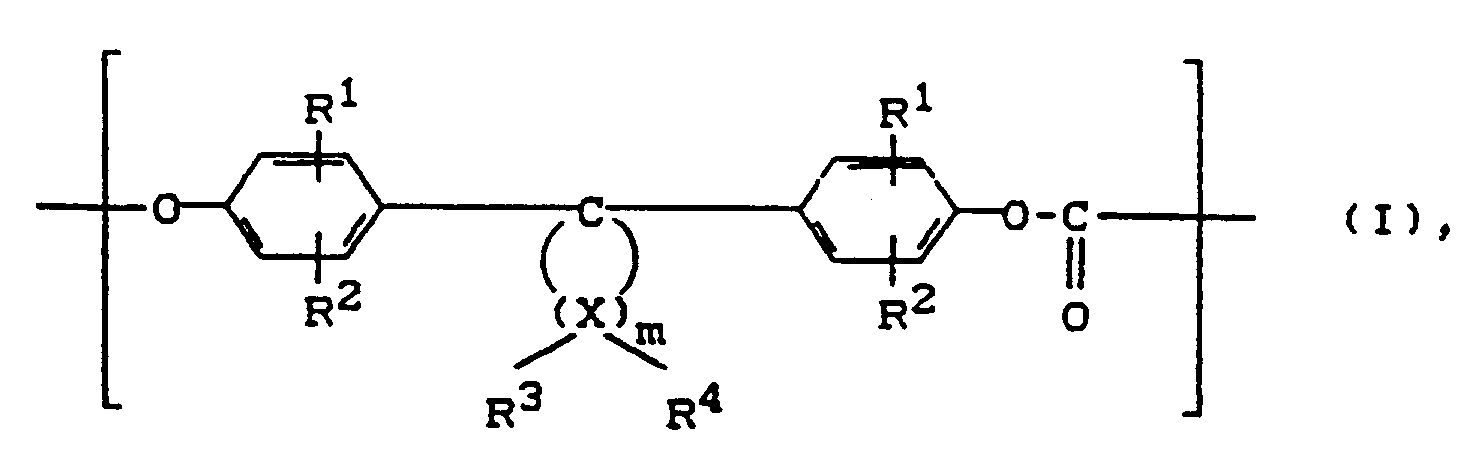
- R1 et R2
- représentent indépendamment l'un de l'autre un atome d'hydrogène, un atome d'halogène, un reste alkyle en C1-C8, un reste cycloalkyle en C5-C6, un reste aryle en C6-C10 ou un reste aralkyle en C7-C12,
- m
- est un nombre entier de 4 à 7,
- R3 et R4
- peuvent être choisis individuellement pour chaque X et représentent indépendamment l'un de l'autre un atome d'hydrogène ou un reste alkyle en C1-C6, et
- X
- représente un atome de carbone,
B. 3 à 95 parties en masse d'un composé constitué deB.1 50 à 98 % en masse de styrène, d'α-méthylstyrène, de styrènes substitués sur le cycle, de méthacrylate d'alkyle en C1-C8, d'acrylate d'alkyle en C1-C8 ou de leurs mélanges etB.2 50 à 2 % en masse d'acrylonitrile, de méthacrylonitrile, de méthacrylate d'alkyle en C1-C8, d'acrylate d'alkyle en C1-C8, d'anhydride maléique, de maléimides N-substitués et de leurs mélanges,C. 1 à 95 parties en masse d'un polymère greffé parC.1. 5 à 90 parties en masse d'un mélange constitué desurC.1.1. 50 à 98 % en masse de styrène, d'α-méthylstyrène, de styrènes substitués sur le cycle par alkyle en C1-C4 ou halogène, de méthacrylate d'alkyle en C1-C8, d'acrylate d'alkyle en C1-C8 ou de leurs mélanges etC.1.2. 5 à 50 % en masse d'acrylonitrile, de méthacrylonitrile, de méthacrylate d'alkyle en C1-C8, d'acrylate d'alkyle en C1-C8, d'anhydride maléique, de maléimides N-substitués par alkyle en C1-C4 ou phényle ou de leurs mélanges,C.2. 10 à 95 parties en masse de caoutchouc diène ayant un diamètre de particules moyen (d50) de 0,09 à 1 µm et une teneur en gel supérieure à 50 % en masse,
les polymères greffés pouvant être obtenus à l'aide d'amorceurs de radicaux choisis parmi des hydroperoxydes et des persulfates, etD. 0 à 80 parties en masse d'un autre polycarbonate aromatique, différent de A. - Mélanges selon la revendication 1, contenant 40 à 98 parties en masse de A, 5 à 50 parties en masse de B et 2 à 60 parties en masse de C.
- Mélanges selon la revendication 1, dans lesquels le diamètre moyen des particules des caoutchoucs diènes C.2 est de 0,09 à 0,6 µm.
- Mélanges selon la revendication 1, dans lesquels la teneur en gel des caoutchoucs diènes C.2 est supérieure à 70 % en masse.
- Mélanges selon la revendication 1, contenant des stabilisants, des pigments, des agents d'écoulement, des agents de démoulage, des agents ignifuges et/ou des antistatiques.
- Utilisation des mélanges selon la revendication 1 pour la préparation d'objets moulés de toutes sortes.
- Procédé de préparation de compositions à mouler thermoplastiques par mélange à haute température deA. 3 à 99 parties en masse d'un polycarbonate aromatique dont les unités constitutives carbonate bifonctionnelles correspondent à au moins 20 % en mol à la formule (I)dans laquelle
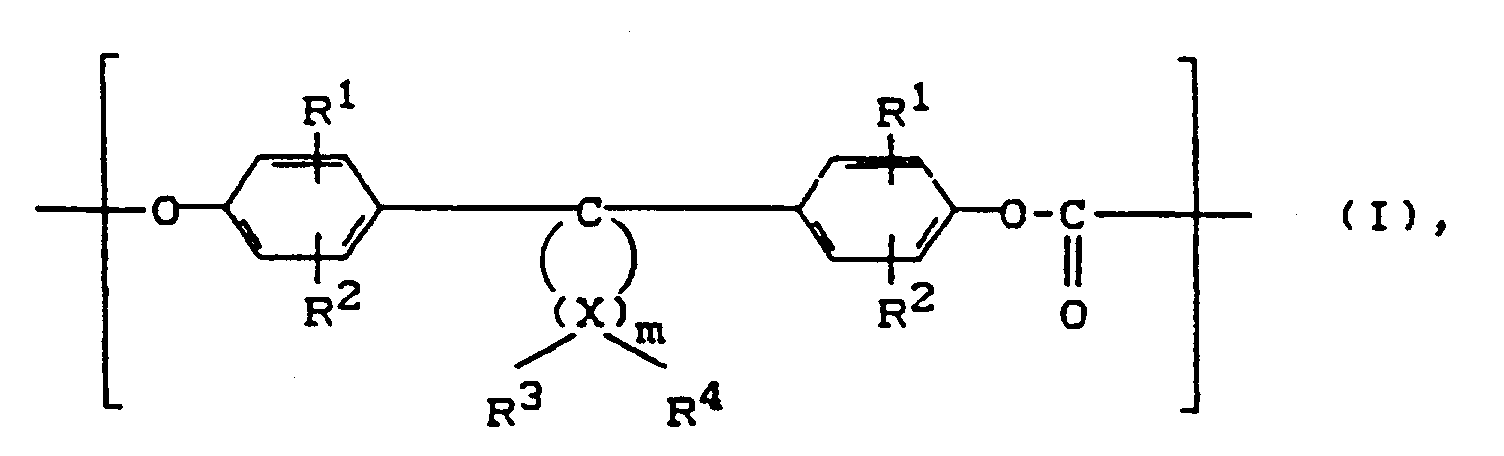
- R1 et R2
- représentent indépendamment l'un de l'autre un atome d'hydrogène, un atome d'halogène, un reste alkyle en C1-C8, un reste cycloalkyle en C5-C6, un reste aryle en C6-C10 ou un reste aralkyle en C7-C12,
- m
- est un nombre entier de 4 à 7,
- R3 et R4
- peuvent être choisis individuellement pour chaque X et représentent indépendamment l'un de l'autre un atome d'hydrogène ou un reste alkyle en C1-C6, et
- X
- représente un atome de carbone,
B. 3 à 95 parties en masse d'un composé constitué deB.1 50 à 98 % en masse de styrène, d'α-méthylstyrène, de styrènes substitués sur le cycle, de méthacrylate d'alkyle en C1-C8, d'acrylate d'alkyle en C1-C8 ou de leurs mélanges etB.2 50 à 2 % en masse d'acrylonitrile, de méthacrylonitrile, de méthacrylate d'alkyle en C1-C8, d'acrylate d'alkyle en C1-C8, d'anhydride maléique, de maléimides N-substitués et de leurs mélanges,C. 1 à 95 parties en masse d'un polymère greffé parC.1. 5 à 90 parties en masse d'un mélange constitué desurC.1.1. 50 à 98 % en masse de styrène, d'α-méthylstyrène, de styrènes substitués sur le cycle par alkyle en C1-C4 ou halogène, de méthacrylate d'alkyle en C1-C8, d'acrylate d'alkyle en C1-C8 ou de leurs mélanges etC.1.2. 5 à 50 % en masse d'acrylonitrile, de méthacrylonitrile, de méthacrylate d'alkyle en C1-C8, d'acrylate d'alkyle en C1-C8, d'anhydride maléique, de maléimides N-substitués par alkyle en C1-C4 ou phényle ou de leurs mélanges,C.2. 10 à 95 parties en masse de caoutchouc diène ayant un diamètre de particules moyen (d50) de 0,09 à 1 µm et une teneur en gel supérieure à 50 % en masse,
les polymères greffés pouvant être obtenus à l'aide d'amorceurs de radicaux choisis parmi des hydroperoxydes et des persulfates, etD. 0 à 80 parties en masse d'un autre polycarbonate aromatique, différent de A.
Applications Claiming Priority (2)
| Application Number | Priority Date | Filing Date | Title |
|---|---|---|---|
| DE3918895 | 1989-06-09 | ||
| DE3918895A DE3918895A1 (de) | 1989-06-09 | 1989-06-09 | Hochwaermeformbestaendige polycarbonat /abs-formmassen |
Publications (3)
| Publication Number | Publication Date |
|---|---|
| EP0401629A2 EP0401629A2 (fr) | 1990-12-12 |
| EP0401629A3 EP0401629A3 (fr) | 1992-03-18 |
| EP0401629B1 true EP0401629B1 (fr) | 2000-03-01 |
Family
ID=6382441
Family Applications (1)
| Application Number | Title | Priority Date | Filing Date |
|---|---|---|---|
| EP90110032A Expired - Lifetime EP0401629B1 (fr) | 1989-06-09 | 1990-05-26 | Mélanges de polycarbonate/ABS à haute stabilité thermique |
Country Status (5)
| Country | Link |
|---|---|
| US (1) | US5137970A (fr) |
| EP (1) | EP0401629B1 (fr) |
| JP (1) | JP2874961B2 (fr) |
| DE (2) | DE3918895A1 (fr) |
| ES (1) | ES2143455T3 (fr) |
Families Citing this family (14)
| Publication number | Priority date | Publication date | Assignee | Title |
|---|---|---|---|---|
| DE4000173A1 (de) * | 1990-01-05 | 1991-07-11 | Bayer Ag | Waermeformbestaendige, gut verarbeitbare und thermostabile polycarbonat-formmassen |
| JP3281075B2 (ja) * | 1992-12-28 | 2002-05-13 | 日本ジーイープラスチックス株式会社 | 熱可塑性樹脂組成物 |
| US6037424A (en) * | 1996-12-28 | 2000-03-14 | Eastman Chemical Company | Clear blends of polycarbonates and polyesters |
| US5942585A (en) * | 1996-12-28 | 1999-08-24 | Eastman Chemical Company | Polycarbonate and polyester blends |
| US6043322A (en) * | 1996-12-28 | 2000-03-28 | Eastman Chemical Company | Clear polycarbonate and polyester blends |
| US6011124A (en) * | 1996-12-28 | 2000-01-04 | Eastman Chemical Company | Blends of bisphenol a polycarbonate and polyesters |
| US6005059A (en) * | 1996-12-28 | 1999-12-21 | Eastman Chemical Company | Clear polycarbonate and polyester blends |
| DE10119681A1 (de) * | 2001-04-20 | 2002-10-24 | Bayer Ag | Schlagzähmodifizierte Blends aus Polyethylenenterephthalat und mindestens einem auf Dihydtoxydlarylcyclohexan basierenden Polycarbonat |
| US20110056706A1 (en) * | 2009-09-10 | 2011-03-10 | Tam International, Inc. | Longitudinally split swellable packer and method |
| EP2578635A1 (fr) | 2011-10-07 | 2013-04-10 | Bayer MaterialScience AG | Compositions de polycarbonate dotées d'une bonne capacité de métallisation |
| EP2578390A1 (fr) | 2011-10-07 | 2013-04-10 | Bayer MaterialScience AG | Procédé de fabrication de corps multicouche métallisés à partir de polycarbonates spécifiques |
| CN104672848A (zh) * | 2013-11-28 | 2015-06-03 | 上海杰事杰新材料(集团)股份有限公司 | 一种耐热pc/abs合金材料及其制备方法 |
| KR102547597B1 (ko) | 2015-07-06 | 2023-06-26 | 코베스트로 도이칠란트 아게 | 열 변형점에 대한 높은 요구사항을 갖는 갈바니 응용을 위한 폴리카르보네이트 조성물 |
| CN109251503A (zh) * | 2018-08-03 | 2019-01-22 | 宁波浙铁大风化工有限公司 | 一种阻燃聚碳酸酯及其制备方法 |
Family Cites Families (10)
| Publication number | Priority date | Publication date | Assignee | Title |
|---|---|---|---|---|
| US3398212A (en) * | 1963-07-01 | 1968-08-20 | Eastman Kodak Co | Bisphenol polycarbonates and polyesters containing units derived from a thiodiphenol |
| US3988389A (en) * | 1972-12-06 | 1976-10-26 | Bayer Aktiengesellschaft | Moulding compositions contain polycarbonate and graft copolymer of a resin forming monomer on a rubber |
| US4554309A (en) * | 1982-12-27 | 1985-11-19 | General Electric Company | Polycarbonate from cycloalkylidene tetra alkyl substituted diphenol |
| US4469833A (en) * | 1983-05-27 | 1984-09-04 | General Electric Company | Flame retardant polycarbonate compositions |
| DE3338502A1 (de) * | 1983-10-22 | 1985-05-02 | Bayer Ag, 5090 Leverkusen | Selbstverloeschende thermoplastische formmassen aus polycarbonat und abs-polymerisaten |
| JPS60252650A (ja) * | 1984-05-30 | 1985-12-13 | Sumitomo Naugatuck Co Ltd | 耐熱性樹脂組成物 |
| US4563469A (en) * | 1984-07-20 | 1986-01-07 | Warner-Lambert Company | Derivatives of N-[2-(tetrahydro-3,5-dioxo-1H-pyrrolizin-7a(5H)-yl)ethyl]amine as cognition activators |
| US4839426A (en) * | 1987-08-10 | 1989-06-13 | General Electric Company | Misciblizing blends of polycarbonate and styrene copolymers |
| NO170326C (no) * | 1988-08-12 | 1992-10-07 | Bayer Ag | Dihydroksydifenylcykloalkaner |
| CA1340125C (fr) * | 1988-10-06 | 1998-11-10 | Dieter Freitag | Melanges de nouveaux polycarbonates speciaux avec d'autre matieres thermoplastiques ou aves des elstomeres |
-
1989
- 1989-06-09 DE DE3918895A patent/DE3918895A1/de not_active Withdrawn
-
1990
- 1990-05-26 DE DE59010899T patent/DE59010899D1/de not_active Expired - Lifetime
- 1990-05-26 EP EP90110032A patent/EP0401629B1/fr not_active Expired - Lifetime
- 1990-05-26 ES ES90110032T patent/ES2143455T3/es not_active Expired - Lifetime
- 1990-06-04 US US07/532,404 patent/US5137970A/en not_active Expired - Lifetime
- 1990-06-06 JP JP2146373A patent/JP2874961B2/ja not_active Expired - Lifetime
Also Published As
| Publication number | Publication date |
|---|---|
| DE59010899D1 (de) | 2000-04-06 |
| ES2143455T3 (es) | 2000-05-16 |
| EP0401629A3 (fr) | 1992-03-18 |
| DE3918895A1 (de) | 1990-12-13 |
| JPH0326754A (ja) | 1991-02-05 |
| US5137970A (en) | 1992-08-11 |
| JP2874961B2 (ja) | 1999-03-24 |
| EP0401629A2 (fr) | 1990-12-12 |
Similar Documents
| Publication | Publication Date | Title |
|---|---|---|
| EP0023291B1 (fr) | Compositions de moulage stabilisées thermoplastiques à base de polycarbonates, polymères ABS et phosphites | |
| EP0396958B1 (fr) | Procédé pour préparer des masses à mouler de polycarbonate | |
| EP0436186B1 (fr) | Masses de moulage de polycarbonate ayant une stabilité dimensionnelle à chaud et une bonne transformabilité, résistant à la chaleur | |
| DE3738143A1 (de) | Verwendung von redoxpfropfpolymerisaten zur verbesserung der benzinbestaendigkeit von thermoplastischen, aromatischen polycarbonat- und/oder polyestercarbonat-formmassen | |
| DE69920200T2 (de) | Kompatibilisierte abs-polycarbonat-formmasse | |
| EP0704488B1 (fr) | Compositions à mouler à base de polycarbonate ayant une ténacité améliorée | |
| EP0401629A2 (fr) | Mélanges de polycarbonate/ABS à haute stabilité thermique | |
| EP0403837A2 (fr) | Masses de polycarbonate à mouler | |
| EP0179290B1 (fr) | Compositions de moulage thermoplastiques à stabilité dimensionnelle à chaud | |
| DE2717165A1 (de) | Thermoplastische formmassen aus polycarbonaten und abs-polymerisaten | |
| EP0173146B1 (fr) | Mélanges à base de polycarbonate exempts d'acrylonitrile | |
| EP0570797A1 (fr) | Masses à mouler de polycarbonate et d'AB | |
| EP0224111A2 (fr) | Masses à mouler thermoplastiques à base de polycondensats segmentés d'oxyde de polyphénylène et de polycarbonate | |
| EP0176811B1 (fr) | Stabilateurs pour des compositions en ABS | |
| EP0372336B1 (fr) | Masses à mouler de polycarbonate à haute résistance au choc | |
| EP0445402B1 (fr) | Matières à mouler thermostables | |
| DE4014308C2 (de) | Polycarbonat/ABS-Formmassen mit hoher Schlagzähigkeit | |
| EP0499927B1 (fr) | Masses à mouler résistant à l'essence | |
| EP0443131B1 (fr) | Masses à mouler thermoplastiques résistant à l'essence | |
| DE4114589A1 (de) | Polycarbonat/polyamid-formmassen | |
| DE19639821A1 (de) | Polycarbonat-ABS-Mischungen mit feinteiligen Pfropfpolymerisaten | |
| DE4038590A1 (de) | Poly(ester)carbonat/abs-formmassen mit hoher fliessnahtfestigkeit | |
| EP0410239A1 (fr) | Compositions de moulage de polycarbonate | |
| DE4300798A1 (de) | Polycarbonat/ABS-Formmassen enthaltend Ethylenvinylacetat-Copolymere | |
| DE3432412A1 (de) | Thermoplastische formmassen |
Legal Events
| Date | Code | Title | Description |
|---|---|---|---|
| PUAI | Public reference made under article 153(3) epc to a published international application that has entered the european phase |
Free format text: ORIGINAL CODE: 0009012 |
|
| 17P | Request for examination filed |
Effective date: 19900531 |
|
| AK | Designated contracting states |
Kind code of ref document: A2 Designated state(s): DE ES FR GB IT NL |
|
| PUAL | Search report despatched |
Free format text: ORIGINAL CODE: 0009013 |
|
| AK | Designated contracting states |
Kind code of ref document: A3 Designated state(s): DE ES FR GB IT NL |
|
| 17Q | First examination report despatched |
Effective date: 19940427 |
|
| APAD | Appeal reference recorded |
Free format text: ORIGINAL CODE: EPIDOS REFNE |
|
| APCB | Communication from the board of appeal sent |
Free format text: ORIGINAL CODE: EPIDOS OBAPE |
|
| APCB | Communication from the board of appeal sent |
Free format text: ORIGINAL CODE: EPIDOS OBAPE |
|
| APCB | Communication from the board of appeal sent |
Free format text: ORIGINAL CODE: EPIDOS OBAPE |
|
| APCB | Communication from the board of appeal sent |
Free format text: ORIGINAL CODE: EPIDOS OBAPE |
|
| APCB | Communication from the board of appeal sent |
Free format text: ORIGINAL CODE: EPIDOS OBAPE |
|
| APCB | Communication from the board of appeal sent |
Free format text: ORIGINAL CODE: EPIDOS OBAPE |
|
| APAB | Appeal dossier modified |
Free format text: ORIGINAL CODE: EPIDOS NOAPE |
|
| GRAG | Despatch of communication of intention to grant |
Free format text: ORIGINAL CODE: EPIDOS AGRA |
|
| GRAG | Despatch of communication of intention to grant |
Free format text: ORIGINAL CODE: EPIDOS AGRA |
|
| GRAH | Despatch of communication of intention to grant a patent |
Free format text: ORIGINAL CODE: EPIDOS IGRA |
|
| GRAH | Despatch of communication of intention to grant a patent |
Free format text: ORIGINAL CODE: EPIDOS IGRA |
|
| GRAA | (expected) grant |
Free format text: ORIGINAL CODE: 0009210 |
|
| AK | Designated contracting states |
Kind code of ref document: B1 Designated state(s): DE ES FR GB IT NL |
|
| REF | Corresponds to: |
Ref document number: 59010899 Country of ref document: DE Date of ref document: 20000406 |
|
| ITF | It: translation for a ep patent filed | ||
| REG | Reference to a national code |
Ref country code: ES Ref legal event code: FG2A Ref document number: 2143455 Country of ref document: ES Kind code of ref document: T3 |
|
| GBT | Gb: translation of ep patent filed (gb section 77(6)(a)/1977) |
Effective date: 20000511 |
|
| ET | Fr: translation filed | ||
| PLBE | No opposition filed within time limit |
Free format text: ORIGINAL CODE: 0009261 |
|
| STAA | Information on the status of an ep patent application or granted ep patent |
Free format text: STATUS: NO OPPOSITION FILED WITHIN TIME LIMIT |
|
| 26N | No opposition filed | ||
| REG | Reference to a national code |
Ref country code: GB Ref legal event code: IF02 |
|
| APAH | Appeal reference modified |
Free format text: ORIGINAL CODE: EPIDOSCREFNO |
|
| PGFP | Annual fee paid to national office [announced via postgrant information from national office to epo] |
Ref country code: NL Payment date: 20090504 Year of fee payment: 20 Ref country code: ES Payment date: 20090605 Year of fee payment: 20 |
|
| PGFP | Annual fee paid to national office [announced via postgrant information from national office to epo] |
Ref country code: IT Payment date: 20090520 Year of fee payment: 20 Ref country code: FR Payment date: 20090515 Year of fee payment: 20 Ref country code: DE Payment date: 20090423 Year of fee payment: 20 |
|
| PGFP | Annual fee paid to national office [announced via postgrant information from national office to epo] |
Ref country code: GB Payment date: 20090520 Year of fee payment: 20 |
|
| REG | Reference to a national code |
Ref country code: NL Ref legal event code: V4 Effective date: 20100526 |
|
| REG | Reference to a national code |
Ref country code: ES Ref legal event code: FD2A Effective date: 20100527 |
|
| PG25 | Lapsed in a contracting state [announced via postgrant information from national office to epo] |
Ref country code: NL Free format text: LAPSE BECAUSE OF EXPIRATION OF PROTECTION Effective date: 20100526 |
|
| PG25 | Lapsed in a contracting state [announced via postgrant information from national office to epo] |
Ref country code: ES Free format text: LAPSE BECAUSE OF EXPIRATION OF PROTECTION Effective date: 20100527 |
|
| PG25 | Lapsed in a contracting state [announced via postgrant information from national office to epo] |
Ref country code: GB Free format text: LAPSE BECAUSE OF EXPIRATION OF PROTECTION Effective date: 20100525 |
|
| PG25 | Lapsed in a contracting state [announced via postgrant information from national office to epo] |
Ref country code: DE Free format text: LAPSE BECAUSE OF EXPIRATION OF PROTECTION Effective date: 20100526 |