EP0402040A2 - Enteisungsvorrichtung für Kraftfahrzeuge - Google Patents
Enteisungsvorrichtung für Kraftfahrzeuge Download PDFInfo
- Publication number
- EP0402040A2 EP0402040A2 EP90305925A EP90305925A EP0402040A2 EP 0402040 A2 EP0402040 A2 EP 0402040A2 EP 90305925 A EP90305925 A EP 90305925A EP 90305925 A EP90305925 A EP 90305925A EP 0402040 A2 EP0402040 A2 EP 0402040A2
- Authority
- EP
- European Patent Office
- Prior art keywords
- voltage
- generator
- windshield
- heater
- switch
- Prior art date
- Legal status (The legal status is an assumption and is not a legal conclusion. Google has not performed a legal analysis and makes no representation as to the accuracy of the status listed.)
- Granted
Links
Images

Classifications
-
- H—ELECTRICITY
- H02—GENERATION; CONVERSION OR DISTRIBUTION OF ELECTRIC POWER
- H02J—ELECTRIC POWER NETWORKS; CIRCUIT ARRANGEMENTS OR SYSTEMS FOR SUPPLYING OR DISTRIBUTING ELECTRIC POWER; SYSTEMS FOR STORING ELECTRIC ENERGY
- H02J7/00—Circuit arrangements for charging or discharging batteries or for supplying loads from batteries
- H02J7/14—Circuit arrangements for charging or discharging batteries or for supplying loads from batteries for charging batteries from dynamo-electric generators driven at varying speed, e.g. on vehicle
- H02J7/1438—Circuit arrangements for charging or discharging batteries or for supplying loads from batteries for charging batteries from dynamo-electric generators driven at varying speed, e.g. on vehicle in combination with power supplies for loads other than batteries
Definitions
- the present invention relates to an ice melting system for thawing ice applied to a motor vehicle windshield such as a front windshield.
- One proposed ice melting system for thawing ice applied to the front windshield of a motor vehicle in cold climate comprises an electric heater in the form of a thin film of silver oxide which is deposited on the front windshield by sputtering.
- the electric heater When the electric heater is energized by electric energy supplied thereto, it is heated to increase the temperature of the glass of the front windshield, thereby thawing the ice.
- the electric heater of the type described has a high electric resistance, and requires a large amount of electric energy to thaw the ice on the front windshield.
- the ice melting system needs to incorporate a large-capacity power supply which can supply a large amount of electric power ranging from 1.5 to 2 KW at a voltage from 60 to 70 V, for example.
- the proposed arrangement disclosed in the former publication comprises a windshield heater circuit which is composed of a generator drivable by an engine on a motor vehicle, a windshield having an electric-resistance heater element, and a battery on the motor vehicle.
- the windshield heater circuit further includes a first switch for connecting the heater element to the generator, and a second switch that can be shifted between a first condition in which the output of the generator is connected to the battery and a voltage regulator for the generator and a second condition in which the voltage regulator is connected to the battery.
- the first switch is closed to connect the heater element to the generator, and the second switch is shifted into the second condition, so that the voltage regulator is supplied with only the voltage from the battery.
- the latter publication shows a windshield heater circuit in which the AC output from a generator is boosted by a three-phase transformer to a higher voltage which is rectified into a DC voltage that is applied to a heater element mounted on a front windshield. Since the transformer is employed to boost the AC output from the generator, however, the disclosed windshield heater circuit is heavy and expensive. Use of the rectifier which rectifies the higher AC voltage into the DC voltage causes an electric power loss.
- Another object of the present invention is to provide an ice melting system for a motor vehicle, which can increase a driving force for a generator thereby to obtain a sufficient output from the generator when a heater on a motor vehicle windshield is energized.
- Still another object of the present invention is to provide an ice melting system for a motor vehicle, which includes means for scraping off any remaining ice from a windshield when the ice applied to the windshield has been thawed to a certain extent, so that the ice on the windshield can be removed in a short period of time.
- an ice melting system in a motor vehicle having an engine, a generator drivable by the engine, a voltage regulator for controlling the generator, a windshield having a heater, and a battery
- the ice melting system comprising a first switch disposed in a circuit interconnecting the generator and the heater, a rectifier for rectifying AC electric energy generated by the generator into DC electric energy, a second switch disposed in a circuit interconnecting the rectifier and the battery, voltage dividing means for dividing a voltage produced by the rectifier at a predetermined ratio, a third switch shiftable between a first condition in which the voltage regulator is connected to the circuit interconnecting the rectifier and the battery, and a second condition in which the voltage dividing means is connected to the voltage regulator when the heater operates, operation command means for giving an operation command to command operation of the heater, and a control circuit for closing the first switch, opening the second switch, and shifting the
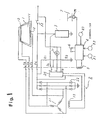
- Fig. 1 shows an ice melting system for a motor vehicle according to an embodiment of the present invention.
- a front windshield 1 of a motor vehicle comprises a laminated sheet of glass including, as intermediate layers, a transparent electrically conductive film 11 formed by sputtering and serving as an ice melting heater, and intermediate adhesive films.
- Three leads 12, for example, are connected to the transparent electrically conductive film 11.
- electric energy of about 1.5 KW/m2 is supplied through the leads 12 to the transparent electrically conductive film 11 to thaw the ice in about 4 minutes. If the electric energy is supplied at a voltage ranging from 60 to 70 V, then a current in the range of from 20 to 25 A is required to be supplied to the leads 12.
- a generator 2 drivable by the engine of the motor vehicle is known as an alternator, and comprises a stator coil 21 for inducing a generated output, a diode bridge 22 for rectifying the generated output, a field coil 23 for controlling a generated output voltage, and a voltage regulator 24 for controlling a current to be supplied to the field coil 23.
- the voltage regulator 24 has a detecting terminal S for detecting the voltage of a battery 3, etc., a lamp terminal L connected to a charge lamp 31, and an ignition terminal IG connected to the ignition circuit of the engine.
- a control circuit 4 which is shown in greater detail in Fig. 2, is supplied with various signals to control the rotational speed of the engine and energize a relay 5 to control various switch contacts when the ice on the windshield 1 is to be thawed.
- the stator coil 21 of the generator 2 and the leads 12 of the generator 2 are connected to each other by nor mally open contacts 5a, 5b, 5c.
- the rectified output from the stator coil 21 is supplied to the battery 3 through a normally closed contact 5d.
- the detecting terminal S of the voltage regulator 24 is selectively connected through a contact 5e to a positive terminal of the battery 3 or a voltage divider which divides the rectified output voltage from the generator 2 at a certain dividing ratio. These contacts 5a through 5e are shiftable under the control of the relay 5.
- the voltage divider comprises two resistors R1, R2 between which the contact 5e is connected.
- the voltage divider serves as a voltage measuring means, and the resistors R1, R2 have respective resistances which are related to each other as follows: where Vs is a voltage applied to the detecting terminal S of the voltage regulator 24 when the generated output is supplied from the generator 2 to the battery 3, and Vo is a voltage applied to the transparent electrically conductive film 11 when the ice applied to the windshield 1 is thawed.
- Vs is a voltage applied to the detecting terminal S of the voltage regulator 24 when the generated output is supplied from the generator 2 to the battery 3
- Vo is a voltage applied to the transparent electrically conductive film 11 when the ice applied to the windshield 1 is thawed.
- An ice melting switch 6, serving as an operation command switch, which is connected to the control circuit 4 is manually turned on or closed when the ice deposited on the windshield 1 is to be thawed.
- the engine has a throttle valve 7 which is actuated by a throttle actuator 71 to control the operation of the engine, the throttle actuator 71 being controlled by the control circuit 4.
- the control circuit 4 is supplied with a detected signal from an engine speed sensor 81 which detects the rotational speed of the engine and a detected signal from a gear position sensor 82 which detects a neutral gear position of a transmission associated with the engine.
- the temperature of the front windshield 1 which incorporates the transparent electrically conductive film 11 is detected by a glass temperature sensor 83 which supplies a detected signal to the control circuit 4.
- Fig. 2 Those parts shown in Fig. 2 which are identical to those shown in Fig. 1 are denoted by identical reference numerals.
- the ice melting switch 6 is connected to AND gates 41, 44, and applies a trigger signal to a timer/inhibitor 46 when the ice melting switch 6 is turned on.
- the detected signal from the engine speed sensor 81 is applied to an integrator/decision circuit 43 which deter mines whether a pulsed rotational speed signal is integrated and has reached a predetermined rotational speed or not.
- the output of the integrator/decision circuit 43 is applied to the AND gate 44.
- the detected signal from the gear position sensor 82 is applied to the AND gate 41. If the ice melting switch 6 is turned on and the transmission is in the neutral gear position, then the output of the AND gate 41 is applied through a power buffer 42 to the throttle actuator 71 which then opens the throttle valve 7 to a predetermined degree.
- the detected signal from the glass temperature sensor 83 is applied through the timer/inhibitor 46 to the AND gate 44, and also applied through a temperature decision circuit 47 to an AND gate 48.
- the AND gate 44 applies an output signal to a power buffer 45 which energizes the relay 5, thus operating the switch contacts 5a through 5e.
- the timer/inhibitor 46 does not apply its output signal to the AND gate 44. Therefore, any continued operation of the ice melting system is inhibited after the ice has been thawed.
- the decision circuit 47 determines whether the ice on the windshield 1 is thawed or not, based on the signal from the glass temperature sensor 83, and applies its output signal to the AND gate 48. If the output signal from the AND gate 44 and the output signal from the decision circuit 47 are applied as input signals to the AND gate 48, then the AND gate 48 applies its output signal to a buffer 49, enabling it to energize a wiper motor 9 to operate the windshield wiper on the front windshield 1 which has reached the ice melting temperature. When the windshield wiper is thus operated, it quickly scrapes off any remaining ice which is being thawed.
- the signal from the gear position sensor 82 connected to the control circuit 4 is checked. If the gear position is the neutral gear position, then the throttle actuator 71 is operated by the output signal from the AND gate 41. The throttle valve 7 is opened to increase the rotational speed of the engine.
- the signal from the engine speed sensor 81, the signal from the ice melting switch 6, and the signal from the timer/inhibitor 46 which has been triggered are applied to enable the AND gate 44 to actuate the relay 5, thereby operating the switch contacts 5a through 5e.
- the electric energy which has been supplied so far from the generator 2 to the battery 3 is turned off, and AC electric energy is supplied from the stator coil 21 through the leads 12 to the transparent electrically conductive film 11.
- a voltage which is produced by dividing the rectified output voltage from the generator 2 with the voltage divider is applied to the detecting circuit S of the voltage regulator 24.
- the voltage regulator 24 increases the current supplied to the field coil 23. Accordingly, a higher voltage is induced across the stator coil 21, so that the electric energy supplied to the transparent electrically conductive film 11 is increased, thus melting the ice on the front windshield 1 at an accelerated rate with the electrically generated heat energy.
- the transparent electrically conductive film 11 is continuously energized to increase its temperature.
- the decision circuit 47 is enabled to cause the AND gate 48 and the buffer 49 to energize the wiper motor 9.
- the windshield wiper now scrapes off the ice which is being thawed on the windshield 1.
- the ice melting switch 6 may be turned off to de-energize the transparent electrically conductive film 11 and inactivate the windshield wiper.
- the voltage obtained by dividing the output voltage from the rectifier at a predetermined dividing ratio is applied as a control input to the voltage regulator for the alternator on the motor vehicle, so that the voltage regulator operates to increase the current supplied to the field coil of the alternator.
- the alternator then produces a higher voltage which is supplied to the electric heater of the windshield. Therefore, the ice on the windshield can quickly be removed by the large amount of electric energy supplied from the alternator to the electric heater.
- the three leads connected to the transparent electrically conductive film which serves as the electric heater are supplied with a three-phase AC output from the alternator, i.e., the generator. Therefore, there is no neutral terminal on the transparent electrically conductive film. Since there are no separate insulated regions in the transparent electrically conductive film, the transparent electrically conductive film generates heat uniformly throughout its area without localized heat radiations. Application of the AC electric energy to the transparent electrically conductive film heats the film in a pulsating manner, so that the ice on the windshield can efficiently be thawed without any electric power loss which would otherwise be caused by a rectifier. Consequently, the ice melting system can melt the ice on the windshield efficiently.
- control circuit which operates the relay checks the rotational speed of the engine, the gear position of the transmission, and the temperature of the front windshield, and opens the throttle valve and actuates the wiper motor depending on the checked parameters. Accordingly, the ice on the front windshield can be thawed efficiently in a short period of time.
Landscapes
- Engineering & Computer Science (AREA)
- Power Engineering (AREA)
- Control Of Eletrric Generators (AREA)
- Control Of Charge By Means Of Generators (AREA)
- Electric Propulsion And Braking For Vehicles (AREA)
Applications Claiming Priority (2)
| Application Number | Priority Date | Filing Date | Title |
|---|---|---|---|
| JP143481/89 | 1989-06-06 | ||
| JP1143481A JPH0310949A (ja) | 1989-06-06 | 1989-06-06 | 車両用融氷装置 |
Publications (3)
| Publication Number | Publication Date |
|---|---|
| EP0402040A2 true EP0402040A2 (de) | 1990-12-12 |
| EP0402040A3 EP0402040A3 (de) | 1991-11-06 |
| EP0402040B1 EP0402040B1 (de) | 1994-09-14 |
Family
ID=15339707
Family Applications (1)
| Application Number | Title | Priority Date | Filing Date |
|---|---|---|---|
| EP90305925A Expired - Lifetime EP0402040B1 (de) | 1989-06-06 | 1990-05-31 | Enteisungsvorrichtung für Kraftfahrzeuge |
Country Status (3)
| Country | Link |
|---|---|
| EP (1) | EP0402040B1 (de) |
| JP (1) | JPH0310949A (de) |
| DE (1) | DE69012436T2 (de) |
Cited By (2)
| Publication number | Priority date | Publication date | Assignee | Title |
|---|---|---|---|---|
| EP0802605A1 (de) * | 1995-01-10 | 1997-10-22 | Hitachi, Ltd. | Stromversorgungssystem für Auto |
| US5841266A (en) * | 1995-01-10 | 1998-11-24 | Hitachi Ltd. | Power source system for a vehicle |
Families Citing this family (1)
| Publication number | Priority date | Publication date | Assignee | Title |
|---|---|---|---|---|
| DE102020200794B4 (de) | 2020-01-23 | 2022-02-10 | Vitesco Technologies GmbH | Lade- und Heizschaltung |
Family Cites Families (6)
| Publication number | Priority date | Publication date | Assignee | Title |
|---|---|---|---|---|
| GB1483033A (en) * | 1976-02-11 | 1977-08-17 | Ford Motor Co | Vehicle window heating circuit |
| JPS5540021A (en) * | 1978-09-12 | 1980-03-21 | Kyoei Seisakusho:Kk | Material feed control checker |
| JPH0635030B2 (ja) * | 1984-07-27 | 1994-05-11 | 昭和電工株式会社 | 金属の水平連続鋳造方法および装置 |
| US4673797A (en) * | 1985-10-28 | 1987-06-16 | Donnelly Corporation | Power control for heated windshields |
| US4857541A (en) * | 1986-08-07 | 1989-08-15 | Canadian Patents And Development Limited/Societe Canadienne Des Brevets Et D'exploitation Limitee | Substituted benzimidazole fungicide |
| FR2630271B1 (fr) * | 1988-04-19 | 1991-10-11 | Equip Electr Moteur | Dispositif d'alimentation electrique sous tension elevee du circuit auxiliaire d'un vehicule automobile |
-
1989
- 1989-06-06 JP JP1143481A patent/JPH0310949A/ja active Pending
-
1990
- 1990-05-31 EP EP90305925A patent/EP0402040B1/de not_active Expired - Lifetime
- 1990-05-31 DE DE1990612436 patent/DE69012436T2/de not_active Expired - Fee Related
Cited By (2)
| Publication number | Priority date | Publication date | Assignee | Title |
|---|---|---|---|---|
| EP0802605A1 (de) * | 1995-01-10 | 1997-10-22 | Hitachi, Ltd. | Stromversorgungssystem für Auto |
| US5841266A (en) * | 1995-01-10 | 1998-11-24 | Hitachi Ltd. | Power source system for a vehicle |
Also Published As
| Publication number | Publication date |
|---|---|
| EP0402040A3 (de) | 1991-11-06 |
| EP0402040B1 (de) | 1994-09-14 |
| DE69012436D1 (de) | 1994-10-20 |
| DE69012436T2 (de) | 1995-02-16 |
| JPH0310949A (ja) | 1991-01-18 |
Similar Documents
| Publication | Publication Date | Title |
|---|---|---|
| US5187350A (en) | Vehicle windshield heater utilizing regulator output current control with a voltage divider | |
| US4084126A (en) | Controlled and energization circuit for electrically heated vehicle windows | |
| US5057763A (en) | High power supply for motor vehicle | |
| US8921739B2 (en) | Systems and methods for windshield deicing | |
| US3991357A (en) | Storage battery monitoring and recharging control system with automatic control of prime mover driving charging generator | |
| KR100262775B1 (ko) | 습기 감지 와이퍼 제어용 차량 인터페이스 | |
| US3440398A (en) | Control circuit for an electric heating system used in automotive vehicles | |
| US4506137A (en) | Temperature responsive control circuit for electric window de-fogger/deicer heater | |
| US4134272A (en) | Protection circuit for a dual source refrigeration unit | |
| US6163013A (en) | Continuous duty direct current heated windshield with ambient temperature limit switch | |
| EP0402040A2 (de) | Enteisungsvorrichtung für Kraftfahrzeuge | |
| US4902874A (en) | Anti-frost system for a windshield of a motor vehicle | |
| EP0371472B1 (de) | Elektrisches System für ein Kraftfahrzeug | |
| EP0407633A1 (de) | Heizungssteuerungsvorrichtung für Wagenscheibe | |
| JPH01247250A (ja) | 車両用窓ガラスの解氷装置 | |
| JPH0742885Y2 (ja) | 車両用窓ガラスの解氷装置 | |
| US5681495A (en) | Alternator power-supply type electric heating control apparatus | |
| JP2692223B2 (ja) | 車両用電源装置 | |
| JP2762469B2 (ja) | 車両の充電制御装置 | |
| EP0446184A1 (de) | Elektrisches System für ein Fahrzeug mit einer Vorrichtung zum Enteisen der Windschutzscheibe und/oder des Rückfensters | |
| JPH0742887Y2 (ja) | 車両用フロントガラスの加熱装置 | |
| JP2661226B2 (ja) | 車両用の電源装置 | |
| JP2605431B2 (ja) | 車両用融氷装置 | |
| EP0401754A1 (de) | Heizvorrichtung für Windschutzscheiben, insbesondere von Kraftfahrzeugen | |
| US5844384A (en) | Electronic charger-starter for vehicles |
Legal Events
| Date | Code | Title | Description |
|---|---|---|---|
| PUAI | Public reference made under article 153(3) epc to a published international application that has entered the european phase |
Free format text: ORIGINAL CODE: 0009012 |
|
| AK | Designated contracting states |
Kind code of ref document: A2 Designated state(s): DE GB |
|
| PUAL | Search report despatched |
Free format text: ORIGINAL CODE: 0009013 |
|
| AK | Designated contracting states |
Kind code of ref document: A3 Designated state(s): DE GB |
|
| 17P | Request for examination filed |
Effective date: 19920416 |
|
| 17Q | First examination report despatched |
Effective date: 19921104 |
|
| GRAA | (expected) grant |
Free format text: ORIGINAL CODE: 0009210 |
|
| AK | Designated contracting states |
Kind code of ref document: B1 Designated state(s): DE GB |
|
| REF | Corresponds to: |
Ref document number: 69012436 Country of ref document: DE Date of ref document: 19941020 |
|
| PGFP | Annual fee paid to national office [announced via postgrant information from national office to epo] |
Ref country code: GB Payment date: 19950524 Year of fee payment: 6 |
|
| PGFP | Annual fee paid to national office [announced via postgrant information from national office to epo] |
Ref country code: DE Payment date: 19950607 Year of fee payment: 6 |
|
| PLBE | No opposition filed within time limit |
Free format text: ORIGINAL CODE: 0009261 |
|
| STAA | Information on the status of an ep patent application or granted ep patent |
Free format text: STATUS: NO OPPOSITION FILED WITHIN TIME LIMIT |
|
| 26N | No opposition filed | ||
| PG25 | Lapsed in a contracting state [announced via postgrant information from national office to epo] |
Ref country code: GB Effective date: 19960531 |
|
| GBPC | Gb: european patent ceased through non-payment of renewal fee |
Effective date: 19960531 |
|
| PG25 | Lapsed in a contracting state [announced via postgrant information from national office to epo] |
Ref country code: DE Effective date: 19970201 |