EP0402065A2 - Milieu d'enrégistrement magnétique - Google Patents
Milieu d'enrégistrement magnétique Download PDFInfo
- Publication number
- EP0402065A2 EP0402065A2 EP90306015A EP90306015A EP0402065A2 EP 0402065 A2 EP0402065 A2 EP 0402065A2 EP 90306015 A EP90306015 A EP 90306015A EP 90306015 A EP90306015 A EP 90306015A EP 0402065 A2 EP0402065 A2 EP 0402065A2
- Authority
- EP
- European Patent Office
- Prior art keywords
- magnetic
- alumite
- plane
- recording medium
- magnetic recording
- Prior art date
- Legal status (The legal status is an assumption and is not a legal conclusion. Google has not performed a legal analysis and makes no representation as to the accuracy of the status listed.)
- Withdrawn
Links
Images

Classifications
-
- G—PHYSICS
- G11—INFORMATION STORAGE
- G11B—INFORMATION STORAGE BASED ON RELATIVE MOVEMENT BETWEEN RECORD CARRIER AND TRANSDUCER
- G11B5/00—Recording by magnetisation or demagnetisation of a record carrier; Reproducing by magnetic means; Record carriers therefor
- G11B5/84—Processes or apparatus specially adapted for manufacturing record carriers
- G11B5/8404—Processes or apparatus specially adapted for manufacturing record carriers manufacturing base layers
-
- G—PHYSICS
- G11—INFORMATION STORAGE
- G11B—INFORMATION STORAGE BASED ON RELATIVE MOVEMENT BETWEEN RECORD CARRIER AND TRANSDUCER
- G11B5/00—Recording by magnetisation or demagnetisation of a record carrier; Reproducing by magnetic means; Record carriers therefor
- G11B5/62—Record carriers characterised by the selection of the material
- G11B5/73—Base layers, i.e. all non-magnetic layers lying under a lowermost magnetic recording layer, e.g. including any non-magnetic layer in between a first magnetic recording layer and either an underlying substrate or a soft magnetic underlayer
- G11B5/739—Magnetic recording media substrates
- G11B5/73911—Inorganic substrates
- G11B5/73917—Metallic substrates, i.e. elemental metal or metal alloy substrates
- G11B5/73919—Aluminium or titanium elemental or alloy substrates
-
- G—PHYSICS
- G11—INFORMATION STORAGE
- G11B—INFORMATION STORAGE BASED ON RELATIVE MOVEMENT BETWEEN RECORD CARRIER AND TRANSDUCER
- G11B5/00—Recording by magnetisation or demagnetisation of a record carrier; Reproducing by magnetic means; Record carriers therefor
- G11B5/84—Processes or apparatus specially adapted for manufacturing record carriers
- G11B5/858—Producing a magnetic layer by electro-plating or electroless plating
-
- Y—GENERAL TAGGING OF NEW TECHNOLOGICAL DEVELOPMENTS; GENERAL TAGGING OF CROSS-SECTIONAL TECHNOLOGIES SPANNING OVER SEVERAL SECTIONS OF THE IPC; TECHNICAL SUBJECTS COVERED BY FORMER USPC CROSS-REFERENCE ART COLLECTIONS [XRACs] AND DIGESTS
- Y10—TECHNICAL SUBJECTS COVERED BY FORMER USPC
- Y10S—TECHNICAL SUBJECTS COVERED BY FORMER USPC CROSS-REFERENCE ART COLLECTIONS [XRACs] AND DIGESTS
- Y10S428/00—Stock material or miscellaneous articles
- Y10S428/90—Magnetic feature
-
- Y—GENERAL TAGGING OF NEW TECHNOLOGICAL DEVELOPMENTS; GENERAL TAGGING OF CROSS-SECTIONAL TECHNOLOGIES SPANNING OVER SEVERAL SECTIONS OF THE IPC; TECHNICAL SUBJECTS COVERED BY FORMER USPC CROSS-REFERENCE ART COLLECTIONS [XRACs] AND DIGESTS
- Y10—TECHNICAL SUBJECTS COVERED BY FORMER USPC
- Y10T—TECHNICAL SUBJECTS COVERED BY FORMER US CLASSIFICATION
- Y10T428/00—Stock material or miscellaneous articles
- Y10T428/12—All metal or with adjacent metals
- Y10T428/12493—Composite; i.e., plural, adjacent, spatially distinct metal components [e.g., layers, joint, etc.]
- Y10T428/12736—Al-base component
-
- Y—GENERAL TAGGING OF NEW TECHNOLOGICAL DEVELOPMENTS; GENERAL TAGGING OF CROSS-SECTIONAL TECHNOLOGIES SPANNING OVER SEVERAL SECTIONS OF THE IPC; TECHNICAL SUBJECTS COVERED BY FORMER USPC CROSS-REFERENCE ART COLLECTIONS [XRACs] AND DIGESTS
- Y10—TECHNICAL SUBJECTS COVERED BY FORMER USPC
- Y10T—TECHNICAL SUBJECTS COVERED BY FORMER US CLASSIFICATION
- Y10T428/00—Stock material or miscellaneous articles
- Y10T428/12—All metal or with adjacent metals
- Y10T428/12493—Composite; i.e., plural, adjacent, spatially distinct metal components [e.g., layers, joint, etc.]
- Y10T428/12736—Al-base component
- Y10T428/1275—Next to Group VIII or IB metal-base component
-
- Y—GENERAL TAGGING OF NEW TECHNOLOGICAL DEVELOPMENTS; GENERAL TAGGING OF CROSS-SECTIONAL TECHNOLOGIES SPANNING OVER SEVERAL SECTIONS OF THE IPC; TECHNICAL SUBJECTS COVERED BY FORMER USPC CROSS-REFERENCE ART COLLECTIONS [XRACs] AND DIGESTS
- Y10—TECHNICAL SUBJECTS COVERED BY FORMER USPC
- Y10T—TECHNICAL SUBJECTS COVERED BY FORMER US CLASSIFICATION
- Y10T428/00—Stock material or miscellaneous articles
- Y10T428/12—All metal or with adjacent metals
- Y10T428/12493—Composite; i.e., plural, adjacent, spatially distinct metal components [e.g., layers, joint, etc.]
- Y10T428/12771—Transition metal-base component
- Y10T428/12861—Group VIII or IB metal-base component
- Y10T428/12931—Co-, Fe-, or Ni-base components, alternative to each other
-
- Y—GENERAL TAGGING OF NEW TECHNOLOGICAL DEVELOPMENTS; GENERAL TAGGING OF CROSS-SECTIONAL TECHNOLOGIES SPANNING OVER SEVERAL SECTIONS OF THE IPC; TECHNICAL SUBJECTS COVERED BY FORMER USPC CROSS-REFERENCE ART COLLECTIONS [XRACs] AND DIGESTS
- Y10—TECHNICAL SUBJECTS COVERED BY FORMER USPC
- Y10T—TECHNICAL SUBJECTS COVERED BY FORMER US CLASSIFICATION
- Y10T428/00—Stock material or miscellaneous articles
- Y10T428/21—Circular sheet or circular blank
-
- Y—GENERAL TAGGING OF NEW TECHNOLOGICAL DEVELOPMENTS; GENERAL TAGGING OF CROSS-SECTIONAL TECHNOLOGIES SPANNING OVER SEVERAL SECTIONS OF THE IPC; TECHNICAL SUBJECTS COVERED BY FORMER USPC CROSS-REFERENCE ART COLLECTIONS [XRACs] AND DIGESTS
- Y10—TECHNICAL SUBJECTS COVERED BY FORMER USPC
- Y10T—TECHNICAL SUBJECTS COVERED BY FORMER US CLASSIFICATION
- Y10T428/00—Stock material or miscellaneous articles
- Y10T428/26—Web or sheet containing structurally defined element or component, the element or component having a specified physical dimension
- Y10T428/263—Coating layer not in excess of 5 mils thick or equivalent
- Y10T428/264—Up to 3 mils
- Y10T428/265—1 mil or less
Definitions
- the present invention relates to a magnetic recording medium making use of a magnetic alumite film, and more specifically, to a magnetic recording medium making use of a magnetic alumite film the in-plane magnetic characteristics of which are improved.
- a magnetic alumite film in which fine pores in the alumite are filled with magnetic metal such as Fe, Co, Ni and the like by plating exhibits perpendicular magnetic anisotropy because of its shape anisotropy.
- R/W characteristics read and write characteristics of perpendicular magnetic recording
- a magnetic head In a hard disk having a magnetic alumite film, a magnetic head is floated about 0.3 micron meter above a medium while recording and reproduction are executed and this floating amount cannot permit recording to be sufficiently performed to the lowermost layer of the medium in the perpendicular magnetic recording. As a result, a sufficient output cannot be obtained in reproduction and further sufficient overwrite characteristics cannot be obtained.
- perpendicular magnetic recording making use of the magnetic alumite film as well as a perpendicularly magnetized film is executed using a head/medium contact type.
- a CoCr or Co-CoO type perpendicular anisotropy film can provide a flexible medium including such as a tape or floppy to realize the head/medium contact type.
- amorphous Al2O3 constituting alumite is hard and brittle, and thus it is very difficult to make a flexible medium using magnetic alumite film.
- alumite perpendicular anisotropy films have a fatal drawback in that it cannot be practically used as a magnetic recording medium, although it exhibits excellent perpendicular magnetic anisotropy.
- the first object of the present invention is to provide an alumite type magnetic recording medium exhibiting excellent R/W characteristics, even if a magnetic head is floated about 0.15 to 0.35 micron meter above the surface of a magnetic alumite film.
- the second object of the present invention is to provide a magnetic recording medium having an in-plane anisotropy film exhibiting stable R/W characteristics.
- the first aspect of the present invention is to provide a magnetic recording medium comprising an alumite 3 made by anodic oxidation of aluminum or aluminum alloy having fine pores in which a ferromagnetic material 1 is filled, characterized in that an in-plane remanence is 2.5 times or more greater than a perpendicular remanence.
- a body of magnetic material existing in each pore is referred to as "a magnetic particle”.
- the second aspect of the present invention is to provide a magnetic recording medium comprising an in-plane magnetic anisotropy film composed of porous alumite formed on a substrate, characterized in that anisotropy field Hk in the film plane is 100 Oe or less.
- the magnetic recording medium is preferable for a rigid disk.
- the third aspect of the present invention is to use Co or Co-Ni alloy containing Fe as a magnetic material to be filled in alumite fine pores by plating.
- the magnetic recording medium having the alumite fine pores in which the magnetic material is filled by plating can be made to a longitudinal magnetic recording medium.
- the above problems can be solved by providing a magnetic alumite film with an in-plane magnetic anisotropy.
- An in-plane magnetic anisotropy film has an output spacing loss of -49.5 dB when a recording wavelength is 0.5 micron meter and a spacing is 0.25 micron meter, whereas a perpendicular magnetic anisotropy film has that of -60 to -90 dB.
- the in-plane magnetic anisotropy film has a reproducing output which is 3.3 to 106 times higher than that of the perpendicular magnetic anisotropy film, and when a recording wavelength is set to a given value of 0.5 micron meter and a spacing is made greater than 0.25 micron meter, a difference between the reproducing outputs thereof is more increased.
- an ultra-high density recording greater than 500 kbpi can be effected by perpendicular magnetic recording in principle in the case of head/medium contact type recording, but the in-plane magnetic anisotropy film is advantageously used as a medium in a medium/head noncontact type magnetic recording system which is usually used at a linear recording density of 50 kbpi or less.
- an alumite magnetic layer is made to a thickness of 500 to 5000 angstroms and further a porosity is made to 0.1 to 0. 75 to decrease the perpendicular shape anisotropy with a result that excellent in-plane magnetic characteristics having a Mr ⁇ /Mr ⁇ of 2.5 or more are provided and a saturation magnetization can be in creased to 3.5 times of prior art.
- the upper limit value of the Mr ⁇ /Mr ⁇ is not particularly specified, but it is generally about 20.
- a porosity greater than conventional 0.06 can increase an amount of saturation magnetization of a conventional magnetic alumite film.
- a magnetic material mainly comprising Co or Fe is used as a ferromagnetic material to be filled into alumite fine pores (e.g., alumite anodized in sulfuric acid, oxalic acid, or phosphoric acid) and thus the large crystalline magnetic anisotropy of Co (Co single crystal: 4.36 x 10⁶ erg/cc) is used together with the above decrease in perpendicular shape anisotropy.
- an addition of other element to Co or Fe can improve the in-plane magnetic characteristics.
- An elements to be added to Co or Fe may be a magnetic member or a nonmagnetic member, that is, it may be any element as long as it induces in-plane magnetic anisotropy, and includes at least one element of, for example, P, S, B, Ni, Zn, Mn, Ag, Pb, Sn, W, Cu, Rh, Re, Pt, Pd, Au and the like and the hydroxides, oxides, phosphides, sulfides, borides and the like thereof.
- nonmagnetic additives must be soluble to a plating bath to be used and be capable of being plated together with Co or Fe.
- the nonmagnetic additives can be in-dependently used or two or more thereof can be used in combination. In short, components necessary to provide desired in-plane magnetic characteristics can be suitably selected and used.
- a magnetic alumite film having in-plane magnetic anisotropy (magnetic film having an inplane remanence greater than a perpendicular remanence) could be provided by the inclusion of the P element (phosphorus) in a magnetic material composed of Co simple substance or alloy mainly composed of Co in alumite fine pores.
- the alloy mainly composed of Co is an alloy including Co exceeding 50 %, such as Co-Ni, Co-Fe, Co-Ni-Fe and the like.
- a content of P (phosphorus element) in the magnetic material is preferably within a range from 0.05 to 33 at% and more preferably within a range from 2 to 10 at%.
- a Co magnetic member filled in pores in alumite contains P within a range from 2 to 10 at%
- a Co plated alumite film can be provided with strong in-plane magnetic anisotropy.
- a porosity of alumite (a ratio of the area of pores occupied in a cell) is increased to 0.3 to 0.7 and an axial ratio of Co-P particles is made to 0.5 to 10, the shape anisotropy of the Co-P particles can be reduced and the in-plane magnetic characteristics can be more imporved.
- a content of P in a Co or Co magnetic alloy material is 33 at% or less, and a content thereof exceeding 33 at% is not preferable because it greatly reduces saturation magnetization and lowers a reproducing output.
- the lower limit of the content of P in the Co or Co magnetic alloy member is not particularly specified, because even a slight amount of P added to Co has an effect to form an in-plane anisotropy film, but it is generally 0.05 at% or more.
- a content of P is preferably 2 to 10 at%, and an amount less than 2 at% is insufficient to further improve the in-plane magnetic characteristics and an amount exceeding 10 at% makes an in-plane coercive force greater than 1500 Oe and thus there is a possibility that a satura tion recording cannot be effected.
- a porosity of alumite is preferably 0.1 to 0.75 and an axial ratio of Co-P particles subsequently formed by filling of Co-P ferromagnetic material into alumite fine pores is preferably 0.5 to 10 to lower shape anisotropy and further improve the in-plane magnetic characteristics.
- An increase in the porosity also provides an effect for increasing the saturation magnetization of the magnetic alumite film and is also advantageous to improve a reproducing output.
- a content of Cu is preferably within a range from 0.05 to 50 at% and more preferably within a range from 0.1 to 30 at%.
- a content of other nonmagnetic members necessary to provide a desired in-plane magnetic characteristics can be suitably determined by a person skilled in the art by repeating experiments.
- An in-plane coercive force of the in-plane magnetization film preferably 500 to 1500 Oe.
- An in-plane coercive force less than 500 Oe is not enough for magnetic recording mediums, because demagnetization effects become large.
- an in-plane coercive force exceeds 1500 Oe a sufficient recording cannot be effected by a magnetic head.
- a longitudinal magnetic recording is made possible, the reduction in a reproducing output is restricted with respect to a floating amount of a magnetic head, and sufficient overwrite characteristics can be expected.
- respective magnetic particles subsequently formed by filling the magnetic material into alumite fine pores are surrounded by aluminum oxide and perfectly separated, they are excellent in corrosion resistance and durability and further zigzag domains are difficult to be generated in a magnetizing transition region. As a result, less noise is produced in reproduction to permit a high reproducing output to be provided and a noise reduction is expected.
- in-plane anisotropy directed to a particular direction is not produced (in-plane anisotropy magnetic field ⁇ 50 Oe), no modulation arises in reproduction.
- a phosphorus compound soluble to a Co plating bath is used as a source for supplying the P element to be added to Co or Co alloy.
- Phosphite and hypophosphite in which a valence number of P is +3 or less such as, for example, sodium phosphite (Na2HPO3), sodium hypophosphite (NaPH2O2) and the like are preferably used as the phosphorus compound.
- Phosphite and hypophosphite can be used independently or in combination of the two or more types thereof. P having a valence number exceeding +3 is not mixed in Co.
- phosphoric acid H3PO4
- P has a valence number of +5 and the electron configuration of P is the same that of Ne. Therefore, it is considered to be related to the above phenomenon that P having a valence number of +5 is made stable and thus no electron is delivered in plating.
- a content of the P element in the Co or Co magnetic alloy material can be controlled by changing plating conditions such as a plating time, applied voltage, a pH, a bath temperature and the like in addition to a concentration of a phosphorus compound to be added to a plating bath.
- the in-plane anisotropy film can be formed by the addition of P and the control of the axial ratio as described above, other methods can be also used in addition to them.
- the surface (100) of the Co or Co alloy is preferably grown in parallel to a substrate and an easy axis of magnetization is oriented in the substrate plane and thus a more excellent in-plane anisotropy film can be provided.
- the underlayer is not limited to Cr but may be any substance so long as it can orient the c axis of Co parallel to the film plane.
- a thickness of the underlayer is not particularly limited, but in general, it is preferably within a range from 0.02 to 1 micron meter. When it is 0.02 micron meter or less, the surface (110) of Cr is not sufficiently grown and thus it is difficult to orient the c-axis of the Co or Co al loy parallel to the film surface, whereas when it exceeds 1 micron meter, the effect applied to the in-plane orientation of the Co or Co alloy is saturated. Therefore, if the underlayer is made thicker than 1 micron meter, it will be more uneconomical.
- a depth of the fine pores formed in an alumite layer can be adjusted by controlling a time of anodic oxidation. Although it is not necessary to describe, a depth of the fine pores is less than a thickness of the alumite layer.
- the alumite layer can be directly formed on an aluminum substrate by anodic oxidation of the aluminum substrate, it can be also formed in such a manner that aluminum or aluminum alloy is deposited on a nonmagnetic substrate by a vapor deposition method and the vapor deposited layer is subjected to anodic oxidation.
- the vapor deposition method includes a vacuum vapor deposition method, ion plating method, sputtering method, ion beam deposition method, chemical vapor deposition (CVD) method and the like.
- a nonmagnetic substrate used in the magnetic recording medium of the present invention includes a polymer film of such as polyimide, polyethylene terephthalate and the like, glasses, ceramics, anodized aluminum, a metal plate such as brass and the like, a silicon single crystal plate, a silicon monocrystal plate the surface of which is subjected to a thermal oxidation treatment in addition to the aluminum substrate.
- the magnetic recording medium of the present invention includes various applications formed to enable them to be in sliding contact with a magnetic head, such as a magnetic tape and disk using as a substrate a synthetic resin film such as a polyester film, polyimide film and the like and a magnetic disk and drum using as a substrate a disk and drum composed of an aluminum plate, glass plate and the like.
- a magnetic head such as a magnetic tape and disk using as a substrate a synthetic resin film such as a polyester film, polyimide film and the like and a magnetic disk and drum using as a substrate a disk and drum composed of an aluminum plate, glass plate and the like.
- the magnetic recording medium of the present invention is provided with an in-plane magnetic anisotropy film using porous alumite.
- the porous alumite has many fine pores in a direction perpendicular to the film surface of thereof (pore density: ⁇ 5 x 10¹⁰ pores/cm2 and the respective pores are completely separated by amorphous Al2O3.
- pore density ⁇ 5 x 10¹⁰ pores/cm2
- the respective pores are completely separated by amorphous Al2O3.
- a material which is filled in the fine pores and exhibits in-plane magnetic anisotropy has a structure which is completely separated magnetically in the respective fine pores each other.
- the material exhibits perfect in-plane isotropic magnetic characteristics regardless a filling con dition and a fabrication apparatus.
- a given stable reproducing output can be provided in either directions including circumferential or radial directions.
- An apparent anisotropy filed in the film plane Hk in the magnetic recording medium of the present invention must be 100 Oe or less.
- the term "apparent” in this specification is used to represent a value determined by the following equation based on an anisotropic energy in the film plane obtained from the torque curve of a specimen being rotated in a magnetic field while a uniform magnetic field parallel to the film plane ( ⁇ 15 KOe) is imposed.
- apparent anisotropy field Hk 2Ku/Ms where, Ms represents a saturation magnetization of the specimen.
- Ms represents a saturation magnetization of the specimen.
- the apparent anisotropy is controlled to 100 Oe or less in such a manner that magnetic particles are perfectly separated by a nonmagnetic region, so that magnetic coupling of the magnetic particles dos not arise.
- an excellent in-plane magnetization film can be provided by making an in-plane remanence to 2.5 times or more of a perpendicular remanence, a thickness of a magnetic layer to 500 to 5000 angstroms, a porosity of alumite to 0.1 to 0.75, and an in-plane coercive force to 500 to 1500 Oe.
- the magnetic alumite film Fe has been used to form a perpendicularly magnetization film and thus it has been considered that Fe cannot be used for forming an in-plane magnetization film. It has been discovered by the inventors, however, that when Fe is used according to the following composition, i.e., (Co x Ni 1-x ) 1-y Fe y (0.5 ⁇ x ⁇ 1; 0 ⁇ y ⁇ 0.3), even Co-Fe or Co-Ni-Fe alloy can be made to an excellent in-plane magnetic film of high saturation magnetization.
- the in-plane magnetization film according to the present invention means a magnetic film having an in-plane remanence greater than a perpendicular remanence.
- the magnetic alumite film of the present invention longitudinal magnetic recording can be effected, a reduction in a reproducing output is restricted with respect to a spacing loss, and sufficient overwrite characteristics are expected.
- the magnetic alumite film is excellent in corrosion resistance and durability and further, since the magnetic coupling of the particles is not effected, zigzag domains are difficult to be generated in a magnetizing transition region. As a result, medium noise is restrained to permit a high reproducing output to be provided. In addition, since anisotropy field in the film plane is very small, no output modulation arises in reproduction.
- the inventors examined the mechanism which generates the in-plane magnetic anisotropy using various measuring and analyzing technologies. More specifically, the inventors investigated shape anisotropy, magnetocrystalline anisotropy, magnetostriction effect, surface anisotropy, and induced magnetic anisotropy.
- the inventors could not have clarified the factor by which the in-plane magnetic anisotropy of the alumite film of the above alloy is generated, but it is assumed that perhaps the above five magnetic anisotropy generating factors are complicatedly affected to each other to generate the in-plane magnetic anisotropy.
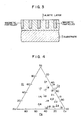
- Figure 4 shows an example of the result of the measurement of the in-plane residual magnetic flux density (Br) of the Co-Fe or Co-Ni-Fe plated alumite film according to the present invention. Note that the data was measured under the condition of a porosity of 0.3. It is found from Figure 4 that a high in-plane residual magnetic flux density can be provided in the range of 0.5 ⁇ x ⁇ 1 and 0 ⁇ y ⁇ 0.3 of the alloy composition (Co x Ni 1-x ) 1-y Fe y .
- the surface (100) of the Co alloy is grown in parallel to a substrate and an easy axis of magnetization is oriented in the film plane of the substrate and thus a more excellent in-plane magnetization film can be provided.
- a method of forming the in-plane magnetization film from a view point of decreasing perpendicular shape anisotropy by lowering an axial ratio of fine pores of the alumite can be also used in addition to the above method using the magnetocrystalline anisotropy of Co.
- a diameter of fine pores of the alumite is substantially proportional to an electrolytic voltage (V) when anode oxidation is effected, and higher is the electrolytic voltage, the diameter of fine pores of the alumite is increased.
- an axial ratio of a magnetic particles in the pores is lowered in the case that the depth of the fine pores is kept constant, which is advantageous to create the in-plane magnetization film.
- the magnetic particles has an axial ratio of 30 or less and preferably 10 or less.
- Sulfuric acid can be used to an anodic oxidation bath. Since sulfuric acid has a large dissociation and lowers an electric resistance of a bath, a voltage applied thereto is about ⁇ 20 V, when an anodic oxidation is effected, and a diameter of fine pores is ⁇ 200 angstroms. In contrast to sulfuric acid, oxalic acid and phosphoric acid have a small dissociation constant and thus a large voltage is applied, when an anodic oxidation is effected.
- alumite having a fine pore diameter of ⁇ 500 angstroms can be obtained, and thus when a magnetic layer has the same thickness, alumite having an axial ratio half of that provided in the sulfuric acid bath can be obtained.
- the fine pores are enlarged in a bath of phosphoric acid, sulfamic acid or the like after the anodic oxidation has been effected, the axial ratio can be further reduced.
- the magnetic alumite film can be made to the in-plane film by the multiplied effect of the magnetocrystalline anisotropy due to the existence of the underlayer and the decrease of perpendicular shape anisotropy due to the axial ratio, as desired, in addition to the control of the compositional ratio of the Fe according to the present invention, so that the in-plane magnetization film having very excellent magnetic characteristics can be provided.
- a thickness of the underlayer is not particularly limited, but in general, it is preferably within a range from 0.02 to 1 micron meter. When it is 0.02 micron meter or less, the surface (110) of Cr is not sufficiently grown and thus it is difficult to longitudinally orient the easy axis of magnetization of Co-Ni alloy, whereas when it exceeds 1 micron meter, the effect applied to the longitudinal orientation of the Co alloy is saturated. Therefore, if the underlayer is made thicker than 1 micron meter, it will be more uneconomical.
- the underlayer is not limited to Cr, but may be any substance so long as it can orient the c-axis of Co in plane direction of the film.
- the Co alloy magnetic layer of the magnetic recording medium according to the present invention preferably has a thickness in a range from 0.05 to 5 micron meters.
- a depth of the fine pores formed in an alumite layer can be adjusted by controlling a time of an anodic oxidation. Although it is not necessary to describe, a depth of the fine pores is less than a thickness of the alumite layer.
- an in-plane magnetization film can be formed even if Fe is contained as a component constituting magnetic particles, and further a reproducing output can be increased by the existence of Fe.
- An aluminum substrate of a 2.5 inch size having a purity of 99.97 % was cleaned and degreased in trichloroethane, the surface oxide layer thereof was removed in NaOH of 5 wt% at 50°C, and thereafter the substrate was neutralized in HNO3 of 6 vol% at 20°C.
- An anodic oxidation was effected in a bath containing H2SO4 of 1 mol/l and Al2(SO4)3 of 5 g/l at 18°C with a constant voltage (counter electrode: carbon) of 17.5 V to form an alumite layer of about 0.45 micron meter.
- a cell diameter (Dc) and a pore diameter (Dp) of the alumite were 450 angstroms and 150 angstroms, respectively.
- the alumite was dipped in H3PO4 of 1 wt% at 30°C and then the anodic oxidation was effected until a voltage across both the electrodes reached 8 V (counter electrode: carbon) with a constant electric current density of 40 mA/dm2.
- the alumite was dipped in the bath for a predetermined period so that the pore diameter was enlarged up to 380 angstroms.
- the alumite was transferred to a plating bath to be subjected to a Co-P plating.
- the bath was composed of Co2+ of 0.2 mol/l, H3BO3 of 0.2 mol/l, gycerine of 2 ml/l, and NaPH2O2 of 0 to 0.02 mol/l with a pH of 3 to 7 at 20°C, a power supply used for the plating was AC 500 Hz and 16 Vp-p (counter electrode: carbon), and Co-P magnetic particles of about 1500 angstroms in height were filled by plating.
- a specimen made by using NaPH2O2 of 0.02 mol/l was cut off to 1 square centimeter, an external magnetic field of 16 KOe, which was parallel to a plane direction, was imposed thereon and the anisotropy in the film plane was determined by a torque curve with a result that the anisotropy field Hk in the film plane was 15 Oe.
- An aluminum substrate having a thickness of 1.28 mm with a Ni-P layer was used as a nonmagnetic substrate and a 500 angstrom thick Co80Ni20 magnetic layer was formed on a Cr underlayer (thickness: 5000 angstroms) by a sputtering method. Then, an anisotropy in the film plane was determined by the same method with a result that it was 830 Oe as Hk.
- Figure 1 shows how the in-plane magnetic characteristics (coercive force and squareness) of the above specimen obtained from Example 1 and the Co-Ni sputtered film of the Comparative Example 1 were varied when the specimens were rotated in an external magnetic field under the condition that the external magnetic field was applied in-plane direction of the film during rotation.
- an in-plane coercive force and an in-plane squareness are normalized by the maximum values of the respective specimens.
- in-plane magnetization film using alumite exhibits good in-plane magnetic properties and their properties are almost independent of the measuring direction in-plane. So, the magnetic recording disk using this material exhibits little output modulation.
- the disk obtained from Example 1 was polished so that a Co-P magnetic layer was made to a thickness of 1micron meter angstroms. Next, a perfluoropolyether lubricant was coated on the surface of the disk and R/W characteristics were evaluated.
- a magnetic head used was a Mn-Zn ferrite head with a track width of 16 micron meters, a gap length of 1.2 micron meters, and the number of windings of 16 + 16, and a spacing was 0.3 micron meter (linear speed: 8.13 m/s).
- Table 1 shows various characteristics of the magnetic alumite films made in Example 1 and a Co-Ni plated magnetic alumite film prepared by Kawai et al.
- Table 1 Specimen Cell Dia. Pore Dia. Magnetic Layer Porosity ( ⁇ ) ( ⁇ ) Thickness ( ⁇ m) (a) 450 270 0.15 0.33 (b) 450 270 0.15 0.33 (c) 450 380 0.15 0.64 (d) 450 380 0.15 0.64 (e) 450 380 0.15 0.64 (f) 450 380 0.15 0.64 (g) 450 380 0.15 0.64 Kawai et al 400 100 1.00 0.06 Table 1 (Continued) Specimen pH of Plating Bath P Content Mr ⁇ /Mr ⁇ Hc ⁇ Ms (at%) (Oe) (emu/cc) (a) 4 0 0.31 340 469 (b) 4 9.0 2.70 1040 426 (c) 4 0 10.90 350 909
- the specimen (a) to which Co simple substance was plated has a saturation magnetization (Ms) greater than 57 emu/cc made by Kawai et al, but it has a Mr ⁇ /Mr ⁇ of 0.31 and a small Hc ⁇ of 340 Oe.
- Ms saturation magnetization
- Specimens (d) to (g) P is added to Co and a content thereof is changed in a range from 2.7 to 10.8 at% by changing a pH in the plating bath in addition to the improvement in configuration similar to that of Specimen (c).
- Specimens (d) to (g) exhibit excellent in-plane magnetic characteristics in that Mr ⁇ /Mr ⁇ is 2.7 to 10.8, Hc ⁇ is 520 to 1330 Oe and Ms is 811 to 884 emu/cc.
- Table 2 shows the result of reproducing outputs at 4 KFCI of Specimens (b) and (d) to (g) shown in Table 1 and the Co-Ni plated alumite film of Kawai et al.
- Table 2 Specimen Reproducing Output at 4KFCI ( ⁇ Vp-p/ ⁇ m ⁇ m/s ⁇ Turn) (b) 0.049 (d) 0.091 (e) 0.098 (f) 0.096 (g) 0.103 Kawai et al 0.020
- the reproducing outputs of the Specimens (b) and (d) to (g) are 2.5 to 5.0 times the CoNi plated alumite film of Kawai et al. This is attributed to the result of the multiplied effects of the increase in Mr ⁇ /Mr ⁇ , the reduction in thickness of the magnetic layer, and the increase in porosity of the alumite.
- An anodic oxidation was effected by the same method as that of Example 1 using an aluminum substrate similar to that of Example 1 and an alumite having an alumite layer of 0.45 micron meter thick, a cell diameter of 450 angstroms, and a pore diameter of 380 angstroms was made.
- the alumite was transferred to a plating bath to be subjected to a Fe plating.
- the bath was composed of Fe2+ of 0.2 mol/l, H3BO3 of 0.2 mol/l, glycerine of 2 ml/l with a pH of 3.0 (at 20°C), and Fe particles of about 1500 angstroms in height were filled by plating using AC 500 Hz and 16 Vp-p (counter electrode: carbon).
- An anodic oxidation was effected by the same method as that of Example 1 using an aluminum substrate similar to that of Example 1 and an alumite having an alumite layer of 0.45 micron meter thick, a cell diameter of 450 angstroms, and a pore diameter of 380 angstroms was made.
- the alumite was transferred to a plating bath to be subjected to a Fe-Cu plating.
- the bath was composed of Fe2+ of 0.2 mol/l, Cu2+ of 0.002 mol/l, H3BO3 of 0.2 mol/l, glycerine of 2 ml/l with a pH of 3.0 (at 20°C), and a multi-layered Fe/Cu particles of about 1500 angstroms in height were filled in alumite pores by plating using a pulse waveform power supply.
- Fe and Cu had an average thickness of 300 angstroms and 20 angstroms, respectively.
- An anodic oxidation was effected by a method similar to that of Example 1 using the same aluminum substrate as that of Example 1 except that the pore diameter en larging treatment was not effected, and an alumite having an alumite layer of 0.45 micron meter thick, a cell diameter of 450 angstroms, and a pore diameter of 150 angstroms was obtained.
- the alumite was transferred to a plating bath similar to that of Example 1 to fill the pores of the alumite with Fe of 1500 angstroms in height.
- Table 3 shows the various characteristics of the magnetic alumite films made by Examples 3 and 4 and Comparative Example 2.
- Table 3 Specimen Cell Dia. Pore Dia. Magnetic Layer Porosity ( ⁇ ) ( ⁇ ) Thickness ( ⁇ m)
- Table 3 Continuously Specimen pH of Plating Bath Cu Content Mr ⁇ /Mr ⁇ Hc ⁇ Ms (at%) (Oe) (emu/cc)
- Table 4 shows the reproducing outputs of Examples 3 and 4 and Comparative Example 2 at 4 KFCI.
- Table 4 Specimen Reproducing Output at 4KFCI ( ⁇ V p-p / ⁇ m ⁇ m/s ⁇ Turn) Example 3 0.070
- Example 4 0.075 Comparative Example 2 0.010
- An aluminum substrate having a purity of 99.99 % was subjected to an ultrasonic cleaning in torichloroethylene, the surface oxide layer thereof was removed in NaOH of 5 wt%, and thereafter the substrate was neutralized in HNO3 of 6 vol% and washed with water.
- anodic oxidation of the aluminum substrate was carried out in a bath (20°C) of H2SO4 of 1 mol/l using carbon as a counter electrode with a current density of 1A/dm2 to form an alumite layer of 0.3 micron meter thick.
- a Co-P plating bath was composed of CoSO4 ⁇ 7H2O of 0.2 mol/l, H3BO3 of 0.2 mol/l, glycerine of 2 ml/l, and NaPH2O2 ⁇ H2O of 0.1 mol/l and a pH of the bath was adjusted to 4.0 by H2SO4 of 1 mol/l.
- a power supply of AC 500 Hz and 16 V p-p was used for the plating.
- the carbon was used as the counter electrode and the plating was effected for 3 minutes at 20°C.
- a Co plated film was formed by the same method as that of Example 6 except that NaPH2O2 ⁇ H2O was not added to a plating bath.
- Example 6 After an alumite layer having a thickness of 0.45 micron meter was formed on a substrate by the same method as that of Example 6, the diameter of the fine pores of the alumite was enlarged to 370 angstroms in a bath containing phosphoric acid of 1 wt% at 30°C. Thereafter, the substrate was subjected to a CoNi-P plating by the following method.
- a plating bath was composed of CoSO4 ⁇ 7H2O of 0.090 mol/l, NiSO4 ⁇ 6H2O of 0.038 mol/l, H3BO3 of 0.24 mol/l, glycerine of 2 ml/l, and NaPH2O2 ⁇ H2O of 0.51 mol/l and a pH was adjusted to 6.5 by NaOH of 5 wt%.
- An AC power supply of AC 500Hz, 25 V p-p was used for the plating, a DC bias was imposed so that -15 V was applied to an alumite side and +10 V was applied to a counter electrode (carbon) side, and the plating was effected for 10 seconds at 20°C.
- a CoNi plated film was formed by the same method as that of Example 7 except that a plating bath was composed of CoSO4 ⁇ 7H2O of 0.064 mol/l, NiSO4 ⁇ 6H2O of 0.064 mol/l, H3BO3 of 0.24 mol/l, and glycerine of 2 ml/l.
- a plating bath was composed of CoSO4 ⁇ 7H2O of 0.090 mol/l, FeSO4(NH4)2SO4 ⁇ 6H2O of 0.006 mol/l, H3BO3 of 0.24 mol/l, glycerine of 2 ml/l, NaPH2O2 ⁇ H2O of 0.51 mol/l and a pH was adjusted to 4.0 using H2SO4 of 1 mol/l.
- An AC power supply of AC 500Hz and 25 V p-p was used for the plating, a DC bias was imposed so that -15 V was applied to an alumite side and +10 V was applied to a counter electrode (carbon) side, and the plating was effected for 10 seconds at 20°C.
- a CoFe plated film was formed by the same method as that of Example 8 except that NaPH2O2 ⁇ H2O was not added to a plating bath.
- a plating bath was composed of CoSO4 ⁇ 7H2O of 0.085 mol/l, NiSO4 ⁇ 6H2O of 0.036 mol/l, FeSO4(NH4)2SO4 ⁇ 6H2O of 0.007 mol/l, H3BO3 of 0.24 mol/l, glycerine of 2 ml/l, and NaPH2O2 ⁇ H2O of 0.51 mol/l, and a pH was adjusted to 4.0 using H2SO4 of 1 mol/l.
- An AC power supply of AC 500Hz and 25 V p-p was used for the plating, a DC bias was imposed so that -15 V was applied to an alumite side and +10 V was applied to a counter electrode (carbon) side, and the plating was effected for 10 seconds at 20°C.
- a CoNiFe plated film was formed by the same method as that of Example 9 except that NaPH2O2 ⁇ H2O was not added to a plating bath.
- Table 5 summarizes the result of the measurement.
- Table 5 Specimen Film Composition (at%) Example 6 Co 88.3 P 11.7 Comparative Example 3 Co100
- Example 7 Co 77.8 Ni 9.7 P 12.5 Comparative Example 4
- Example 8 Co 84.3 Fe 4.4 P 11.3
- Comparative Example 5 Co 95.0 Fe 5.0
- Example 9 Co 76.3 Ni 8.5 Fe 4.4 P 10.7
- Comparative Example 6 Co 85.7 Ni 9.5 Fe 4.8
- Table 5 (Continued) Specimen In-plane Coercive Force (Oe) In-plane Squareness
- Example 6 1240 0.43 Comparative Example 3 440 0.14
- Example 7 1000 0.45 Comparative Example 4 550 0.27
- Example 9 1050 0.43 Comparative Example 6 700 0.31
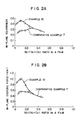
- Figures 2A and 2B show the relationship between the in-plane squareness and coercive force of the magnetic alumite films obtained from Example 10 and Comparative Example 7, and the ratio of atoms of Ni/(Ni + Co) in the films.
- a content of P i.e., P/(Co + Ni + P) is 0.092 to 0.135
- Comparative Example 7 does not contain P.
- the P content causes the in-plane squareness and coercive force to be increased in the region where a large amount of Co is contained. It is considered that the saturation magnetization of the film is large at higher Co content, and the addition of P contributes to the improvement of reproducing output.
- a Co-P plating was effected by the same method as that of Example 6 except that the pH of a plating bath was adjusted to 6.5 by NaOH of 5 wt%.
- Table 6 shows the result of the measurement of the in-plane coercive force and squareness of Co-P plated films obtained from Examples 6 and 11.
- Table 6 Specimen Film Composition (at%) pH Example 6 Co 88.3 P 11.7 4.0
- Example 11 Co 93.8 P 6.2 6.5
- Table 6 Continuous) Specimen In-plane Coercive Force (Oe) In-plane Squareness
- Example 6 1240 0.43 Example 11 900 0.28
- An anodic oxidation of a rolled aluminum substrate of a purity of 99.99 % was carried out in H2SO4 of 1 mol/l at 20°C with a constant electric current density of 1A/dm2 to form an alumite layer of 0.45 micron meter thick.
- a cell diameter and a pore diameter were 450 angstroms and 130 angstroms, respectively.
- the specimens were dipped in a H3PO4 of 1 wt% at 30°C, the pore diameter was enlarged to 395 angstroms and homogenization of barrier layer was carried out.
- Specimens A and B exhibit the effect of the addition of P under the condition that a pore diameter is 270 angstroms and a porosity is 0.33.
- Specimen A which does not contain P has a S ⁇ /S ⁇ of 0.31, that is, this film is a perpendicular magnetization film.
- Specimen B which contains P of 9.0 at% has a S improved from 0.098 to 0.414 and a S ⁇ /S ⁇ of 1.76 and is moved to an in-plane magnetization film (S ⁇ /S ⁇ > 1) regardless that it has an axial ratio of about twice that of Specimen A.
- Specimen B has a large Hc of 1350 Oe, and thus it is considered that there still remains a perpendicular component.
- Specimen C and D are used to examine the effect of the addition of P, when a porosity is increased from 0.33 to 0.61 and an axial ratio is reduced to 5 or less.
- Specimen C which does not contain P has a significantly increased S ⁇ of 0.667 but has a low in-plane coercive force of 340 Oe
- Specimen D which contains P of 5.0 at% exhibits an excellent in-plane magnetic characteristics with a S ⁇ of 0.58, S ⁇ /S ⁇ of 10.7, and an Hc ⁇ of 680 and has a perpendicular coercive force reduced to about 700 Oe.
- the alumite was transferred to H3PO4 of 1 wt% and the anodic oxidation was again carried out until a voltage across both electrodes (counter electrode: carbon) reached 8 V with a constant electric current density of 40mA/dm2, and then the specimen was dipped in the bath to enlarge the diameter of the fine pores thereof.
- the specimen was transferred to a plating bath containing Co2+ of 0.2 mol/l, Cu2+ of 0.002 mol/l, H3BO3 of 0.2 mol/l, and glycerine of 2 ml/l, and multi-layered Co/Cu particles of 0.25 micron meter in height were filled into the fine pores of the specimen by plating using a pulse wave power supply.
- the basic idea of the pulse plating is an alternative application of an electric potential (ECo) by which Co2+ is reduced and an electric potential (ECu) by which Cu2+ is reduced.
- ECo electric potential
- ECu electric potential
- NaPH2O2 having a concentration of 0.02 mol/l was added to the plating bath used in the Example 13 and a multi-layered Co94-P6/Cu particles of 0.25 micron meter in height were filled into the fine pores of the alumite of Example 13 by plating.
- Fe2+ having a concentration of 0.2 mol/l was added to the plating bath used in the Example 13 and a multi-layered Fe60-Co40/Cu particles of 0.25 micron meter in height were filled into the fine pores of the alumite of Example 13 by plating.
- Cu2+ was removed from the plating bath used in Example 13 and Ni2+ having a concentration of 0.1 mol/l was added thereto and a multi-layered Co/Ni particles of 0.25 micron meter in height were filled into the fine pores of the alumite of Example 13 by plating.
- Cu2+ was removed from the plating bath used in Example 13 and Fe2+ having a concentration of 0.2 mol/l was added thereto and a Fe/Cu multi-film of 0.25 micron meter was filled into the fine pores of the alumite of Example 13 by plating.
- the Co simple substance particles were filled into the fine pores of an alumite under the same condition as that of Example 13 except that a plating bath did not contain Cu2+ and a power supply of AC 500 Hz and 16 V p-p was used.
- the Fe simple substance particles were filled into the fine pores of an alumite under the same condition as that of Example 13 except that a plating bath did not contain Cu2+ and a power supply of AC 500 Hz and 16 V p-p was used.
- Table 8 shows the configurational characteristics and magnetic characteristics of the magnetic alumite films obtained in Examples 13 to 17 and Comparative Example 8 and 9.
- Table 8 Cell Dia. Pore Dia. Porosity Mr ⁇ /Ms (A) (A) Example 13 450 380 0.64 0.68 Example 14 450 380 0.64 0.74 Example 15 450 380 0.64 0.65 Example 16 450 380 0.64 0.70 Example 17 450 380 0.64 0.60 Comparative Example 8 450 380 0.64 0.64 Comparative Example 9 450 380 0.64 0.32 Table 8 (Continued) Hc ⁇ Cu Layer Thickness Ni Layer Thickness (Oe) ( ⁇ ) ( ⁇ ) ( ⁇ ) ( ⁇ ) ( ⁇ ) Example 13 520 200 --- Example 14 790 200 --- Example 15 600 200 --- Example 16 800 --- 200 Example 17 500 200 --- Comparative Example 8 340 --- Comparative Example 9 175 --- --- ---
- the provision of the layer structure in the magnetic particles improves the in-plane squareness and coercive force as compared with the cases in which plating was effected only by Co or Fe. From this result, it is considered that the introduction of the multi-layered structure results in the effect of lowering the shape anisotropy of the particles.
- the layered structure is not necessarily required to be a perfect layer.
- An aluminum substrate having a purity of 99.99 % was cleaned by trichloroethylene, and after the surface oxide layer thereof was removed in NaOH of 5 wt%, the substrate was neutralized in HNO3 of 6 vol% and washed with water.
- an anodic oxidation of aluminum substrate was carried out in a bath (20°C) containing H2SO4 of 1 mol/l using carbon as a counter electrode with a current density of 1A/dm2 to form an alumite layer of 3 micron meter. Thereafter, the diameter of the fine pores of the alumite was enlarged to 260 angstroms in a bath containing H3PO4 of 1 wt% (30°C).
- a plating bath was composed of H3BO3 of 0.2 mol/l, glycerine of 2 ml/l, and further a mixture prepared by CoSO4 ⁇ 7H2O, FeSO3(NH4)2SO4 ⁇ 6H2O, and NiSO4 ⁇ 6H2O to provide a desired alloy compositional ratio.
- a pH of the bath was adjusted to 3 by H2SO4 of 1 mol/l.
- a power supply of AC 500 Hz and 16 V p-p was used for plating and the plating was continued using carbon as a counter electrode at 20°C until overflow occurred.
- a used magnetic head was a metal-in-gap (MIG) type ring head having a CoNbZr amorphous layer (Bs9000G) sputtered to the vicinity of the gap thereof and had a gap length of 0.44 micron meter.
- a spacing between the magnetic head and a recording medium in the evaluation was 0.22 + 0.1 micron meter, and the performance of various mediums were compared based on an output at a recording density of 10 KFCI.
- Table 9 summarizes the composition of the prepared specimens and the result of the measurement of the in-plane residual magnetic flux density Br (kG) and the reproducing output thereof at a recording density of 10 KFCI. Note that, in Table 9, the reproducing output of Specimen composed of Co70Ni30 is used as a reference to the reproducing outputs.
- the medium according to the present invention satisfying the condition of 0.5 ⁇ x ⁇ 1 and 0 ⁇ y ⁇ 0.3 in the composition of (Co x Ni 1-x ) 1-y fe y forms an in-plane magnetization film of high saturation magnetization and thus can improve the reproducing output thereof.
Landscapes
- Engineering & Computer Science (AREA)
- Metallurgy (AREA)
- Manufacturing & Machinery (AREA)
- Chemical & Material Sciences (AREA)
- Inorganic Chemistry (AREA)
- Magnetic Record Carriers (AREA)
Applications Claiming Priority (4)
| Application Number | Priority Date | Filing Date | Title |
|---|---|---|---|
| JP142599/89 | 1989-06-05 | ||
| JP14259989 | 1989-06-05 | ||
| JP31007089 | 1989-11-29 | ||
| JP310070/89 | 1989-11-29 |
Publications (2)
| Publication Number | Publication Date |
|---|---|
| EP0402065A2 true EP0402065A2 (fr) | 1990-12-12 |
| EP0402065A3 EP0402065A3 (fr) | 1991-10-02 |
Family
ID=26474549
Family Applications (1)
| Application Number | Title | Priority Date | Filing Date |
|---|---|---|---|
| EP19900306015 Withdrawn EP0402065A3 (fr) | 1989-06-05 | 1990-06-01 | Milieu d'enrégistrement magnétique |
Country Status (3)
| Country | Link |
|---|---|
| US (1) | US5480694A (fr) |
| EP (1) | EP0402065A3 (fr) |
| JP (2) | JP2923790B2 (fr) |
Cited By (1)
| Publication number | Priority date | Publication date | Assignee | Title |
|---|---|---|---|---|
| WO2001059771A1 (fr) * | 2000-02-11 | 2001-08-16 | Obschestvo S Ogranichennoi Otvetstvennostiju 'laboratoriya Ionnykh Nanotekhnology (Ooo 'labintekh') | Procede de production d'un support d'informations magnetique |
Families Citing this family (18)
| Publication number | Priority date | Publication date | Assignee | Title |
|---|---|---|---|---|
| US5679473A (en) * | 1993-04-01 | 1997-10-21 | Asahi Komag Co., Ltd. | Magnetic recording medium and method for its production |
| WO1996037885A1 (fr) * | 1995-05-26 | 1996-11-28 | International Business Machines Corporation | Disque a contact direct pour enregistrement magnetique vertical de donnees |
| US6174597B1 (en) * | 1996-07-26 | 2001-01-16 | Kabushiki Kaisha Toshiba | Magnetic recording apparatus |
| JP2821456B1 (ja) * | 1997-07-03 | 1998-11-05 | 学校法人早稲田大学 | コバルト・鉄・ニッケル磁性薄膜とその製造方法,及びそれを用いた複合型薄膜磁気ヘッドと磁気記憶装置 |
| US5867239A (en) * | 1997-10-17 | 1999-02-02 | Minnesota Mining And Manufacturing Company | Wide angle optical retarder |
| US20020145826A1 (en) * | 2001-04-09 | 2002-10-10 | University Of Alabama | Method for the preparation of nanometer scale particle arrays and the particle arrays prepared thereby |
| US6808741B1 (en) * | 2001-10-26 | 2004-10-26 | Seagate Technology Llc | In-line, pass-by method for vapor lubrication |
| US6995121B1 (en) | 2002-06-24 | 2006-02-07 | Seagate Technology Llc | Stability polymeric lubricants and thin film recording media comprising same |
| US6846542B1 (en) | 2002-09-30 | 2005-01-25 | Seagate Technology Llc | UV treatment for improving performance of lubricated thin film recording media and media obtained thereby |
| SG118264A1 (en) * | 2004-06-29 | 2006-01-27 | Sony Corp | A magnetic material and a MEMS device using the magnetic material |
| US20070147348A1 (en) * | 2005-12-23 | 2007-06-28 | Tingting Lu | Methods, systems, and computer program products for providing location information for VoIP emergency calling |
| US7719793B2 (en) | 2005-12-28 | 2010-05-18 | Hitachi Global Storage Technologies Netherlands B.V. | Circumferentially patterned disk for longitudinal and perpendicular recording |
| US7532505B1 (en) * | 2006-07-17 | 2009-05-12 | Grandis, Inc. | Method and system for using a pulsed field to assist spin transfer induced switching of magnetic memory elements |
| US7502249B1 (en) * | 2006-07-17 | 2009-03-10 | Grandis, Inc. | Method and system for using a pulsed field to assist spin transfer induced switching of magnetic memory elements |
| US8900655B2 (en) | 2006-10-04 | 2014-12-02 | Seagate Technology Llc | Method for fabricating patterned magnetic recording device |
| US7704614B2 (en) * | 2006-10-20 | 2010-04-27 | Seagate Technology Llc | Process for fabricating patterned magnetic recording media |
| JPWO2010002003A1 (ja) | 2008-07-03 | 2011-12-22 | 株式会社フジクラ | パルス光発生器及びパルスファイバレーザ |
| US8411497B2 (en) | 2010-05-05 | 2013-04-02 | Grandis, Inc. | Method and system for providing a magnetic field aligned spin transfer torque random access memory |
Family Cites Families (7)
| Publication number | Priority date | Publication date | Assignee | Title |
|---|---|---|---|---|
| JPS59221826A (ja) * | 1983-05-28 | 1984-12-13 | Toshiro Takahashi | 磁気記録媒体 |
| DE3421442A1 (de) * | 1983-06-10 | 1984-12-13 | Nippon Light Metal Co. Ltd., Tokio/Tokyo | Verfahren zur herstellung eines magnetischen aufzeichnungsmediums |
| US4774130A (en) * | 1985-01-17 | 1988-09-27 | Hitachi Metals, Ltd. | Magnetic recording medium |
| JPS623423A (ja) * | 1985-06-27 | 1987-01-09 | Pilot Precision Co Ltd | Al製磁気記録材料の基板 |
| JPS6262419A (ja) * | 1985-09-12 | 1987-03-19 | Pilot Precision Co Ltd | 磁気記録材料およびその製造方法 |
| JPS62125526A (ja) * | 1985-11-27 | 1987-06-06 | Nippon Gakki Seizo Kk | 磁気記録媒体 |
| US4738885A (en) * | 1986-02-24 | 1988-04-19 | Kyocera Corporation | Magnetic disk, substrate therefor and process for preparation thereof |
-
1990
- 1990-02-27 JP JP2046737A patent/JP2923790B2/ja not_active Expired - Fee Related
- 1990-03-22 JP JP2072768A patent/JP2923791B2/ja not_active Expired - Lifetime
- 1990-06-01 EP EP19900306015 patent/EP0402065A3/fr not_active Withdrawn
- 1990-06-04 US US07/532,756 patent/US5480694A/en not_active Expired - Fee Related
Cited By (2)
| Publication number | Priority date | Publication date | Assignee | Title |
|---|---|---|---|---|
| WO2001059771A1 (fr) * | 2000-02-11 | 2001-08-16 | Obschestvo S Ogranichennoi Otvetstvennostiju 'laboratoriya Ionnykh Nanotekhnology (Ooo 'labintekh') | Procede de production d'un support d'informations magnetique |
| US6565929B2 (en) | 2000-02-11 | 2003-05-20 | Obschestvo s organichennoi otvetstvennostju “Laboratoria Ionnykh Nanotekhnology” (OOO “Labintech”) | Method for producing magnetic information carrier |
Also Published As
| Publication number | Publication date |
|---|---|
| JP2923790B2 (ja) | 1999-07-26 |
| JP2923791B2 (ja) | 1999-07-26 |
| EP0402065A3 (fr) | 1991-10-02 |
| US5480694A (en) | 1996-01-02 |
| JPH03219415A (ja) | 1991-09-26 |
| JPH03219416A (ja) | 1991-09-26 |
Similar Documents
| Publication | Publication Date | Title |
|---|---|---|
| US6426157B1 (en) | Perpendicular magnetic recording medium | |
| US5480694A (en) | Magnetic recording medium | |
| Shiraki et al. | Perpendicular magnetic media by anodic oxidation method and their recording characteristics | |
| JP3429972B2 (ja) | 磁気記録媒体およびそれを用いた磁気記憶装置 | |
| JPH0666087B2 (ja) | 磁気記録媒体 | |
| JP2002175621A (ja) | 磁気記録媒体及びその製造方法 | |
| EP0479232B1 (fr) | Alliage magnétique à base de cobalt, nickel, platine et chrome | |
| CN1070278A (zh) | 磁性记录介质及其制造方法 | |
| JPH05274644A (ja) | 磁気記録媒体及びその製造方法 | |
| US6620533B2 (en) | Magnetic recording medium | |
| US6809901B2 (en) | Low moment material for magnetic recording head write pole | |
| EP0809238B1 (fr) | Support d'enregistrement magnétique et système d'enregistrement magnétique utilisant un tel support | |
| JPH06295431A (ja) | 垂直磁気記録媒体 | |
| JP2550039B2 (ja) | 面内磁気記録媒体 | |
| US4939045A (en) | Magnetic recording medium | |
| JPH0650683B2 (ja) | 磁気記憶体 | |
| Osaka et al. | An attempt on control of perpendicular coercivity toward film thickness direction of electroless plated cobalt alloy films for perpendicular magnetic recording | |
| Tsumita et al. | Perpendicular and longitudinal magnetic properties and crystallographic orientation of Co‐Cr film | |
| Terada et al. | Signal-to-noise ratio studies on γ-Fe 2 O 3 thin film recording disks | |
| JP2644994B2 (ja) | ディスク状磁気記録媒体 | |
| Turilli et al. | Magneto and magneto-optical recording materials | |
| JP4389381B2 (ja) | 磁気記録媒体及び磁気記録装置 | |
| JP2897485B2 (ja) | 軟磁性薄膜およびその製造方法 | |
| JP2963230B2 (ja) | 磁気記録媒体の製造方法 | |
| JP2991688B2 (ja) | 磁気記録媒体及び磁気記録再生装置 |
Legal Events
| Date | Code | Title | Description |
|---|---|---|---|
| PUAI | Public reference made under article 153(3) epc to a published international application that has entered the european phase |
Free format text: ORIGINAL CODE: 0009012 |
|
| AK | Designated contracting states |
Kind code of ref document: A2 Designated state(s): DE GB |
|
| PUAL | Search report despatched |
Free format text: ORIGINAL CODE: 0009013 |
|
| AK | Designated contracting states |
Kind code of ref document: A3 Designated state(s): DE GB |
|
| RHK1 | Main classification (correction) |
Ipc: G11B 5/64 |
|
| STAA | Information on the status of an ep patent application or granted ep patent |
Free format text: STATUS: THE APPLICATION IS DEEMED TO BE WITHDRAWN |
|
| 18D | Application deemed to be withdrawn |
Effective date: 19920403 |