EP0402910A2 - Schweissmaschine mit Schweissspiegel - Google Patents
Schweissmaschine mit Schweissspiegel Download PDFInfo
- Publication number
- EP0402910A2 EP0402910A2 EP90111225A EP90111225A EP0402910A2 EP 0402910 A2 EP0402910 A2 EP 0402910A2 EP 90111225 A EP90111225 A EP 90111225A EP 90111225 A EP90111225 A EP 90111225A EP 0402910 A2 EP0402910 A2 EP 0402910A2
- Authority
- EP
- European Patent Office
- Prior art keywords
- welding
- columns
- welding machine
- mirror
- machine according
- Prior art date
- Legal status (The legal status is an assumption and is not a legal conclusion. Google has not performed a legal analysis and makes no representation as to the accuracy of the status listed.)
- Granted
Links
Images



Classifications
-
- B—PERFORMING OPERATIONS; TRANSPORTING
- B29—WORKING OF PLASTICS; WORKING OF SUBSTANCES IN A PLASTIC STATE IN GENERAL
- B29C—SHAPING OR JOINING OF PLASTICS; SHAPING OF MATERIAL IN A PLASTIC STATE, NOT OTHERWISE PROVIDED FOR; AFTER-TREATMENT OF THE SHAPED PRODUCTS, e.g. REPAIRING
- B29C65/00—Joining or sealing of preformed parts, e.g. welding of plastics materials; Apparatus therefor
- B29C65/02—Joining or sealing of preformed parts, e.g. welding of plastics materials; Apparatus therefor by heating, with or without pressure
- B29C65/18—Joining or sealing of preformed parts, e.g. welding of plastics materials; Apparatus therefor by heating, with or without pressure using heated tools
- B29C65/20—Joining or sealing of preformed parts, e.g. welding of plastics materials; Apparatus therefor by heating, with or without pressure using heated tools with direct contact, e.g. using "mirror"
- B29C65/2007—Joining or sealing of preformed parts, e.g. welding of plastics materials; Apparatus therefor by heating, with or without pressure using heated tools with direct contact, e.g. using "mirror" characterised by the type of welding mirror
- B29C65/203—Joining or sealing of preformed parts, e.g. welding of plastics materials; Apparatus therefor by heating, with or without pressure using heated tools with direct contact, e.g. using "mirror" characterised by the type of welding mirror being several single mirrors, e.g. not mounted on the same tool
-
- B—PERFORMING OPERATIONS; TRANSPORTING
- B29—WORKING OF PLASTICS; WORKING OF SUBSTANCES IN A PLASTIC STATE IN GENERAL
- B29C—SHAPING OR JOINING OF PLASTICS; SHAPING OF MATERIAL IN A PLASTIC STATE, NOT OTHERWISE PROVIDED FOR; AFTER-TREATMENT OF THE SHAPED PRODUCTS, e.g. REPAIRING
- B29C65/00—Joining or sealing of preformed parts, e.g. welding of plastics materials; Apparatus therefor
- B29C65/02—Joining or sealing of preformed parts, e.g. welding of plastics materials; Apparatus therefor by heating, with or without pressure
- B29C65/18—Joining or sealing of preformed parts, e.g. welding of plastics materials; Apparatus therefor by heating, with or without pressure using heated tools
- B29C65/20—Joining or sealing of preformed parts, e.g. welding of plastics materials; Apparatus therefor by heating, with or without pressure using heated tools with direct contact, e.g. using "mirror"
- B29C65/2053—Joining or sealing of preformed parts, e.g. welding of plastics materials; Apparatus therefor by heating, with or without pressure using heated tools with direct contact, e.g. using "mirror" characterised by special ways of bringing the welding mirrors into position
- B29C65/2084—Joining or sealing of preformed parts, e.g. welding of plastics materials; Apparatus therefor by heating, with or without pressure using heated tools with direct contact, e.g. using "mirror" characterised by special ways of bringing the welding mirrors into position by pivoting
-
- B—PERFORMING OPERATIONS; TRANSPORTING
- B29—WORKING OF PLASTICS; WORKING OF SUBSTANCES IN A PLASTIC STATE IN GENERAL
- B29C—SHAPING OR JOINING OF PLASTICS; SHAPING OF MATERIAL IN A PLASTIC STATE, NOT OTHERWISE PROVIDED FOR; AFTER-TREATMENT OF THE SHAPED PRODUCTS, e.g. REPAIRING
- B29C65/00—Joining or sealing of preformed parts, e.g. welding of plastics materials; Apparatus therefor
- B29C65/78—Means for handling the parts to be joined, e.g. for making containers or hollow articles, e.g. means for handling sheets, plates, web-like materials, tubular articles, hollow articles or elements to be joined therewith; Means for discharging the joined articles from the joining apparatus
- B29C65/7858—Means for handling the parts to be joined, e.g. for making containers or hollow articles, e.g. means for handling sheets, plates, web-like materials, tubular articles, hollow articles or elements to be joined therewith; Means for discharging the joined articles from the joining apparatus characterised by the feeding movement of the parts to be joined
-
- B—PERFORMING OPERATIONS; TRANSPORTING
- B29—WORKING OF PLASTICS; WORKING OF SUBSTANCES IN A PLASTIC STATE IN GENERAL
- B29C—SHAPING OR JOINING OF PLASTICS; SHAPING OF MATERIAL IN A PLASTIC STATE, NOT OTHERWISE PROVIDED FOR; AFTER-TREATMENT OF THE SHAPED PRODUCTS, e.g. REPAIRING
- B29C66/00—General aspects of processes or apparatus for joining preformed parts
- B29C66/01—General aspects dealing with the joint area or with the area to be joined
- B29C66/05—Particular design of joint configurations
- B29C66/301—Three-dimensional joints, i.e. the joined area being substantially non-flat
-
- B—PERFORMING OPERATIONS; TRANSPORTING
- B29—WORKING OF PLASTICS; WORKING OF SUBSTANCES IN A PLASTIC STATE IN GENERAL
- B29C—SHAPING OR JOINING OF PLASTICS; SHAPING OF MATERIAL IN A PLASTIC STATE, NOT OTHERWISE PROVIDED FOR; AFTER-TREATMENT OF THE SHAPED PRODUCTS, e.g. REPAIRING
- B29C66/00—General aspects of processes or apparatus for joining preformed parts
- B29C66/50—General aspects of joining tubular articles; General aspects of joining long products, i.e. bars or profiled elements; General aspects of joining single elements to tubular articles, hollow articles or bars; General aspects of joining several hollow-preforms to form hollow or tubular articles
- B29C66/51—Joining tubular articles, profiled elements or bars; Joining single elements to tubular articles, hollow articles or bars; Joining several hollow-preforms to form hollow or tubular articles
- B29C66/54—Joining several hollow-preforms, e.g. half-shells, to form hollow articles, e.g. for making balls, containers; Joining several hollow-preforms, e.g. half-cylinders, to form tubular articles
- B29C66/545—Joining several hollow-preforms, e.g. half-shells, to form hollow articles, e.g. for making balls, containers; Joining several hollow-preforms, e.g. half-cylinders, to form tubular articles one hollow-preform being placed inside the other
-
- B—PERFORMING OPERATIONS; TRANSPORTING
- B29—WORKING OF PLASTICS; WORKING OF SUBSTANCES IN A PLASTIC STATE IN GENERAL
- B29C—SHAPING OR JOINING OF PLASTICS; SHAPING OF MATERIAL IN A PLASTIC STATE, NOT OTHERWISE PROVIDED FOR; AFTER-TREATMENT OF THE SHAPED PRODUCTS, e.g. REPAIRING
- B29C66/00—General aspects of processes or apparatus for joining preformed parts
- B29C66/80—General aspects of machine operations or constructions and parts thereof
-
- B—PERFORMING OPERATIONS; TRANSPORTING
- B29—WORKING OF PLASTICS; WORKING OF SUBSTANCES IN A PLASTIC STATE IN GENERAL
- B29C—SHAPING OR JOINING OF PLASTICS; SHAPING OF MATERIAL IN A PLASTIC STATE, NOT OTHERWISE PROVIDED FOR; AFTER-TREATMENT OF THE SHAPED PRODUCTS, e.g. REPAIRING
- B29C66/00—General aspects of processes or apparatus for joining preformed parts
- B29C66/80—General aspects of machine operations or constructions and parts thereof
- B29C66/82—Pressure application arrangements, e.g. transmission or actuating mechanisms for joining tools or clamps
- B29C66/824—Actuating mechanisms
- B29C66/8242—Pneumatic or hydraulic drives
-
- B—PERFORMING OPERATIONS; TRANSPORTING
- B29—WORKING OF PLASTICS; WORKING OF SUBSTANCES IN A PLASTIC STATE IN GENERAL
- B29C—SHAPING OR JOINING OF PLASTICS; SHAPING OF MATERIAL IN A PLASTIC STATE, NOT OTHERWISE PROVIDED FOR; AFTER-TREATMENT OF THE SHAPED PRODUCTS, e.g. REPAIRING
- B29C66/00—General aspects of processes or apparatus for joining preformed parts
- B29C66/80—General aspects of machine operations or constructions and parts thereof
- B29C66/83—General aspects of machine operations or constructions and parts thereof characterised by the movement of the joining or pressing tools
- B29C66/832—Reciprocating joining or pressing tools
- B29C66/8322—Joining or pressing tools reciprocating along one axis
- B29C66/83221—Joining or pressing tools reciprocating along one axis cooperating reciprocating tools, each tool reciprocating along one axis
Definitions
- the invention relates to a welding machine with a welding mirror for heating the workpieces to be welded together according to the preamble of claim 1.
- Such welding machines are known.
- the plastic components to be welded are attached to one another and fastened to plates which are arranged displaceably in a frame of the machine by means of guide rods and drive cylinders.
- a heatable welding mirror is inserted between the workpieces, which heats the workpieces. After removing the welding mirror, the plates are moved towards each other and the heated components are welded together.
- the structure of such welding machines is very different.
- the frame required to accommodate the press plates with the guides and drive cylinders with the additional facilities for the heating mirror proves to be cumbersome and complex for the operation of the welding machine, since the access to the working space between the plates is made possible by the spars of the frame and by the facilities for the heating mirror is disabled.
- the object of the invention is therefore to design the welding machine so that a compact, simplified frame with rigid press plates and an integrated welding mirror arrangement perform the various tasks, such as accessibility for operation, horizontal or vertical design and over lapping of the welding process with a basic structure.
- the welding machine is very simple in construction.
- the main advantage of the design is that the space between the press plates is accessible from several sides, so that the machine can be better integrated into the work process.
- the columns can be arranged so that a desired accessibility from several sides is achieved.
- the welding machine thus enables the operator position to be optionally assigned, as well as extensive freedom for the rotability of the welding mirror and the optional assignment of the transfer system for the components and finished products to be delivered.
- a compact modular element results from the arrangement of two or three columns for holding two press plates and the heating mirror which can be pivoted about a column.
- This modular element can be arranged vertically or horizontally, depending on the requirements.
- a welding machine with a double welding station can be put together, in which, in order to shorten the processing time, the welding mirror is moved back and forth alternately between the two stations, the heating taking place alternately in one station and the welding simultaneously in the other station .
- a first embodiment is shown in Figures 1 and 2.
- Two press plates 1 and 2 are slidably arranged on three columns 3, 4 and 5.
- the columns 3, 4 and 5 are in turn preferably held fixed to the housing at their ends.
- end plates, yokes or housing frames (not shown) can be provided.
- the continuous columns 3, 4 and 5 form the welding machine frame, the columns also taking on the task of guiding the plates 1 and 2 and a column, namely the column 4 and pivot axis for a welding mirror 8, that shown in Figure 1 Way can be swung in and out.
- the columns 3 and 5 are arranged at adjacent corners of the plates 1, 2, while the column 4 is provided opposite in the middle on the edge of the plates.
- the plates 1 and 2 are provided with receptacles 9 and 10 designed in accordance with the components to be welded.
- the welding mirror 8 can also be designed accordingly. In the pivoted-out position, the welding mirror 8 can enter a quiver 12 or a handling device for charging and preheating the welding parts, which is arranged outside the plates 1, 2 behind the column 4.
- the machine is accessible from three sides and the welding mirror can be swung out in either direction of rotation.
- the columns are arranged vertically, so that there is a vertical construction.
- the columns can also be arranged horizontally for a horizontal arrangement of the welding machine.
- FIGS. 6 and 7 Another embodiment is shown in FIGS. 6 and 7, in which the welding machine is arranged lying down term end pieces 16, 18 held, which are attached to a base 20, which is set up with corresponding frame feet 21 on the floor.
- the workpieces located between the press plates 1 and 2 are heated and welded on the upper floor and the finished parts are removed on the lower floor.
- FIG. 7 shows the top view of the upper floor according to FIG. 6.
- the drive for pivoting the welding mirror 8 is also not shown.
- the exemplary embodiment shown in FIGS. 8 to 10 is a welding machine with two work stations I and II.
- the welding mirror 28, which can be rotated about a central column 24, can be pivoted back and forth between the two stations I and II.
- On the side of station I there are two columns 23 and on the side of station II two columns 25 are arranged stationary.
- the columns 23 and the column 24 are for guiding and moving the plates 30, 31 for the station I and the column 24 with the columns 25 is for guiding the plates 32 and 33 for the station II.
- the plates 30 to 33 are each displaceably arranged on a common plate 36 or 38, which are held and guided in the columns 23, 24 and 25, via longitudinal drives, of which a drive 35 is shown in FIG. 9.
- the plates 30 to 33 carry the holding devices for the workpieces to be welded.
- the separate drives for stations I and II are necessary because the displacement paths in the two stations are different, depending on whether the welding mirror is retracted in the respective station in order to heat the workpieces picked up, or whether in the
- the plates 30, 31 and 32, 33 are in the open position of the welding machine, so that the welding mirror can be retracted in station I, while in station II the finished part can be removed and the next workpieces are inserted.
- the welding mirror is pivoted into station II and the plate pairs are pushed together, so that the previously heated workpieces are welded in station I and the inserted workpieces are heated in station II.
- the plates 36 and 38 which support the press plates 30 to 33, can also be moved along the columns 23 to 25, for example to open the machine completely for changing the workpiece holders or to take rapid movements into account in the process sequence, depending on the degree of mechanization of the machine.
- the columns 23 to 25 are held on end pieces, not shown, for example in the construction according to FIGS. 6 and 7.
Landscapes
- Engineering & Computer Science (AREA)
- Mechanical Engineering (AREA)
- Physics & Mathematics (AREA)
- Fluid Mechanics (AREA)
- Lining Or Joining Of Plastics Or The Like (AREA)
Abstract
Description
- Die Erfindung betrifft eine Schweißmaschine mit einem Schweißspiegel zum Aufheizen der miteinander zu verschweißenden Werkstücke gemäß dem Oberbegriff des Patentanspruchs 1.
- Solche Schweißmaschinen sind bekannt. Die zu verschweißenden Bauteile aus Kunststoff werden einander zugekehrt an Platten befestigt, die mittels Führungsstangen und Antriebszylinder verschiebbar in einem Rahmengestell der Maschine angeordnet sind. Zwischen die Werkstücke wird ein beheizbarer Schweißspiegel eingefahren, der die Werkstücke erwärmt. Nach dem Entfernen des Schweißspiegels werden die Platten aufeinanderzu gefahren und die erhitzten Bauteile miteinander verschweißt. Je nach Verwendungszweck und Form der zu verschweißenden Teile ist der Aufbau solcher Schweißmaschinen sehr unterschiedlich. Das zur Unterbringung der Pressenplatten mit den Führungen und Antriebszylindern erforderliche Rahmengestell mit den zusätzlichen Einrichtungen für den Heizspiegel erweist sich für die Bedienung der Schweißmaschine als hinderlich und aufwendig, da die Zugänglichkeit zu dem Arbeitsraum zwischen den Platten durch die Holme des Rahmengestells sowie durch die Einrichtungen für den Heizspiegel behindert sind.
- Die der Erfindung zugrundeliegende Aufgabe besteht deshalb darin, die Schweißmaschine so auszubilden, daß ein kompaktes, vereinfachtes Rahmengestell mit bausteif geführten Pressenplatten sowie integrierter Schweißspiegelanordnung den unterschiedlichen Aufgaben, wie Zugänglichkeit für Bedienung, horizontale oder vertikale Ausführung sowie Über lappung des Schweißprozeßablaufes mit einem Grundaufbau gerecht wird.
- Die genannte Aufgabe ist erfindungsgemäß durch die Merkmale des Patentanspruchs 1 gelöst. Vorteilhafte Weiterbildungen ergeben sich aus den Unteransprüchen.
- Da erfindungsgemäß das übliche Rahmengestell mit seinen Holmen entfällt und die Pressenplatten vielmehr an den durchlaufenden Säulen verschiebbar sind, wobei eine Säule gleichzeitig auch als Drehachse für den Schweißspiegel dient, ergibt sich ein sehr einfacher Aufbau der Schweißmaschine. Der wesentliche Vorteil der Konstruktion liegt darin, daß der Raum zwischen den Pressenplatten von mehreren Seiten zugänglich ist, so daß die Maschine besser in den Arbeitsprozeß eingegliedert werden kann. Außerdem lassen sich die Säulen so anordnen, daß eine gewünschte Zugänglichkeit von mehreren Seiten erzielt wird. Ferner ist man frei in der Wahl, wie der Heizspiegel drehbar angeordnet wird. Die Schweißmaschine ermöglicht somit die wahlweise Zuordnung der Bedienerposition, sowie eine weitgehende Freiheit für die Drehbarkeit des Schweißspiegels und die wahlweise Zuordnung des Transfersystems für die anzuliefernden Bauteile und fertigen Produkte.
- Ferner ergibt sich ein kompaktes Baukastenelement durch die Anordnung von zwei oder drei Säulen für die Aufnahme von zwei Pressenplatten und des um eine Säule schwenkbaren Heizspiegels. Dieses Baukastenelement kann je nach Anforderung vertikal oder horizontal angeordnet sein. Ferner läßt sich in dieser Bauweise auch eine Schweißmaschine mit doppelter Schweißstation zusammenstellen, bei der zur Abkürzung der Bearbeitungszeit der Schweißspiegel abwechselnd zwischen den beiden Stationen hin- und herbewegt wird, wobei abwechselnd in der einen Station die Aufheizung und gleichzeitig in der anderen Station die Verschweißung erfolgt.
- Mehrere Ausführungsbeispiele der Erfindung sind nachstehend anhand der Zeichnung näher erläutert. Es zeigt:
- Figur 1 eine Draufsicht auf eine Schweißmaschine mit drei Säulen,
- Figur 2 eine Seitenansicht der in Figur 1 dargestellten Maschine,
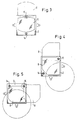
- Figuren 3 bis 5 Draufsichten auf jeweils eine Maschine mit zwei Säulen unterschiedlicher Anodnung,
- Figur 6 eine Seitenansicht einer waagerecht angeordneten Schweißmaschine,
- Figur 7 eine Draufsicht auf die in Figur 6 dargestellte Maschine,
- Figur 8 eine Zwei-Stationen-Schweißmaschine,
- Figuren 9 und 10 Ansichten der in Figur 8 dargestellten Maschine mit dem Schweißspiegel einman in der Station I und in der Station II.
- Eine erste Ausführungsform ist in den Figuren 1 und 2 dargestellt. Dabei sind zwei Pressenplatten 1 und 2 an drei Säulen 3, 4 und 5 verschiebbar angeordnet. Die Säulen 3, 4 und 5 sind ihrerseits vorzugsweise an ihren Enden gehäusefest gehalten. Beispielsweise können nicht dargestellte Endplatten, Joche oder Gehäuserahmen vorgesehen sein. Zusammen mit diesen nicht dargestellten Endstücken bilden die durchlaufenden Säulen 3, 4 und 5 das Schweißmaschinengestell, wobei die Säulen auch die Aufgabe übernehmen, die Platten 1 und 2 zu führen und wobei eine Säule, nämlich die Säule 4 und Schwenkachse für einen Schweißspiegel 8 bildet, der in der in Figur 1 dargestellten Weise ein- und ausschwenkbar ist. Wie aus Figur 1 hervorgeht, sind die Säulen 3 und 5 an benachbarten Ecken der Platten 1, 2 angeordnet, während die Säule 4 gegenüberliegend in der Mitte am Rande der Platten vorgesehen ist.
- Die Platten 1 und 2 sind mit entsprechend den zu verschweißenden Bauteilen ausgebildeten Aufnahmen 9 und 10 versehen. Auch der Schweißspiegel 8 kann entsprechend ausgebildet sein. In der ausgeschwenkten Lage kann der Schweißspiegel 8 in einen Köcher 12 oder Handhabungsgerät für Beschikkung und Vorheizen der Schweißteile eintreten, der außerhalb der Platten 1, 2 hinter der Säule 4 angeordnet ist.
- Durch diese Anordnung der Säulen in Verbindung mit den Platten und dem Schweißspiegel ist die Maschine von drei Seiten her zugänglich und der Schweißspiegel kann wahlweise in beiden Drehrichtungen ausgeschwenkt werden. In dieser Ausführungsform sind die Säulen senkrecht angeordnet, so daß sich eine stehende Bauweise ergibt. Die Säulen können aber auch waagerecht für eine liegende Anordnung der Schweißmaschine angeordnet werden.
- In den Figuren 3 bis 5 sind Schweißmaschinen mit zwei einander gegenüberliegenden Säulen vorgesehen, von denen eine auch die Drehachse für den Schweißspiegel bildet. In diesen Figuren sind die Säulen mit den Bezugszeichen 14, 15 versehen. Die Führung der Platten an nur zwei Säulen ist ausreichend, da die auf die Bauteile aufzubringenden Drücke beim Verschweißen verhältnismäßig gering sein können. Die Ausführungsformen zeigen die wahlweise Zuordnung der Bedienerposition entsprechend der gewählten Anordnung der Säulen 14, 15 und der Drehrichtung des Spiegels 8.
- In den Figuren 6 und 7 ist eine weitere Ausführungsform dargestellt, bei der die Schweißmaschine liegend angeordnet tigen Endstücken 16, 18 gehalten, die an einem Untergestell 20 befestigt sind, das mit entsprechenden Gestellfüßen 21 auf dem Boden aufgestellt ist. In der oberen Etage erfolgt die Erwärmung und Verschweißung der zwischen den Pressenplatten 1 und 2 befindlichen Werkstücke und die Entnahme der Fertigteile erfolgt in der unteren Etage. In Figur 7 ist die Draufsicht auf die obere Etage gemäß Figur 6 dargestellt. Zwischen den Platten 1, 2 und den Endstücken 16, 18 befindet sich jeweils ein nicht dargestellter hydraulischer. Zylinder zum Antrieb der Pressenplatten längs den Säulen. Auch der Antrieb zum Schwenken des Schweißspiegels 8 ist nicht dargestellt.
- Das in den Figuren 8 bis 10 dargestellte Ausführungsbeispiel ist eine Schweißmaschine mit zwei Arbeitsstationen I und II. Dabei ist der um eine mittige Säule 24 drehbare Schweißspiegel 28 zwischen den beiden Stationen I und II hin- und herschwenkbar. Auf der Seite der Station I sind noch zwei Säulen 23 und auf der Seite der Station II zwei Säulen 25 feststehend angeordnet. Die Säulen 23 und die Säule 24 sind zum Führen und Verschieben der Platten 30, 31 für die Station I und die Säule 24 mit den Säulen 25 ist zum Führen der Platten 32 und 33 für die Station II vorgesehen. Die Platten 30 bis 33 sind jeweils über Längsantriebe, von denen ein Antrieb 35 in Figur 9 dargestellt ist, verschiebbar an einer gemeinsamen Platte 36 bzw. 38 angeordnet, die in den Säulen 23, 24 und 25 gehalten und geführt sind. Die Platten 30 bis 33 tragen die Aufnahmevorrichtungen für die zu verschweißenden Werkstücke. Die getrennten Antriebe für die Stationen I und II sind deshalb erforderlich, weil die Verschiebewege in den beiden Stationen jeweils unterschiedlich sind, abhängig davon, ob in der jeweiligen Station der Schweißspiegel eingefahren ist, um die aufgenommenen Werkstücke zu erwärmen, oder ob in der Station die Verschweißung der erhitzten Werkstücke erfolgt.
- In Figur 9 sind die Platten 30, 31 bzw. 32, 33 in der geöffneten Stellung der Schweißmaschine, so daß in der Station I der Schweißspiegel eingefahren werden kann, während in der Station II das Fertigteil entnehmbar ist und die nächsten Werkstücke eingelegt werden. In Figur 10 ist der Schweißspiegel in die Station II geschwenkt und sind die Plattenpaare zusammengeschoben, so daß in der Station I die Verschweißung der vorher erwärmten Werkstücke erfolgt und in der Station II die eingelegten Werkstücke angewärmt werden.
- Die Platten 36 und 38, welche die Pressenplatten 30 bis 33 tragen, sind ebenfalls längs der Säulen 23 bis 25 verschiebbar, um beispielsweise zum Auswechseln der Werkstückaufnahmen die Maschine vollständig zu öffnen oder je Mechanisierungsgrad der Maschine im Prozeßablauf Schnellbewegungen zu berücksichtigen. Die Säulen 23 bis 25 sind an nicht dargestellten Endstücken, beispielsweise in der Bauweise gemäß Figuren 6 und 7 gehalten.
Claims (11)
Applications Claiming Priority (2)
| Application Number | Priority Date | Filing Date | Title |
|---|---|---|---|
| DE19893919800 DE3919800A1 (de) | 1989-06-16 | 1989-06-16 | Schweissmaschine mit schweissspiegel |
| DE3919800 | 1989-06-16 |
Publications (3)
| Publication Number | Publication Date |
|---|---|
| EP0402910A2 true EP0402910A2 (de) | 1990-12-19 |
| EP0402910A3 EP0402910A3 (de) | 1991-09-11 |
| EP0402910B1 EP0402910B1 (de) | 1994-11-23 |
Family
ID=6382934
Family Applications (1)
| Application Number | Title | Priority Date | Filing Date |
|---|---|---|---|
| EP19900111225 Expired - Lifetime EP0402910B1 (de) | 1989-06-16 | 1990-06-13 | Schweissmaschine mit Schweissspiegel |
Country Status (3)
| Country | Link |
|---|---|
| EP (1) | EP0402910B1 (de) |
| DE (2) | DE3919800A1 (de) |
| ES (1) | ES2063862T3 (de) |
Cited By (3)
| Publication number | Priority date | Publication date | Assignee | Title |
|---|---|---|---|---|
| WO1996008359A1 (en) * | 1994-09-12 | 1996-03-21 | Kvernex A.S. | A welding device |
| US5628859A (en) * | 1993-06-17 | 1997-05-13 | Mecasonic S.A. | Method of heating by emission of electromagnetic radiation, especially infrared radiation |
| EP3257656A1 (de) * | 2016-06-16 | 2017-12-20 | Georg Fischer Rohrleitungssysteme AG | Rohrendenerkennung |
Families Citing this family (1)
| Publication number | Priority date | Publication date | Assignee | Title |
|---|---|---|---|---|
| DE19820198B4 (de) * | 1998-05-06 | 2004-02-19 | Branson Ultraschall Niederlassung Der Emerson Technologies Gmbh & Co | Vorrichtung zum Verschweißen großflächiger Spritzgußbauteile aus Kunststoff |
Family Cites Families (9)
| Publication number | Priority date | Publication date | Assignee | Title |
|---|---|---|---|---|
| DE1981592U (de) * | 1965-06-30 | 1968-03-21 | Werner & Pfleiderer | Presse zum spritzen von gummi, kunststoff u. dgl. |
| US3454741A (en) * | 1966-04-11 | 1969-07-08 | Kwikseal | Heat seal machine |
| DE2412531B2 (de) * | 1973-03-16 | 1976-08-12 | Fuji Electrochemical Co., Ltd., Tokio; The Furukawa Battery Co., Ltd., Yokohama, Kanagawa; (Japan) | Vorrichtung zum verbinden des blockdeckels mit dem blockkasten einer batterie |
| US3883369A (en) * | 1973-12-26 | 1975-05-13 | Eltra Corp | Battery assembly machine |
| DE2734911C3 (de) * | 1977-08-03 | 1980-03-20 | Widos Wilhelm Dommer Soehne Gmbh, 7257 Ditzingen | Vorrichtung zum Einschweißen eines Kunststoff-Rohres in ein Kunststoff-Formstück |
| JPS6032575B2 (ja) * | 1979-02-20 | 1985-07-29 | 三菱化学株式会社 | 大形合成樹脂成形品の溶着装置 |
| CH640775A5 (de) * | 1979-10-11 | 1984-01-31 | Fischer Ag Georg | Einrichtung zum verschweissen von koaxial liegenden rohrenden oder von rohrenden mit fittings aus kunststoff. |
| JPS5836409A (ja) * | 1981-08-26 | 1983-03-03 | Mitsubishi Chem Ind Ltd | 熱可塑性合成樹脂成形品の溶着方法及び装置 |
| GB8615517D0 (en) * | 1986-06-25 | 1986-07-30 | Fusion Equipment Ltd | Butt-welding of pipes |
-
1989
- 1989-06-16 DE DE19893919800 patent/DE3919800A1/de active Granted
-
1990
- 1990-06-13 ES ES90111225T patent/ES2063862T3/es not_active Expired - Lifetime
- 1990-06-13 EP EP19900111225 patent/EP0402910B1/de not_active Expired - Lifetime
- 1990-06-13 DE DE59007741T patent/DE59007741D1/de not_active Expired - Fee Related
Cited By (4)
| Publication number | Priority date | Publication date | Assignee | Title |
|---|---|---|---|---|
| US5628859A (en) * | 1993-06-17 | 1997-05-13 | Mecasonic S.A. | Method of heating by emission of electromagnetic radiation, especially infrared radiation |
| WO1996008359A1 (en) * | 1994-09-12 | 1996-03-21 | Kvernex A.S. | A welding device |
| EP3257656A1 (de) * | 2016-06-16 | 2017-12-20 | Georg Fischer Rohrleitungssysteme AG | Rohrendenerkennung |
| US10427355B2 (en) | 2016-06-16 | 2019-10-01 | Georg Fischer Rohrleitungssysteme Ag | Tube end detection |
Also Published As
| Publication number | Publication date |
|---|---|
| EP0402910B1 (de) | 1994-11-23 |
| EP0402910A3 (de) | 1991-09-11 |
| DE3919800A1 (de) | 1990-12-20 |
| DE3919800C2 (de) | 1992-05-07 |
| ES2063862T3 (es) | 1995-01-16 |
| DE59007741D1 (de) | 1995-01-05 |
Similar Documents
| Publication | Publication Date | Title |
|---|---|---|
| DE2839978C2 (de) | ||
| DE68910186T2 (de) | Arbeitsform für eine Jacke. | |
| DE3035451C2 (de) | ||
| EP0341235B1 (de) | Schweissmaschine zum Stumpfschweissen von Kunststoffprofilen | |
| EP0512126B1 (de) | Vorrichtung zur Handhabung von plattenförmigen Werkstücken | |
| DE3005606C2 (de) | Numerisch gesteuerte Maschine zum Schleifen mehrerer unterschiedlicher Flächen an ein- und demselben Werkstück | |
| DE4010445C2 (de) | Rohrbiegemaschine | |
| DE10022269B4 (de) | Verfahren und Vorrichtung zur Durchführung eines Produktwechsels bei Thermoformvorgängen | |
| DE4330683A1 (de) | Falzvorrichtung | |
| DE3440224C2 (de) | Werkzeugwechselvorrichtung an einer Stanz- oder Nibbelmaschine | |
| DE3533235C2 (de) | Biegepresse | |
| DE19858791B4 (de) | Plattenbearbeitungsmaschine | |
| EP0292712B1 (de) | Maschine zum Bearbeiten von plattenförmigen Werkstücken | |
| DE69805550T2 (de) | Rohrbiegevorrichtung und ihre trommeleinrichtung | |
| EP0402910B1 (de) | Schweissmaschine mit Schweissspiegel | |
| DE2443195C2 (de) | Mehrzweck-Werkzeugmaschine zur Metallbearbeitung durch längsbewegte Werkzeuge | |
| DE3406367A1 (de) | Vorrichtung zum transportieren und bearbeiten von plattenfoermigen werkstuecken | |
| DE102019003613A1 (de) | Verfahren zur Bearbeitung von Werkstücken aus Holz, Kunststoff und dergleichen | |
| DE3043361C2 (de) | Automatische Palettenwechseleinrichtung für Werkzeugmaschinen | |
| CH665159A5 (de) | Schleifmaschine. | |
| AT403690B (de) | Vorrichtung zum schneiden einer glastafel und zum abtragen einer beschichtung von der glastafel | |
| DE102010025521B4 (de) | Maschine zum Bearbeiten von Tafeln aus Holz oder dergleichen | |
| DE3740584C2 (de) | ||
| DE3424680C2 (de) | ||
| DE2444370A1 (de) | Vorrichtung zum verbinden von parallelogrammfoermigen gummistuecken ohne ueberlappung |
Legal Events
| Date | Code | Title | Description |
|---|---|---|---|
| PUAI | Public reference made under article 153(3) epc to a published international application that has entered the european phase |
Free format text: ORIGINAL CODE: 0009012 |
|
| AK | Designated contracting states |
Kind code of ref document: A2 Designated state(s): BE DE ES FR GB IT LU NL |
|
| PUAL | Search report despatched |
Free format text: ORIGINAL CODE: 0009013 |
|
| AK | Designated contracting states |
Kind code of ref document: A3 Designated state(s): BE DE ES FR GB IT LU NL |
|
| 17P | Request for examination filed |
Effective date: 19911206 |
|
| 17Q | First examination report despatched |
Effective date: 19930401 |
|
| GRAA | (expected) grant |
Free format text: ORIGINAL CODE: 0009210 |
|
| AK | Designated contracting states |
Kind code of ref document: B1 Designated state(s): BE DE ES FR GB IT LU NL |
|
| GBT | Gb: translation of ep patent filed (gb section 77(6)(a)/1977) |
Effective date: 19941207 |
|
| REF | Corresponds to: |
Ref document number: 59007741 Country of ref document: DE Date of ref document: 19950105 |
|
| REG | Reference to a national code |
Ref country code: ES Ref legal event code: FG2A Ref document number: 2063862 Country of ref document: ES Kind code of ref document: T3 |
|
| ITF | It: translation for a ep patent filed | ||
| ET | Fr: translation filed | ||
| PGFP | Annual fee paid to national office [announced via postgrant information from national office to epo] |
Ref country code: LU Payment date: 19950601 Year of fee payment: 6 |
|
| PGFP | Annual fee paid to national office [announced via postgrant information from national office to epo] |
Ref country code: GB Payment date: 19950605 Year of fee payment: 6 |
|
| PGFP | Annual fee paid to national office [announced via postgrant information from national office to epo] |
Ref country code: NL Payment date: 19950629 Year of fee payment: 6 Ref country code: FR Payment date: 19950629 Year of fee payment: 6 |
|
| PGFP | Annual fee paid to national office [announced via postgrant information from national office to epo] |
Ref country code: ES Payment date: 19950630 Year of fee payment: 6 |
|
| PGFP | Annual fee paid to national office [announced via postgrant information from national office to epo] |
Ref country code: BE Payment date: 19950713 Year of fee payment: 6 |
|
| PGFP | Annual fee paid to national office [announced via postgrant information from national office to epo] |
Ref country code: DE Payment date: 19950727 Year of fee payment: 6 |
|
| PLBE | No opposition filed within time limit |
Free format text: ORIGINAL CODE: 0009261 |
|
| STAA | Information on the status of an ep patent application or granted ep patent |
Free format text: STATUS: NO OPPOSITION FILED WITHIN TIME LIMIT |
|
| 26N | No opposition filed | ||
| PG25 | Lapsed in a contracting state [announced via postgrant information from national office to epo] |
Ref country code: LU Free format text: LAPSE BECAUSE OF NON-PAYMENT OF DUE FEES Effective date: 19960613 Ref country code: GB Effective date: 19960613 |
|
| PG25 | Lapsed in a contracting state [announced via postgrant information from national office to epo] |
Ref country code: ES Free format text: LAPSE BECAUSE OF EXPIRATION OF PROTECTION Effective date: 19960614 |
|
| PG25 | Lapsed in a contracting state [announced via postgrant information from national office to epo] |
Ref country code: BE Effective date: 19960630 |
|
| BERE | Be: lapsed |
Owner name: BRANSON ULTRASCHALL NIEDERLASSUNG DER EMERSON TEC Effective date: 19960630 |
|
| PG25 | Lapsed in a contracting state [announced via postgrant information from national office to epo] |
Ref country code: NL Effective date: 19970101 |
|
| GBPC | Gb: european patent ceased through non-payment of renewal fee |
Effective date: 19960613 |
|
| PG25 | Lapsed in a contracting state [announced via postgrant information from national office to epo] |
Ref country code: FR Effective date: 19970228 |
|
| PG25 | Lapsed in a contracting state [announced via postgrant information from national office to epo] |
Ref country code: DE Effective date: 19970301 |
|
| NLV4 | Nl: lapsed or anulled due to non-payment of the annual fee |
Effective date: 19970101 |
|
| REG | Reference to a national code |
Ref country code: FR Ref legal event code: ST |
|
| REG | Reference to a national code |
Ref country code: ES Ref legal event code: FD2A Effective date: 19990601 |
|
| PG25 | Lapsed in a contracting state [announced via postgrant information from national office to epo] |
Ref country code: IT Free format text: LAPSE BECAUSE OF NON-PAYMENT OF DUE FEES;WARNING: LAPSES OF ITALIAN PATENTS WITH EFFECTIVE DATE BEFORE 2007 MAY HAVE OCCURRED AT ANY TIME BEFORE 2007. THE CORRECT EFFECTIVE DATE MAY BE DIFFERENT FROM THE ONE RECORDED. Effective date: 20050613 |