EP0404140A2 - Silylierte Benzoesäurederivate II - Google Patents
Silylierte Benzoesäurederivate II Download PDFInfo
- Publication number
- EP0404140A2 EP0404140A2 EP90111727A EP90111727A EP0404140A2 EP 0404140 A2 EP0404140 A2 EP 0404140A2 EP 90111727 A EP90111727 A EP 90111727A EP 90111727 A EP90111727 A EP 90111727A EP 0404140 A2 EP0404140 A2 EP 0404140A2
- Authority
- EP
- European Patent Office
- Prior art keywords
- formula
- radical
- compounds
- radicals
- groups
- Prior art date
- Legal status (The legal status is an assumption and is not a legal conclusion. Google has not performed a legal analysis and makes no representation as to the accuracy of the status listed.)
- Granted
Links
Classifications
-
- C—CHEMISTRY; METALLURGY
- C09—DYES; PAINTS; POLISHES; NATURAL RESINS; ADHESIVES; COMPOSITIONS NOT OTHERWISE PROVIDED FOR; APPLICATIONS OF MATERIALS NOT OTHERWISE PROVIDED FOR
- C09K—MATERIALS FOR MISCELLANEOUS APPLICATIONS, NOT PROVIDED FOR ELSEWHERE
- C09K19/00—Liquid crystal materials
- C09K19/04—Liquid crystal materials characterised by the chemical structure of the liquid crystal components, e.g. by a specific unit
- C09K19/40—Liquid crystal materials characterised by the chemical structure of the liquid crystal components, e.g. by a specific unit containing elements other than carbon, hydrogen, halogen, oxygen, nitrogen or sulfur, e.g. silicon, metals
- C09K19/406—Liquid crystal materials characterised by the chemical structure of the liquid crystal components, e.g. by a specific unit containing elements other than carbon, hydrogen, halogen, oxygen, nitrogen or sulfur, e.g. silicon, metals containing silicon
-
- C—CHEMISTRY; METALLURGY
- C07—ORGANIC CHEMISTRY
- C07F—ACYCLIC, CARBOCYCLIC OR HETEROCYCLIC COMPOUNDS CONTAINING ELEMENTS OTHER THAN CARBON, HYDROGEN, HALOGEN, OXYGEN, NITROGEN, SULFUR, SELENIUM OR TELLURIUM
- C07F7/00—Compounds containing elements of Groups 4 or 14 of the Periodic Table
- C07F7/02—Silicon compounds
- C07F7/08—Compounds having one or more C—Si linkages
- C07F7/0803—Compounds with Si-C or Si-Si linkages
- C07F7/081—Compounds with Si-C or Si-Si linkages comprising at least one atom selected from the elements N, O, halogen, S, Se or Te
-
- C—CHEMISTRY; METALLURGY
- C07—ORGANIC CHEMISTRY
- C07F—ACYCLIC, CARBOCYCLIC OR HETEROCYCLIC COMPOUNDS CONTAINING ELEMENTS OTHER THAN CARBON, HYDROGEN, HALOGEN, OXYGEN, NITROGEN, SULFUR, SELENIUM OR TELLURIUM
- C07F7/00—Compounds containing elements of Groups 4 or 14 of the Periodic Table
- C07F7/02—Silicon compounds
- C07F7/08—Compounds having one or more C—Si linkages
- C07F7/0834—Compounds having one or more O-Si linkage
- C07F7/0838—Compounds with one or more Si-O-Si sequences
-
- C—CHEMISTRY; METALLURGY
- C07—ORGANIC CHEMISTRY
- C07F—ACYCLIC, CARBOCYCLIC OR HETEROCYCLIC COMPOUNDS CONTAINING ELEMENTS OTHER THAN CARBON, HYDROGEN, HALOGEN, OXYGEN, NITROGEN, SULFUR, SELENIUM OR TELLURIUM
- C07F7/00—Compounds containing elements of Groups 4 or 14 of the Periodic Table
- C07F7/02—Silicon compounds
- C07F7/08—Compounds having one or more C—Si linkages
- C07F7/0896—Compounds with a Si-H linkage
Definitions
- the invention relates to new, partly liquid-crystalline silylated benzoic acid derivatives, processes for their preparation and their use.
- Liquid-crystalline compounds are known, inter alia, from D. Demus, H. Demus and H. Zaschke (Liquid Crystals in Tables, 1974; D. Demus and H. Zaschke, Liquid Crystals in Tables II, 1984, VEB-Verlag für).
- US-A-4,358,391 H. Finkelmann et al., Wacker-Chemie GmbH describes liquid-crystalline polymers with an organopolysiloxane backbone and mesogenic side groups.
- M. Petrzilka et al. EP-A-122 389, F.
- the object of the present invention was to synthesize new, preferably liquid-crystalline, compounds, in particular those having organosilicon groups. Another object of the present invention was to produce liquid-crystalline compounds which are readily miscible, colorless and low-viscosity with other liquid crystals. It was also an object of the present invention to present liquid-crystalline compounds which are well suited as dielectrics in display devices and in particular by means of which short response times and high contrasts can be achieved in such devices.
- Z is a radical bonded to the benzene ring in the 2-, 3-, 5- or 6-position, namely a halogen atom, a cyano group, a hydroxyl group, n 0, 1 or 2
- n has the value 0 or 1, in particular 0.
- Fluorine or chlorine atoms, cyano radicals and oxiranyl radicals are preferred as substituents for the R * radicals.
- R2 is a radical of formula (22): where in formulas (1) and (22) mean R * identical or different, optionally substituted, C1 to C18 hydrocarbon or hydrocarbonoxy radicals, R1 is a halogen atom, a cyano radical, a radical of the meaning R **, and R ′′′, R ⁇ ⁇ , R ** and y have the meanings given for formula (8) or (9).
- Preferred compounds of the formula (1) are those in which R ′′′ is a C1 to C4 alkyl group, preferably a methyl group, and or R ⁇ ⁇ is a double-bonded radical of the formula -O- or a chemical single bond, and or R1 optionally substituted with C1 to C8 alkyl or alkoxy, phenyl or cyclohexyl, C1 to C18 Alkyl radicals, C1 to C18 alkoxy radicals, with the exception of n-octoxy and n-decoxy radicals, where the radicals mentioned can be substituted by halogen atoms and trialkylsilyl groups, and or R * methyl groups, and or n has the value 0, and the respective other radicals have the meanings given for formula (1) above.
- the chain-like compounds according to the invention preferably contain a maximum of four identical or different radicals B mentioned above as additional structural units, which are linked in particular to one another and to the rest of the chain-like compound by a maximum of five of the radicals D mentioned above.
- radicals B and D mentioned above as additional structural units are preferably not substituted or by hydrogen atoms.
- each of the residues B and D can assume the meanings given above, with the proviso that no radicals D are linked directly to one another, each of the indices b and c each represent an identical or different integer from 0 to 6 and d is the number 0 or 1,
- liquid crystalline compounds are preferred.
- the present invention includes, where applicable, all enantiomers and diastereomers of the compounds mentioned individually and in a mixture.
- Compounds of formula (8) or (1) can be prepared by reacting compounds of the formula or of compounds of the formula with compounds of the formula R ′′′ - [Si (R *) 2] -H (12), in the presence of platinum metals and / or their compounds, where in the above formulas (2), (11) and (12) n, y, Z, R ′, R ′′′, R ⁇ ⁇ and R * have the formula (8) and R1 have the meanings given for formula (1).
- Platinum and / or its compounds are preferably used as platinum metals and / or their compounds. All catalysts can be used here which have also been used to date for the addition of hydrogen atoms bonded directly to Si atoms to aliphatic unsaturated compounds. Examples of such catalysts are metallic and finely divided platinum, which can be on supports, such as silicon dioxide, aluminum oxide or activated carbon, compounds or complexes of platinum, such as platinum halides, for example PtCl4, H2PtCl6 * 6H2O, Na2PtCl4 * 4H2O, platinum-olefin complexes, Platinum-alcohol complexes, platinum-alcoholate complexes, platinum-ether complexes, platinum-aldehyde complexes, platinum-ketone complexes, including reaction products of H2PtCl6 * 6H2O and cyclohexanone, platinum-vinyl siloxane complexes, in particular platinum-divinyltetramethyldisiloxane complexe
- Platinum catalyst is preferably used in amounts of 0.1 to 50 mol%, based on the number of moles of those of the starting materials of the formulas (11) or (2) which are present in deficiency or in a stoichiometric amount.
- the reaction is preferably carried out at temperatures from 0 ° C. to 110 ° C., preferably at pressures from 0.05 MPa to 1.0 MPa.
- the reaction is preferably carried out in a solvent which should in particular be aprotic; solvents or solvent mixtures with a boiling point or boiling range of up to 160 ° C., in particular of up to 120 ° C. at 0.1 MPa (abs.) In each case, are preferred .
- solvents examples include esters, such as methyl acetate, ethyl acetate, n- and isopropyl acetate, n-, sec- and t-butyl acetate, ethyl formate and diethyl carbonate; Ethers such as dioxane, tetrahydrofuran, diethyl ether, di-n-propyl ether, diisopropyl ether, di-n-butyl ether, ethylene glycol monomethyl ether, ethylene glycol mo noethyl ether, diethylene glycol dimethyl ether and anisole; chlorinated hydrocarbons such as dichloromethane, trichloromethane, carbon tetrachloride, 1,2-dichloroethane, trichlorethylene, carbon tetrachloride and chlorobenzene; Hydrocarbons, such as pentane, n-hexane, hexane isomer mixtures, cyclo
- reaction does not mean that all reaction components must dissolve in it.
- the reaction can also be carried out in a suspension or emulsion of one or more reactants.
- the reaction can also be carried out in a solvent mixture with a miscibility gap, at least one reactant being soluble in each of the mixing phases.
- Compounds (11) or (2) are preferably used in the process according to the invention in a molar ratio of 1: 2 to 2: 1, in particular from 1: 1.1 to 1.1: 1, compared to the compound of formula (12).
- the alkenyl radical can be introduced into compounds of the formula (2), for example, by reacting the corresponding alkenyl halides with organometallic benzene derivatives, in particular with the corresponding Grignard reagents or organolithium compounds, for example 4-halophenyl magnesium halide.
- This implementation usually takes place in a solvent inert to the organometallic compound used, such as diethyl ether, methyl tert-butyl ether, tetrahydrofuran, 1,4-dioxane, acetonitrile, hydrocarbons and mixtures thereof, such as toluene, benzene, hexane isomer mixture. It is preferably carried out at temperatures from -100 ° C. to +110 ° C., in particular at pressures from 0.09 to 0.11 MPa (abs.). Under certain circumstances, the implementation can be accelerated by ultrasound. Examples 1 and 2 were carried out according to method 1.
- the corresponding metals and compounds mentioned for process 1 can be used as platinum metals and / or their compounds.
- reaction conditions such as quantitative ratios, pressures, temperatures and solvents also correspond to those of process 1.
- the dimethylsilylbenzoic acid chlorides can also be used as starting materials for compounds of the formula (13).
- US patent application 2 291 88 filed on August 8, 1988, corresponds to EP-A-304 720, F.-H. Kreuzer et al., Consortium for electrochemical industry GmbH
- 1,4-dihalobenzene conversion of the corresponding Monogrignard compound with dimethylchlorosilane, renewed reaction with magnesium and reaction with CO2 and finally reaction of the 4-dimethylsilylbenzoic acid thus obtained, for example with thionyl chloride, available.
- the liquid-crystalline compounds according to the invention or which can be produced according to the invention can be used in display devices, particularly in display devices which are produced using smectic liquid crystal (mixtures). Pure compounds of the formulas (8) or (1), their mixtures and in particular mixtures of liquid-crystalline compounds of the formula (8) and / or (1) with other liquid crystals can be used.
- the compounds according to the invention are particularly suitable for the production of smectic mixtures for mixtures that can form a smectic C phase. However, they can also be used as additives to nematic or cholesteric phases.
- both liquid-crystalline base mixtures can be produced and the properties of already completed base mixtures - such as the optical anisotropy, the electrical anisotropy, the spontaneous polarization, the viscosity, the tilt angle, the pitch and change the phase behavior favorably.
- liquid-crystalline silylated benzoic acid derivatives according to the invention in liquid-crystal mixtures can vary within wide limits depending on the intended use. It can be, for example, from 1 percent by weight to 100 percent by weight.
- 4-butyloxybenzoic acid (4- (6-pentamethyldisiloxyanylhexyloxy) phenyl ester); Phases: k 64 (sa 54-56) i 4- (5 (pentymethyldisiloxanylpentyloxy) phenyl 4-heptyloxybenzoic acid); Phases: k 27 sA 67 i 4- (4 (pentamethyldisiloxanylbutyloxy) phenyl 4-heptyloxybenzoic acid); Phases: k 57 (sa 49) i 4-heptyloxybenzoic acid (4- (1-pentamethyldisiloxylhexyloxy) phenyl ester), phases: k 42 sA 67 i.
Landscapes
- Chemical & Material Sciences (AREA)
- Organic Chemistry (AREA)
- Crystallography & Structural Chemistry (AREA)
- Engineering & Computer Science (AREA)
- Materials Engineering (AREA)
- Liquid Crystal Substances (AREA)
- Low-Molecular Organic Synthesis Reactions Using Catalysts (AREA)
Abstract
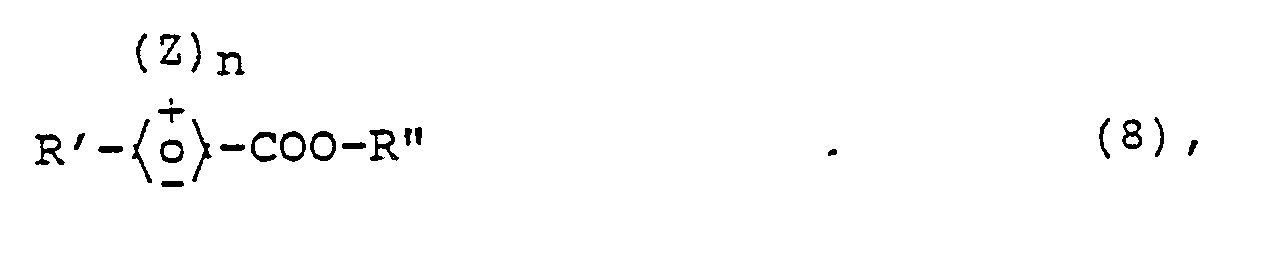
Z einen in 2-, 3-, 5- oder 6-Position an den Benzolring gebundener Rest, nämlich ein Halogenatom, eine Cyanogruppe, eine Hydroxylgruppe,
n 0, 1 oder 2,
R˝ einen Rest der Formel
R‴-[Si(R*)₂](CH₂)yR˝˝- (9),
worin bedeuten
y eine ganze Zahl von 4 bis 18,
R‴ die in der Beschreibung angegebene Bedeutung hat,
R* gleiche oder verschiedene, gegebenenfalls substituierte, C₁- bis C₁₈-Kohlenwasserstoff- oder Kohlenwasserstoffoxyreste,
R˝˝ einen gegebenfalls über einen Phenylen- oder Biphenylenrest an die Carboxylgruppe gebundener Rest der Formel -(E)z-, wobei
E ein zweibindiger Rest der Formel -O- oder -Si(R*)₂- ist und
z die Zahl 0 oder 1 bedeutet, und der Rest
R′ ein Halogenatom, einen Cyanorest, einen Cholesterylrest, einen Rest der Bedeutung R* oder der Formel -C₆H₄-R** bedeutet, und
R** alle Bedeutungen von R*, mit Ausnahme von einem n-Oktyloxy- oder einem n-Decyloxyrest, haben kann,
sowie deren Herstellung und Anwendung.
Description
- Die Erfindung betrifft neue, zum Teil flüssigkristalline silylierte Benzoesäurederivate, Verfahren zu deren Herstellung und deren Verwendung.
- Flüssigkristalline Verbindungen sind u.a. durch D. Demus, H. Demus und H. Zaschke (Flüssige Kristalle in Tabellen, 1974; D. Demus und H. Zaschke, Flüssige Kristalle in Tabellen II, 1984, VEB-Verlag Leipzig) bekannt. In US-A-4 358 391 (H. Finkelmann et al., Wacker-Chemie GmbH) sind flüssigkristalline Polymere mit Organopolysiloxanrückgrat und mesogenen Seitengruppen beschrieben. M. Petrzilka et al. (EP-A-122 389, F.Hoffmann-La Roche & Co.) beanspruchen Flüssigkristallkomponenten mit einer Alkenylkette, wobei an dieser Alkenylkette auch ein Benzoesäurederivat hängen kann. Diese Verbindungen weisen keine Organosiliciumgruppen auf. W. R. Young et al. (Molecular Crystals and Liquid Crystals, Vol. 13, Seite 305-321, 1971, Gordon and Breach Science Publishers) berichten u.a. über 4′-silylierte Benzimide von Benzoesäure-4-aminophenolester. Unten auf der Seite 309 erwähnen sie, daß diese Silicium enthaltenden Ester im Gegensatz zu vergleichbaren Substanzen keine mesomorphe Phase ausbilden, was auf die sterische Hinderung der Organosilylgruppe zurückgeführt wird. In 89JP-A 144 491 (offengelegt am 6.6. 1989, referiert in Chemical Abstracts, Vol. 111, 205 667e (1989) ) ist die Herstellung von (R)-4-(3-Pentamethyldisiloxypropyloxy)phenyl-4′-(1-methylheptyloxy)biphenyl-4-carboxyate beschrieben. Diese Verbindung ist jedoch nicht stabil und neigt dazu, die Si-gebundenen Propylengruppe abzuspalten. Weitere dort genannte Verbindungen sind nicht herstellbar, da sie nicht-existente organische Gruppen (-C₂H₇ und -C₆H₁₇) aufweisen.
- Aufgabe der vorliegenden Erfindung war es, neue, vorzugsweise flüssigkristalline Verbindungen, insbesondere solche mit Organosiliciumgruppierungen zu synthetisieren. Eine weitere Aufgabe der vorliegenden Erfindung war es, flüssigkristalline Verbindungen herzustellen, welche mit anderen Flüssigkristallen gut mischbar, farblos und niederviskos sind. Ferner war es Aufgabe der vorliegenden Erfindung, Flüssigkristalline Verbindungen darzustellen, welche sich gut als Dielektrika in Anzeigevorrichtungen eignen und insbesondere mittels derer in solchen Vorrichtungen kurze Ansprechzeiten und hohe Kontraste bewirkt werden können.
- Die vorstehend genannten Aufgaben werden durch die vorliegende Erfindung gelöst durch Verbindungen der Formel

Z einen in 2-, 3-, 5- oder 6-Position an den Benzolring gebundener Rest, nämlich ein Halogenatom, eine Cyanogruppe, eine Hydroxylgruppe,
n 0, 1 oder 2,
R˝ einen Rest der Formel
R‴-[Si(R*)₂](CH₂)y-R˝˝- (9),
worin bedeuten
y eine ganze Zahl von 4 bis 18,
R‴ einen C₁- bis C₈-Alkylrest, einen Rest der Formel
R*-[Si(R*)₂O]v-, wobei
v eine ganze Zahl im Wert von 1 bis 10 ist,
oder einen Rest der Formel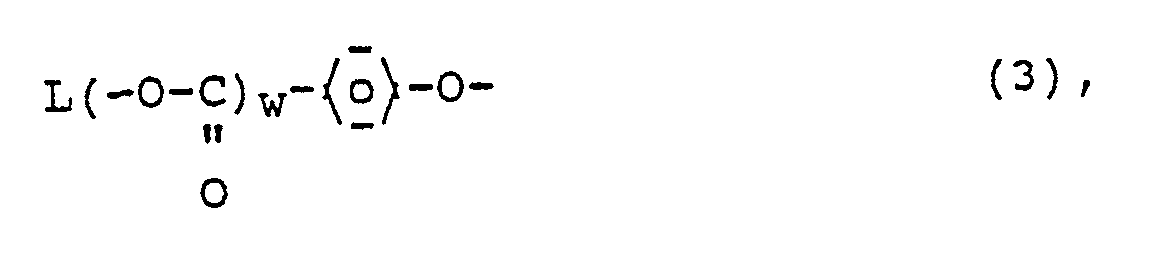
w die Zahl 0 oder 1 und
L einen Cholesterylrest oder einen gegebenenfalls durch Phenyl-, Halogen-, Cyano- und/oder C₁- bis C₄-Alkoxyreste substituierten Phenylrest, oder, falls w=0, auch ein Halogenatom, einen Cyano- oder C₁- bis C₄-Alkoxyrest bedeuten kann;
R* gleiche oder verschiedene, gegebenenfalls substituierte, C₁- bis C₁₈-Kohlenwasserstoff- oder Kohlenwasserstoffoxyreste,
R˝˝ einen gegebenfalls über einen Phenylen- oder Biphenylenrest an die Carboxylgruppe gebundener Rest der Formel -E-, wobei
E ein zweibindiger Rest der Formel -O- oder -[Si(R*)₂]z- ist, wobei ein Rest der Formel -O- nicht direkt an das Sauerstoffatom der Carboxylgruppe gebunden sein darf, und
z die Zahl 0 oder 1 bedeutet
und der Rest
R′ ein Halogenatom, einen Cyanorest, einen Rest der Bedeutung R* oder der Formel -C₆H₄-R** bedeutet, wobei
R** gleiche oder verschiedene, gegebenenfalls substitu ierte, C₁- bis C₁₈-Kohlenwasserstoff- oder Kohlenwasserstoffoxyreste, mit Ausnahme von einem n-Oktyloxy- oder einem n-Decyloxyrest, sind. - Vorzugsweise hat n den Wert 0 oder 1, insbesondere 0. Als Substituenten für die Reste R* sind insbesondere Fluor- oder Chloratome, Cyanoreste und Oxiranylreste bevorzugt.
- Die vorliegende Erfindung betrifft auch und insbesondere Verbindungen der Formel


R* gleiche oder verschiedene, gegebenenfalls substituierte, C₁- bis C₁₈-Kohlenwasserstoff- oder Kohlenwasserstoffoxyreste,
R¹ ein Halogenatom, einen Cyanorest, einen Rest der Bedeutung R**, und
R‴, R˝˝, R** und y die zu Formel (8) bzw. (9) angegebenen Bedeutungen haben. - Bevorzugt sind Verbindungen der Formel (1), worin bedeuten
R‴ eine C₁- bis C₄-Alkylgruppe, vorzugsweise eine Methylgruppe,
und/oder
R˝˝ ein zweibindiger Rest der Formel -O- oder eine chemische Einfachbindung,
und/oder
R¹ gegebenenfalls mit C₁- bis C₈-Alkyl- oder Alkoxyresten substituierte Phenyl- oder Cyclohexylreste, C₁- bis C₁₈- Alkylreste, C₁- bis C₁₈-Alkoxyreste, ausgenommen n-Oktoxy- und n-Decoxyreste, wobei die genannten Reste mit Halogenatomen und Trialkylsilylgruppen substituiert sein können,
und/oder
R* Methylgruppen,
und/oder
n den Wert 0,
und die jeweiligen anderen Reste die oben zu Formel (1) angegebenen Bedeutungen haben. - Die oben genannten Verbindungen der Formel (8) bzw. (1) können weitere Struktureinheiten entlang ihrer Molekülkette aufweisen, welche ausgewählt sind aus der Gruppe der Reste
B, nämlich der Phenylen-, Cyclohexylen-, Pyridindiyl-, Pyrimidindiyl-, Pyridazindiyl-, Triazindiyl-, Tetrazindiyl-, Dioxandiyl-, Tetrahydrofurandiyl-, Bicyclo[2.2.2]octandiylreste, Cholesterylreste, und der Reste
D, nämlich der Carbonyloxy-, Oxycarbonylgruppen, -CH₂-CH₂-, -O-CH₂- und -CH₂-O-Gruppen, Reste der Formeln -CH=CH-, -N=CH-, -CH=N-, -C≡C-, -N=N-, -N=N(O)- und -O-,
mit der Maßgabe, daß die oben genannten Reste und Gruppen, soweit möglich, durch C₁- bis C₁₈-Alkylreste, Phenylreste oder polare Reste, vorzugsweise Halogenatome, Cyanogruppen oder Hydroxylgruppen substituiert sein können und keine Reste D direkt miteinander verknüpft sind. - Vorzugsweise sind die weiteren Struktureinheiten, die die Kette verlängern, ausgewählt aus der Gruppe der -1,4-Phenylen-, -1,4-Cyclohexylen-, -2,5-Pyridindiyl-, -2,5-Pyrimidindiyl-, -3,6-Pyridazindiyl-, -3,6-Triazindiyl-, -3,6-Tetrazindiyl-, -2,5-Dioxandiyl-, -2,5-Tetrahydrofurandiyl-, Bicyclo[2.2.2]octandiylreste, Cholesterylreste, Carbonyloxy-, Oxycarbonylgruppen, -CH₂-CH₂-, -O-CH₂- und -CH₂-O- Gruppen, Reste der Formeln -C=C-, -N=CH-, -CH=N-, -C≡C-,-N=N-, -N=N(O)- und -O-, mit der Maßgabe, daß die oben genannten Reste und Gruppen, soweit möglich, durch C₁- bis C₁₈-Alkylreste, Phenylreste oder polare Reste, vorzugsweise Halogenatome, Cyanogruppen oder Hydroxylgruppen substituiert sein können.
- Vorzugsweise enthalten die erfindungsgemäßen kettenförmigen Verbindungen maximal vier gleiche oder verschiedene der als zusätzliche Struktureinheiten oben genannten Reste B, welche insbesondere untereinander und mit dem Rest der kettenförmigen Verbindung durch maximal fünf der oben genannten Reste D verknüpft sind.
- Vorzugsweise sind die oben als zusätzliche Struktureinheiten genannten Reste B bzw. D nicht bzw. durch Wasserstoffatome substituiert.
- Vorzugsweise sind die oben genannten zusätzlichen Struktureinheiten B und D gemäß folgender Formel miteinander verknüpft:
-[(B)b(D)d]c-, wobei jeder der Reste
B und D die oben angegebenen Bedeutungen annehmen können,
mit der Maßgabe, daß keine Reste D direkt miteinander verknüpft sind, jeder der Indices
b und c jeweils eine gleiche oder verschiedene ganze Zahl im Wert von 0 bis 6 und
d jeweils die Zahl 0 oder 1 ist, - Unter den oben bezeichneten Verbindungen sind die flüssigkristallinen Verbindungen bevorzugt. Die vorliegende Erfindung umfaßt, soweit anwendbar, alle Enantiomere und Diastereomere der genannten Verbindungen einzeln und im Gemisch.
- Verbindungen der Formel (8) oder (1) können hergestellt werden durch Umsetzung von Verbindungen der Formel


R‴-[Si(R*)₂]-H (12),
in Gegenwart von Platinmetallen und/oder deren Verbindungen, wobei in den obigen Formeln (2), (11) und (12) n, y, Z, R′, R‴, R˝˝ und R* die zu Formel (8) und R¹ die zu Formel (1) angegebenen Bedeutungen besitzen. - Als Platinmetalle und/oder deren Verbindungen werden vorzugsweise Platin und/oder dessen Verbindungen eingesetzt. Es können hier alle Katalysatoren eingesetzt werden, die auch bisher zur Addition von direkt an Si-Atome gebundenen Wasserstoffatomen an aliphatisch ungesättigte Verbindungen eingesetzt wurden. Beispiele für solche Katalysatoren sind metallisches und feinverteiltes Platin, das sich auf Trägern, wie Siliciumdioxyd, Aluminiumoxyd oder Aktivkohle befinden kann, Verbindungen oder Komplexe von Platin, wie Platinhalogenide, z.B. PtCl₄, H₂PtCl₆*6H₂O, Na₂PtCl₄*4H₂O, Platin-Olefin-Komplexe, Platin-Alkohol-Komplexe, Platin-Alkoholat-Komplexe, Platin-Ether-Komplexe, Platin-Aldehyd-Komplexe, Platin-Keton-Komplexe, einschließlich Umsetzungsprodukten aus H₂PtCl₆*6H₂O und Cyclohexanon, Platin-Vinyl siloxankomplexe, insbesondere Platin-Divinyltetramethyldisiloxankomplexe mit oder ohne Gehalt an nachweisbarem anorganisch gebundenem Halogen, Bis-(gamma-picolin)-platindichlorid, Trimethylendipyridinplatindichlorid, Dicyclopentadienplatindichlorid, Dimethylsulfoxydethylenplatin-(II)-dichlorid sowie Umsetzungsprodukte von Platintetrachlorid mit Olefin und primärem Amin oder sekundärem Amin oder primärem und sekundärem Amin, wie das Umsetzungsprodukt aus in 1-0cten gelöstem Platintetra-chlorid mit sec.-Butylamin, oder Ammonium-Platinkomplexe gemäß EP-B 110 370.
- Platinkatalysator wird vorzugsweise in Mengen von 0,1 bis 50 Mol% bezogen auf die Molzahl derjenigen der Ausgangsstoffe der Formeln (11) bzw. (2), welche im Unterschuß oder in stöchiometrischer Menge vorliegen, eingesetzt.
- Die Reaktion wird vorzugsweise bei Temperaturen von 0 °C bis 110 °C, vorzugsweise bei Drücken von 0,05 MPa bis 1,0 MPa durchgeführt.
- Sollten die Verbindungen der Formeln (2), (11) bzw. (12) sehr reaktionsträge sein, kann auch bei höheren Temperaturen, höheren Drücken und in Anwesenheit von mehr Platinkatalysator gearbeitet werden.
- Vorzugsweise wird die Reaktion in einem Lösungsmittel durchgeführt, welches insbesondere aprotisch sein sollte;Lösungsmittel oder Lösungsmittelgemische mit einem Siedepunkt bzw. Siedebereich von bis zu 160 °C, insbesondere von bis zu 120 °C bei jeweils 0,1 MPa (abs.) sind bevorzugt. Beispiele für Lösungsmittel sind Ester, wie Methylacetat, Ethylacetat, n- und iso-Propylacetat, n-, sec.- und t.-Butylacetat, Ethylformiat und Diethylcarbonat; Ether, wie Dioxan, Tetrahydrofuran, Diethylether, Di-n-propylether, Diisopropylether, Di-n-butylether, Ethylenglycolmonomethylether, Ethylenglycolmo noethylether, Diethylenglycoldimethylether und Anisol; chlorierte Kohlenwasserstoffe, wie Dichlormethan, Trichlormethan, Tetrachlormethan, 1,2-Dichlorethan, Trichlorethylen, Tetrachlorethylen und Chlorbenzol; Kohlenwasserstoffe, wie Pentan, n-Hexan, Hexan-Isomerengemische, Cyclohexan, Heptan, Oktan, Waschbenzin, Petrolether, Benzol, Toluol, Xylole; Ketone, wie Aceton, Methylethylketon, Methylisobutylketon; Schwefelkohlenstoff, Pyridin, Acetonitril und Nitrobenzol oder Gemische dieser Lösungsmittel.
- Die Bezeichnung Lösungsmittel bedeutet nicht, daß sich alle Reaktionskomponenten in diesem lösen müssen. Die Reaktion kann auch in einer Suspension oder Emulsion eines oder mehrerer Reaktionspartner durchgeführt werden . Die Reaktion kann auch in einem Lösungsmittelgemisch mit einer Mischungslücke ausgeführt werden, wobei in jeder der Mischphasen jeweils mindestens ein Reaktionspartner löslich ist.
- Vorzugsweise werden die Verbindungen (11) bzw.(2) im Vergleich zu Verbindung der Formel (12) im erfindungsgemäßen Verfahren im Molverhältnis 1:2 bis 2:1, insbesondere von 1:1,1 bis 1,1:1 eingesetzt.
- Die Verbindungen der Formeln (2), (11) und (12) sind teilweise käuflich. Sie lassen sich mit Hilfe bekannter Methoden aus bekannten Verbindungen herstellen (beispielsweise gemäß: Houben-Weyl-Müller, Methoden der Organischen Chemie, Georg Thieme Verlag, Stuttgart).
- Die Einführung des Alkenylrestes in Verbindungen der Formel (2) gelingt beispielsweise durch Reaktion der entsprechenden Alkenylhalogenide mit metallorganischen Benzolderivaten, insbesondere mit den entsprechenden Grignard-Reagentien oder Organolithiumverbindungen, beispielsweise 4-Halogenphenylmagnesiumhalogenid. Üblicherweise erfolgt diese Umsetzung in einem gegen die eingesetzte metallorganische Verbindung inertem Lösungsmittel, wie Diethylether, Methyl-tert.-butylether, Tetrahydrofuran, 1,4-Dioxan, Acetonitril, Kohlenwasserstoffen und deren Gemischen, wie Toluol, Benzol, Hexanisomerengemisch. Sie wird vorzugsweise bei Temperaturen von -100 °C bis +110 °C, insbesondere bei Drücken von 0,09 bis 0,11 MPa (abs.) durchgeführt. Die Umsetzung kann unter Umständen durch Ultraschall beschleunigt werden. Gemäß Verfahren 1 wurden die Beispiele 1 und 2 durchgeführt.
- Verbindungen der Formel (8) oder (1) können auch hergestellt werden durch Umsetzung von Verbindungen der Formel


R‴-[Si(R*)₂](CH₂)(y-2)-CH=CH₂ (14),
in Gegenwart von Platinmetallen und/oder deren Verbindungen,
wobei in den obigen Formeln (13), (4) und (14) R′, R‴, R˝˝, R* und y die oben zu Formel (8) und R¹ die oben zu Formel (1) angegebenen Bedeutungen besitzen. - Als Platinmetalle und/oder deren Verbindungen können die zu Verfahren 1 genannten entsprechenden Metalle und Verbindungen eingesetzt werden.
- Die bevorzugten Reaktionsbedingungen, wie Mengenverhältnisse, Drücke, Temperaturen und Lösungsmittel entsprechen ebenfalls denen von Verfahren 1.
- Über die Zugänglichkeit der Ausgangsverbindungen (13) und (4) bzw. (14) gilt entsprechend das zu den Ausgangsverbindungen (2), (11) und (12) oben angeführte.
- Als Ausgangsstoffe für Verbindungen der Formel (13) können auch die Dimethylsilylbenzoesäurechloride verwendet werden. Diese sind gemäß US-Patentanmeldung 2 291 88 (angemeldet am 8.8. 1988, entspricht EP-A-304 720, F.-H. Kreuzer et al., Consortium für elektrochemische Industrie GmbH) aus 1,4-Dihalogenbenzol, Umsetzung der entsprechenden Monogrignardverbindung mit Dimethylchlorsilan, erneute Umsetzung mit Magnesium und Umsetzung mit CO₂ und schließlich Umsetzung der so erhaltenen 4-Dimethylsilylbenzoesäure beispielsweise mit Thionylchlorid, erhältlich.
- Die Herstellung von Verbindungen der Formel (8) bzw. (1) kann auch erfolgen durch
- (a) Umsetzung von Verbindungen der Formel

Hal ein Halogenatom, vorzugsweise Chlor oder Brom ist,
mit Metall, vorzugsweise Magnesium, und Reaktion der so erhaltenen metallorganischen Verbindung mit - (b) Verbindungen der Formel
R˝-OOC-Hal (16),
beziehungsweise
R²-OOC-Hal (7),
worin Hal die für Formel (15) bzw. (5) angegebene Bedeutung hat, - Die oben genannten Umsetzungen (a) und (b) finden vorzugsweise in einem aprotischen, im wesentlichen wasserfreien Lösungsmittel statt. Beispiele für solche Lösungsmittel sind die für das Verfahren 1 oben als geeignet genannten Lösungsmittel. Bei der Umsetzung mit Metall, vorzugsweise Magnesium, ist es überdies vorteilhaft, wenn das Lösungsmittel unter den dort gewählten Reaktionsbedingungen nicht mit dem Metall reagiert. Es sollten deshalb in diesem Schritt keine halogenierten Lösungsmittel eingesetzt werden.
- Verfahren 3 kann auch dadurch abgewandelt werden, daß in den Verbindungen der Formel (16) der Rest R˝ ersetzt ist durch einen Rest der Formel
H₂C=CH-(CH₂)(y-2)-R˝˝- (18),
oder einen Rest der Formel
H-R˝˝- (19),
beziehungsweise in den Verbindungen der Formel (7) der Rest R² ersetzt ist durch einen Rest der Formel

und das aus der Umsetzung erhaltene Produkt, das einen Rest der Formel (18) bzw. (25) enthält, anschließend gemäß Verfahren 1 und das aus der Umsetzung erhaltene Produkt, das einen Rest der Formel (19) oder (23) aufweist, anschließend gemäß dem Verfahren 2 weiterbehandelt wird. - Die erfindungsgemäßen bzw. erfindungsgemäß herstellbaren flüssigkristallinen Verbindungen können in Anzeigevorrichtungen verwendet werden, besonders in Anzeigevorrichtungen, welche unter Verwendung von smektischen Flüssigkristall(mischungen) hergestellt werden. Dabei können reine Verbindungen der Formeln (8) oder (1), deren Mischungen und insbesondere Mischungen von flüssigkristallinen Verbindungen der Formel (8) und/oder (1) mit anderen Flüssigkristallen verwendet werden. Die erfindungsgemäßen Verbindungen eignen sich zur Herstellung von smektischen Gemischen, vor allem für Gemische, welche eine smektische C-Phase ausbilden können. Sie können aber auch als Zusätze zu nematischen oder cholesterischen Phasen Verwendung finden. Mit Hilfe von Verbindungen der Formel (8) bzw. (1) lassen sich sowohl flüssigkristalline Basismischungen herstellen als auch die Eigenschaften bereits fertiggestellter Basismischungen - wie beispielsweise die optische Anisotropie, die elektrische Anisotropie, die spontane Polarisation, die Viskosität, der Tiltwinkel, der Pitch und das Phasenverhalten -günstig verändern.
- Der Anteil der erfindungsgemäßen flüssigkristallinen silylierten Benzoesäurederivate in Flüssigkristallmischungen kann je nach Verwendungszweck in breiten Grenzen variieren. Er kann beispielsweise von 1 Gewichtsprozent bis zu 100 Gewichtsprozent betragen.
- In den nachfolgenden Beispielen sind, falls jeweils nicht anders angegeben,
- a) alle Mengenangaben auf das Gewicht bezogen;
- b) alle Drücke 0,10 MPa (abs.);
- c) alle Temperaturen 20° C .
- Die Phasenbeschreibungen sind wie folgt abgekürzt dargestellt:
- d) Die Zahlenwerte bedeuten Übergangstemperaturen, gemessen in °C;
- e) Die Phasentypen sind wie folgt charakterisiert:
i : isotrope Phase,
n : nematische Phase,
ch : cholesterische Phase,
sA : smektische A-Phase,
sC : smektische C-Phase,
sC* : chirale smektische C-Phase,
sB : smektische B-Phase,
s : smektischer Zustand, dessen Typ nicht bestimmt wurde,
k : kristallin,
G : Glaszustand. - f) Phasenbeschreibungen in Klammern zeigen unterkühlbare Phasen an.
- Die in den folgenden Beispielen verwendete Nomenklatur der chemischen Verbindungen entspricht nicht immer den Regeln der International Union of Pure and Applied Chemistry (IUPAC). So wird der in einigen Beispielen als "Pentamethyldisiloxyl-"-Gruppe angegebene Rest richtiger als Pentamethyldisiloxanyl-Gruppe bezeichnet.
- Zu einer Lösung von n-Heptyloxybenzoesäure-[4-(5-hexenyl-1-oxy)phenyl]ester in Dichlormethan wurde eine 0,5 %ige Dicyclopentadienylplatindichloridlösung in Dichlormethan als Katalysator zugegeben und unter Rückfluß während 14 Stunden ein leichter Überschuß an Trimethylsilan eingeleitet. Nach 8 und nach 12 Stunden wurden jeweils weitere Mengen an Dicyclopentadienylplatindichloridlösung zugegeben. Nach vollständiger Hydrosilylierung wurde mit Stickstoff gespült und das Dichlormethan bei vermindertem Druck abdestilliert. Das Rohprodukt wurde zur Reinigung über Kieselgel chromatographiert. Erhalten wurde
4-Heptyloxybenzoesäure-(4-(1-trimethylsilylhexyloxy)phenylester), Phasen: k 60 sA 70 i. - Analog wurden dargestellt:
4-(4-Propyl-trans-cyclohexylen)benzoesäure-(4-(1-trimethylsilylhexyloxy)phenylester, Phasen: k 92 sA 140 n 147 i.
4-Butyloxybenzoesäure-(4-(6-trimethylsilanylhexyloxy)phenylester); Phasen: k 81 (n 61) i
4-Heptyloxybenzoesäure-(4-(5-trimethylsilylpentyloxy)phenylester); Phasen: k 74 (s ?? sA 71-72) i
4-Heptyloxybenzoesäure-(4-(4-trimethylsilylbutyloxy)phenylester); Phasen: k 78 (sA 56) i
4-(1′-Trimethylsilyhexyoxy)benzoesäure-(4-oxycarbonyl-2′-(s)-chlorethyl)phenylester Phasen: k 80 (sC 58-59) i
4-Heptyloxybenzoesäure-(4-(1-trimethylsilylhexyloxy)phenylester); Phasen: k 60 sA 70 i
4-(4-Propyl-trans-cyclohexylen)benzoesäure-(4-(1-trimethylsilylhexyloxy)phenylester); Phasen: k 92 sA 140 n 147 i
4-Butyloxybenzoesäure-(4-(6-trimethylsilanylhexyloxy)phenylester); Phasen: k 81 (n 61) i
4-Heptyloxybenzoesäure-(4-(5-trimethylsilylpentyloxy)phenylester); Phasen: k 74 (s ?? sA 71-72) i
4-Heptyloxybenzoesäure-(4-(4-trimethylsilylbutyloxy)phenylester); Phasen: k 78 (sA 56) i
[(S)-2-Methylpentyloxy]-3-fluorbenzoesäure-[4-(6-trimethylsilylhexyloxy)phenyl]ester - Zu einer Lösung von n-Heptyloxybenzoesäure-[4-(5-hexenyl-1-oxy)phenyl]ester und einer äquimolaren Menge an Pentamethyldisiloxan in Toluol wurde eine 0,5 %ige Dicyclopentadienylplatindichloridlösung in Dichlormethan zugegeben und die so erhaltene Mischung 5 Stunden lang unter Rückfluß gekocht. Nach vollständiger Hydrosilylierung wurde das Reaktionsgemisch mit Stickstoff gespült und das Lösungsmittel bei vermindertem Druck abdestilliert. Das Rohprodukt wurde zur Reinigung über Kieselgel chromatographiert. Erhalten wurde 4-Heptyloxybenzoesäure-(4-(1-pentamethyldisiloxyhexyloxy)phenylester), Phasen: k42 sA 67 i
- Analog wurden dargestellt:
4-(4-Propyl-trans-cyclohexylen)benzoesäure-(4-(1-pentamethyldisiloxyhexyloxy)phenylester, Phasen: k 57 sC 79 sA 139 i.
4-Butyloxybenzoesäure-(4-(6-pentamethyldisiloxyanylhexyloxy)phenylester); Phasen: k 64 (sA 54-56) i
4-Heptyloxybenzoesäure-(4-(5-pentymethyldisiloxanylpentyloxy)phenylester); Phasen: k 27 sA 67 i
4-Heptyloxybenzoesäure-(4-(4-pentamethyldisiloxanylbutyloxy)phenylester); Phasen: k 57 (sA 49) i
4-Heptyloxybenzoesäure-(4-(1-pentamethyldisiloxylhexyloxy)phenylester), Phasen: k 42 sA 67 i.
4-(4-Propyl-trans-cyclohexylen)benzoesäure-(4-(1-pentamethyldisiloxylhexyloxy)phenylester, Phasen: k 57 sC 79 sA 139 i.
Claims (9)

Z einen in 2-, 3-, 5- oder 6-Position an den Benzolring gebundener Rest, nämlich ein Halogenatom, eine Cyanogruppe, eine Hydroxylgruppe,
n 0, 1 oder 2,
R˝ einen Rest der Formel
R‴-[Si(R*)₂](CH₂)y-R˝˝- (9),
worin bedeuten
y eine ganze Zahl von 4 bis 18,
R‴ einen C₁- bis C₈-Alkylrest, einen Rest der Formel
R*-[Si(R*)₂O]v-, wobei
v eine ganze Zahl im Wert von 1 bis 10 ist,
oder einen Rest der Formel

w die Zahl 0 oder 1 und
L einen Cholesterylrest oder einen gegebenenfalls durch Phenyl-, Halogen-, Cyano- und/oder C₁- bis C₄-Alkoxyreste substituierten Phenylrest, oder, falls w=0, auch ein Halogenatom, einen Cyano- oder C₁- bis C₄-Alkoxyrest bedeuten kann;
R* gleiche oder verschiedene, gegebenenfalls substituierte, C₁- bis C₁₈-Kohlenwasserstoff- oder Kohlenwasserstoffoxyreste,
R˝˝ einen gegebenfalls über einen Phenylen- oder Biphenylenrest an die Carboxylgruppe gebundener Rest der Formel -E-, wobei
E ein zweibindiger Rest der Formel -O- oder -[Si(R*)₂]z- ist, wobei ein Rest der Formel -O- nicht direkt an das Sauerstoffatom der Carboxylgruppe gebunden sein darf, und der Rest
R′ ein Halogenatom, einen Cyanorest, einen Rest der Bedeutung R* oder der Formel -C₆H₄-R** bedeutet, wobei
R** gleiche oder verschiedene, gegebenenfalls substituierte, C₁- bis C₁₈-Kohlenwasserstoff- oder Kohlenwasserstoffoxyreste, mit Ausnahme von einem n-Oktyloxy- oder einem n-Decyloxyrest, sind.


R* gleiche oder verschiedene, gegebenenfalls substituierte, C₁- bis C₁₈-Kohlenwasserstoff- oder Kohlenwasserstoffoxyreste,
R¹ ein Halogenatom, einen Cyanorest, einen Cholesterylrest, einen Rest der Bedeutung R*, ausgenommen n-Oktoxy- oder n-Decoxyreste, und
R‴, R˝˝, Z, n und y die in Anspruch 1 angegebenen Bedeutungen haben.
R‴ eine C₁- bis C₄-Alkylgruppe, vorzugsweise eine Methylgruppe,
und/oder
R˝˝ ein zweibindiger Rest der Formel -O- oder eine chemische Einfachbindung,
und/oder
R¹ gegebenenfalls mit C₁- bis C₈-Alkyl- oder Alkoxyresten substituierte Phenyl- oder Cyclohexylreste, C₁- bis C₁₈-Alkylreste, C₁- bis C₁₈-Alkoxyreste, ausgenommen n-Oktoxy- und n-Decoxyreste, wobei die genannten Reste mit Halogenatomen und Trialkylsilylgruppen substituiert sein können,
und/oder
R* Methylgruppen,
und/oder
n den Wert 0
und die jeweiligen anderen Reste die in Anspruch 2 angegebenen Bedeutungen haben.
B, nämlich der Phenylen-, Cyclohexylen-, Pyridindiyl-, Pyrimidindiyl-, Pyridazindiyl-, Triazindiyl-, Tetrazindiyl-, Dioxandiyl-, Tetrahydrofurandiyl-, Bicyclo[2.2.2]octandiylreste, Cholesterylreste, und der Reste
D, nämlich der Carbonyloxy-, Oxycarbonylgruppen, -CH₂-CH₂-, -O-CH₂- und -CH₂-O-Gruppen, Reste der Formeln -CH=CH-, -N=CH-, -CH=N-, -C≡C-, -N=N-, -N=N(O)- und -O-,
mit der Maßgabe, daß die oben genannten Reste und Gruppen, soweit möglich, durch C₁- bis C₁₈-Alkylreste, Phenylreste oder polare Reste, vorzugsweise Halogenatome, Cyanogruppen oder Hydroxylgruppen substituiert sein können und keine Reste D direkt miteinander verknüpft sind.


R‴-[Si(R*)₂]-H (12),
in Gegenwart von Platinmetallen und/oder deren Verbindungen, wobei in den obigen Formeln (2), (11) und (12) n, y, Z, R′, R‴, R˝˝ und R* die in Anspruch 1 und R¹ die in Anspruch 2 angegebenen Bedeutungen besitzen.


R‴-[Si(R*)₂](CH₂)(y-2)-CH=CH₂ (14),
in Gegenwart von Platinmetallen und/oder deren Verbindungen,
wobei in den obigen Formeln (13), (4) und (14) R′, R‴, R˝˝, R*, Z, n und y die in Anspruch 1 und R¹ die in Anspruch 2 angegebenen Bedeutungen besitzen.
(a) Umsetzung von Verbindungen der Formel
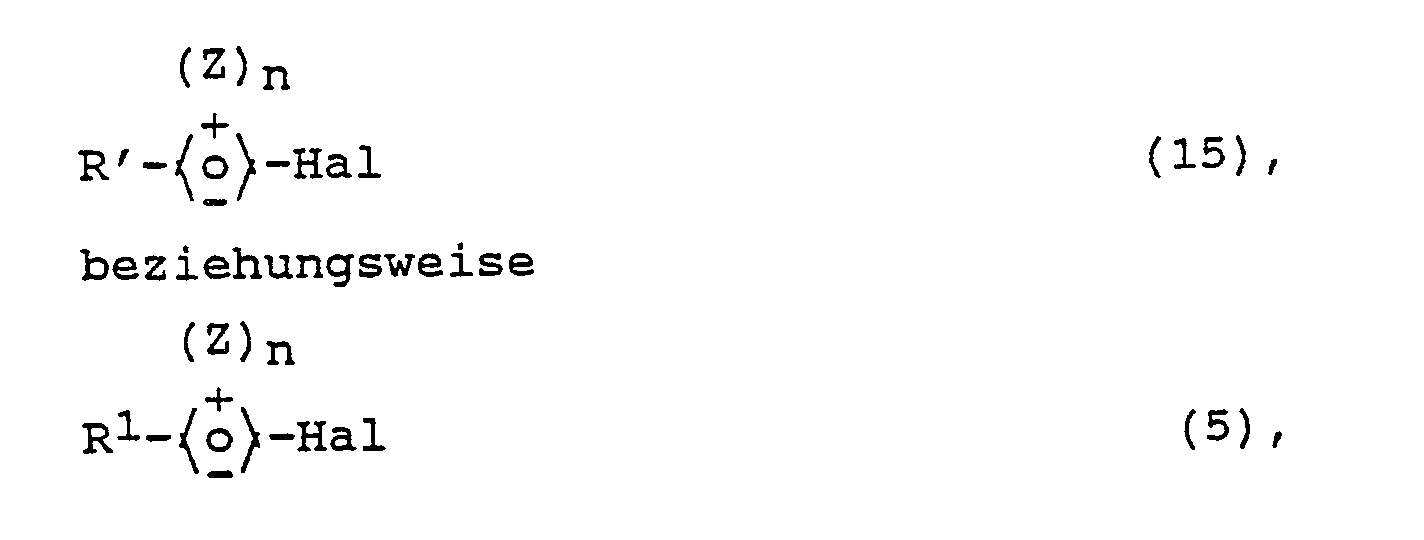
Hal ein Halogenatom, vorzugsweise Chlor oder Brom ist,
mit Metall, vorzugsweise Magnesium, und Reaktion der so erhaltenen metallorganischen Verbindung mit
(b) Verbindungen der Formel
R˝-OOC-Hal (16),
beziehungsweise
R²-OOC-Hal (7),
worin Hal die für Formel (15) bzw. (5) angegebene Bedeutung hat,
wobei in den oben genannten Formeln (15), (5), (16) und (7) die Reste R′ und R˝, Z und n die zu Formel (8) in Anspruch 1 und R¹ und R² die zu Formel (1) in Anspruch 2 angegebenen Bedeutungen haben.
H₂C=CH-(CH₂)(y-2)-R˝˝- (18),
oder einen Rest der Formel
H-R˝˝- (19),
beziehungsweise in den Verbindungen der Formel (7) der Rest R² ersetzt ist durch einen Rest der Formel


und das aus der Umsetzung erhaltene Produkt, das einen Rest der Formel (18) bzw. (25) enthält, anschließend gemäß dem Verfahren nach Anspruch 5 und das aus der Umsetzung erhaltene Produkt, das einen Rest der Formel (19) oder (23) aufweist, anschließend gemäß dem Verfahren nach Anspruch 6 behandelt wird.
Applications Claiming Priority (4)
| Application Number | Priority Date | Filing Date | Title |
|---|---|---|---|
| DE3920509 | 1989-06-22 | ||
| DE3920509A DE3920509A1 (de) | 1989-06-22 | 1989-06-22 | Silylierte benzoesaeurederivate |
| DE4013045 | 1990-04-24 | ||
| DE4013045 | 1990-04-24 |
Publications (3)
| Publication Number | Publication Date |
|---|---|
| EP0404140A2 true EP0404140A2 (de) | 1990-12-27 |
| EP0404140A3 EP0404140A3 (de) | 1991-05-29 |
| EP0404140B1 EP0404140B1 (de) | 1996-03-20 |
Family
ID=25882242
Family Applications (1)
| Application Number | Title | Priority Date | Filing Date |
|---|---|---|---|
| EP90111727A Expired - Lifetime EP0404140B1 (de) | 1989-06-22 | 1990-06-21 | Silylierte Benzoesäurederivate II |
Country Status (4)
| Country | Link |
|---|---|
| US (1) | US5158702A (de) |
| EP (1) | EP0404140B1 (de) |
| JP (1) | JPH0348688A (de) |
| DE (1) | DE59010209D1 (de) |
Cited By (1)
| Publication number | Priority date | Publication date | Assignee | Title |
|---|---|---|---|---|
| US5399290A (en) * | 1991-12-06 | 1995-03-21 | Consortium Fur Elektrochemische Industrie Gmbh | Liquid crystals with (polysila) alkyl wing groups |
Families Citing this family (2)
| Publication number | Priority date | Publication date | Assignee | Title |
|---|---|---|---|---|
| DE3827600A1 (de) * | 1988-08-13 | 1990-02-15 | Hoechst Ag | Organosilylalkyl- oder -alkenyl-verbindungen, verfahren zu ihrer herstellung und ihre verwendung in fluessigkristallinen mischungen |
| GB9126339D0 (en) * | 1991-12-11 | 1992-02-12 | Ici Plc | Chemical process |
Family Cites Families (9)
| Publication number | Priority date | Publication date | Assignee | Title |
|---|---|---|---|---|
| DE322703C (de) * | 1920-07-07 | Werner Otto | Verfahren zum Betriebe von Gluehkathodenroehren | |
| DE355008C (de) * | 1920-09-28 | 1922-06-19 | Stock & Co Spiralbohrer Werkze | Verfahren zum Schmirgeln von Profilflaechen an Werkzeugstaehlen o. dgl. |
| USRE30554E (en) * | 1977-02-28 | 1981-03-24 | Union Carbide Corporation | Coordination complexes as catalysts |
| JPS6483036A (en) * | 1987-09-24 | 1989-03-28 | Idemitsu Kosan Co | Novel compound |
| JP2513742B2 (ja) * | 1987-12-01 | 1996-07-03 | 株式会社東芝 | 液晶材料 |
| DE3854383T2 (de) * | 1987-12-18 | 1996-03-14 | Canon Kk | Mesomorphische Verbindung, Flüssigkristallzusammensetzung und Flüssigkristallvorrichtung. |
| JPH01271431A (ja) * | 1988-04-22 | 1989-10-30 | Toray Dow Corning Silicone Co Ltd | 液晶性オルガノポリシロキサン及びその製造方法 |
| DE3827600A1 (de) * | 1988-08-13 | 1990-02-15 | Hoechst Ag | Organosilylalkyl- oder -alkenyl-verbindungen, verfahren zu ihrer herstellung und ihre verwendung in fluessigkristallinen mischungen |
| DE3827603A1 (de) * | 1988-08-13 | 1990-03-15 | Hoechst Ag | Chirale smektische fluessigkristalle und diese enthaltende glasartige materialien zur darstellung und speicherung von information |
-
1990
- 1990-06-21 EP EP90111727A patent/EP0404140B1/de not_active Expired - Lifetime
- 1990-06-21 DE DE59010209T patent/DE59010209D1/de not_active Expired - Fee Related
- 1990-06-22 JP JP2162998A patent/JPH0348688A/ja active Pending
- 1990-06-22 US US07/542,130 patent/US5158702A/en not_active Expired - Fee Related
Cited By (1)
| Publication number | Priority date | Publication date | Assignee | Title |
|---|---|---|---|---|
| US5399290A (en) * | 1991-12-06 | 1995-03-21 | Consortium Fur Elektrochemische Industrie Gmbh | Liquid crystals with (polysila) alkyl wing groups |
Also Published As
| Publication number | Publication date |
|---|---|
| US5158702A (en) | 1992-10-27 |
| JPH0348688A (ja) | 1991-03-01 |
| EP0404140A3 (de) | 1991-05-29 |
| DE59010209D1 (de) | 1996-04-25 |
| EP0404140B1 (de) | 1996-03-20 |
Similar Documents
| Publication | Publication Date | Title |
|---|---|---|
| EP0405326B1 (de) | Silylierte Benzoesäurederivate | |
| EP0333022B1 (de) | Flüssigkristalline Organopolysiloxane mit chromophoren Seitengruppen | |
| EP0358208B1 (de) | (Meth)acryloxygruppen enthaltende flüssigkristalline Polyorganosiloxane | |
| DE69418773T2 (de) | Eine Silacyclohexanverbindung, ein Verfahren zu deren Herstellung und eine diese enthaltende flüssigkristalline Zusammensetzung | |
| EP0446912B1 (de) | Organosilsesquioxane mit mindestens einer mesogenen Seitengruppe | |
| EP0773250A1 (de) | Chirale Dianhydrohexit-Derivate enthaltende flüssigkristalline Organosiloxane | |
| EP0545409B1 (de) | Flüssigkristalle mit (Mehrfachsila)alkylflügelgruppen | |
| EP0217354B1 (de) | Optisch aktives Tolanderivat | |
| DE4344308A1 (de) | Polymerisierbare flüssigkristalline Siloxane | |
| EP0711780B1 (de) | Verfahren zur Herstellung (Meth)acryloxygruppen enthaltender flüssigkristalliner Polyorganosiloxane | |
| DE69514557T2 (de) | Silacyclohexan Verbindungen, Verfahren zu ihrer Herstellung und Flüssigkristallzusammensetzungen, die sie enthalten | |
| EP0466183B1 (de) | Cyclosiloxane mit mesogenen Seitengruppen | |
| EP0887399B1 (de) | Organosiloxane mit niedriger Glastemperatur | |
| DE69513858T2 (de) | Eine Silacyclohexanverbindung, ein Verfahren zu deren Herstellung und eine diese enthaltende flüssigkristalline Zusammensetzung | |
| DE69420503T2 (de) | Eine Silacyclohexan-Verbindung, ein Verfahren zu ihrer Herstellung und eine sie enthaltende flüssigkristalline Mischung | |
| EP0626386B1 (de) | Chirale Weinsäureimide enthaltende flüssigkristalline Organosiloxane | |
| EP0424959B1 (de) | Organosilylalkylaromaten | |
| EP0404140B1 (de) | Silylierte Benzoesäurederivate II | |
| DE69519639T2 (de) | Silacyclohexanverbindung, Verfahren zu deren Herstellung und diese enthaltende Flüssigkristallzusammensetzung | |
| EP0431466A2 (de) | Cyclische Organosiloxane mit nichtlinearen optischen Eigenschaften | |
| DE69515441T2 (de) | Eine Silacyclohexan-Verbindung, ein Verfahren zu ihrer Herstellung und eine sie enthaltende flüssigkristalline Zusammensetzung. | |
| EP1016703B1 (de) | Flüssigkristalline Silicone mit erhöhter UV-Beständigkeit | |
| DE69012474T2 (de) | Cyclohexenylethanverbindungen. | |
| DE69509935T2 (de) | Eine Silacyclohexanverbindung, deren Herstellung und diese enthaltende Flüssigkristallzusammensetzungen | |
| DE69114600T2 (de) | Mesogene Gruppen enthaltende Silanolverbindungen, mesogene Gruppen enthaltende polymerisierbare Monomere und mesogene Gruppen enthaltende Polymere. |
Legal Events
| Date | Code | Title | Description |
|---|---|---|---|
| PUAI | Public reference made under article 153(3) epc to a published international application that has entered the european phase |
Free format text: ORIGINAL CODE: 0009012 |
|
| 17P | Request for examination filed |
Effective date: 19900621 |
|
| AK | Designated contracting states |
Kind code of ref document: A2 Designated state(s): BE CH DE FR GB LI NL |
|
| PUAL | Search report despatched |
Free format text: ORIGINAL CODE: 0009013 |
|
| AK | Designated contracting states |
Kind code of ref document: A3 Designated state(s): BE CH DE FR GB LI NL |
|
| 17Q | First examination report despatched |
Effective date: 19930826 |
|
| GRAH | Despatch of communication of intention to grant a patent |
Free format text: ORIGINAL CODE: EPIDOS IGRA |
|
| GRAA | (expected) grant |
Free format text: ORIGINAL CODE: 0009210 |
|
| AK | Designated contracting states |
Kind code of ref document: B1 Designated state(s): BE CH DE FR GB LI NL |
|
| ET | Fr: translation filed | ||
| REF | Corresponds to: |
Ref document number: 59010209 Country of ref document: DE Date of ref document: 19960425 |
|
| GBT | Gb: translation of ep patent filed (gb section 77(6)(a)/1977) |
Effective date: 19960424 |
|
| PLBE | No opposition filed within time limit |
Free format text: ORIGINAL CODE: 0009261 |
|
| STAA | Information on the status of an ep patent application or granted ep patent |
Free format text: STATUS: NO OPPOSITION FILED WITHIN TIME LIMIT |
|
| 26N | No opposition filed | ||
| PGFP | Annual fee paid to national office [announced via postgrant information from national office to epo] |
Ref country code: FR Payment date: 19970521 Year of fee payment: 8 |
|
| PGFP | Annual fee paid to national office [announced via postgrant information from national office to epo] |
Ref country code: NL Payment date: 19970523 Year of fee payment: 8 |
|
| PGFP | Annual fee paid to national office [announced via postgrant information from national office to epo] |
Ref country code: GB Payment date: 19970527 Year of fee payment: 8 Ref country code: BE Payment date: 19970527 Year of fee payment: 8 |
|
| PGFP | Annual fee paid to national office [announced via postgrant information from national office to epo] |
Ref country code: CH Payment date: 19970528 Year of fee payment: 8 |
|
| PGFP | Annual fee paid to national office [announced via postgrant information from national office to epo] |
Ref country code: DE Payment date: 19970703 Year of fee payment: 8 |
|
| PG25 | Lapsed in a contracting state [announced via postgrant information from national office to epo] |
Ref country code: GB Free format text: LAPSE BECAUSE OF NON-PAYMENT OF DUE FEES Effective date: 19980621 |
|
| PG25 | Lapsed in a contracting state [announced via postgrant information from national office to epo] |
Ref country code: LI Free format text: LAPSE BECAUSE OF NON-PAYMENT OF DUE FEES Effective date: 19980630 Ref country code: CH Free format text: LAPSE BECAUSE OF NON-PAYMENT OF DUE FEES Effective date: 19980630 Ref country code: BE Free format text: LAPSE BECAUSE OF NON-PAYMENT OF DUE FEES Effective date: 19980630 |
|
| BERE | Be: lapsed |
Owner name: CONSORTIUM FUR ELEKTROCHEMISCHE INDUSTRIE G.M.B.H Effective date: 19980630 |
|
| PG25 | Lapsed in a contracting state [announced via postgrant information from national office to epo] |
Ref country code: NL Free format text: LAPSE BECAUSE OF NON-PAYMENT OF DUE FEES Effective date: 19990101 |
|
| GBPC | Gb: european patent ceased through non-payment of renewal fee |
Effective date: 19980621 |
|
| REG | Reference to a national code |
Ref country code: CH Ref legal event code: PL |
|
| PG25 | Lapsed in a contracting state [announced via postgrant information from national office to epo] |
Ref country code: FR Free format text: LAPSE BECAUSE OF NON-PAYMENT OF DUE FEES Effective date: 19990226 |
|
| NLV4 | Nl: lapsed or anulled due to non-payment of the annual fee |
Effective date: 19990101 |
|
| PG25 | Lapsed in a contracting state [announced via postgrant information from national office to epo] |
Ref country code: DE Free format text: LAPSE BECAUSE OF NON-PAYMENT OF DUE FEES Effective date: 19990401 |
|
| REG | Reference to a national code |
Ref country code: FR Ref legal event code: ST |