EP0405460A2 - Dispositif semi-conducteur utilisant un système à cellule standard - Google Patents
Dispositif semi-conducteur utilisant un système à cellule standard Download PDFInfo
- Publication number
- EP0405460A2 EP0405460A2 EP90112150A EP90112150A EP0405460A2 EP 0405460 A2 EP0405460 A2 EP 0405460A2 EP 90112150 A EP90112150 A EP 90112150A EP 90112150 A EP90112150 A EP 90112150A EP 0405460 A2 EP0405460 A2 EP 0405460A2
- Authority
- EP
- European Patent Office
- Prior art keywords
- cell
- wirings
- semiconductor device
- standard
- inter
- Prior art date
- Legal status (The legal status is an assumption and is not a legal conclusion. Google has not performed a legal analysis and makes no representation as to the accuracy of the status listed.)
- Withdrawn
Links
- 239000004065 semiconductor Substances 0.000 title claims abstract description 61
- 239000000758 substrate Substances 0.000 claims abstract description 20
- 239000010410 layer Substances 0.000 description 73
- XAGFODPZIPBFFR-UHFFFAOYSA-N aluminium Chemical compound [Al] XAGFODPZIPBFFR-UHFFFAOYSA-N 0.000 description 59
- 229910052782 aluminium Inorganic materials 0.000 description 59
- 238000003491 array Methods 0.000 description 12
- 230000005764 inhibitory process Effects 0.000 description 8
- 229910021420 polycrystalline silicon Inorganic materials 0.000 description 7
- 238000010586 diagram Methods 0.000 description 6
- 229920005591 polysilicon Polymers 0.000 description 5
- 230000010354 integration Effects 0.000 description 4
- 238000010276 construction Methods 0.000 description 2
- 238000000034 method Methods 0.000 description 2
- XUIMIQQOPSSXEZ-UHFFFAOYSA-N Silicon Chemical compound [Si] XUIMIQQOPSSXEZ-UHFFFAOYSA-N 0.000 description 1
- 239000004411 aluminium Substances 0.000 description 1
- 238000009413 insulation Methods 0.000 description 1
- 239000011229 interlayer Substances 0.000 description 1
- 239000011159 matrix material Substances 0.000 description 1
- 229920000136 polysorbate Polymers 0.000 description 1
- 229910052710 silicon Inorganic materials 0.000 description 1
- 239000010703 silicon Substances 0.000 description 1
Images







Classifications
-
- H—ELECTRICITY
- H10—SEMICONDUCTOR DEVICES; ELECTRIC SOLID-STATE DEVICES NOT OTHERWISE PROVIDED FOR
- H10D—INORGANIC ELECTRIC SEMICONDUCTOR DEVICES
- H10D89/00—Aspects of integrated devices not covered by groups H10D84/00 - H10D88/00
- H10D89/10—Integrated device layouts
Definitions
- This invention relates to a semiconductor device using a standard cell system, and more particularly to a semiconductor device having improved inter-cell wirings for connecting standard cells to one another.
- a standard cell type semiconductor device is known as one type of semiconductor device (ASIC) for a special application.
- the standard cell is a standard logic circuit such as an AND, NAND, OR or NOR.
- the standard cells are registered in a library, and various circuits can be designed by variously combining the standard cells in the most suitable cell arrangement pattern and in the most suitable inter-cell wiring pattern. For this reason, the standard cell system is mainly used for semiconductor devices which will be manufactured each time small orders have been received.
- the wirings inside the standard cell or between the standard cells are formed of a conductive layer having three layers sequentially laminated on the main surface of a semiconductor substrate.
- a polysilicon layer, first and second aluminum layers are sequentially formed from the main surface of the semiconductor substrate.
- the polysilicon layer is used for forming the gate electrodes of transistors or the like
- the first aluminum layer is used for forming wirings connecting the gate electrodes of the transistors to one another and intra-cell wirings such as power source lines or the like arranged in a row direction of the standard cell
- a second aluminum layer is used for forming wirings for connection between the cells or inter-cell wirings arranged in a direction perpendicular to the power source lines.
- the inter-cell wiring pattern or the pattern of the wirings in the cell formed of the first aluminum layer is standardized and registered.
- two power source lines of high and low potentials which are necessary for circuit operation are formed of the first aluminum layer and are separately arranged in parallel with each other at the end portion of the standard cell area. Further, since the arranged positions of the two power source lines are set on the end portion of the standard cell, the power source lines can be arranged in the same position in all of the registered standard cells.
- a plurality of standard cells as described above are arranged in a direction along the power source lines.
- the thus arranged standard cells are called a standard cell array.
- a plurality of standard cell arrays are formed on the semiconductor substrate.
- the wirings formed of the second aluminum layer are connected to the intra-cell wirings formed of the first aluminum layer, and as described above, arranged in a direction perpendicular to the power source lines to constitute part of the inter-cell wirings.
- the inter-cell wirings formed of the second aluminum layer are formed to extend over the power source lines to an area other than the standard cell area, particularly, between the standard cell array.
- the inter-cell wirings for connection between the standard cells or between the inter-cell wirings formed of the second aluminum layer are formed of the first aluminum layer, and arranged in a direction perpendicular to the inter-cell wirings formed of the second aluminum layer between the standard cell arrays.
- the inter-cell wirings formed of the first aluminum layer and the inter-cell wirings formed of the second aluminum layer are connected to each other between the standard cell arrays so as to attain a desired circuit output.
- An area between the standard cell arrays is deter strictlymined as a wiring area for electrically connecting the standard cells to one another to attain a desired circuit output and is generally called a channel region.
- the area of the channel region on the semiconductor substrate is further increased with an increase in the number of inter-cell wirings necessary for attaining more complicated logic functions.
- An object of this invention is to provide a semiconductor device which can be formed by using the standard cell system with a higher integration density.
- a semiconductor device formed by using a standard cell system comprising a semiconductor substrate having a main surface; a plurality of standard cells formed on the main surface; intra-cell wirings formed inside the standard cells; and inter-cell wirings formed of only a conductive layer formed above a conductive layer constituting the intra-cell wirings, for electrically connecting the plurality of standard cells to one another.
- the inter-cell wirings for electrically connecting different standard cells to each other is formed of only a conductive layer which lies above a conductive layer which constitutes the intra-cell wirings formed inside the standard cell.
- a channel region for electrically connecting the standard cells lying between the standard cell arrays can be omitted.
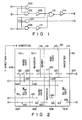
- Fig. 1 is a circuit diagram of a full adder
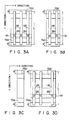
- Fig. 2 is a schematic block diagram showing the full adder which is formed by using the standard cell system according to this invention.
- Figs. 1 and 2 the same portions are denoted by the same reference numerals.
- a first input A is supplied to a first exclusive-OR gate 100 and a first NAND gate 102.
- a second input B is supplied to the first exclusive-OR gate 100 and the first NAND gate 102.
- An output of the first exclusive-OR gate 100 is supplied to a second exclusive-OR gate 104 and a second NAND gate 106.
- a third input C is supplied to the second exclusive-OR gate 104 and the second NAND gate 106.
- An output of the first NAND gate 102 is supplied to a first inverter 108.
- An output of the first inverter 108 is input to a NOR gate 110.
- An output of the second exclusive-OR gate 104 is supplied to a first output D.
- An output of the second NAND gate 106 is input to a second inverter 112.
- An output of the second inverter 112 is input to the NOR gate 110.
- An output of the NOR gate 110 is input to a third inverter 114 and an output of the third inverter 114 is supplied to a second output E.
- each block indicates an occupied area 50 of a standard cell on the semiconductor substrate.
- 116 denotes dummy cell.
- Intra wiring S are formed of first aluminum layer.
- Second aluminum used for cell terminal wirings.
- inter-cell wirings for electrically connecting standard cells to one another include inter-cell wirings 120 formed of a third aluminum layer to extend in an X direction and inter-cell wirings 122 formed of a fourth aluminum layer to extend in a Y direction.
- the inter-cell wirings 120 and 122 are connected to each other above the occupied areas 50 of the standard cells on the semiconductor substrate.
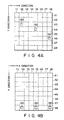
- Figs. 3A to 3D are plan views showing first examples of basic patterns registered into a library of standard cells in this invention.
- a polysilicon layer used for forming gate electrodes of transistors above the main surface of the semiconductor substrate is omitted only for simplifying the drawing.
- the first aluminum layer except the high-potential power source line VDD and low-potential power source line VSS which is formed above the polysilicon layer and used for forming the intra-cell wirings is also omitted for the same reason.
- Fig. 3A is a plan view of a registered pattern of an exclusive-OR gate, NOR gate or NAND gate shown in Fig. 2.
- the high-potential power source line VDD and low-potential power source line VSS are constructed by the first aluminum layer and formed to extend in the X direction.
- Cell terminal wirings 118 which are arranged above the power source lines VDD and VSS, constructed by the second aluminum layer formed above the first aluminum layer to extend in the Y direction are formed above the high-potential power source line VDD and low-potential power source line VSS.
- the cell terminal wirings 118 are formed in contact with intra-cell wirings for connecting the gate electrodes of transistors (not shown), for example, which are formed of the first aluminum layer to one another via via-holes 130.
- the cell terminal wirings 118 are previously registered into the library with their length L set to a preset value.
- the cell terminal wirings 118 function as input and output terminals of the standard cell.
- the cell terminal wirings 118 are formed in contact with the inter-cell wirings 120 which are not shown in Fig. 3A and are constructed by the third aluminum layer formed above the second aluminum layer.
- the inter-cell wirings 120 are formed in contact with the inter-cell wirings 122 which are also not shown in Fig. 3A and are constructed by a fourth aluminum layer formed above the third aluminum layer.
- the standard cells are electrically connected to one another by means of the inter-cell wirings 120 and 122 which are respectively constructed by the different aluminum layers extending in the X and Y directions.
- an area in which the cell terminal wirings 118 are connected to the inter-cell wirings 120 extending in the X direction can be provided over the length L.
- the standard cells are registered with a distance R set between the ends of the power source lines VDD and VSS and the end of the standard cell area.
- the device according to this invention no channel region is provided between the standard cell arrays. For this reason, if the ends of the power source lines VDD and VSS and the end of the standard cell area are registered to be set in the same position in the same manner as in the conventional case, then the power source lines of the different standard cell arrays are short-circuited. In order to prevent occurrence of the short circuit, the ends of the power source lines VDD and VSS and the end of the standard cell area are deviated from each other by the distance R, and the standard cells are registered into the library with the distance R caused by the deviation between them.
- Fig. 3B is a registered pattern of, for example, the inverter shown in Fig. 2. Portions of Fig. 3B which are the same as those of Fig. 3A are denoted by the same reference numerals.
- cell terminal wirings 118 which have a preset length L and are formed of the second aluminum layer and arranged to extend over the power source lines VDD and VSS are provided.
- Fig. 3C shows a registered pattern of dummy cells.
- Fig. 3D shows a registered pattern of a standard cell which requires three or more terminals.
- Fig. 3D in a case where the standard cell is required to have three or more terminals, for example, in the case of a 3-input/1-output NAND gate, three or more cell terminal wirings 118 having a preset length L and formed of the second aluminum layer are provided.
- the number of cell terminal wirings 118 may be variously modified and registered according to the function of the standard cell.
- the cell terminal wirings 118 are formed in contact with the intra-cell wirings which are formed of the first aluminum layer and positioned below the second aluminum layer used to form the cell terminal wirings via the via-holes 130. In this way, an electric signal can be output from elements inside the standard cell or an electric signal can be input to the elements.
- an area disposed above an area in which the contact for the wirings are made is regarded as being a wiring inhibition area, and no wirings are formed above the area.
- an opening area 131 for via-holes 130 linearly extending along the power source line VDD or VSS is previously provided, for example.
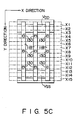
- the wiring inhibition area is explained in more detail with reference to Fig. 4A.
- a computer for controlling the standard cell system recognizes eight wiring areas X1 to X8 in the X direction and eight wiring areas Y1 to Y8 in the Y direction, for example.
- the intra-cell wirings and the power source lines VDD and VSS in the X direction are formed of the first aluminum layer.
- the arrangement direction of the cell terminal wirings formed of the second aluminum layer is set in the Y direction so that the cell terminal wirings may be arranged to. extend over the power source lines VDD and VSS.
- the via-holes 130 for making the cell terminal wirings in contact with the intra-cell wirings are formed in positions (X3, Y2), (X4, Y5) and (X6, Y8).
- the positions (X3, Y2), (X4, Y5) and (X6, Y8) are determined as the wiring inhibition areas and no inter-cell wirings are formed to pass over the areas.
- five out of the eight wiring areas X1 to X8 except the wiring areas X3, X4 and X6 can be used as the wiring areas which can freely pass over the occupied area of the standard cell.
- via-holes 130 as is shown in Fig. 4B are formed.
- the via-holes 130 are formed in the positions (X8, Y2), (X8, Y5) and (X8, Y8). In this way, the via-holes 130 are concentrated on one of the eight wiring areas, for example, the wiring area X8.
- Figs. 5A to 5C are plan views showing preferable examples of registered patterns of standard cells to which the above method is applied. Portions of Figs. 5A to 5C which are the same as those of Figs. 1 to 3 are denoted by the same reference numerals.
- the standard cell shown in Fig. 5A is a standard cell having 15 wiring areas X1 to X15 arranged in the X direction, for example.
- via holes 130 for making the cell terminal wirings 118 in contact with intra-cell wirings are concentrated on one wiring area X12. Therefore, 14 out of the 15 wiring areas X1 to X15, that is, all the wiring areas but the wiring area X12 can freely pass over the standard cell area.
- the standard cell shown in Fig. 5B is a standard cell having the same number of wiring areas as in the case of Fig. 5A.
- a standard cell if it is required to make the cell terminal wirings 118 in contact with intra-cell wirings in two positions, via-holes 130 are concentrated on two wiring areas X 4 and X12, for example. Therefore, the number of wiring areas which can freely pass over the standard cell area can be set to maximum.
- the standard cell shown in Fig. 5C is a standard cell having the same number of wiring areas as in the case of Fig. 5A.
- the number (three) of contacts which is required by one cell terminal wiring 118 is set equal to that of the wiring areas including the wiring inhibition area caused by the contacts by using the same method as is explained in Fig. 5B.
- twelve out of the fifteen wiring areas X1 to X15 that is, all the wiring areas but the wiring areas X4, X8 and X12 can be used as wiring areas which can freely pass over the standard cell area.
- the opening area 131 shown in Figs. 3A, 3B and 3D so as to correspond to the wiring area shown in Figs. 5A to 5C.
- the inter-cell wirings 120 and 122 are located above portions of the cell terminal wirings 118, other than portions of the cell terminal wirings in which said via holes 130 are formed.
- Fig. 6 is a plan view of a semiconductor device having the full adder circuit of Fig. 1 formed on a semiconductor substrate by using the standard cells shown in Figs. 3A to 3D.
- a cross section taken along the line 7-7 of Fig. 6 is shown in Fig. 7, and a cross section taken along the line 8-8 of Fig. 6 is shown in Fig. 8.
- Portions of Figs. 6 to 8 which are the same as those shown in Figs. 1 to 3 are denoted by the same reference numerals.
- polysilicon layers 202 are formed on the main surface of a silicon substrate 200, for example, to form the gate electrodes of MOSFETs which are circuit elements.
- Intra-cell wirings 206 shown in Fig. 8 and constituted by a first aluminum layer are made in contact with the polysilicon layer 202 via contact holes.
- the first aluminum layer also constitutes power source lines VDD and VSS in addition to the intra-cell wirings 206.
- Cell terminal wirings 118 constituted by a second aluminum layer are formed in contact with the cell terminal wirings 206 via via-holes 130.
- the cell terminal wirings 118 are made in contact with inter-cell wirings 120 which are formed of a third aluminum layer and extend in the X direction.
- inter-cell wirings 120 are made in contact with inter-cell wirings 122 which are formed of a fourth aluminum layer and extend in the Y direction.
- the wirings formed of the above conductive layers, that is, the polysilicon layer, the first to fourth aluminum layers are insulated from one another by interlayer insulation film 208 shown in Figs. 7 and 8.
- A1 denotes a standard cell array constituted by a NAND gate 106, inverter 112, dummy 116, NOR gate 110 and inverter 114.
- A2 denotes a standard cell array constituted by an exclusive-OR gate 100, NAND gate 102, inverter 108 and exclusive-OR gate 104.
- the inter-cell wirings 120 and 122 for electrically connecting the standard cells to one another are formed of the third and fourth aluminum layers, respectively. Therefore, the electrical connection between the standard cells can be made above the occupied area 50 of the standard cells and a channel region which has been conventional provided between the standard cell arrays A1 and A2 for electrically connecting the standard cells to one another can be eliminated.
- the integration density of the semiconductor device formed by using the standard cell system can be further enhanced.
- the cell terminal wirings 118 formed of the second aluminum layer and having a preset length L are provided for each standard cell and registered into the library.
- the inter-cell wirings 120 formed of the third aluminum layer are arranged in a direction perpendicular to the arrangement direction of the cell terminal wirings 118. With this arrangement, an area in which the cell terminal wirings 118 and the inter-cell wirings 120 can be connected to each other can be ensured over the length L of the cell terminal wirings 118.
- the area lying above the via-holes 130 for making contact between the cell terminal wirings 118 and the intra-cell wirings 206 is determined as the wiring inhibition area, the area is excluded from the area for permitting connection between the cell terminal wirings 118 and the inter-cell wirings 120.
- the way of excluding the area is also taken into consideration. That is, in order to minimize reduction in the number of wiring areas which can freely pass over the standard cell area due to the presence of the wiring inhibition area, the via-holes 130 are concentrated on one wiring area. With this arrangement, a larger number of wiring areas which can freely pass over the standard cell area can be ensured above the cell terminal wirings 118.
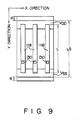
- Fig. 9 is a plan view showing a second example of a basic registered pattern of the standard cell of this invention in the library
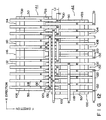
- Fig. 10 is a plan view of a semiconductor device having the full adder circuit of Fig. 1 formed by using the standard cells shown in Fig. 9.
- the length L of the cell terminal wirings 118 is set to be smaller than the length LS between the power source lines VDD and VSS, and the cell terminal wirings 118 are arranged between the power source lines VDD and VSS.
- no cell terminal wirings 118 are formed in an area of distance R.
- the distance R is set to 1/2 of the minimum design rule and a plurality of standard cell arrays are formed, a distance between the two power source lines of the different standard cells will be 2R.
- the distance 2R between the power source line VSS of the standard cell A1 and the power source line VDD of the different standard cell A2 is determined as the minimum design rule.
- the distance between the wirings arranged on the end most portion of the standard cell array becomes minimum. Therefore, the integration density of the semiconductor device formed by using the standard cell system can be further enhanced.
- Fig. 11 is a plan view showing a third example of a basic registered pattern of the standard cell of this invention in the library
- Fig. 12 is a plan view of a semiconductor device having the full adder circuit of Fig. 1 formed by using the standard cells shown in Fig. 11.
- the cell terminal wirings 118 are formed to be longer than the occupied area 50 of the standard cell. That is, the cell terminal wirings 118 are formed to extend over the power source lines VDD and VSS and the end portions thereof project from the occupied area 50 of the standard cell by a length L1.
- the projecting portions L1 of the cell terminal wirings 118 extend into the occupied area 50 of the other standard cell.
- the two standard cell arrays A1 and A2 are deviated from each other so as to prevent the cell terminal wirings 118 of different standard cells from being made in contact with each other.
- those portions of the cell terminal wirings 118 which extend over the occupied area 50 of the different standard cell, that is, the projecting portions L1 may also serve as the inter-cell wirings formed to extend in the Y direction in the same manner as the inter-cell wirings 122 formed of the fourth aluminum layer in the above embodiment.
- a semiconductor device in which no channel region is provided can be formed by using only the first, second and third aluminum layers according to the standard cell system as in the first and second embodiments.
- Fig. 13 is a plan view showing a fourth example of a basic registered pattern of the standard cell of this invention in the library
- Fig. 14 is a plan view of a semiconductor device having the full adder circuit of Fig. 1 formed by using the standard cells shown in Fig. 13.
- the cell terminal wirings 118 are formed in the X direction or in the same direction as the power source lines VDD and VSS.
- the inter-cell wirings are formed of the third and fourth aluminum layers, it is possible to arrange the cell terminal wirings 118 in the X direction or the same direction as the power source lines VDD and VSS.
- the device may have such a plane pattern as shown in Fig. 14.
- an intra-cell pattern formed of the first aluminum layer as shown in Fig. 15 can be obtained, for example.
- Fig. 15 is a plan view of the standard cell in which a schematic plane pattern of the intra-cell wirings is partly shown.
- Fig. 15 the same portions as those in Figs. 3A and 8 are denoted by the same reference numerals.
- Y1 to Y5 denote the wiring areas.
- Fig. 16 is a plan view showing a fifth example of a basic registered pattern of the standard cell of this invention in the library.
- some of the cell terminal wirings 118 are formed within the occupied area 50 of the standard cell and the remaining cell terminal wirings are formed to project to the exterior from the occupied area 50 of the standard cell.
- the length of the cell terminal wirings 118 can be variously changed and registered into the library.
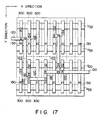
- Fig. 17 is a plan view illustrating a semiconductor device according to a sixth embodiment of the invention.
- This device is of the gate-array structure, not the standard-cell structure applied to the first to fifth embodiments described above.
- Those of the elements of the device, which are identical to those shown in Fig. 6, are designated by the same numerals in Fig. 17, and will not be described in detail.
- base cells 300 are arranged on a semiconductor substrate, in rows and column, or in a matrix pattern.
- This embodiment has four aluminum layers.
- the first aluminum layer is pattern, thus forming intra-cell wirings, and the second aluminum layer is pattered, thus forming cell terminal wirings 118.
- the third and fourth aluminum layers are patterned, forming inter-cell wirings 120 and 122, which connects the base cells 300 to one another. Hence, no channel regions need be provided amount the base cells 300.
- the intra-cell wirings are formed of one aluminum layer, i.e., the first aluminum layer. If necessary, they can be formed of two or more aluminum layers. In the case where they are made of two aluminum layers, the cell terminal wirings are formed of the third aluminum layer, and the inter-cell wirings are formed of the fourth aluminum layer and the upper aluminium layer or layers.
Landscapes
- Design And Manufacture Of Integrated Circuits (AREA)
- Internal Circuitry In Semiconductor Integrated Circuit Devices (AREA)
Applications Claiming Priority (2)
| Application Number | Priority Date | Filing Date | Title |
|---|---|---|---|
| JP163197/89 | 1989-06-26 | ||
| JP1163197A JPH0329342A (ja) | 1989-06-26 | 1989-06-26 | 半導体装置 |
Publications (2)
| Publication Number | Publication Date |
|---|---|
| EP0405460A2 true EP0405460A2 (fr) | 1991-01-02 |
| EP0405460A3 EP0405460A3 (en) | 1991-12-27 |
Family
ID=15769122
Family Applications (1)
| Application Number | Title | Priority Date | Filing Date |
|---|---|---|---|
| EP19900112150 Withdrawn EP0405460A3 (en) | 1989-06-26 | 1990-06-26 | Semiconductor device using standard cell system |
Country Status (4)
| Country | Link |
|---|---|
| US (1) | US5111271A (fr) |
| EP (1) | EP0405460A3 (fr) |
| JP (1) | JPH0329342A (fr) |
| KR (1) | KR910001945A (fr) |
Cited By (1)
| Publication number | Priority date | Publication date | Assignee | Title |
|---|---|---|---|---|
| EP1061583A1 (fr) * | 1999-06-18 | 2000-12-20 | Nec Corporation | Circuit intégré semi-conducteur et appareil pour la formation d'un modèle son layout |
Families Citing this family (17)
| Publication number | Priority date | Publication date | Assignee | Title |
|---|---|---|---|---|
| JP3027990B2 (ja) * | 1991-03-18 | 2000-04-04 | 富士通株式会社 | 半導体装置の製造方法 |
| US5831467A (en) * | 1991-11-05 | 1998-11-03 | Monolithic System Technology, Inc. | Termination circuit with power-down mode for use in circuit module architecture |
| DE69226150T2 (de) * | 1991-11-05 | 1999-02-18 | Hsu Fu Chieh | Redundanzarchitektur für Schaltungsmodul |
| US5576554A (en) * | 1991-11-05 | 1996-11-19 | Monolithic System Technology, Inc. | Wafer-scale integrated circuit interconnect structure architecture |
| US5498990A (en) * | 1991-11-05 | 1996-03-12 | Monolithic System Technology, Inc. | Reduced CMOS-swing clamping circuit for bus lines |
| WO1994003901A1 (fr) | 1992-08-10 | 1994-02-17 | Monolithic System Technology, Inc. | Systeme de bus a grande vitesse et interface de bus insensibles aux defaillances pour integration a l'echelle d'une tranche |
| US5536955A (en) * | 1993-03-29 | 1996-07-16 | Toppan Electronics (Usa) Inc. | Electronic devices for use in generating integrated circuit structures and method therefor |
| US5440153A (en) * | 1994-04-01 | 1995-08-08 | United Technologies Corporation | Array architecture with enhanced routing for linear asics |
| JP3185540B2 (ja) * | 1994-06-10 | 2001-07-11 | 松下電器産業株式会社 | 半導体集積回路 |
| US5655113A (en) | 1994-07-05 | 1997-08-05 | Monolithic System Technology, Inc. | Resynchronization circuit for a memory system and method of operating same |
| US5742099A (en) * | 1994-09-29 | 1998-04-21 | Intel Corporation | Power bus for an integrated circuit including end-to-end arranged segments providing power and ground |
| US5789807A (en) * | 1996-10-15 | 1998-08-04 | International Business Machines Corporation | On-chip power distribution for improved decoupling |
| US5894142A (en) * | 1996-12-11 | 1999-04-13 | Hewlett-Packard Company | Routing for integrated circuits |
| US6025616A (en) * | 1997-06-25 | 2000-02-15 | Honeywell Inc. | Power distribution system for semiconductor die |
| KR100437344B1 (ko) * | 2001-08-20 | 2004-06-25 | 한국에너지기술연구원 | 먼지가 내부로 침투하는 것을 방지하는 표면층을 구비한 집진필터와 그 제조방법 및 장치 |
| US6892370B2 (en) * | 2003-04-02 | 2005-05-10 | Silicon Design Systems Ltd. | Computerized standard cell library for designing integrated circuits (ICs) with high metal layer intra cell signal wiring, and ICs including same |
| US8816403B2 (en) * | 2011-09-21 | 2014-08-26 | Taiwan Semiconductor Manufacturing Co., Ltd. | Efficient semiconductor device cell layout utilizing underlying local connective features |
Family Cites Families (14)
| Publication number | Priority date | Publication date | Assignee | Title |
|---|---|---|---|---|
| JPS51147982A (en) * | 1975-06-13 | 1976-12-18 | Nec Corp | Integrated circuit |
| JPS5319775A (en) * | 1976-08-09 | 1978-02-23 | Hitachi Ltd | Large scale integrated circuit |
| US4969029A (en) * | 1977-11-01 | 1990-11-06 | Fujitsu Limited | Cellular integrated circuit and hierarchial method |
| JPS5878450A (ja) * | 1981-11-04 | 1983-05-12 | Nippon Telegr & Teleph Corp <Ntt> | 半導体集積回路装置 |
| JPS5887854A (ja) * | 1981-11-20 | 1983-05-25 | Nec Corp | マスタスライス方式lsi基板 |
| JPS5911670A (ja) * | 1982-07-12 | 1984-01-21 | Toshiba Corp | 半導体集積回路装置 |
| JPS607147A (ja) * | 1983-06-24 | 1985-01-14 | Mitsubishi Electric Corp | 半導体装置 |
| JPS61292341A (ja) * | 1985-06-20 | 1986-12-23 | Toshiba Corp | 半導体集積回路 |
| JPS628538A (ja) * | 1985-07-05 | 1987-01-16 | Hitachi Ltd | 半導体集積回路装置 |
| JPS6278848A (ja) * | 1985-09-30 | 1987-04-11 | Nec Corp | 大規模半導体集積回路 |
| JPS62177940A (ja) * | 1986-01-31 | 1987-08-04 | Toshiba Corp | 半導体論理集積回路装置 |
| JPS62273751A (ja) * | 1986-05-21 | 1987-11-27 | Nec Corp | 集積回路 |
| US4910574A (en) * | 1987-04-30 | 1990-03-20 | Ibm Corporation | Porous circuit macro for semiconductor integrated circuits |
| JPH0812882B2 (ja) * | 1987-08-25 | 1996-02-07 | 富士通株式会社 | 半導体集積回路 |
-
1989
- 1989-06-26 JP JP1163197A patent/JPH0329342A/ja active Pending
-
1990
- 1990-06-25 US US07/543,128 patent/US5111271A/en not_active Expired - Lifetime
- 1990-06-26 EP EP19900112150 patent/EP0405460A3/en not_active Withdrawn
- 1990-06-26 KR KR1019900009459A patent/KR910001945A/ko not_active Abandoned
Cited By (2)
| Publication number | Priority date | Publication date | Assignee | Title |
|---|---|---|---|---|
| EP1061583A1 (fr) * | 1999-06-18 | 2000-12-20 | Nec Corporation | Circuit intégré semi-conducteur et appareil pour la formation d'un modèle son layout |
| US6513147B1 (en) | 1999-06-18 | 2003-01-28 | Nec Corporation | Semiconductor integrated circuit device and layout method using primitive cells having indentical core designs |
Also Published As
| Publication number | Publication date |
|---|---|
| KR910001945A (ko) | 1991-01-31 |
| JPH0329342A (ja) | 1991-02-07 |
| EP0405460A3 (en) | 1991-12-27 |
| US5111271A (en) | 1992-05-05 |
Similar Documents
| Publication | Publication Date | Title |
|---|---|---|
| EP0405460A2 (fr) | Dispositif semi-conducteur utilisant un système à cellule standard | |
| US6838713B1 (en) | Dual-height cell with variable width power rail architecture | |
| EP0295707B1 (fr) | Dispositif semi-conducteur à circuit intégré comprenant des lignes d'alimentation multicouches | |
| US4811073A (en) | Gate array arrangement | |
| KR100375753B1 (ko) | 반도체 소자의 파워/그라운드 금속 경로 설정 | |
| EP0102644B1 (fr) | Circuit intégré semi-conducteur | |
| US20020003270A1 (en) | Semiconductor device | |
| US5300796A (en) | Semiconductor device having an internal cell array region and a peripheral region surrounding the internal cell array for providing input/output basic cells | |
| US6479845B2 (en) | Pattern for routing power and ground for an integrated circuit chip | |
| US6591406B2 (en) | Semiconductor apparatus including bypass capacitor having structure for making automatic design easy, and semiconductor apparatus layout method | |
| US5229629A (en) | Semiconductor integrated circuit having improved cell layout | |
| US6603158B1 (en) | Semiconductor integrated circuit having high-density base cell array | |
| US5237184A (en) | Semiconductor integrated circuit | |
| US5539246A (en) | Microelectronic integrated circuit including hexagonal semiconductor "gate " device | |
| US4750026A (en) | C MOS IC and method of making the same | |
| US5506428A (en) | Gate array LSI | |
| JPH0113222B2 (fr) | ||
| US5869852A (en) | Semiconductor integrated circuit and semiconductor integrated circuit having layout designed by cell base system | |
| US5434436A (en) | Master-slice type semiconductor integrated circuit device having multi-power supply voltage | |
| US4745307A (en) | Semiconductor integrated circuit with a programmable logic array | |
| US5654563A (en) | Microelectronic integrated circuit including triangular semiconductor "or"g | |
| US5631581A (en) | Microelectronic integrated circuit including triangular semiconductor "and" gate device | |
| JP2839722B2 (ja) | 集積回路装置 | |
| US5656850A (en) | Microelectronic integrated circuit including hexagonal semiconductor "and"g | |
| EP0349294B1 (fr) | Cellules d'entrée-sortie pour circuits intégrés semiconducteurs |
Legal Events
| Date | Code | Title | Description |
|---|---|---|---|
| PUAI | Public reference made under article 153(3) epc to a published international application that has entered the european phase |
Free format text: ORIGINAL CODE: 0009012 |
|
| 17P | Request for examination filed |
Effective date: 19900626 |
|
| AK | Designated contracting states |
Kind code of ref document: A2 Designated state(s): DE FR GB |
|
| PUAL | Search report despatched |
Free format text: ORIGINAL CODE: 0009013 |
|
| AK | Designated contracting states |
Kind code of ref document: A3 Designated state(s): DE FR GB |
|
| 17Q | First examination report despatched |
Effective date: 19930415 |
|
| STAA | Information on the status of an ep patent application or granted ep patent |
Free format text: STATUS: THE APPLICATION IS DEEMED TO BE WITHDRAWN |
|
| 18D | Application deemed to be withdrawn |
Effective date: 19950810 |