EP0406023B1 - Opto-magnetisches Aufzeichnungsmedium - Google Patents
Opto-magnetisches Aufzeichnungsmedium Download PDFInfo
- Publication number
- EP0406023B1 EP0406023B1 EP90307186A EP90307186A EP0406023B1 EP 0406023 B1 EP0406023 B1 EP 0406023B1 EP 90307186 A EP90307186 A EP 90307186A EP 90307186 A EP90307186 A EP 90307186A EP 0406023 B1 EP0406023 B1 EP 0406023B1
- Authority
- EP
- European Patent Office
- Prior art keywords
- layer
- film
- recording medium
- writing
- reading
- Prior art date
- Legal status (The legal status is an assumption and is not a legal conclusion. Google has not performed a legal analysis and makes no representation as to the accuracy of the status listed.)
- Expired - Lifetime
Links
- 239000010410 layer Substances 0.000 claims description 225
- 230000005415 magnetization Effects 0.000 claims description 71
- 239000010408 film Substances 0.000 claims description 48
- 239000000203 mixture Substances 0.000 claims description 38
- 229910052723 transition metal Inorganic materials 0.000 claims description 35
- 229910052761 rare earth metal Inorganic materials 0.000 claims description 30
- 239000002355 dual-layer Substances 0.000 claims description 24
- 150000003624 transition metals Chemical class 0.000 claims description 23
- 150000002910 rare earth metals Chemical class 0.000 claims description 22
- 239000000758 substrate Substances 0.000 claims description 16
- 229910045601 alloy Inorganic materials 0.000 claims description 8
- 239000000956 alloy Substances 0.000 claims description 8
- 238000010168 coupling process Methods 0.000 claims description 8
- 238000005859 coupling reaction Methods 0.000 claims description 8
- 229910000808 amorphous metal alloy Inorganic materials 0.000 claims description 5
- 239000011521 glass Substances 0.000 claims description 4
- 239000010409 thin film Substances 0.000 claims description 4
- 229910052689 Holmium Inorganic materials 0.000 claims description 3
- 229910052779 Neodymium Inorganic materials 0.000 claims description 3
- 229910052692 Dysprosium Inorganic materials 0.000 claims description 2
- 229910052688 Gadolinium Inorganic materials 0.000 claims description 2
- 239000003989 dielectric material Substances 0.000 claims description 2
- 239000011347 resin Substances 0.000 claims description 2
- 229920005989 resin Polymers 0.000 claims description 2
- 230000001965 increasing effect Effects 0.000 description 20
- 238000000034 method Methods 0.000 description 14
- 230000008569 process Effects 0.000 description 13
- 238000005259 measurement Methods 0.000 description 6
- 230000006872 improvement Effects 0.000 description 4
- -1 rare earth RE Chemical class 0.000 description 4
- 230000035945 sensitivity Effects 0.000 description 4
- 238000010438 heat treatment Methods 0.000 description 3
- 230000003287 optical effect Effects 0.000 description 3
- 238000012546 transfer Methods 0.000 description 3
- VYPSYNLAJGMNEJ-UHFFFAOYSA-N Silicium dioxide Chemical compound O=[Si]=O VYPSYNLAJGMNEJ-UHFFFAOYSA-N 0.000 description 2
- 230000008859 change Effects 0.000 description 2
- 238000011156 evaluation Methods 0.000 description 2
- 238000002474 experimental method Methods 0.000 description 2
- 230000009467 reduction Effects 0.000 description 2
- 229910052727 yttrium Inorganic materials 0.000 description 2
- 239000004925 Acrylic resin Substances 0.000 description 1
- 229920000178 Acrylic resin Polymers 0.000 description 1
- 230000015572 biosynthetic process Effects 0.000 description 1
- 229910052681 coesite Inorganic materials 0.000 description 1
- 230000008878 coupling Effects 0.000 description 1
- 229910052906 cristobalite Inorganic materials 0.000 description 1
- 230000003247 decreasing effect Effects 0.000 description 1
- 238000000151 deposition Methods 0.000 description 1
- 238000011161 development Methods 0.000 description 1
- 230000009977 dual effect Effects 0.000 description 1
- 230000000694 effects Effects 0.000 description 1
- 238000010894 electron beam technology Methods 0.000 description 1
- 230000003028 elevating effect Effects 0.000 description 1
- 238000005516 engineering process Methods 0.000 description 1
- 230000002708 enhancing effect Effects 0.000 description 1
- 239000003822 epoxy resin Substances 0.000 description 1
- 230000001788 irregular Effects 0.000 description 1
- 230000002093 peripheral effect Effects 0.000 description 1
- 229920003229 poly(methyl methacrylate) Polymers 0.000 description 1
- 239000004417 polycarbonate Substances 0.000 description 1
- 229920000515 polycarbonate Polymers 0.000 description 1
- 229920000647 polyepoxide Polymers 0.000 description 1
- 239000004926 polymethyl methacrylate Substances 0.000 description 1
- 229920006395 saturated elastomer Polymers 0.000 description 1
- 239000004065 semiconductor Substances 0.000 description 1
- 239000000377 silicon dioxide Substances 0.000 description 1
- 235000012239 silicon dioxide Nutrition 0.000 description 1
- 238000004544 sputter deposition Methods 0.000 description 1
- 229910052682 stishovite Inorganic materials 0.000 description 1
- 229910052905 tridymite Inorganic materials 0.000 description 1
- 238000001771 vacuum deposition Methods 0.000 description 1
- 238000007740 vapor deposition Methods 0.000 description 1
Images



Classifications
-
- G—PHYSICS
- G11—INFORMATION STORAGE
- G11B—INFORMATION STORAGE BASED ON RELATIVE MOVEMENT BETWEEN RECORD CARRIER AND TRANSDUCER
- G11B11/00—Recording on or reproducing from the same record carrier wherein for these two operations the methods are covered by different main groups of groups G11B3/00 - G11B7/00 or by different subgroups of group G11B9/00; Record carriers therefor
- G11B11/10—Recording on or reproducing from the same record carrier wherein for these two operations the methods are covered by different main groups of groups G11B3/00 - G11B7/00 or by different subgroups of group G11B9/00; Record carriers therefor using recording by magnetic means or other means for magnetisation or demagnetisation of a record carrier, e.g. light induced spin magnetisation; Demagnetisation by thermal or stress means in the presence or not of an orienting magnetic field
- G11B11/105—Recording on or reproducing from the same record carrier wherein for these two operations the methods are covered by different main groups of groups G11B3/00 - G11B7/00 or by different subgroups of group G11B9/00; Record carriers therefor using recording by magnetic means or other means for magnetisation or demagnetisation of a record carrier, e.g. light induced spin magnetisation; Demagnetisation by thermal or stress means in the presence or not of an orienting magnetic field using a beam of light or a magnetic field for recording by change of magnetisation and a beam of light for reproducing, i.e. magneto-optical, e.g. light-induced thermomagnetic recording, spin magnetisation recording, Kerr or Faraday effect reproducing
- G11B11/10582—Record carriers characterised by the selection of the material or by the structure or form
- G11B11/10586—Record carriers characterised by the selection of the material or by the structure or form characterised by the selection of the material
-
- G—PHYSICS
- G11—INFORMATION STORAGE
- G11B—INFORMATION STORAGE BASED ON RELATIVE MOVEMENT BETWEEN RECORD CARRIER AND TRANSDUCER
- G11B11/00—Recording on or reproducing from the same record carrier wherein for these two operations the methods are covered by different main groups of groups G11B3/00 - G11B7/00 or by different subgroups of group G11B9/00; Record carriers therefor
- G11B11/10—Recording on or reproducing from the same record carrier wherein for these two operations the methods are covered by different main groups of groups G11B3/00 - G11B7/00 or by different subgroups of group G11B9/00; Record carriers therefor using recording by magnetic means or other means for magnetisation or demagnetisation of a record carrier, e.g. light induced spin magnetisation; Demagnetisation by thermal or stress means in the presence or not of an orienting magnetic field
- G11B11/105—Recording on or reproducing from the same record carrier wherein for these two operations the methods are covered by different main groups of groups G11B3/00 - G11B7/00 or by different subgroups of group G11B9/00; Record carriers therefor using recording by magnetic means or other means for magnetisation or demagnetisation of a record carrier, e.g. light induced spin magnetisation; Demagnetisation by thermal or stress means in the presence or not of an orienting magnetic field using a beam of light or a magnetic field for recording by change of magnetisation and a beam of light for reproducing, i.e. magneto-optical, e.g. light-induced thermomagnetic recording, spin magnetisation recording, Kerr or Faraday effect reproducing
- G11B11/10582—Record carriers characterised by the selection of the material or by the structure or form
- G11B11/10586—Record carriers characterised by the selection of the material or by the structure or form characterised by the selection of the material
- G11B11/10589—Details
-
- Y—GENERAL TAGGING OF NEW TECHNOLOGICAL DEVELOPMENTS; GENERAL TAGGING OF CROSS-SECTIONAL TECHNOLOGIES SPANNING OVER SEVERAL SECTIONS OF THE IPC; TECHNICAL SUBJECTS COVERED BY FORMER USPC CROSS-REFERENCE ART COLLECTIONS [XRACs] AND DIGESTS
- Y10—TECHNICAL SUBJECTS COVERED BY FORMER USPC
- Y10S—TECHNICAL SUBJECTS COVERED BY FORMER USPC CROSS-REFERENCE ART COLLECTIONS [XRACs] AND DIGESTS
- Y10S428/00—Stock material or miscellaneous articles
- Y10S428/90—Magnetic feature
Definitions
- the present invention concerns an opto-magnetic recording medium such as an opto-magnetic disk and, more particularly, it relates to an opto-magnetic recording medium having a perpendicularly magnetized film of a dual layer structure comprising a first layer (reading layer) and a second layer (writing layer) each composed of rare earth-transition metal alloy film.
- An opto-magnetic recording medium using a thin amorphous alloy film comprising a rare earth metal (RE) and a transition metal (TM) has insufficient reading characteristics and various improvements have been studied.
- a curie point writing type opto-magnetic recording medium mainly constituted with an exchange-coupled perpendicularly magnetized film of a dual layer structure comprising a writing layer having a low curie point and a large coersive force and a reading layer having a higher curie point and a smaller coersive force as compared with those of the writing layer
- Japanese Patent Laid Open Sho 57-78652 "III amorphous multi-layered film", p 294 - 305 in, Collected Technology for Optical Memory-Opto-Magnetic memory, published by Science Forum Co. Ltd, October 31, 1983.
- TbFe, DyFe, TbFeCo and DyFeCo are used for the writing layer and GdFe, GdFeCo and TbFeCo are used for the reading layer.
- C/N ratio which is a ratio between a carrier level and a noise level in an opto-magnetic recording medium thereby improving the reading characteristics, it is necessary to increase the carrier level and reduce the noise level.
- the carrier level may be increased by making the Kerr rotational angle greater in the reading layer, while it is important to increase the exchange-coupling force between the two layers for reducing the noise level.
- a medium having a high Kerr rotation angle for the reading layer, but a medium having a greater Kerr rotation angle generally has increased saturation magnetization.
- saturation magnetization the recording characteristics of the reading layer become predominant during recording, tending to cause writing noise.
- the noise level is also increased by as much, thereby giving no contribution to the improvement of the C/N ratio.
- the present invention seeks to improve the C/N ratio of an opto-magnetic recording medium by developing a medium for the reading layer having a high Kerr rotation angle while suppressing the increase of the saturation magnetization as much as possible and controlling the sublattice magnetization for each of the rare earth and the transition metal in each of the writing layer and the reading layer, thereby suppressing the occurrence of writing noise.
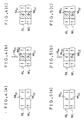
- the dual layer medium includes, as shown in Figs. 2(a) and (b), a type in which the magnetization Ms1 and Ms2 in the reading layer RL and the writing layer WL, respectively, are in parallel with each other (hereinafter referred to as P type) and, as shown in Figs. 3(a) and (b), a type in which the magnetization Msl and Ms2 in the reading layer RL and the writing layer WL, respectively, are opposite to each other (hereinafter referred to as A type).
- sublattice magnetization Ms RE for the rare earth RE is predominant in both of the reading layer RL and the writing layer WL (hereinafter the state in which the auxiliary magnetization Ms RE for the rare earth RE is predominant is referred to as RE rich), or sublattice magnetization Ms TM for the transition metal TM is predominant in both of the layers (hereinafter the state in which the sublattice magnetization Ms TM for the transition metal TM is predominant is referred to as TM rich).
- one of the layers is RE rich and the other of the layers is TM rich in the two layers of the reading layer RL and the writing layer WL.
- both of the reading layer RL and the writing layer WL are TM rich for the P type and that the reading layer RL is TM rich, while the writing layer WL is RE rich for the A type.
- the directions for the respective magnetization Ms1 and Ms2 in the reading layer RL and the writing layer WL of the medium are identical as shown in Fig. 4(a) and then an external auxiliary magnetic field Hex is applied downwardly while heating a recording area shown by hatched lines by means of a laser beam, by which the magnetization Ms2 and Ms1 in the writing layer WL and the reading layer RL are reversed. Then, following temperature reduction, downward magnetization Ms2 and Ms1 appears the writing layer W1 and the reading layer RL.
- magnetization Ms1 in the reading layer RL and the magnetization Ms2 in the writing layer WL of the medium are in opposite directions.
- the bits written into the reading layer RL have a regular and well-arranged shape.
- bits, when recorded in the reading layer RL do not diffuse into other regions than the area of the writing layer WL that reaches the temperature near the curie point (laser beam irradiated area) by the exchanging force between the two layers.
- the film thickness h2 of the writing layer WL has to be within such a range as capable of undergoing the exchanging force from the boundary between both of the layers and, if the magnetization Ms2 in the writing layer WL is excessively large, a stray magnetic field or demagnetizing field is increased to cause distortion in the shape of the recorded bits even if in the curie point recording.
- the reading layer RL is required to have a high Kerr rotation angle ⁇ k, and small saturation magnetization Ms and coersive force Hc.
- GdFeCo among the reading layer media used at present has a rather high Kerr rotational angle ⁇ k of about 0.46° (at a measuring wavelength of 780 nm), in which the saturation magnetization Ms and the coersive force Hc are about 50 emu/cm3 and 0.5 KOe, respectively. Accordingly, for improving the C/N ratio further, it is necessary to develop a medium having a higher Kerr rotational angle ⁇ k than that of GdFeCo while suppressing Ms and Hc.
- the present inventor has sought for media adaptable to the conditions described above among quaternary rare earth-transition metal opto-magnetic recording media and has found that GdDyFeCo is particularly excellent as the reading layer medium.
- the Kerr rotational angle ⁇ k can be increased to 0.54° while suppressing the saturation magnetization Ms to less than 250 emu/cm3 in a TM rich composition ratio in which X is about 20 and the coersive force Hc is less than 2 KOe.
- the Kerr rotational angle ⁇ k is increased by 17.4% as compared with that of conventional CdFeCo.
- the saturation magnetization Ms can be suppressed to as relatively low as 250 emu/cm3, it is increased as compared with that of the conventional reading layer medium. Therefore, in order to form regular and well-arranged bits while satisfying the conditions in Table 1, it is necessary that the saturation magnetization Ms in the writing layer WL is also made greater, relatively.
- a large coersive force Hc is required for the writing layer medium and, at the same time, a lower curie temperature Tc is required for the improvement of the recording sensitivity. Accordingly, a medium having a curie temperature Tc between 100 to 150°C has predominantly been used. However, according to the study of the present inventor, it has been found that there is no practical problems in view of the recording sensitivity so long as the curie temperature Tc is up to about 190°C. Accordingly, the range for selecting the writing layer can be widened as compared with the usual case.
- TbFeCo is excellent as the writing layer.
- Tb X (Fe 100-Y Co Y ) 100-X both of the saturation magnetization Ms and the coersive force Hc could be increased while restricting the curie temperature Tc to 155 - 195°C by defining X as 15 to 30 and Y as 6 to 12.
- TbFeCo has RE rich composition ratio near the compensation composition with X being greater than 25, and such a composition ratio that predominant magnetization does not turn from RE into TM in the temperature elevation process due to the irradiation of laser beams upon recording. If a portion of Tb in TbFeCo is substituted with other rare earth element such as Ge, Dy, Ho or Nd, for controlling the curie temperature, TbFeCo can be used sufficiently as the writing layer medium, so long as the RE rich composition ratio is maintained.
- the inventors have examined as to which of the P or A type film medium is suitable.
- bits formed by the external auxiliary magnetic field and the stray magnetic field to the laser beam irradiated area of the reading layer RL upon recording undergo the effect of exchanging force between both of the layers and, accordingly, are not diffused to the outside of the area of the writing layer WL that reaches a temperature near the curie point (laser beam irradiation area), but can take any optional shape within a range near the curie temperature.
- the saturation magnetization Ms of the reading layer RL is large, the bits formed in the reading layer RL are disturbed at the outer periphery or tend to form multiple polymagnetic domains so as to reduce the magnetostatic energy within the region near the curie temperature of the writing layer WL.
- the bits thus formed irregularly also form irregular shape of bits in the writing layer WL in the temperature lowering process. Accordingly, in the case of using a medium of large saturated magnetization Ms as in the present invention, the P type dual layer film medium is not suitable.
- the A type dual layer film structure is considered to be preferable for a medium having a large saturation magnetisation with an aim of improving the Kerr rotation angle ⁇ k for thereading layer RL.
- the second layer preferably comprises a rare earth-transition metal alloy of TbFeCo or TbFeCo in which Tb is partially (ca. 5 - 20 %) substituted with rare earth element other than Tb such as Gd, Dy, Nd and Ho, and in which the curie point is set to higher than 155°C and sublattice magnetization for rare earth remains predominant upon temperature elevation for recording.
- Each of the layers can be formed by means of a known method such as vapor deposition, sputtering or CVD.
- the recording medium comprising the second layer (writing layer) previously magnetized perpendicularly in one direction and the first layer (reading layer) magnetized in the direction opposite to that of the second layer (writing layer) by means of the exchange-coupling force is irradiated with a laser beam emitted from a semiconductor laser, etc. and, at the same time, applied with an external auxiliary magnetic field in the direction opposite to that of the magnetization in the second layer (writing layer).
- the area in the second layer (writing layer) irradiated with the laser beam is heated to a temperature near the curie point and the coercive force is reduced.
- bits magnetized in the direction opposite to the peripheral area are formed by the external auxiliary magnetic field and the stray magnetic field.
- the bits recorded in the second layer (writing layer) are transferred by the exchange-coupling force to the first layer (reading layer).
- Reproduction is conducted by reading the bits recorded in the first layer (reading layer) by the laser beam.
- the Kerr rotational angle in the first layer (reading layer) can be increased and, at the same time, increase of the saturation magnetization and the coercive force along with the increase of the Kerr rotational angle can be suppressed.
- the second layer (writing layer)
- TbFeCo film mainly comprising TbFeCo of predominant sublattice magnetization for rare earth at a room temperature
- the saturation magnetization for the second layer (writing layer) can also be increased corresponding to the increase of the saturation magnetization in the first layer (reading layer).
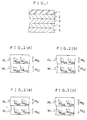
- an opto-magnetic disk as an opto-magnetic recording medium comprises a disk substrate 1 made of glass, and a first SiO layer 2 for enhancing the Kerr rotational angle ⁇ k, a reading layer 3 as the first layer, a writing layer 4 as the second layer 2 and a second SiO layer 5 as a protection layer laminated on the substrate 1.
- the film thickness for each of the layers is set, for example, to 82 nm for the first SiO layer 2, 40 to 50 nm for the reading layer 3, 100 nm for the writing layer 4 and 55 nm for the second SiO layer 5 respectively.
- the reading layer 3 and the writing layer 4 were formed by using two electron beam heating vacuum deposition devices and vapor depositing transition metal (TM) from one direction and rare earth (RE) from the other direction simultaneously.
- TM transition metal
- RE rare earth
- Each of the layers 2 - 5 was laminated on the disc substrate 1 within one identical vacuum vessel without changing the vacuum state.
- a glass disk substrate of 130 mm diameter manufactured by Corning Co. in USA was used as the disk substrate 1.
- a resin substrate made of polycarbonate, PMMA (acrylic resin) or epoxy resin may be used in place of the glass substrate.
- dielectric material such as AlN, SiN or SiO2 may also be used.
- Table 2 described below shows the results of measurement for coercive force Hc, Kerr rotational angle ⁇ K and the saturation magnetization Ms, while varying the composition ratio in the GdDyFeCo layer as the reading layer 3.
- a micro-sheet (0211) manufactured by the Corning Co. was used as the substrate and only the reading layer 3 and the protection layer 5 were formed at 100 nm and 55 nm thickness respectively on the substrate.
- the Kerr rotational angle was measured at a wavelength of 780 nm from the side of the substrate.
- specimens Nos. 1, 2, 4 through 8, 11 and 12 are included within the range of the composition of the present invention and remaining specimens Nos. 3, 9, 10 and 13 through 15 are out of the range of the composition of the present invention.
- the specimen No. 8 is suitable as the reading layer 3 since a great Kerr rotational angle ⁇ k and a relatively small coercive force Hc can be obtained while suppressing the saturation magnetization Ms to less than 250 emu/cm3.
- CdTbFeCo also has a Kerr rotational angle ⁇ k of greater than 0.50° with the same range composition as that of GdDyFeCo.
- ⁇ k Kerr rotational angle
- the Kerr rotational angle ⁇ k can be increased to greater than 0.55° in any of the medium of GdDyFeCo and GdTbFeCo in which the composition ratio Fe: Co between the transition metals is 60 - 80 : 40 - 20 and the composition ratio between the rare earth elements is about 50:50, the status is TM rich and the coercive force Hc is less than about 2 KOe.
- the saturation magnetization Ms is extremely increased as larger than 300 emu/cm3 in such a composition region, the conditions for the recording process shown in Table 1 can not be satisfied.
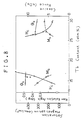
- Fig. 7 shows the change of characteristics in Tb X (Fe 93.8 Co 6.2 ) 100-X when the Tb content X was varied and Fig. 8 shows the change of the characteristics of Tb X (Fe 89.5 Co 10.5 ) 100-X when the Tb content X was varied.
- Fig. 9 shows the changes for coercive force Hc, Kerr rotational angle ⁇ k, and saturation magnetization Ms of: (Gd50Tb50) X Fe 100-X when X was varied.
- Figs. 7 - 9 when the saturation magnetization Ms at an identical coercive force Hc is compared, the saturation magnetization Ms for TbFeCo is larger than that for GdTbFe. Further, in TbFeCo, saturation magnetization Ms is larger as the amount of Co is increased. Further, curie temperature To for each of the media, the characteristics of which are shown in Figs. 7 - 9, are 150 to 175°C for (Gd50Tb50) X Fe 100-X in Fig. 9, 155 - 160 °C for Tb X (Fe 93.8 Co 6.2 ) 100-X in Fig.
- Tb X (Fe 89.5 Co 10.5 ) 100-X in Fig. 8.
- Tb X (Fe 89.5 Co 10.5 ) 100-X is excellent for the writing layer 5.
- an element of Tb in TbFeCo may be partially substituted with Dy.
- Tb may be partially replaced with Gd.
- Table 3 shows the result of measurement for saturation magnetization Ms, coercive force Hs and writing noises in each of the layers when the composition and the film thickness for the reading layer 3 and the writing layer 4 were varied in the dual layer film medium.
- Each of the dual layer film media has a structure as shown in Fig. 1.
- the reading layer (RL) 3 was formed to a film thickness of 40 to 50 nm on the first SiO layer 2. Since the thickness of the reading layer (RL) 3 was reduced in the disk formation as compared with the case of the measurement in Table 2 (formed to a thickness of 100 nm on the micro-sheet), the conditions as the reading layer shown in Table 1 can sufficiently be satisfied. In this case, it is desirable that the entire thickness of the dual layer film is from 15 to 300 nm and the film thickness of the writing layer 4 is made greater than that of the reading layer 3.
- Evaluation conditions for recording/reproduction were set as: number of rotation of the disk to 1800 rpm, recording diameter to 110 mm ⁇ , recording frequency to 1 MHz, recording duty to 50% and reproducing laser power to 1.5 mW, and the recording laser power Pw and the external auxiliary magnetic field Hex were set so as to minimize the writing noises in each of the specimens.
- specimens Nos. 1 - 4 are disks of P type in which both the reading layer (RL) 3 and the writing layer (WL) 4 are TM rich (refer to Figs. 2(a), (b) and Figs, 4(a) - (c)) and the writing noises are reduced so reduced as to satisfy the conditions for the recording process in the P type shown in Table 1.
- occurrence of the writing noises is suppressed substantially to 0 dB in the specimen No. 4. It can be understood from the comparison between the specimen No. 1 and the specimen No. 2 that TbFeCo is more excellent over GdTbFe as the writing layer (WL) 4.
- the specimen No. 5 of Table 3 GdDyFeCo of the same composition as that for the specimen No. 4 was used for the reading layer (RL) 3, while TbFeCo for the writing layer (WL) 4 was changed from the TM rich composition ratio to the RE rich composition ratio.
- the specimen No. 5 can satisfy the conditions for the recording process of the A type shown in Table 1 (refer to Figs. 3(a), (b) and Figs 5(a) - (c)), in which the writing noises are substantially reduced to 0 dB like that in the specimen No. 4.
- the boundary magnetic wall energy ⁇ w as a measure for the exchange-coupling force between the reading layer (RL) 3 and the writing layer (WL) 4 in the specimens Nos. 1 - 5 is 2.0 erg/cm2 for the specimen No. 1, 2.5 erg/cm2 for the specimen No. 2, 1.8 erg/cm2 for the specimen No. 3, 2.5 erg/cm2 for the specimen No. 4, and 1.4 erg/cm2 for the specimen No. 5. Accordingly, it can be understood that the magnitude of the writing noises can not be defined only based on that of the boundary magnetic wall energy ⁇ w.
- a composition of (Gd80Dy20)(Fe 81.5 Co 18.5 ) is used as the reading layer (RL) 3 for increasing the saturation magnetization Ms of the reading layer (RL) 3 to obtain a sufficiently great Kerr rotational angle ⁇ k.
- Tb(Fe 89.5 Co 10.5 ) is used for the writing layer (WL) 4.
- the specimen No. 6 uses a composition ratio which is always TM rich
- the specimen No. 7 uses a composition ratio which is TM rich at a normal temperature and RE rich upon recording (at high temperature)
- the specimen No. 8 uses a composition ratio which is always RE rich.
- any of the specimen Nos. 6 - 8 can sufficiently satisfy the conditions for the recording process in Table 1, relatively large writing noises are generated in the composition of the specimens Nos.6, 7.
- the specimen No. 8 since the writing noises are substantially reduced to 0 dB and the saturation magnetization Ms for the reading layer (RL) 3 is relatively large, a great Kerr rotational angle can be obtained. Accordingly, among each of the specimens shown in Table 3, the specimen No. 8 gives most excellent composition.
- the composition for the reading layer (RL) 3 and the writing layer (WL) 4 is not necessarily restricted to that for the specimen No. 8, and any of the compositions may be used so long as it is within the composition range according to the present invention as described above.
- Fig. 10 shows the X-dependency of Ms, Hc and ⁇ k in the composition of: (Gd80Dy20) X (Fe 81.5 Co 18.5 ) 100-X .
- Figs. 11 and 12 show, respectively, the dependency of the recording/reproducing characteristics on the auxiliary magnetic field for the specimens Nos. 6 and 8.
- evaluation conditions for the recording/reproducing characteristics were set as: number of rotation for the optical disk to 1800 rpm, recording diameter to 110 mm ⁇ , recording frequency to 3 MHz, recording duty to 50% and reproducing laser power to 1.5 mW.
- the recording laser power Pw means a value at which the reproducing secondary harmonic wave level takes a minimum value
- C/N noise level (N) and the carrier level (C)
- the specimen No. 8 has a high C/N, shows no dependency of the recording laser power Pw on the auxiliary magnetic field and is excellent as the optical magnetic disk.
- the present invention since a GdDyFeCo film in which sublattice magnetization for the transition metal is predominant at a room temperature is used for the first layer (reading layer), it is possible to increase the Kerr rotational angle for the first layer (reading layer) while suppressing the increase of the saturation magnetization and the coercive force along with the increase of the Kerr rotational angle.
- the second layer (writing layer) since a TbFeCo series film in which sublattice magnetization for rare earth at a room temperature is predominant is used for the second layer (writing layer), a large coercive force and a relatively low curie temperature necessary for the second layer can be obtained. Further, the saturation magnetization for the second layer (writing layer) can be increased along with the increase in the saturation magnetization of the first layer (reading layer).
- the bits in the second layer can be transferred with regular and well-arranged shape into the first layer (reading layer) by means of the exchanging force in the temperature lowering step thereby enabling to reduce the writing noises.
Claims (8)
- Ein optomagnetisches Aufzeichnungsmedium mit einer senkrecht magnetisierten Schicht aus einer Zweischichtstruktur umfassend eine erste Schicht (3) bestehend aus einer Seltenerdmetall-Übergangsmetall-Amorphlegierungs-Dünnschicht und einer zweiten Schicht (4) bestehend aus einer Seltenerdmetall-Übergangsmetall-Amorphlegierungs-Dünnschicht anderer Zusammensetzung und mit einem niedrigeren Curiepunkt und einer größeren Koerzitivkraft im Vergleich mit der ersten Schicht und welche in der Lage ist, bei einem Curiepunkt in der zweiten Schicht aufgezeichnete Bits an die erste Schicht durch Austauschkopplung zu übertragen,
worin die erste Schicht besteht aus einer GdDyFeCo-Schicht einer Legierung, welche durch die Formel
- Ein Aufzeichnungsmedium nach Anspruch 1, in welchem die Schicht der TbFeCo-Serie besteht aus TbFeCo oder einer auf TbFeCo basierenden Legierung, in welcher Tb teilweise ausgetauscht ist mit einem anderen Seltenerdelement wie Gd, Dy, Nd oder Ho.
- Ein Aufzeichnungsmedium nach Anspruch 1 oder 2, in welchem die Gesamtdicke der magnetisierten Schicht 15 bis 300 nm ist.
- Aufzeichnungsmedium nach einem der Ansprüche 1 bis 3, in welchem die Dicke der zweiten Schicht größer ist als die der ersten Schicht.
- Aufzeichnungsmedium nach einem der Ansprüche 1 bis 4, in welchem die magnetisierte Schicht auf einem transparenten Substrat wie einem Glassubstrat oder Harzsubstrat gebildet ist.
- Aufzeichnungsmedium nach Anspruch 5, in welchem die magnetisierte Schicht zwischen einem Paar von Schichten aus dielektrischem Material angebracht ist.
- Aufzeichnungsmedium nach einem der Ansprüche 1 bis 6 mit einem Kerr-Rotationswinkel ϑK von mehr als 0,48°.
- Aufzeichnungsmedium nach einem der Ansprüche 1 bis 7 mit einer Sättigungsmagnetisierung Ms von weniger als 250 emu/cm³.
Applications Claiming Priority (2)
| Application Number | Priority Date | Filing Date | Title |
|---|---|---|---|
| JP17064889 | 1989-06-30 | ||
| JP170648/89 | 1989-06-30 |
Publications (3)
| Publication Number | Publication Date |
|---|---|
| EP0406023A2 EP0406023A2 (de) | 1991-01-02 |
| EP0406023A3 EP0406023A3 (en) | 1992-03-04 |
| EP0406023B1 true EP0406023B1 (de) | 1995-08-16 |
Family
ID=15908773
Family Applications (1)
| Application Number | Title | Priority Date | Filing Date |
|---|---|---|---|
| EP90307186A Expired - Lifetime EP0406023B1 (de) | 1989-06-30 | 1990-06-29 | Opto-magnetisches Aufzeichnungsmedium |
Country Status (4)
| Country | Link |
|---|---|
| US (1) | US5094925A (de) |
| EP (1) | EP0406023B1 (de) |
| JP (1) | JP2703395B2 (de) |
| DE (1) | DE69021657T2 (de) |
Families Citing this family (25)
| Publication number | Priority date | Publication date | Assignee | Title |
|---|---|---|---|---|
| JP2910250B2 (ja) * | 1990-12-27 | 1999-06-23 | ソニー株式会社 | 光磁気記録媒体 |
| JP2672895B2 (ja) * | 1991-01-16 | 1997-11-05 | 三菱電機株式会社 | 光磁気記録媒体 |
| US5202880A (en) * | 1992-03-06 | 1993-04-13 | Digital Equipment Corporation | Double-sided magneto-optical media for a multi-disk storage device |
| US5434844A (en) * | 1992-04-10 | 1995-07-18 | Hitachi, Ltd. | Magneto-optical recording media and magneto-optical recording device using the same |
| JPH06208736A (ja) * | 1992-10-30 | 1994-07-26 | Canon Inc | 光磁気記録媒体 |
| JPH06309710A (ja) * | 1993-04-27 | 1994-11-04 | Nikon Corp | 光磁気記録媒体 |
| JPH07230637A (ja) * | 1994-02-18 | 1995-08-29 | Canon Inc | 光磁気記録媒体および該媒体を用いた情報記録再生方法 |
| CA2142767C (en) * | 1994-02-21 | 1998-11-17 | Naoki Nishimura | Magneto-optical recording medium, and information reproducing method using the medium |
| JP3230388B2 (ja) * | 1994-03-15 | 2001-11-19 | 富士通株式会社 | 光磁気記録媒体及び該媒体に記録された情報の再生方法 |
| JP3426034B2 (ja) * | 1994-07-20 | 2003-07-14 | シャープ株式会社 | 光磁気記録媒体および記録再生方法並びに光磁気記録媒体の製造方法 |
| JPH08106660A (ja) * | 1994-10-05 | 1996-04-23 | Canon Inc | 光磁気記録媒体及び該媒体を用いた情報再生方法 |
| DE19535994C2 (de) * | 1994-10-14 | 1998-07-16 | Sharp Kk | Magnetooptisches Aufzeichnungsmedium und Herstellverfahren für dieses |
| US6423430B1 (en) * | 1995-07-17 | 2002-07-23 | Samsung Electronics Co., Ltd. | Magneto-optical recording medium for short wavelength |
| WO2000048172A2 (en) | 1999-02-12 | 2000-08-17 | General Electric Company | Data storage media |
| US7179551B2 (en) | 1999-02-12 | 2007-02-20 | General Electric Company | Poly(arylene ether) data storage media |
| US6590836B1 (en) * | 1999-09-29 | 2003-07-08 | Sanyo Electric Co., Ltd. | Magneto optical recording medium capable of preventing a reproduction layer from having a degraded characteristic |
| US20020155216A1 (en) * | 2001-04-19 | 2002-10-24 | Reitz John Bradford | Spin coated media |
| EP1610387B1 (de) * | 2003-03-31 | 2010-05-19 | Panasonic Corporation | Speicherzelle, speicher mit der speicherzelle, speicherzellenherstellungsverfahren und speicheraufzeichnungs-/leseverfahren |
| US7736765B2 (en) * | 2004-12-28 | 2010-06-15 | Seagate Technology Llc | Granular perpendicular magnetic recording media with dual recording layer and method of fabricating same |
| US8110298B1 (en) | 2005-03-04 | 2012-02-07 | Seagate Technology Llc | Media for high density perpendicular magnetic recording |
| US8119263B2 (en) * | 2005-09-22 | 2012-02-21 | Seagate Technology Llc | Tuning exchange coupling in magnetic recording media |
| JP4820156B2 (ja) * | 2005-11-29 | 2011-11-24 | 住友大阪セメント株式会社 | セメント硬化体の破砕方法および静的破砕剤注入用容器 |
| US8697260B2 (en) * | 2008-07-25 | 2014-04-15 | Seagate Technology Llc | Method and manufacture process for exchange decoupled first magnetic layer |
| US7867637B2 (en) * | 2008-11-17 | 2011-01-11 | Seagate Technology Llc | Low coupling oxide media (LCOM) |
| US9142240B2 (en) | 2010-07-30 | 2015-09-22 | Seagate Technology Llc | Apparatus including a perpendicular magnetic recording layer having a convex magnetic anisotropy profile |
Family Cites Families (17)
| Publication number | Priority date | Publication date | Assignee | Title |
|---|---|---|---|---|
| JPS5778652A (en) * | 1980-11-01 | 1982-05-17 | Daido Steel Co Ltd | Thermal magnetic recording carrier and thermal magnetic recording system |
| JPS5961011A (ja) * | 1982-09-30 | 1984-04-07 | Ricoh Co Ltd | 光磁気記録媒体 |
| US4556291A (en) * | 1983-08-08 | 1985-12-03 | Xerox Corporation | Magneto-optic storage media |
| JPS6066349A (ja) * | 1983-09-22 | 1985-04-16 | Agency Of Ind Science & Technol | 光熱磁気記録媒体およびその製造方法 |
| JPS60107751A (ja) * | 1983-11-17 | 1985-06-13 | Canon Inc | 光熱磁気記録媒体 |
| JPS60173746A (ja) * | 1984-02-17 | 1985-09-07 | Kyocera Corp | 光磁気記録媒体 |
| CA1254385A (en) * | 1985-07-26 | 1989-05-23 | Noboru Sato | Magneto-optical recording medium having amorphous artificially layered structure of rare earth element and transition metal element |
| JPH07105082B2 (ja) * | 1985-11-28 | 1995-11-13 | ソニー株式会社 | 光磁気記録媒体 |
| ATE172047T1 (de) * | 1986-07-08 | 1998-10-15 | Canon Kk | Magnetoptisches aufzeichnungsmedium mit der möglichkeit des überschreibens mit zwei oder mehr magnetschichten und dieses medium verwendende aufzeichnungsmethode |
| JP2570270B2 (ja) * | 1986-10-08 | 1997-01-08 | 株式会社ニコン | ツービームによる光磁気記録方法及び装置 |
| JP2754537B2 (ja) * | 1987-05-18 | 1998-05-20 | 株式会社ニコン | 光磁気記録媒体並びにそれを使用したビット形成方法 |
| EP0305185B1 (de) * | 1987-08-25 | 1992-11-25 | Canon Kabushiki Kaisha | Optomagnetischer Aufzeichnungsträger mit einer Mehrzahl von austauschgekoppelten magnetischen Schichten |
| EP0330394B1 (de) * | 1988-02-22 | 1996-07-17 | Canon Kabushiki Kaisha | Zweischichtiger magneto-optischer Aufzeichnungsträger mit einer Schicht niedriger Koerzitivkraft, bestehend aus Gd und mindestens Tb oder Dy |
| JP2642656B2 (ja) * | 1988-03-10 | 1997-08-20 | キヤノン株式会社 | 光磁気記録媒体 |
| JP2556564B2 (ja) * | 1988-10-11 | 1996-11-20 | キヤノン株式会社 | 光磁気記録媒体 |
| JP2556563B2 (ja) * | 1988-10-11 | 1996-11-20 | キヤノン株式会社 | 光磁気記録媒体 |
| GB2234623B (en) * | 1988-11-04 | 1993-04-14 | Ricoh Kk | Magneto-optical recording method and magneto-optical recording medium for use in the same |
-
1990
- 1990-06-27 US US07/544,759 patent/US5094925A/en not_active Expired - Lifetime
- 1990-06-29 EP EP90307186A patent/EP0406023B1/de not_active Expired - Lifetime
- 1990-06-29 DE DE69021657T patent/DE69021657T2/de not_active Expired - Fee Related
- 1990-06-29 JP JP2173809A patent/JP2703395B2/ja not_active Expired - Fee Related
Also Published As
| Publication number | Publication date |
|---|---|
| JPH0386952A (ja) | 1991-04-11 |
| US5094925A (en) | 1992-03-10 |
| EP0406023A2 (de) | 1991-01-02 |
| JP2703395B2 (ja) | 1998-01-26 |
| DE69021657D1 (de) | 1995-09-21 |
| EP0406023A3 (en) | 1992-03-04 |
| DE69021657T2 (de) | 1996-02-01 |
Similar Documents
| Publication | Publication Date | Title |
|---|---|---|
| EP0406023B1 (de) | Opto-magnetisches Aufzeichnungsmedium | |
| US6187460B1 (en) | Magneto-optical recording medium and method for reproducing information therein | |
| EP0810594B1 (de) | Magnetooptischer Aufzeichnungsträger | |
| EP0668586B1 (de) | Magneto-optischer Aufzeichnungsträger und verwendete Informationswiedergabemethode | |
| EP0586122B1 (de) | Magnetooptische Speichervorrichtung und Verfahren zur Informationsaufnahme und -wiedergabe | |
| US5862105A (en) | Information recording method capable of verifying recorded information simultaneously with recording, and magneto-optical recording medium used in the method | |
| JP3078145B2 (ja) | 光磁気記録媒体の製造方法 | |
| US5719829A (en) | Magnetooptical recording medium allowing super-resolution, and information reproduction method using the medium | |
| JPH06124500A (ja) | 光磁気記録媒体及び該媒体の再生方法 | |
| JPH0863810A (ja) | 光磁気記録媒体及び該媒体を用いた情報再生方法 | |
| EP0330394B1 (de) | Zweischichtiger magneto-optischer Aufzeichnungsträger mit einer Schicht niedriger Koerzitivkraft, bestehend aus Gd und mindestens Tb oder Dy | |
| JP3297513B2 (ja) | 光磁気記録媒体及び該媒体を用いた情報再生方法 | |
| EP0668585B1 (de) | Verfahren und System zur Informationsaufzeichnung auf ein magnetooptisches Aufzeichnungsmedium | |
| EP0385786B1 (de) | Magnetooptischer Aufzeichungsträger | |
| US5547773A (en) | Magnetooptic recording medium | |
| USRE38922E1 (en) | Magneto-optical recording medium and method for reproducing information from a magneto-optical recording medium having three layers | |
| EP0384746A2 (de) | Überschreibbares magneto-optisches Aufzeichnungsmedium | |
| JPH08212607A (ja) | 光磁気記録媒体 | |
| JP3592399B2 (ja) | 光磁気記録媒体 | |
| JPH06309729A (ja) | 光磁気記録媒体及び該媒体を用いた情報再生方法 | |
| JPH07254176A (ja) | 光磁気記録媒体および該媒体を用いた情報再生方法 | |
| JPH08241544A (ja) | 光磁気媒体 | |
| JPH10162439A (ja) | 光磁気記録媒体 | |
| JPH09293285A (ja) | 光磁気記録媒体及びその再生方法 | |
| JP2001176140A (ja) | 光磁気記録媒体及びその記録再生方法 |
Legal Events
| Date | Code | Title | Description |
|---|---|---|---|
| PUAI | Public reference made under article 153(3) epc to a published international application that has entered the european phase |
Free format text: ORIGINAL CODE: 0009012 |
|
| 17P | Request for examination filed |
Effective date: 19900724 |
|
| AK | Designated contracting states |
Kind code of ref document: A2 Designated state(s): DE FR GB |
|
| PUAL | Search report despatched |
Free format text: ORIGINAL CODE: 0009013 |
|
| AK | Designated contracting states |
Kind code of ref document: A3 Designated state(s): DE FR GB |
|
| 17Q | First examination report despatched |
Effective date: 19931115 |
|
| GRAA | (expected) grant |
Free format text: ORIGINAL CODE: 0009210 |
|
| AK | Designated contracting states |
Kind code of ref document: B1 Designated state(s): DE FR GB |
|
| REF | Corresponds to: |
Ref document number: 69021657 Country of ref document: DE Date of ref document: 19950921 |
|
| ET | Fr: translation filed | ||
| PLBE | No opposition filed within time limit |
Free format text: ORIGINAL CODE: 0009261 |
|
| STAA | Information on the status of an ep patent application or granted ep patent |
Free format text: STATUS: NO OPPOSITION FILED WITHIN TIME LIMIT |
|
| 26N | No opposition filed | ||
| REG | Reference to a national code |
Ref country code: GB Ref legal event code: IF02 |
|
| PGFP | Annual fee paid to national office [announced via postgrant information from national office to epo] |
Ref country code: DE Payment date: 20070621 Year of fee payment: 18 |
|
| PGFP | Annual fee paid to national office [announced via postgrant information from national office to epo] |
Ref country code: GB Payment date: 20070627 Year of fee payment: 18 |
|
| PGFP | Annual fee paid to national office [announced via postgrant information from national office to epo] |
Ref country code: FR Payment date: 20070608 Year of fee payment: 18 |
|
| GBPC | Gb: european patent ceased through non-payment of renewal fee |
Effective date: 20080629 |
|
| REG | Reference to a national code |
Ref country code: FR Ref legal event code: ST Effective date: 20090228 |
|
| PG25 | Lapsed in a contracting state [announced via postgrant information from national office to epo] |
Ref country code: DE Free format text: LAPSE BECAUSE OF NON-PAYMENT OF DUE FEES Effective date: 20090101 |
|
| PG25 | Lapsed in a contracting state [announced via postgrant information from national office to epo] |
Ref country code: GB Free format text: LAPSE BECAUSE OF NON-PAYMENT OF DUE FEES Effective date: 20080629 |
|
| PG25 | Lapsed in a contracting state [announced via postgrant information from national office to epo] |
Ref country code: FR Free format text: LAPSE BECAUSE OF NON-PAYMENT OF DUE FEES Effective date: 20080630 |