EP0406727A2 - Polyesterrohstoff und Verfahren zu seiner Herstellung - Google Patents
Polyesterrohstoff und Verfahren zu seiner Herstellung Download PDFInfo
- Publication number
- EP0406727A2 EP0406727A2 EP90112482A EP90112482A EP0406727A2 EP 0406727 A2 EP0406727 A2 EP 0406727A2 EP 90112482 A EP90112482 A EP 90112482A EP 90112482 A EP90112482 A EP 90112482A EP 0406727 A2 EP0406727 A2 EP 0406727A2
- Authority
- EP
- European Patent Office
- Prior art keywords
- polyester
- raw material
- inert particles
- weight
- dispersant
- Prior art date
- Legal status (The legal status is an assumption and is not a legal conclusion. Google has not performed a legal analysis and makes no representation as to the accuracy of the status listed.)
- Granted
Links
Images


Classifications
-
- C—CHEMISTRY; METALLURGY
- C08—ORGANIC MACROMOLECULAR COMPOUNDS; THEIR PREPARATION OR CHEMICAL WORKING-UP; COMPOSITIONS BASED THEREON
- C08L—COMPOSITIONS OF MACROMOLECULAR COMPOUNDS
- C08L67/00—Compositions of polyesters obtained by reactions forming a carboxylic ester link in the main chain; Compositions of derivatives of such polymers
- C08L67/02—Polyesters derived from dicarboxylic acids and dihydroxy compounds
-
- C—CHEMISTRY; METALLURGY
- C08—ORGANIC MACROMOLECULAR COMPOUNDS; THEIR PREPARATION OR CHEMICAL WORKING-UP; COMPOSITIONS BASED THEREON
- C08K—Use of inorganic or non-macromolecular organic substances as compounding ingredients
- C08K3/00—Use of inorganic substances as compounding ingredients
- C08K3/01—Use of inorganic substances as compounding ingredients characterized by their specific function
- C08K3/013—Fillers, pigments or reinforcing additives
Definitions
- the present invention relates to a polyester raw material which contains homogeneously distributed inorganic and / or organic inert particles.
- the invention also relates to a method for producing the raw material and moldings from this raw material, in particular films which are uniaxially or biaxially oriented and heat-set.
- Biaxially oriented films made of polyester, in particular of polyethylene terephthalate and / or polyethylene naphthalate, are used to a large extent in many technical fields, such as, for example, because of their superior properties, such as their tensile strength, their tensile strength, their modulus of elasticity, their transparency, their chemical and thermal resistance and the like.
- the reprographic sector as a dielectric for capacitors, as carrier films for magnetic recording media such.
- polyester films must meet specific requirements for the various areas of application, which are usually set using the raw material recipes or using certain process technologies during film production.
- the surface structure of the films is of particular importance here, because they are responsible for the sliding and abrasion behavior in the manufacture and processing of the Is crucial.
- Particularly with magnetic tape carrier films in addition to a uniform and good sliding behavior and high abrasion resistance, particularly high demands are made on the homogeneity of the surface, because undesired elevations on the surface within the magnetic layer subsequently applied to this surface can lead to information losses and thus restrict the possible uses of the information carrier.
- inert particles with a defined particle size distribution.
- inert particles which can be used alone or in combination, are CaCO3, TiO2, Al2O3, ZrO2, BaSO4, calcium phosphate, kaolin, SiO2 and natural and synthetic silicates.
- inert particles which can be used alone or in combination, are CaCO3, TiO2, Al2O3, ZrO2, BaSO4, calcium phosphate, kaolin, SiO2 and natural and synthetic silicates.
- spherical metal oxides described in EP-A-0 216 278 and EP-A-0 236 945 and the spherical organic inert particles described in EP-A-0 125 482, which have an extremely narrow particle size distribution.
- the inert particles can be incorporated into the polyester using both glycolic dispersions and masterbatches.
- the incorporation of the inert particles via glycolic dispersions is associated with a number of disadvantages, which can have a negative effect on the property profile of the molded articles made from the raw material, especially the films.
- the stability of glycolic dispersions of inert particles is more or less limited depending on the type and size of the same. This can lead to sedimentation of the inert particles and the associated formation of agglomerates, which in turn can have a negative effect on the filtration required to remove coarse particles.
- An attempt is made to remedy this deficiency by using dispersion aids and / or by stirring the dispersions until immediately before their use or by modifying the surface of the inert particles.
- Another disadvantage is that the dispersions have to be metered into the hot reaction mixture. This temperature shock can also lead to the formation of agglomerates.
- the inert particles can, as already mentioned, be incorporated into the polyester via a masterbatch as part of the film production.
- the production of agglomerate-free masterbatches requires the installation of high-quality mixing units.
- the degradation of the polyester due to thermal stress should be kept within limits.
- certain inert particles such as B. incorporate highly disperse silicas or monodisperse SiO2 particles only partially agglomerate-free in the polyester. To ensure a really even distribution of the inert particles, one is additionally bound to certain maximum concentrations, which considerably affects the economy of this process variant.
- the object of the present invention was therefore to create a polyester raw material which contains inert particles in a uniform distribution and is free of agglomerates which can occur when the inert particles are incorporated via dispersions.
- polyester raw material of the type mentioned at the outset contains 80 to 99.998% by weight of polyester, 0.001 to 10% by weight of inert particles with an average particle size in the range from 0.02 to 5 ⁇ m and 0.001 to 10% by weight of a dispersant compatible with the polyester, the melting point of which is below 200 ° C., preferably below 120 ° C.
- polyesters are considered to be homo- and copolycondensates, mixtures of different polyesters and blends or blends of polyesters with other polymers and, if appropriate, resins.
- the polyester can be produced by the transesterification process, e.g. B. with the help of transesterification catalysts such. B. Zn, Mg, Ca, Mn, Li or Ge salts, as well as by the direct ester process, in the antimony compounds as polycondensation catalysts and phosphorus compounds as stabilizers be used.
- Your RSV value is preferably in the range of 0.60 to 0.90 dl / g.
- polyesters are polycondensates of terephthalic acid, isophthalic acid or 2,6-naphthalenedicarboxylic acid with glycols having 2 to 10 carbon atoms, such as polyethylene terephthalate, polybutylene terephthalate, poly-1,4-cyclohexylene-dimethylene terephthalate, polyethylene-2,6-naphthalenedicarboxylate or polyethylene-p-hydroxy -benzoate.
- the polyesters can be composed of up to 30 mol% of comonomer units, with a variation in the glycol and / or the acid component being possible.
- the copolyesters can u. a. Adipic acid, glutaric acid, succinic acid, sebacic acid, phthalic acid, isophthalic acid, 5-Na-sulfoisophthalic acid or polyfunctional acids such as trimelitic acid and the like. a. contain.
- the polyester mixtures can consist of polyester homopolymers, polyester copolymers or polyester homopolymers and copolymers. Examples of these are mixtures of polyethylene terephthalate / polybutylene terephthalate, polyethylene terephthalate / polyethylene isophthalate or polyethylene isophthalate / 5-sodium sulfoisophthalate.
- polyesters which the polyester contains to improve its stretchability, its mechanical properties or to adjust special surface properties of molded articles produced therefrom can, are polyolefin homo- or copolymers such as polyethylene, polypropylene, poly-4-methylpentene, ethylene-vinyl acetate copolymers, which in turn can be saponified, ionomers, polyamides, polylactones, polycarbonates, polytetrafluoroethylene, polysulfones, etc. These substances can be used during the Raw material or film production can be incorporated into the polyester.
- polyolefin homo- or copolymers such as polyethylene, polypropylene, poly-4-methylpentene, ethylene-vinyl acetate copolymers, which in turn can be saponified, ionomers, polyamides, polylactones, polycarbonates, polytetrafluoroethylene, polysulfones, etc.
- the resins are natural or synthetic low molecular weight resins with a softening point in the range from 60 to 180 ° C., determined according to ASTM E 28.
- the hydrocarbon resins in particular the petroleum resins (petroleum resins), styrene resins, cyclopentadiene resins and Terpene resins preferred.
- the polyesters of the present invention can additionally contain organic slip lubricants / nucleating agents, antioxidants, thermal stabilizers, antistatic agents (for example salts of alkylsulfonic acids or sulfonated polyoxyalkylenes) and the like. a. contain.
- organic slip lubricants / nucleating agents antioxidants, thermal stabilizers, antistatic agents (for example salts of alkylsulfonic acids or sulfonated polyoxyalkylenes) and the like.
- antistatic agents for example salts of alkylsulfonic acids or sulfonated polyoxyalkylenes
- additives that have a positive effect on both the sliding and the abrasion behavior of polyester films are long-chain monocarboxylic acids and esters thereof, e.g. their ester wax salts such as palmitates, stearates or montanates.
- Examples of the inert particles are the above-mentioned inorganic and organic particles with the particle diameters specified in claim 1.
- Prefers are spherical particles based on polymers and / or metal oxides such as B. SiO2, TiO2, ZrO2 and Al2O3 and mixed oxides thereof, which can be adjusted to a particularly narrow particle size distribution by known methods.
- the grain size distribution can be found in Woods et al in 'Journal of Paint Technology', Vol. 40, No. 527, page 545 (1968), by the quotient of the weight average of the particle diameter (D w ) and the number average of the particle diameter (D n ).
- This quotient gives a value of ⁇ 1.5, particularly preferably ⁇ 1.2, for the inert particles preferably used in the context of the invention.
- Suitable components include the building blocks of the polyester such.
- the dispersants mentioned can be used either alone or in combination.
- Crucial parameters for the suitability of the dispersants are their polarity and their freezing point, in connection with this also their molecular weight.
- the polarity can be influenced via the chemical composition of the organic dispersant.
- dispersants of higher polarity for modified SiO2 particles such as in DE-A-36 16 133, which have a hydrophobic character, on the other hand, a non-polar dispersant lends itself.
- the molecular weight of the dispersant varies from a few hundred to a few hundred thousand. It is preferably in the range from 300 to 600,000.
- the dispersions can be prepared following the synthesis of the inert particles, for example following the production of spherical metal oxide particles with a narrow particle size distribution by the sol-gel method by substitution of the reaction medium and subsequent dispersion of the finished particles in a selected agent, such as a polyalkylene glycol in the warmth.
- a selected agent such as a polyalkylene glycol in the warmth.
- the stable dispersion can be produced by subsequently incorporating the inert particles into the molten dispersion medium using known methods.
- the concentration of the dispersion of inert particles is in the range from 0.1 to 70% by weight, preferably between 20 to 60% by weight.
- the mixtures are remeltable and pourable and can thus be handled in a manageable manner, e.g. of dandruff, granules, etc.
- the dispersants in particular have a melting point below 200 ° C., preferably below 120 ° C., and are viscous or solid at room temperature.
- the main advantage of the mixtures according to the invention in comparison with glycolic dispersions is the almost unlimited storage stability and, associated with this, the elimination of the disadvantages described when using glycolic dispersions of inert particles and the resultant necessary workup processes prior to the intended use.
- the mixture of the inert particles and the dispersant and, if appropriate, the addition mentioned above can be added in accordance with the glycolic dispersions in any phase during the production of the raw material, preferably before or after the transesterification or at the start of the polycondensation if the viscosity of the reaction mixture is still low. This will ensure a good distribution of the Inert particles achieved in the matrix. Since the mixture first has to be melted, the temperature shock associated with the formation of agglomerates, which occurs when glycolic dispersions are added, is eliminated.
- the mixtures of inert particles and polyester-compatible dispersants can alternatively also be added to the polyester after the completion of the polyester and during the production of moldings, for example films. This method is preferred if additional additives are to be incorporated into the polyester at the same time as the inert particles, which tend to decompose during the polycondensation time of several hours.
- the polyester raw material according to the invention is then formed to a certain extent in situ during the production of the molded articles inside the extruder.
- Moldings in particular biaxially stretch-oriented films, can advantageously be produced from the polyester raw material according to the invention.
- the film is produced by the extrusion process, in which the polyester material containing the inert particles and the dispersing agent is melted, extruded to form a pre-film and quenched on a chill roll, and this film is then lengthwise and / or crosswise at temperatures between the glass point of the polymer and 160.degree an area stretch ratio, preferably in the range from 4 to 30, and then heat-set at temperatures between 150 and 240 ° C.
- the number and sequence of the longitudinal and transverse stretching stages is not fixed ben, but depends on the requirements.
- the individual stretching processes "lengthwise” and “crosswise” can be carried out in one or more stages. Simultaneous longitudinal and transverse stretching (simultaneous stretching) is also possible.
- the films resulting from the stretching process can only have strength in one direction (monoaxially stretched), have balanced mechanical properties in both directions (balanced films) or have special strengths in the transverse and / or longitudinal direction (tensilized or supertensilized films).
- the films can have one or more layers, they can be constructed symmetrically or asymmetrically, wherein differently formulated or formulated or non-formulated polymers or polymers of the same chemical composition but with different molecular weights and different viscosities can be combined by coextrusion.
- Films from the raw material according to the invention can be used both in the technical sector, e.g. B. for capacitors, magnetic recording media, reprographic purposes, as separating or embossing foils u. a., as well as in the packaging sector.
- the value indicates the reduced specific viscosity, it was measured according to DIN 53 728, sheet 2.
- the value indicates the tear strength of the film at 5% elongation.
- the measurement was carried out in accordance with DIN 53 455.
- the modulus of elasticity was measured in accordance with DIN 53 457.
- the F5 value and modulus of elasticity were determined with a ZWICK device type 1445, the measuring length being 100 mm, the strip width 15 mm and the take-off speed 10 mm / min (modulus of elasticity) and 100 mm / min, respectively.
- the values given are based on five individual measurements.
- the coefficient of friction indicates the slip of the film. It was measured according to DIN 53 375.
- the R a value expresses the surface roughness of the film numerically as the arithmetic mean of all distances of the roughness profile R from the center line.
- the measurement was carried out in accordance with DIN 4768 using a surface measuring device Perthometer SP 6 from Feinprüf GmbH, Göttingen. The values given are based on six individual measurements, whereby the highest value was not taken into account when averaging. The cut off was 0.08 mm in each case.
- a polyester raw material was prepared from dimethyl terephthalate and ethylene glycol in a conventional manner using manganese acetate as the transesterification catalyst, antimony trioxide as the polymerization catalyst and phosphorous acid as the stabilizer, which had an RSV of 0.81 dl / g would have.
- the polyester raw material contained 1,500 ppm of monodisperse, spherical SiO2 particles with a diameter of 0.5 ⁇ m, the quotient of the weight average of the particle diameter (D w ) and the number average of the particle diameter (D n ) being 1.2, and further 300 ppm monodisperse, spherical SiO2 particles with a diameter of 0.7 ⁇ m and corresponding properties.
- the spherical SiO2 particles were added to the transesterification process in the form of a mixture with 50 wt .-% polyethylene glycol (PEG) 1000 with an average molecular weight in the range of 950 to 1 050 and a solidification point between 35 and 40 ° C.
- PEG polyethylene glycol
- a 12 ⁇ m thick, biaxially oriented film was produced from the raw material obtained, by melting the granulate in an extruder, extruding it onto a highly polished cooling roll using a slot die, and the amorphous pre-film obtained first by rolling in two stages at temperatures in the range from 107 ° C. to 115 ° C was stretched 4.2 times longitudinally and then at temperatures around 95 ° C by circumferential clip chains by 3.6 times and heat set at 200 ° C.
- the film had, as the SEM image after 6 ° bevel vapor deposition of Fig. 1, a good distribution of the SiO2 particles incorporated in the manner described.
- the physical properties of the film are given in the table at the end of the examples.
- the amorphous approx. 32 ⁇ m thick pre-film was stretched 3.8 times lengthways at temperatures of approx. 100 ° C in the longitudinal direction and 4 times crosswise at temperatures of 110 ° C in the stent frame and subsequently fixed at 200 ° C for 5 s .
- the physical properties of the approximately 2 ⁇ m thick film obtained are also summarized in the table.
- spherical particles was added to an additive-free polyester raw material added from SiO2 with a diameter of 250 nm and mixed in a twin-screw extruder.
- the raw material obtained was mixed with the additive-free polyester raw material so that the content of monodisperse, spherical SiO2 particles was 1 750 ppm and then melted in an extruder and extruded onto a polished cooling roll with a surface temperature of 25 ° C.
- the preliminary film was stretched in two stages in the temperature range from 107 to 115 ° C by rolling with an aspect ratio of 4 lengthwise and in a frame at 95 ° C by 3.8 times wide. It was then stretched again 1.9 times in the machine direction and fixed at 200 ° C. for about 5 s.
- the film obtained had a good particle distribution, as shown in FIG. 2 of the SEM image of the surface taken at an angle of 6 ° after oblique evaporation with silver.
- the physical properties of the approximately 9 ⁇ m thick film obtained are also summarized in the table.
- a polyester raw material was produced in accordance with Example 1, but containing about 0.5% by weight of spherical SiO 2 particles with a diameter of 0.9 ⁇ m, which before the transesterification in the form of a mixture of 49% by weight of PEG 1000 and 51 wt .-% of the SiO2 particles were added.
- a 190 ⁇ m thick pre-film was made from the raw material, which was stretched 3.6 times simultaneously in both directions on the Brückner Karo frame at a temperature of 95.5 ° C.
- Fig. 3 shows a recorded with a Hommel device under the specified conditions surface diagram of the approximately 14 microns thick film
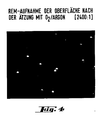
- Fig. 4 is a SEM picture of the film surface after etching the same with O2 / argon (20 min).
Landscapes
- Chemical & Material Sciences (AREA)
- Health & Medical Sciences (AREA)
- Chemical Kinetics & Catalysis (AREA)
- Medicinal Chemistry (AREA)
- Polymers & Plastics (AREA)
- Organic Chemistry (AREA)
- Compositions Of Macromolecular Compounds (AREA)
- Manufacture Of Macromolecular Shaped Articles (AREA)
- Processes Of Treating Macromolecular Substances (AREA)
Abstract
Description
- Die vorliegende Erfindung betrifft einen Polyesterrohstoff, der homogen verteilte anorganische und/oder organische Inertpartikel enthält. Die Erfindung betrifft auch ein Verfahren zur Herstellung des Rohstoffes sowie Formkörper aus diesem Rohstoff, insbesondere Folien, die ein- oder biaxial orientiert und thermofixiert sind.
- Biaxial orientierte Folien aus Polyester, insbesondere aus Polyethylenterephthalat und/oder Polyethylennaphthalat, finden wegen ihrer überlegenen Eigenschaften wie ihrer Zugfestigkeit, ihrer Reißfestigkeit, ihres Elastizitätsmoduls, ihrer Transparenz, ihrer chemischen und thermischen Beständigkeit und dergleichen Anwendung in großem Umfang auf vielen technischen Gebieten wie z. B. dem reprografischen Sektor, als Dielektrikum für Kondensatoren, als Trägerfolien für magnetische Aufzeichnungsmedien wie z. B. für Audio-, Video- und Computerbänder sowie Floppy Disks, Thermodruckbänder usw.
- Die Polyesterfolien müssen für die verschiedenen Einsatzgebiete spezifische Anforderungen erfüllen, die üblicherweise mit Hilfe der Rohstoffrezepturen oder mittels bestimmter Verfahrenstechniken während der Folienherstellung eingestellt werden.
- Der Oberflächenstruktur der Folien kommt hierbei generell eine besondere Bedeutung zu, weil sie für das Gleit- und Abriebverhalten bei der Herstellung und Verarbeitung der Folien ausschlaggebend ist. Speziell bei Magnetbandträgerfolien werden neben einem gleichmäßigen und guten Gleitverhalten und hoher Abriebfestigkeit besonders hohe Anforderungen an die Homogenität der Oberfläche gestellt, weil unerwünschte Erhebungen auf der Oberfläche innerhalb der nachfolgend auf diese Oberfläche aufgebrachten Magnetschicht zu Informationsverlusten führen können und damit die Einsatzmöglichkeiten des Informationsträgers einschränken.
- Es gehört zum Stand der Technik, die genannten Nachteile durch Einarbeitung anorganischer und/oder organischer Inertpartikel mit definierter Korngrößenverteilung zu überwinden bzw. abzumildern. Beispiele für derartige Inertpartikel, die allein oder in Kombination eingesetzt werden können, sind CaCO₃, TiO₂, Al₂O₃, ZrO₂, BaSO₄, Calciumphosphat, Kaolin, SiO₂ sowie natürliche und synthetische Silikate. Von besonderem Interesse sind die u. a. in der EP-A-0 216 278 und der EP-A-0 236 945 beschriebenen kugelförmigen Metalloxide sowie die in der EP-A-0 125 482 beschriebenen sphärischen organischen Inertpartikel, die eine extrem enge Korngrößenverteilung aufweisen.
- Die Inertpartikel können sowohl über glykolische Dispersionen als auch Masterbatche in den Polyester eingearbeitet werden.
- Die Einarbeitung der Inertpartikel über glykolische Dispersionen ist mit einer Reihe von Nachteilen verbunden, die sich auf das Eigenschaftsbild der aus dem Rohstoff hergestellten Formkörper, speziell der Folien, negativ auswirken können. So ist die Stabilität glykolischer Dispersionen von Inertpartikeln in Abhängigkeit vom Typ und der Größe derselben mehr oder weniger stark begrenzt. Hierdurch kann es zur Sedimentation der Inertpartikel und damit verbunden leicht zur Bildung von Agglomeraten kommen, die sich wiederum auf die zur Entfernung von Grobkornanteilen erforderliche Filtration negativ auswirken kann. Eine Behebung dieses Mangels wird durch den Einsatz von Dispergierhilfsmitteln und/oder durch Rühren der Dispersionen bis unmittelbar vor ihrem Einsatz oder über eine Oberflächenmodifizierung der Inertpartikel versucht. Ein weiterer Nachteil ist, daß die Dispersionen in das heiße Reaktionsgemisch hinzudosiert werden müssen. Durch diesen Temperaturschock kann es ebenfalls zur Bildung von Agglomeraten kommen.
- Alternativ zur Dispersionsroute können die Inertpartikel wie bereits erwähnt über ein Masterbatch im Rahmen der Folienherstellung in den Polyester eingearbeitet werden. Die Herstellung agglomeratfreier Masterbatche setzt aber die Installation hochwertiger Mischaggregate voraus, darüber hinaus soll der Abbau des Polyesters infolge thermischer Belastung in Grenzen gehalten werden. Trotz des Einsatzes aufwendiger Mischaggregate lassen sich bestimmte Inertpartikel wie z. B. hochdisperse Kieselsäuren oder monodisperse SiO₂-Partikel nur bedingt agglomeratfrei in den Polyester einarbeiten. Um eine wirklich gleichmäßige Verteilung der Inertpartikel zu gewährleisten, ist man zusätzlich an bestimmte Höchstkonzentrationen gebunden, wodurch die Wirtschaftlichkeit dieser Verfahrensvariante beachtlich beeinträchtigt wird.
- Aufgabe der vorliegenden Erfindung war es daher, einen Polyesterrohstoff zu schaffen, der Inertpartikel in gleichmäßiger Verteilung enthält und frei von Agglomeraten ist, die bei einer Einarbeitung der Inertpartikel über Dispersionen auftreten können.
- Gelöst wird diese Aufgabe durch einen Polyesterrohstoff der eingangs genannten Gattung, dessen Kennzeichenmerkmale darin zu sehen sind, daß er 80 bis 99,998 Gew.-% Polyester enthält, 0,001 bis 10 Gew.-% Inertpartikel mit einer mittleren Teilchengröße im Bereich von 0,02 bis 5 µm und 0,001 bis 10 Gew.-% eines mit dem Polyester verträglichen Dispergiermittels, dessen Schmelzpunkt unter 200 °C, vorzugsweise unterhalb von 120 °C, liegt.
- Als Polyester werden im Rahmen der Erfindung Homo- und Copolykondensate, Gemische verschiedener Polyester sowie Abmischungen oder Blends von Polyestern mit anderen Polymeren und gegebenenfalls Harzen angesehen.
- Die Herstellung der Polyester kann sowohl nach dem Umesterungsverfahren, z. B. mit Hilfe von Umesterungskatalysatoren wie z. B. Zn-, Mg-, Ca-, Mn-, Li- oder Ge-Salzen, wie auch nach dem Direktesterverfahren erfolgen, bei dem Antimonverbindungen als Polykondensationskatalysatoren und Phosphorverbindungen als Stabilisatoren verwendet werden. Ihr RSV-Wert liegt vorzugsweise im Bereich von 0,60 bis 0,90 dl/g.
- Beispiele für Polyester sind Polykondensate aus Terephthalsäure, Isophthalsäure oder 2,6-Naphthalindicarbonsäure mit Glykolen mit 2 bis 10 Kohlenstoffatomen wie Polyethylenterephthalat, Polybutylenterephthalat, Poly-1,4-cyclohexylen-dimethylenterephthalat, Polyethylen-2,6-naphthalindicarboxylat oder Polyethylen-p-hydroxy-benzoat.
- Die Polyester können bis zu 30 Mol-% aus Comonomereinheiten aufgebaut sein, wobei eine Variation in der Glykol- und/oder der Säurekomponente möglich ist. Als Säurekomponente können die Copolyester u. a. Adipinsäure, Glutarsäure, Bernsteinsäure, Sebazinsäure, Phthalsäure, Isophthalsäure, 5-Na-sulfoisophthalsäure oder polyfunktionelle Säuren wie Trimelithsäure u. a. enthalten.
- Die Polyestergemische können aus Polyester-Homopolymeren, Polyester-Copolymeren oder Polyester-Homo- und Copolymeren bestehen. Beispiele hierfür sind Abmischungen von Polyethylenterephthalat/Polybutylenterephthalat, Polyethylenterephthalat/Polyethylenisophthalat oder Polyethylenisophthalat/5-Natriumsulfoisophthalat.
- Beispiele für Polymere, die der Polyester zur Verbesserung seiner Streckbarkeit, seiner mechanischen Eigenschaften oder zur Einstellung spezieller Oberflächeneigenschaften daraus hergestellter Formkörper enthalten kann, sind Polyolefin-Homo- oder -Copolymere wie Polyethylen, Polypropylen, Poly-4-methylpenten, Ethylen-Vinylacetat-Copolymere, die ihrerseits verseift sein können, Ionomere, Polyamide, Polylactone, Polycarbonate, Polytetrafluorethylen, Polysulfone u. a. Diese Substanzen können während der Rohstoff- oder Folienherstellung in den Polyester eingearbeitet werden.
- Bei den Harzen handelt es sich um natürliche oder synthetische niedermolekulare Harze mit einem Erweichungspunkt im Bereich von 60 bis 180 °C, bestimmt nach ASTM E 28. Von den Zahlreichen niedermolekularen Harzen sind die Kohlenwasserstoffharze, insbesondere die Erdölharze (Petroleumharze), Styrolharze, Cyclopentadienharze und Terpenharze bevorzugt.
- Die Polyester der voliegenden Erfindung können neben den schlupffördernden Inertpartikeln noch zusätzlich organische Schlupf-Gleitmittel/Nukleierungsmittel, Antioxidantien, Thermostabilisatoren, Antistatika (z. B. Salze von Alkylsulfonsäuren oder sulfonierte Polyoxyalkylene) u. a. enthalten. Beispiele für Additive, die sich sowohl auf das Gleit- als auch das Abriebverhalten von Polyesterfolien positiv auswirken, sind langkettige Monocarbonsäuren und Ester derselben wie z.B. ihre Esterwachssalze wie Palmitate, Stearate oder Montanate.
- Beispiele für die Inertpartikel sind die eingangs bereits erwähnten anorganischen und organischen Partikel mit den in Anspruch 1 angegebenen Teilchendurchmessern. Bevorzugt sind kugelförmige Partikel auf Basis von Polymeren und/oder aus Metalloxiden wie z. B. SiO₂, TiO₂, ZrO₂ und Al₂O₃ sowie Mischoxyde derselben, die sich durch bekannte Verfahren auf eine besonders enge Korngrößenverteilung einstellen lassen. Die Korngrößenverteilung läßt sich nach Woods et al in 'Journal of Paint Technology', Vol. 40, No. 527, Seite 545 (1968), durch den Quotient aus dem Gewichtsmittel des Teilchendurchmessers (Dw) und dem Zahlenmittel des Teilchendurchmessers (Dn) angeben.
- Dieser Quotient ergibt bei den vorzugsweise im Rahmen der Erfindung eingesetzten Inertpartikeln einen Wert von <1,5, besonders bevorzugt < 1,2.
- Die Auswahl des als dritte Komponente in dem erfindungsgemäßen Polyesterrohstoff enthaltenen Mittels, das als Dispergiermittel für die Inertpartikel dient und bei Raumtemperatur zähflüssig oder fest ist, erfolgt vorrangig unter dem Gesichtspunkt der Verträglichkeit mit dem Polyester. Geeignet sind u. a. die Bausteine des Polyesters wie z. B. die Terephthalsäure, der Dimethylester der Isophthalsäure, niedermolekulare Polyester, Polyalkylenglykole, Copolyester z. B. aus Terephthalsäure und Adipinsäure, Wachse d.h. Esterwachse und Paraffinwachse, natürliche und synthetische niedermolekulare Harze, Polysiloxane, Polyolefine, Polyamide u.ä. sowie alle Subsanzen, die in den verwendeten Mengen entweder keinen Einfluß auf das Eigenschaftsbild der aus dem erfindungsgemäßen Polyester hergestellten Formkörper ausüben oder sich zusätzlich positiv auswirken.
- Die erwähnten Dispergiermittel können entweder allein oder in Kombination verwendet werden.
- Entscheidende Parameter für die Eignung der Dispergiermittel sind ihre Polarität und ihr Erstarrungspunkt, im Zusammenhang damit auch ihr Molekulargewicht. Die Polarität ist über die chemische Zusammensetzung des organischen Dispergiermittels beeinflußbar. Zur Herstellung stabiler Dispersionen der Inertpartikel ist es günstig, Dispergiermittel auszuwählen, die eine ähnliche Polarität wie die zu dispergierenden Partikel aufweisen. Für die mehr oder weniger hydrophilen SiO₂-Partikel ist es z.B. vorteilhaft, Dispergiermittel höherer Polarität zu verwenden, für modifizierte SiO₂-Partikel wie sie u.a. in der DE-A-36 16 133 beschrieben werden, die einen hydrophoben Charakter aufweisen, bietet sich dagegen ein unpolares Dispergiermittel an.
- Das Molekulargewicht des Dispergiermittels varriert von einigen Hundert zu auf einigen Hunderttausend. Vorzugsweise liegt es im Bereich von 300 bis 600 000.
- Die Herstellung der Dispersionen kann im Anschluß an die Synthese der Inertpartikel, z.B. im Anschluß an die Herstellung sphärischer Metalloxidpartikel mit enger Korngrößenverteilung nach dem Sol-Gel-Verfahren durch Substitution des Reaktionsmediums und nachfolgendes Dispergieren der fertigen Partikel in einem ausgewählten Mittel, wie z.B. einem Polyalkylenglykol, in der Wärme erfolgen.
- Lassen sich die Herstellungsverfahren der Inertpartikel und der stabilen Dispersionen nicht miteinander verbinden, dann kann die Herstellung der stabilen Dispersion durch nachträgliches Einarbeiten der Inertpartikel in das geschmolzene Dispergiermedium mittels bekannter Methoden erfolgen.
- Die Konzentration der Dispersion an Inertpartikeln liegt im Bereich von 0,1 bis 70 Gew.-%, vorzugsweise zwischen 20 bis 60 Gew.-%. Die Gemische sind wiederaufschmelzbar und gießbar und lassen sich damit in gut handhabbarer Form, z.B. von Schuppen, Granulate etc., bringen.
- Die Dispergiermittel besitzen insbesondere einen Schmelzpunkt unterhalb von 200 °C, vorzugsweise unterhalb von 120 °C, und sind bei Raumtemperatur zähflüssig oder fest.
- Der wesentliche Vorteil der erfindungsgemäßen Gemische im Vergleich mit glykolischen Dispersionen besteht in der nahezu unbegrenzten Lagerstabilität und damit verbunden dem Wegfall der bei Einsatz glykolischer Dispersionen von Inertpartikeln beschriebenen Nachteile und daraus resultierenden notwendigen Aufarbeitungsprozessen vor dem bestimmungsgemäßen Einsatz.
- Die Mischung aus den Inertpartikeln und dem Dispergiermittel sowie gegebenenfalls der o.a. Addition kann entsprechend den glykolischen Dispersionen in beliebiger Phase bei der Rohstoffherstellung zugesetzt werden, vorzugsweise vor oder nach der Umesterung oder zu Beginn der Polykondensation, wenn die Viskosität der Reaktionsmischung noch gering ist. Hierdurch wird eine gute Verteilung der Inertpartikel in der Matrix erzielt. Da das Gemisch erst aufgeschmolzen werden muß, entfällt der bei Zusatz glykolischer Dispersionen auftretende teilweise mit der Bildung von Agglomeraten verbundene Temperaturschock.
- Die Mischungen aus Inertpartikeln und polyesterverträglichen Dispergiermitteln können alternativ hierzu auch nach der Fertigstellung des Polyesters und während der Herstellung von Formkörpern, beispielsweise Folien, dem Polyester zugesetzt werden. Diese Methode ist dann zu bevorzugen, wenn gleichzeitig mit den Inertpartikeln weitere Additive in den Polyester eingearbeitet werden sollen, die während der mehrstündigen Polykondensationszeit zur Zersetzung tendieren. Der erfindungsgemäße Polyesterrohstoff entsteht dann gewissermaßen in situ während der Herstellung der Formkörper im Inneren des Extruders.
- Aus dem erfindungsgemäßen Polyesterrohstoff lassen sich vorteilhaft Formkörper herstellen, insbesondere biaxial streckorientierte Folien. Die Folie wird nach dem Extrusionsverfahren hergestellt, wobei das die Inertpartikel und das Dispergiernmittel enthaltende Polyestermaterial aufgeschmolzen, zu einer Vorfolie extrudiert und auf einer Kühlwalze abgeschreckt und dieser Film anschließend in Längsrichtung und/oder Querrichtung bei Temperaturen zwischen dem Glaspunkt des Polymeren und 160 °C mit einem Flächenstreckverhältnis vorzugsweise im Bereich von 4 bis 30 verstreckt und anschließend bei Temperaturen zwischen 150 und 240 °C hitzefixiert wird. Die Anzahl und Reihenfolge der Längs- und Querstreckstufen ist nicht fest vorgege ben, sondern richtet sich nach den Erfordernissen. Die einzelnen Streckvorgänge "längs" und "quer" können ein- oder mehrstufig durchgeführt werden. Eine gleichzeitige Längs- und Querstreckung (Simultanstreckung) ist ebenso möglich.
- Die aus den Streckverfahren resultierenden Folien können nur in einer Richtung eine Festigkeit aufweisen (monoaxial gestreckt), in beiden Richtungen ausgewogene mechanische Eigenschaften aufweisen (balanced Folien) oder in Quer- und/oder Längsrichtung besondere Festigkeiten aufweisen (tensilized oder supertensilized Folien).
- Die Folien können ein- oder mehrschichtig sein, sie können symmetrisch oder asymmetrisch aufgebaut sein, wobei verschieden rezepturierte bzw. rezepturierte oder nicht rezepturierte Polymere oder Polymere gleicher chemischer Zusammensetzung, jedoch mit unterschiedlichem Molekulargewicht und verschiedener Viskosität durch Coextrusion vereinigt sein können.
- Folien aus dem erfindungsgemäßen Rohstoff können sowohl auf dem technischen Sektor, z. B. für Kondensatoren, magnetische Aufzeichnungsmedien, reprografische Zwecke, als Trenn- oder Prägefolien u. a., als auch auf dem Verpackungssektor verwendet werden.
- Im folgenden soll die Erfindung beispielhaft anhand von Ausführungsbeispielen näher erläutert werden.
- Die in den Beispielen angegebenen Parameter sind insbesondere auf die folgende Art und Weise bestimmt worden:
- Der Wert gibt die reduzierte spezifische Viskosität an, er wurde nach DIN 53 728, Blatt 2, gemessen.
- Sie wurde mit Hilfe eines selbst entwickelten Gerätes geprüft, bei dem ein 12,5 mm breites Folienband mit konstanter Geschwindigkeit und Bahnspannung zunächst über Reinigungswalzen, dann über einen Umlenkstift aus Edelstahl und anschließend über zwei als Meßrollen dienende Gummiwalzen geführt wird. Die Beladung der Gummirollen diente als Maßstab für die Abriebfestigkeit der Folie. Als Vergleiche dienten Meßstandards von 1 (sehr abriebfest) bis 6 (sehr starker Abrieb).
- Der Wert gibt die Reißfestigkeit der Folie bei 5 % Dehnung an. Die Messung erfolgte gemäß DIN 53 455.
- Der Elastizitätsmodul wurde nach DIN 53 457 gemessen. F₅-Wert und E-Modul wurden mit einem ZWICK-Gerät Typ 1445 bestimmt, wobei die Meßlänge 100 mm, die Streifenbreite 15 mm und die Abzugsgeschwindigkeit 10 mm/min (E-Modul) bzw. 100 mm/min betrugen. Die angegebenen Werte basieren auf fünf Einzelmessungen.
- Die Reibungszahl gibt den Schlupf der Folie an. Er wurde gemessen nach DIN 53 375.
- Der Ra-Wert drückt die Oberflächenrauhigkeit der Folie zahlenmäßig als arithmetischer Mittelwert aller Abstände des Rauhigkeitsprofils R von der Mittellinie aus. Die Messung erfolgte nach DIN 4768 mittels Oberflächenmeßgerät Perthometer SP 6 der Firma Feinprüf GmbH, Göttingen. Die angegebenen Werte basieren auf sechs Einzelmessungen, wobei der höchste Wert bei der Mittelwertbildung unberücksichtigt blieb. Der cut off betrug jeweils 0,08 mm.
- Es wurde ein Polyesterrohstoff aus Dimethylterephthalat und Ethylenglykol in üblicher Weise unter Verwendung von Manganacetat als Umesterungskatalysator, Antimontrioxid als Polymerisationskatalysator und phosphoriger Säure als Stabilisator hergestellt, der einen RSV-Wert von 0,81 dl/g hatte. Der Polyesterrohstoff enthielt 1 500 ppm monodisperse, kugelförmige SiO₂-Partikel mit einem Durchmesser von 0,5 µm, wobei der Quotient aus dem Gewichtsmittel des Teilchendurchmessers (Dw) und dem Zahlenmittel des Teilchendurchmessers (Dn) 1,2 betrug, und ferner 300 ppm monodisperse, kugelförmige SiO₂-Partikel mit einem Durchmesser von 0,7 µm und entsprechenden Eigenschaften.
- Die kugelförmigen SiO₂-Partikel wurden im Anschluß an den Umesterungsprozeß jeweils in Form eines Gemisches mit 50 Gew.-% Polyethylenglykol (PEG) 1000 mit einer mittleren Molmasse im Bereich von 950 bis 1 050 und einem Erstarrungspunkt zwischen 35 und 40 °C zugesetzt.
- Aus dem erhaltenen Rohstoff wurde eine 12 µm dicke, biaxial orientierte Folie hergestellt, indem das Granulat in einem Extruder aufgeschmolzen, mittels einer Breitschlitzdüse auf eine hochglanzpolierte Kühlwalze extrudiert und die erhaltene amorphe Vorfolie zunächst mittels Walzen zweistufig bei Temperaturen im Bereich von 107 °C bis 115 °C um das 4,2fache längs- sowie anschließend bei Temperaturen um 95 °C mittels umlaufender Kluppenketten um das 3,6fache quergestreckt sowie bei 200 °C thermofixiert wurde.
- Die Folie wies, wie die REM-Aufnahme nach 6°-Schrägbedampfung der Fig. 1 zeigt, eine gute Verteilung der auf die beschriebene Weise eingearbeiteten SiO₂-Partikel auf. Die physikalischen Eigenschaften der Folie sind in der Tabelle am Ende der Beispiele angegeben.
- Der in Beispiel 1 beschriebene 1 500 ppm monodisperse, kugelförmige SiO₂-Partikel mit einem Durchmesser von 0,5 µm und 300 ppm monodisperse, kugelförmige SiO₂-Partikel mit einem Durchmesser von 0,7 µm enthaltende Polyesterrohstoff wurde nach dem Trocknen bei 160 °C in einem Extruder aufgeschmolzen und durch eine Breitschlitzdüse auf eine hochglanzpolierte Kühlwalze mit einer Oberflächentemperatur von 25 °C extrudiert. Die amorphe ca. 32 µm starke Vorfolie wurde mittels Walzen in Längsrichtung bei Temperaturen von ca. 100 °C um das 3,8fache längs- und bei Temperaturen um 110 °C im Stenterrahmen um das 4fache querverstreckt sowie nachfolgend bei 200 °C 5 s fixiert. Die physikalischen Eigenschaften der erhaltenen ca. 2 µm starken Folie sind ebenso in der Tabelle zusammengestellt.
- Zu einem additivfreien Polyesterrohstoff wurden 1 Gew.-%, bezogen auf das Gewicht des Polyesters, eines Gemisches aus 49 Gew.-Teilen Pentaerythrit-4-stearat mit einem Schmelzpunkt von ca. 65 °C und 51 Gew.-Teilen monodispersen, kugelförmigen Teilchen aus SiO₂ mit einem Durchmesser von 250 nm zugesetzt und in einem Zweischneckenextruder durchmischt. Der erhaltene Rohstoff wurde mit dem additivfreien Polyesterrohstoff so abgemischt, daß der Gehalt an monodispersen, kugelförmigen SiO₂-Partikeln 1 750 ppm betrug und anschließend in einem Extruder aufgeschmolzen und auf eine polierte Kühlwalze mit einer Oberflächentemperatur von 25 °C extrudiert. Die Vorfolie wurde im Temperaturbereich von 107 bis 115 °C zweistufig mittels walzen mit einem Streckverhältnis von 4 längs- und in einem Rahmen bei 95 °C um das 3,8fache breitgestreckt. Anschließend wurde noch einmal um das 1,9fache in Maschinenrichtung gestreckt und bei 200 °C ca. 5 s fixiert. Die erhaltene Folie wies, wie die Fig. 2 der unter einem Winkel von 6° nach Schrägbedampfung mit Silber aufgenommenen REM-Aufnahme der Oberfläche zeigt, eine gute Partikelverteilung auf. Die physikalischen Eigenschaften der erhaltenen ca. 9 µm starken Folie sind ebenso in der Tabelle zusammengestellt.
- Es wurde entsprechend Beispiel 1 ein Polyesterrohstoff hergestellt, der jedoch ca. 0,5 Gew.-% kugelförmiger SiO₂-Partikel mit einem Durchmesser von 0,9 µm enthielt, die vor der Umesterung in Form einer Mischung aus 49 Gew.-% PEG 1000 und 51 Gew.-% der SiO₂-Partikeln zugesetzt wurden. Aus dem Rohstoff wurde eine 190 µm starke Vorfolie hergestellt, die am Brückner-Karo-Rahmen bei einer Temperatur von 95,5 °C in beiden Richtungen gleichzeitig jeweils um das 3,6fache gestreckt wurde. Die Fig. 3 zeigt ein mit einem Hommel-Gerät unter den angegebenen Bedingungen aufgenommenes Oberflächendiagramm der ca. 14 µm starken Folie, die Fig. 4 eine REM-Aufnahme der Folienoberfläche nach Ätzung derselben mit O₂/Argon (20 min). Beide Aufnahmen lassen auf eine gute Verteilung der kugelförmigen SiO₂-Partikel im Rohstoff schließen. Die Rauhigkeit der Folie betrug 61 nm bei einem cut off von 0,25 mm.
Tabelle Beispiel 1 2 3 Rauhigkeit Ra (nm) 21 13 10 Trübung (%) 7 4 4 Haftreibung 32 34 37 Gleitreibung 28 30 30 Abriebfestigkeit 2 - 1 F₅-Wert (N/mm²) längs 114 125 185 quer 124 120 110
Claims (11)
Applications Claiming Priority (2)
| Application Number | Priority Date | Filing Date | Title |
|---|---|---|---|
| DE3922329 | 1989-07-07 | ||
| DE3922329A DE3922329A1 (de) | 1989-07-07 | 1989-07-07 | Polyesterrohstoff und verfahren zu seiner herstellung |
Publications (3)
| Publication Number | Publication Date |
|---|---|
| EP0406727A2 true EP0406727A2 (de) | 1991-01-09 |
| EP0406727A3 EP0406727A3 (en) | 1992-01-15 |
| EP0406727B1 EP0406727B1 (de) | 1999-05-06 |
Family
ID=6384470
Family Applications (1)
| Application Number | Title | Priority Date | Filing Date |
|---|---|---|---|
| EP90112482A Expired - Lifetime EP0406727B1 (de) | 1989-07-07 | 1990-06-29 | Verfahren zur Herstellung eines Polyesterrohstoffes |
Country Status (3)
| Country | Link |
|---|---|
| EP (1) | EP0406727B1 (de) |
| JP (1) | JPH0345647A (de) |
| DE (2) | DE3922329A1 (de) |
Families Citing this family (4)
| Publication number | Priority date | Publication date | Assignee | Title |
|---|---|---|---|---|
| JPH0726006B2 (ja) * | 1990-10-05 | 1995-03-22 | ダイアホイルヘキスト株式会社 | ポリエステル組成物の製造方法 |
| KR19990065003A (ko) * | 1998-01-03 | 1999-08-05 | 한형수 | 자기기록매체용 이축배향 폴리에스테르 필름 |
| JP5262059B2 (ja) * | 2007-10-17 | 2013-08-14 | 東レ株式会社 | 複合繊維の製造方法 |
| JP7139730B2 (ja) * | 2018-07-03 | 2022-09-21 | 東洋インキScホールディングス株式会社 | 金属酸化物分散体、樹脂組成物および成形体 |
Family Cites Families (3)
| Publication number | Priority date | Publication date | Assignee | Title |
|---|---|---|---|---|
| JPS57195143A (en) * | 1981-05-27 | 1982-11-30 | Teijin Ltd | Polyester composition |
| DE3313923A1 (de) * | 1983-04-16 | 1984-10-18 | Hoechst Ag, 6230 Frankfurt | Polyesterrohstoff, daraus hergestellte formkoerper, vorzugsweise eine folie, sowie verwendung der formkoerper |
| EP0479774B1 (de) * | 1986-03-07 | 1996-06-26 | Nippon Shokubai Co., Ltd. | Verfahren zur Verbesserung des Gleitvermögens von Polyesterfolie |
-
1989
- 1989-07-07 DE DE3922329A patent/DE3922329A1/de not_active Withdrawn
-
1990
- 1990-06-29 EP EP90112482A patent/EP0406727B1/de not_active Expired - Lifetime
- 1990-06-29 DE DE59010870T patent/DE59010870D1/de not_active Expired - Fee Related
- 1990-07-06 JP JP2179401A patent/JPH0345647A/ja active Pending
Also Published As
| Publication number | Publication date |
|---|---|
| DE3922329A1 (de) | 1991-01-17 |
| EP0406727A3 (en) | 1992-01-15 |
| JPH0345647A (ja) | 1991-02-27 |
| DE59010870D1 (de) | 1999-06-10 |
| EP0406727B1 (de) | 1999-05-06 |
Similar Documents
| Publication | Publication Date | Title |
|---|---|---|
| EP0238985B1 (de) | Mehrschichtige Polyesterfolie für magnetische Informationsträger | |
| EP0188198B1 (de) | Polyesterfolie | |
| DE3855033T2 (de) | Flüssigkristallpolymere enthaltende Filme | |
| DE69217712T2 (de) | Polymerfilm | |
| DE69936497T2 (de) | Mehrschichtige, biaxial orientierte Polyesterfolie und Verfahren zu ihrer Herstellung | |
| DE69317376T2 (de) | Laminierter Polyesterfilm für magnetisches Aufzeichnungsmedium | |
| DE69424518T2 (de) | Biaxial-orientierte Folie aus Polyethylen-2,6-naphthalendicarboxylat | |
| DE69818036T2 (de) | Biaxial orientierter polyesterfilm für magnetische aufzeichnungsmedien | |
| DE69730862T2 (de) | Kunstharzmasse | |
| DE69332109T2 (de) | Film-Laminat | |
| DE69005695T2 (de) | Polyesterfilm. | |
| DE69122154T2 (de) | Biaxial ausgerichteter Polyesterfilm für magnetische Aufzeichnungsmedia | |
| EP0483676B1 (de) | Flächenhafter Formkörper mit wenigstens einseitig regelmässig strukturierter Oberfläche | |
| EP0663933B1 (de) | Formkörper aus polyester, die kovalent eingebundene oxidpartikel enthalten | |
| EP1385700A1 (de) | Pla-folie mit guten antistatischen eigenschaften | |
| EP0193844B1 (de) | Biaxial orientierte Folie mit hoher Kratz- und Abriebfestigkeit | |
| DE69127188T2 (de) | Thermoplastische polyesterzusammensetzung und daraus hergestellter film | |
| DE69202628T2 (de) | Mehrschichtiger Polyesterfilm für HD-Magnetplatte. | |
| DE69831310T2 (de) | Biaxial orientierte folie | |
| DE69330327T2 (de) | Biaxial ausgerichteter Polyesterfilm für magnetisches Aufzeichnungsmedium | |
| DE60023298T2 (de) | Magnetaufzeichnungsfilm und basisfilm dafür | |
| EP0406727B1 (de) | Verfahren zur Herstellung eines Polyesterrohstoffes | |
| EP0176017A2 (de) | Verwendung von Nucleierungsmittel zur Verbesserung der Dimensionsstabilität, Abriebfestigkeit und Streckbarkeit von Polyesterfolien | |
| DE3725568A1 (de) | Verfahren zur herstellung einer gut regenerierbaren polyesterfolie enthaltend gleitmittelzusatz | |
| DE69220932T2 (de) | Polyesterzusammensetzung und daraus hergestellter biaxial orientierter polyesterfilm |
Legal Events
| Date | Code | Title | Description |
|---|---|---|---|
| PUAI | Public reference made under article 153(3) epc to a published international application that has entered the european phase |
Free format text: ORIGINAL CODE: 0009012 |
|
| AK | Designated contracting states |
Kind code of ref document: A2 Designated state(s): BE DE FR GB IT LU NL |
|
| 17P | Request for examination filed |
Effective date: 19901126 |
|
| GBC | Gb: translation of claims filed (gb section 78(7)/1977) | ||
| PUAL | Search report despatched |
Free format text: ORIGINAL CODE: 0009013 |
|
| AK | Designated contracting states |
Kind code of ref document: A3 Designated state(s): BE DE FR GB IT LU NL |
|
| 17Q | First examination report despatched |
Effective date: 19940509 |
|
| GRAG | Despatch of communication of intention to grant |
Free format text: ORIGINAL CODE: EPIDOS AGRA |
|
| GRAG | Despatch of communication of intention to grant |
Free format text: ORIGINAL CODE: EPIDOS AGRA |
|
| GRAH | Despatch of communication of intention to grant a patent |
Free format text: ORIGINAL CODE: EPIDOS IGRA |
|
| RBV | Designated contracting states (corrected) |
Designated state(s): DE FR GB IT LU NL |
|
| GRAH | Despatch of communication of intention to grant a patent |
Free format text: ORIGINAL CODE: EPIDOS IGRA |
|
| GRAA | (expected) grant |
Free format text: ORIGINAL CODE: 0009210 |
|
| AK | Designated contracting states |
Kind code of ref document: B1 Designated state(s): DE FR GB IT LU NL |
|
| REF | Corresponds to: |
Ref document number: 59010870 Country of ref document: DE Date of ref document: 19990610 |
|
| GBT | Gb: translation of ep patent filed (gb section 77(6)(a)/1977) |
Effective date: 19990707 |
|
| ET | Fr: translation filed | ||
| PLBE | No opposition filed within time limit |
Free format text: ORIGINAL CODE: 0009261 |
|
| STAA | Information on the status of an ep patent application or granted ep patent |
Free format text: STATUS: NO OPPOSITION FILED WITHIN TIME LIMIT |
|
| PGFP | Annual fee paid to national office [announced via postgrant information from national office to epo] |
Ref country code: NL Payment date: 20000320 Year of fee payment: 11 |
|
| PGFP | Annual fee paid to national office [announced via postgrant information from national office to epo] |
Ref country code: FR Payment date: 20000324 Year of fee payment: 11 |
|
| PGFP | Annual fee paid to national office [announced via postgrant information from national office to epo] |
Ref country code: DE Payment date: 20000325 Year of fee payment: 11 |
|
| PGFP | Annual fee paid to national office [announced via postgrant information from national office to epo] |
Ref country code: GB Payment date: 20000329 Year of fee payment: 11 |
|
| PGFP | Annual fee paid to national office [announced via postgrant information from national office to epo] |
Ref country code: LU Payment date: 20000410 Year of fee payment: 11 |
|
| 26N | No opposition filed | ||
| PG25 | Lapsed in a contracting state [announced via postgrant information from national office to epo] |
Ref country code: LU Free format text: LAPSE BECAUSE OF NON-PAYMENT OF DUE FEES Effective date: 20010629 Ref country code: GB Free format text: LAPSE BECAUSE OF NON-PAYMENT OF DUE FEES Effective date: 20010629 |
|
| PG25 | Lapsed in a contracting state [announced via postgrant information from national office to epo] |
Ref country code: NL Free format text: LAPSE BECAUSE OF NON-PAYMENT OF DUE FEES Effective date: 20020101 |
|
| GBPC | Gb: european patent ceased through non-payment of renewal fee |
Effective date: 20010629 |
|
| PG25 | Lapsed in a contracting state [announced via postgrant information from national office to epo] |
Ref country code: FR Free format text: LAPSE BECAUSE OF NON-PAYMENT OF DUE FEES Effective date: 20020228 |
|
| NLV4 | Nl: lapsed or anulled due to non-payment of the annual fee |
Effective date: 20020101 |
|
| PG25 | Lapsed in a contracting state [announced via postgrant information from national office to epo] |
Ref country code: DE Free format text: LAPSE BECAUSE OF NON-PAYMENT OF DUE FEES Effective date: 20020403 |
|
| PG25 | Lapsed in a contracting state [announced via postgrant information from national office to epo] |
Ref country code: IT Free format text: LAPSE BECAUSE OF NON-PAYMENT OF DUE FEES;WARNING: LAPSES OF ITALIAN PATENTS WITH EFFECTIVE DATE BEFORE 2007 MAY HAVE OCCURRED AT ANY TIME BEFORE 2007. THE CORRECT EFFECTIVE DATE MAY BE DIFFERENT FROM THE ONE RECORDED. Effective date: 20050629 |