EP0407689B1 - Verfahren zur Herstellung von 1,1-Dichlor-1-fluoroethan und 1-Chlor-1-1-difluorethan - Google Patents
Verfahren zur Herstellung von 1,1-Dichlor-1-fluoroethan und 1-Chlor-1-1-difluorethan Download PDFInfo
- Publication number
- EP0407689B1 EP0407689B1 EP90104929A EP90104929A EP0407689B1 EP 0407689 B1 EP0407689 B1 EP 0407689B1 EP 90104929 A EP90104929 A EP 90104929A EP 90104929 A EP90104929 A EP 90104929A EP 0407689 B1 EP0407689 B1 EP 0407689B1
- Authority
- EP
- European Patent Office
- Prior art keywords
- hydrogen fluoride
- fluoroethane
- dichloro
- reaction zone
- difluoroethane
- Prior art date
- Legal status (The legal status is an assumption and is not a legal conclusion. Google has not performed a legal analysis and makes no representation as to the accuracy of the status listed.)
- Expired - Lifetime
Links
- FRCHKSNAZZFGCA-UHFFFAOYSA-N 1,1-dichloro-1-fluoroethane Chemical compound CC(F)(Cl)Cl FRCHKSNAZZFGCA-UHFFFAOYSA-N 0.000 title claims description 20
- 238000000034 method Methods 0.000 title claims description 18
- 238000004519 manufacturing process Methods 0.000 title claims description 9
- 238000006243 chemical reaction Methods 0.000 claims description 54
- KRHYYFGTRYWZRS-UHFFFAOYSA-N Fluorane Chemical compound F KRHYYFGTRYWZRS-UHFFFAOYSA-N 0.000 claims description 42
- 229910000040 hydrogen fluoride Inorganic materials 0.000 claims description 42
- 239000012071 phase Substances 0.000 claims description 25
- 239000007791 liquid phase Substances 0.000 claims description 18
- BHNZEZWIUMJCGF-UHFFFAOYSA-N 1-chloro-1,1-difluoroethane Chemical compound CC(F)(F)Cl BHNZEZWIUMJCGF-UHFFFAOYSA-N 0.000 claims description 12
- UOCLXMDMGBRAIB-UHFFFAOYSA-N 1,1,1-trichloroethane Chemical compound CC(Cl)(Cl)Cl UOCLXMDMGBRAIB-UHFFFAOYSA-N 0.000 claims description 9
- 239000000203 mixture Substances 0.000 claims description 6
- 238000004821 distillation Methods 0.000 claims description 5
- 238000001816 cooling Methods 0.000 claims description 4
- 239000000047 product Substances 0.000 description 19
- 238000003682 fluorination reaction Methods 0.000 description 10
- 230000015572 biosynthetic process Effects 0.000 description 5
- 239000006227 byproduct Substances 0.000 description 5
- 239000011541 reaction mixture Substances 0.000 description 5
- NVSXSBBVEDNGPY-UHFFFAOYSA-N 1,1,1,2,2-pentafluorobutane Chemical compound CCC(F)(F)C(F)(F)F NVSXSBBVEDNGPY-UHFFFAOYSA-N 0.000 description 4
- 239000011269 tar Substances 0.000 description 4
- OEPOKWHJYJXUGD-UHFFFAOYSA-N 2-(3-phenylmethoxyphenyl)-1,3-thiazole-4-carbaldehyde Chemical compound O=CC1=CSC(C=2C=C(OCC=3C=CC=CC=3)C=CC=2)=N1 OEPOKWHJYJXUGD-UHFFFAOYSA-N 0.000 description 3
- 238000005191 phase separation Methods 0.000 description 3
- 238000011084 recovery Methods 0.000 description 3
- CYRMSUTZVYGINF-UHFFFAOYSA-N trichlorofluoromethane Chemical compound FC(Cl)(Cl)Cl CYRMSUTZVYGINF-UHFFFAOYSA-N 0.000 description 3
- 229940029284 trichlorofluoromethane Drugs 0.000 description 3
- 238000009835 boiling Methods 0.000 description 2
- 150000001875 compounds Chemical class 0.000 description 2
- 238000010276 construction Methods 0.000 description 2
- 239000012530 fluid Substances 0.000 description 2
- 239000006260 foam Substances 0.000 description 2
- 238000000746 purification Methods 0.000 description 2
- 238000001577 simple distillation Methods 0.000 description 2
- 239000007858 starting material Substances 0.000 description 2
- UJPMYEOUBPIPHQ-UHFFFAOYSA-N 1,1,1-trifluoroethane Chemical compound CC(F)(F)F UJPMYEOUBPIPHQ-UHFFFAOYSA-N 0.000 description 1
- 239000004604 Blowing Agent Substances 0.000 description 1
- VEXZGXHMUGYJMC-UHFFFAOYSA-N Hydrochloric acid Chemical compound Cl VEXZGXHMUGYJMC-UHFFFAOYSA-N 0.000 description 1
- CBENFWSGALASAD-UHFFFAOYSA-N Ozone Chemical compound [O-][O+]=O CBENFWSGALASAD-UHFFFAOYSA-N 0.000 description 1
- 239000002033 PVDF binder Substances 0.000 description 1
- 125000003118 aryl group Chemical group 0.000 description 1
- 238000007664 blowing Methods 0.000 description 1
- 230000003197 catalytic effect Effects 0.000 description 1
- 239000007795 chemical reaction product Substances 0.000 description 1
- 239000013626 chemical specie Substances 0.000 description 1
- 239000007788 liquid Substances 0.000 description 1
- 239000000463 material Substances 0.000 description 1
- 238000005272 metallurgy Methods 0.000 description 1
- 238000002156 mixing Methods 0.000 description 1
- 229920005906 polyester polyol Polymers 0.000 description 1
- 229920002981 polyvinylidene fluoride Polymers 0.000 description 1
- 239000000376 reactant Substances 0.000 description 1
- 238000005057 refrigeration Methods 0.000 description 1
- 239000000126 substance Substances 0.000 description 1
- 239000002699 waste material Substances 0.000 description 1
Images
Classifications
-
- C—CHEMISTRY; METALLURGY
- C07—ORGANIC CHEMISTRY
- C07C—ACYCLIC OR CARBOCYCLIC COMPOUNDS
- C07C19/00—Acyclic saturated compounds containing halogen atoms
- C07C19/08—Acyclic saturated compounds containing halogen atoms containing fluorine
- C07C19/10—Acyclic saturated compounds containing halogen atoms containing fluorine and chlorine
- C07C19/12—Acyclic saturated compounds containing halogen atoms containing fluorine and chlorine having two carbon atoms
-
- C—CHEMISTRY; METALLURGY
- C07—ORGANIC CHEMISTRY
- C07C—ACYCLIC OR CARBOCYCLIC COMPOUNDS
- C07C17/00—Preparation of halogenated hydrocarbons
- C07C17/093—Preparation of halogenated hydrocarbons by replacement by halogens
- C07C17/20—Preparation of halogenated hydrocarbons by replacement by halogens of halogen atoms by other halogen atoms
- C07C17/202—Preparation of halogenated hydrocarbons by replacement by halogens of halogen atoms by other halogen atoms two or more compounds being involved in the reaction
- C07C17/206—Preparation of halogenated hydrocarbons by replacement by halogens of halogen atoms by other halogen atoms two or more compounds being involved in the reaction the other compound being HX
Definitions
- the invention relates generally to the production of 1,1-dichloro-1-fluoroethane and 1-chloro-1,1-difluoroethane, and more particularly to a process for the production of 1,1-dichloro-1-fluoroethane and 1-chloro-1,1-difluoroethane by the fluorination of 1,1,1-trichloroethane with hydrogen fluoride.
- 1,1-Dichloro-1-fluoroethane (hereinafter referred to by its American Society of Refrigeration Engineers designation, "141b") is presently under consideration as a replacement for trichlorofluoromethane as a foam blowing agent. It has a substantially lower ozone depletion index than trichlorofluoromethane. Moreover, 141b displays a 10-15% greater blowing efficiency in rigid foam, and an improved solubility in aromatic polyester polyol, in comparison-to trichlorofluoromethane.
- 1-Chloro-1,1-difluoroethane (hereinafter “142b") is the starting material for the production of polyvinylidene fluoride.
- the fluorination of 1,1,1-trichloroethane (hereinafter "140a") to manufacture 142b results in a product stream which includes unreacted starting materials as well as by-products including HCl, vinylidene chloride and 1,1,1-trifluoroethane (hereinafter “143a”).
- the reactor bottoms include unreacted hydrogen fluoride, pentafluorobutane and possibly small amounts of other organics.
- Pentafluorobutane is the principal component of reactor tars which accumulate in the reactor bottoms. Vinylidene chloride and pentafluorobutane have boiling points so close to 141b that they cannot be removed by simple distillation. Additional steps for separating 141b from these undesired side products are required, contributing to the overall expense of the process. Moreover, large yield losses are suffered when reactor tars are dumped.
- US-A- 3,833,676 discloses a non-catalytic process for the fluorination of 140a with hydrogen fluoride to produce 141b and 142b, without formation of tar substances.
- a process for the production of 141b and 142b is provided which is characterized by:
- 1,1,1-trichloroethane is treated in a first reaction zone with HF to selectively form 141b.
- the effluent from the first reaction zone is divided to form first and second 141b-containing streams.
- the first 141b-containing stream is cooled to separate the stream into a hydrogen fluoride-rich liquid phase and a 141b-rich liquid phase.
- the two phases are separated.
- the second 141b-containing stream is treated with hydrogen fluoride in a second reaction zone to form 142b.
- the second reaction zone effluent is cooled to separate the effluent into a hydrogen fluoride-rich liquid phase and a 142b-rich liquid phase.
- the phases are separated.
- Production of 141b and 142b is thus carried out in two separate reactors in order to control the ultimate yield structure, and to allow the separate reactions to proceed under the mildest possible conditions. This greatly minimizes the formation of undesirable side products.
- the reaction mixtures are processed via distillation and phase separation to recover the desired products 141b and 142b.
- the expression "selectively form" with respect to a desired chemical species means generating a product which comprises at least 50% by weight the desired species.
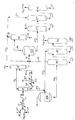
- the Figure is a schematic illustration an embodiment of the process of the invention.
- the fluorination of 140a in the first reaction zone is conducted in a manner such that 141b is selectively formed over 142b. This is accomplished using relatively mild reaction conditions and reactant resident times in the reaction zone. Accordingly, 140a is preferably treated in the first reaction zone with hydrogen fluoride in a molar ratio of hydrogen fluoride to 1,1,1-trichloroethane of at least 20:1, at a temperature of from 80°C to 95°C, for a period of time from 0.5 minutes to 2 minutes.
- the effluent from the first reaction zone comprising primarily 141b and unreacted 140a and hydrogen fluoride, is divided into two streams.
- the one stream is diverted for removal of 141b by phase separation and distillation.
- the second stream is fed to a second reaction zone for continued fluorination under conditions favoring formation of the more fluorinated product, 142b.
- This second stream Is preferably treated in the second reaction zone with hydrogen fluoride in a molar ratio of hydrogen fluoride to 141b (based on the amount of 141b in the stream) of at least 20:1, at a temperature of from 95°C to 110°C, for from 5 minutes to 10 minutes.
- 1-Chloro-1,1-difluoroethane is subsequently recovered from the second reaction zone reaction mixture by phase separation and distillation.
- the reaction conditions in the first reaction zone yield a conversion of 140a to 141b from 80% to 90%.
- the total conversion to 141b and 142b in the first reaction zone ranges from 82 to 97%.
- the first and second reaction zones may comprise any form of reactor known to those skilled in the art useful for conducting fluorination of chlorohydrocarbons.
- the reactions may be catalyzed, but are preferably not catalyzed.
- both reaction zones comprise plug flow reactors.
- plug flow also known as piston flow
- the fluid comprising the reactor feed passes through the reaction zone with a substantially uniform velocity profile such that there is no mixing of elements of the reactor feed which have entered the reactor at different times.
- all fluid in the reactor remains in the reaction zone for substantially the same amount of time. Accordingly, greater control over reaction conditions, and a uniformity of product, is achieved.
- a molar ratio of hydrogen fluoride to 140a of at least 20:1, preferably at least 25:1, is generally required to ensure that the fluorination reaction proceeds with the desired velocity.
- the fluorination of 140a to 141b is very rapid at HF to 140a molar ratios of at least 20:1, and particularly at ratios of at least 25:1.
- a scant 8.2 mole% conversion of 140a is achieved with a residence time as long as 15 minutes.
- hydrogen fluoride is preferably present in a sufficient molar excess with respect to 140a in the reaction mixture to reach the solubility limits of 140a in hydrogen fluoride. Once mutual solubility is achieved, the reaction proceeds very rapidly. Residence time and temperature then become contributing factors to the overall conversion of 140a to fluorinated product. We have found that at low hydrogen fluoride levels, the residence time and temperature have no significant affect on the overall conversion of 140a to fluorinated product.
- reaction temperature may be increased to increase the solubility of 140a in hydrogen fluoride, and therefore reduce the amount of hydrogen fluoride required in the reaction mixture, such higher reaction temperatures are undesirable, since they appear to lead to the formation of undesirable side products, and require exotic metallurgy for reactor hardware.
- reactor vessels of conventional fabrication may be advantageously employed.
- the operating pressures in the reactors comprising the reaction zones are selected so as to maintain the reactor contents in the liquid phase.
- the operating pressure is preferably at least 15.2 bar (15.5 kg/cm2) in the first reaction zone, and somewhat higher in the second reaction zone.
- Reactor performance for both reactions is generally independent of pressure, so long as the pressure is high enough to assure liquid phase operation in each reactor.
- the process of the present invention allows the ratio of 141b to 142b product to be varied from up to 98% 141b to greater than 98% 142b, by the simple expedient of diverting more or less product from the 141b recovery portion of the system to the second reaction zone, wherein 141b is converted to 142b.
- Hydrogen fluoride and 140a from supply tanks are pumped to reactor 10, which is preferably a plug flow reactor, wherein a portion of the 140a is converted to 141b.
- the conditions in the reactor are selected such that 141b is formed preferentially over the more fluorinated product 142b.
- the effluent from the reactor provides a product stream in line 12 at a temperature of, for example, 88°C, containing 141b and unreacted hydrogen fluoride and 140a, in addition to HCl.
- the product stream is fed to a flash drum 14 wherein the bulk of the HCl from the reaction is removed and shunted through line 16 to HCl stripper column 18.
- Column 18 may be operated at, for example, a bottom temperature of about 82°C, and a pressure of 7.3 bar (7.4 kg/cm2).
- the inlet temperature and drum pressure of flash drum 14 are determined by the HCl stripper column pressure.
- the liquid from the flash drum, constituting the product stream from reactor 10 from which a substantial portion of the HCl has been removed, is split between a 141b recovery system via line 20 and a second reactor 22 wherein 141b and any unreacted 140a are converted to 142b.
- the 141b-containing stream carried through lino 20 is combined with an azeotropic mixture of 141b and HF recycled from a downstream distillation column 21 which shall be described later.
- the combined stream is fad to a phase separator 26.
- the phase separator which is operated at, for example, a temperature of about 0°C, and atmospheric pressure, the feed stream rapidly separates into an HF-rich upper phase and a 141b-rich lower phase.
- the HF-rich phase contains, by weight, about 95% HF and about 5% 141b. This material is recycled to the hydrogen fluoride feed for reactor 10.
- the 141b-rich phase from separator 26 contains, by weight, about 99% 141b and about 1% HF and trace amounts of 142b, 143b and possibly HCl.
- This 141b-rich stream is pumped through line 28 to light ends column 30, which is operated, for example, at about 2.8 kg/cm and about 77°C at the top.
- the overhead stream from light ends column 30 is recycled via line 31 to the feed of a phase separator 42, described in more detail below.
- the column 30 overhead stream contains hydrogen fluoride, HCl, 142b and 143a.
- the bottoms from light ends column 30 is fed through line 32 to azeotrope column 24.
- the latter is operated, for example, at 1.4 bar (1.4 kg/cm2) and a bottom temperature of about 60°C.
- the 141b/HF azeotrope (comprising about 66% 141b and about 34% HF) is recycled through line 25 back to phase separator 26, after combination with the product stream 20 from flash drum 14.
- the essentially HF-free bottoms stream in line 34 leading from azeotrope column 24 is fed to column 36 for further purification.
- Column 36 is operated, for example, at a pressure of about 0.7 bar (0.7 kg/cm2), and a bottom temperature of about 92°C.
- the overhead of column 36 comprises essentially pure 141b.
- the bottoms from column 36 contains unreacted 140a which is recycled via line 39 to reactor 10.
- the stream in line 38 from flash drum 14 is fed to reactor 22, which is preferably a plug flow reactor.
- the reaction conditions are selected such that 141b, and any unreacted 140a, in the stream are converted to 142b.
- This provides a product stream comprising 142b, hydrogen fluoride, HCl and possibly 143a, at a temperature of, for example, 104°C.
- the reaction products are fed through line 40 to HCl stripper column 18.
- the product stream from the stripper is combined with the overhead from light ends column 30 (supplied via line 31) and routed through line 44 to phase separator 42.
- Phase separator 42 is similar in construction to phase separator 26.
- Phase separator 42 is operated at a temperature of, for example, about -20°C and at a pressure of, for example, about 0.01 bar (0.01 kg/cm2).
- the feed stream rapidly separates into a HF-rich upper phase and a 142b-rich lower phase.
- the HF-rich upper phase which contains, e.g., by weight 60% HF and 40% 142b, is fed through line 46 to azeotrope column 48.
- Azeotrope column 48 is operated, for example, at a bottom temperature of about 54°C and a pressure of about 2.1 bar (2.1 kg/cm2).
- the composition of the azeotrope overhead stream is, by weight, about 88% 142b and 12% HF.
- the overhead stream is recycled to the feed 44 of phase separator 42 through line 50.
- the essentially 142b-free bottoms stream from column 48 is recycled via line 49 to the hydrogen fluoride feed of reactor 10.
- the 142b-rich phase from phase separator 42 which contains about 97% 142b, 3% hydrogen fluoride, and possibly trace amounts of 143a and HCl, is pumped through line 52 to light ends column 54.
- Light ends column 54 is similar to light ends column 30 in construction and operation. It is operated at, for example, about 8.2 bar (8.4 kg/cm2) and a bottom temperature of about 57°C.
- An overhead stream comprising HCl and 143a is removed via line 55 and routed to a waste incinerator (not shown).
- the bottom product from column 54 is fed by line 56 to azeotrope column 58, which is operated, for example, at a pressure of about 3.4 bar (3.5 kg/cm2), and at a temperature of about 35°C at the bottom.
- the essentially HF-free bottoms stream in line 60 is removed for further purification in column 62.
- Column 62 is operated, for example, at a pressure of about 4.8 bar (4.9 kg/cm2) and a bottom temperature of about 83°C.
- the 142b/HF azeotrope is removed at the overhead of column 58, combined via line 59 with the overhead in line 64 from azeotrope column 48, and recycled back to the feed of phase separator 42.
- the bottoms from column 62 which comprises any unreacted 140a or 141b, is recycled via line 63 back to reactor 22 or incinerated. Essentially pure 142b is obtained as the overhead from column 62.
Landscapes
- Chemical & Material Sciences (AREA)
- Organic Chemistry (AREA)
- Chemical Kinetics & Catalysis (AREA)
- Organic Low-Molecular-Weight Compounds And Preparation Thereof (AREA)
Claims (9)
- Verfahren zur Herstellung von 1,1-Dichlor-1-fluorethan und 1-Chlor-1,1-difluorethan, dadurch gekennzeichnet, daß man:(a) 1,1,1-Trichlorethan in einer ersten Reaktionszone mit Fluorwasserstoff behandelt, um selektiv 1,1-Dichlor-1-fluorethan zu bilden;(b) erste und zweite 1,1-Dichlor-1-fluorethan enthaltende Ströme aus dem Abstrom der ersten Reaktionszone bildet;(c) den ersten 1,1-Dichlor-1-fluorethan enthaltenden Strom abkühlt, um den genannten Strom in eine an Fluorwasserstoff reiche flüssige Phase und eine an 1,1-Dichlor-1-fluorethan reiche flüssige Phase aufzutrennen, und daß man die zwei Phasen trennt;(d) den zweiten 1,1-Dichlor-1-fluorethan enthaltenden Strom mit Fluorwasserstoff in einer zweiten Reaktionszone behandelt, um 1-Chlor-1,1-difluorethan zu bilden; und daß man(e) den Abstrom aus der zweiten Reaktionszone abkühlt, um den genannten Abstrom in eine an Fluorwasserstoff reiche flüssige Phase und eine an 1-Chlor-1,1-difluorethan reiche flüssige Phase aufzutrennen, und daß man die zwei Phasen trennt.
- Verfahren nach Anspruch 1, dadurch gekennzeichnet, daß die Stufe (a) die selektive Bildung von 1,1-Dichlor-1-fluorethan durch Behandlung von 1,1,1-Trichlorethan in einer ersten Reaktionszone mit Fluorwasserstoff bei einem Molverhältnis von Fluorwasserstoff zu 1,1,1-Trichlorethan von mindestens 20:1 bei einer Temperatur von 80°C bis 95°C und über einen Zeitraum von 0,5 Minuten bis 2 Minuten umfaßt.
- Verfahren nach Anspruch 1, dadurch gekennzeichnet, daß die Stufe (d) die Bildung von 1-Chlor-1,1-difluorethan durch Behandlung des 1,1-Dichlor-1-fluorethan enthaltenden Stroms mit Fluorwasserstoff bei einem Molverhältnis von mindestens 20:1, bezogen auf das 1,1,1-Trichlorethan in dem das 1,1-Dichlor-1-fluorethan enthaltenden Strom, bei einer Temperatur von 95°C bis 110°C und über 5 Minuten bis 10 Minuten umfaßt.
- Verfahren nach Anspruch 1, dadurch gekennzeichnet, daß die erste und die zweite Reaktionszone Pfropfenströmungsreaktoren umfassen.
- Verfahren nach Anspruch 1, dadurch gekennzeichnet, daß man HCl aus dem Abstrom der ersten Reaktionszone entfernt.
- Verfahren nach Anspruch 1, dadurch gekennzeichnet, daß man ein azeotropes Gemisch von Fluorwasserstoff und 1-Chlor-1,1-difluorethan aus den an 1-Chlor-1,1-difluorethan reichen und an Fluorwasserstoff reichen flüssigen Phasen in (e) destilliert und die azeotropen Gemische mit dem Abstrom aus der zweiten Reaktionszone kombiniert.
- Verfahren nach Anspruch 6, dadurch gekennzeichnet, daß man den Fluorwasserstoff von der Destillation der an Fluorwasserstoff reichen flüssigen Phase in die erste Reaktionszone zurückführt.
- Verfahren nach Anspruch 1, dadurch gekennzeichnet, daß man ein azeotropes Gemisch von Fluorwasserstoff und 1,1-Dichlor-1-fluorethan aus der an 1,1-Dichlor-1-fluorethan reichen flüssigen Phase von (c) destilliert und daß man das azeotrope Gemisch mit dem Abstrom der ersten Reaktionszone kombiniert.
- Verfahren nach Anspruch 8, dadurch gekennzeichnet, daß man die an Fluorwasserstoff reiche flüssige Phase von (c) in die erste Reaktionszone zurückführt.
Applications Claiming Priority (2)
| Application Number | Priority Date | Filing Date | Title |
|---|---|---|---|
| US379518 | 1989-07-13 | ||
| US07/379,518 US4996378A (en) | 1989-07-13 | 1989-07-13 | Process for production of 1,1-dichloro-1-fluoroethane and/or 1-chloro-1,1-difluoroethane |
Publications (2)
| Publication Number | Publication Date |
|---|---|
| EP0407689A1 EP0407689A1 (de) | 1991-01-16 |
| EP0407689B1 true EP0407689B1 (de) | 1993-07-07 |
Family
ID=23497588
Family Applications (1)
| Application Number | Title | Priority Date | Filing Date |
|---|---|---|---|
| EP90104929A Expired - Lifetime EP0407689B1 (de) | 1989-07-13 | 1990-03-15 | Verfahren zur Herstellung von 1,1-Dichlor-1-fluoroethan und 1-Chlor-1-1-difluorethan |
Country Status (5)
| Country | Link |
|---|---|
| US (1) | US4996378A (de) |
| EP (1) | EP0407689B1 (de) |
| JP (1) | JPH0819017B2 (de) |
| CA (1) | CA2012100A1 (de) |
| DE (1) | DE69002134D1 (de) |
Families Citing this family (5)
| Publication number | Priority date | Publication date | Assignee | Title |
|---|---|---|---|---|
| TW228512B (de) * | 1992-08-10 | 1994-08-21 | Showa Denko Kk | |
| US5336816A (en) * | 1992-12-17 | 1994-08-09 | Laroche Chemicals, Inc. | Method for preparing 1,1-dichloro-1-fluoroethane |
| US7329786B2 (en) * | 2001-09-28 | 2008-02-12 | Great Lakes Chemical Corporation | Processes for producing CF3CFHCF3 |
| JP4956087B2 (ja) * | 2006-08-07 | 2012-06-20 | 株式会社東芝 | 半導体記憶装置 |
| CN102614678B (zh) * | 2012-03-09 | 2014-01-22 | 常熟三爱富氟化工有限责任公司 | 一氟二氯乙烷生产中分离回收二氟一氯乙烷装置及工艺 |
Family Cites Families (4)
| Publication number | Priority date | Publication date | Assignee | Title |
|---|---|---|---|---|
| US2894044A (en) * | 1956-02-16 | 1959-07-07 | Monsanto Chemicals | Preparation of 1, 1-dichloro-1-fluoroethane |
| JPS505681B1 (de) * | 1970-07-28 | 1975-03-06 | ||
| DE3362972D1 (en) * | 1982-06-08 | 1986-05-22 | Pennwalt Corp | Anhydrous phase separation for recovering hydrogen fluoride from a fluorination reaction |
| FR2617475B1 (fr) * | 1987-07-03 | 1989-12-01 | Atochem | Synthese du chloro-1 difluoro-1,1 ethane |
-
1989
- 1989-07-13 US US07/379,518 patent/US4996378A/en not_active Expired - Lifetime
-
1990
- 1990-03-09 JP JP2056797A patent/JPH0819017B2/ja not_active Expired - Lifetime
- 1990-03-13 CA CA002012100A patent/CA2012100A1/en not_active Abandoned
- 1990-03-15 DE DE9090104929T patent/DE69002134D1/de not_active Expired - Lifetime
- 1990-03-15 EP EP90104929A patent/EP0407689B1/de not_active Expired - Lifetime
Also Published As
| Publication number | Publication date |
|---|---|
| JPH0819017B2 (ja) | 1996-02-28 |
| JPH0352829A (ja) | 1991-03-07 |
| DE69002134D1 (de) | 1993-08-12 |
| CA2012100A1 (en) | 1991-01-13 |
| US4996378A (en) | 1991-02-26 |
| EP0407689A1 (de) | 1991-01-16 |
Similar Documents
| Publication | Publication Date | Title |
|---|---|---|
| US7566809B2 (en) | Process for separation of a mixture comprising at least one hydrofluoroalkane | |
| EP0354697B1 (de) | Verfahren zur Abtrennung von HF durch azeotrope Destillation | |
| EP2563750B1 (de) | Verfahren zur herstellung von 2-chlor-3, 3, 3-trifluorpropen (hcfo 1233xf) durch flüssigphasenfluorierung von pentachlorpropan | |
| EP0395898B1 (de) | Verfahren zur Abtrennung von Fluorwasserstoff, 1,1-Dichlor-1-fluorethan und 1-Chlor-1,1-difluorethan aus deren Mischungen | |
| EP1395535B1 (de) | Verfahren zur herstellung von fluorkohlenwasserstoffen | |
| US4996378A (en) | Process for production of 1,1-dichloro-1-fluoroethane and/or 1-chloro-1,1-difluoroethane | |
| US6316682B1 (en) | Process for preparing 1,1,1,3,3-pentafluoropropane | |
| JPH07324044A (ja) | 1,1,1,2,2−ペンタフルオロエタンの製法 | |
| US4885416A (en) | Fluorination process | |
| CN112624897A (zh) | 同时生产反式-1-氯-3,3,3-三氟丙烯和反式-1,3,3,3-四氟丙烯的方法 | |
| US4765876A (en) | Simultaneous production of higher chloromethanes | |
| EP0923514B1 (de) | Abtrennung von wasser aus verfahrenströmen | |
| EP0777638B1 (de) | Verfahren zur herstellung von pentafluorethan | |
| US5345015A (en) | Process for producing 1,1,2-tetrafluoroethane | |
| JP3816148B2 (ja) | ハイドロフルオロカーボン類の製造方法 | |
| KR101024100B1 (ko) | 디클로로트리플루오로에탄의 제조 공정 | |
| KR20060117312A (ko) | 하이드로플루오로카본의 제조방법 | |
| JPH08198783A (ja) | 1,1,1,3,3−ペンタフルオロブタンの製造方法 | |
| CN101356140A (zh) | 制备二氯三氟乙烷的方法 | |
| JP2003313146A (ja) | ハイドロフルオロカーボンの製造方法 | |
| MXPA01006206A (en) | Method for separating a mixture comprising at least an hydrofluoroalkane and hydrogen fluoride, methods for preparing a hydrofluoroalkane and azeotropic compositions |
Legal Events
| Date | Code | Title | Description |
|---|---|---|---|
| PUAI | Public reference made under article 153(3) epc to a published international application that has entered the european phase |
Free format text: ORIGINAL CODE: 0009012 |
|
| AK | Designated contracting states |
Kind code of ref document: A1 Designated state(s): BE DE FR GB IT NL |
|
| 17P | Request for examination filed |
Effective date: 19910710 |
|
| 17Q | First examination report despatched |
Effective date: 19920610 |
|
| GRAA | (expected) grant |
Free format text: ORIGINAL CODE: 0009210 |
|
| ITF | It: translation for a ep patent filed | ||
| AK | Designated contracting states |
Kind code of ref document: B1 Designated state(s): BE DE FR GB IT NL |
|
| PG25 | Lapsed in a contracting state [announced via postgrant information from national office to epo] |
Ref country code: NL Effective date: 19930707 Ref country code: DE Effective date: 19930707 Ref country code: BE Effective date: 19930707 |
|
| REF | Corresponds to: |
Ref document number: 69002134 Country of ref document: DE Date of ref document: 19930812 |
|
| ET | Fr: translation filed | ||
| NLV1 | Nl: lapsed or annulled due to failure to fulfill the requirements of art. 29p and 29m of the patents act | ||
| PG25 | Lapsed in a contracting state [announced via postgrant information from national office to epo] |
Ref country code: GB Effective date: 19940315 |
|
| PLBE | No opposition filed within time limit |
Free format text: ORIGINAL CODE: 0009261 |
|
| STAA | Information on the status of an ep patent application or granted ep patent |
Free format text: STATUS: NO OPPOSITION FILED WITHIN TIME LIMIT |
|
| 26N | No opposition filed | ||
| GBPC | Gb: european patent ceased through non-payment of renewal fee |
Effective date: 19940315 |
|
| PGFP | Annual fee paid to national office [announced via postgrant information from national office to epo] |
Ref country code: FR Payment date: 20000214 Year of fee payment: 11 |
|
| PG25 | Lapsed in a contracting state [announced via postgrant information from national office to epo] |
Ref country code: FR Free format text: LAPSE BECAUSE OF NON-PAYMENT OF DUE FEES Effective date: 20011130 |
|
| REG | Reference to a national code |
Ref country code: FR Ref legal event code: ST |
|
| PG25 | Lapsed in a contracting state [announced via postgrant information from national office to epo] |
Ref country code: IT Free format text: LAPSE BECAUSE OF NON-PAYMENT OF DUE FEES;WARNING: LAPSES OF ITALIAN PATENTS WITH EFFECTIVE DATE BEFORE 2007 MAY HAVE OCCURRED AT ANY TIME BEFORE 2007. THE CORRECT EFFECTIVE DATE MAY BE DIFFERENT FROM THE ONE RECORDED. Effective date: 20050315 |