EP0408128A2 - Saugfähiges Papier aus mit Polymeren modifizierten faserigen Zellstoffen und Verfahren zur Herstellung durch nasses Ablegen - Google Patents
Saugfähiges Papier aus mit Polymeren modifizierten faserigen Zellstoffen und Verfahren zur Herstellung durch nasses Ablegen Download PDFInfo
- Publication number
- EP0408128A2 EP0408128A2 EP90201814A EP90201814A EP0408128A2 EP 0408128 A2 EP0408128 A2 EP 0408128A2 EP 90201814 A EP90201814 A EP 90201814A EP 90201814 A EP90201814 A EP 90201814A EP 0408128 A2 EP0408128 A2 EP 0408128A2
- Authority
- EP
- European Patent Office
- Prior art keywords
- pulp
- type
- wet
- fibrous
- web
- Prior art date
- Legal status (The legal status is an assumption and is not a legal conclusion. Google has not performed a legal analysis and makes no representation as to the accuracy of the status listed.)
- Granted
Links
Images
Classifications
-
- D—TEXTILES; PAPER
- D21—PAPER-MAKING; PRODUCTION OF CELLULOSE
- D21H—PULP COMPOSITIONS; PREPARATION THEREOF NOT COVERED BY SUBCLASSES D21C OR D21D; IMPREGNATING OR COATING OF PAPER; TREATMENT OF FINISHED PAPER NOT COVERED BY CLASS B31 OR SUBCLASS D21G; PAPER NOT OTHERWISE PROVIDED FOR
- D21H11/00—Pulp or paper, comprising cellulose or lignocellulose fibres of natural origin only
- D21H11/16—Pulp or paper, comprising cellulose or lignocellulose fibres of natural origin only modified by a particular after-treatment
- D21H11/20—Chemically or biochemically modified fibres
-
- D—TEXTILES; PAPER
- D21—PAPER-MAKING; PRODUCTION OF CELLULOSE
- D21H—PULP COMPOSITIONS; PREPARATION THEREOF NOT COVERED BY SUBCLASSES D21C OR D21D; IMPREGNATING OR COATING OF PAPER; TREATMENT OF FINISHED PAPER NOT COVERED BY CLASS B31 OR SUBCLASS D21G; PAPER NOT OTHERWISE PROVIDED FOR
- D21H5/00—Special paper or cardboard not otherwise provided for
- D21H5/12—Special paper or cardboard not otherwise provided for characterised by the use of special fibrous materials
- D21H5/14—Special paper or cardboard not otherwise provided for characterised by the use of special fibrous materials of cellulose fibres only
- D21H5/141—Special paper or cardboard not otherwise provided for characterised by the use of special fibrous materials of cellulose fibres only of fibrous cellulose derivatives
-
- A—HUMAN NECESSITIES
- A61—MEDICAL OR VETERINARY SCIENCE; HYGIENE
- A61L—METHODS OR APPARATUS FOR STERILISING MATERIALS OR OBJECTS IN GENERAL; DISINFECTION, STERILISATION OR DEODORISATION OF AIR; CHEMICAL ASPECTS OF BANDAGES, DRESSINGS, ABSORBENT PADS OR SURGICAL ARTICLES; MATERIALS FOR BANDAGES, DRESSINGS, ABSORBENT PADS OR SURGICAL ARTICLES
- A61L15/00—Chemical aspects of, or use of materials for, bandages, dressings or absorbent pads
- A61L15/16—Bandages, dressings or absorbent pads for physiological fluids such as urine or blood, e.g. sanitary towels, tampons
- A61L15/22—Bandages, dressings or absorbent pads for physiological fluids such as urine or blood, e.g. sanitary towels, tampons containing macromolecular materials
- A61L15/28—Polysaccharides or their derivatives
Definitions
- the present invention relates to the manufacture, by continuous wet-laying, of absorbent structures, especially absorbent paper webs which are useful in absorbent articles such as disposable paper towels, wipes and tissues.
- the processes disclosed include particular on-line chemical treatment steps.
- the process of preparing the sheets comprises the steps of air-laying the fibers to form an airfelt, increasing the moisture content of the airfelt, and compacting the moisturized airfelt between a pair of opposed pressure-loaded rollers or between two planar members such as hydraulic rams.
- such resinous materials may be applied to absorbent articles, such as paper towels, by various methods including mixing the powdered resin with materials such as pulp, spraying an aqueous dispersion of the resin onto substrates such as pulp or paper, or immersing such substrates in aqueous dispersions of the resin followed by kneading and drying.
- These improved materials include a substantially water-insoluble, slightly cross-linked, partially neutralized, hydrogel-forming polyacrylate polymer. It is disclosed that various gross morphologies of the polymer, including fibers, can be used in an air-laid or laminated absorbent structure suitable for use in an absorbent article, the latter being defined as including, inter alia, diapers, paper towels and facial tissues.
- the specific disadvantages of wet-laying the hydrogel apparently include stiffness of the wet-laid product because of undesirable fiber-fiber bonding, as well as expense incurred by added drying load. Poor wicking characteristics of hydrogels and restricted swelling of hydrogel particles in a fibrous matrix are referred to as two possible causes for poorly performing hydrogel-containing webs.
- Saotome EPA 192,216, published August 27, 1986, describes another water-absorbent fibrous structure, characterized as comprising a fibrous cellulosic material impregnated with a water-absorbent acrylic polymer and a fibrous material, which is produced by a method in which an aqueous solution of a monomeric component comprising acrylic acid and a radical initiator is diffused in a fibrous cellulosic material and heated, followed by blending with a fibrous material. It is stated that this material finds application in various absorbent articles, including disposable diapers and paper towels. There is not, apparently, any criticality in the kind of fibrous cellulosic material or fibrous material.
- the former may, for example, be a chemically purified wood pulp; the latter may be identical with the former or may comprise a synthetic fiber such as polyester.
- a chemically purified wood pulp such as polyester
- the former may, for example, be a chemically purified wood pulp; the latter may be identical with the former or may comprise a synthetic fiber such as polyester.
- acrylic acid, sodium hydroxide, N,N-methylenebisacrylamide and potassium persulfate are mixed and reacted in water, the resulting solution is sprayed over a chemically purified wood pulp, heated to obtain a polymerization product, and dried.
- This intermediate product is mixed with wood pulp, water and methanol and "vigorously stirred to bring the polymerization product to pieces.”
- the mixture is wet-laid on a wire netting to make a sheet, and the sheet is dried.
- Nakanishi et al U.S. 4,721,647, issued January 26, 1988, discloses absorbent articles comprising a base material of fibers, a part or all of which fibers are hydrophobic; and a water-absorbent polymer, a part or all of which is in the form of substantially spherical particles bonded to said fibers to surround them. Though little preparative detail is given, the article is apparently made by steps comprising spraying droplets of monomer onto the fibers, polymerizing such as by heat-curing, and drying.
- the Kopolow disclosures relate to compression or heat treatment of boards in the dry state after a wet-laying papermaking process.
- the boards comprise "hydrocolloidal fibers" such as those of U.S. 3,889,678, Chatterjee et al, issued June 17, 1975.
- Such converted disposable absorbent articles include multi-ply tissues and towels or wipes.
- U.S. 4,025,472, Lepoutre discloses a process for drying wet, highly swollen, polymer-modified cellulosic fibers to provide fibers having enhanced retention of both water and physiological liquids.
- the essential steps of the drying process are as follows: first, the hydrolyzed fibers are thoroughly washed with water, thus rendering them to a substantially maximum swollen state. The fibers are then acidified to a low, critical pH whereby the water previously retained by the alkaline fiber is released and filtered off, thus rendering them to a substantially minimum swollen state. Further treatment with an alkaline non-swelling solvent mixture renders the fibers substantially water-free in their alkaline salt form. A final wash and drying step using substantially water-free solvent and heat completes the process.
- the cellulose contained in a cellulose paste is activated; acrylonitrile is grafted to the cellulose while its dry content is sufficient to obtain a grafting rate of about 200%; the grafted cellulose paste is hydrolyzed until a state of maximum expansion is reached; the product is acidified to a pH which brings it to a state of minimum expansion after which the water is removed; the product is converted to its salt form in the presence of a water-miscible liquid, and under agitation which is sufficient to prevent clustering of the fibers; this is effected so that the quantity of water, expressed by volume, does not exceed about 10% of the liquid phase; the product is finally dried.
- Patents relating to papermaking processes generally useful in the context of the present invention and incorporated herein by reference include U.S. 3,301,746, Sanford et al, issued January 31, 1967; U.S. 3,905,863, Ayers, issued September 16, 1975; U.S. 3,974,025, Ayers, issued August 10, 1976; U.S. 3,994,771, Morgan, Jr. et al, issued November 30, 1976; U.S. 4,191,609, Trokhan, issued March 4, 1980; U.S. 4,300,981, Carstens, issued November 17, 1981; U.S. 4,440,597, Wells et al, issued April 3, 1984; U.S. 4,469,735, Trokhan, issued September 4, 1984; and U.S. 4,637,859, Trokhan, issued January 20, 1987.
- the present invention relates to an improvement in a continuous wet-laying papermaking process for the manufacture of absorbent paper sheets from two or more fibrous pulps, wherein at least one of said fibrous pulps, A, is a polymer-modified fibrous pulp, as described more fully hereinafter, which, in its alkali-metal-cation exchanged state, imbibes water by hydrocolloidal swelling, and wherein the balance of said fibrous pulps, B, comprises conventional papermaking pulps, said process comprising the steps of web lay-down and dewatering.
- the improved process herein comprises conducting the wet-laying process in the absence of interfering cationic materials, under conditions wherein pulp A is laid down in an embryonic web in a protonated state and wherein said embryonic web is at least partially dewatered, preferably to a consistency of about 15%, or higher, while maintaining pulp A in said protonated state.
- pulp A is taken back from the protonated state to the alkali-metal-cation-exchanged state prior to final high-temperature drying of the web.
- the process comprises the sequence of steps: (a) treating a stock of said fibrous pulps A and B (they may be treated separately or in admixture) with acid; the amount of said acid being sufficient to ensure that in subsequent step (b), the type A component of said fibrous pulps is maintained in said protonated state; (b) wet-laying the acidic stock (A + B) formed in step (a) from a single-channel or multi-channel headbox onto a first foraminous member, thereby draining water to the extent of forming an embryonic web, said embryonic web having one or more layers; (c) at least partially dewatering the embryonic web in one or more steps to provide a partially dewatered web; (d) contacting the partially dewatered web of step (c) with alkali so as to bring the fibrous
- the process temperature throughout steps (a)-(e) preferably does not exceed about 200 o C. Even more preferably, since the type A pulp is most heat-sensitive in the protonated state, temperatures are kept as low as practically possible before alkali-treatment step (d).
- the predryer inlet temperature is preferably set in the range from about 125 o C to about 175 o C.
- Final drying step (e) is usually carried out using a conventional, commercial hot drum dryer, commonly known as a Yankee dryer, the temperature of which is preferably in the range from about 150 o C to about 175 o C, most preferably from about 163-170 o C which typically corresponds with a saturated steam pressure of 97-114 psi (669-786 kiloPascals).
- a conventional, commercial hot drum dryer commonly known as a Yankee dryer
- the amount of acid in step (a) is generally such as to deliver a pH in the range of from about 3 to about 5, as determined in the water draining from said embryonic web.
- the pH of water draining from the web in each of steps (b) and (c) is in the range from about 3.5 to about 4.5; pH at the end of step (d) is preferably in the range from about 6 to about 9, even more preferably 7-8.
- Water samples for pH measurement can be obtained by squeezing the web or, if the web is too dry, by equilibrating a sample of the web with pure water.
- the preferred consistency of the web at the end of step (c), i.e., immediately prior to alkali-treatment step (d), is in the range from about 15 % to about 75 %.
- fibrous pulp A comprises a covalently chemically bonded polymeric modifier consisting of a hydrophilic organic polycarboxylate polymer.
- the preferred polymer-modified fibrous pulp (A) is a mildly hydrolyzed methyl acrylate grafted southern softwood kraft pulp, wherein the polymeric modifier is polyacrylate derived from the polymerization and subsequent hydrolysis of the methyl acrylate component; this polyacrylate is covalently chemically bonded to, as distinct from merely physically coating, the kraft pulp.
- the type B pulp is a conventional pulp, e.g., kraft pulp, sulfite pulp or chemithermomechanical pulp; such pulp is widely available in commerce; the type B pulp is not polymer-modified.
- the proportion of pulp A is generally from about 1% to about 20%, more preferably from about 3% to about 15% and the balance of the pulp, to 100%, is pulp B.
- the acid used in the process is typically sulfuric acid, e.g., as an aqueous solution.
- the alkali is preferably a hydroxide, carbonate or bicarbonate of sodium or potassium; aqueous sodium carbonate is highly preferred on grounds of cost but potassium carbonate has superior solubility and has the advantage that it is more easily applied in concentrated aqueous form.
- the type A pulp has two states: a protonated state and an alkali-metal-cation-exchanged state.
- the invention embodies the discovery that the type A pulp responds differently to individual steps in wet-laying papermaking operations, depending on which of these states it is in: in the protonated state, pulp A is appreciably more resistant to disintegration during wet-laying and partial dewatering operations where mechanical shear forces tend to be high; whereas in the alkali-metal-cation-exchanged state, pulp A is more resistant to thermal degradation.
- pulp A should invariably be in the protonated state at the wet-end of the papermaklng operation, e.g., as laid down on a Fourdrinier wire.
- pulp A should furthermore be taken to the alkall-metal-cation exchanged state, as noted, prior to final high-temperature drying.
- a suitable amount of acid is most conveniently specified on the basis that the pH of the recirculating process water (whether at the headbox, or draining from the embryonic web, or at the fan pump, or at the wire pit) is in the range from about 3 to about 5.
- the type A pulp should be brought to the protonated state before it reaches the fan pump (i.e., the point in the process at which it is customary to dilute papermaking pulps with large volumes of process water).
- the present invention also requires that interfering cationic materials should not be present. Such materials interact adversely with the type A pulp, significantly affecting sheet formation by causing excessive pulp flocculation, as well as by reducing the absorbency benefits of the invention. Specific types and levels of interfering cationic materials, as well as general tests to determine if a particular cationic material is or is not interfering, are described at length hereinafter. Cationic wet-strength resins, such as KYMENE 557H (Hercules Inc.), are especially interfering, and under normal circumstances, their use in the process should be avoided.
- KYMENE 557H Hercules Inc.
- the invention encompasses absorbent paper structures, in the form of paper webs as directly produced by the instant process, as well as various absorbent articles which can readily be manufactured therefrom by conventional papermaking conversion operations.
- the product of the invention preferably takes the form of disposable tissues, towels and wipes.
- the invention secures paper webs incorporating modest levels (e.g., 10%-20% based on total pulp) of water-absorbent or aqueous-fluid-absorbent type A pulps, yet having significantly greater absorbency than a conventional reference paper e.g., as illustrated by an equal basis weight wet-laid paper containing only type B pulp which is made by an entirely conventional wet-laying process.
- modest levels e.g., 10%-20% based on total pulp
- a conventional reference paper e.g., as illustrated by an equal basis weight wet-laid paper containing only type B pulp which is made by an entirely conventional wet-laying process.
- the invention encompasses highly economical paper webs incorporating even lower levels (e.g., 3%-5% based on total pulp) of water-absorbent or aqueous-fluid-absorbent type A pulps. Even when such webs embody significant economies in terms of total usage of paper pulp (the content of type B pulp having been reduced by as much as 20% or more, thereby significantly reducing the basis weight), the webs have water or aqueous fluid absorbency which is fully equivalent to that of higher-basis-weight wet-laid reference paper.
- Higher-basis-weight reference paper can be made by an entirely conventional wet-laying process; as compared with the paper of the invention embodying a saving in the amount of type B pulp, no type B pulp has been removed; furthermore no type A pulp has been added.
- the present process does not materially harm the absorbency or absorbency rate of the type A pulp in the product paper web as compared with the absorbency or absorbency rate of the pulp A starting-material.
- the invention is especially adapted for practical application in the manufacture of paper products such as disposable absorbent paper towels, where absorbent capacity coupled with economy and quick pick-up of spills are, for consumers, especially important product attributes.
- the present invention relates to papermaking using continuous wet-laying papermaking equipment as distinct from relatively slow and more easily controlled batch processes such as handsheet making.
- Continuous papermaking processes in accordance with the invention operate at high speeds, e.g., about 500 ft/min (152.4 meters/min), or higher. Typical high speeds are from about 2,000 ft/min to about 4,000 ft/min (609.6 meters/min - 1219.2 meters/min).
- the present invention relates to a process for wet-laying specific kinds of fibrous pulps to form paper webs suitable for use as disposable absorbents.
- the paper webs generally contain "fibrous pulps type A”, which are particular, polymer-modified fibrous pulps; as well as “fibrous pulps type B”, which are pulps of the kind conventionally used in disposable absorbent papers.
- Fibrous pulps type A are potentially highly absorbent materials, but are difficult to incorporate into paper by wet-laying techniques. Significant processing problems are encountered and, ultimately, inferior product webs are made when the type A pulps are conventionally wet-laid. More specifically, these conventionally wet-laid webs tend to have an undesirable "hand”, due to stiffness or wet "gel-feel", and furthermore tend to have significantly poorer absorbency than expected on the basis of having wet-laid into the paper web a supposedly highly absorbent fibrous pulp type A, usually at considerable expense.
- the present invention overcomes these problems, and improves a wet-laying process so as to exploit fibrous pulp type A having two distinct states, namely a protonated state and an alkali-metal--cation-exchanged state.
- the process herein makes use of the different behavior of these two states of fibrous pulp type A under wet-laying papermaking conditions to provide the desired product, as follows:
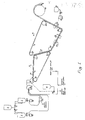
- Fig. 1 is a simplified, schematic representation of an embodiment of a continuous papermaking machine useful in the practice of the present invention.
- Chests 1 and 2 are storage chests for aqueous dispersions of pulps of type A and type B, respectively.
- Chest 1 contains an aqueous dispersion of type A pulp having a pH of from about 3.5 to about 4.5.
- the pH of the aqueous dispersion of type A pulp may be adjusted by adding aqueous sulfuric acid which is stored in storage vessel 3 .
- the amount of acid added to chest 1 is controlled by metering device 4 , incorporating pH sensing means situated in chest 1 .
- the consistency of the aqueous dispersion of type A pulp may be adjusted by adding water.
- the type A pulp is most sensitive to water hardness whenever it is not in the protonated state; thus, when preparing the aqueous dispersion of type A pulp from type A pulp receipts which are in the alkali-metal cation-exchanged state, the water used to prepare and to adjust the consistency of the aqueous dispersion of type A pulp in chest 1 is typically deionized water, or soft water having a total water hardness (calcium plus magnesium) of 5 ppm or less. When preparing the aqueous dispersion of type A pulp from type A pulp receipts which are in the protonated state, the hardness of the water used to prepare and to adjust the consistency of the aqueous dispersion of type A pulp in chest 1 is less critical. Water having a total water hardness (calcium plus magnesium) up to about 150 ppm is then satisfactory.
- Chest 2 contains an aqueous dispersion of type B pulp having a pH of from about 3.5 to about 4.5.
- the pH of the aqueous dispersion of type B pulp may be adjusted by adding aqueous sulfuric acid which is stored in storage vessel 3 .
- the amount of acid added to chest 2 is controllable independently from the amount added to chest 1 .
- the amount of acid added to chest 2 is controlled by metering device 5 , incorporating pH sensing means situated in chest 2 .
- the consistency of the aqueous dispersion of type B pulp may be adjusted by adding water.
- the water hardness of water used to prepare and to adjust the consistency of the aqueous dispersion of type B pulp in chest 2 is not as critical as the water hardness of water used or added in chest 1 ; typically, papermaking process water of good quality will suffice: such water has water hardness (parts per million, calcium plus magnesium) of from about 40 to about 150.
- the aqueous dispersions of pulps A and B pass via valves 6 and 7 and pumps 8 and 9 to fan pump 11 .
- online mixer 10 can be used to add compatible additives, provided that such additives are non-interfering with respect to the type A pulp, as further discussed in detail hereinafter.
- the acidic stock is diluted by recycled process water.
- the fan pump serves also to mix the type A and type B pulps.
- process water As process water is subsequently removed in the wet-end papermaking operation, it is collected from the wet-end using a water collection system comprising water collecting pans and a wire pit not shown, and recirculates via the fan pump to the headbox 12 .
- the entire process water recirculation system is kept at an approximately constant pH in the range from about 3.5 to about 4.5 by adding aqueous sulfuric acid, as needed, using metering device 14 incorporating pH sensing means located at headbox 12 .
- additional process water bleed outlets, fresh process water inputs, and inline mixers may be provided, the better to control the process water composition.
- Having a separate acid storage Vessel 13 is not strictly neccessary: if convenient, storage vessel 3 can be used to provide all the acid.
- metering devices 4 , 5 and 14 each function independently so that acid may independently be added to the type A pulp, the type B pulp and the recirculating process water.
- Fig. 1 broken lines are used to show the connection of metering devices to the aforementioned suitably positioned pH sensing means. Though less convenient than the continuous pH monitoring and acid adjustment shown, it is of course possible to monitor pH non-continuously by taking water samples at any stage in the process, measuring their pH, and adjusting the amount of acid accordingly.
- the acidic, diluted stock (now typically having a consistency in the range from about 0.15% to about 0.2%) is delivered to a first foraminous member 15 , which is typically a Fourdrinier wire.
- a first foraminous member 15 which is typically a Fourdrinier wire.
- Optional auxiliary units and devices commonly associated with stock preparation for papermaking machines but not shown in Fig. 1 may include refiners, as well as additional pumps, flow control and metering devices, stock storage chests and the like.
- the purpose of the stock preparation units and devices, illustrated and not illustrated, is to prepare acidic stock from pulps type A and type B, and further, to provide a uniformly pumped dispersion of papermaking fibers, in one or more streams, to the headbox.
- Fig. 1 the type A and type B pulps are shown as being mixed in fan pump 11 and as being laid down in a unitary nonlayered web by means of headbox 12 .
- headbox 12 is a multi-channel headbox and the fan-pump equipment 11 comprises two or more conventional fan pumps capable of separately pumping two or more pulp streams in parallel, and capable of diluting those separate streams with recycled process water without mixing the type A and type B pulp components.
- a two-layered web can be laid down by passing two separate acidic stocks, one comprising the type A pulp (from chest 1 ) and the other, the type B pulp (from chest 2 ), in two separate streams, to a double fan-pump.
- the two separate streams now diluted by recycled process water, pass to a conventional multi-channel headbox, and are laid down as a two-layer web.
- the pH is from about 3.5 to about 4.5 overall.
- a three-layered web can be laid down by passing three separate acidic stocks, one comprising the type A pulp (from chest 1 ) and each of the remaining two stocks comprising type B pulp (from chest 2 ) in three separate streams, to a triple fan-pump.
- the pH of water draining from the web as it is laid down is again from about 3.5 to about 4.5.
- First foraminous member 15 is supported by breast roll 16 and a plurality of return rolls of which only two, 17 and 18 , are illustrated.
- the aforementioned breast roll 16 is typically a vacuum breast roll with internal shower.
- First foraminous member 15 is propelled in the direction indicated by directional arrow 19 by drive means not shown.
- Optional wet-end auxiliary units and devices commonly associated with papermaking machines, but not shown in Fig. 1 include forming boards, hydrofoils, vacuum boxes, tension rolls, support rolls, wire cleaning showers, and the like.
- headbox 12 The purpose of headbox 12 , first foraminous member 15 , and these auxiliary units and devices, illustrated and not illustrated, is to form an embryonic web of papermaking fibers; this particular assembly of equipment collectively being termed the "wet-end" of the papermaking machine.
- embryonic web 20 is formed by removal of a portion of the aqueous dispersing medium or process water, by techniques well known to those skilled in the art. Vacuum boxes, forming boards, hydrofoils and the like are useful in enhancing removal of this water.
- a process water collection system collects and returns a major portion of the aqueous dispersing medium as it is removed from the embryonic web via first foraminous member 15 ; the recirculating process water or aqueous dispersing medium may contain varying levels of pulp not initially retained on the first foraminous member, and is recycled to the fan pump as indicated supra.
- Embryonic web 20 travels with first foraminous member 15 about return roll 17 and is brought into the proximity of a second foraminous member 21 .
- Second foraminous member 21 is typically a second Fourdrinier wire, a woven transfer fabric of open-mesh construction, or a heat-resistant deflection member. Suitable transfer fabrics and deflection members are disclosed in detail in the hereinbefore-mentioned U.S. Patents.
- Conventional means are generally used to assist transfer and pick-up of the embryonic web on the second foraminous member; such means can include, but are not limited to, conventional vacuum pickup shoes or the transfer head arrangement of U.S. Patent 4,440,597, Wells et al, issued April 3, 1984, which is incorporated herein by reference.
- the second foraminous member is supported by a plurality of rolls of which 22 , 23 , 24 and pressure roll 25 are illustrated. Second foraminous member 21 is propelled in the direction indicated by directional arrow 26 by drive means not shown.
- this section of the papermaking machine is to continue dewatering of the embryonic web, thereby forming an intermediate (partially dewatered) web having a significantly lower water content.
- the dewatering operation in this section of the machine typically includes some mechanical dewatering. Mechanical dewatering can be carried out by applying differential fluid pressure, such as by means of vacuum box 27 .
- This section also includes dewatering by predryer 28 which operates at carefully controlled temperatures, as discussed in more detail elsewhere herein.
- the intermediate web now preferably having a consistency of from about 50% to about 75%, arrives in contact with the second foraminous member at a spray and suction box arrangement 29 .
- the spray is of conventional construction and is positioned so as to deposit aqueous alkali uniformly, substantially across the full cross-machine width occupied by the paper web; the suction box assists in drawing the alkali through the paper web.
- spray and suction box arrangement 29 can be repositioned at 29a , that is to say, at a position before pre-dryer 28 .
- Alkali storage vessel 30 its associated delivery system comprising flow control device 31 and pump 32 , are used in conjunction with the aforementioned fluid delivery spray 29 to apply aqueous alkall to the outwardly facing surface of the paper web.
- the purpose of the spray arrangement is to treat the web with sufficient alkali to convert the type A pulp component to the alkali-metal-cation-exchanged state, in which it is most effective as a water-absorbing material.
- the alkali treatment step improves the tolerance of the type A pulp for thermal drying.
- the intermediate web continues motion indicated by motion arrow 26 , and arrives at a conventional Yankee dryer arrangement 33 , whereon the paper web is finally dried, taking care not to overheat.
- the Yankee drum temperature is generally not in excess of about 200 o C, preferably 175 o C or less.
- the Yankee dryer can optionally include conventional adhesive applicator means, doctor blade, or other conventional creping means not shown in Figs 1 .
- a stock wherein the pulp consists essentially of from about 3% to about 15% fibrous pulp type A, the balance of pulp (about 97% to about 85%) being fibrous pulp type B, dry basis.
- Conventional process water is present, subject to a limitation on the content of "cationic materials", which is discussed at length hereinafter.
- fibrous pulp type A is a particular hydrolyzed methyl acrylate grafted southern softwood kraft pulp made by a particular process described in detail hereinafter
- fibrous pulp type B is a mixture of conventional hardwood kraft, softwood kraft and chemithermomechanical pulps.
- pulp B need not include chemithermomechanical pulp, but its use in the type B pulp leads to highly economical embodiments of the invention.
- the process water e.g., as analyzed at the wire pit, may contain some water hardness, e.g., calcium and magnesium ions, but no deliberately added soluble multivalent metal cations, e.g., alum, or cationic synthetic wet-strength resins, e.g., KYMENE 557H (Hercules Inc.) are initially present or are added in subsequent process steps.
- the improved wet-laying process is carried out according to the following sequence of steps: (a) treating said stock with acid, aqueous sulfuric acid being highly preferred, so as to arrive at an acidic stock, the consistency of which is typical for wet-laying, e.g., in the range from about 0.05% to about 4%.
- the pH of the water in the pulp-acid-water mixture constituting this acidic stock is from about 3 to about 5, more preferably about 3.5 to about 4.5.
- This step is followed by (b) wet-laying said acidic stock from a conventional headbox onto a first foraminous member such as a Fourdrinier wire, thereby forming an embryonic web.
- Partial dewatering (c), is now carried out as follows: (c-i) mechanically dewatering said embryonic web ("mechanical" dewatering, relying on the foraminous member and other conventional mechanical dewatering means such as table rolls and vacuum boxes is by definition partial); (c-ii) transferring the partially dewatered web using conventional means, such as a pick-up shoe, to a second foraminous member, such as an open-weave fabric; and (c-iii) further mechanically dewatering said embryonic web thereon, preferably to a consistency in the range from about 15 % to about 25 %, typically using conventional mechanical and thermal dewatering means, the latter preferably in the form of a forced air predryer operating at an air temperature below about 200 o C, more preferably in the range from about 125 o C to about 175 o C; thereby forming a partially dewatered web having a consistency in the range from about 50% to about 75%.
- the following step (d) involves contacting the partially dewatered web with alkali, in an amount sufficient to at least partially bring the fibrous pulp type A component to the alkali-metal-cation-exchanged state. More preferably, this step involves the use of enough alkali to substantially fully convert the type A pulp to the alkali-metal-cation-exchanged state. In general, such a condition is reached when the pH of the residual water in the alkali-contacted web is about 6 or higher.
- the alkali-contacting step (d) relies on the use of a conventional spray, positioned so as to uniformly treat with alkali at least one of the two major surfaces of the web.
- the alkali-treatment step (d) is followed by (e) thermally drying, typically using a Yankee dryer, at controlled dryer temperatures, generally not in excess of about 200 o C, more preferably, in the range from about 150 o C to about 175 o C.
- the specified equipment operating temperatures of the predryer and Yankee manifestly lie within the same ranges. This might suggest to those unfamiliar with papermaking that the paper web is no cooler in the predryer than on the Yankee dryer. In reality, papermakers will readily appreciate that this is not the case.
- the paper web has a significantly lower temperature in the predryer than on the Yankee. This is due to the relatively low web consistency and large amount of water being evaporated in the predryer, which carries away great amounts of heat, as compared with the Yankee where there is a relatively small heat loss due to the relatively smaller proportion of water being evaporated.
- what is actually being taught in this preferred embodiment of the invention is to carry out the alkali-contacting step prior to the high-heat final drying operation, while the web is as yet relatively cool.
- the alkali is generally an aqueous solution of an inorganic base, such as caustic soda or, more preferably, potassium carbonate or sodium carbonate.
- step (d) care is taken not to add too much water along with the aqueous alkali, i.e., the alkali should not be overly dilute, or sheet control problems may develop on the high-speed papermaking machine.
- the use of overly concentrated alkali is also not preferred, since it may then be more difficult to pump and may tend to precipitate.
- potassium carbonate which as noted is a highly preferred alkali on solubility grounds
- the concentration is typically about 4 Molar, or higher, more preferably from about 4 Molar to about 6 Molar.
- sodium hydroxide As the alkali, the concentration is preferably from about 4 Molar to about 8 Molar.
- Potassium hydroxide may be substituted for sodium hydroxide.
- Other alkalis which may be used herein, but are rather poorer in terms of solubility, are illustrated by potassium bicarbonate, sodium bicarbonate and sodium carbonate.
- the preferred consistency of the partially dewatered web lies in the range from about 40% to about 75% as measured upon entry to the ultimate thermal drying step (e).
- the acidification step (a) in the instant process ensures having fibrous pulp type A in the protonated state at stages in the process where mechanical shear forces would otherwise harm its integrity; invariably, the protonated state is maintained in the web-forming stage (b) as well as the partial web-dewatering stage, here illustrated by the sequence of steps (c) of the papermaking operation.
- the extent of acidification is not merely that which would be required to start the wet-laying process with fibrous pulp type A component temporarily in the protonated state; the protonated state needs to be maintained in the wet-end operations, at least until the embryonic web is partially dewatered as noted, since the natural alkalinity reserves of the process water and/or the fibrous pulp type B are otherwise capable of deleteriously reverting the type A pulp to the relatively fragile and difficultly dewatered alkali-metal-cation-exchanged state during wet-laying.
- the type A pulps can usefully be manufactured at a facility remote from the papermaking plant, and can be acidified to convert them to the protonated state prior to shipping.
- This has the advantage of being able to ship at rather low water content, typically from about 10% to about 20% solids.
- the practitioner further acidifies, to the extent neccessary for the instant process.
- more acid will generally still need to be added.
- the pH of water draining from the web in each of steps (b) and (c) is in the range from about 3.5 to about 4.5 and the pH of a water sample, e.g., one extractable by squeezing a sample of the web, at the end of step (d) is in the range from about 6 to about 9, more preferably from 7 to about 8.
- the fibrous pulp type A is initially in the protonated state, acidification of the pulp as a whole, to the necessary extent, may be accomplished quickly; there is no particularly critical time, and a few seconds' acidification time is generally sufficient. However, if fibrous pulp type A is not initially in the protonated state, sufficient acid contacting time, generally at least about 10 minutes, more preferably about 30 minutes to about 60 minutes, should be allowed to ensure that conversion to the protonated state occurs before the stock containing the type A pulp passes through the fan pump, where it is finally diluted and then passes to the headbox and wire.
- fibrous pulp type A may, if desired, be checked by microscopic examination. In the protonated state, discrete fibers of fibrous pulp type A are substantially unswollen, and at least on cursory examination, resemble conventional papermaking fibers to a much greater extent than in the alkali-metal-cation-exchanged state. In the latter state, discrete fibers of fibrous pulp type A are typically swollen to the extent of about 2.5 - fold to about 4 - fold, or even more, relative to the protonated state thickness.
- the alkali-adding process step (d) deliberately places the fibrous pulp type A in the alkali-metal-cation-exchanged, highly absorbent state. This may appear surprising in view of the greater difficulty of drying fibrous pulp type A in that state. Without being bound by theory, fibrous pulps type A, especially particular chemical forms thereof discussed more fully hereinafter, tend to undergo chemical reactions adverse to the ultimate absorbency of the paper sheet if the heating of the web is not limited as indicated.
- pre-drying prior to alkali treatment is quite acceptable, even if the predryer temperatures seem to suggest the web attains high temperatures similar to those used at the Yankee, in view of the reality of great evaporative cooling effects on the web in the predryer.
- the above-outlined process can readily be adapted to lay down a layered web, for example by using a multi-channel headbox, and a web having two or three layers is laid down in a single or twin-wire former of conventional design.
- pulp A is typically in the inner layer and pulp B is typically used to form two outer layers.
- the second foraminous member takes the form of an open-weave fabric or, even more desirably, takes the form of a deflection member as described by Trokhan in the above-referenced U.S. Patent 4,637,859.
- pulp Since numerous particulate materials, including "crumb-like” and regularly shaped hydrocolloid particles, have sometimes been referred to as “pulps” in the art, the term “fibrous pulp” is used herein to indicate that the pulps with which the instant invention is concerned, whether novel or conventional, generally have particle lengths and particle length-width (i.e., aspect) ratios typical of and suitable for wet-laying papermaking, and are not generally spherical or otherwise peculiarly shaped in any manner significantly detrimental to wet-laying.
- the terms "polymer-modified fibrous pulp”, “fibrous pulp type A”, or, for brevity, simply "type A pulp”, used herein to refer to an essential starting-material, are more narrowly defined.
- the essential fibrous pulp type A herein can, in general, be considered as consisting essentially of a polymer-modified fibrous pulp having two distinct states: a protonated state, and an alkali-metal-cation-exchanged state. By definition, these states are associated with significant differences in chemical and physical properties. The terms used are not neccessarily intended to insist upon absolutely complete substitution of all ion exchange sites by protons or alkali metal cations, respectively; only the extent of substitution which is practical is intended.
- the fibrous pulp type A As characterized in the protonated state (whether wet or dry), the fibrous pulp type A generally has fibrous morphology. In the protonated state, the type A pulp fibers are relatively non-swollen and resemble, at least superficially, the unmodifed form of conventional fibrous pulp from which the type A pulps originally derive. In contrast, in the alkali-metal-cation-exchanged state, the fibrous pulp type A has the form of a substantially fibrous polyanionic hydrocolloid. For practical purposes the anionic charge is mostly polycarboxylate-derived.
- the mechanism of water absorption by the type A pulp fibers in the alkali-metal-cation-exchanged state is not necessarily strictly hydrocolloidal, the structure of individual fibers offering the additional possibility of capillary wicking.
- the type A pulp in the alkali-metal-cation-exchanged state is characterized by hydrocolloidal swelling upon wetting.
- the total water or aqueous fluid absorbency of fibrous pulp type A is at least about 20 g/g, more preferably in the range from about 20 g/g to about 60 g/g, as measured by the Tea Bag Gel Volume (TBGV) method.
- TBGV Tea Bag Gel Volume
- the rate of water or aqueous fluid absorption of the type A pulp is rapid.
- the type A pulp is capable of absorbing water or aqueous fluids to the extent of reaching 90%, or higher, of the above-quantified total water or aqueous fluid absorbency, within 10 seconds or less.
- the rate can be measured by microscopy, e.g., a Video Enhanced Light Microscopy (VELM) method. Test methods are further discussed hereinafter.
- VAM Video Enhanced Light Microscopy
- the polymer-modified fibrous pulp i.e., fibrous pulp type A
- fibrous pulp type A is relatively fragile, tends to lose individual fiber structural integrity rather easily, and is difficult to dewater relative to conventional papermaking fibers on a wet-laying papermaking machine.
- these problems are reduced to a useful extent, or even substantially overcome, when fibrous pulp type A is in the protonated state, as compared with the alkali-metal-catlon-exchanged state wherein the fibrous pulp type A readily imbibes large quantities of water.
- Both of the above-identified states of the fibrous pulps type A are heat-sensitive to a significantly greater degree than normal papermaking pulps, but for thermal stability at elevated temperatures, e.g., on the Yankee dryer, the alkali-metal-cation-exchanged state is greatly preferred.
- the preferred type A pulps herein can be described as the product of a process of pulp-grafting followed by hydrolysis, provided that the grafting and hydrolysis processes involve forming a polymer having a hydrophilic polyanion (especially polycarboxylate) component effectively covalently bonded to a natural hardwood chemical pulp or natural softwood chemical pulp.
- the starting-material pulp to which the polymer is bonded is generally one having substantial natural fibrous integrity.
- non-fibrous cellulosic particles such as spherical particles
- spherical particles are not included in defining fibrous pulp type A; furthermore, particles made from cellulosics which have substantially lost their natural, layered character, such as those of rayon, are significantly less preferred than the naturally layered cellulosics, e.g., kraft pulps.
- the preferred type A pulp containing polymer chemically bonded to discrete pulp fibers, is further characterized in that after treating the starting pulp by grafting and hydrolysis, the degree of mercerization should remain relatively low.
- Control of mercerization conditions in the treatment of cellulosics under hydrolyzing conditions is generally known in the art, although its importance in the present context does not seem to have been appreciated.
- several grafting and hydrolysis processes inherently acceptable for making fibrous pulps type A in terms of the degree of mercerization are known, as further illustrated hereinafter; on the other hand, an unsuitable grafting and hydrolysis process, in terms of the hydrolysis conditions being too extreme and the resulting degree of mercerization being excessive, is given in U.S. Patent 3,793,299, Zimmerer, issued February 19, 1974.
- One especially preferred fibrous pulp type A for use herein is a hydrolyzed methyl acrylate-grafted kraft pulp produced by a process further described hereinafter.
- This preferred fibrous pulp type A is illustrative of a kind of absorbent material having a superabsorbent element (a particular synthetic polycarboxylate polymer) covalently connected to a structural element (naturally derived cellulose fiber structure) which gives strength, integrity and processability in wet-laying relative to the lightly crosslinked polyacrylate absorbents of Brandt et al. discussed in background supra.
- a superabsorbent element a particular synthetic polycarboxylate polymer
- structural element naturally derived cellulose fiber structure
- wet-laying type A pulps in the manner of the instant invention is believed to significantly reduce or even eliminate certain disadvantages commonly associated with the use of chemically homogeneous crosslinked polyacrylate superabsorbents in tissues and towels, such as shedding of absorbent, gel blocking, film-forming, slow water wicking and gel feel. It should furthermore be noted that although the theoretical maximum absorbency of a Brandt et al type absorbent material may exceed the maximum absorbency of the type A pulp, the latter has an advantage in terms of quicker water or aqueous fluid pickup, i.e., rate.
- the lignin content is relatively low.
- Over-processing e.g., excessive mercerization, as well as excessive post-refining, sonication or the like, are all to be avoided to the extent practically possible. Over-processing is believed to undesirably increase pulp viscosity and/or fines levels, thereby impacting negatively on dewatering characteristics of the resulting pulp, or to produce too fine a structure in the remaining intact pulp fibers such that the water-accessible surfaces are closed and the water-absorbency (especially rate thereof) and structural integrity tend to be spoiled.
- the preferred hydrolyzed grafted fibrous pulps type A can be characterized as the product of a grafting-and-hydrolysis process comprising: starting from a substrate pulp selected from the group consisting of kraft pulp and sulfite pulp, grafting said substrate pulp by reaction thereof in the presence of a polymerization initiator with one or more compatible monomers and hydrolyzing under mild conditions the intermediate fibrous graft copolymer so formed, thereby providing said polymer-modified pulp type A having said organic polycarboxylate polymer formed in-situ covalently bonded in or upon said substrate pulp.
- graft said substrate pulp by reaction thereof in an aqueous medium in the presence of the polymerization initiator selected from the group consisting of a water-soluble salt of Ce(IV), Mn(III), or Fe(II) (as well-known in the art, Fe(II) is used with hydrogen peroxide copresent) and one or more of the compatible monomers selected from the group consisting of methyl acrylate, ethyl acrylate, acrylonitrile, acrylamide and mixtures thereof.
- the polymerization initiator selected from the group consisting of a water-soluble salt of Ce(IV), Mn(III), or Fe(II) (as well-known in the art, Fe(II) is used with hydrogen peroxide copresent) and one or more of the compatible monomers selected from the group consisting of methyl acrylate, ethyl acrylate, acrylonitrile, acrylamide and mixtures thereof.
- the most highly preferred polymerization initiator is Ce(IV) (especially as ceric ammonium nitrate), the most highly preferred compatible monomer is methyl acrylate and most preferably, the grafting reaction is carried out with said substrate pulp at a level of from about 20 % to about 50 %; said polymerization initiator is at a level of from about 0.5 % to about 3 % and said compatible monomer is at a level of from about 50 % to about 80 %.
- said polymerization initiator is the last-added component.
- the substrate pulp, polymerization initiator and compatible monomer are conveniently reacted together in said aqueous medium at low shear under an inert atmosphere at a temperature from about 10 o C to about 40 o C, more preferably about 20 o C to about 40 o C, for a period of from about 0.5 hours to about 10 hours.
- the hydrolysis procedure is preferably as follows: any water used during the hydrolysis should be soft, i.e., substantially free from calcium and magnesium hardness.
- the intermediate fibrous graft copolymer, formed by the aforementioned reaction of substrate pulp, polymerization initiator and compatible monomer, is filtered to remove any unreacted compatible monomer, polymerization initiator, etc., as filtrate.
- Hydrolysis of the intermediate fibrous graft copolymer involves reaction with water and sodium hydroxide.
- the hydrolysis conditions are as follows: an initial aqueous concentration of intermediate fibrous graft copolymer in the range from about 1 % to about 5 %; an initial aqueous sodium hydroxide concentration in the range from about 1 % to about 5 %; a hydrolysis temperature in the range from about 80 o C to about 100 o C, a hydrolysis time period in the range from about 0.5 hours to about 2 hours and an approximately atmospheric hydrolysis pressure.
- step (a) of the wet-laying papermaking process without any intervening step of grinding, extruding, sonicating, or beating.
- the fibrous pulps type A in the alkali-metal-cation exchanged state in dry form, generally contain water-soluble cations, especially sodium, which can dissociate when the type A pulp-containing absorbent structure is exposed to water.
- the water-soluble cations balance the charge of the polymer anions (polyanions) chemically bonded to the pulp fibers in the type A pulp.
- the fibrous pulps type A are generally chemically stable materials, the above-identified considerations of thermal stability and interaction with reactive cationic materials excepted. Apart from water-soluble alkali metal cations, which dissolve or dissociate, the fibrous pulps type A do not otherwise dissolve in water or aqueous fluids to any significant extent when in use.
- Oxygen-polyanionic polymers are typical of the synthetic polymers in fibrous pulp type A.
- Sulfur- or phosphorus-based polymer derivatives such as found in phosphorylated pulps, are significantly less preferred; however at least partial substitution of sulfur- or phosphorus- based polymer derivatives for the oxygen analogs may be conceived of without departing from the spirit and scope of the invention.
- complete replacement of polycarboxylate by a polyanion having a significantly lower pK a is viewed as being unlikely to lead to a type A pulp which can successfully be processed by the instant wet-laying process.
- Fibrous pulps type A can generally contain impurities, such as lignin, as alluded to supra. Catalyst residues and/or homopolymer of the water-absorbing component can also be present. However, homopolymer will in general not be present to the extent of introducing any significant amount of an undesirable water-extractable component as defined by Brandt et al.
- Interfering cationic materials generally encompass interfering polycationic polymers and interfering multivalent metal cations.
- the common water-soluble metal monocations such as those of sodium, potassium and lithium, in contrast, are non-interfering.
- Interfering polycationic polymers are more specifically illustrated by the commonly known synthetic wet-strength resins of the cationic type, at levels customarily used for wet-strength generation. Examples include KYMENE 557H (Hercules Inc.), PAREZ 631NC (American Cyanamid), and polyethyleneimine. Of these materials, the most strongly interfering is KYMENE 557H.
- Interfering multivalent metal cations are illustrated by trivalent metal cations in a water-soluble form, such as Al 3+, present in alums used at customary wet-laying papermaking levels.
- a water-soluble form such as Al 3+
- dissolved divalent metal cations more specifically Ca 2+ and Mg 2+ at their normal levels in process water, are non-interfering, and are therefore tolerable herein.
- the type A pulps are exposed to water having high levels of these "water-hardness" cations prior to acidifying the type A pulp in accordance with the invention, they can irreversibly harm the absorbency of the type A pulp.
- a cationic material is or is not interfering depends on both the type of cation and on the level.
- the following convenient test can be used to determine whether or not, over a range of conventional levels of use for wet-strength additives, retention aids etc., in wet-laying (e.g., 0.001%-2%), any given cationic material is "interfering" and is therefore unacceptable herein.
- the test involves determining whether any particular level of the cationic material flocculates an aqueous test suspension containing a mixture of type A and type B pulps as used in the instant process.
- the pulp consists of 0.01% type A pulp, dry basis, and 0.09% type B pulp, dry basis.
- the pH of the aqueous test suspension is in the same range as that used In the process; in one embodiment of a suitable test, the pH is in the range 3.5-4.5. If flocculation occurs when the cationic material is added to the aqueous test suspension, the cationic material is considered as interfering: its use should be avoided in the instant process.
- a second convenient test is used to determine whether a cationic material is interfering on the basis of having a damaging effect on the absorbency of the type A pulp.
- a series of samples of type A pulp typically about 1 gram in weight, in water (pH 3.5-4.5, consistency about 0.1%) are treated with the cationic material, the ratios of weights of the type A pulp to the cationic material in the series of samples encompassing a range of from about 10:1 to about 100:1.
- the samples are filtered to drain free water and are heated in an oven at about 100 o C to about 105 o C for about 1 hour.
- the absorbency of the dried treated pulp samples is determined using the TBGV test described hereinafter. If the absorbency and absorbency rate of the treated type A pulp are now found to fall outside an acceptable range for a type A pulp as specified elsewhere herein, the cationic material is interfering: its use should be avoided in the instant process.
- Whether a given cationic material is interfering also depends on whether it is acid-reactive or acid-unreactive. Acid-reactive cationic materials are generally interfering, at any stage of the instant process where the process water is acidic. However, after treating the paper webs herein with alkali so as to neutralize them, an otherwise acid-reactive water-insoluble cation-containing material can be added to the web, and the cation therein is non-interfering.
- the above-identified tests can be used to check whether the process water has unacceptably high hardness.
- the levels of such adventitious metal cations in solution in the process water as "hardness” can be minimized by conventional water-treatment techniques.
- deliberate dissolution of multivalent metal cations in the process water is generally to be avoided: this exclusionary measure is the same as is practiced for interfering cationic polymers.
- switching fibrous pulp type A to the protonated state in the manner of the instant process is accompanied by a significant relative decrease in fragility and increase in ease of dewatering as compared with the alkali-metal cation exchanged state, and furthermore brings about a significantly improved tolerance for hard water in the process; but interfering cationic materials, especially objectionable cationic polymers as illustrated above, need to be excluded quite regardless of the state of the type A pulp.
- Fibrous pulp type B is conventional wet-layable fibrous pulp compatible with the type A pulps. More specifically, fibrous pulp type B is illustrated by a variety of conventional pulps such as kraft pulps of hardwood or softwood, chemithermomechanical pulps and sulfite pulps. Typical type B pulp is further illustrated by northern softwood kraft pulp, southern softwood kraft pulp, a mixture consisting essentially of northern softwood kraft pulp and eucalyptus pulp, and a mixture consisting essentially of northern softwood kraft pulp and chemithermomechanical pulp.
- type B pulp When the type B pulp is a mixture, the relative proportions of the constituent conventional pulps may vary widely. Depending on the intended use of the paper structure, recycled pulps may also be used as type B pulp in the instant process.
- Preferred mixtures of conventional fibrous pulps used as the type B pulp component are illustrated by a type B pulp blend consisting essentially of 60 % kraft pulp and 40 % eucalyptus pulp; and another, consisting essentially of 70 % kraft pulp and 30 % chemithermomechanical pulp, dry basis.
- the type B pulp can be used in admixture with the type A pulp at various levels.
- the relative proportions of type A and type B pulps, together constituting the total pulp used herein, are such that the total pulp, dry basis, consists essentially of from about 1 % to about 20 %, more preferably about 3 % to about 15 %, most preferably 5% to about 15% fibrous pulp type A and from about 80 % to about 99 %, more preferably about 85 % to about 97 %, most preferably 85% to about 95% fibrous pulp type B.
- the acid most suitable for use in the instant wet-laying process is sulfuric acid.
- Sulfuric acid is inexpensive and papermaking equipment is more tolerant of this acid than other relatively inexpensive acids, such as hydrochloric acid.
- Alkalis suitable for use herein include sodium hydroxide, sodium bicarbonate, sodium carbonate, potassium hydroxide, potassium bicarbonate and potassium carbonate.
- the alkali is in the form of an aqueous solution, typically having high concentration, e.g., the maximum concentration consistent with the solubility of the alkali in water. Potassium carbonate is particularly preferred.
- various compatible chemically homogeneous carboxymethylcelluloses, powdered absorbent copolymers, resinous polymers, starch acrylates, etc. can also be used in the instant wet-laying process, provided that they are nonionic or anionic in character. No such materials, it will be clear, are included in defining the essential polymer-modified pulp (the type A pulp). Preferably, these particular optional materials will be avoided altogether.
- compatible wet-strength additives can be used herein.
- Such compatible wet-strength additives are generally nonionic or anionic, rather than cationic in character.
- Examples of compatible wet-strength additives are provided by the anionic or nonionic (but not the cationic) water-soluble ionic-hydrophilic vinylamide polymers of U.S. Patent 3,556,932, Coscia and Williams, issued January 19, 1971, incorporated herein by reference.
- cationic polymers identified in '932 are unsuitable for use herein, i.e., they are considered interfering cationic materials for purposes of the present process.
- Preferred compatible wet-stength additives are the glyoxylated anionic polyacrylamides of '932. More specifically, these preferred compatible wet-strength additives are illustrated by Examples 6, 7 and 9 of '932; the wet-strength additive of '932 Example 6 is especially preferred.
- a compatible wet-stength additive in accordance with the present invention differs specifically from '932 in that co-use of alum with the compatible wet-strength additive is not permitted since, as taught hereinabove, the alum is incompatible with the type A pulp.
- the compatible wet-strength additives do not act as interfering materials, i.e., they do not harm the absorbency of the type A pulp. Furthermore, their crosslinking to generate wet-strength in the web very preferably occurs at temperatures which are significantly below those temperatures identified hereinabove as being capable of harming the absorbency of the type A pulp.
- Preferred embodiments of the wet-laying process of the invention giving stronger webs than those more generally obtainable involve an additional, wet-strength-adding step, comprising spray-on to the web, by means of a conventional spray-head, of the above-identified compatible wet-strength additives, said additional, wet-strength-adding step intervening at any stage of said process between step (b) and step (e).
- said additional, wet-strength-adding step is positioned immediately after step (d) and immediately prior to step (e).
- the most commonly prepared absorbent structures in accordance with the invention will contain fibrous pulp type A in the alkali-metal-cation exchanged state, since the artisan will most likely practice not only the essential acidification step, but also the optional by highly preferred alkali-treatment step of the instant process.
- the corresponding absorbent structures contain fibrous pulp type A in the highly absorbent, alkali-metal cation-exchanged state, and the absorbent structure can directly be used as an absorbent article (e.g., a single-ply paper towel or wipe).
- an absorbent article e.g., a single-ply paper towel or wipe.
- it is also possible to make more complex absorbent articles for example multi-ply towels at least one ply is in accordance with the invention.
- the acidic mixture of fibrous pulps type A and B can be used in accordance with the invention to make an "acidic" ply, which can be sandwiched between alkaline plies made from conventional pulp so as to secure particular multi-ply absorbent articles.
- the alkali is liberated and converts the type A pulp to the highly absorbent alkali-metal-cation exchanged state, in-situ.
- the paper webs formed by the instant process are absorbent structure, more specifically sheets, which can be used in numerous forms of absorbent article where quick absorption and good water-absorbing capacity and retention of water or other aqueous fluids, is required, all without encountering significant aesthetic disadvantages such as "gel-feel" when the absorbent article is wet, or stiffness or absorbent material "shedding" when it is dry.
- the paper sheets of the invention are directly useful as single-ply tissues or towels, or are indirectly useful as an element of multi-ply disposable paper tissues, towels and wipes; or are further indirectly useful through conventional papermaking converting operations yielding catamenial articles and dressings of various kinds.
- the invention encompasses a preferred embodiment of an absorbent structure, in the form of a wet-laid paper sheet, having the following characteristics:
- the absorbent structure comprises from about 5% to about 15% of fibrous pulp type A.
- the pulp type A consists essentially of a polymer-modified fibrous pulp having distinct protonated and alkali-metal-cation-exchanged states. As characterized in the protonated state, pulp type A has relatively non-swollen fibrous morphology.
- pulp type A has the form of a substantially fibrous polyanionic hydrocolloid further characterized by hydrocolloidal swelling upon wetting, to the extent that said fibrous pulp type A has a water or aqueous fluid absorbency of from about 20g/g to about 60 g/g, measured by the TBGV method, and a rate of water or aqueous fluid absorption such that said fibrous pulp type A reaches at least 90% of its maximum water-absorbing capacity within 10 seconds, measured by the VELM method.
- the polymer-modified fibrous pulp (pulp type A) is characteristically fragile and difficult to dewater in the wet, alkali-metal-cation-exchanged state as compared with conventional papermaking fibers and is furthermore susceptible to deactivation as an absorbent upon exposure to either of both of the classes of cationic materials (i) multivalent metal ions such as are commonly present in papermaking process water and (ii) cationic polymers or cationic polyelectrolytes conventionally known for use in papermaking for improving paper wet-strength.
- multivalent metal ions such as are commonly present in papermaking process water
- cationic polymers or cationic polyelectrolytes conventionally known for use in papermaking for improving paper wet-strength.
- Polymer-modified fibrous pulp type A is also characterized by a significant relative decrease in fragility, increase in ease of dewatering and increase in resistance to multivalent metal ions in the protonated state as compared with said alkali-metal-cation-exchanged state.
- the balance (to 100%) of the absorbent structure comprises conventional papermaking pulp (type B pulp) and, optionally, non-interfering additives, such as the glyoxylated anionic or nonionic (but not cationic) polyacrylamides described in U.S. Patent 3,556,932.
- the properties of the absorbent structure are as follows: density in the range from about 0.05 g/cm3 to about 0.25 g/cm3; mean water or aqueous fluid absorbency of the sheet in the range from about 2 g/g to about 10 g/g as measured by the TBGV method; and total wet tensile, machine direction plus cross-machine directions, in the range from about 500 g/inch (197 g/cm) to about 1500 g/inch (591 g/cm).
- the paper is the product of a process comprising both wet-laying said pulps and at least partially dewatering the resulting wet paper sheet whilst maintaining fibrous pulp type A in the protonated state; said wet-laying and partial dewatering operations being conducted in the substantial absence of interfering cationic materials.
- the following examples illustrate particularly preferred type A fibrous pulps, and further illustrate the papermaking process of the invention.
- the units corresponding with the first value given are those of the experimental measurement (these units are commonly used by papermakers in the United States of America).
- the units of the second value when present, are Metric System units, and are based on applying metric conversion factors to the first value.
- the paper properties are reported for a single ply of paper, i.e., as directly produced using the machine illustrated in Fig. 1 hereinabove.
- kraft pulp fibers are used as the substrate pulp; more specifically, southern softwood kraft (SSK), HP-11 grade, Foley Plant, from Procter and Gamble Cellulose, Buckeye, is quite suitable.
- Methyl Acrylate, used to polymer-modify the SSK pulp is obtained from Polyscience Inc. or Pfaltz & Bauer inc.
- Ceric Ammonium Nitrate (anhydrous, crystals) is obtained from Fisher Scientific Co.
- the equipment comprises a grafting reactor, which is a conventional stainless steel stirred reactor of about 125 gallon (about 473 liter) capacity equipped with steam-heating coils. Also used is a centrifuge (Buck, Model 755, 30 inch (76.3 cm) diameter bowl, 5 horsepower (3.73 kW), 1725 rpm.) The same reactor is used for both the grafting step and the hydrolysis step.
- a grafting reactor which is a conventional stainless steel stirred reactor of about 125 gallon (about 473 liter) capacity equipped with steam-heating coils.
- a centrifuge Buck, Model 755, 30 inch (76.3 cm) diameter bowl, 5 horsepower (3.73 kW), 1725 rpm.
- the same reactor is used for both the grafting step and the hydrolysis step.
- the grafting of the substrate pulp is carried out as follows: Weigh out 3.5 kg bone dry HP-11 (SSK, Southern Softwood Kraft). Soak the HP-11 pulp fibers in about 110 gallons (about 416 liters) water overnight. Tap water can be used, but the water is more preferably demineralized. After overnight soak, add about 280 ml of concentrated nitric acid, mixing effectively but not at high shear; pass nitrogen gas into the resulting mixture, thereby purging air dissolved in the mixture. Continue light mixing and passage of nitrogen for about 30 minutes; a pH reading taken at this stage should preferably yield a pH value in the range from about 2.0 to about 2.5. Add 10.5 liters of methyl acrylate to the mixture and stir for about 20 minutes.
- SSK Southern Softwood Kraft
- Hydrolysis of the methyl acrylate grafted pulp is carried out under mild conditions, as follows: Transfer the methyl acrylate-grafted pulp into the clean hydrolysis reactor. Add an amount of water calculated to give a mixture containing 2.5% solids and 97.5% water upon completion of the hydroxide addition step infra. Mix slowly and thoroughly. Add sodium hydroxide (fresh 50% aqueous solution) in an amount of about 0.82 litres/kg of methyl acrylate grafted pulp. Typically, about 10 liters of sodium hydroxide solution are required when operating at the scale of the instant example. Heat the mixture to about 90 o C by passing steam through coils in the reactor. Stop mixing. Let hydrolysis reaction proceed for about 2 hours. Pump the hydrolyzed methyl acrylate-grafted pulp mixture to a centrifuge.
- Acid treatment and washing is now carried out as follows: Centrifuge the mixture to remove as much of the sodium hydroxide as possible. With the centrifuge running, pump in an acid solution (made from about 5 liters sulfuric acid (99%) in about 130 gallons (492 liters) of demineralized water), treating the hydrolyzed, methyl acrylate-grafted pulp with this acid solution until the pH of the effluent from the centrifuge drops to about 2.0. Carry out a follow-up washing with a second, more-dilute, acid solution (316 ml concentrated sulfuric acid in about 300 gallons (about 1135 liters) of demineralized water).
- the absorbency (TBGV method) of the product type A pulp in the alkali-metal-cation-exchanged state is about 40 g/g (pH 8); in the protonated state, the absorbency (TBGV method) is about 4 g/g (pH 2).
- a paper sheet is produced in accordance with the process illustrated and described in connection with Fig. 1 .
- Fibrous pulp type A is the product of Example 1.
- Fibrous pulp type B is a mixture of chemithermomechanical pulp (Quesnel Co.) and bleached northern softwood kraft pulp (Grand Prairie, P&G Cellulose).
- the type A pulp is made up into a stock having a consistency of about 0.6% in chest 1 using water having a hardness of less than 5 ppm (calcium plus magnesium). Process water supplies used at other stages of the papermaking operation have hardness of about 100 ppm (calcium plus magnesium).
- No cationic materials, whether in the form of cationic wet-strength resins or aqueous polyvalent metal cations, are added at any stage.
- Aqueous concentrated sulfuric acid is in storage vessel 3 ; (corrosion-resistant steels are generally used in the constructin of all process equipment herein which may be exposed to corrosive acids).
- the aqueous dispersion of type A pulp in chest 1 has a pH of about 3.5.
- the pH of the aqueous dispersion of type B pulp in chest 2 is about 3.5 and the consistency is about 3%.
- the headbox 12 is a Fixed Roof Former, equipped with (a) a multi-orifice distribution plate to redirect incoming furnish and distribute it equally over the width of the first foraminous member, (b) a chamber to promote turbulence in the distributed flow and to prevent flocking, (c) a flow channel to carry the furnish to the first foraminous member and (d) distribution leaves to further promote turbulence.
- the consistency of the acidic stock at the headbox is about 0.15-0.2%.
- First foraminous member 15 is 84-mesh, 5-shed, M-design, with filament diameter of .17 inch (4.3 millimeters) in the warp and shute, specifically, 84-M DURAFORM Pilot Machine Fabric, obtainable from Albany international Corp., Appleton Wire Division.
- This foraminous member moves continuously at 500 feet per minute (about 152.4 meters per minmute). Flow and wire movement are regulated so that a uniform, moist web (embryonic web) is laid down. The pH of water draining from this embryonic web is about 3.7. The embryonic web travels as shown in Fig. 1 until it is transferred by means of a conventional vacuum pickup shoe (not shown in Fig. 1 ).
- the location of the vacuum pickup shoe is conventional, i.e., between 22 and 27 and it is positioned so as to assist transfer of web 20 from first foraminous member 15 to second foraminous member 21 .
- the vacuum pickup shoe operates at a vacuum of 8-9 inches of mercury (27.04 - 30.42 kiloPascal).
- Second foraminous member 21 is a woven synthetic transfer fabric, 31M x 2S, 3S, obtainable from Appleton Wire Division of Albany International Corp.
- the paper web 21 arrives at a spray-and-vacuum box at the alternate position 29a and is there treated with aqueous potassium carbonate having a concentration of about 4 M (mole per liter) by means of a VIB sprayer, VIB Systems Inc., nozzle size 1 mm, 4 nozzles spaced over 16 inches (40.64 cm), air atomization.
- aqueous potassium carbonate having a concentration of about 4 M (mole per liter) by means of a VIB sprayer, VIB Systems Inc., nozzle size 1 mm, 4 nozzles spaced over 16 inches (40.64 cm), air atomization.
- the alkali passes into the web, and there in-situ, takes type A pulp from the acidic state to the alkali-metal-cation-exchanged state.
- Some water and unreacted alkali are removed from the web by the spray-and-vacuum box 29a by applying a vacuum typical for tissue-paper making, e.g., about 8 - 9 inches of mercury (27.04 - 30.42 kiloPascal).
- the web now has a consistency of about 20.7 % and enters a conventional forced air predryer 28 .
- This predryer is (in common with all the other parts of the paper machine which handle the wet paper web) so designed as to avoid compacting the web: instead, drying is here achieved by passing hot air through the moist paper web and through the second foraminous member.
- the predryer air inlet temperature is about 175 o C.
- the paper web has a consistency of about 50% on the second foraminous member leaving the predryer.
- the web continues motion indicated by motion arrow 26 , and arrives at a conventional Yankee dryer arrangement 33 , whereon the paper web is finally dried.
- the Yankee dryer includes conventional adhesive applicator means and a doctor blade for creping.
- the Yankee operates at a temperature of about 168 o C.
- a conventional polyvinyl alcohol glue (0.025% solution) is conventionally applied to bond the web to the dryer drum, and 15 % creping is applied. If desired, some calendaring and further converting operations may be carried out, e.g., to make two-ply towels.
- the properties of the resulting paper sheet are as follows: Process pH prior to alkali treatment 3.5 pH of paper 7.5 Pulp composition (% as laid down) Type A 15.0 Type B CTMP* 25.0 NSK** 60.0 Creped Basis Weight (lb/3000 sq. ft) 16.5 (g/sq.
- a layered paper sheet is produced in accordance with the process illustrated and described in connection with Fig. 1 . Additional details of the papermaking machinery are as in Example 2 , unless otherwise specifically noted.
- Fibrous pulp type A is the product of Example 1.
- Fibrous pulp type B is a mixture of chemithermomechanical pulp (Quesnel Co.) and bleached northern softwood kraft pulp (Grand Prairie, P&G Cellulose).
- the type A pulp is made up into a stock having a consistency of about 0.6% in chest 1 using water having a hardness of less than 5 ppm (calcium plus magnesium). Process water supplies used at other stages of the papermaking operation have hardness of about 100 ppm (calcium plus magnesium).
- No cationic materials, whether in the form of cationic wet-strength resins or aqueous polyvalent metal cations, are added at any stage.
- Aqueous concentrated sulfuric acid is in storage vessel 3 .
- the aqueous dispersion of type A pulp in chest 1 has a pH of about 3.5.
- the pH of the aqueous dispersion of type B pulp in chest 2 is about 3.5 and the consistency is about 3%.
- the headbox 12 is a Fixed Roof Former, equipped with (a) a multi-orifice distribution plate to redirect incoming furnish and distribute it equally over the width of the first foraminous member, (b) a chamber to promote turbulence in the distributed flow and to prevent flocking, (c) a flow channel to carry the furnish to the first foraminous member and (d) distribution leaves to further promote turbulence.
- the distribution leaves of the headbox are now arranged to deliver type A and type B pulps as three separate streams, so in the web as laid down, there are two outer layers comprised of type B pulp, and the type A pulp is in the middle layer, i.e., is "sandwiched" between layers of type B pulp.
- the fan-pump configuration 11 has three parallel pumps, rather than a single pump, and the type A and type B pulps do not contact each other, even when they are diluted by the recirculating process water flowing through the fan pumps.
- First foraminous member 15 is a fine-mesh Fourdrinier wire, as described in Example 2.
- a layered embryonic web is laid down, a type B pulp layer being laid down an the wire side, that is to say, adjacent to the Fourdrinier wire.
- the single stream of type A pulp is codeposited from the headbox as a second layer of pulp, superposed on the wire-side layer of type B pulp.
- a third layer (the composition of which is exclusively type B pulp) is codeposited from the headbox, superposed on the type A pulp layer.
- the pH of water draining from this three-layer embryonic web is about 3.5.
- the embryonic web travels as shown in Fig. 1 until it is transferred to second foraminous member 21 with the assistance of a vacuum pickup shoe, operating as described in Example 2.
- Second foraminous member 21 is a woven transfer fabric of open-mesh construction as described in Example 2.
- the paper web arrives at alternate spray point 29a and is there treated with aqueous potassium carbonate having a concentration of about 4 M (moles per liter) by means of a VIB sprayer as described in Example 2.
- the web now has a consistency of about 21 % and enters a forced air predryer 28 of the same type as described in connection with Example 1.
- the predryer inlet temperature is about 170 o C.
- the paper web has a consistency of about 50%.
- the web continues motion indicated by motion arrow 26 , and arrives at a conventional Yankee dryer arrangement 33 , whereon the paper web is finally dried.
- the Yankee dryer includes conventional adhesive applicator means and a doctor blade for creping.
- the Yankee temperature, glue application and creping are all as in Example 2.
- Process pH prior to alkali treatment 3.5 pH of paper 7.7 Pulp composition (% as laid down) Type A 15.0 Type B CTMP 25.0 NSK 60.0 Creped Basis Weight (lb/3000 sq. ft) 16.9 (g/sq. meter) 27.6 Absorbency of type A pulp (TBGV, g/g, pH 7-8) 37.0 Absorbency of paper (TBGV, g/g) 8.5 Absorbency Rate of paper (sec) less than 10.0 Spill Wipe Up, measured as two plies significantly better than either of two controls (Example 7 and commercial BOUNTY towels) Integrity of type A pulp in paper (VELM) good Caliper under load of 95 g/ 5 cm dia.
- a paper sheet is produced in accordance with the process illustrated and described in connection with Fig. 1.
- the materials and process are as in Example 2, with the exception that the proportion of chemithermomechanical pulp is reduced 5% and the proportion of type A pulp (material from Example 1) is increased 5%.
- the properties of the resulting paper sheet are set forth below: Process pH prior to alkali treatment 3.5 pH of paper 8.0 Pulp composition (% as laid down) Type A 20.0 Type B CTMP 20.0 NSK 60.0 Creped Basis Weight (lb/3000 sq. ft) 17.0 (g/sq.
- a paper sheet is produced in accordance with the process illustrated and described in connection with Fig. 1, with the important exception that no alkali spray-on operation is carried out; i.e., as compared with Example 2, no potassium carbonate is sprayed onto the web. Accordingly, the Example 5 process is not a preferred embodiment of the invention.
- the properties of the resulting paper sheet are set forth below: Process pH 3.5 pH of paper 4.2 Pulp composition (% as laid down)Type A 15.0 Type B CTMP 25.0 NSK 60.0 Creped Basis Weight (lb/3000 sq. ft) 14.3 (g/sq.
- Paper sheets are produced, not in accordance with the process of the invention in the following specific respects:
- wet-laying is carried out at a pH of 8 and no acid is added at any stage in the process.
- the web consistency immediately prior to entering the pre-dryer is about 16.3%.
- Paper Properties for Comparative Example 6 Process pH 3.5 pH of paper 4.0 Pulp composition (% as laid down)Type A 0 Type B CTMP 40.0 NSK 60.0 Creped Basis Weight (lb/3000 sq. ft) 14.3 (g/sq. meter) 23.3 Absorbency of type A pulp (TBGV, g/g) not present Absorbency of paper (TBGV, g/g) 2.8 Caliper under load of 95 g/5 cm dia.
- a paper sheet is produced in accordance with the process illustrated and described in connection with Fig. 1. Conditions are closely similar to Example 2, with the important exception that 1% glyoxylated anionic polyacrylamide, made in accordance with Example 6 of hereinbefore referenced U.S. Patent 3,556,932, is used as a wet-strength additive.
- This additive mixed with water, is uniformly sprayed as a mist or aerosol onto the paper web across its full width at any convenient position on the paper machine which is situated following the alkali-spraying stage of the process ( 29 or 29a ) yet prior to the Yankee dryer ( 33 ).
- Process pH prior to alkali treatment 3.5 pH of paper 7.6 Pulp composition (% as laid down) Type A 15.0 Type B CTMP 25.0 NSK 60.0 Creped Basis Weight (lb/3000 sq. ft) 16.4 (g/sq. meter) 26.7 Absorbency of type A pulp (TBGV, g/g at pH 7-8) 38.0 Absorbency of paper (TBGV, g/g) 8.0 Absorbency Rate of paper (sec) less than 10.0 Spill Wipe Up, measured as two plies significantly better than control (Example 7) or commercial BOUNTY towel Integrity of type A pulp in paper (VELM) good Caliper under load of 95 g/5 cm dia.
- Equipment is as follows: Sample holders: glass cylinders open at both ends, 1.4 cm inside diameter, 3.4 cm height.
- Tea-bag material Tea-bag paper, grade 1234T, obtainable from the C.H Dexter Division of the Dexter Corp., Windsor Locks, Conn. This paper is cut into 4.0 x 7.2 cm rectangles.
- the purpose of the tea-bag material is to provide a substantially non-absorbent pulp-retaining material through which water will pass during centrifugation, and which acts to prevent the possibility of obtaining artificially high pulp absorbencies, which might otherwise occur, e.g., if the pulp were allowed to block the constriction in the centrifuge tube.
- Balance 0.0001 g sensitivity.
- Centrifuge clinical model, variable speed, with a swinging bucket rotor, four 29.4 mm inside diameter x 95 mm depth shields, and tachometer adapted to measure centrifuge speed.
- Centrifuge tubes designed with a constriction so that on centrifuging, the water will separate into the lower half of the tube, leaving the sample and "tea-bag" in the upper half.
- Drying beakers 10 ml capacity.
- Vacuum oven capable of approximately 250 mTorr vacuum, heating to at least 110 o C; temperature thermostatted at 60 o C.
- Convection oven thermostatted at 105 o C. Soaking beakers: 25-30 ml capacity.
- Absorbency Rate of paper (sec) (This method is identified elsewhere in the specification as "VELM method”. "VELM” is an acronym for "Video Enhanced Light Microscopy” since in practice, it is convenient, albeit not essential, to attach a television camera to the light microscope and to observe the pulp fibers swelling by means of a television screen).
- the essential aspects of the method are as follows: Absorbency rate is determined on the basis of the time required for type A pulp fibers to reach 90% of their maximum swelling. Whether making the determination on loose fibers or on the type A pulp fibers within a paper sheet, the procedure involves microscopic examination, as follows: Place a sample of type A pulp, or paper containing type A pulp, in the field of a light microscope.
- the type A pulp fibers are selectively stained by the cationic dye, and swell rapidly. Thus, stained Type A pulp is pink. For comparison, stained chemithermomechanical pulp is dark blue and stained kraft pulp is light blue. Observation is continued for 10 minutes, at which time the type A pulp fibers are generally fully swollen.
- the type A pulp starting material is of good quality for the purposes of the instant invention when fibers thereof swell to 90% or more of their full (10 minute) capacity within 10 seconds or less. When paper is produced in accordance with the preferred process of the invention (having both acid treatment and alkali treatment steps), then the type A pulp in the paper retains its integrity and swells to 90% or more of the full (10 minute) capacity within 10 seconds or less.
- Single-ply paper according to the process of the invention is conventionally converted to two-ply paper, without using glue or gluing the plies very lightly.
- Spill wipe-up capability of the two-ply paper is evaluated by a group of 48 panelists who, without being told which is the test paper and which is the control paper, are asked to wipe up aliquots of 5, 10 and 20 ml of water from a table surface using the paper samples.
- control paper the panelists are provided with conventional two-ply towels made from the conventional paper of Example 7 or commercially obtained BOUNTY towels. The panelists complete forms indicating spill wipe-up preferences.
- Integrity of type A pulp in paper is qualitatively determined by light microscopy. An experienced operator qualitatively judges whether degradation has occurred, using as guideline the proportion of Toluidine Blue-stained intact type A fibers in relation to Toluidine Blue-stained non-fibrous material (fines, appreciably fibrillated fiber fragments).
- the density of a paper web can be obtained by dividing the Basis Weight by the thickness, that is to say, the Caliper.
- the Basis Weight and Caliper are directly measured, as noted supra.
- the formula is: Density (grams per cubic centimeter) Basis Weight (pounds per 3000 square feet) / Caliper (thousandths of an inch) x 8.602.
- TAPPI Standard Methods T456-OM-82 and T494-OM-81 are measured using TAPPI Standard Methods T456-OM-82 and T494-OM-81 at the standard conditioning and testing atmosphere described in TAPPI T402-OM-83 with the following modification:
- pH as referred to herein will be taken as relating to pH of water (e.g., process water or aqueous pulp-dispersing medium) which is at equilibrium with a fibrous pulp at least to the extent that a pH measurement meaningful to one of ordinary skill can be taken.
- acidification as a step in the process of the invention will be taken as referring to addition of sufficient acid to significantly decrease pH, arriving at an absolute pH value below 7, more preferably more than two pH units below 7.
- alkali-treatment or “addition of alkali” refers to addition of sufficient alkali to significantly increase pH.
- alkali treatment results in pH values of about 7.5 to about 9.
Landscapes
- Health & Medical Sciences (AREA)
- Chemical & Material Sciences (AREA)
- Life Sciences & Earth Sciences (AREA)
- Animal Behavior & Ethology (AREA)
- Hematology (AREA)
- Engineering & Computer Science (AREA)
- Materials Engineering (AREA)
- Epidemiology (AREA)
- Biochemistry (AREA)
- General Health & Medical Sciences (AREA)
- Public Health (AREA)
- Veterinary Medicine (AREA)
- Paper (AREA)
- Nonwoven Fabrics (AREA)
- Orthopedics, Nursing, And Contraception (AREA)
- Absorbent Articles And Supports Therefor (AREA)
Applications Claiming Priority (2)
| Application Number | Priority Date | Filing Date | Title |
|---|---|---|---|
| US07/378,154 US4986882A (en) | 1989-07-11 | 1989-07-11 | Absorbent paper comprising polymer-modified fibrous pulps and wet-laying process for the production thereof |
| US378154 | 1989-07-11 |
Publications (3)
| Publication Number | Publication Date |
|---|---|
| EP0408128A2 true EP0408128A2 (de) | 1991-01-16 |
| EP0408128A3 EP0408128A3 (en) | 1993-07-07 |
| EP0408128B1 EP0408128B1 (de) | 1995-09-27 |
Family
ID=23491954
Family Applications (1)
| Application Number | Title | Priority Date | Filing Date |
|---|---|---|---|
| EP90201814A Expired - Lifetime EP0408128B1 (de) | 1989-07-11 | 1990-07-06 | Saugfähiges Papier aus mit Polymeren modifizierten faserigen Zellstoffen und Verfahren zur Herstellung durch nasses Ablegen |
Country Status (12)
| Country | Link |
|---|---|
| US (1) | US4986882A (de) |
| EP (1) | EP0408128B1 (de) |
| JP (1) | JP2874973B2 (de) |
| KR (1) | KR0180014B1 (de) |
| AT (1) | ATE128500T1 (de) |
| AU (1) | AU624009B2 (de) |
| CA (1) | CA2020566C (de) |
| DE (1) | DE69022646T2 (de) |
| DK (1) | DK0408128T3 (de) |
| ES (1) | ES2077014T3 (de) |
| GR (1) | GR3017910T3 (de) |
| MX (1) | MX164424B (de) |
Cited By (4)
| Publication number | Priority date | Publication date | Assignee | Title |
|---|---|---|---|---|
| EP0528248A1 (de) * | 1991-08-13 | 1993-02-24 | Kimberly-Clark Corporation | Nassgeformte Verbundwerkstoffe und Verfahren zu ihrer Herstellung |
| WO2001038638A1 (en) * | 1999-11-23 | 2001-05-31 | Kimberly-Clark Worldwide, Inc. | Sanitary tissue products with improved flushability |
| US6494989B2 (en) | 1999-03-19 | 2002-12-17 | Sca Hygiene Products Ab | Absorbent paper and a method for production thereof |
| WO2003057986A1 (en) * | 2001-12-31 | 2003-07-17 | Kimberly-Clark Worldwide, Inc. | Process for manufacturing a cellulosic paper product exhibiting reduced malodor |
Families Citing this family (80)
| Publication number | Priority date | Publication date | Assignee | Title |
|---|---|---|---|---|
| US5294988A (en) * | 1990-09-21 | 1994-03-15 | Hitachi, Ltd. | Electronic apparatus with a watertight housing |
| GB2269602A (en) * | 1992-08-13 | 1994-02-16 | Courtaulds Plc | Absorbent nonwoven fabric |
| US5336373A (en) * | 1992-12-29 | 1994-08-09 | Scott Paper Company | Method for making a strong, bulky, absorbent paper sheet using restrained can drying |
| US6022447A (en) * | 1996-08-30 | 2000-02-08 | Kimberly-Clark Corp. | Process for treating a fibrous material and article thereof |
| US5858021A (en) * | 1996-10-31 | 1999-01-12 | Kimberly-Clark Worldwide, Inc. | Treatment process for cellulosic fibers |
| US5795439A (en) * | 1997-01-31 | 1998-08-18 | Celanese Acetate Llc | Process for making a non-woven, wet-laid, superabsorbent polymer-impregnated structure |
| US6096152A (en) * | 1997-04-30 | 2000-08-01 | Kimberly-Clark Worldwide, Inc. | Creped tissue product having a low friction surface and improved wet strength |
| JP2001527476A (ja) * | 1997-05-13 | 2001-12-25 | ウェヤーハウザー・カンパニー | 網状吸収性複合体 |
| EP0996788A1 (de) | 1997-06-30 | 2000-05-03 | Kimberly-Clark Worldwide, Inc. | Medizinisches verpackungspapier |
| ID24605A (id) * | 1997-07-31 | 2000-07-27 | Procter & Gamble | Bahan-bahan pembersih seperti basah |
| US6423183B1 (en) | 1997-12-24 | 2002-07-23 | Kimberly-Clark Worldwide, Inc. | Paper products and a method for applying a dye to cellulosic fibers |
| US5997690A (en) * | 1998-02-18 | 1999-12-07 | Basf Corporation | Smooth textured wet-laid absorbent structure |
| US6019871A (en) * | 1998-04-30 | 2000-02-01 | Ahlstrom Paper Group Oy | Effective utilization of sap in producing non-woven webs using the foam process |
| US6323388B1 (en) | 1998-11-04 | 2001-11-27 | Kimberly-Clark Worldwide, Inc. | Absorbent article with an improved, wet-formed absorbent |
| US6706945B1 (en) | 1998-11-04 | 2004-03-16 | Kimberly-Clark Worldwide, Inc. | Absorbent article with improved, wet-formed absorbent |
| US6238518B1 (en) | 1999-03-02 | 2001-05-29 | Ahlstrom Paper Group Oy | Foam process for producing multi-layered webs |
| US6214274B1 (en) | 1999-05-14 | 2001-04-10 | Kimberly-Clark Worldwide, Inc. | Process for compressing a web which contains superabsorbent material |
| US6514615B1 (en) | 1999-06-29 | 2003-02-04 | Stockhausen Gmbh & Co. Kg | Superabsorbent polymers having delayed water absorption characteristics |
| US6572735B1 (en) * | 1999-08-23 | 2003-06-03 | Kimberly-Clark Worldwide, Inc. | Wet-formed composite defining latent voids and macro-cavities |
| US6979386B1 (en) * | 1999-08-23 | 2005-12-27 | Kimberly-Clark Worldwide, Inc. | Tissue products having increased absorbency |
| US6579958B2 (en) | 1999-12-07 | 2003-06-17 | The Dow Chemical Company | Superabsorbent polymers having a slow rate of absorption |
| US6433058B1 (en) | 1999-12-07 | 2002-08-13 | Dow Global Technologies Inc. | Superabsorbent polymers having a slow rate of absorption |
| US6866906B2 (en) | 2000-01-26 | 2005-03-15 | International Paper Company | Cut resistant paper and paper articles and method for making same |
| US6379498B1 (en) * | 2000-02-28 | 2002-04-30 | Kimberly-Clark Worldwide, Inc. | Method for adding an adsorbable chemical additive to pulp during the pulp processing and products made by said method |
| US6464830B1 (en) | 2000-11-07 | 2002-10-15 | Kimberly-Clark Worldwide, Inc. | Method for forming a multi-layered paper web |
| US6749721B2 (en) * | 2000-12-22 | 2004-06-15 | Kimberly-Clark Worldwide, Inc. | Process for incorporating poorly substantive paper modifying agents into a paper sheet via wet end addition |
| US6582560B2 (en) * | 2001-03-07 | 2003-06-24 | Kimberly-Clark Worldwide, Inc. | Method for using water insoluble chemical additives with pulp and products made by said method |
| US7749356B2 (en) * | 2001-03-07 | 2010-07-06 | Kimberly-Clark Worldwide, Inc. | Method for using water insoluble chemical additives with pulp and products made by said method |
| PT1381476E (pt) * | 2001-04-11 | 2010-06-04 | Int Paper Co | Artigos em papel para armazenamento a longo prazo |
| US6906131B2 (en) | 2001-09-17 | 2005-06-14 | Stockhausen Gmbh & Co. Kg | Cellulose material with improved absorbency |
| US6607636B2 (en) * | 2001-11-01 | 2003-08-19 | Kimberly-Clark Worldwide, Inc. | Non-rewetting multi-fiber hand towel and methods of making same |
| US7287650B2 (en) * | 2002-01-31 | 2007-10-30 | Kx Technologies Llc | Structures that inhibit microbial growth |
| US6835311B2 (en) * | 2002-01-31 | 2004-12-28 | Koslow Technologies Corporation | Microporous filter media, filtration systems containing same, and methods of making and using |
| ES2347993T3 (es) | 2002-09-13 | 2010-11-26 | International Paper Company | Papel con rigidez y cuerpo mejorados y método para fabricarlo campo de aplicación de la invención. |
| US6916402B2 (en) * | 2002-12-23 | 2005-07-12 | Kimberly-Clark Worldwide, Inc. | Process for bonding chemical additives on to substrates containing cellulosic materials and products thereof |
| US7828935B2 (en) * | 2003-04-07 | 2010-11-09 | International Paper Company | Papers for liquid electrophotographic printing and method for making same |
| US7819852B2 (en) * | 2003-06-20 | 2010-10-26 | The Procter & Gamble Company | Sanitary napkin for clean body benefit |
| US7361399B2 (en) * | 2004-05-24 | 2008-04-22 | International Paper Company | Gloss coated multifunctional printing paper |
| WO2006019808A1 (en) * | 2004-07-14 | 2006-02-23 | International Paper Company | Method to manufacture paper |
| US7670459B2 (en) * | 2004-12-29 | 2010-03-02 | Kimberly-Clark Worldwide, Inc. | Soft and durable tissue products containing a softening agent |
| MX2007009667A (es) | 2005-02-11 | 2007-12-06 | Int Paper Co | Substratos de papel, utiles en aplicaciones de cinta de tableros de pared. |
| CA2600801C (en) | 2005-03-11 | 2012-07-10 | International Paper Company | Compositions containing expandable microspheres and an ionic compound, as well as methods of making and using the same |
| US20060207738A1 (en) * | 2005-03-16 | 2006-09-21 | Wild Martha P | Paper substrates useful in wallboard tape applications |
| EP1913199A1 (de) * | 2005-07-11 | 2008-04-23 | International Paper Company | Papiersubstrat mit funktionsschicht und seine herstellung und verwendung |
| CA2621110C (en) * | 2005-07-22 | 2012-12-18 | International Paper Company | Paper substrate containing a fluorine containing compound and having enhanced grease-resistance and glueability |
| US20070098932A1 (en) * | 2005-10-31 | 2007-05-03 | Rudolph Richard F | Anticorrosive paper or paperboard material |
| RU2008121128A (ru) | 2005-11-01 | 2009-12-10 | Интернэшнл Пэйпа кампании (US) | Бумажная основа для печати повышенной плотности |
| US7682438B2 (en) * | 2005-11-01 | 2010-03-23 | International Paper Company | Paper substrate having enhanced print density |
| CN102517989B (zh) | 2006-01-17 | 2015-01-07 | 国际纸业公司 | 包含高表面施胶和低内部施胶并具有高尺寸稳定性的纸张衬底 |
| US7622022B2 (en) | 2006-06-01 | 2009-11-24 | Benny J Skaggs | Surface treatment of substrate or paper/paperboard products using optical brightening agent |
| US7666274B2 (en) * | 2006-08-01 | 2010-02-23 | International Paper Company | Durable paper |
| US7838111B2 (en) * | 2007-01-25 | 2010-11-23 | Weyerhaeuser Nr Company | Cellulose pulp particle and product to promote fluid flow |
| US9809928B2 (en) * | 2007-01-25 | 2017-11-07 | International Paper Company | Product to promote fluid flow |
| CA2688067C (en) * | 2007-05-21 | 2013-07-09 | International Paper Company | Recording sheet with improved image waterfastness, surface strength, and runnability |
| EP2148700B1 (de) * | 2007-05-23 | 2015-04-29 | International Paper Company | Zusammensetzungen und partikel mit cellulosefasern und stabilisierten und/oder aktivierten ureasehemmern sowie verfahren zu deren herstellung und verwendung |
| CA2710804C (en) | 2007-12-26 | 2013-07-02 | International Paper Company | A paper substrate containing a wetting agent and having improved print mottle |
| PL2274484T3 (pl) * | 2008-03-20 | 2013-04-30 | Loparex Llc | Podłoża papierowe nadające się do stosowania jako uniwersalne wykładziny uwalniane |
| PT2274478E (pt) | 2008-03-31 | 2012-10-02 | Int Paper Co | Folha de registo com qualidade de impressão melhorada a baixos niveis de aditivos |
| PT2288752E (pt) | 2008-06-20 | 2014-05-07 | Int Paper Co | Composição e folha de impressão que apresenta propriedades ópticas melhoradas |
| EP2291563B1 (de) * | 2008-06-26 | 2013-09-11 | International Paper Company | Aufzeichnungsschicht mit verbesserter druckdichte |
| CN102137878B (zh) * | 2008-08-28 | 2014-06-18 | 国际纸业公司 | 可膨胀微球及其制造和使用方法 |
| WO2010036521A1 (en) | 2008-09-26 | 2010-04-01 | International Paper Company | Composition suitable for multifunctional printing and recording sheet containing same |
| US8460511B2 (en) * | 2008-10-01 | 2013-06-11 | International Paper Company | Paper substrate containing a wetting agent and having improved printability |
| JP5202284B2 (ja) * | 2008-12-22 | 2013-06-05 | 株式会社日立産機システム | 熱硬化性樹脂組成物 |
| WO2010148156A1 (en) | 2009-06-16 | 2010-12-23 | International Paper Company | Anti-microbial paper substrates useful in wallboard tape applications |
| MY162376A (en) | 2009-08-05 | 2017-06-15 | Shell Int Research | Method for monitoring a well |
| US8535482B2 (en) | 2009-08-05 | 2013-09-17 | International Paper Company | Dry fluff pulp sheet additive |
| ES2955492T3 (es) | 2009-08-05 | 2023-12-01 | Int Paper Co | Proceso para aplicar una composición que contiene un metal trivalente catiónico y un desligante y hoja de pulpa de pelusa fabricada a partir de la misma |
| IN2012DN06316A (de) * | 2009-12-29 | 2015-10-02 | Internat Paper Do Brasil Ltda | |
| JP5816280B2 (ja) | 2010-07-20 | 2015-11-18 | インターナショナル・ペーパー・カンパニー | 多価カチオン性金属とアミン含有帯電防止剤とを含有する組成物、およびそれらの製造方法と使用方法 |
| CN103003488B (zh) | 2010-07-22 | 2015-04-15 | 国际纸业公司 | 使用阳离子型染料和解胶剂型表面活性剂制造绒毛浆片材的方法和由该方法制得的绒毛浆片材 |
| US8663427B2 (en) | 2011-04-07 | 2014-03-04 | International Paper Company | Addition of endothermic fire retardants to provide near neutral pH pulp fiber webs |
| US8697203B2 (en) | 2010-11-16 | 2014-04-15 | International Paper Company | Paper sizing composition with salt of calcium (II) and organic acid, products made thereby, method of using, and method of making |
| US8388807B2 (en) | 2011-02-08 | 2013-03-05 | International Paper Company | Partially fire resistant insulation material comprising unrefined virgin pulp fibers and wood ash fire retardant component |
| AU2012284019B2 (en) | 2011-07-20 | 2015-07-30 | International Paper Company | Substrate for wallboard joint tape and process for making same |
| WO2013112511A2 (en) | 2012-01-23 | 2013-08-01 | International Paper Company | Separated treatment of paper substrate with multivalent metal salts and obas |
| US9206552B2 (en) | 2012-02-17 | 2015-12-08 | International Paper Company | Absorbent plastic pigment with improved print density containing and recording sheet containing same |
| US9869059B2 (en) | 2012-08-10 | 2018-01-16 | International Paper Company | Fluff pulp and high sap loaded core |
| SE539946C2 (en) * | 2016-07-01 | 2018-02-06 | Stora Enso Oyj | A method for the production of a film comprising microfibrillated cellulose and a film comprising microfibrillated cellulose |
| US11560443B2 (en) | 2019-09-11 | 2023-01-24 | Buckman Laboratories International, Inc. | Grafted polyvinyl alcohol polymer, formulations containing the same, and creping methods |
Family Cites Families (11)
| Publication number | Priority date | Publication date | Assignee | Title |
|---|---|---|---|---|
| US3256372A (en) * | 1964-04-28 | 1966-06-14 | American Can Co | Method for preparing modified cellulose filter material |
| US3434918A (en) * | 1965-12-13 | 1969-03-25 | Kimberly Clark Co | Process of forming absorbent paper from a mixture of cellulosic fibers and partially crosslinked cellulosic fibers and paper thereof |
| US3589364A (en) * | 1968-03-14 | 1971-06-29 | Buckeye Cellulose Corp | Bibulous cellulosic fibers |
| US3793299A (en) * | 1972-10-02 | 1974-02-19 | Procter & Gamble | Cellulose graft polymer ion exchange material |
| US3889678A (en) * | 1973-12-07 | 1975-06-17 | Personal Products Co | Cellulose graft copolymer containing non-ionic and ionic polymer moieties as absorbent media in absorbent dressings |
| CA1035483A (en) * | 1974-06-26 | 1978-07-25 | Pierre Lepoutre | Process for drying polymer-modified cellulose fibres |
| US4354901A (en) * | 1979-10-05 | 1982-10-19 | Personal Products Company | Flexible absorbent boards |
| US4300981A (en) * | 1979-11-13 | 1981-11-17 | The Procter & Gamble Company | Layered paper having a soft and smooth velutinous surface, and method of making such paper |
| US4552618A (en) * | 1981-08-03 | 1985-11-12 | Personal Products Company | Stabilized absorbent boards |
| FR2574826B1 (fr) * | 1984-12-14 | 1987-01-09 | Du Pin Cellulose | Procede de preparation de cellulose modifiee lui conferant des proprietes absorbantes ameliorees |
| JPH0299697A (ja) * | 1988-10-03 | 1990-04-11 | Yukinobu Suzuki | 吸水性高分子化合物を内添する吸水紙の製造方法 |
-
1989
- 1989-07-11 US US07/378,154 patent/US4986882A/en not_active Expired - Lifetime
-
1990
- 1990-07-06 DK DK90201814.2T patent/DK0408128T3/da active
- 1990-07-06 AT AT90201814T patent/ATE128500T1/de not_active IP Right Cessation
- 1990-07-06 EP EP90201814A patent/EP0408128B1/de not_active Expired - Lifetime
- 1990-07-06 DE DE69022646T patent/DE69022646T2/de not_active Expired - Lifetime
- 1990-07-06 CA CA002020566A patent/CA2020566C/en not_active Expired - Lifetime
- 1990-07-06 ES ES90201814T patent/ES2077014T3/es not_active Expired - Lifetime
- 1990-07-10 AU AU58817/90A patent/AU624009B2/en not_active Ceased
- 1990-07-10 MX MX21511A patent/MX164424B/es unknown
- 1990-07-11 JP JP2183869A patent/JP2874973B2/ja not_active Expired - Lifetime
- 1990-07-11 KR KR1019900010465A patent/KR0180014B1/ko not_active Expired - Fee Related
-
1995
- 1995-10-30 GR GR950403009T patent/GR3017910T3/el unknown
Cited By (8)
| Publication number | Priority date | Publication date | Assignee | Title |
|---|---|---|---|---|
| EP0528248A1 (de) * | 1991-08-13 | 1993-02-24 | Kimberly-Clark Corporation | Nassgeformte Verbundwerkstoffe und Verfahren zu ihrer Herstellung |
| US5651862A (en) * | 1991-08-13 | 1997-07-29 | Kimberly-Clark Worldwide, Inc. | Wet-formed absorbent composite |
| US6494989B2 (en) | 1999-03-19 | 2002-12-17 | Sca Hygiene Products Ab | Absorbent paper and a method for production thereof |
| WO2001038638A1 (en) * | 1999-11-23 | 2001-05-31 | Kimberly-Clark Worldwide, Inc. | Sanitary tissue products with improved flushability |
| US6548427B1 (en) | 1999-11-23 | 2003-04-15 | Kimberly-Clark Worldwide, Inc. | Sanitary tissue products with improved flushability |
| WO2003057986A1 (en) * | 2001-12-31 | 2003-07-17 | Kimberly-Clark Worldwide, Inc. | Process for manufacturing a cellulosic paper product exhibiting reduced malodor |
| US7153390B2 (en) | 2001-12-31 | 2006-12-26 | Kimberly-Clark Wordwide, Inc. | Process for manufacturing a cellulosic paper product exhibiting reduced malodor |
| US7462260B2 (en) | 2001-12-31 | 2008-12-09 | Kimberly-Clark Worldwide, Inc. | Process for manufacturing a cellulosic paper product exhibiting reduced malodor |
Also Published As
| Publication number | Publication date |
|---|---|
| ATE128500T1 (de) | 1995-10-15 |
| DE69022646D1 (de) | 1995-11-02 |
| ES2077014T3 (es) | 1995-11-16 |
| DE69022646T2 (de) | 1996-04-18 |
| CA2020566A1 (en) | 1991-01-12 |
| MX164424B (es) | 1992-08-12 |
| GR3017910T3 (en) | 1996-01-31 |
| AU5881790A (en) | 1991-01-17 |
| US4986882A (en) | 1991-01-22 |
| CA2020566C (en) | 1996-01-09 |
| AU624009B2 (en) | 1992-05-28 |
| KR910003219A (ko) | 1991-02-27 |
| JP2874973B2 (ja) | 1999-03-24 |
| KR0180014B1 (ko) | 1999-05-15 |
| DK0408128T3 (da) | 1995-12-18 |
| EP0408128A3 (en) | 1993-07-07 |
| EP0408128B1 (de) | 1995-09-27 |
| JPH03130494A (ja) | 1991-06-04 |
Similar Documents
| Publication | Publication Date | Title |
|---|---|---|
| EP0408128B1 (de) | Saugfähiges Papier aus mit Polymeren modifizierten faserigen Zellstoffen und Verfahren zur Herstellung durch nasses Ablegen | |
| JP2974771B2 (ja) | ポリ(メチルビニルエーテル―コ―マレエート)とポリオールとで変性されたセルロース繊維 | |
| US5160789A (en) | Fibers and pulps for papermaking based on chemical combination of poly(acrylate-co-itaconate), polyol and cellulosic fiber | |
| US6911114B2 (en) | Tissue with semi-synthetic cationic polymer | |
| KR100304216B1 (ko) | 알데히드-작용화된셀룰로즈섬유및중합체로부터제조된습윤강도를갖는종이제품 | |
| CA1037754A (en) | Use of thermomechanical pulp in a high bulk tissue papermaking process | |
| US4853086A (en) | Hydrophilic cellulose product and method of its manufacture | |
| KR100302361B1 (ko) | 초기습윤강도가높은종이제품용알데히드-개질된셀룰로즈섬유 | |
| US6264791B1 (en) | Flash curing of fibrous webs treated with polymeric reactive compounds | |
| US5656746A (en) | Temporary wet strength polymers from oxidized reaction product of polyhydroxy polymer and 1,2-disubstituted carboxylic alkene | |
| KR20040047913A (ko) | 비재습윤성 다섬유 핸드 타월 및 그의 제조 방법 | |
| EP0685593A2 (de) | Sulfonierter Zellstoff, und Verfahren zu seiner Herstellung | |
| KR100307188B1 (ko) | 일시적습윤강도첨가제 | |
| EP2938787B1 (de) | Modifizierte cellulosefasern mit reduzierter wasserstoffbindung | |
| US4270977A (en) | Process for preparing water sorptive products | |
| US4908097A (en) | Modified cellulosic fibers | |
| WO2015114520A1 (en) | Tissue having reduced hydrogen bonding | |
| MXPA02004054A (es) | Tejidos de alto funcionamiento en humedo usando compuestos reactivos polimericos. | |
| JP2000508033A (ja) | 吸収性材料及びその製造 | |
| EP0213415B1 (de) | Verfahren zur Herstellung von modifizierten Zellulosefasern | |
| CA1240670A (en) | Modified polysaccharide materials | |
| HK1014038A (en) | Sulfonated cellulose and method of preparation |
Legal Events
| Date | Code | Title | Description |
|---|---|---|---|
| PUAI | Public reference made under article 153(3) epc to a published international application that has entered the european phase |
Free format text: ORIGINAL CODE: 0009012 |
|
| AK | Designated contracting states |
Kind code of ref document: A2 Designated state(s): AT BE CH DE DK ES FR GB GR IT LI LU NL SE |
|
| PUAL | Search report despatched |
Free format text: ORIGINAL CODE: 0009013 |
|
| AK | Designated contracting states |
Kind code of ref document: A3 Designated state(s): AT BE CH DE DK ES FR GB GR IT LI LU NL SE |
|
| 17P | Request for examination filed |
Effective date: 19940107 |
|
| 17Q | First examination report despatched |
Effective date: 19940908 |
|
| GRAA | (expected) grant |
Free format text: ORIGINAL CODE: 0009210 |
|
| AK | Designated contracting states |
Kind code of ref document: B1 Designated state(s): AT BE CH DE DK ES FR GB GR IT LI LU NL SE |
|
| REF | Corresponds to: |
Ref document number: 128500 Country of ref document: AT Date of ref document: 19951015 Kind code of ref document: T |
|
| ET | Fr: translation filed | ||
| REF | Corresponds to: |
Ref document number: 69022646 Country of ref document: DE Date of ref document: 19951102 |
|
| REG | Reference to a national code |
Ref country code: ES Ref legal event code: FG2A Ref document number: 2077014 Country of ref document: ES Kind code of ref document: T3 |
|
| ITF | It: translation for a ep patent filed | ||
| REG | Reference to a national code |
Ref country code: DK Ref legal event code: T3 |
|
| REG | Reference to a national code |
Ref country code: GR Ref legal event code: FG4A Free format text: 3017910 |
|
| PLBE | No opposition filed within time limit |
Free format text: ORIGINAL CODE: 0009261 |
|
| STAA | Information on the status of an ep patent application or granted ep patent |
Free format text: STATUS: NO OPPOSITION FILED WITHIN TIME LIMIT |
|
| 26N | No opposition filed | ||
| PGFP | Annual fee paid to national office [announced via postgrant information from national office to epo] |
Ref country code: CH Payment date: 19991021 Year of fee payment: 10 |
|
| PGFP | Annual fee paid to national office [announced via postgrant information from national office to epo] |
Ref country code: AT Payment date: 20000614 Year of fee payment: 11 Ref country code: DK Payment date: 20000614 Year of fee payment: 11 |
|
| PGFP | Annual fee paid to national office [announced via postgrant information from national office to epo] |
Ref country code: NL Payment date: 20000620 Year of fee payment: 11 |
|
| PGFP | Annual fee paid to national office [announced via postgrant information from national office to epo] |
Ref country code: SE Payment date: 20000706 Year of fee payment: 11 |
|
| PGFP | Annual fee paid to national office [announced via postgrant information from national office to epo] |
Ref country code: GR Payment date: 20000726 Year of fee payment: 11 |
|
| PG25 | Lapsed in a contracting state [announced via postgrant information from national office to epo] |
Ref country code: CH Free format text: LAPSE BECAUSE OF NON-PAYMENT OF DUE FEES Effective date: 20000731 Ref country code: LI Free format text: LAPSE BECAUSE OF NON-PAYMENT OF DUE FEES Effective date: 20000731 |
|
| PGFP | Annual fee paid to national office [announced via postgrant information from national office to epo] |
Ref country code: LU Payment date: 20000803 Year of fee payment: 11 |
|
| PGFP | Annual fee paid to national office [announced via postgrant information from national office to epo] |
Ref country code: BE Payment date: 20000814 Year of fee payment: 11 |
|
| REG | Reference to a national code |
Ref country code: CH Ref legal event code: PL |
|
| PGFP | Annual fee paid to national office [announced via postgrant information from national office to epo] |
Ref country code: FR Payment date: 20010702 Year of fee payment: 12 |
|
| PG25 | Lapsed in a contracting state [announced via postgrant information from national office to epo] |
Ref country code: AT Free format text: LAPSE BECAUSE OF NON-PAYMENT OF DUE FEES Effective date: 20010706 Ref country code: DK Free format text: LAPSE BECAUSE OF NON-PAYMENT OF DUE FEES Effective date: 20010706 Ref country code: LU Free format text: LAPSE BECAUSE OF NON-PAYMENT OF DUE FEES Effective date: 20010706 |
|
| PG25 | Lapsed in a contracting state [announced via postgrant information from national office to epo] |
Ref country code: SE Free format text: LAPSE BECAUSE OF NON-PAYMENT OF DUE FEES Effective date: 20010707 |
|
| PGFP | Annual fee paid to national office [announced via postgrant information from national office to epo] |
Ref country code: ES Payment date: 20010717 Year of fee payment: 12 |
|
| PG25 | Lapsed in a contracting state [announced via postgrant information from national office to epo] |
Ref country code: GR Free format text: LAPSE BECAUSE OF NON-PAYMENT OF DUE FEES Effective date: 20010731 Ref country code: BE Free format text: LAPSE BECAUSE OF NON-PAYMENT OF DUE FEES Effective date: 20010731 |
|
| REG | Reference to a national code |
Ref country code: GB Ref legal event code: IF02 |
|
| BERE | Be: lapsed |
Owner name: THE PROCTER & GAMBLE CY Effective date: 20010731 |
|
| PG25 | Lapsed in a contracting state [announced via postgrant information from national office to epo] |
Ref country code: NL Free format text: LAPSE BECAUSE OF NON-PAYMENT OF DUE FEES Effective date: 20020201 |
|
| EUG | Se: european patent has lapsed |
Ref document number: 90201814.2 |
|
| REG | Reference to a national code |
Ref country code: DK Ref legal event code: EBP |
|
| NLV4 | Nl: lapsed or anulled due to non-payment of the annual fee |
Effective date: 20020201 |
|
| PG25 | Lapsed in a contracting state [announced via postgrant information from national office to epo] |
Ref country code: ES Free format text: LAPSE BECAUSE OF NON-PAYMENT OF DUE FEES Effective date: 20020707 |
|
| PG25 | Lapsed in a contracting state [announced via postgrant information from national office to epo] |
Ref country code: FR Free format text: LAPSE BECAUSE OF NON-PAYMENT OF DUE FEES Effective date: 20030331 |
|
| REG | Reference to a national code |
Ref country code: FR Ref legal event code: ST |
|
| REG | Reference to a national code |
Ref country code: GB Ref legal event code: 732E |
|
| REG | Reference to a national code |
Ref country code: ES Ref legal event code: FD2A Effective date: 20030811 |
|
| PG25 | Lapsed in a contracting state [announced via postgrant information from national office to epo] |
Ref country code: IT Free format text: LAPSE BECAUSE OF NON-PAYMENT OF DUE FEES;WARNING: LAPSES OF ITALIAN PATENTS WITH EFFECTIVE DATE BEFORE 2007 MAY HAVE OCCURRED AT ANY TIME BEFORE 2007. THE CORRECT EFFECTIVE DATE MAY BE DIFFERENT FROM THE ONE RECORDED. Effective date: 20050706 |
|
| PGFP | Annual fee paid to national office [announced via postgrant information from national office to epo] |
Ref country code: GB Payment date: 20090818 Year of fee payment: 20 Ref country code: DE Payment date: 20090821 Year of fee payment: 20 |
|
| REG | Reference to a national code |
Ref country code: GB Ref legal event code: PE20 Expiry date: 20100705 |
|
| PG25 | Lapsed in a contracting state [announced via postgrant information from national office to epo] |
Ref country code: GB Free format text: LAPSE BECAUSE OF EXPIRATION OF PROTECTION Effective date: 20100705 |
|
| PG25 | Lapsed in a contracting state [announced via postgrant information from national office to epo] |
Ref country code: DE Free format text: LAPSE BECAUSE OF EXPIRATION OF PROTECTION Effective date: 20100706 |