EP0408182A2 - Dispositif en usage pour l'analyse de solutions d'échantillons - Google Patents
Dispositif en usage pour l'analyse de solutions d'échantillons Download PDFInfo
- Publication number
- EP0408182A2 EP0408182A2 EP90305699A EP90305699A EP0408182A2 EP 0408182 A2 EP0408182 A2 EP 0408182A2 EP 90305699 A EP90305699 A EP 90305699A EP 90305699 A EP90305699 A EP 90305699A EP 0408182 A2 EP0408182 A2 EP 0408182A2
- Authority
- EP
- European Patent Office
- Prior art keywords
- micropipette
- base member
- light
- temperature
- metal base
- Prior art date
- Legal status (The legal status is an assumption and is not a legal conclusion. Google has not performed a legal analysis and makes no representation as to the accuracy of the status listed.)
- Withdrawn
Links
Images

Classifications
-
- G—PHYSICS
- G01—MEASURING; TESTING
- G01N—INVESTIGATING OR ANALYSING MATERIALS BY DETERMINING THEIR CHEMICAL OR PHYSICAL PROPERTIES
- G01N21/00—Investigating or analysing materials by the use of optical means, i.e. using sub-millimetre waves, infrared, visible or ultraviolet light
- G01N21/01—Arrangements or apparatus for facilitating the optical investigation
-
- B—PERFORMING OPERATIONS; TRANSPORTING
- B01—PHYSICAL OR CHEMICAL PROCESSES OR APPARATUS IN GENERAL
- B01L—CHEMICAL OR PHYSICAL LABORATORY APPARATUS FOR GENERAL USE
- B01L3/00—Containers or dishes for laboratory use, e.g. laboratory glassware; Droppers
- B01L3/02—Burettes; Pipettes
- B01L3/021—Pipettes, i.e. with only one conduit for withdrawing and redistributing liquids
-
- B—PERFORMING OPERATIONS; TRANSPORTING
- B01—PHYSICAL OR CHEMICAL PROCESSES OR APPARATUS IN GENERAL
- B01L—CHEMICAL OR PHYSICAL LABORATORY APPARATUS FOR GENERAL USE
- B01L7/00—Heating or cooling apparatus; Heat insulating devices
-
- G—PHYSICS
- G01—MEASURING; TESTING
- G01N—INVESTIGATING OR ANALYSING MATERIALS BY DETERMINING THEIR CHEMICAL OR PHYSICAL PROPERTIES
- G01N21/00—Investigating or analysing materials by the use of optical means, i.e. using sub-millimetre waves, infrared, visible or ultraviolet light
- G01N21/01—Arrangements or apparatus for facilitating the optical investigation
- G01N21/03—Cuvette constructions
- G01N21/0332—Cuvette constructions with temperature control
-
- G—PHYSICS
- G05—CONTROLLING; REGULATING
- G05D—SYSTEMS FOR CONTROLLING OR REGULATING NON-ELECTRIC VARIABLES
- G05D23/00—Control of temperature
- G05D23/19—Control of temperature characterised by the use of electric means
- G05D23/20—Control of temperature characterised by the use of electric means with sensing elements having variation of electric or magnetic properties with change of temperature
- G05D23/22—Control of temperature characterised by the use of electric means with sensing elements having variation of electric or magnetic properties with change of temperature the sensing element being a thermocouple
-
- C—CHEMISTRY; METALLURGY
- C08—ORGANIC MACROMOLECULAR COMPOUNDS; THEIR PREPARATION OR CHEMICAL WORKING-UP; COMPOSITIONS BASED THEREON
- C08G—MACROMOLECULAR COMPOUNDS OBTAINED OTHERWISE THAN BY REACTIONS ONLY INVOLVING UNSATURATED CARBON-TO-CARBON BONDS
- C08G2130/00—Compositions of compatibilising agents used in mixtures of high-molecular-weight compounds having active hydrogen with other compounds having active hydrogen
-
- G—PHYSICS
- G01—MEASURING; TESTING
- G01N—INVESTIGATING OR ANALYSING MATERIALS BY DETERMINING THEIR CHEMICAL OR PHYSICAL PROPERTIES
- G01N21/00—Investigating or analysing materials by the use of optical means, i.e. using sub-millimetre waves, infrared, visible or ultraviolet light
- G01N21/01—Arrangements or apparatus for facilitating the optical investigation
- G01N21/03—Cuvette constructions
- G01N2021/0346—Capillary cells; Microcells
-
- G—PHYSICS
- G01—MEASURING; TESTING
- G01N—INVESTIGATING OR ANALYSING MATERIALS BY DETERMINING THEIR CHEMICAL OR PHYSICAL PROPERTIES
- G01N35/00—Automatic analysis not limited to methods or materials provided for in any single one of groups G01N1/00 - G01N33/00; Handling materials therefor
- G01N2035/00178—Special arrangements of analysers
- G01N2035/00237—Handling microquantities of analyte, e.g. microvalves, capillary networks
-
- G—PHYSICS
- G01—MEASURING; TESTING
- G01N—INVESTIGATING OR ANALYSING MATERIALS BY DETERMINING THEIR CHEMICAL OR PHYSICAL PROPERTIES
- G01N35/00—Automatic analysis not limited to methods or materials provided for in any single one of groups G01N1/00 - G01N33/00; Handling materials therefor
- G01N35/10—Devices for transferring samples or any liquids to, in, or from, the analysis apparatus, e.g. suction devices, injection devices
- G01N2035/1027—General features of the devices
- G01N2035/1048—General features of the devices using the transfer device for another function
- G01N2035/1062—General features of the devices using the transfer device for another function for testing the liquid while it is in the transfer device
Definitions
- the present invention pertains to devices which hold sample materials while the composition of the material is being measured and analysed. More particularly, the invention relates to apparatus for use in analysing sample solutions. Specifically, the present invention pertains to sample holders which may be used with spectrophotometers, and colorimeters. The present invention is particularly, but not exclusively, useful for obtaining spectroscopic measurements of very small samples of material while being heated.
- spectrophotometers to measure the light absorption characteristics of sample materials. Indeed, the basic principles involved are relatively simple. A beam of light, whose characteristics are known, is directed through the sample material and the light that emerges is analysed to determine which wavelengths of the original beam were absorbed, or otherwise affected, by the sample material. Based on differences between the incident light and the transmitted light, certain characteristics of the sample material can be determined. Many variables are involved, however, that can make a spectrophotometric measurement quite complex. In sum, these complexities arise from the fact that the sensitivity and accuracy of a measurement rely on the ability of the spectrophotometer to measure the light which is absorbed by the samples.
- the output intensity I t ( ⁇ ) is directly proportional to the input intensity I o ( ⁇ ). Therefore, it is clearly necessary to have an input intensity that is sufficient to give an output intensity which can be effectively used for analysis and measurement of the sample material. Further, the efficacy of the measurement will also be enhanced if the concentration of the sample material is increased. Thus, for spectrophotometric analysis it is desirable to have a light input of high intensity, and have a highly concentrated sample in solution. There is a problem, however, when low concentration solutions of sample material are available in only very small quantities (e.g. 0.5 to 50 micrograms/microliter).
- test cuvettes for holding the sample material must be completely filled. This typically requires substantial amount of sample material. Consequently, when only a small amount of the sample material is effectively available for testing, presently available test cuvettes (e.g. 12.5 mm x 12.5 mm cuvette) are inadequate because of their relatively large size. Merely reducing the size of the cuvette is not the answer. This is so because, with a size reduction of the cuvette there is also a reduction in the amount of sample material through which light can pass. Consequently, the intensity of the light passing through the sample material is reduced and the sensitivity and accuracy of the measurement is compromised.
- test cuvettes e.g. 12.5 mm x 12.5 mm cuvette
- apparatus for use in analysing a sample solution contained in a micropipette, characterised by: light focusing means and light collimating means; a base member adapted to hold said micropipette, said base member being positioned between said light focusing means and said light collimated means; and heating means connected to said base member for heating said base member holding said micropipette.
- an adaptor for holding a micropipette in a spectrophotometer having a source of collimated light and a detector comprising: a first layer and a second layer; a metal base member adapted to hold said micropipette, said base member being positioned between and attached to said first and second layers; a heater wire connected to said base member for heating said base member holding said micropipette; and means for monitoring the temperature of said base member.
- an apparatus for analysing a sample solution contained in a micropipette comprising: means for receiving a source of collimated light to linearly focus said light; a metal base for holding said micropipette in axial alignment with said linearly focused light; means for receiving and recollimating said focused light which has passed through said micropipette; and means for heating said metal base for heating a sample solution contained in the micropipette which is held in said metal base.
- a method for analysing a sample solution contained in a micropipette characterised by the steps of: receiving a source of collimated light to linearly focus said light; holding said micropipette in a metal base in axial alignment with said linearly focused light; receiving and recollimating said focused light which has passed through said micropipette; and heating said metal base to heat a sample solution contained in the micropipette which is held in said metal base.
- the present invention recognises that it is possible to take spectrophotometric measurements of very small quantities of a sample material even where there is a relatively low concentration of the material in solution.
- the present invention recognises that this can be done by properly focusing collimated light onto the sample material to obtain sufficiently high input light intensities for the desired measurements. Further, the present invention recognises that this focusing can be accomplished by a device which is engageable, and operatively compatible, with presently available spectrophotometers such as a UVIKON Model 820 spectrophotometer by Kontron.
- the present invention further recognises that occasionally it is important to make spectroscopic observations of small samples at various controlled elevated temperatures.
- DNA material it is known that the double strands of DNA break into two single strands (denatures) at temperatures above 79°C. This denaturing of the DNA is also know to result in a significant increase in the light absorption of the sample. It is desirable to spectroscopically monitor denaturisation. it is also desirable to spectroscopically monitor enzymatic and other thermally-induced reactions in small biological, as well as nonbiological, samples. For example, the progress of the polymerase chain reaction of assembling DNA segments can be studied if the sample is properly heated. Indeed, part of this study requires heating the DNA sample to raise the temperature above the denaturing temperature and then reducing the temperature to allow the single strands to find their complementary sites to form new double strands.
- the present invention further recognises that it is possible to monitor spectrophotometric and spectroflorometric changes at biologically significant temperatures. Study of bacteria or virus growth at human body temperatures of 37°C could also be possible. In addition, nonbiological chemical reactions at temperatures elevated above room temperature can also be studied. The present invention accomplishes this by providing an apparatus which allows heating of the very small quantities of sample material in a controlled and efficient manner.
- micropipette adaptor for spectrophotometers which allows for spectrophorometric measurements of very small quantities of sample material in solution.
- Another advantage of the present invention is that it provides a micropipette adaptor for spectrophotometers which permits recovery of the sample material after spectrophotometric measurements have been made.
- Yet another advantage of the present invention is that it provides a micropipette adaptor for spectrophotometers which allows spectroscopic measurements of samples while the sample is in the process of being transferred through a micropipette.
- Still another advantage of the present invention is that it provides a micropipette adaptor for spectrophotometers which provides for a high light collection efficiency to increase the sensitivity of the measurements which are made.
- Another advantage of the present invention is that it provides a micropipette adaptor for spectrophotometers which allows a micropipette or other capillary sample holder to be easily installed and removed from the adaptor.
- Yet another advantage of the present invention is that it provides a micropipette adaptor for spectrophotometers which provides approximately the same intensity light path length product for small samples as is provided for larger samples.
- Another advantage of the present invention is that is provides a micropipette adaptor for spectrophotometers which is relatively easy to manufacture and comparatively cost-effective to operate.
- an advantage of the present invention is that it provides a micropipette adaptor in which the temperature of the sample may be controlled. Another advantage of the present invention is that it provides such a temperature-controlled micropipette adaptor which may be used in commercially available spectrophotometers. Yet another advantage of the present invention is that it provides a temperature-controlled micropipette adaptor capable of easily attaining higher sample temperatures, and capable of maintaining predetermined temperatures for desired lengths of time. Another advantage of the present invention is that it provides a temperature-controlled micropipette adaptor which is relatively simple and convenient to manufacture and use.
- the micropipette adaptor for spectrophotometers comprises a base member which is adapted to hold a capillary tube, such as a micropipette, which is filled with a solution of the sample material to be analysed.
- the base member may be formed with an opening, and may be formed with a hole which is distanced across the the opening from a conical well. As formed on the base member, both the hole and the conical well may be aligned with each other to respectively receive a portion of the micropipette and hold it on the base member. When so held, the micropipette may extend across the opening of the base member to permit light to pass through the micropipette.
- An optical system may be provided for the adaptor and may be attached to the base member to both focus a beam of collimated light onto the micropipette, and to recollimate the light that has passed through the micropipette.
- a cylindrical quartz lens i.e. a directing lens
- this directing lens may be used to focus collimated light from the light source into a line.
- this linearly focused light may be aligned along the longitudinal axis of the micropipette to provide a very high intensity light input for the sample material which fills the lumen of the micropipette.
- Another cylindrical quartz lens i.e. a receiving lens
- both the directing lens and the receiving lens are respectively held by holders which are positioned on opposite sides of the base member. Each of these holders may be independently adjustable in its position relative to the base member.
- the directing lens may be independently moved relative to the micropipette to achieve alignment of its linearly focused light with the axis of the micropipette.
- the receiving lens may be moved relative to the micropipette to achieve effective recollimation of the light that has passed through the micropipette. This recollimated light may then be received by a detector in the spectrophotometer for further spectro-analysis.
- the receiving lens and the directing lens may be made of quartz, glass, sapphire, fused silicon or any other appropriate light transmitting material.
- the micropipette adaptor may comprise a temperature control feature which may include a metal base member sandwiched between two plastic material layers.
- the metal base member may have an orifice adapted to hold a micropipette containing a sample material solution for analysis.
- the plastic material layers may each have a lens mounted on either side of a passageway in the centre of the base member, which may form the optical system to focus the collimated light through the sample in the micropipette.
- a resistive heater wire may be held between the metal base and one of plastic layers, in position against the surface of the metal base, to transfer heat from the heater wire to the metal base.
- the metal base includes a thermocouple, preferably a chromel-alumel thermocouple, which provides a signal representative of the temperature of the metal base, which allows the temperature of the sample material to be monitored.
- the micropipette of sample material may be inserted into the orifice of the metal base and heated to a desired temperature.
- the metal base may act as a thermal reservoir for heating the sample, in addition to maintaining the alignment between the micropipette sample and the focusing lens.
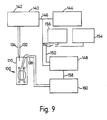
- the micropipette adaptor may further include a temperature feedback control system to maintain the sample at any desired temperature.
- the controls system may comprise an analog thermocouple gauge display driver, a digital panel meter, a comparator, a set point programmer, and a transistor heater driver.
- An external input may also be provided to allow programming of desired temperature variations over time.
- the adaptor is intended for use with very small micropipettes.
- a micro-pipette having a capillary tube with a lumen which is approximately half a millimeter (0.5 mm) in diameter can be effectively used with the adaptor disclosed herein. Even so, it will be appreciated by the skilled artisan that pipettes of various sizes may be used.
- the light wavelengths which are useful with the adaptor of the present invention need not necessarily be limited to the visual and ultraviolet ranges.
- the micropipette adaptor for spectrophotometers in accordance with the present invention is schematically shown in its operative environment and is designated 10.
- adaptor 10 is positioned for operative engagement with a spectrophotometer 12 and, specifically, is positioned between a light source 14 and a detector 16.
- an input beam of collimated light 18, having an intensity I o ( ⁇ ) is directed from the light source 14 toward the adaptor 10.
- adaptor 10 focuses the beam 18 of collimated light onto a micropipette 20 which is held by the adaptor 10.
- Adaptor 10 recollimates this light into an output light beam 22 which has an intensity of I t ( ⁇ ).
- the difference between I o ( ⁇ ) and I t ( ⁇ ) is indicative of the light absorption characteristics of the sample material held in micropipette 22 and, hence, is an indication of the composition of the sample material.
- adaptor 10 comprises a base member 24 which is sandwiched between a resilient member 26 and a resilient member 28. Respectively positioned against resilient members 26 and 28 and opposite base member 24 are holders 30 and 32.
- base member 24 and the holders 30 and 32 are made of a rigid material, such as black delrin plastic, while the resilient members 26 and 28 are made of an elastomeric material such as rubber or foam plastic.
- holder 30 is formed with an opening 34 as shown in Figure 2, and base member 24, resilient members 26, 28 and holder 32 are each formed with openings (not shown in Figure 2) which are aligned with opening 34 to establish a pathway 44 which allows light to pass through adaptor 10.
- base member 24 is formed with an opening 36 which, as indicated above, is positioned in alignment with opening 34 of holder 30. Further, base member 24 is shown formed with a hole 38 and a conical-shaped well 40 which are positioned across the opening 36 from each other. Specifically, hole 38 and conical well 40 respectively receive portion of micropipette 20 to hold the micro pipette 20 in place within and across the opening 36.
- a bushing 42 which is appropriately sized to receive micropipette 20, may be positioned in hole 38 to securely hold the micropipette on adaptor 10.
- the base member 24, together with its adjacent resilient members 26, 28 and the holders 30, 32 are all positioned with their respective openings aligned to create a pathway 44 through adaptor 10 along which light can shine.
- Figure 4 also shows that a lens 46 is positioned in pathway 44.
- lens 46 is attached or mounted on holder 30 by any means well known in the pertinent art, such as by gluing or solvent bonding. Further, lens 46 may be mounted on holder 30 by a frictional snap-in configuration or held thereon by setscrews (not shown).
- a lens 48 is attached or mounted on holder 32 and is positioned in the pathway 44 substantially as shown. For purposes of the present invention, it is preferable that the lenses 46, 48 be cylindrical.
- both cylindrical lens 46 and cylindrical lens 48 are made of a quartz material which permits use of either visible or ultraviolet light.
- input light beam, 18 can be precisely focused along the longitudinal axis of micropipette 20 by appropriately moving lens 46 in a direction along the pathway 44.
- the holder 30 on which lens 46 is mounted can be moved relative to the base member 24 on which micropipette 20 is mounted.
- input beam 18 will be focused into a line which is coincident with the centre of lumen 50 of micropipette 20. Following well known optical principles, light will emerge from micropipette 20 in a predictable fashion.
- cylindrical lens 48 (the receiving lens) can receive this emerging light and recollimate the light into the output light beam 22.
- lens 48 is mounted on holder 32 and is movable therewith relative to base member 24.
- the resilient members 26, 28 permit selective relative movement between base member 24 and the respective holders 30, 32.
- resilient members 26, 28 provide a support for maintaining the relative positions of these components when they are not being moved. It is possible, however, to completely eliminate the resilient members 26, 28. Manufacturing tolerances may suffice to properly position lens 46 on holder 30 without any further adjustment necessary to predictably focus light from the lens 46 along the interior lumen of micropipette 20.
- lens 48 may be mounted on holder 32 and positioned relative to base member 24 without the need for subsequent adjustments.
- FIG. 2 The mechanism for moving holders 30, 32 relative to base member 24 will be best seen by referring to Figure 2 wherein a screw 52 is shown extending through holder 30 and resilient member 26 for threadable connection with base member 24.
- the screws 54 and 56 likewise connect holder 30 with base member 24.
- screws (of which the screw 58 shown in phantom is exemplary) connect holder 32 with base member 24.
- the screws 52, 54, 56, 58 (and others not shown) can be individually rotated to independently move the holders 30, 32 relative to the base member 24. Consequently, this moves lenses 46, 48 relative to micropipette 20.
- movement of cylindrical lens 46 relative to micropipette 20 is accomplished to linearly focus input light beam 18 along the axis of micropipette 20. This increases the intensity I o ( ⁇ ) of the light which is incident on the sample material held in solution in lumen 50 of micropipette 20.
- movement of the cylindrical lens 48 relative to micropipette 20 is accomplished in order to recollimate the light which emerges from micropipette 20 for easier analysis of its intensity I t ( ⁇ ) by the detector 16.
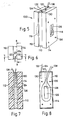
- adaptor 100 with temperature control which is generally designated 100.
- the adaptor 100 can generally be thought of as being used in place of adaptor 10 earlier described.
- adaptor 100 comprises a base member 110 sandwiched between a layer 112 and a layer 114.
- Base member 110 is made of a metal material which has high thermal conductivity and is easy to machine, such as copper, brass or aluminium.
- Layers 112, 114 are made of a different material, preferably nonmetal, such as delrin plastic, which are attached, such as by bonding, to each side of base member 110.
- the overall dimensions of the adaptor are such that it easily fits into a conventional sample holder slot of a commercially available spectrophotometer.
- the dimensions of layers 112 and 114 are approximately 12.5 millimeters in width, and approximately 38 millimeters in height.
- Base member 110 is slightly smaller in these dimensions, i.e. width and height, to prevent heat loss by contact of the base member 110 with the spectrophotometer.
- Lenses 116 and 118 are mounted in layers 112, 114 respectively, similar to mounting of lenses 46, 48 as earlier shown in Figure 4.
- Base member 110 has an orifice 120 in the top thereof.
- Orifice 120 is generally cylindrical and vertically oriented in base member 110 for receiving a micropipette containing sample material.
- Orifice 120 has a top 122 and walls 124 adapted to the shape of the micropipette.
- Base member 110 has a passageway 126, into which orifice 120 opens at orifice bottom 128.
- a micropipette which is inserted into orifice 120 then may extend through orifice 120 down into passageway 126. Then a collimated light beam, such as light beam 18 of Figure 4, can be passed through the sample.
- Base member 110 further includes a thermocouple 130 for measuring the temperature of base member 110.
- Thermocouple 130 is preferably a chromel-alumel thermocouple having wires 132, 134, which provide a temperature signal.
- Quartz lenses 118, 116 may be held in place with teflon tipped set screws inserted into set screw slots 146.
- a heater wire 138 is positioned and held between layer 112 and base member 110. It is routed around the perimeter of passageway 126 and is positioned against base member 110 being held firmly in place by layer 112.
- Heater wire 138 is preferably made of manganin, five thousandths (.005) inches in diameter. It will be appreciated, however, that tungsten or other resistive type wires are also appropriate for use as heater wire 138.
- Wire 138 is connected to a direct current power supply (not shown) for heating the wire, with typical values for the output of the supply being from five tenths to one (0.5 - 1.0) amperes at two to four (2-4) volts.
- the adaptor 100 serves at least two functions, namely maintaining the alignment between the sample and the focusing lenses, and further acting as a thermal reservoir.
- the base member 110 can be heated. This results in heating of the sample which is contained in a micropipette inserted in orifice 120 to the desired temperature. It has been found, for example, that use of four (4) watts of power may be used to obtain temperatures of a micropipette sample of eighty to one hundred degrees (80° - 100°C).
- thermocouple circuit 142 connected to thermocouple outputs 132, 134 from base member 110.
- the temperature output of thermocouple circuit 142 may be displayed by digital panel meter 144.
- output 146 of thermocouple circuit 142 is connected to a comparator 148. Also connected as an input to comparator 148 is a set point input signal line 150. The actual measured thermocouple output signal 146 is compared to the set point 150 at comparator 148.
- Set point signal information 150 can be alternately provided via switch 152 between a signal generated by a temperature set point potentiometer 154, or a signal generated by an analog temperature programming input device 156.
- Potentiometer 154 can be set by selecting a desired voltage which corresponds to the desired temperature at which the base member is to be maintained.
- the temperature programming input 156 provides an external input to provide a varying time/temperature wave form using an analog signal.
- the set point signal 150 can be programmed to maintain a constant temperature based on the potentiometer 154 setting, or specific temperatures for predetermined periods of time based on the programming input 156.
- the comparator Based upon the comparison between the set point signal 150 and the actual measured temperature signal 146, the comparator generates an "on" or “off” signal 158. This activates or deactivates a transistor heater driver 160. Driver 160 sends a current through heater wire 138 to heat up base member 110 when it is activated, or cuts off the current to allow base member 110 to cool down when it is deactivated.
- the absorption of light at 260 nanometers of DNA was observed and measured as it was being denatured at a temperature of between seventy and eighty degrees centigrade (70°-80°C). Since double-stranded DNA denatures at these temperatures, it was found that the absorption at 260 nanometers increased by approximately thirty-seven percent (37%).
- the melting temperature, or denaturing temperature is approximately eighty-three degrees (83°C).
- 70°C seventy degrees centigrade
- the adaptor 100 of the present invention took approximately ten minutes to reach eight degrees centigrade (80°C) from twenty-three degrees centigrade (23°C).
- the absorbance of the sample used namely Lambda DNA markers, at concentration of 675 micrograms per milliter, changed from 0.589 before denaturing to 0.737 after denaturing, or changed approximately twenty-five percent (25%).
Landscapes
- Health & Medical Sciences (AREA)
- Chemical & Material Sciences (AREA)
- Physics & Mathematics (AREA)
- General Physics & Mathematics (AREA)
- General Health & Medical Sciences (AREA)
- Biochemistry (AREA)
- Analytical Chemistry (AREA)
- Life Sciences & Earth Sciences (AREA)
- Immunology (AREA)
- Pathology (AREA)
- Clinical Laboratory Science (AREA)
- Chemical Kinetics & Catalysis (AREA)
- Engineering & Computer Science (AREA)
- Automation & Control Theory (AREA)
- Investigating Or Analysing Materials By Optical Means (AREA)
Applications Claiming Priority (4)
| Application Number | Priority Date | Filing Date | Title |
|---|---|---|---|
| US377476 | 1989-07-10 | ||
| US07/377,476 US4991958A (en) | 1989-07-10 | 1989-07-10 | Micropipette adaptor for spectrophotometers |
| US407539 | 1989-09-15 | ||
| US07/407,539 US5092674A (en) | 1989-07-10 | 1989-09-15 | Micropipette adaptor for spectrophotometers with temperature control |
Publications (2)
| Publication Number | Publication Date |
|---|---|
| EP0408182A2 true EP0408182A2 (fr) | 1991-01-16 |
| EP0408182A3 EP0408182A3 (en) | 1991-09-11 |
Family
ID=27007837
Family Applications (1)
| Application Number | Title | Priority Date | Filing Date |
|---|---|---|---|
| EP19900305699 Withdrawn EP0408182A3 (en) | 1989-07-10 | 1990-05-25 | Apparatus for use in analysing sample solutions |
Country Status (2)
| Country | Link |
|---|---|
| US (1) | US5092674A (fr) |
| EP (1) | EP0408182A3 (fr) |
Cited By (2)
| Publication number | Priority date | Publication date | Assignee | Title |
|---|---|---|---|---|
| DE4102336A1 (de) * | 1991-01-26 | 1992-08-06 | Behringwerke Ag | Pipettiereinrichtung mit temperierbarem pipettierroehrchen |
| WO1998021594A3 (fr) * | 1996-11-12 | 1998-08-13 | Beckman Instruments Inc | Analyseur chimique automatique avec ensemble cuve de reaction chauffee ameliore |
Families Citing this family (8)
| Publication number | Priority date | Publication date | Assignee | Title |
|---|---|---|---|---|
| US5241363A (en) * | 1989-07-10 | 1993-08-31 | General Atomics | Micropipette adaptor with temperature control for PCR amplification |
| US5265957A (en) * | 1992-08-11 | 1993-11-30 | Texas Instruments Incorporated | Wireless temperature calibration device and method |
| JPH07146295A (ja) * | 1993-11-19 | 1995-06-06 | Kyoto Daiichi Kagaku:Kk | ラマン分光測定による免疫分析方法及び装置 |
| US5363199A (en) * | 1994-01-14 | 1994-11-08 | Victor Bruce H | Smoke opacity detector |
| DE19535046C2 (de) * | 1995-09-21 | 1998-04-16 | Eppendorf Geraetebau Netheler | Handgerät zum Pipettieren und photometrischen Messen von Proben |
| US5846492A (en) * | 1997-03-11 | 1998-12-08 | Johnson & Johnson Clinical Diagnostics, Inc. | Sample quality measurement and/or analyte measurement in the dispensing tip of an analyzer |
| US8663575B2 (en) * | 2005-08-19 | 2014-03-04 | Canadian Blood Services | Sample holder for dynamic light scattering |
| US7842247B2 (en) | 2005-08-19 | 2010-11-30 | Canadian Blood Services | Sample holder for dynamic light scattering |
Family Cites Families (7)
| Publication number | Priority date | Publication date | Assignee | Title |
|---|---|---|---|---|
| US3877817A (en) * | 1973-07-02 | 1975-04-15 | Wilson Ralston | Temperature stabilized photometer for kinetic analysis |
| US4006990A (en) * | 1974-07-22 | 1977-02-08 | Varian Associates | Convergent light illuminated flow cell for liquid chromatography |
| DE2844805A1 (de) * | 1978-10-11 | 1980-04-24 | Lange Gmbh Dr Bruno | Vorrichtung zur thermostatisierung von proben in photometern |
| US4440497A (en) * | 1982-05-17 | 1984-04-03 | Corning Glass Works | Combination absorbance fluorescence aspirating thermal cuvette |
| DE3305982C2 (de) * | 1983-02-21 | 1986-04-30 | INTERATOM GmbH, 5060 Bergisch Gladbach | Heizbare Infrarot-Gasküvette für hohen Druck |
| AT384488B (de) * | 1985-03-18 | 1987-11-25 | Avl Verbrennungskraft Messtech | Kuevette zur messung von dampf- bzw. gasspektren |
| US4935875A (en) * | 1987-12-02 | 1990-06-19 | Data Chem, Inc. | Chemical analyzer |
-
1989
- 1989-09-15 US US07/407,539 patent/US5092674A/en not_active Expired - Lifetime
-
1990
- 1990-05-25 EP EP19900305699 patent/EP0408182A3/en not_active Withdrawn
Cited By (3)
| Publication number | Priority date | Publication date | Assignee | Title |
|---|---|---|---|---|
| DE4102336A1 (de) * | 1991-01-26 | 1992-08-06 | Behringwerke Ag | Pipettiereinrichtung mit temperierbarem pipettierroehrchen |
| WO1998021594A3 (fr) * | 1996-11-12 | 1998-08-13 | Beckman Instruments Inc | Analyseur chimique automatique avec ensemble cuve de reaction chauffee ameliore |
| US5863506A (en) * | 1996-11-12 | 1999-01-26 | Beckman Instruments, Inc. | Automatic chemistry analyzer with improved heated reaction cup assembly |
Also Published As
| Publication number | Publication date |
|---|---|
| EP0408182A3 (en) | 1991-09-11 |
| US5092674A (en) | 1992-03-03 |
Similar Documents
| Publication | Publication Date | Title |
|---|---|---|
| US5241363A (en) | Micropipette adaptor with temperature control for PCR amplification | |
| EP0408181B1 (fr) | Adaptateur pour le maintien d'une micropipette | |
| US5557398A (en) | Photometric device | |
| US6986837B2 (en) | Microfluidic controller and detector system with self-calibration | |
| US5092674A (en) | Micropipette adaptor for spectrophotometers with temperature control | |
| US9557269B2 (en) | Instrument and method for the automated thermal treatment of liquid samples | |
| KR100840949B1 (ko) | 다중 채널 광학적 검출 시스템 | |
| AU2006200021B2 (en) | Ultra high throughput microfluidic analytical systems and methods | |
| US20020154299A1 (en) | Liquid photometer using surface tension to contain sample | |
| EP1024355B1 (fr) | Dispositif du type scanner pour la détection de la fluorescence d'une pluralité d'échantillons. | |
| US7005053B2 (en) | Multi-capillary electrophoresis apparatus | |
| JPH03163352A (ja) | 高性能毛管電気泳動装置用統合温度制御/整合装置 | |
| WO2008044329A1 (fr) | Spectrophotomètre | |
| JP2006515672A (ja) | 精密制御型サーモスタット | |
| US20050158209A1 (en) | Microcomponent connection system | |
| WO2007113895A1 (fr) | Instrument de mesure optique pour échantillon liquide à l'état de trace | |
| JPH03107742A (ja) | 温度制御付き分光測定器用マイクロピペットアダプタ | |
| JP7546141B2 (ja) | 光源及び自動分析装置 | |
| DE2651356C2 (fr) | ||
| EP1950553B1 (fr) | Photomètre pour la mesure d'un échantillon liquide contenu par tension de surface | |
| US12605714B2 (en) | Method and device for mixing and temperature-controlling liquid media | |
| HK1168621B (en) | Instrument and method for the automated thermal treatment of liquid samples |
Legal Events
| Date | Code | Title | Description |
|---|---|---|---|
| PUAI | Public reference made under article 153(3) epc to a published international application that has entered the european phase |
Free format text: ORIGINAL CODE: 0009012 |
|
| AK | Designated contracting states |
Kind code of ref document: A2 Designated state(s): AT BE CH DE FR GB IT LI |
|
| PUAL | Search report despatched |
Free format text: ORIGINAL CODE: 0009013 |
|
| AK | Designated contracting states |
Kind code of ref document: A3 Designated state(s): AT BE CH DE FR GB IT LI |
|
| 17P | Request for examination filed |
Effective date: 19920228 |
|
| STAA | Information on the status of an ep patent application or granted ep patent |
Free format text: STATUS: THE APPLICATION IS DEEMED TO BE WITHDRAWN |
|
| 18D | Application deemed to be withdrawn |
Effective date: 19941201 |