EP0408431B1 - Verfahren zur Speicherung und Rückausgabe eines von einem Prozessor auszuführenden modifizierbaren Programmes - Google Patents
Verfahren zur Speicherung und Rückausgabe eines von einem Prozessor auszuführenden modifizierbaren Programmes Download PDFInfo
- Publication number
- EP0408431B1 EP0408431B1 EP19900401959 EP90401959A EP0408431B1 EP 0408431 B1 EP0408431 B1 EP 0408431B1 EP 19900401959 EP19900401959 EP 19900401959 EP 90401959 A EP90401959 A EP 90401959A EP 0408431 B1 EP0408431 B1 EP 0408431B1
- Authority
- EP
- European Patent Office
- Prior art keywords
- parts
- address
- memorisation
- program
- memory
- Prior art date
- Legal status (The legal status is an assumption and is not a legal conclusion. Google has not performed a legal analysis and makes no representation as to the accuracy of the status listed.)
- Expired - Lifetime
Links
Images

Classifications
-
- G—PHYSICS
- G05—CONTROLLING; REGULATING
- G05B—CONTROL OR REGULATING SYSTEMS IN GENERAL; FUNCTIONAL ELEMENTS OF SUCH SYSTEMS; MONITORING OR TESTING ARRANGEMENTS FOR SUCH SYSTEMS OR ELEMENTS
- G05B19/00—Program-control systems
- G05B19/02—Program-control systems electric
- G05B19/04—Program control other than numerical control, i.e. in sequence controllers or logic controllers
- G05B19/042—Program control other than numerical control, i.e. in sequence controllers or logic controllers using digital processors
Definitions
- the present invention relates to a method of memorizing and restoring a program to be executed by a processor to control the selective and sequential starting of a plurality of organs of an automatic device.
- the invention is particularly applicable in the field of household appliances, for washing machines for laundry or dishes. These devices are provided with a programmer which controls the progress of the washing program to be carried out by the device, a program also chosen by the user from a plurality of available programs.
- the manufacturer of programmers therefore faces the problem of choosing the type of memory in which the program will be stored.
- the most economical solution consists in choosing a read only memory, for example a so-called "masked" ROM memory, because it is obtained by masking at the request of a prediffused circuit.
- the stored program can no longer be modified.
- it is often necessary to modify the memorized program because one realizes afterwards that a correction is necessary, or because one wants to respond to desires from the manufacturer of household appliances using the programmer.
- the present invention aims to overcome the above drawbacks by providing a method of storing and restoring a modifiable program in a memory which remains at a reasonable cost price.
- the method of the invention makes it possible to very quickly put into circulation a programmer provided with a modified program, without having to wait for the production of new masked memories.
- the modifications are memorized in the reprogrammable memory in the order of the increasing addresses of the read-only memory, and, before any reading of the content of an address for memorizing the read-only memory, in order to find out whether the content of this address has been modified, the reprogrammable memory is scanned until either this storage address or an address to be modified of higher rank is encountered.
- This characteristic makes it possible to have a particularly reduced reprogrammable memory size.
- the executable code of this new task is stored in the reprogrammable memory.
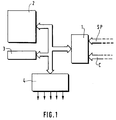
- a programmer for a washing machine here comprises a microprocessor 1 connected by a bus to a masked ROM memory 2, to an EEPROM memory 3 and to a supply circuit 4 of the various power members. of the washing machine.
- washing machine power units include for example a drum drive motor, a heating element for heating the water in the tank, a drain pump, and so on. .
- the washing machine is also provided on the one hand with a device for selecting, by the user of the machine, the washing program, device not shown, and on the other hand with a certain number of sensors, also not -represented, for example to measure the amount of water, its temperature, and so on.
- the selection device delivers to the microprocessor 1 a program selection signal SP.
- the sensors deliver to the microprocessor 1 a set of signals denoted C.
- the signals SP and C are assumed, for the sake of simplicity, delivered in a digital form directly usable by the microprocessor 1.
- the power supply circuit 4 comprises either a set of relays controlled by the microprocessor 1, each relay allowing the supply of electrical energy to a power member and therefore switching it on, or a set of contacts having the same function, and mechanically actuated by a block of cams driven by a motor controlled by microprocessor 1, that is to say both.
- the programmer which has just been described operates as follows.
- the microprocessor 1 reads from memories 2 and 3 a series of instructions corresponding to the selected program. It executes these instructions which correspond mainly to the control of the sequential and selective starting, via the circuit 4, of the power members, taking into account, where appropriate the information delivered by the sensors, so for example to stop heating the water when it has reached a determined temperature, or to take into account a possible overload in linen, and so on.
- each step or sub-step is associated with a particular task to be performed by the microprocessor.
- one step corresponds to rinsing, and if this rinsing must include two water replenishments, the step comprises six sub-steps which are successively: filling, beating, emptying, filling, beating, and emptying.
- the unmodified program is broken down into a set of hierarchical parts, each part being associated with a task to be executed by the microprocessor.
- the original program is broken down into a series of first parts, each of the first parts into a series of second parts, each of the second parts into a series of third parts, and so on until the last parts.
- first parts are the steps and the second parts are the sub-steps, and, for the sake of simplicity, these second parts are also the last in the hierarchy.
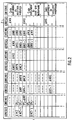
- the executable code of each of the different sub-steps is stored in the ROM 2 memory at a storage address which is assigned to this sub-step. For example, if the executable code of the sub-step relating to emptying requires four memory boxes, this code is stored in a group of four memory boxes, and the AMV address of this group is assigned to the sub-step relating to emptying.
- the AMV address of the group of four boxes is here the address of the first of these four boxes, the microprocessor 1 being arranged, in a known manner, to read in block the content of the four boxes from the address of the first boxes.
- a group of six AMB address boxes assigned to the beat sub step is also shown in FIG. 2, which contains the executable code relating to the control of the machine's drum beats by the microprocessor 1, as well as a group of three AMR address boxes assigned to the filling sub-step, which contains the executable code relating to the command to fill the tank by microprocessor 1.
- composition of this step is also stored for each of the different steps, that is to say the list of storage addresses assigned to the sub-steps of the sequence into which this step has been broken down.
- the following list of storage addresses is stored: AMR, AMB, AMV, AMR, AMB and AMV
- FIG. 2 also shows an AMPR address box assigned to the prewash step, which determines the composition of this step, as well as an AMCH address box assigned to the sub step of heating, which determines the composition of this step.
- the list of storage addresses assigned to the steps of the sequence in which the program has been broken down is then stored.
- the following list would be stored: AMPR, AMCH, ... and AMRI
- the initial address for memorizing the program step list here the address AMY
- the address AMY is stored in a box assigned to the program.
- the value taken by the signal SP when the user chooses this program is also stored in this box assigned to the program. For example, if the user has the choice between five programs, the signal SP is likely to take five values: SP1, SP2, ... and SP5
- the value SP3 is stored with the address AMY in the box assigned to this third program. It is then convenient to assign following the five programs five boxes whose addresses follow one another, for example: AMZ, AMZ + 1, ... and AMZ + 4
- each program is decomposed into a sequence of steps and each step into a sequence of sub-steps.
- it is within the capacity of a person skilled in the art to transpose the method described in the case where the hierarchical decomposition comprises a large number of different hierarchical levels.
- the modification relating to the content is then memorized at this address AMY +1.
- a coded word MOTMOD always the same, which will be interpreted by the microprocessor 1 as representative of a start of modification, is stored in the first box of the memory 3.
- a code word MOTSUP is linked, linked to the type of modification to be carried out.
- the stored code word corresponds to the non-execution of the content of the box to be modified.
- the storage address is stored, that is to say the address of the box, the content of which is to be modified.
- this address is AMY + 1.
- the modification relating to the content is then passed to the address AMX + 1.
- the code word MOTMOD is stored in the fourth box to indicate the start of a new modification, then in the fifth box a code word MOTINS which corresponds to the insertion of additional content before the content of the box to be modified.
- the sixth box we memorize the storage address to be modified, here the address AMX + 1, and in the seventh box the content to be inserted, here the address AMB, so that two successive sub-steps of beats are carried out.
- the restoring of the modified program stored as described above is done by successive readings of the contents of the storage addresses of the ROM 2 memory, by looking in the EEPROM memory 3, for each storage address, a possible modification in order to take it into account. This is the reason why, as has been pointed out, the modifications are stored in the EEPROM memory 3 in the order of the increasing addresses of the ROM memory 2.
- the microprocessor 1 before any reading of the content of an address of memorization of the ROM memory 2, the microprocessor 1, to find out whether the content of this address has been modified, scans the reprogrammable memory 3 until it encounters either this memorization address or an address to be modified of higher rank .
- the microprocessor 1 when it receives the signal SP3 begins first by systematically scanning the sequence of addresses AMZ to AMZ + 4 of the memory ROM 2 by comparing the values of the signal SP contained therein with the value SP3. It thus determines the storage address assigned to the chosen program, in this case AMY. It goes to this address AMY, which is the initial address of the list of steps that make up the third program chosen,. To read the content stored there, namely AMPR. AMPR is the address assigned to the prewash step. The microprocessor 1 goes to this address to read the content stored therein, which is the initial address of the list of sub-steps which make up the prewash step.
- the microprocessor 1 then scans this list of sub-steps and reads each time the executable code which it executes so that the prewash step is accomplished. Naturally, each time it passes through a storage address of the ROM memory 2, the microprocessor 1 searches the EEPROM memory 3 for a possible modification. In the example described here, none of the storage addresses of the ROM memory 2 encountered up to this stage of the program had its content to be modified.
- the microprocessor 1 goes to the address AMY + 1 which follows the initial address AMY of the step list making up the third program. As this address appears in the EEPROM memory 3, the microprocessor 1 takes account of the modification of the content of this box AMY + 1, modification which consists in deleting the corresponding step, which is here the heating step.
- the microprocessor 1 therefore does not take account of the content stored at the address AMY + 1 and goes to the address AMY + 2, and and so on.
- the microprocessor 1 will pass through the address AMX + 1 of the ROM memory 2, it will take account of the modification to insert an additional sub-step of beats at the first sub-step of beats of the no rinsing.
Landscapes
- Physics & Mathematics (AREA)
- General Physics & Mathematics (AREA)
- Engineering & Computer Science (AREA)
- Automation & Control Theory (AREA)
- Information Retrieval, Db Structures And Fs Structures Therefor (AREA)
- Stored Programmes (AREA)
- Read Only Memory (AREA)
Claims (4)
- Verfahren zur Speicherung und Rückausgabe eines von einem Prozessor (1) auszuführenden modifizierbaren Programms, um die selektive und sequenzielle Inbetriebnahme einer Mehrzahl von Organen einer automatischen Vorrichtung zu steuern, ein Verfahren, dadurch gekennzeichnet, daß:- man das nicht modifizierte Programm in einen Satz hierarchisch angeordneter Teile zerlegt, wobei jeder Teil mit einer von dem Prozessor (1) auszuführenden Aufgabe assoziiert ist,- man in einem Festspeicher (2) einerseits den auszuführenden Code von jedem der verschiedenen letzten Teile in der Hierarchie und andererseits die Zusammensetzung (AMX, AMR-AMB-AMV-AMR-AMB-AMV, AMY, AMPR-AMCH-...-AMRI) jedes der anderen Teile speichert,- man in einem wiederprogrammierbaren Speicher (3) die Speicheradressen (AMY+1, AMX+1) des Festspeichers (2), dessen Inhalt in Antwort auf eine Modifikation des Programms zu modifizieren ist, sowie die entsprechenden Modifikationen (MOTSUP, MOTINS, AMB) speichert, und- man das gespeicherte modifizierte Programm wieder ausgibt, indem man nacheinander die Inhalte der Speicheradressen des Festspeichers (2) liest und in dem wiederprogrammierbaren Speicher (3) für jede Speicheradresse eine eventuelle Modifikation ihres Inhalts sucht, um diese zu berücksichtigen.
- Verfahren nach Anspruch 1, bei dem:- man das nicht modifizierte Programm in eine Folge erster Teile, jeden dieser ersten Teile in eine Folge zweiter Teile, jeden dieser zweiten Teile in eine Folge dritter Teile u.s.w. bis zum Erhalt von Folgen letzter Teile zerlegt, und- man in dem Festspeicher (2):- den auszuführenden Code von jedem der verschiedenen letzten Teile bei einer Speicheradresse (AMV, AMB, AMR), die diesem letzten Teil zugeordnet ist, speichert,- man für jeden der verschiedenen vorletzten Teile einerseits die Liste (AMR-AMB-AMV-AMR-AMB-AMV) der Speicheradressen, die den letzten Teilen der Folge zugeordnet sind, in welche diese vorletzten Teile zerlegt worden sind, und andererseits die Anfangsspeicheradresse (AMX) dieser Liste bei einer Speicheradresse (AMRI), welche diesem vorletzten Teil zugeordnet ist, speichert,- und so fort, bis man für jeden der verschiedenen ersten Teile einerseits die Liste (AMR-AMB-AMV-AMR-AMB-AMV) der Speicheradressen, die den zweiten Teilen der Folge zugeordnet sind, in welche diese ersten Teile zerlegt worden sind, und andererseits die Anfangsspeicheradresse (AMX) dieser Liste bei einer Speicheradresse (AMRI), welche diesem ersten Teil zugeordnet ist, speichert und- man die Liste (AMPR-AMCH-...-AMRI) der Speicheradressen, die den ersten Teilen der Folge zugeordnet sind, in welche das Programm zerlegt worden ist, speichert.
- Verfahren nach einem der Ansprüche 1 oder 2, bei dem man die Modifikationen in dem wiederprogrammierbaren Speicher (3) in der Reihenfolge der steigenden Adressen des Festspeichers (2) speichert und man vor jeglichem Lesen des Inhalts einer Speicheradresse des Festspeichers (2), um zu untersuchen, ob der Inhalt dieser Adresse verändert worden ist, den wiederprogrammierbaren Speicher (3) abfragt, bis man entweder auf diese Speicheradresse oder auf eine zu modifizierende Adresse von höherem Rang trifft.
- Verfahren nach einem der Ansprüche 1 bis 3, bei dem man in Antwort auf eine Modifikation des Programms, welche die Ausführung einer Aufgabe impliziert, die nicht in dem Festspeicher (2) gespeichert worden ist, in dem wiederprogrammierbaren Speicher (3) entweder den auszuführenden Code dieser neuen Aufgabe oder ihre Zusammensetzung speichert, wenn sie in Teile zerlegbar ist, die bereits in dem Festspeicher (2) gespeichert sind.
Applications Claiming Priority (2)
| Application Number | Priority Date | Filing Date | Title |
|---|---|---|---|
| FR8909300 | 1989-07-11 | ||
| FR8909300A FR2649808B1 (fr) | 1989-07-11 | 1989-07-11 | Procede de memorisation et de restitution d'un programme modifiable a executer par un processeur |
Publications (2)
| Publication Number | Publication Date |
|---|---|
| EP0408431A1 EP0408431A1 (de) | 1991-01-16 |
| EP0408431B1 true EP0408431B1 (de) | 1994-06-15 |
Family
ID=9383661
Family Applications (1)
| Application Number | Title | Priority Date | Filing Date |
|---|---|---|---|
| EP19900401959 Expired - Lifetime EP0408431B1 (de) | 1989-07-11 | 1990-07-06 | Verfahren zur Speicherung und Rückausgabe eines von einem Prozessor auszuführenden modifizierbaren Programmes |
Country Status (5)
| Country | Link |
|---|---|
| EP (1) | EP0408431B1 (de) |
| BR (1) | BR8905470A (de) |
| DE (1) | DE69009871T2 (de) |
| ES (1) | ES2057470T3 (de) |
| FR (1) | FR2649808B1 (de) |
Families Citing this family (2)
| Publication number | Priority date | Publication date | Assignee | Title |
|---|---|---|---|---|
| ATE149704T1 (de) * | 1992-08-27 | 1997-03-15 | Siemens Ag | Steuergerät, insbesondere für die kraftfahrzeugtechnik |
| DE19814446A1 (de) * | 1998-03-31 | 1999-10-07 | Bosch Siemens Hausgeraete | Programmgesteuertes Haushaltsgerät |
Family Cites Families (4)
| Publication number | Priority date | Publication date | Assignee | Title |
|---|---|---|---|---|
| CA1116729A (en) * | 1978-07-28 | 1982-01-19 | Stephen E. Heeger | Sequence controller with microprocessor |
| JPS5699504A (en) * | 1980-01-14 | 1981-08-10 | Mitsubishi Electric Corp | Electric control circuit |
| DE3419559A1 (de) * | 1984-05-25 | 1985-11-28 | Robert Bosch Gmbh, 7000 Stuttgart | Steuervorrichtung fuer funktionen im kraftfahrzeug |
| DE3723024A1 (de) * | 1987-07-11 | 1989-01-19 | Bosch Gmbh Robert | Verfahren und vorrichtung zur steuerung von technischen anlagen und maschinen |
-
1989
- 1989-07-11 FR FR8909300A patent/FR2649808B1/fr not_active Expired - Lifetime
- 1989-10-26 BR BR8905470A patent/BR8905470A/pt unknown
-
1990
- 1990-07-06 EP EP19900401959 patent/EP0408431B1/de not_active Expired - Lifetime
- 1990-07-06 DE DE1990609871 patent/DE69009871T2/de not_active Expired - Fee Related
- 1990-07-06 ES ES90401959T patent/ES2057470T3/es not_active Expired - Lifetime
Also Published As
| Publication number | Publication date |
|---|---|
| DE69009871T2 (de) | 1995-02-02 |
| FR2649808B1 (fr) | 1991-10-25 |
| EP0408431A1 (de) | 1991-01-16 |
| FR2649808A1 (fr) | 1991-01-18 |
| BR8905470A (pt) | 1991-04-23 |
| ES2057470T3 (es) | 1994-10-16 |
| DE69009871D1 (de) | 1994-07-21 |
Similar Documents
| Publication | Publication Date | Title |
|---|---|---|
| EP2063328B1 (de) | Elektronischer funktionssteuerungsschaltkreis von peripheriegeräten einer uhr | |
| FR2633742A1 (fr) | Micro-ordinateur contenu dans une carte a circuit integre | |
| EP0408431B1 (de) | Verfahren zur Speicherung und Rückausgabe eines von einem Prozessor auszuführenden modifizierbaren Programmes | |
| EP0684551B1 (de) | Elektronischer Schaltkreis und Verfahren für die Verwendung mit einem Koprozessor | |
| FR2749422A1 (fr) | Procede pour determiner le temps compris entre l'arret du moteur d'un vehicule automobile et son redemarrage | |
| EP0742516A2 (de) | Vorrichtung zur Inbetriebsnahme einer Halbleiterschaltung | |
| FR3055992A1 (fr) | Gestion d'index dans une memoire flash | |
| FR2761183A1 (fr) | Dispositif de commande d'un actionneur telecommande | |
| FR2616935A1 (fr) | Dispositif d'adressage sur bus | |
| EP0017516A1 (de) | Elektronische Programmiervorrichtung für ein elektrisches Haushaltsgerät und deren Anwendungen | |
| CA2117159C (fr) | Outil de mise au point d'un systeme d'exploitation | |
| EP0228329A1 (de) | Einen schnellen stabilen Speicher bildende elektronische Vorrichtung | |
| EP0542599B1 (de) | Waschmaschinen- oder Trocknerprogrammschaltwerk mit zwei verschiedenartigen Zeitbasen | |
| FR2755259A1 (fr) | Procede de mise en correspondance d'un boitier de commande de groupe avec un boitier de commande et/ou un boitier d'action et/ou un boitier de mesure | |
| FR2601471A1 (fr) | Programmateur de commande de lave-linge a microprocesseur et composant electromecanique | |
| EP0703584B1 (de) | Adressen-Dekodierverfahren für einen integrierten Speicher und Speicherschaltung zur Anwendung eines solchen Verfahrens | |
| EP0253710B1 (de) | Programmierteil der Steuerung einer Waschmaschine mit Mikroprozessor und elektromechanischer Komponente | |
| FR2534044A1 (fr) | Dispositif de triage integre pour des mots de donnees ayant la forme d'un composant et processeur de traitement de donnees integre pourvu d'un tel dispositif de triage cointegre | |
| EP2130097B1 (de) | Verfahren zum zugreifen einen nichtflüchtigen speicher für eine uhr | |
| EP0055159B1 (de) | Elektronische Programmsteuereinrichtung für eine Waschmaschine und Maschine mit einer solchen Programmsteuereinrichtung | |
| EP0504052A1 (de) | Elektrisches Haushaltsgerät mit Programmschalteinrichtung mit elektromechanischer Zeitbasis und mit elektronischer Zeitbasis | |
| EP0252817B1 (de) | Steuerungsvorrichtung für Waschmaschine oder Wäschetrockner mit automatischer Ermittlung der Wäschemenge | |
| EP0081873A1 (de) | Datenverarbeitungssystem das die Verwendung des selben Lösch- und Programmierspeichers erlaubt um Instruktionen und Daten sowohl zu lesen, als zu schreiben | |
| FR2547435A1 (fr) | Procede pour entrer un programme de commutation dans un minuteur electronique, et dispositif pour la mise en oeuvre du procede | |
| EP0225813B1 (de) | Steuervorrichtung des Antriebsmotors einer Waschmaschinentrommel |
Legal Events
| Date | Code | Title | Description |
|---|---|---|---|
| PUAI | Public reference made under article 153(3) epc to a published international application that has entered the european phase |
Free format text: ORIGINAL CODE: 0009012 |
|
| AK | Designated contracting states |
Kind code of ref document: A1 Designated state(s): DE ES FR GB IT |
|
| 17P | Request for examination filed |
Effective date: 19910712 |
|
| 17Q | First examination report despatched |
Effective date: 19931011 |
|
| RAP1 | Party data changed (applicant data changed or rights of an application transferred) |
Owner name: CROUZET ELECTROMENAGER |
|
| GRAA | (expected) grant |
Free format text: ORIGINAL CODE: 0009210 |
|
| AK | Designated contracting states |
Kind code of ref document: B1 Designated state(s): DE ES FR GB IT |
|
| REF | Corresponds to: |
Ref document number: 69009871 Country of ref document: DE Date of ref document: 19940721 |
|
| ITF | It: translation for a ep patent filed | ||
| GBT | Gb: translation of ep patent filed (gb section 77(6)(a)/1977) |
Effective date: 19940826 |
|
| REG | Reference to a national code |
Ref country code: ES Ref legal event code: FG2A Ref document number: 2057470 Country of ref document: ES Kind code of ref document: T3 |
|
| PLBE | No opposition filed within time limit |
Free format text: ORIGINAL CODE: 0009261 |
|
| STAA | Information on the status of an ep patent application or granted ep patent |
Free format text: STATUS: NO OPPOSITION FILED WITHIN TIME LIMIT |
|
| 26N | No opposition filed | ||
| REG | Reference to a national code |
Ref country code: FR Ref legal event code: CD |
|
| PGFP | Annual fee paid to national office [announced via postgrant information from national office to epo] |
Ref country code: GB Payment date: 19960627 Year of fee payment: 7 |
|
| PG25 | Lapsed in a contracting state [announced via postgrant information from national office to epo] |
Ref country code: GB Free format text: LAPSE BECAUSE OF NON-PAYMENT OF DUE FEES Effective date: 19970706 |
|
| GBPC | Gb: european patent ceased through non-payment of renewal fee |
Effective date: 19970706 |
|
| PGFP | Annual fee paid to national office [announced via postgrant information from national office to epo] |
Ref country code: DE Payment date: 20000711 Year of fee payment: 11 |
|
| PGFP | Annual fee paid to national office [announced via postgrant information from national office to epo] |
Ref country code: ES Payment date: 20000717 Year of fee payment: 11 |
|
| PGFP | Annual fee paid to national office [announced via postgrant information from national office to epo] |
Ref country code: FR Payment date: 20000727 Year of fee payment: 11 |
|
| PG25 | Lapsed in a contracting state [announced via postgrant information from national office to epo] |
Ref country code: ES Free format text: LAPSE BECAUSE OF NON-PAYMENT OF DUE FEES Effective date: 20010707 |
|
| PG25 | Lapsed in a contracting state [announced via postgrant information from national office to epo] |
Ref country code: FR Free format text: LAPSE BECAUSE OF NON-PAYMENT OF DUE FEES Effective date: 20020329 |
|
| PG25 | Lapsed in a contracting state [announced via postgrant information from national office to epo] |
Ref country code: DE Free format text: LAPSE BECAUSE OF NON-PAYMENT OF DUE FEES Effective date: 20020501 |
|
| REG | Reference to a national code |
Ref country code: FR Ref legal event code: ST |
|
| REG | Reference to a national code |
Ref country code: ES Ref legal event code: FD2A Effective date: 20020810 |
|
| PG25 | Lapsed in a contracting state [announced via postgrant information from national office to epo] |
Ref country code: IT Free format text: LAPSE BECAUSE OF NON-PAYMENT OF DUE FEES;WARNING: LAPSES OF ITALIAN PATENTS WITH EFFECTIVE DATE BEFORE 2007 MAY HAVE OCCURRED AT ANY TIME BEFORE 2007. THE CORRECT EFFECTIVE DATE MAY BE DIFFERENT FROM THE ONE RECORDED. Effective date: 20050706 |