EP0703584B1 - Adressen-Dekodierverfahren für einen integrierten Speicher und Speicherschaltung zur Anwendung eines solchen Verfahrens - Google Patents
Adressen-Dekodierverfahren für einen integrierten Speicher und Speicherschaltung zur Anwendung eines solchen Verfahrens Download PDFInfo
- Publication number
- EP0703584B1 EP0703584B1 EP95402054A EP95402054A EP0703584B1 EP 0703584 B1 EP0703584 B1 EP 0703584B1 EP 95402054 A EP95402054 A EP 95402054A EP 95402054 A EP95402054 A EP 95402054A EP 0703584 B1 EP0703584 B1 EP 0703584B1
- Authority
- EP
- European Patent Office
- Prior art keywords
- row
- circuit
- address
- voltage
- signal
- Prior art date
- Legal status (The legal status is an assumption and is not a legal conclusion. Google has not performed a legal analysis and makes no representation as to the accuracy of the status listed.)
- Expired - Lifetime
Links
- 230000015654 memory Effects 0.000 title claims description 43
- 238000000034 method Methods 0.000 title claims description 8
- 238000001914 filtration Methods 0.000 claims description 28
- 238000001514 detection method Methods 0.000 claims description 27
- 230000008859 change Effects 0.000 claims description 18
- 230000007704 transition Effects 0.000 claims description 18
- 239000011159 matrix material Substances 0.000 claims description 4
- 230000004044 response Effects 0.000 claims description 2
- 230000005764 inhibitory process Effects 0.000 description 9
- 238000010586 diagram Methods 0.000 description 4
- 238000002955 isolation Methods 0.000 description 4
- 238000010200 validation analysis Methods 0.000 description 3
- 230000000903 blocking effect Effects 0.000 description 2
- 239000003990 capacitor Substances 0.000 description 2
- 208000037516 chromosome inversion disease Diseases 0.000 description 2
- 238000005516 engineering process Methods 0.000 description 2
- 230000002401 inhibitory effect Effects 0.000 description 2
- 150000003839 salts Chemical class 0.000 description 2
- 241001296405 Tiso Species 0.000 description 1
- 230000004913 activation Effects 0.000 description 1
- 230000001174 ascending effect Effects 0.000 description 1
- 238000013475 authorization Methods 0.000 description 1
- 230000007423 decrease Effects 0.000 description 1
- 230000003111 delayed effect Effects 0.000 description 1
- 230000000694 effects Effects 0.000 description 1
- 238000009413 insulation Methods 0.000 description 1
- 230000010354 integration Effects 0.000 description 1
- 244000045947 parasite Species 0.000 description 1
- 230000008569 process Effects 0.000 description 1
- 230000002441 reversible effect Effects 0.000 description 1
- 238000012163 sequencing technique Methods 0.000 description 1
Images

Classifications
-
- G—PHYSICS
- G11—INFORMATION STORAGE
- G11C—STATIC STORES
- G11C8/00—Arrangements for selecting an address in a digital store
- G11C8/08—Word line control circuits, e.g. drivers, boosters, pull-up circuits, pull-down circuits, precharging circuits, for word lines
-
- G—PHYSICS
- G11—INFORMATION STORAGE
- G11C—STATIC STORES
- G11C8/00—Arrangements for selecting an address in a digital store
- G11C8/10—Decoders
-
- G—PHYSICS
- G11—INFORMATION STORAGE
- G11C—STATIC STORES
- G11C8/00—Arrangements for selecting an address in a digital store
- G11C8/18—Address timing or clocking circuits; Address control signal generation or management, e.g. for row address strobe [RAS] or column address strobe [CAS] signals
Definitions
- the invention relates to a decoding method. address in an integrated circuit memory, and a corresponding memory.
- a voltage multiplier is particularly characterized by its number of transistors and of capacities, its internal resistance and its ability to deliver a given current for a given time and at an output voltage as constant as possible: in other words, for a given output load, the given time after which the output voltage goes start to fall apart. This last characteristic is particularly sensitive, hindering the use of multipliers in circuits with high consumption of common, unless using an expensive structure in surface and very current consuming (number and characteristics of the transistors and capacities).
- Asynchronous memory circuits that is to say not receiving an external clock signal, can receive data all the time: this data is immediately taken into account and the corresponding operations carried out.
- the addresses which appear are immediately decoded: the access time of these memories is thus very efficient.
- low-voltage asynchronous memories they are therefore able to take into account a new address very quickly: the corresponding rows and columns of the memory are selected and the control voltages applied.
- reading which is generally the default access mode, the reading voltage supplied by the multiplier is applied to the addressed row.
- the memory addresses are provided by a bus external which can be noisy (parasites) or shared with other integrated circuits. If the decoder of the memory takes into account all address changes on the external bus, we select at very fast rates close to different rows (which are lines capacitive) to which the voltage from the multiplier is successively applied: the multiplier no longer has the time required to recharge between two row selections and collapses: the tension in multiplier output dangerously decreases to zero before gradually ascending, the recharge time of the multiplier being particularly long, of the order of a hundred nanoseconds.
- the invention proposes to solve this problem of reading voltage of the rows incompatible with memory access time.
- the invention relates to a method of decoding the addresses of a memory.
- a circuit which isolates the address decoder for a determined period T to each change of address detection. Of this way we reduce current consumption.
- the lines are preloaded word at zero volts for a predetermined period after which a word line is selected by a row decoder.
- an inhibit command is generated for a duration d1 applied to the voltage switching circuit. So if we have successive changes of address important, these changes will be ignored, to avoid remember that the last change, inhibiting the decoder going up to the duration after the last change of address. By however, the decoder can process any stable address on the address bus for a period greater than d1.
- the invention also relates to a circuit memory integrated including an address decoder for select memory cells according to claim 2.
- the memory includes a filtering circuit for address changes to inhibit said decoder address for a fixed period of time after detection of a change of address.
- the invention applies to the filtering of row addresses of the memory.
- the decoder comprising a row decoder and a column decoder
- the filter circuit emits an applied filter signal to the row decoder.
- the row decoder includes an address decoding circuit for selecting a row and deselect the others, and a circuit of voltage switching on the rows, it includes in addition to an inhibition circuit which receives as input the filter signal, to inhibit the voltage switching. So decoding the address is performed continuously, only the switching of the read voltage on the row is inhibited. Of this way, the memory access time is practically unchanged, the decoding of the address being slower than voltage switching on the rows. We choose the order inhibition duration the maximum time required to decode the address (worst case).
- Detection circuits address transition or transition on signals circuit control or validation are conventionally used in asynchronous circuits, to generate the internal clocks necessary for sequencing of operations to be executed. Conversely, when there is no address transition, they are used generate a circuit standby signal, allowing a very reduced consumption of the circuit.
- the operating principle of a detection circuit address is to compare the current state of a signal entry to the previously memorized state, to memorize the current state if it is different from the previous state memorized and generate an output pulse.
- Pulse generation circuits are also used in these same asynchronous circuits, at output of the address transition detection circuit, for generate internal clocks.
- the matrix memory plane 1 is made up of columns connected to cell and row drains connected to the cell grids.
- the cells are performed in the example in grid MOS technology floating. But the invention is not limited to this example.
- a decoder 2 thus comprises a DR row decoder and DC column decoder.
- An address presented by an external BA address bus is stored in an address register 3 connected in output to the memory address bus, marked ADR.
- the internal address bus ADR is divided into two parts: row address applied as input on the DR row decoder and column address applied as input to the DC column decoder, coded in the example respectively on the bits address a0-a7 and a8-a15.
- the row decoder directly controls the memory rows: it applies a voltage of Vr command on the addressed row, and puts the others rows to ground (Vss).
- the control voltage can to be a tension of reading or writing.
- the column decoder controls a circuit door 4 which applies the control voltage (Vc) to the addressed columns and mass (Vss) to others and connect the columns to the input or data output, grouped under reference 5 and connected to the external BD data input / output bus from memory.
- Vc control voltage
- Vss mass
- Column and row control voltages are for example from a circuit 6 for generating voltages, receiving as input the voltages Vcc and Vss. It includes a 6m multiplier circuit receiving as input the low operating voltage Vcc, for example of the order of 3 volts and which provides a reading voltage of the order of 5 volts for the row control voltage Vr.
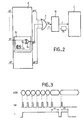
- the memory architecture comprises in addition a circuit 7 for filtering addresses.
- This circuit is connected as input to the address bus internal ADR and outputs a signal filtering f applied as input to decoder 2 of the memory.
- this filtering circuit makes it possible to filter too fast address transitions, by inhibiting decoder 2 for a period d1 after the detection of any change of address on the bus ADR internal address.
- this circuit 7 thus includes a circuit 8 for detecting a transition on each of the address bits, a circuit logic OR gate 9 to deliver information from change of address as soon as at least one transition on an address bit is detected and a circuit 10 generator of a pulse of duration d1 on the signal of filtering f.
- the address transition detection circuit 8 includes a detection stage per address bit to take into account: each stage 8i receives as input address bit noted ai and outputs a detection signal correspondent at output noted ati.
- An 8i stage includes for example a flip-flop Di and an exclusive OR gate Xi.
- Input D of the flip-flop receives the address bit ai and the Q output of the flip-flop delivers a Qi signal.
- the exclusive OR gate Xi receives on an input the bit of address ai and on another input, the signal Qi.
- the Exit from the exclusive OR gate delivers the signal ati detection and this signal is looped back to the input rocker clock (H).
- the operating principle is simple. For detect an address transition, there is reason to memorize the previous high or low logic state, what allows the Di flip-flop which stores the previous state on its Q output.
- the state of the corresponding Qi signal is permanently compared in the exclusive OR gate to the current state of the address bit ai.
- the ati output of the door Xi is at a first logical level (0, in example) as long as the signals ai and Qi have the same logical level. As soon as the signals ai and Qi have different logic states, the output of gate Xi goes to a second logical level (1 in the example).
- the transition from the first level (0) to the second level (1) which corresponds to the detection of a transition on the address bit ai causes the state to be memorized current of bit ai which is applied to input D of the rocking.
- the signals ai and Qi then again have the same logic state and the output of gate Xi goes back at the first logical level (0). Detection of a address transition on bit ai therefore generates a very short pulse on the ati output.
- Transition detection signals ati address are applied at the circuit entry OR gate 9, to output an Sd signal of change of address detection corresponding to a transition on at least one address bit.
- This signal Sd is applied to circuit 10 for generating a pulse, which generates a pulse of fixed duration d1 in response to the change detection pulse address.
- a pulse generation circuit can include a load control inverter and discharge of a capacitor and a reset circuit form of the signal supplied by the capacitor. Others more complex achievements are possible. These commonly used circuits are well known to the skilled person.
- the fixed-term pulse d1 emitted on the filtering signal f inhibits the decoder 2 during this time.
- the addresses on the bus are therefore decoded ADR address for at least this period d1.
- the timing diagram shown in Figure 3 illustrates the filter circuit operation. Every address transition on the ADR address bus a change of address detection pulse is emitted at the Sd output of the OR gate. In the example, we have represented 6 successive changes of address quickly followed by two address changes succeeding more slowly, these last two addresses remaining stable for a period greater than d1.
- the corresponding filter signal f therefore comprises a first long pulse, which begins on the first address detection pulse and stops after the last duration d1 ordered by the seventh change of address detection pulse. Then another pulse is issued of duration d1, on the detection of the next change of address, the address remaining stable thereafter.
- the filter circuit preferably receives only the row address bits, a0-a7 in the example (figure 2).
- the decoder performs on the one hand the row address decoding for select the corresponding row and secondly controls the application of the necessary voltages on the rows: control voltage Vr on the row selected and zero voltage (Vss) on the others rows, which we will say are they, deselected.
- the decoder therefore includes a circuit pure decoding and a switching circuit of voltage.
- the filtering signal is then advantageously used (in an inhibition circuit) to inhibit the voltage switching circuit of the row decoder: so address decoding is performed continuously, in parallel with the detection of change of address and only the switching of voltages is inhibited by the filter signal. Yes meanwhile, the selection of the row disappears, the voltages will not be applied.
- the row decoder comprises thus advantageously for each row a circuit inhibition receiving as input the filtering signal f and a row selection control signal, and outputting a filtered control command signal row selection applied to a circuit voltage switching (Vr) on the selected row.
- the block address is coded on 4 bits, a5-a7, the row address is coded on 5 bits, a0-a4.
- the row decoder includes k address decoders of blocks delivering block enable signals. For each block address decoder, we have 32 decoders row address. Each address decoder of row issues a selection command signal and a row deselection control signal corresponding.
- the row decoder also includes, associated with each block, 32 voltage switching circuits on a row. Each circuit is validated by the signals of the address decoder of the associated block and receives as input the selection command signal and the decoder deselection control signal address of the row to which it is connected in output and on which it switches the voltage Vr supplied by voltage generation circuit 6 (selection) or the voltage Vss (deselection).
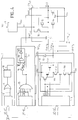
- the NAND gate with two isolated outputs is explained in CMOS technology in FIG. 4.
- the isolation is obtained in known manner by inserting an isolation transistor Tiso between a series network RN of transistors N and a parallel network RP of transistors P.
- An output comn 2 is taken between the output of the parallel network and the isolation transistor, the other output comp 2 is taken between the isolation transistor and the input of the serial network (the output comp2 is the one that controls the switching of the voltage Vr, as will be seen below, hence the need for insulation between the two outputs).
- the decoder DECr 4 of address row 4 of block B 2 comprises a first circuit with inversion stage 14 and NAND gate 15 for decoding the address (4) of this group.
- the NAND gate also receives as input the signal VB 2 for decoding validation delivered by the decoder of the associated block DECB 2 .
- the NAND gate is followed by an inverter 16 which outputs a sel signal 4 , 2 of row selection command.
- a deselection control signal dsel 4'2 of the address row 4 of block B 2 is delivered directly by the output of the NAND gate.
- the row decoder further comprises an inhibition circuit 17 receiving as input the inverse of the filtering signal f supplied by the filtering circuit 7 according to the invention and the sel row selector control signal 4 , 2 , to provide a selection control signal which is filtered according to the method of the invention, noted fsel 4.2 .
- This inhibition circuit includes in the example a first NAND 18 gate followed in series by a inverter 19.
- the selection control signal will be at logical "1", that is to say at approximately 3 volts at low logic voltage and the deselection control signal dsel 4'2 will be at logic "0". Otherwise, it is the signal dsel 4'2 which will be at "1” and the signal salt 4.2 which will be at "0".
- the detection of a change of address on the bus generates a filtering signal f.
- the filtered selection command signal fsel 4.2 at the output of the inhibition circuit 17 according to the invention is therefore forced to logic "0" level for at least a period d1 upon detection of a change of address, in accordance with the timing diagram of FIG. 2. In fact, it is kept at zero as long as there is not a stable address for a duration greater than d1. Then, it takes the logic level of the sel sel sel command signal 4.2 : If row 4 of block B 2 is effectively addressed, it therefore goes to logic level "1".
- control signals comp 2 ' comn 2' are active in the low state, noted “0” and corresponding at the zero logic voltage Vss and the signals fsel 4.2 and dsel 4'2 are active in the high state, noted “1” and corresponding to the high logic voltage, Vcc (3 volts in the example).
- the signal comn 2 (“0") applied to the gate of the transistor Tn blocks it, while the selection transistor Ts is made passing by the signal fsel 4.2 ("1") : the transistor Tp of the inverter is therefore conducting and thus switches the voltage Vr on the row W 4.2 .
- row 4 of block B 2 is deselected, it is the signal dsel 4'2 which becomes active ("1") and makes the deselection transistor Tds conductive, the transistors Ts and Tp being blocked. The row is then brought to Vss.
- the command signals comn 2 , comp 2 are both at "1"
- the filtered selection command signal fsel 4.2 is at "0”
- the deselection command signal dsel 4'2 is at "1”. Consequently, the transistors Ts and Tp are blocked, while the transistors Tn and Tds are on, which has the effect of maintaining (if the row was already deselected) or carrying (if the row was previously selected) the deselected row to ground.
- the blocking transistor Tb is on if the row is brought to ground: it thus puts the voltage Vr on the gate of transistor Tp, which keeps blocked.
- the filtered selection command signal fsel 4.2 is maintained at "0" by the inhibition circuit 17 as long as an address is not stable within the meaning of the invention (it is to say present for at least a period d1), the transistor Tp is blocked, preventing any current call on the voltage line Vr: The multiplier is therefore not requested until an address is stable on the bus.
- the embodiment of the decoder which has just been explained in relation to FIG. 4 and more generally the inhibition of the selection command (salt 4.2 ) makes it possible to delay only the switching of the voltage Vr to the selected row. In particular, decoding and deselection are not delayed.
- the determined duration d1 corresponds to the maximum time required to decode the address, so that the filtering according to the invention influences the less possible on memory access time.
- the filtering method according to the invention makes it possible to make the operation of memories compatible low voltage asynchronous with the use of a internal voltage multiplier, and its mode of preferred embodiment advantageously makes it possible not to penalize memory access time too much.
Landscapes
- Engineering & Computer Science (AREA)
- Microelectronics & Electronic Packaging (AREA)
- Dram (AREA)
- Static Random-Access Memory (AREA)
- Read Only Memory (AREA)
Claims (5)
- Verfahren zum Dekodieren von Adressen in einem matrixförmig in Zeilen und Spalten unterteilten Speicher mit einem Multiplizierer (6m) für eine Versorgungsspannung Vcc des Schaltkreises zum Ausgeben einer Steuerspannung (Vr), wobei der Zeilendekodierer einen Dekodierungsschaltkreis zum Auswählen einer adressierten Zeile und zum Nichtauswählen der anderen Zeilen und einen Spannungskommutatorschaltkreis zum Anlegen der Steuerspannung (Vr) an die ausgewählte Zeile und der Masse an die anderen nicht ausgewählten Zeilen umfaßt, dadurch gekennzeichnet, daß ein Inhibierungsbefehl (f) bei jeder erfaßten Adreßänderung auf dem Adreßbus erzeugt wird, wobei der Inhibierungsbefehl an den Spannungskommutatorschaltkreis während einer vorgegebenen Dauer angelegt wird, die der Zeit entspricht, die maximal für den Dekodierungsschaltkreis zum Auswählen einer adressierten Zeile notwendig ist.
- Integrierter Speicherschaltkreis, der matrixförmig in Zeilen und Spalten unterteilt ist und einen Multiplizierer (6m) für eine Versorgungsspannung Vcc des Schaltkreises zum Ausgeben einer Steuerspannung (Vr), einen Zeilendekodierer mit einem Adreßdekodierungsschaltkreis zum Auswählen einer Zeile und zum Nichtauswählen der anderen und einen Spannungskommutatorschaltkreis zum Anlegen der Steuerspannung (Vr) an die ausgewählte Zeile und der Masse an die anderen nichtausgewählten Zeilen umfaßt, dadurch gekennzeichnet, daß der Speicher außerdem einen Schaltkreis zum Erfassen von Adreßänderungen (7) zum Erzeugen eines Filtersignals (f) während einer vorgegebenen Dauer umfaßt, wobei der Zeilendokodierer außerdem einen Inhibierungsschaltkreis (17) zum Inhibieren des Spannungskommutatorschaltkreises während einer vorgegebenen Dauer, die der Zeit entspricht, die maximal notwendig ist für den Dekodierungsschaltkreis, um eine adressierte Zeile auszuwählen, umfaßt.
- Integrierter Speicherschaltkreis nach Anspruch 2, wobei der Schaltkreis zur Dekodierung der Adresse für jede Zeile eine Dekodierungsstufe zum Ausgeben eines Steuersignals zur Auswahl der Zeile und eines Steuersignals zur Nichtauswahl der Zeile umfaßt und der Kommutatorschaltkreis für jede Zeile eine Kommutatorstufe zum Kommutieren der Steuerspannung (Vr) oder der Masse (Vss) bei der Zeile je nach logischem Zustand der Steuersignale umfaßt, dadurch gekennzeichnet, daß der Schaltkreis zur Dekodierung für jede Dekodierungsstufe einen Inhibierungsschaltkreis (17) umfaßt, der das Filtersignal f und das Steuersignal zur Auswahl der entsprechenden Zeile (sel4,2) empfängt, um am Ausgang ein gefiltertes Steuersignal zur Auswahl der Zeile (fsel4,2) auszugeben, das mit dem entsprechenden Steuersignal zur Nichtauswahl (dsel4,2) an die Kommutatorstufe angelegt wird.
- Integrierter Speicherschaltkreis nach Anspruch 3, dadurch gekennzeichnet, daß der Zeilendekodierer für jede Zeile einen Inhibierungsschaltkreis (17) umfaßt, der am Eingang das Filtersignal (f) und ein Steuersignal zur Auswahl der Zeile empfängt, um ein gefiltertes Steuersignal zur Auswahl (fsel4,2) an einen Schaltkreis zur Kommutierung einer Auswahlspannung (Vr) bei der Zeile auszugeben.
- Integrierter Speicherschaltkreis nach einem der Ansprüche 3 oder 4, dadurch gekennzeichnet, daß der Schaltkreis (7) zur Filterung einen Schaltkreis (8) zur Erfassung von Adreßübergängen aufweist, der am Eingang die Adreßbits (ai) empfängt und am Ausgang Erfassungsignale zum entsprechenden Bitübergang (ati) ausgibt, wobei ein ODER-Gatter (9) am Eingang die Übergangserfassungssignale (ati) empfängt, um ein Impulssignal (Sd) der Erfassung einer Adreßänderung auszugeben, und ein Impulsgeneratorschaltkreis (10) am Eingang das Erfassungsimpulssignal (Sd) empfängt und am Ausgang das Filtersignal (f) ausgibt, um am Ausgang (f) einen Impuls mit derselben Dauer wie die vorgegebene Dauer (d1) auf einen Impuls auf das Erfassungsimpulssignal abzugeben.
Applications Claiming Priority (2)
| Application Number | Priority Date | Filing Date | Title |
|---|---|---|---|
| FR9410833 | 1994-09-12 | ||
| FR9410833A FR2724483B1 (fr) | 1994-09-12 | 1994-09-12 | Procede de decodage d'adresse dans une memoire en circuit integre et circuit memoire mettant en oeuvre le procede |
Publications (2)
| Publication Number | Publication Date |
|---|---|
| EP0703584A1 EP0703584A1 (de) | 1996-03-27 |
| EP0703584B1 true EP0703584B1 (de) | 1998-04-22 |
Family
ID=9466839
Family Applications (1)
| Application Number | Title | Priority Date | Filing Date |
|---|---|---|---|
| EP95402054A Expired - Lifetime EP0703584B1 (de) | 1994-09-12 | 1995-09-11 | Adressen-Dekodierverfahren für einen integrierten Speicher und Speicherschaltung zur Anwendung eines solchen Verfahrens |
Country Status (5)
| Country | Link |
|---|---|
| US (1) | US5742546A (de) |
| EP (1) | EP0703584B1 (de) |
| JP (1) | JP3124713B2 (de) |
| DE (1) | DE69502155T2 (de) |
| FR (1) | FR2724483B1 (de) |
Families Citing this family (9)
| Publication number | Priority date | Publication date | Assignee | Title |
|---|---|---|---|---|
| US5762193A (en) | 1996-10-23 | 1998-06-09 | Illinois Tool Works Inc. | Clip-on sheet for container carrier |
| FR2762708B1 (fr) * | 1997-04-29 | 1999-06-04 | Sgs Thomson Microelectronics | Procede de commande d'une cellule memoire et memoire non volatile programmable une seule fois en technologie cmos |
| JP3604548B2 (ja) | 1997-11-28 | 2004-12-22 | 株式会社ルネサステクノロジ | アドレス一致検出装置、通信制御システム及びアドレス一致検出方法 |
| US20050035429A1 (en) * | 2003-08-15 | 2005-02-17 | Yeh Chih Chieh | Programmable eraseless memory |
| US7768865B2 (en) * | 2008-04-21 | 2010-08-03 | Vikram Bollu | Address decoder and/or access line driver and method for memory devices |
| US8363766B2 (en) * | 2008-06-06 | 2013-01-29 | Freescale Semiconductor, Inc. | Device and method of synchronizing signals |
| GB2472015B (en) * | 2009-07-21 | 2011-06-15 | Andrew Gordon Cameron Bruce | Cranks powered by each individual leg, ankle and foot bicycle pedal cranks |
| US8477555B2 (en) * | 2011-06-30 | 2013-07-02 | Intel Corporation | Deselect drivers for a memory array |
| CN119512992B (zh) * | 2024-10-28 | 2026-01-23 | 湖南开鸿智谷数字产业发展有限公司 | 一种电路板通讯地址分配系统、方法、装置及存储介质 |
Family Cites Families (11)
| Publication number | Priority date | Publication date | Assignee | Title |
|---|---|---|---|---|
| JPS53117342A (en) * | 1977-03-23 | 1978-10-13 | Nec Corp | Memory unit |
| JPS5828676B2 (ja) * | 1979-11-29 | 1983-06-17 | 富士通株式会社 | デコ−ダ回路 |
| JPS5963094A (ja) * | 1982-10-04 | 1984-04-10 | Fujitsu Ltd | メモリ装置 |
| JPS63290159A (ja) | 1987-05-20 | 1988-11-28 | Matsushita Electric Ind Co Ltd | 昇圧回路 |
| FR2619939B1 (fr) * | 1987-09-01 | 1989-12-08 | Thomson Semiconducteurs | Circuit de detection de transitions d'adresses |
| JP2728679B2 (ja) * | 1988-06-27 | 1998-03-18 | 株式会社東芝 | 不揮発性半導体メモリ装置 |
| JPH0373495A (ja) * | 1989-02-15 | 1991-03-28 | Ricoh Co Ltd | 半導体メモリ装置 |
| JPH04195894A (ja) * | 1990-11-27 | 1992-07-15 | Nec Ic Microcomput Syst Ltd | 非同期式ram |
| DE69317927T2 (de) * | 1992-02-28 | 1998-11-19 | Sony Corp | Halbleiterspeicheranordnung mit einer Adressübergangsabfühlschaltung |
| JP2734315B2 (ja) * | 1992-09-24 | 1998-03-30 | 日本電気株式会社 | 半導体メモリ装置 |
| JPH06236686A (ja) * | 1993-01-22 | 1994-08-23 | Nec Corp | 半導体装置 |
-
1994
- 1994-09-12 FR FR9410833A patent/FR2724483B1/fr not_active Expired - Fee Related
-
1995
- 1995-09-11 DE DE69502155T patent/DE69502155T2/de not_active Expired - Fee Related
- 1995-09-11 US US08/526,500 patent/US5742546A/en not_active Expired - Lifetime
- 1995-09-11 EP EP95402054A patent/EP0703584B1/de not_active Expired - Lifetime
- 1995-09-12 JP JP07259289A patent/JP3124713B2/ja not_active Expired - Fee Related
Also Published As
| Publication number | Publication date |
|---|---|
| DE69502155T2 (de) | 1998-08-13 |
| FR2724483B1 (fr) | 1996-12-27 |
| EP0703584A1 (de) | 1996-03-27 |
| FR2724483A1 (fr) | 1996-03-15 |
| JP3124713B2 (ja) | 2001-01-15 |
| US5742546A (en) | 1998-04-21 |
| JPH0887890A (ja) | 1996-04-02 |
| DE69502155D1 (de) | 1998-05-28 |
Similar Documents
| Publication | Publication Date | Title |
|---|---|---|
| EP0318363B1 (de) | Verfahren zum Testen von Zellen von elektrisch programmierbaren Speichern und entsprechende integrierte Schaltung | |
| FR2689294A1 (fr) | Circuit de pompage de tension à utiliser dans des dispositifs de mémoire à semi-conducteur. | |
| FR2690751A1 (fr) | Procédé et circuit de détection de fuites de courant dans une ligne de bit. | |
| EP0703584B1 (de) | Adressen-Dekodierverfahren für einen integrierten Speicher und Speicherschaltung zur Anwendung eines solchen Verfahrens | |
| FR2665973A1 (fr) | Circuit d'optimisation d'effacement automatique pour une memoire a semiconducteur programmable et effacable electriquement et procede s'y rapportant. | |
| FR2606199A1 (fr) | Circuit integre du type circuit logique comportant une memoire non volatile programmable electriquement | |
| EP0902949A1 (de) | Elektrisch lösch-und programmierbarer nichtflüchtiger speicher, geschützt gegen stromunterbrechungen | |
| FR2801419A1 (fr) | Procede et dispositif de lecture pour memoire en circuit integre | |
| FR2956228A1 (fr) | Procede d'ecriture a chevauchement dans une memoire non remanente | |
| EP1220101A1 (de) | Verfahren und Anordnung um Schutz gegen integrierte Schnittstellenpiraterie zu gewähren | |
| EP1365418B1 (de) | Elektrisch lösch- und programmierbare Speicher mit interner Versorgungsspannungsregelungsvorrichtung | |
| EP0660331B1 (de) | Zeilendekodierer für einen Speicher mit niedriger Versorgungsspannung | |
| EP0267091B1 (de) | Elektrisch programmierbarer Festwertspeicher | |
| FR2838840A1 (fr) | Comparateur de tension d'alimentation | |
| EP0678875B1 (de) | Verfahren und Schaltungen zur Löschung eines Speichers | |
| FR2750240A1 (fr) | Generateur de reference de tension | |
| EP0606796B1 (de) | Verfahren zur uniformen Programmierung eines elektrisch programmierbaren Speichers und Speicher zur Durchführung des Verfahrens | |
| FR2729020A1 (fr) | Circuit de survoltage utilise dans un etat actif d'un dispositif de memoire a semi-conducteurs | |
| EP0913836B1 (de) | Schaltungsanordnung zur Erzeugung einer Spannung zum Programmieren oder Löschen von Halbleiter-Speicherzellen mit schwebendem Gate | |
| FR2810438A1 (fr) | Circuit de detection d'usure | |
| EP0478440B1 (de) | Vorladeschaltung um einen Speicher zu lesen | |
| WO1999013474A1 (fr) | Procede d'enregistrement d'un mot binaire au moyen de cellules memoire du type programmable et effaçable electriquement | |
| EP2777045B1 (de) | Schaltungsanordnung zur vorspannung der invertern-wannen zur reduzierung des energieverbrauchs eines srams | |
| FR2773012A1 (fr) | Dispositif a pompe de charges negatives | |
| FR2798767A1 (fr) | Procede d'ecriture en mode page d'une memoire non volatile electriquement programmable/effacable et architecture correspondante |
Legal Events
| Date | Code | Title | Description |
|---|---|---|---|
| PUAI | Public reference made under article 153(3) epc to a published international application that has entered the european phase |
Free format text: ORIGINAL CODE: 0009012 |
|
| AK | Designated contracting states |
Kind code of ref document: A1 Designated state(s): DE FR GB IT |
|
| 17P | Request for examination filed |
Effective date: 19960314 |
|
| 17Q | First examination report despatched |
Effective date: 19960702 |
|
| GRAG | Despatch of communication of intention to grant |
Free format text: ORIGINAL CODE: EPIDOS AGRA |
|
| GRAG | Despatch of communication of intention to grant |
Free format text: ORIGINAL CODE: EPIDOS AGRA |
|
| GRAG | Despatch of communication of intention to grant |
Free format text: ORIGINAL CODE: EPIDOS AGRA |
|
| GRAH | Despatch of communication of intention to grant a patent |
Free format text: ORIGINAL CODE: EPIDOS IGRA |
|
| GRAH | Despatch of communication of intention to grant a patent |
Free format text: ORIGINAL CODE: EPIDOS IGRA |
|
| GRAA | (expected) grant |
Free format text: ORIGINAL CODE: 0009210 |
|
| AK | Designated contracting states |
Kind code of ref document: B1 Designated state(s): DE FR GB IT |
|
| GBT | Gb: translation of ep patent filed (gb section 77(6)(a)/1977) |
Effective date: 19980424 |
|
| ITF | It: translation for a ep patent filed | ||
| REF | Corresponds to: |
Ref document number: 69502155 Country of ref document: DE Date of ref document: 19980528 |
|
| RAP4 | Party data changed (patent owner data changed or rights of a patent transferred) |
Owner name: STMICROELECTRONICS S.A. |
|
| PLBE | No opposition filed within time limit |
Free format text: ORIGINAL CODE: 0009261 |
|
| STAA | Information on the status of an ep patent application or granted ep patent |
Free format text: STATUS: NO OPPOSITION FILED WITHIN TIME LIMIT |
|
| 26N | No opposition filed | ||
| REG | Reference to a national code |
Ref country code: GB Ref legal event code: IF02 |
|
| PGFP | Annual fee paid to national office [announced via postgrant information from national office to epo] |
Ref country code: GB Payment date: 20040908 Year of fee payment: 10 |
|
| PGFP | Annual fee paid to national office [announced via postgrant information from national office to epo] |
Ref country code: DE Payment date: 20040909 Year of fee payment: 10 |
|
| PGFP | Annual fee paid to national office [announced via postgrant information from national office to epo] |
Ref country code: FR Payment date: 20050823 Year of fee payment: 11 |
|
| PG25 | Lapsed in a contracting state [announced via postgrant information from national office to epo] |
Ref country code: IT Free format text: LAPSE BECAUSE OF NON-PAYMENT OF DUE FEES Effective date: 20050911 Ref country code: GB Free format text: LAPSE BECAUSE OF NON-PAYMENT OF DUE FEES Effective date: 20050911 |
|
| PG25 | Lapsed in a contracting state [announced via postgrant information from national office to epo] |
Ref country code: DE Free format text: LAPSE BECAUSE OF NON-PAYMENT OF DUE FEES Effective date: 20060401 |
|
| GBPC | Gb: european patent ceased through non-payment of renewal fee |
Effective date: 20050911 |
|
| REG | Reference to a national code |
Ref country code: FR Ref legal event code: ST Effective date: 20070531 |
|
| PG25 | Lapsed in a contracting state [announced via postgrant information from national office to epo] |
Ref country code: FR Free format text: LAPSE BECAUSE OF NON-PAYMENT OF DUE FEES Effective date: 20061002 |