EP0410206B1 - Fluoran-Verbindungen, kristalline Toluol-Addukte davon, Aufzeichnungsmaterial damit und Verfahren zu deren Herstellung - Google Patents
Fluoran-Verbindungen, kristalline Toluol-Addukte davon, Aufzeichnungsmaterial damit und Verfahren zu deren Herstellung Download PDFInfo
- Publication number
- EP0410206B1 EP0410206B1 EP90113209A EP90113209A EP0410206B1 EP 0410206 B1 EP0410206 B1 EP 0410206B1 EP 90113209 A EP90113209 A EP 90113209A EP 90113209 A EP90113209 A EP 90113209A EP 0410206 B1 EP0410206 B1 EP 0410206B1
- Authority
- EP
- European Patent Office
- Prior art keywords
- compound
- crystalline
- formula
- type
- crystals
- Prior art date
- Legal status (The legal status is an assumption and is not a legal conclusion. Google has not performed a legal analysis and makes no representation as to the accuracy of the status listed.)
- Expired - Lifetime
Links
- 0 Cc(cc(c1c2)Oc3cc(N(C)C4CCCCC4)ccc3C11O*c3c1cccc3)c2Nc1ccccc1 Chemical compound Cc(cc(c1c2)Oc3cc(N(C)C4CCCCC4)ccc3C11O*c3c1cccc3)c2Nc1ccccc1 0.000 description 3
Images


Classifications
-
- B—PERFORMING OPERATIONS; TRANSPORTING
- B41—PRINTING; LINING MACHINES; TYPEWRITERS; STAMPS
- B41M—PRINTING, DUPLICATING, MARKING, OR COPYING PROCESSES; COLOUR PRINTING
- B41M5/00—Duplicating or marking methods; Sheet materials for use therein
- B41M5/124—Duplicating or marking methods; Sheet materials for use therein using pressure to make a masked colour visible, e.g. to make a coloured support visible, to create an opaque or transparent pattern, or to form colour by uniting colour-forming components
- B41M5/132—Chemical colour-forming components; Additives or binders therefor
- B41M5/136—Organic colour formers, e.g. leuco dyes
- B41M5/145—Organic colour formers, e.g. leuco dyes with a lactone or lactam ring
- B41M5/1455—Organic colour formers, e.g. leuco dyes with a lactone or lactam ring characterised by fluoran compounds
-
- B—PERFORMING OPERATIONS; TRANSPORTING
- B41—PRINTING; LINING MACHINES; TYPEWRITERS; STAMPS
- B41M—PRINTING, DUPLICATING, MARKING, OR COPYING PROCESSES; COLOUR PRINTING
- B41M5/00—Duplicating or marking methods; Sheet materials for use therein
- B41M5/26—Thermography ; Marking by high energetic means, e.g. laser otherwise than by burning, and characterised by the material used
- B41M5/30—Thermography ; Marking by high energetic means, e.g. laser otherwise than by burning, and characterised by the material used using chemical colour formers
- B41M5/323—Organic colour formers, e.g. leuco dyes
- B41M5/327—Organic colour formers, e.g. leuco dyes with a lactone or lactam ring
- B41M5/3275—Fluoran compounds
-
- C—CHEMISTRY; METALLURGY
- C07—ORGANIC CHEMISTRY
- C07D—HETEROCYCLIC COMPOUNDS
- C07D493/00—Heterocyclic compounds containing oxygen atoms as the only ring hetero atoms in the condensed system
- C07D493/02—Heterocyclic compounds containing oxygen atoms as the only ring hetero atoms in the condensed system in which the condensed system contains two hetero rings
- C07D493/10—Spiro-condensed systems
Definitions
- the present invention relates to novel fluoran compounds which are useful as chromogenic compounds in recording materials such as pressure-sensitive and heat-sensitive recording materials. More particularly, the invention relates to crystal of a fluoran compounds in crystalline form, to crystalline toluene adducts thereof, to a process for the preparation of these compounds and to recording materials comprising these compounds.
- Pressure-sensitive recording, heat-sensitive recording and electroheat-sensitive recording have conventionally been used as systems for recording transfered information through the mediation of external energy, such as pressure, heat or electricity, by utilizing a color reaction between a colorless or pale colored electron donative compound (chromogenic compound) and an organic or inorganic electron acceptor (developer).
- external energy such as pressure, heat or electricity
- fluoran compounds have widely been used as the chromogenic compound.
- the compound has the defect that the compound itself colors gray to dark gray when mixed with a developer such as bisphenol A and provide only a gray to dark gray colored (soiled) paper by applying the mixture to a paper.
- One object of the present invention is to provide novel fluoran compounds capable of meeting the current performance demands as a chromogenic compound for use in the recording materials.
- Another object of the present invention is to provide crystalline forms of novel fluoran compounds having further improved functional properties when used in recording materials.
- a further object of the present invention is to provide a process for the preparation of the novel fluoran compounds and specific crystalline forms of these compounds.
- Still another object of the present invention is to provide recording materials comprising a novel fluoran compound of this invention, especially those comprising a specific crystal form of the compound.
- the present invention relates to novel fluoran compounds represented by Formula (I): wherein R1 and R2 are different groups selected from cyclohexyl, n-butyl and isobutyl.
- this invention relates to a process for the preparation of the fluoran compounds of this invention by reacting a benzoic acid derivative represented by Formula (II): wherein R1 and R2 are the same as in Formula (I), with a diphenylamine derivative represented by Formula (III): wherein R3 is a lower alkyl group.
- this invention relates to the fluoran compounds of this invention in crystalline form, which crystals are characterized by a specific X-ray diffraction diagram and is represented by Formula (I); to crystalline solvated adducts, e.g., toluene adducts, of the fluoran compounds of this invention, which crystals are characterized by a specific X-ray diffraction diagram; and to recording materials comprising a fluoran compound or specific crystal or crystalline toluene adducts of a fluoran compound of this invention.
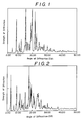
- Figure 1 is an X-ray diffraction diagram of a Type I crystal of the compound represented by Formula (I-1);
- Figure 2 is an X-ray diffraction diagram of a Type II crystal of the crystalline toluene adduct of the compound represented by Formula (I -1);
- Figure 3 is an X-ray diffraction diagram of a Type III crystal of the compound represented by Formula (I -2),
- Figure 4 is an X-ray diffraction diagram of a Type IV crystal of the crystalline toluene adduct of the compound represented by Formula (I -2),
- Figure 5 is an X-ray diffraction diagram of a Type V crystal of the compound represented by Formula (I -3),
- Figure 6 is an X-ray diffraction diagram of a Type VI crystal of a crystalline toluene adduct of the compound represented by formula (I -3),
- Figure 7 is an X-ray diffraction diagram of a Type VII crystal of another crystalline
- axis of abscissa indicates angle of diffraction (2 ⁇ ) and axis of ordinate indicates strength of diffraction.
- Figure 8 illustrates color density characteristics to temperature change on the surface of heat-sensitive recording paper prepared using the Type I crystalline form of the compound represented by Formula (I -1), the Type II crystalline form of the crystalline toluene adduct of the compound represented by Formula (I -1); and a known fluoran compound.
- curve (a) illustrates color density characteristic of Type 1 crystal
- curve (a′) that of Type II crystal
- curve (b) that of the compound of Formula (A)
- curve (c) that of the compound of Formula (B)
- curve (d) that of the compound of Formula (C), respectively.
- Figure 9 illustrates color density characteristics in relation ship to temperature change on the surface of heat-sensitive recording paper prepared using Type III crystal of the compound represented by Formula (I -2), using Type IV crystal of the crystalline toluene adduct of the compound represented by formula (I -2), and using a known fluoran compound, respectively.
- curve (e) illustrates the color density characteristic of the Type III crystalline form
- curve (e′) illustrates that of the Type IV crystalline form
- curve (f) illustrates that of the compound of Formula (D).
- Figure 10 illustrates color density characteristics relative to temperature change on the surface of heat-sensitive recording paper prepared using the Type V crystalline form of the compound represented by formula (I -3), using the Type VI crystalline form of the crystalline toluene adduct of the compound represented by the formula (I -3), using the Type VII crystalline form of another crystalline toluene adduct of the compound represented by Formula (I -3), and using a known fluoran compound.
- curve (g) illustrates the color density characteristic of the Type V crystalline form
- curve (g′) illustrates that of the Type VI crystalline form
- curve (g ⁇ ) illustrates that of the TypeVII crystalline form
- the curve (h) illustrates that of the compounof formula (E), respectively.
- the fluoran compounds of the present invention include compounds having the structural Formulas (I -1), (I -2) and (I -3):
- the fluoran compounds of this invention can be prepared by reacting an benzoic acid derivative represented by Formula (II): wherein R1 and R2 are the same as in Formula (I), e.g., compounds of formula (II -1), (II -2) or (II -3): with a diphenylamine derivative represented by Formula (III): wherein R3 is a lower alkyl group, in the presence of a dehydrating condensation agent, for example, concentrated sulfuric acid, mixture of oleum and concentrated sulfuric acid, polyphosphoric acid, phosphorus pentaoxide and anhydrous aluminum chloride, preferably concentrated sulfuric acid, and thereafter bringing the reaction mixture to an alkaline pH.
- a dehydrating condensation agent for example, concentrated sulfuric acid, mixture of oleum and concentrated sulfuric acid, polyphosphoric acid, phosphorus pentaoxide and
- the time and temperature of the dehydrating condensation reaction is not critical and is usually carried out at 0 to 100 °C for from several hours to 100 hours.
- the preferred reaction temperature is in the range of 0 to 50 °C.
- the reaction time depends upon the selected reaction temperature and hence the reaction is conducted for a sufficient time to permit the reaction to go to completion.
- the alkali treatment is usually carried out by the addition of a base, e.g., aqueous potassium hydroxide or sodium hydroxide solution to adjust the pH to an alkali value, e.g., 9 to 12.
- a base e.g., aqueous potassium hydroxide or sodium hydroxide solution
- the treatment can be conducted in the temperature range of 0 to 100 °C.
- the alkali treatment may be conducted in the presence of an organic solvent other than water, for example, benzene or toluene.
- the benzoic acid derivative represented by Formula (II ) can be prepared by reacting aminophenols, for example, 3-N-cyclohexyl-N-n-butylaminophenol, 3-N-cyclohexyl-N-isobutylaminophenol or 3-N-n-butyl-N-isobutylaminophenol, with phthalic anhydride in the absence or presence of a solvent such as benzene, toluene, xylene or trichloroethylene.
- a Lewis acid such as zinc chloride, may also be added to the reaction.
- Preferred examples of the diphenylamine derivatives represented by Formula (III) include compounds wherein R3 is a lower alkyl group such as methyl or ethyl.
- a particularly preferred diphenylamine derivative is 4-methoxy-2-methyldiphenylamine, i.e., wherein R3 is methyl.
- the fluoran compounds of the present invention prepared by the above process can be obtained in a crystalline form which has a specific X-ray diffraction diagram by dissolving the desired product in an organic solvent and precipitating in the form of crystals.
- the crystalline form of a fluoran compound in the invention can be obtained by precipitating the product prepared by the above described reaction as crystals from a solution thereof in an aromatic hydrocarbon solvent such as benzene, an alcohol solvent such as methanol, ethanol, isopropanol and n-butanol, a polar solvent such as acetonitrile and dimethylformamide, or a mixture of these solvents, and isolating the precipitated crystals.
- an aromatic hydrocarbon solvent such as benzene
- an alcohol solvent such as methanol, ethanol, isopropanol and n-butanol
- a polar solvent such as acetonitrile and dimethylformamide
- a frequently employed method for precipitating the crystalline form thereof is to dissolve the fluoran compound completely in the solvent and then cool the solution.
- the mixture of the fluoran compound and the solvent may also be heated, if necessary, in the range of room temperature to the boiling point of the solvent in order to completely dissolve the fluoran compound. After dissolving completely, the resulting solution is then cooled with stirring or on standing to precipitate the crystalline form of the compound.
- Isolation of the precipitated crystal requires no specific procedure and can be suitably carried out by known method such as filtration.
- the crystalline solvated adducts of the fluoran compounds of the present invention can be obtained by using a solvent which forms an adduct therewith, e.g., toluene, as the solvent for precipitating the crystalline form of the compound.
- a crystalline toluene adduct of a fluoran compound of the present invention can be prepared by precipitating the fluoran compound from a toluene-containing solvent.
- toluene-containing solvents include toluene and a solvent mixture of toluene with one or more other solvents, for example, alcohols such as methanol and isopropanol, acetonitrile, and hydrocarbons such as n-hexane and benzene.
- the toluene content in the solvent mixture is generally 2 by weight or more, preferably 5 % by weight or more.
- a method for precipitating the toluene adduct from a toluene-containing solvent is to dissolve the fluoran compound in toluene or the solvent mixture of toluene with other solvents and to precipitate the crystalline toluene adduct by cooling the resultant solution to a temperature from 100 to -30 °C, preferably from 80 to -5 °C, with stirring or on standing. Additionally or alternatively, another solvent in which the adduct is less soluble can be added to a toluene solution of the fluoran compound to precipitate the crystalline adduct.
- the mole ratio of the fluoran compound to toluene in the crystalline toluene adduct of the fluoran compound of the invention and X-ray diffraction diagrams of crystal powder are as described below.
- the mole ratio of the fluoran compound to toluene was determined by elementary analysis and 'H-NMR spectrum analysis.
- the molar ratio of the fluoran compound to the toluene is from 3 : 1.5 to 3 : 2.5.
- Type I crystals exhibit high peaks at the diffraction angle (2 ⁇ ) of 9.2° , 15.2° , 18.5° , 19.5° , 19.9° and 21.8° , and relatively high peaks at 19.1° and 22.8° in the X-ray diffraction diagram by Cu-K ⁇ beams as illustrated in Figure 1.
- Type II crystals exhibit high peaks at the diffraction angle (2 ⁇ ) of 5.5° , 9.5° , 17.7° , 18.7° , 19.1° and 19.6° , and relatively high peaks at 11.8° , 15.3° , 21.0° , 23.4° , 23.7° and 24.2° in the X-ray diffraction diagram by Cu-K ⁇ beams as illustrated in Figure 2. (Errors of about ⁇ 0.2° can be permitted in the indication of diffraction angle.)
- Type I crystals have a melting point of 186 to 189 °C
- Type II crystals have a melting point of 124 to 128 °C.
- molar ratio of the fluoran compound to the toluene is from 4 : 2.5 to 4 : 3.5 moles.
- Figure 3 illustrates a X-ray diffraction diagram of the crystalline form of the fluoran compound of Formula (I -2) which is not solvated by a solvent such as toluene (hereinafter referred to as Type III crystal).
- Figure 4 illustrates a X-ray diffraction diagram of a crystalline toluene adduct of the fluoran compound of Formula (I -2) (hereinafter referred to as TypeIV crystal).
- Type III crystals exhibit high peaks at the diffraction angle (2 ⁇ ) of 7.9° and 19.0° , and relatively high peaks at 17.0° , 20.3° and 24.1° in the X-ray diffraction diagram by Cu-K ⁇ beams as illustrated in Figure 3.
- Type IV crystals exhibit a high peak at the diffraction angle (2 ⁇ ) of 6.0° and relatively high peaks at 11.2° , 13.3° , 16.4° , 18.5° , 19.0° and 20.6° in the X-ray diffraction diagram by Cu-K ⁇ beams as illustrated in Figure 4.
- Type III crystals have a melting point of 175 to 177 °C and Type IV crystal has melting point of 123 to 126°C.
- the crystalline toluene adducts of the fluoran compound of Formula (I -3) exist as two different crystal forms. These two crystalline toluene adducts have a molar ratio of fluoran compound to toluene of 4 : 2.5 and 4 : 3.5, respectively.
- Figure 5 illustrates an X-ray diffraction diagram of the crystal of fluoran compound of Formula (I -3) which is not solvated (hereinafter referred to as Type V crystal).
- Figure 6 and Figure 7 illustrate X-ray diffraction diagrams of the two kinds of crystalline toluene adducts of the compound of Formula (I -3) (hereinafter referred to as Type VI crystal and Type VII crystal, respectively).
- Type V crystals exhibit high peaks at the diffraction angle (2 ⁇ ) of 6.7° , 11.6° and 20.7° , and relatively high peaks at 12.1° , 18.2° and 21.3° in the X-ray diffraction diagram by Cu-K ⁇ beams as illustrated in Figure 5.
- Type VI crystals exhibit a high peak at the diffraction angle (2 ⁇ ) of 5.7° and relatively high peaks at 17.8° , 18.7° , 20.3° and 24.4° in the X-ray diffraction diagram by Cu-K ⁇ beams as illustrated in Figure 6.
- Type VII crystals exhibit a high peak at 6.3° and relatively high peaks at 13.2° , 16.4° and 20.6° in the X-ray diffraction diagram by Cu-K ⁇ beams as illustrated in Figure 7.
- Type V crystals have a melting point of 147 to 149 °C
- Type VI crystals have a melting point of 116 to 119°C
- Type VII crystal have melting point of 95 to 98 °C.
- the fluoran compounds of Formula (I), the crystalline forms thereof, and the crystalline toluene adducts thereof can provide high solubility in capsule oil, an important property which is highly desired for the chromogenic compound of pressure-sensitive recording material, and provides excellent weather resistance developed color image.
- the method for determining the solubility is as follows. Each crystal or compound is dissolved by heating at a concentration of 10 % by weight in the three capsule oils, respectively. After standing at 5 °C for a week, the capsule oil is examined for precipitation of crystals. In Table ; ⁇ means that no crystals are precipitated and X means that precipitation of crystals is observed.
- SAS-296 is a capsule oil produced by Nippon Petrochemical Co., Ltd. and KMC-113 is a capsule oil produced by Kureha Chemical Industry Co., Ltd. IP is isoparaffine.
- the compound of Formula (A) cannot be completely dissolved even in hot KMC-113.
- the fluoran compounds of the invention can provide a heat-sensitive recording paper which is free from soiling and has high whitenwss.
- the recording paper thus obtained can develop color more quickly at lower temperatures, compared with the compounds of formulas (A), (B), (C), (D and (E).
- the fluoran compounds of the present invention have extremely excellent properties in view of the present demand for high speed and high density recording materials.
- the recording materials of the present invention are pressure-sensitive recording material or heat-sensitive recording material which comprise a fluoran compound of the present invention, e.g., a crystalline form thereof or a crystalline solvent, e.g., toluene, adduct thereof.
- a fluoran compound of the present invention e.g., a crystalline form thereof or a crystalline solvent, e.g., toluene, adduct thereof.
- the chromogenic compound employed therein can be a single fluoran compound or a mixture of fluoran compounds of the invention, e.g., as a crystalline form thereof and/or a crystalline solvent, e.g., toluene, adduct thereof.
- a crystalline solvent e.g., toluene, adduct thereof.
- other chromogenic materials such as triphenylmethanlactones, fluorans and spiropiranes can also be added depending upon the demand.
- a fluoran compound of the invention e.g., a crystalline form thereof or a crystalline toluene adduct thereof, is dissolved in the selected solvent, i.e., capsule oil.
- the solvent which is generally used in the field of pressure-sensitive recording includes single solvents and mixture thereof, for example, alkylbenzenes such as n-dodecylbenzene, alkylbiphenyls such as triethylbiphenyl and diisopropylbiphenyl, hydrogenated terphenyls, alkylnaphthalenes such as diisopropylnaphthalene, diarylethanes such as phenylxylylethane and styrenated ethylbenzene, and chlorinated paraffins.
- alkylbenzenes such as n-dodecylbenzene
- alkylbiphenyls such as triethylbiphenyl and diisopropylbiphenyl
- hydrogenated terphenyls alkylnaphthalenes such as diisopropylnaphthalene
- diarylethanes such as
- microcapsules having an external wall comprised of gelatin, melaminealdehyde resin, urea-aldehyde resin, polyurethane, polyurea, polyamide or the like.
- Aqueous dispersion of the microcapsules is mixed with a suitable binder, such as starch paste and latex, and applied to a suitable substrate such as paper, plastic sheet or resin coated paper. The coated back sheet for pressure-sensitive recording is thus obtained.
- micro dispersion thus obtained can, of course, be used to produce so-called middle-sheets wherein the microcapsule dispersion is applied to one side of a substrate and a coating liquid primarily comprising a developer is applied to the other side of the substrate, and to produce so-called self contained sheets wherein both the microcapsules and the developer are present on the same side of a substrate.
- the self contained sheet is prepared by applying a coating liquid comprising the microcapsules and the developer to one side of the substrate or by applying a microcapsules dispersion to one side of the substrate and then applying a coating liquid of the developer on the coated layer of the microcapsules.
- Exemplary developer suitable for use in the pressure-sensitive recording material includes copolymers of salicylic acid, phenols and aldehydes such as form aldehyde; alkyl, aryl or aralkyl substituted salicylic acid such as 3,5-di- ⁇ -methylbenzylsalicylic acid; polycondensate of substituted salicylic acid and styrene; alkylphenols such as octylphenol; phenol aldehyde resin, such as p-phenylphenol novolak resin; metal salts of these compounds such as zinc, magnesium, aluminum, calcium, tin and nickel salts; and activated clays.
- aldehydes such as form aldehyde
- alkyl, aryl or aralkyl substituted salicylic acid such as 3,5-di- ⁇ -methylbenzylsalicylic acid
- polycondensate of substituted salicylic acid and styrene alkylphenols such as oct
- a fluoran compound of the invention e.g., a crystalline form thereof or a crystalline toluene adduct thereof is pulverized in water to form an aqueous dispersion.
- the dispersion is mixed with an aqueous dispersion of pulverized developer, and binder is added to the thus obtained mixture.
- Exemplary binder used for the heat-sensitive recording material includes polyvinyl alcohol, modified polyvinyl alcohol, methylcellulose, hydroxyethylcellulose, carboxymethylcellulose, gum arabic, salt of styrene-maleic anhydride copolymer, and isobutylene-acrylic acid-maleic anhydride copolymer.
- additives include fillers such as talc, kaolin and calcium carbonate, and if necessary, may also include sensitizers such as higher fatty acid amides, aromatic carboxylic acid esters, aromatic sulfonic acid esters, aromatic ethers, aromatic substituted aliphatic ethers, aromatic hydrocarbons, aromatic substituted aliphatic hydrocarbons and other generally known sensitizers for the heat-sensitive recording material; UV-absorbers; and defoamers.
- sensitizers such as higher fatty acid amides, aromatic carboxylic acid esters, aromatic sulfonic acid esters, aromatic ethers, aromatic substituted aliphatic ethers, aromatic hydrocarbons, aromatic substituted aliphatic hydrocarbons and other generally known sensitizers for the heat-sensitive recording material; UV-absorbers; and defoamers.
- the coating liquid obtained by the addition of the above additives can be applied to a suitable substrate such as paper, plastic sheet and resin coated paper and used as the heat-sensitive recording material.
- a suitable substrate such as paper, plastic sheet and resin coated paper
- the heat-sensitive recording system of the invention can of course be used in a solvent system without any problem in place of the above aqueous dispersion system.
- the system of the invention can also be employed for other enduse applications using chromogenic materials, for example, a temperature-indicating material.
- the color density characteristics dependent upon the temperature change were measured on the heat-sensitive recording material of the present invention, that is, a heat-sensitive recording paper obtained by using the crystalline form and the crystalline toluene adduct of a fluoran compound represented by the formula (I ) as the chromogenic compound and using bisphenol A as the developer.
- the results are illustrated in Figures 8, 9 and 10.
- Color density was measured with a Macbeth reflection densitometer (Model; TR-524). Larger values indicate higher density of developed color.
- Figure 8 illustrates the color density characteristics depending upon temperature change for Type I and Type II crystals of the invention and reference compounds of Formulas (A), (B) and (C)
- Figure 9 illustrates the same relationship on Type III and Type IV crystals of the invention and a reference compound of Formula (D)
- Figure 10 illustrates the same relationship on Type V, Type VI and Type VII crystals of the present invention and a reference compound of Formula (E), respectively.
- Figure 8 illustrates that Type I and Type II crystals of the invention have the excellent characteristic of developing color more quickly at lower temperatures as compared with the compounds of Formulas (A), (B) and (C).
- Figure 9 illustrates that Type III and Type IV crystals of the invention have the excellent characteristic of developing color more quickly at lower temperatures as compared with the compounds of Formulas (C) and (D).
- Figure 10 illustrates that Type V, Type VI and Type VII crystals of the invention have the excellent characteristic of developing color more quickly at lower temperatures as compared with the compounds of Formulas (A), (B) and (D).
- a sensitizer which is a heat-fusible substance having a relatively low melting point of about 100 °C is commonly used in addition to the chromogenic compound and the developer.
- a fluoran compound represented by the formula (I) of the invention e.g., a crystalline form thereof or a crystalline toluene adduct thereof, has the remarkable advantage that color development can be quickly achieved at lower temperature in the absence of the sensitizer or in the presence of a smaller amount of the sensitizer as compared to using a compound of Formulas (A), (B), (C), (D) or (E).
- the fluoran compounds of Formula (I ) differs from the fluoran compounds of Formulas (A), (B), (C), (D) and (E) only in the substituent on the amino group at the 3 position of the fluoran structure.
- the compounds of Formula (I -1) and Formula (I -2) differ from the methylamino substituted compound of 3 position of Formula (C) or the isoamylamino substituted compound of formula (D) by an n-butylamino or an isobutylamino group, respectively.
- the compound of Formula (I -3) differs from the compound of Formula (B) by one of the butyl groups on the amino group at the 3 position being isobutyl instead of n-butyl.
- the separated solid was collected, washed with water and added to 500 ml of a 10 % aqueous sodium hydroxide solution, and stirred at 60 to 70 °C for 2 hours. Thereafter the solid was filtered, washed with water and further washed with 100 ml of isopropanol.
- a toluene solution of the compound thus obtained was colorless and transparent. A reddish black color quickly developed on silica gel.
- the compound had a maximum absorption at a wave length of 455 nm and 594 nm in a 95 % aqueous acetic acid solution.
- An X-ray diffraction diagram of the powder of these crystals is illustrated in Figure 1.
- reaction mixture was poured into 6000 ml of ice water.
- the separated solid was collected, washed with water and added to 1000 ml of a 20 % aqueous sodium hydroxide solution.
- a further 1000 ml of toluene was added to the resultant mixture and stirred at 60 to 70 °C for 2 hours.
- a toluene solution of the compound thus obtained was colorless and transparent. A reddish black color quickly developed on silica gel.
- the compound had a maximum absorption at a wave length of 455 nm and 594 nm in a 95 % aqueous acetic acid solution.
- An X-ray diffraction diagram of the powder is illustrated in Figure 2.
- Example 3 [Preparation of Type II crystals of a crystalline toluene adduct of the fluoran compound of Formula (I-1)] .
- reaction mixture was poured into 600 ml of ice water.
- the separated solid was collected, washed with water and added to 500 ml of a 10 % aqueous sodium hydroxide solution.
- a further 300 ml of toluene was added to the resultant mixture and stirred at 60 to 70 °C for 2 hours.
- the toluene layer was separated and washed with warm water until the water became neutral after washing. Thereafter 280 ml of toluene was distilled off from the toluene solution at 50 °C under reduced pressure. The residual viscous oil was mixed with 300 ml of methanol to precipitate crystals.
- the desired toluene adduct of 3-N-cyclohexyl-N-n-butylamino-6-methyl-7-anilinofluoran thus obtained was 22 g. The adduct was almost colorless crystals and had a melting point of 124 to 128 °C.
- the reaction mixture was poured into 1500 ml of ice water the separated solid was collected, washed with water and added to 1000 ml of a 10 % aqueous sodium hydroxide solution. A further 800 ml of toluene was added to the resultant mixture and stirred at 60 to 70°C for 2 hours. The toluene layer was separated and washed with warm water until the water became neutral after washing. The toluene solution thus obtained was concentrated to 200 ml by distilling off toluene at 50 °C under reduced pressure and allowed to cool to room temperature.
- the precipitated crystals were filtered, slurried with 1000 ml of methanol and washed with 500 ml of methanol to obtain 88 g of 3-N-cyclohexyl-N-isobutylamino-6-methyl-7-anilinofluoran. Yield was 62 % and melting point was 175 to 177°C.
- a toluene solution of the compound was colorless and transparent. A reddish black color quickly developed on silica gel. The compound had a maximum absorption at a wave length of 455 nm and 595 nm in a 95 % aqueous acetic acid solution.
- the X-ray diffraction diagram of the powder is illustrated in Figure 3.
- Example 6 [Preparation of Type IV crystals of crystalline toluene adduct of the fluoran compound of Formula (I-2)]
- reaction mixture was poured into 1500 ml of ice water.
- the separated solid was collected, washed with water and added to 1000 ml of a 10 % aqueous sodium hydroxide solution.
- a further 800 ml of toluene was added to the resultant mixture and stirred at 60 to 70 °C for 2 hours.
- a toluene solution of the compound thus obtained was colorless and transparent. A reddish black color was quickly developed on silica gel.
- the compound had a maximum absorption at a wave length of 455 nm and 595 nm in a 95% aqueous acetic acid solution.
- the X-ray diffraction diagram of the powder is illustrated in Figure 4.
- Type IV crystals prepared as described in Example 6, in 100 ml of methanol by heating, the solution was cooled to room temperature. Separated crystals were filtered to obtain 15 g of Type III crystals. Melting point was 175 to 177 °C.
- the reaction mixture was poured into 600 ml of ice water.
- the separated solid was collected, washed with water and added to 500 ml of a 10 % aqueous sodium hydroxide solution.
- the mixture was stirred at 60 to 70 °C for 2 hours.
- the solid was filtered,washed with water, washed with 100 ml of isopropanol and further recrystalized twice from isopropanol to obtain 26 g of 3-N-n-butyl-N-isobutylamino-6-methyl-7-anilinofluoran as almost colorless crystals. Yield was 62 %. Melting point was 147-149°C.
- a toluene solution of the compound thus obtained was colorless and transparent. A reddish black color was quickly developed on silica gel.
- the compound had a maximum absorption at a wave length of 452 nm and 594 nm in a 95 % aqueous acetic acid solution.
- the X-ray diffraction diagram of the powder is illustrated in Figure 5.
- Example 9 [Preparation of Type VI crystals of crystalline toluene adduct of the fluoran compound of Formula (I -3)]
- reaction mixture was poured into 600 ml of ice water.
- the separated solid was collected, washed with water and added to 500 ml of a 10 % aqueous sodium hydroxide solution.
- a further 300 ml of toluene was added to the resultant mixture, which was then stirred at 60 to 70 °C for 2 hours.
- a toluene solution of the compound thus obtained was colorless and transparent. A reddish black color was quickly developed on silica gel.
- the compound had a maximum absorption at a wave length of 452 nm and 594 nm in a 95 % aqueous acetic acid solution.
- the X-ray diffraction diagram of the powder is illustrated in Figure 6.
- Example 10 [Preparation of Type VII crystals of crystalline toluene adduct of the fluoran compound of Formula (I-3)]
- reaction mixture was poured into 2000 ml of ice water.
- the separated solid was collected, washed with water and added to 1500 ml of a 10 % aqueous sodium hydroxide solution.
- a further 1000 ml of toluene was added to the resultant mixture, which was then stirred at 60 to 70 °C for 2 hours.
- a toluene solution of the compound thus obtained was colorless and transparent. A reddish black color was quickly developed on silica gel.
- the compound had a maximum absorption at a wave length of 452 nm and 594 nm in a 95 % aqueous acetic acid solution.
- the X-ray diffraction diagram of the powder is illustrated in Figure 7.
- Type VI crystals prepared as described in Example 9, in 180 ml of isopropanol by heating, the solution was cooled to the room temperature. Separated crystals were filtered to obtain 17 g of Type V crystals. Melting point was 147 to 149 °C.
- Type VII crystals prepared in Example 10 After dissolving 20 g of Type VII crystals prepared in Example 10 in 180 ml of isopropanol by heating, the solution was cooled to the room temperature. The crystals which separated were filtered to obtain 17 g of Type V crystals. Melting point was 147 to 149°C.
- a mixture of 10 g of Type I crystals of the compound represented by Formula (I -1), 5 g of 10 % aqueous polyvinyl alcohol solution and 37.5 g of water was pulverized to a particle size of 3 » using a sand mill.
- bisphenol A was dispersed in a similar manner to obtain a 38 % dispersion of developer.
- 65.8 g of the developer dispersion thus obtained 50 g of the above aqueous dispersion of Type I crystals, 18.3 g of 60 % aqueous precipitated calcium carbonate dispersion, 88 g of 10 % aqueous polyvinyl alcohol solution and 51.9 g of water were mixed.
- the thus-obtained mixture was applied on a white base paper by using a wire rod No. 10 and air-dried at the room temperature to obtain an extremely white heat-sensitive recording paper which was free from soiling.
- a slightly reddish black color was very quickly developed.
- Color density was measured with a Macbeth reflection densitometer Model TR-524. A larger value indicates higher color density.
- Example 14 [Preparation of heat-sensitive recording paper using Type II crystals of the crystalline toluene adduct of the compound of Formula (I -1)]
- a heat-sensitive recording paper was prepared carrying out the same procedures as described in Example 13 except that Type II crystals of the crystalline toluene adduct of the compound of Formula (I -1) were used in place of Type I crystals of the compound of Formula (I -1).
- Example 15 [Preparation of heat-sensitive recording paper using Type III crystals of the compound of Formula (I -2)]
- a heat-sensitive recording paper was prepared carrying out the same procedures as described in Example 13 except that Type III crystals of the compound of Formula (I -2) were used in place of Type I crystals of the compound of Formula (I -1).
- Example 16 [Preparation of heat-sensitive recording paper using Type IV crystals of the crystaline toluene adduct of the compound of Formula (I -2)]
- a heat-sensitive recording paper was prepared carrying out the same procedures as described in Example 13 except that Type IV crystals of the crystalline toluene adduct of the compound of Formula (I -2) were used in place of Type I crystals of the compound of Formula (I -1).
- Example 17 [Preparation of heat-sensitive recording paper using Type V crystals of the compound of Formula (I -3)]
- a heat-sensitive recording paper was prepared carrying out the same procedures as described in Example 13 except that Type V crystals of the compound of Formula (I -3) were used in place of Type I crystals of the compound of Formula (I -1).
- Example 18 [Preparation of heat-sensitive recording paper using Type VI crystals of the crystalline toluene adduct of the compound of Formula (I -3)]
- a heat-sensitive recording paper was prepared carrying out the same procedures as described in Example 13 except that Type VI crystals of the crystalline toluene adduct of the compound of Formula (I -3) were used in place of Type I crystals of the compound of Formula (I -1).
- Example 19 [Preparation of heat-sensitive recording paper using Type VII crystals of the crystalline toluene adduct of the compound of Formula (I -3)]
- a heat-sensitive recording paper was prepared by carrying out the same procedures as described in Example 13 except that Type VII crystals of the crystalline toluene adduct of the compound of Formula (I -3) were used in place of Type I crystals of the compound represented by the formula (I -1).
- Heat-sensitive recording papers were prepared carrying out the same procedures as described in Example 13 except that Type I crystals of the compound of Formula (I -1) were replaced by 3-N,N-diethylamino-6-methyl-7-anilinofluoran [compound of Formula (A)], 3-N,N-di-n-butylamino-6-methyl-7-anilinofluoran [compound of Formula (B)] , 3-N-cyclohexyl-N-methylamino-6-methyl-7-anilinofluoran [ compound of Formula (C)] , 3-N-cyclohexyl-N-isoamylamino-6-methyl-7-anilinofluoran [compound of Formula (D)] , and 3-N-isobutyl-N-ethyl-6-methyl-7-anilinofluoran [compound of Formula (E)], respectively. Color density characteristics to temperature change were measured. Results are illustrated in Figures 8, 9 and 10.
- the surface of the heat-sensitive recording paper to which the compound of the formula (A) was applied had somewhat greyish color and greasing was observed.
- Example 20 [Preparation of pressure-sensitive recording paper using Type I crystal of the compound of Formula (I -1)]
- Coated back sheet (CB) and coated front sheet (CF) were prepared by the following procedures.
- microcapsule dispersion To 100 g of the microcapsule dispersion, 4.0 g of wheat starch, 20 g of 20 % paste of oxidized starch and 116 g of water were added and dispersed. The dispersion thus obtained was applied on a paper having a basis weight of 40 g/m2 so as to obtain a coating weight of 5 g/m2 as solid, CB sheet was thus obtained.
- CF sheet the zinc salt of a substituted salicylic acid-styrene copolymer was pulverized in water with a sand grinding mill in the presence of a small amount of a high molecular weight anionic surfactant to obtain an aqueous dispersion with a 40 % by weight solids content.
- a coating compound (30 % solid content) having the below described composition was prepared and applied on a woodfree paper having a basis weight of 40 g/m2 so as to obtain a coating weight of 5.5 g/m2.
- a CF sheet was thus obtained.
- the microcapsule coated CB sheet and the developer coated CF sheet were overlapped so as to bring both coated surfaces into contact with each other.
- pressure was applied on the overlapped sheets with a pencil a reddish black image emerged on the developer coated surface.
- the developed color image had practically no problems with respect to resistance to light, moisture and NO x .
- Example 21 [Preparation of pressure-sensitive recording paper using Type II crystals of crystalline toluene adduct of the compound of Formula (I -1)]
- a CB sheet and a CF sheet were prepared carrying out the same procedures as described in Example 20 except that Type II crystals of the crystalline toluene adduct of the compound of formula (I -1) were used in place of the Type I crystals of the compound of Formula (I -1).
- a color image was developed by the same procedures as in Example 20. The developed color image had practically no problems with respect to resistance to light, moisture and No x .
- Example 22 [Preparation of pressure-sensitive recording paper using Type III crystals of the compound of Formula (I -2)]
- a CB sheet and a CF sheet were prepared carrying out the same procedures as described in Example 20 except that Type III crystals of the compound represented by the formula (I -2) were used in place of the Type I crystals of the compound of Formula (I -2).
- a color image was developed by the same procedures as in Example 20. The developed color image had practically no problems with respect to resistance to light, moisture and No x .
- Example 23 [Preparation of pressure-sensitive recording paper using Type IV crystals of crystalline toluene adduct of the compound of Formula (I -2)]
- a CB sheet and a CF sheet were prepared carrying out the same procedures as described in Example 20 except that Type IV crystals of the crystalline toluene adduct of the compound of Formula (I -2) were used in place of the Type I crystals of the compound of Formula (I -1).
- a color image was developed by the same procedures as in Example 20. The developed color image had practically no problem on the resistance to light, moisture and NO x .
- Example 24 [Preparation of pressure-sensitive recording paper using Type V crystals of the compound of Formula (I -3)]
- a CB sheet and a CF sheet were prepared carrying out the same procedures as described in Example 20 except that Type V crystals of the compound of Formula (I-3) were used in place of the Type I crystals of the compound of Formula (I -1).
- a color image was developed by the same procedures as in Example 20. The developed color image had practically no problem on the resistance to light, moisture and NO x .
- Example 25 [Preparation of pressure-sensitive recording paper using Type VI crystals of crystalline toluene adduct of the compound of Formula (I -3)]
- a CB sheet and a CF sheet were prepared carrying out the same procedures as described in Example 20 except that Type VI crystals of the crystalline toluene adduct of the compound of Formula (I -3) were used in place of the Type I crystals of the compound of Formula (I -1).
- a color image was developed by the same procedures as in Example 20. The developed color image had practically no problems with respect to resistance to light, moisture and NO x .
- Example 26 [Preparation of pressure-sensitive recording paper using Type VII crystals of crystalline toluene adduct of the compound of Formula (I -3)]
- a CB sheet and a CF sheet were prepared carrying out the same procedures as described in Example 20 except that Type VII crystals of the crystalline toluene adduct of the compound of Formula (I -3) were used in place of the Type I crystals of the compound of Formula (I -1).
- a color image was developed by the same procedures as in Example 20. The developed color image had practically no problems with respect to resistance to light, moisture and NO x .
Landscapes
- Chemical & Material Sciences (AREA)
- Organic Chemistry (AREA)
- Chemical Kinetics & Catalysis (AREA)
- General Chemical & Material Sciences (AREA)
- Physics & Mathematics (AREA)
- Optics & Photonics (AREA)
- Heterocyclic Carbon Compounds Containing A Hetero Ring Having Oxygen Or Sulfur (AREA)
- Organic Low-Molecular-Weight Compounds And Preparation Thereof (AREA)
- Color Printing (AREA)
Claims (34)
- Eine Fluoran-Verbindung, die durch die Formel (I):

- Die Fluoran-Verbindung nach Anspruch 1, bei der R₁ Cyclohexyl und R₂ n-Butyl ist.
- Die Fluoran-Verbindung nach Anspruch 1, bei der R₁ Cyclohexyl und R₂ Isobutyl ist.
- Die Fluoran-Verbindung nach Anspruch 1, bei der R₁ n-Butyl und R₂ Isobutyl ist.
- Eine Verbindung nach Anspruch 1 in kristalliner Form.
- Die kristalline Verbindung nach Anspruch 5, bei der R₁ Cyclohexyl und R₂ n-Butyl ist.
- Die kristalline Verbindung nach Anspruch 5, bei der R₁ Cyclohexyl und R₂ Isobutyl ist.
- Die kristalline Verbindung nach Anspruch 5, bei der R₁ n-Butyl und R₂ Isobutyl ist.
- Die kristalline Verbindung nach Anspruch 6, deren Röntgenstrahlen-Beugungsdiagramm durch Cu-Kα-Strahlen einen hohen Peak bei einem Beugungswinkel 2ϑ von 9,2°, 15,2°, 18,5°, 19,5°, 19,9° und 21,8° und einen relativ hohen Peak bei 19,1° und 22,8° zeigt.
- Die kristalline Verbindung nach Anspruch 7, deren Röntgenstrahlen-Beugungsdiagramm durch Cu-Kα-Strahlen einen hohen Peak bei einem Beugungswinkel 2ϑ von 7,9° und 19,0° und einen relativ hohen Peak bei 17,0° , 20,3° und 24,1° zeigt.
- Die kristalline Verbindung nach Anspruch 8, deren Röntgenstrahlen-Beugungsdiagramm durch Cu-Kα-Strahlen einen hohen Peak bei einem Beugungswinkel 2ϑ von 6,7°, 11,6° und 20,7° und einen relativ hohen Peak bei 12,1°, 18,2° und 21,3° zeigt.
- Ein kristallines Toluol-Addukt von einer Fluoran-Verbindung nach Anspruch 1.
- Das kristalline Toluol-Addukt nach Anspruch 12, bei dem R₁ der Fluoran-Verbindung Cyclohexyl und R₂ n-Butyl in der Formel (I) ist.
- Das kristalline Toluol-Addukt nach Anspruch 12, bei dem R₁ der Fluoran-Verbindung Cyclohexyl und R₂ Isobutyl in der Formel (I) ist.
- Das kristalline Toluol-Addukt nach Anspruch 12, bei dem R¹ n-Butyl in der Fluoran-Verbindung und R₂ Isobutyl in der Formel (I) ist.
- Das kristalline Toluol-Addukt nach Anspruch 13, dessen Röntgenstrahlen-Beugungsdiagramm durch Cu-Kα-Strahlen einen hohen Peak bei einem Beugungswinkel 2ϑ von 5,5°, 9,5°, 17,7°, 18,7°, 19,1° und 19,6° und einen relativ hohen Peak bei 11,8°, 15,3°, 21,0°, 23,4°, 23,7° und 24,2° zeigt.
- Das kristalline Toluol-Addukt nach Anspruch 14, dessen Röntgenstrahlen-Beugungsdiagramm durch Cu-Kα-Strahlen einen hohen Peak bei einem Beugungswinkel 2ϑ von 6,0° und einen relativ hohen Peak bei 11,2°, 13,3°, 16,4°, 18,5°, 19,0° und 20,6° zeigt.
- Das kristalline Toluol-Addukt nach Anspruch 15, dessen Röntgenstrahlen-Beugungsdiagramm durch Cu-Kα-Strahlen einen hohen Peak bei einem Beugungswinkel 2ϑ von 5,7° und einen relativ hohen Peak bei 17,8°, 18,7°, 20,3° und 24,4° zeigt.
- Das kristalline Toluol-Addukt nach Anspruch 15, dessen Röntgenstrahlen-Beugungsdiagramm durch Cu-Kα-Strahlen einen hohen Peak bei einem Beugungswinkel 2ϑ von 6,3° und einen relativ hohen Peak bei 13,2°, 16,4° und 20,6° zeigt.
- Ein Verfahren zur Herstellung einer Fluoran-Verbindung, die durch die Formel (I):


- Ein Verfahren zur Herstellung eines kristallinen Toluol-Adduktes, einer Fluoran-Verbindung nach Anspruch 1, das das Ausfällen des Adduktes von einer Lösung der Fluoran-Verbindung in einem Toluol umfassenden Lösungsmittelsystem umfaßt.
- Ein Aufzeichnungsmaterial, das eine Fluoran-Verbindung nach Anspruch 1 umfaßt.
- Ein Aufzeichnungsmaterial, das die Fluoran-Verbindung nach Anspruch 2 umfaßt.
- Ein Aufzeichnungsmaterial, das die Fluoran-Verbindung nach Anspruch 3 umfaßt.
- Ein Aufzeichnungsmaterial, das die Fluoran-Verbindung nach Anspruch 4 umfaßt.
- Ein Aufzeichnungsmaterial, das eine kristalline Form einer Fluoran-Verbindung nach Anspruch 5 umfaßt.
- Ein Aufzeichnungsmaterial, das die kristalline Fluoran-Verbindung nach Anspruch 9 umfaßt.
- Ein Aufzeichnungsmaterial, das die kristalline Fluoran-Verbindung nach Anspruch 10 umfaßt.
- Ein Aufzeichnungsmaterial, das die kristalline Fluoran-Verbindung nach Anspruch 11 umfaßt.
- Ein Aufzeichnungsmaterial, das ein kristallines Toluol-Addukt nach Anspruch 12 umfaßt.
- Ein Aufzeichnungsmaterial, das ein kristallines Toluol-Addukt nach Anspruch 16 umfaßt.
- Ein Aufzeichnungsmaterial, das ein kristallines Toluol-Addukt nach Anspruch 17 umfaßt.
- Ein Aufzeichnungsmaterial, das ein kristallines Toluol-Addukt der Fluoran-Verbindung nach Anspruch 18 umfaßt.
- Ein Aufzeichnungsmaterial, das ein kristallines Toluol-Addukt der Fluoran-Verbindung nach Anspruch 19 umfaßt.
Applications Claiming Priority (6)
| Application Number | Priority Date | Filing Date | Title |
|---|---|---|---|
| JP18471889 | 1989-07-19 | ||
| JP184718/89 | 1989-07-19 | ||
| JP197949/89 | 1989-08-01 | ||
| JP19794989 | 1989-08-01 | ||
| JP3381690 | 1990-02-16 | ||
| JP33816/90 | 1990-02-16 |
Publications (2)
| Publication Number | Publication Date |
|---|---|
| EP0410206A1 EP0410206A1 (de) | 1991-01-30 |
| EP0410206B1 true EP0410206B1 (de) | 1994-09-28 |
Family
ID=27288218
Family Applications (1)
| Application Number | Title | Priority Date | Filing Date |
|---|---|---|---|
| EP90113209A Expired - Lifetime EP0410206B1 (de) | 1989-07-19 | 1990-07-11 | Fluoran-Verbindungen, kristalline Toluol-Addukte davon, Aufzeichnungsmaterial damit und Verfahren zu deren Herstellung |
Country Status (5)
| Country | Link |
|---|---|
| US (2) | US5220038A (de) |
| EP (1) | EP0410206B1 (de) |
| KR (1) | KR920009063B1 (de) |
| DE (1) | DE69012910T2 (de) |
| FI (1) | FI903630A7 (de) |
Families Citing this family (6)
| Publication number | Priority date | Publication date | Assignee | Title |
|---|---|---|---|---|
| EP0466040B1 (de) * | 1990-07-12 | 1996-11-06 | MITSUI TOATSU CHEMICALS, Inc. | Kristalle einer Fluoranverbindung, ihre kristallinen Solvate, Verfahren zu deren Herstellung und Aufzeichnungsmaterial, das diese Kristalle oder besagte Solvate enthält |
| ES2095366T3 (es) * | 1991-08-01 | 1997-02-16 | Yamamoto Chemicals Inc | Modificaciones de los cristales de 2-m-toluidino-3-metil-6-di-n-butilaminofluorano, procedimiento para su preparacion y materias de registro que contienen estas modificaciones. |
| JP3718582B2 (ja) * | 1996-09-27 | 2005-11-24 | 三菱製紙株式会社 | 新規な発色性染料前駆体及びそれを用いた組成物並びに発色性感熱記録材料 |
| GB9724871D0 (en) * | 1997-11-26 | 1998-01-21 | Ciba Sc Holding Ag | Crystalline fluoran compound |
| GB2441020A (en) * | 2007-05-11 | 2008-02-20 | Ciba Sc Holding Ag | Heat sensitive coating |
| JP5418804B2 (ja) * | 2008-07-17 | 2014-02-19 | 日本ポリウレタン工業株式会社 | ウレタンエラストマー充填材 |
Family Cites Families (14)
| Publication number | Priority date | Publication date | Assignee | Title |
|---|---|---|---|---|
| GB214172A (en) * | 1923-11-09 | 1924-04-17 | Gas Light & Coke Co | Improvements in or relating to worm, paddle, or screw conveyors |
| JPS4843296A (de) * | 1971-09-30 | 1973-06-22 | ||
| JPS4843290A (de) * | 1971-10-04 | 1973-06-22 | ||
| JPS5123204A (en) * | 1974-08-13 | 1976-02-24 | Toa Gosei Chem Ind | 1*1*11 torikuroruetanno anteikahoho |
| JPS5434909A (en) * | 1977-08-08 | 1979-03-14 | Yamada Chem Co | Colored recording material |
| JPS5896588A (ja) * | 1981-12-04 | 1983-06-08 | Sumitomo Chem Co Ltd | 記録紙 |
| JPS59197463A (ja) * | 1983-04-26 | 1984-11-09 | Shin Nisso Kako Co Ltd | フルオラン化合物 |
| JPS60141762A (ja) * | 1983-12-28 | 1985-07-26 | Nippon Kayaku Co Ltd | フルオラン化合物及びこれを用いる感熱記録シ−ト |
| JPS60199064A (ja) * | 1984-03-24 | 1985-10-08 | Hodogaya Chem Co Ltd | フルオラン化合物 |
| JPS60202155A (ja) * | 1984-03-26 | 1985-10-12 | Nippon Kayaku Co Ltd | 3−ジブチルアミノ−6−メチル−7−アニリノフルオランの結晶変態 |
| EP0176161A1 (de) * | 1984-08-24 | 1986-04-02 | Taoka Chemical Co., Ltd | Fluoranverbindungen und Herstellung sowie deren Verwendung |
| GB8516385D0 (en) * | 1985-06-28 | 1985-07-31 | Ici Plc | Chromogenic compounds |
| CA1280433C (en) * | 1985-10-08 | 1991-02-19 | Teijiro Kitao | Fluoran derivatives, process for preparation thereof and recording material containing the same |
| DE69012917T2 (de) * | 1989-08-01 | 1995-04-27 | Mitsui Toatsu Chemicals | Fluoran-Verbindung, Verfahren zur ihrer Herstellung und diese enthaltende wärmeempflindliche Aufzeichnungsmaterialien. |
-
1990
- 1990-07-11 EP EP90113209A patent/EP0410206B1/de not_active Expired - Lifetime
- 1990-07-11 DE DE69012910T patent/DE69012910T2/de not_active Expired - Fee Related
- 1990-07-18 FI FI903630A patent/FI903630A7/fi not_active IP Right Cessation
- 1990-07-18 US US07/553,834 patent/US5220038A/en not_active Expired - Fee Related
- 1990-07-19 KR KR1019900010994A patent/KR920009063B1/ko not_active Expired
-
1993
- 1993-03-29 US US08/037,847 patent/US5324704A/en not_active Expired - Fee Related
Also Published As
| Publication number | Publication date |
|---|---|
| KR910002861A (ko) | 1991-02-26 |
| KR920009063B1 (ko) | 1992-10-13 |
| US5220038A (en) | 1993-06-15 |
| DE69012910T2 (de) | 1995-05-18 |
| DE69012910D1 (de) | 1994-11-03 |
| FI903630A0 (fi) | 1990-07-18 |
| EP0410206A1 (de) | 1991-01-30 |
| FI903630A7 (fi) | 1991-01-20 |
| US5324704A (en) | 1994-06-28 |
Similar Documents
| Publication | Publication Date | Title |
|---|---|---|
| US5338866A (en) | Crystal modification of 2-(3-methylanilino)-3-methyl-6-diethylaminofluoran, process for the preparation thereof, and recording materials containing said crystal modification | |
| EP0410206B1 (de) | Fluoran-Verbindungen, kristalline Toluol-Addukte davon, Aufzeichnungsmaterial damit und Verfahren zu deren Herstellung | |
| JPH0826025B2 (ja) | 環置換4−アザフタリド | |
| US5283222A (en) | Recording material comprising novel crystalline fluoran and process for prepartion of the said crystalline fluoran | |
| EP0420024B1 (de) | Fluoranverbindungen, Verfahren zu ihrer Herstellung und diese enthaltende Aufzeichnungsmaterialien | |
| EP0477623B1 (de) | Kristall einer Fluoranverbindung, dessen Herstellungsverfahren und Aufzeichnungsmaterial, das den Kristall enthält | |
| US5208209A (en) | Fluoran compounds, process for preparation thereof and recording materials comprising said compound | |
| US5302571A (en) | Crystals of fluoran compound, crystalline solvates thereof, process for their preparation and recording material comprising said crystal or said solvate | |
| JP2854022B2 (ja) | フルオラン化合物,および該化合物を含有する記録材料 | |
| JP2960121B2 (ja) | フルオラン化合物、該化合物の結晶性トルエン和物、該化合物の製造方法および該化合物を含有する記録材料 | |
| US5342967A (en) | Crystal modifications of 2-M-toluidino-3-methyl-6-di-N-butylaminofluoran, process for preparing thereof, and recording materials containing said crystal modifications | |
| JP3302381B2 (ja) | フルオラン化合物の結晶、該化合物の結晶性溶媒和物、およびそれらの製造法、ならびにそれらを含有する記録材料 | |
| JP2854021B2 (ja) | フルオラン化合物、その製造法及び該化合物を含有する記録材料 | |
| JP2854024B2 (ja) | フルオラン化合物,および該化合物を含有する記録材料 | |
| JP2810174B2 (ja) | フルオラン化合物、及び該化合物を含有する記録材料 | |
| JP3071883B2 (ja) | フルオラン化合物の結晶、該結晶の製造方法、および該結晶を含有する記録材料 | |
| JP3105030B2 (ja) | フルオラン化合物の結晶、該結晶の製造方法および該結晶を含有する記録材料 | |
| JP3105023B2 (ja) | フルオラン化合物の結晶、該結晶の製造方法および該結晶を含有する記録材料 | |
| JP2768444B2 (ja) | フルオラン化合物,および該化合物を含有する記録材料 | |
| JPH0349984A (ja) | フルオラン化合物、その製造法及び該化合物を含有する記録材料 | |
| JPH04117384A (ja) | フルオラン化合物の結晶、該結晶の単離法および該結晶を含有する記録材料 | |
| JPH0363172A (ja) | フルオラン化合物,および該化合物を含有する記録材料 |
Legal Events
| Date | Code | Title | Description |
|---|---|---|---|
| PUAI | Public reference made under article 153(3) epc to a published international application that has entered the european phase |
Free format text: ORIGINAL CODE: 0009012 |
|
| 17P | Request for examination filed |
Effective date: 19901015 |
|
| AK | Designated contracting states |
Kind code of ref document: A1 Designated state(s): BE CH DE FR GB IT LI |
|
| 17Q | First examination report despatched |
Effective date: 19930212 |
|
| ITF | It: translation for a ep patent filed | ||
| GRAA | (expected) grant |
Free format text: ORIGINAL CODE: 0009210 |
|
| AK | Designated contracting states |
Kind code of ref document: B1 Designated state(s): BE CH DE FR GB IT LI |
|
| PG25 | Lapsed in a contracting state [announced via postgrant information from national office to epo] |
Ref country code: BE Effective date: 19940928 |
|
| ET | Fr: translation filed | ||
| REF | Corresponds to: |
Ref document number: 69012910 Country of ref document: DE Date of ref document: 19941103 |
|
| PLBE | No opposition filed within time limit |
Free format text: ORIGINAL CODE: 0009261 |
|
| STAA | Information on the status of an ep patent application or granted ep patent |
Free format text: STATUS: NO OPPOSITION FILED WITHIN TIME LIMIT |
|
| 26N | No opposition filed | ||
| REG | Reference to a national code |
Ref country code: CH Ref legal event code: PFA Free format text: MITSUI TOATSU CHEMICALS, INCORPORATED TRANSFER- MITSUI CHEMICALS, INC. |
|
| REG | Reference to a national code |
Ref country code: GB Ref legal event code: 732E |
|
| REG | Reference to a national code |
Ref country code: FR Ref legal event code: TP |
|
| REG | Reference to a national code |
Ref country code: GB Ref legal event code: IF02 |
|
| PGFP | Annual fee paid to national office [announced via postgrant information from national office to epo] |
Ref country code: FR Payment date: 20020709 Year of fee payment: 13 |
|
| PGFP | Annual fee paid to national office [announced via postgrant information from national office to epo] |
Ref country code: GB Payment date: 20020710 Year of fee payment: 13 |
|
| PGFP | Annual fee paid to national office [announced via postgrant information from national office to epo] |
Ref country code: DE Payment date: 20020717 Year of fee payment: 13 Ref country code: CH Payment date: 20020717 Year of fee payment: 13 |
|
| PG25 | Lapsed in a contracting state [announced via postgrant information from national office to epo] |
Ref country code: GB Free format text: LAPSE BECAUSE OF NON-PAYMENT OF DUE FEES Effective date: 20030711 |
|
| PG25 | Lapsed in a contracting state [announced via postgrant information from national office to epo] |
Ref country code: LI Free format text: LAPSE BECAUSE OF NON-PAYMENT OF DUE FEES Effective date: 20030731 Ref country code: CH Free format text: LAPSE BECAUSE OF NON-PAYMENT OF DUE FEES Effective date: 20030731 |
|
| PG25 | Lapsed in a contracting state [announced via postgrant information from national office to epo] |
Ref country code: DE Free format text: LAPSE BECAUSE OF NON-PAYMENT OF DUE FEES Effective date: 20040203 |
|
| GBPC | Gb: european patent ceased through non-payment of renewal fee |
Effective date: 20030711 |
|
| REG | Reference to a national code |
Ref country code: CH Ref legal event code: PL |
|
| PG25 | Lapsed in a contracting state [announced via postgrant information from national office to epo] |
Ref country code: FR Free format text: LAPSE BECAUSE OF NON-PAYMENT OF DUE FEES Effective date: 20040331 |
|
| REG | Reference to a national code |
Ref country code: FR Ref legal event code: ST |
|
| PG25 | Lapsed in a contracting state [announced via postgrant information from national office to epo] |
Ref country code: IT Free format text: LAPSE BECAUSE OF NON-PAYMENT OF DUE FEES;WARNING: LAPSES OF ITALIAN PATENTS WITH EFFECTIVE DATE BEFORE 2007 MAY HAVE OCCURRED AT ANY TIME BEFORE 2007. THE CORRECT EFFECTIVE DATE MAY BE DIFFERENT FROM THE ONE RECORDED. Effective date: 20050711 |