EP0410953B1 - Composés de pipéridine inhibiteurs de glycosidase - Google Patents
Composés de pipéridine inhibiteurs de glycosidase Download PDFInfo
- Publication number
- EP0410953B1 EP0410953B1 EP90870119A EP90870119A EP0410953B1 EP 0410953 B1 EP0410953 B1 EP 0410953B1 EP 90870119 A EP90870119 A EP 90870119A EP 90870119 A EP90870119 A EP 90870119A EP 0410953 B1 EP0410953 B1 EP 0410953B1
- Authority
- EP
- European Patent Office
- Prior art keywords
- carbon atoms
- radicals
- compounds
- alkyl
- aryl
- Prior art date
- Legal status (The legal status is an assumption and is not a legal conclusion. Google has not performed a legal analysis and makes no representation as to the accuracy of the status listed.)
- Expired - Lifetime
Links
- 0 *C(*)(OCC1N(*)C[C@@]2I)O[C@]1C2=O Chemical compound *C(*)(OCC1N(*)C[C@@]2I)O[C@]1C2=O 0.000 description 6
Classifications
-
- C—CHEMISTRY; METALLURGY
- C07—ORGANIC CHEMISTRY
- C07D—HETEROCYCLIC COMPOUNDS
- C07D491/00—Heterocyclic compounds containing in the condensed ring system both one or more rings having oxygen atoms as the only ring hetero atoms and one or more rings having nitrogen atoms as the only ring hetero atoms, not provided for by groups C07D451/00 - C07D459/00, C07D463/00, C07D477/00 or C07D489/00
- C07D491/02—Heterocyclic compounds containing in the condensed ring system both one or more rings having oxygen atoms as the only ring hetero atoms and one or more rings having nitrogen atoms as the only ring hetero atoms, not provided for by groups C07D451/00 - C07D459/00, C07D463/00, C07D477/00 or C07D489/00 in which the condensed system contains two hetero rings
- C07D491/04—Ortho-condensed systems
-
- A—HUMAN NECESSITIES
- A61—MEDICAL OR VETERINARY SCIENCE; HYGIENE
- A61P—SPECIFIC THERAPEUTIC ACTIVITY OF CHEMICAL COMPOUNDS OR MEDICINAL PREPARATIONS
- A61P3/00—Drugs for disorders of the metabolism
- A61P3/06—Antihyperlipidemics
-
- A—HUMAN NECESSITIES
- A61—MEDICAL OR VETERINARY SCIENCE; HYGIENE
- A61P—SPECIFIC THERAPEUTIC ACTIVITY OF CHEMICAL COMPOUNDS OR MEDICINAL PREPARATIONS
- A61P3/00—Drugs for disorders of the metabolism
- A61P3/08—Drugs for disorders of the metabolism for glucose homeostasis
-
- C—CHEMISTRY; METALLURGY
- C07—ORGANIC CHEMISTRY
- C07D—HETEROCYCLIC COMPOUNDS
- C07D211/00—Heterocyclic compounds containing hydrogenated pyridine rings, not condensed with other rings
- C07D211/04—Heterocyclic compounds containing hydrogenated pyridine rings, not condensed with other rings with only hydrogen or carbon atoms directly attached to the ring nitrogen atom
- C07D211/06—Heterocyclic compounds containing hydrogenated pyridine rings, not condensed with other rings with only hydrogen or carbon atoms directly attached to the ring nitrogen atom having no double bonds between ring members or between ring members and non-ring members
- C07D211/36—Heterocyclic compounds containing hydrogenated pyridine rings, not condensed with other rings with only hydrogen or carbon atoms directly attached to the ring nitrogen atom having no double bonds between ring members or between ring members and non-ring members with hetero atoms or with carbon atoms having three bonds to hetero atoms with at the most one bond to halogen, e.g. ester or nitrile radicals, directly attached to ring carbon atoms
- C07D211/40—Oxygen atoms
- C07D211/42—Oxygen atoms attached in position 3 or 5
-
- C—CHEMISTRY; METALLURGY
- C07—ORGANIC CHEMISTRY
- C07D—HETEROCYCLIC COMPOUNDS
- C07D211/00—Heterocyclic compounds containing hydrogenated pyridine rings, not condensed with other rings
- C07D211/04—Heterocyclic compounds containing hydrogenated pyridine rings, not condensed with other rings with only hydrogen or carbon atoms directly attached to the ring nitrogen atom
- C07D211/06—Heterocyclic compounds containing hydrogenated pyridine rings, not condensed with other rings with only hydrogen or carbon atoms directly attached to the ring nitrogen atom having no double bonds between ring members or between ring members and non-ring members
- C07D211/36—Heterocyclic compounds containing hydrogenated pyridine rings, not condensed with other rings with only hydrogen or carbon atoms directly attached to the ring nitrogen atom having no double bonds between ring members or between ring members and non-ring members with hetero atoms or with carbon atoms having three bonds to hetero atoms with at the most one bond to halogen, e.g. ester or nitrile radicals, directly attached to ring carbon atoms
- C07D211/40—Oxygen atoms
- C07D211/44—Oxygen atoms attached in position 4
- C07D211/46—Oxygen atoms attached in position 4 having a hydrogen atom as the second substituent in position 4
-
- C—CHEMISTRY; METALLURGY
- C07—ORGANIC CHEMISTRY
- C07D—HETEROCYCLIC COMPOUNDS
- C07D491/00—Heterocyclic compounds containing in the condensed ring system both one or more rings having oxygen atoms as the only ring hetero atoms and one or more rings having nitrogen atoms as the only ring hetero atoms, not provided for by groups C07D451/00 - C07D459/00, C07D463/00, C07D477/00 or C07D489/00
- C07D491/12—Heterocyclic compounds containing in the condensed ring system both one or more rings having oxygen atoms as the only ring hetero atoms and one or more rings having nitrogen atoms as the only ring hetero atoms, not provided for by groups C07D451/00 - C07D459/00, C07D463/00, C07D477/00 or C07D489/00 in which the condensed system contains three hetero rings
- C07D491/14—Ortho-condensed systems
-
- C—CHEMISTRY; METALLURGY
- C07—ORGANIC CHEMISTRY
- C07F—ACYCLIC, CARBOCYCLIC OR HETEROCYCLIC COMPOUNDS CONTAINING ELEMENTS OTHER THAN CARBON, HYDROGEN, HALOGEN, OXYGEN, NITROGEN, SULFUR, SELENIUM OR TELLURIUM
- C07F7/00—Compounds containing elements of Groups 4 or 14 of the Periodic Table
- C07F7/22—Tin compounds
- C07F7/2224—Compounds having one or more tin-oxygen linkages
Definitions
- This invention relates to novel piperidine derivatives which manifest glycosidase inhibition activity and to novel intermediates useful in the manufacture thereof.
- the present invention also relates to methods for preparing such derivatives and intermediates.
- the present invention relates to 5-fluoro analogs of 2-hydroxymethyl-3, 4,-dihydroxypiperidines and to 4-fluoro analogs of 2-hydroxymethyl-3, 5,-dihydroxypiperidines, which are the ring nitrogen analogs of 1-deoxy-D-glucose and are generally referred to as 1-deoxynojirimycin (DNJ) analogs.
- DNJ 1-deoxynojirimycin
- the present invention relates to 1,2 dideoxy-2-fluoronojirimycin and to 1,3-dideoxy-3-fluoronojirimycin and the corresponding N-derivatives; to intermediates useful in preparing such fluorinated analogs; to methods for preparing the intermediates beginning with 1-deoxynojirimycin as starting material; and to methods for preparing the 2-fluoro and 3-fluoro analogs utilizing such intermediates.
- 1-Deoxynojirimycin is a known glucosidase inhibitor. See, for example, Truscheit et al., Ang. Chemie Int'l. Ed., 20 , 744 (1981). Fluoro analogs of glucose and glucose derivatives are also known. For example, see Withers et al, J.Amer. Chem. Soc., 109 , 7530-31 (1987), and "Fluorinated Carbohydrates: Chemical and Biochemical Aspects; ACS Symposium Series 184," ed. N.F. Taylor, American Chemical Society (1988).
- EP 0 298 350 discloses chiral 6-hydroxymethylene-3-amino-4,5-dihydroxypiperidine derivatives, their synthesis and the use of said derivatives as a medicament, particularly, for influencing the metabolism of lipids and carbohydrates.
- EP 0 298 350 discloses, inter alia, the use of N-derivatized 4,6-O-protected 1,5-dideoxy-1,5-imino-glucitol as an intermediate to the synthesis of 2-amino-derivatized 1,5-dideoxy-1,5-imino sugars.
- the present invention is directed at 1,2-dideoxy-2-fluoronojirimycin and 1,3-dideoxy-3-fluoronojirimyin, and the N-derivatives thereof.
- These compounds are prepared utilizing novel N-substituted-4,6-0-benzylidene-1,2-dideoxy-2-fluoronojirimycin intermediates, N-substituted-2,3-anhydro-4,6-0-benzylidene-1-deoxymannojirimycin intermediates, N-substituted-4,6-0-benzylidene-2-0-(sulfonyl ester)-1-deoxynojirimycin intermediates, N-substituted-4,6-0-benzylidene-1,3-dideoxy-3-fluoronojirimycin intermediates, N-substituted-4,6-0-benzylidene-2-0-substituted-1-deoxynojirimycin intermediates, N-substituted-2-0-substituted-4,
- the present invention resides in the discovery that novel 2-deoxy-2-fluoro and 3-deoxy-3-fluoro analogs of 1-deoxynojirimycin and the N-derivatives thereof manifest glycosidase inhibition activity.
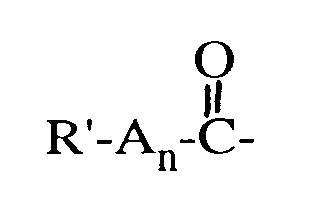
- the subject compounds can be represented by the formulas: wherein R represents hydrogen, alkyl radicals having from 1 to 10 carbon atoms, alkenyl radicals having up to 10 carbon atoms, aryl, alkaryl and aralkyl radicals having from 6 to 16 carbon atoms, and acyl and acyloxy radicals of the formula wherein R' represents alkyl radicals having from 1 to 10 carbon atoms, and aryl, aralkyl and alkaryl radicals having from 6 to 26 carbon atoms; A represents oxygen; n is 0 or 1.
- the present invention is directed to such novel analogs, to novel intermediates useful in the manufacture of such analogs, and to methods for preparing such novel intermediates and analogs.
- R represents hydrogen, alkyl radicals having from 1 to 10 carbon atoms, alkenyl radicals having up to 10 carbon atoms, aryl, alkaryl and aralkyl radicals having from 6 to 16 carbon atoms and acyl and acyloxy radicals of the formula wherein R' represents alkyl radicals having from 1 to 10 carbon atoms, and aryl, aralkyl and alkaryl radicals having from 6 to 26 carbon atoms; A represents oxygen; n is 0 or 1; R1 represents hydrogen; R2 represents hydrogen, fluorine, and sulfonyl esters represented by the following formula: wherein R10 represents alkyl radicals having from 1 to 6 carbon atoms and aryl, aralkyl and alkaryl radicals; R3 represents hydroxy or together with R2 represents a cyclic stannylene derivative of the formula: wherein R6 and R7 independently represent alkyl radicals
- novel analogs can be represented by the formulas: wherein R represents hydrogen, alkyl radicals having from 1 to 10 carbon atoms, alkenyl radicals having up to 10 carbon atoms, aryl, alkaryl and aralkyl radicals having from 6 to 16 carbon atoms and acyl and acyloxy radicals of the formula wherein R' represents alkyl radicals having from 1 to 10 carbon atoms, and aryl, aralkyl and alkaryl radicals having from 6 to 26 carbon atoms; A represents oxygen; n is 0 or 1.
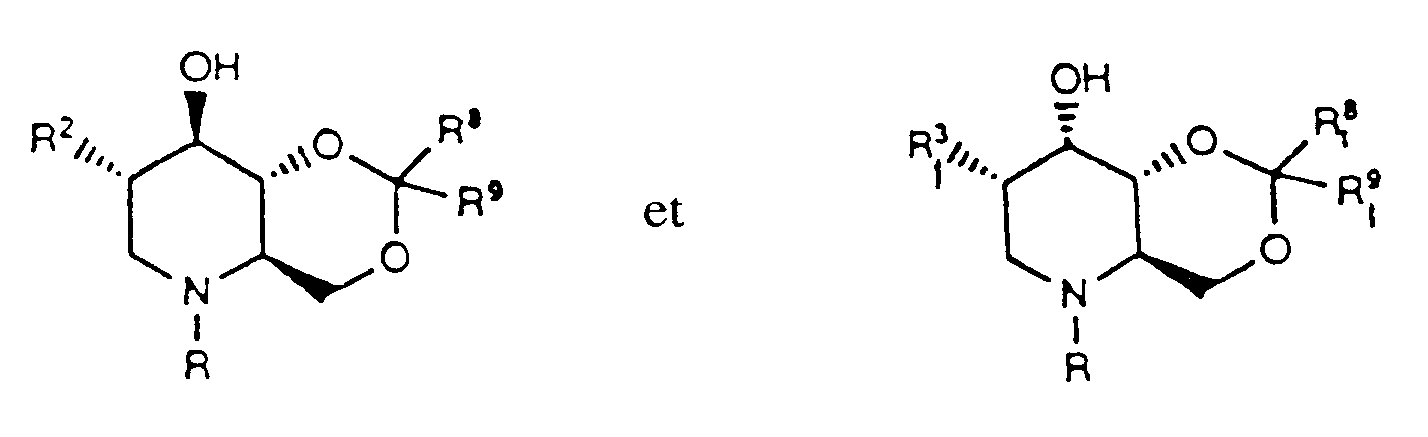
- N-substituted-4,6-0-protected-1, 2-dideoxy-2-fluoronojirimycin and 3-dideoxy-3-fluoronojirimycin intermediates can be represented by the formulas: wherein R has the same meaning as set forth above and R8 and R9 independently represent hydrogen, alkyl radicals having from 1 to 10 carbon atoms and aryl radicals.
- the epoxide intermediates of Formula E can be represented by the formula: wherein R, R8 and R9 have the same meaning as set forth above.
- N-substituted-2-0-substituted-1,3-dideoxy-3-fluoronojirimycin of Formula F can be represented by the formula: wherein R, R13, R8 and R9 have the same meaning as set forth above.
- N-substituted-2-0-substituted-4,6-0-protected-1-deoxyallojirimycin can be represented by the formula: wherein R, R13, R8 and R9 have the same meaning as set forth above.
- N-substituted-2-0-substituted-4,6-0-benzylidene-3-keto-1-deoxynojirimycin can be represented by the formula: wherein R, R13, R8 and R9 have the same meaning as set forth above.
- the 2- and 2-0-substituted intermediates can be represented by the formulas: wherein R has the same meaning as set forth above;
- R2 represents sulfonyl ester represented by the formula: wherein R10 represents alkyl radicals having from 1 to 6 carbon atoms and aryl, aralkyl and alkaryl radicals;
- R13 represents benzyl and allyl ethers, acyl esters represented by the formula: wherein R10 represents alkyl radicals having from 1 to 10 carbon atoms and aryl, aralkyl and alkaryl radicals; and
- R8 and R9 have the same meaning as set forth above.
- the cyclic stannylene intermediates can be represented by the formula: wherein R, R8 and R9 represent radicals as defined above; and R11 and R12 represent alkyl radicals having from 1 to about 10 carbon atoms.
- the 1,2-dideoxy-2-fluoronojirimycin and 1,3-dideoxy-3-fluoronojirimycin compounds of the present invention can be prepared beginning with 1-deoxynojirimycin (hereinafter referred to as "DNJ"), which can be prepared by known procedures as disclosed in U.S. Patent Nos. 4,220,782; 4,246,345; and 4,806,650.
- DNJ 1-deoxynojirimycin
- the corresponding N-alkyl derivatives can then be prepared according to known procedures. See, for example, U.S. Patent Nos. 4,220,782; 4,266,025; 4,405,714; and 4,806,650.
- N-alkyl group can first be introduced according to known procedures.
- the 4-hydroxy and 6-hydroxy groups are then protected by techniques well known to those familiar with carbohydrate chemistry.
- These N-alkyl-4,6-O-protected derivatives can be represented by the formula: wherein R8 and R9 independently represent radicals as defined above.
- R8 and R9 independently represent radicals as defined above.
- These reactions are generally conducted in an inert organic solvent and in the presence of a strong acid which acts as catalyst.
- the reactions can be conducted at temperatures of from about 0°C to about 50°C, preferably from about 10°C to 40°C, such as from about 20°C to about 30°C.
- Exemplary acid catalysts include zinc chloride and p-toluenesulfonic acid.
- a molecular sieve such as a 3 angstrom ( ⁇ ) molecular sieve.
- the amino group can be protected and then the 4-hydroxy and 6-hydroxy groups are protected according to the above procedure. Protection of the amino group can be accomplished by methods well known to those familiar with amino acid chemistry.
- the amino group can be protected utilizing a carbonyl compound represented by the formula: wherein R' represents alkyl radicals having from 1 to 10 carbon atoms, and aryl, aralkyl and alkaryl radicals having from 6 to 26 carbon atoms, A represents oxygen; n is 0 or 1; and X represents Cl, Br, I, or C(O)A n R' wherein R', A and n have the same meanings as defined above.
- Exemplary amino protecting groups include carbobenzoxy, butyryl, benzoyl, and the like. These reactions ace generally conducted in a polar solvent and in the presence of a base at a temperature of from about 0°C to about 50°C, preferably from about 0°C to about 25°C such as from about 10°C to 20°C.
- Exemplary bases include NaHCO3, NaOH and certain tertiary amines.
- Exemplary solvents include water and N,N-dimethylformamide.
- the compounds of the present invention be prepared starting with DNJ, protecting the amino group with the carbobenzoxy group and then protecting the 4-hydroxy and 6-hydroxy groups utilizing the benzylidene protecting group.
- the amino protecting group can then be removed by procedures well known in the art, such as with a base, e.g., KOH, NaOH, and LiOH.
- a base e.g., KOH, NaOH, and LiOH.
- an alkyl acid chloride is then reacted with the 4,6-O-benzylidene-1-deoxynojirimycin to produce the N-carboalkyl-4,6-O-benzylidene-1-deoxynojirimycin, the N-carboalkyl being reduced to the desired alkyl group in a subsequent step as discussed below.
- the amino protecting group can be removed in a later step as discussed below.
- N-alkyl, N-carboaryloxy, N-carboallyloxy, and N-carboalkyl DNJ derivatives will be collectively referred to as N-protected.
- 4,6-O-benzylidene compounds will be referred to as 4,6-O-protected compounds.
- N-protected-4,6-O-protected-1-deoxynojirimycin is then reacted with a dialkyltin oxide (R11R12SnO), preferably di-n-butyltin oxide, in a suitable solvent such as methanol, benzene or toluene to form the novel corresponding cyclic stannylene derivative represented by the formula: wherein R, R8 and R9 have the same meaning as set forth above and R11 and R12 independently represent alkyl radicals having from 1 to 10 carbon atoms, such as from 1 to 6 carbon atoms, preferably about 4 carbon atoms.
- electrophilic sulfonyl compound Suitable electrophiles are sulfonyl halides and anhydrides. Preferred electrophiles are those represented by the formula: wherein X represents Cl, Br, I, and and R10 represents alkyl radicals having from 1 to 6 carbon atoms and aralkyl and aryl radicals. Exemplary R10 radicals include phenyl, p-methylphenyl, trifluoromethyl (CF3) and methyl.
- a preferred electrophile is the p-toluenesulfonyl chloride.
- the reactions are conducted in an inert solvent in the presence of a base and at a temperature of between about 0°C and 100°C, preferably at a temperature of from about 0°C to about 25°C.
- exemplary bases include tertiary amines such as triethylamine, and diisopropylethyl amine, pyridine, N,N-dimethylaminopyridine, 1,8-diazabicyclo[5.4.0]undec-7-ene (DBU) and 1,5-diazabicyclo[4.3.0]non-5-ene (DBN).
- the resulting novel product of the reaction between the cyclic stannylene and the electrophile is predominantly the N-protected-2-O-substituted-4,6-O-benzylidene-1-deoxynojirimycin represented by the formula: wherein R2 represents a sulfonyl ester and R, R8 and R9 are as defined above.
- R2 represents a sulfonyl ester
- R, R8 and R9 are as defined above.
- a strong base such as sodium hydride, potassium hydride, a potassium or sodium alkoxide, e.g., sodium methoxide, sodium ethoxide, potassium t-butoxide and the like, or DBU
- the sulfonyl ester at the 2-position is displaced, along with the oxygen, with inversion of configuration at C-2 to produce the corresponding 2,3-anhydro-1-deoxymannojirimycin.
- a preferred base is sodium hydride.
- the reaction is generally conducted in a suitable solvent in the presence of the base and at a temperature of between about 0°C and about 120°C, preferably at a temperature of between about 0°C and 25°C.
- Exemplary suitable solvents include tetrahydrofuran, methylene chloride, methanol and ethanol.
- a preferred solvent is tetrahydrofuran.
- N-protected-2,3-anhydro-4,6-O-benzylidene-1-deoxymannojirimycin is then reacted with a fluorine source with inversion of configuration at C-2 to produce the corresponding N-protected-4,6-O-benzylidene-1,2-dideoxy-2-fluoronojirimycin represented by the formula: wherein R, R8 and R9 are as defined above.
- the reaction is preferably conducted neat, i.e., no solvent, at a temperature of between about 50°C and 150°C, preferably between about 100°C and about 140°C.
- Exemplary fluorine sources include those represented by the formula: wherein R13 and R14 independently represent optionally substituted alkyl groups having from 1 to 6 carbon atoms. A preferred alkyl group is isopropyl.
- Other fluoride sources include potassium hydrogen fluoride, hydrogen fluoride, hydrogen tetrafluoroborate and tetra-alkylammonium fluorides (e.g. tetra-N-butylammonium fluoride).
- Suitable acylating agents include those represented by the formula: wherein X represents Cl, Br, I, and and R110 represents alkyl radicals having from 1 to 10 carbon atoms and aralkyl and aryl radicals. Exemplary R10 radicals include phenyl, p-methylphenyl, chloromethyl and methyl.
- a preferred acylating agent is benzoyl chloride.
- Exemplary bases include tertiary amines such as triethylamine, and diisopropylethyl amine, pyridine, N,N-dimethylaminopyridine, 1,8-diazabicyclo[5.4.0] undec-7-ene (DBU) and 1,5-diazabicyclo[4.3.0]non-5-ene (DBN).
- Suitable benzylating agents include benzyl triflate and benzyl halides, e.g., benzyl chloride, bromide and iodide.
- Suitable allylating agents include allyl halides such as allyl bromide and allyl iodide.
- the benzylation and allylation reactions are conducted in the presence of a catalytic amount of a tetraalkylammonium iodide, for example, tetra-n-butyl ammonium iodide, in a suitable solvent such as THF, acetonitrile or N,N-dimethylformamide.
- a tetraalkylammonium iodide for example, tetra-n-butyl ammonium iodide
- a suitable solvent such as THF, acetonitrile or N,N-dimethylformamide.
- the reactions are conducted in an inert solvent in the presence of a base and at a temperature of between about 0°C and 100°C, preferably at a temperature of from about 0°C to about 25°C.
- the resulting novel product of the reaction between the cyclic stannylene and the acylating, benzylatin or allylating agent is predominantly the N-protected-2-O-substituted-4,6-0-benzylidene-1-deoxynojirimycin represented by the formula: wherein R13 represents an acyl ester as defined above and R, R8 and R9 are as defined above.
- R13 represents an acyl ester as defined above
- R, R8 and R9 are as defined above.
- N-protected-2-O-substituted-4,6-0-benzylidene-1-deoxynojirimycin is then oxidized and reduced under conditions which produce the corresponding N-protected-2-O-substituted-4,6-O-benzylidene-1-deoxyallojirimycin represented by the formula: wherein R, R13, R8 and R9 are as defined above.
- oxidation an be effected utilizing a variety of oxidizing agents, for example, pyridinium chlorochromate, pyridinium dichromate and the like.
- Preferred oxidizing agents are those referred to as Swern reagents by those skilled in the art.
- Swern reagents generally are combinations of dimethyl sulfoxide and either trifluoroacetic anhydride or oxallyl chloride, and triethylamine.
- the reaction is conducted in an inert solvent at a temperature of from about -80°C to about 30°C.
- a preferred inert solvent is methylene chloride.
- the resulting ketone represented by the formula: where R, R3, R8 and R9 are as defined above, is then reduced utilizing a metal borohydride such as sodium, lithium and potassium borohydride, in the presence of THF and methanol or with an alumino hydride, such as lithium trialkylaluminohydride and lithium trialkoxyaluminohydride, in THF, and at a temperature of from about -80°C to about 30°C.
- a metal borohydride such as sodium, lithium and potassium borohydride
- an alumino hydride such as lithium trialkylaluminohydride and lithium trialkoxyaluminohydride
- N-protected-2-0-substituted-4,6-O-benzylidene-1-deoxyallojirimycin is then reacted with a suitable fluorine source with inversion of configuration at C-3 to produce the corresponding N-protected-2-O-substituted-4,6-O-benzylidene-1,3-dideoxy-3-fluoronojirimycin represented by the formula: wherein R, R3, R8 and R9 are as defined above.
- the reaction is preferably conducted in an inert-solvent, e.g., methylene chloride, benzene, toluene, chloroform, THF, and the like, at a temperature of between about -80°C and about 120°C, preferably between about 0°C and about 85°C.
- inert-solvent e.g., methylene chloride, benzene, toluene, chloroform, THF, and the like
- exemplary fluorine sources include those represented by the formula: wherein R13 and R14 independently represent alkyl groups having from 1 to 6 carbon atoms. A preferred alkyl group is ethyl.
- the inverted alcohol can first be activated by conversion to its trifluoromethanesulfonate or p-methylbenzenesulfonate derivative and then displaced by a fluoride source in a suitable solvent.
- fluoride sources include cesium fluoride, potassium hydrogen fluoride, tetraalkylammonium fluorides, e.g., tetra-n-butylammonium fluoride, and tris(dimethylamino)sulfur (trimethylsilyl)difluoride.
- Suitable solvents include acetonitrile and N,N-dimethylformamide. This reaction is conducted at a temperature of between about -80°C and 120°C.
- the next step involves removal of the acyl, benzyl or allyl group at C-2.
- These groups can be removed in a variety of ways well known to those skilled in the art.
- the acyl groups can be removed utilizing lithium hydroxide, sodium hydroxide or potassium hydroxide in aqueous tetrahydrofuran.
- a preferred method for removal utilizes sodium methoxide in methanol.
- the next step involves removal of the 4,6-O-protecting group, e.g., the benzylidene group, by methods well known to those skilled in the art.
- protecting groups can be removed utilizing an acid in an appropriate solvent at room temperatures.
- CF3CO2H in water, CH3CO2H in water or HCl in water can be utilized to effectively deprotect the 4- and 6-hydroxy groups.
- such protecting groups can be removed catalytically. For example, reaction with palladium on carbon at 50°C and 3.5 Kg/sq.cm. H2.
- amino protecting group can be removed through hydrogenolysis (for example, a carbobenzoxy group)
- hydrogenation in the presence of palladium on carbon will remove both the nitrogen protecting group and the 4,6-O-benzylidene protecting group.
- deprotection can occur in one step.
- the acyl group can be reduced utilizing borane:dimethylsulfide, lithium aluminum hydride or diborane in a suitable solvent, e.g., THF, at a temperature of from about 0°C to about 120°C, preferably from about 0°C to about 25°C.
- a suitable solvent e.g., THF
- a preferred reducing agent is borane:dimethylsulfide
- compositions comprising one or more of the fluoro analogs can be administered to a patient for this purpose.
- Such compositions which may contain acceptable diluents and/or carriers, can be prepared by reference to general texts in the field such as, for example, Remington's Pharmaceutical Sciences , Ed. Arthur Osol, 16th ed., 1980, Mack Publishing Co.
- Contemplated equivalents of the general formulas set forth above for the DNJ analogs and derivatives as well as the intermediates are compounds otherwise corresponding thereto and having the same general properties wherein one or more of the various R groups are simple variations of the substituents as defined therein, e.g., wherein R is a higher alkyl group.
- a substituent is designated as, or can be, a hydrogen
- the exact chemical nature of a substituent which is other than hydrogen at that position is not critical so long as it does not adversely affect the overall activity and/or synthesis procedure.
- a total of 75.0 g (0.46 moles) of 1-deoxynojirimycin was dissolved in 1500 mL of saturated aqueous sodium bicarbonate and then treated with 73.5 mL (87.8 g, 0.52 moles) of 95% benzyl chloroformate at room temperature using an overhead stirrer under a nitrogen atmosphere for eighteen hours.
- the solution was extracted once with 250 mL of methylene chloride to remove any benzyl chloride and unreacted benzyl chloroformate.
- the aqueous solution was then extracted ten times with 500 mL of ethyl acetate.
- the reactor was flushed with nitrogen, opened and the contents filtered through celite, which was then washed with water.
- the filtrate was extracted once with ethyl acetate to remove organics and the aqueous layer was concentrated under vacuum at 50°C to afford an oil.
- the remaining water was removed by azeotrope with ethanol to provide 1.2 g of a white solid, whose 1H NMR was consistent with 1,2-dideoxy-2-fluoronojirimycin. This was dissolved in water, filtered to remove a slight grey color and stripped again.
- the first isomer to elute (5.7 g, 35%), which corresponded to the major isomer, was identified as N-butyryl-4,6-O-benzylidene-1,2-dideoxy-2-fluoronojirimycin. It was recrystallized from chloroform and hexane to afford 6.0 g of material which contained chloroform in the crystals. This was suitable for the subsequent chemistry.
- the stannylene intermediate from Example 2 (1.30 mmol) was placed under a nitrogen atmosphere, 5 mL of anhydrous methylene chloride was added, followed by 0.20 mL (150 mg, 1.48 mmol, 1.14 eq) of dry triethylamine and then 0.15 mL (183 mg, 1.30 mmol, 1.0 eq) of benzoyl chloride. After stirring at room temperature for one hour and fifteen minutes, an aqueous saturated sodium bicarbonate solution was added, the layer separated, the organic layer washed with IN hydrochloric acid, dried with magnesium sulfate, filtered and concentrated to afford 0.93 g of crude material.
- the crude ketone was used without further purification. It was dissolved in 50 mL of methanol and 400 mL of tetrahydrofuran was added. The solution was cooled to -5°C in an ice bath and 1.2 mL of acetic acid was added followed by 0.770 g (20.6 mmol) of sodium borohydride and stirred for 10 min. at which time another 0.770 g of sodium borohydride was added and stirred an additional 1 min. The reaction was quenched with 100 mL of saturated ammonium chloride and diluted with 25 mL of water to dissolve precipitate. The solution was extracted with 3 x 200 mL of ethyl acetate.
- the crude stannylene was dissolved in 65 mL (0.4 M) of acetonitrile and to this was added 2.0 g (20 mol %) of tetra-n-butylammonium iodide and 4.5 mL (1.5 eq) of benzylbromide and the mixture refluxed for 24 hours. After cooling, the solvents were removed in vacuo to yield 11.5 g (94%) of 3:1 mixture of 2-O-benzyl and 3-O-benzyl products, respectively.
- This example illustrates glycosidase inhibition activity for 1,2-dideoxy 2-fluoronojirimycin (1), N-butyl-1,2-dideoxy-2-fluoronojirimycin (2), 1,3-dideoxy-3-fluoronojirimycin (3), and N-butyl-1,3-dideoxy-3-fluoronojirimycin (4). It is contemplated that other N-derivatives will also manifest glycosidase inhibition activity.
- the glycosidase inhibition activity is determined by modifying an assay procedure described in Evans et al, Phytochemistry, 22 , pp. 768-770 (1983). More particularly, yeast ⁇ -glucosidase and almond ⁇ -glucosidase activities were measured by the Evans et al method which was modified by assaying activities at pH 7.4 in N-2-hydroxyethylpiperazine-N-2-ethane sulfonic acid (HEPES) buffer, measuring in 96 well microtiter plates, and including 10% DMSO in control and test samples.
- HEPES N-2-hydroxyethylpiperazine-N-2-ethane sulfonic acid
- the release of p-nitrophenol from the substrate p-nitrophenylglycoside was measured spectrophotometrically in the presence and absence of test compound.
- Each assay included a known inhibitor of the enzyme as a standard. IC50 values were determined for compounds which inhibited the enzymes more than 50% at a 1 millimolar concentration.
- IC50 values were determined from the linear portion of the log concentration vs percent inhibition curve obtained from a minimum of 3 points. Castanospermine was used as standard inhibitor. Table 1 Enzyme and Virus Inhibition Data COMPOUND NO. ALPHA GLUCOSIDASE BETA GLUCOSIDASE-pH4.8 BETA GLUCOSIDASE-pH7.4 ALPHA MANNOSIDASE-pH4.5 ALPHA MANNOSIDASE-pH7.4 1 24% @ 1mM 6% @ 1mM 11% @ 1mM 4% @ 1mM 19% @ 1mM 64% @ 5mM 25% @ 5mM 25% @ 5mM 5% @ 5mM 11% @ 5mM 2 8% @ 1mM 2% @ 1mM 4% @ 1mM 3% @ 1mM 4% @ 1mM 13% @ 5mM -6% @ 5mM 11% @ 5mM 5% @ 5mM 12% @ 5mM 3 26% @ 1mM 4% @ 1mM 3%
Landscapes
- Chemical & Material Sciences (AREA)
- Organic Chemistry (AREA)
- Health & Medical Sciences (AREA)
- Diabetes (AREA)
- Pharmacology & Pharmacy (AREA)
- Life Sciences & Earth Sciences (AREA)
- Hematology (AREA)
- Chemical Kinetics & Catalysis (AREA)
- General Chemical & Material Sciences (AREA)
- Medicinal Chemistry (AREA)
- Nuclear Medicine, Radiotherapy & Molecular Imaging (AREA)
- Bioinformatics & Cheminformatics (AREA)
- Engineering & Computer Science (AREA)
- Obesity (AREA)
- Animal Behavior & Ethology (AREA)
- General Health & Medical Sciences (AREA)
- Public Health (AREA)
- Veterinary Medicine (AREA)
- Emergency Medicine (AREA)
- Endocrinology (AREA)
- Hydrogenated Pyridines (AREA)
- Pharmaceuticals Containing Other Organic And Inorganic Compounds (AREA)
- Plural Heterocyclic Compounds (AREA)
- Nitrogen Condensed Heterocyclic Rings (AREA)
Claims (52)
- Composés représentés par les formules :

les R représentent des atomes d'hydrogène, des groupes alkyle comportant de 1 à 10 atomes de carbone, des groupes alcényle comportant jusqu'à 10 atomes de carbone, des groupes aryle, alkaryle ou aralkyle comportant de 6 à 16 atomes de carbone, ou des groupes acyle ou acyloxy de formule
R¹ représente un atome d'hydrogène;
R² représente un atome d'hydrogène ou de fluor ou un groupe ester sulfonique de formule
R³ représente un groupe hydroxy, ou bien, conjointement avec R², un groupe cyclique de type stannylène, de formule
ou bien R³, conjointement avec R¹, représente un substituant époxy ;
sous réserve que, quand R² représente un atome de fluor, R³ représente un groupe hydroxy, et que, quand R² représente un atome d'hydrogène, R¹ et R³ constituent conjointement un substituant époxy ;
R⁴ et R⁵ représentent des atomes d'hydrogène ou des groupes hydroxy-protecteurs, où R⁴ et R⁵ constituent conjointement un groupe de formule
R₁¹ représente un atome d'hydrogène ou un groupe hydroxy;
R₁² représente un atome d'hydrogène ou de fluor ou un groupe hydroxy, ou bien, conjointement avec R₁¹, un substituant oxo ;
R₁³ représente un groupe hydroxy, benzyloxy ou allyloxy, ou encore un groupe acyloxy représenté par la formule
ou bien, conjointement avec R₁², un groupe cyclique de type stannylène, de formule
sous réserve que, quand R₁² représente un atome de fluor, R₁³ représente un groupe hydroxy, acyloxy, benzyloxy ou allyloxy, et que, quand R₁¹ représente un groupe hydroxy, R₁³ représente un groupe hydroxy, acyloxy, benzyloxy ou allyloxy, et encore que, quand R₁² représente un groupe hydroxy, R₁³ ne représente pas un groupe hydroxy, et que, quand R₁¹ représente un groupe hydroxy, R₁² représente un atome d'hydrogène, et enfin, qu'un seul à la fois des symboles R₁¹ et R₁² représente un atome d'hydrogène; et
R₁⁴ et R₁⁵ représentent des groupes hydroxy-protecteurs, où R₁⁴ et R₁⁵ constituent conjointement un groupe de formule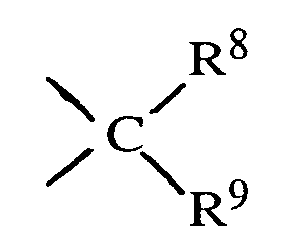
sous réserve que les formules A et B n'englobent pas les formules C et D
- Composés représentés par les formules


- Composés conformes à la revendication 2, dans lesquels R représente un atome d'hydrogène.
- Composés conformes à la revendication 2, dans lesquels R représente un groupe alkyle comportant de 1 à 10 atomes de carbone.
- Composés conformes à la revendication 2, dans lesquels R représente un groupe alkyle comportant de 1 à 6 atomes de carbone.
- Composés conformes à la revendication 2, dans lesquels R représente un groupe alkyle comportant 4 atomes de carbone.
- Composés conformes à la revendication 2, dans lesquels R représente un groupe n-butyle.
- Composés conformes à la revendication 1, représentés par les formules

les R représentent des atomes d'hydrogène, des groupes alkyle comportant de 1 à 10 atomes de carbone, des groupes alcényle comportant jusqu'à 10 atomes de carbone, des groupes aryle, alkaryle ou aralkyle comportant de 6 à 16 atomes de carbone, ou des groupes acyle ou acyloxy définis dans la revendication 1; et
R⁸ et R⁹ représentent indépendamment des atomes d'hydrogène, des groupes alkyle comportant de 1 à 10 atomes de carbone, ou des groupes aryle. - Composés conformes à la revendication 8, dans lesquels R représente un atome d'hydrogène.
- Composés conformes à la revendication 8, dans lesquels R représente un groupe alkyle comportant de 1 à 10 atomes de carbone.
- Composés conformes à la revendication 8, dans lesquels R représente un groupe alkyle comportant de 1 à 6 atomes de carbone.
- Composés conformes à la revendication 8, dans lesquels R représente un groupe alkyle comportant 4 atomes de carbone.
- Composés conformes à la revendication 8, dans lesquels R représente un groupe n-butyle.
- Composés conformes à la revendication 8, dans lesquels R représente un groupe phénoxycarbonyle.
- Composés conformes à la revendication 8, dans lesquels R représente un groupe butyryle.
- Composés conformes à la revendication 1, représentés par les formules

les R représentent des atomes d'hydrogène, des groupes alkyle comportant de 1 à 10 atomes de carbone, des groupes alcényle comportant jusqu'à 10 atomes de carbone, des groupes aryle, alkaryle ou aralkyle substitués, comportant de 7 à 14 atomes de carbone dans le cas de la formule G et de 6 à 16 atomes de carbone dans le cas de la formule H, ou des groupes acyle ou acyloxy définis dans la revendication 1;
R₁³ représente un groupe benzyloxy ou allyloxy, ou un groupe acyloxy représenté par la formule
R⁸ et R⁹ représentent indépendamment des atomes d'hydrogène, des groupes alkyle comportant de 1 à 10 atomes de carbone, ou des groupes aryle. - Composés conformes à la revendication 16, dans lesquels R représente un atome d'hydrogène.
- Composés conformes à la revendication 16, dans lesquels R représente un groupe alkyle comportant de 1 à 10 atomes de carbone.
- Composés conformes à la revendication 16, dans lesquels R représente un groupe alkyle comportant de 1 à 6 atomes de carbone.
- Composés conformes à la revendication 16, dans lesquels R représente un groupe alkyle comportant 4 atomes de carbone.
- Composés conformes à la revendication 16, dans lesquels R représente un groupe n-butyle.
- Composés conformes à la revendication 16, dans lesquels R représente un groupe phénoxycarbonyle.
- Composés conformes à la revendication 16, dans lesquels R représente un groupe butyryle.
- Composés conformes à la revendication 1, représentés par les formules
les R représentent des atomes d'hydrogène, des groupes alkyle comportant de 1 à 10 atomes de carbone, des groupes alcényle comportant jusqu'à 10 atomes de carbone, des groupes aryle, alkaryle ou aralkyle comportant de 6 à 16 atomes de carbone, ou des groupes acyle ou acyloxy définis dans la revendication 1;
R² représente un groupe ester sulfonique de formule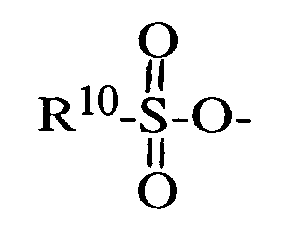
R₁³ représente un groupe benzyloxy ou allyloxy, ou un groupe acyloxy représenté par la formule
R⁸ et R⁹ représentent indépendamment des atomes d'hydrogène, des groupes alkyle comportant de 1 à 10 atomes de carbone, ou des groupes aryle. - Composés conformes à la revendication 24, dans lesquels R représente un atome d'hydrogène.
- Composés conformes à la revendication 24, dans lesquels R représente un groupe alkyle comportant de 1 à 10 atomes de carbone.
- Composés conformes à la revendication 24, dans lesquels R représente un groupe alkyle comportant de 1 à 6 atomes de carbone.
- Composés conformes à la revendication 24 dans lesquels R représente un groupe alkyle comportant 4 atomes de carbone.
- Composés conformes à la revendication 24, dans lesquels R représente un groupe n-butyle.
- Composés conformes à la revendication 24, dans lesquels R représente un groupe phénoxycarbonyle.
- Composés conformes à la revendication 24, dans lesquels R représente un groupe butyryle.
- Composés conformes à la revendication 1, représentés par les formules

les R représentent des atomes d'hydrogène, des groupes alkyle comportant de 1 à 10 atomes de carbone, des groupes alcényle comportant jusqu'à 10 atomes de carbone, des groupes aryle, alkaryle ou aralkyle comportant de 6 à 16 atomes de carbone, ou des groupes acyle ou acyloxy définis dans la revendication 1;
R₁³ représente un groupe benzyloxy ou allyloxy, ou un groupe acyloxy représenté par la formule
R⁸ et R⁹ représentent indépendamment des atomes d'hydrogène, des groupes alkyle comportant de 1 à 10 atomes de carbone, ou des groupes aryle; et
R¹¹ et R¹² représentent des groupes alkyle comportant de 1 à 10 atomes de carbone. - Composés conformes à la revendication 32, dans lesquels R représente un atome d'hydrogène.
- Composés conformes à la revendication 32, dans lesquels R représente un groupe alkyle comportant de 1 à 10 atomes de carbone.
- Composés conformes à la revendication 32, dans lesquels R représente un groupe alkyle comportant de 1 à 6 atomes de carbone.
- Composés conformes à la revendication 32, dans lesquels R représente un groupe alkyle comportant 4 atomes de carbone.
- Composés conformes à la revendication 32, dans lesquels R représente un groupe n-butyle.
- Composés conformes à la revendication 32, dans lesquels R représente un groupe phénoxycarbonyle.
- Composés conformes à la revendication 32, dans lesquels R représente un groupe butyryle.
- Composé conforme à la revendication 1, représenté par la formule

R représente un atomes d'hydrogène, un groupe alkyle comportant de 1 à 10 atomes de carbone, un groupe alcényle comportant jusqu'à 10 atomes de carbone, un groupe aryle, alkaryle ou aralkyle comportant de 6 à 16 atomes de carbone, ou un groupe acyle ou acyloxy défini dans la revendication 1 ;
R₁³ représente un groupe benzyloxy ou allyloxy, ou un groupe acyloxy représenté par la formule
R⁸ et R⁹ représentent indépendamment des atomes d'hydrogène, des groupes alkyle comportant de 1 à 10 atomes de carbone, ou des groupes aryle. - Composé conforme à la revendication 40, dans lequel R représente un atome d'hydrogène.
- Composé conforme à la revendication 40, dans lequel R représente un groupe alkyle comportant de 1 à 10 atomes de carbone.
- Composé conforme à la revendication 40, dans lequel R représente un groupe alkyle comportant de 1 à 6 atomes de carbone.
- Composé conforme à la revendication 40, dans lequel R représente un groupe alkyle comportant 4 atomes de carbone.
- Composé conforme à la revendication 40, dans lequel R représente un groupe n-butyle.
- Composé conforme à la revendication 40, dans lequel R représente un groupe phénoxycarbonyle.
- Composé conforme à la revendication 40, dans lequel R représente un groupe butyryle.
- Composition contenant un composé conforme à la revendication 2.
- N-butyl-1,2-didésoxy-2-fluoro-nojirimycine.
- 1,2-didésoxy-2-fluoro-nojirimycine.
- N-butyl-1,3-didésoxy-3-fluoro-nojirimycine.
- 1,3-didésoxy-3-fluoro-nojirimycine.
Applications Claiming Priority (4)
| Application Number | Priority Date | Filing Date | Title |
|---|---|---|---|
| US07/386,538 US5025021A (en) | 1989-07-27 | 1989-07-27 | 1,2-dideoxy-2-fluoronojirimycin as glycosidase inhibitors |
| US386538 | 1989-07-27 | ||
| US07/400,252 US5026713A (en) | 1989-08-29 | 1989-08-29 | 1,3-dideoxy-3-fluoronojirimycin which inhibits glycosidase activity |
| US400252 | 1989-08-29 |
Publications (3)
| Publication Number | Publication Date |
|---|---|
| EP0410953A2 EP0410953A2 (fr) | 1991-01-30 |
| EP0410953A3 EP0410953A3 (en) | 1991-08-21 |
| EP0410953B1 true EP0410953B1 (fr) | 1995-11-08 |
Family
ID=27011478
Family Applications (1)
| Application Number | Title | Priority Date | Filing Date |
|---|---|---|---|
| EP90870119A Expired - Lifetime EP0410953B1 (fr) | 1989-07-27 | 1990-07-23 | Composés de pipéridine inhibiteurs de glycosidase |
Country Status (8)
| Country | Link |
|---|---|
| EP (1) | EP0410953B1 (fr) |
| JP (1) | JPH0358969A (fr) |
| AT (1) | ATE129997T1 (fr) |
| CA (1) | CA2022061A1 (fr) |
| DE (1) | DE69023408T2 (fr) |
| DK (1) | DK0410953T3 (fr) |
| ES (1) | ES2036512T3 (fr) |
| GR (1) | GR3018629T3 (fr) |
Families Citing this family (6)
| Publication number | Priority date | Publication date | Assignee | Title |
|---|---|---|---|---|
| US5128347A (en) * | 1990-10-18 | 1992-07-07 | Monsanto Company | Glycosidase inhibiting 1,4-dideoxy-4-fluoronojirimycin |
| ATE142201T1 (de) * | 1992-04-01 | 1996-09-15 | Searle & Co | 2- und 3-amino und azidoderivate von 1,5- iminozuckern als antivirale arzneimittel |
| US5268482A (en) * | 1992-04-01 | 1993-12-07 | G. D. Searle & Co. | 2- and 3-sulfur derivatives of 1,5-iminosugars |
| US5258518A (en) * | 1992-04-01 | 1993-11-02 | G. D. Searle & Co. | 2-substituted tertiary carbinol derivatives of deoxynojirimycin |
| US5451679A (en) * | 1994-03-08 | 1995-09-19 | G. D. Searle & Co. | 2-chloro and 2-bromo derivatives of 1,5-iminosugars |
| DE69526228T2 (de) * | 1994-07-27 | 2002-10-24 | Genzyme Ltd., Haverhill | Regioselektive sulfatierung |
Family Cites Families (2)
| Publication number | Priority date | Publication date | Assignee | Title |
|---|---|---|---|---|
| DE3611841A1 (de) * | 1986-04-09 | 1987-10-15 | Bayer Ag | Verfahren zur herstellung von 1-desoxynojirimycin und dessen n-derivaten |
| DE3722788A1 (de) * | 1987-07-10 | 1989-01-19 | Bayer Ag | Chirale 6-hydroxymethylenverzweigte 3-amino-4,5-dihydroxypiperidine, zwischenprodukte zu ihrer herstellung, verfahren zu ihrer herstellung und ihre verwendung |
-
1990
- 1990-07-23 AT AT90870119T patent/ATE129997T1/de not_active IP Right Cessation
- 1990-07-23 EP EP90870119A patent/EP0410953B1/fr not_active Expired - Lifetime
- 1990-07-23 ES ES90870119T patent/ES2036512T3/es not_active Expired - Lifetime
- 1990-07-23 DK DK90870119.6T patent/DK0410953T3/da active
- 1990-07-23 DE DE69023408T patent/DE69023408T2/de not_active Expired - Fee Related
- 1990-07-26 JP JP2198981A patent/JPH0358969A/ja active Pending
- 1990-07-26 CA CA002022061A patent/CA2022061A1/fr not_active Abandoned
-
1996
- 1996-01-09 GR GR960400049T patent/GR3018629T3/el unknown
Also Published As
| Publication number | Publication date |
|---|---|
| ES2036512T1 (es) | 1993-06-01 |
| ES2036512T3 (es) | 1996-03-01 |
| DK0410953T3 (da) | 1996-01-22 |
| DE69023408T2 (de) | 1996-05-02 |
| GR3018629T3 (en) | 1996-04-30 |
| CA2022061A1 (fr) | 1991-01-28 |
| ATE129997T1 (de) | 1995-11-15 |
| EP0410953A2 (fr) | 1991-01-30 |
| EP0410953A3 (en) | 1991-08-21 |
| DE69023408D1 (de) | 1995-12-14 |
| JPH0358969A (ja) | 1991-03-14 |
Similar Documents
| Publication | Publication Date | Title |
|---|---|---|
| EP0593478B1 (fr) | Antagonistes de leukotriene b 4 | |
| US5663342A (en) | 2-chloro and 2-bromo derivatives of 1,5-iminosugars | |
| US5391742A (en) | Intermediates for 2-piperidino-1-alkanols | |
| JP3520269B2 (ja) | 1,5−イミノ糖類の2−および3−アミノおよびアジド誘導体類の合成に適した化合物 | |
| JPS62242663A (ja) | 1−デオキシノジリマイシンおよびそれのn−誘導体を製造する方法 | |
| US5026713A (en) | 1,3-dideoxy-3-fluoronojirimycin which inhibits glycosidase activity | |
| US4246269A (en) | Antidepressant piperidinones | |
| US5654302A (en) | Prodrug esters of phenolic 2-piperidino-1-alkanols | |
| US5025021A (en) | 1,2-dideoxy-2-fluoronojirimycin as glycosidase inhibitors | |
| DE69303413T2 (de) | 2-substituierte-tertiäre-Carbinolderivate als antivirale Arzneimittel | |
| CA2688850C (fr) | Nouvelle methode de preparation d'isofagomine et de ses derives | |
| US5128347A (en) | Glycosidase inhibiting 1,4-dideoxy-4-fluoronojirimycin | |
| US5130320A (en) | Glycosidase inhibiting 1,3-dideoxy-3-fluoronojirimycin | |
| DE69023408T2 (de) | Glykosidasehemmende Piperidinverbindungen. | |
| US5273981A (en) | Intramolecular carbamate derivative of 2,3-Di-O-blocked-1,4-dideoxy-4-fluoro-nojirimycins | |
| US5218121A (en) | Synthesis of 1,3-dideoxy-3-fluoronojirimycin | |
| US5175168A (en) | Intermediates for 1,2-dideoxy-2-fluoronojirimycin | |
| US5595976A (en) | Tetrahydropyran compounds | |
| US5384417A (en) | Heptitols | |
| Pino-González et al. | Studies on reactivity of azidoamides, intermediates in the synthesis of tetrahydroxypipecolic acid derivatives | |
| Cheng et al. | Concise synthesis of 1-epi-castanospermine | |
| CA1093071A (fr) | DERIVES DE LA 5.alpha.-BICYCLOMYCINE | |
| US5594000A (en) | Spirofurane derivatives | |
| SE460418B (sv) | Derivat av 3-azabicyklo /3.3.1/ nonan-9-ol, foerfarande foer framstaellning av detta, farmaceutiska komposition och en mellanprodukt | |
| WO2006008493A1 (fr) | Synthèse des alcaloïdes polyhydroxylés |
Legal Events
| Date | Code | Title | Description |
|---|---|---|---|
| PUAI | Public reference made under article 153(3) epc to a published international application that has entered the european phase |
Free format text: ORIGINAL CODE: 0009012 |
|
| AK | Designated contracting states |
Kind code of ref document: A2 Designated state(s): AT BE CH DE DK ES FR GB GR IT LI LU NL SE |
|
| PUAL | Search report despatched |
Free format text: ORIGINAL CODE: 0009013 |
|
| AK | Designated contracting states |
Kind code of ref document: A3 Designated state(s): AT BE CH DE DK ES FR GB GR IT LI LU NL SE |
|
| 17P | Request for examination filed |
Effective date: 19920113 |
|
| 17Q | First examination report despatched |
Effective date: 19920731 |
|
| GRAA | (expected) grant |
Free format text: ORIGINAL CODE: 0009210 |
|
| AK | Designated contracting states |
Kind code of ref document: B1 Designated state(s): AT BE CH DE DK ES FR GB GR IT LI LU NL SE |
|
| REF | Corresponds to: |
Ref document number: 129997 Country of ref document: AT Date of ref document: 19951115 Kind code of ref document: T |
|
| REF | Corresponds to: |
Ref document number: 69023408 Country of ref document: DE Date of ref document: 19951214 |
|
| ET | Fr: translation filed | ||
| REG | Reference to a national code |
Ref country code: DK Ref legal event code: T3 |
|
| ITF | It: translation for a ep patent filed | ||
| REG | Reference to a national code |
Ref country code: CH Ref legal event code: NV Representative=s name: A. BRAUN, BRAUN, HERITIER, ESCHMANN AG PATENTANWAE |
|
| REG | Reference to a national code |
Ref country code: ES Ref legal event code: FG2A Ref document number: 2036512 Country of ref document: ES Kind code of ref document: T3 |
|
| REG | Reference to a national code |
Ref country code: GR Ref legal event code: FG4A Free format text: 3018629 |
|
| PGFP | Annual fee paid to national office [announced via postgrant information from national office to epo] |
Ref country code: LU Payment date: 19960601 Year of fee payment: 7 |
|
| PGFP | Annual fee paid to national office [announced via postgrant information from national office to epo] |
Ref country code: FR Payment date: 19960617 Year of fee payment: 7 |
|
| PGFP | Annual fee paid to national office [announced via postgrant information from national office to epo] |
Ref country code: SE Payment date: 19960618 Year of fee payment: 7 Ref country code: DE Payment date: 19960618 Year of fee payment: 7 |
|
| PGFP | Annual fee paid to national office [announced via postgrant information from national office to epo] |
Ref country code: DK Payment date: 19960619 Year of fee payment: 7 |
|
| PGFP | Annual fee paid to national office [announced via postgrant information from national office to epo] |
Ref country code: AT Payment date: 19960620 Year of fee payment: 7 |
|
| PGFP | Annual fee paid to national office [announced via postgrant information from national office to epo] |
Ref country code: NL Payment date: 19960624 Year of fee payment: 7 Ref country code: CH Payment date: 19960624 Year of fee payment: 7 |
|
| PGFP | Annual fee paid to national office [announced via postgrant information from national office to epo] |
Ref country code: BE Payment date: 19960625 Year of fee payment: 7 |
|
| PGFP | Annual fee paid to national office [announced via postgrant information from national office to epo] |
Ref country code: GB Payment date: 19960626 Year of fee payment: 7 |
|
| PGFP | Annual fee paid to national office [announced via postgrant information from national office to epo] |
Ref country code: GR Payment date: 19960628 Year of fee payment: 7 |
|
| PGFP | Annual fee paid to national office [announced via postgrant information from national office to epo] |
Ref country code: ES Payment date: 19960717 Year of fee payment: 7 |
|
| PLBE | No opposition filed within time limit |
Free format text: ORIGINAL CODE: 0009261 |
|
| STAA | Information on the status of an ep patent application or granted ep patent |
Free format text: STATUS: NO OPPOSITION FILED WITHIN TIME LIMIT |
|
| 26N | No opposition filed | ||
| PG25 | Lapsed in a contracting state [announced via postgrant information from national office to epo] |
Ref country code: LU Free format text: LAPSE BECAUSE OF NON-PAYMENT OF DUE FEES Effective date: 19970723 Ref country code: GB Free format text: LAPSE BECAUSE OF NON-PAYMENT OF DUE FEES Effective date: 19970723 Ref country code: DK Free format text: LAPSE BECAUSE OF NON-PAYMENT OF DUE FEES Effective date: 19970723 Ref country code: AT Free format text: LAPSE BECAUSE OF NON-PAYMENT OF DUE FEES Effective date: 19970723 |
|
| REG | Reference to a national code |
Ref country code: DK Ref legal event code: EBP |
|
| PG25 | Lapsed in a contracting state [announced via postgrant information from national office to epo] |
Ref country code: SE Effective date: 19970724 Ref country code: ES Free format text: LAPSE BECAUSE OF NON-PAYMENT OF DUE FEES Effective date: 19970724 |
|
| PG25 | Lapsed in a contracting state [announced via postgrant information from national office to epo] |
Ref country code: LI Free format text: LAPSE BECAUSE OF NON-PAYMENT OF DUE FEES Effective date: 19970731 Ref country code: GR Free format text: LAPSE BECAUSE OF NON-PAYMENT OF DUE FEES Effective date: 19970731 Ref country code: CH Free format text: LAPSE BECAUSE OF NON-PAYMENT OF DUE FEES Effective date: 19970731 Ref country code: BE Free format text: LAPSE BECAUSE OF NON-PAYMENT OF DUE FEES Effective date: 19970731 |
|
| BERE | Be: lapsed |
Owner name: MONSANTO CY Effective date: 19970731 |
|
| PG25 | Lapsed in a contracting state [announced via postgrant information from national office to epo] |
Ref country code: NL Free format text: LAPSE BECAUSE OF NON-PAYMENT OF DUE FEES Effective date: 19980201 |
|
| REG | Reference to a national code |
Ref country code: CH Ref legal event code: PL |
|
| GBPC | Gb: european patent ceased through non-payment of renewal fee |
Effective date: 19970723 |
|
| PG25 | Lapsed in a contracting state [announced via postgrant information from national office to epo] |
Ref country code: FR Free format text: LAPSE BECAUSE OF NON-PAYMENT OF DUE FEES Effective date: 19980331 |
|
| NLV4 | Nl: lapsed or anulled due to non-payment of the annual fee |
Effective date: 19980201 |
|
| PG25 | Lapsed in a contracting state [announced via postgrant information from national office to epo] |
Ref country code: DE Free format text: LAPSE BECAUSE OF NON-PAYMENT OF DUE FEES Effective date: 19980401 |
|
| EUG | Se: european patent has lapsed |
Ref document number: 90870119.6 |
|
| REG | Reference to a national code |
Ref country code: FR Ref legal event code: ST |
|
| REG | Reference to a national code |
Ref country code: ES Ref legal event code: FD2A Effective date: 19980811 |
|
| PG25 | Lapsed in a contracting state [announced via postgrant information from national office to epo] |
Ref country code: IT Free format text: LAPSE BECAUSE OF NON-PAYMENT OF DUE FEES Effective date: 20050723 |