EP0411615B1 - (Amino-4-butyne-2-yl-1) urées et thiourées substituées au groupe amino et leurs dérivés en tant qu'agents muscariniques à action centrale - Google Patents
(Amino-4-butyne-2-yl-1) urées et thiourées substituées au groupe amino et leurs dérivés en tant qu'agents muscariniques à action centrale Download PDFInfo
- Publication number
- EP0411615B1 EP0411615B1 EP90114787A EP90114787A EP0411615B1 EP 0411615 B1 EP0411615 B1 EP 0411615B1 EP 90114787 A EP90114787 A EP 90114787A EP 90114787 A EP90114787 A EP 90114787A EP 0411615 B1 EP0411615 B1 EP 0411615B1
- Authority
- EP
- European Patent Office
- Prior art keywords
- carbon atoms
- alkyl
- alkoxy
- hydroxy
- hydrogen
- Prior art date
- Legal status (The legal status is an assumption and is not a legal conclusion. Google has not performed a legal analysis and makes no representation as to the accuracy of the status listed.)
- Expired - Lifetime
Links
- 0 CNC(N(C)C)=* Chemical compound CNC(N(C)C)=* 0.000 description 2
Classifications
-
- C—CHEMISTRY; METALLURGY
- C07—ORGANIC CHEMISTRY
- C07C—ACYCLIC OR CARBOCYCLIC COMPOUNDS
- C07C335/00—Thioureas, i.e. compounds containing any of the groups, the nitrogen atoms not being part of nitro or nitroso groups
- C07C335/02—Thiourea
-
- C—CHEMISTRY; METALLURGY
- C07—ORGANIC CHEMISTRY
- C07D—HETEROCYCLIC COMPOUNDS
- C07D295/00—Heterocyclic compounds containing polymethylene-imine rings with at least five ring members, 3-azabicyclo [3.2.2] nonane, piperazine, morpholine or thiomorpholine rings, having only hydrogen atoms directly attached to the ring carbon atoms
- C07D295/04—Heterocyclic compounds containing polymethylene-imine rings with at least five ring members, 3-azabicyclo [3.2.2] nonane, piperazine, morpholine or thiomorpholine rings, having only hydrogen atoms directly attached to the ring carbon atoms with substituted hydrocarbon radicals attached to ring nitrogen atoms
- C07D295/12—Heterocyclic compounds containing polymethylene-imine rings with at least five ring members, 3-azabicyclo [3.2.2] nonane, piperazine, morpholine or thiomorpholine rings, having only hydrogen atoms directly attached to the ring carbon atoms with substituted hydrocarbon radicals attached to ring nitrogen atoms substituted by singly or doubly bound nitrogen atoms
- C07D295/125—Heterocyclic compounds containing polymethylene-imine rings with at least five ring members, 3-azabicyclo [3.2.2] nonane, piperazine, morpholine or thiomorpholine rings, having only hydrogen atoms directly attached to the ring carbon atoms with substituted hydrocarbon radicals attached to ring nitrogen atoms substituted by singly or doubly bound nitrogen atoms with the ring nitrogen atoms and the substituent nitrogen atoms attached to the same carbon chain, which is not interrupted by carbocyclic rings
- C07D295/13—Heterocyclic compounds containing polymethylene-imine rings with at least five ring members, 3-azabicyclo [3.2.2] nonane, piperazine, morpholine or thiomorpholine rings, having only hydrogen atoms directly attached to the ring carbon atoms with substituted hydrocarbon radicals attached to ring nitrogen atoms substituted by singly or doubly bound nitrogen atoms with the ring nitrogen atoms and the substituent nitrogen atoms attached to the same carbon chain, which is not interrupted by carbocyclic rings to an acyclic saturated chain
-
- A—HUMAN NECESSITIES
- A61—MEDICAL OR VETERINARY SCIENCE; HYGIENE
- A61P—SPECIFIC THERAPEUTIC ACTIVITY OF CHEMICAL COMPOUNDS OR MEDICINAL PREPARATIONS
- A61P25/00—Drugs for disorders of the nervous system
- A61P25/02—Drugs for disorders of the nervous system for peripheral neuropathies
-
- A—HUMAN NECESSITIES
- A61—MEDICAL OR VETERINARY SCIENCE; HYGIENE
- A61P—SPECIFIC THERAPEUTIC ACTIVITY OF CHEMICAL COMPOUNDS OR MEDICINAL PREPARATIONS
- A61P25/00—Drugs for disorders of the nervous system
- A61P25/28—Drugs for disorders of the nervous system for treating neurodegenerative disorders of the central nervous system, e.g. nootropic agents, cognition enhancers, drugs for treating Alzheimer's disease or other forms of dementia
-
- C—CHEMISTRY; METALLURGY
- C07—ORGANIC CHEMISTRY
- C07C—ACYCLIC OR CARBOCYCLIC COMPOUNDS
- C07C275/00—Derivatives of urea, i.e. compounds containing any of the groups, the nitrogen atoms not being part of nitro or nitroso groups
- C07C275/04—Derivatives of urea, i.e. compounds containing any of the groups, the nitrogen atoms not being part of nitro or nitroso groups having nitrogen atoms of urea groups bound to acyclic carbon atoms
- C07C275/20—Derivatives of urea, i.e. compounds containing any of the groups, the nitrogen atoms not being part of nitro or nitroso groups having nitrogen atoms of urea groups bound to acyclic carbon atoms of an unsaturated carbon skeleton
Definitions
- the present invention relates to novel 4-(N-substituted amino)-2-butynyl-1-ureas and thioureas and derivatives thereof useful as pharmaceutical agents, to methods for their production and to pharmaceutical compositions which include these compounds and a pharmaceutically acceptable carrier. More particularly, the novel compounds of the present invention are centrally acting muscarinic agents useful in treating the symptoms of cognitive decline in an elderly patient.
- Disorders of cognition are generally characterized by symptoms of forgetfulness, confusion, memory loss, attentional deficits and/or, in some cases, affective disturbances. These symptoms may arise as a result of the general aging process and/or from organic brain disease, cerebrovascular disease, head injury or developmental or genetic defects.
- CAT choline acetyltransferase
- CAT catalyzes the synthesis of acetylcholine from its precursors choline and acetyl coenzyme A
- the loss of CAT reflects the loss of cholinergic or acetylcholine-releasing nerve ending in the hippocampus and cerebral cortex.
- cholinergic terminals in the hippocampus are critically important for memory formation.
- Aminopyridines such as 3,4-diaminopyridine ameliorate age-related cognitive deficits by increasing the release of acetylcholine from presynaptic nerve terminals, thus increasing synaptic acetylcholine (see Davis, H. P., et al, Experimental Aging Research , 9, pages 211 to 214 (1983)).
- Oxotremorine (1-pyrrolidino-4-(2-oxopyrrolidino)-2-butyne) was discovered while exploring the pharmacologic actions of tremorine. During the course of screening drugs in mice, it was observed that tremorine (1,4-dipyrrolidino-2-butyne) produced a profound tremor of the head and limbs lasting for more than one hour (see Everett, G. M., Science , 124, page 79 (1956)). It was later discovered that tremorine is converted to an active metabolite, oxotremorine, which is responsible for its pharmacological properties.
- N-(4-amino-2-butynyl)-N-alkylcarboxamides useful as central nervous system stimulants is disclosed in United States Patent 3,354,178.
- N-(4-amino-2-butynyl)imides useful as central nervous system stimulants and depressants is disclosed in United States Patent 4,065,471.
- the present invention is a compound of Formula I wherein X is oxygen or sulfur; R is hydrogen, and R1 is hydrogen, alkyl of from one to six carbon atoms, alkyl of from one to six carbon atoms substituted with hydroxy or alkoxy of from one to four carbon atoms, alkenyl of from three to six carbon atoms, alkenyl of from three to six carbon atoms substituted with hydroxy or alkoxy of from one to four carbon atoms, alkynyl of from three to six carbon atoms, alkynyl of from three to six carbon atoms substituted with hydroxy or alkoxy of from one to four carbon atoms, cycloalkyl of from three to six carbon atoms, or R and R1 when taken together with the nitrogen atom to which they are attached form a ring denoted by wherein n is zero or an integer from one to eight and R5 is hydrogen, alkyl of from one to ten carbon atoms, alkyl of from one to ten carbon
- the compounds of Formula I are useful as analgesic agents for the treatment of pain in mammals including man, as sleep aids, and as agents for treating the symptoms of senile dementia, Alzheimer's disease, Huntington's chorea, tardive dyskinesia, hyperkinesia, mania or similar conditions of cerebral insufficiency characterized by decreased cerebral acetylcholine production or release.
- a still further embodiment of the present invention is a pharmaceutical composition for administering an effective amount of a compound of Formula I in unit dosage form in the treatment methods mentioned above.
- the present invention is directed to methods for production of a compound of Formula I.
- alkyl means a straight or branched hydrocarbon radical having from one to twenty carbon atoms and includes, for example, methyl, ethyl, n-propyl, isopropyl, n-butyl, sec-butyl, isobutyl, tert-butyl, n-pentyl, n-hexyl, n-heptyl, n-octyl, n-nonyl, n-decyl, undecyl, dodecyl, tridecyl, tetradecyl, pentadecyl, hexadecyl, heptadecyl, octadecyl, nonadecyl, eicodecyl, and the like.
- alkenyl means a straight or branched unsaturated hydrocarbon radical having from two to twenty carbon atoms and includes, for example, ethenyl, 2-propenyl, 1-butenyl, 2-butenyl, 1-pentenyl, 2-pentenyl, 3-methyl-3-butenyl, 1-hexenyl, 2-hexenyl, 3-hexenyl, 3-heptenyl, 1-octenyl, 1-nonenyl, 1-decenyl, 1-undecenyl, 1-dodecenyl, 1-tridecenyl, 1-tetradecenyl, 1-pentadecenyl, 1-hexadecenyl, 1-heptadecenyl, 1-octadecenyl, 1-nonadecenyl, 1-eicodenyl, and the like.
- alkynyl means a straight or branched triple bonded unsaturated hydrocarbon radical having from two to twenty carbon atoms and includes, for example, ethynyl, 2-propynyl, 1-butynyl, 2-butynyl, 3-butynyl, 1-pentynyl, 3-pentynyl, 1-hexynyl, 2-hexynyl, 3-hexynyl, 3-heptynyl, 1-octynyl, 2-octynyl, 1-nonynyl, 2-nonynyl, 3-nonynyl, 4-nonynyl, 1-decynyl, 2-decynyl, 2-undecynyl, 3-undecynyl, 3-dedecynyl, 3-tridecynyl, 1-tetradecynyl, 3-tetradecynyl, 3-pentadecynyn
- alkoxy means alkyl-0- of from one to four carbon atoms as defined above for “alkyl.”
- cycloalkyl means a saturated hydrocarbon ring having three to eight carbon atoms and includes, for example, cyclopropyl, cyclobutyl, cyclopentyl, cyclohexyl, cycloheptyl, cyclooctyl, and the like.
- Halogen is fluorine, chlorine, bromine, or iodine.
- Pharmaceutically acceptable acid addition salts of the compounds of Formula I include salts derived from nontoxic inorganic acids, such as hydrochloric, nitric, phosphoric, sulfuric, hydrobromic, hydriodic, phosphorous, and the like, as well as the salts derived from nontoxic organic acids, such as aliphatic mono- and dicarboxylic acids, phenyl-substituted alkanoic acids, hydroxy alkanoic acids, alkanedioic acids, aromatic acids, aliphatic and aromatic sulfonic acids, etc.
- nontoxic inorganic acids such as hydrochloric, nitric, phosphoric, sulfuric, hydrobromic, hydriodic, phosphorous, and the like
- nontoxic organic acids such as aliphatic mono- and dicarboxylic acids, phenyl-substituted alkanoic acids, hydroxy alkanoic acids, alkanedioic acids, aromatic acids, aliphatic and aromatic s
- Such salts thus include sulfate, pyrosulfate, bisulfate, sulfite, bisulfite, nitrate, phosphate, monohydrogenphosphate, dihydrogenphosphate, metaphosphate, pyrophosphate, chloride, bromide, iodide, acetate, propionate, caprylate, isobutyrate, oxalate, malonate, succinate, suberate, sebacate, fumarate, maleate, mandelate, benzoate, chlorobenzoate, methylbenzoate, dinitrobenzoate, phthalate, benzenesulfonate, toluenesulfonate, phenylacetate, citrate, lactate, maleate, tartrate, methanesulfonate, and the like.
- salts of amino acids such as arginate and the like and gluconate, galacturonate (see, for example, Berge, S. M., et al, "Pharmaceutical Salts," Journal of Pharmaceutical Science , Vol. 66 , pages 1-19 (1977)).
- the acid addition salts of said basic compounds are prepared by contacting the free base form with a sufficient amount of the desired acid to produce the salt in the conventional manner.
- the free base form may be regenerated by contacting the salt form with a base and isolating the free base in the conventional manner.
- the free base forms differ from their respective salt forms somewhat in certain physical properties such as solubility in polar solvents, but otherwise the salts are equivalent to their respective free bases for purposes of the present invention.
- Certain of the compounds of the present invention can exist in unsolvated forms as well as solvated forms, including hydrated forms.
- the solvated forms, including hydrated forms are equivalent to unsolvated forms and are intended to be encompassed within the scope of the present invention.
- a preferred compound of Formula I is one wherein X is oxygen; R is hydrogen; R1 is hydrogen, alkyl of from one to six carbon atoms, or alkenyl of from three to six carbon atoms; R2 is hydrogen, or alkyl of from two to six carbon atoms; and R3 and R4 are each independently hydrogen, alkyl of from one to twenty carbon atoms, alkyl of from one to twenty carbon atoms substituted with hydroxy or alkoxy of from one to four carbon atoms, alkenyl of from three to twenty carbon atoms, alkynyl of from three to twenty carbon atoms or R3 and R4 are taken together with the nitrogen atom to which they are attached to form a ring denoted by wherein n is zero or an integer from one to eight, wherein X is oxygen or sulfur or wherein R6 is hydrogen or alkyl of from one to six carbon atoms.
- a further embodiment is a compound of Formula I in which X is oxygen; R is hydrogen; R1 is hydrogen, methyl, or ethyl; R2 is hydrogen, methyl, or ethyl; and R3 and R4 are each independently hydrogen, methyl, ethyl, -(CH2) n -OH, wherein n is an integer from three to four, -CH2C ⁇ CH or R3 and R4 are taken together with the nitrogen atoms to which they are attached to form a ring denoted by wherein n is zero or an integer from one to six, wherein R6 is hydrogen or methyl.
- N,N'-Dimethyl-N-[4-(1-pyrrolidinyl)-2-butynyl] urea N-[4-(Dimethylamino)-2-butynyl]-N,N'-dimethyl-urea; N-[4-(Diethylamino)-2-butynyl]-N,N'-dimethyl-urea; N'-Ethyl-N-methyl-N-[4-(1-pyrrolidinyl)-2-butynyl]-urea; N-[4-(Dimethylamino)-2-butynyl]-N'-ethyl-N-methyl-urea; N,N'-Dimethyl-N-[4-(1-piperidinyl)-2-butynyl]-urea; N-[4-(Hexahydro-1H-azepin-1-yl)-2-butynyl]-N,N'
- the compounds of Formula I are valuable centrally acting muscarinic agents.
- the biological activity of compounds of the present invention was evaluated using a number of tests.
- the activity of compounds of the present invention as central muscarinic binding site agonists and antagonists was measured.
- RQNB Receptor [3H]Quinuclidinyl Benzilate Binding Assay
- MIPA Muscarinic Induced Inositol Phosphate Accumulation Assay
- a compound of Formula I may be prepared by reacting a compound of Formula II and a compound of Formula III in the presence of an aqueous solution of formaldehyde, a catalyst such as, for example, cupric sulfate and the like and adjusting the pH to about 8.5 by the addition of an aqueous solution of a base such as, for example, an aqueous solution of a compound of Formula III at about 25°C to about 100°C to give a compound of Formula I.
- a catalyst such as, for example, cupric sulfate and the like
- a solvent such as, for example, tetrahydrofuran and the like at about 25°C to about the reflux temperature of the solvent
- a compound of Formula II wherein R, R1, R2, and X are as defined above may be prepared by reacting a compound of Formula VI wherein R, R1 and X are as defined above with a compound of Formula V to give a compound of Formula II.
- a compound of Formula II b wherein n is an integer from one to three and X and R1 are as defined above may be prepared by reacting a compound of Formula VII wherein R1 and n are as defined above with a compound of Formula VIII wherein X is oxygen or sulfur to give a compound of Formula II b .
- a compound of Formula I wherein R, R1, R2, R3, R4, and X are as defined above may be prepared by reacting a compound of Formula IX wherein R1, R2 and X are as defined above with a compound of Formula III to give a compound of Formula I.
- a compound of Formula IX may be prepared by reacting a compound of Formula I a wherein R1, R2 and X are as defined above with cyanogen bromide in a solvent such as, for example, diethyl ether and the like at about 25°C to give a compound of Formula IX.
- the compounds of the present invention can be prepared and administered in a wide variety of oral and parenteral dosage forms. It will be obvious to those skilled in the art that the following dosage forms may comprise as the active component, either a compound of Formula I or a corresponding pharmaceutically acceptable salt of a compound of Formula I.
- pharmaceutically acceptable carriers can be either solid or liquid.
- Solid form preparations include powders, tablets, pills, capsules, cachets, suppositories, and dispersible granules.
- a solid carrier can be one or more substances which may also act as diluents, flavoring agents, solubilizers, lubricants, suspending agents, binders, preservatives, tablet disintegrating agents, or an encapsulating material.
- the carrier is a finely divided solid which is in a mixture with the finely divided active component.
- the active component is mixed with the carrier having the necessary binding properties in suitable proportions and compacted in the shape and size desired.
- the powders and tablets preferably contain from five or ten to about seventy percent of the active compound.
- Suitable carriers are magnesium carbonate, magnesium stearate, talc, sugar, lactose, pectin, dextrin, starch, gelatin, tragacanth, methylcellulose, sodium carboxymethylcellulose, a low melting wax, cocoa butter, and the like.
- the term "preparation" is intended to include the formulation of the active compound with encapsulating material as a carrier providing a capsule in which the active component, with or without other carriers, is surrounded by a carrier, which is thus in association with it.
- cachets and lozenges are included. Tablets, powders, capsules, pills, cachets, and lozenges can be used as solid dosage forms suitable for oral administration.
- a low melting wax such as a mixture of fatty acid glycerides or cocoa butter
- the active component is dispersed homogeneously therein, as by stirring.
- the molten homogenous mixture is then poured into convenient sized molds, allowed to cool, and thereby to solidify.
- Liquid form preparations include solutions, suspensions, and emulsions, for example, water or water propylene glycol solutions.
- liquid preparations can be formulated in solution in aqueous polyethylene glycol solution.
- Aqueous solutions suitable for oral use can be prepared by dissolving the active component in water and adding suitable colorants, flavors, stabilizing and thickening agents as desired.
- Aqueous suspensions suitable for oral use can be made by dispersing the finely divided active component in water with viscous material, such as natural or synthetic gums, resins, methylcellulose, sodium carboxymethylcellulose, and other well-known suspending agents.
- viscous material such as natural or synthetic gums, resins, methylcellulose, sodium carboxymethylcellulose, and other well-known suspending agents.
- solid form preparations which are intended to be converted, shortly before use, to liquid form preparations for oral administration.
- liquid forms include solutions, suspensions, and emulsions.
- These preparations may contain, in addition to the active component, colorants, flavors, stabilizers, buffers, artificial and natural sweeteners, dispersants, thickeners, solubilizing agents, and the like.
- the pharmaceutical preparation is preferably in unit dosage form.
- the preparation is subdivided into unit doses containing appropriate quantities of the active component.
- the unit dosage form can be a packaged preparation, the package containing discrete quantities of preparation, such as packeted tablets, capsules, and powders in vials or ampoules.
- the unit dosage form can be a capsule, tablet, cachet, or lozenge itself, or it can be the appropriate number of any of these in packaged form.
- the quantity of active component in a unit dose preparation may be varied or adjusted from 0.7 to 7000 mg depending upon the particular application and the potency of the active component.
- the composition can, if desired, also contain other compatible therapeutic agents.
- the compounds utilized in the pharmaceutical method of this invention are administered at the initial dosage of about 0.01 to about 100 mg per kilogram daily.
- the dosages may be varied depending upon the requirements of the patient, the severity of the condition being treated, and the compound being employed. Determination of the proper dosage for a particular situation is within the skill of the art. Generally, treatment is initiated with smaller dosages which are less than the optimum dose of the compound. Thereafter, the dosage is increased by small increments until the optimum effect under the circumstances is reached. For convenience, the total daily dosage may be divided and administered in portions during the day if desired.
- N'-Ethyl-N-methyl-N-[4-(1-pyrrolidinyl)-2-butynyl]-urea gold viscous liquid.
- a solution of 40% aqueous dimethylamine (67.5 ml, 0.6 mol) in water (500 ml) is adjusted to pH 9 by addition of concentrated sulfuric acid.
- Formaldehyde (32 ml, 0.5 mol), N,N'-dimethyl-N-(2-propynyl)urea (50.4 g, 0.4 mol) (Example A) and cupric sulfate (1.5 g) is added and the pH adjusted to 8.5 by addition of aqueous dimethylamine.
- the solution is heated to 100°C under a dry ice condenser for 2.5 hours. After cooling, the solution is allowed to stir overnight.
- the solution is filtered through celite and made basic with solid potassium carbonate.
- the solution is extracted with chloroform (5 x 300 ml), dried over magnesium sulfate, and concentrated.
- the resulting oil is purified by bulb to bulb distillation under high vacuum and the monohydrochloride salt formed; mp 94-97°C.
Landscapes
- Chemical & Material Sciences (AREA)
- Organic Chemistry (AREA)
- Health & Medical Sciences (AREA)
- Engineering & Computer Science (AREA)
- Bioinformatics & Cheminformatics (AREA)
- Biomedical Technology (AREA)
- Neurology (AREA)
- Neurosurgery (AREA)
- Pharmacology & Pharmacy (AREA)
- General Health & Medical Sciences (AREA)
- Medicinal Chemistry (AREA)
- Nuclear Medicine, Radiotherapy & Molecular Imaging (AREA)
- Chemical Kinetics & Catalysis (AREA)
- Life Sciences & Earth Sciences (AREA)
- Animal Behavior & Ethology (AREA)
- General Chemical & Material Sciences (AREA)
- Public Health (AREA)
- Veterinary Medicine (AREA)
- Hospice & Palliative Care (AREA)
- Psychiatry (AREA)
- Pharmaceuticals Containing Other Organic And Inorganic Compounds (AREA)
- Acyclic And Carbocyclic Compounds In Medicinal Compositions (AREA)
- Organic Low-Molecular-Weight Compounds And Preparation Thereof (AREA)
- Low-Molecular Organic Synthesis Reactions Using Catalysts (AREA)
Claims (7)
- Un dérivé de formule I:
 X représente un atome d'oxygène ou de soufre;R représente un atome d'hydrogène; etR¹ représente un atome d'hydrogène, un radical alkyle renfermant de 1 à 6 atomes de carbone, un alkyle renfermant de 1 à 6 atomes de carbone substitué par un groupe hydroxy ou alcoxy renfermant de 1 à 4 atomes de carbone; alkényle renfermant de 3 à 6 atomes de carbone, alkényle renfermant de 3 à 6 atomes de carbone substitué par un groupe hydroxy ou alcoxy renfermant de 1 à 4 atomes de carbone; alkynyle renfermant de 3 à 6 atomes de carbone, alkynyle renfermant de 3 à 6 atomes de carbone substitué par un groupe hydroxy ou alcoxy renfermant de 1 à 4 atomes de carbone; cycloalkyle renfermant de 3 à 6 atomes de carbone, ouR et R¹ lorsqu'ils sont pris ensemble en même temps que l'atome d'azote auquel ils sont attachés, forment un cycle représenté par le schéma:
 n est égal à zéro ou est un nombre entier compris entre 1 et 8, etR⁵ est un atome d'hydrogène, un radical alkyle renfermant de 1 à 10 atomes de carbone, alkyle renfermant de 1 à 10 atomes de carbone substitué par un groupe hydroxy ou alcoxy renfermant de 1 à 4 atomes de carbone; alkényle renfermant de 2 à 10 atomes de carbone, alkényle renfermant de 2 à 10 atomes de carbone substitué par un groupe hydroxy ou alcoxy renfermant de 1 à 4 atomes de carbone; alkynyle renfermant de 2 à 10 atomes de carbone ou alkynyle renfermant de 2 à 10 atomes de carbone substitué par un groupe hydroxy ou alcoxy renfermant de 1 à 4 atomes de carbone;R² représente un atome d'hydrogène, un radical alkyle renfermant de 1 à 6 atomes de carbone, alkyle renfermant de 1 à 6 atomes de carbone substitué par un groupe hydroxy ou alcoxy renfermant de 1 à 4 atomes de carbone; alkényle renfermant de 3 à 6 atomes de carbone, alkényle renfermant de 3 à 6 atomes de carbone substitué par un groupe hydroxy ou alcoxy renfermant de 1 à 4 atomes de carbone; alkynyle renfermant de 3 à 6 atomes de carbone, alkynyle renfermant de 3 à 6 atomes de carbone substitué par un groupe hydroxy ou alcoxy renfermant de 1 à 4 atomes de carbone; cycloalkyle renfermant de 3 à 6 atomes de carbone, ouR² pris ensemble en même temps que R, ils forment un cycle représenté par la structure:
 n est un nombre entier compris entre 1 et 3, etX et R¹ sont tels que définis ci-dessus;R³ et R⁴ représentent chacun indépendamment un atome d'hydrogène, un radical alkyle renfermant de 1 à 20 atomes de carbone, alkyle renfermant de 1 à 20 atomes de carbone substitué par un groupe hydroxy ou alcoxy renfermant de 1 à 4 atomes de carbone; alkényle renfermant de 3 à 20 atomes de carbone, alkényle renfermant de 3 à 20 atomes de carbone substitué par un groupe hydroxy ou alcoxy renfermant de 1 à 4 atomes de carbone; alkynyle renfermant de 3 à 20 atomes de carbone, alkynyle renfermant de 3 à 20 atomes de carbone substitué par un groupe hydroxy ou alcoxy renfermant de 1 à 4 atomes de carbone; cycloalkyle renfermant de 3 à 8 atomes de carbone; phényle, phényle substitué par un radical alkyle renfermant de 1 à 4 atomes de carbone, alkyle renfermant de 1 à 4 atomes de carbone substitué par un groupe hydroxy ou alcoxy renfermant de 1 à 4 atomes de carbone; alcoxy renfermant de 1 à 4 atomes de carbone, un atome de chlore, de brome, un groupe hydroxy, nitro ou trifluorométhyle; ouR³ et R⁴ lorsqu'ils sont pris ensemble en même temps que l'atome d'azote auquel ils sont rattachés, forment un cycle présentant la structure:
n et R⁵ sont tels que définis ci-dessus, X est tel que défini ci-dessus, ou
 R⁶ est un atome d'hydrogène ou un radical alkyle renfermant de 1 à 6 atomes de carbone, ouun de leurs sels d'addition d'acide pharmaceutiquement acceptable.
 - Un dérivé selon la revendication 1, dans lequel:X représente un atome d'oxygène;R représente un atome d'hydrogène;R¹ représente un atome hydrogène, un radical alkyle renfermant de 1 à 6 atomes de carbone, ou alkényle renfermant de 2 à 6 atomes de carbone;R² représente un atome hydrogène ou un radical alkyle renfermant de 2 à 6 atomes de carbone;R³ et R⁴ représentent chacun, indépendamment, un atome d'hydrogène, un radical alkyle renfermant de 1 à 20 atomes de carbone, alkyle renfermant de 1 à 20 atomes de carbone substitué par un groupe hydroxy ou alcoxy renfermant de 1 à 4 atomes de carbone; alkényle renfermant de 3 à 20 atomes de carbone; alkynyle renfermant de 3 à 20 atomes de carbone, ouR³ et R⁴ lorsqu'ils sont pris ensemble en même temps que l'atome d'hydrogène auquel ils sont rattachés, forment un cycle possédant la structure:dans laquelle:
 n est égal à zéro ou est un nombre entier compris entre 1 et 8;
 X représente un atome d'oxygène ou de soufre, ou
 R⁶ représente un atome d'hydrogène ou un radical alkyle renfermant de 1 à 6 atomes de carbone.
 - Un dérivé selon la revendication 2, dans lequel:X représente un atome d'oxygène;R représente un atome d'hydrogène;R¹ représente un atome d'hydrogène, ou un radical méthyle ou éthyle;R² représente un atome d'hydrogène ou un radical méthyle ou éthyle; etR³ et R⁴ représentent chacun indépendamment, un atome d'hydroène, un radical méthyle, éthyle, -(CH₂)n-OH dans lequel:dans laquelle:n est un nombre entier égal à 3 ou 4,-CH₂C≡CH ou R³ et R⁴, lorsqu'ils sont pris ensemble en même temps que les atomes d'azote auxquels ils sont rattachés, forment un cycle possédant la structure:
 n est égal à zéro ou est un nombre entier compris entre 1 et 6;dans laquelle:
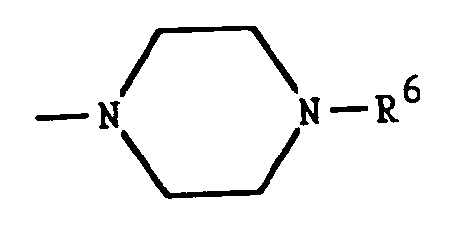 R⁶ représente un atome d'hydrogène ou un radical méthyle.
 - Un dérivé selon les revendications 1 à 3, choisi dans le groupe consistant en:
N,N'-diméthyl-N-[4-(1-pyrrolidinyl)-2-butynyl]urée;
N-[4-(diméthylamino)-2-butynyl]-N,N'-diméthyl-urée;
N-[4-(diéthylamino)-2-butynyl]-N,N'-diméthyl-urée;
N'-éthyl-N-méthyl-N-[4-(1-pyrrolidinyl)-2-butynyl]-urée;
N-[4-(diméthylamino)-2-butynyl)-N'-éthyl-N-méthyl-urée;
N,N'- diméthyl-N-[4-(1-pipéridinyl)-2-butynyl]-urée;
N-[4-(hexahydro-1H-azépin-1-yl)-2-butynyl]-N,N'-diméthyl-urée;
N-éthyl-N'-méthyl-N-[4-(1-pyrrolidinyl)-2-butynyl]-urée;
N-[4-(diméthylamino)-2-butynyl-N-éthyl-N'-méthyl-urée; et
N-[4-(1-pyrrolidinyl)-2-butynyl]-urée. - Utilisation d'un dérivé selon les revendications 1 à 4, pour la préparation de produits pharmaceutiques destinés au traitement des symptomes du déclin de la cognition chez un patient âgé.
- Une composition pharmaceutique pour le traitement des symptômes du déclin de la cognition chez un patient âgé, comprenant une quantité cholinergiquement efficace d'un dérivé selon les revendications 1 à 4, en association avec un support pharmaceutiquement acceptable.
- Un procédé de préparation d'un dérivé de formule I selon les revendications 1 à 4, ou un sel d'addition d'acide pharmaceutiquement acceptable de ce dérivé, qui consiste à faire réagir un dérivé de formule II:

R, R¹, R² et X sont tels que définis ci-dessus,
avec un dérivé de formule III: R³ et R⁴ sont tels que définis ci-dessus en présence de paraformaldéhyde, d'un catalyseur et d'un solvant, à environ 25°C jusqu'à environ la température de reflux du solvant pour obtenir un dérivé de formule I et, si on le souhaite, à convertir un dérivé de formule I en un sel d'addition d'acide pharmaceutiquement acceptable par des moyens classiques et, si on le souhaite, à convertir le sel d'addition d'acide pharmaceutiquement acceptable correspondant en un dérivé de formule I par des moyens classiques.
Priority Applications (1)
| Application Number | Priority Date | Filing Date | Title |
|---|---|---|---|
| AT90114787T ATE99290T1 (de) | 1989-08-02 | 1990-08-01 | Substituierte 4-amino-2-butinyl-harnstoffe und - thioharnstoffe sowie deren derivate als zentral wirkende muscarinische mittel. |
Applications Claiming Priority (2)
| Application Number | Priority Date | Filing Date | Title |
|---|---|---|---|
| US388785 | 1989-08-02 | ||
| US07/388,785 US4988688A (en) | 1989-08-02 | 1989-08-02 | 4-(N-substituted amino)-2-butynyl-1-ureas and thioureas and derivatives thereof as centrally acting muscarinic agents |
Publications (2)
| Publication Number | Publication Date |
|---|---|
| EP0411615A1 EP0411615A1 (fr) | 1991-02-06 |
| EP0411615B1 true EP0411615B1 (fr) | 1993-12-29 |
Family
ID=23535507
Family Applications (1)
| Application Number | Title | Priority Date | Filing Date |
|---|---|---|---|
| EP90114787A Expired - Lifetime EP0411615B1 (fr) | 1989-08-02 | 1990-08-01 | (Amino-4-butyne-2-yl-1) urées et thiourées substituées au groupe amino et leurs dérivés en tant qu'agents muscariniques à action centrale |
Country Status (15)
| Country | Link |
|---|---|
| US (1) | US4988688A (fr) |
| EP (1) | EP0411615B1 (fr) |
| JP (1) | JPH0374359A (fr) |
| KR (1) | KR910004559A (fr) |
| AT (1) | ATE99290T1 (fr) |
| AU (1) | AU6001990A (fr) |
| CA (1) | CA2022510A1 (fr) |
| DE (1) | DE69005557T2 (fr) |
| DK (1) | DK0411615T3 (fr) |
| ES (1) | ES2062220T3 (fr) |
| FI (1) | FI903835A7 (fr) |
| IE (1) | IE902792A1 (fr) |
| NO (1) | NO903384L (fr) |
| PT (1) | PT94874A (fr) |
| ZA (1) | ZA906057B (fr) |
Families Citing this family (12)
| Publication number | Priority date | Publication date | Assignee | Title |
|---|---|---|---|---|
| JPH09504278A (ja) * | 1944-06-01 | 1997-04-28 | ザ、ウェルカム、ファンデーション、リミテッド | Noシンターゼインヒビターとしての置換尿素およびイソチオ尿素誘導体 |
| US5202459A (en) * | 1989-11-07 | 1993-04-13 | Nippon Kayaku Kabushiki Kaisha | Process for producing cyclobutane derivative |
| US5182284A (en) * | 1990-01-26 | 1993-01-26 | Taiho Pharmaceutical Co., Ltd. | Piperazine compounds, processes for preparation thereof and medical uses thereof |
| FR2677019B1 (fr) * | 1991-05-27 | 1994-11-25 | Pf Medicament | Nouvelles piperidines disubstituees-1,4, leur preparation et leur application en therapeutique. |
| US6297276B1 (en) | 1993-10-04 | 2001-10-02 | Glaxosmithkline | Substituted urea and isothiourea derivatives as no synthase inhibitors |
| US6090846A (en) * | 1994-06-01 | 2000-07-18 | Glaxo Wellcome Inc. | Substituted urea and isothiourea derivatives as no synthase inhibitors |
| US6225305B1 (en) | 1993-10-04 | 2001-05-01 | Glaxo Wellcome Inc. | Substituted urea and isothiorea derivatives as no synthase inhibitors |
| GB9418912D0 (en) * | 1994-09-20 | 1994-11-09 | Fisons Corp | Pharmaceutically active compounds |
| TW397812B (en) * | 1995-02-11 | 2000-07-11 | Astra Ab | Bicyclic isothiourea derivatives useful in therapy |
| US6313172B1 (en) * | 2000-04-13 | 2001-11-06 | Allergan Sales, Inc. | Methods and compositions for modulating alpha adrenergic receptor activity |
| US6545182B2 (en) * | 2000-04-13 | 2003-04-08 | Allergan Sales, Inc. | Methods and compositions for modulating alpha adrenergic receptor activity |
| US7185522B2 (en) | 2005-05-10 | 2007-03-06 | T. Sendzimir, Inc. | Side supported 6-high rolling mill |
Family Cites Families (2)
| Publication number | Priority date | Publication date | Assignee | Title |
|---|---|---|---|---|
| US3354178A (en) * | 1965-04-09 | 1967-11-21 | Sterling Drug Inc | Nu-(4-amino-2-butynyl)-nu-alkylcarboxamides |
| US4065471A (en) * | 1965-04-09 | 1977-12-27 | Sterling Drug Inc. | N-(4-Amino-2-butynyl)imides |
-
1989
- 1989-08-02 US US07/388,785 patent/US4988688A/en not_active Expired - Fee Related
-
1990
- 1990-07-31 AU AU60019/90A patent/AU6001990A/en not_active Abandoned
- 1990-08-01 ZA ZA906057A patent/ZA906057B/xx unknown
- 1990-08-01 KR KR1019900011931A patent/KR910004559A/ko not_active Withdrawn
- 1990-08-01 AT AT90114787T patent/ATE99290T1/de not_active IP Right Cessation
- 1990-08-01 DE DE90114787T patent/DE69005557T2/de not_active Expired - Fee Related
- 1990-08-01 PT PT94874A patent/PT94874A/pt not_active Application Discontinuation
- 1990-08-01 IE IE279290A patent/IE902792A1/en unknown
- 1990-08-01 NO NO90903384A patent/NO903384L/no unknown
- 1990-08-01 ES ES90114787T patent/ES2062220T3/es not_active Expired - Lifetime
- 1990-08-01 FI FI903835A patent/FI903835A7/fi not_active Application Discontinuation
- 1990-08-01 JP JP2202622A patent/JPH0374359A/ja active Pending
- 1990-08-01 CA CA002022510A patent/CA2022510A1/fr not_active Abandoned
- 1990-08-01 EP EP90114787A patent/EP0411615B1/fr not_active Expired - Lifetime
- 1990-08-01 DK DK90114787.6T patent/DK0411615T3/da active
Also Published As
| Publication number | Publication date |
|---|---|
| DE69005557T2 (de) | 1994-04-21 |
| NO903384L (no) | 1991-02-04 |
| CA2022510A1 (fr) | 1991-02-03 |
| AU6001990A (en) | 1991-02-07 |
| FI903835A0 (fi) | 1990-08-01 |
| FI903835A7 (fi) | 1991-02-03 |
| PT94874A (pt) | 1991-04-18 |
| JPH0374359A (ja) | 1991-03-28 |
| NO903384D0 (no) | 1990-08-01 |
| DK0411615T3 (da) | 1994-01-24 |
| DE69005557D1 (de) | 1994-02-10 |
| ES2062220T3 (es) | 1994-12-16 |
| EP0411615A1 (fr) | 1991-02-06 |
| ATE99290T1 (de) | 1994-01-15 |
| US4988688A (en) | 1991-01-29 |
| ZA906057B (en) | 1992-04-29 |
| IE902792A1 (en) | 1991-02-27 |
| KR910004559A (ko) | 1991-03-28 |
Similar Documents
| Publication | Publication Date | Title |
|---|---|---|
| JP3827712B2 (ja) | 尿素誘導体およびその用途 | |
| US4797419A (en) | Method of treating the symptoms of senile cognitive decline employing di- or trisubstituted urea cholinergic agents | |
| EP0411615B1 (fr) | (Amino-4-butyne-2-yl-1) urées et thiourées substituées au groupe amino et leurs dérivés en tant qu'agents muscariniques à action centrale | |
| EP0628548B1 (fr) | Dérivés de 1,2,3,4-tétrahydro-9-acridinamine | |
| HU211566A9 (en) | New benzimidazoline-2-oxo-1-carboxylic acid derivatives useful as 5-ht receptor antagonists | |
| JP3367670B2 (ja) | コリン作用薬としてのアザビシクロアリールアセチレンおよびアリーレニンオキシム | |
| JP2000239166A (ja) | アザビシクロおよびアミンコリン作働剤 | |
| US4996201A (en) | 4-(N-substituted amino)-2-butynyl-1-carbamates and thiocarbamates and derivatives thereof as centrally acting muscarinic agents | |
| DE60015732T2 (de) | Amidverbindungen zur stärkung der cholinergischen wirkung | |
| US5468875A (en) | 1-azabicycloheptane derivatives | |
| FI98459C (fi) | Menetelmä terapeuttisesti käyttökelpoisten 5-etano-2,3,4,5-1H-2-bentsatsepin-7-olikarbamaattijohdannaisten valmistamiseksi | |
| DE69232980T2 (de) | Pyrroloazepinderivate | |
| EP0508370B1 (fr) | Diazépinones condensées, procédé pour leur préparation et compositions les contenant pour le traitement de maladies du système nerveux central et pour augmenter la perfusion cérébrale | |
| US5066662A (en) | Substituted oxazolidin-2-ones and 1,2,4-oxadiazolin-5-ones and derivatives thereof acting at muscarinic receptors | |
| DE60036081T2 (de) | (1-phenacyl-3-phenyl-3-piperidylethyl)piperidinderivate, verfahren zu deren herstellung und sie enthaltende pharmazeutische zusammensetzungen | |
| US5066665A (en) | Substituted isoxazolidin-3-ones and derivatives thereof acting at muscarinic receptors | |
| IE902762A1 (en) | Packet opening device | |
| US5066663A (en) | Substituted-hetero-cyclopentanones and cyclopentenones and derivatives thereof acting at muscarinic receptors | |
| US5068237A (en) | Substituted furans and derivatives thereof acting at muscarinic receptors | |
| US5200419A (en) | Substituted tetrazoles and derivatives thereof acting at muscarinic receptors | |
| JP2000500139A (ja) | 1−アザビシクロヘプタン誘導体およびそれらの医薬用途 | |
| EA003613B1 (ru) | Уреидопиперидиновые производные как селективные антагонисты nk3-рецепторов человека | |
| EP0326066A2 (fr) | Diazépinones condensées, procédé pour leur préparation et médicament les contenant | |
| EP0016746A1 (fr) | Spirocycloalcoylamines à activité thérapeutique et préparations pharmaceutiques de tels composés | |
| HK1054744A (en) | 5-phenylbenzylamine compounds, process for their production and intermediates for their synthesis |
Legal Events
| Date | Code | Title | Description |
|---|---|---|---|
| PUAI | Public reference made under article 153(3) epc to a published international application that has entered the european phase |
Free format text: ORIGINAL CODE: 0009012 |
|
| 17P | Request for examination filed |
Effective date: 19900801 |
|
| AK | Designated contracting states |
Kind code of ref document: A1 Designated state(s): AT BE CH DE DK ES FR GB GR IT LI LU NL SE |
|
| 17Q | First examination report despatched |
Effective date: 19921211 |
|
| GRAA | (expected) grant |
Free format text: ORIGINAL CODE: 0009210 |
|
| AK | Designated contracting states |
Kind code of ref document: B1 Designated state(s): AT BE CH DE DK ES FR GB GR IT LI LU NL SE |
|
| REF | Corresponds to: |
Ref document number: 99290 Country of ref document: AT Date of ref document: 19940115 Kind code of ref document: T |
|
| REG | Reference to a national code |
Ref country code: DK Ref legal event code: T3 |
|
| ET | Fr: translation filed | ||
| REF | Corresponds to: |
Ref document number: 69005557 Country of ref document: DE Date of ref document: 19940210 |
|
| ITF | It: translation for a ep patent filed | ||
| REG | Reference to a national code |
Ref country code: GR Ref legal event code: FG4A Free format text: 3010879 |
|
| PGFP | Annual fee paid to national office [announced via postgrant information from national office to epo] |
Ref country code: GB Payment date: 19940504 Year of fee payment: 5 |
|
| PGFP | Annual fee paid to national office [announced via postgrant information from national office to epo] |
Ref country code: GR Payment date: 19940527 Year of fee payment: 5 |
|
| PGFP | Annual fee paid to national office [announced via postgrant information from national office to epo] |
Ref country code: ES Payment date: 19940711 Year of fee payment: 5 |
|
| PGFP | Annual fee paid to national office [announced via postgrant information from national office to epo] |
Ref country code: AT Payment date: 19940727 Year of fee payment: 5 |
|
| PGFP | Annual fee paid to national office [announced via postgrant information from national office to epo] |
Ref country code: LU Payment date: 19940801 Year of fee payment: 5 |
|
| PGFP | Annual fee paid to national office [announced via postgrant information from national office to epo] |
Ref country code: DK Payment date: 19940802 Year of fee payment: 5 |
|
| PGFP | Annual fee paid to national office [announced via postgrant information from national office to epo] |
Ref country code: SE Payment date: 19940803 Year of fee payment: 5 |
|
| PGFP | Annual fee paid to national office [announced via postgrant information from national office to epo] |
Ref country code: CH Payment date: 19940819 Year of fee payment: 5 |
|
| PGFP | Annual fee paid to national office [announced via postgrant information from national office to epo] |
Ref country code: FR Payment date: 19940822 Year of fee payment: 5 |
|
| PGFP | Annual fee paid to national office [announced via postgrant information from national office to epo] |
Ref country code: NL Payment date: 19940831 Year of fee payment: 5 |
|
| PGFP | Annual fee paid to national office [announced via postgrant information from national office to epo] |
Ref country code: DE Payment date: 19940902 Year of fee payment: 5 Ref country code: BE Payment date: 19940902 Year of fee payment: 5 |
|
| PLBE | No opposition filed within time limit |
Free format text: ORIGINAL CODE: 0009261 |
|
| STAA | Information on the status of an ep patent application or granted ep patent |
Free format text: STATUS: NO OPPOSITION FILED WITHIN TIME LIMIT |
|
| REG | Reference to a national code |
Ref country code: ES Ref legal event code: FG2A Ref document number: 2062220 Country of ref document: ES Kind code of ref document: T3 |
|
| 26N | No opposition filed | ||
| EAL | Se: european patent in force in sweden |
Ref document number: 90114787.6 |
|
| PG25 | Lapsed in a contracting state [announced via postgrant information from national office to epo] |
Ref country code: LU Free format text: LAPSE BECAUSE OF NON-PAYMENT OF DUE FEES Effective date: 19950801 Ref country code: GB Effective date: 19950801 Ref country code: DK Effective date: 19950801 Ref country code: AT Effective date: 19950801 |
|
| REG | Reference to a national code |
Ref country code: DK Ref legal event code: EBP |
|
| PG25 | Lapsed in a contracting state [announced via postgrant information from national office to epo] |
Ref country code: SE Effective date: 19950802 Ref country code: ES Free format text: LAPSE BECAUSE OF EXPIRATION OF PROTECTION Effective date: 19950802 |
|
| PG25 | Lapsed in a contracting state [announced via postgrant information from national office to epo] |
Ref country code: LI Effective date: 19950831 Ref country code: CH Effective date: 19950831 Ref country code: BE Effective date: 19950831 |
|
| PG25 | Lapsed in a contracting state [announced via postgrant information from national office to epo] |
Ref country code: GR Free format text: THE PATENT HAS BEEN ANNULLED BY A DECISION OF A NATIONAL AUTHORITY Effective date: 19960228 |
|
| BERE | Be: lapsed |
Owner name: WARNER-LAMBERT CY Effective date: 19950831 |
|
| PG25 | Lapsed in a contracting state [announced via postgrant information from national office to epo] |
Ref country code: NL Effective date: 19960301 |
|
| GBPC | Gb: european patent ceased through non-payment of renewal fee |
Effective date: 19950801 |
|
| REG | Reference to a national code |
Ref country code: CH Ref legal event code: PL |
|
| PG25 | Lapsed in a contracting state [announced via postgrant information from national office to epo] |
Ref country code: FR Effective date: 19960430 |
|
| REG | Reference to a national code |
Ref country code: GR Ref legal event code: MM2A Free format text: 3010879 |
|
| NLV4 | Nl: lapsed or anulled due to non-payment of the annual fee |
Effective date: 19960301 |
|
| PG25 | Lapsed in a contracting state [announced via postgrant information from national office to epo] |
Ref country code: DE Effective date: 19960501 |
|
| EUG | Se: european patent has lapsed |
Ref document number: 90114787.6 |
|
| REG | Reference to a national code |
Ref country code: FR Ref legal event code: ST |
|
| REG | Reference to a national code |
Ref country code: ES Ref legal event code: FD2A Effective date: 19991007 |
|
| PG25 | Lapsed in a contracting state [announced via postgrant information from national office to epo] |
Ref country code: IT Free format text: LAPSE BECAUSE OF NON-PAYMENT OF DUE FEES;WARNING: LAPSES OF ITALIAN PATENTS WITH EFFECTIVE DATE BEFORE 2007 MAY HAVE OCCURRED AT ANY TIME BEFORE 2007. THE CORRECT EFFECTIVE DATE MAY BE DIFFERENT FROM THE ONE RECORDED. Effective date: 20050801 |