EP0412026A1 - Aufzeichnungsverfahren und Aufzeichnungsvorrichtung, die eine lichtempfindliche Aufzeichnungsschicht gebrauchen - Google Patents
Aufzeichnungsverfahren und Aufzeichnungsvorrichtung, die eine lichtempfindliche Aufzeichnungsschicht gebrauchen Download PDFInfo
- Publication number
- EP0412026A1 EP0412026A1 EP90420350A EP90420350A EP0412026A1 EP 0412026 A1 EP0412026 A1 EP 0412026A1 EP 90420350 A EP90420350 A EP 90420350A EP 90420350 A EP90420350 A EP 90420350A EP 0412026 A1 EP0412026 A1 EP 0412026A1
- Authority
- EP
- European Patent Office
- Prior art keywords
- reproduction
- sheet
- compound
- microcapsules
- radiation
- Prior art date
- Legal status (The legal status is an assumption and is not a legal conclusion. Google has not performed a legal analysis and makes no representation as to the accuracy of the status listed.)
- Withdrawn
Links
- 238000000034 method Methods 0.000 title claims description 31
- 230000008569 process Effects 0.000 title claims description 15
- 239000003094 microcapsule Substances 0.000 claims abstract description 77
- 230000005855 radiation Effects 0.000 claims abstract description 65
- 150000001875 compounds Chemical class 0.000 claims abstract description 56
- 239000000758 substrate Substances 0.000 claims abstract description 20
- 230000009471 action Effects 0.000 claims abstract description 15
- 239000003795 chemical substances by application Substances 0.000 claims abstract description 13
- 238000010438 heat treatment Methods 0.000 claims abstract description 9
- 239000007788 liquid Substances 0.000 claims abstract description 8
- 230000005670 electromagnetic radiation Effects 0.000 claims abstract description 3
- 239000003086 colorant Substances 0.000 claims description 43
- 238000000576 coating method Methods 0.000 claims description 27
- 239000011248 coating agent Substances 0.000 claims description 24
- 239000000126 substance Substances 0.000 claims description 16
- 238000010521 absorption reaction Methods 0.000 claims description 11
- 230000000694 effects Effects 0.000 claims description 11
- 239000000463 material Substances 0.000 claims description 10
- XLYOFNOQVPJJNP-UHFFFAOYSA-N water Substances O XLYOFNOQVPJJNP-UHFFFAOYSA-N 0.000 claims description 10
- 230000000295 complement effect Effects 0.000 claims description 8
- 150000001412 amines Chemical class 0.000 claims description 6
- 239000002253 acid Substances 0.000 claims description 5
- 150000007513 acids Chemical class 0.000 claims description 4
- 150000001298 alcohols Chemical class 0.000 claims description 4
- 238000005286 illumination Methods 0.000 claims description 4
- 125000000524 functional group Chemical group 0.000 claims description 3
- 229910052751 metal Inorganic materials 0.000 claims description 2
- 239000002184 metal Substances 0.000 claims description 2
- 150000002739 metals Chemical class 0.000 claims description 2
- 239000000049 pigment Substances 0.000 claims description 2
- 239000011888 foil Substances 0.000 claims 1
- 238000000016 photochemical curing Methods 0.000 claims 1
- 239000002775 capsule Substances 0.000 description 21
- 239000000243 solution Substances 0.000 description 17
- 230000009172 bursting Effects 0.000 description 9
- 229920000642 polymer Polymers 0.000 description 9
- 238000005538 encapsulation Methods 0.000 description 8
- 238000012695 Interfacial polymerization Methods 0.000 description 7
- 238000011161 development Methods 0.000 description 6
- 239000000178 monomer Substances 0.000 description 6
- 238000006116 polymerization reaction Methods 0.000 description 6
- 238000012546 transfer Methods 0.000 description 6
- 239000000839 emulsion Substances 0.000 description 5
- 238000003756 stirring Methods 0.000 description 5
- HRPVXLWXLXDGHG-UHFFFAOYSA-N Acrylamide Chemical compound NC(=O)C=C HRPVXLWXLXDGHG-UHFFFAOYSA-N 0.000 description 4
- AIJULSRZWUXGPQ-UHFFFAOYSA-N Methylglyoxal Chemical compound CC(=O)C=O AIJULSRZWUXGPQ-UHFFFAOYSA-N 0.000 description 4
- 238000004040 coloring Methods 0.000 description 4
- 239000000203 mixture Substances 0.000 description 4
- 230000000717 retained effect Effects 0.000 description 4
- PLXMOAALOJOTIY-FPTXNFDTSA-N Aesculin Natural products OC[C@@H]1[C@@H](O)[C@H](O)[C@@H](O)[C@H](O)[C@H]1Oc2cc3C=CC(=O)Oc3cc2O PLXMOAALOJOTIY-FPTXNFDTSA-N 0.000 description 3
- 229920002396 Polyurea Polymers 0.000 description 3
- HEMHJVSKTPXQMS-UHFFFAOYSA-M Sodium hydroxide Chemical compound [OH-].[Na+] HEMHJVSKTPXQMS-UHFFFAOYSA-M 0.000 description 3
- 238000005516 engineering process Methods 0.000 description 3
- YQGOJNYOYNNSMM-UHFFFAOYSA-N eosin Chemical compound [Na+].OC(=O)C1=CC=CC=C1C1=C2C=C(Br)C(=O)C(Br)=C2OC2=C(Br)C(O)=C(Br)C=C21 YQGOJNYOYNNSMM-UHFFFAOYSA-N 0.000 description 3
- 239000003999 initiator Substances 0.000 description 3
- 239000012948 isocyanate Substances 0.000 description 3
- 239000002904 solvent Substances 0.000 description 3
- 239000000725 suspension Substances 0.000 description 3
- DILXLMRYFWFBGR-UHFFFAOYSA-N 2-formylbenzene-1,4-disulfonic acid Chemical compound OS(=O)(=O)C1=CC=C(S(O)(=O)=O)C(C=O)=C1 DILXLMRYFWFBGR-UHFFFAOYSA-N 0.000 description 2
- LBLYYCQCTBFVLH-UHFFFAOYSA-M 2-methylbenzenesulfonate Chemical compound CC1=CC=CC=C1S([O-])(=O)=O LBLYYCQCTBFVLH-UHFFFAOYSA-M 0.000 description 2
- RBTBFTRPCNLSDE-UHFFFAOYSA-N 3,7-bis(dimethylamino)phenothiazin-5-ium Chemical compound C1=CC(N(C)C)=CC2=[S+]C3=CC(N(C)C)=CC=C3N=C21 RBTBFTRPCNLSDE-UHFFFAOYSA-N 0.000 description 2
- QTBSBXVTEAMEQO-UHFFFAOYSA-N Acetic acid Natural products CC(O)=O QTBSBXVTEAMEQO-UHFFFAOYSA-N 0.000 description 2
- QGZKDVFQNNGYKY-UHFFFAOYSA-N Ammonia Chemical compound N QGZKDVFQNNGYKY-UHFFFAOYSA-N 0.000 description 2
- RPNUMPOLZDHAAY-UHFFFAOYSA-N Diethylenetriamine Chemical compound NCCNCCN RPNUMPOLZDHAAY-UHFFFAOYSA-N 0.000 description 2
- PIICEJLVQHRZGT-UHFFFAOYSA-N Ethylenediamine Chemical compound NCCN PIICEJLVQHRZGT-UHFFFAOYSA-N 0.000 description 2
- ZHNUHDYFZUAESO-UHFFFAOYSA-N Formamide Chemical compound NC=O ZHNUHDYFZUAESO-UHFFFAOYSA-N 0.000 description 2
- 229920000877 Melamine resin Polymers 0.000 description 2
- OFBQJSOFQDEBGM-UHFFFAOYSA-N Pentane Chemical compound CCCCC OFBQJSOFQDEBGM-UHFFFAOYSA-N 0.000 description 2
- CDBYLPFSWZWCQE-UHFFFAOYSA-L Sodium Carbonate Chemical compound [Na+].[Na+].[O-]C([O-])=O CDBYLPFSWZWCQE-UHFFFAOYSA-L 0.000 description 2
- 230000003213 activating effect Effects 0.000 description 2
- 239000007864 aqueous solution Substances 0.000 description 2
- UWCPYKQBIPYOLX-UHFFFAOYSA-N benzene-1,3,5-tricarbonyl chloride Chemical compound ClC(=O)C1=CC(C(Cl)=O)=CC(C(Cl)=O)=C1 UWCPYKQBIPYOLX-UHFFFAOYSA-N 0.000 description 2
- 239000012965 benzophenone Substances 0.000 description 2
- 150000008366 benzophenones Chemical class 0.000 description 2
- 239000011230 binding agent Substances 0.000 description 2
- 238000006243 chemical reaction Methods 0.000 description 2
- 229920001577 copolymer Polymers 0.000 description 2
- WMPOZLHMGVKUEJ-UHFFFAOYSA-N decanedioyl dichloride Chemical compound ClC(=O)CCCCCCCCC(Cl)=O WMPOZLHMGVKUEJ-UHFFFAOYSA-N 0.000 description 2
- 230000005284 excitation Effects 0.000 description 2
- -1 inorganic peracid compounds Chemical class 0.000 description 2
- 150000002513 isocyanates Chemical class 0.000 description 2
- 229960000907 methylthioninium chloride Drugs 0.000 description 2
- 239000003921 oil Substances 0.000 description 2
- 230000003287 optical effect Effects 0.000 description 2
- 150000002923 oximes Chemical class 0.000 description 2
- 125000001997 phenyl group Chemical group [H]C1=C([H])C([H])=C(*)C([H])=C1[H] 0.000 description 2
- 230000000704 physical effect Effects 0.000 description 2
- 239000012985 polymerization agent Substances 0.000 description 2
- 239000002243 precursor Substances 0.000 description 2
- 210000004994 reproductive system Anatomy 0.000 description 2
- 159000000000 sodium salts Chemical class 0.000 description 2
- 238000012360 testing method Methods 0.000 description 2
- YRHRIQCWCFGUEQ-UHFFFAOYSA-N thioxanthen-9-one Chemical compound C1=CC=C2C(=O)C3=CC=CC=C3SC2=C1 YRHRIQCWCFGUEQ-UHFFFAOYSA-N 0.000 description 2
- BEQKKZICTDFVMG-UHFFFAOYSA-N 1,2,3,4,6-pentaoxepane-5,7-dione Chemical compound O=C1OOOOC(=O)O1 BEQKKZICTDFVMG-UHFFFAOYSA-N 0.000 description 1
- 101100037762 Caenorhabditis elegans rnh-2 gene Proteins 0.000 description 1
- 229920002134 Carboxymethyl cellulose Polymers 0.000 description 1
- XDTMQSROBMDMFD-UHFFFAOYSA-N Cyclohexane Chemical compound C1CCCCC1 XDTMQSROBMDMFD-UHFFFAOYSA-N 0.000 description 1
- VGGSQFUCUMXWEO-UHFFFAOYSA-N Ethene Chemical compound C=C VGGSQFUCUMXWEO-UHFFFAOYSA-N 0.000 description 1
- 239000001856 Ethyl cellulose Substances 0.000 description 1
- ZZSNKZQZMQGXPY-UHFFFAOYSA-N Ethyl cellulose Chemical compound CCOCC1OC(OC)C(OCC)C(OCC)C1OC1C(O)C(O)C(OC)C(CO)O1 ZZSNKZQZMQGXPY-UHFFFAOYSA-N 0.000 description 1
- 239000005977 Ethylene Substances 0.000 description 1
- 206010019345 Heat stroke Diseases 0.000 description 1
- 238000012696 Interfacial polycondensation Methods 0.000 description 1
- CTQNGGLPUBDAKN-UHFFFAOYSA-N O-Xylene Chemical compound CC1=CC=CC=C1C CTQNGGLPUBDAKN-UHFFFAOYSA-N 0.000 description 1
- 229920000538 Poly[(phenyl isocyanate)-co-formaldehyde] Polymers 0.000 description 1
- 239000004952 Polyamide Substances 0.000 description 1
- 239000004115 Sodium Silicate Substances 0.000 description 1
- 208000007180 Sunstroke Diseases 0.000 description 1
- 238000013019 agitation Methods 0.000 description 1
- 150000001408 amides Chemical class 0.000 description 1
- 229910021529 ammonia Inorganic materials 0.000 description 1
- 238000004061 bleaching Methods 0.000 description 1
- 239000001045 blue dye Substances 0.000 description 1
- 238000003490 calendering Methods 0.000 description 1
- 239000001768 carboxy methyl cellulose Substances 0.000 description 1
- 235000010948 carboxy methyl cellulose Nutrition 0.000 description 1
- 239000008112 carboxymethyl-cellulose Substances 0.000 description 1
- 238000001311 chemical methods and process Methods 0.000 description 1
- 230000006835 compression Effects 0.000 description 1
- 238000007906 compression Methods 0.000 description 1
- 238000001816 cooling Methods 0.000 description 1
- 239000003431 cross linking reagent Substances 0.000 description 1
- 230000009849 deactivation Effects 0.000 description 1
- 238000010908 decantation Methods 0.000 description 1
- 239000012933 diacyl peroxide Substances 0.000 description 1
- 150000004985 diamines Chemical class 0.000 description 1
- 125000004177 diethyl group Chemical group [H]C([H])([H])C([H])([H])* 0.000 description 1
- 125000005442 diisocyanate group Chemical group 0.000 description 1
- 230000008034 disappearance Effects 0.000 description 1
- 239000006185 dispersion Substances 0.000 description 1
- 238000004090 dissolution Methods 0.000 description 1
- 239000012153 distilled water Substances 0.000 description 1
- 239000000975 dye Substances 0.000 description 1
- 239000003995 emulsifying agent Substances 0.000 description 1
- 229920001249 ethyl cellulose Polymers 0.000 description 1
- 235000019325 ethyl cellulose Nutrition 0.000 description 1
- 238000002474 experimental method Methods 0.000 description 1
- 239000004744 fabric Substances 0.000 description 1
- 239000000945 filler Substances 0.000 description 1
- 239000012530 fluid Substances 0.000 description 1
- 239000006260 foam Substances 0.000 description 1
- 239000011521 glass Substances 0.000 description 1
- 238000000265 homogenisation Methods 0.000 description 1
- 230000007062 hydrolysis Effects 0.000 description 1
- 238000006460 hydrolysis reaction Methods 0.000 description 1
- 230000000977 initiatory effect Effects 0.000 description 1
- 239000008267 milk Substances 0.000 description 1
- 210000004080 milk Anatomy 0.000 description 1
- 235000013336 milk Nutrition 0.000 description 1
- 239000002480 mineral oil Substances 0.000 description 1
- 235000010446 mineral oil Nutrition 0.000 description 1
- 238000012986 modification Methods 0.000 description 1
- 230000004048 modification Effects 0.000 description 1
- 125000000896 monocarboxylic acid group Chemical group 0.000 description 1
- 239000005416 organic matter Substances 0.000 description 1
- 150000004967 organic peroxy acids Chemical class 0.000 description 1
- 229920000620 organic polymer Polymers 0.000 description 1
- 229940097156 peroxyl Drugs 0.000 description 1
- 239000004033 plastic Substances 0.000 description 1
- 229920003023 plastic Polymers 0.000 description 1
- 229920002647 polyamide Polymers 0.000 description 1
- 229920000768 polyamine Polymers 0.000 description 1
- 238000006068 polycondensation reaction Methods 0.000 description 1
- 229920001228 polyisocyanate Polymers 0.000 description 1
- 239000005056 polyisocyanate Substances 0.000 description 1
- 239000003505 polymerization initiator Substances 0.000 description 1
- 238000012545 processing Methods 0.000 description 1
- 239000003223 protective agent Substances 0.000 description 1
- 239000002994 raw material Substances 0.000 description 1
- 239000001044 red dye Substances 0.000 description 1
- 229910000029 sodium carbonate Inorganic materials 0.000 description 1
- NTHWMYGWWRZVTN-UHFFFAOYSA-N sodium silicate Chemical compound [Na+].[Na+].[O-][Si]([O-])=O NTHWMYGWWRZVTN-UHFFFAOYSA-N 0.000 description 1
- 229910052911 sodium silicate Inorganic materials 0.000 description 1
- 239000007787 solid Substances 0.000 description 1
- 238000001228 spectrum Methods 0.000 description 1
- 230000000087 stabilizing effect Effects 0.000 description 1
- 239000007858 starting material Substances 0.000 description 1
- 150000003512 tertiary amines Chemical class 0.000 description 1
- 229940099259 vaseline Drugs 0.000 description 1
- 238000001429 visible spectrum Methods 0.000 description 1
- 238000004078 waterproofing Methods 0.000 description 1
- 239000008096 xylene Substances 0.000 description 1
Images
Classifications
-
- B—PERFORMING OPERATIONS; TRANSPORTING
- B41—PRINTING; LINING MACHINES; TYPEWRITERS; STAMPS
- B41M—PRINTING, DUPLICATING, MARKING, OR COPYING PROCESSES; COLOUR PRINTING
- B41M5/00—Duplicating or marking methods; Sheet materials for use therein
- B41M5/26—Thermography ; Marking by high energetic means, e.g. laser otherwise than by burning, and characterised by the material used
- B41M5/28—Thermography ; Marking by high energetic means, e.g. laser otherwise than by burning, and characterised by the material used using thermochromic compounds or layers containing liquid crystals, microcapsules, bleachable dyes or heat- decomposable compounds, e.g. gas- liberating
- B41M5/287—Thermography ; Marking by high energetic means, e.g. laser otherwise than by burning, and characterised by the material used using thermochromic compounds or layers containing liquid crystals, microcapsules, bleachable dyes or heat- decomposable compounds, e.g. gas- liberating using microcapsules or microspheres only
-
- B—PERFORMING OPERATIONS; TRANSPORTING
- B41—PRINTING; LINING MACHINES; TYPEWRITERS; STAMPS
- B41M—PRINTING, DUPLICATING, MARKING, OR COPYING PROCESSES; COLOUR PRINTING
- B41M5/00—Duplicating or marking methods; Sheet materials for use therein
- B41M5/124—Duplicating or marking methods; Sheet materials for use therein using pressure to make a masked colour visible, e.g. to make a coloured support visible, to create an opaque or transparent pattern, or to form colour by uniting colour-forming components
- B41M5/165—Duplicating or marking methods; Sheet materials for use therein using pressure to make a masked colour visible, e.g. to make a coloured support visible, to create an opaque or transparent pattern, or to form colour by uniting colour-forming components characterised by the use of microcapsules; Special solvents for incorporating the ingredients
-
- G—PHYSICS
- G03—PHOTOGRAPHY; CINEMATOGRAPHY; ANALOGOUS TECHNIQUES USING WAVES OTHER THAN OPTICAL WAVES; ELECTROGRAPHY; HOLOGRAPHY
- G03F—PHOTOMECHANICAL PRODUCTION OF TEXTURED OR PATTERNED SURFACES, e.g. FOR PRINTING, FOR PROCESSING OF SEMICONDUCTOR DEVICES; MATERIALS THEREFOR; ORIGINALS THEREFOR; APPARATUS SPECIALLY ADAPTED THEREFOR
- G03F7/00—Photomechanical, e.g. photolithographic, production of textured or patterned surfaces, e.g. printing surfaces; Materials therefor, e.g. comprising photoresists; Apparatus specially adapted therefor
- G03F7/002—Photomechanical, e.g. photolithographic, production of textured or patterned surfaces, e.g. printing surfaces; Materials therefor, e.g. comprising photoresists; Apparatus specially adapted therefor using materials containing microcapsules; Preparing or processing such materials, e.g. by pressure; Devices or apparatus specially designed therefor
Definitions
- the present invention relates to the reproduction of an image on a support, whether it be techniques akin to photography, or techniques akin to photocopying, or reprography of originals, and this also well in black and white, that is to say in monochrome, than in color, that is to say in polychrome.
- a reproduction sheet has been described and proposed sensitive to actinic radiation, preferably in the visible spectrum domain, as well as pressure, comprising: - a sheet-shaped substrate, for example a paper a coating sensitive to said actinic radiation, as described below, disposed on at least one face of substrate, this coating comprising synthetic microcapsules; each micro-capsule comprises firstly, a sealed envelope, for example made of organic polymer, capable of breaking under the action of an external agent, in this case a mechanical pressure applied by pinching or calendering, secondly a liquid internal medium, for example an oil, thirdly a coloring agent or revealing compound contained in the interior medium, in this case dissolved in the latter, namely a coloring precursor, capable of reacting chemically with a complementary compound, such as a chromogenic agent, present on the same support or on a transfer or development support, and fourthly a photocurable compound under the
- micro-capsules are obtained in a traditional manner, according to the techniques of micro-encapsulation by polymerization, widely described in the relevant literature.
- Such a reproduction sheet is used according to the reproduction method described below: - with a source of actinic radiation, we project the image of an original to be reproduced on the sheet, and more precisely on the coating mentally sensitive; one thus obtains an insolation or exposure of the latter, differentiated in the plane of the sheet; in the exposed areas, the curable compound increases the mechanical resistance to crushing of the microcapsules and / or increases the viscosity of the interior medium; in unexposed areas, the curable compound remains unchanged -
- the reproduction sheet thus exposed is mechanically subjected, for example between two rollers, to crushing; the latter preferentially bursts unexposed microcapsules, that is to say those whose envelope has not been reinforced, by difference to exposed microcapsules; the coloring agent is released outside the exposed microcapsules, to react with the complementary component or chromogenic agent, on the same substrate, or a transfer or development support, and give a colored product materializing the image of the 'original.
- a reproduction sheet as previously described, and the reproduction method which corresponds to it have the following significant drawbacks.
- the mechanical bursting of the microcapsules requires the application of a regular pressure, and homogeneous in the plane of the reproduction sheet.
- this requires the use of precision compression equipment, and fine adjustment, and on the other hand, the irregularity of the support, on the scale of micro-capsules, in hollow and in bumps, counteracts the application of a uniform pressure in the plane of the sheet. All this therefore leads to a bursting of the microcapsules, erratic as to its location in the plane of the sheet, and consequently unsuitable for the reproduction of a precise image, which requires a bursting exactly at the unexposed places.
- micro-capsules having a certain size for example greater than 100 ⁇ m.
- Micro-capsules with such large dimensions may be incompatible with the reproduction process or device used. It appears desirable in any case to use micro-capsules as fine as possible, so as to have a fine and precise reproduction.
- the thickness of the envelope of the microcapsules can vary significantly from one individual to another.
- all the capsules are subjected individually from the outside to the same compress if we. As a result, some capsules will burst, others will not, and this always in an erratic and uncontrolled manner, which affects the control and precision of the reproduction process.
- the object of the present invention is to remedy these drawbacks.
- the subject of the invention is a reproduction sheet, the microcapsules of which can be exploded exhaustively, whatever the irregularities or imperfections of the substrate / support, or of their various components.
- the subject of the invention is also a reproduction sheet, the micro-capsules of which can be of relatively fine size, for example of the order of 5 to 10 ⁇ m, but can nevertheless be split.
- a subject of the invention is also a reproduction sheet for reproducing a color image of an original.
- At least one of the components of the microcapsules namely the envelope, the interior medium, and the revealing compound, is capable of absorbing and of heating under the action of radiation.
- electromagnetic hyper-frequency known as microwave radiation. This heating leads to the rupture of the same microcapsules, with release towards the outside of the revealing compound. Consequently, according to the invention, microwave radiation is used as an agent revealing the reproduction sheet.
- Such a method also provides the following determining advantages.
- Bursting under the action of microwaves proves to be very rapid, almost instantaneous, and is then compatible with the automation or mechanization of a machine or reproduction device, such as a photocopier.
- microwaves avoids having to resort to any solvent, or other organic, polluting organic matter, for example to dissolve the envelope of the microcapsules. It is therefore a process which can be carried out “dry", which also is largely compatible with a reprographic apparatus.
- microwaves are selective, and does not alter the properties or characteristics of the components of microcapsules, other than those absorbing hyper-frequency radiation. This allows, if necessary, to preserve the properties of the coloring agent or of the revealing compound.
- the power of the microwaves can be adjusted so as to modulate the bursting of the microcapsules.
- the invention offers a reproduction process, easy to implement, and relatively inexpensive as regards the technical means which must be associated with it.
- the present invention also provides a new reproduction system, consisting in incorporating microcapsules into the interior medium, of revealing compound, a coloring agent complementary to the photopolymerizable compound, or vice versa, that is to say: a coloring agent, on the one hand activated by absorption of a first actinic radiation or first band of actinic radiation, for example a first fundamental color of visible light, such as blue, and on the other hand deactivated by absorption of '' a second actinic radiation, or second band of actinic radiation, for example at least one other fundamental color of visible light, complementary to the first fundamental color, such as green or yellow - And a photopolymerizable compound, activated under the effect of the other actinic radiation at least, and inactivated under the effect of the first actinic radiation.
- a coloring agent on the one hand activated by absorption of a first actinic radiation or first band of actinic radiation, for example a first fundamental color of visible light, such as blue, and on the other hand deactiv
- Such a characteristic allows direct polychrome reproduction, that is to say without additional chemical reaction with a chromogenic agent, and without transfer of a latent image on a separate reproduction paper. It suffices to have on the support of the sheet three sets of monochrome microcapsules, corresponding to three fundamental colors respectively, for example, blue, red and yellow. These three sets can be arranged in a single coating, that is to say mixed intimately and homogeneously on the same layer, or in three coatings superimposed on the substrate, corresponding to the three monochrome sets respectively.
- the internal medium of the microcapsules of a given monochrome assembly contains a given couple of coloring agent / photopolymerizable compound, the coloring agent being activated by a given fundamental color, for example the color blue, and deactivated by the other fundamental colors. , namely yellow and green, and the photopolymerizable compound which selectively polymerizes under illumination of at least one other fundamental color, namely yellow and / or green. Consequently, to the three sets given, correspond respectively three different pairs of coloring agents-polymerizable compounds.
- a given couple of coloring agent / photo-polymerizable compound makes it possible to obtain a reproduction in a monochrome color, for example in black and in white.
- a reproduction sheet as described above comprises coloring agents encapsulated in microcapsules sensitive to microwave radiation, then the exposure of the exposed sheet to such radiation makes it possible to directly reveal or develop a color image.
- actinic radiation is meant any radiation of the electromagnetic spectrum, in particular visible, ultra-violet and infrared, X-ray radiation, capable of activating the coloring agent and / or of initiating directly or indirectly the polymerization of the light-curing compound.
- substrate any material having the form of a sheet, that is to say the thickness of which is substantially less than the other two dimensions, namely width and length.
- the materials that can be retained are very diverse; it may be paper, a plastic material, a fabric, a nonwoven, etc.
- This substrate receives a coating comprising the micro-capsules, with or without binder, and is suitable for consequence, either by the choice of material, or by an appropriate treatment and prior.
- a coating capable of being modified as to at least one of its intrinsic properties, by the absorption or reception of actinic radiation.
- the local modifications if they are not already visible to the naked eye, can be subsequently revealed, that is to say made visible, by any suitable process, physical and / or chemical, to obtain a reproduction of the original.
- this coating consists essentially of the microcapsules defined below, incorporated or bonded to the substrate by any suitable means, for example a binder.
- This coating can be constituted in particular by microcapsules lying on a paper.
- the coating can comprise bodies other than the micro-capsules, for example a filler, a protective agent, etc.
- microcapsules closed vesicles, for example spherical, hollow inside, having different dimensions ranging from a few ⁇ m to a few millimeters. These micro-capsules are obtained according to traditional micro-encapsulation techniques, well described in the literature, and for example in: - document FR-A-2 548 046 - document BE-A-796 746 - documents US-C-3,790,497, 3,577,515, 3,173,878 - the "Journal of Micro-Encapsulation", Vol.1, N ° 1, Microcapsules processing and technology - Asaji Kondo.
- the envelope of these capsules transparent to the actinic radiation used in the reproduction process, is generally obtained by polymerization of a monomer, at the interface in dispersed medium of two distinct phases, one of which consists of the interior medium and the various compounds to be encapsulated, generally with vigorous stirring.
- the chemical polymerization routes can be traditional, for example radical, ionic, polyaddition, polycondensation, etc.
- the polymer envelope obtained may or may not be elastic. All kinds of polymers can be retained, for example EMA, copolymer ethylene-maleic anhydride, ethyl cellulose, a polyamide, a polyurea, etc.
- internal medium is meant the liquid or fluid substance contained by the microcapsules. It can be a substance distinct from the revealing and photopolymerizable compounds, active in the process of reproduction or revelation; in this case, the compounds of the reproductive system can be in solution, suspension, dispersion or emulsion in said substance. However, these compounds of the reproductive system can alone form the interior medium, for example in the form of a mixture of liquids.
- revealing compound is meant a body, for example a coloring agent, which once released from the microcapsule is capable of being perceived with the naked eye, directly, or indirectly, for example after an appropriate treatment, especially chemical.
- coloring agent is meant - any compound visible to the naked eye, in the form of a color, including the color white - any compound liable, by chemical and / or physical action, to reveal a color, visible or perceived with the naked eye; if the compound has an original color, the color revealed is different from the latter - any compound such as a coloring precursor, capable of reacting chemically with a complementary compound, such as a chromogenic agent, present on the same support or on a transfer or development support, to generate a product, visible or perceived at the naked eye; if the starting compound and / or the complementary compound have an original color, the colored product obtained has a color different from the latter.
- activating is meant the physical action obtained by absorption of an actinic excitation radiation, consisting in preserving the coloring of the coloring agent, or in bleaching the latter.
- deactivating the coloring agent consists, under the effect of an actinic radiation different from the excitation radiation, or in the absence of the latter, discoloring the coloring agent, or preserving its coloration.
- This coloring agent must be capable of being suspended or solution in the internal environment of the microcapsules.
- microwave radiation electromagnetic radiation whose wavelengths are less than 1 cm, or whose frequencies are greater than 1 GHz.
- the technology specific to the generation and use of this radiation is for example described in: - HF Mark, DF Othmer et al: "Kirk-Othmer Encyclopedia of Chemical Technology, Edition 3, N ° 15, 1989, Wiley and Sons, New York, USA, page 505 to page 521.
- polar material or “polar functional group” is meant any arrangement of atoms electrically polarized due to the chemical nature of said atoms, and behaving like a dipole when they are placed between two electrodes of opposite polarity. It is known that in the presence of microwaves, such arrangements are set in motion, in particular in rotation, which leads to the heating of the corresponding material.
- photo-polymerizable compound in particular any chemical system comprising a monomer, or an oligomer, or a polymer, a photo-polymerization or photo-crosslinking agent under actinic radiation, or photo-initiator, and a transfer agent electronic or "relay".
- This chemical system must be able to be suspended or solution in the internal environment of the microcapsules.
- monomers unsaturated compounds such as ethylene can be used.
- the coloring agent / photo-polymerizable compound couple introduced previously with regard to polychrome or monochrome reproduction, its operation can be as follows: - by insolation of the microcapsules, the coloring agent absorbs the incident light energy, and deactivates, for example passes to the exited state where it is colorless - in doing so, the coloring agent transmits its energy to the photo-polymerization agent, which initiates the polymerization of the monomer, by energy transfer at the relay - under the effect of irradiation, and provided that the illumination wavelength corresponds to the zone of deactivation or absorption of the dye, the microcapsule then became hard and colorless.
- the following products can be selected: - coloring agents: methylene blue, eosin, Capelle red, yellow and blue dyes - monomer or polymer (soluble in water): acrylamide - photo-initiator: 1 phenyl 1-2 propanedione 2- (0 - ethoxycarbonyl) oxime - relay: sodium salt of p-toluene sulfinic acid at 99%
- organic or inorganic peracid compounds such as diacyl peroxide, sulfuryl peroxyl, peroxydicarbonate, etc. may be used.
- the microcapsules according to the invention absorb the microwave radiation, and heat up under the effect of the latter
- different solutions can be adopted: - it can first of all be the envelope of the microcapsules which absorbs this radiation, for example if it is made of a polar chemical material
- it can then be the internal medium of the microcapsules which absorbs this same radiation, in particular if it consists of water, polar organic bodies, such as alcohols, amines, and acids, as well as divided metals in suspension, for example -
- it can also be the revealing compound which absorbs microwave radiation, for example if it is a chemical body comprising polar functional groups, for example alcohols, amines, and acids; but the revealing compound can also absorb microwave radiation, if it is a metallic pigment.
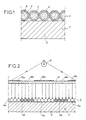
- FIG. 1 shows schematically, and on an enlarged scale a reproduction sheet according to the invention
- FIG. 2 shows the sunstroke or exposure phase of a sheet according to the invention, in an appropriate device
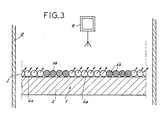
- Figure 3 shows the development phase or revelation of the same sheet, in an appropriate device, after exposure according to Figure 2, this development phase being accomplished in the presence of microwave radiation.
- the reproduction sheet marked with the reference numeral 1 comprises a sheet-shaped substrate 2, for example a sheet of paper, a sensitive coating 3 disposed on one of the faces of the aforementioned substrate, comprising microcapsules 4 according to the invention.
- Each microcapsule comprises a sealed envelope 5, and a liquid interior medium 6 comprising a revealing compound, active with respect to reproduction, namely a coloring agent as defined above, but also a photo-polymerizable compound under the action of actinic radiation, for example visible or infrared light.
- a polychromatic light source 13 and from an original 10 to be reproduced, there is obtained by light reflected or transmitted by said original, an image comprising for example beams colored in blue (fundamental color), resulting from the absorption in areas 10a of the original of the other fundamental colors, and of beams of another color, corresponding to areas 10b of the same original 10, having not absorbed the colors green and yellow.
- beams colored in blue fundamental color
- beams of another color corresponding to areas 10b of the same original 10 having not absorbed the colors green and yellow.
- the coloring agent contained in the capsules 4a is activated, that is to say that it is not discolored by the radiation received.
- the photopolymerizable compound is not activated, so that these capsules 4a are not hardened.
- the coloring agent contained in the latter is deactivated, that is to say discolored, and on the other hand, the photopolymerizable compound is polymerized under the effect of the radiation received, so that the capsules 4b are stiffened.
- the reproduction sheet 1 is subjected in a cavity 12 to microwave radiation generated by a magnetron 11 for example.
- the capsules 4a will rupture under the effect of this radiation, and release the activated coloring agent, that is to say remained intact, while the capsules 4b, of white color, since discolored in the previous step, will not break and remain intact.
- a coating 3 will therefore be obtained having areas colored blue, corresponding to capsules 4a, and white areas, corresponding to capsules 4b.
- This method uses a particular polymer: EMA, ethylene-maleic anhydride copolymer which in a certain pH zone interacts with a melamine-formaldehyde resin to form the wall of the microcapsules.
- EMA ethylene-maleic anhydride copolymer which in a certain pH zone interacts with a melamine-formaldehyde resin to form the wall of the microcapsules.
- the mixture is vigorously stirred while heating an aqueous solution (480g) containing 50% sodium hydroxide (11.62g), as well as the EMA copolymer (15g).
- an aqueous solution 480g
- 50% sodium hydroxide 11.62g
- the EMA copolymer 15g
- the solution is cooled to 30 ° C.
- the pH must then be between 5.8 and 6.2.
- - n-butylamine (8.3 g) the pH is then between 10.5 and 11 - a melamine-formaldehyde resin (45% weight: 51.1 g) - acetic acid until a pH below 4.5 is obtained.
- the agitation is stopped.
- the solution is in the form of a milk.
- the solution to be encapsulated (280 g) is added to the previous solution. This includes the product to be encapsulated solubilized in a suitable solvent. After decantation and disappearance of the foams, the encapsulation operation can take place.
- the microdisperse turbine is brought to its maximum power (12,000 rpm) for 10 minutes.
- the capsule walls solidify then by heating the emulsion at 95 ° C for one hour.
- This encapsulation technique is simple and quick. It allows obtaining regular and fairly solid capsules. These capsules have a diameter of 20 to 50 microns, and the size distribution within the same solution is fairly homogeneous.
- micro-encapsulation by interfacial polymerization is generally carried out between an amine RNH2 and an acid R′COOH to give an amide RCONHR ′. This process is called simple interfacial polymerization.
- the complex interfacial polymerization is retained.
- Solution 2 is poured into solution 1 with rapid stirring for 1 minute, at room temperature.
- Solution 3 is then added with anchor-type stirring for 1 hour, at room temperature.
- the quantities can be varied in ratios from 1 to 10. We then obtain more or less significant polymer walls, and the microcapsules naturally present different aspects to observation under an optical microscope.
- Hydrolysis of an isocyanate is carried out to form an amine which in turn reacts with the same isocyanate to form a polyurea.
- the dispersing phase is prepared by dissolution and homogeni sation of: - 400 cm3 of xylene - 10 g of 22-ethyl-monoanhydrosorbitol-isocyanate trioleate (oleophilic emulsifier) - 12 g of a polymethylene-polyphenyl-isocyanate sold by the company Bayer under the name of Desmodur R 44 V 20, and whose average functionality in NCO groups per mole is 2.7.
- 70 cm3 of distilled water are emulsified in the mixture prepared above, using a turbine rotating at 4500 rpm. After 40 seconds a stable emulsion is obtained. The turbine is stopped and the test continues with anchor-type stirring.
- the reaction is allowed to continue for 3 hours at room temperature. Then let settle.
- the microcapsules are filtered and then washed with cyclohexane, then with a 50/50 mixture by weight of water and 22 diethyl monoanhydrosorbitol monolaurate, then with pure water.
- Variants are made to this procedure, with the possibility of stabilizing the emulsion with carboxymethylcellulose or sodium silicate (at a given pH).
- This method makes it possible to obtain micro-capsules of the water in oil type, of very small diameter (5 to 10 microns), having a wall of suitable thickness, that is to say allowing good waterproofing of the micro-capsules. .
- the raw materials tested are as follows: - monomer: acrylamide (soluble in water) - photoinitiator: 1 phenyl 1-2 propanedione 2- (O-ethoxycarbonyl) oxime, benzophenones, thioxanthones combined with a tertiary amine - relay: sodium salt of 99% p-toluene sulfinic acid.
- Benzophenones and thioxanthones appear a priori suitable for applications according to the invention.
- Microcapsules containing water (internal medium), eosin (coloring agent), toluene sulfonate (initiator of photopolymerization), thioxanthone (photopolymerizable material) are produced by interfacial polymerization. , acrylamide (envelope polymer).
- capsules are placed in organic suspension, and deposited on a coverslip simulating a support such as paper.
- the coverslip is placed in the center of a TE type cavity 12, and irradiated by a magnetron radio-electric generator 11 of 2.45 Giga Hertz, according to FIG. 2.
- the transmitter operates in Pulsed mode.
- the irradiation power is 200 Watts.
- a burst of the microcapsules is observed under the optical microscope, releasing the eosin.
- Microcapsules containing formamide (envelope polymer), methylene blue (coloring agent), toluene sulfonate (photo-polymerization initiator), thioxanthone (photo-polymerizable material) are produced by interfacial polymerization. , acrylamide.
- capsules are placed in aqueous solution, under the same conditions as above, that is to say under microwave radiation, but at a lower power of 150 Watts.
Landscapes
- Physics & Mathematics (AREA)
- General Physics & Mathematics (AREA)
- Optics & Photonics (AREA)
- Manufacturing Of Micro-Capsules (AREA)
Applications Claiming Priority (2)
| Application Number | Priority Date | Filing Date | Title |
|---|---|---|---|
| FR8910630A FR2650682A1 (fr) | 1989-08-02 | 1989-08-02 | Procede et dispositif de reproduction, mettant en oeuvre une feuille de reproduction sensible a la lumiere |
| FR8910630 | 1989-08-02 |
Publications (1)
| Publication Number | Publication Date |
|---|---|
| EP0412026A1 true EP0412026A1 (de) | 1991-02-06 |
Family
ID=9384546
Family Applications (1)
| Application Number | Title | Priority Date | Filing Date |
|---|---|---|---|
| EP90420350A Withdrawn EP0412026A1 (de) | 1989-08-02 | 1990-07-20 | Aufzeichnungsverfahren und Aufzeichnungsvorrichtung, die eine lichtempfindliche Aufzeichnungsschicht gebrauchen |
Country Status (3)
| Country | Link |
|---|---|
| EP (1) | EP0412026A1 (de) |
| JP (1) | JPH0387828A (de) |
| FR (1) | FR2650682A1 (de) |
Citations (5)
| Publication number | Priority date | Publication date | Assignee | Title |
|---|---|---|---|---|
| US3936573A (en) * | 1971-07-02 | 1976-02-03 | Ncr Corporation | Microcapsule having hydrophilic wall material and containing water soluble core material |
| FR2516269A1 (de) * | 1981-11-12 | 1983-05-13 | Mead Corp | |
| GB2113860A (en) * | 1982-01-18 | 1983-08-10 | Mead Corp | Color image-forming |
| EP0164931A2 (de) * | 1984-06-15 | 1985-12-18 | The Mead Corporation | Lichtempfindliche Materialien und die diese Materialien verwendenden Aufzeichnungsverfahren |
| EP0279104A1 (de) * | 1987-02-06 | 1988-08-24 | Seiko Instruments Inc. | Standbildherstellungsmaterial |
-
1989
- 1989-08-02 FR FR8910630A patent/FR2650682A1/fr not_active Withdrawn
-
1990
- 1990-07-20 EP EP90420350A patent/EP0412026A1/de not_active Withdrawn
- 1990-07-31 JP JP20376890A patent/JPH0387828A/ja active Pending
Patent Citations (5)
| Publication number | Priority date | Publication date | Assignee | Title |
|---|---|---|---|---|
| US3936573A (en) * | 1971-07-02 | 1976-02-03 | Ncr Corporation | Microcapsule having hydrophilic wall material and containing water soluble core material |
| FR2516269A1 (de) * | 1981-11-12 | 1983-05-13 | Mead Corp | |
| GB2113860A (en) * | 1982-01-18 | 1983-08-10 | Mead Corp | Color image-forming |
| EP0164931A2 (de) * | 1984-06-15 | 1985-12-18 | The Mead Corporation | Lichtempfindliche Materialien und die diese Materialien verwendenden Aufzeichnungsverfahren |
| EP0279104A1 (de) * | 1987-02-06 | 1988-08-24 | Seiko Instruments Inc. | Standbildherstellungsmaterial |
Non-Patent Citations (2)
| Title |
|---|
| CHEMICAL ABSTRACTS, vol. 93, no. 15, 13 octobre 1980 Columbus, Ohio, USA Academia Sinica: "Preparation and application of cholesterol type liquid crystalmicrocapsule membrane" page 589; colonne 2; ref. no. 159126N * |
| H.F. Mark, D.F. Othmer et al.: "Kirk-Othmer Encyclopedia of Chemical Technology, Edition 3" no. 15, 1989, Wiley and Sons, New_York, U.S.A. * |
Also Published As
| Publication number | Publication date |
|---|---|
| FR2650682A1 (fr) | 1991-02-08 |
| JPH0387828A (ja) | 1991-04-12 |
Similar Documents
| Publication | Publication Date | Title |
|---|---|---|
| FR2516269A1 (de) | ||
| KR910007216B1 (ko) | 현상제 시트 및 영상시스템과 그 프로세스 | |
| US4842976A (en) | Color image-forming process | |
| US4440846A (en) | Photocopy sheet employing encapsulated radiation sensitive composition and imaging process | |
| JP3188274B2 (ja) | 内蔵型像形成アセンブリおよび像形成方法 | |
| CA1203108A (en) | Photosensitive material employing encapsulated radiation sensitive composition and process for improving sensitivity by sequestering oxygen | |
| JP2840262B2 (ja) | マイクロカプセルの層を片面に持つ支持体を含むイメージシート | |
| JPS6124495A (ja) | 多色画像形成に有用な感光マイクロカプセル | |
| JPH0628722B2 (ja) | マイクロカプセル分散液の連続的製造方法 | |
| JPS59137944A (ja) | 改良された像形成系 | |
| JP2003527241A (ja) | 改良された壁特性を有するマイクロカプセルの製造方法 | |
| CA1178494A (fr) | Procede d'obtention de microcapsules isodiametrales a diametre regle | |
| US4977059A (en) | Sulfonated-ethylene oxide dispersants for use in preparing amine-formaldehyde microcapsules | |
| EP0412025B1 (de) | Verfahren zum Einschliessen und Freisetzen einer aktiven Substanz sowie dadurch erhaltene Micro-Kapseln | |
| FR2650682A1 (fr) | Procede et dispositif de reproduction, mettant en oeuvre une feuille de reproduction sensible a la lumiere | |
| FR2569482A1 (fr) | Produit photosensible de formation d'images employant une composition sensible aux rayonnements encapsulee ayant une qualite de tons amelioree | |
| US5996793A (en) | Method of storing and kit containing dry image-forming material | |
| US4842981A (en) | Imaging system | |
| JPS5814943A (ja) | 光硬化型マイクロカプセル | |
| JPS6087321A (ja) | 改良感光性マイクロカプセルおよびその製法 | |
| US4929531A (en) | Process for producing photosensitive composition capable of forming full color images from a single capsule batch | |
| US5153634A (en) | Imaging system | |
| US5134052A (en) | Process for forming images using a low temperature exposure step | |
| JP4678591B2 (ja) | 超音波破壊用マイクロカプセル | |
| JPH10254130A (ja) | 感光記録媒体 |
Legal Events
| Date | Code | Title | Description |
|---|---|---|---|
| PUAI | Public reference made under article 153(3) epc to a published international application that has entered the european phase |
Free format text: ORIGINAL CODE: 0009012 |
|
| AK | Designated contracting states |
Kind code of ref document: A1 Designated state(s): AT BE CH DE DK ES FR GB GR IT LI LU NL SE |
|
| 17P | Request for examination filed |
Effective date: 19901227 |
|
| 17Q | First examination report despatched |
Effective date: 19930324 |
|
| STAA | Information on the status of an ep patent application or granted ep patent |
Free format text: STATUS: THE APPLICATION IS DEEMED TO BE WITHDRAWN |
|
| 18D | Application deemed to be withdrawn |
Effective date: 19930804 |