EP0412047A1 - Procédé et système pour codage et décodage arithmétique - Google Patents
Procédé et système pour codage et décodage arithmétique Download PDFInfo
- Publication number
- EP0412047A1 EP0412047A1 EP90810442A EP90810442A EP0412047A1 EP 0412047 A1 EP0412047 A1 EP 0412047A1 EP 90810442 A EP90810442 A EP 90810442A EP 90810442 A EP90810442 A EP 90810442A EP 0412047 A1 EP0412047 A1 EP 0412047A1
- Authority
- EP
- European Patent Office
- Prior art keywords
- symbol
- symbols
- context
- pattern
- subpattern
- Prior art date
- Legal status (The legal status is an assumption and is not a legal conclusion. Google has not performed a legal analysis and makes no representation as to the accuracy of the status listed.)
- Withdrawn
Links
- 238000000034 method Methods 0.000 title claims abstract description 71
- 238000011156 evaluation Methods 0.000 claims description 11
- 238000007906 compression Methods 0.000 description 13
- 230000006835 compression Effects 0.000 description 13
- 230000001186 cumulative effect Effects 0.000 description 9
- 238000010586 diagram Methods 0.000 description 8
- 238000012545 processing Methods 0.000 description 5
- 238000013144 data compression Methods 0.000 description 2
- 230000006870 function Effects 0.000 description 2
- 238000012827 research and development Methods 0.000 description 2
- 230000009471 action Effects 0.000 description 1
- 238000013459 approach Methods 0.000 description 1
- 238000013481 data capture Methods 0.000 description 1
- 238000009795 derivation Methods 0.000 description 1
- 230000006866 deterioration Effects 0.000 description 1
- 230000000694 effects Effects 0.000 description 1
- 238000013213 extrapolation Methods 0.000 description 1
- 230000006872 improvement Effects 0.000 description 1
- 239000002655 kraft paper Substances 0.000 description 1
- 238000012986 modification Methods 0.000 description 1
- 230000004048 modification Effects 0.000 description 1
- 230000008569 process Effects 0.000 description 1
Images



Classifications
-
- H—ELECTRICITY
- H03—ELECTRONIC CIRCUITRY
- H03M—CODING; DECODING; CODE CONVERSION IN GENERAL
- H03M7/00—Conversion of a code where information is represented by a given sequence or number of digits to a code where the same, similar or subset of information is represented by a different sequence or number of digits
- H03M7/30—Compression; Expansion; Suppression of unnecessary data, e.g. redundancy reduction
- H03M7/40—Conversion to or from variable length codes, e.g. Shannon-Fano code, Huffman code, Morse code
- H03M7/4006—Conversion to or from arithmetic code
-
- Y—GENERAL TAGGING OF NEW TECHNOLOGICAL DEVELOPMENTS; GENERAL TAGGING OF CROSS-SECTIONAL TECHNOLOGIES SPANNING OVER SEVERAL SECTIONS OF THE IPC; TECHNICAL SUBJECTS COVERED BY FORMER USPC CROSS-REFERENCE ART COLLECTIONS [XRACs] AND DIGESTS
- Y10—TECHNICAL SUBJECTS COVERED BY FORMER USPC
- Y10S—TECHNICAL SUBJECTS COVERED BY FORMER USPC CROSS-REFERENCE ART COLLECTIONS [XRACs] AND DIGESTS
- Y10S706/00—Data processing: artificial intelligence
- Y10S706/90—Fuzzy logic
Definitions
- This invention relates to an improved method of arithmetic coding and to a system for carrying out the method.
- the arithmetic coder was developed by Rissanen and first published in an article entitled "Generalized Kraft Inequality Arithmetic Coding", IBM Journal of Research and Development, Volume 20, No. 3, May 1976.
- the Arithmetic Coding procedure introduced by Rissanen permits the compression of multi-alphabet data, i.e. data each of whose symbols may be found within a multi-symbol alphabet.
- compression of a source data string is meant reducing the amount of data associated with the source data string, without reducing its information content.
- output data may be constructed having a lower data content than the original source data, whilst still permitting the source data in its entirety to be reconstructed.
- Arithmetic coding procedures normally represent the output data string as a binary fraction within the unit interval [0,1).
- arithmetic coding is related to the process of sub-dividing the unit interval. This sub-division is achieved by marking along the unit interval code points C n for each symbol within the source alphabet, each code point being equal to the sum of the probabilities of occurrence of the pre- ceding symbols.
- the width or size A n of the sub-interval to the right of each code point represents the probability of occurrence of the source data string up to the corresponding symbol (of. Fig. 1 of that publication).
- the sub-interval corresponding to the second symbol a5 is a second sub-interval within the first sub-interval corresponding to a0
- the width A2 of the second sub-interval is equal to p(0) ⁇ p(5), i.e. the product of the probabilities of occurrence of both symbols a0 and a5.
- the starting point of the second sub-interval within the unit interval depends on the width A1 of the first sub-interval and the cumulative probability S(5) associated with the second symbol a5, being equal to their product A1 ⁇ S(5).
- a succession of sub-intervals is generated each of which may be specified in terms of a specific code point and width.
- the code point for the current sub-interval corresponds to the start of the current sub-interval within the previous interval or sub-interval. As explained above, this is equal to the cumulative probability associated with the current symbol.
- the width of the new sub-interval itself will be equal to the product of the probabilities of all symbols (including the current one) so far encoded, i,e. p(0) ⁇ p (5) ⁇ p(3)... for the above source data string.
- the data corresponding to the width A n and code points C n of the n th sub-interval thus encode the first n + 1 symbols in the source data string.
- Arithmetic coders therefore require two memory registers, usually called the A and C registers, for storing these data.
- U.S. Patent No. 4,286,256 discloses a method and means for arithmetic coding using a reduced number of operations. Langdon simplifies the multiplication operation by truncating one of the inner products corresponding to the width of the sub-interval prior to encoding the current code-point.
- Langdon's method is suitable only for binary sources (i.e. alphabets containing only two symbols) wherein it is possible to encode each symbol of the source data string either as a more probable or less probable event. This procedure is unsuitable for multi-alphabet codes.
- U.S. Patent No. 4,652,856 discloses a multiplication-free multi-alphabet arithmetic code in which each sub-interval is stored in floating point format, as explained above, such that the mantissa stored within the A register is a binary fraction greater than 0.1.
- a variable criterion is adopted which either truncates the mantissa of the sub-interval to exactly 0.1 (binary) or, alternatively, rounds it up to 1.
- Such an approximation still achieves the desired compression, but at a loss of efficiency. In other words, more bits than the minimum are required for representing the compressed data string.
- the inefficiency associated with Mohiuddin's procedure depends on the nature of the source data being compressed.
- European Patent Application No. 0'350'439 discloses an improved method of generating a compressed representation of a source data string each symbol of which is taken from a finite set of m + 1 symbols, a0 to a m .
- the method is based on an arithmetic coding procedure wherein the source data string is recursively generated as successive sub-intervals within a predetermined interval.
- the width of each sub-interval is theoretically equal to the width of the previous sub-interval multiplied by the probability of the current symbol.
- the improvement derives from approximating the width of the previous sub-interval so that the approximation can be achieved by a single shift and add operation using a suitable shift register.
- the probability of a symbol in a source data string depends on the context in which the symbol appears.
- context is meant the pattern of symbols in the immediate vicinity of the symbol in question.
- the context of a particular symbol in a one-dimensional string may include one or more symbols on either or both sides of the particular symbol.
- the source data string represents pixel information in an image processing system, wherein each pixel can be either 0 or 1, depending on whether it is black or white in colour, respectively, then clearly in a dark section of the image all of the pixels are 0, whilst in a bright area of the image all of the pixels are 1.
- a particular pixel within a bright area will be surrounded on all four sides by pixels having a value of 1. If, when determining the probability of a particular pixel, we consider the context of the two preceding pixels, then it is clear that the context of a pixel in the middle of a bright section of the image will be equal to 11X (X being the particular pixel).
- a method for arithmetic coding of a pattern of symbols so as to produce a compressed output code string said symbols being taken from a finite symbol set and each symbol appearing in a position of said pattern, said code string being a number based on the probabilities of said symbols appearing in said positions, the method comprising the following steps: determining predictable points PP and unpredictable points UP in the pattern, by evaluating the symbols in a given first subpatterpositions in the vicinity of each position, representing the context; an unpredictable point UP being defined when the context renders for each possible symbol a similar probability to apear in the respective position, and a predictable point PP being defined in all other cases; for each symbol in a PP, applying normal arithmetic coding, using the respective symbol's probability in the respective position; and for each symbol in a UP, applying arithmetic coding, using the combined probability lity of a predetermined set of possible symbols which can appear in the respective position.
- a method for lossless arithmetic coding of a pattern of symbols so as to produce a compressed output code string said symbols being taken from a finite symbol set and each symbol appearing in a position of said pattern, said code string being a number based on the probabilities of said symbols appearing in said positions
- the method comprising the following steps: determining predictable points PP and unpredictable points UP in the pattern, by evaluating the symbols in a given first subpattern of positions in the vicinity of each position, representing the context; an unpredictable point UP being defined when the context renders for each possible symbol a similar probability to apear in the respective position, and a predictable point PP being defined in all other cases; for each symbol in a PP, applying normal arithmetic coding, using the respective symbol's probability in the respective context; and for each symbol in a UP, evaluating a second subpattern of positions larger than said given first subpattern so as to render said UP predictable, and performing arithmetic
- positions of data symbols to be envolved are split into classes corresponding to predictable and unpredictable points which are then treated separately.
- Symbols in predictable points are encoded using an arithmetic coder in the normal manner.
- the complete class of symbols containing the unpredictable symbol is transmitted using a normal arithmetic coder but, instead of utilising the probability of the current symbol, utilising the combined probability of the complete class of symbols containing the unpredictable point.
- the context of an unpredictable point may be increased so as to render the probability of the symbol at that point different from 1/n for an n-symbol alphabet and thereby enable prediction thereof.
- each symbol is decoded using the normal rules of arithmetic coding, whilst for unpredictable points there are several options, depending upon whether lossy or lossless decoding is required.
- the unpredictable point is merely replaced by an auxiliary symbol which indicates the complete class of which the unpredictable point is a member.
- the resulting decoded output string is a set of possible strings rather than a unique string.
- the context of an unpredictable point may be increased, in exactly the same manner as was done for encoding, in order to obtain for the unpredictable point a probability different from 1/n and thereby enable prediction thereof.
- the context is increased in the vicinity of the unpredictable point by increasing the number of symbols appearing before that point.
- the context is increased by considering points appearing after the unpredictable point as well.
- the unpredictable point may be guessed by means of interpolation or extrapolation of the decoded string in the vicinity of the unpredictable point.
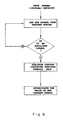
- FIG. 1 there is shown a flow diagram of a generalised encoding procedure according to the invention.
- the main steps of the procedure are numbered 1(A/B), 3(A/B), 4 and 5, for reasons which will become apparent below with reference to Fig. 7 of the drawings.
- the context For each symbol in the source data string the context is determined by evaluating a given sub-pattern of positions in the vicinity of the symbol.
- the context For a linear source data string, the context may be evaluated by considering symbols on one side only of the current symbol or, alternatively, on both sides.
- the context For two-dimensional data, such as occurs, for example, in image processing, the context may be evaluated on any or all of the four sides of the current symbol.
- the source data string must be stored and postprocessed, resulting in a short delay between data capture and data compression. In practice, the delay is so short as to be of negligible consequence.
- Fig. 1 there are two alternative approaches for handling unpredictable points UP, depending upon whether lossy (fuzzy) or lossless encoding is required.
- lossy the probability of the fuzzy set (a set of different symbols including the current symbol) corresponding to the current symbol is determined, and arithmetic coding is then performed using this combined probability so as effectively to transmit the whole class of points to which the current symbol belongs.
- context of the current symbol is increased so as to render its probability different from 1/n and hence render the point predictable.
- Arithmetic coding is then performed using the newly determined probability, based on the larger context, so as losslessly to encode the current symbol.
- Fig. 2 there is shown an alternative method for achieving lossless encoding.
- Predictable points are treated in exactly the same manner as described above with reference to Fig. 1.
- the probability of the fuzzy set to which the current symbol belongs is first determined and then, using this combined probability, arithmetic coding is performed so as effectively to transmit the whole class of points to which the current symbol belongs.
- This is identical to the procedure shown in Fig. 1.
- the context of the current symbol is increased, in order to render it predictable, and the probability of the current symbol is then determined with the new enlarged context.
- the new probability will no longer be equal to 1/n (for an n-symbol alphabet) and so the current symbol is now predictable within the enlarged context and arithmetic coding may be applied in the normal manner.
- the step of arithmetic coding is performed only once for each unpredictable point UP with an enlarged context.
- the step of arithmetic coding is performed twice, once for encoding the complete fuzzy set and once for encoding the current symbol.
- a knowledge of the fuzzy set to which the current symbol belongs has already been determined and is therefore known. Consequently, the resulting probability of the current symbol, within the new enlarged context, is not the same as that for the two stage method and may result in more efficient compression of the source data string.
- the context may be enlarged by differing amounts for different fuzzy sets whilst, if no knowledge of the fuzzy set is first encoded, the context must always be increased by the same amount.
- Fig. 3 of the drawings the principal steps of an alternative method of lossy (fuzzy) encoding are labelled 10 to 15 for reasons which will become clear with reference to Fig. 8 of the drawings.
- fuzzy coding shown in Fig. 3
- predictable points PP are treated in exactly the same way as explained above with reference to Fig. 1 of the drawings, using conventional arithmetic coding techniques.
- unpredictable points UP are treated differently.
- the current point, corresponding to a UP is set to an auxiliary symbol and the probability of the fuzzy set to which the current symbol belongs is determined. From a knowledge of this "combined" probability, arithmetic coding is employed so as effectively to transmit information corresponding to the complete class of symbols to which the UP belongs.
- the auxiliary symbol is not transmitted to the decoder.
- the auxiliary symbol is stored in a temporary buffer within the encoder so as to permit the correct evaluation of subsequent contexts. It will be understood from what has been explained above, that the context determines the conditional probability of symbols in the source data string.
- the context of a particular symbol contains a UP
- the existence and location of the UP within the current context must be known in order to determine correctly the probability of the current symbol.
- the auxiliary symbol is, in effect, merely a flag which indicates that the original (initial) symbol in the respective position was a UP.
- the method of arithmetic coding described with reference to Fig. 3 of the drawings does not permit a unique string to be decoded at the receiver site. Instead, a set of strings is transmitted wherein unpredictable points UP are specified in terms of the complete class to which they belong.
- the decoded string contains somewhat less information than the original source string and, for this reason, such an encoder is termed a "fuzzy" encoder.
- fuzzy arithmetic coders When employed in image processing, fuzzy arithmetic coders have improved compression ratio at the expense of some deterioration in image quality. In such cases, fuzzy arithmetic coding, in accordance with the invention, would clearly be confined to those areas where such errors are unnoticeable.
- arithmetic coders employ two shift registers designated A and C.
- the A register represents the length of the code interval whilst the C register contains the actual value of the code.
- log2 A log2p(a1) + log2p(a2) + log2p(a3) + .... + log2p(a n-1 ) + log2p(a n )
- log2 A represents the number of shifts required to normalise the A register which, in turn, determines the length of the code extracted from the C register. Consequently, the length of the code derived from the arithmetic coder may be calculated simply by adding the logarithms to base 2 of the probability of each encoded symbol in the source data string.
- the length of the compressed code is 32 bits.
- Decoding the above code string produces the original source data string, STR.
- EXAMPLE 2 Fuzzy Logic Arithmetic Coder (FLAC)
- the length of the compressed code is only 29 bits.
- the estimated code string STR′ and the original code string STR are equal in length and differ only in the 21st symbol.
- decoding is based on conventional arithmetic decoding techniques. This is true, and for predictable points PP constituting, in the above example, 31 out of the 35 code points, decoding is implemented using standard arithmetic decoding techniques. However, these techniques need to be modified slightly in order to interpret unpredictable points UP denoted by in the above estimated code string STR′.
- FIGs. 4 to 6 there are shown flow diagrams which illustrate slight modifications which must be effected to standard arithmetic decoders in order to deal with unpredictable points.
- Fig. 4 shows the relevant additional steps for decoding unpredictable points which were previously encoded according to the method described above with reference to Fig. 1 of the drawings.
- the decoded string contains an auxiliary symbol, this indicates that the current point is unpredictable within the default context. If no further action is taken and the auxiliary symbol is not replaced by one of the symbols from the original symbol alphabet, then the decoded output string represents a set of possible strings, as explained in Example 2 above. If instead, however, the context of the auxiliary symbol is increased according to the same rules as used by the encoder shown in Fig. 1, then the unpredictable point becomes predictable and decoding is possible.
- auxiliary symbols, * in the estimated output string STR′ were not decoded by increasing their context but, rather, were interpolated.
- Fig. 5 shows a portion of a two-pass decoding operation for interpolating the value of an auxiliary symbol from a knowledge of the context of that symbol which includes both previously and successively decoded symbols.
- the symbols decoded in real time both before and after the auxiliary symbol are used in order to evaluate the value of the current symbol by interpolation between those symbols.
- Such a method of decoding is termed "two-pass" because two passes along the decoded symbol string are required in order to evaluate the auxiliary symbol.
- the predictable points are decoded and the locations, but not the values, of the unpredictable points are determined.
- the resulting string is then scanned during a second pass in order to interpolate the values of the unpredictable points from their context including predictable points both before and after each respective unpredictable point.
- Fig. 6 shows an alternative method of evaluating unpredictable points using one-pass decoding.
- a single pass along the decoded string is used, each auxiliary symbol being evaluated by extrapolating from its prior context. Since, in this case, symbols appearing after the unpredictable point are not considered, decoding of the auxiliary symbols may be performed in flight, as the string is decoded.
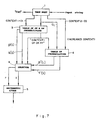
- Fig. 7 shows the flow of data between units in an arithmetic coder, employing the method shown in Fig. 1.
- a LOOK-UP TABLE (3) contains the probabilities of all symbols and fuzzy sets corresponding to predictable and unpredictable points, respectively, according to the context C1.
- the output from the LOOK-UP TABLE (3) is the probability p(i) of the current symbol a i or of the fuzzy set containing this symbol and its cumulative probability S(i).
- the values p(i) and S(i) are fed to a SELECTOR (6) whose outputs p and S are fed to an ARITHMETIC CODER (5) which encodes the current symbol or the current fuzzy set according to the probability and cumulative probability, p and S, respectively, derived from the SELECTOR (6).
- a second LOOK-UP TABLE (4) contains probabilities p′(i) and cumulative probabilities S′(i) according to an increased context C2.
- the values p′(i) and S′(i) are fed to the SELECTOR (6) and are selected in the event that the first context C1 indicates an unpredictable point UP.
- the outputs from the SELECTOR (6), p and 5, are fed to the ARITHMETIC CODER (5), enabling the symbol to be encoded in the normal manner.
- Fig. 8 shows the relationship between the various shift registers in a fuzzy arithmetic coder employing the method described with reference to Fig. 3 of the drawings.
- the context is determined (11) and this context is compared against a standard table of contexts which permits classification of predictable points PP and unpredictable points UP.
- a LOOK-UP TABLE (12) containing the probabilities p(i) and cumulative probabilities S(i) for predictable points permits determination of the respective probabilities which are then fed to an ARITHMETIC CODER (15) for processing in the normal manner.
- the current symbol a i is set to an auxiliary symbol (13), denoted in Example 2 above by *, and a second LOOK- UP TABLE (14) is accessed, containing the probabilities for fuzzy sets containing the current symbol a i .
- the output from the second LOOK-UP TABLE (14), denoted by p′(i) and S′(i) and corresponding to the probability and the cumulative probability, respectively, of the current fuzzy set, are then fed to the ARITHMETIC CODER (15) for processing in the normal manner.
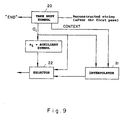
- a two-pass decoder employing the method of two-pass decoding explained above with reference to Fig. 5 of the drawings.
- the reconstructed string after the first pass is fed to a REGISTER (20) permitting the reconstructed string to be scanned point by point.
- the context and the current auxiliary symbol a i are fed to an INTERPOLATOR (21) which replaces the auxiliary symbol by a corresponding symbol from the symbol alphabet according to predefined rules.
- the output from the INTERPOLATOR (21), as well as the current symbol a i are fed to a SELECTOR (22) whose output is either the current symbol a i or, alternatively, the output from the INTERPOLATOR (21) according to whether or not the current symbol a i is an auxiliary symbol.
- the current auxiliary symbol will be reconstructed both according to the current context and also according to the particular fuzzy set to which the current symbol a i belongs.
- the code string comprises consonants, vowels, numerals and punctuation (i.e. four distinct classes of data) and a particular unpredictable point is known to be a vowel
- the current symbol will be replaced by a particular auxiliary symbol corresponding to the class of vowels.
- the symbol will be interpolated from the current context, thereby permitting a specific vowel to be substituted for the auxiliary symbol.
- an improved method of arithmetic coding which may be adapted, as required, to lossy or lossless coding. It has been found that the method of lossy coding according to the invention may result in a 16% increase in compression over conventional arithmetic coders. It will be appreciated that since the number of unpredictable points UP is relatively small, more computing resources may be allocated to these problematic points. For instance, it is quite possible that, for a given application, available CPU power will allow only four bits to be allocated for context determination. Under these circumstances, only sixteen different contexts may be considered for each point in the source data string. However, it is quite conceivable that for 1 % of unpredictable points UP, ten bits can be allocated thereby resulting in 1024 contexts, thereby permitting the entropy of the unpredictable points to be reduced and the overall compression ratio to be increased.
Landscapes
- Engineering & Computer Science (AREA)
- Theoretical Computer Science (AREA)
- Compression, Expansion, Code Conversion, And Decoders (AREA)
Applications Claiming Priority (2)
| Application Number | Priority Date | Filing Date | Title |
|---|---|---|---|
| IL91158A IL91158A (en) | 1989-07-28 | 1989-07-28 | Method and system for arithmetic coding and decoding |
| IL91158 | 1989-07-31 |
Publications (1)
| Publication Number | Publication Date |
|---|---|
| EP0412047A1 true EP0412047A1 (fr) | 1991-02-06 |
Family
ID=11060228
Family Applications (1)
| Application Number | Title | Priority Date | Filing Date |
|---|---|---|---|
| EP90810442A Withdrawn EP0412047A1 (fr) | 1989-07-28 | 1990-06-18 | Procédé et système pour codage et décodage arithmétique |
Country Status (4)
| Country | Link |
|---|---|
| US (1) | US5142283A (fr) |
| EP (1) | EP0412047A1 (fr) |
| JP (1) | JPH0366227A (fr) |
| IL (1) | IL91158A (fr) |
Cited By (1)
| Publication number | Priority date | Publication date | Assignee | Title |
|---|---|---|---|---|
| DE4429585C1 (de) * | 1994-08-19 | 1995-11-23 | Bosch Gmbh Robert | Verfahren zur arithmetischen Decodierung |
Families Citing this family (34)
| Publication number | Priority date | Publication date | Assignee | Title |
|---|---|---|---|---|
| US5313204A (en) * | 1991-04-25 | 1994-05-17 | Mitsubishi Denki Kabushiki Kaisha | Encoding and decoding devices with predictor and detector |
| US5675714A (en) * | 1992-03-30 | 1997-10-07 | Canon Kabushiki Kaisha | Mode identifying method and output apparatus using such a method |
| US5414423A (en) * | 1993-04-29 | 1995-05-09 | International Business Machines Corporation | Stabilization of probability estimates by conditioning on prior decisions of a given context |
| US5546080A (en) * | 1994-01-03 | 1996-08-13 | International Business Machines Corporation | Order-preserving, fast-decoding arithmetic coding arithmetic coding and compression method and apparatus |
| JP3302210B2 (ja) * | 1995-02-10 | 2002-07-15 | 富士通株式会社 | データ符号化/復号化方法及び装置 |
| US5751859A (en) * | 1995-06-14 | 1998-05-12 | Lucent Technologies Inc. | Compression of text images by soft pattern matching |
| US6968003B1 (en) * | 1996-01-29 | 2005-11-22 | International Business Machines Corporation | Speed-memory tradeoff for MPEG decoders |
| JP2840589B2 (ja) * | 1996-02-09 | 1998-12-24 | 富士通株式会社 | データ圧縮装置及びデータ復元装置 |
| US6415061B1 (en) | 1997-06-13 | 2002-07-02 | Cisco Technology, Inc. | Method of updating dictionaries in a data transmission system using data compression |
| KR100488421B1 (ko) * | 1997-10-17 | 2005-07-07 | 주식회사 팬택앤큐리텔 | 이진영상의 손실 부호화 방법 |
| IL122393A0 (en) * | 1997-12-01 | 1998-06-15 | Ttr Technologies Ltd | A code word for use in digital optical media and a method of generation thereof |
| US6952823B2 (en) * | 1998-09-01 | 2005-10-04 | Pkware, Inc. | Software patch generator using compression techniques |
| US7111094B1 (en) * | 1999-08-02 | 2006-09-19 | Shin-Ping Liu | System, method and algorithm for the optimization of entropy for lossless compression |
| US6318156B1 (en) * | 1999-10-28 | 2001-11-20 | Micro Motion, Inc. | Multiphase flow measurement system |
| JP2003526986A (ja) * | 2000-03-07 | 2003-09-09 | コーニンクレッカ フィリップス エレクトロニクス エヌ ヴィ | 算術的に符号化された情報信号の算術復号化 |
| US20060173848A1 (en) * | 2000-03-09 | 2006-08-03 | Pkware, Inc. | System and method for manipulating and managing computer archive files |
| US20060143249A1 (en) * | 2000-03-09 | 2006-06-29 | Pkware, Inc. | System and method for manipulating and managing computer archive files |
| US7844579B2 (en) * | 2000-03-09 | 2010-11-30 | Pkware, Inc. | System and method for manipulating and managing computer archive files |
| US20060143180A1 (en) * | 2000-03-09 | 2006-06-29 | Pkware, Inc. | System and method for manipulating and managing computer archive files |
| US20060155788A1 (en) * | 2000-03-09 | 2006-07-13 | Pkware, Inc. | System and method for manipulating and managing computer archive files |
| US20060173847A1 (en) * | 2000-03-09 | 2006-08-03 | Pkware, Inc. | System and method for manipulating and managing computer archive files |
| US20060143237A1 (en) * | 2000-03-09 | 2006-06-29 | Pkware, Inc. | System and method for manipulating and managing computer archive files |
| US20060143199A1 (en) * | 2000-03-09 | 2006-06-29 | Pkware, Inc. | System and method for manipulating and managing computer archive files |
| US8959582B2 (en) | 2000-03-09 | 2015-02-17 | Pkware, Inc. | System and method for manipulating and managing computer archive files |
| US8230482B2 (en) | 2000-03-09 | 2012-07-24 | Pkware, Inc. | System and method for manipulating and managing computer archive files |
| US20060143253A1 (en) * | 2000-03-09 | 2006-06-29 | Pkware, Inc. | System and method for manipulating and managing computer archive files |
| US6879988B2 (en) * | 2000-03-09 | 2005-04-12 | Pkware | System and method for manipulating and managing computer archive files |
| US20050015608A1 (en) * | 2003-07-16 | 2005-01-20 | Pkware, Inc. | Method for strongly encrypting .ZIP files |
| KR100405819B1 (ko) * | 2001-01-15 | 2003-11-14 | 한국과학기술원 | 이진 영상의 데이터 압축 및 복원방법 |
| US7187804B2 (en) | 2001-01-30 | 2007-03-06 | California Institute Of Technology | Lossless and near-lossless source coding for multiple access networks |
| US6677868B2 (en) * | 2001-03-16 | 2004-01-13 | Sharp Laboratories Of America, Inc. | Entropy coding with adaptive syntax to replace high probability symbols with lower probabilities symbols |
| US7161507B2 (en) * | 2004-08-20 | 2007-01-09 | 1St Works Corporation | Fast, practically optimal entropy coding |
| WO2007002468A2 (fr) * | 2005-06-23 | 2007-01-04 | 1Stworks Corporation | Modelisation pour codage enumeratif |
| US8779950B2 (en) | 2012-03-05 | 2014-07-15 | Dcba, Llc | Command encoded data compression |
Citations (8)
| Publication number | Priority date | Publication date | Assignee | Title |
|---|---|---|---|---|
| EP0021283A1 (fr) * | 1979-06-14 | 1981-01-07 | International Business Machines Corporation | Appareil de données numériques |
| EP0029967A2 (fr) * | 1979-11-28 | 1981-06-10 | International Business Machines Corporation | Appareil pour générer une séquence FIFO instantanée de codes arithmétiques binaires, appareil pour reconstruire une séquence de symboles binaires à partir d'une telle séquence de codes, et une méthode pour coder récursivement, et une méthode pour décoder récursivement, une séquence FIFO instantanée de nombres arithmétiques binaires |
| EP0199035A2 (fr) * | 1985-04-17 | 1986-10-29 | International Business Machines Corporation | Méthode adaptative pour la compression de données de caractères |
| US4652856A (en) * | 1986-02-04 | 1987-03-24 | International Business Machines Corporation | Multiplication-free multi-alphabet arithmetic code |
| EP0215229A2 (fr) * | 1985-07-31 | 1987-03-25 | International Business Machines Corporation | Procédé pour la compression de données à deux niveaux |
| EP0260462A2 (fr) * | 1986-09-15 | 1988-03-23 | International Business Machines Corporation | Codage arithmétique pour compression décompression de données, par emploi sélectif de divers codeurs et décodeurs arithmétiques |
| EP0260461A2 (fr) * | 1986-09-15 | 1988-03-23 | International Business Machines Corporation | Méthode de codage arithmétique pour codage et décodage |
| EP0350439A2 (fr) * | 1988-07-05 | 1990-01-10 | International Business Machines Corporation | Méthode pour générer une représentation comprimée d'une source de suites de données |
Family Cites Families (4)
| Publication number | Priority date | Publication date | Assignee | Title |
|---|---|---|---|---|
| US3701108A (en) * | 1970-10-30 | 1972-10-24 | Ibm | Code processor for variable-length dependent codes |
| US4494108A (en) * | 1981-11-09 | 1985-01-15 | International Business Machines Corporation | Adaptive source modeling for data file compression within bounded memory |
| US4881075A (en) * | 1987-10-15 | 1989-11-14 | Digital Equipment Corporation | Method and apparatus for adaptive data compression |
| US5023611A (en) * | 1989-07-28 | 1991-06-11 | At&T Bell Laboratories | Entropy encoder/decoder including a context extractor |
-
1989
- 1989-07-28 IL IL91158A patent/IL91158A/xx not_active IP Right Cessation
-
1990
- 1990-06-18 EP EP90810442A patent/EP0412047A1/fr not_active Withdrawn
- 1990-07-19 US US07/555,560 patent/US5142283A/en not_active Expired - Lifetime
- 1990-07-20 JP JP2190885A patent/JPH0366227A/ja active Pending
Patent Citations (9)
| Publication number | Priority date | Publication date | Assignee | Title |
|---|---|---|---|---|
| EP0021283A1 (fr) * | 1979-06-14 | 1981-01-07 | International Business Machines Corporation | Appareil de données numériques |
| EP0029967A2 (fr) * | 1979-11-28 | 1981-06-10 | International Business Machines Corporation | Appareil pour générer une séquence FIFO instantanée de codes arithmétiques binaires, appareil pour reconstruire une séquence de symboles binaires à partir d'une telle séquence de codes, et une méthode pour coder récursivement, et une méthode pour décoder récursivement, une séquence FIFO instantanée de nombres arithmétiques binaires |
| US4286256A (en) * | 1979-11-28 | 1981-08-25 | International Business Machines Corporation | Method and means for arithmetic coding utilizing a reduced number of operations |
| EP0199035A2 (fr) * | 1985-04-17 | 1986-10-29 | International Business Machines Corporation | Méthode adaptative pour la compression de données de caractères |
| EP0215229A2 (fr) * | 1985-07-31 | 1987-03-25 | International Business Machines Corporation | Procédé pour la compression de données à deux niveaux |
| US4652856A (en) * | 1986-02-04 | 1987-03-24 | International Business Machines Corporation | Multiplication-free multi-alphabet arithmetic code |
| EP0260462A2 (fr) * | 1986-09-15 | 1988-03-23 | International Business Machines Corporation | Codage arithmétique pour compression décompression de données, par emploi sélectif de divers codeurs et décodeurs arithmétiques |
| EP0260461A2 (fr) * | 1986-09-15 | 1988-03-23 | International Business Machines Corporation | Méthode de codage arithmétique pour codage et décodage |
| EP0350439A2 (fr) * | 1988-07-05 | 1990-01-10 | International Business Machines Corporation | Méthode pour générer une représentation comprimée d'une source de suites de données |
Cited By (1)
| Publication number | Priority date | Publication date | Assignee | Title |
|---|---|---|---|---|
| DE4429585C1 (de) * | 1994-08-19 | 1995-11-23 | Bosch Gmbh Robert | Verfahren zur arithmetischen Decodierung |
Also Published As
| Publication number | Publication date |
|---|---|
| IL91158A0 (en) | 1990-03-19 |
| IL91158A (en) | 1993-01-31 |
| JPH0366227A (ja) | 1991-03-20 |
| US5142283A (en) | 1992-08-25 |
Similar Documents
| Publication | Publication Date | Title |
|---|---|---|
| US5142283A (en) | Arithmetic compression coding using interpolation for ambiguous symbols | |
| US4989000A (en) | Data string compression using arithmetic encoding with simplified probability subinterval estimation | |
| US5045852A (en) | Dynamic model selection during data compression | |
| US5471207A (en) | Compression of palettized images and binarization for bitwise coding of M-ary alphabets therefor | |
| EP0776569B1 (fr) | Procede et systeme de codage/decodage de donnees d'images | |
| US4028731A (en) | Apparatus for compression coding using cross-array correlation between two-dimensional matrices derived from two-valued digital images | |
| US7365658B2 (en) | Method and apparatus for lossless run-length data encoding | |
| US6445314B1 (en) | System and method for the decoding of variable length codes | |
| US5177622A (en) | Method and apparatus for detecting run length of two successive pixels and subjecting run length to universal coding | |
| US5151949A (en) | System and method employing multiple predictor sets to compress image data having different portions | |
| US4494151A (en) | 4-Pixel run-length code for data compression | |
| US5509088A (en) | Method for converting CCITT compressed data using a balanced tree | |
| EP0658982A2 (fr) | Système à besoin en mémoire réduit pour le codage - décodage de symboles à deux niveaux et méthode associée | |
| EP0349677B1 (fr) | Système de codage des images | |
| US5198898A (en) | Data compressing system for compressing serial image data with color information | |
| JP2954438B2 (ja) | 符号化装置 | |
| US5091977A (en) | Image data compression method using a run prediction technique | |
| US6549665B1 (en) | Image signal processing device | |
| JP3676078B2 (ja) | ランレングス符号化方法及び圧縮装置 | |
| JPH05151349A (ja) | 画像データ圧縮方法および符号化回路 | |
| JPH0723238A (ja) | 画像データ圧縮及び復元装置 | |
| JP2859507B2 (ja) | 画像データの圧縮・伸長方法および装置 | |
| JP2833743B2 (ja) | Mh符号復号器 | |
| KR100275267B1 (ko) | 고속 가변길이부호 복호화 장치 | |
| JP2755463B2 (ja) | 画像データ圧縮方式 |
Legal Events
| Date | Code | Title | Description |
|---|---|---|---|
| PUAI | Public reference made under article 153(3) epc to a published international application that has entered the european phase |
Free format text: ORIGINAL CODE: 0009012 |
|
| 17P | Request for examination filed |
Effective date: 19901213 |
|
| AK | Designated contracting states |
Kind code of ref document: A1 Designated state(s): DE FR GB |
|
| 17Q | First examination report despatched |
Effective date: 19940209 |
|
| STAA | Information on the status of an ep patent application or granted ep patent |
Free format text: STATUS: THE APPLICATION IS DEEMED TO BE WITHDRAWN |
|
| 18D | Application deemed to be withdrawn |
Effective date: 19940820 |