EP0215229A2 - Procédé pour la compression de données à deux niveaux - Google Patents
Procédé pour la compression de données à deux niveaux Download PDFInfo
- Publication number
- EP0215229A2 EP0215229A2 EP86109714A EP86109714A EP0215229A2 EP 0215229 A2 EP0215229 A2 EP 0215229A2 EP 86109714 A EP86109714 A EP 86109714A EP 86109714 A EP86109714 A EP 86109714A EP 0215229 A2 EP0215229 A2 EP 0215229A2
- Authority
- EP
- European Patent Office
- Prior art keywords
- image
- pels
- dither
- text
- level data
- Prior art date
- Legal status (The legal status is an assumption and is not a legal conclusion. Google has not performed a legal analysis and makes no representation as to the accuracy of the status listed.)
- Granted
Links
- 238000000034 method Methods 0.000 title claims abstract description 8
- 239000011159 matrix material Substances 0.000 claims abstract description 7
- 238000005070 sampling Methods 0.000 claims description 2
- 238000007906 compression Methods 0.000 description 8
- 230000006835 compression Effects 0.000 description 8
- 230000006978 adaptation Effects 0.000 description 7
- 230000003044 adaptive effect Effects 0.000 description 5
- 238000013144 data compression Methods 0.000 description 5
- 239000002131 composite material Substances 0.000 description 2
- 230000002596 correlated effect Effects 0.000 description 2
- 230000003068 static effect Effects 0.000 description 2
- 238000004364 calculation method Methods 0.000 description 1
- 230000001276 controlling effect Effects 0.000 description 1
- 230000006837 decompression Effects 0.000 description 1
- 230000000694 effects Effects 0.000 description 1
- 230000004807 localization Effects 0.000 description 1
- 238000012827 research and development Methods 0.000 description 1
Images

Classifications
-
- H—ELECTRICITY
- H04—ELECTRIC COMMUNICATION TECHNIQUE
- H04N—PICTORIAL COMMUNICATION, e.g. TELEVISION
- H04N1/00—Scanning, transmission or reproduction of documents or the like, e.g. facsimile transmission; Details thereof
- H04N1/40—Picture signal circuits
- H04N1/40062—Discrimination between different image types, e.g. two-tone, continuous tone
-
- H—ELECTRICITY
- H04—ELECTRIC COMMUNICATION TECHNIQUE
- H04N—PICTORIAL COMMUNICATION, e.g. TELEVISION
- H04N1/00—Scanning, transmission or reproduction of documents or the like, e.g. facsimile transmission; Details thereof
- H04N1/41—Bandwidth or redundancy reduction
- H04N1/4105—Bandwidth or redundancy reduction for halftone screened pictures
Definitions
- the invention relates to a method for compressing bi-level data by use of an arithmetic coding.
- the adaptive binary arithmetic coding has been suggested for compressing and decompressing the bi-level data or signals each of which represents one pel of textßgraphic image.
- the arithmetic coding is described in Reference (1), Glen G. Langdon, Jr. "An Introduction to Arithmetic Coding", IBM Journal of Research and Development, Vol. 28, No. 2, March l984, pp. l35-l49, and Reference (2), Glen G. Landon, Jr. and jorma Rissanen, "Compression of Black-White Image with Arithmetic Coding", IEEE Transactions on Commumications, Vol. COM-29, No. 6, June l98l, pp. 858-867.
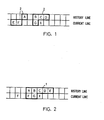
- the bi-level arithmetic coding scheme utilizes a statistical prediction whether a current pel is black or white, "1" or "0". The more the prediction is correct, the higher the resultant data compression efficiency is. For predicting black or white at the current pel position "X", the information of neighboring previous pels is important. The sampling area of the previous pels is called “template”. Fig. 2 shows a 7 bit template model in the reference (2).
- the template or a sample window 1 and the current pel "X" to be processed are shown.
- the first step of the arithmetic coding is to sample the bi-level data or bits of the pels "A” through “G”.
- the next step is to access a statistic table by using the bit pattern of the pels "A” through “G” as an address.
- the statistic table stores in each entry the most probable symbol or bit generated based upon the bit pattern of the pels "A” through “G” and the probability of the less probable symbol or bit.
- the current pel "X" is compared with the most probable symbol in the access ed entry. If the both are equal, YES signal is generated. And, if not equal, NO signal is generated.
- the YES or NO signal and the probability of the less probable symbol are supplied to a coding means which calculates a composite probability or code string.
- the most probable symbol and the probability of the less probable symbol in the accessed entry are modified in accordance with the number of occurance of the YES signal and the occurance of the NO signal. Decompression of the original dot pattern from the code string is performed by steps of the reverse sequence of the coding steps.
- the prior template model 1 for the black and white pels is an effective data compression model in conjunction with the adaptive arithmetic coding scheme, as shown in the references.
- the scheme is used for a dither image or a mixed image consisting of textßgraphic and dither images, the resultant data compression rate is degraded for the following reasons, although it is still better than other static coding scheme, such as modified READ scheme.
- the current bit "X" is well correlated to the neighboring pels, especially to the nearest neighbors "B"; “C”; “D” and “G”.
- the current bit "X" accordingly, is well predicted by the bit information of the seven bit template 1.
- the adaptive arithmetic coding updates the probability of less probable symbol based upon the recent bit pattern of the history pels, as described hereinbefore. Such update, however, is too slow to follow frequent change from the text/graphic image to the dither image and vice versa in documents in real world.
- the slow adaptation in the prior arithmetic coding scheme cannot follow such a frequent switching between the text/graphic and dither images.
- the patterns of the history pels are common to both the text/graphic and dither images, but the probability of less probable symbol of the common bit patterns to the both images is different from each other. And, this is called as "State Overlap", hereinafter.
- the prior arithmetic coding scheme inherently has the slow adaptation and the state overlap, whereby the resultant data compression efficiency for the mixed image is degraded.
- Embodiments of the invention are defined in claims 2 to 4.
- the invention can solve the both problems, the "delocalization” and the "state overlap", and can compress the mixed image effectively.
- the invention introduces new template or sample window taking into consideration the delocalized bit correlation, and a rapid adaptation scheme to solve the problem "state overlap".
- the template of the invention is so arranged as to sample previously processed pels or history pels, which are adjacent pels to the current pel selected to adapt to the text/graphic image and pels so separated from the adjacent pels as to adapt to a period of a dither matrix.
- the image pels of the scan line are sequentially processed, so that the template is also sequentially moved along the scan lines.
- the image or the bit pattern of the sampled history pels is determined as to which of the dither dominant image pattern or the text/graphic dominant image pattern the image has. More particularly, one of the first, second and third signals is generated as a result of the determination.
- the first signal represents that the image has the dither dominant image pattern
- the second signal represents that the image has the text/graphic dominant image pattern
- the third signal represents that the image is not classified as a dither dominant image pattern or a text/graphic dominant image pattern.
- the number of occurrences of the first, second and third signals are accumulated to control selective switching of access to one of the following two statistic tables.
- the first table stores, at each entry, the most probable symbol and the probability of less probable symbol for the text/graphic image
- the second table stores, at each entry, the most probable symbol and the probability of less probable symbol for the dither image.
- the bit of the current pel is compared with the most probable symbol in the addressed entry of the selected table.
- the result of the comparison is supplied to the coding means along with the probability of less probable symbol in the entry.
- the coding means produces coded data. And the most probable symbol and the probability of less probable symbol in the addressed entry are updated.
- the dither image described herein is generated with a 4 by 4 matrix, although the invention can be applied to any images generated by dither matrices with arbitrary size and threshold pattern.
- the invention is described hereinafter utilizing the 7 bit template. Of cource the invention can be applicable to larger template sizes. To enlarge the template, however, increases a size of the statistic table of the arithmetic coder.
- the 7 bit template is one of practical sizes in the tradeoff of compression efficiency and cost of the coder.
- Fig. 1 shows the template 2 of the present invention.
- the template 2 samples the history pels "A”; “B”; “C”; “D”; “E”; “F” and “G” in a history line and a current line.
- the pels “B”; “C”; “D” and “G” are adjacent pels to the current pel “X” to be processed, and the pels "A", “E” and “F” are separated from the adjacent pels.
- the pels "A” and “E” are so separated from the pels "D” and “G", respectively, as to adapt to a period of the 4 ⁇ 4 dither matrix.
- the sampled previous 7 bits are determined as to whether the bit pattern or image of the 7 bits should be treated as the text/graphic image or the dither image, or not.
- 128 bit patterns represented by the 7 bits are classified into dither dominant group, text/graphic dominant group and the remaining group which does not belong to the dither dominant and the text/graphic dominant group.
- the determination for seven bit pattern is made by a table 3.
- the seven bits are supplied to a register 6 and the table 3 in the Fig. 3.
- the seven bits are used as an address for accessing the table 3.
- the following table 2 partially shows the contents of the table 3 of the Fig. 3.
- the invention basically switches after the dither or the text/graphic images occur, the access to the first and second statistical tables 8 and 9.
- the first table 8 stores, at each entry, the most probable symbol and the probability of less probable symbol for the seven bit pattern of the text/graphic image
- the second statistic table 9 stores, at each entry, the most probable symbol and the probability of less probable symbol for the seven bit pattern of the dither image.
- the 7 bit pattern accidentally matches to a dither dominant pattern although the 7 bit pattern is in the text image, and vice versa.
- Such a fluctuation can be removed by introducing a hysteresis in the switching operation, as follows:
- a counter 4 and a decision and control circuit 5 are provided between the table 3 and the register 6.
- the counter 4 counts up whenever the " +1" output is applied, and counts down whenever the "-1" output is applied, and stays at its value when the "0" output is applied.
- the invention introduces an upper and lower threshold for the count value.
- the decision and control circuit 5 determines whether the count value reaches to the upper threshold or the lower threshold, or not. When the count value is equal to or larger than the upper threshold, the decision and control circuit 5 supplies "1" to the position "Q" of the register 6, and causes the count value to be equal to the upper threshold value. When the count value is equal to or smaller than the lower threshold, the decision and control circuit 5 supplies "0" to the posi tion "Q" of the register 6, and causes the counter value to be equal to the lower threshold. Otherwise, the bit in the position "Q" is not changed.
- the upper and lower threshold are determined or selected empirically to maximize the compression efficiency.
- the eight bits including the bit "Q” and seven bits “A” through “G” are supplied from the register 6 to a table circuit 7, which switches the access operation to the first and second statistic tables 8 and 9 in response to the bit "Q".
- the selected statistic table is accessed by use of the seven bits as an address.
- the most probable bit or symbol in the addressed entry is supplied to a compare circuit 10, which compares the most probable bit with the current bit "X". If equal, YES signal is supplied to a coding circuit 11, and if not equal, NO signal is supplied to the coding circuit 11. Also, the coding circuit 11 receives the probability of less probable bit from the addressed entry, and calculates the composite probability or the coded output. And, the most probable bit and the probability of less probable bit in the entry are updated. These calculation and the update are described in the references, and are not described herein.
- the first chart was CCITT's test chart No. 1, called as Test chart hereinbelow.
- the second chart was text chart of The Institutes of Image Electronics Engineers of Japan, and called as Dither chart.
- the third chart was IEEE's Facsimile Test Chart "IEEE Std 167A-1980" which includes text, graphic and dither images, and called as Mixed Chart.
- the entropy is very close to actual compressed data volume according to arithmetic coding scheme as shown in the reference (2).
- the slow adaptation scheme was not used to evaluate the several template models here.
- the slow adaptation can be utilized in addition to the fast adaptation of the invention at the same time, and it will help to improve the compression about l0% comparing with the entropy on static adaptation as shown in the reference (2).
- the entropy is a good measure to evaluate the prediction models in general, and especially very close to real compressed data volume in the arithmetic coding scheme.
- the calculated entropies are compared with original data and compressed data volumes with modified READ scheme.
- present invention can improve the compression efficiency in both dither picture and mixed document drastically.
- This improvement is realized by the present invention wherein the new template model is introduced taking into consideration the delocalization of bit correlations in the dither image and the localization of bit correlations in the text/graphic image, and the adaptive switching scheme is introduced to adapt to the different statistics between the both images.
- the new scheme of the present invention can be implemented in both software and hardware coders/decoders.
Landscapes
- Engineering & Computer Science (AREA)
- Multimedia (AREA)
- Signal Processing (AREA)
- Image Processing (AREA)
- Compression, Expansion, Code Conversion, And Decoders (AREA)
- Compression Of Band Width Or Redundancy In Fax (AREA)
Applications Claiming Priority (2)
| Application Number | Priority Date | Filing Date | Title |
|---|---|---|---|
| JP167868/85 | 1985-07-31 | ||
| JP60167868A JPS6229372A (ja) | 1985-07-31 | 1985-07-31 | 2値デ−タの圧縮方法 |
Publications (3)
| Publication Number | Publication Date |
|---|---|
| EP0215229A2 true EP0215229A2 (fr) | 1987-03-25 |
| EP0215229A3 EP0215229A3 (en) | 1988-09-21 |
| EP0215229B1 EP0215229B1 (fr) | 1990-06-13 |
Family
ID=15857569
Family Applications (1)
| Application Number | Title | Priority Date | Filing Date |
|---|---|---|---|
| EP86109714A Expired EP0215229B1 (fr) | 1985-07-31 | 1986-07-15 | Procédé pour la compression de données à deux niveaux |
Country Status (4)
| Country | Link |
|---|---|
| US (1) | US4901363A (fr) |
| EP (1) | EP0215229B1 (fr) |
| JP (1) | JPS6229372A (fr) |
| DE (1) | DE3672059D1 (fr) |
Cited By (3)
| Publication number | Priority date | Publication date | Assignee | Title |
|---|---|---|---|---|
| EP0311265A3 (fr) * | 1987-10-09 | 1991-01-09 | International Business Machines Corporation | Procédé et appareil de traitement de signaux d'éléments d'images |
| EP0412047A1 (fr) * | 1989-07-28 | 1991-02-06 | International Business Machines Corporation | Procédé et système pour codage et décodage arithmétique |
| EP0613290A1 (fr) * | 1993-02-26 | 1994-08-31 | Nec Corporation | Procédé et appareil pour la compression de données d'images binaires |
Families Citing this family (29)
| Publication number | Priority date | Publication date | Assignee | Title |
|---|---|---|---|---|
| DE3838730C2 (de) | 1987-11-16 | 1994-07-28 | Canon Kk | Verfahren und Vorrichtung zur Bildverarbeitung |
| US5055942A (en) * | 1990-02-06 | 1991-10-08 | Levien Raphael L | Photographic image reproduction device using digital halftoning to screen images allowing adjustable coarseness |
| JP2662305B2 (ja) * | 1990-04-19 | 1997-10-08 | 富士写真フイルム株式会社 | 図形選択方法 |
| US5351138A (en) * | 1990-04-24 | 1994-09-27 | Ricoh Company, Ltd. | Image area discriminating device |
| JP3108479B2 (ja) * | 1991-08-28 | 2000-11-13 | 株式会社リコー | 符号化復号化方法およびその装置 |
| US5339170A (en) * | 1991-12-31 | 1994-08-16 | Xerox Corporation | Image processing system and method employing hybrid filtering to provide improved reconstruction of continuous tone images from halftone screen-structured images |
| KR950000286B1 (ko) * | 1992-05-28 | 1995-01-12 | 삼성전자 주식회사 | 산술 부호화 장치 및 방법 |
| JP2752306B2 (ja) * | 1992-10-30 | 1998-05-18 | 株式会社東芝 | 画像処理装置 |
| US5509088A (en) * | 1993-12-06 | 1996-04-16 | Xerox Corporation | Method for converting CCITT compressed data using a balanced tree |
| JP3302246B2 (ja) * | 1995-03-14 | 2002-07-15 | 株式会社リコー | 符号化装置 |
| DE69715426T2 (de) | 1996-07-31 | 2003-01-09 | Matsushita Electric Industrial Co., Ltd. | Verfahren und vorrichtung zur bilddekodierung |
| US6055338A (en) * | 1996-08-22 | 2000-04-25 | Sumitomo Metal Industries Limited | Bi-level adaptive coding using a dual port memory and a context comparator |
| US5745603A (en) * | 1996-08-26 | 1998-04-28 | Hewlett-Packard Company | Two dimensional context model obtained without a line buffer for arithmetic coding |
| US6058216A (en) * | 1996-09-03 | 2000-05-02 | Sumitomo Metal Industries Limited | Apparatus for encoding image data |
| US6094453A (en) * | 1996-10-11 | 2000-07-25 | Digital Accelerator Corporation | Digital data compression with quad-tree coding of header file |
| US6683993B1 (en) * | 1996-11-08 | 2004-01-27 | Hughes Electronics Corporation | Encoding and decoding with super compression a via a priori generic objects |
| WO1998026603A1 (fr) * | 1996-12-09 | 1998-06-18 | Telecom Finland Oy | Procede de transmission d'images video |
| US5901251A (en) * | 1997-03-18 | 1999-05-04 | Hewlett-Packard Company | Arithmetic coding compressor using a context model that is adaptive to variable length patterns in bi-level image data |
| JP3082837B2 (ja) * | 1997-03-19 | 2000-08-28 | 日本電気株式会社 | パタンマッチング符号化装置、復号化装置及び記録媒体 |
| US5886655A (en) * | 1997-04-09 | 1999-03-23 | Hewlett-Packard Company | Arithmetic coding context model that accelerates adaptation for small amounts of data |
| US6272256B1 (en) | 1997-11-26 | 2001-08-07 | International Business Machines Corporation | Fast compression of periodic halftoned bitonal images |
| KR100405819B1 (ko) * | 2001-01-15 | 2003-11-14 | 한국과학기술원 | 이진 영상의 데이터 압축 및 복원방법 |
| JP4164257B2 (ja) * | 2001-12-06 | 2008-10-15 | キヤノン株式会社 | 画像処理装置、画像処理方法、プログラム、及び記憶媒体 |
| EP1318665B1 (fr) | 2001-12-06 | 2015-02-25 | Canon Kabushiki Kaisha | Appareil et procédé de traitement d'image, programe et support d'enregistrement |
| US7076109B2 (en) * | 2002-03-28 | 2006-07-11 | International Business Machines Corporation | System and method of automatically determining the dominant periodicity in sequential binary data |
| US8176155B2 (en) * | 2003-11-26 | 2012-05-08 | Riip, Inc. | Remote network management system |
| US7161507B2 (en) * | 2004-08-20 | 2007-01-09 | 1St Works Corporation | Fast, practically optimal entropy coding |
| WO2007002468A2 (fr) * | 2005-06-23 | 2007-01-04 | 1Stworks Corporation | Modelisation pour codage enumeratif |
| US8779950B2 (en) | 2012-03-05 | 2014-07-15 | Dcba, Llc | Command encoded data compression |
Family Cites Families (6)
| Publication number | Priority date | Publication date | Assignee | Title |
|---|---|---|---|---|
| US4204232A (en) * | 1977-07-08 | 1980-05-20 | Nippon Electric Co., Ltd. | Pattern transmission system comprising an encoder for encoding partial thinned patterns in two scanning lines along only one boundary line |
| US4229768A (en) * | 1978-03-30 | 1980-10-21 | Canon Kabushiki Kaisha | Information processing apparatus |
| US4325085A (en) * | 1980-06-09 | 1982-04-13 | Digital Communications Corporation | Method and apparatus for adaptive facsimile compression using a two dimensional maximum likelihood predictor |
| US4425582A (en) * | 1980-07-03 | 1984-01-10 | Xerox Corporation | Hardware implementation of 2 line/11 element predictor |
| JPS5730464A (en) * | 1980-07-30 | 1982-02-18 | Nec Corp | Adaptive forecasting and encoding device |
| JPS5937774A (ja) * | 1982-08-26 | 1984-03-01 | Nec Corp | 画像信号の符号化方法および装置 |
-
1985
- 1985-07-31 JP JP60167868A patent/JPS6229372A/ja active Granted
-
1986
- 1986-07-15 DE DE8686109714T patent/DE3672059D1/de not_active Expired - Lifetime
- 1986-07-15 EP EP86109714A patent/EP0215229B1/fr not_active Expired
-
1988
- 1988-09-28 US US07/250,596 patent/US4901363A/en not_active Expired - Fee Related
Cited By (4)
| Publication number | Priority date | Publication date | Assignee | Title |
|---|---|---|---|---|
| EP0311265A3 (fr) * | 1987-10-09 | 1991-01-09 | International Business Machines Corporation | Procédé et appareil de traitement de signaux d'éléments d'images |
| EP0412047A1 (fr) * | 1989-07-28 | 1991-02-06 | International Business Machines Corporation | Procédé et système pour codage et décodage arithmétique |
| EP0613290A1 (fr) * | 1993-02-26 | 1994-08-31 | Nec Corporation | Procédé et appareil pour la compression de données d'images binaires |
| US5491564A (en) * | 1993-02-26 | 1996-02-13 | Nec Corporation | Data compression method and apparatus for binary image using Markov model encoding |
Also Published As
| Publication number | Publication date |
|---|---|
| JPH0448311B2 (fr) | 1992-08-06 |
| US4901363A (en) | 1990-02-13 |
| DE3672059D1 (de) | 1990-07-19 |
| EP0215229B1 (fr) | 1990-06-13 |
| EP0215229A3 (en) | 1988-09-21 |
| JPS6229372A (ja) | 1987-02-07 |
Similar Documents
| Publication | Publication Date | Title |
|---|---|---|
| EP0215229A2 (fr) | Procédé pour la compression de données à deux niveaux | |
| US5867600A (en) | Image coding method and system for providing reduced bit rate arithmetic codes | |
| EP0777386B1 (fr) | Procédé et appareil pour le codage et le décodage d'une image | |
| EP0060694B1 (fr) | Appareil et procédé pour la compression de données numériques | |
| US5267052A (en) | Encoding the original image data and progessively encoding the image data independently | |
| US4028731A (en) | Apparatus for compression coding using cross-array correlation between two-dimensional matrices derived from two-valued digital images | |
| US4476495A (en) | Multilevel signal compression method | |
| US5151949A (en) | System and method employing multiple predictor sets to compress image data having different portions | |
| CA1207885A (fr) | Methode et appareil de traitement de signaux d'image pour accroitre la longueur | |
| JPH06315089A (ja) | 符号化方法及びシステム | |
| US5007102A (en) | Data compression using block list transform | |
| EP0311265B1 (fr) | Procédé et appareil de traitement de signaux d'éléments d'images | |
| EP0381129A1 (fr) | Compression binaire en demi-teinte | |
| US5970174A (en) | Method and apparatus for data compression and gray value estimation | |
| US7460721B2 (en) | Methods and apparatus for data compression with a hybrid context | |
| EP1033885B1 (fr) | Dispositif et procede de codage et de decodage | |
| EP0238254B1 (fr) | Compression de données utilisant une transformation des listes | |
| EP0448226B1 (fr) | Procédé à coder des données d'image | |
| JPH05151349A (ja) | 画像データ圧縮方法および符号化回路 | |
| US6757440B2 (en) | Methods and apparatus for data compression | |
| US6801664B1 (en) | Method of image coding, image coding apparatus, and recording medium including image coding program | |
| JP3320282B2 (ja) | 多値画像処理装置 | |
| US5255105A (en) | Encoding image data | |
| JPS63182973A (ja) | フアクシミリ装置の擬似中間調画像伝送方法 | |
| JP2002077627A (ja) | 画像符号化方法、画像符号化装置、画像復号化方法、画像復号化装置、画像形成装置及び記録媒体 |
Legal Events
| Date | Code | Title | Description |
|---|---|---|---|
| PUAI | Public reference made under article 153(3) epc to a published international application that has entered the european phase |
Free format text: ORIGINAL CODE: 0009012 |
|
| AK | Designated contracting states |
Kind code of ref document: A2 Designated state(s): DE FR GB |
|
| 17P | Request for examination filed |
Effective date: 19870529 |
|
| PUAL | Search report despatched |
Free format text: ORIGINAL CODE: 0009013 |
|
| AK | Designated contracting states |
Kind code of ref document: A3 Designated state(s): DE FR GB |
|
| 17Q | First examination report despatched |
Effective date: 19890206 |
|
| GRAA | (expected) grant |
Free format text: ORIGINAL CODE: 0009210 |
|
| AK | Designated contracting states |
Kind code of ref document: B1 Designated state(s): DE FR GB |
|
| REF | Corresponds to: |
Ref document number: 3672059 Country of ref document: DE Date of ref document: 19900719 |
|
| ET | Fr: translation filed | ||
| PLBE | No opposition filed within time limit |
Free format text: ORIGINAL CODE: 0009261 |
|
| STAA | Information on the status of an ep patent application or granted ep patent |
Free format text: STATUS: NO OPPOSITION FILED WITHIN TIME LIMIT |
|
| 26N | No opposition filed | ||
| PGFP | Annual fee paid to national office [announced via postgrant information from national office to epo] |
Ref country code: GB Payment date: 19920624 Year of fee payment: 7 |
|
| PGFP | Annual fee paid to national office [announced via postgrant information from national office to epo] |
Ref country code: FR Payment date: 19920630 Year of fee payment: 7 |
|
| PGFP | Annual fee paid to national office [announced via postgrant information from national office to epo] |
Ref country code: DE Payment date: 19920729 Year of fee payment: 7 |
|
| PG25 | Lapsed in a contracting state [announced via postgrant information from national office to epo] |
Ref country code: GB Effective date: 19930715 |
|
| GBPC | Gb: european patent ceased through non-payment of renewal fee |
Effective date: 19930715 |
|
| PG25 | Lapsed in a contracting state [announced via postgrant information from national office to epo] |
Ref country code: FR Effective date: 19940331 |
|
| PG25 | Lapsed in a contracting state [announced via postgrant information from national office to epo] |
Ref country code: DE Effective date: 19940401 |
|
| REG | Reference to a national code |
Ref country code: FR Ref legal event code: ST |