EP0412155A1 - Capteur enzymatique - Google Patents
Capteur enzymatique Download PDFInfo
- Publication number
- EP0412155A1 EP0412155A1 EP88902926A EP88902926A EP0412155A1 EP 0412155 A1 EP0412155 A1 EP 0412155A1 EP 88902926 A EP88902926 A EP 88902926A EP 88902926 A EP88902926 A EP 88902926A EP 0412155 A1 EP0412155 A1 EP 0412155A1
- Authority
- EP
- European Patent Office
- Prior art keywords
- enzyme
- sensor
- film
- enzyme sensor
- buffer solution
- Prior art date
- Legal status (The legal status is an assumption and is not a legal conclusion. Google has not performed a legal analysis and makes no representation as to the accuracy of the status listed.)
- Withdrawn
Links
Images


Classifications
-
- C—CHEMISTRY; METALLURGY
- C12—BIOCHEMISTRY; BEER; SPIRITS; WINE; VINEGAR; MICROBIOLOGY; ENZYMOLOGY; MUTATION OR GENETIC ENGINEERING
- C12Q—MEASURING OR TESTING PROCESSES INVOLVING ENZYMES, NUCLEIC ACIDS OR MICROORGANISMS; COMPOSITIONS OR TEST PAPERS THEREFOR; PROCESSES OF PREPARING SUCH COMPOSITIONS; CONDITION-RESPONSIVE CONTROL IN MICROBIOLOGICAL OR ENZYMOLOGICAL PROCESSES
- C12Q1/00—Measuring or testing processes involving enzymes, nucleic acids or microorganisms; Compositions therefor; Processes of preparing such compositions
- C12Q1/001—Enzyme electrodes
Definitions
- This invention relates to an enzyme sensor and, more particularly, to an enzyme sensor in which a fixed-enzyme film is formed.
- Moriizumi et. al. have reported [Nihon Kagaku Kaishi, No. 6, (1983)] on a glass electrode-type ion-sensitive electrode, a miniature tip-type ion-sensitive electrode utilizing semiconductor machining technology, and an enzyme sensor in which an enzyme-fixed film is formed on an ion-sensitive film of an ion-sensitive field-effect transistor (ISFET) utilizing semiconductor device technology.
- ISFET ion-sensitive field-effect transistor
- An ion-sensitive film is one in which the surface potential of a film varies in dependence upon the concentration of an ion in solution. By measuring this potential, the ion concentration of the solution can be determined.
- an enzyme film which is accompanied by an increase or decrease in hydrogen ion due to an enzyme reaction, on this ion-sensitive film, an enzyme sensor is formed which makes possible measurement in a continuous and simple manner.
- the present invention provides an enzyme sensor in which deterioration of the sensor is prevented to make possible long-term, stable measurement.
- the enzyme sensor of the present invention has a fixed-enzyme film and is immersed in a solution having a predetermined pH. In such an arrangement, deterioration of the fixed-enzyme film is prevented by the predetermined pH solution, so that there can be provided an enzyme sensor which is prevented from deteriorating, thereby enabling stable measurement over a long period of time.
- the predetermined pH solution is a buffer solution, and the predetermined solution contains ethylenediamine tetraacedic acid (EDTA).
- EDTA ethylenediamine tetraacedic acid
- the enzyme sensor of the present invention has a fixed-enzyme film and is present in an atmosphere that does not contain a heavy metal.
- deterioration of the fixed-enzyme film due to heavy metals is prevented and deactivation of the enzyme caused by heavy metals is prevented in the heavy metal-free atmosphere.
- an enzyme sensor which is prevented from deteriorating, thereby making possible long-term, stable measurement.
- the heavy metal-free atmosphere is formed from dry air and a member enclosing the dried air. Further, the heavy metal-free atmosphere is formed from a prescribed gas and a member enclosing the prescribed gas.
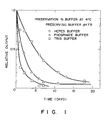
- Fig. 1 is a view illustrating a change in lifetime of a urease film enzyme sensor when the type of buffer solution in which the sensor is preserved is changed;
- Fig. 2 is a view illustrating a change in lifetime of a urease film enzyme sensor depending upon the type of buffer solution when EDTA is incorporated in the buffer solution preserving the sensor;
- Fig. 3 is a view illustrating a change in lifetime of a urease film enzyme sensor when preservation is carried out in dry air at a temperature of 4°C and the buffer solution of measurement is changed;
- Figs. 4(a) - (c) are views showing examples of enzyme sensors.
- a pH sensor can be prepared by forming a film of iridium oxide (IrO x ), which is a hydrogen ion-sensitive film, on ITO glass, a quartz substrate or a sapphire substrate. It is also possible to prepare a pH sensor by forming iridium oxide (IrO x ) as the sensitive film of an ISFET on the gate of a FET or on a substrate extending from a gate.
- IrO x iridium oxide
- lead wires were brought into contact with the sensor by an electrically conductive adhesive after formation of the iridium oxide (IrO x ) film.
- the pH sensor was molded in epoxy resin or silicone resin.
- An enzyme sensor is fabricated by forming a fixed-enzyme film on the ion-sensitive film of the pH sensor prepared in accordance with method (1).
- the method of forming the fixed-enzyme film relies upon cross-linking.
- Dissolved in a 0.1 M, pH 7.5 HEPES (N-2-hydroxyethylpiperazine-N-2-ethanesulfonic acid) buffer solution were 300 mg/ml of cow serum albumin and 50 mg/ml of urease. Glutaric aldehyde was mixed with this solution, the resulting mixture was dropped onto the iridium oxide (IrO x ) film of the pH sensor, and the sensor was immediately rotated at about 3000 rpm for one minute (preparation by the spin coating method).
- IrO x iridium oxide
- the enzyme sensor fabricated in accordance with (2) above was measured at a fixed urea concentration of 100 mg/dl in a HEPES - NaOH buffer solution, a phosphate buffer solution and in a tris-HCl buffer solution (all of which were 0.1 M, pH 7.5 buffer solutions at a temperature of 30°C). After the output voltage of the enzyme sensor was measured using Ag/AgCl as a reference electrode, the enzyme sensor was immersed and preserved in various solutions and the state of deterioration was tested, as indicated in each of the following Examples.
- the pH of the solution preferably is in a range which will not deactivate the enzyme. A range of 5.0 - 8.0 is preferred, especially a range of 7.4 - 8.0. A preferred temperature range is 20°C - -20°C, which will not result in deactivation of the enzyme. A range of 4°C - 0°C is especially preferred.
- the enzyme sensor was immersed in a 0.1 M, pH 7.5 tris-HCL buffer solution at a temperature of 4°C and measured in a 10 mM tris-HCl buffer solution (thickness of fixed-enzyme film: 1 ⁇ m).
- the enzyme sensor was immersed in a 0.1 M, pH 7.5 phosphate buffer solution at a temperature of 4°C and measured in a 25 mM tris-HCl buffer solution (thickness of fixed-enzyme film: 1 ⁇ m).
- the enzyme sensor was immersed in a 0.1 M, pH 7.5 HEPES-NaOH buffer solution at a temperature of 20°C and measured in a 20 mM KEPES-NaOH buffer solution (thickness of fixed-enzyme film: 1 ⁇ m).
- the enzyme sensor was immersed in a tris-HCL buffer solution containing 1 mM EDTA (ethylenediamine tetraacedic acid (thickness of fixed-enzyme film: 10 um).
- the enzyme sensor was immersed in a phosphate buffer solution containing 1 mM EDTA (ethylenediamine tetraacedic acid (thickness of fixed-enzyme film: 10 um).
- EDTA ethylenediamine tetraacedic acid
- the enzyme sensor was immersed in a HEPES-NaOH buffer solution containing 1 mM EDTA (ethylenediamine tetraacedic acid (thickness of fixed-enzyme film: 10 um).
- 1 mM EDTA ethylenediamine tetraacedic acid (thickness of fixed-enzyme film: 10 um).
- Fig. 1 shows changes, with the passage of time, in the output of the enzyme sensor fabricated in accordance with the present embodiment, the differences in the curves being attributable to the different buffer solutions used in immersion and measurement. It will be understood that the rate of deterioration differs depending upon the buffer solution, wherein the use of the phosphate solution somewhat suppresses deterioration in comparison with use of the tris-HCl buffer solution, with deterioration being reduced to an even greater degree by using the HEPES-NaOH buffer solution.
- Fig. 2 shows changes, with the passage of time, in the output of the enzyme sensor fabricated in accordance with the present embodiment, based on different buffer solutions when the sensor is preserved in buffer solutions containing 1 mM EDTA. It will be understood that incorporating the EDTA in the buffer solutions. suppresses deterioration in all cases in comparison with the results shown in Fig. 1. It will be appreciated that when EDTA is incorporated in the phosphate buffer solution, deterioration can be suppressed to a major degree.
- the buffer solutions refer to solutions the pH whereof is held constant so as not to deactivate the enzyme.
- the sensor was preserved in air at 4°C, and the measurement buffer solution was tris-HCl (thickness of fixed-enzyme film: 10 ⁇ m).
- the sensor was preserved in air at 4°C, and the measurement buffer solution was phosphate (thickness of fixed-enzyme film: 10 ⁇ m).
- the sensor was preserved in air at 4°C, and the measurement buffer solution was HEPES-NaOH (thickness of fixed-enzyme film: 10 ⁇ m).
- Fig. 3 shows changes, with the passage of time, in the output of the enzyme sensor fabricated in accordance with the present embodiment when the sensor is preserved in air at 4°C and the measurement buffer solutions are changed.
- deterioration differs depending upon the type of buffer solution. In comparison with the tris-HCl buffer solution, deterioration is smaller using the phosphate buffer solution or the HEPES-NaOH buffer solution.
- the pH range of the buffer solutions is one which will not result in deactivation of the enzyme.
- An excellent pH range is 5.0 - 8.0, with 7.4 - 8.0 being especially preferred.
- As for temperature a range of 20° - -20°C is preferred since this will not cause deactivation of the enzyme.
- a particularly preferred range is 4°C - 0°C.
- the buffer solutions refer to solutions the pH whereof is held constant so as not to deactivate the enzyme. It is self-evident that an atmosphere substantially free of heavy metals will produce the same effects as an O2 gas atmosphere, an N2 gas atmosphere and an atmosphere of inert gas such as Ar.
- Figs. 4(a) - (c) illustrate examples of enzyme sensors that can be contrived based on the results of Examples 1 - 9.
- Numeral 1 denotes an enclosure, 2 the main body of an enzyme sensor, 3 an enzyme-sensitive portion having a fixed-enzyme film, 4 a cover and 5 a sheath.
- the interior of the enclosure 1 is filled with a buffer solution, a buffer solution containing EDTA, dry air or any of the abovementioned gases.
- Examples of materials that can be used for the enclosure 1 include vinyl chloride, AS resin, polycarbonate, polystyrene, polyolefin (especially propylene and polyethylene), polyethylene chloride, ethylene-vinyl acetate copolymer (EVA) and glass.
- the enzyme sensor in the present embodiment is typified by a urea sensor, it is self-evident that the same results will be obtained even with enzyme sensors having other fixed-enzyme films.
Landscapes
- Chemical & Material Sciences (AREA)
- Organic Chemistry (AREA)
- Life Sciences & Earth Sciences (AREA)
- Zoology (AREA)
- Wood Science & Technology (AREA)
- Proteomics, Peptides & Aminoacids (AREA)
- Health & Medical Sciences (AREA)
- Engineering & Computer Science (AREA)
- Microbiology (AREA)
- Biochemistry (AREA)
- Physics & Mathematics (AREA)
- Molecular Biology (AREA)
- Biotechnology (AREA)
- Biophysics (AREA)
- Analytical Chemistry (AREA)
- Immunology (AREA)
- Bioinformatics & Cheminformatics (AREA)
- General Engineering & Computer Science (AREA)
- General Health & Medical Sciences (AREA)
- Genetics & Genomics (AREA)
- Apparatus Associated With Microorganisms And Enzymes (AREA)
- Immobilizing And Processing Of Enzymes And Microorganisms (AREA)
Abstract
Applications Claiming Priority (4)
| Application Number | Priority Date | Filing Date | Title |
|---|---|---|---|
| JP71831/87 | 1987-03-27 | ||
| JP62071830A JPS63238550A (ja) | 1987-03-27 | 1987-03-27 | 酵素センサ |
| JP62071831A JPS63238551A (ja) | 1987-03-27 | 1987-03-27 | 酵素センサ |
| JP71830/87 | 1987-03-27 |
Publications (2)
| Publication Number | Publication Date |
|---|---|
| EP0412155A1 true EP0412155A1 (fr) | 1991-02-13 |
| EP0412155A4 EP0412155A4 (en) | 1991-04-03 |
Family
ID=26412932
Family Applications (1)
| Application Number | Title | Priority Date | Filing Date |
|---|---|---|---|
| EP19880902926 Withdrawn EP0412155A4 (en) | 1987-03-27 | 1988-03-25 | Enzyme sensor |
Country Status (2)
| Country | Link |
|---|---|
| EP (1) | EP0412155A4 (fr) |
| WO (1) | WO1988007676A1 (fr) |
Cited By (8)
| Publication number | Priority date | Publication date | Assignee | Title |
|---|---|---|---|---|
| US5328823A (en) * | 1992-11-27 | 1994-07-12 | American Air Liquide | Enzyme-based biosensors for detecting noble gases |
| US5364777A (en) * | 1992-04-03 | 1994-11-15 | American Air Liquide | Method of improving lipase activity using noble gases |
| US5382525A (en) * | 1992-11-27 | 1995-01-17 | American Air Liquide | Method of effecting increased performance of diagnostic enzyme reaction systems using noble gases |
| US5462861A (en) * | 1991-05-28 | 1995-10-31 | American Air Liquide, Chicago Research Center | Method for improving enzyme activities with noble gases |
| US5512464A (en) * | 1992-01-03 | 1996-04-30 | American Air Liquide | Method of producing high fructose corn syrup from glucose using noble gases |
| US6274185B1 (en) | 1992-04-03 | 2001-08-14 | American Air Liquide | Method of controlling browning reactions using noble gases |
| US6309679B1 (en) | 1992-11-27 | 2001-10-30 | American Air Liquide | Method of improving processes using pectinase enzymes with noble gases |
| US6342261B1 (en) | 1992-04-03 | 2002-01-29 | American Air Liquide | Method of preserving foods using noble gases |
Families Citing this family (1)
| Publication number | Priority date | Publication date | Assignee | Title |
|---|---|---|---|---|
| CA2486362A1 (fr) | 2002-06-06 | 2003-12-18 | Tze Chein Wun | Nouvelles proteines de recombinaison anticoagulantes |
Family Cites Families (2)
| Publication number | Priority date | Publication date | Assignee | Title |
|---|---|---|---|---|
| DD229222A1 (de) * | 1984-11-19 | 1985-10-30 | Adw Ddr | Verfahren zur stabilisierung von enzymelektroden mit immobilisierter urease |
| JPH06232353A (ja) * | 1993-01-29 | 1994-08-19 | Toshiba Corp | 半導体装置およびその製造方法 |
-
1988
- 1988-03-25 WO PCT/JP1988/000308 patent/WO1988007676A1/fr not_active Ceased
- 1988-03-25 EP EP19880902926 patent/EP0412155A4/en not_active Withdrawn
Cited By (8)
| Publication number | Priority date | Publication date | Assignee | Title |
|---|---|---|---|---|
| US5462861A (en) * | 1991-05-28 | 1995-10-31 | American Air Liquide, Chicago Research Center | Method for improving enzyme activities with noble gases |
| US5512464A (en) * | 1992-01-03 | 1996-04-30 | American Air Liquide | Method of producing high fructose corn syrup from glucose using noble gases |
| US5364777A (en) * | 1992-04-03 | 1994-11-15 | American Air Liquide | Method of improving lipase activity using noble gases |
| US6274185B1 (en) | 1992-04-03 | 2001-08-14 | American Air Liquide | Method of controlling browning reactions using noble gases |
| US6342261B1 (en) | 1992-04-03 | 2002-01-29 | American Air Liquide | Method of preserving foods using noble gases |
| US5328823A (en) * | 1992-11-27 | 1994-07-12 | American Air Liquide | Enzyme-based biosensors for detecting noble gases |
| US5382525A (en) * | 1992-11-27 | 1995-01-17 | American Air Liquide | Method of effecting increased performance of diagnostic enzyme reaction systems using noble gases |
| US6309679B1 (en) | 1992-11-27 | 2001-10-30 | American Air Liquide | Method of improving processes using pectinase enzymes with noble gases |
Also Published As
| Publication number | Publication date |
|---|---|
| WO1988007676A1 (fr) | 1988-10-06 |
| EP0412155A4 (en) | 1991-04-03 |
Similar Documents
| Publication | Publication Date | Title |
|---|---|---|
| US4505799A (en) | ISFET sensor and method of manufacture | |
| US20040256685A1 (en) | Biosensor, method of manufacturing sensing unit thereof, and measuring system | |
| US4968400A (en) | Enzyme sensor | |
| US7727370B2 (en) | Reference pH sensor, preparation and application thereof | |
| US20070095663A1 (en) | Preparation of a PH sensor, the prepared PH sensor, system comprising the same and measurement using the system | |
| Thust et al. | A long-term stable penicillin-sensitive potentiometric biosensor with enzyme immobilized by heterobifunctional cross-linking | |
| US20090145776A1 (en) | Penicillin g biosensor, systems comprising the same, and measurement using the systems | |
| EP0235024B1 (fr) | Senseur enzymatique et sa méthode de production | |
| Ltith et al. | Penicillin detection by means of silicon-based field-effect structures | |
| EP0366566B1 (fr) | Electrodes de référence | |
| Palleschi et al. | Urea determination in human sera with an ammonium ion selective electrode made with solid inner electric contact and immobilised urease | |
| EP0345347B1 (fr) | Electrode a transistor a effet de champ (fet) | |
| US5200053A (en) | Reference electrode | |
| WO1988007676A1 (fr) | Capteur enzymatique | |
| EP0149330A1 (fr) | Capteur ISFET et procédé de fabrication | |
| US8148756B2 (en) | Separative extended gate field effect transistor based uric acid sensing device, system and method for forming thereof | |
| US7638157B2 (en) | Method of fabricating electrode assembly of sensor | |
| EP0241991A2 (fr) | Transistor à effet de champ ayant une membrane par-dessus l'isolant de porte | |
| JP2748526B2 (ja) | 酵素電極 | |
| JPH0570103B2 (fr) | ||
| JP2861131B2 (ja) | イオン電極 | |
| JPS63238550A (ja) | 酵素センサ | |
| JPS62132160A (ja) | 分離ゲ−ト型isfetを用いたバイオセンサ− | |
| JPH0287056A (ja) | 酵素センサ | |
| JPS63238551A (ja) | 酵素センサ |
Legal Events
| Date | Code | Title | Description |
|---|---|---|---|
| PUAI | Public reference made under article 153(3) epc to a published international application that has entered the european phase |
Free format text: ORIGINAL CODE: 0009012 |
|
| 17P | Request for examination filed |
Effective date: 19890926 |
|
| AK | Designated contracting states |
Kind code of ref document: A1 Designated state(s): BE DE FR GB IT NL SE |
|
| A4 | Supplementary search report drawn up and despatched |
Effective date: 19910215 |
|
| AK | Designated contracting states |
Kind code of ref document: A4 Designated state(s): BE DE FR GB IT NL SE |
|
| 17Q | First examination report despatched |
Effective date: 19930408 |
|
| STAA | Information on the status of an ep patent application or granted ep patent |
Free format text: STATUS: THE APPLICATION IS DEEMED TO BE WITHDRAWN |
|
| 18D | Application deemed to be withdrawn |
Effective date: 19930819 |