EP0412452A2 - Casque - Google Patents
Casque Download PDFInfo
- Publication number
- EP0412452A2 EP0412452A2 EP90114952A EP90114952A EP0412452A2 EP 0412452 A2 EP0412452 A2 EP 0412452A2 EP 90114952 A EP90114952 A EP 90114952A EP 90114952 A EP90114952 A EP 90114952A EP 0412452 A2 EP0412452 A2 EP 0412452A2
- Authority
- EP
- European Patent Office
- Prior art keywords
- helmet
- layer
- fiber
- cloth
- polyethylene fiber
- Prior art date
- Legal status (The legal status is an assumption and is not a legal conclusion. Google has not performed a legal analysis and makes no representation as to the accuracy of the status listed.)
- Withdrawn
Links
Images

Classifications
-
- B—PERFORMING OPERATIONS; TRANSPORTING
- B32—LAYERED PRODUCTS
- B32B—LAYERED PRODUCTS, i.e. PRODUCTS BUILT-UP OF STRATA OF FLAT OR NON-FLAT, e.g. CELLULAR OR HONEYCOMB, FORM
- B32B5/00—Layered products characterised by the non- homogeneity or physical structure, i.e. comprising a fibrous, filamentary, particulate or foam layer; Layered products characterised by having a layer differing constitutionally or physically in different parts
- B32B5/22—Layered products characterised by the non- homogeneity or physical structure, i.e. comprising a fibrous, filamentary, particulate or foam layer; Layered products characterised by having a layer differing constitutionally or physically in different parts characterised by the presence of two or more layers which are next to each other and are fibrous, filamentary, formed of particles or foamed
- B32B5/24—Layered products characterised by the non- homogeneity or physical structure, i.e. comprising a fibrous, filamentary, particulate or foam layer; Layered products characterised by having a layer differing constitutionally or physically in different parts characterised by the presence of two or more layers which are next to each other and are fibrous, filamentary, formed of particles or foamed one layer being a fibrous or filamentary layer
- B32B5/26—Layered products characterised by the non- homogeneity or physical structure, i.e. comprising a fibrous, filamentary, particulate or foam layer; Layered products characterised by having a layer differing constitutionally or physically in different parts characterised by the presence of two or more layers which are next to each other and are fibrous, filamentary, formed of particles or foamed one layer being a fibrous or filamentary layer another layer next to it also being fibrous or filamentary
-
- A—HUMAN NECESSITIES
- A42—HEADWEAR
- A42B—HATS; HEAD COVERINGS
- A42B3/00—Helmets; Helmet covers ; Other protective head coverings
- A42B3/04—Parts, details or accessories of helmets
- A42B3/06—Impact-absorbing shells, e.g. of crash helmets
- A42B3/062—Impact-absorbing shells, e.g. of crash helmets with reinforcing means
- A42B3/063—Impact-absorbing shells, e.g. of crash helmets with reinforcing means using layered structures
-
- B—PERFORMING OPERATIONS; TRANSPORTING
- B32—LAYERED PRODUCTS
- B32B—LAYERED PRODUCTS, i.e. PRODUCTS BUILT-UP OF STRATA OF FLAT OR NON-FLAT, e.g. CELLULAR OR HONEYCOMB, FORM
- B32B5/00—Layered products characterised by the non- homogeneity or physical structure, i.e. comprising a fibrous, filamentary, particulate or foam layer; Layered products characterised by having a layer differing constitutionally or physically in different parts
- B32B5/22—Layered products characterised by the non- homogeneity or physical structure, i.e. comprising a fibrous, filamentary, particulate or foam layer; Layered products characterised by having a layer differing constitutionally or physically in different parts characterised by the presence of two or more layers which are next to each other and are fibrous, filamentary, formed of particles or foamed
- B32B5/24—Layered products characterised by the non- homogeneity or physical structure, i.e. comprising a fibrous, filamentary, particulate or foam layer; Layered products characterised by having a layer differing constitutionally or physically in different parts characterised by the presence of two or more layers which are next to each other and are fibrous, filamentary, formed of particles or foamed one layer being a fibrous or filamentary layer
-
- B—PERFORMING OPERATIONS; TRANSPORTING
- B32—LAYERED PRODUCTS
- B32B—LAYERED PRODUCTS, i.e. PRODUCTS BUILT-UP OF STRATA OF FLAT OR NON-FLAT, e.g. CELLULAR OR HONEYCOMB, FORM
- B32B7/00—Layered products characterised by the relation between layers; Layered products characterised by the relative orientation of features between layers, or by the relative values of a measurable parameter between layers, i.e. products comprising layers having different physical, chemical or physicochemical properties; Layered products characterised by the interconnection of layers
- B32B7/02—Physical, chemical or physicochemical properties
- B32B7/022—Mechanical properties
-
- C—CHEMISTRY; METALLURGY
- C08—ORGANIC MACROMOLECULAR COMPOUNDS; THEIR PREPARATION OR CHEMICAL WORKING-UP; COMPOSITIONS BASED THEREON
- C08J—WORKING-UP; GENERAL PROCESSES OF COMPOUNDING; AFTER-TREATMENT NOT COVERED BY SUBCLASSES C08B, C08C, C08F, C08G or C08H
- C08J5/00—Manufacture of articles or shaped materials containing macromolecular substances
- C08J5/04—Reinforcing macromolecular compounds with loose or coherent fibrous material
-
- C—CHEMISTRY; METALLURGY
- C08—ORGANIC MACROMOLECULAR COMPOUNDS; THEIR PREPARATION OR CHEMICAL WORKING-UP; COMPOSITIONS BASED THEREON
- C08L—COMPOSITIONS OF MACROMOLECULAR COMPOUNDS
- C08L67/00—Compositions of polyesters obtained by reactions forming a carboxylic ester link in the main chain; Compositions of derivatives of such polymers
- C08L67/06—Unsaturated polyesters
-
- B—PERFORMING OPERATIONS; TRANSPORTING
- B32—LAYERED PRODUCTS
- B32B—LAYERED PRODUCTS, i.e. PRODUCTS BUILT-UP OF STRATA OF FLAT OR NON-FLAT, e.g. CELLULAR OR HONEYCOMB, FORM
- B32B2262/00—Composition or structural features of fibres which form a fibrous or filamentary layer or are present as additives
- B32B2262/02—Synthetic macromolecular fibres
- B32B2262/0253—Polyolefin fibres
-
- B—PERFORMING OPERATIONS; TRANSPORTING
- B32—LAYERED PRODUCTS
- B32B—LAYERED PRODUCTS, i.e. PRODUCTS BUILT-UP OF STRATA OF FLAT OR NON-FLAT, e.g. CELLULAR OR HONEYCOMB, FORM
- B32B2262/00—Composition or structural features of fibres which form a fibrous or filamentary layer or are present as additives
- B32B2262/10—Inorganic fibres
- B32B2262/101—Glass fibres
-
- B—PERFORMING OPERATIONS; TRANSPORTING
- B32—LAYERED PRODUCTS
- B32B—LAYERED PRODUCTS, i.e. PRODUCTS BUILT-UP OF STRATA OF FLAT OR NON-FLAT, e.g. CELLULAR OR HONEYCOMB, FORM
- B32B2307/00—Properties of the layers or laminate
- B32B2307/50—Properties of the layers or laminate having particular mechanical properties
- B32B2307/54—Yield strength; Tensile strength
-
- B—PERFORMING OPERATIONS; TRANSPORTING
- B32—LAYERED PRODUCTS
- B32B—LAYERED PRODUCTS, i.e. PRODUCTS BUILT-UP OF STRATA OF FLAT OR NON-FLAT, e.g. CELLULAR OR HONEYCOMB, FORM
- B32B2437/00—Clothing
- B32B2437/04—Caps, helmets
Definitions
- the present invention relates to a helmet which protects the human head from an injury by cushioning a shock applied thereto. Particularly, it relates to a helmet of a fiber reinforced plastic having excellent penetration resistance and shock absorption properties.
- the helmet of the present invention is lightweight and inexpensive, and exhibits excellent protective properties.
- a helmet of a glass fiber reinforced thermosetting plastic (hereinafter referred to as GFRP) is widely used as a safety helmet, particularly, that for motorcycles.
- GFRP glass fiber reinforced thermosetting plastic
- a helmet for motorcycles has become sophisticated as a motorcyclist's outfit has become fashionable, and it tends to become large-sized gradually from the viewpoint of improvement of safety.
- GFRP is relatively heavy, there is a limit to produce a large-sized helmet.
- a helmet of a fiber reinforced plastic which is rendered lightweight and large-sized by using aramid fibers having high tenacity and high modulus, general-purpose organic fibers (e.g., vinylon fibers, etc.) and the like in combination with GFRP as reinforcements to reduce the amount of glass fibers used, has been already marketed.
- FRP fiber reinforced plastic
- a helmet made of this kind of FRP has shock resistance and penetration resistance comparable to those of the conventional GFRP helmet and it can meet lightweight and large-sized requirements.
- it costs too much because a large amount of expensive fiber materials is used. That is, in comparison with vinylon fibers, fibers having high tenacity and high modulus such as aramid fibers are very expensive.
- aramid fibers have a relatively large specific gravity and, as a matter of course, there is a limit to produce a lightweight helmet. Furthermore, since cutting properties of aramid fibers are inferior, there is a disadvantage that trimming or punching workability in the production of a helmet is inferior and, therefore, the amount thereof to be used as the reinforcement is considerably limited. Then, in order to obtain sufficient penetration resistance and shock absorption properties, a large amount of vinylon fibers and the like, which have less reinforcing effect, should be used in combination with aramid fibers. However, since, next to aramid fibers, the specific gravity of vinylon fibers are also large and, consequently, the component of a helmet becomes thick. Therefore, lightweight requirement can not be fully satisfied and any satisfactory product has not yet obtained.
- the main object of the present invention is to provide a helmet having excellent penetration resistance and shock absorption properties which is lightweight, large-sized and inexpensive.
- an improved helmet comprising a fiber reinforced thermosetting resin as a main component.
- a fiber reinforced thermosetting resin as a main component.
- at least a part thereof to be subjected to shock adsorption property test defined by JIS T 8133 (1982) is reinforced with a cloth of polyethylene fiber having high tenacity and high modulus.
- the part to be subjected to shock absorption property test is:
- the component of the body part thereof is mainly composed of a fiber reinforced thermosetting resin, and at least a part of the body which requires the highest shock absorption properties and penetration resistance is reinforced by a cloth of polyethylene fiber having high tenacity and high modulus at the middle layer.
- a part is corresponding to that to be subjected to shock absorption property test for a safety helmet defined by JIS T 8133 (1982) (hereinafter merely referred to the part defined by JIS).
- the part is reinforced in the above-described manner (1) to (3).
- thermosetting resin to be used in the present invention which is a matrix component of the above reinforcing fibers
- any thermosetting resin for the production of general-purpose FRP can be used.
- examples thereof include unsaturated polyester resin, vinyl ester resin, epoxy resin and polyurethane resin. They can be used alone or in combination thereof.
- the glass fiber that having electric insulation properties and chemical resistance, which is generally called as E-glass, can be used, but the glass fiber is not limited thereto.
- the glass fiber can be used as a preforming set or a chopped mat formed in a shape of a helmet in advance.
- the organic fiber layer mainly contributes to lightweight properties of the helmet with maintaining its shock absorption properties and penetration resistance.
- the organic fibers usually, general-purpose organic fibers such as those of polyamide, polyester, vinylon and the like can be used.
- general-purpose organic fibers such as those of polyamide, polyester, vinylon and the like can be used.
- a thicker layer of the general-purpose organic fiber should be used, which results in increase in the total weight of the helmet.
- a layer of a cloth of polyethylene fiber having high tenacity and high modulus is formed as a part of or instead of the conventional organic fiber layer at a middle layer of the part defined by JIS to compensate insufficient protection due to the above lightweight and large-sized requirement.
- the polyethylene fiber having high tenacity and high modulus used in the present invention is that having a tensile strength of, preferably not less than 20 g/denier, more preferably not less than 25 g/denier and a tensile modulus of not less than 500 g/denier, preferably not less than 1000 g/d, more preferably not less than 1200 g/denier.
- a fiber is commercially available and, for example, those manufactured by Dyneema V.O.F., the Netherlands, and Dyneema Japan, Ltd., Japan can be used.
- a method for improving adhesion is not specifically limited and, in general, corona discharge treatment, low temperature plasma treatment, or coating treatment are employed.
- the cloth of polyethylene fiber having high tenacity and high modulus polyethylene may be in the form of a non-woven fabric or woven fabric.
- a woven fabric is more effective.
- texture of the woven fabric for example, plain weave, satin weave, twill weave or basket weave, and any kind of texture can be used.
- plain weave is most preferable from the viewpoint of handling properties and adhesion of the cloth.
- Both non-twisted yarn and twisted yarns can be used.
- both weft and warp are twisted, or the weft is twisted, while the warp is substantially non-twisted.
- twisted yarns when a torsion constant becomes too large, the tensile strength tends to lower and, therefore, it is desired to limit a torsion constant to not larger than 2.0.
- the weight of the cloth of polyethylene fiber having high tenacity and high modulus is 100 to 400 g/m2, particularly, 100 to 300 g/m2.
- the weight of the cloth is not more than 100 g/m2, the number of the cloth to be laminated should be increased, which results in high cost.
- the weight of the cloth is not less than 400 g/m2, the density of the cloth becomes too large and this adversely affects on resin permeability during molding, which results in lowering of shock absorption properties.
- the polyethylene fiber having high tenacity and high modulus per se shows a lower ILSS (interlaminar shear strength) value in comparison with that of aromatic polyamide fibers.
- ILSS internal shear strength
- a method for the production of the helmet by using the laminate is not limited to a specific one and, for example, the helmet of the present invention can be produced by the following method.
- a preform glass fiber set formed in the shape of a helmet in advance is placed in a female mold heated at about 120°C. Then, a predetermined number of cloths of polyethylene fiber having high tenacity and high modulus in the predetermined size are placed in the inner side at least at the part defined by JIS where the reinforcement is required and, further, a thin glass fiber mat cut in the predetermined size is further placed on the inner most layer as a patch glass to form a reinforcing fiber layer.
- a predetermined amount of a resin solution which is prepared by, for example, adding a suitable amount of a curing agent such as benzoyl peroxide to a vinyl ester resin is cast into a mold, and a rubber membrane is expanded in the female mold, immediately, to pressurize the mold for a predetermined time to cure the resin (pressure bag method).
- a curing agent such as benzoyl peroxide
- the part defined by JIS of the helmet of the present invention has the laminated structure of the thermosetting resin layer containing reinforcing fibers of glass fiber-a layer of cloth of polyethylene fiber having high tenacity and high modulus-glass fiber.
- a layer of the cloth of polyethylene fiber having high tenacity and high modulus is disposed as a surface layer regardless of the inner or outer surface, cutting of the polyethylene fiber having high tenacity and high modulus during a finishing step (e.g., perforation or cutting) can not be fully conducted and whiskers are formed. Thereby, the appearance becomes inferior and the layer of the polyethylene fiber having high tenacity and high modulus tends to cause ply off at the cutting edge.
- the glass fiber layer is disposed at both sides of the polyethylene fiber reinforced resin layer, the above problems can be avoided.
- the cloth of the polyethylene fiber may be used throughout the whole part of the organic fiber layer, it is essential to use the polyethylene fiber cloth at least at the part defined by JIS.
- the amount of the polyethylene fiber to be used is selected so that the volume proportion occupied by the polyethylene fiber in the reinforced part, that is, the part defined by JIS is 40 to 70% of the total volume of the fiber component of the part defined by JIS.
- the proportion of the polyethylene fiber is less than 40%, the reinforcing effect is insufficient and the desired protective properties can hardly be obtained unless the amount of the total fibers is increased. Therefore, the lightweight requirement is hardly accomplished.
- the proportion of the polyethylene fiber exceeds 70%, the lightweight requirement is sufficiently accomplished, but the resulting helmet becomes considerably expensive in comparison with the conventional commercially available helmet of GFRP reinforced with an organic fiber. Further, the reinforced part has insufficient stiffness and there is a tendency that deformation by shock is not easily restored to its original shape.
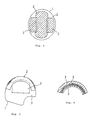
- the helmet is shown by the cross section 1 of a front portion of its body part without any inner cushion.
- H is a human head model and P-P′ plane is a base plane which is corresponding to the plane involving the ear holes and the lower side of eyeholes.
- O-O′ and M-M′ planes are parallell to P-P′ plane and the distance between these planes (o and m) are shown in Table 1.
- M-M′ plain is a reference plain.
- B is the top point of the head model and B-B′ line is the central axis of the head model. The dimensions of a, b, c and d are shown in Table 1.
- a helmet to be tested is put on the above human head model electrically connected to a device for measuring acceleration of shock.
- a weight of 5 kg is dropped from a spot of 1.7 m in height so that the impact point is hit by the weight to measure the acceleration of shock.
- Type A helmet should not bring about an acceleration of shock of higher than 400 G (3924 m/s2). If an acceleration of shock of 200 G (1962 m/s2) or higher is brought about, its duration should be not longer than 2 ms. If an acceleration of shock of 150 G (1472 m/s2) or higher is brought about, its duration should be not more than 4 ms.
- Type B or C helmet should not bring about an acceleration of shock of higher than 300 G (2943 m/s2). If an acceleration fo shock of 150 G is brought about, its duration should be not longer than 4 ms.
- a helmet to be tested is put on the above human head model and a weight having a sharp tip of 3 kg is dropped from a spot of 3 m in height so that the tip hit against the impact part. According to the standards of JIS T 8133 (1982), no penetration should be observed.
- the helmet of the present invention is not limited to any particular type of the above A to B and includes all types of helmets including those for boats, aircrafts and the like. Further, the helmet of the present invention includes those for construction workers.
- a polyethylene fiber having high tenacity and high modulus which had the fineness of 1600 denier, tensile strength of 30 g/denier and tensile modulus of 1100 g/denier (manufactured by Dyneema Japan, Ltd., Japan; trade name: SK-60) was used to weave a five-shaft satin reinforcing woven fabric having the weft density of 18 filaments/inch, warp density of 14 filaments/inch and five-shaft satin after sizing. Its fabric weight was 248 g/m2.
- a glass fiber preform set was placed in a female mold heated at about 115°C and two reinforcing woven fabrics obtained in the above were laminated on the inner side thereof at least on the inner side of the part defined by JIS as shown by the shaded parts 2 in Fig. 2. Then, a thin glass fiber mat was patched on the inner most layer. Then, a resin solution prepared by adding 1.5 parts of a benzoyl peroxide paste (50 %) to 100 parts of an unsaturated polyester resin was cast into the mold, and the female mold and a male mold are fastened to each other, immediately. Then, pressure molding was carried out at 115°C for 10 minutes to cure the resin to produce a large-sized jet type helmet body (weight: 710 g).
- the body part of the helmet 1 was mainly composed of GFRP layer 3 and the reinforced part 2 is laminated with the cloth of polyethylene fiber having high tenacity and high modulus 4 (see Fig. 4).
- the helmet thus produced was subjected to shock adsorption property test and penetration resistance test according to JIS T 8133, type C. As a result, the helmet met both standards of shock absorption properties and penetration resistance.
- a helmet body (weight: 710 g) was produced by using the same polyethylene fiber having high strength and high modulus polyethylene fiber, glass fiber preform set and resin as those used in Example 1 except that the polyethylene fiber layer was formed on the outer side of the glass fiber preform set and thin glass fiber mat was patched on its outer most side.
- the helmet thus produced was subjected to the same tests as those of Example 1. As a result, the helmet met the standard of shock absorption properties, but it did not meet the standard of penetration resistance.
- Two helmets were produced by using only unsaturated polyester resin reinforced with glass fiber without any reinforcement with a cloth of polyethylene fiber having high tenacity and high modulus.
- the amount of glass fiber was increased to obtain a helmet body of 920 g.
- the amount of glass fiber was slightly decreased to meet lightweight requirement to obtain a helmet body of 850 g.
- Respective helmets thus obtained were subjected to the same tests as those described above.
- the former helmet met both standards of shock absorption properties and penetration resistance. However, it was very heavy in comparison with that obtained in Example 1.
- the latter helmet was slightly lightweight. However, it did not meet the standard of penetration resistance.
- a plain woven fabric was woven by using polyethylene fiber having high tenacity and high modulus (manufactured by Dyneema Japan, Ltd., Japan; trade name: SK-60) which had a total denier of 1200 denier, a tensile strength of 30 g/denier and a tensile modulus of 1100 g/denier.
- the plain woven fabric had the construction as shown in Table 2.
- Table 2 Weft Warp Twist 80 turns/m 0 turn/m Fabric density 12 filaments/inch 11 filaments/inch Fabric weight 130 g/m2
- a helmet was produced by using the above plain woven fabric, a glass fiber preform set, an organic fiber woven fabric (vinylon woven fabric "Basket” manufactured by Kuraray Co., Ltd., Japan; weight: 230 g/m2), a glass fiber mat as inner finishing (manufactured by Nitto Boseki Co., Ltd, Japan; weight: 450 g/m2) and a vinyl ester resin (Lipoxy R 802 manufactured by Showa Kobunshi Co., Ltd., Japan) as a thermosetting resin.
- the helmet had the construction as shown in Table 3. For molding, pressure bag method was employed and curing was carried out at 120°C for 15 minutes.
- the helmet obtained was 800 g and lightweight. Further, its shock absorption properties and penetration resistance met the standards according to JIS T 8133.
- a plain woven fabric was woven by using the same polyethylene fiber having high tenacity and high modulus as that used in Example 2.
- the plain woven fabric had the construction as shown in Table 4.
- Table 4 Weft Warp Twist 80 turns/m 0 turn/m Fabric density 16 filaments/inch 16 filaments/inch Fabric weight 170 g/m2
- a helmet was produced by using the above plain woven fabric, and the same glass fiber preform set, organic fiber woven fabric, glass fiber mat for finishing and thermosetting resin as those used in Example 2.
- the helmet had the construction as shown in Table 5.
- Table 5 Layers Construction of layer The sinciput part The occiput part The temple part Outer layer glass fiber set preform, 1 set preform, 1 set preform, 1 set Reinforcing layer high tenacity polyethylene fiber 1 ply 0 0 Middle layer vinylon woven fabric 3 ply 2 ply 1 ply Reinforcing layer high tenacity polyethylene fiber 1 ply 1 ply 1 ply 1 ply Inner layer glass fiber mat patch glass patch glass patch glass patch glass
- the helmet obtained was 780 g and lightweight. Further, its shock absorption properties and penetration resistance met the standards according to JIS T 8133.
- a helmet having the same laminate construction as that of Example 2 was produced except that a commercially available kevlar plain woven fabric (aramid fiber fabric manufactured by Asahi Schebel Co., Ltd., Japan; weight: 170 g/m2) was used as the reinforcing fiber in place of the polyethylene fiber having high tenacity and high modulus.
- a commercially available kevlar plain woven fabric aramid fiber fabric manufactured by Asahi Schebel Co., Ltd., Japan; weight: 170 g/m2
- the helmet obtained met the standards of both shock absorption properties and penetration resistance according to JIS T 8133. However, it was 830 g and heavy. Further, its cutting properties in trimming and punch finishing steps after pressure molding were inferior, and whiskers of the kevlar fiber were remained at the cut surface.
- a helmet was produced by using the same glass fiber set, organic fiber woven fabric, glass fiber mat for finishing and thermosetting resin as those used in Example 2 without using no cloth of polyethylene having high tenacity and high modulus.
- the helmet had the laminate construction as shown in Table 5 except no reinforcing layer was present between the middle and inner layers at the occiput and temple parts.
- the molding conditions were same as those of Example 2.
- the helmet obtained did not meet the standard of the penetration resistance according to JIS T 8133.
- Plain woven fabrics were woven by using polyethylene fiber having high tenacity and high modulus (manufactured by Dyneema Japan, Ltd., Japan; trade name: Dyneema SK-60) which had total denier of 1200 denier, tensile strength of 30 g/denier and tensile modulus of 1100 g/denier.
- the plain woven fabrics had the construction as shown in Table 6.
- Helmet bodies having the construction as shown in Table 7 were molded by using the plain woven fabrics as shown in Table 6.
- helmet bodies were produced by using the polyethylene fabrics as shown in Table 6, preform glass fiber set (manufactured by Kuraray Co., Ltd., Japan; weight: 300 g/set), glass fiber mat (manufactured by Nitto Boseki Co., Ltd., Japan; weight: 450 g/m2) and a vinyl ester resin ("Lipoxy R 802" manufactured by Showa Kobunshi Co., Ltd., Japan) as a thermosetting resin according to pressure bad method. Curing was carried out at 120°C for 15 minutes.
- Helmet bodies were produced by using the fabric of Table 8.
- the helmets had the construction as shown in Table 9.
- Table 6 No.1 No.2 No.3 No.4 Twist (turn/m) 1200 d x 1 filament 1200 d x 1 filament 1200 d x 1 filament 1200 d x 1 filament
- Table 7 Example No.
- a lightweight helmet having excellent shock absorption properties and penetration resistance can be provided at low cost.
Landscapes
- Chemical & Material Sciences (AREA)
- Health & Medical Sciences (AREA)
- Chemical Kinetics & Catalysis (AREA)
- Medicinal Chemistry (AREA)
- Polymers & Plastics (AREA)
- Organic Chemistry (AREA)
- Engineering & Computer Science (AREA)
- Manufacturing & Machinery (AREA)
- Materials Engineering (AREA)
- Mechanical Engineering (AREA)
- Helmets And Other Head Coverings (AREA)
- Laminated Bodies (AREA)
Applications Claiming Priority (6)
| Application Number | Priority Date | Filing Date | Title |
|---|---|---|---|
| JP1203133A JP2923306B2 (ja) | 1989-08-05 | 1989-08-05 | ヘルメット |
| JP203134/89 | 1989-08-05 | ||
| JP203133/89 | 1989-08-05 | ||
| JP203135/89 | 1989-08-05 | ||
| JP1203135A JP2831711B2 (ja) | 1989-08-05 | 1989-08-05 | ヘルメット |
| JP1203134A JP2831710B2 (ja) | 1989-08-05 | 1989-08-05 | 繊維強化樹脂製ヘルメット |
Publications (2)
| Publication Number | Publication Date |
|---|---|
| EP0412452A2 true EP0412452A2 (fr) | 1991-02-13 |
| EP0412452A3 EP0412452A3 (en) | 1992-11-19 |
Family
ID=27328190
Family Applications (1)
| Application Number | Title | Priority Date | Filing Date |
|---|---|---|---|
| EP19900114952 Withdrawn EP0412452A3 (en) | 1989-08-05 | 1990-08-03 | Helmet |
Country Status (3)
| Country | Link |
|---|---|
| US (1) | US5075904A (fr) |
| EP (1) | EP0412452A3 (fr) |
| KR (1) | KR910004131A (fr) |
Cited By (6)
| Publication number | Priority date | Publication date | Assignee | Title |
|---|---|---|---|---|
| DE4129339A1 (de) * | 1991-09-04 | 1993-03-11 | Toho Zweiradzubehoergesellscha | Radfahrerhelm |
| DE4140044A1 (de) * | 1991-12-05 | 1993-06-09 | Uvex Winter Optik Gmbh, 8510 Fuerth, De | Helm, insbesondere schutz- bzw. sturzhelm |
| GB2276935A (en) * | 1993-04-07 | 1994-10-12 | Courtaulds Aerospace Ltd | Composite ballistic armour |
| US7964518B1 (en) | 2010-04-19 | 2011-06-21 | Honeywell International Inc. | Enhanced ballistic performance of polymer fibers |
| US20130055790A1 (en) * | 2011-09-06 | 2013-03-07 | Honeywell International Inc. | Apparatus and method to measure back face signature of armor |
| EP2242984A4 (fr) * | 2007-12-20 | 2013-05-29 | Honeywell Int Inc | Casques pour la protection contre les balles d'arme à feu |
Families Citing this family (23)
| Publication number | Priority date | Publication date | Assignee | Title |
|---|---|---|---|---|
| US6012178A (en) * | 1995-04-08 | 2000-01-11 | Akzo Nobel Nv | Antiballistic protective helmet |
| US5603117A (en) * | 1995-09-13 | 1997-02-18 | The United States Of America As Represented By The Secretary Of The Army | Protective helmet assembly |
| US5794271A (en) * | 1996-10-17 | 1998-08-18 | Hastings; Dale | Helmet shell structure |
| KR20010038599A (ko) * | 1999-10-26 | 2001-05-15 | 홍완기 | 2중구조의 헬멧본체와 그 제조방법 |
| WO2002043949A2 (fr) * | 2000-11-28 | 2002-06-06 | 3Tex, Inc. | Structure composite rigide profilee et procede associe |
| US6931671B2 (en) * | 2003-07-22 | 2005-08-23 | Joseph Skiba | Lightweight impact resistant helmet system |
| US20050028253A1 (en) * | 2003-08-07 | 2005-02-10 | Fowler David B. | Decorative protective helmet |
| USD518920S1 (en) | 2004-08-27 | 2006-04-11 | Fowler David B | Rigid protective helmet |
| WO2006041355A1 (fr) * | 2004-09-07 | 2006-04-20 | Poc Sweden Ab | Casque |
| USD569555S1 (en) | 2007-03-15 | 2008-05-20 | Fowler David B | Rigid protective helmet |
| USD571048S1 (en) | 2007-03-15 | 2008-06-10 | Fowler David B | Rigid protective helmet |
| US9107466B2 (en) * | 2009-08-31 | 2015-08-18 | Rawlings Sporting Goods Company, Inc. | Batting helmet having localized impact protection |
| US9023452B2 (en) | 2011-09-06 | 2015-05-05 | Honeywell International Inc. | Rigid structural and low back face signature ballistic UD/articles and method of making |
| US9023451B2 (en) | 2011-09-06 | 2015-05-05 | Honeywell International Inc. | Rigid structure UHMWPE UD and composite and the process of making |
| US9023450B2 (en) | 2011-09-06 | 2015-05-05 | Honeywell International Inc. | High lap shear strength, low back face signature UD composite and the process of making |
| US9168719B2 (en) | 2011-09-06 | 2015-10-27 | Honeywell International Inc. | Surface treated yarn and fabric with enhanced physical and adhesion properties and the process of making |
| US9163335B2 (en) * | 2011-09-06 | 2015-10-20 | Honeywell International Inc. | High performance ballistic composites and method of making |
| US9585433B1 (en) | 2012-05-02 | 2017-03-07 | Rawlings Sporting Goods Company, Inc. | Fiber reinforced helmet |
| US10132006B2 (en) | 2012-07-27 | 2018-11-20 | Honeywell International Inc. | UHMWPE fiber and method to produce |
| US10132010B2 (en) | 2012-07-27 | 2018-11-20 | Honeywell International Inc. | UHMW PE fiber and method to produce |
| US9909240B2 (en) | 2014-11-04 | 2018-03-06 | Honeywell International Inc. | UHMWPE fiber and method to produce |
| US9526969B1 (en) * | 2015-05-26 | 2016-12-27 | Jeremiah A. Raber | Composite athletic cup |
| CN111909489B (zh) * | 2020-08-14 | 2023-12-29 | 南通大学 | 一种纤维树脂复合材料及其制备方法与应用 |
Family Cites Families (17)
| Publication number | Priority date | Publication date | Assignee | Title |
|---|---|---|---|---|
| US2956916A (en) * | 1958-07-01 | 1960-10-18 | Mine Safety Appliances Co | Helmet shell and method of making it |
| FR2335169A1 (fr) * | 1975-12-17 | 1977-07-15 | Gallet Adrien | Casque de protection et son procede de fabrication |
| FR2340066A1 (fr) * | 1976-02-09 | 1977-09-02 | Sl France | Casque de protection |
| GB1578351A (en) * | 1976-12-20 | 1980-11-05 | Du Pont Canada | Protective helmet |
| DE2855967C2 (de) * | 1978-12-23 | 1982-11-18 | Düsseldorfer Lackgroßhandel Otto Hartung GmbH, 4000 Düsseldorf | Verfahren zum Herstellen von Schutzhelmen, insbesondere für den Motorsport |
| IT1113216B (it) * | 1979-03-30 | 1986-01-20 | Nava Pier Luigi | Struttura in resina armata resistente agli urti e relativo procedimento di realizzazione |
| US4242406A (en) * | 1979-04-30 | 1980-12-30 | Ppg Industries, Inc. | Fiber reinforced composite structural laminate composed of two layers tied to one another by embedded fibers bridging both layers |
| FR2485341A1 (fr) * | 1980-06-24 | 1981-12-31 | Gpa International Sarl | Casque de protection a coque injectee en thermoplastique et procede de fabrication dudit casque |
| JPS59124813A (ja) * | 1982-12-30 | 1984-07-19 | Tokyo Seat Kk | ヘルメツトの製造方法 |
| GB2158471B (en) * | 1984-05-04 | 1988-03-16 | Budd Co | Fiberous armor material |
| JPS61174407A (ja) * | 1985-01-30 | 1986-08-06 | 住友ベークライト株式会社 | ヘルメツトの製造方法 |
| FR2585239B1 (fr) * | 1985-07-24 | 1987-09-25 | Commissariat Energie Atomique | Calotte de protection pour boite cranienne et son procede de fabrication |
| JPH0764035B2 (ja) * | 1986-09-22 | 1995-07-12 | 東洋紡績株式会社 | 中実若しくは中空状の繊維強化プラスチツク |
| US4732803A (en) * | 1986-10-07 | 1988-03-22 | Smith Novis W Jr | Light weight armor |
| GB8630459D0 (en) * | 1986-12-19 | 1987-01-28 | Secr Defence | Impact protection helmet |
| KR890701976A (ko) * | 1987-08-03 | 1989-12-22 | 로이 에이취.멧신길 | 충격 저항성 헬멧 |
| US4879165A (en) * | 1988-06-20 | 1989-11-07 | Smith W Novis | Lightweight armor |
-
1990
- 1990-08-01 US US07/560,995 patent/US5075904A/en not_active Expired - Lifetime
- 1990-08-03 EP EP19900114952 patent/EP0412452A3/en not_active Withdrawn
- 1990-08-04 KR KR1019900011986A patent/KR910004131A/ko not_active Withdrawn
Cited By (10)
| Publication number | Priority date | Publication date | Assignee | Title |
|---|---|---|---|---|
| DE4129339A1 (de) * | 1991-09-04 | 1993-03-11 | Toho Zweiradzubehoergesellscha | Radfahrerhelm |
| DE4140044A1 (de) * | 1991-12-05 | 1993-06-09 | Uvex Winter Optik Gmbh, 8510 Fuerth, De | Helm, insbesondere schutz- bzw. sturzhelm |
| GB2276935A (en) * | 1993-04-07 | 1994-10-12 | Courtaulds Aerospace Ltd | Composite ballistic armour |
| GB2276935B (en) * | 1993-04-07 | 1997-04-16 | Courtaulds Aerospace Ltd | Ballistic resistant composites |
| EP2242984A4 (fr) * | 2007-12-20 | 2013-05-29 | Honeywell Int Inc | Casques pour la protection contre les balles d'arme à feu |
| US8853105B2 (en) | 2007-12-20 | 2014-10-07 | Honeywell International Inc. | Helmets for protection against rifle bullets |
| US9683815B2 (en) | 2007-12-20 | 2017-06-20 | Honeywell International Inc. | Helmets for protection against rifle bullets |
| US7964518B1 (en) | 2010-04-19 | 2011-06-21 | Honeywell International Inc. | Enhanced ballistic performance of polymer fibers |
| US20130055790A1 (en) * | 2011-09-06 | 2013-03-07 | Honeywell International Inc. | Apparatus and method to measure back face signature of armor |
| US9222864B2 (en) * | 2011-09-06 | 2015-12-29 | Honeywell International Inc. | Apparatus and method to measure back face signature of armor |
Also Published As
| Publication number | Publication date |
|---|---|
| KR910004131A (ko) | 1991-03-28 |
| EP0412452A3 (en) | 1992-11-19 |
| US5075904A (en) | 1991-12-31 |
Similar Documents
| Publication | Publication Date | Title |
|---|---|---|
| EP0412452A2 (fr) | Casque | |
| US5190802A (en) | Ballistic resistant laminate | |
| US5538781A (en) | Composite reinforcing fabric | |
| JP5241257B2 (ja) | 繊維強化複合材及びその製造方法 | |
| US4550044A (en) | Ballistic resistant armor panel and method of constructing the same | |
| JPH08501131A (ja) | 安全ヘルメット | |
| KR101398748B1 (ko) | 방탄용 복합재료 및 이를 이용하여 제조된 방탄용 헬멧 | |
| US5035952A (en) | Ballistic structure | |
| EP3647025B1 (fr) | Tissu d'aramide ayant une excellente adhérence à une résine de matrice de polyuréthane et une excellente résistance à la traction, procédé pour la fabrication de celui-ci, préimprégné de tissu d'aramide comprenant celui-ci et composite de tissu d'aramide/résine de polyuréthane thermoplastique comprenant celui-ci | |
| JP2831711B2 (ja) | ヘルメット | |
| CN221562467U (zh) | 一种具有连续纤维结构的复合材料壳体 | |
| JP4964092B2 (ja) | 繊維強化樹脂複合材料及びそれを成形してなる成形品 | |
| JP2923306B2 (ja) | ヘルメット | |
| JP2831710B2 (ja) | 繊維強化樹脂製ヘルメット | |
| JPH08300526A (ja) | 輸送機器用部材 | |
| JPH0577368A (ja) | 耐衝撃透過性ラミネート | |
| JP3558177B2 (ja) | ヘルメット | |
| JPH08269809A (ja) | ヘルメット | |
| EP0574626A1 (fr) | Cadre de raquette fabriqué en matériau plastique composé | |
| JP3011055B2 (ja) | ヘルメット | |
| JPH0345334A (ja) | 繊維強化プラスチックおよびその補強材 | |
| JP3651065B2 (ja) | ヘルメット | |
| JP4515829B2 (ja) | スピーカー振動板 | |
| JP2556995Y2 (ja) | ヘルメット帽体 | |
| JP2543816Y2 (ja) | 防御楯 |
Legal Events
| Date | Code | Title | Description |
|---|---|---|---|
| PUAI | Public reference made under article 153(3) epc to a published international application that has entered the european phase |
Free format text: ORIGINAL CODE: 0009012 |
|
| 17P | Request for examination filed |
Effective date: 19901116 |
|
| AK | Designated contracting states |
Kind code of ref document: A2 Designated state(s): BE DE ES FR GB IT NL |
|
| PUAL | Search report despatched |
Free format text: ORIGINAL CODE: 0009013 |
|
| AK | Designated contracting states |
Kind code of ref document: A3 Designated state(s): BE DE ES FR GB IT NL |
|
| 17Q | First examination report despatched |
Effective date: 19940907 |
|
| STAA | Information on the status of an ep patent application or granted ep patent |
Free format text: STATUS: THE APPLICATION IS DEEMED TO BE WITHDRAWN |
|
| 18D | Application deemed to be withdrawn |
Effective date: 19950118 |