EP0412461A2 - Appareil de fac-similé et procédé de transmission fac-similé pour un réseau de communication numérique - Google Patents
Appareil de fac-similé et procédé de transmission fac-similé pour un réseau de communication numérique Download PDFInfo
- Publication number
- EP0412461A2 EP0412461A2 EP90114991A EP90114991A EP0412461A2 EP 0412461 A2 EP0412461 A2 EP 0412461A2 EP 90114991 A EP90114991 A EP 90114991A EP 90114991 A EP90114991 A EP 90114991A EP 0412461 A2 EP0412461 A2 EP 0412461A2
- Authority
- EP
- European Patent Office
- Prior art keywords
- communication
- communication mode
- specifying information
- information
- mode
- Prior art date
- Legal status (The legal status is an assumption and is not a legal conclusion. Google has not performed a legal analysis and makes no representation as to the accuracy of the status listed.)
- Granted
Links
Images




Classifications
-
- H—ELECTRICITY
- H04—ELECTRIC COMMUNICATION TECHNIQUE
- H04N—PICTORIAL COMMUNICATION, e.g. TELEVISION
- H04N1/00—Scanning, transmission or reproduction of documents or the like, e.g. facsimile transmission; Details thereof
- H04N1/32—Circuits or arrangements for control or supervision between transmitter and receiver or between image input and image output device, e.g. between a still-image camera and its memory or between a still-image camera and a printer device
- H04N1/32037—Automation of particular transmitter jobs, e.g. multi-address calling, auto-dialing
- H04N1/32058—Abbreviated dialing, e.g. one-touch dialing
-
- H—ELECTRICITY
- H04—ELECTRIC COMMUNICATION TECHNIQUE
- H04N—PICTORIAL COMMUNICATION, e.g. TELEVISION
- H04N1/00—Scanning, transmission or reproduction of documents or the like, e.g. facsimile transmission; Details thereof
- H04N1/32—Circuits or arrangements for control or supervision between transmitter and receiver or between image input and image output device, e.g. between a still-image camera and its memory or between a still-image camera and a printer device
- H04N1/32037—Automation of particular transmitter jobs, e.g. multi-address calling, auto-dialing
-
- H—ELECTRICITY
- H04—ELECTRIC COMMUNICATION TECHNIQUE
- H04N—PICTORIAL COMMUNICATION, e.g. TELEVISION
- H04N1/00—Scanning, transmission or reproduction of documents or the like, e.g. facsimile transmission; Details thereof
- H04N1/32—Circuits or arrangements for control or supervision between transmitter and receiver or between image input and image output device, e.g. between a still-image camera and its memory or between a still-image camera and a printer device
- H04N1/333—Mode signalling or mode changing; Handshaking therefor
- H04N1/33307—Mode signalling or mode changing; Handshaking therefor prior to start of transmission, input or output of the picture signal only
- H04N1/33323—Mode signalling or mode changing; Handshaking therefor prior to start of transmission, input or output of the picture signal only transmission mode only, e.g. speed
-
- H—ELECTRICITY
- H04—ELECTRIC COMMUNICATION TECHNIQUE
- H04N—PICTORIAL COMMUNICATION, e.g. TELEVISION
- H04N1/00—Scanning, transmission or reproduction of documents or the like, e.g. facsimile transmission; Details thereof
- H04N1/32—Circuits or arrangements for control or supervision between transmitter and receiver or between image input and image output device, e.g. between a still-image camera and its memory or between a still-image camera and a printer device
- H04N1/333—Mode signalling or mode changing; Handshaking therefor
- H04N1/33338—Mode signalling or mode changing; Handshaking therefor adapting to particular facsimile group, e.g. G3
-
- H—ELECTRICITY
- H04—ELECTRIC COMMUNICATION TECHNIQUE
- H04N—PICTORIAL COMMUNICATION, e.g. TELEVISION
- H04N1/00—Scanning, transmission or reproduction of documents or the like, e.g. facsimile transmission; Details thereof
- H04N1/32—Circuits or arrangements for control or supervision between transmitter and receiver or between image input and image output device, e.g. between a still-image camera and its memory or between a still-image camera and a printer device
- H04N1/333—Mode signalling or mode changing; Handshaking therefor
- H04N1/33361—Mode signalling or mode changing; Handshaking therefor according to characteristics or the state of the communication line
-
- H—ELECTRICITY
- H04—ELECTRIC COMMUNICATION TECHNIQUE
- H04N—PICTORIAL COMMUNICATION, e.g. TELEVISION
- H04N1/00—Scanning, transmission or reproduction of documents or the like, e.g. facsimile transmission; Details thereof
- H04N1/32—Circuits or arrangements for control or supervision between transmitter and receiver or between image input and image output device, e.g. between a still-image camera and its memory or between a still-image camera and a printer device
- H04N1/333—Mode signalling or mode changing; Handshaking therefor
- H04N1/33369—Storage of mode or retrieval of prestored mode
-
- H—ELECTRICITY
- H04—ELECTRIC COMMUNICATION TECHNIQUE
- H04N—PICTORIAL COMMUNICATION, e.g. TELEVISION
- H04N1/00—Scanning, transmission or reproduction of documents or the like, e.g. facsimile transmission; Details thereof
- H04N1/32—Circuits or arrangements for control or supervision between transmitter and receiver or between image input and image output device, e.g. between a still-image camera and its memory or between a still-image camera and a printer device
- H04N1/333—Mode signalling or mode changing; Handshaking therefor
- H04N1/33376—Mode signalling or mode changing; Handshaking therefor according to characteristics or state of one of the communicating parties, e.g. available memory capacity
-
- H—ELECTRICITY
- H04—ELECTRIC COMMUNICATION TECHNIQUE
- H04Q—SELECTING
- H04Q11/00—Selecting arrangements for multiplex systems
- H04Q11/04—Selecting arrangements for multiplex systems for time-division multiplexing
- H04Q11/0428—Integrated services digital network, i.e. systems for transmission of different types of digitised signals, e.g. speech, data, telecentral, television signals
- H04Q11/0435—Details
- H04Q11/0457—Connection protocols
-
- H—ELECTRICITY
- H04—ELECTRIC COMMUNICATION TECHNIQUE
- H04N—PICTORIAL COMMUNICATION, e.g. TELEVISION
- H04N2201/00—Indexing scheme relating to scanning, transmission or reproduction of documents or the like, and to details thereof
- H04N2201/32—Circuits or arrangements for control or supervision between transmitter and receiver or between image input and image output device, e.g. between a still-image camera and its memory or between a still-image camera and a printer device
- H04N2201/333—Mode signalling or mode changing; Handshaking therefor
- H04N2201/33307—Mode signalling or mode changing; Handshaking therefor of a particular mode
- H04N2201/33342—Mode signalling or mode changing; Handshaking therefor of a particular mode of transmission mode
- H04N2201/3335—Speed or rate
-
- H—ELECTRICITY
- H04—ELECTRIC COMMUNICATION TECHNIQUE
- H04N—PICTORIAL COMMUNICATION, e.g. TELEVISION
- H04N2201/00—Indexing scheme relating to scanning, transmission or reproduction of documents or the like, and to details thereof
- H04N2201/32—Circuits or arrangements for control or supervision between transmitter and receiver or between image input and image output device, e.g. between a still-image camera and its memory or between a still-image camera and a printer device
- H04N2201/333—Mode signalling or mode changing; Handshaking therefor
- H04N2201/33307—Mode signalling or mode changing; Handshaking therefor of a particular mode
- H04N2201/33342—Mode signalling or mode changing; Handshaking therefor of a particular mode of transmission mode
- H04N2201/33371—Mode signalling or mode changing; Handshaking therefor of a particular mode of transmission mode using test signals, e.g. checking error occurrences
-
- H—ELECTRICITY
- H04—ELECTRIC COMMUNICATION TECHNIQUE
- H04Q—SELECTING
- H04Q2213/00—Indexing scheme relating to selecting arrangements in general and for multiplex systems
- H04Q2213/09—Subscriber related equipment; Analog terminal
-
- H—ELECTRICITY
- H04—ELECTRIC COMMUNICATION TECHNIQUE
- H04Q—SELECTING
- H04Q2213/00—Indexing scheme relating to selecting arrangements in general and for multiplex systems
- H04Q2213/091—Indication of kind/number of subscriber
-
- H—ELECTRICITY
- H04—ELECTRIC COMMUNICATION TECHNIQUE
- H04Q—SELECTING
- H04Q2213/00—Indexing scheme relating to selecting arrangements in general and for multiplex systems
- H04Q2213/096—Digital subscriber terminal
-
- H—ELECTRICITY
- H04—ELECTRIC COMMUNICATION TECHNIQUE
- H04Q—SELECTING
- H04Q2213/00—Indexing scheme relating to selecting arrangements in general and for multiplex systems
- H04Q2213/103—Memories
-
- H—ELECTRICITY
- H04—ELECTRIC COMMUNICATION TECHNIQUE
- H04Q—SELECTING
- H04Q2213/00—Indexing scheme relating to selecting arrangements in general and for multiplex systems
- H04Q2213/179—Facsimile; Fax, e.g. still picture
-
- H—ELECTRICITY
- H04—ELECTRIC COMMUNICATION TECHNIQUE
- H04Q—SELECTING
- H04Q2213/00—Indexing scheme relating to selecting arrangements in general and for multiplex systems
- H04Q2213/297—Coupling circuits between different (rate) TDM systems
Definitions
- the present invention generally relates to facsimile apparatuses and facsimile transmission methods, and more particularly, to an apparatus for and method of facsimile communication utilizing a digital communication network such as ISDN (Integrated Services Digital Network).
- ISDN Integrated Services Digital Network
- This facsimile apparatus operable in both communication modes of G4 and G3 has been put to practical use.
- This facsimile apparatus with both modes of G3 and G4 can be connected to an ISDN line as well as a G3 mode subscriber telephone line and a G4 mode fast digital line (facsimile-directed line).
- a G3/G4 facsimile apparatus (facsimile apparatus with both modes of G3 and G4) connected to the ISDN line can perform transmission through the ISDN line either in the G3 mode or in the G4 mode.
- the ISDN communication line has channels each different in data transmission rate, from which selections are made to perform efficient communication according to communication modes. The selection of a channel and the adjustment between the channel and the facsimile apparatus in data transmission rate are made by a network.
- An ISDN communication network is connectable to existing subscriber telephone lines or facsimile-directed lines (digital lines).
- the G3/G4 facsimile apparatus connected to the ISDN line performs communication in both modes through the ISDN line.
- This ISDN line is also connectable through a modem to a facsimile apparatus which can make facsimile communication only in the G3 mode.
- Fig. 1 is a schematic diagram showing structure of a conventional G3/G4 facsimile apparatus.
- the facsimile apparatus comprises a processing circuit 1 for executing various types of control required to perform communication, and a facsimile mechanism 5 for performing reading of an original, printing out of received information and so forth.
- the processing circuit 1 comprises a control circuit constituted of, for example, a microcomputer for monitoring and controlling operations of the entire facsimile apparatus, a communication control circuit 20 for executing protocol control over respective lines for the G3 and G4 modes, and an ISDN interface circuit 30 constituted of, for example, a microcomputer for establishing interface between an ISDN line 2 and the communication control circuit 20.
- the communication control circuit 20 comprises a G3 control circuit 21 for controlling facsimile communication in the G3 mode and a G4 control circuit 22 for controlling facsimile communication in the G4 mode.
- the G3 control circuit 21 controls G3 line protocol and transmits and receives data to and from the disc unit 40.
- the G4 control circuit 22 controls G4 line protocol and transmits and receives data to and from the disc unit 40.
- the ISDN interface circuit 30 converts a signal on the ISDN line 2 into a data signal for the G4 control circuit 22 (for example 64k bps), an audio signal for the G3 control circuit 21 (analog signal of, for example, 3.4 kHz) and calling/reference control signals for the control circuits 21 and 22. Also, the ISDN interface circuit 30 transmits, in response to a control signal from the communication control circuit 20, an information signal and a control signal from the communication control circuit 20 onto the ISDN line 2. This interface circuit performs conversion of signals, confirmation of transmission and reception, and the like.
- the ten-key 4 receives input of address information specifying a destination.
- a caller sets an original to be transmitted in the facsimile mechanism 5 (step m2).
- a destination specifying number or code is entered with the ten-key 4 (step m3).
- the destination specifying number is applied to the main control circuit 10.
- the main control circuit 10 drives the G4 control circuit 22 in response to the transmission start indicating signal.
- the G4 control circuit 22 forms, based on destination specifying information received from the main control circuit 10, calling information including information for specifying its own station (caller specifying information), G4 mode specifying information and the like, and transmits the same through the ISDN interface circuit 30 to the ISDN line 2. In this manner, a call is made in the G4 mode (step m6).
- the G4 control circuit 22 detects presence or absence of the response signal (step m7).
- the G4 control circuit 22 reads out original information that has been already written in the disc unit 40 under control of the main control unit 10 and transmits the same according to the G4 communication protocol onto the ISDN line 2 through the ISDN interface circuit 30 (step m8).
- the non-acceptance of transmission is displayed at the operation portion of the mechanism 5 through operation of the main control circuit 10.
- An operator who has noticed this display at the operation portion returns to step m3 to enter again the destination specifying information and specifies this time the G3 mode for facsimile transmission.
- the facsimile communication requires operation of the communication mode selection key, resulting in complicated operation procedure.
- the destination facsimile apparatus is operable in both modes of G3 and G4, in case an operator first specifies the G3 mode, a call is made in the G3 mode to perform subsequently facsimile communication in the G3 mode. Since the G3 mode is a lower-speed communication mode when compared with the G4 mode, it takes a longer communication time and charges unduely extra fee for the communication.
- a system to make a match in communication mode between facsimile apparatuses each having a plurality of communication modes is disclosed in Japanese Patent Laying-Open No. 59-26152.
- one facsimile apparatus transmits a signal indicative of available transmission modes to a destination apparatus.
- the destination apparatus selects, according to priority, one communication mode among them and sends back a signal indicating the selected one to the transmission apparatus.
- the transmission apparatus starts facsimile transmission according to the sent back selected communication mode.
- Another object of the present invention is to provide a facsimile apparatus which can make communication in a mode of a highest possible speed.
- a facsimile apparatus comprises means for making first a call in a first communication mode of a large communication capability when communication modes available in a destination facsimile apparatus are not known, and for making another call in a second communication mode of a smaller communication capability relative to the first mode when no response signal has been sent back in connection with the former call.
- a first facsimile apparatus comprises: means for generating destination specifying information; means for generating transmission start indicating signal; a first calling means responsive to the transmission start indicating signal for creating, based on the generated destination specifying information, first calling information suitable to a first communication mode and transmitting in the first communication mode the first calling information onto a communication line; means for monitoring the communication line and detecting whether or not an acknowledge signal for the first calling information has been sent back; means responsive to detection of the acknowledge signal by the detection means for executing facsimile communication in the first communication mode; means responsive to non-detection of the acknowledge signal by the detection means for being activated to create, based on the generated destination specifying information, second calling information suitable to a second communication mode and transmit in the second communication mode the second calling information onto the communication line; second detection means for monitoring the communication line and detecting whether or not an acknowledge signal for the second calling information has been sent back; and means responsive to detection of the acknowledge signal by the second detection means for executing facsimile communication in the second communication
- the facsimile apparatus further comprises a memory for storing the destination specifying information and communication mode specifying information corresponding to the destination specifying information, a circuit for retrieving communication mode specifying information corresponding to received destination specifying information and making a call in a communication mode in accordance with the retrieved communication mode specifying information, and another circuit for making a call in the first communication mode when communication mode specifying information which corresponds to the received destination specifying information has been stored in the memory.
- first a call is made in the first communication mode of a large communication capability and another call is made in the second communication mode when no response is obtained in connection with the first call. Accordingly, facsimile communication is executed in an appropriate communication mode corresponding to the communication capability of a destination facsimile apparatus.
- Fig. 3 is a schematic diagram showing structure of a facsimile apparatus according to an embodiment of the present invention.
- the same reference numerals are given to the parts corresponding to those in the conventional facsimile apparatus shown in Fig. 1.
- the facsimile apparatus further comprises one-touch keys 8 and a memory 9.
- the one-touch keys 8 are provided n in number allowing operators to specify n different destinations at maximum. That is, one one-touch key corresponds to one destination. Therefore, by operating these one-touch keys, the destination specifying information can be generated without the use of the ten-key 4.
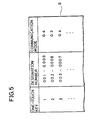
- the memory 9 is a readable/writable memory and stores the destination specifying information corresponding to the respective one-touch keys. For example, when the number of a one-touch key is assumed to represent an address, the memory 9 stores destination specifying information corresponding to each address.
- the main control circuit 100 starts various types of control necessary for a transmission, in response to a detection signal from the detection element 6.
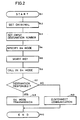
- Destination specifying information is generated through operation of the ten-key 4 and then a transmission start instruction is generated with the start key 7 (steps n2 and n3).
- the main control circuit 100 drives the G4 control circuit 22 in response to the transmission start instruction.
- the G4 control circuit 22 creates calling information from the destination specifying information received from the main control circuit 100 and transmits the same through the ISDN interface circuit 30 to the ISDN line 2. This call is made in the G4 mode in the form of a non-limit digital signal of 64k bps (step n5).
- the G4 control circuit 22 waits until the calling information reaches a destination and a response or acknowledge signal to the call is sent back (step n6).
- the G4 control circuit 22 informs the main control circuit 100 thereof.
- the main control circuit 100 makes determination that the destination facsimile apparatus has not been provided with communication function of the G4 mode and activates in turn the G3 control circuit 21.
- the G3 control circuit 21 creates from the destination specifying information of the main control circuit 100 calling information according to the G3 mode protocol and transmits the same through the ISDN interface circuit 30 to the ISDN line 2. This call is made in the form of an audio signal of 3.1 kHz.
- the G3 control circuit 21 monitors a control signal from the ISDN interface circuit 30 and waits for a response signal to the call just made to be sent back. When the response signal is received, the G3 control circuit 21 makes access to the disc unit 40, reads out the original information, and transmits the read-out information through the ISDN interface circuit 30 in the G3 mode (step n8).
- an operation mode of "re-call" where a call is made again in the G4 mode may be executed instead of disconnecting the ISDN line 2.
- destination specifying information destination facsimile numbers
- communication modes corresponding to the respective one-touch keys 8 are stored in the memory 9. That is, in making programs for the one-touch keys 8 (in registering the destination numbers), also their corresponding communication modes are registered. In the transmission, calls are made according to those registered communication modes.
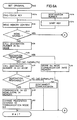
- operation of the apparatus will be described along the operation flow charts in Figs. 6A and 6B.
- the main control circuit 100 is activated to be put in a key-input stand-by state.
- the main control circuit 100 makes determination as to whether or not the communication mode information has been read out (step n23).
- the communication modes have been stored generally in advance. However, they may not be registered in making programs for the one-touch keys.
- the input destination specifying information may not have been stored in the memory 9.
- the memory 9 is provided with an extra memory area besides the memory area corresponding to the one-touch keys 8, it can store more destination numbers than the number of the one-touch keys.
- the main control circuit 100 applies the entered destination specifying information to the G4 control circuit 22.
- the G4 control circuit 22 creates, based on the applied destination specifying information, calling information and transmits the same through the ISDN interface circuit 30 to the ISDN line 2 (step n24).
- the G4 control circuit 22 When a response signal to the call made in the G4 mode is sent back from a destination, the G4 control circuit 22 reads out contents of the disc unit 40 and executes facsimile transmission in the G4 mode.
- the main control circuit 100 writes in the memory area for the communication modes, in response to detection of the response signal by the G4 control circuit 22, data indicating that the destination can communicate in the G4 mode(step n26). At this time, if the destination specifying information has been already registered in the memory 9, the communication mode specifying information is written in a corresponding memory area. When the destination specifying information has not been registered yet, it is written into the memory 9 together with the communication mode specifying information.
- the main control circuit 100 makes determination that the destination facsimile apparatus has not been provided with function of the G4 mode communication and activates the G3 control circuit 21.
- the G3 control circuit 21 creates, based on the destination specifying information from the main control circuit 100, calling information and transmits the same through the ISDN interface circuit 30 to the ISDN line 2 (step n27).
- step n28 When no response signal to the call made in the G3 mode has been sent back from the destination (step n28), the ISDN line 2 is disconnected under control of the G3 control circuit 21 (step n31) and the facsimile apparatus is put in the reception stand-by state (step n32).
- a facsimile transmission in the G3 mode is performed under control of the G3 control circuit 21.
- the main control circuit 100 Upon reception of such G3 mode transmissible information from the G3 control circuit 21, the main control circuit 100 stores the G3 mode transmissible information in a location corresponding to the destination specifying information in the memory 9. At this time, when the input destination specifying information has not been registered yet, the G3 mode transmissible information is stored together with the input destination specifying information (step n29).
- the first G4 mode transmissible information is changed to the G3 mode transmissible information to be stored in the original location (step n30). In this manner, erroneous registration of the communication mode specifying information is corrected.
- the main control circuit 100 makes identification of the read-out communication mode specifying information at steps n40 and n41.
- step n42 When the G3 mode is not detected at step n42, a determination is made that communication is impossible in either mode of G4 and G3, and the ISDN line 2 is disconnected (step n44).
- the communication mode specifying information is stored in the memory together with the destination specifying information, a high-performance facsimile apparatus which can make a communication in a mode corresponding to the communication capability of a destination can be obtained.
Landscapes
- Engineering & Computer Science (AREA)
- Multimedia (AREA)
- Signal Processing (AREA)
- Automation & Control Theory (AREA)
- Computer Networks & Wireless Communication (AREA)
- Facsimile Transmission Control (AREA)
- Communication Control (AREA)
Applications Claiming Priority (4)
| Application Number | Priority Date | Filing Date | Title |
|---|---|---|---|
| JP205048/89 | 1989-08-07 | ||
| JP1205047A JPH0368264A (ja) | 1989-08-07 | 1989-08-07 | Isdnファクシミリ装置 |
| JP1205048A JPH0368265A (ja) | 1989-08-07 | 1989-08-07 | Isdnファクシミリ装置 |
| JP205047/89 | 1989-08-07 |
Publications (3)
| Publication Number | Publication Date |
|---|---|
| EP0412461A2 true EP0412461A2 (fr) | 1991-02-13 |
| EP0412461A3 EP0412461A3 (en) | 1992-04-01 |
| EP0412461B1 EP0412461B1 (fr) | 1995-11-29 |
Family
ID=26514816
Family Applications (1)
| Application Number | Title | Priority Date | Filing Date |
|---|---|---|---|
| EP19900114991 Expired - Lifetime EP0412461B1 (fr) | 1989-08-07 | 1990-08-03 | Appareil de fac-similé et procédé de transmission fac-similé pour un réseau de communication numérique |
Country Status (3)
| Country | Link |
|---|---|
| EP (1) | EP0412461B1 (fr) |
| CA (1) | CA2022584C (fr) |
| DE (1) | DE69023830T2 (fr) |
Cited By (12)
| Publication number | Priority date | Publication date | Assignee | Title |
|---|---|---|---|---|
| DE4222768A1 (de) * | 1991-07-15 | 1993-01-21 | Hitachi Ltd | Faksimile-postsystem fuer den gebrauch verschiedener protokolle |
| EP0524891A1 (fr) * | 1991-07-25 | 1993-01-27 | Societe D'applications Generales D'electricite Et De Mecanique Sagem | Télécopieur perfectionné à fonctionnement dans l'un ou l'autre de plusieurs modes |
| WO1995022865A1 (fr) * | 1994-02-18 | 1995-08-24 | Microsoft Corporation | Systeme pour le transfert de messages entre des unites d'entree et de sortie dans une unite de communication |
| EP0515276A3 (en) * | 1991-05-22 | 1996-09-04 | Canon Kk | Facsimile apparatus, and communication method thereof |
| EP0724355A3 (fr) * | 1995-01-25 | 1997-10-29 | Canon Kk | Dispositif de communication de données |
| EP0752783A3 (fr) * | 1991-11-21 | 1997-11-19 | Canon Kabushiki Kaisha | Appareil de traitement de signaux d'information |
| EP0883286A3 (fr) * | 1997-06-04 | 1999-07-28 | Nec Corporation | Méthode de communication à rélais de trames et réseau pour des signaux téléphoniques à largeur de bande fixe et des signaux fac-simile à largeur de bande modifiable |
| US6253023B1 (en) | 1991-11-21 | 2001-06-26 | Canon Kabushiki Kaisha | Image pickup device |
| GB2382941A (en) * | 2001-10-18 | 2003-06-11 | Murata Machinery Ltd | Communication terminal device |
| EP1076991B1 (fr) * | 1997-12-15 | 2004-03-31 | Nortel Networks Limited | Transmission ultra-rapide par telecopie |
| EP0952724B1 (fr) * | 1998-04-21 | 2007-08-08 | Toshiba Tec Kabushiki Kaisha | Système de transmission de facsimilé en utilisant de courrier éléctronique |
| EP1841197A4 (fr) * | 2005-01-21 | 2008-01-16 | Huawei Tech Co Ltd | Procede applique a une passerelle t.38 pour le passage de la telecopie grande vitesse a la telecopie normale |
Family Cites Families (4)
| Publication number | Priority date | Publication date | Assignee | Title |
|---|---|---|---|---|
| JPS60137169A (ja) * | 1983-12-26 | 1985-07-20 | Ricoh Co Ltd | ファクシミリ装置 |
| US4746986A (en) * | 1985-03-04 | 1988-05-24 | Ricoh Company, Ltd. | Manifold analog/digital facsimile apparatus |
| JP2507299B2 (ja) * | 1985-05-17 | 1996-06-12 | 株式会社日立製作所 | 高速g3ファクシミリ装置 |
| JP2609098B2 (ja) * | 1987-01-19 | 1997-05-14 | 株式会社リコー | デジタルファクシミリ装置 |
-
1990
- 1990-08-02 CA CA 2022584 patent/CA2022584C/fr not_active Expired - Fee Related
- 1990-08-03 DE DE1990623830 patent/DE69023830T2/de not_active Expired - Fee Related
- 1990-08-03 EP EP19900114991 patent/EP0412461B1/fr not_active Expired - Lifetime
Cited By (20)
| Publication number | Priority date | Publication date | Assignee | Title |
|---|---|---|---|---|
| EP0515276A3 (en) * | 1991-05-22 | 1996-09-04 | Canon Kk | Facsimile apparatus, and communication method thereof |
| US5583658A (en) * | 1991-05-22 | 1996-12-10 | Canon Kabushiki Kaisha | Facsimile apparatus employing user-to-user information on an ISDN |
| DE4222768A1 (de) * | 1991-07-15 | 1993-01-21 | Hitachi Ltd | Faksimile-postsystem fuer den gebrauch verschiedener protokolle |
| EP0524891A1 (fr) * | 1991-07-25 | 1993-01-27 | Societe D'applications Generales D'electricite Et De Mecanique Sagem | Télécopieur perfectionné à fonctionnement dans l'un ou l'autre de plusieurs modes |
| FR2679725A1 (fr) * | 1991-07-25 | 1993-01-29 | Sagem | Telecopieur perfectionne a fonctionnement dans l'un ou l'autre de plusieurs modes. |
| EP0752783A3 (fr) * | 1991-11-21 | 1997-11-19 | Canon Kabushiki Kaisha | Appareil de traitement de signaux d'information |
| US6253023B1 (en) | 1991-11-21 | 2001-06-26 | Canon Kabushiki Kaisha | Image pickup device |
| US5991050A (en) * | 1994-02-18 | 1999-11-23 | Microsoft Corporation | System for transferring messages between input and output devices in a communication device |
| US5499109A (en) * | 1994-02-18 | 1996-03-12 | Microsoft Corporation | System for transferring messages between input and output devices in a communication device |
| WO1995022865A1 (fr) * | 1994-02-18 | 1995-08-24 | Microsoft Corporation | Systeme pour le transfert de messages entre des unites d'entree et de sortie dans une unite de communication |
| EP0724355A3 (fr) * | 1995-01-25 | 1997-10-29 | Canon Kk | Dispositif de communication de données |
| EP0883286A3 (fr) * | 1997-06-04 | 1999-07-28 | Nec Corporation | Méthode de communication à rélais de trames et réseau pour des signaux téléphoniques à largeur de bande fixe et des signaux fac-simile à largeur de bande modifiable |
| US6359903B1 (en) | 1997-06-04 | 2002-03-19 | Nec Corporation | Frame relay communication method and network for fixed-bandwidth telephone signals and alterable-bandwidth facsimile signals |
| EP1076991B1 (fr) * | 1997-12-15 | 2004-03-31 | Nortel Networks Limited | Transmission ultra-rapide par telecopie |
| EP0952724B1 (fr) * | 1998-04-21 | 2007-08-08 | Toshiba Tec Kabushiki Kaisha | Système de transmission de facsimilé en utilisant de courrier éléctronique |
| GB2382941A (en) * | 2001-10-18 | 2003-06-11 | Murata Machinery Ltd | Communication terminal device |
| GB2382941B (en) * | 2001-10-18 | 2005-08-10 | Murata Machinery Ltd | Communication terminal device |
| EP1841197A4 (fr) * | 2005-01-21 | 2008-01-16 | Huawei Tech Co Ltd | Procede applique a une passerelle t.38 pour le passage de la telecopie grande vitesse a la telecopie normale |
| US8059293B2 (en) | 2005-01-21 | 2011-11-15 | Huawei Technologies Co., Ltd. | Method and apparatus for switching high-speed facsimile to ordinary facsimile |
| US8259337B2 (en) | 2005-01-21 | 2012-09-04 | Huawei Technologies Co., Ltd. | Method and apparatus for switching high-speed facsimile to ordinary facsimile |
Also Published As
| Publication number | Publication date |
|---|---|
| EP0412461B1 (fr) | 1995-11-29 |
| CA2022584A1 (fr) | 1991-02-08 |
| EP0412461A3 (en) | 1992-04-01 |
| CA2022584C (fr) | 1995-03-28 |
| DE69023830D1 (de) | 1996-01-11 |
| DE69023830T2 (de) | 1996-07-18 |
Similar Documents
| Publication | Publication Date | Title |
|---|---|---|
| US4646160A (en) | Facsimile apparatus | |
| US4785355A (en) | Image communication apparatus | |
| JP2941056B2 (ja) | ファクシミリのルーティング方法 | |
| US5384830A (en) | Apparatus with selective forwarding of facsimile and voice communications | |
| EP0412461B1 (fr) | Appareil de fac-similé et procédé de transmission fac-similé pour un réseau de communication numérique | |
| JPH0815284B2 (ja) | ファクシミリ通信装置 | |
| US5410591A (en) | Private branch exchange with resumption of interrupted communication | |
| US6710897B1 (en) | Facsimile device applying one-touch dialing operation for effecting automatic transmission by pre-registered destination facsimile numbers | |
| EP0504068A2 (fr) | Dispositif fac-similé de communication | |
| US6281987B1 (en) | Communication apparatus | |
| EP0892547A2 (fr) | Dispositif de communication | |
| JP2731432B2 (ja) | 一括送信機能を有するファクシミリ装置 | |
| US6118551A (en) | Technique for informing calling party of no-paper state during reception of image data by facsimile machine | |
| JP3757721B2 (ja) | ファクシミリ通信装置 | |
| JP3011976B2 (ja) | ファクシミリ装置 | |
| JPH08293979A (ja) | ファクシミリ装置 | |
| JP3886655B2 (ja) | ファクシミリシステムおよびこのファクシミリシステムに用いられるファクシミリ装置 | |
| JP3356057B2 (ja) | 通信端末装置 | |
| JPH06350822A (ja) | ファクシミリ装置 | |
| JP3283667B2 (ja) | Isdn用ファクシミリ装置 | |
| JPH07264378A (ja) | ファクシミリ装置 | |
| JPH07221894A (ja) | ファクシミリ装置 | |
| GB2321825A (en) | A system for editing the option data stored in a facsimile machine using a personal computer | |
| JPH0491552A (ja) | 電話機能付きファクシミリ装置 | |
| JPH09163058A (ja) | データ通信装置及び方法 |
Legal Events
| Date | Code | Title | Description |
|---|---|---|---|
| PUAI | Public reference made under article 153(3) epc to a published international application that has entered the european phase |
Free format text: ORIGINAL CODE: 0009012 |
|
| AK | Designated contracting states |
Kind code of ref document: A2 Designated state(s): DE FR GB |
|
| 17P | Request for examination filed |
Effective date: 19901221 |
|
| PUAL | Search report despatched |
Free format text: ORIGINAL CODE: 0009013 |
|
| AK | Designated contracting states |
Kind code of ref document: A3 Designated state(s): DE FR GB |
|
| 17Q | First examination report despatched |
Effective date: 19940128 |
|
| GRAA | (expected) grant |
Free format text: ORIGINAL CODE: 0009210 |
|
| AK | Designated contracting states |
Kind code of ref document: B1 Designated state(s): DE FR GB |
|
| REF | Corresponds to: |
Ref document number: 69023830 Country of ref document: DE Date of ref document: 19960111 |
|
| ET | Fr: translation filed | ||
| PLBE | No opposition filed within time limit |
Free format text: ORIGINAL CODE: 0009261 |
|
| STAA | Information on the status of an ep patent application or granted ep patent |
Free format text: STATUS: NO OPPOSITION FILED WITHIN TIME LIMIT |
|
| 26N | No opposition filed | ||
| REG | Reference to a national code |
Ref country code: GB Ref legal event code: IF02 |
|
| PGFP | Annual fee paid to national office [announced via postgrant information from national office to epo] |
Ref country code: DE Payment date: 20050728 Year of fee payment: 16 |
|
| PGFP | Annual fee paid to national office [announced via postgrant information from national office to epo] |
Ref country code: GB Payment date: 20050803 Year of fee payment: 16 |
|
| PGFP | Annual fee paid to national office [announced via postgrant information from national office to epo] |
Ref country code: FR Payment date: 20050809 Year of fee payment: 16 |
|
| PG25 | Lapsed in a contracting state [announced via postgrant information from national office to epo] |
Ref country code: DE Free format text: LAPSE BECAUSE OF NON-PAYMENT OF DUE FEES Effective date: 20070301 |
|
| GBPC | Gb: european patent ceased through non-payment of renewal fee |
Effective date: 20060803 |
|
| REG | Reference to a national code |
Ref country code: FR Ref legal event code: ST Effective date: 20070430 |
|
| PG25 | Lapsed in a contracting state [announced via postgrant information from national office to epo] |
Ref country code: GB Free format text: LAPSE BECAUSE OF NON-PAYMENT OF DUE FEES Effective date: 20060803 |
|
| PG25 | Lapsed in a contracting state [announced via postgrant information from national office to epo] |
Ref country code: FR Free format text: LAPSE BECAUSE OF NON-PAYMENT OF DUE FEES Effective date: 20060831 |