EP0412830A2 - Verfahren und Gerät zur Intermodulationsverzerrungsverringerung in einem Lichtwellenleiternetzwerk - Google Patents
Verfahren und Gerät zur Intermodulationsverzerrungsverringerung in einem Lichtwellenleiternetzwerk Download PDFInfo
- Publication number
- EP0412830A2 EP0412830A2 EP90308804A EP90308804A EP0412830A2 EP 0412830 A2 EP0412830 A2 EP 0412830A2 EP 90308804 A EP90308804 A EP 90308804A EP 90308804 A EP90308804 A EP 90308804A EP 0412830 A2 EP0412830 A2 EP 0412830A2
- Authority
- EP
- European Patent Office
- Prior art keywords
- signal
- output
- input
- distortion
- input signal
- Prior art date
- Legal status (The legal status is an assumption and is not a legal conclusion. Google has not performed a legal analysis and makes no representation as to the accuracy of the status listed.)
- Withdrawn
Links
Images




Classifications
-
- H—ELECTRICITY
- H04—ELECTRIC COMMUNICATION TECHNIQUE
- H04B—TRANSMISSION
- H04B1/00—Details of transmission systems, not covered by a single one of groups H04B3/00 - H04B13/00; Details of transmission systems not characterised by the medium used for transmission
- H04B1/62—Details of transmission systems, not covered by a single one of groups H04B3/00 - H04B13/00; Details of transmission systems not characterised by the medium used for transmission for providing a predistortion of the signal in the transmitter and corresponding correction in the receiver, e.g. for improving the signal/noise ratio
-
- H—ELECTRICITY
- H04—ELECTRIC COMMUNICATION TECHNIQUE
- H04B—TRANSMISSION
- H04B10/00—Transmission systems employing electromagnetic waves other than radio-waves, e.g. infrared, visible or ultraviolet light, or employing corpuscular radiation, e.g. quantum communication
- H04B10/50—Transmitters
- H04B10/501—Structural aspects
- H04B10/502—LED transmitters
-
- H—ELECTRICITY
- H04—ELECTRIC COMMUNICATION TECHNIQUE
- H04B—TRANSMISSION
- H04B10/00—Transmission systems employing electromagnetic waves other than radio-waves, e.g. infrared, visible or ultraviolet light, or employing corpuscular radiation, e.g. quantum communication
- H04B10/50—Transmitters
- H04B10/501—Structural aspects
- H04B10/503—Laser transmitters
- H04B10/505—Laser transmitters using external modulation
- H04B10/5053—Laser transmitters using external modulation using a parallel, i.e. shunt, combination of modulators
-
- H—ELECTRICITY
- H04—ELECTRIC COMMUNICATION TECHNIQUE
- H04B—TRANSMISSION
- H04B2210/00—Indexing scheme relating to optical transmission systems
- H04B2210/07—Monitoring an optical transmission system using a supervisory signal
- H04B2210/075—Monitoring an optical transmission system using a supervisory signal using a pilot tone
Definitions
- the present invention relates to reduction of harmonic and intermodulation distortion in an optical fiber network and more specifically to a circuit and method that pre-distorts the modulating input signal of a light emitting or laser diode to compensate the non-linear transfer characteristics of the diode.
- a large number of signals e.g. TV signals
- a base band signal which is subsequently employed to modulate the output of a light emitting diode (LED) or laser diode.
- the intermodulation distortion between signals is caused by the non-linear transfer characteristics of the diode and may induce a significant level of interference in the network thereby distorting the output signals, reducing the efficiency of the network, or possibly rendering the network inoperable.
- the LED will saturate as the input current is increased, and the diode's output power will fall off accordingly.
- the output power of the diode plotted with respect to the input current falls off non-linearly as the current is increased, as shown by curve 20 in FIG. 1.
- FIG. 2 is a simplified view of a fiber optic communication network 22 wherein an input signal 60 modulates an optical signal (not shown) of an LED 56 to form a modulated output signal 68 which is transmitted through an analog optic fiber network 70 where the modulated signal 68 is detected by a detector 32 thereby providing an output signal 69 corresponding to input signal 60. It is highly desirable that the detected output signal 69 vary linearly with respect to the input signal 60 modulating the LED. If, however, the transfer curve of the LED exhibits the non-linear characteristics previously described, the output signal will also vary non-linearly with respect to the input signal indicating the existence of intermodulation products between channels and distortion in the network.
- a feedback system in order to compensate the effects of higher order harmonic distortion in an LED as well as saturation of the LED at increased current levels and intermodulation between signals in a fiber optic network, a feedback system is employed wherein pilot tones are injected into a base band signal that directly modulates the LED.
- An optical detector detects a portion of the modulated output signal resulting from the pilot tones, the detected signal being sampled and processed to generate correction coefficients that are input along with the original base band signal to a correction circuit.
- the correction circuit pre-distorts the base band input in a non-linear manner and thereafter modulates the LED with the corrected signal.
- This system compensates the non-linearities of the diode such that the output signal of the LED is directly proportional to the original undistorted input signal.
- the present invention relates to reducing intermodulation distortion between signal channels in an analog optical fiber network and more specifically to a circuit and method that pre-distorts the modulating input signal of a light emitting or laser diode to compensate the non-linear transfer characteristics of the diode.
- the system injects known signals (pilot tones) into the network, detects the distortion in the optical outputs resulting from these signals, and employs the distortion data to pre-distort the input signals to the network such that the output power of the diode is directly proportional to the original undistorted input current.
- Pre-distorting the input signals effectively cancels the intermodulation products between signals, particularly the third intermodulation product, and compensates for the fall off of the output power of the LED at higher current levels. Therefore, a signal output at a location on the network will vary linearly with respect to the corresponding input signal, and the level of noise and intermodulation distortion in the network will be reduced.
- FIG. 3 is a block diagram of one channel of an analog optical fiber network.
- N input signals (Mn(t)) 40 such as TV signals, are frequency multiplexed to form a base band signal at 62 for modulating the output of an LED, wherein N modulators 42 multiply each of the input signals by a different subcarrier frequency Wn.
- the subcarrier frequencies are adequately separated to avoid overlap or interference between the spectra of the input signals.
- the modulated input signals are summed together by a summing circuit 44 to form a composite signal that may be considered as the base band signal for modulating the LED 56 through a modulation circuit 58.
- base band signal at 62 is the same as the input signal at 60 in FIG. 2.
- the modulated optical output signal of the LED is distributed through the optic fiber network 70 to another location where detector 32 receives the modulated signal and provides an output signal corresponding to the base band signal.
- the individual TV signals are recovered by employing N bandpass filters 52, each filter being tuned to one of the subcarrier frequencies, and N demodulators 54 receiving the output of the respective bandpass filters. Ideally, the output of the demodulators would be the same as the input signals, but because of the non-linear transfer characteristics of the LED, the output signals will be distorted.
- the first step towards minimizing the distortion in the network and compensating the non-linear transfer characteristics of the LED is to configure the LED and the modulating circuit in such a way that the response of the diode is the best it can be without employing system level compensation such as pre-distortion of the modulating current of the LED according to the present invention.
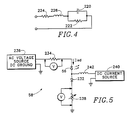
- FIGS. 4 and 5 illustrate the LED and the direct modulating circuit employed to reduce the distortion in the output of the LED and improve its response.
- junction capacitance 220 includes the diffusion capacitance and depletion layer capacitance, and is disposed in parallel with the forward resistance 222 of the LED.
- Resistor 224 in series with the LED represents the sum of the excess diode series resistance and the external circuit resistance, while series inductor 226 represents inductance mainly due to the bonding wire.
- the reactance of the junction capacitance is an order of magnitude greater than the forward resistance and it can be shown that changes or mismatches in the reactance of the capacitance have a limited effect on harmonic and third order intermodulation distortion when compared to variations in non-linear forward resistance characteristics.
- FIG. 5 illustrates a modulating circuit 58 for reducing distortion and intermodulation in the LED, as set forth and claimed in my copending application entitled REDUCTION OF INTERMODULATION DISTORTION IN LIGHT EMITTING DIODES, Serial No. 07/329,052, filed March 27, 1989.
- LED 56 is electrically connected in anti-series (anode to anode in the illustrated case) with a compensating diode 232.
- the cathode of LED 56 is connected to a biasing resistor 234.
- the remote side of resistor 234 is connected to an AC voltage source 236 which is returned to ground while the cathode of compensating diode 232 is connected to one terminal of a variable biasing resistor 238 having its opposite terminal grounded.
- AC voltage source 236 corresponds to the base band signal or input signal that produces the input current for modulating the LED.
- the anodes of LED 56 and diode 232 are connected in parallel with respect to a DC current source 240 coupled to the anodes of the diodes via inductance 242 for blocking the AC signal.
- the DC current source biases the LED to emit an optical output signal that is modulated by the AC signal source.
- the DC current source is also returned to ground.
- Source 236 provides a DC ground for resistor 234, e.g. via a second inductance (not shown) in parallel with the source terminals.
- Compensating diode 232 is desirably chosen to have a forward resistance characteristic (V vs. I characteristics) similar to the forward resistance characteristic of the LED and to have a capacitance value which may be on the order of but preferably less than the capacitance of the LED.
- V vs. I characteristics similar to the forward resistance characteristic of the LED
- capacitance value which may be on the order of but preferably less than the capacitance of the LED.
- variable resistor 238 is adjusted such that the DC biasing currents in the two diodes are equal, with the currents being monitored at least initially by measuring the voltage across biasing resistor 234 and biasing resistor 238 respectively.
- a substantially compensating match can be achieved through adjusting the currents to be equal even though the resistances of the LED and the compensating diode are not quite the same, or resistances elsewhere in the circuit are not balanced.
- FIG. 6 is a spectral plot associated with a 25% capacitive mismatch and a forward resistance match between the diodes when driven with two input tones at frequencies of 450 and 550 Mhz.
- the second order harmonic distortion terms occur at 900 and 1100 Mhz having magnitudes of approximately -97 Db
- the third intermodulation distortion terms occur at 350 and 650 Mhz and have magnitudes of approximately -75 Db.
- FIG. 7 is a plot of output power vs. input power in the linear region of the LED for the fundamental frequencies (450 and 550Mhz) and the third order intermodulation frequencies for the circuit shown in FIG. 5.
- the fundamental power varies linearly with a slope of one, whereas the third order intermodulation product increases with a slope of three as input power is increased.
- These lines intersect at a point referred to as the third order intermodulation intercept, whereby for input power levels exceeding the intercept point the intermodulation power surpasses the fundamental output power.
- the third order intermodulation product is much less (e.g. -60 Db) than the output power at the fundamental frequency.
- the fifth order intermodulation product (not shown) varies linearly with a slope of five and may also surpass the power at the fundamental frequency if the input power is too high.
- the magnitudes shown in FIG. 6 represent the distortion levels that can be achieved while operating at power levels far below the third intermodulation intercept without pre-distorting the input current to the LED.
- the modulating circuit and LED shown in FIG. 5 are desirably used in combination with a feedback system as illustrated in FIG. 8.
- FIG. 8 is a block diagram of a system embodying the present invention for pre-distorting the input current to the LED such that distortion, and in particular third order intermodulation distortion in the individual signals and between the signals, is reduced.
- the signal at 60 comprising the base band signal from the input 62 and two pilot tones provided at 64, is pre-distorted by correction circuit 86 to form a corrected input signal at 65.
- This input signal corresponds to the AC voltage from source 236 in FIG. 5 and produces the modulating current in the LED.
- the input signal at 65 is a non-linear function of the input signal delivered at 60 and is input to LED 56 via the broad band modulating circuit 58 (as shown in FIG.
- the base band signal represents the composite signal formed by multiplexing N input signals as shown in FIG. 3, wherein the individual input signals 40 are located between 50 and 500Mhz, whereas the pilot tones are injected at much lower frequencies, e.g. 10 and 12MHz so that the pilot tones will not create distortion in the input signals.
- the modulated output signal 68 is distributed through the optic fiber network 70.
- a tap 72 diverts a small portion of output signal from point 68 to an optical detector 74 that generates a detected RF signal at 75.
- the signal on lead 75 corresponds to the input signal at 65 including distortion caused by the diode's transfer characteristics and intermodulation products. If correction circuit 86 has compensated the system correctly, the signal at 75 will be directly proportional to input signal at 60 indicating the overall response of the system is linear.
- An A/D converter 76 samples the detected signal 75 at a rate sufficient to extract frequency components generated by the pilot tones including the fundamental, harmonics, and intermodulation products.
- a microprocessor 78 performs a fast fourier transform (FFT) on the digital samples to determine the frequency spectrum associated with the pilot tones, calculates a distortion level in the spectrum, and generates correction coefficients, applied at 79, for pre-distorting signal 60 to form input signal 65 that compensates the non-linear response of the LED.
- the processor also controls sine-wave generators 80 for generating two pilot tones delivered at 64. Two signals are needed to create intermodulation distortion and by supplying two controlled tones the system can evaluate the intermodulation distortion and compensate the input signal accordingly.
- the two pilot tones and the base band input 62 are added by a combiner circuit 82 to form the input signal for correction circuit 86 on lead 60.
- a central timing unit 84 receives signals from the processor and generates a sampling strobe for the A/D converter. Because the processor controls the exact amplitude and frequency of the pilot tones, the sampling strobe frequency may be set at an optimum rate whereby the FFT may be relatively short (e.g. 256 samples).
- Correction coefficients indicated at 79 and the input signal on lead 60 are applied to the bias and linearity correction circuit 86 which pre-distorts signal 60 to form a corrected input signal 65 that compensates the LED.
- C o represents a DC bias term.
- the non-linear relation between Vcor and Vinp is shown in FIG. 9 as a response curve 88 which increases in non-linearity as the input voltage increases, whereas in FIG. 1 the output power falls off or decreases non-linearly as the input current increases.
- the signals transmitted in the network and employed to operate digitally controlled attenuators and multipliers are voltage signals whereas a current signal directly modulates the LED.
- the system combines the effects shown in FIGS. 1 and 9 thereby creating an overall system transfer curve 90 as shown in FIG. 10 exhibiting a linear relationship between the output signal of the network and the corresponding input signal at 60.
- FIG. 11 is a diagram of the optical detector 74 employed in the correction system to provide the detected signal (at 75) which represents the LED distortion and intermodulation effects on the input signal at 65 (in FIG. 8) modulating the LED.
- the LED 56 is biased to emit an optical output signal directly modulated by the corrected input signal 65 in modulator 58 thereby generating the modulated output signal 68 distributed through the optic fiber network 70.
- Signal 68 is detected and demodulated at locations throughout the network as shown in FIG. 3.
- the tap 72 diverts a portion of the optical signal to optical detector 74, the optical signal being incident upon the n-type face of a p-n photodiode 92 for generating an output at 75 corresponding to the signal at 65 modulating the LED, including the distortion induced by the LED.
- the p-n photodiode 92 is biased by voltage source 94 wherein the positive side of the voltage source connects to the n side of the diode and the negative side is grounded.
- the signal is next amplified by an amplifier 96 having a resistor 98 coupled between the inverting and non-inverting input terminals thereof.
- the non-inverting terminal is coupled via capacitor 100 to one end of resistor 98 as well as to the p side of the photodiode while the inverting terminal of the amplifier is returned to ground.
- the output of the amplifier is sampled by A/D converter 76.
- the optical detector 74 can induce some distortion in the signal but the level will be negligible.
- a typical network may have twenty taps and therefore each signal would represent approximately 5% of the output signal. Since the power level of the detector is only 1/20 the power level of the LED, the amount of distortion of the type shown in FIG. 7 will be small.
- FIGS. 12-13 illustrate varying configurations for correction circuit 86 of FIG. 8.
- FIG. 12 illustrates the basic connection of a multiplier 102A and a digitally controlled attenuator 104A for generating the non-linear corrected input signal 65 from input signal 60 from combiner 82 (as also illustrated in FIG. 8), with correction coefficients 79 being provided by the microprocessor 78.
- the multiplier 102A has X and Y inputs 106A and 108A respectively and an output 110A, while the digitally controlled attenuator is provided with an input 112A for receiving an input voltage, an input 114A for receiving one of the correction coefficients 79 from the microprocessor, and an output 116A.
- Input signal 60 is supplied to the X input of the multiplier as well as to input 112A of the digitally controlled attenuator, and the output 116A of the digitally controlled attenuator is connected to one input of a summing circuit 303.
- a variable bias voltage source 138 is connected to the other input of the summing circuit to provide a dc term, suitably equal to one.
- the output of the summing circuit is connected to the Y input of the multiplier.
- the output of the multiplier 102A provides the AC voltage for modulating the LED.
- the Y input of the multiplier is C o +A ⁇ *Vinp and the output of the multiplier is C o *Vinp+A o *Vinp2.
- the modulating current of the LED is in part directly proportional to the second order output of the multiplier which provides some measure of correction for the non-linearities of the LED.
- This configuration has the advantage of comprising only a single stage but the limitation of only producing a second order term. Since the transfer characteristics of the LED are substantially linear at lower power levels and increasingly non-linear at higher power levels, it is desirable to employ a correction circuit that also supplies higher order terms.
- the third order correction coefficient is equal to the error at the third order intermodulation frequency which can be expressed as MAG(3IMFREQ)/MAG(FUND), these terms being further described hereinbelow.
- Microprocessor 78 iteratively adjusts the correction coefficients to provide minimal system distortion.
- FIG. 13 illustrates a preferred embodiment of a correction circuit.
- the input signal, Vinp (corresponding to signal 60 in FIG. 8) is provided to the X input 106A and Y input 108A of multiplier 102A as well as to the X input 106B of multiplier 1028.
- the output of multiplier 102A is connected to Che input 112A of attenuator 104A.
- the binary coefficient A o is supplied from the microprocessor to input 114A of attenuator 104A, which then outputs an analog voltage equal to A o *Vinp2 for application to one input of summing circuit 320.
- a plus one is provided to the other input of summer 320 whereby the summer supplies a signal 1+A o *Vinp2 to the Y input 108B of multiplier 102B.
- Multiplier 102B then outputs a voltage Vinp+A o *Vinp3 which is employed as the corrected input signal 65 to the modulating circuit in FIG. 8.
- the distortion in the system can be reduced significantly by correcting only the third intermo dulation term. Such embodiment reduces the hardware required and increases the speed of correction.
- fifth order correction coef ficients may be easily incorporated by extending the circuit to further reduce distortion and enhance system performance.
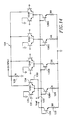
- FIG. 14 is a schematic representation of a digitally controlled attenuator 104.
- This particular embodiment is a four bit bipolar attenuator that receives a four bit correction coefficient from the microprocessor and a reference voltage provided by the input signal, and outputs a controlled fraction of the reference voltage in the range of v/8 to 15v/8. This fraction controls the linearity of curve 88 shown in FIG. 9.
- the reference voltage is connected to the base and collector of a bipolar transistor 120 the emitter of which is connected through a resistor 122, having a value of 8R, to ground.
- the 4-bit attenuator further comprises four substantially similar circuits 124A-D, one for each bit, for setting the output level.
- Each of the circuits 124A-D comprises a bipolar transistor 126, a biasing resistor 128 connected between th,e emitter of transistor 126 and ground, and a current steering circuit 130 connected between the collector of transistor 126 and the output of the attenuator.
- the base of each of the transistors 126A-D is connected to the reference voltage.
- Current steering circuit 130 in each case comprises first and second transistors 132 and 134 having their emitters connected to the collector of a corresponding transistor 126 and wherein the collector of transistor 132 is connected to ground while the collector of transistor 134 is connected to the output.
- a differential input voltage representing one bit of the correction term is applied between the bases of transistors 134 and 132 of each circuit 130 by leads 133 and 131.
- the circuits 124A-D are differentiated only by the value of biasing resistor 128.
- the values of the four resistors 128 in this example are R, 2R, 4R and 8R respectively, with the value R corresponding to the most significant bit and the value 8R corresponding to the least significant bit of a correction coefficient 79.
- the collector of transistor 134 in each of the circuits is connected to the output provided across an output resistor 136 having a value R and returned to ground.
- the output of the digital attenuator is a voltage signal having a magnitude determined by the correction coefficient.
- each transistor 126 corresponds to the reference voltage.
- transistor 134 When transistor 134 is off, i.e. a differential voltage corresponding to a logic level zero is applied between the bases of its transistors 134 and 132, the current in transistor 126 is steered to ground and that particular circuit does not contribute to the output.
- transistor 134 When transistor 134 is on, i.e. logic level one, the current in transistor 126 flows through output resistor 136 and sets the voltage at a controlled fraction of the reference voltage, the fraction being determined by the value of biasing resistor 128.
- a correction coefficient received at 79 is the 4-bit quantity 0001 then a one will be input to circuit 124D and zeros input to circuits 124A-C.
- the output of the attenuator is applied differentially to a multiplier which corrects for the sign of the voltage.
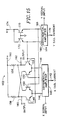
- FIG. 15 is a schematic diagram of multiplier 102, here comprising a four-quadrant multiplier as described and claimed in U. S. Patent 4,156,283.
- a first signal input x is applied as an input to differential amplifier 140 for proportioning a substantially constant X tail current 142 differentially between two outputs 144 and 146.
- a first pair of differentially connected transistors 148 and 150 have their emitters connected together and connected to the output 144 while a second differential pair of transistors 152 and 154 include emitter terminals connected to the aforementioned output 146.
- the first and second pairs of differentially connected transistors have their collector terminals cross-connected to load resistors 156 and 158 through which supply current flows from a positive source 160.
- the collectors of transistors 148 and 152 are connected to resistor 156, while the collectors of transistors 150 and 154 are connected to resistor 158.
- the output is derived between terminals 160 and 162 connected respectively to the ends of the load resistors opposite the power supply.
- a second differential amplifier 164 is employed for producing differential output currents 166 and 168 proportional to a Y input signal with output currents 166 and 168 totaling a substantially constant Y tail current 170.
- Output current 168 is connected to the base terminals of transistors 150 and 152, while the output current 166 is connected to the base terminals of transistors 148 and 154.
- a pair of input device transistors 170 and 172 have their collector terminals connected to a positive source 174, their base terminals grounded, and their emitter terminals connecting respectively to the base terminals of transistors 150 and 152, and 148 and 154.
- the FIG. 15 circuit is effective for producing an output between terminals 160 and 162 proportional to the product of input signals X and Y taking the respective sign of X and Y into consideration.
- a four-quadrant multiplier is provided.
- each of the differential pairs 148-150 and 152-154 has the property of performing a multiplying function.
- the transistor pair 148-150 will apportion the current on lead 144 between the transistor collectors in accordance with the product of such current and the differential voltage applied to the transistor bases.
- Multiplication depends upon a non-linear or exponential characteristic of the transistors.
- the transconductance from base to collector of each of the transistors 148 and 150 is proportional to the emitter tail current. Therefore, as the current on lead 144 is increased, the differential output procured with transistors 148 and 150 in response to differential base voltage input is multiplied in proportion to the current on lead 144.
- the circuit multiplies as a result of non-linear operating characteristic, the multiplication is accomplished without distortion.
- the base voltages are "predistorted" as to the Y signal input factor.
- transistors 170 and 172 receive current outputs at 168 and 166 producing voltages across transistors 170 and 172 which are logarithmically related to the input currents.
- the ensuing exponential distortion in transistors 148 and 150 is cancelled by such logarithmic conversion. Multiplication is nonetheless accomplished because of the non-linear operation of the transistor 148-150.
- transistors 152-154 are also utilized, with the outputs of the two pairs being reversely connected. Each pair will have an opposite effect on the output.
- the "sign" of the ultimate output at 160-162 depends upon which pair output predominates, that is, upon which pair receives the larger emitter current from differential amplifier 140 and delivers the same to resistors 156 and 158. If the X input is at bias level, no differential output is produced. If the X input signal is above the bias level of amplifier 140, one of the leads 144, 146 will deliver more current than the other producing an output in a first sense. If the X input signal is below the bias level of amplifier 140, the opposite one of leads 144, 146 will deliver more current. The ultimate output will then depend not only on the magnitude but also on the sign of the X input.
- each pair e.g. transistors 148-150
- the output "sign" will depend also on the "sign" of the Y signal input relative to the bias level of differential amplifier 164. If the Y signal input is at ground, and the bias level of amplifier 164 is at ground, equal outputs will be delivered at 166 and 168 whereby neither the output of transistor 148 nor the output of transistor 150 will predominate. Similarly, neither the output of transistor 152 nor the output of transistor 154 will predominate. However, if the Y signal is above or below bias level, the sense or sign of the output at terminals 160 and 162 will be governed accordingly. The magnitude of the output will be proportional to the Y input.
- FIG. 16 is a schematic of a possible configuration of differential amplifiers 140 and 164.
- the amplifier comprises first and second transistors 176 and 178 wherein their emitters are connected to a tail current source 180.
- the voltage signals are applied differentially between the bases of transistors 176 and 178.
- the output currents 144 and 146 correspond to the currents flowing through the collectors of transistors 176 and 178 respectively.
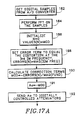
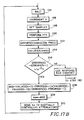
- FIGS. 17A-B are flowcharts describing the operations of microprocessor 78 for iteratively calculating correction coefficients provided at 79 (FIG. 8) including third order coefficients indicated as A o .
- the microprocessor receives the digital samples from the A/D converter 76 (FIG. 8) in step 182 and performs a fast fourier transform (FFT) on the digital samples (step 184) thereby generating a magnitude versus frequency spectrum for the digital samples.
- FFT fast fourier transform
- the A/D converter samples optical signal 68 at a rate sufficient to observe the effects of the fundamental, harmonics, and intermodulation products associated with pilot tones 64. Because the microprocessor controls the generation of the pilot tones, it "knows" their amplitude and frequency exactly and can therefore calculate a sufficiently accurate spectrum from a relatively short FFT, for example, 256 terms.
- the microprocessor calculates the correction coefficient NOD corresponding to the third order intermodulation term.
- NOD equals the negative of the value of the error term divided by the magnitude at the fundamental frequency of either one of the pilot tones.
- MOD - ERRORS(N)/MAG(Fund)
- the correction coefficient is set equal to minus MOD.
- the correction coefficient A o is, for example, a 4-bit binary code.
- the microprocessor then waits (step 194) for the correction circuitry to adjust the modulating current of the LED and the A/D converter to obtain a new record of samples.
- the microprocessor increments N to the next state (step 196) and receives the samples from the A/D converter (step 198).
- step 206 the difference in the error terms from the current state and the previous state is ascertained and if their difference exceeds a value, for example, an arbitrarily selected amount of le ⁇ 5, new correction coefficients are calculated.
- the correction coefficient A o is set equal to minus MOD at step 209 and is sent to the digitally controlled attenuators in step 210.
- step 206 If at step 206, the error terms differ by less than le ⁇ 5, the system has drifted between measurements. If the response of the LED has changed, the system resets and starts over at step 182. It has been found that the program converges very quickly, usually in two iterations, thereby producing very accurate correction terms very quickly, and providing an overall system response that is substantially linear.
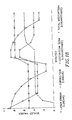
- FIG. 15 is a plot showing the simulated system response versus time for the system illustrated in FIG. 8 and described hereinabove.
- Laser error, third intermodulation distortion, correction coefficient (A o ) and the total distortion are plotted with respect to time.
- the scaling of the functions is adjusted so that the functions are easy to observe.
- the laser error plot between points each shown as a box in the figure is a simulation parameter that represents the physical device characteristics of the LED shown in FIG. 4 that cause the non-linear response of the diode.
- the scale for laser error is linear and has a range of .01 to .03 with the initial error being simulated as .02.
- the third intermodulation distortion product illustrated by a diamond is plotted on a logarithmic scale from 0Db down to -150Db.
- the initial third intermodulation product without any compensation is approximately -20Db.
- This value represents the third intermodulation distortion after adjusting the modulating circuit but before employing system level compensation.
- the third intermodulation product was reduced to -75Db.
- the important characteristic shown in FIG. 18 is the substantial reduction in distortion achieved by employing system level compensations.
- the third order correction term MOD is shown by a plus sign on a linear scale of .01 to .03.
- the correction term is initially zero (no compensation), increases to approximately .014 after the first sampling period, and levels off at approximately .017 after three sampling periods.
- the total distortion shown as a triangle is plotted on a logarithmic scale and starts at a relatively high value of -33Db with no correction and is reduced to a plateau of -64Db in three iterations.
- the substantial drop in total distortion and improvement in system performance is achieved quickly and accurately.
- the system level compensation employed by the invention substantially increases performance by correcting for the non- linear response of the LED or laser diode.
- the system level correction adjusts for the fall off of the diode at increased power levels and the intermodulation products between signals, thereby lowering distortion, providing an overall system response that is linear, and effectively increasing the operating range of the diode.
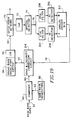
- FIG. 19 illustrates an alternative embodiment of the present invention for reducing intermodulation distortion in an optical fiber network.
- the digital circuitry shown in the FIG. 8 embodiment consisting of the A/D converter, the micro-processor and the bias and linearity correction circuit, is replaced by analog circuitry.
- Two crystal filters 304 and 306 tuned respectively to one of the pilot tones and the third intermodulation frequency receive the detected RF signal at 75 from optical detector 74 and drive RF detectors 308 and 310 to produce outputs proportional to the magnitude of the pilot tone and the magnitude of the third intermodulation frequency.
- the pilot tone indicating output is supplied as the A input while the output indicating the third intermodulation frequency is provided to the B input of an analog divider 312 which outputs a voltage equal to B/A or NAG(3IMFREQ)/MAG(PILOT). This voltage is applied to bias and linearity correction circuit 316.
- Correction circuit 316 is similar to circuit 86 of the earlier embodiments but wherein the digitally controlled attenuator is replaced with an analog controlled attenuator.
- This analog embodiment performs the same basic function as the digital embodiments regarding measurement of the magnitude of one of the pilot tones and the third intermodulation frequency for determining a correction coefficient.
- the analog implementation may also be easily expanded to include fifth or higher order terms by adding filters tuned to desired higher harmonics, together with means for comparing their outputs with the magnitude of the pilot tone.
- FIGS. 8 and 19 describe systems for correcting the non-linear distortion at the system transmitter.
- the same type of circuitry can be applied to correcting the distortion at the receiver if so desired.
- systems of the latter type may employ feed-forward circuits instead of feed-back circuitry, and employ a separate circuit at each receiver.
- the present invention may be considered in its broadest aspect to comprise apparatus for compensating distortion in an electrical or electronic component having a non-linear transfer function to an AC input signal, characterised in that it comprises means for generating pilot signals distinguishable from the said input signal to the component, means for combining the pilot signals and the input signal to form a composite signal for application to the said component, means for detecting the output signal from the component resulting from the pilot signals, means for analysing the output signal to determine the distortion therein due to the non-linearity of the transfer function of the said component, and means responsive to the output from the analysing means for pre-distorting the composite signal applied to the component in a sense such as to result in reduced distortion of the output signal therefrom.
Landscapes
- Physics & Mathematics (AREA)
- Engineering & Computer Science (AREA)
- Computer Networks & Wireless Communication (AREA)
- Signal Processing (AREA)
- Electromagnetism (AREA)
- Optics & Photonics (AREA)
- Optical Communication System (AREA)
- Semiconductor Lasers (AREA)
- Led Devices (AREA)
- Amplifiers (AREA)
Applications Claiming Priority (2)
| Application Number | Priority Date | Filing Date | Title |
|---|---|---|---|
| US392175 | 1989-08-10 | ||
| US07/392,175 US5060310A (en) | 1989-08-10 | 1989-08-10 | Apparatus and method for reduction of intermodulation distortion in an optical fiber network |
Publications (2)
| Publication Number | Publication Date |
|---|---|
| EP0412830A2 true EP0412830A2 (de) | 1991-02-13 |
| EP0412830A3 EP0412830A3 (en) | 1992-07-08 |
Family
ID=23549560
Family Applications (1)
| Application Number | Title | Priority Date | Filing Date |
|---|---|---|---|
| EP19900308804 Withdrawn EP0412830A3 (en) | 1989-08-10 | 1990-08-09 | Apparatus and method for reduction of intermodulation distortion in an optical fiber network |
Country Status (3)
| Country | Link |
|---|---|
| US (1) | US5060310A (de) |
| EP (1) | EP0412830A3 (de) |
| JP (1) | JPH0821896B2 (de) |
Cited By (3)
| Publication number | Priority date | Publication date | Assignee | Title |
|---|---|---|---|---|
| EP0580889A1 (de) * | 1992-07-30 | 1994-02-02 | Siemens Aktiengesellschaft | Verfahren zur Kompensation von nichtlinearen Signalverzerrungen elektrooptischer Wandler in einem optischen Telekommunikationssystem |
| CN101127534B (zh) * | 2007-08-14 | 2010-05-26 | 锐德科无线通信技术(上海)有限公司 | 模拟预失真电路及方法 |
| WO2015153235A1 (en) * | 2014-04-03 | 2015-10-08 | Arris Enterprises, Inc. | Eml bias control system |
Families Citing this family (28)
| Publication number | Priority date | Publication date | Assignee | Title |
|---|---|---|---|---|
| JP2897492B2 (ja) * | 1991-10-24 | 1999-05-31 | 日本電気株式会社 | 移動通信装置 |
| USRE38359E1 (en) * | 1991-11-22 | 2003-12-23 | Verizon Laboratories Inc. | Optical signal equalizer for wavelength division multiplexed optical fiber systems |
| JP2697639B2 (ja) * | 1994-11-04 | 1998-01-14 | 日本電気株式会社 | 光変調装置 |
| DE19505578A1 (de) * | 1995-02-18 | 1996-08-22 | Sel Alcatel Ag | Optisches Übertragungssystem für Kabelfernsehsignale und Video- und Telekommunikationssignale |
| US5745274A (en) * | 1995-12-27 | 1998-04-28 | Lucent Technologies Inc. | Maintenance of optical networks |
| KR100342431B1 (ko) * | 2000-09-07 | 2002-07-03 | 윤덕용 | 파장분할다중방식 광통신시스템을 위한 다파장 안정화방법및 장치 |
| US6178316B1 (en) * | 1997-04-29 | 2001-01-23 | Meta-C Corporation | Radio frequency modulation employing a periodic transformation system |
| US7154914B1 (en) | 1998-03-05 | 2006-12-26 | Forster Energy Llc | Through-timing of data transmitted across an optical communications system utilizing frequency division multiplexing |
| US6529303B1 (en) * | 1998-03-05 | 2003-03-04 | Kestrel Solutions, Inc. | Optical communications networks utilizing frequency division multiplexing |
| US6373611B1 (en) * | 1998-06-22 | 2002-04-16 | Scientific-Atlanta, Inc. | Digital optical transmitter |
| US6590683B1 (en) * | 1999-02-04 | 2003-07-08 | Lockheed Martin Corporation | Bandwidth efficient phase shift keyed modulation over nonlinear distortion limited optical fiber links |
| US20020039211A1 (en) * | 1999-09-24 | 2002-04-04 | Tian Shen | Variable rate high-speed input and output in optical communication networks |
| US7228077B2 (en) * | 2000-05-12 | 2007-06-05 | Forster Energy Llc | Channel gain control for an optical communications system utilizing frequency division multiplexing |
| US20020012146A1 (en) * | 2000-06-01 | 2002-01-31 | Newell Laurence J. | Synchronizing nodes in an optical communications system utilizing frequency division multiplexing |
| US7096257B2 (en) * | 2000-06-15 | 2006-08-22 | Forster Energy Llc | Automatic assignment of addresses to nodes in a network |
| US20020110157A1 (en) * | 2001-02-14 | 2002-08-15 | Kestrel Solutions | Method and apparatus for providing a gigabit ethernet circuit pack |
| JP4690569B2 (ja) * | 2001-04-02 | 2011-06-01 | 日本オプネクスト株式会社 | 半導体レーザ装置及びそれを用いた光送信装置。 |
| FR2832274B1 (fr) * | 2001-11-15 | 2006-08-25 | Alcatel Optronics | Procede de controle dynamique d'un module optique |
| US7756421B2 (en) * | 2002-10-03 | 2010-07-13 | Ciena Corporation | Electrical domain compensation of non-linear effects in an optical communications system |
| US7382984B2 (en) * | 2002-10-03 | 2008-06-03 | Nortel Networks Limited | Electrical domain compensation of optical dispersion in an optical communications system |
| KR100606100B1 (ko) * | 2004-01-15 | 2006-07-28 | 삼성전자주식회사 | 바이어스 제어장치를 구비한 광변조장치 및 이를 이용한바이어스 제어방법 |
| US7805082B1 (en) * | 2004-09-21 | 2010-09-28 | Ciena Corporation | Optical laser control for optical communications systems |
| US20080039041A1 (en) * | 2006-08-10 | 2008-02-14 | Motorola, Inc. | Method and apparatus for reducing inter-modulation |
| CA2712137A1 (en) * | 2007-01-29 | 2008-08-07 | Ofidium Pty Ltd | Methods and apparatus for generation and transmission of optical signals |
| JP4980319B2 (ja) * | 2008-09-08 | 2012-07-18 | 日本電信電話株式会社 | 光送信器 |
| US8611750B2 (en) * | 2009-10-14 | 2013-12-17 | Futurewei Technologies, Inc. | Wavelength locker for simultaneous control of multiple dense wavelength division multiplexing transmitters |
| KR102478167B1 (ko) * | 2016-11-29 | 2022-12-16 | 한국전자통신연구원 | 주파수 할당 방법 및 그 방법을 수행하는 전송 장치 |
| US11063623B2 (en) * | 2018-11-28 | 2021-07-13 | Texas Instruments Incorporated | Baseband corrector for RF non-linearity in zero-IF receiver |
Family Cites Families (13)
| Publication number | Priority date | Publication date | Assignee | Title |
|---|---|---|---|---|
| US4032802A (en) * | 1976-02-09 | 1977-06-28 | Harris Corporation | Reduction of intermodulation |
| US4009385A (en) * | 1976-03-22 | 1977-02-22 | Bell Telephone Laboratories, Incorporated | Laser control circuit |
| JPS5431761A (en) * | 1977-08-13 | 1979-03-08 | Nec Corp | Light modulating circuit |
| GB2025121B (en) * | 1978-07-06 | 1982-05-19 | Post Office | Stabilisation of injection lasers |
| GB2113035B (en) * | 1981-12-03 | 1985-10-09 | Standard Telephones Cables Ltd | Optical transmission system and method |
| FR2526554B1 (fr) * | 1982-05-06 | 1985-06-07 | Telecommunications Sa | Procede de regulation de moyens emetteurs d'informations lumineuses et le systeme de mise en oeuvre |
| JPS59151296A (ja) * | 1983-02-18 | 1984-08-29 | 工業技術院長 | 光学的計測システム |
| US4621376A (en) * | 1983-04-28 | 1986-11-04 | Kabushiki Kaisha Toshiba | Driving apparatus for stabilizing burst light output |
| DE3342001A1 (de) * | 1983-11-22 | 1985-05-30 | Standard Elektrik Lorenz Ag | Schaltungsanordnung zur kompensation |
| US4662004A (en) * | 1984-12-17 | 1987-04-28 | Fmw Corporation | Laser communication system |
| US4768186A (en) * | 1986-02-11 | 1988-08-30 | Pirelli Cable Corporation | Multiplex transmission of analog signals by fiber optic channel |
| US4893300A (en) * | 1988-08-01 | 1990-01-09 | American Telephone And Telegraph Company | Technique for reducing distortion characteristics in fiber-optic links |
| EP0407919B1 (de) * | 1989-07-11 | 1996-04-24 | Harmonic Lightwaves, Inc. | Optische Sender, linearisiert durch parametrische Rückkopplung |
-
1989
- 1989-08-10 US US07/392,175 patent/US5060310A/en not_active Expired - Lifetime
-
1990
- 1990-08-09 JP JP21146190A patent/JPH0821896B2/ja not_active Expired - Lifetime
- 1990-08-09 EP EP19900308804 patent/EP0412830A3/en not_active Withdrawn
Cited By (4)
| Publication number | Priority date | Publication date | Assignee | Title |
|---|---|---|---|---|
| EP0580889A1 (de) * | 1992-07-30 | 1994-02-02 | Siemens Aktiengesellschaft | Verfahren zur Kompensation von nichtlinearen Signalverzerrungen elektrooptischer Wandler in einem optischen Telekommunikationssystem |
| CN101127534B (zh) * | 2007-08-14 | 2010-05-26 | 锐德科无线通信技术(上海)有限公司 | 模拟预失真电路及方法 |
| WO2015153235A1 (en) * | 2014-04-03 | 2015-10-08 | Arris Enterprises, Inc. | Eml bias control system |
| US9479263B2 (en) | 2014-04-03 | 2016-10-25 | Arris Enterprises, Inc. | EML bias control system |
Also Published As
| Publication number | Publication date |
|---|---|
| EP0412830A3 (en) | 1992-07-08 |
| JPH03192829A (ja) | 1991-08-22 |
| US5060310A (en) | 1991-10-22 |
| JPH0821896B2 (ja) | 1996-03-04 |
Similar Documents
| Publication | Publication Date | Title |
|---|---|---|
| EP0412830A2 (de) | Verfahren und Gerät zur Intermodulationsverzerrungsverringerung in einem Lichtwellenleiternetzwerk | |
| US4670789A (en) | Television transmitter | |
| JP3221594B2 (ja) | 電子信号及び光信号を直線化するひずみ補正回路 | |
| US5172068A (en) | Third-order predistortion linearization circuit | |
| FI115576B (fi) | Laite ja menetelmä kantataajuisen digitaalisen virhesignaalin muodostamiseksi adaptiivisessa esivääristimessä | |
| CA2074124C (en) | Transmitter with nonlinearity correction circuits | |
| KR20020019466A (ko) | 왜곡보상장치 | |
| US4857865A (en) | Self equalizing multi-stage radio frequency power amplifier | |
| US7248644B2 (en) | Circuit and method for compensating for nonliner distortion of power amplifier | |
| US3982115A (en) | Electronically programmable function generator | |
| US6313701B1 (en) | External optical modulation system comprising a predistorter | |
| EP0048057A1 (de) | Schaltungsanordnung zur Modulation des Ausgangssignals eines Wandlers, z.B. eines elektrooptischen Wandlers | |
| US4234804A (en) | Signal correction for electrical gain control systems | |
| US4331928A (en) | Referenced phase RF feedback linear amplifier | |
| CA1235797A (en) | Device for the automatic precorrection of non- linearities in a power amplification chain for a television transmitter | |
| US4140981A (en) | Linearizing network | |
| US6307492B1 (en) | Device to compensate for the non-linearity of an analog/digital converter | |
| US6396327B1 (en) | Method and apparatus for reducing distortion produced by a nonlinear device | |
| US4099136A (en) | Amplifier circuit for high frequency signals, particularly for cable distribution systems, comprising at least a first transistor controlled at its base electrode by a signal source, and a difference amplifier | |
| GB2061065A (en) | Rf pulse modulation with automatic control | |
| CN100452643C (zh) | 交替的增益和相位控制系统及方法 | |
| Teikari et al. | Baseband digital predistorter with quadrature error correction | |
| GB2080066A (en) | Variable-gain amplifier arrangement with improved linearity | |
| JP2000261255A (ja) | 歪補償電力増幅回路 | |
| CA2256811A1 (en) | External optical modulation system comprising a predistorting device |
Legal Events
| Date | Code | Title | Description |
|---|---|---|---|
| PUAI | Public reference made under article 153(3) epc to a published international application that has entered the european phase |
Free format text: ORIGINAL CODE: 0009012 |
|
| AK | Designated contracting states |
Kind code of ref document: A2 Designated state(s): DE FR GB |
|
| PUAL | Search report despatched |
Free format text: ORIGINAL CODE: 0009013 |
|
| RAP1 | Party data changed (applicant data changed or rights of an application transferred) |
Owner name: TEKTRONIX, INC. |
|
| AK | Designated contracting states |
Kind code of ref document: A3 Designated state(s): DE FR GB |
|
| PUAF | Information related to the publication of a search report (a3 document) modified or deleted |
Free format text: ORIGINAL CODE: 0009199SEPU |
|
| PUAL | Search report despatched |
Free format text: ORIGINAL CODE: 0009013 |
|
| D17D | Deferred search report published (deleted) | ||
| AK | Designated contracting states |
Kind code of ref document: A3 Designated state(s): DE FR GB |
|
| 17P | Request for examination filed |
Effective date: 19921012 |
|
| 17Q | First examination report despatched |
Effective date: 19950316 |
|
| GRAG | Despatch of communication of intention to grant |
Free format text: ORIGINAL CODE: EPIDOS AGRA |
|
| GRAH | Despatch of communication of intention to grant a patent |
Free format text: ORIGINAL CODE: EPIDOS IGRA |
|
| STAA | Information on the status of an ep patent application or granted ep patent |
Free format text: STATUS: THE APPLICATION IS DEEMED TO BE WITHDRAWN |
|
| 18D | Application deemed to be withdrawn |
Effective date: 19970313 |