EP0412935A1 - Verfahren zum Aufarbeiten von Knopfzellen in Mischung mit anderen metallischen Gegenständen und Rückgewinnung der metallenen Bestandteile - Google Patents
Verfahren zum Aufarbeiten von Knopfzellen in Mischung mit anderen metallischen Gegenständen und Rückgewinnung der metallenen Bestandteile Download PDFInfo
- Publication number
- EP0412935A1 EP0412935A1 EP19900810583 EP90810583A EP0412935A1 EP 0412935 A1 EP0412935 A1 EP 0412935A1 EP 19900810583 EP19900810583 EP 19900810583 EP 90810583 A EP90810583 A EP 90810583A EP 0412935 A1 EP0412935 A1 EP 0412935A1
- Authority
- EP
- European Patent Office
- Prior art keywords
- anode
- metals
- metallic
- cathode
- objects
- Prior art date
- Legal status (The legal status is an assumption and is not a legal conclusion. Google has not performed a legal analysis and makes no representation as to the accuracy of the status listed.)
- Withdrawn
Links
Images

Classifications
-
- C—CHEMISTRY; METALLURGY
- C22—METALLURGY; FERROUS OR NON-FERROUS ALLOYS; TREATMENT OF ALLOYS OR NON-FERROUS METALS
- C22B—PRODUCTION AND REFINING OF METALS; PRETREATMENT OF RAW MATERIALS
- C22B7/00—Working up raw materials other than ores, e.g. scrap, to produce non-ferrous metals and compounds thereof; Methods of a general interest or applied to the winning of more than two metals
- C22B7/006—Wet processes
- C22B7/007—Wet processes by acid leaching
-
- C—CHEMISTRY; METALLURGY
- C25—ELECTROLYTIC OR ELECTROPHORETIC PROCESSES; APPARATUS THEREFOR
- C25C—PROCESSES FOR THE ELECTROLYTIC PRODUCTION, RECOVERY OR REFINING OF METALS; APPARATUS THEREFOR
- C25C1/00—Electrolytic production, recovery or refining of metals by electrolysis of solutions
-
- B—PERFORMING OPERATIONS; TRANSPORTING
- B29—WORKING OF PLASTICS; WORKING OF SUBSTANCES IN A PLASTIC STATE IN GENERAL
- B29B—PREPARATION OR PRETREATMENT OF THE MATERIAL TO BE SHAPED; MAKING GRANULES OR PREFORMS; RECOVERY OF PLASTICS OR OTHER CONSTITUENTS OF WASTE MATERIAL CONTAINING PLASTICS
- B29B17/00—Recovery of plastics or other constituents of waste material containing plastics
- B29B17/02—Separating plastics from other materials
-
- C—CHEMISTRY; METALLURGY
- C22—METALLURGY; FERROUS OR NON-FERROUS ALLOYS; TREATMENT OF ALLOYS OR NON-FERROUS METALS
- C22B—PRODUCTION AND REFINING OF METALS; PRETREATMENT OF RAW MATERIALS
- C22B3/00—Extraction of metal compounds from ores or concentrates by wet processes
- C22B3/04—Extraction of metal compounds from ores or concentrates by wet processes by leaching
- C22B3/045—Leaching using electrochemical processes
-
- H—ELECTRICITY
- H01—ELECTRIC ELEMENTS
- H01M—PROCESSES OR MEANS, e.g. BATTERIES, FOR THE DIRECT CONVERSION OF CHEMICAL ENERGY INTO ELECTRICAL ENERGY
- H01M6/00—Primary cells; Manufacture thereof
- H01M6/52—Reclaiming serviceable parts of waste cells or batteries, e.g. recycling
-
- B—PERFORMING OPERATIONS; TRANSPORTING
- B29—WORKING OF PLASTICS; WORKING OF SUBSTANCES IN A PLASTIC STATE IN GENERAL
- B29B—PREPARATION OR PRETREATMENT OF THE MATERIAL TO BE SHAPED; MAKING GRANULES OR PREFORMS; RECOVERY OF PLASTICS OR OTHER CONSTITUENTS OF WASTE MATERIAL CONTAINING PLASTICS
- B29B17/00—Recovery of plastics or other constituents of waste material containing plastics
- B29B17/02—Separating plastics from other materials
- B29B2017/0213—Specific separating techniques
- B29B2017/0293—Dissolving the materials in gases or liquids
-
- B—PERFORMING OPERATIONS; TRANSPORTING
- B29—WORKING OF PLASTICS; WORKING OF SUBSTANCES IN A PLASTIC STATE IN GENERAL
- B29B—PREPARATION OR PRETREATMENT OF THE MATERIAL TO BE SHAPED; MAKING GRANULES OR PREFORMS; RECOVERY OF PLASTICS OR OTHER CONSTITUENTS OF WASTE MATERIAL CONTAINING PLASTICS
- B29B17/00—Recovery of plastics or other constituents of waste material containing plastics
- B29B17/04—Disintegrating plastics, e.g. by milling
- B29B2017/0424—Specific disintegrating techniques; devices therefor
- B29B2017/0436—Immersion baths
-
- B—PERFORMING OPERATIONS; TRANSPORTING
- B29—WORKING OF PLASTICS; WORKING OF SUBSTANCES IN A PLASTIC STATE IN GENERAL
- B29K—INDEXING SCHEME ASSOCIATED WITH SUBCLASSES B29B, B29C OR B29D, RELATING TO MOULDING MATERIALS OR TO MATERIALS FOR MOULDS, REINFORCEMENTS, FILLERS OR PREFORMED PARTS, e.g. INSERTS
- B29K2023/00—Use of polyalkenes or derivatives thereof as moulding material
- B29K2023/04—Polymers of ethylene
- B29K2023/06—PE, i.e. polyethylene
-
- B—PERFORMING OPERATIONS; TRANSPORTING
- B29—WORKING OF PLASTICS; WORKING OF SUBSTANCES IN A PLASTIC STATE IN GENERAL
- B29K—INDEXING SCHEME ASSOCIATED WITH SUBCLASSES B29B, B29C OR B29D, RELATING TO MOULDING MATERIALS OR TO MATERIALS FOR MOULDS, REINFORCEMENTS, FILLERS OR PREFORMED PARTS, e.g. INSERTS
- B29K2023/00—Use of polyalkenes or derivatives thereof as moulding material
- B29K2023/10—Polymers of propylene
- B29K2023/12—PP, i.e. polypropylene
-
- B—PERFORMING OPERATIONS; TRANSPORTING
- B29—WORKING OF PLASTICS; WORKING OF SUBSTANCES IN A PLASTIC STATE IN GENERAL
- B29K—INDEXING SCHEME ASSOCIATED WITH SUBCLASSES B29B, B29C OR B29D, RELATING TO MOULDING MATERIALS OR TO MATERIALS FOR MOULDS, REINFORCEMENTS, FILLERS OR PREFORMED PARTS, e.g. INSERTS
- B29K2105/00—Condition, form or state of moulded material or of the material to be shaped
- B29K2105/06—Condition, form or state of moulded material or of the material to be shaped containing reinforcements, fillers or inserts
- B29K2105/065—Condition, form or state of moulded material or of the material to be shaped containing reinforcements, fillers or inserts containing impurities
-
- B—PERFORMING OPERATIONS; TRANSPORTING
- B29—WORKING OF PLASTICS; WORKING OF SUBSTANCES IN A PLASTIC STATE IN GENERAL
- B29K—INDEXING SCHEME ASSOCIATED WITH SUBCLASSES B29B, B29C OR B29D, RELATING TO MOULDING MATERIALS OR TO MATERIALS FOR MOULDS, REINFORCEMENTS, FILLERS OR PREFORMED PARTS, e.g. INSERTS
- B29K2705/00—Use of metals, their alloys or their compounds, for preformed parts, e.g. for inserts
-
- B—PERFORMING OPERATIONS; TRANSPORTING
- B29—WORKING OF PLASTICS; WORKING OF SUBSTANCES IN A PLASTIC STATE IN GENERAL
- B29K—INDEXING SCHEME ASSOCIATED WITH SUBCLASSES B29B, B29C OR B29D, RELATING TO MOULDING MATERIALS OR TO MATERIALS FOR MOULDS, REINFORCEMENTS, FILLERS OR PREFORMED PARTS, e.g. INSERTS
- B29K2705/00—Use of metals, their alloys or their compounds, for preformed parts, e.g. for inserts
- B29K2705/04—Lead
-
- B—PERFORMING OPERATIONS; TRANSPORTING
- B29—WORKING OF PLASTICS; WORKING OF SUBSTANCES IN A PLASTIC STATE IN GENERAL
- B29K—INDEXING SCHEME ASSOCIATED WITH SUBCLASSES B29B, B29C OR B29D, RELATING TO MOULDING MATERIALS OR TO MATERIALS FOR MOULDS, REINFORCEMENTS, FILLERS OR PREFORMED PARTS, e.g. INSERTS
- B29K2705/00—Use of metals, their alloys or their compounds, for preformed parts, e.g. for inserts
- B29K2705/08—Transition metals
- B29K2705/10—Copper
-
- B—PERFORMING OPERATIONS; TRANSPORTING
- B29—WORKING OF PLASTICS; WORKING OF SUBSTANCES IN A PLASTIC STATE IN GENERAL
- B29L—INDEXING SCHEME ASSOCIATED WITH SUBCLASS B29C, RELATING TO PARTICULAR ARTICLES
- B29L2031/00—Other particular articles
- B29L2031/34—Electrical apparatus, e.g. sparking plugs or parts thereof
- B29L2031/3425—Printed circuits
-
- B—PERFORMING OPERATIONS; TRANSPORTING
- B29—WORKING OF PLASTICS; WORKING OF SUBSTANCES IN A PLASTIC STATE IN GENERAL
- B29L—INDEXING SCHEME ASSOCIATED WITH SUBCLASS B29C, RELATING TO PARTICULAR ARTICLES
- B29L2031/00—Other particular articles
- B29L2031/34—Electrical apparatus, e.g. sparking plugs or parts thereof
- B29L2031/3468—Batteries, accumulators or fuel cells
-
- Y—GENERAL TAGGING OF NEW TECHNOLOGICAL DEVELOPMENTS; GENERAL TAGGING OF CROSS-SECTIONAL TECHNOLOGIES SPANNING OVER SEVERAL SECTIONS OF THE IPC; TECHNICAL SUBJECTS COVERED BY FORMER USPC CROSS-REFERENCE ART COLLECTIONS [XRACs] AND DIGESTS
- Y02—TECHNOLOGIES OR APPLICATIONS FOR MITIGATION OR ADAPTATION AGAINST CLIMATE CHANGE
- Y02P—CLIMATE CHANGE MITIGATION TECHNOLOGIES IN THE PRODUCTION OR PROCESSING OF GOODS
- Y02P10/00—Technologies related to metal processing
- Y02P10/20—Recycling
-
- Y—GENERAL TAGGING OF NEW TECHNOLOGICAL DEVELOPMENTS; GENERAL TAGGING OF CROSS-SECTIONAL TECHNOLOGIES SPANNING OVER SEVERAL SECTIONS OF THE IPC; TECHNICAL SUBJECTS COVERED BY FORMER USPC CROSS-REFERENCE ART COLLECTIONS [XRACs] AND DIGESTS
- Y02—TECHNOLOGIES OR APPLICATIONS FOR MITIGATION OR ADAPTATION AGAINST CLIMATE CHANGE
- Y02W—CLIMATE CHANGE MITIGATION TECHNOLOGIES RELATED TO WASTEWATER TREATMENT OR WASTE MANAGEMENT
- Y02W30/00—Technologies for solid waste management
- Y02W30/50—Reuse, recycling or recovery technologies
- Y02W30/62—Plastics recycling; Rubber recycling
-
- Y—GENERAL TAGGING OF NEW TECHNOLOGICAL DEVELOPMENTS; GENERAL TAGGING OF CROSS-SECTIONAL TECHNOLOGIES SPANNING OVER SEVERAL SECTIONS OF THE IPC; TECHNICAL SUBJECTS COVERED BY FORMER USPC CROSS-REFERENCE ART COLLECTIONS [XRACs] AND DIGESTS
- Y02—TECHNOLOGIES OR APPLICATIONS FOR MITIGATION OR ADAPTATION AGAINST CLIMATE CHANGE
- Y02W—CLIMATE CHANGE MITIGATION TECHNOLOGIES RELATED TO WASTEWATER TREATMENT OR WASTE MANAGEMENT
- Y02W30/00—Technologies for solid waste management
- Y02W30/50—Reuse, recycling or recovery technologies
- Y02W30/84—Recycling of batteries or fuel cells
Definitions
- the present invention relates to a method for recycling an unsorted mixture of used button cells and / or other metallic objects, and for recovering their metallic components.
- a button cell (see fig. 1) consists of a cup-shaped box (2) (positive pole) closed by a cover (1) (negative pole). Both the housing and the cover are generally made of nickel-plated annealed steel. The thickness of the nickel plating is around 5 ⁇ .
- the positive (5) and negative (3) electrodes consist of compressed pellets contained in a fine mesh. Between the electrodes is a microporous separation (4) made of non-woven plastic fibers (or paper).
- the batteries are sealed with a plastic seal around the cover. This plastic sealing ring acts as insulation between the housing and the cover.
- Button cells have a generally cylindrical shape, the diameter of which is greater than the height. The diameters are generally between 7 and 50 mm. and heights between 5 and 10 mm. In addition to the usual circular batteries, this category of batteries also includes oval batteries.
- the most important chemical couples allowing to operate these button cells are: - the Zn / HgO couple average composition of these batteries: Hg 30 to 40% Zn around 10 % electrolyte 5 to 10% diaphragm, paper 1 to 5% steel the rest - the Zn / Ag2O couple average composition of these batteries: Ag 20 to 40% Zn around 10 % electrolyte 5 to 10% diaphragm 1 to 5% steel the rest - the couple Zn / O2; these batteries essentially contain zinc and the cathode is made of porous graphite.
- the Zn / MnO2 couple although widely used in larger cylindrical batteries, is more rarely used to make button cells.
- button cells are collected, often in stores selling equipment using these batteries as an energy source. Attempts have been made to separate the different button cells according to their chemical composition, but this is still a painful and expensive operation. Therefore, mixtures of button cells of all chemical types, although separate from larger batteries, accumulate in a particular, hazardous waste, which cannot be disposed of as ordinary, industrial or household waste.
- patent EP-A-069 117 describes a process comprising the following steps: - cooling of the battery mixture to - 150 ° C followed by heating to 600 ° C (thermal destruction by bursting and distillation of mercury) - dissolution of open batteries using HNO3 - precipitation of silver in the form of AgCl - recovery of gold in the form of amalgam by adding mercury - recovery of a Fe, Cr, Al, Mn mixture in the form of hydroxide - recovery of Cd and Ni by electrolysis (the electrolyte comprising a mixture of Cl- and NO3- ions).
- the object of the present invention is to recycle used electric button cells and other metallic objects to prevent dangerous chemicals, in particular mercury, from being dispersed in the environment; the object of the present invention is also to recover the metal components contained in the button cell batteries and other objects, to reuse said metals in metallurgical processes or in the manufacture of batteries.
- This object is achieved by the present invention using a method characterized in that the components of these batteries and / or other objects are separated at least partially by means of an anodic dissolution of these batteries and / or other objects, said batteries and / or other objects themselves constituting the anode.
- the method according to the present invention does not use a thermal or mechanical grinding step, but dissolves said button cells in a suitable acid. It was recognized by the applicant that despite the differences in shape, size and chemical composition, all button cells have a common characteristic: their outer shell is essentially metallic, can be dissolved in an appropriate acid, and can also conduct the electric current, and this fact can be taken advantage of in an industrial process. According to another aspect of the present invention, said dissolution is not a simple chemical dissolution in an appropriate acid but is an anodic dissolution.
- the batteries are collected and compressed in a plastic envelope provided with mesh walls, called an anode basket, so as to be in conductive contact (with electricity), to form an anode to which an electric voltage is applied (see fig. 2).
- This anode basket can be constructed, for example, of polypropylene, polyethylene or teflon. This particular procedure not only increases the rate of dissolution, but also constitutes a combined step of dissolution and separation.
- the simultaneous application of an acid and the electric current produces a synergetic effect, that is to say, the simultaneous dissolution and separation born from the components of cells in subgroups.
- the organic material contained in these button cells plastic membrane, ring, rubber, paper etc.
- the organic material contained in these button cells accumulates in the anodic basket and can be eliminated. Consequently, no pyrolysis, which would cause a mixture of more or less carbonized material with metals and metal oxides, is necessary.
- this anodic dissolution leads to a first separation into cathodic products which include metals such as silver, mercury, zinc, iron, chromium, nickel, and possibly copper and cadmium (if batteries nickel-cadmium are part of the unsorted mixture of batteries), and in anodic products which include mercury oxides, silver oxides, gold, silver, copper and manganese oxide (if batteries Zn-MnO2 type buttons are part of the raw material).
- cathodic products which include metals such as silver, mercury, zinc, iron, chromium, nickel, and possibly copper and cadmium (if batteries nickel-cadmium are part of the unsorted mixture of batteries), and in anodic products which include mercury oxides, silver oxides, gold, silver, copper and manganese oxide (if batteries Zn-MnO2 type buttons are part of the raw material).
- the proportions of silver, mercury and copper present in the anode compartment and in the cathode compartment depend on the initial composition of the treated mixture and on the operating conditions of the anodic
- the preferred acid for carrying out the process is tetrafluoroboric acid.
- This acid has several advantages over other commonly used mineral acids: - certain acids such as dilute sulfuric acid do not dissolve the steel and recover the iron by electrolysis - other acids such as hydrochloric acid or nitric acid produce dangerous gases at the electrodes (nitrogen oxides or chlorine) by decomposing and cannot be easily regenerated.
- HBF4 dissolves almost all metals, especially heavy and precious metals.
- HBF4 is regenerated during the electrolysis and can also be recovered by distillation (preferably under reduced pressure to avoid decomposition).
- Part of the tetrafluoroboric acid is consumed during the anodic dissolution by the electrolyte of the batteries, mainly KOH.
- the alkaline tetrafluoroborates which gradually accumulate are recovered by crystallization of the dissolved salts. These can be broken down by heat into fluorides and BF B, from which HBF4 can be regenerated by passing the gaseous BF3 through an aqueous solution of HF.
- the method according to the present invention can also be used to recycle other metallic objects and recover precious metallic components: defective electronic components with metallic outer casing, wristwatches, mercury thermometers, special alloys, etc ...
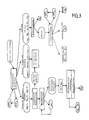
- the separation of the metallic components of button cells, linked to the anodic dissolution of said cells can be improved either by a batch process, or by a continuous process.
- a batch process by fixing the electrical voltage applied to the electrolysis cell successively to different values, the metals are deposited successively at the cathode, that is to say in the Zn order, the group [Fe + Cr + Ni], Hg, Ag, and are recovered by scraping these metals from the cathode, for example using a rotating cathode equipped with scrapers (for example cells of the DIETZEL type). In this way, the metals can be effectively separated.
- the cathode compartment can be equipped with several cathodes placed at different distances from the anode and subjected to different electrical voltages.
- the anode slurry can be easily refined using thermal decomposition coupled with a distillation of mercury.
- This refining step is carried out by heating the anode sludge gradually from 100 to 300 ° C and finally to 500 ° C.
- the silver and mercury oxides decompose according to the reaction patterns: Ag2O ⁇ 2Ag + 1/2 O2 (250 to 300 ° C) HgO ⁇ Hg + 1/2 O2 (500 ° C) Hg2O ⁇ HgO + Hg (100 ° C)
- this process step leads to the recovery of pure mercury from the distillate and pure silver remaining in the oven; if manganese oxides are present in the anode mud (when Zn / MnO2 button cells are present in the starting mixture) the silver is easily separated from the manganese oxides by dissolution in an acid. If gold is present, the gold-silver mixture is separated by known methods or directly reused in jewelry.
- the cathode products are first separated from the mercury, which may be present there, by distilling this mercury at 500 ° C.
- the distillation residue in the form of mixed metals, in powder form
- the zinc is recovered by fixing the electric voltage at 2 V.
- the group Fe + Cr + Ni is recovered by fixing the electric voltage applied at 3 Volts, while the silver remains at the anode.
- the anodic dissolution of the batteries (duration, temperature, electrical voltage, etc.) of silver, possibly mercury of copper, under metallic form, appear both at the cathode and at the anode or at one electrode only; if they appear simultaneously at the two electrodes, it may be economically useful, according to variants of the present invention, to mix the two distillation residues before further treatment, and to refine them together by electrolytic means, or even to mix the anodic products with cathodic products before the distillation of mercury.
- a washing column not shown
- the products remaining in the anodic basket consist of plastic and rubber rings, membranes, wire mesh, pieces of paper, graphite and a little broken glass. This mixture, after washing, can be disposed of as ordinary waste.
- the anodic mud contains mainly metallic oxides (fine powder) and also some fragments of paper and graphite.
- This slurry is put in aqueous suspension and coarsely filtered to remove fragments of paper or plastic; these are eliminated with the contents of the anode basket.
- the filtrate is decanted and filtered, the water is replenished in the process (washing and suspension) and the remaining anode sludge is taken to the next step.
- the anodic mud is gradually heated to 500 ° C and this temperature is maintained for 120 minutes.
- the vapors are condensed through two successive cold traps; mercury (99%) is recovered in the first cold trap, while aqueous condensate, dust and mercury are recovered in the second cold trap and added to the anode sludge of the next batch to be treated. 650 gr. of mercury are recovered as well.
- the residue of decomposition thermal is cooled and recovered. It consists of silver containing traces of gold (around 0.01%).
- the cathodic products are subjected to the same operating conditions for distillation; 420 gr. of mercury are recovered by distillation.
- the cathodic distillation residue is dissolved under electric current with a solution of tetrafluoroboric acid at 20% by weight also comprising Zn (BF4) 2, so that the pH is of the order of 5, in a closed polyethylene container under gentle and constant ventilation; the anode is made of graphite and the cathode is made of stainless steel.
- the electrical voltage of the cell is first fixed at two volts for 8 hours. 1.85 Kg of metallic powder consisting of 95-99% zinc are recovered. Then the cell voltage is increased to 3 V. and maintained at this voltage for 20 hours; 5.1 kg of metallic powder comprising approximately 90% iron, 3% nickel and 6% chromium are recovered. In the anode compartment remains a metallic powder, composed of silver with graphite debris. During electrolysis the average temperature is 45 ° C.
- the electrolyte is replaced by pure HBF4 (at 20%) and the electrolysis is resumed for 2 hours. 330 gr. silver (purity> 99%) are recovered at the cathode.
Landscapes
- Engineering & Computer Science (AREA)
- Chemical & Material Sciences (AREA)
- Environmental & Geological Engineering (AREA)
- Manufacturing & Machinery (AREA)
- Life Sciences & Earth Sciences (AREA)
- Mechanical Engineering (AREA)
- Electrochemistry (AREA)
- Organic Chemistry (AREA)
- Metallurgy (AREA)
- Materials Engineering (AREA)
- Chemical Kinetics & Catalysis (AREA)
- Geology (AREA)
- General Chemical & Material Sciences (AREA)
- General Life Sciences & Earth Sciences (AREA)
- Sustainable Development (AREA)
- Geochemistry & Mineralogy (AREA)
- Processing Of Solid Wastes (AREA)
- Manufacture And Refinement Of Metals (AREA)
- Electrolytic Production Of Metals (AREA)
- Primary Cells (AREA)
Applications Claiming Priority (2)
| Application Number | Priority Date | Filing Date | Title |
|---|---|---|---|
| CH291889 | 1989-08-08 | ||
| CH2918/89 | 1989-08-08 |
Publications (1)
| Publication Number | Publication Date |
|---|---|
| EP0412935A1 true EP0412935A1 (de) | 1991-02-13 |
Family
ID=4244546
Family Applications (1)
| Application Number | Title | Priority Date | Filing Date |
|---|---|---|---|
| EP19900810583 Withdrawn EP0412935A1 (de) | 1989-08-08 | 1990-08-01 | Verfahren zum Aufarbeiten von Knopfzellen in Mischung mit anderen metallischen Gegenständen und Rückgewinnung der metallenen Bestandteile |
Country Status (7)
| Country | Link |
|---|---|
| US (1) | US5120409A (de) |
| EP (1) | EP0412935A1 (de) |
| JP (1) | JPH03149757A (de) |
| KR (1) | KR910004845A (de) |
| CA (1) | CA2022763A1 (de) |
| RU (1) | RU1836494C (de) |
| ZA (1) | ZA906257B (de) |
Cited By (2)
| Publication number | Priority date | Publication date | Assignee | Title |
|---|---|---|---|---|
| WO1996003182A1 (en) * | 1994-07-22 | 1996-02-08 | Aea Technology Plc | The disposal of organic materials encased in metal |
| RU2205882C1 (ru) * | 2001-10-15 | 2003-06-10 | Закрытое акционерное общество Кыштымский медеэлектролитный завод | Способ растворения металла |
Families Citing this family (12)
| Publication number | Priority date | Publication date | Assignee | Title |
|---|---|---|---|---|
| NL9001825A (nl) * | 1990-08-15 | 1992-03-02 | Tno | Terugwinning van cd en ni uit batterijen. |
| US5221325A (en) * | 1992-03-03 | 1993-06-22 | Industrial Technology Research Institute | Process for recovering silver oxide and metals from spent silver oxide button cells |
| EP0608098A1 (de) * | 1993-01-19 | 1994-07-27 | Eveready Battery Company, Inc. | Verfahren und Vorrichtung zum Rückgewinnen von Nickel und/oder Cadmium |
| US5340456A (en) * | 1993-03-26 | 1994-08-23 | Mehler Vern A | Anode basket |
| DE69617458T2 (de) * | 1995-12-01 | 2002-06-06 | Eastern Power Ltd., Toronto | Vorrichtung und verfahren zum recycling und umwandeln von abfall |
| US6048458A (en) * | 1995-12-01 | 2000-04-11 | Eastern Power Limited | Apparatus and method for waste recycling and conversion |
| US6416567B1 (en) * | 1997-03-18 | 2002-07-09 | Mercury Waste Solutions, Inc. | Removal of mercury from waste materials |
| DE19849385A1 (de) * | 1998-10-27 | 2000-05-04 | Eisenmann Kg Maschbau | Verfahren zur Verwertung unsortierter Altbatterien sowie Vorrichtung zur Durchführung dieses Verfahrens |
| US6686086B1 (en) | 2000-06-30 | 2004-02-03 | Secor International Inc. | Battery reclamation system |
| DE102014215036A1 (de) | 2014-07-31 | 2016-02-04 | Robert Bosch Gmbh | Neutralisation von Batteriemodulen oder Batterie-Packs mit mehreren Batteriezellen |
| DE102014215039A1 (de) | 2014-07-31 | 2016-02-04 | Robert Bosch Gmbh | Verfahren zur Neutralisation von Batteriezellen oder Batteriemodulen |
| US11430997B2 (en) | 2019-11-01 | 2022-08-30 | Battery Reclamation Research Associates Llc | Process for separating and recycling a spent alkaline battery |
Citations (2)
| Publication number | Priority date | Publication date | Assignee | Title |
|---|---|---|---|---|
| EP0238714A1 (de) * | 1986-03-21 | 1987-09-30 | Pennwalt Corporation | Elektrolytische Rückgewinnung von Blei aus Abfällen |
| EP0274059A2 (de) * | 1986-12-12 | 1988-07-13 | Recytec S.A. | Verfahren zum Recycling von elektrischen Batterien, gedruckten Leiterschalttafeln und elektronischen Bauteilen |
Family Cites Families (7)
| Publication number | Priority date | Publication date | Assignee | Title |
|---|---|---|---|---|
| US4098658A (en) * | 1974-07-25 | 1978-07-04 | Ginatta Marco | Method of extracting metals from spent electric storage batteries |
| GB1486738A (en) * | 1974-07-25 | 1977-09-21 | Ginatta M | Process for the electrochemical extraction of the metals contained in spent electric storage batteries |
| GB1476055A (en) * | 1975-03-05 | 1977-06-10 | Imp Metal Ind Kynoch Ltd | Eletro-winning metals |
| US4229271A (en) * | 1979-05-24 | 1980-10-21 | Rsr Corporation | Method of recovering lead values from battery sludge |
| IT1191650B (it) * | 1986-01-09 | 1988-03-23 | Tecneco Spa | Processo idrometallurgico per un recupero complessivo dei componenti delle batterie acide al piombo esauste |
| IT1223314B (it) * | 1987-10-20 | 1990-09-19 | Engitec Impianti | Processo idrometallurgico per recuperare in forma metallica pura tutto il piombo contenuto nella massa attiva delle batterie esauste |
| CH679158A5 (de) * | 1989-07-20 | 1991-12-31 | Recytec S A C O Orfigest S A |
-
1990
- 1990-07-31 US US07/560,145 patent/US5120409A/en not_active Expired - Fee Related
- 1990-08-01 EP EP19900810583 patent/EP0412935A1/de not_active Withdrawn
- 1990-08-07 JP JP2207701A patent/JPH03149757A/ja active Pending
- 1990-08-07 KR KR1019900012087A patent/KR910004845A/ko not_active Withdrawn
- 1990-08-07 RU SU904830992A patent/RU1836494C/ru active
- 1990-08-07 CA CA 2022763 patent/CA2022763A1/en not_active Abandoned
- 1990-08-08 ZA ZA906257A patent/ZA906257B/xx unknown
Patent Citations (2)
| Publication number | Priority date | Publication date | Assignee | Title |
|---|---|---|---|---|
| EP0238714A1 (de) * | 1986-03-21 | 1987-09-30 | Pennwalt Corporation | Elektrolytische Rückgewinnung von Blei aus Abfällen |
| EP0274059A2 (de) * | 1986-12-12 | 1988-07-13 | Recytec S.A. | Verfahren zum Recycling von elektrischen Batterien, gedruckten Leiterschalttafeln und elektronischen Bauteilen |
Non-Patent Citations (1)
| Title |
|---|
| JOURNAL OF METALS, vol. 35, no. 8, August 1983, pages 42-46, Warrendale, PA, US; E.R. COLE et al.: "Recovery of lead from battery sludge by electrowinning" * |
Cited By (2)
| Publication number | Priority date | Publication date | Assignee | Title |
|---|---|---|---|---|
| WO1996003182A1 (en) * | 1994-07-22 | 1996-02-08 | Aea Technology Plc | The disposal of organic materials encased in metal |
| RU2205882C1 (ru) * | 2001-10-15 | 2003-06-10 | Закрытое акционерное общество Кыштымский медеэлектролитный завод | Способ растворения металла |
Also Published As
| Publication number | Publication date |
|---|---|
| RU1836494C (ru) | 1993-08-23 |
| US5120409A (en) | 1992-06-09 |
| KR910004845A (ko) | 1991-03-29 |
| CA2022763A1 (en) | 1991-02-09 |
| ZA906257B (en) | 1991-05-29 |
| JPH03149757A (ja) | 1991-06-26 |
Similar Documents
| Publication | Publication Date | Title |
|---|---|---|
| TWI726033B (zh) | 從具有高錳含量的廢棄鋰離子電池回收有價金屬的方法 | |
| JP4909907B2 (ja) | リチウム二次電池から有価物質を回収するための回収方法及び回収装置 | |
| CA1323854C (en) | Process for the recycling of electrical batteries, assembled printed circuit boards and electronic components | |
| FR2512065A1 (fr) | Procede hydrometallurgique pour la recuperation de substances metalliferes a partir d'accumulateurs acides au plomb uses | |
| US5120409A (en) | Process for recycling an unsorted mixture of spent button cells and/or other metallic objects and for recovering their metallic components | |
| FR2694769A1 (fr) | Procédé de traitement de déchets de graphite. | |
| FR2786927A1 (fr) | Procede de traitement d'un accumulateur au lithium en vue du recyclage de ses materiaux constitutifs | |
| FR2691649A1 (fr) | Procédé de décontamination des terres polluées par des métaux. | |
| EP3071717B1 (de) | Verfahren zur rückgewinnung von metallen in einem ni-mh-akku | |
| WO2006080742A1 (en) | Method for recovering high purity indium | |
| EP0620607B1 (de) | Verfahren zur elektrolytischen Behandlung von Altbatterien | |
| EP0483017B1 (de) | Verfahren zur Rückgewinnung von Zink und Quecksilber aus gebrauchten Zinkzellen oder -batterien | |
| EP0443929B1 (de) | Verfahren zur Vernichtung von elektrischen Altbatterien und Wiedergewinnung der verschiedenen Komponenten | |
| FR2560895A1 (fr) | Procede de production electrolytique d'oxyde metallique pour ferrite | |
| JPH0971825A (ja) | ニッケル・水素吸蔵合金二次電池からの有効成分の回収方法 | |
| JPH07145427A (ja) | 接点材料からのパラジウム又はパラジウム合金の回収・再利用方法 | |
| JP3504813B2 (ja) | ニッケル水素二次電池からの有価金属回収方法 | |
| CA1193996A (fr) | Procede et appareil pour la recuperation du zinc de dechets zinciferes industriels | |
| US1374003A (en) | Reclaiming dry batteries | |
| JP2946874B2 (ja) | 水銀無添加アルカリ電池 | |
| CH158003A (fr) | Procédé de préparation de plomb électrolytique à partir de minerai de plomb et électrolyseur pour la mise en oeuvre de ce procédé. | |
| WO1983003627A1 (fr) | Procede et appareil pour la recuperation du zinc de dechets zinciferes industriels | |
| BE830302A (fr) | Procede pour l'extraction de metaux contenus dans des batteries d'accumulateurs electriques epuises | |
| BE653388A (de) | ||
| FR2796206A1 (fr) | Procede pour assurer l'inactivation totale des especes encore reactives de piles et accumulateurs au lithium |
Legal Events
| Date | Code | Title | Description |
|---|---|---|---|
| PUAI | Public reference made under article 153(3) epc to a published international application that has entered the european phase |
Free format text: ORIGINAL CODE: 0009012 |
|
| AK | Designated contracting states |
Kind code of ref document: A1 Designated state(s): AT BE CH DE DK ES FR GB GR IT LI LU NL SE |
|
| 17P | Request for examination filed |
Effective date: 19910516 |
|
| 17Q | First examination report despatched |
Effective date: 19930317 |
|
| STAA | Information on the status of an ep patent application or granted ep patent |
Free format text: STATUS: THE APPLICATION IS DEEMED TO BE WITHDRAWN |
|
| 18D | Application deemed to be withdrawn |
Effective date: 19940525 |