EP0413215A2 - Procédé de préparation de carbonates de dialkyle - Google Patents
Procédé de préparation de carbonates de dialkyle Download PDFInfo
- Publication number
- EP0413215A2 EP0413215A2 EP90114910A EP90114910A EP0413215A2 EP 0413215 A2 EP0413215 A2 EP 0413215A2 EP 90114910 A EP90114910 A EP 90114910A EP 90114910 A EP90114910 A EP 90114910A EP 0413215 A2 EP0413215 A2 EP 0413215A2
- Authority
- EP
- European Patent Office
- Prior art keywords
- alkanol
- copper
- reactor
- catalyst
- und
- Prior art date
- Legal status (The legal status is an assumption and is not a legal conclusion. Google has not performed a legal analysis and makes no representation as to the accuracy of the status listed.)
- Granted
Links
Images
Classifications
-
- C—CHEMISTRY; METALLURGY
- C07—ORGANIC CHEMISTRY
- C07C—ACYCLIC OR CARBOCYCLIC COMPOUNDS
- C07C68/00—Preparation of esters of carbonic or haloformic acids
- C07C68/01—Preparation of esters of carbonic or haloformic acids from carbon monoxide and oxygen
Definitions
- the present invention relates to a process for the continuous production of dialkyl carbonates of the general formula I.
- RO- -OR I wherein R is a C1 to C4 alkyl group, by reacting C1 to C4 alkanols with carbon monoxide and oxygen in the presence of a copper-containing catalyst dissolved or suspended in the reaction medium, at elevated temperature and at elevated pressure.
- Dialkyl carbonates are used, among other things, for the production of special monomers and for the carbonylation and alkylation of highly refined organic intermediates.
- dimethyl carbonate serves as a starting material for polycarbonates, as an active ingredient intermediate and as a solvent for cellulose derivatives.
- divalent copper salts in particular copper (II) chloride
- the yield in this process is very low and a large part of the methanol is converted into undesirable by-products such as methyl chloride and dimethyl ether in the strongly acidic reaction solution - the copper salt forms strongly acidic cationic acids with the water. This process is therefore not practiced industrially.
- DE-A 21 10 194 uses copper catalysts in which the copper has been complexed by means of organic complexing agents. Because of the redox reaction taking place during the reaction, the copper ions can be present next to one another in the valence stages 1 and 2. This method gives good yields in laboratory tests, but has the disadvantage that these complex catalysts are very expensive and sensitive to the action of water and carbon dioxide, which leads to their decomposition and the precipitation of copper carbonate.
- the separation of the catalyst from the reaction product is achieved according to the teaching of the above-mentioned patent by filtering or centrifuging in the case of the suspended catalyst or by rectification and crystallization with a dissolved catalyst.
- the catalyst-containing reaction solutions are highly corrosive, the processing of the reaction product and catalyst requires a high level of equipment: All parts of the system - such as kettles, pipelines, distillation, crystallization and filtration devices - which come into contact with catalyst-containing solutions, have to be made of corrosion-resistant materials such as industrial ceramics, enamel, teflon or tantalum, and even then corrosion problems that occur with pumps and valves still have to be solved. This makes the process uneconomical.
- a 4 636 576 (cyclic amides as cosolvents), US-A 4 604 242 (copper pentanedionate complexes as catalysts), US-A 4 370 275 (copper complexes with nitrogen bases) and DE-A-23 34 736 (copper complexes with organic phosphorus compounds) become uneconomical on an industrial scale.
- a process engineering alternative for separating the catalyst in a catalyst circuit is taught in EP-A 134 668.
- the dialkyl carbonate to be produced is placed in the reactor together with the catalyst and a gas stream of carbon monoxide, oxygen and inert gas and the alkanol to be reacted are continuously introduced into this suspension.
- the water obtained during the reaction is continuously azeotropically distilled off with the aid of the dialkyl carbonate and the water is removed separated from this azeotrope. Since more dialkyl carbonate is required to form the dialkyl carbonate-water azeotrope than is formed during the reaction, part of the dialkyl carbonate distilled off azeotropically must be returned to the reactor.
- the alkanol concentration in the reaction mixture In order to make the separation of water as effective as possible, ie to avoid the energy-intensive circulation of large amounts of dialkyl carbonate, it is necessary for the alkanol concentration in the reaction mixture to be as low as possible, preferably below 5% by weight.
- the low concentration of the reactant alkanol in the reaction medium results in a sharp reduction in the space-time yield. Only a modest space-time yield of dimethyl carbonate of 15 g / (l ⁇ h) is achieved. Since US-A 4 360 477 works practically according to the same refurbishment process, the same statements apply with regard to the economy of this process.
- the dialkyl carbonates (I) are formed by reacting the alkanols ROH with carbon monoxide and oxygen, preferably in the presence of a copper catalyst, formally according to equation (1) (cf. also: Saegusa et al; J. Org. Chem., 35 , 2976 (1970 ))
- the alkanol to be reacted is placed in the reactor together with the catalyst, and the reaction gases oxygen and carbon monoxide, if desired together with inert gas, are passed through this reaction mixture.
- the dialkyl carbonate and water formed in the reaction are discharged from the gas stream from unreacted carbon monoxide and oxygen from the reaction solution.
- the liquid reaction medium consists essentially of the alkanol to be reacted.
- the molar ratio of alkanol / dialkyl carbonate / catalyst (calculated as Cu in the reaction mixture) in the reaction medium and during the reaction is 1 / (0.03-1) / (0.01-0.33) with respect to the alkanol content.
- the reaction can also be carried out at lower catalyst contents of the reaction mixture, albeit with a lower space-time yield, while at higher catalyst concentrations the economy no longer improves further despite a higher catalyst expenditure.
- dialkyl carbonate content of the reaction mixture it is expedient to seek to discharge the dialkyl carbonate together with the water of reaction from the reaction mixture as soon as it is formed, i.e. generally a low stationary dialkyl carbonate concentration in the reactor is aimed for.
- reaction can also be carried out, but only with a higher outlay in the product separation and with the acceptance of a reduced space-time yield.
- Such a low stationary dialkyl carbonate concentration in the reaction mixture, accompanied by a high space-time yield, is achieved according to the invention in that the reaction gases containing carbon monoxide and oxygen are advantageously in an amount of 1 to 100, advantageously 10 to 50 and in particular 20 to 30 Nl per hour and per gram of copper present as copper catalyst in the reactor passes through the reaction mixture.
- dialkyl carbonate and water are formed almost exclusively from part of the reaction gases and the alkanol, while the remaining part of the reaction gases serves to form the dialkyl carbonate formed together with the water of reaction and the amounts of alkanol required in accordance with the thermodynamic vapor-liquid equilibrium to strip the reaction mixture.
- This procedure not only simplifies the isolation of the process product dialkyl carbonate, it also has a favorable effect on the productivity of the reaction by advantageously shifting the reaction equilibrium. It also results in a low stationary concentration of the water of reaction in the reaction mixture. This is generally less than 5, advantageously less than 1% by weight, based on the reaction mixture. As a result, side reactions such as the formation of carbon dioxide and the gradual deactivation of the copper catalyst with the formation of copper carbonates are suppressed.
- reaction gases which can also contain admixed inert gas
- concentration of the alcohol in the reaction discharge can be varied within very wide limits, with a high alcohol content in the discharge Can have expense for the energy costs of the separation.
- the reaction gases can be reacted with the alkanol at atmospheric pressure or under elevated pressure.
- pressures from 1 to 50, preferably from 15 to 30 bar and at temperatures from 80 to 200 ° C., preferably from 90 to 130 ° C.
- the pressure is expediently set by injecting the reaction gas.
- the carbon monoxide / oxygen molar ratio in the reaction gas can be varied within wide limits, but a carbon monoxide / oxygen molar ratio of 1 / 0.01 to 1 / 0.5 is advantageously used. With these molar ratios, on the one hand the oxygen partial pressure is sufficiently high to achieve economic space-time yields, and on the other hand no explosive carbon monoxide / oxygen gas mixtures can form due to a low oxygen content.
- reaction gas - carbon monoxide and oxygen - can also contain admixed inert gas additives. This is particularly useful if you want to work with otherwise explosive carbon monoxide-oxygen gas mixtures. An explosion of these mixtures is prevented by adding suitable amounts of inert gas.
- Copper catalysts based on copper (I) and / or copper (II) salts are used as catalysts in the process according to the invention. Since the reaction according to equation (I) is a redox reaction, both copper ion species are present side by side in the reaction mixture.
- copper salt catalysts are preferably simple or mixed copper salts such as copper (I) - and / or copper (II) halides, copper (I or II) sulfate, copper (II) (C1 to C4 -) (alkoxy) halides such as copper (methoxy) chloride, copper (ethoxy) chloride, copper (butoxy) chloride or copper (methoxy) bromide.
- copper (alkoxy) halides When copper (alkoxy) halides are used as the catalyst, their alkoxy component suitably corresponds to the alkanol to be reacted, since otherwise mixed dialkyl carbonates are formed, which is generally not desirable.
- Copper (I) halides in particular copper (I) chloride and / or the copper (alkoxy) halides corresponding to the alkanol to be reacted are particularly preferably used in the process according to the invention.
- the copper catalyst is generally used in amounts of 0.1 to 10, advantageously 0.3 to 3, in particular 0.3 to 1.5 mol / l alkanol. Since the catalytically active copper salts are only moderately soluble in the alkanols, the catalyst concentrations mentioned here often lead to the formation of catalyst slurries.
- the inventive method is suitable for the production of C1 to C1 dialkyl carbonates such as dimethyl carbonate, diethyl carbonate, di-n-propyl carbonate, diisopropyl carbonate and dibutyl carbonates. It is particularly advantageously used for the production of diethyl carbonate and in particular dimethyl carbonate.
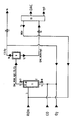
- the reaction takes place in the reactor 1, which is heated, for example, by means of a heating jacket 2 from the outside to the reaction temperature and provided with feed lines 3 (for the alkanol) and 4 (for the CO / O2-containing reaction gas) and the discharge line 5 for the gaseous reaction discharge is.
- the liquid level 6 in the reactor can be set so that it is above or below the alkanol inlet; the alkanol (ROH) is preferably introduced below the liquid level.
- the catalyst can be introduced into the reactor via the filler neck 7 and, if desired, the catalyst-containing reaction medium can be discharged via the outlet neck 8.
- the CO / O2-containing reaction gas is introduced into the reactor charged with catalyst-containing alkanol and heated to the reaction temperature via the inlet 4 attached to the bottom of the reactor.
- this can advantageously be carried out with the aid of conventional dispersing devices such as baffle plates or nozzles, etc. (cf. DE-C 19 06 448; Nagel et al: Chem.-Ing. Techn., 42, 474 (1970 ); Zehner: Chem.-Ing.-Techn. 47, 209 (1975)).
- the reactor can be operated like a bubble reactor. If desired, it can additionally be equipped with stirring devices, pumping devices or the like in order to bring the reaction gas, reaction medium and catalyst into better contact.
- the dialkyl carbonate (DAG) formed in the reaction is fed to the separator 9 with the aid of the reaction exhaust gas containing carbon monoxide and oxygen together with the water of reaction and together with the amount of alkanol required to form the azeotropic mixture.
- this separator 9 which can be a pressure-stable cooler, the gaseous reaction discharge is separated under pressure, expediently under the reaction pressure, into its components which are liquid and gaseous at a lower temperature.
- the pressure in the separator 9 is generally 5 to 125% of the pressure in the reaction vessel 1, the separation is preferably carried out under the same pressure as the reaction.
- the deposition could also be carried out, for example, under atmospheric pressure; however, this is not economical.
- the deposition is advantageously carried out at a temperature of 40 to -20 ° C., preferably at 25 to -15 ° C., advantageously at 10 to -10 ° C.
- the gaseous constituents are withdrawn via the discharge line 10 at the top of the separator and, if desired, returned to the reaction via the inlet 4.
- the carbon monoxide and oxygen content in the residual gas to be recycled is expediently supplemented by metering in fresh carbon monoxide or oxygen, depending on the consumption.
- the pressure can be regulated in this circulating gas guide via the pressure control valve 11. If it is not desired to recycle the residual gas, it can be removed from the system via outlet 16.
- the type of distillation process used is not the subject of the present invention. However, it can be carried out by the customary distillation methods of the prior art, for example distillation under elevated pressure or at atmospheric pressure.
- the mixture obtained is advantageously separated by the method of extraction distillation described in US Pat. No. 4,162,200, cyclohexane or chlorobenzene preferably being used as the extraction agent.
- the dialkyl carbonate isolated in the distillation is generally of sufficient purity to be fed directly to most of its uses.
- the recovered alkanol can, if desired, be completely returned to the reactor via line 14 and inlet 3.
- the amount of liquid in the reactor is supplemented by supplying fresh or recycled alkanol in accordance with the consumption and discharge of alkanol.
- the amount of liquid in the reactor is expediently kept approximately constant in this way, but fluctuations in the amount of liquid are possible and do not significantly change the results.
- the method according to the invention has the particular advantage that it is extremely corrosive and only partially dissolved catalyst in the alkanol remains in the reactor during the continuous reaction. This eliminates all the problems that would have to be overcome when working with a special catalyst circuit, such as corrosion on the separating devices, difficulty in sealing special materials, erosion, blockages etc. In the process according to the invention, therefore, only the reactor has to be equipped with special materials such as industrial ceramics, enamel, Teflon or glass . As a result, the costs of this method are significantly reduced compared to the already known methods.
- methanol was reacted with carbon monoxide and oxygen at 25 bar and 120 ° C.
- Copper methoxy chloride in an amount of 0.7 mol / l of methanol was used as the catalyst.
- a bubble reactor made of pressure-stable glass (volume 0.13 l) with a stirrer was used as the reactor. The reactor was operated in a bottoms mode and the reaction medium was kept in motion by stirring and by the flow of the reaction gases.
- the dimethyl carbonate formed was discharged from the reaction mixture in gaseous form by the stream of the unreacted reaction gases together with the water of reaction and the amount of methanol required to produce the ternary azeotrope.
- This gas stream was broken down into its liquid and gaseous components in a separator at 5 ° C.
- the liquid reaction discharge contained dimethyl carbonate (17% by weight), water (3 to 5% by weight) and methanol (78 to 80% by weight) as well as traces ( ⁇ 0.2% by weight) of formaldehyde dimethyl acetal. At a conversion of 13%, the methanol was converted to dimethyl carbonate with a selectivity of 98 to 100%.
- the carbon monoxide / oxygen mixture (60-65 l / h) drawn off over the head of the separator contained 0.4-3% O2 and less than 0.05% CO2. The rest consisted of CO.
Landscapes
- Chemical & Material Sciences (AREA)
- Organic Chemistry (AREA)
- Organic Low-Molecular-Weight Compounds And Preparation Thereof (AREA)
- Catalysts (AREA)
- Low-Molecular Organic Synthesis Reactions Using Catalysts (AREA)
Applications Claiming Priority (2)
| Application Number | Priority Date | Filing Date | Title |
|---|---|---|---|
| DE3926709A DE3926709A1 (de) | 1989-08-12 | 1989-08-12 | Verfahren zur herstellung von dialkylcarbonaten |
| DE3926709 | 1989-08-12 |
Publications (3)
| Publication Number | Publication Date |
|---|---|
| EP0413215A2 true EP0413215A2 (fr) | 1991-02-20 |
| EP0413215A3 EP0413215A3 (en) | 1992-02-12 |
| EP0413215B1 EP0413215B1 (fr) | 1994-04-20 |
Family
ID=6387022
Family Applications (1)
| Application Number | Title | Priority Date | Filing Date |
|---|---|---|---|
| EP90114910A Expired - Lifetime EP0413215B1 (fr) | 1989-08-12 | 1990-08-03 | Procédé de préparation de carbonates de dialkyle |
Country Status (5)
| Country | Link |
|---|---|
| US (1) | US5142087A (fr) |
| EP (1) | EP0413215B1 (fr) |
| JP (1) | JP2859395B2 (fr) |
| DE (2) | DE3926709A1 (fr) |
| ES (1) | ES2051418T3 (fr) |
Cited By (7)
| Publication number | Priority date | Publication date | Assignee | Title |
|---|---|---|---|---|
| EP0460732A1 (fr) * | 1990-06-04 | 1991-12-11 | ENICHEM SYNTHESIS S.p.A. | Procédé pour la fabrication de carbonate de diméthyle |
| US5233072A (en) * | 1991-11-26 | 1993-08-03 | Bayer Aktiengesellschaft | Process for the preparation of dialkyl carbonates |
| EP0583789A1 (fr) * | 1992-08-20 | 1994-02-23 | Daicel Chemical Industries, Ltd. | Procédé de réglage de réactions |
| EP0658536A1 (fr) | 1993-12-15 | 1995-06-21 | Bayer Ag | Procédé de séparation du méthanol d'un mélange de carbonate de diméthyle et de méthanol |
| EP0667336A1 (fr) * | 1994-02-02 | 1995-08-16 | Bayer Ag | Procédé de préparation contenue de carbonates de diaryle |
| US5523452A (en) * | 1993-12-23 | 1996-06-04 | Bayer Aktiengesellschaft | Process for preparing dimethyl carbonate |
| EP0749955A1 (fr) * | 1995-06-23 | 1996-12-27 | Bayer Ag | Procédé pour la préparation des carbonates de diaryles |
Families Citing this family (12)
| Publication number | Priority date | Publication date | Assignee | Title |
|---|---|---|---|---|
| US5183920A (en) * | 1992-01-13 | 1993-02-02 | The Dow Chemical Company | Integrated process for the production of dimethyl carbonate |
| DE4203796A1 (de) * | 1992-02-10 | 1993-08-12 | Bayer Ag | Verfahren zur herstellung von dialkylcarbonaten |
| DE4325651A1 (de) * | 1993-07-30 | 1995-02-02 | Bayer Ag | Verfahren zur Herstellung von Dialkylcarbonaten |
| DE4339977A1 (de) * | 1993-11-24 | 1995-06-01 | Bayer Ag | Verfahren zur Aufarbeitung der flüssigen Reaktionsprodukte aus der Cu-katalysierten Dimethylcarbonatherstellung |
| IT1269916B (it) * | 1994-03-25 | 1997-04-16 | Enichem Spa | Procedimento migliorato per la sintesi di dimetilcarbonato |
| US6008399A (en) * | 1999-03-11 | 1999-12-28 | Mobil Oil Corporation | Process for preparing organic carbonates |
| US6420589B1 (en) | 2000-12-14 | 2002-07-16 | General Electric Company | Process for the production of diaryl carbonates |
| US6521777B2 (en) | 2000-12-14 | 2003-02-18 | General Electric Company | Process for the production of diaryl carbonates |
| US6384262B1 (en) | 2000-12-14 | 2002-05-07 | General Electric Company | Process for the production of diaryl carbonates |
| US6441215B1 (en) | 2001-06-06 | 2002-08-27 | General Electric Company | Method for reducing carbonate decomposition in reaction mixtures |
| US6903049B2 (en) * | 2002-02-25 | 2005-06-07 | General Electric Company | Method and catalyst composition for producing aromatic carbonates using activating solvents |
| JP5725496B2 (ja) * | 2010-09-10 | 2015-05-27 | 国立大学法人名古屋大学 | 炭酸エステルの製造方法 |
Family Cites Families (14)
| Publication number | Priority date | Publication date | Assignee | Title |
|---|---|---|---|---|
| USRE29338E (en) * | 1970-03-04 | 1977-08-02 | Snam Progetti S.P.A. | Process for the preparation of esters of carbonic acid |
| CA923139A (en) * | 1970-03-04 | 1973-03-20 | Snamprogetti S.P.A. | Process for the preparation of esters of the carbonic acid |
| DE2334736C3 (de) * | 1973-07-09 | 1988-02-11 | Roehm Gmbh, 6100 Darmstadt | Verfahren zur Herstellung von Kohlensäureestern |
| IT1070574B (it) * | 1976-09-30 | 1985-03-29 | Snam Progetti | Procedimento per la preparazione di esteri dell acido carbonico |
| US4218391A (en) * | 1976-09-30 | 1980-08-19 | Anic, S.P.A. | Method for the preparation of esters of carbonic acid |
| IT1127270B (it) * | 1979-12-04 | 1986-05-21 | Anic Spa | Processo per la produzione di dimetilcarbonato |
| DE3016187A1 (de) * | 1980-04-26 | 1981-10-29 | Bayer Ag | Verfahren zur herstellung von kohlensaeureestern |
| US4360477A (en) * | 1981-11-09 | 1982-11-23 | General Electric Company | Carbonylation of alkanols |
| GB8321199D0 (en) * | 1983-08-05 | 1983-09-07 | Ici Plc | Carbonate production |
| US4604242A (en) * | 1984-03-19 | 1986-08-05 | The Dow Chemical Company | Preparation of dialiphatic, dialicyclic, or di(aryl-substituted aliphatic) carbonates |
| US4638076A (en) * | 1985-08-16 | 1987-01-20 | Texaco Inc. | Phosphoramide additives for preparation of organic carbonates |
| US4761467A (en) * | 1985-10-21 | 1988-08-02 | Texaco Inc. | Pyridine ligands for preparation of organic carbonates |
| EP0217651A3 (fr) * | 1985-09-30 | 1988-11-17 | Texaco Development Corporation | Préparation de carbonates organiques |
| US4636576A (en) * | 1985-09-30 | 1987-01-13 | Texaco Inc. | Cyclic amide additives for organic carbonate process |
-
1989
- 1989-08-12 DE DE3926709A patent/DE3926709A1/de not_active Withdrawn
-
1990
- 1990-08-03 DE DE59005420T patent/DE59005420D1/de not_active Expired - Lifetime
- 1990-08-03 ES ES90114910T patent/ES2051418T3/es not_active Expired - Lifetime
- 1990-08-03 EP EP90114910A patent/EP0413215B1/fr not_active Expired - Lifetime
- 1990-08-08 US US07/564,324 patent/US5142087A/en not_active Expired - Fee Related
- 1990-08-13 JP JP2211749A patent/JP2859395B2/ja not_active Expired - Fee Related
Cited By (9)
| Publication number | Priority date | Publication date | Assignee | Title |
|---|---|---|---|---|
| EP0460732A1 (fr) * | 1990-06-04 | 1991-12-11 | ENICHEM SYNTHESIS S.p.A. | Procédé pour la fabrication de carbonate de diméthyle |
| US5233072A (en) * | 1991-11-26 | 1993-08-03 | Bayer Aktiengesellschaft | Process for the preparation of dialkyl carbonates |
| EP0583789A1 (fr) * | 1992-08-20 | 1994-02-23 | Daicel Chemical Industries, Ltd. | Procédé de réglage de réactions |
| EP0658536A1 (fr) | 1993-12-15 | 1995-06-21 | Bayer Ag | Procédé de séparation du méthanol d'un mélange de carbonate de diméthyle et de méthanol |
| US5455368A (en) * | 1993-12-15 | 1995-10-03 | Bayer Aktiengesellschaft | Process for separating off methanol from a mixture of dimethyl carbonate and methanol |
| US5523452A (en) * | 1993-12-23 | 1996-06-04 | Bayer Aktiengesellschaft | Process for preparing dimethyl carbonate |
| EP0667336A1 (fr) * | 1994-02-02 | 1995-08-16 | Bayer Ag | Procédé de préparation contenue de carbonates de diaryle |
| EP0749955A1 (fr) * | 1995-06-23 | 1996-12-27 | Bayer Ag | Procédé pour la préparation des carbonates de diaryles |
| US5625091A (en) * | 1995-06-23 | 1997-04-29 | Bayer Aktiengesellschaft | Process for the production of diaryl carbonates |
Also Published As
| Publication number | Publication date |
|---|---|
| ES2051418T3 (es) | 1994-06-16 |
| EP0413215A3 (en) | 1992-02-12 |
| US5142087A (en) | 1992-08-25 |
| JPH0399041A (ja) | 1991-04-24 |
| DE59005420D1 (de) | 1994-05-26 |
| JP2859395B2 (ja) | 1999-02-17 |
| EP0413215B1 (fr) | 1994-04-20 |
| DE3926709A1 (de) | 1991-02-14 |
Similar Documents
| Publication | Publication Date | Title |
|---|---|---|
| EP0413215B1 (fr) | Procédé de préparation de carbonates de dialkyle | |
| DE69102826T2 (de) | Verfahren zur Herstellung von Dimethylcarbonat. | |
| DE69009393T3 (de) | Verfahren zur Herstellung eines Diesters der Kohlensäure. | |
| EP0807619B1 (fr) | Procédé de fabrication de carbonates de diaryle | |
| DE69223367T2 (de) | Verfahren zur Herstellung von Alkylcarbonaten | |
| EP0667336B1 (fr) | Procédé de préparation contenue de carbonates de diaryle | |
| EP0634386A1 (fr) | Procédé de préparation du carbonate de diméthyle | |
| EP0555697B1 (fr) | Procédé de préparation de carbonates de dialkyle | |
| DE2721734A1 (de) | Verfahren zur herstellung von oxalsaeureestern | |
| DE2925336A1 (de) | Verfahren zur herstellung von oxalsaeuredialkylestern | |
| EP0636601A1 (fr) | Procédé de préparation de carbonates de dialkyle | |
| DE4339977A1 (de) | Verfahren zur Aufarbeitung der flüssigen Reaktionsprodukte aus der Cu-katalysierten Dimethylcarbonatherstellung | |
| EP0659731A1 (fr) | Procédé de préparation de diméthyl carbonate | |
| DE2743690C3 (de) | Verfahren zur Herstellung von Dimethylcarbonat | |
| EP0596483B1 (fr) | Procédé de fabrication du formiate de méthyle | |
| DE68908073T2 (de) | Kontinuierliches Verfahren zur Herstellung von Dialkylcarbonaten. | |
| EP0544162B1 (fr) | Procédé de préparation de carbonates de dialkyle | |
| DE4333642C2 (de) | Verfahren zur Herstellung von 2-Alkyl-5-formylimidazolen | |
| EP0600309A1 (fr) | Procédé de préparation continu de nitrites d'alkyle | |
| EP0635473B1 (fr) | Procédé pour la préparation de chlorures d'acides carboxyliques | |
| DE19727163B4 (de) | Verfahren zur Herstellung von Kohlensäurediester | |
| EP0413217B1 (fr) | Procédé de préparation de carbonates de dialkyle | |
| DE2314950C3 (de) | Verfahren zur Herstellung von Hydroxydiphenyl | |
| DE2057956A1 (de) | Verfahren zur Herstellung von aliphatischen Carbonsaeurechloriden | |
| DE69307492T2 (de) | Verfahren zur herstellung von kohlensauren diestern |
Legal Events
| Date | Code | Title | Description |
|---|---|---|---|
| PUAI | Public reference made under article 153(3) epc to a published international application that has entered the european phase |
Free format text: ORIGINAL CODE: 0009012 |
|
| AK | Designated contracting states |
Kind code of ref document: A2 Designated state(s): BE CH DE ES FR GB IT LI NL |
|
| 17P | Request for examination filed |
Effective date: 19901227 |
|
| PUAL | Search report despatched |
Free format text: ORIGINAL CODE: 0009013 |
|
| AK | Designated contracting states |
Kind code of ref document: A3 Designated state(s): BE CH DE ES FR GB IT LI NL |
|
| 17Q | First examination report despatched |
Effective date: 19930910 |
|
| GRAA | (expected) grant |
Free format text: ORIGINAL CODE: 0009210 |
|
| AK | Designated contracting states |
Kind code of ref document: B1 Designated state(s): BE CH DE ES FR GB IT LI NL |
|
| REF | Corresponds to: |
Ref document number: 59005420 Country of ref document: DE Date of ref document: 19940526 |
|
| ITF | It: translation for a ep patent filed | ||
| REG | Reference to a national code |
Ref country code: ES Ref legal event code: FG2A Ref document number: 2051418 Country of ref document: ES Kind code of ref document: T3 |
|
| GBT | Gb: translation of ep patent filed (gb section 77(6)(a)/1977) |
Effective date: 19940525 |
|
| ET | Fr: translation filed | ||
| PLBE | No opposition filed within time limit |
Free format text: ORIGINAL CODE: 0009261 |
|
| 26N | No opposition filed | ||
| REG | Reference to a national code |
Ref country code: GB Ref legal event code: IF02 |
|
| PGFP | Annual fee paid to national office [announced via postgrant information from national office to epo] |
Ref country code: FR Payment date: 20020716 Year of fee payment: 13 |
|
| PGFP | Annual fee paid to national office [announced via postgrant information from national office to epo] |
Ref country code: NL Payment date: 20020724 Year of fee payment: 13 |
|
| PGFP | Annual fee paid to national office [announced via postgrant information from national office to epo] |
Ref country code: CH Payment date: 20020725 Year of fee payment: 13 |
|
| PGFP | Annual fee paid to national office [announced via postgrant information from national office to epo] |
Ref country code: GB Payment date: 20020802 Year of fee payment: 13 |
|
| PGFP | Annual fee paid to national office [announced via postgrant information from national office to epo] |
Ref country code: ES Payment date: 20020807 Year of fee payment: 13 |
|
| PGFP | Annual fee paid to national office [announced via postgrant information from national office to epo] |
Ref country code: BE Payment date: 20020830 Year of fee payment: 13 |
|
| PGFP | Annual fee paid to national office [announced via postgrant information from national office to epo] |
Ref country code: DE Payment date: 20020924 Year of fee payment: 13 |
|
| PG25 | Lapsed in a contracting state [announced via postgrant information from national office to epo] |
Ref country code: GB Free format text: LAPSE BECAUSE OF NON-PAYMENT OF DUE FEES Effective date: 20030803 |
|
| PG25 | Lapsed in a contracting state [announced via postgrant information from national office to epo] |
Ref country code: ES Free format text: LAPSE BECAUSE OF NON-PAYMENT OF DUE FEES Effective date: 20030804 |
|
| PG25 | Lapsed in a contracting state [announced via postgrant information from national office to epo] |
Ref country code: LI Free format text: LAPSE BECAUSE OF NON-PAYMENT OF DUE FEES Effective date: 20030831 Ref country code: CH Free format text: LAPSE BECAUSE OF NON-PAYMENT OF DUE FEES Effective date: 20030831 Ref country code: BE Free format text: LAPSE BECAUSE OF NON-PAYMENT OF DUE FEES Effective date: 20030831 |
|
| PG25 | Lapsed in a contracting state [announced via postgrant information from national office to epo] |
Ref country code: DE Free format text: LAPSE BECAUSE OF THE APPLICANT RENOUNCES Effective date: 20030927 |
|
| BERE | Be: lapsed |
Owner name: *BASF A.G. Effective date: 20030831 |
|
| PG25 | Lapsed in a contracting state [announced via postgrant information from national office to epo] |
Ref country code: NL Free format text: LAPSE BECAUSE OF NON-PAYMENT OF DUE FEES Effective date: 20040301 |
|
| GBPC | Gb: european patent ceased through non-payment of renewal fee |
Effective date: 20030803 |
|
| REG | Reference to a national code |
Ref country code: CH Ref legal event code: PL |
|
| PG25 | Lapsed in a contracting state [announced via postgrant information from national office to epo] |
Ref country code: FR Free format text: LAPSE BECAUSE OF NON-PAYMENT OF DUE FEES Effective date: 20040430 |
|
| NLV4 | Nl: lapsed or anulled due to non-payment of the annual fee |
Effective date: 20040301 |
|
| REG | Reference to a national code |
Ref country code: FR Ref legal event code: ST |
|
| REG | Reference to a national code |
Ref country code: ES Ref legal event code: FD2A Effective date: 20030804 |
|
| PG25 | Lapsed in a contracting state [announced via postgrant information from national office to epo] |
Ref country code: IT Free format text: LAPSE BECAUSE OF NON-PAYMENT OF DUE FEES;WARNING: LAPSES OF ITALIAN PATENTS WITH EFFECTIVE DATE BEFORE 2007 MAY HAVE OCCURRED AT ANY TIME BEFORE 2007. THE CORRECT EFFECTIVE DATE MAY BE DIFFERENT FROM THE ONE RECORDED. Effective date: 20050803 |