EP0413541A1 - Rotary internal combustion engine - Google Patents
Rotary internal combustion engine Download PDFInfo
- Publication number
- EP0413541A1 EP0413541A1 EP90308887A EP90308887A EP0413541A1 EP 0413541 A1 EP0413541 A1 EP 0413541A1 EP 90308887 A EP90308887 A EP 90308887A EP 90308887 A EP90308887 A EP 90308887A EP 0413541 A1 EP0413541 A1 EP 0413541A1
- Authority
- EP
- European Patent Office
- Prior art keywords
- rotor
- cylinder
- engine
- valve
- rotary
- Prior art date
- Legal status (The legal status is an assumption and is not a legal conclusion. Google has not performed a legal analysis and makes no representation as to the accuracy of the status listed.)
- Withdrawn
Links
- 238000002485 combustion reaction Methods 0.000 title claims abstract description 33
- 239000000567 combustion gas Substances 0.000 claims description 22
- 239000007789 gas Substances 0.000 claims description 21
- 238000007789 sealing Methods 0.000 claims description 8
- 238000010408 sweeping Methods 0.000 claims description 4
- 230000001360 synchronised effect Effects 0.000 claims description 3
- 230000002093 peripheral effect Effects 0.000 claims 1
- 230000006835 compression Effects 0.000 description 5
- 238000007906 compression Methods 0.000 description 5
- 238000010276 construction Methods 0.000 description 2
- 238000001816 cooling Methods 0.000 description 2
- 239000012530 fluid Substances 0.000 description 2
- 230000004048 modification Effects 0.000 description 2
- 238000012986 modification Methods 0.000 description 2
- 125000004122 cyclic group Chemical group 0.000 description 1
- 230000003247 decreasing effect Effects 0.000 description 1
- 229910003460 diamond Inorganic materials 0.000 description 1
- 239000010432 diamond Substances 0.000 description 1
- 239000002283 diesel fuel Substances 0.000 description 1
- 230000000694 effects Effects 0.000 description 1
- 239000000446 fuel Substances 0.000 description 1
- 239000008246 gaseous mixture Substances 0.000 description 1
- 230000005484 gravity Effects 0.000 description 1
- 239000007788 liquid Substances 0.000 description 1
- 238000005461 lubrication Methods 0.000 description 1
- 238000004519 manufacturing process Methods 0.000 description 1
- 239000000463 material Substances 0.000 description 1
- 238000005204 segregation Methods 0.000 description 1
Images

Classifications
-
- F—MECHANICAL ENGINEERING; LIGHTING; HEATING; WEAPONS; BLASTING
- F01—MACHINES OR ENGINES IN GENERAL; ENGINE PLANTS IN GENERAL; STEAM ENGINES
- F01C—ROTARY-PISTON OR OSCILLATING-PISTON MACHINES OR ENGINES
- F01C1/00—Rotary-piston machines or engines
- F01C1/08—Rotary-piston machines or engines of intermeshing engagement type, i.e. with engagement of co- operating members similar to that of toothed gearing
- F01C1/12—Rotary-piston machines or engines of intermeshing engagement type, i.e. with engagement of co- operating members similar to that of toothed gearing of other than internal-axis type
- F01C1/14—Rotary-piston machines or engines of intermeshing engagement type, i.e. with engagement of co- operating members similar to that of toothed gearing of other than internal-axis type with toothed rotary pistons
- F01C1/20—Rotary-piston machines or engines of intermeshing engagement type, i.e. with engagement of co- operating members similar to that of toothed gearing of other than internal-axis type with toothed rotary pistons with dissimilar tooth forms
Definitions
- This invention relates to a rotary internal combustion engine.
- a rotary internal combustion engine comprising a rotor mounted for rotation concentrically within a closed ended cylindrical bore formed within a cylinder block, the rotor being separated from the internal cylinder wall by an annular chamber spanned and swept by two rotor blades secured to, spaced about and extending along the side of the rotor and sealingly engagable with the inner periphery of the cylinder; a combustion gas inlet port and an exhaust gas outlet port to the annular chamber; a first rotary cylinder valve mounted in the cylinder block for rotation about an axis parallel to that of the rotor, connecting into and spacing across the annular chamber and disposed between the inlet and the outlet ports, and a second rotary cylinder valve mounted in the cylinder block for rotation about an axis parallel to that of the rotor connecting into and spanning across the annular chamber, both the first and the second cylinder valves being provided with elongate slots along their length adapted to receive and cooperate with the rot
- the second rotary cylinder valve may contain or connect to a reservoir chamber for the collection under increased pressure of combustion gas.
- a rotary internal combustion engine effectively free from epicyclic and reciprocating motion.
- the rotary valves enable power to be extracted from the engine by means of the bladed rotor.
- the construction enables the cylindrical valves to "roll" synchronously against the rotor, whilst allowing the rotor blades to pass by and maintain their cyclic path and at the same time provide a boundary for combustion and exhaust gases.
- the internal combustion engine comprises a main shaft 1 and a principle rotor 2 connected by means of gearing 3 to cylindrical valves 4 and 5.
- a pair of diametrically opposed rotor blades 6 and 7 are secured to and extend along the periphery of the rotor 2 such as to bear by means of sealing strips 12 and 13 against the cylindrical inner wall 19 of the cylinder block 9.
- the cylindrical inner wall 19 of the cylinder block and the concentric rotor 2 define between them an annular chamber 20 in association with end plates 22 and 35.
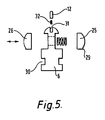
- the rotor blades 6 and 7 include outwardly extending sealing cheeks 25 and 26 on each side urged apart by spring means 28.
- Each sealing cheek is provided with a bottom edge 29 locatable under a rim on the respective blade to limit outward movement.
- the rotor blades are povided with keyways 30 for attachment to the rotor.
- the sealing strip 12 is located within an appropriate groove 31 in each rotor blade and is urged outwardly by spring means 32. The lateral movement is kept to a minimum whilst allowing for wear and play tolerances.
- the spring forces being sufficient to contain pressures of combustion.
- a combustion gas inlet port 8 and an exhaust gas outlet port 16 connect to the annular chamber 20.
- a spark ignition plug 14 is connected into a combustion chamber portion 15 of the annular chamber 20.
- the second rotary valve 5 is provided with a passage 10 leading to a reservoir for compressed combustion gas 11.
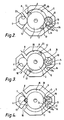
- Figure 2 shows the engine with the combustion chamber 15 formed between valve 5 and blade 7 ready for ignition with compressed combustion gas therein.
- Figure 3 shows the arrangement after ignition of the combustion gas, with the rotor blade 7 being swept towards the exhaust port 16 and the cylindrical valve 4, at the same time sweeping out combustion gas through outlet port 16 from a previous combustion ahead of rotor blade 7. At the same time combustion gas is sweeping into the annular chamber via inlet port 8 behind rotor blade 6 which is also compressing and feeding ahead of itself further combustion gas towards rotary valve 5.
- Figure 4 shows the engine with the rotor blades 6 and 7 engaging in the appropriately shaped partly cylindrical slots or grooves 23, 24 in cylindrical valves 4 and 5. At this position exhaust gases can leave via outlet port 16, whilst combustion gases compressed ahead of rotor blade 6 are forced via passage 10 into reservoir 11.
- the rotating cylinder valve 5 turns such that the passage 10 is opened to the reservoir chamber 11 therein.
- the cylinder valve curve surfaces synchronously mate with the rotor maintaining a boundary to the gases, whilst the rotor blades, by means of sealing edges 12, 13 ensure sealing with the cylinder block 9, and as the rotor blades pass by the cylindrical valves maintain an orbital path with respect to the main shaft and rotor.
- the sealing cheeks 25 and 26 of each rotor blade engage and co-operate within the cylindrical valves 4 and 5 as the rotor blades pass therethrough, thereby assisting gas transfer efficiency.
- the number of cylinder valves and rotor blades may be, in some embodiments of the invention, greater than those described hereinabove.
- passages for gas tranference may also be varied to suit alternative arrangements for compression and combustion chamber segregation.
- Cooling means may be incorporated throughout the block constituting the combustion chamber by means of channels 17 via which fluid may be passed, utilising the power from the engine to achieve the fluid flow.
- the reservoir 11 may be part of the cylindrical valve 5 as shown or externally thereto, the volume effecting the peak compression pressure an initial period to operational pressure levels.
- Lubrication of relevant surfaces may be provided using appropriate channels 18 and 27 through which cooling may also be effected and surface contact areas reduced for the rotor and cylinder valves to reduce friction losses.
- Diesel fuels may be used with the use of injectors to achieve the high compression required along with rechannelled gas paths to enable high performance.
- the engine may be modified from that illustrated in that pressurised gas or liquid may be utilised to extract power.
- the engine herein described differs from and is a significant improvement over the forementioned commercially developed "rotary" engine in that the output shaft may be fixed to the rotor directly thereby removing the need for heavily loaded precision gears, although simple gearing means are, as illustrated, used for synchronisation of the cylindrical valves with the principal rotor.
- the rotor additionally is fixed to the centre of the cylinder block, with the centre of gravity thereof lying on the centre line of the output shaft to provide a freedom from eccentric movement thereby, and hence reduction in vibration.
- the rotor blades travel concentric to the main output shaft, and the cylindrical valves are used to allow the blades to rotate freely whilst allowing either of the gas to pass in front of the blade or behind it, gas transfer being accomplished either side of one of the cylindrical valves.
- the overall annular chamber including the combustion chamber (formed by the main cylinder block) is of a compact configuration of primarily diamond configuration and of similar dimensions in length as to its width and depth. However of course the shape can be varied to achieve differently dimensioned combustion chambers for optimisation of effeciency.
Landscapes
- Engineering & Computer Science (AREA)
- Mechanical Engineering (AREA)
- General Engineering & Computer Science (AREA)
- Combustion Methods Of Internal-Combustion Engines (AREA)
Abstract
The invention provides a rotary internal combustion engine characterised by a rotor (2) mounted for rotation concentrically within a closed ended cylindrical bore formed within a cylinder block (9), the rotor (2) being separated from the internal cylinder wall by an annular chamber (20) spanned and swept by two rotor blades (6,7) secured to, spaced about and extending along the side of the rotor (2) and sealingly engagable with the inner periphery (19) of the cylinder (9); a first rotary cylinder valve (4) mounted in the cylinder block (9) for rotation about an axis parallel to that of the rotor (2), connecting into and spacing across the annular chamber (20) and disposed between the inlet and the outlet ports (8,16), and a second rotary cylinder valve (5) mounted in the cylinder block (9) for rotation about an axis parallel to that of the rotor (2) connecting into and spanning across the annular chamber (20), both the first and the second cylinder valves (4,5) being provided with elongate slots (22,23) along their length adapted to receive and cooperate with the rotor blades (6,7) during rotation with the rotor (2).
Description
- This invention relates to a rotary internal combustion engine.
- So called "rotary" internal combustion engines have already been proposed in which the intrinsic inefficiencies and wear characteristics of reciprocating piston engines have been potentially overcome by providing an internal combustion engine in which there is no reciprocating movement of parts. At least one such engine has been developed to commercial production and sales. However, such an engine has disadvantages. Thus the output shaft of the engine is driven via a gearing means from the rotor, thus requiring precision gears (one of which is an internal gear) which can tolerate the heavy loads generated. In addition the rotor travels in an eccentric manner about the output shaft in order to achieve the compression and expansion cycles typical of an internal combustion engine. In practice this unbalanced movement can only be compensated by a second unit operating 180° out of phase. This provides an engine in smoothness equivalent to a six cylinder reciprocating piston engine. In addition, in practice the combustion chamber is long and thin leading to greater conducted heat losses than with a more spherical or square shape, which effects the ignition propagation. To overcome this problem it is often necessary for two spark ignition sources to be used.
- It is an object of the present invention to overcome or at least substantially reduce the problems and disadvantages mentioned hereinabove.
- In accordance with the present invention there is provided a rotary internal combustion engine comprising a rotor mounted for rotation concentrically within a closed ended cylindrical bore formed within a cylinder block, the rotor being separated from the internal cylinder wall by an annular chamber spanned and swept by two rotor blades secured to, spaced about and extending along the side of the rotor and sealingly engagable with the inner periphery of the cylinder; a combustion gas inlet port and an exhaust gas outlet port to the annular chamber; a first rotary cylinder valve mounted in the cylinder block for rotation about an axis parallel to that of the rotor, connecting into and spacing across the annular chamber and disposed between the inlet and the outlet ports, and a second rotary cylinder valve mounted in the cylinder block for rotation about an axis parallel to that of the rotor connecting into and spanning across the annular chamber, both the first and the second cylinder valves being provided with elongate slots along their length adapted to receive and cooperate with the rotor blades during rotation thereof with the rotor; ignition means protruding into a combustion chamber portion of the annular chamber after the second cylinder valve in the direction of the rotation of the rotor, the first cylinder valve, the rotor, and the second cylinder valve being connected for synchronous rotational drive whereby combustion gas from the inlet port is compressed by and swept to and from the second cylinder valve into the combustion chamber for ignition by one of the rotor blades, whilst the other rotor blade, in turn, forms the leading end of the combustion chamber and subsequently sweeps before it exhaust gases to the outlet port before sweeping past the first inlet valve again to compress incoming combustion gas.
- The second rotary cylinder valve may contain or connect to a reservoir chamber for the collection under increased pressure of combustion gas.
- By means of the invention we have provided a rotary internal combustion engine effectively free from epicyclic and reciprocating motion. The rotary valves enable power to be extracted from the engine by means of the bladed rotor. Essentially the construction enables the cylindrical valves to "roll" synchronously against the rotor, whilst allowing the rotor blades to pass by and maintain their cyclic path and at the same time provide a boundary for combustion and exhaust gases.
- In practice, as the blades of the rotor rotate, combustion gases are drawn in behind one blade from the combustion gas inlet and compressed in front of the other enabling transferrence to the reservoir chamber in the second valve. After sufficient rotary cycles, enough combustion gas at sufficient pressure accumulates in the reservoir chamber to allow adequate gas transfer via the same rotary valve to the ignition chamber defined between the second valve and the preceding rotating blade. Upon ignition the combustion causes that rotating blade to force the rotor such that the burnt gases are moved to the exhaust port.
- By this means power may be extracted from the rotor.
- In order that the invention may be more readily understood one embodiment thereof will now be described by way of example with reference to the accompanying drawings in which:-
- Figure 1 is a schematic part sectional isometric view of a rotary internal combustion engine in accordance with the invention;
- Figures 2, 3 and 4 are schematic side views of the combustion chamber of the engine of Figure 1 shown in various stages in the operation thereof; and
- Figure 5 is an exploded side view showing the construction of the rotor blade of the engine of Figure 1.
- Referring now to the drawings, it is to be seen that the internal combustion engine comprises a main shaft 1 and a principle rotor 2 connected by means of gearing 3 to
cylindrical valves 4 and 5. A pair of diametrically opposedrotor blades 6 and 7 are secured to and extend along the periphery of the rotor 2 such as to bear by means ofsealing strips inner wall 19 of the cylinder block 9. The cylindricalinner wall 19 of the cylinder block and the concentric rotor 2 define between them anannular chamber 20 in association withend plates 22 and 35. - Reference to Figure 5 will show that the
rotor blades 6 and 7 (rotor blade 6 being shown) include outwardly extendingsealing cheeks bottom edge 29 locatable under a rim on the respective blade to limit outward movement. The rotor blades are povided withkeyways 30 for attachment to the rotor. It is to be noted that thesealing strip 12 is located within anappropriate groove 31 in each rotor blade and is urged outwardly by spring means 32. The lateral movement is kept to a minimum whilst allowing for wear and play tolerances. The spring forces being sufficient to contain pressures of combustion. - A combustion
gas inlet port 8 and an exhaustgas outlet port 16 connect to theannular chamber 20. - A
spark ignition plug 14 is connected into acombustion chamber portion 15 of theannular chamber 20. - The second
rotary valve 5 is provided with apassage 10 leading to a reservoir for compressedcombustion gas 11. - The operational sequence of the engine illustrated is described in detail hereinafter, but it is to be noted that Figure 2 shows the engine with the
combustion chamber 15 formed betweenvalve 5 and blade 7 ready for ignition with compressed combustion gas therein. - Figure 3 shows the arrangement after ignition of the combustion gas, with the rotor blade 7 being swept towards the
exhaust port 16 and the cylindrical valve 4, at the same time sweeping out combustion gas throughoutlet port 16 from a previous combustion ahead of rotor blade 7. At the same time combustion gas is sweeping into the annular chamber viainlet port 8 behindrotor blade 6 which is also compressing and feeding ahead of itself further combustion gas towardsrotary valve 5. - Figure 4 shows the engine with the
rotor blades 6 and 7 engaging in the appropriately shaped partly cylindrical slots orgrooves cylindrical valves 4 and 5. At this position exhaust gases can leave viaoutlet port 16, whilst combustion gases compressed ahead ofrotor blade 6 are forced viapassage 10 intoreservoir 11. - In chronological sequence therefore, rotation of main shaft 1 and the rotor 2 causes, by means of the gearing 3, synchronous rotation with the two
cylindrical valves 4, 5. Asfixed rotor blades 6, 7 extending along the periphery of the rotor 2 pass combustiongas inlet ports 8, a combustable gaseous mixture is induced by therotor blade 6 into theannular chamber 20 between the rotor and cylinder block 9 behind therotor blade 6. At the same time a previously induced combustion gas input in front of theblade 6 is compressed by the leading face of theblade 6 by the decreasing volume between thecylindrical wall 19, thecylinder end plates 22, 35, the rotor 2, therotor blade 6 and thecylindrical valve 5. As the gas compress, the rotatingcylinder valve 5 turns such that thepassage 10 is opened to thereservoir chamber 11 therein. The cylinder valve curve surfaces synchronously mate with the rotor maintaining a boundary to the gases, whilst the rotor blades, by means ofsealing edges sealing cheeks cylindrical valves 4 and 5 as the rotor blades pass therethrough, thereby assisting gas transfer efficiency. - Having compressed the combustion gas into the
reservoir 11, further rotation of the rotor 2 enables gas from the reservoir chamber to be transferred to thecombustion chamber 15 defined behind therotor blade 13. The gas can be ignited by aspark plug 14 when thecylindrical valve 5 closes (the ignition time being adjusted depending upon the fuel used). In order to accumulate adequate pressure within thereservoir 11 and hence in thecombustion chamber 15 several compression cycles may be required. It is however to be appreciated that in certain circumstances pressure of a single revolution of the rotor will be adequate for ignition and thereservoir 11 contained within the cylindrical valve might not be used. - After ignition of the gases the increase in pressure forces the
rotor blade 13 towardsexhaust outlet 16 until it passes by it to the first rotary cylinder valve 4 which segregates the inlet and outlet gases whilst allowing the rotor blade to pass by. - The number of cylinder valves and rotor blades may be, in some embodiments of the invention, greater than those described hereinabove. Similarly passages for gas tranference may also be varied to suit alternative arrangements for compression and combustion chamber segregation.
- Cooling means may be incorporated throughout the block constituting the combustion chamber by means of
channels 17 via which fluid may be passed, utilising the power from the engine to achieve the fluid flow. - The
reservoir 11 may be part of thecylindrical valve 5 as shown or externally thereto, the volume effecting the peak compression pressure an initial period to operational pressure levels. - Lubrication of relevant surfaces may be provided using
appropriate channels - Any appropriate materials suitable for a combustion engine may be utilised.
- Diesel fuels may be used with the use of injectors to achieve the high compression required along with rechannelled gas paths to enable high performance.
- The engine may be modified from that illustrated in that pressurised gas or liquid may be utilised to extract power.
- The engine herein described differs from and is a significant improvement over the forementioned commercially developed "rotary" engine in that the output shaft may be fixed to the rotor directly thereby removing the need for heavily loaded precision gears, although simple gearing means are, as illustrated, used for synchronisation of the cylindrical valves with the principal rotor. The rotor additionally is fixed to the centre of the cylinder block, with the centre of gravity thereof lying on the centre line of the output shaft to provide a freedom from eccentric movement thereby, and hence reduction in vibration. The rotor blades travel concentric to the main output shaft, and the cylindrical valves are used to allow the blades to rotate freely whilst allowing either of the gas to pass in front of the blade or behind it, gas transfer being accomplished either side of one of the cylindrical valves.
- The overall annular chamber including the combustion chamber (formed by the main cylinder block) is of a compact configuration of primarily diamond configuration and of similar dimensions in length as to its width and depth. However of course the shape can be varied to achieve differently dimensioned combustion chambers for optimisation of effeciency.
- It is to be understood that the foregoing is merely ememplary of a rotary engine in accordance with the invention and that modifications can readily be made thereto without departing from the true scope of the invention.
- It is to be understood that the foregoing is merely exemplary of a rotary internal combustion engine in accordance with the invention and that modification can readily be made thereto without departing from the true scope of the invention.
Claims (11)
1. A rotary internal combustion engine characterised by a rotor (2) mounted for rotation concentrically within a closed ended cylindrical bore formed within a cylinder block (9), the rotor (2) being separated from the internal cylinder wall by an annular chamber (20) spanned and swept by two rotor blades (6, 7) secured to, spaced about and extending along the side of the rotor (2) and sealingly engagable with the inner periphery (19) of the cylinder (9); a combustion gas inlet port (8) and an exhaust gas outlet port (16) to the annular chamber; a first rotary cylinder valve (4) mounted in the cylinder block (9) for rotation about an axis parallel to that of the rotor (2), connecting into and spacing across the annular chamber (20) and disposed between the inlet and the outlet ports (8, 16), and a second rotary cylinder valve (5) mounted in the cylinder block (9) for rotation about an axis parallel to that of the rotor (2) connecting into and spanning across the annular chamber (20), both the first and the second cylinder valves (4, 5) being provided with elongate slots (23, 24) along their length adapted to receive and cooperate with the rotor blades (6, 7) during rotation thereof with the rotor (2); ignition means (14) protruding into a combustion chamber portion (15) of the annular chamber (20) after the second cylinder valve (5) in the direction of the rotation of the rotor; the first cylinder valve (4), the rotor (2), and the second cylinder valve (5) being connected for synchronous rotational drive whereby combustion gas from the inlet port (18) is compressed by and swept by one of the rotor blades (6, 7) to and then away from the second cylinder valve (5) into the combustion chamber (15) for ignition, whilst the other rotor blade (7, 6), in turn, forms the leading end of the combustion chamber (15) and subsequently sweeps before it exhaust gases to the outlet port (16) before sweeping past the first inlet valve (8) again to compress incoming combustion gas.
2. An engine as claimed in Claim 1 characterised in that the second rotary engine valve (16) is associated with a reservoir chamber (11) for the collection, under increased pressure, of combustion gas.
3. An engine as claimed in Claim 2 characterised in that the second rotary cylinder valve (16) contains a reservoir chamber (11).
4. An engine as claimed in Claim 2 wherein the second rotary cylinder valve is connected to a separate reservoir chamber.
5. An engine as claimed in any one of the preceding claims characterised in that the first and second rotary cylinder valves (8, 16) are geared to rotate in the opposite direction to the rotor and at the same peripheral speed whereby in operation the outer surfaces of the first and second rotary cylinder valves roll upon the rotor.
6. An engine as claimed in any one of the preceding claims wherein the first and second cylinder valves (8, 16) are disposed on diametrically opposite sides of the annular chamber (20).
7. An engine as claimed in any one of the preceding claims characterised in that the rotor blades (6, 7) are carried in a diametrically opposed disposition about the rotor (2).
8. An engine as claimed in any one of the preceding claims characterised in that the rotor blades (6, 7) each include spring urged sealing strips (12, 13) for sealingly engaging the inner periphery of the cylinder.
9. An engine as claimed in any one of the preceding claims characterised in that the elongate slots (23, 24) provided in the first and second cylinder valves (8, 6) are part circular in section.
10. An engine as claimed in any one of the preceding claims charactersied in that the ignition means comprises a spark plug (14) protruding into the annular chamber (20) shortly after the second cylinder valve (5) in the direction of rotation of the rotor (2).
11. An engine as claimed in any one of the preceding claims characterised in that the inlet port (8) and the outlet port (16) are disposed closely adjacent to the first rotary cylinder valve (4).
Applications Claiming Priority (2)
| Application Number | Priority Date | Filing Date | Title |
|---|---|---|---|
| GB8918932 | 1989-08-18 | ||
| GB898918932A GB8918932D0 (en) | 1989-08-18 | 1989-08-18 | Rotary internal combustion engine |
Publications (1)
| Publication Number | Publication Date |
|---|---|
| EP0413541A1 true EP0413541A1 (en) | 1991-02-20 |
Family
ID=10661859
Family Applications (1)
| Application Number | Title | Priority Date | Filing Date |
|---|---|---|---|
| EP90308887A Withdrawn EP0413541A1 (en) | 1989-08-18 | 1990-08-13 | Rotary internal combustion engine |
Country Status (2)
| Country | Link |
|---|---|
| EP (1) | EP0413541A1 (en) |
| GB (1) | GB8918932D0 (en) |
Cited By (2)
| Publication number | Priority date | Publication date | Assignee | Title |
|---|---|---|---|---|
| WO2008108743A1 (en) * | 2007-03-02 | 2008-09-12 | Peter Varga | Rotary internal combustion engine with annular chamber |
| WO2008121082A1 (en) * | 2007-04-03 | 2008-10-09 | Peter Varga | Rotary internal combustion engine with annular chamber |
Citations (7)
| Publication number | Priority date | Publication date | Assignee | Title |
|---|---|---|---|---|
| GB784554A (en) * | 1955-08-30 | 1957-10-09 | Clifford Edmund Brewer | Improvements in or relating to rotary motors, compressors or the like |
| US3453992A (en) * | 1968-07-08 | 1969-07-08 | Anthony Graham | Rotary type device |
| FR1594801A (en) * | 1968-11-20 | 1970-06-08 | ||
| FR2113141A5 (en) * | 1970-10-22 | 1972-06-23 | Przybylski Zdzislaw | |
| US3863610A (en) * | 1972-08-18 | 1975-02-04 | Raymond G Spinnett | Rotary converters having specialized interleaving elements |
| FR2243607A5 (en) * | 1973-09-10 | 1975-04-04 | Widemann Antoine | Rotary I.C. engine with gear type rotors - blades of central rotor engage recesses on adjacent rotors |
| DE3543944A1 (en) * | 1985-12-12 | 1987-06-19 | Werner Gleixner | Internal combustion engine |
-
1989
- 1989-08-18 GB GB898918932A patent/GB8918932D0/en active Pending
-
1990
- 1990-08-13 EP EP90308887A patent/EP0413541A1/en not_active Withdrawn
Patent Citations (7)
| Publication number | Priority date | Publication date | Assignee | Title |
|---|---|---|---|---|
| GB784554A (en) * | 1955-08-30 | 1957-10-09 | Clifford Edmund Brewer | Improvements in or relating to rotary motors, compressors or the like |
| US3453992A (en) * | 1968-07-08 | 1969-07-08 | Anthony Graham | Rotary type device |
| FR1594801A (en) * | 1968-11-20 | 1970-06-08 | ||
| FR2113141A5 (en) * | 1970-10-22 | 1972-06-23 | Przybylski Zdzislaw | |
| US3863610A (en) * | 1972-08-18 | 1975-02-04 | Raymond G Spinnett | Rotary converters having specialized interleaving elements |
| FR2243607A5 (en) * | 1973-09-10 | 1975-04-04 | Widemann Antoine | Rotary I.C. engine with gear type rotors - blades of central rotor engage recesses on adjacent rotors |
| DE3543944A1 (en) * | 1985-12-12 | 1987-06-19 | Werner Gleixner | Internal combustion engine |
Cited By (2)
| Publication number | Priority date | Publication date | Assignee | Title |
|---|---|---|---|---|
| WO2008108743A1 (en) * | 2007-03-02 | 2008-09-12 | Peter Varga | Rotary internal combustion engine with annular chamber |
| WO2008121082A1 (en) * | 2007-04-03 | 2008-10-09 | Peter Varga | Rotary internal combustion engine with annular chamber |
Also Published As
| Publication number | Publication date |
|---|---|
| GB8918932D0 (en) | 1989-09-27 |
Similar Documents
| Publication | Publication Date | Title |
|---|---|---|
| US5494014A (en) | Rotary internal combustion engine | |
| US3855977A (en) | Rotary internal-combustion engine | |
| US7621255B2 (en) | Toroidal engine method and apparatus | |
| EP0890721A1 (en) | Rotary vane engine | |
| CN1022772C (en) | Combined blade rotary engine | |
| US6401686B1 (en) | Apparatus using oscillating rotating pistons | |
| EP0510125B1 (en) | Rotary internal combustion engine | |
| US3931809A (en) | Rotary internal combustion engine | |
| US6945217B2 (en) | Rotary machine | |
| US6526937B1 (en) | Economical eccentric internal combustion engine | |
| US4864814A (en) | Continuous combustion heat engine | |
| US8616176B2 (en) | Rotary internal combustion engine | |
| US6298821B1 (en) | Bolonkin rotary engine | |
| JPH0674721B2 (en) | Machine with integrated piston and cylinder-wall section | |
| EP0734486B1 (en) | Rotary engine | |
| US4007715A (en) | Rotary engines, compressors and vacuum pumps | |
| KR100678485B1 (en) | Rotary internal combustion engine | |
| US5433176A (en) | Rotary-reciprocal combustion engine | |
| US3934559A (en) | Anti-pollutant spherical rotary engine with automatic supercharger | |
| JPH1068301A (en) | Vane rotating volume change device and internal combustion engine using the same | |
| US7621254B2 (en) | Internal combustion engine with toroidal cylinders | |
| US7398757B2 (en) | Toroidal engine method and apparatus | |
| US5131359A (en) | Rotating head and piston engine | |
| WO1991005940A1 (en) | Pump or motor | |
| EP0915238A2 (en) | Internal combustion engine with slot-type gas distribution |
Legal Events
| Date | Code | Title | Description |
|---|---|---|---|
| PUAI | Public reference made under article 153(3) epc to a published international application that has entered the european phase |
Free format text: ORIGINAL CODE: 0009012 |
|
| AK | Designated contracting states |
Kind code of ref document: A1 Designated state(s): DE FR GB |
|
| STAA | Information on the status of an ep patent application or granted ep patent |
Free format text: STATUS: THE APPLICATION IS DEEMED TO BE WITHDRAWN |
|
| 18D | Application deemed to be withdrawn |
Effective date: 19910821 |