EP0413577A2 - Procédé et appareil pour l'analyse automatique de la dégradation de feuilles de tabac traitées - Google Patents
Procédé et appareil pour l'analyse automatique de la dégradation de feuilles de tabac traitées Download PDFInfo
- Publication number
- EP0413577A2 EP0413577A2 EP19900308988 EP90308988A EP0413577A2 EP 0413577 A2 EP0413577 A2 EP 0413577A2 EP 19900308988 EP19900308988 EP 19900308988 EP 90308988 A EP90308988 A EP 90308988A EP 0413577 A2 EP0413577 A2 EP 0413577A2
- Authority
- EP
- European Patent Office
- Prior art keywords
- tobacco
- sample
- conveyor
- screen
- weight
- Prior art date
- Legal status (The legal status is an assumption and is not a legal conclusion. Google has not performed a legal analysis and makes no representation as to the accuracy of the status listed.)
- Withdrawn
Links
Images


Classifications
-
- A—HUMAN NECESSITIES
- A24—TOBACCO; CIGARS; CIGARETTES; SIMULATED SMOKING DEVICES; SMOKERS' REQUISITES
- A24C—MACHINES FOR MAKING CIGARS OR CIGARETTES
- A24C1/00—Elements of cigar manufacture
- A24C1/02—Tobacco-feeding devices with or without means for dividing the tobacco into measured quantities
-
- A—HUMAN NECESSITIES
- A24—TOBACCO; CIGARS; CIGARETTES; SIMULATED SMOKING DEVICES; SMOKERS' REQUISITES
- A24B—MANUFACTURE OR PREPARATION OF TOBACCO FOR SMOKING OR CHEWING; TOBACCO; SNUFF
- A24B5/00—Stripping tobacco; Treatment of stems or ribs
-
- A—HUMAN NECESSITIES
- A24—TOBACCO; CIGARS; CIGARETTES; SIMULATED SMOKING DEVICES; SMOKERS' REQUISITES
- A24B—MANUFACTURE OR PREPARATION OF TOBACCO FOR SMOKING OR CHEWING; TOBACCO; SNUFF
- A24B3/00—Preparing tobacco in the factory
- A24B3/18—Other treatment of leaves, e.g. puffing, crimpling, cleaning
Definitions
- the present invention relates generally to techniques for analyzing the degradation of leaf tobacco that occurs during the processing thereof and more particularly to methods of and apparatus for automatically analyzing a sample of leaf tobacco diverted from an operating tobacco processing line to determine the weight distribution of various predetermined sizes of the tobacco leaf, including tobacco fines, in the sample.
- One conventional technique for determining degradation of leaf tobacco during the processing thereof involves the use of a multi-screen vibratory separator apparatus of a type manufactured by The Cardwell Machine Company of Richmond, Virginia.
- a multi-screen vibratory separator apparatus of a type manufactured by The Cardwell Machine Company of Richmond, Virginia.
- four screens of decreasing screen size are used to separate an approximate six-pound tobacco sample into five fractions of different predetermined sizes of tobacco leaf parts including fines. It should be apparent that where the weight distribution of the sample is greater in the larger size fractions, the higher the quality, or the lesser the degradation, of the tobacco being processed.
- the conventional separator apparatus has an impervious endless conveyor on which the tobacco sample is manually deposited and evenly distributed prior to start-up.
- the conveyor is positioned above the vibratory screens and is arranged to slowly discharge the tobacco sample onto the feed end of the first or uppermost vibratory screen.
- the smaller size fractions (“underflow”) pass through the screen and the larger size fraction (“overflow”) is vibrated to the discharge end of the first screen from which it is discharged into a trough and collected in a weigh box for that fraction.
- the overflow of each successive screen is discharged into a trough at the discharge end thereof and collected in a respective weigh box.
- the tobacco fines which pass as underflow through all screens are collected in a weigh box beneath the last screen.
- the screens are manually brushed to clear the screens of any residual tobacco parts which are brushed into the troughs at the discharge end of each screen for passage to the appropriate weigh box.
- Each of the five weigh boxes is then manually removed from the apparatus and weighed individually on a scale. The weight of each weigh box and sample is manually recorded and the "tare" (the weight of the empty box) is subtracted from the total weight to determine the net weight of each tobacco fraction. The weight distribution of the five fractions is then calculated as a percentage of the total sample weight and a comparison is then made with standard values to determine the relative quality or relative degradation of the tobacco being processed.
- Rotex screening machine Another known apparatus used in the tobacco industry for grading leaf tobacco by the weight distribution of various sizes of the tobacco is known as a Rotex screening machine that was manufactured by Rotex, Inc. of Cincinnati, Ohio. That machine is said to have been manufactured according to U.S. Patent Nos. 1,688,948; 1,791,291; 1,981,081; 2,047,713; 2,114,406; and 2,149,368.
- the grading screens are formed by a plurality of inclined pairs of spaced upper and lower screens. A plurality of elastomeric balls are disposed between the cooperating pairs of upper and lower screens.
- the upper screen comprises the sizing or grading screen and the lower screen supports the elastomeric balls which strike the underside of the upper grading screen during operation of the machine and thereby improve the process of separating the tobacco parts into underflow and overflow.
- the known Rotex machine is also provided with a blanket of flexible material, such as a rubber sheet, which is slackly disposed on a portion of the uppermost grading screen.
- the transverse edges or the ends of the blanket may be suspended above the screening surface to provide a curved inlet for the tobacco parts to be screened.
- the relative motion between the vibrating screen and the blanket results in a rubbing action on the tobacco material between the blanket and the screen surface. Such rubbing action improves the separation process and cleaning of the screen by breaking up any cohered tobacco leaf parts and by forcing the appropriately sized tobacco parts through the screen.
- U.S. Patent No. 1,981,081 describes one construction of the flexible blanket arrangement described above.
- the present invention provides apparatus for analyzing the degradation of leaf tobacco during the processing thereof comprising: means for selecting a sample of tobacco from a tobacco processing line for degradation analysis, said selecting means comprising a weigh conveyor means receiving a supply of tobacco from said processing line for weighing the supplied tobacco and for producing an output signal proportional to the weight of the sample of tobacco to be analyzed; means for separating the selected sample of tobacco into a plurality of different-sized fractions of tobacco, said separating means comprising a plurality of screen means over which said sample is passed in succession, said screen means having upper and lower surfaces, said weigh conveyor means being arranged to deliver the selected sample of tobacco to a first one of said screen means; means associated with said separating means for automatically cleaning residual tobacco of the sample from the surfaces of at least some of said screen means; means for collecting and weighing each of the different-sized fractions of tobacco and for producing output signals indicative of the weights of each tobacco fraction; and means for receiving said output signals and for calculating the percentage by weight of each fraction of tobacco to the total weight of the tobacco
- the present invention provides a method of analyzing the degradation of leaf tobacco comprising the steps of: selecting a sample of tobacco for degradation analysis; automatically weighing the sample of tobacco on a weigh conveyor and producing an output signal proportional to the weight of the sample; moving the weigh conveyor in a first direction to gradually convey the weighed tobacco sample to a separating means; separating the sample of tobacco into a plurality of fractions; and electronically weighing each fraction of tobacco and producing output signals proportional to the weight of each tobacco fraction.
- the degradation analysis is performed by a fully automatic, microprocessor-controlled apparatus which is capable of periodic sampling of an associated tobacco processing line in two modes, namely, a "discrete” mode and a "non-discrete” mode.
- a sample of a predetermined amount by weight of tobacco is (a) diverted from the tobacco processing line, (b) automatically separated, weighed and analyzed according to the weight distribution of four sizes or fractions of tobacco leaf parts and a fifth fraction comprising the tobacco fines contained in the sample and (c) returned to the tobacco processing line.
- the microprocessor calculates the sum of the weights of all five fractions and the ratio as a percentage of the weight of each fraction to the sum of the weights of all fractions. It will be understood that the present invention contemplates that a greater or lesser number of fractions of the tobacco sample may be utilized if desired.
- the discrete mode may be operated in "SINGLE” mode in which each sampling is initiated by an operator who manually starts each sampling cycle or an "AUTO” mode in which the operator initiates only the first sampling and subsequent samplings are automatically initiated at preset intervals by the microprocessor.
- tobacco diverted from the processing line is supplied substantially continuously to the vibratory screening apparatus of the degradation analyzer until a lower set point of the weight of the largest fraction is reached at which time the supply of tobacco to the screening apparatus is stopped.
- the vibratory screening apparatus is then stopped and the weight of the fifth fraction or tobacco fines is automatically recorded.
- the vibratory apparatus is then restarted for a timed period to clear the remaining four screens of tobacco parts and the weights of the remaining four fractions are automatically recorded.
- the microprocessor then calculates the same sum of the weights of all fractions and ratios of the fractions to the sum of the weights as in the discrete mode described above.
- the non-discrete mode may also be operated in a "SINGLE” or "AUTO” mode in the same manner as the discrete mode may be operated.
- the essential difference between the discrete and non-discrete modes of operation is that in the discrete mode a discrete sample of a predetermined weight of tobacco is supplied to the vibratory screening apparatus from the tobacco processing line for degradation analysis, whereas in the non-discrete mode the tobacco sample for degradation analysis is taken from a substantially continuous supply of tobacco diverted from the tobacco processing line and the initiation of the weighing of the five fractions is based on a setpoint of weight for the largest fraction.
- the degradation analyzer comprises a vibratory screening apparatus similar in construction to the multi-screen vibratory separator apparatus manufactured by The Cardwell Machine Company as described above.
- Several improvements have been made to that apparatus to overcome inherent disadvantages of the conventional separator apparatus.
- One such improvement resides in the cleaning or sweeping of the screens of any residual tobacco that is retained on the screens.
- the cleaning cycle insures that substantially the entire tobacco sample is size graded and that the vibratory screens are substantially cleared of residual tobacco prior to initiation of each subsequent sampling cycle.
- Cleaning of the screens is achieved by a plurality of sets of brushes, each set of which is arranged to brush and clean the upper surface of a screen disposed beneath such brush set and the lower surface of a screen disposed above such brush set.
- Another improvement in the vibratory separator apparatus resides in the endless conveyor which supplies the tobacco sample to the vibratory screens.
- the conveyor is mounted to the apparatus by four force measuring cells or modules, the outputs of which are summed to provide an output equivalent to the weight of the tobacco on the conveyor at any instant of time.
- Such output is transmitted to the microprocessor for use in controlling the movement of the conveyor during the discrete and non-discrete modes of operation as described in greater detail hereinafter.
- the weigh boxes or weigh buckets for each of the five fractions of tobacco are supported on individual electronic weigh scales, the outputs of which are transmitted to the microprocessor for calculating the weight distribution data for the five fractions of the tobacco sample.
- Each weigh bucket is provided with a power actuated door at the lowermost end thereof for dumping the tobacco fraction contained therein after the fraction weight is recorded in the microprocessor memory.
- Conveyors disposed beneath the dumping doors for each weigh bucket are provided for returning the discharged tobacco fractions to the tobacco processing line.
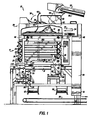
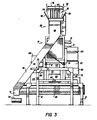
- the automatic degradation analyzer 10 of the present embodiment is shown in front, back and end elevation views and a partial perspective view, respectively.
- the degradation analyzer 10 comprises a base 12 on which is mounted a multi-screen vibratory separator 14 .
- the separator 14 has a supporting frame 11 which is mounted to the base 12 by means of four isolation mounts 16 of conventional construction.
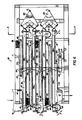
- the separator 14 comprises a plurality of screens 18,20,22,24 arranged one above the other and mounted to the separator frame 11 by resilient straps or springs 26 in a known manner. The details of the construction and operating of the vibratory separator 14 and the screen cleaning means therefor are described hereafter in connection with FIG. 6.
- Each screen has a respective discharge trough arranged transversely across the downstream end of the screens, i.e., the end of the screen from which the overflow is discharged.
- the uppermost two screens 18,20 discharge overflow into respective troughs 19,21 toward the rear of the degradation analyzer (FIG. 2) and the lowermost two screens 22,24 discharge overflow into respective troughs 23,25 toward the front of the degradation analyzer (FIG. 1).
- the underflow from the lowermost screen 24 is discharged from an underflow chute 27 disposed beneath screen 24 .
- Weigh buckets 62,64,66,68 are arranged beneath the discharge troughs 19,21,23,25 , respectively, for receiving the overflow from each of the screens 18,20,22,24 and weigh bucket 70 is disposed beneath the underflow chute 27 for receiving the underflow (tobacco fines) from the lowermost screen 24 .
- Each weigh bucket 62-70 is supported on a respective electronic weigh scale 72,74,76,78,80 , the outputs of which are transmitted to the microprocessor.
- Each weigh bucket 62-70 is provided with a pivotable door 82,84,86,88,90 at the lower end thereof which is actuable to open or close under control of the microprocessor by means of a pneumatically or electrically operated linkage 92,94,96,98,100 .
- the pivotable doors of all the buckets 62-70 are arranged to dump the tobacco in the buckets onto a pair of transverse take-away conveyors 97,99 which discharge the tobacco onto conveyor 50 for return to the tobacco processing line.
- the weigh buckets 62-70 have a wedge-like shape with a gradually increasing rectangular cross section from the lowermost end to the top thereof.
- the pivotable door is arranged on the forward vertical wall of the bucket so that when the door is pivoted open, the flow of tobacco out of the bucket is along the inclined interior surface of the bucket. That construction of the weigh buckets and doors advantageously minimizes the possibility of "bridging" of the tobacco within the bucket. "Bridging” is an undesirable phenomenon in which a particulate material becomes sufficiently compacted or interconnected to form a "bridge” of material which resists outflow from a container.
- inlet extensions 102,104,106,108,110 are provided for a respective weigh bucket 62-70 .
- outlet extensions are provided where necessary to insure that the tobacco discharged from each bucket is directed onto one of the transverse conveyors 97,99 transporting the dumped tobacco fractions to the return conveyor 50 .
- Weigh buckets 64 and 68 are thus provided with inclined discharge chutes 112,114 respectively, which extend over the upper reach of conveyor 97 .
- Weigh bucket 66 is provided with a vertical discharge chute 116 which extends over the upper reach of conveyor 99 .
- Weigh bucket 62 may also be provided with a similar vertical discharge chute if desired.
- a weigh conveyor 28 is mounted to the separator frame 11 superposed over the uppermost screen 18 of the separator 14 .
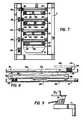
- the weigh conveyor 28 is supported on the frame by means of four conventional force measuring cells 30 (FIG. 9) of a type manufactured by Toledo Scale, Masstron Scale Division of Colombus, Ohio and designated 650 59-250.
- the four weights are summed in "summing box" designated 20034-4 (also manufactured by Toledo Scale) to obtain total weight.
- the weigh conveyor 28 comprises an endless conveyor belt 32 which is driven by a reversible motor (not shown) under control of the microprocessor so that the upper reach of the conveyor belt 32 is movable to convey in both horizontal directions as shown by the arrows 34,35 .
- a conventional conveyor adjustment mechanism 33 is mounted to the conveyor roll at one end of the conveyor belt 32 for adjusting the tension of the belt.
- a leveler means 36 is rotatably mounted in bearing blocks 38 on the sidewalls 40,42 of the conveyor 28 for rotation by motor means (not shown).
- the leveler means 36 comprises a plurality of rods 43 bent as shown in FIG. 1 and mounted to a shaft 44 in a plurality of bores spaced 90° from one another about the shaft.
- the shaft 44 between the bearing blocks 38 has a rectangular cross-section and the rods 43 are mounted in longitudinally spaced planes from one end of the shaft to the other, with a pair of rods spaced 180° apart mounted in each plane, the rods of one pair being arranged 90° from the rods of a next adjacent rod pair.
- the shaft 44 is rotated counterclockwise as seen in FIG.
- the height of the leveler 36 is adjustable up and down to deliver the sample S according to a predetermined feed rate for tobacco of different densities, sizes or the like. For example, a more dense tobacco is leveled at a lower height to accommodate the same feed rate as compared to a less dense tobacco. Feed rates varying from about 5 to about 10 minutes for an approximately six pound sample are presently preferred.
- Chute 46 discharges the tobacco sample S to the vibratory separator 14 for a degradation analysis of the sample and chute 48 discharges the tobacco sample S to a return conveyor 50 via an inclined chute portion 49 and outlet 51 .
- an inclined conveyor 52 Suspended above the weigh conveyor 28 is an inclined conveyor 52 with an outlet chute 54 .
- the upstream end of conveyor 52 (not shown) is arranged in the tobacco processing line in a known manner to divert the tobacco from the processing line to the conveyor belt 56 which is driven by a reversible motor (not shown) so as to convey tobacco from the processing line to the outlet chute 54 or to return tobacco on the upper reach of the conveyor belt 56 to the tobacco processing line.
- the direction of movement of the conveyor is belt 56 is controlled by the microprocessor.
- a pair of deflector plates 58,60 are mounted on the upper ends of the conveyor sidewalls 40,42 to prevent spillage of the tobacco as it is discharged from the outlet chute 54 of conveyor 52 .
- each screen 18-24 is resiliently mounted to the frame 11 by means of four flat straps or springs 26 (only two shown for each screen).
- the springs 26 are longitudinally and transversely stiff but are flexible in both directions normal to the flat faces of the spring as illustrated by the arrows A in FIG. 6.
- the screens are vibrated by means of rocker arms 120,122 which are each oscillated about pivot points B and C by a respective shaker motor (not shown) in a well known manner. Oscillation of the rocker arms 120,122 drives the screens in a vibratory motion which causes the tobacco to be sampled to pass from left to right over screens 18 and 22 and from right to left over screens 20 and 24 as viewed in FIG. 6.
- Each screen comprises an impervious portion 18a,20a,22a,24a and a mesh portion 18b,20b,22b,24b the latter having a predetermined mesh number.
- the screens are provided in a descending size order from top-to-bottom; sizes are chosen by the user according to the user's requirements and according to the material to be analyzed, e.g., tobacco, strip, cut filler, scrap, etc.
- screen portion 18b is 1-inch mesh
- screen portion 20b is 2 mesh
- screen 22b is 4 mesh
- screen portion 24b is 8 mesh.
- the screens are ASTM-E-11-70 type screens of sieve designations and wire diameters as follows: 1.0 inch and 0.1496 inch; 0.50 inch and 0.1051 inch; 0.250 inch and 0.0717 inch; Number 8 mesh and 0.0394 inch.
- the impervious portions 18a-24a of the screens are provided so that the underflow from a given screen will pass over substantially the entire screening area of the screen disposed below such given screen.
- the fifth fraction or tobacco fines is advantageously separated in the central portion of the screening apparatus so that carry-over of fines with other fractions is also minimized.
- a plurality of rods or tines 45 are arranged in spaced relation in a horizontal plane and other rods or tines 47 in a vertical plane at the lower end of the chute 46 superposed over the impervious portion 18a of screen 18 .
- the tines 45 and 47 advantageously help to more evenly distribute the tobacco sample over the entire transverse area of the impervious portion of the screen 18 .
- a first fraction of the tobacco sample having a particle size larger than the mesh of screen 18b will pass as overflow from the inlet chute 46 over impervious and mesh portions 18a and 18b and into discharge trough 19 .
- the underflow from mesh portion 18b falls to screen 20 where a second fraction of the tobacco sample having a particle size larger than the mesh screen 20b will pass as overflow over impervious and mesh portions 20a and 20b and into discharge trough 21 .
- the underflow from mesh portion 20b falls to screen 22 where a third fraction of the tobacco sample having a particle size larger than the mesh screen 22b will pass as overflow over impervious and mesh portions 22a and 22b and into discharge trough 23 .
- the same result occurs with respect to the fourth fraction and screen 24 .
- the underflow from mesh portion 24b of the lowermost screen 24 falls as the fifth fraction (tobacco fines) into an impervious collector pan 124 from which it is carried to discharge chute 27 .
- a plurality of brush means 126,128,130,132 are provided for cleaning the upper and lower screening surfaces of each mesh portion 18b-24b , except for the lower surface of mesh portion 24b as will be described hereafter.
- Each brush means 126-132 preferably comprises a set of eight rows of elongated brush elements (FIG. 7), however, a greater or lesser number of brush elements may be used for each brush means. In FIG. 6, the brush means 126-132 are shown in a position for screening of the sample.
- each brush means 126-132 are connected at their opposite ends to a pair (only one shown) of endless chains 134,136,138,140 each of which is trained about a pair of spaced sprockets 142,144,146,148 . Movement of the chains 138,140 , the brush means can readily pass about the small diameter sprockets 146,148 at the ends of the runs of the chains.
- FIG. 7 illustrates a cross-section of the vibratory separator 28 along the line 7-7 with the brush means 126-132 shown in the cleaning position with the free ends of the brushing elements bearing against a respective mesh portion 18b-24b of the screens 18-24 .
- the brush means 128 and 132 are located on the lower run of their respective endless chains 136 and 140 at the remote ends thereof as viewed in FIG. 7, i.e., adjacent the discharge troughs 21 and 25 , respectively.
- the analyzer 10 is controlled by a microprocessor located in a control console 200 (FIGS. 4 and 5) from which an operator controls the initiation of the selected sampling mode and makes any desired or appropriate changes in the system parameters such as sample weight setpoints, weigh bucket and weigh conveyor tare and the like.
- a control console 200 FIGS. 4 and 5
- the construction of the control console, the microprocessor and the computer program for controlling the operation of the degradation analyzer are not set forth in detail herein and is considered to be within the capabilities of those skilled in the art of utilizing computers to control the operation of complex equipment.
- tare is set on the weight readouts 202,204,206,208,210 for each of the empty weigh bucket weight scales 72-80 . Tare is also set for the weigh conveyor 32 on its weight readout 212 on the control console. When all weight scales are set at tare or zero the operator initiates a sampling cycle, for example, in the discrete SINGLE mode. It will be understood that each of the below described movements or functions of the apparatus is the result of a signal or signals transmitted by the microprocessor in accordance with a predetermined program.
- the inclined conveyor 52 Upon initiation of the sampling cycle in the "discrete" mode, the inclined conveyor 52 diverts tobacco flow from a remotely located tobacco processing line (not shown) and conveys the tobacco up conveyor belt 56 where it is discharged via outlet chute 54 onto the conveyor belt 32 of weigh conveyor 28 .
- the conveyor belt 56 is reversed so that no more tobacco is supplied to the weigh conveyor.
- the conveyor 56 reverses and the conveyor 32 is energized so as to convey the overweight sample S of tobacco in the direction 35 and discharge it via chute 48 , inclined chute portion 49 and outlet 51 onto conveyor 50 for return to the tobacco processing line.
- the conveyor belt 32 stops after a timed period and a new sampling cycle begins.
- the weight of the sample is recorded in memory and the pivotable doors 82-90 of the weigh buckets 62-70 are closed.
- the vibratory shaker motors are energized to vibrate the screens 18-24 and the conveyor belt 32 moves the sample S in the forward direction, i.e., in the direction shown by the arrow 34 .
- the leveler means 36 is operated counterclockwise as viewed in FIG. 1 to level the upper surface of the tobacco sample at about a six-inch height above the conveyor 32 .
- the shaker motors and the conveyor 32 run for a predetermined time period sufficient to permit the tobacco sample to be delivered from the conveyor 32 to the vibratory screening apparatus 28 and separated into the five sizes or fractions of tobacco as previously described.
- the screen cleaning process is initiated by starting the cleaning motor 160 .
- the brush means 126-132 pass over and under the screens 18-24 to brush any residual tobacco parts from the screens into the troughs 19-25 aided by the vibratory action of the shaker motors.
- the cleaning cycle continues for a predetermined time which may be increased or decreased depending on the effectiveness and desired thoroughness of the cleaning.
- the weights of the five weigh buckets 62-70 are taken and the weights of the five sizes or fractions are recorded in memory. After all the weights are recorded in memory, the transverse take-away conveyors 97,99 are started and the pivotable doors 82-90 of all the weigh buckets 62-70 are opened, for example, by pneumatic operation of the door linkages 92-100 , to dump the five tobacco fractions onto the conveyors 97,99 which convey and discharge the fractions on the conveyor 50 for return to the tobacco processing line. After the weigh buckets are dumped, cleaning air may be supplied for a timed period to the interior of each weigh bucket to insure that all residual tobacco parts are discharged from the buckets.
- the microprocessor calculates the sum of the weights of the tobacco fraction in the weigh buckets and the ratio as a percentage of the weight of each tobacco fraction to the total (summed) weight of the tobacco sample.
- the microprocessor then commands a printout of the calculated data with an identifying sample number, the time, date and the mode of operation, i.e., "discrete". If the sampling procedure was initiated in the SINGLE mode a new cycle will have to be initiated by the operator, but if in the AUTO mode, a periodic sampling in the "discrete" mode will be taken.
- the sampling is performed on a more-or-less continuously supplied sample of tobacco.
- the “non-discrete” mode will be described only to the extent it differs from the “discrete” mode.
- the inclined conveyor 52 diverts tobacco flow from the remotely located tobacco processing line and conveys tobacco up conveyor belt 56 where it is discharged via outlet chute 54 onto the conveyor belt 32 .
- the conveyor belt 56 reverses, the conveyor belt 32 is started in the forward direction indicated by the arrow 34 and the shaker motors are started. If the upper setpoint is exceeded, the tobacco on the belt 32 is discharged and conveyed back to the processing line as in the "discrete” mode.
- the sample is supplied to the vibratory screening apparatus via chute 46 .
- the weight of the tobacco on the conveyor 32 is continuously monitored to ensure that a minimum weight of tobacco, e.g., two pounds, is on the belt at all times. If the weight becomes light, the conveyor 56 is operated to add tobacco to the belt 32 until the minimum weight is maintained.
- This procedure provides a substantially continuous flowthrough of tobacco in the vibratory screening apparatus 14 with the weigh buckets open. Then with the shaker motors and conveyor belt 32 operating, the bucket doors are closed as in the "discrete" mode. The weight of the weigh bucket 62 for the top or largest size fraction is monitored during the period after the bucket doors are closed.
Landscapes
- Manufacture Of Tobacco Products (AREA)
- Manufacturing Of Cigar And Cigarette Tobacco (AREA)
Applications Claiming Priority (2)
| Application Number | Priority Date | Filing Date | Title |
|---|---|---|---|
| US395876 | 1989-08-18 | ||
| US07/395,876 US4991598A (en) | 1989-08-18 | 1989-08-18 | Method of and apparatus for automatically analyzing the degradation of processed leaf tobacco |
Publications (2)
| Publication Number | Publication Date |
|---|---|
| EP0413577A2 true EP0413577A2 (fr) | 1991-02-20 |
| EP0413577A3 EP0413577A3 (fr) | 1992-12-30 |
Family
ID=23564917
Family Applications (1)
| Application Number | Title | Priority Date | Filing Date |
|---|---|---|---|
| EP19900308988 Withdrawn EP0413577A3 (fr) | 1989-08-18 | 1990-08-16 | Procédé et appareil pour l'analyse automatique de la dégradation de feuilles de tabac traitées |
Country Status (6)
| Country | Link |
|---|---|
| US (1) | US4991598A (fr) |
| EP (1) | EP0413577A3 (fr) |
| JP (1) | JPH0385451A (fr) |
| KR (1) | KR910004125A (fr) |
| BR (1) | BR9004033A (fr) |
| CA (1) | CA2022483C (fr) |
Cited By (1)
| Publication number | Priority date | Publication date | Assignee | Title |
|---|---|---|---|---|
| CN105823536A (zh) * | 2016-04-15 | 2016-08-03 | 河南中烟工业有限责任公司 | 标识物法测定卷烟搭口胶施胶量的方法 |
Families Citing this family (13)
| Publication number | Priority date | Publication date | Assignee | Title |
|---|---|---|---|---|
| DE3943085A1 (de) * | 1989-12-27 | 1991-07-04 | Hauni Werke Koerber & Co Kg | Verfahren und vorrichtung zum herstellen eines homogen durchmischten stromes aus tabakteilen |
| DE4127270C2 (de) * | 1990-09-01 | 2000-12-14 | Hauni Werke Koerber & Co Kg | Vorrichtung zum Klassifizieren von Tabakteilchen |
| US6058940A (en) * | 1997-04-21 | 2000-05-09 | Lane; Kerry Scott | Method and system for assay and removal of harmful toxins during processing of tobacco products |
| US6637438B1 (en) * | 1997-04-21 | 2003-10-28 | Kerry Scott Lane | Method for assay and removal of harmful toxins during processing of tobacco products |
| JP2003516723A (ja) * | 1999-10-18 | 2003-05-20 | ケリー・スコット・レーン | タバコ製品を加工する間に有害トキシンをアッセイ及び除去する方法及びシステム |
| JP3793455B2 (ja) * | 2001-12-19 | 2006-07-05 | 株式会社堀場製作所 | 乾式粒径分布測定装置の試料供給装置 |
| CA2499853C (fr) * | 2004-03-15 | 2012-11-13 | Universal Leaf Tobacco Company, Inc. | Appareil et methode de balayage et de tri de feuilles de tabac |
| US8281931B2 (en) * | 2009-09-18 | 2012-10-09 | Key Technology, Inc. | Apparatus and method for post-threshing inspection and sorting of tobacco lamina |
| CN105341984B (zh) * | 2015-11-25 | 2017-12-19 | 龙岩烟草工业有限责任公司 | 卷烟制丝柔性加工系统和方法 |
| CN109406729B (zh) * | 2018-12-05 | 2021-03-16 | 云南中烟工业有限责任公司 | 一种混合库基因编辑t1代烟株筛选方法 |
| CN110538789B (zh) * | 2019-09-02 | 2021-08-24 | 马鞍山市新桥工业设计有限公司 | 一种矿石筛选装置及其使用方法 |
| CN112284850B (zh) * | 2020-10-22 | 2021-05-18 | 四川大学华西医院 | 一种消化内科活体取样后的智能分析前端处理设备 |
| CN114223936A (zh) * | 2022-02-21 | 2022-03-25 | 智思控股集团有限公司 | 物料柔性计量单元及多仓单管计量柔性喂料系统和方法 |
Family Cites Families (18)
| Publication number | Priority date | Publication date | Assignee | Title |
|---|---|---|---|---|
| US1536363A (en) * | 1923-09-06 | 1925-05-05 | Charles W Ware | Screen or riddle cleaner |
| US1668984A (en) * | 1924-10-03 | 1928-05-08 | Simpson Lowe | Counterbalancing means for vibrating devices |
| US1791291A (en) * | 1927-06-17 | 1931-02-03 | Lowe E Simpson | Sifting and sorting machine |
| US2090252A (en) * | 1930-06-18 | 1937-08-17 | Paula Damm | Automatic tobacco weigher |
| US1981081A (en) * | 1931-06-22 | 1934-11-20 | Lowe E Simpson | Sifting apparatus |
| US2047713A (en) * | 1934-01-29 | 1936-07-14 | Lowe E Simpson | Conduit connecter for agitating devices |
| US2149368A (en) * | 1935-11-12 | 1939-03-07 | Lowe E Simpson | Sifter |
| US2114406A (en) * | 1936-05-12 | 1938-04-19 | Lowe E Simpson | Sieve frame |
| US2782926A (en) * | 1951-02-26 | 1957-02-26 | Conveyor Company Inc | Apparatus for measuring fineness modulus |
| US2755931A (en) * | 1952-05-16 | 1956-07-24 | Huntley Mfg Company | Grain screen cleaner |
| DE1632152A1 (de) * | 1967-01-24 | 1971-01-14 | Hauni Werke Koerber & Co Kg | Verfahren und Vorrichtung zum Steuern der Entrippung von Tabakblaettern |
| US3545281A (en) * | 1968-12-12 | 1970-12-08 | Cargill Inc | Method and apparatus for analyzing a particulate material |
| US4487323A (en) * | 1983-05-09 | 1984-12-11 | Weyerhaeuser Company | Automatic particle-size analyzer |
| IT8321934U1 (it) * | 1983-05-20 | 1984-11-20 | Barbieri Adriano | Macchina selezionatrice di prodotti granulari in genere |
| JPS6027373A (ja) * | 1983-07-27 | 1985-02-12 | 日本たばこ産業株式会社 | たばこの原料処理工程における中骨混入率の制御装置 |
| EP0157977A3 (fr) * | 1983-08-30 | 1986-02-05 | Amf Incorporated | Appareil pour l'évaluation de matériel en particules |
| US4719928A (en) * | 1985-04-15 | 1988-01-19 | R. J. Reynolds Tobacco Company | Method and apparatus for determining stem content of baled tobacco |
| FR2605252B1 (fr) * | 1986-08-29 | 1994-11-25 | Agro Systemes Sa | Methode et appareil de triage, de calibrage avec mesure automatique du taux d'impuretes dans les grains |
-
1989
- 1989-08-18 US US07/395,876 patent/US4991598A/en not_active Expired - Fee Related
-
1990
- 1990-08-01 CA CA002022483A patent/CA2022483C/fr not_active Expired - Fee Related
- 1990-08-03 JP JP2205313A patent/JPH0385451A/ja active Pending
- 1990-08-15 BR BR909004033A patent/BR9004033A/pt not_active IP Right Cessation
- 1990-08-16 EP EP19900308988 patent/EP0413577A3/fr not_active Withdrawn
- 1990-08-17 KR KR1019900012767A patent/KR910004125A/ko not_active Ceased
Cited By (2)
| Publication number | Priority date | Publication date | Assignee | Title |
|---|---|---|---|---|
| CN105823536A (zh) * | 2016-04-15 | 2016-08-03 | 河南中烟工业有限责任公司 | 标识物法测定卷烟搭口胶施胶量的方法 |
| CN105823536B (zh) * | 2016-04-15 | 2018-06-26 | 河南中烟工业有限责任公司 | 标识物法测定卷烟搭口胶施胶量的方法 |
Also Published As
| Publication number | Publication date |
|---|---|
| KR910004125A (ko) | 1991-03-28 |
| JPH0385451A (ja) | 1991-04-10 |
| EP0413577A3 (fr) | 1992-12-30 |
| CA2022483A1 (fr) | 1991-02-19 |
| CA2022483C (fr) | 1994-10-04 |
| BR9004033A (pt) | 1991-09-03 |
| US4991598A (en) | 1991-02-12 |
Similar Documents
| Publication | Publication Date | Title |
|---|---|---|
| US4991598A (en) | Method of and apparatus for automatically analyzing the degradation of processed leaf tobacco | |
| JP2774873B2 (ja) | 積み重ねたふるいを用いる自動粒子サイズ・アナライザ | |
| US3439800A (en) | Aggregate size testing apparatus and process | |
| US3545281A (en) | Method and apparatus for analyzing a particulate material | |
| CN112638182A (zh) | 粒状物的进给系统及其进给方法 | |
| JPH01503551A (ja) | 材料を空気形成システムに計量しながら供給するための方法及び装置 | |
| AU7242191A (en) | Soil separating apparatus and method | |
| JP3024959B2 (ja) | パン粉コーティング装置 | |
| EP0143346B1 (fr) | Dispositif pour mesurer des corps longs | |
| US2228977A (en) | Separator | |
| EP0157977A2 (fr) | Appareil pour l'évaluation de matériel en particules | |
| US5191904A (en) | Trash removal apparatus and method | |
| CN210655055U (zh) | 一种分选机的上料装置 | |
| US20050055736A1 (en) | Method and Apparatus for Separating Oil Seeds | |
| US1952336A (en) | Tobacco feeding apparatus | |
| US3246756A (en) | Method and apparatus for uniformly diffusing mineral suspension fluid | |
| US3056485A (en) | Conveyor for article packing machine | |
| JPS6259995B2 (fr) | ||
| CN113171971A (zh) | 一种长短棒料筛选分装系统 | |
| JP3405798B2 (ja) | 籾摺り工程の歩合検出方法並びに歩合制御装置 | |
| US3469688A (en) | Grain scalper | |
| Harmond et al. | Seed cleaning and handling | |
| DE3015490A1 (de) | Der einlassoeffnung eines brechers fuer metallische spaene vorgeordnete sortierstrecke | |
| DE2462623B2 (de) | Vorrichtung zur Trennung spezifisch unterschiedlich schwerer Teilchen in einem Schüttgut | |
| JPH091076A (ja) | ふるい網破れ検知方法およびその装置 |
Legal Events
| Date | Code | Title | Description |
|---|---|---|---|
| PUAI | Public reference made under article 153(3) epc to a published international application that has entered the european phase |
Free format text: ORIGINAL CODE: 0009012 |
|
| AK | Designated contracting states |
Kind code of ref document: A2 Designated state(s): DE GB IT |
|
| RIN1 | Information on inventor provided before grant (corrected) |
Inventor name: COLEMAN, DAVID B. Inventor name: FOOTE, ROGER A. Inventor name: WARREN, HENRY H., JR. Inventor name: MCHONE, RANDALL D. Inventor name: HENDERSON, RICHARD M. |
|
| PUAL | Search report despatched |
Free format text: ORIGINAL CODE: 0009013 |
|
| AK | Designated contracting states |
Kind code of ref document: A3 Designated state(s): DE GB IT |
|
| 17P | Request for examination filed |
Effective date: 19930614 |
|
| 17Q | First examination report despatched |
Effective date: 19941228 |
|
| STAA | Information on the status of an ep patent application or granted ep patent |
Free format text: STATUS: THE APPLICATION IS DEEMED TO BE WITHDRAWN |
|
| 18D | Application deemed to be withdrawn |
Effective date: 19950708 |