EP0414058A2 - Carbonsäurederivate - Google Patents
Carbonsäurederivate Download PDFInfo
- Publication number
- EP0414058A2 EP0414058A2 EP90115343A EP90115343A EP0414058A2 EP 0414058 A2 EP0414058 A2 EP 0414058A2 EP 90115343 A EP90115343 A EP 90115343A EP 90115343 A EP90115343 A EP 90115343A EP 0414058 A2 EP0414058 A2 EP 0414058A2
- Authority
- EP
- European Patent Office
- Prior art keywords
- group
- carry
- alkyl
- halogen atoms
- phenyl
- Prior art date
- Legal status (The legal status is an assumption and is not a legal conclusion. Google has not performed a legal analysis and makes no representation as to the accuracy of the status listed.)
- Granted
Links
- 150000001732 carboxylic acid derivatives Chemical class 0.000 title claims abstract description 10
- 150000003254 radicals Chemical class 0.000 claims abstract description 29
- 125000004178 (C1-C4) alkyl group Chemical group 0.000 claims abstract description 17
- 125000001997 phenyl group Chemical group [H]C1=C([H])C([H])=C(*)C([H])=C1[H] 0.000 claims abstract description 16
- 238000000034 method Methods 0.000 claims abstract description 15
- 239000000203 mixture Substances 0.000 claims abstract description 15
- 125000000229 (C1-C4)alkoxy group Chemical group 0.000 claims abstract description 14
- IJGRMHOSHXDMSA-UHFFFAOYSA-N Atomic nitrogen Chemical compound N#N IJGRMHOSHXDMSA-UHFFFAOYSA-N 0.000 claims abstract description 14
- UFHFLCQGNIYNRP-UHFFFAOYSA-N Hydrogen Chemical compound [H][H] UFHFLCQGNIYNRP-UHFFFAOYSA-N 0.000 claims abstract description 13
- 239000001257 hydrogen Substances 0.000 claims abstract description 12
- 229910052739 hydrogen Inorganic materials 0.000 claims abstract description 12
- 238000002360 preparation method Methods 0.000 claims abstract description 9
- 230000008569 process Effects 0.000 claims abstract description 9
- 125000006552 (C3-C8) cycloalkyl group Chemical group 0.000 claims abstract description 8
- 125000001434 methanylylidene group Chemical group [H]C#[*] 0.000 claims abstract description 8
- 229910052757 nitrogen Inorganic materials 0.000 claims abstract description 8
- 229910052760 oxygen Inorganic materials 0.000 claims abstract description 6
- 239000001301 oxygen Substances 0.000 claims abstract description 6
- 229910052717 sulfur Inorganic materials 0.000 claims abstract description 6
- 229910052736 halogen Inorganic materials 0.000 claims abstract description 5
- 150000002367 halogens Chemical class 0.000 claims abstract description 5
- 125000001424 substituent group Chemical group 0.000 claims abstract description 5
- QVGXLLKOCUKJST-UHFFFAOYSA-N atomic oxygen Chemical compound [O] QVGXLLKOCUKJST-UHFFFAOYSA-N 0.000 claims abstract description 4
- 125000004093 cyano group Chemical group *C#N 0.000 claims abstract description 4
- 125000002485 formyl group Chemical group [H]C(*)=O 0.000 claims abstract description 4
- 125000002887 hydroxy group Chemical group [H]O* 0.000 claims abstract description 4
- 125000000449 nitro group Chemical class [O-][N+](*)=O 0.000 claims abstract description 4
- 125000002924 primary amino group Chemical group [H]N([H])* 0.000 claims abstract description 4
- 125000004767 (C1-C4) haloalkoxy group Chemical group 0.000 claims abstract description 3
- 125000004765 (C1-C4) haloalkyl group Chemical group 0.000 claims abstract description 3
- NINIDFKCEFEMDL-UHFFFAOYSA-N Sulfur Chemical compound [S] NINIDFKCEFEMDL-UHFFFAOYSA-N 0.000 claims abstract description 3
- 239000011593 sulfur Substances 0.000 claims abstract description 3
- 125000001072 heteroaryl group Chemical group 0.000 claims abstract 2
- -1 heteroaryl radical Chemical class 0.000 claims description 101
- 150000001875 compounds Chemical class 0.000 claims description 33
- 125000005843 halogen group Chemical group 0.000 claims description 29
- 150000003839 salts Chemical class 0.000 claims description 10
- 230000002363 herbicidal effect Effects 0.000 claims description 8
- 125000003282 alkyl amino group Chemical group 0.000 claims description 7
- 125000004414 alkyl thio group Chemical group 0.000 claims description 7
- 239000003795 chemical substances by application Substances 0.000 claims description 6
- 230000008635 plant growth Effects 0.000 claims description 6
- CIUQDSCDWFSTQR-UHFFFAOYSA-N [C]1=CC=CC=C1 Chemical compound [C]1=CC=CC=C1 CIUQDSCDWFSTQR-UHFFFAOYSA-N 0.000 claims description 4
- 239000004009 herbicide Substances 0.000 claims description 4
- 150000001298 alcohols Chemical class 0.000 claims description 3
- 125000003806 alkyl carbonyl amino group Chemical group 0.000 claims description 3
- 125000002490 anilino group Chemical group [H]N(*)C1=C([H])C([H])=C([H])C([H])=C1[H] 0.000 claims description 3
- 150000001735 carboxylic acids Chemical class 0.000 claims description 3
- 125000004122 cyclic group Chemical group 0.000 claims description 3
- 150000004820 halides Chemical class 0.000 claims description 3
- 125000004433 nitrogen atom Chemical group N* 0.000 claims description 3
- 125000004076 pyridyl group Chemical group 0.000 claims description 3
- 125000004434 sulfur atom Chemical group 0.000 claims description 3
- 125000004169 (C1-C6) alkyl group Chemical group 0.000 claims description 2
- 125000004209 (C1-C8) alkyl group Chemical group 0.000 claims description 2
- MYMOFIZGZYHOMD-UHFFFAOYSA-N Dioxygen Chemical compound O=O MYMOFIZGZYHOMD-UHFFFAOYSA-N 0.000 claims description 2
- 230000001105 regulatory effect Effects 0.000 claims 3
- 239000000654 additive Substances 0.000 claims 2
- WPYMKLBDIGXBTP-UHFFFAOYSA-N benzoic acid Chemical class OC(=O)C1=CC=CC=C1 WPYMKLBDIGXBTP-UHFFFAOYSA-N 0.000 claims 2
- 230000001276 controlling effect Effects 0.000 claims 1
- 125000003342 alkenyl group Chemical group 0.000 abstract description 4
- 125000003971 isoxazolinyl group Chemical group 0.000 abstract description 2
- 241000196324 Embryophyta Species 0.000 description 30
- 239000004480 active ingredient Substances 0.000 description 23
- XLYOFNOQVPJJNP-UHFFFAOYSA-N water Substances O XLYOFNOQVPJJNP-UHFFFAOYSA-N 0.000 description 19
- 239000006185 dispersion Substances 0.000 description 13
- 230000012010 growth Effects 0.000 description 12
- 239000000243 solution Substances 0.000 description 12
- ZAMOUSCENKQFHK-UHFFFAOYSA-N Chlorine atom Chemical compound [Cl] ZAMOUSCENKQFHK-UHFFFAOYSA-N 0.000 description 11
- PXGOKWXKJXAPGV-UHFFFAOYSA-N Fluorine Chemical compound FF PXGOKWXKJXAPGV-UHFFFAOYSA-N 0.000 description 11
- 125000000217 alkyl group Chemical group 0.000 description 11
- 239000000460 chlorine Substances 0.000 description 11
- 229910052801 chlorine Inorganic materials 0.000 description 11
- 229910052731 fluorine Inorganic materials 0.000 description 11
- 239000011737 fluorine Substances 0.000 description 11
- 239000003630 growth substance Substances 0.000 description 11
- VYPSYNLAJGMNEJ-UHFFFAOYSA-N Silicium dioxide Chemical compound O=[Si]=O VYPSYNLAJGMNEJ-UHFFFAOYSA-N 0.000 description 10
- 239000003921 oil Substances 0.000 description 10
- 235000019198 oils Nutrition 0.000 description 10
- IAYPIBMASNFSPL-UHFFFAOYSA-N Ethylene oxide Chemical compound C1CO1 IAYPIBMASNFSPL-UHFFFAOYSA-N 0.000 description 9
- IAZDPXIOMUYVGZ-UHFFFAOYSA-N Dimethylsulphoxide Chemical compound CS(C)=O IAZDPXIOMUYVGZ-UHFFFAOYSA-N 0.000 description 8
- JHIVVAPYMSGYDF-UHFFFAOYSA-N cyclohexanone Chemical compound O=C1CCCCC1 JHIVVAPYMSGYDF-UHFFFAOYSA-N 0.000 description 8
- 244000038559 crop plants Species 0.000 description 7
- 239000002689 soil Substances 0.000 description 7
- RTZKZFJDLAIYFH-UHFFFAOYSA-N Diethyl ether Chemical compound CCOCC RTZKZFJDLAIYFH-UHFFFAOYSA-N 0.000 description 6
- XEKOWRVHYACXOJ-UHFFFAOYSA-N Ethyl acetate Chemical compound CCOC(C)=O XEKOWRVHYACXOJ-UHFFFAOYSA-N 0.000 description 6
- OKKJLVBELUTLKV-UHFFFAOYSA-N Methanol Chemical compound OC OKKJLVBELUTLKV-UHFFFAOYSA-N 0.000 description 6
- KWYUFKZDYYNOTN-UHFFFAOYSA-M Potassium hydroxide Chemical compound [OH-].[K+] KWYUFKZDYYNOTN-UHFFFAOYSA-M 0.000 description 6
- 239000000741 silica gel Substances 0.000 description 6
- 229910002027 silica gel Inorganic materials 0.000 description 6
- 239000007787 solid Substances 0.000 description 6
- 238000011282 treatment Methods 0.000 description 6
- 239000013543 active substance Substances 0.000 description 5
- 125000003545 alkoxy group Chemical group 0.000 description 5
- 238000011161 development Methods 0.000 description 5
- 230000018109 developmental process Effects 0.000 description 5
- 235000013399 edible fruits Nutrition 0.000 description 5
- 230000002829 reductive effect Effects 0.000 description 5
- WBIQQQGBSDOWNP-UHFFFAOYSA-N 2-dodecylbenzenesulfonic acid Chemical compound CCCCCCCCCCCCC1=CC=CC=C1S(O)(=O)=O WBIQQQGBSDOWNP-UHFFFAOYSA-N 0.000 description 4
- UFWIBTONFRDIAS-UHFFFAOYSA-N Naphthalene Chemical compound C1=CC=CC2=CC=CC=C21 UFWIBTONFRDIAS-UHFFFAOYSA-N 0.000 description 4
- 229910052783 alkali metal Inorganic materials 0.000 description 4
- 229910052784 alkaline earth metal Inorganic materials 0.000 description 4
- 230000015572 biosynthetic process Effects 0.000 description 4
- 239000004359 castor oil Substances 0.000 description 4
- 235000019438 castor oil Nutrition 0.000 description 4
- 235000013339 cereals Nutrition 0.000 description 4
- 238000006243 chemical reaction Methods 0.000 description 4
- 239000000839 emulsion Substances 0.000 description 4
- 125000001495 ethyl group Chemical group [H]C([H])([H])C([H])([H])* 0.000 description 4
- ZEMPKEQAKRGZGQ-XOQCFJPHSA-N glycerol triricinoleate Natural products CCCCCC[C@@H](O)CC=CCCCCCCCC(=O)OC[C@@H](COC(=O)CCCCCCCC=CC[C@@H](O)CCCCCC)OC(=O)CCCCCCCC=CC[C@H](O)CCCCCC ZEMPKEQAKRGZGQ-XOQCFJPHSA-N 0.000 description 4
- 238000003306 harvesting Methods 0.000 description 4
- ZXEKIIBDNHEJCQ-UHFFFAOYSA-N isobutanol Chemical compound CC(C)CO ZXEKIIBDNHEJCQ-UHFFFAOYSA-N 0.000 description 4
- 125000001449 isopropyl group Chemical group [H]C([H])([H])C([H])(*)C([H])([H])[H] 0.000 description 4
- 125000002496 methyl group Chemical group [H]C([H])([H])* 0.000 description 4
- 239000006072 paste Substances 0.000 description 4
- 239000000047 product Substances 0.000 description 4
- 239000011541 reaction mixture Substances 0.000 description 4
- 159000000000 sodium salts Chemical class 0.000 description 4
- 238000012360 testing method Methods 0.000 description 4
- 125000002023 trifluoromethyl group Chemical group FC(F)(F)* 0.000 description 4
- 125000004974 2-butenyl group Chemical group C(C=CC)* 0.000 description 3
- 125000003903 2-propenyl group Chemical group [H]C([*])([H])C([H])=C([H])[H] 0.000 description 3
- 239000005995 Aluminium silicate Substances 0.000 description 3
- WKBOTKDWSSQWDR-UHFFFAOYSA-N Bromine atom Chemical compound [Br] WKBOTKDWSSQWDR-UHFFFAOYSA-N 0.000 description 3
- LFQSCWFLJHTTHZ-UHFFFAOYSA-N Ethanol Chemical compound CCO LFQSCWFLJHTTHZ-UHFFFAOYSA-N 0.000 description 3
- ZMXDDKWLCZADIW-UHFFFAOYSA-N N,N-Dimethylformamide Chemical compound CN(C)C=O ZMXDDKWLCZADIW-UHFFFAOYSA-N 0.000 description 3
- CTQNGGLPUBDAKN-UHFFFAOYSA-N O-Xylene Chemical compound CC1=CC=CC=C1C CTQNGGLPUBDAKN-UHFFFAOYSA-N 0.000 description 3
- YXFVVABEGXRONW-UHFFFAOYSA-N Toluene Chemical compound CC1=CC=CC=C1 YXFVVABEGXRONW-UHFFFAOYSA-N 0.000 description 3
- 150000001340 alkali metals Chemical class 0.000 description 3
- 150000001342 alkaline earth metals Chemical class 0.000 description 3
- 235000012211 aluminium silicate Nutrition 0.000 description 3
- 150000001408 amides Chemical class 0.000 description 3
- 150000003863 ammonium salts Chemical class 0.000 description 3
- 239000002585 base Substances 0.000 description 3
- GDTBXPJZTBHREO-UHFFFAOYSA-N bromine Substances BrBr GDTBXPJZTBHREO-UHFFFAOYSA-N 0.000 description 3
- 229910052794 bromium Inorganic materials 0.000 description 3
- 239000000969 carrier Substances 0.000 description 3
- 239000012141 concentrate Substances 0.000 description 3
- 125000000753 cycloalkyl group Chemical group 0.000 description 3
- 125000000113 cyclohexyl group Chemical group [H]C1([H])C([H])([H])C([H])([H])C([H])(*)C([H])([H])C1([H])[H] 0.000 description 3
- 125000001511 cyclopentyl group Chemical group [H]C1([H])C([H])([H])C([H])([H])C([H])(*)C1([H])[H] 0.000 description 3
- 125000001559 cyclopropyl group Chemical group [H]C1([H])C([H])([H])C1([H])* 0.000 description 3
- 125000001028 difluoromethyl group Chemical group [H]C(F)(F)* 0.000 description 3
- 239000008187 granular material Substances 0.000 description 3
- NLYAJNPCOHFWQQ-UHFFFAOYSA-N kaolin Chemical compound O.O.O=[Al]O[Si](=O)O[Si](=O)O[Al]=O NLYAJNPCOHFWQQ-UHFFFAOYSA-N 0.000 description 3
- 239000002480 mineral oil Substances 0.000 description 3
- 235000010446 mineral oil Nutrition 0.000 description 3
- 239000005648 plant growth regulator Substances 0.000 description 3
- 239000004033 plastic Substances 0.000 description 3
- 229920003023 plastic Polymers 0.000 description 3
- LPNYRYFBWFDTMA-UHFFFAOYSA-N potassium tert-butoxide Chemical compound [K+].CC(C)(C)[O-] LPNYRYFBWFDTMA-UHFFFAOYSA-N 0.000 description 3
- 239000000843 powder Substances 0.000 description 3
- 125000001436 propyl group Chemical group [H]C([*])([H])C([H])([H])C([H])([H])[H] 0.000 description 3
- 239000002904 solvent Substances 0.000 description 3
- 239000000725 suspension Substances 0.000 description 3
- LNETULKMXZVUST-UHFFFAOYSA-N 1-naphthoic acid Chemical compound C1=CC=C2C(C(=O)O)=CC=CC2=C1 LNETULKMXZVUST-UHFFFAOYSA-N 0.000 description 2
- 125000004206 2,2,2-trifluoroethyl group Chemical group [H]C([H])(*)C(F)(F)F 0.000 description 2
- KBLAMUYRMZPYLS-UHFFFAOYSA-N 2,3-bis(2-methylpropyl)naphthalene-1-sulfonic acid Chemical compound C1=CC=C2C(S(O)(=O)=O)=C(CC(C)C)C(CC(C)C)=CC2=C1 KBLAMUYRMZPYLS-UHFFFAOYSA-N 0.000 description 2
- NFAOATPOYUWEHM-UHFFFAOYSA-N 2-(6-methylheptyl)phenol Chemical compound CC(C)CCCCCC1=CC=CC=C1O NFAOATPOYUWEHM-UHFFFAOYSA-N 0.000 description 2
- 125000000069 2-butynyl group Chemical group [H]C([H])([H])C#CC([H])([H])* 0.000 description 2
- 125000001494 2-propynyl group Chemical group [H]C#CC([H])([H])* 0.000 description 2
- 125000006050 3-methyl-2-pentenyl group Chemical group 0.000 description 2
- BVKZGUZCCUSVTD-UHFFFAOYSA-M Bicarbonate Chemical class OC([O-])=O BVKZGUZCCUSVTD-UHFFFAOYSA-M 0.000 description 2
- OYPRJOBELJOOCE-UHFFFAOYSA-N Calcium Chemical compound [Ca] OYPRJOBELJOOCE-UHFFFAOYSA-N 0.000 description 2
- 229920000742 Cotton Polymers 0.000 description 2
- 235000010469 Glycine max Nutrition 0.000 description 2
- 244000299507 Gossypium hirsutum Species 0.000 description 2
- DGAQECJNVWCQMB-PUAWFVPOSA-M Ilexoside XXIX Chemical compound C[C@@H]1CC[C@@]2(CC[C@@]3(C(=CC[C@H]4[C@]3(CC[C@@H]5[C@@]4(CC[C@@H](C5(C)C)OS(=O)(=O)[O-])C)C)[C@@H]2[C@]1(C)O)C)C(=O)O[C@H]6[C@@H]([C@H]([C@@H]([C@H](O6)CO)O)O)O.[Na+] DGAQECJNVWCQMB-PUAWFVPOSA-M 0.000 description 2
- CSNNHWWHGAXBCP-UHFFFAOYSA-L Magnesium sulfate Chemical compound [Mg+2].[O-][S+2]([O-])([O-])[O-] CSNNHWWHGAXBCP-UHFFFAOYSA-L 0.000 description 2
- LRHPLDYGYMQRHN-UHFFFAOYSA-N N-Butanol Chemical compound CCCCO LRHPLDYGYMQRHN-UHFFFAOYSA-N 0.000 description 2
- SECXISVLQFMRJM-UHFFFAOYSA-N N-Methylpyrrolidone Chemical compound CN1CCCC1=O SECXISVLQFMRJM-UHFFFAOYSA-N 0.000 description 2
- ISWSIDIOOBJBQZ-UHFFFAOYSA-N Phenol Chemical compound OC1=CC=CC=C1 ISWSIDIOOBJBQZ-UHFFFAOYSA-N 0.000 description 2
- WQDUMFSSJAZKTM-UHFFFAOYSA-N Sodium methoxide Chemical compound [Na+].[O-]C WQDUMFSSJAZKTM-UHFFFAOYSA-N 0.000 description 2
- LSNNMFCWUKXFEE-UHFFFAOYSA-N Sulfurous acid Chemical compound OS(O)=O LSNNMFCWUKXFEE-UHFFFAOYSA-N 0.000 description 2
- 239000002253 acid Substances 0.000 description 2
- 239000000853 adhesive Substances 0.000 description 2
- 230000001070 adhesive effect Effects 0.000 description 2
- 125000003302 alkenyloxy group Chemical group 0.000 description 2
- 125000000304 alkynyl group Chemical group 0.000 description 2
- 125000003118 aryl group Chemical group 0.000 description 2
- 238000009835 boiling Methods 0.000 description 2
- 239000011575 calcium Substances 0.000 description 2
- 159000000007 calcium salts Chemical class 0.000 description 2
- 235000013877 carbamide Nutrition 0.000 description 2
- 125000004432 carbon atom Chemical group C* 0.000 description 2
- MVPPADPHJFYWMZ-UHFFFAOYSA-N chlorobenzene Chemical compound ClC1=CC=CC=C1 MVPPADPHJFYWMZ-UHFFFAOYSA-N 0.000 description 2
- 238000004587 chromatography analysis Methods 0.000 description 2
- 235000020971 citrus fruits Nutrition 0.000 description 2
- 239000007859 condensation product Substances 0.000 description 2
- 238000005520 cutting process Methods 0.000 description 2
- 230000006378 damage Effects 0.000 description 2
- 239000002270 dispersing agent Substances 0.000 description 2
- 229940060296 dodecylbenzenesulfonic acid Drugs 0.000 description 2
- 230000000694 effects Effects 0.000 description 2
- 239000003995 emulsifying agent Substances 0.000 description 2
- 125000001301 ethoxy group Chemical group [H]C([H])([H])C([H])([H])O* 0.000 description 2
- 150000002191 fatty alcohols Chemical class 0.000 description 2
- 235000013312 flour Nutrition 0.000 description 2
- 238000009472 formulation Methods 0.000 description 2
- 125000004438 haloalkoxy group Chemical group 0.000 description 2
- 125000001188 haloalkyl group Chemical group 0.000 description 2
- 125000000623 heterocyclic group Chemical group 0.000 description 2
- 229910052500 inorganic mineral Inorganic materials 0.000 description 2
- PNDPGZBMCMUPRI-UHFFFAOYSA-N iodine Chemical compound II PNDPGZBMCMUPRI-UHFFFAOYSA-N 0.000 description 2
- HJOVHMDZYOCNQW-UHFFFAOYSA-N isophorone Chemical compound CC1=CC(=O)CC(C)(C)C1 HJOVHMDZYOCNQW-UHFFFAOYSA-N 0.000 description 2
- 125000001786 isothiazolyl group Chemical group 0.000 description 2
- 125000000842 isoxazolyl group Chemical group 0.000 description 2
- 229920005610 lignin Polymers 0.000 description 2
- WSFSSNUMVMOOMR-NJFSPNSNSA-N methanone Chemical compound O=[14CH2] WSFSSNUMVMOOMR-NJFSPNSNSA-N 0.000 description 2
- 125000000956 methoxy group Chemical group [H]C([H])([H])O* 0.000 description 2
- 125000002816 methylsulfanyl group Chemical group [H]C([H])([H])S[*] 0.000 description 2
- 239000011707 mineral Substances 0.000 description 2
- 235000010755 mineral Nutrition 0.000 description 2
- 150000002790 naphthalenes Chemical class 0.000 description 2
- 239000012074 organic phase Substances 0.000 description 2
- 125000001715 oxadiazolyl group Chemical group 0.000 description 2
- 125000002971 oxazolyl group Chemical group 0.000 description 2
- 125000006340 pentafluoro ethyl group Chemical group FC(F)(F)C(F)(F)* 0.000 description 2
- 229920000151 polyglycol Polymers 0.000 description 2
- 239000010695 polyglycol Substances 0.000 description 2
- 125000001844 prenyl group Chemical group [H]C([*])([H])C([H])=C(C([H])([H])[H])C([H])([H])[H] 0.000 description 2
- HEMHJVSKTPXQMS-UHFFFAOYSA-M sodium hydroxide Inorganic materials [OH-].[Na+] HEMHJVSKTPXQMS-UHFFFAOYSA-M 0.000 description 2
- 238000009331 sowing Methods 0.000 description 2
- 241000894007 species Species 0.000 description 2
- 239000000758 substrate Substances 0.000 description 2
- 238000003786 synthesis reaction Methods 0.000 description 2
- 125000001113 thiadiazolyl group Chemical group 0.000 description 2
- 125000000335 thiazolyl group Chemical group 0.000 description 2
- 150000003672 ureas Chemical class 0.000 description 2
- 235000013311 vegetables Nutrition 0.000 description 2
- 230000009105 vegetative growth Effects 0.000 description 2
- 239000002699 waste material Substances 0.000 description 2
- 239000000080 wetting agent Substances 0.000 description 2
- 239000008096 xylene Substances 0.000 description 2
- FIARMZDBEGVMLV-UHFFFAOYSA-N 1,1,2,2,2-pentafluoroethanolate Chemical group [O-]C(F)(F)C(F)(F)F FIARMZDBEGVMLV-UHFFFAOYSA-N 0.000 description 1
- 125000006079 1,1,2-trimethyl-2-propenyl group Chemical group 0.000 description 1
- 125000006059 1,1-dimethyl-2-butenyl group Chemical group 0.000 description 1
- 125000006033 1,1-dimethyl-2-propenyl group Chemical group 0.000 description 1
- 125000006060 1,1-dimethyl-3-butenyl group Chemical group 0.000 description 1
- 125000004893 1,1-dimethylethylamino group Chemical group CC(C)(C)N* 0.000 description 1
- 125000004711 1,1-dimethylethylthio group Chemical group CC(C)(S*)C 0.000 description 1
- 125000006062 1,2-dimethyl-2-butenyl group Chemical group 0.000 description 1
- 125000006035 1,2-dimethyl-2-propenyl group Chemical group 0.000 description 1
- 125000006063 1,2-dimethyl-3-butenyl group Chemical group 0.000 description 1
- 125000006065 1,3-dimethyl-2-butenyl group Chemical group 0.000 description 1
- 125000006066 1,3-dimethyl-3-butenyl group Chemical group 0.000 description 1
- CMCBDXRRFKYBDG-UHFFFAOYSA-N 1-dodecoxydodecane Chemical compound CCCCCCCCCCCCOCCCCCCCCCCCC CMCBDXRRFKYBDG-UHFFFAOYSA-N 0.000 description 1
- 125000006080 1-ethyl-1-methyl-2-propenyl group Chemical group 0.000 description 1
- 125000006074 1-ethyl-2-butenyl group Chemical group 0.000 description 1
- 125000006082 1-ethyl-2-methyl-2-propenyl group Chemical group 0.000 description 1
- 125000006037 1-ethyl-2-propenyl group Chemical group 0.000 description 1
- 125000006075 1-ethyl-3-butenyl group Chemical group 0.000 description 1
- 125000004776 1-fluoroethyl group Chemical group [H]C([H])([H])C([H])(F)* 0.000 description 1
- 125000006028 1-methyl-2-butenyl group Chemical group 0.000 description 1
- 125000006048 1-methyl-2-pentenyl group Chemical group 0.000 description 1
- 125000006021 1-methyl-2-propenyl group Chemical group 0.000 description 1
- 125000006030 1-methyl-3-butenyl group Chemical group 0.000 description 1
- 125000006052 1-methyl-3-pentenyl group Chemical group 0.000 description 1
- 125000006055 1-methyl-4-pentenyl group Chemical group 0.000 description 1
- MXFCDZPQABWNSS-UHFFFAOYSA-N 1-phenoxy-2,3,4,5,6-pentakis-phenylbenzene Chemical compound C=1C=CC=CC=1C=1C(C=2C=CC=CC=2)=C(C=2C=CC=CC=2)C(C=2C=CC=CC=2)=C(C=2C=CC=CC=2)C=1OC1=CC=CC=C1 MXFCDZPQABWNSS-UHFFFAOYSA-N 0.000 description 1
- XUJLWPFSUCHPQL-UHFFFAOYSA-N 11-methyldodecan-1-ol Chemical compound CC(C)CCCCCCCCCCO XUJLWPFSUCHPQL-UHFFFAOYSA-N 0.000 description 1
- 238000005160 1H NMR spectroscopy Methods 0.000 description 1
- 125000000453 2,2,2-trichloroethyl group Chemical group [H]C([H])(*)C(Cl)(Cl)Cl 0.000 description 1
- 125000004781 2,2-dichloro-2-fluoroethyl group Chemical group [H]C([H])(*)C(F)(Cl)Cl 0.000 description 1
- 125000004778 2,2-difluoroethyl group Chemical group [H]C([H])(*)C([H])(F)F 0.000 description 1
- 125000006067 2,2-dimethyl-3-butenyl group Chemical group 0.000 description 1
- 125000006069 2,3-dimethyl-2-butenyl group Chemical group 0.000 description 1
- 125000006070 2,3-dimethyl-3-butenyl group Chemical group 0.000 description 1
- QFUSCYRJMXLNRB-UHFFFAOYSA-N 2,6-dinitroaniline Chemical class NC1=C([N+]([O-])=O)C=CC=C1[N+]([O-])=O QFUSCYRJMXLNRB-UHFFFAOYSA-N 0.000 description 1
- PAWQVTBBRAZDMG-UHFFFAOYSA-N 2-(3-bromo-2-fluorophenyl)acetic acid Chemical compound OC(=O)CC1=CC=CC(Br)=C1F PAWQVTBBRAZDMG-UHFFFAOYSA-N 0.000 description 1
- ZJIBUTNFWLOAPL-UHFFFAOYSA-N 2-(4,6-dimethoxypyrimidin-2-yl)oxynaphthalene-1-carboxylic acid Chemical compound COC1=CC(OC)=NC(OC=2C(=C3C=CC=CC3=CC=2)C(O)=O)=N1 ZJIBUTNFWLOAPL-UHFFFAOYSA-N 0.000 description 1
- 125000004780 2-chloro-2,2-difluoroethyl group Chemical group [H]C([H])(*)C(F)(F)Cl 0.000 description 1
- QQPKTDFQNRQTPO-UHFFFAOYSA-N 2-chloro-n-(3-chloroprop-2-enoxy)ethanimine Chemical compound ClCC=NOCC=CCl QQPKTDFQNRQTPO-UHFFFAOYSA-N 0.000 description 1
- 125000006077 2-ethyl-2-butenyl group Chemical group 0.000 description 1
- 125000006078 2-ethyl-3-butenyl group Chemical group 0.000 description 1
- 125000004777 2-fluoroethyl group Chemical group [H]C([H])(F)C([H])([H])* 0.000 description 1
- 125000006040 2-hexenyl group Chemical group 0.000 description 1
- UPHOPMSGKZNELG-UHFFFAOYSA-N 2-hydroxynaphthalene-1-carboxylic acid Chemical compound C1=CC=C2C(C(=O)O)=C(O)C=CC2=C1 UPHOPMSGKZNELG-UHFFFAOYSA-N 0.000 description 1
- 125000006029 2-methyl-2-butenyl group Chemical group 0.000 description 1
- 125000006049 2-methyl-2-pentenyl group Chemical group 0.000 description 1
- 125000006022 2-methyl-2-propenyl group Chemical group 0.000 description 1
- 125000006031 2-methyl-3-butenyl group Chemical group 0.000 description 1
- 125000006053 2-methyl-3-pentenyl group Chemical group 0.000 description 1
- 125000006056 2-methyl-4-pentenyl group Chemical group 0.000 description 1
- 125000006024 2-pentenyl group Chemical group 0.000 description 1
- REEXLQXWNOSJKO-UHFFFAOYSA-N 2h-1$l^{4},2,3-benzothiadiazine 1-oxide Chemical class C1=CC=C2S(=O)NN=CC2=C1 REEXLQXWNOSJKO-UHFFFAOYSA-N 0.000 description 1
- FOGYNLXERPKEGN-UHFFFAOYSA-N 3-(2-hydroxy-3-methoxyphenyl)-2-[2-methoxy-4-(3-sulfopropyl)phenoxy]propane-1-sulfonic acid Chemical compound COC1=CC=CC(CC(CS(O)(=O)=O)OC=2C(=CC(CCCS(O)(=O)=O)=CC=2)OC)=C1O FOGYNLXERPKEGN-UHFFFAOYSA-N 0.000 description 1
- 125000004975 3-butenyl group Chemical group C(CC=C)* 0.000 description 1
- 125000000474 3-butynyl group Chemical group [H]C#CC([H])([H])C([H])([H])* 0.000 description 1
- 125000006041 3-hexenyl group Chemical group 0.000 description 1
- 125000006032 3-methyl-3-butenyl group Chemical group 0.000 description 1
- 125000006054 3-methyl-3-pentenyl group Chemical group 0.000 description 1
- 125000006057 3-methyl-4-pentenyl group Chemical group 0.000 description 1
- ITDVJJVNAASTRS-UHFFFAOYSA-N 4,6-dimethoxy-2-methylsulfonylpyrimidine Chemical compound COC1=CC(OC)=NC(S(C)(=O)=O)=N1 ITDVJJVNAASTRS-UHFFFAOYSA-N 0.000 description 1
- CSDQQAQKBAQLLE-UHFFFAOYSA-N 4-(4-chlorophenyl)-4,5,6,7-tetrahydrothieno[3,2-c]pyridine Chemical compound C1=CC(Cl)=CC=C1C1C(C=CS2)=C2CCN1 CSDQQAQKBAQLLE-UHFFFAOYSA-N 0.000 description 1
- 125000006042 4-hexenyl group Chemical group 0.000 description 1
- 125000006051 4-methyl-2-pentenyl group Chemical group 0.000 description 1
- 125000003119 4-methyl-3-pentenyl group Chemical group [H]\C(=C(/C([H])([H])[H])C([H])([H])[H])C([H])([H])C([H])([H])* 0.000 description 1
- 125000006058 4-methyl-4-pentenyl group Chemical group 0.000 description 1
- XAZNOOMRYLFDQO-UHFFFAOYSA-N 4h-3,1-benzoxazine Chemical class C1=CC=C2COC=NC2=C1 XAZNOOMRYLFDQO-UHFFFAOYSA-N 0.000 description 1
- XPGUOAQTTSKMGE-UHFFFAOYSA-N 5-(bromomethyl)-3-propan-2-yl-1,2-oxazole Chemical compound CC(C)C=1C=C(CBr)ON=1 XPGUOAQTTSKMGE-UHFFFAOYSA-N 0.000 description 1
- 125000006043 5-hexenyl group Chemical group 0.000 description 1
- 125000006163 5-membered heteroaryl group Chemical group 0.000 description 1
- 240000006995 Abutilon theophrasti Species 0.000 description 1
- QTBSBXVTEAMEQO-UHFFFAOYSA-M Acetate Chemical compound CC([O-])=O QTBSBXVTEAMEQO-UHFFFAOYSA-M 0.000 description 1
- 240000001592 Amaranthus caudatus Species 0.000 description 1
- 235000009328 Amaranthus caudatus Nutrition 0.000 description 1
- 235000013479 Amaranthus retroflexus Nutrition 0.000 description 1
- 244000237956 Amaranthus retroflexus Species 0.000 description 1
- QGZKDVFQNNGYKY-UHFFFAOYSA-O Ammonium Chemical compound [NH4+] QGZKDVFQNNGYKY-UHFFFAOYSA-O 0.000 description 1
- 239000004254 Ammonium phosphate Substances 0.000 description 1
- 235000003130 Arctium lappa Nutrition 0.000 description 1
- 244000294263 Arctium minus Species 0.000 description 1
- 235000008078 Arctium minus Nutrition 0.000 description 1
- 241000894006 Bacteria Species 0.000 description 1
- 241000219310 Beta vulgaris subsp. vulgaris Species 0.000 description 1
- 240000002791 Brassica napus Species 0.000 description 1
- 235000006008 Brassica napus var napus Nutrition 0.000 description 1
- 240000000385 Brassica napus var. napus Species 0.000 description 1
- CPELXLSAUQHCOX-UHFFFAOYSA-M Bromide Chemical compound [Br-] CPELXLSAUQHCOX-UHFFFAOYSA-M 0.000 description 1
- 244000025254 Cannabis sativa Species 0.000 description 1
- 235000012766 Cannabis sativa ssp. sativa var. sativa Nutrition 0.000 description 1
- 235000012765 Cannabis sativa ssp. sativa var. spontanea Nutrition 0.000 description 1
- BVKZGUZCCUSVTD-UHFFFAOYSA-L Carbonate Chemical compound [O-]C([O-])=O BVKZGUZCCUSVTD-UHFFFAOYSA-L 0.000 description 1
- 244000201986 Cassia tora Species 0.000 description 1
- 235000014552 Cassia tora Nutrition 0.000 description 1
- VEXZGXHMUGYJMC-UHFFFAOYSA-M Chloride anion Chemical compound [Cl-] VEXZGXHMUGYJMC-UHFFFAOYSA-M 0.000 description 1
- 235000008733 Citrus aurantifolia Nutrition 0.000 description 1
- RYGMFSIKBFXOCR-UHFFFAOYSA-N Copper Chemical compound [Cu] RYGMFSIKBFXOCR-UHFFFAOYSA-N 0.000 description 1
- FBPFZTCFMRRESA-JGWLITMVSA-N D-glucitol Chemical class OC[C@H](O)[C@@H](O)[C@H](O)[C@H](O)CO FBPFZTCFMRRESA-JGWLITMVSA-N 0.000 description 1
- 241000233866 Fungi Species 0.000 description 1
- 235000014820 Galium aparine Nutrition 0.000 description 1
- 240000005702 Galium aparine Species 0.000 description 1
- 244000068988 Glycine max Species 0.000 description 1
- 241000208818 Helianthus Species 0.000 description 1
- 235000003222 Helianthus annuus Nutrition 0.000 description 1
- 244000043261 Hevea brasiliensis Species 0.000 description 1
- 206010061217 Infestation Diseases 0.000 description 1
- 239000005909 Kieselgur Substances 0.000 description 1
- 235000019738 Limestone Nutrition 0.000 description 1
- FYYHWMGAXLPEAU-UHFFFAOYSA-N Magnesium Chemical compound [Mg] FYYHWMGAXLPEAU-UHFFFAOYSA-N 0.000 description 1
- 208000002720 Malnutrition Diseases 0.000 description 1
- 240000000982 Malva neglecta Species 0.000 description 1
- 208000031888 Mycoses Diseases 0.000 description 1
- 235000002637 Nicotiana tabacum Nutrition 0.000 description 1
- 244000061176 Nicotiana tabacum Species 0.000 description 1
- 241000207836 Olea <angiosperm> Species 0.000 description 1
- 208000002193 Pain Diseases 0.000 description 1
- 239000005662 Paraffin oil Substances 0.000 description 1
- 241000209504 Poaceae Species 0.000 description 1
- 229920003171 Poly (ethylene oxide) Polymers 0.000 description 1
- 239000004721 Polyphenylene oxide Substances 0.000 description 1
- ZLMJMSJWJFRBEC-UHFFFAOYSA-N Potassium Chemical compound [K] ZLMJMSJWJFRBEC-UHFFFAOYSA-N 0.000 description 1
- 240000000111 Saccharum officinarum Species 0.000 description 1
- 235000007201 Saccharum officinarum Nutrition 0.000 description 1
- KEAYESYHFKHZAL-UHFFFAOYSA-N Sodium Chemical compound [Na] KEAYESYHFKHZAL-UHFFFAOYSA-N 0.000 description 1
- 244000061457 Solanum nigrum Species 0.000 description 1
- 235000021536 Sugar beet Nutrition 0.000 description 1
- 235000011941 Tilia x europaea Nutrition 0.000 description 1
- 206010044278 Trace element deficiency Diseases 0.000 description 1
- 229920001807 Urea-formaldehyde Polymers 0.000 description 1
- 241000607479 Yersinia pestis Species 0.000 description 1
- 240000008042 Zea mays Species 0.000 description 1
- 235000005824 Zea mays ssp. parviglumis Nutrition 0.000 description 1
- 235000002017 Zea mays subsp mays Nutrition 0.000 description 1
- HCHKCACWOHOZIP-UHFFFAOYSA-N Zinc Chemical compound [Zn] HCHKCACWOHOZIP-UHFFFAOYSA-N 0.000 description 1
- 150000007513 acids Chemical class 0.000 description 1
- 125000001931 aliphatic group Chemical group 0.000 description 1
- 125000002877 alkyl aryl group Chemical group 0.000 description 1
- 150000008055 alkyl aryl sulfonates Chemical class 0.000 description 1
- 150000005215 alkyl ethers Chemical class 0.000 description 1
- 125000004390 alkyl sulfonyl group Chemical group 0.000 description 1
- 125000005133 alkynyloxy group Chemical group 0.000 description 1
- 229910000148 ammonium phosphate Inorganic materials 0.000 description 1
- 235000019289 ammonium phosphates Nutrition 0.000 description 1
- BFNBIHQBYMNNAN-UHFFFAOYSA-N ammonium sulfate Chemical compound N.N.OS(O)(=O)=O BFNBIHQBYMNNAN-UHFFFAOYSA-N 0.000 description 1
- 229910052921 ammonium sulfate Inorganic materials 0.000 description 1
- 235000011130 ammonium sulphate Nutrition 0.000 description 1
- 239000008346 aqueous phase Substances 0.000 description 1
- 150000004945 aromatic hydrocarbons Chemical class 0.000 description 1
- 125000004104 aryloxy group Chemical group 0.000 description 1
- 159000000009 barium salts Chemical class 0.000 description 1
- 125000000484 butyl group Chemical group [H]C([*])([H])C([H])([H])C([H])([H])C([H])([H])[H] 0.000 description 1
- 229910052791 calcium Inorganic materials 0.000 description 1
- OSGAYBCDTDRGGQ-UHFFFAOYSA-L calcium sulfate Inorganic materials [Ca+2].[O-]S([O-])(=O)=O OSGAYBCDTDRGGQ-UHFFFAOYSA-L 0.000 description 1
- 235000009120 camo Nutrition 0.000 description 1
- 150000001723 carbon free-radicals Chemical class 0.000 description 1
- 150000004649 carbonic acid derivatives Chemical class 0.000 description 1
- 230000008859 change Effects 0.000 description 1
- 235000005607 chanvre indien Nutrition 0.000 description 1
- 125000004775 chlorodifluoromethyl group Chemical group FC(F)(Cl)* 0.000 description 1
- 239000004927 clay Substances 0.000 description 1
- 239000011280 coal tar Substances 0.000 description 1
- 239000000470 constituent Substances 0.000 description 1
- 229910052802 copper Inorganic materials 0.000 description 1
- 239000010949 copper Substances 0.000 description 1
- 235000005822 corn Nutrition 0.000 description 1
- 238000012937 correction Methods 0.000 description 1
- 150000001907 coumarones Chemical class 0.000 description 1
- 150000003983 crown ethers Chemical class 0.000 description 1
- 125000001995 cyclobutyl group Chemical group [H]C1([H])C([H])([H])C([H])(*)C1([H])[H] 0.000 description 1
- 125000000582 cycloheptyl group Chemical group [H]C1([H])C([H])([H])C([H])([H])C([H])([H])C([H])(*)C([H])([H])C1([H])[H] 0.000 description 1
- HJSLFCCWAKVHIW-UHFFFAOYSA-N cyclohexane-1,3-dione Chemical class O=C1CCCC(=O)C1 HJSLFCCWAKVHIW-UHFFFAOYSA-N 0.000 description 1
- HPXRVTGHNJAIIH-UHFFFAOYSA-N cyclohexanol Chemical compound OC1CCCCC1 HPXRVTGHNJAIIH-UHFFFAOYSA-N 0.000 description 1
- 125000000640 cyclooctyl group Chemical group [H]C1([H])C([H])([H])C([H])([H])C([H])([H])C([H])(*)C([H])([H])C([H])([H])C1([H])[H] 0.000 description 1
- 230000003247 decreasing effect Effects 0.000 description 1
- 230000035613 defoliation Effects 0.000 description 1
- 125000004663 dialkyl amino group Chemical group 0.000 description 1
- MNNHAPBLZZVQHP-UHFFFAOYSA-N diammonium hydrogen phosphate Chemical compound [NH4+].[NH4+].OP([O-])([O-])=O MNNHAPBLZZVQHP-UHFFFAOYSA-N 0.000 description 1
- 150000004891 diazines Chemical class 0.000 description 1
- 125000004774 dichlorofluoromethyl group Chemical group FC(Cl)(Cl)* 0.000 description 1
- 239000002283 diesel fuel Substances 0.000 description 1
- 235000014113 dietary fatty acids Nutrition 0.000 description 1
- MTHSVFCYNBDYFN-UHFFFAOYSA-N diethylene glycol Chemical compound OCCOCCO MTHSVFCYNBDYFN-UHFFFAOYSA-N 0.000 description 1
- 125000004786 difluoromethoxy group Chemical group [H]C(F)(F)O* 0.000 description 1
- 238000010790 dilution Methods 0.000 description 1
- 239000012895 dilution Substances 0.000 description 1
- USIUVYZYUHIAEV-UHFFFAOYSA-N diphenyl ether Chemical class C=1C=CC=CC=1OC1=CC=CC=C1 USIUVYZYUHIAEV-UHFFFAOYSA-N 0.000 description 1
- 201000010099 disease Diseases 0.000 description 1
- 208000037265 diseases, disorders, signs and symptoms Diseases 0.000 description 1
- 238000009826 distribution Methods 0.000 description 1
- LQZZUXJYWNFBMV-UHFFFAOYSA-N dodecan-1-ol Chemical compound CCCCCCCCCCCCO LQZZUXJYWNFBMV-UHFFFAOYSA-N 0.000 description 1
- 239000010459 dolomite Substances 0.000 description 1
- 229910000514 dolomite Inorganic materials 0.000 description 1
- 239000000428 dust Substances 0.000 description 1
- 238000010410 dusting Methods 0.000 description 1
- 210000002615 epidermis Anatomy 0.000 description 1
- 230000032050 esterification Effects 0.000 description 1
- 238000005886 esterification reaction Methods 0.000 description 1
- 150000002148 esters Chemical class 0.000 description 1
- 238000003810 ethyl acetate extraction Methods 0.000 description 1
- 125000004705 ethylthio group Chemical group C(C)S* 0.000 description 1
- 238000011156 evaluation Methods 0.000 description 1
- 238000002474 experimental method Methods 0.000 description 1
- 239000000194 fatty acid Substances 0.000 description 1
- 229930195729 fatty acid Natural products 0.000 description 1
- 150000004665 fatty acids Chemical class 0.000 description 1
- 230000002349 favourable effect Effects 0.000 description 1
- 230000004720 fertilization Effects 0.000 description 1
- 239000003337 fertilizer Substances 0.000 description 1
- 125000004216 fluoromethyl group Chemical group [H]C([H])(F)* 0.000 description 1
- 239000000499 gel Substances 0.000 description 1
- 230000035784 germination Effects 0.000 description 1
- 238000000227 grinding Methods 0.000 description 1
- 150000003977 halocarboxylic acids Chemical class 0.000 description 1
- 239000011487 hemp Substances 0.000 description 1
- 238000003898 horticulture Methods 0.000 description 1
- 239000003864 humus Substances 0.000 description 1
- XMBWDFGMSWQBCA-UHFFFAOYSA-N hydrogen iodide Chemical compound I XMBWDFGMSWQBCA-UHFFFAOYSA-N 0.000 description 1
- 150000004679 hydroxides Chemical class 0.000 description 1
- 150000007928 imidazolide derivatives Chemical class 0.000 description 1
- 125000002883 imidazolyl group Chemical group 0.000 description 1
- 239000012535 impurity Substances 0.000 description 1
- 230000002401 inhibitory effect Effects 0.000 description 1
- 230000005764 inhibitory process Effects 0.000 description 1
- 238000002347 injection Methods 0.000 description 1
- 239000007924 injection Substances 0.000 description 1
- 150000007529 inorganic bases Chemical class 0.000 description 1
- 230000002452 interceptive effect Effects 0.000 description 1
- 159000000014 iron salts Chemical class 0.000 description 1
- 238000003973 irrigation Methods 0.000 description 1
- 230000002262 irrigation Effects 0.000 description 1
- 125000000959 isobutyl group Chemical group [H]C([H])([H])C([H])(C([H])([H])[H])C([H])([H])* 0.000 description 1
- 239000003350 kerosene Substances 0.000 description 1
- 239000004816 latex Substances 0.000 description 1
- 229920000126 latex Polymers 0.000 description 1
- 230000002015 leaf growth Effects 0.000 description 1
- 239000004571 lime Substances 0.000 description 1
- 239000006028 limestone Substances 0.000 description 1
- 239000000944 linseed oil Substances 0.000 description 1
- 235000021388 linseed oil Nutrition 0.000 description 1
- 239000011777 magnesium Substances 0.000 description 1
- 229910052749 magnesium Inorganic materials 0.000 description 1
- 239000000395 magnesium oxide Substances 0.000 description 1
- CPLXHLVBOLITMK-UHFFFAOYSA-N magnesium oxide Inorganic materials [Mg]=O CPLXHLVBOLITMK-UHFFFAOYSA-N 0.000 description 1
- 229910052943 magnesium sulfate Inorganic materials 0.000 description 1
- 235000019341 magnesium sulphate Nutrition 0.000 description 1
- AXZKOIWUVFPNLO-UHFFFAOYSA-N magnesium;oxygen(2-) Chemical compound [O-2].[Mg+2] AXZKOIWUVFPNLO-UHFFFAOYSA-N 0.000 description 1
- WPBNNNQJVZRUHP-UHFFFAOYSA-L manganese(2+);methyl n-[[2-(methoxycarbonylcarbamothioylamino)phenyl]carbamothioyl]carbamate;n-[2-(sulfidocarbothioylamino)ethyl]carbamodithioate Chemical compound [Mn+2].[S-]C(=S)NCCNC([S-])=S.COC(=O)NC(=S)NC1=CC=CC=C1NC(=S)NC(=O)OC WPBNNNQJVZRUHP-UHFFFAOYSA-L 0.000 description 1
- 239000000463 material Substances 0.000 description 1
- 230000007246 mechanism Effects 0.000 description 1
- 230000004060 metabolic process Effects 0.000 description 1
- 229920000609 methyl cellulose Polymers 0.000 description 1
- 239000001923 methylcellulose Substances 0.000 description 1
- 235000010981 methylcellulose Nutrition 0.000 description 1
- 125000004170 methylsulfonyl group Chemical group [H]C([H])([H])S(*)(=O)=O 0.000 description 1
- 238000002156 mixing Methods 0.000 description 1
- 230000004048 modification Effects 0.000 description 1
- 238000012986 modification Methods 0.000 description 1
- PSZYNBSKGUBXEH-UHFFFAOYSA-N naphthalene-1-sulfonic acid Chemical class C1=CC=C2C(S(=O)(=O)O)=CC=CC2=C1 PSZYNBSKGUBXEH-UHFFFAOYSA-N 0.000 description 1
- 231100001184 nonphytotoxic Toxicity 0.000 description 1
- 238000000655 nuclear magnetic resonance spectrum Methods 0.000 description 1
- 235000016709 nutrition Nutrition 0.000 description 1
- ZQPPMHVWECSIRJ-KTKRTIGZSA-N oleic acid group Chemical group C(CCCCCCC\C=C/CCCCCCCC)(=O)O ZQPPMHVWECSIRJ-KTKRTIGZSA-N 0.000 description 1
- 239000012188 paraffin wax Substances 0.000 description 1
- 230000035515 penetration Effects 0.000 description 1
- 239000012071 phase Substances 0.000 description 1
- 239000003444 phase transfer catalyst Substances 0.000 description 1
- PWXJULSLLONQHY-UHFFFAOYSA-N phenylcarbamic acid Chemical class OC(=O)NC1=CC=CC=C1 PWXJULSLLONQHY-UHFFFAOYSA-N 0.000 description 1
- XYFCBTPGUUZFHI-UHFFFAOYSA-O phosphonium Chemical compound [PH4+] XYFCBTPGUUZFHI-UHFFFAOYSA-O 0.000 description 1
- 230000003032 phytopathogenic effect Effects 0.000 description 1
- 239000002798 polar solvent Substances 0.000 description 1
- 229920000570 polyether Polymers 0.000 description 1
- 239000011591 potassium Substances 0.000 description 1
- 229910052700 potassium Inorganic materials 0.000 description 1
- XAEFZNCEHLXOMS-UHFFFAOYSA-M potassium benzoate Chemical compound [K+].[O-]C(=O)C1=CC=CC=C1 XAEFZNCEHLXOMS-UHFFFAOYSA-M 0.000 description 1
- 238000001556 precipitation Methods 0.000 description 1
- 230000001737 promoting effect Effects 0.000 description 1
- BDERNNFJNOPAEC-UHFFFAOYSA-N propan-1-ol Chemical compound CCCO BDERNNFJNOPAEC-UHFFFAOYSA-N 0.000 description 1
- 239000011814 protection agent Substances 0.000 description 1
- 125000003226 pyrazolyl group Chemical group 0.000 description 1
- 125000000168 pyrrolyl group Chemical group 0.000 description 1
- LOAUVZALPPNFOQ-UHFFFAOYSA-N quinaldic acid Chemical class C1=CC=CC2=NC(C(=O)O)=CC=C21 LOAUVZALPPNFOQ-UHFFFAOYSA-N 0.000 description 1
- 230000009467 reduction Effects 0.000 description 1
- 230000004044 response Effects 0.000 description 1
- 230000005070 ripening Effects 0.000 description 1
- 229940058287 salicylic acid derivative anticestodals Drugs 0.000 description 1
- 150000003872 salicylic acid derivatives Chemical class 0.000 description 1
- 239000012266 salt solution Substances 0.000 description 1
- 239000004576 sand Substances 0.000 description 1
- 125000002914 sec-butyl group Chemical group [H]C([H])([H])C([H])([H])C([H])(*)C([H])([H])[H] 0.000 description 1
- 230000035945 sensitivity Effects 0.000 description 1
- 238000004904 shortening Methods 0.000 description 1
- 150000004760 silicates Chemical class 0.000 description 1
- 239000000377 silicon dioxide Substances 0.000 description 1
- 239000011734 sodium Substances 0.000 description 1
- 229910052708 sodium Inorganic materials 0.000 description 1
- ODZPKZBBUMBTMG-UHFFFAOYSA-N sodium amide Chemical compound [NH2-].[Na+] ODZPKZBBUMBTMG-UHFFFAOYSA-N 0.000 description 1
- 239000012312 sodium hydride Substances 0.000 description 1
- 229910000104 sodium hydride Inorganic materials 0.000 description 1
- 238000001228 spectrum Methods 0.000 description 1
- 239000007921 spray Substances 0.000 description 1
- 238000005507 spraying Methods 0.000 description 1
- 238000003892 spreading Methods 0.000 description 1
- 230000007480 spreading Effects 0.000 description 1
- 239000007858 starting material Substances 0.000 description 1
- 239000004575 stone Substances 0.000 description 1
- 238000003860 storage Methods 0.000 description 1
- 239000010902 straw Substances 0.000 description 1
- 238000005728 strengthening Methods 0.000 description 1
- 239000000126 substance Substances 0.000 description 1
- RWSOTUBLDIXVET-UHFFFAOYSA-O sulfonium Chemical compound [SH3+] RWSOTUBLDIXVET-UHFFFAOYSA-O 0.000 description 1
- 125000005537 sulfoxonium group Chemical group 0.000 description 1
- 150000003463 sulfur Chemical class 0.000 description 1
- 230000002195 synergetic effect Effects 0.000 description 1
- 239000000454 talc Substances 0.000 description 1
- 235000012222 talc Nutrition 0.000 description 1
- 229910052623 talc Inorganic materials 0.000 description 1
- 125000000999 tert-butyl group Chemical group [H]C([H])([H])C(*)(C([H])([H])[H])C([H])([H])[H] 0.000 description 1
- 150000003512 tertiary amines Chemical class 0.000 description 1
- 150000005621 tetraalkylammonium salts Chemical class 0.000 description 1
- CXWXQJXEFPUFDZ-UHFFFAOYSA-N tetralin Chemical compound C1=CC=C2CCCCC2=C1 CXWXQJXEFPUFDZ-UHFFFAOYSA-N 0.000 description 1
- 210000001519 tissue Anatomy 0.000 description 1
- 125000005147 toluenesulfonyl group Chemical group C=1(C(=CC=CC1)S(=O)(=O)*)C 0.000 description 1
- 150000003918 triazines Chemical class 0.000 description 1
- 125000003866 trichloromethyl group Chemical group ClC(Cl)(Cl)* 0.000 description 1
- 125000000876 trifluoromethoxy group Chemical group FC(F)(F)O* 0.000 description 1
- 125000001889 triflyl group Chemical group FC(F)(F)S(*)(=O)=O 0.000 description 1
- 230000017260 vegetative to reproductive phase transition of meristem Effects 0.000 description 1
- 239000004562 water dispersible granule Substances 0.000 description 1
- 239000002023 wood Substances 0.000 description 1
- 239000011701 zinc Substances 0.000 description 1
- 229910052725 zinc Inorganic materials 0.000 description 1
Classifications
-
- C—CHEMISTRY; METALLURGY
- C07—ORGANIC CHEMISTRY
- C07D—HETEROCYCLIC COMPOUNDS
- C07D239/00—Heterocyclic compounds containing 1,3-diazine or hydrogenated 1,3-diazine rings
- C07D239/02—Heterocyclic compounds containing 1,3-diazine or hydrogenated 1,3-diazine rings not condensed with other rings
- C07D239/24—Heterocyclic compounds containing 1,3-diazine or hydrogenated 1,3-diazine rings not condensed with other rings having three or more double bonds between ring members or between ring members and non-ring members
- C07D239/28—Heterocyclic compounds containing 1,3-diazine or hydrogenated 1,3-diazine rings not condensed with other rings having three or more double bonds between ring members or between ring members and non-ring members with hetero atoms or with carbon atoms having three bonds to hetero atoms with at the most one bond to halogen, directly attached to ring carbon atoms
- C07D239/46—Two or more oxygen, sulphur or nitrogen atoms
- C07D239/52—Two oxygen atoms
-
- C—CHEMISTRY; METALLURGY
- C07—ORGANIC CHEMISTRY
- C07D—HETEROCYCLIC COMPOUNDS
- C07D401/00—Heterocyclic compounds containing two or more hetero rings, having nitrogen atoms as the only ring hetero atoms, at least one ring being a six-membered ring with only one nitrogen atom
- C07D401/02—Heterocyclic compounds containing two or more hetero rings, having nitrogen atoms as the only ring hetero atoms, at least one ring being a six-membered ring with only one nitrogen atom containing two hetero rings
- C07D401/12—Heterocyclic compounds containing two or more hetero rings, having nitrogen atoms as the only ring hetero atoms, at least one ring being a six-membered ring with only one nitrogen atom containing two hetero rings linked by a chain containing hetero atoms as chain links
-
- A—HUMAN NECESSITIES
- A01—AGRICULTURE; FORESTRY; ANIMAL HUSBANDRY; HUNTING; TRAPPING; FISHING
- A01N—PRESERVATION OF BODIES OF HUMANS OR ANIMALS OR PLANTS OR PARTS THEREOF; BIOCIDES, e.g. AS DISINFECTANTS, AS PESTICIDES OR AS HERBICIDES; PEST REPELLANTS OR ATTRACTANTS; PLANT GROWTH REGULATORS
- A01N43/00—Biocides, pest repellants or attractants, or plant growth regulators containing heterocyclic compounds
- A01N43/48—Biocides, pest repellants or attractants, or plant growth regulators containing heterocyclic compounds having rings with two nitrogen atoms as the only ring hetero atoms
- A01N43/54—1,3-Diazines; Hydrogenated 1,3-diazines
-
- A—HUMAN NECESSITIES
- A01—AGRICULTURE; FORESTRY; ANIMAL HUSBANDRY; HUNTING; TRAPPING; FISHING
- A01N—PRESERVATION OF BODIES OF HUMANS OR ANIMALS OR PLANTS OR PARTS THEREOF; BIOCIDES, e.g. AS DISINFECTANTS, AS PESTICIDES OR AS HERBICIDES; PEST REPELLANTS OR ATTRACTANTS; PLANT GROWTH REGULATORS
- A01N43/00—Biocides, pest repellants or attractants, or plant growth regulators containing heterocyclic compounds
- A01N43/72—Biocides, pest repellants or attractants, or plant growth regulators containing heterocyclic compounds having rings with nitrogen atoms and oxygen or sulfur atoms as ring hetero atoms
- A01N43/80—Biocides, pest repellants or attractants, or plant growth regulators containing heterocyclic compounds having rings with nitrogen atoms and oxygen or sulfur atoms as ring hetero atoms five-membered rings with one nitrogen atom and either one oxygen atom or one sulfur atom in positions 1,2
-
- A—HUMAN NECESSITIES
- A01—AGRICULTURE; FORESTRY; ANIMAL HUSBANDRY; HUNTING; TRAPPING; FISHING
- A01N—PRESERVATION OF BODIES OF HUMANS OR ANIMALS OR PLANTS OR PARTS THEREOF; BIOCIDES, e.g. AS DISINFECTANTS, AS PESTICIDES OR AS HERBICIDES; PEST REPELLANTS OR ATTRACTANTS; PLANT GROWTH REGULATORS
- A01N43/00—Biocides, pest repellants or attractants, or plant growth regulators containing heterocyclic compounds
- A01N43/72—Biocides, pest repellants or attractants, or plant growth regulators containing heterocyclic compounds having rings with nitrogen atoms and oxygen or sulfur atoms as ring hetero atoms
- A01N43/82—Biocides, pest repellants or attractants, or plant growth regulators containing heterocyclic compounds having rings with nitrogen atoms and oxygen or sulfur atoms as ring hetero atoms five-membered rings with three ring hetero atoms
-
- C—CHEMISTRY; METALLURGY
- C07—ORGANIC CHEMISTRY
- C07D—HETEROCYCLIC COMPOUNDS
- C07D239/00—Heterocyclic compounds containing 1,3-diazine or hydrogenated 1,3-diazine rings
- C07D239/02—Heterocyclic compounds containing 1,3-diazine or hydrogenated 1,3-diazine rings not condensed with other rings
- C07D239/24—Heterocyclic compounds containing 1,3-diazine or hydrogenated 1,3-diazine rings not condensed with other rings having three or more double bonds between ring members or between ring members and non-ring members
- C07D239/28—Heterocyclic compounds containing 1,3-diazine or hydrogenated 1,3-diazine rings not condensed with other rings having three or more double bonds between ring members or between ring members and non-ring members with hetero atoms or with carbon atoms having three bonds to hetero atoms with at the most one bond to halogen, directly attached to ring carbon atoms
- C07D239/46—Two or more oxygen, sulphur or nitrogen atoms
- C07D239/60—Three or more oxygen or sulfur atoms
-
- C—CHEMISTRY; METALLURGY
- C07—ORGANIC CHEMISTRY
- C07D—HETEROCYCLIC COMPOUNDS
- C07D251/00—Heterocyclic compounds containing 1,3,5-triazine rings
- C07D251/02—Heterocyclic compounds containing 1,3,5-triazine rings not condensed with other rings
- C07D251/12—Heterocyclic compounds containing 1,3,5-triazine rings not condensed with other rings having three double bonds between ring members or between ring members and non-ring members
- C07D251/26—Heterocyclic compounds containing 1,3,5-triazine rings not condensed with other rings having three double bonds between ring members or between ring members and non-ring members with only hetero atoms directly attached to ring carbon atoms
- C07D251/38—Sulfur atoms
-
- C—CHEMISTRY; METALLURGY
- C07—ORGANIC CHEMISTRY
- C07D—HETEROCYCLIC COMPOUNDS
- C07D413/00—Heterocyclic compounds containing two or more hetero rings, at least one ring having nitrogen and oxygen atoms as the only ring hetero atoms
- C07D413/02—Heterocyclic compounds containing two or more hetero rings, at least one ring having nitrogen and oxygen atoms as the only ring hetero atoms containing two hetero rings
- C07D413/12—Heterocyclic compounds containing two or more hetero rings, at least one ring having nitrogen and oxygen atoms as the only ring hetero atoms containing two hetero rings linked by a chain containing hetero atoms as chain links
-
- C—CHEMISTRY; METALLURGY
- C07—ORGANIC CHEMISTRY
- C07D—HETEROCYCLIC COMPOUNDS
- C07D413/00—Heterocyclic compounds containing two or more hetero rings, at least one ring having nitrogen and oxygen atoms as the only ring hetero atoms
- C07D413/14—Heterocyclic compounds containing two or more hetero rings, at least one ring having nitrogen and oxygen atoms as the only ring hetero atoms containing three or more hetero rings
Definitions
- the present invention relates to carboxylic acid derivatives of the general formula I. in which the substituents have the following meaning: R1, R2 C1-C4 alkyl, C1-C4 haloalkyl, C1-C4 alkoxy, C1-C4 haloalkoxy C1-C C alkylthio; R3 Hydrogen; Hydroxy; Cyano; Nitro; Amino; Formyl; Halogen; a C1-C4 alkyl group, a C1-C4 alkoxy group, a C3-C6 alkenyl group, a C3-C6 alkenyloxy group, a C3-C6 alkynyl group or a C3-C6alkynyloxy group, these groups having one to five halogen atoms and / or can carry a C1-C4 alkoxy or C1-C4 alkylthio group; a C1-C4 alkylamino group; a di-C1-C4
- the invention further relates to processes for the preparation of the compounds I and their use as herbicides and growth regulators.
- the object of the present invention was to provide compounds which have improved herbicidal and growth-regulating properties with regard to crop plant compatibility and application rate.
- the carboxylic acid derivatives of the formula I can be obtained in various ways. For example, they are obtained particularly advantageously by reacting a corresponding aromatic ortho-hydroxy- or ortho-mercaptocarboxylic acid of the formula II in a manner known per se in the presence of a base with a heterocycle of the formula III.
- R9 represents a leaving group such as halogen, e.g. Fluorine, chlorine, bromine and iodine, or aryl or alkylsulfonyl such as toluenesulfonyl, methylsulfonyl and trifluoromethylsulfonyl.
- halogen e.g. Fluorine, chlorine, bromine and iodine
- aryl or alkylsulfonyl such as toluenesulfonyl, methylsulfonyl and trifluoromethylsulfonyl.
- Suitable bases are alkali metal or alkaline earth metal hydrides, hydroxides, carbonates, bicarbonates and amides, as well as alkyl or aryl alkali metal compounds, alkali metal and alkaline earth metal alcoholates and tertiary amines.
- sodium or calcium hydride, sodium or potassium hydroxide, carbonate or hydrogen carbonate, sodium methylate, potassium tert-butoxide and sodium amide are used as bases in this reaction.
- reaction rate When using inorganic bases, it may be advantageous for the reaction rate to add a phase transfer catalyst such as crown ether and organic ammonium salts to the reaction mixture.
- a phase transfer catalyst such as crown ether and organic ammonium salts
- the heterocycles III required for the reaction are known or can be obtained in a known manner.
- the compounds I can be obtained by first converting a carboxylic acid IV into the halide or another activated form of the carboxylic acid in a manner known per se and then esterifying these derivatives with an alcohol of the formula V.
- Activated forms of the carboxylic acid include halides such as chloride, bromide and iodide as well as imidazolides.
- the carboxylic acids IV required for the esterification are known.
- the alcohols of the formula V can be prepared by known methods.
- R1, R2 Alkyl such as methyl, ethyl, propyl, 1-methylethyl, butyl, 1-methylpropyl, 2-methylpropyl and 1,1-dimethylethyl, preferably methyl, ethyl and 1-methylethyl
- Haloalkyl such as fluoromethyl, difluoromethyl, trifluoromethyl, chlorodifluoromethyl, dichlorofluoromethyl, trichloromethyl, 1-fluoroethyl, 2-fluoroethyl, 2,2-difluoroethyl, 2,2,2-trifluoroethyl, 2-chloro-2,2-difluoroethyl, 2,2- Dichloro-2-fluoroethyl, 2,2,2-trichloroethyl and pentafluoroethyl, especially difluoromethyl, trifluoro
- Suitable salts of the compounds of the formula I are agriculturally useful salts, for example alkali metal salts such as the potassium or sodium salt, alkaline earth metal salts such as the calcium, magnesium or barium salt, manganese, copper, zinc or iron salts and ammonium, phosphonium, Sulfonium or sulfoxonium salts, for example ammonium salts, tetraalkylammonium salts, benzyltrialkylammonium salts, trialkylsulfonium salts or trialkylsulfoxonium salts.
- alkali metal salts such as the potassium or sodium salt
- alkaline earth metal salts such as the calcium, magnesium or barium salt, manganese, copper, zinc or iron salts and ammonium, phosphonium, Sulfonium or sulfoxonium salts, for example ammonium salts, tetraalkylammonium salts, benzyltrialkylammonium salts, trialkyl
- the herbicidal and growth-regulating compounds I according to the invention or the compositions comprising them can be sprayed, for example, in the form of directly sprayable solutions, powders, suspensions, and also high-strength aqueous, oily or other suspensions or dispersions, emulsions, oil dispersions, pastes, dusts, spreading agents or granules , Atomizing, dusting, scattering or pouring can be used.
- the application forms depend on the purposes; in any case, they should ensure the finest possible distribution of the active compounds according to the invention.
- the compounds I are generally suitable for the preparation of directly sprayable solutions, emulsions, pastes or oil dispersions.
- Mineral oil fractions of medium to high boiling point such as kerosene or diesel oil, furthermore coal tar oils as well as oils of vegetable or animal origin, aliphatic, cyclic and aromatic hydrocarbons, e.g.
- Aqueous use forms can be prepared from emulsion concentrates, dispersions, pastes, wettable powders or water-dispersible granules by adding water.
- emulsions, pastes or oil dispersions the substrates as such or dissolved in an oil or solvent can be homogenized in water by means of wetting agents, adhesives, dispersants or emulsifiers.
- concentrates consisting of an active substance, wetting agent, tackifier, dispersant or emulsifier and possibly solvent or oil, which are suitable for dilution with water.
- the surface-active substances are the alkali metal, alkaline earth metal and ammonium salts of aromatic sulfonic acids, for example lignin, phenol, naphthalene and dibutylnaphthalenesulfonic acid, and of fatty acids, alkyl and alkylarylsulfonates, alkyl, lauryl ether and fatty alcohol sulfates, and salts sulfated hexa-, hepta- and octadecanols, as well as fatty alcohol glycol ether, condensation products of sulfonated naphthalene and its derivatives with formaldehyde, condensation products of naphthalene or naphthalenesulfonic acids with phenol and formaldehyde, polyoxyethylene octylphenol ether, ethoxylated isooctyl, octylphenylphenol or phenylphenylphenylphenylphen
- Powders, materials for broadcasting and dusts can be prepared by mixing or grinding the active substances together with a solid carrier.
- Granules e.g. Coated, impregnated and homogeneous granules can be produced by binding the active ingredients to solid carriers.
- Solid carriers are mineral soils such as silica gel, silicas, silica gels, silicates, talc, kaolin, limestone, lime, chalk, bolus, loess, clay, dolomite, diatomaceous earth, calcium and magnesium sulfate, magnesium oxide, ground plastics, fertilizers such as ammonium sulfate, ammonium phosphate, Ammonium nitrate, ureas and vegetable products, such as cereal flour, tree bark, wood and nutshell flour, cellulose powder or other solid carriers.
- the formulations contain between 0.1 and 95% by weight, preferably between 0.5 and 90% by weight, of active ingredient.
- the active ingredients are used in a purity of 90% to 100%, preferably 95% to 100% (according to the NMR spectrum).
- the herbicidal and growth-regulating agents or the active compounds can be applied pre- or post-emergence. If the active ingredients are less compatible with certain crop plants, application techniques can be used in which the herbicidal compositions are sprayed with the aid of sprayers in such a way that the leaves of the sensitive crop plants are not struck wherever possible, while the active ingredients are applied to the leaves of undesirable plants growing below them or the uncovered floor area (post-directed, lay-by).
- the application rates of active ingredient when used as herbicides are 0.001 to 3, preferably 0.01 to 1 kg / ha of active substance (a.S.) depending on the control target, the season, the target plants and the growth stage.
- the vegetative growth of the plants can be strongly inhibited, which manifests itself in particular in a reduction in the growth in length.
- the growth regulators can save cutting costs.
- the alternance of fruit trees can be broken by growth regulators.
- growth regulators can also increase or inhibit the lateral branching of the plants. There is interest in this, e.g. if in tobacco plants the formation of side shoots (stinging shoots) should be inhibited in favor of leaf growth.
- frost resistance can also be increased considerably in winter rape.
- the growth in length and the development of a lush (and therefore particularly susceptible to frost) leaf or plant mass are inhibited.
- the young rapeseed plants become vege after sowing and before the onset of winter frosts, despite favorable growth conditions stage of development. This also eliminates the risk of frost for plants that tend to prematurely degrade flowering and switch to the generative phase.
- crops for example winter cereals, it is advantageous if the stocks are well planted in autumn by treatment with compounds according to the invention, but do not go into the winter too abundantly.
- the compounds of the formula I can increase yields by interfering with plant metabolism or by promoting or inhibiting vegetative and / or generative growth.
- plant growth regulators can both shorten or lengthen the development stages and accelerate or delay the ripeness of the harvested parts of the plant before or after the harvest.
- Ease of harvest for example, is of economic interest, which is made possible by the time-related falling or decreasing of the adhesive strength on the tree in the case of citrus fruits, olives or other types and varieties of pome, stone and nuts.
- the same mechanism that is, the promotion of the formation of separating tissue between the fruit or leaf and shoot part of the plant is also essential for a well controllable defoliation of useful plants such as cotton.
- D. Growth regulators can further reduce the water consumption of plants. This is particularly important for agricultural land that has to be artificially irrigated at a high cost, for example in arid or semi-arid areas.
- By the use of the substances according to the invention enables the intensity of irrigation to be reduced and thus more economical management to be carried out. Under the influence of growth regulators there is a better use of the water available because, among other things - The opening width of the stomata is reduced - A thicker epidermis and cuticle are formed - The root penetration of the soil is improved and - The microclimate in the crop is favorably influenced by a more compact growth.
- the growth regulators of the formula I to be used according to the invention can be added to the crop plants both from the seed (as a seed dressing agent) and via the soil, i.e. through the root and - particularly preferably - by spraying over the leaf.
- the compounds according to the invention or compositions containing them can be used in a large number of crop plants for eliminating undesired plants.
- the compounds I according to the invention can be mixed with numerous representatives of other herbicidal or growth-regulating active compound groups and applied together.
- Plastic flower pots with loamy sand with about 3.0% humus as a substrate served as culture vessels.
- the seeds of the test plants were sown separately according to species.
- the active ingredients suspended or emulsified in water were applied directly after sowing using finely distributing nozzles.
- the tubes were lightly sprinkled to promote germination and growth and then covered with clear plastic hoods until the plants had grown. This cover causes the test plants to germinate evenly, unless this was affected by the active ingredients.
- the application rate for the pre-emergence application was 0.06 kg / ha a.S.
- test plants were treated with the active ingredients suspended or emulsified in water only at a height of 3 to 15 cm, depending on the growth habit.
- the application rate for post-emergence treatment was 0.06 kg / ha a.S.
- the plants were kept at 10-25 ° C and 20-35 ° C depending on the species.
- the trial period lasted 2 to 4 weeks. During this time, the plants were cared for and their response to the individual treatments was evaluated.
- Evaluation was carried out on a scale from 0 to 100. 100 means no emergence of the plants or complete destruction of at least the aerial parts and 0 means no damage or normal growth.
- the plants used in the greenhouse experiments are composed of the following types: Latin name German name Abutilon theophrasti Chinese hemp Amaranthus retroflexus Curved foxtail Cassia tora - Galium aparine Burdock herb Malva neglecta Mallow Solanum nigrum Black nightshade With 0.06 kg / ha aS used in the pre-emergence or post-emergence process, broad-leaved undesired plants can be combated very well with the example compounds 1,014, 1,015 and 1,016.
Landscapes
- Chemical & Material Sciences (AREA)
- Organic Chemistry (AREA)
- Life Sciences & Earth Sciences (AREA)
- Wood Science & Technology (AREA)
- Environmental Sciences (AREA)
- Plant Pathology (AREA)
- Health & Medical Sciences (AREA)
- Engineering & Computer Science (AREA)
- Dentistry (AREA)
- General Health & Medical Sciences (AREA)
- Agronomy & Crop Science (AREA)
- Zoology (AREA)
- Pest Control & Pesticides (AREA)
- Agricultural Chemicals And Associated Chemicals (AREA)
- Plural Heterocyclic Compounds (AREA)
- Heterocyclic Carbon Compounds Containing A Hetero Ring Having Nitrogen And Oxygen As The Only Ring Hetero Atoms (AREA)
- Organic Low-Molecular-Weight Compounds And Preparation Thereof (AREA)
- Pyridine Compounds (AREA)
- Pharmaceuticals Containing Other Organic And Inorganic Compounds (AREA)
- Preparation Of Compounds By Using Micro-Organisms (AREA)
Abstract

R¹, R²
C₁-C₄-Alkyl, C₁-C₄-Halogenalkyl, C₁-C₄-Alkoxy, C₁-C₄-Halogenalkoxy und/oder C₁-C₄-Alkylthio;
R³
Wasserstoff; Hydroxy; Cyano; Nitro; Formyl; Halogen; gegebenenfalls substituiertes Amino, C₁-C₄-Alkyl, C₁-C₄-Alkoxy, C₃-C₆-Alkenyl, C₃-C₆-Alkenyloxy, C₃-C₆-Alkinyl oder C₃-C₆-Alkinyloxy;
R⁴
Wasserstoff oder C₁-C₄-Alkyl;
R⁵
gegebenenfalls substituiertes fünfgliedriges Heteroaryl oder Isoxazolinyl oder -CR⁶=NOR⁷;
R⁶
Wasserstoff;
gegebenenfalls substituiertes C₁-C₄-Alkyl, C₃-C₈-Cycloalkyl oder Phenyl;
R⁷
gegebenenfalls substituiertes C₁-C₄-Alkyl, C₃-C₆-Alkenyl, C₃-C₈-Cycloalkyl oder Phenyl;
A
Sauerstoff oder Schwefel;
X
Stickstoff oder Methin =CR⁸-;
R⁸
einen der Reste R³ oder R⁸ und R³ gemeinsam gegebenenfalls substituiertes 1,3-Butadien-1,4-yl oder Aza-1,3-butadien-1,4-yl;
Y, Z
Stickstoff oder Methin =CH-,
Verfahren zu ihrer Herstellung und sie enthaltende Mittel.
Description
- Die vorliegende Erfindung betrifft Carbonsäurederivate der allgemeinen Formel I

R¹, R²
C₁-C₄-Alkyl, C₁-C₄-Halogenalkyl, C₁-C₄-Alkoxy, C₁-C₄-Halogenalkoxy C₁-C₄-Alkylthio;
R³
Wasserstoff; Hydroxy; Cyano; Nitro; Amino; Formyl; Halogen;
eine C₁-C₄-Alkylgruppe, eine C₁-C₄-Alkoxygruppe, eine C₃-C₆-Alkenylgruppe, eine C₃-C₆-Alkenyloxygruppe, eine C₃-C₆-Alkinylgruppe oder eine C₃-C₆Alkinyloxygruppe, wobei diese Gruppen ein bis fünf Halogenatome und/oder eine C₁-C₄-Alkoxy- oder C₁-C₄-Alkylthiogruppe tragen können; eine C₁-C₄-Alkylaminogruppe; eine Di-C₁-C₄-Alkylaminogruppe; eine Phenylaminogruppe; eine N-Phenyl-N-C₁-C₄-alkylaminogruppe oder eine C₁-C₆-Alkylcarbonylaminogruppe;
R⁴
Wasserstoff oder C₁-C₄-Alkyl;
R⁵
einen fünfgliedrigen Heteroarylrest, der ein oder zwei Stickstoffatome und ein Sauerstoff- oder Schwefelatom enthält, oder einen Isoxazolinylrest, wobei diese Ringsysteme ein bis vier Halogenatome und/oder ein oder zwei der folgenden Reste tragen können: C₁-C₆-Alkyl, C₁-C₂-Halogenalkyl, C₁-C₄-Alkoxy, C₁-C₂-Halogenalkoxy, C₃-C₈-Cycloalkyl, Phenyl oder Pyridyl, wobei die aromatischen Reste ihrerseits ein bis fünf Halogenatome und/oder ein bis drei der bei R¹ genannten Reste tragen können;
oder eine Gruppe -CR⁶=NOR⁷, worin
R⁶
Wasserstoff;
C₁-C₄-Alkyl, bedeutet welches ein bis fünf Halogenatome und/oder einen der folgenden Reste tragen kann: C₁-C₄-Alkoxy, C₁-C₄-Alkylthio oder Phenyi, wobei der Phenylrest seinerseits ein bis fünf Halogenatome und/oder ein bis drei der bei R¹ genannten Reste tragen kann, oder für C₃-C₈-Cycloalkyl steht, welches ein bis drei C₁-C₄-Alkylgruppen tragen kann, Phenyl, welches ein bis fünf Halogenatome und/oder ein bis drei der bei R¹ genannten Reste tragen kann, bedeutet und
R⁷
C₁-C₈-Alkyl oder C₃-C₆-Alkenyl, welches ein bis fünf Halogenatome und/oder einen der folgenden Reste tragen kann: C₁-C₄-Alkoxy, C₁-C₄-Alkylthio oder Phenyl, wobei der Phenylrest seinerseits ein bis fünf Halogenatome und/oder ein bis drei der bei R¹ genannten Reste tragen kann; C₃-C₈-Cycloalkyl, welches ein bis drei C₁-C₄-Alkylgruppen tragen kann; Phenyl, welches ein bis fünf Halogenatome und/oder ein bis drei der bei R¹ genannten Reste tragen kann, bedeutet;
A
Sauerstoff oder Schwefel;
X
Stickstoff oder eine Methingruppe =CR⁸-, worin
R⁸
einen der Reste R³ bedeutet oder R⁸ und R³ gemeinsam eine 1,3-Butadien-1,4-diyl- oder eine Aza-1,3-butadien-1,4-diylkette bedeuten, wobei diese Ketten ihrerseits ein bis vier Halogenatome und/oder ein oder zwei der bei R¹ genannten Reste tragen können;
Y, Z
Stickstoff oder eine Methingruppe =CH-,
sowie deren landwirtschaftlich brauchbaren Salze. - Weiterhin betrifft die Erfindung Verfahren zur Herstellung der Verbindungen I gowie ihre Verwendung als Herbizide und Wachstumsregulatoren.
- In der Literatur (EP-A 223 406, EP-A 249 708, EP-A 287 072 und EP-A 287 079) werden herbizid wirksame Salizylsäurederivate und deren Schwefelanaloge beschrieben.
- Der vorliegenden Erfindung lagen Verbindungen als Aufgabe zugrunde, die hinsichtlich der Kulturpflanzenverträglichkeit und Aufwandmenge verbesserte herbizide und wachstumsregulierende Eigenschaften haben.
- Demgemäß wurden die eingangs definierten Carbonsäurederivate I gefunden.
- Außerdem wurden Verfahren zur Herstellung der Verbindungen, Verfahren zur Bekämpfung unerwünschten Pflanzenwachstums und Verfahren zur Beeinflussung des Pflanzenwuchses mit den Verbindungen I und die entsprechenden Mittel gefunden.
- Die Carbonsäurederivate der Formel I sind auf verschiedenen Wegen zugänglich. So erhält man sie beispielsweise besonders vorteilhaft, indem man eine entsprechende aromatische ortho-Hydroxy- bzw. ortho-Mercaptocarbonsäure der Formel II in an sich bekannter Weise in Gegenwart einer Base mit einem Heterocyclus der Formel III umsetzt.

- In Formel III bedeutet R⁹ eine Abgangsgruppe wie Halogen, z.B. Fluor, Chlor, Brom und Jod, oder Aryl- oder Alkylsulfonyl wie Toluolsulfonyl, Methylsulfonyl und Trifluormethylsulfonyl.
- Als Basen kommen Alkalimetall- oder Erdalkalimetalhydride, -hydroxide, -carbonate, -hydrogencarbonate und -amide ebenso in Betracht wie Alkyl- oder Arylalkalimetallverbindungen, Alkalimetall- und Erdalkalimetallalkoholate und tertiäre Amine.
- Insbesondere finden bei dieser Umsetzung Natrium- oder Calciumhydrid, Natrium- oder Kaliumhydroxid, -carbonat bzw. -hydrogencarbonat, Natriummethylat, Kalium-tert.-butylat und Natriumamid als Basen Verwendung.
- Bei Verwendung von anorganischen Basen kann es von Vorteil für die Umsetzungsgeschwindigkeit sein, der Reaktionsmischung einen Phasentransfer-Katalysator wie Kronenether und organische Ammoniumsalze zuzusetzen.
- Die für die Umsetzung benötigten Heterocyclen III sind bekannt oder in bekannter Weise erhältlich.
- Außerdem kann man die Verbindungen I erhalten, indem man eine Carbonsäure IV zunächst in an sich bekannter Weise in das Halogenid oder eine andere aktivierte Form der Carbonsäure überführt und diese Derivate anschließend mit einem Alkohol der Formel V verestert.

- Aktivierte Formen der Carbonsäure sind neben Halogeniden wie Chlorid, Bromid und Jodid auch Imidazolide.
- Die für die Veresterung benötigten Carbonsäuren IV sind bekannt. Die Alkohole der Formel V lassen sich nach bekannten Methoden herstellen.
- Im Hinblick auf die herbizide Wirksamkeit sind Verbindungen I bevorzugt, in denen die Substituenten folgende Bedeutung haben:
R¹, R²
Alkyl wie Methyl, Ethyl, Propyl, 1-Methylethyl, Butyl, 1-Methylpropyl, 2-Methylpropyl und 1,1-Dimethylethyl, vorzugsweise Methyl, Ethyl und 1-Methylethyl,
Halogenalkyl wie Fluormethyl, Difluormethyl, Trifluormethyl, Chlordifluormethyl, Dichlorfluormethyl, Trichlormethyl, 1-Fluorethyl, 2-Fluorethyl, 2,2-Difluorethyl, 2,2,2-Trifluorethyl, 2-Chlor-2,2-difluorethyl, 2,2-Dichlor-2-fluorethyl, 2,2,2-Trichlorethyl und Pentafluorethyl, insbesondere Difluormethyl, Trifluormethyl, 2,2,2-Trifluorethyl und Pentafluorethyl, vorzugsweise Difluormethyl und Trifluormethyl; Alkoxy wie insbesondere Methoxy, Ethoxy, Propyloxy, 1-Methylethoxy, Butyloxy, 1-Methylpropyloxy, 2-Methylpropyloxy und 1,1-Dimethylethoxy, vorzugsweise Methoxy und Ethoxy;
Halogenalkoxy wie Difluormethoxy, Trifluormethoxy, Chlordifluormethoxy, Dichlorfluormethoxy, 1-Fluorethoxy, 2-Fluorethoxy, 2,2-Difluorethoxy, 1,1,2,2-Tetrafluorethoxy, 2,2,2-Trifluorethoxy, 2-Chlor-1,1,2-trifluorethoxy und Pentafluorethoxy, vorzugsweise Difluormethoxy und Trifluormethoxy und/oder
Alkylthio wie Methylthio, Ethylthio, Propylthio, 1-Methylethylthio, Butylthio, 1-Methylpropylthio, 2-Methylpropylthio und 1,1-Dimethylethylthio, vorzugsweise Methylthio und Ethylthio;
R³
Wasserstoff; Hydroxy; Cyano; Nitro; Amino; Formyl;
Halogen wie Fluor, Chlor, Brom und Jod, vorzugsweise Fluor und Chlor; Alkyl wie im allgemeinen und im besonderen bei R¹ genannt;
Alkoxy wie bei R¹ genannt, vorzugsweise Methoxyx;
Alkenyl wie 2-Propenyl, 2-Butenyl, 3-Butenyl, 1-Methyl-2-propenyl, 2-Methyl-2-propenyl, 2-Pentenyl, 3-Pentenyl, 4-Pentenyl, 1-Methyl-2-butenyl, 2-Methyl-2-butenyl, 3-Methyl-2-butenyl, 1-Methyl-3-butenyl, 2-Methyl-3-butenyl, 3-Methyl-3-butenyl, 1,1-Dimethyl-2-propenyl, 1,2-Dimethyl-2-propenyl, 1-Ethyl-2-propenyl, 2-Hexenyl, 3-Hexenyl, 4-Hexenyl, 5-Hexenyl, 1-Methyl-2-pentenyl, 2-Methyl-2-pentenyl, 3-Methyl-2-pentenyl, 4-Methyl-2-pentenyl, 1-Methyl-3-pentenyl, 2-Methyl-3-pentenyl, 3-Methyl-3-pentenyl, 4-Methyl-3-pentenyl, 1-Methyl-4-pentenyl, 2-Methyl-4-pentenyl, 3-Methyl-4-pentenyl, 4-Methyl-4-pentenyl, 1,1-Dimethyl-2-butenyl, 1,1-Dimethyl-3-butenyl, 1,2-Dimethyl-2-butenyl, 1,2-Dimethyl-3-butenyl, 1,3-Dimethyl-2-butenyl, 1,3-Dimethyl-3-butenyl, 2,2-Dimethyl-3-butenyl, 2,3-Dimethyl-2-butenyl, 2,3-Dimethyl-3-butenyl, 1-Ethyl-2-butenyl, 1-Ethyl-3-butenyl, 2-Ethyl-2-butenyl, 2-Ethyl-3-butenyl, 1,1,2-Trimethyl-2-propenyl, 1-Ethyl-1-methyl-2-propenyl und 1-Ethyl-2-methyl-2-propenyl, insbesondere 2-Propenyl, 2-Butenyl, 3-Methyl-2-butenyl und 3-Methyl-2-pentenyl, vorzugsweise 2-Propenyl und 2-Butenyl;
Alkenyloxy wie Prop-2-enyloxy; But-2-enyloxy, But-3-enyloxy, 1-Methylprop-2-enyloxy, 2-Methylprop-2-enyloxy, Pent-2-enyloxy, Pent-3-enyloxy, Pent-4-enyloxy, 1-Methylbut-2-enyloxy, 2-Methylbut-2-enyloxy, 3-Methylbut-2-1-Methylbut-3-enyloxy, 2-Methylbut-3-enyloxy, 3-Methylbut-3-enyloxy, 1,1-Dimethylprop-2-enyloxy, 1,2-Dimethylprop-2-enyloxy, 1-Ethylprop-2-enyloxy, Hex-2-enyloxy, Hex-3-enyloxy, Hex-4-enyloxy, Hex-5-enyloxy, 1-Methylpent-2-enyloxy, 2-Methylpent-2-enyloxy, 3-Methylpent-2-enyloxy, 4-Methylpent-2-enyloxy, 1-Methylpent-3-enyloxy, 2-Methylpent-3-enyloxy, 3-Methylpent-3-enyloxy, 4-Methylpent-3-enyloxy, 1-Methylpent-4-enyloxy, 2-Methylpent-4-enyloxy, 3-Methylpent-4-enyloxy, 4-Methylpent-4-enyloxy, 1,1-Dimethylbut-2-enyloxy, 1,2-Dimethylbut-2-enyloxy, 1,3-Dimethylbut-2-enyloxy, 2,3-Dimethylbut-2-enyloxy, 1,1-Dimethylbut-3-enyloxy, 1,2-Dimethylbut-3-enyloxy, 1,3-Dimethylbut-3-enyloxy, 2,3-Dimethylbut-3-enyloxy, 2,2-Dimethylbut-3-enyloxy, , 1-Ethylbut-2-enyloxy, 2-Ethylbut-2-enyloxy, 1-Ethylbut-3-enyloxy, 2-Ethylbut-3-enyloxy, 1,1,2-Trimethylprop-2-enyloxy, 1-Ethyl-1-methylprop-2-enyloxy und 1-Ethylen-2-methylprop-2-enyloxy, vorzugsweise 2-Propenyloxy und 2-Butenyloxy;
Alkinyl wie 2-Propinyl, 2-Butinyl, 3-Butinyl, 1-Methyl-2-propinyl, 2-Pentinyl, 3-Pentinyl, 4-Pentinyl, 1-Methyl-2-butinyl, 1-Methyl-3-butinyl, 2-Methyl-3-butinyl, 1,1-Dimethyl-2-propinyl, 1-Ethyl-2-propinyl, 2-Hexinyl, 3-Hexinyl, 4-Hexynyl, 5-Hexinyl, 1-Methyl-2-pentinyl, 1-Methyl-3-pentinyl, 1-Methyl-4-pentinyl, 2-Methyl-3-pentinyl, 2-Methyl-4-pentinyl, 3-Methyl-4-pentinyl, 4-Methyl-2-pentinyl, 1,1-Dimethyl-2-butinyl, 1,1-Dimethyl-3-butinyl, 1,2-Dimethyl-3-butinyl, 2,2-Dimethyl-3-butinyl, 1-Ethyl-2-butinyl, 1-Ethyl-3-butinyl, 2-Ethyl-3-butinyl und 1-Ethyl-1-methyl-2-propinyl, vorzugsweise 2-Propinyl und 2-Butinyl;
Alkinyloxy wie Prop-2-inyloxy, But-2-inyloxy, But-3-inyloxy, 1-Methylprop-2-inyloxy, Pent-2-inyloxy, Pent-3-inyloxy, Pent-4-inyloxy, 1-Methylbut-2-inyloxy, 1-Methylbut-3-inyloxy, 2-Methylbut-3-inyloxy, 1,1-Dimethylprop-2-inyloxy, 1-Ethylprop-2-inyloxy, Hex-2-inyloxy, Hex-3-inyloxy, Hex-4-inyloxy, Hex-5-inyloxy, 1-Methylpent-2-inyloxy, 1-Methylpent-3-inyloxy, 1-Methylpent-4-inyloxy, 2-Methylpent-3-inyloxy, 2-Methylpent-4-inyloxy, 3-Methylpent-4-inyloxy, 4-Methylpent-2-inyloxy, 1,1-Dimethylbut-2-inyloxy, 1,1-Dimethylbut-3-inyloxy, 1,2-Dimethylbut-3-inyloxy, 2,2-Dimethylbut-3-inyloxy, 1-Ethylbut-2-inyloxy, 1-Ethylbut-3-inyloxy, 2-Ethylbut-3-inyloxy und 1-Ethyl-1-methylprop-2-inyloxy, vorzugsweise 2-Propinyloxy und 2-Butinyloxy;
wobei die vorstehend genannten Kohlenstoffreste ein bis fünf Halogenatome wie vorstehend genannt, vorzugsweise Fluor und insbesondere Chlor
und/oder eine
Alkoxygruppe wie im allgemeinen und im besonderen bei R¹ genannt;
oder eine
Alkylthiogruppe wie bei R¹ genannt, vorzugsweise Methylthio tragen können;
Alkylamino wie
Methylamino, Ethylamino, Propylamino, 1-Methylethylamino, Butylamino, 1-Methylpropylamino, 2-Methylpropylamino und 1,1-Dimethylethylamino;
Dialkylamino wie
Di-Methylamino, Di-Ethylamino, Di-Propylamino, Di-1-Methylethylamino, Di-Butylamino, Di-1-Methylpropylamino, Di-2-Methylpropylamino, Di-1,1-Dimethylethylamino, Ethylmethylamino, Propylmethylamino, 1-Methylethylmethylamino, Butylmethylamino, 1-Methylpropylmethylamino, 2-Methylpropylmethylamino, 1,1-Dimethylethylmethylamino, Propylethylamino, 1-Methylethylethylamino, Butylethylamino, 1-Methylpropylethylamino, 2-Methylpropylethylamino, 1,1-Dimethylethylethylamino, 1-Methylethylpropylamino, Butylpropylamino, 1-Methylpropylpropylamino, 2-Methylpropylpropylamino, 1,1-Dimethylethylpropylamino, 1-Methylethylbutylamino, 1-Methylpropylbutylamino, 2-Methylpropylbutylamino und 1,1-Dimethylethylbutylamino;
Phenylamino;
Alkylphenylamino wie N-Methyl-N-phenylamino, N-Ethyl-N-phenylamino, N-Phenyl-N-propylamino, N-(1-Methylethyl)-N-phenylamino, N-Butyl-N-phenylamino, N-(1-Methylpropyl)-N-phenylamino, N-(2-Methylpropyl)-N-phenylamino und N-(1,1-Dimethylethyl)-N-phenylamino;
oder
Alkylcarbonylamino wie Methylcarbonylamino, Ethylcarbonylamino, Propylcarbonylamino, 1-Methylethylcarbonylamino, Butylcarbonylamino, 1-Methylpropylcarbonylamino, 2-Methylpropylcarbonylamino, 1,1-Dimethylethylcarbonylamino, Pentylcarbonylamino, 1-Methylbutylcarbonylamino, 2-Methylbutylcarbonylamino, 3-Methylbutylcarbonylamino, 1,1-Dimethylpropylcarbonylamino, 1,2-Dimethylpropylcarbonylamino, 2,2-Dimethylpropylcarbonylamino, 1-Ethylpropylcarbonylamino, Hexylcarbonylamino, 1-Methylpentylcarbonylamino, 2-Methylpentylcarbonylamino, 3-Methylpentylcarbonylamino, 4-Methylpentylcarbonylamino, 1,1-Dimethylbutylcarbonylamino, 1,2-Dimethylbutylcarbonylamino, 1,3-Dimethylbutylcarbonylamino, 2,2-Dimethylbutylcarbonylamino, 2,3-Dimethylbutylcarbonylamino, 3,3-Dimethylbutylcarbonylamino, 1-Ethylbutylcarbonylamino, 2-Ethylbutylcarbonylamino, 1,1,2-Trimethylpropylcarbonylamino, 1,2,2-Trimethylpropylcarbonylamino, 1-Ethyl-1-methylpropylcarbonylamino und 1-Ethyl-2-methylpropylcarbonyl amino;
R⁴
Wasserstoff oder
Alkyl wie bei R¹ genannt, vorzugsweise Methyl, Ethyl, Propyl und 1-Methylethyl;
R⁵
5-gliedriges Heteroaryl wie Pyrrolyl, Pyrazolyl, Imidazolyl, Oxadiazolyl, Thiadiazolyl, Oxazolyl, Isoxazolyl, Thiazolyl und Isothiazolyl, vorzugsweise Oxazolyl, Isoxazolyl, Oxadiazolyl, Thiadiazolyl, Thiazolyl und Isothiazolyl
oder
Isoxazolinyl,
wobei diese cyclischen Reste ein bis vier Halogenatome wie bei R³ genannt, vorzugsweise Fluor und Chlor;
und/oder ein oder zwei der folgenden Reste tragen können:
Alkyl mit 1 bis 6 Kohlenstoffen, vorzugsweise die bei R¹ im allgemeinen genannten Gruppen;
Halogenalkyl wie bei R¹ genannt, vorzugsweise Trifluormethyl;
Alkoxy wie bei R¹ genannt, vorzugsweise Methoxy und Ethoxy;
Halogenalkoxy wie im allgemeinen und im besonderen bei R¹ genannt;
Cycloalkyl wie Cyclopropyl, Cyclobutyl, Cyclopentyl, Cyclohexyl, Cycloheptyl und Cyclooctyl;
Phenyl oder Pyridyl, wobei die aromatischen Reste ihrerseits ein bis fünf Halogenatome wie bei R³ genannt, vorzugsweise Fluor und Chlor
und/oder ein bis drei der im allgemeinen und im besonderen bei R¹ genannten Reste tragen können;
oder
eine Gruppe -CR⁶=NOR⁷, worin die Substituenten folgende Bedeutung haben:
R⁶
Wasserstoff;
Alkyl wie bei R¹ genannt, vorzugsweise Methyl, Ethyl, Propyl und 1-Methylethyl,
welches ein bis fünf Halogenatome wie bei R³ genannt, vorzugsweise Fluor und Chlor
und/oder einen Phenylring oder eine der im allgemeinen und im besonderen bei R¹ genannten Alkoxy- oder Alkylthiogruppen tragen kann,
wobei der Phenylring seinerseits ein bis fünf Halogenatome und/oder ein bis drei der im allgemeinen und im besonderen bei R¹ genannten Reste tragen kann;
Cycloalkyl wie vorstehend genannt, vorzugsweise Cyclopropyl, Cyclopentyl und Cyclohexyl;
welches ein bis drei der bei R¹ im allgemeinen und im besonderen genannten Alkylgruppen tragen kann;
Phenyl, welches ein bis fünf Halogenatome wie bei R³ genannt, vorzugsweise Fluor und Chlor,
und/oder ein bis drei der im allgemeinen und im besonderen bei R¹ genannten Reste tragen kann;
R⁷
Alkyl mit 1 bis 8 Kohlenstoffatomen, vorzugsweise mit 1 bis 4 Kohlenstoffatomen, wie bei R¹ genannt;
Alkenyl wie bei R³ genannt,
wobei diese Reste ein bis fünf Halogenatome wie bei R³ genannt, vorzugsweise Fluor und Chlor
und/oder einen der im allgemeinen und im besonderen bei R¹ genannten Reste tragen kann;
Cycloalkyl wie vorstehend genannt, vorzugsweise Cyclopropyl, Cyclopentyl und Cyclohexyl;
welches ein bis drei der bei R¹ im allgemeinen und im besonderen genannten Alkylgruppen tragen kann;
Phenyl, welches ein bis fünf Halogenatome wie bei R³ genannt, vorzugsweise Fluor und Chlor
und/oder ein bis drei der im allgemeinen und im besonderen bei R¹ genannten Reste tragen kann;
A
ein Sauerstoff- oder ein Schwefelatom;
X
ein Stickstoffatom oder eine Methingruppe =CR⁸-, worin
R⁸
einen der im allgemeinen und im besonderen bei R³ genannten Rest bedeutet
oder
R⁸ und R³ gemeinsam
eine 1,3-Butadien-1,4-diylkette oder eine Aza-1,3-butadien-1,4-diylkette wie 1-Azabuta-1,3-dien-1,4-diyl und 2-Azabuta-1,3-dien-1,4-diyl bedeuten, wobei diese Ketten ihrerseits ein bis vier
Halogenatome wie bei R³ genannt, vorzugsweise Fluor, Chlor und Brom und/oder ein oder zwei der im allgemeinen und im besonderen bei R¹ genannten Reste tragen können;
Y, Z
Stickstoff oder eine Methingruppe =CH-,
sowie deren landwirtschaftlich brauchbaren Salze. - Besonders bevorzugte Carbonsäurederivate der Formel I sind in den folgenden Tabellen A und B wiedergegeben.
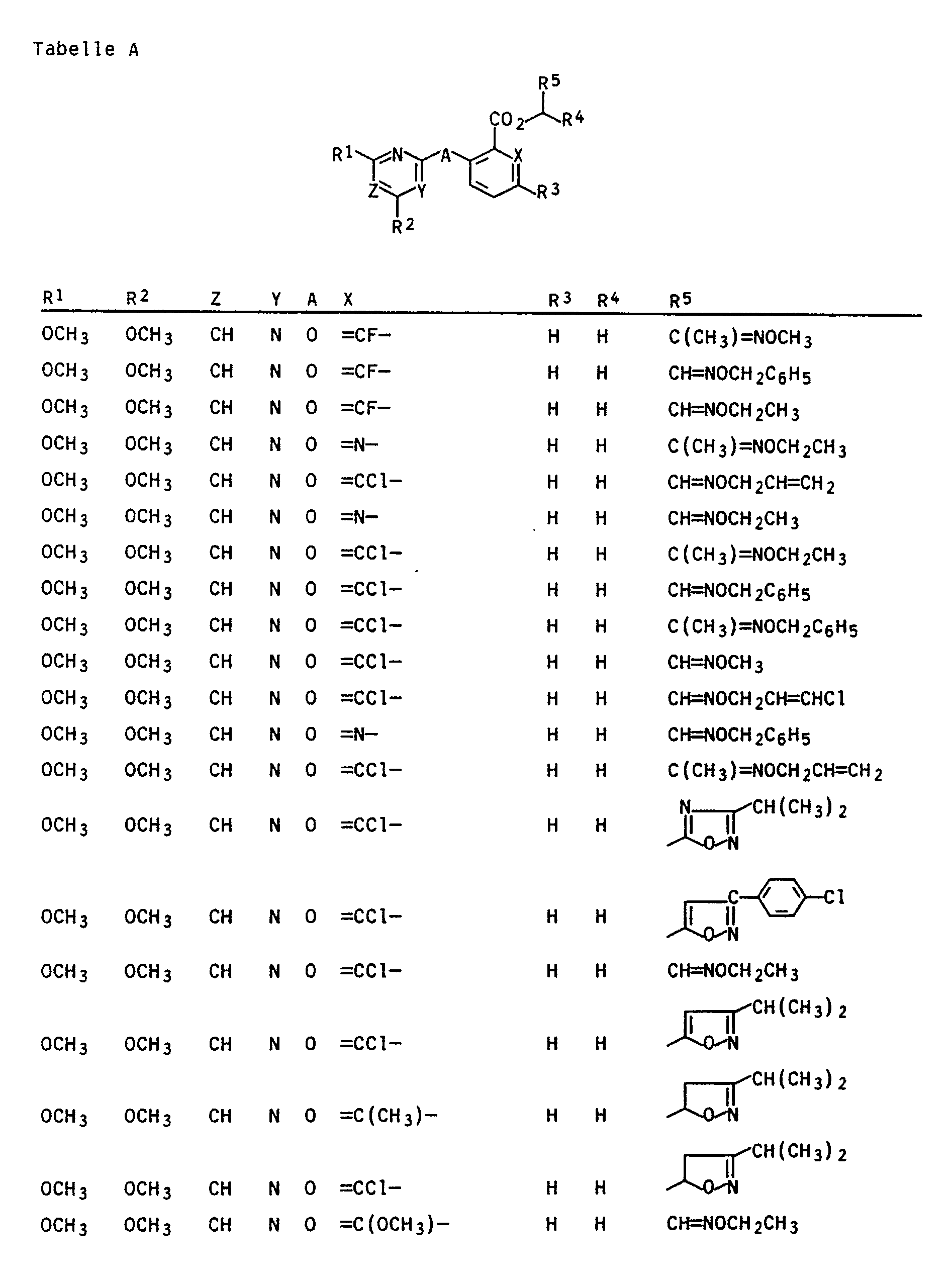


- Als Salze der Verbindungen der Formel I kommen landwirtschaftlich brauchbare Salze, beispielsweise Alkalimetallsalze, wie das Kalium- oder Natriumsalz, Erdalkalimetallsalze, wie das Calcium-, Magnesium- oder Bariumsalz, Mangan-, Kupfer-, Zink- oder Eisensalze sowie Ammonium, Phosphonium-, Sulfonium- oder Sulfoxoniumsalze, beispielsweise Ammoniumsalze, Tetraalkylammoniumsalze, Benzyltrialkylammoniumsalze, Trialkylsulfoniumsalze oder Trialkylsulfoxoniumsalze in Betracht.
- Die erfindungsgemäßen herbiziden und wachstumsregulierenden Verbindungen I bzw. die sie enthaltenden Mittel können beispielsweise in Form von direkt versprühbaren Lösungen, Pulvern, Suspensionen, auch hochprozentigen wäßrigen, öligen oder sonstigen Suspensionen oder Dispersionen, Emulsionen, Öldispersionen, Pasten, Stäubemitteln, Streumitteln oder Granulaten durch Versprühen, Vernebeln, Verstäuben, Verstreuen oder Gießen angewendet werden. Die Anwendungformen richten sich nach den Verwendungszwecken; sie sollten in jedem Fall möglichst die feinste Verteilung der erfindungsgemäßen Wirkstoffe gewährleisten.
- Die Verbindungen I eignen sich allgemein zur Herstellung von direkt versprühbaren Lösungen, Emulsionen, Pasten oder Öldispersionen. Als inerte Zusatzstoffe kommen Mineralölfraktionen von mittlerem bis hohem Siedepunkt, wie Kerosin oder Dieselöl, ferner Kohlenteeröle sowie Öle pflanzlichen oder tierischen Ursprungs, aliphatische, cyclische und aromatische Kohlenwasserstoffe, z.B. Toluol, xylol, Paraffin, Tetrahydronaphthalin, alkylierte Naphthaline oder deren Derivate, Methanol, Ethanol, Propanol, Butanol, Cyclohexanol, Cyclohexanon, Chlorbenzol, Isophoron oder stark polare Lösungsmittel wie N,N-Dimethylformamid, Dimethylsulfoxid, N-Methylpyrrolidon oder Wasser in Betracht.
- Wäßrige Anwendungsformen können aus Emulsionskonzentraten, Dispersionen, Pasten, netzbaren Pulvern oder wasserdispergierbaren Granulaten durch Zusatz von Wasser bereitet werden. Zur Herstellung von Emulsionen, Pasten oder Öldispersionen können die Substrate als solche oder in einem Öl oder Lösungsmittel gelöst, mittels Netz-, Haft-, Dispergier- oder Emulgiermittel in Wasser homogenisiert werden. Es können aber auch aus wirksamer Substanz, Netz-, Haft-, Dispergier- oder Emulgiermittel und eventuell Lösungsmittel oder Öl bestehende Konzentrate hergestellt werden, die zur Verdünnung mit Wasser geeignet sind.
- Als oberflächenaktive Stoffe kommen die Alkali-, Erdalkali-, Ammoniumsalze von aromatischen Sulfonsäuren, z.B. Lignin-, Phenol-, Naphthalin- und Dibutylnaphthalinsulfonsäure, sowie von Fettsäuren, Alkyl- und Alkylarylsulfonaten, Alkyl-, Laurylether- und Fettalkoholsulfaten, sowie Salze sulfatierter Hexa-, Hepta- und Octadecanolen, sowie von Fettalkoholglykolether, Kondensationsprodukte von sulfoniertem Naphthalin und seiner Derivate mit Formaldehyd, Kondensationsprodukte des Naphthalins bzw. der Naphthalinsulfonsäuren mit Phenol und Formaldehyd, Polyoxyethylenoctylphenolether, ethoxyliertes Isooctyl-, Octyl- oder Nonylphenol, Alkylphenol-, Tributylphenylpolyglykolether, Alkylarylpolyetheralkohole, Isotridecylalkohol, Fettalkoholethylenoxid-Kondensate, ethoxyliertes Rizinusöl, Polyoxyethylenalkylether oder Polyoxypropylen, Laurylalkoholpolyglykoletheracetat, Sorbitester, Lignin-Sulfitablaugen oder Methylcellulose in Betracht.
- Pulver-, Streu- und Stäubemittel können durch Mischen oder gemeinsames Vermahlen der wirksamen Substanzen mit einem festen Trägerstoff hergestellt werden.
- Granulate, z.B. Umhüllungs-, Imprägnierungs- und Homogengranulate können durch Bindung der Wirkstoffe an feste Trägerstoffe hergestellt werden. Feste Trägerstoffe sind Mineralerden wie Silicagel, Kieselsäuren, Kieselgele, Silikate, Talkum, Kaolin, Kalkstein, Kalk, Kreide, Bolus, Löß, Ton, Dolomit, Diatomeenerde, Calcium- und Magnesiumsulfat, Magnesiumoxid, gemahlene Kunststoffe, Düngemittel, wie Ammoniumsulfat, Ammoniumphosphat, Ammoniumnitrat, Harnstoffe und pflanzliche Produkte, wie Getreidemehl, Baumrinden-, Holz- und Nußschalenmehl, Cellulosepulver oder andere feste Trägerstoffe.
- Die Formulierungen enthalten zwischen 0,1 und 95 Gew.%, vorzugsweise zwischen 0,5 und 90 Gew.%, Wirkstoff. Die Wirkstoffe werden dabei in einer Reinheit von 90 % bis 100 %, vorzugsweise 95 % bis 100 % (nach NMR-Spektrum) eingesetzt.
- Die erfindungsgemäßen Verbindungen I können beispielsweise wie folgt formuliert werden:
- I. Man vermischt 90 Gewichtsteile der Verbindung Nr. 1.016 mit 10 Gewichtsteilen N-Methyl-α-pyrrolidon und erhält eine Lösung, die zur Anwendung in Form kleinster Tropfen geeignet ist.
- II. 20 Gewichtsteile der Verbindung Nr. 1.003 werden in einer Mischung gelöst, die aus 80 Gewichtsteilen Xylol, 10 Gewichtsteilen des Anlagerungsproduktes von 8 bis 10 Mol Ethylenoxid an 1 Mol Ölsäure-N-monoethanolamid, 5 Gewichtsteilen Calciumsalz der Dodecylbenzolsulfonsäure und 5 Gewichtsteilen des Anlagerungsproduktes von 40 Mol Ethylenoxid an 1 Mol Ricinusöl besteht. Durch Ausgießen und feines Verteilen der Lösung in 100 000 Gewichtsteilen Wasser erhält man eine wäßrige Dispersion, die 0,02 Gew.% des Wirkstoffs enthält.
- III. 20 Gewichtsteile der Verbindung Nr. 2.003 werden in einer Mischung gelöst, die aus 40 Gewichtsteilen Cyclohexanon, 30 Gewichtsteilen Isobutanol, 20 Gewichtsteilen des Anlagerungsproduktes von 7 Mol Ethylenoxid an 1 Mol Isooctylphenol und 10 Gewichtsteilen des Anlagerungsproduktes von 40 Mol Ethylenoxid an 1 Mol Ricinusöl besteht. Durch Eingießen und feines Verteilen der Lösung in 100 000 Gewichtsteilen Wasser erhält man eine wäßrige Dispersion, die 0,02 Gew.% des Wirkstoffs enthält.
- IV. 20 Gewichtsteile des Wirkstoffs Nr. 2.006 werden in einer Mischung gelöst, die aus 25 Gewichtsteilen Cyclohexanon, 65 Gewichtsteilen einer Mineralölfraktion vom Siedepunkt 210 bis 280°C und 10 Gewichtsteilen des Anlagerungsproduktes von 40 Mol Ethylenoxid an 1 Mol Ricinusöl besteht. Durch Eingießen und feines Verteilen der Lösung in 100 000 Gewichtsteilen Wasser erhält man eine wäßrige Dispersion, die 0,02 Gew.% des Wirkstoffs enthält.
- V. 20 Gewichtsteile des Wirkstoffs Nr. 1.014 werden mit 3 Gewichtsteilen des Natriumsalzes der Diisobutylnaphthalin-α-sulfonsäure, 17 Gewichtsteilen des Natriumsalzes einer Ligninsulfonsäure aus einer Sulfit-Ablauge und 60 Gewichtsteilen pulverförmigem Kieselsäuregel gut vermischt und in einer Hammermühle vermahlen. Durch feines Verteilen der Mischung in 20 000 Gewichtsteilen Wasser erhält man eine Spritzbrühe, die 0,1 Gew.% des Wirkstoffs enthält.
- VI. 3 Gewichtsteile des Wirkstoffs Nr. 1.016 werden mit 97 Gewichtsteilen feinteiligem Kaolin vermischt. Man erhält auf diese Weise ein Stäubemittel, das 3 Gew.% des Wirkstoffs enthält.
- VII. 30 Gewichtsteile des Wirkstoffs Nr. 1.015 werden mit einer Mischung aus 92 Gewichtsteilen pulverförmigem Kieselsäuregel und 8 Gewichtsteilen Paraffinöl, das auf die Oberfläche dieses Kieselsäuregels gesprüht wurde, innig vermischt. Man erhält auf diese Weise eine Aufbereitung des Wirkstoffs mit guter Haftfähigkeit.
- VIII. 20 Gewichtsteile des Wirkstoffs Nr. 2.004 werden mit 2 Gewichtsteilen Calciumsalz der Dodecylbenzolsulfonsäure, 8 Gewichtsteilen Fettalkohol-polyglykolether, 2 Gewichtsteilen Natriumsalz eines Phenol-Harnstoff-Formaldehyd-Kondensates und 68 Gewichtsteilen eines paraffinischen Mineralöls innig vermischt. Man erhält eine stabile ölige Dispersion.
- Die Applikation der herbiziden und wachstumsregulierenden Mittel bzw. der Wirkstoffe kann im Vorauflauf- oder im Nachauflaufverfahren erfolgen. Sind die Wirkstoffe für gewisse Kulturpflanzen weniger verträglich, so können Ausbringungstechniken angewandt werden, bei welchen die herbiziden Mittel mit Hilfe der Spritzgeräte so gespritzt werden, daß die Blätter der empfindlichen Kulturpflanzen nach Möglichkeit nicht getroffen werden, während die Wirkstoffe auf die Blätter darunter wachsender unerwünschter Pflanzen oder die unbedeckte Bodenfläche gelangen (post-directed, lay-by).
- Die Aufwandmengen an Wirkstoff bei Anwendung als Herbizide betragen je nach Bekämpfungsziel, Jahreszeit, Zielpflanzen und Wachstumsstadium 0,001 bis 3, vorzugsweise 0,01 bis 1 kg/ha aktive Substanz (a.S.).
- Die Verbindungen der Formel I können praktisch alle Entwicklungsstadien einer Pflanze verschiedenartig beeinflussen und werden deshalb als Wachstumsregulatoren eingesetzt. Die Wirkungsvielfalt der Pflanzenwachstumsregulatoren hängt ab vor allem
- a) von der Pflanzenart und -sorte,
- b) von dem Zeitpunkt der Applikation, bezogen auf das Entwicklungsstadium der Pflanze und von der Jahreszeit,
- c) von dem Applikationsort und -verfahren z.B. (Samenbeize, Bodenbehandlung, Blattapplikation oder Stamminjektion bei Bäumen)
- d) von klimatischen Faktoren, z.B. Temperatur, Niederschlagsmenge, außerdem auch Tageslänge und Lichtintensität
- e) von der Bodenbeschaffenheit (einschließlich Düngung),
- f) von der Formulierung bzw. Anwendungsform des Wirkstoffs und schließlich
- g) von den angewendeten Konzentrationen der aktiven Substanz.
- Aus der Reihe der verschiedenartigen Anwendungsmöglichkeiten der erfindungsgemäßen Pflanzenwachstumsregulatoren der Formel I im Pflanzenanbau, in der Landwirtschaft und im Gartenbau, werden eingige nachstehend erwähnt.
- A. Mit den erfindungsgemäß verwendbaren Verbindungen läßt sich das vegetative Wachstum der Pflanzen stark hemmen, was sich insbesondere in einer Reduzierung des Längenwachstums äußert. Die behandelten Pflanzen weisen demgemäß einen gedrungenen Wuchs auf; außerdem ist eine dunklere Blattfärbung zu beobachten.
- Als vorteilhaft für die Praxis erweist eine verminderte Intensität des Wachstums von Gräsern an Straßenrändern, Hecken, Kanalböschungen und auf Rasenflächen wie Park-, Sport- und Obstanlagen, Zierrasen und Flugplätzen, so daß der Arbeits- und kostenaufwendige Rasenschnitt reduziert werden kann.
- Von wirtschaftlichem Interesse ist auch die Erhöhung der Standfestigkeit von lageranfälligen Kulturen wie Getreide, Mais, Sonnenblumen und Soja. Die dabei verursachte Halmverkürzung und Halmverstärkung verringern oder beseitigen die Gefahr des "Lagerns" (des Umknickens) von Pflanzen unter ungünstigen Witterungsbedingungen vor der Ernte.
- Wichtig ist auch die Anwendung von Wachstumsregulatoren zur Hemmung des Längenwachstums und zur zeitlichen Veränderung des Reifeverlaufs bei Baumwolle. Damit wird ein vollständig mechanisiertes Beernten dieser wichtigen Kulturpflanze ermöglicht.
- Bei Obst- und anderen Bäumen lassen sich mit den Wachstumsregulatoren Schnittkosten einsparen. Außerdem kann die Alternanz von Obstbäumen durch Wachstumsregulatoren gebrochen werden.
- Durch Anwendung von Wachstumsregulatoren kann auch die seitliche Verzweigung der Pflanzen vermehrt oder gehemmt werden. Daran besteht Interesse, wenn z.B. bei Tabakpflanzen die Ausbildung von Seitentrieben (Geiztrieben) zugunsten des Blattwachstums gehemmt werden soll.
- Mit Wachstumsregulatoren läßt sich beispielsweise bei Winterraps auch die Frostresistenz erheblich erhöhen. Dabei werden einerseits das Längenwachstum und die Entwicklung einer zu üppigen (und dadurch besonders frostanfälligen) Blatt- bzw. Pflanzenmasse gehemmt. Andererseits werden die jungen Rapspflanzen nach der Aussaat und vor dem Einsetzen der Winterfröste trotz günstiger Wachstumsbedingungen im vege tativen Entwicklungsstadium zurückgehalten. Dadurch wird auch die Frostgefährdung solcher Pflanzen beseitigt, die zum vorzeitigen Abbau der Blühhemmung und zum Übergang in die generativen Phase neigen. Auch bei anderen Kulturen, z.B. Wintergetreide ist es vorteilhaft, wenn die Bestände durch Behandlung mit erfindungsgemäßen Verbindungen im Herbst zwar gut bestockt werden, aber nicht zu üppig in den Winter hineingehen. Dadurch kann der erhöhten Frostempfindlichkeit und - wegen der relativ geringen Blatt- bzw. Pflanzenmasse - dem Befall mit verschiedenen Krankheiten (z.B. Pilzkrankheit) vorgebeugt werden. Die Hemmung des vegetativen Wachstums ermöglicht außerdem bei vielen Kulturpflanzen eine dichtere Bepflanzung des Bodens, so daß ein Mehrertrag bezogen auf die Bodenfläche erzielt werden kann.
- B. Mit den Wachstumsregulatoren lassen sich Mehrerträge sowohl an Pflanzenteilen als auch an Pflanzeninhaltsstoffen erzielen. So ist es beispielsweise möglich, das Wachstum größerer Mengen an Knospen, Blüten, Blättern, Früchten, Samenkörnern, Wurzeln und Knollen zu induzieren, den Gehalt an Zucker in Zuckerrüben, Zuckerrohr sowie Zitrusfrüchten zu erhöhen, den Proteingehalt in Getreide oder Soja zu steigern oder Gummibäume zum vermehrten Latexfluß zu stimulieren.
- Dabei können die Verbindungen der Formel I Ertragssteigerungen durch Eingriffe in den pflanzlichen Stoffwechsel bzw. durch Förderung oder Hemmung des vegetativen und/oder des generativen Wachstums verursachen.
- C. Mit Pflanzenwachstumsregulatoren lassen sich schließlich sowohl eine Verkürzung bzw. Verlängerung der Entwicklungsstadien als auch eine Beschleunigung bzw. Verzögerung der Reife der geernteten Pflanzenteile vor oder nach der Ernte erreichen.
- Von wirtschaftlichem Interesse ist beispielsweise die Ernteerleichterung, die durch das zeitlich konzentrierte Abfallen oder Vermindern der Haftfestigkeit am Baum bei Zitrusfrüchten, Oliven oder bei anderen Arten und Sorten von Kern-, Stein- und Schalenobst ermöglicht wird. Derselbe Mechanismus, das heißt die Förderung der Ausbildung von Trenngewebe zwischen Frucht- bzw. Blatt- und Sproßteil der Pflanze ist auch für ein gut kontrollierbares Entblättern von Nutzpflanzen wie beispielsweise Baumwolle wesentlich.
- D. Mit Wachstumsregulatoren kann weiterhin der Wasserverbrauch von Pflanzen reduziert werden. Dies ist besonders wichtig für landwirtschaftliche Nutzflächen, die unter einem hohen Kostenaufwand künstlich bewässert werden müssen, z.B. in ariden oder semiariden Gebieten. Durch den Einsatz der erfindungsgemäßen Substanzen läßt sich die Intensität der Bewässerung reduzieren und damit eine kostengünstigere Bewirtschaftung durchführen. Unter dem Einfluß von Wachstumsregulatoren kommt es zu einer besseren Ausnutzung des vorhandenen Wassers, weil u.a.
- die Öffnungsweite der Stomata reduziert wird
- eine dickere Epidermis und Cuticula ausgebildet werden
- die Durchwurzelung des Bodens verbessert wird und
- das Mikroklima im Pflanzenbestand durch einen kompakteren Wuchs günstig beeinflußt wird. - Die erfindungsgemäß zu verwendenden Wachstumsregulatoren der Formel I können den Kulturpflanzen sowohl vom Samen her (als Saatgutbeizmittel) als auch über den Boden, d.h. durch die Wurzel sowie - besonders bevorzugt - durch Spritzung über das Blatt zugeführt werden.
- Infolge der hohen Pflanzenverträglichkeit kann die Aufwandmenge stark variiert werden.
- In Anbetracht der Vielseitigkeit der Applikationsmethoden können die erfindungsgemäßen Verbindungen bzw. sie enthaltende Mittel in einer großen Zahl von Kulturpflanzen zur Beseitigung unerwünschter Pflanzen eingesetzt werden.
- Zur Verbreiterung des Wirkungsspektrums und zur Erzielung synergistischer Effekte können die erfindungsgemäßen Verbindungen I mit zahlreichen Vertretern anderer herbizider oder wachstumsregulierender Wirkstoffgruppen gemischt und gemeinsam ausgebracht werden. Beispielsweise kommen als Mischungspartner Diazine, 4H-3,1-Benzoxazinderivate, Benzothiadiazinone, 2,6-Dinitroaniline, N-Phenylcarbamate, Thiolcarbamate, Halogencarbonsäuren, Triazine, Amide, Harnstoffe, Diphenylether, Triazinone, Uracile, Benzofuranderivate, Cyclohexan-1,3-dionderivate, Chinolincarbonsäurederivate, Aryloxy-, Heteroaryloxyphenoxypropionsäuren sowie deren Salze, Ester und Amide und andere in Betracht.
- Außerdem kann es von Nutzen sein, die Verbindungen I allein oder in Kombination mit anderen Herbiziden auch noch mit weiteren Pflanzenschutzmitteln gemischt gemeinsam auszubringen, beispielsweise mit Mitteln zur Bekämpfung von Schädlingen oder phytopathogenen Pilzen bzw. Bakterien. Von Interesse ist ferner die Mischbarkeit mit Mineralsalzlösungen, welche zur Behebung von Ernährungs-und Spurenelementmängeln eingesetzt werden. Es können auch nichtphytotoxische Öle und Ölkonzentrate zugesetzt werden.
- Die in den nachstehenden Synthesebeispielen wiedergegebenen Vorschriften wurden unter entsprechender Abwandlung der Ausgangsverbindungen zur Gewinnung weiterer Verbindungen I benutzt. Die so erhaltenen Verbindungen sind in den nachstehenden Tabellen mit physikalischen Angaben aufgeführt.
-

-

- Eine Mischung aus 14,7 g 2-Hydroxynaphthalin-1-carbonsäure und 640 ml Methanol wurde bei 25°C mit 5,1 g Kaliumhydroxid versetzt. Nach ca. 10 min. wurde das Lösungsmittel bei vermindertem Druck entfernt. Das so erhaltene Kaliumsalz wurde getrocknet und anschließend in 380 ml Dimethylsulfoxid gelöst. Zu dieser Lösung gab man bei 25°C portionsweise 2,52 g (80 %ige Suspension in Leinöl) Natriumhydrid. Nach weiteren 30 min. wurde die klare Lösung mit 17,4 g 4,6-Dimethoxy-2-methylsulfonylpyrimidin versetzt. Die Umsetzung war nach ca. 12 Std. beendet. Zur Aufarbeitung wurde das Reaktionsgemisch mit Wasser versetzt und mittels Essigsäureethylester-Extraktion von Verunreinigungen befreit. Durch Ansäuern der wäßrigen Phase erhielt man das gewünschte Produkt als Feststoff. Ausbeute: 22 g
- Eine Mischung aus 4,9 g der Naphthalincarbonsäure aus a) und 100 ml Dimethylsulfoxid wurde bei 25°C nacheinander zunächst mit 1,7 g Kalium-tert.-butylat und dann mit 3,1 g (3-Isopropylisoxazol-5-yl)methylbromid versetzt. Nach ca. 12 Std. bei 25°C war die Umsetzung beendet. Zur Aufarbeitung wurde die Reaktionsmischung mit Wasser verdünnt, angesäuert und mit Essigsäureethylester extrahiert. Aus der organischen Phase erhielt man das gewünschte Produkt als Öl.
- Ausbeute: 3,6 g [nach Chromatographie an Kieselgel]; ¹H-NMR (250 mHz) ausgewählte Signale: 1,25 (d); 3,02 (m), 3,75 (s); 5,35 (s); 5,75 (s); 6,10 (s)
Wirkstoffbeispiel 2.001 -

- Eine Mischung aus 3,1 g der Naphthalincarbonsäure aus 1a) und 50 ml Dimethylsulfoxid wurde bei 25°C nacheinander zunächst mit 1,1 g Kaliumtert.-butylat und dann mit 1,7 g 2-(3-Chlor-2-propen-1-yloxyimino)ethyl chlorid (E-Isomer) versetzt. Nach ca. 12 Std. war die Umsetzung beendet. Zur Aufarbeitung wurde die Reaktionsmischung mit Wasser verdünnt, angesäuert und mit Essigsäureethylester extrahiert. Aus der organischen Phase erhielt man das gewünschte Produkt als Feststoff.
- Ausbeute: 2,2 g [nach Chromatographie an Kieselgel]; Fp.: 77-83°C. Wirkstoffbeispiel 2.002
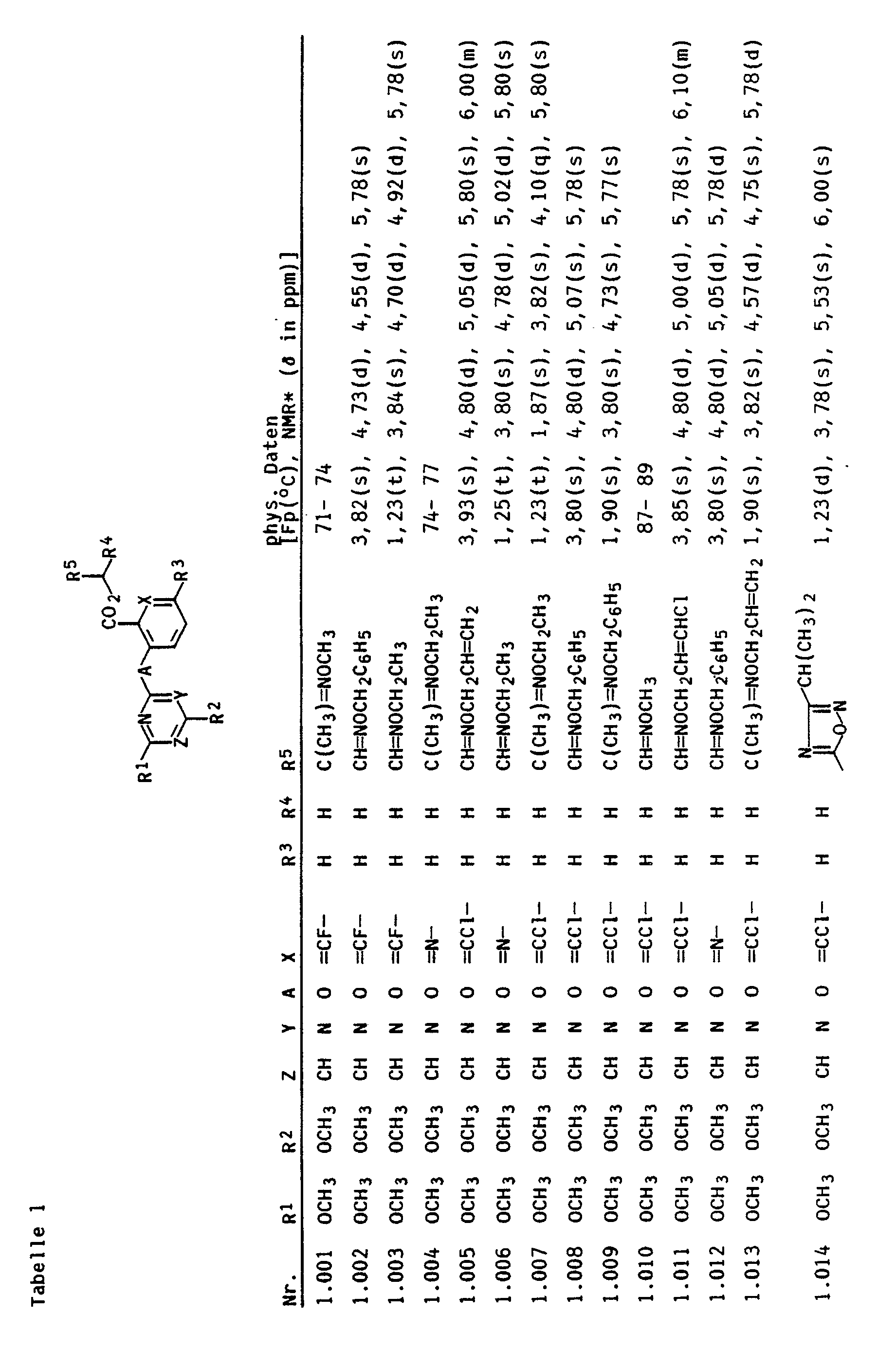


- Die herbizide Wirkung der Carbonsäuren der Formel I ließ sich durch Gewächshausversuche zeigen:
- Als Kulturgefäße dienten Plastikblumentöpfe mit lehmigem Sand mit etwa 3,0 % Humus als Substrat. Die Samen der Testpflanzen wurden nach Arten getrennt eingesät.
- Bei Vorauflaufbehandlung wurden die in Wasser suspendierten oder emulgierten Wirkstoffe direkt nach Einsaat mittels fein verteilender Düsen aufgebracht. Die Gefäße wurden leicht beregnet, um Keimung und Wachstum zu fördern und anschließend mit durchsichtigen Plastikhauben abgedeckt, bis die Pflanzen angewachsen waren. Diese Abdeckung bewirkt ein gleichmäßiges Keimen der Testpflanzen, sofern dies nicht durch die Wirkstoffe beeinträchtigt wurde. Die Aufwandmenge für die Vorauflaufanwendung betrug 0,06 kg/ha a.S.
- Zum Zwecke der Nachauflaufbehandlung wurden die Testpflanzen je nach Wuchsform erst bei einer Wuchshöhe von 3 bis 15 cm mit den in Wasser suspendierten oder emulgierten Wirkstoffen behandelt. Die Aufwandmenge für die Nachauflaufbehandlung betrug 0,06 kg/ha a.S.
- Die Pflanzen wurden artenspezifisch bei Temperaturen von 10-25°C bzw. 20-35°C gehalten. Die Versuchsperiode erstreckte sich über 2 bis 4 Wochen. Während dieser Zeit wurden die Pflanzen gepflegt und ihre Reaktion auf die einzelnen Behandlungen wurde ausgewertet.
- Bewertet wurde nach einer Skala von 0 bis 100. Dabei bedeutet 100 kein Aufgang der Pflanzen bzw. völlige Zerstörung zumindest der oberirdischen Teile und 0 keine Schädigung oder normaler Wachstumsverlauf.
- Die in den Gewächshausversuchen verwendeten Pflanzen setzten sich aus folgenden Arten zusammen:
Lateinischer Name Deutscher Name Abutilon theophrasti Chinesischer Hanf Amaranthus retroflexus Zurückgekrümmter Fuchsschwanz Cassia tora - Galium aparine Klettenlabkraut Malva neglecta Wegmalve Solanum nigrum Schwarzer Nachtschatten
Claims (9)

R¹, R²
C₁-C₄-Alkyl, C₁-C₄-Halogenalkyl, C₁-C₄-Alkoxy, C₁-C₄-Halogenalkoxy oder C₁-C₄-Alkylthio;
R³
Wasserstoff; Hydroxy; Cyano; Nitro; Amino; Formyl;
Halogen;
eine C₁-C₄-Alkylgruppe, eine C₁-C₄-Alkoxygruppe, eine C₃-C₆-Alkenylgruppe, eine C₃-C₆-Alkenyloxygruppe, eine C₃-C₆-Alkinylgruppe oder eine C₃-C₆-Alkinyloxygruppe, wobei diese Gruppen ein bis fünf Halogenatome und/oder eine C₁-C₄-Alkoxy- oder C₁-C₄-Alkylthiogruppe tragen können;
eine C₁-C₄-Alkylaminogruppe; eine Di-C₁-C₄-Alkylaminogruppe; eine Phenylaminogruppe; eine N-Phenyl-N-C₁-C₄-alkylaminogruppe oder eine C₁-C₆-Alkylcarbonylaminogruppe;
R⁴
Wasserstoff oder C₁-C₄-Alkyl;
R⁵
einen fünfgliedrigen Heteroarylrest, der ein oder zwei Stickstoffatome und ein Sauerstoff- oder Schwefelatom enthält, oder einen Isoxazolinylrest, wobei diese Ringsysteme ein bis vier Halogenatome und/oder ein oder zwei der folgenden Reste tragen können: C₁-C₆-Alkyl, C₁-C₂-Halogenalkyl, C₁-C₄-Alkoxy, C₁-C₂-Halogenalkoxy, C₃-C₈-Cycloalkyl, Phenyl oder Pyridyl, wobei die aromatischen Reste ihrerseits ein bis fünf Halogenatome und/oder ein bis drei der bei R¹ genannten Reste tragen können;
oder eine Gruppe -CR⁶=NOR⁷, worin
R⁶
Wasserstoff;
C₁-C₄-Alkyl bedeutet, welches ein bis fünf Halogenatome und/oder einen der folgenden Reste tragen kann: C₁-C₄-Alkoxy, C₁-C₄-Alkylthio oder Phenyl, wobei der Phenylrest seinerseits ein bis fünf Halogenatome und/oder ein bis drei der bei R¹ genannten Reste tragen kann oder für C₃-C₈-Cycloalkyl steht, welches ein bis drei C₁-C₄-Alkylgruppen tragen kann;
Phenyl, welches ein bis fünf Halogenatome und/oder ein bis drei der bei R¹ genannten Reste tragen kann, bedeutet und
R⁷
C₁-C₈-Alkyl oder C₃-C₆-Alkenyl, welches ein bis fünf Halogenatome und/oder einen der folgenden Reste tragen kann: C₁-C₄-Alkoxy, C₁-C₄-Alkylthio oder Phenyl, wobei der Phenylrest seinerseits ein bis fünf Halogenatome und/oder ein bis drei der bei R¹ genannten Reste tragen kann;
C₃-C₈-Cycloalkyl, welches ein bis drei C₁-C₄-Alkylgruppen tragen kann; Phenyl, welches ein bis fünf Halogenatome und/oder ein bis drei der bei R¹ genannten Reste tragen kann, bedeutet;
A
Sauerstoff oder Schwefel;
X
Stickstoff oder eine Methingruppe =CR⁸-, worin
R⁸
einen der Reste R³ bedeutet oder R⁸ und R³ gemeinsam eine 1,3-Butadien-1,4-diyl- oder eine Aza-1,3-butadien-1,4-diylkette bedeuten, wobei diese Ketten ihrerseits ein bis vier Halogenatome und/oder ein oder zwei der bei R¹ genannten Reste tragen können;
Y, Z
Stickstoff oder eine Methingruppe =CH-,
sowie deren landwirtschaftlich brauchbaren Salze.

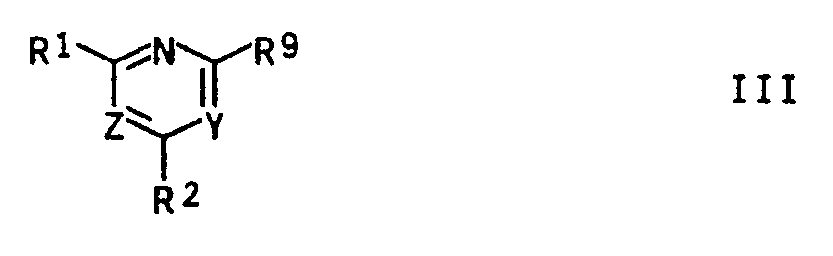


Applications Claiming Priority (2)
| Application Number | Priority Date | Filing Date | Title |
|---|---|---|---|
| DE3927382 | 1989-08-19 | ||
| DE3927382A DE3927382A1 (de) | 1989-08-19 | 1989-08-19 | Carbonsaeurederivate |
Publications (3)
| Publication Number | Publication Date |
|---|---|
| EP0414058A2 true EP0414058A2 (de) | 1991-02-27 |
| EP0414058A3 EP0414058A3 (en) | 1991-08-21 |
| EP0414058B1 EP0414058B1 (de) | 1994-06-15 |
Family
ID=6387418
Family Applications (1)
| Application Number | Title | Priority Date | Filing Date |
|---|---|---|---|
| EP90115343A Expired - Lifetime EP0414058B1 (de) | 1989-08-19 | 1990-08-10 | Carbonsäurederivate |
Country Status (10)
| Country | Link |
|---|---|
| US (1) | US5085685A (de) |
| EP (1) | EP0414058B1 (de) |
| JP (1) | JP3053413B2 (de) |
| KR (1) | KR0174541B1 (de) |
| AT (1) | ATE107301T1 (de) |
| CA (1) | CA2022747C (de) |
| DE (2) | DE3927382A1 (de) |
| ES (1) | ES2055242T3 (de) |
| HU (1) | HU207645B (de) |
| YU (1) | YU158590A (de) |
Cited By (1)
| Publication number | Priority date | Publication date | Assignee | Title |
|---|---|---|---|---|
| WO1992017468A1 (en) * | 1991-03-26 | 1992-10-15 | Kumiai Chemical Industry Co., Ltd. | Pyridine derivative, production thereof, herbicide and method of weeding |
Families Citing this family (11)
| Publication number | Priority date | Publication date | Assignee | Title |
|---|---|---|---|---|
| JPH04235171A (ja) * | 1990-07-26 | 1992-08-24 | Sumitomo Chem Co Ltd | スルホヒドロキサム酸誘導体、その製造法およびそれを有効成分とする除草剤 |
| US5298632A (en) * | 1990-05-15 | 1994-03-29 | Sumitomo Chemical Company, Limited | Herbicidal pyrimidine compounds, compositions containing the same and method of use |
| US5232897A (en) * | 1990-05-15 | 1993-08-03 | Sumitomo Chemical Company, Limited | Herbicidal pyrimidine compounds, compositions containing the same and method of use |
| US5506192A (en) * | 1990-06-07 | 1996-04-09 | Sandoz Ltd. | Substituted phthalides and heterocyclic phthalides |
| AU638840B2 (en) * | 1990-07-05 | 1993-07-08 | Sumitomo Chemical Company, Limited | Pyrimidine derivative |
| US5391537A (en) * | 1990-10-25 | 1995-02-21 | Kumiai Chemical Industry Co., Ltd. | Picolinic acid derivative, and herbicidal composition |
| JPH05301872A (ja) * | 1992-04-23 | 1993-11-16 | Kumiai Chem Ind Co Ltd | ピコリン酸誘導体及び除草剤 |
| EP0507962B1 (de) * | 1990-10-25 | 2001-06-13 | Kumiai Chemical Industry Co., Ltd. | Picolinsäurederivat, seine herstellung und verwendung als herbizid |
| BR9106704A (pt) * | 1991-12-18 | 1994-03-22 | Kumiai Chemical Industry Co | Derivato de acido picolinico,metodo para sua preparacao e composicao herbicida |
| KR100251814B1 (ko) * | 1994-12-16 | 2000-07-01 | 겜마 아키라 | 립스틱용 조성물 |
| WO1998057957A1 (en) * | 1997-06-18 | 1998-12-23 | Nissan Chemical Industries, Ltd. | Pyridine compounds and herbicides |
Family Cites Families (6)
| Publication number | Priority date | Publication date | Assignee | Title |
|---|---|---|---|---|
| JPH0651684B2 (ja) * | 1985-10-15 | 1994-07-06 | クミアイ化学工業株式会社 | ピリミジン誘導体および除草剤 |
| JPH082883B2 (ja) * | 1986-06-06 | 1996-01-17 | クミアイ化学工業株式会社 | 2−フエノキシピリミジン誘導体および除草剤 |
| EP0249707B1 (de) * | 1986-06-14 | 1992-03-11 | Kumiai Chemical Industry Co., Ltd. | Picolinsäure-Derivate und herbizide Zusammensetzungen |
| DE3851773T2 (de) * | 1987-04-14 | 1995-04-20 | Ihara Chemical Ind Co | 2-Phenoxypyrimidin-Derivate und herbizide Zusammensetzungen. |
| US4946495A (en) * | 1987-04-14 | 1990-08-07 | Kumiai Chemical Industry Co., Ltd. | 2-phenoxypyrimidine derivative and herbicidal composition |
| EP0346789B1 (de) * | 1988-06-16 | 1994-04-20 | BASF Aktiengesellschaft | Salicylsäurederivate und deren Schwefelanaloge |
-
1989
- 1989-08-19 DE DE3927382A patent/DE3927382A1/de not_active Withdrawn
-
1990
- 1990-08-07 CA CA002022747A patent/CA2022747C/en not_active Expired - Fee Related
- 1990-08-10 AT AT90115343T patent/ATE107301T1/de not_active IP Right Cessation
- 1990-08-10 DE DE59006120T patent/DE59006120D1/de not_active Expired - Lifetime
- 1990-08-10 EP EP90115343A patent/EP0414058B1/de not_active Expired - Lifetime
- 1990-08-10 ES ES90115343T patent/ES2055242T3/es not_active Expired - Lifetime
- 1990-08-13 US US07/566,536 patent/US5085685A/en not_active Expired - Fee Related
- 1990-08-17 YU YU158590A patent/YU158590A/sh unknown
- 1990-08-17 JP JP2215953A patent/JP3053413B2/ja not_active Expired - Lifetime
- 1990-08-17 HU HU905066A patent/HU207645B/hu not_active IP Right Cessation
- 1990-08-18 KR KR1019900012710A patent/KR0174541B1/ko not_active Expired - Fee Related
Cited By (1)
| Publication number | Priority date | Publication date | Assignee | Title |
|---|---|---|---|---|
| WO1992017468A1 (en) * | 1991-03-26 | 1992-10-15 | Kumiai Chemical Industry Co., Ltd. | Pyridine derivative, production thereof, herbicide and method of weeding |
Also Published As
| Publication number | Publication date |
|---|---|
| HU905066D0 (en) | 1991-01-28 |
| US5085685A (en) | 1992-02-04 |
| JP3053413B2 (ja) | 2000-06-19 |
| CA2022747A1 (en) | 1991-02-20 |
| KR0174541B1 (ko) | 1999-02-01 |
| DE59006120D1 (de) | 1994-07-21 |
| EP0414058B1 (de) | 1994-06-15 |
| YU158590A (sh) | 1993-05-28 |
| ES2055242T3 (es) | 1994-08-16 |
| JPH03106876A (ja) | 1991-05-07 |
| DE3927382A1 (de) | 1991-02-21 |
| CA2022747C (en) | 2000-11-07 |
| EP0414058A3 (en) | 1991-08-21 |
| ATE107301T1 (de) | 1994-07-15 |
| HUT54464A (en) | 1991-03-28 |
| KR910004576A (ko) | 1991-03-28 |
| HU207645B (en) | 1993-05-28 |
Similar Documents
| Publication | Publication Date | Title |
|---|---|---|
| EP0346789B1 (de) | Salicylsäurederivate und deren Schwefelanaloge | |
| EP0402751B1 (de) | Salicylaldehyd- und Salicylsäurederivate sowie deren Schwefelanaloge, Verfahren zu ihrer Herstellung und ihre Verwendung als Herbizide und Bioregulatoren | |
| EP0695295B1 (de) | 3-(het)aryl-carbonsäurederivate, verfahren und zwischenprodukte zu ihrer herstellung | |
| EP0388871A1 (de) | Herbizide und pflanzenwachstumsregulierende Azolylmethyloxirane | |
| EP0414058B1 (de) | Carbonsäurederivate | |
| EP0490060B1 (de) | Salicylsäurederivate | |
| DE4126937A1 (de) | Salicyl(thio)etherderivate, verfahren und zwischenprodukte zu ihrer herstellung | |
| EP0652216B1 (de) | Substituierte Pyridylsalicylaldehyd - bzw. -salicylsäurederivate, Verfahren zu ihrer Herstellung und ihre Verwendung als Herbizide | |
| EP0400356B1 (de) | Sulfonamide | |
| EP0527380B1 (de) | Salicylsäurederivate als selektive Herbizide | |
| DE4313413A1 (de) | 3-(Het)aryloxy(thio)-Carbonsäurederivate, Verfahren und Zwischenprodukte zu ihrer Herstellung | |
| EP0490224B1 (de) | Salicylaldehyd- und Salicylsäurederivate sowie deren Schwefelanaloge, Verfahren und Zwischenprodukte zu ihrer Herstellung | |
| EP0554661B1 (de) | Thiocarbonsäurederivate, Verfahren und Zwischenprodukte zu ihrer Herstellung | |
| EP0435104A2 (de) | Salicylsäurederivate, Verfahren zu ihrer Herstellung und ihre Verwendung als Herbizide und Bioregulatoren | |
| EP0716654A1 (de) | Substituierte milchsäurederivate mit einem n-organischen rest in beta-position, deren herstellung und deren verwendung als herbizide und antidote | |
| EP0656357A1 (de) | Pyridin-N-oxid substituierte Salicylaldehyd- bzw. Salicylsäurederivate, Verfahren zu ihrer Herstellung und ihre Verwendung als Herbizide | |
| EP0469423A1 (de) | Oxalyl-bishydroxamsäurederivate, ihre Herstellung und sie enthaltende Mittel zur Regulierung des Pflanzenwachstums | |
| EP0695302B1 (de) | 3-halogen-3-hetarylcarbonsäurederivate, verfahren und zwischenprodukte zu ihrer herstellung | |
| DE3921271A1 (de) | Purinsulfonamide | |
| EP0345637A1 (de) | N-substituierte 3,4,5,6-Tetrahydrophthalimid-Derivate | |
| EP0479055A1 (de) | Benzaldoximetherderivate | |
| WO1996016045A1 (de) | DERIVATE VON α-HALOGENCARBONYLVERBINDUNGEN, VERFAHREN UND ZWISCHENPRODUKTE ZU IHRER HERSTELLUNG | |
| DE4126935A1 (de) | Salicylaldehyd- und salicylsaeurederivate sowie deren schwefelanaloge, verfahren und zwischenprodukte zu ihrer herstellung | |
| DE4039940A1 (de) | Salicylaldehyd- und salicylsaeurederivate sowie deren schwefelanaloge, verfahren und zwischenprodukte zu ihrer herstellung |
Legal Events
| Date | Code | Title | Description |
|---|---|---|---|
| PUAI | Public reference made under article 153(3) epc to a published international application that has entered the european phase |
Free format text: ORIGINAL CODE: 0009012 |
|
| 17P | Request for examination filed |
Effective date: 19901227 |
|
| AK | Designated contracting states |
Kind code of ref document: A2 Designated state(s): AT BE CH DE ES FR GB IT LI NL |
|
| PUAL | Search report despatched |
Free format text: ORIGINAL CODE: 0009013 |
|
| AK | Designated contracting states |
Kind code of ref document: A3 Designated state(s): AT BE CH DE ES FR GB IT LI NL |
|
| 17Q | First examination report despatched |
Effective date: 19930812 |
|
| GRAA | (expected) grant |
Free format text: ORIGINAL CODE: 0009210 |
|
| AK | Designated contracting states |
Kind code of ref document: B1 Designated state(s): AT BE CH DE ES FR GB IT LI NL |
|
| REF | Corresponds to: |
Ref document number: 107301 Country of ref document: AT Date of ref document: 19940715 Kind code of ref document: T |
|
| REF | Corresponds to: |
Ref document number: 59006120 Country of ref document: DE Date of ref document: 19940721 |
|
| ITF | It: translation for a ep patent filed | ||
| GBT | Gb: translation of ep patent filed (gb section 77(6)(a)/1977) |
Effective date: 19940711 |
|
| REG | Reference to a national code |
Ref country code: ES Ref legal event code: FG2A Ref document number: 2055242 Country of ref document: ES Kind code of ref document: T3 |
|
| ET | Fr: translation filed | ||
| PLBE | No opposition filed within time limit |
Free format text: ORIGINAL CODE: 0009261 |
|
| STAA | Information on the status of an ep patent application or granted ep patent |
Free format text: STATUS: NO OPPOSITION FILED WITHIN TIME LIMIT |
|
| 26N | No opposition filed | ||
| PGFP | Annual fee paid to national office [announced via postgrant information from national office to epo] |
Ref country code: FR Payment date: 20010713 Year of fee payment: 12 |
|
| PGFP | Annual fee paid to national office [announced via postgrant information from national office to epo] |
Ref country code: NL Payment date: 20010719 Year of fee payment: 12 |
|
| PGFP | Annual fee paid to national office [announced via postgrant information from national office to epo] |
Ref country code: AT Payment date: 20010720 Year of fee payment: 12 |
|
| PGFP | Annual fee paid to national office [announced via postgrant information from national office to epo] |
Ref country code: CH Payment date: 20010723 Year of fee payment: 12 |
|
| PGFP | Annual fee paid to national office [announced via postgrant information from national office to epo] |
Ref country code: GB Payment date: 20010801 Year of fee payment: 12 |
|
| PGFP | Annual fee paid to national office [announced via postgrant information from national office to epo] |
Ref country code: ES Payment date: 20010806 Year of fee payment: 12 |
|
| PGFP | Annual fee paid to national office [announced via postgrant information from national office to epo] |
Ref country code: DE Payment date: 20010811 Year of fee payment: 12 |
|
| PGFP | Annual fee paid to national office [announced via postgrant information from national office to epo] |
Ref country code: BE Payment date: 20010912 Year of fee payment: 12 |
|
| REG | Reference to a national code |
Ref country code: GB Ref legal event code: IF02 |
|
| PG25 | Lapsed in a contracting state [announced via postgrant information from national office to epo] |
Ref country code: GB Free format text: LAPSE BECAUSE OF NON-PAYMENT OF DUE FEES Effective date: 20020810 Ref country code: AT Free format text: LAPSE BECAUSE OF NON-PAYMENT OF DUE FEES Effective date: 20020810 |
|
| PG25 | Lapsed in a contracting state [announced via postgrant information from national office to epo] |
Ref country code: ES Free format text: LAPSE BECAUSE OF NON-PAYMENT OF DUE FEES Effective date: 20020811 |
|
| PG25 | Lapsed in a contracting state [announced via postgrant information from national office to epo] |
Ref country code: LI Free format text: LAPSE BECAUSE OF NON-PAYMENT OF DUE FEES Effective date: 20020831 Ref country code: CH Free format text: LAPSE BECAUSE OF NON-PAYMENT OF DUE FEES Effective date: 20020831 Ref country code: BE Free format text: LAPSE BECAUSE OF NON-PAYMENT OF DUE FEES Effective date: 20020831 |
|
| PG25 | Lapsed in a contracting state [announced via postgrant information from national office to epo] |
Ref country code: DE Free format text: LAPSE BECAUSE OF THE APPLICANT RENOUNCES Effective date: 20020924 |
|
| BERE | Be: lapsed |
Owner name: *BASF A.G. Effective date: 20020831 |
|
| PG25 | Lapsed in a contracting state [announced via postgrant information from national office to epo] |
Ref country code: NL Free format text: LAPSE BECAUSE OF NON-PAYMENT OF DUE FEES Effective date: 20030301 |
|
| GBPC | Gb: european patent ceased through non-payment of renewal fee |
Effective date: 20020810 |
|
| REG | Reference to a national code |
Ref country code: CH Ref legal event code: PL |
|
| PG25 | Lapsed in a contracting state [announced via postgrant information from national office to epo] |
Ref country code: FR Free format text: LAPSE BECAUSE OF NON-PAYMENT OF DUE FEES Effective date: 20030430 |
|
| NLV4 | Nl: lapsed or anulled due to non-payment of the annual fee |
Effective date: 20030301 |
|
| REG | Reference to a national code |
Ref country code: FR Ref legal event code: ST |
|
| REG | Reference to a national code |
Ref country code: ES Ref legal event code: FD2A Effective date: 20030912 |
|
| PG25 | Lapsed in a contracting state [announced via postgrant information from national office to epo] |
Ref country code: IT Free format text: LAPSE BECAUSE OF NON-PAYMENT OF DUE FEES;WARNING: LAPSES OF ITALIAN PATENTS WITH EFFECTIVE DATE BEFORE 2007 MAY HAVE OCCURRED AT ANY TIME BEFORE 2007. THE CORRECT EFFECTIVE DATE MAY BE DIFFERENT FROM THE ONE RECORDED. Effective date: 20050810 |