EP0414683B1 - Procedes pour fabriquer un produit polymere a orientation biaxiale, et produit ainsi obtenu - Google Patents
Procedes pour fabriquer un produit polymere a orientation biaxiale, et produit ainsi obtenu Download PDFInfo
- Publication number
- EP0414683B1 EP0414683B1 EP88908845A EP88908845A EP0414683B1 EP 0414683 B1 EP0414683 B1 EP 0414683B1 EP 88908845 A EP88908845 A EP 88908845A EP 88908845 A EP88908845 A EP 88908845A EP 0414683 B1 EP0414683 B1 EP 0414683B1
- Authority
- EP
- European Patent Office
- Prior art keywords
- polymer
- feedstock
- sheet
- biaxially oriented
- product
- Prior art date
- Legal status (The legal status is an assumption and is not a legal conclusion. Google has not performed a legal analysis and makes no representation as to the accuracy of the status listed.)
- Expired - Lifetime
Links
Images




Classifications
-
- B—PERFORMING OPERATIONS; TRANSPORTING
- B29—WORKING OF PLASTICS; WORKING OF SUBSTANCES IN A PLASTIC STATE IN GENERAL
- B29C—SHAPING OR JOINING OF PLASTICS; SHAPING OF MATERIAL IN A PLASTIC STATE, NOT OTHERWISE PROVIDED FOR; AFTER-TREATMENT OF THE SHAPED PRODUCTS, e.g. REPAIRING
- B29C55/00—Shaping by stretching, e.g. drawing through a die; Apparatus therefor
- B29C55/02—Shaping by stretching, e.g. drawing through a die; Apparatus therefor of plates or sheets
- B29C55/18—Shaping by stretching, e.g. drawing through a die; Apparatus therefor of plates or sheets by squeezing between surfaces, e.g. rollers
-
- B—PERFORMING OPERATIONS; TRANSPORTING
- B29—WORKING OF PLASTICS; WORKING OF SUBSTANCES IN A PLASTIC STATE IN GENERAL
- B29C—SHAPING OR JOINING OF PLASTICS; SHAPING OF MATERIAL IN A PLASTIC STATE, NOT OTHERWISE PROVIDED FOR; AFTER-TREATMENT OF THE SHAPED PRODUCTS, e.g. REPAIRING
- B29C43/00—Compression moulding, i.e. applying external pressure to flow the moulding material; Apparatus therefor
- B29C43/02—Compression moulding, i.e. applying external pressure to flow the moulding material; Apparatus therefor of articles of definite length, i.e. discrete articles
-
- B—PERFORMING OPERATIONS; TRANSPORTING
- B29—WORKING OF PLASTICS; WORKING OF SUBSTANCES IN A PLASTIC STATE IN GENERAL
- B29C—SHAPING OR JOINING OF PLASTICS; SHAPING OF MATERIAL IN A PLASTIC STATE, NOT OTHERWISE PROVIDED FOR; AFTER-TREATMENT OF THE SHAPED PRODUCTS, e.g. REPAIRING
- B29C43/00—Compression moulding, i.e. applying external pressure to flow the moulding material; Apparatus therefor
- B29C43/22—Compression moulding, i.e. applying external pressure to flow the moulding material; Apparatus therefor of articles of indefinite length
-
- B—PERFORMING OPERATIONS; TRANSPORTING
- B29—WORKING OF PLASTICS; WORKING OF SUBSTANCES IN A PLASTIC STATE IN GENERAL
- B29C—SHAPING OR JOINING OF PLASTICS; SHAPING OF MATERIAL IN A PLASTIC STATE, NOT OTHERWISE PROVIDED FOR; AFTER-TREATMENT OF THE SHAPED PRODUCTS, e.g. REPAIRING
- B29C48/00—Extrusion moulding, i.e. expressing the moulding material through a die or nozzle which imparts the desired form; Apparatus therefor
- B29C48/03—Extrusion moulding, i.e. expressing the moulding material through a die or nozzle which imparts the desired form; Apparatus therefor characterised by the shape of the extruded material at extrusion
- B29C48/07—Flat, e.g. panels
- B29C48/08—Flat, e.g. panels flexible, e.g. films
-
- B—PERFORMING OPERATIONS; TRANSPORTING
- B29—WORKING OF PLASTICS; WORKING OF SUBSTANCES IN A PLASTIC STATE IN GENERAL
- B29C—SHAPING OR JOINING OF PLASTICS; SHAPING OF MATERIAL IN A PLASTIC STATE, NOT OTHERWISE PROVIDED FOR; AFTER-TREATMENT OF THE SHAPED PRODUCTS, e.g. REPAIRING
- B29C48/00—Extrusion moulding, i.e. expressing the moulding material through a die or nozzle which imparts the desired form; Apparatus therefor
- B29C48/03—Extrusion moulding, i.e. expressing the moulding material through a die or nozzle which imparts the desired form; Apparatus therefor characterised by the shape of the extruded material at extrusion
- B29C48/09—Articles with cross-sections having partially or fully enclosed cavities, e.g. pipes or channels
-
- B—PERFORMING OPERATIONS; TRANSPORTING
- B29—WORKING OF PLASTICS; WORKING OF SUBSTANCES IN A PLASTIC STATE IN GENERAL
- B29C—SHAPING OR JOINING OF PLASTICS; SHAPING OF MATERIAL IN A PLASTIC STATE, NOT OTHERWISE PROVIDED FOR; AFTER-TREATMENT OF THE SHAPED PRODUCTS, e.g. REPAIRING
- B29C48/00—Extrusion moulding, i.e. expressing the moulding material through a die or nozzle which imparts the desired form; Apparatus therefor
- B29C48/25—Component parts, details or accessories; Auxiliary operations
- B29C48/30—Extrusion nozzles or dies
- B29C48/305—Extrusion nozzles or dies having a wide opening, e.g. for forming sheets
-
- B—PERFORMING OPERATIONS; TRANSPORTING
- B29—WORKING OF PLASTICS; WORKING OF SUBSTANCES IN A PLASTIC STATE IN GENERAL
- B29C—SHAPING OR JOINING OF PLASTICS; SHAPING OF MATERIAL IN A PLASTIC STATE, NOT OTHERWISE PROVIDED FOR; AFTER-TREATMENT OF THE SHAPED PRODUCTS, e.g. REPAIRING
- B29C55/00—Shaping by stretching, e.g. drawing through a die; Apparatus therefor
- B29C55/02—Shaping by stretching, e.g. drawing through a die; Apparatus therefor of plates or sheets
- B29C55/10—Shaping by stretching, e.g. drawing through a die; Apparatus therefor of plates or sheets multiaxial
- B29C55/12—Shaping by stretching, e.g. drawing through a die; Apparatus therefor of plates or sheets multiaxial biaxial
-
- B—PERFORMING OPERATIONS; TRANSPORTING
- B29—WORKING OF PLASTICS; WORKING OF SUBSTANCES IN A PLASTIC STATE IN GENERAL
- B29C—SHAPING OR JOINING OF PLASTICS; SHAPING OF MATERIAL IN A PLASTIC STATE, NOT OTHERWISE PROVIDED FOR; AFTER-TREATMENT OF THE SHAPED PRODUCTS, e.g. REPAIRING
- B29C67/00—Shaping techniques not covered by groups B29C39/00 - B29C65/00, B29C70/00 or B29C73/00
- B29C67/0029—Cold deforming of thermoplastics material
-
- B—PERFORMING OPERATIONS; TRANSPORTING
- B29—WORKING OF PLASTICS; WORKING OF SUBSTANCES IN A PLASTIC STATE IN GENERAL
- B29K—INDEXING SCHEME ASSOCIATED WITH SUBCLASSES B29B, B29C OR B29D, RELATING TO MOULDING MATERIALS OR TO MATERIALS FOR MOULDS, REINFORCEMENTS, FILLERS OR PREFORMED PARTS, e.g. INSERTS
- B29K2995/00—Properties of moulding materials, reinforcements, fillers, preformed parts or moulds
- B29K2995/0037—Other properties
- B29K2995/0041—Crystalline
-
- B—PERFORMING OPERATIONS; TRANSPORTING
- B29—WORKING OF PLASTICS; WORKING OF SUBSTANCES IN A PLASTIC STATE IN GENERAL
- B29K—INDEXING SCHEME ASSOCIATED WITH SUBCLASSES B29B, B29C OR B29D, RELATING TO MOULDING MATERIALS OR TO MATERIALS FOR MOULDS, REINFORCEMENTS, FILLERS OR PREFORMED PARTS, e.g. INSERTS
- B29K2995/00—Properties of moulding materials, reinforcements, fillers, preformed parts or moulds
- B29K2995/0037—Other properties
- B29K2995/005—Oriented
- B29K2995/0053—Oriented bi-axially
-
- Y—GENERAL TAGGING OF NEW TECHNOLOGICAL DEVELOPMENTS; GENERAL TAGGING OF CROSS-SECTIONAL TECHNOLOGIES SPANNING OVER SEVERAL SECTIONS OF THE IPC; TECHNICAL SUBJECTS COVERED BY FORMER USPC CROSS-REFERENCE ART COLLECTIONS [XRACs] AND DIGESTS
- Y10—TECHNICAL SUBJECTS COVERED BY FORMER USPC
- Y10S—TECHNICAL SUBJECTS COVERED BY FORMER USPC CROSS-REFERENCE ART COLLECTIONS [XRACs] AND DIGESTS
- Y10S428/00—Stock material or miscellaneous articles
- Y10S428/91—Product with molecular orientation
Definitions
- the instant invention relates to methods of producing biaxially oriented polymer product and to the product produced thereby. More particularly, the instant invention is directed to methods of producing such a product by continuous forging, wherein polymer feedstock is advanced between a pair of opposed belts.
- Biaxially oriented polymers such as the polypropylene polymers sold under the trademark BEXOR, have numerous advantages over unoriented polymers in that they have higher strength, improved stiffness, increased toughness and superior thermoformability.
- Biaxially oriented polymers have been successfully produced using the techniques disclosed in U.S. Patent 4,282,277, the disclosure of which is incorporated herein by reference, assigned to the assignee of the instant invention, wherein a tubular product is initially produced by hydrostatic extrusion using a mandrel in combination with a conical die. The tubular product is then cut, flattened and annealed utilizing expensive flattening and annealing equipment.
- twin belt annealing press of the type generally used in the manufacture of items such as particle board, wherein wood particles or fibers are pressed together in the presence of a bonding agent to create sheets of material.
- This type of process is practiced at lower pressures than those required to biaxially orient polymers and was proved by tests to be unsatisfactory.
- twin-belt machines used for producing metal sheet or slab by continuous casting. However, continuous casting machines only require sufficient pressure to retain the melt being processed thereby. In these types of machines, molten material is deposited between a pair of converging belts and spreads laterally and longitudinally between the belts in order to continuously produce a metallic sheet product.
- the instant invention contemplates a method of producing biaxially oriented polymer product, such as polymer sheet, by introducing a solid workpiece of polymer feedstock in an axial direction between a pair of moving opposed endless surfaces which converge in a downstream direction.
- the surfaces which may be in the form of belts, converge toward one another at an angle in an approximate range greater than zero degrees and less than six degrees, depending on numerous factors such as polymer composition, surface friction, workpiece width and thickness and workpiece temperature.
- sufficient support is provided for the belt surfaces to overcome the compressive deformation resistance of the polymer feedstock.
- the feedstock is simultaneously elongated in a longitudinal direction while spreading in a lateral direction as it is reduced in thickness.
- the temperature of the workpiece is maintained between the glass transition temperature and the viscous flow temperature thereof during deformation and the surfaces under conditions which equalize the surface friction effect and the internal resistance to compressive flow of the polymer.
- the workpiece is restrained for a period of time and at a temperature sufficient to stabilize the morphology thereof through crystallization or crosslinking so that the product remains stable subsequent to the biaxial-orientation production.
- the material and surfaces are heated to a temperature level above the glass transition temperature of the polymer, but below the temperature at which viscous flow occurs and maintained in this temperature range during deformation of the workpiece while the product is either cooled during the restraining step or heated to permit stabilization of the structure through crystallization or crosslinking.
- the polymer is selected from a semi-crystalline group of materials including polypropylene, polyethylene, ultra-high molecular weight polyethylene, polyacetal, polyamide, polyethylene terephthalate and polybutylene terephthalate.
- the polymer could also be selected from an amorphous group of materials including polyvinyl chloride, polystyrene, polymethylmethacrylate, polycarbonate and polyethylene terephthalate.
- the aforementioned polymers can also be biaxially oriented with up to 60% by weight of fillers such as calcium carbonate, talc, mica, or alumina trihydrate.
- Fillers which render sheets fire proof or fire retardant can be used to form structural panels, e.g., for aircraft interiors, which heretofore was not possible because sheets formed from such filled polymers lacked sufficient flexural and impact strength to be utilizable for such purposes.
- Apparatus for practicing the methods of the instant invention include a continuous forging machine in the form of a twin-belt press having a pair of temperature controlled, opposed belts which converge to biaxially orient the polymer in a first region.
- the first region includes a pair of opposed platens to support the belts and maintain the correct inter-belt spacing.
- the opposed belts may also extend through a second region in which the sheet, which has been biaxially oriented by continuous forging, is stabilized while restrained between the belts.
- a lubricating film between the polymer and the belts to assure uniform spreading and biaxial orientation.
- a lubricating film may be provided in several ways. For example, a flow additive may be compounded into the polymer feedstock or a surface film of a low friction polymer, such as polyethylene, may be interposed between the polymer feedstock and the belts. A high temperature, chemically inert lubricating substance may be brushed or otherwise applied to the polymer surface prior to deformation.
- the novel polymer sheet has planar surfaces, is semi-crystalline or amorphous and has a density equal to or higher than that of the unoriented polymer form which it is produced.
- the sheet has a uniform distribution of deformed crystalline aggregates in a matrix of deformed amorphous molecules, or has deformed amorphous molecules only, through the thickness thereof with substantially uniform strain distributed throughout the sheet.
- twin-belt press designated generally by the numeral 10, configured in accordance with the principles of the instant invention.
- the twin-belt press 10 receives polymer feedstock, designated generally by the numeral 11, at its upstream end 12 and dispenses biaxially oriented sheet 13 at its downstream end 14.
- the twin-belt press 10 has a working region 16 which biaxially orients the feedstock 11 and a restraining region 17 which restrains the biaxially oriented feedstock as the feedstock is annealed and/or cooled so that the resulting sheet 13 is planar and stable.
- the workpiece 11 is produced just upstream of the twin-belt machine 10 of Figure 1A by feeding pellets (not shown) of the workpiece material into an extruder (not shown), extruding the workpiece, cooling the workpiece (not shown) and feeding the workpiece directly into the twin-belt machine 10 as a continuous body.
- the workpiece 11 can be made continuous by heat welding billets end-to-end (not shown) just prior to feeding the workpiece into the twin belt machine.
- the twin-belt press 10 includes two upper rollers 21 and 23 and two lower rollers 24 and 26 opposing the upper rollers. Trained around the upper rollers 21 and 23 is a metal belt 28, while trained around the lower rollers 24 and 26 is a belt 29.
- the belts 28 and 29 are preferably made of chrome plated steel, are seamless, and have a hardness of at least 45 Rockwell C.
- the portions of the belts 28 and 29 between the rollers 21 and 24 in the working region 16 are urged into substantially uniform engagement with the feedstock 11 by a pair of opposed upper and lower platens 41(a) and 42(a), respectively.
- the angle ⁇ between the belts 28 and 29 in the first region 16 is in the approximate range of greater than zero degrees and less than six degrees.
- the optimum angle ⁇ for producing balanced biaxial orientation is a function of the thickness of the polymer feedstock 11, the width thereof, the polymer composition, and the desired orientation ratio.
- the angle ⁇ for a balanced biaxial orientation ratio of 2.2-2.5 is typically in the range of 2.48 degrees to 3.14 degrees.
- the specific angles ⁇ for particular materials are derived by an experimental program designed to define the effects of temperature, surface friction, polymer composition and orientation ratio desired.
- the rollers 21 and 24 are heated to a temperature between the glass transition temperature of the polymer and temperature of viscous flow of the feedstock 11.
- the feedstock 11 is also heated to a temperature above the glass transition temperature, but below the temperature of viscous flow prior to passing the feedstock through the first region 16.
- the feedstock 11 being biaxially oriented is polypropylene, it will be heated to approximately 140-160°C, as will the platens 41(a) and 42(a) and the rollers 21 and 24. The temperature rise upon working the feedstock 11 does exceed the viscous flow temperature of polypropylene.
- Control of the relative temperatures of the surfaces and the feedstock within the overall temperature range as defined above, is an essential parameter in equalizing the surface friction and flow resistance of the polymer thereby achieving substantially uniform through-the-thickness, biaxial orientation.
- substantially uniform, biaxial orientation is achieved when the surfaces are heated to about 160°C and the workpiece to about 146°C.
- twin-belt machine 10 With the twin-belt machine 10 there is a constant belt velocity from the inlet end 12 of the machine to the outlet end 14. Accordingly, the twin-belt machine 10 diminishes longitudinal sliding friction which is not caused by deformation of the work piece 11. Longitudinal sliding friction occurs with the flat or conical die approach when feedstock is pushed through the dies. Frictional forces which occur between the belts 28 and 29 and feedstock 11 are created by spreading the feedstock polymer. These forces are substantially less than the sliding frictional forces which occur when solid-state extruding the feedstock 11 by urging it through a stationary die.
- the feedstock 11 retains its dimensions as it advances through the restraining region 17.
- the restraining region 17 includes two pairs of opposed platens 41(b)-42(b) and 41(c)-42(c) for heat treating the workpiece 11 after it has been spread laterally and reduced in vertical cross-section in the working region 16.
- the platens 41(b)-42(b) may be heated for annealing the workpiece 11 or may be cooled to fix the structure of the workpiece.
- the platen pair 41(a)-42(a) is heated to anneal the workpiece, while the platen pair 41(c)-42(c) is cooled to stabilize the structure of the workpiece.
- the feedstock 11 emerges from the downstream end 14 of the twin belt press 10 as the finished sheet 13 which has a stable, planar configuration.
- Biaxally oriented polymers cool relatively slowly in twin-belt machines and this limits production rates. Machines with very long cooling zones are undesirable from both a mechanical and cost viewpoint so it may be better in some cases to have two machiens, one for the lot deformation, annealing and limited cooling and a second lower pressure machine for more extended cooling.
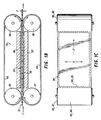
- an additional annealing and/or cooling apparatus designated generally by numeral 39, wherein the sheet 13 is restrained between belts 43 and 44 trained around roller pairs 45-46 and 47-48, respectively, while being annealed, cooled or otherwise heat-treated directly after emerging from the twin belt machine 10 of Figure 1.
- the belts 43 and 44 are urged into engagement with the sheet 13 by opposed platens 49 and 50 which may be heated or cooled.
- the platens 49 and 50 isobarically support belts 43 and 44 on an oil film contained by dynamic peripheral seals 54 and 55.
- the apparatus 13 of Figures 1B and 1C provides a flexible system accommodating a number of situations. For example, some products, such as amorphous polymer, may need relatively long annealing times in which case the platens 49 and 50 of apparatus 39 may be heated.
- a loop 80 of the patterned metallic foil 81 may be inserted between the belt 28 and the feedstock 11 and if desired between the belt 29 and the feedstock in order to emboss a pattern on the final sheet 13 corresponding to patterns existing on the metallic foil.
- the flat sheets 13 produced by the processes and apparatus illustrated in Figures 1-7 are substantially biaxally oriented, semi-crystalline or amorphous, thermoplastic, polymer sheets which, unlike those of U.S. 4,282,277, have substantially uniform strain throughout the thicknesses thereof.
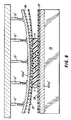
- the bottom platen 42(a)' is flat and is supported by a rigid frame 75.
- arrays of closely spaced roller supports, 96 and 97, respectively, are disposed to insure that the belts run freely over the platens.
- the final product as exemplified by sheet 13, if made from a semi-crystalline polymer, is characterized by having a microstructure comprised of spherulitic crystalline aggregates which are compressed transversely to the plane of the product and are biaxially oriented in the plane of the product.
- the product is substantially devoid of any process induced microvoids and microfibrils.
- the product retains at least the same density as the unoriented polymer and is less permeable than a product made by conventional solid state stretching processes.
- thermoplastic sheet 13 may contain up to about sixty weight percent filler material.
- hydrostatically extruded BEXOR it was very difficult, if not impossible, to produce on a commercial scale oriented thermoplastic material which contains a substantial quantity of filler material.
- thermoplastic polymer When a semi-crystalline thermoplastic polymer contains a filler and is worked in accordance with the present invention, the thermoplastic polymer can be successfully oriented as described above and will have a structure unlike previous products, in that it is substantially devoid of microvoids and microfibrils and having within the thermoplastic polymer discrete, plateletlike, spherulitic, crystalline aggregates which are compressed transversely to the plane of the product and biaxially oriented in the plane of the sheet 13.
- the sheet product 13 can be used as is for structural or like purposes, or other uses, but will in many cases be used as a blank to form final products such as, for example, solid state formed products.
- final products such as, for example, solid state formed products.
- Many solid state formed products are so called stretch-formed products where the thermoplastic polymer is formed in a die under sufficient heat and pressure to deform the thermoplastic polymer in a solid state.
- the properties of the final solid state stretch-formed product will depend primarily upon the extent of deformation.
- the solid state stretch-formed products made from the biaxially oriented sheet blanks of the invention have superior properties compared with the properties of similar products made from unoriented thermoplastic polymer.
- stretch-formed products made from the biaxially oriented thermoplastic polymer sheet blanks of the invention will have a more uniform cross section since the superior properties of the oriented thermoplastic polymer prevent the thermoplastic polymer from "necking" down appreciably.
- the resulting product is thus more uniformly stiff than would otherwise be the case.
- the actual properties of the stretch-formed product may vary from place to place in the product depending upon the amount of work or deformation applied to any given portion of the product.
- Any flanges on the product, being substantially unworked, will have the same superior characteristic properties as the original biaxially oriented blank. In some products this is very important as the flanges provide important structural strength and toughness.
- the polymer feedstock is polypropylene, it might, for example, have an initial thickness of 0.5 inches (12.7 mm) with the biaxially oriented sheet 13 having a thickness of approximately one-tenth of an inch (2.54 mm).
- the polypropylene utilized has approximately 65-70% crystallinity. Density measurements indicate that there are little or no changes in crystallinity from the feedstock 11 to the sheet 13, the only change being in morphology.
- biaxial orientation improves impact strength by absorbing impact energy through delamination in contrast to energy absorbed by puncture or through cracking as is the case with unoriented polymers.
- Initial markets for products produced by the apparatus and method of the instant invention are ballistic shields, formed articles requiring superior physical and mechanical properties, and punched strips to produce terminal boards for the electronics industry.
- the invention in its preferred embodiment is directed to a process for the continuous production of rectangular, relatively rigid, thermoplastic sheets 13 having substantially uniform thickness in the range of 0.03 inches (0.76mm) to 0.5 inches (2.7mm) and a thickness-to-width ratio less than about 0.04.
- the sheets consist of a compressively, biaxially oriented structure with essentially the same orientation ratio in all planes of the sheets.
- the sheets 13 have the combined properties of high strength, stiffness, low temperature impact and uniform thermal expansion.
- the sheets 13 are made by solid-state, continuous wedge forming of rectangular slabstock 11 between two flat converging belts 28 and 29 followed by substantially immediate post treatment in zone 17 between parallel belts 28, 29 to stabilize the product structure at the biaxial orientation ratio desired.
- the slabstock which may contain up to 60% by weight of filler simultaneously spreads in both the transverse and longitudinal directions while between the belts 28 and 29 to produce a biaxially oriented sheet structure with an elongation in both directions of at least 100%.
- the process is capable of producing a continuous sheet of indeterminant length.
- the sheets may be discontinuous with the length of each sheet 13 being more than 20 feet (6.1m) in order to provide discrete sheets which can be conveniently handled and if necessary cut into shorter lengths for whatever purposes desired.
- the apparatus 10 continues to operate and maintain its temperature and pressure parameters in the intervals between insertion of billets in the production of discrete sheets 13.
- the sheets 13 produced by the process of this invention ordinarily are rectangular in cross-section and in the plane of the sheet are formed of a semi-crystalline thermoplastic polymer which is biaxially oriented.
- the sheets 13 have a density which is equal to, or greater than, the density of the unoriented polymer and have a microstructure substantially devoid of process-induced microvoids and microfibrils.
- each of the sheets 13 are comprised of compressed, plateletlike, crystalline aggregates 101, which are biaxially oriented in the plane of sheet extent with the sheets having a substantially uniform distribution of deformed crystalline aggregates over the length and width thereof and through the thickness thereof.
- the sheets of this invention are preferably produced as continuous, rectangular, polymer sheets of substantially uniform thickness with each of the sheets being comprised of a biaxially oriented, semi-crystalline, thermoplastic polymer having a density which is at least equal to the density of the polymer in the unoriented state.
- Each sheet has a microstructure substantially devoid of process-induced microvoids and microfibrils, and being further comprised of discrete, platelike, crystalline aggregates formed from compressed, originally spherulitic aggregates; which aggregates are biaxially oriented in the plane of the sheet extent.
- Each sheet has substantially uniformly deformed crystalline aggregates over the length and width thereof and through the thickness thereof, resulting in a sheet which is thermally stable with substantially constant mechanical and physical properties in all planes.
- Each sheet preferably has a thickness from about 0.03 inches (0076mm) to about 0.5 inches (12.7mm) e.g., 0.05 inches (1.27mm) to 0.3 inches (7.62mm) preferably, with a thickness-to-width ratio less than about 0.04, e.g., 0.001 to 0.01, preferably.
- the sheets are produced in lengths of at least 20 feet (6.1m), optionally, but preferably for some end uses.
- the sheet may contain filler material included therein which comprises up to 60% by weight of the sheet.
- rectangular, biaxially oriented sheet is continuously produced from a thermoplastic amorphous polymer, the sheet having a density which is at least equal to the density of the unoriented amorphous thermoplastic polymer.
- This amorphous sheet has a substantially uniform distribution of strain over the length and width thereof, and through the thickness thereof, and has substantially constant mechanical and physical properties in all planes.
- Orientation ratios in the range of 1.5 to 4.0 are generally considered most desirable for materials such as, for example, polypropylene.
- machinery capable of maintaining pressures on the order of 1000 psi (70.3 kg/cm2).
- Such machines as the twin belt machines marketed by Kurt Held and Edward Kusters of the German Federal Republic can maintain such pressures; however, these machines require modification to incorporate a high pressure, fixed angle entry zone.
- Materials such as polyethylene, ultra high molecular weight polyethylene, polypropylene, and amorphous polyvinyl chloride have been successfully biaxially oriented to orientation ratios above 2.0 at pressures between 650 psi (45.7 kg/cm2) and 1000 psi (70.3 kg/cm2). At these pressures, materials such as polymethylmethacrylate which is an amorphous material, and polyacetal homopolymer which is a semi-crystalline material, have also been biaxially oriented.
- twin-belt forging of polypropylene into biaxially oriented sheet in accordance with this invention.
- Isotactic polypropylene slabs of Himont Corporation HE6023 produced by melt extrusion, were cut into strips 13.2 centimeters (5.2 inches) wide and 30 centimeters (11.8 inches) long. The thickness of the strips was 1.27 centimeters (0.50 inches). The strips had a density of 0.903, a crystallinity of 67.8% and peak crystalline melting temperature of 169°C (336°F) determined by differential scan calorimetry (D.S.C.). A melt flow index of 0.4 dgm/min was measured on material machined from the slabs.
- the surfaces of the strips were lightly scored in a one centimeter square (0.39 inches) grid pattern.
- the gridded strips were heated in an air circulating oven for 60 minutes at an indicated temperature of 146°C (295°F) and placed on the bottom belt of a twin-belt machine with the center line of the length of the strip along the center line of the belt and parallel to the machine length.
- the machine had the following dimensions - Deformation zone length 19.5 centimeters (7.7 inches), Deformation angle 3.14°, Parallel zone 31.0 centimeters (12.2 inches), Belt width 66.0 centimeters (26.0 inches), Belt spacing at feed rolls 5.8 centimeters (2.3 inches), Belt Spacing at exit (downstream) rolls 0.2 centimeters (0.08 inches).
- the machine differed from that shown in Figure 1 in that the parallel zone was not supported by platens.
- Two strips with butted ends were fed through the twin belt machine described above at a belt speed of 1.2 meters/minute (3.9 feet/minute).
- the machine was stopped when the first strip had emerged from the downstream rolls and the second strip was completed contained within the deformation and parallel zones of the machine.
- the machine was force air cooled to ambient temperature. On removal of the cooled strip from the machine, it was found to be substantially, uniformly, biaxially oriented at the end of the deformation zone.
- sheets were formed from high density polyethylene, ultra-high molecular weight polyethylene, polyacetal, -PVC and polymethylmethacrylates.
- Flexible polymer sheets can also be formed, for example, from polypropylene containing 30 parts by weight micaflakes or talc or 40 parts calcium carbonate or 60 parts alumina trihydrate flame retardant.
- the aforedescribed process and apparatus can produce flat sheet of any width.
- a sheet having a width of forty-eight inches can accommodate a host of existing situations for transport, storage, structures, and processing machinery.
- a forty-eight inch sheet may be conveniently produced from a billet or blank which is eighteen inches wide and half an inch thick. Sheet width is limited only by mechanical limitations in the belt equipment.
- B.O.R. biaxial orientation ratio
Landscapes
- Engineering & Computer Science (AREA)
- Mechanical Engineering (AREA)
- Manufacturing & Machinery (AREA)
- Shaping By String And By Release Of Stress In Plastics And The Like (AREA)
- Casting Or Compression Moulding Of Plastics Or The Like (AREA)
- Extrusion Moulding Of Plastics Or The Like (AREA)
Abstract
Claims (11)
- Procédé pour produire un produit (13) à base de polymère orienté selon deux axes, selon lequel on introduit une charge polymère solide (11) selon une direction axiale entre au moins deux surfaces sans fin opposées en mouvement (28, 29) et on oriente le matériau (11) selon deux axes en allongeant le matériau (11) dans une direction longitudinale (z) alors que l'on étire simultanément le matériau (11) dans une direction latérale (x) en réduisant l'épaisseur du matériau pendant que le matériau (11) avance au moyen des surfaces (28, 29) alors que les surfaces sont en mouvement, la température de la charge (11) et des surfaces (28, 29) étant maintenue entre la température de transition vitreuse et la température d'écoulement visqueux du polymère pendant que la charge (11) est orientée selon deux axes, et la charge (11) est retenue après que son épaisseur a été réduite jusqu'à celle du produit polymère (13) pendant une durée suffisante pour stabiliser la morphologie et la configuration de ce dernier, caractérisé en ce que les surfaces sans fin opposées en mouvement (28, 29) convergent dans le sens de la progression de la charge sous un angle (α) dans la gamme approximative de plus de 0 degré à moins de 6 degrés.
- Procédé selon la revendication 1, dans lequel les surfaces en mouvement (28, 29) convergent l'une vers l'autre sous un angle (α)dans la gamme approximative de 2,48° à 3,14°.
- Procédé selon la revendication 2, dans lequel les surfaces en mouvement (28, 29) sont chauffées à une température entre la température de transition vitreuse et la température d'écoulement visqueux du polymère avant de commencer à mettre en oeuvre le procédé.
- Procédé selon la revendication 1, dans lequel le polymère est un polymère semi-cristallin.
- Procédé selon la revendication 4, dans lequel le polymère est choisi parmi le polypropylène, le polyéthylène, le polyéthylène de ultra-haut poids moléculaire, un polyacétal, un polyamide, le polyéthylène téréphtalate et le polybutylène téréphtalate.
- Procédé selon la revendication 1, dans lequel le polymère est un matériau morphe.
- Procédé selon la revendication 6, dans lequel le matériau amorphe est choisi parmi le groupe du poly(chlorure de vinyle), le poly(méthacrylate de méthyle), un polycarbonate et le polyéthylène téréphtalate.
- Procédé selon la revendication 1, qui opère en continu et dans lequel l'étape de retenue de la charge (11) a lieu immédiatement après l'étape de déformation du matériau.
- Procédé selon l'une quelconque des revendications 1 à 8, dans lequel le produit polymère (13) est sous forme d'une feuille et dans lequel la charge polymère solide est de section rectangulaire.
- Procédé selon l'une quelconque des revendications 4, 5 et 8, dans lequel le produit polymère est sous forme d'une feuille (13) et la charge (11) possède une partie centrale et des parties extrêmes, et dans lequel le frottement entre le matériau et les surfaces sans fin opposées est compensé en appliquant au matériau une pression supérieure sur la partie centrale que sur les parties extrêmes.
- Procédé selon la revendication 1, dans lequel les surfaces sans fin opposées au mouvement se trouvent sur des rubans.
Applications Claiming Priority (3)
| Application Number | Priority Date | Filing Date | Title |
|---|---|---|---|
| US06/806,994 US4789514A (en) | 1985-12-09 | 1985-12-09 | Methods of producing biaxially oriented polymer sheet |
| US06/933,951 US4874657A (en) | 1985-12-09 | 1986-11-24 | Methods of producing biaxially-oriented polymer product, and the product produced thereby |
| PCT/US1988/001569 WO1989010828A1 (fr) | 1985-12-09 | 1988-05-11 | Procedes pour fabriquer un produit polymere a orientation biaxiale, et produit ainsi obtenu |
Publications (3)
| Publication Number | Publication Date |
|---|---|
| EP0414683A1 EP0414683A1 (fr) | 1991-03-06 |
| EP0414683A4 EP0414683A4 (en) | 1991-06-05 |
| EP0414683B1 true EP0414683B1 (fr) | 1995-09-27 |
Family
ID=27122946
Family Applications (2)
| Application Number | Title | Priority Date | Filing Date |
|---|---|---|---|
| EP86309572A Withdrawn EP0226434A2 (fr) | 1985-12-09 | 1986-12-09 | Méthode et dispositif pour produire une feuille en polymère orienté biaxialement et feuille en polymère ainsi produite |
| EP88908845A Expired - Lifetime EP0414683B1 (fr) | 1985-12-09 | 1988-05-11 | Procedes pour fabriquer un produit polymere a orientation biaxiale, et produit ainsi obtenu |
Family Applications Before (1)
| Application Number | Title | Priority Date | Filing Date |
|---|---|---|---|
| EP86309572A Withdrawn EP0226434A2 (fr) | 1985-12-09 | 1986-12-09 | Méthode et dispositif pour produire une feuille en polymère orienté biaxialement et feuille en polymère ainsi produite |
Country Status (5)
| Country | Link |
|---|---|
| US (2) | US4789514A (fr) |
| EP (2) | EP0226434A2 (fr) |
| JP (1) | JPS62183326A (fr) |
| DE (1) | DE3854528T2 (fr) |
| WO (1) | WO1989010828A1 (fr) |
Families Citing this family (36)
| Publication number | Priority date | Publication date | Assignee | Title |
|---|---|---|---|---|
| US4789514A (en) * | 1985-12-09 | 1988-12-06 | Aluminum Company Of America | Methods of producing biaxially oriented polymer sheet |
| US5049347A (en) * | 1988-11-22 | 1991-09-17 | The University Of Pittsburgh | Method for producing doubly oriented polymers |
| US5171815A (en) * | 1986-10-22 | 1992-12-15 | University Of Pittsburgh | Method for producing doubly oriented polymers |
| US5053180A (en) * | 1986-11-24 | 1991-10-01 | Aluminum Company Of America | Process for deformation of amorphous polymers |
| JPH01174339A (ja) * | 1987-12-28 | 1989-07-10 | Nippi Koraagen Kogyo Kk | コラーゲン質シート及びその製造方法 |
| JP2569161B2 (ja) * | 1988-05-11 | 1997-01-08 | アルミニウム コンパニー オブ アメリカ | 2軸延伸ポリマーシートを製造する方法と、その方法によって製造されたシート |
| DE3816855A1 (de) * | 1988-05-18 | 1989-11-23 | Roehm Gmbh | Verfahren zur herstellung kratzfest beschichteter kunststoffbahnen |
| JP2606894B2 (ja) * | 1988-08-18 | 1997-05-07 | チッソ株式会社 | 圧延熱処理フィルムまたはシートの製造方法 |
| JPH02196626A (ja) * | 1989-01-26 | 1990-08-03 | Chisso Corp | 圧延フィルムまたはシートの製造方法 |
| US5030402A (en) * | 1989-03-17 | 1991-07-09 | Zachariades Anagnostis E | Process for producing a new class of ultra-high-molecular-weight polyethylene orthopaedic prostheses with enhanced mechanical properties |
| EP0424674A3 (en) * | 1989-09-22 | 1991-06-12 | Daikin Industries, Limited | Extrusion molding die |
| GB2236504A (en) * | 1989-10-07 | 1991-04-10 | Liberato Mascia | Convergent-divergent dies to produce biaxial orientation in plastics products by extrusion or pultrusion |
| US5039462A (en) * | 1990-01-08 | 1991-08-13 | Aluminum Company Of America | Method and apparatus for producing biaxially oriented polymer sheet |
| JP2603353B2 (ja) * | 1990-04-20 | 1997-04-23 | 日本石油株式会社 | ポリオレフィン材料の連続的製造方法 |
| US5169589A (en) * | 1990-06-27 | 1992-12-08 | Symplastics Limited | Process and apparatus for deformation of solid thermoplastic polymers and related products |
| US5352110A (en) * | 1991-03-12 | 1994-10-04 | Takeda Chemical Industries, Ltd. | Molding apparatus for molding fiber reinforced resin with plurality of roll pairs |
| US5326245A (en) * | 1992-06-26 | 1994-07-05 | International Business Machines Corporation | Apparatus for extruding materials that exhibit anisotropic properties due to molecular or fibril orientation as a result of the extrusion process |
| US5312238A (en) * | 1992-06-26 | 1994-05-17 | International Business Machines Corporation | Apparatus for extruding materials that exhibit anisotropic properties by means of reciprocating die surfaces |
| DE4301594C2 (de) * | 1993-01-21 | 2002-10-31 | Dieffenbacher Gmbh Maschf | Verfahren und Anlage zur Herstellung von Spanplatten |
| EP0875349A4 (fr) * | 1995-12-15 | 1998-12-30 | Daikin Ind Ltd | Procede de production de feuilles de polytetrafluoroethylene, appareil y servant et granuleuse petrisseuse |
| US5695698A (en) * | 1996-01-30 | 1997-12-09 | Ajji; Abdellah | Production of oriented plastics by roll-drawing |
| SE513201C2 (sv) * | 1997-07-03 | 2000-07-31 | Sca Hygiene Prod Ab | Anordning för luftläggning av fiber- eller granulatmaterial |
| US5932150A (en) * | 1997-08-25 | 1999-08-03 | Holo-Source Corporation | Replication of diffraction images in oriented films |
| JP4121700B2 (ja) * | 1997-10-31 | 2008-07-23 | ザ・グッドイヤー・タイヤ・アンド・ラバー・カンパニー | 重合体案内装置、及び流れ案内インサート |
| RU2163546C1 (ru) * | 1999-06-23 | 2001-02-27 | Закрытое акционерное общество "Проектно-строительное предприятие "ИНСЕРВ" | Устройство для футерования металлической трубы пластмассовой оболочкой |
| SE9903255L (sv) * | 1999-09-13 | 2001-03-14 | Aamic Ab | Förfarande för att framställa en matris samt en matris sålunda framställd.(Hybridtillämpningen) |
| US7651757B2 (en) * | 2005-08-31 | 2010-01-26 | Sealed Air Corporation (Us) | Floor underlayment |
| US7736579B2 (en) * | 2006-07-21 | 2010-06-15 | Quadrant Epp Ag | Production of UHMWPE sheet materials |
| US7758797B2 (en) * | 2006-07-21 | 2010-07-20 | Quadrant Epp Ag | Production of UHMWPE sheet materials |
| US7803450B2 (en) * | 2006-07-21 | 2010-09-28 | Quadrant Epp Ag | Production of UHMWPE sheet materials |
| US7758796B2 (en) * | 2006-07-21 | 2010-07-20 | Quadrant Epp Ag | Production of UHMWPE sheet materials |
| FR3000971B1 (fr) | 2013-01-11 | 2016-05-27 | Saint Gobain Isover | Produit d'isolation thermique a base de laine minerale et procede de fabrication du produit |
| US10427347B2 (en) | 2016-02-19 | 2019-10-01 | Rochling Engineering Plastics | Ram extruding thin panels of UHMW polymers |
| US11292172B2 (en) | 2016-02-19 | 2022-04-05 | Rochling Engineering Plastics | Ram extruding thin panels of UHMW polymers |
| US10414082B2 (en) | 2016-02-19 | 2019-09-17 | Rochling Engineering Plastics | Ram extruding thin panels of UHMW polymers |
| US12011868B2 (en) | 2021-09-14 | 2024-06-18 | Case Western Reserve University | High elastomeric modulus and strength polymer constructs and methods of forming |
Family Cites Families (25)
| Publication number | Priority date | Publication date | Assignee | Title |
|---|---|---|---|---|
| CA577185A (fr) * | 1959-06-02 | E.I. Du Pont De Nemours And Company | Orientation de pellicule de terephtalate de polyethylene | |
| US2732591A (en) * | 1956-01-31 | whittum | ||
| US1952038A (en) * | 1927-11-25 | 1934-03-20 | Carey Philip Mfg Co | Process of extruding sheet material |
| US1821552A (en) * | 1929-03-19 | 1931-09-01 | Patent & Licensing Corp | Roofing and method of making same |
| US2611150A (en) * | 1949-04-26 | 1952-09-23 | Wingfoot Corp | Apparatus and method for performing sheeting or coating operations on or with plastic material |
| US3354023A (en) * | 1963-04-22 | 1967-11-21 | Du Pont | Oriented polymers |
| US3478138A (en) * | 1966-12-01 | 1969-11-11 | Charles E Friesner | Method of making thermoplastic articles having non-planar surface contours |
| NL6701289A (fr) * | 1967-01-27 | 1967-04-25 | ||
| US3499957A (en) * | 1968-09-11 | 1970-03-10 | Union Carbide Corp | Method for producing substantially uniform calendered material |
| US3714320A (en) * | 1968-09-30 | 1973-01-30 | Shell Oil Co | Cold extrusion process |
| US3852387A (en) * | 1970-04-24 | 1974-12-03 | James W White | Double belt plastic sheet forming and take-off method |
| US4151245A (en) * | 1972-12-06 | 1979-04-24 | Matsushita Electric Industrial Co., Ltd. | Method for stretching a thermo-softening high molecular film |
| DE2433242A1 (de) * | 1974-07-11 | 1976-01-29 | Gofini Ag | Verfahren zum betrieb einer anlage zur herstellung eines kunststoffprofilstranges und fuer das verfahren ausgeruestete anlage |
| US3939243A (en) * | 1974-08-19 | 1976-02-17 | The Dow Chemical Company | Tube treating and method |
| US3963813A (en) * | 1974-12-24 | 1976-06-15 | The United States Of America As Represented By The Secretary Of The Navy | Cuspated sheet forming |
| DE2706688C2 (de) * | 1977-02-17 | 1982-05-06 | Röhm GmbH, 6100 Darmstadt | Verfahren und Vorrichtung zum kontinuierlichen Recken eines Kunststoffbandes |
| US4282277A (en) * | 1978-09-08 | 1981-08-04 | Bethlehem Steel Corporation | Oriented, semi-crystalline polymer product and method and apparatus for producing such product |
| US4234530A (en) * | 1978-09-27 | 1980-11-18 | Thiel Alfons W | Method for the manufacture of thin-walled shaped articles of crystalline thermoplastic material |
| US4440702A (en) * | 1980-02-08 | 1984-04-03 | Rca Corporation | Method and apparatus for making thin-walled plastic articles |
| JPS57110421A (en) * | 1980-12-29 | 1982-07-09 | Sakushin Kogyo Kk | Apparatus for molding long synthetic resin plate or sheet |
| US4361527A (en) * | 1981-10-21 | 1982-11-30 | Ppg Industries, Inc. | Method of forming stretched acrylic sheets |
| SE435596B (sv) * | 1982-10-14 | 1984-10-08 | Plm Ab | Sett for bildande av en artikel genom formning och kristallisation av material i veggen hos ett emne av termoplastmaterial vid dettas tjockleksreduktion samt mekaniskt formningsorgan herfor |
| US4629650A (en) * | 1982-12-30 | 1986-12-16 | Asahi Kasei Kogyo Kabushiki Kaisha | Process for producing molded thermoplastic resin |
| GB2161105B (en) * | 1984-07-04 | 1988-06-15 | Fred Whitehead | Calendar or roll assembly |
| US4789514A (en) * | 1985-12-09 | 1988-12-06 | Aluminum Company Of America | Methods of producing biaxially oriented polymer sheet |
-
1985
- 1985-12-09 US US06/806,994 patent/US4789514A/en not_active Expired - Fee Related
-
1986
- 1986-11-24 US US06/933,951 patent/US4874657A/en not_active Expired - Fee Related
- 1986-12-09 JP JP61293313A patent/JPS62183326A/ja active Pending
- 1986-12-09 EP EP86309572A patent/EP0226434A2/fr not_active Withdrawn
-
1988
- 1988-05-11 WO PCT/US1988/001569 patent/WO1989010828A1/fr not_active Ceased
- 1988-05-11 DE DE3854528T patent/DE3854528T2/de not_active Expired - Fee Related
- 1988-05-11 EP EP88908845A patent/EP0414683B1/fr not_active Expired - Lifetime
Also Published As
| Publication number | Publication date |
|---|---|
| WO1989010828A1 (fr) | 1989-11-16 |
| EP0226434A2 (fr) | 1987-06-24 |
| JPS62183326A (ja) | 1987-08-11 |
| DE3854528D1 (de) | 1995-11-02 |
| EP0414683A1 (fr) | 1991-03-06 |
| EP0414683A4 (en) | 1991-06-05 |
| DE3854528T2 (de) | 1996-05-15 |
| US4789514A (en) | 1988-12-06 |
| US4874657A (en) | 1989-10-17 |
Similar Documents
| Publication | Publication Date | Title |
|---|---|---|
| US4956140A (en) | Methods of and apparatus for producing biaxially oriented polymer product | |
| US4874657A (en) | Methods of producing biaxially-oriented polymer product, and the product produced thereby | |
| EP0624126B1 (fr) | Feuilles stratifiees | |
| US3320225A (en) | Method for manufacturing a plastic hinge | |
| EP0461488B1 (fr) | Procédé pour fabriquer des feuilles ou des plaques massives lissées extrudées en matière thermoplastique | |
| US5053180A (en) | Process for deformation of amorphous polymers | |
| US3394045A (en) | Polypropylene sheet and method | |
| EP0614748A1 (fr) | Procédé pour la fabrication de films ou plaques en résine thermoplastique | |
| US5169587A (en) | Process for extruding large oriented polymer shapes | |
| US4514351A (en) | Process for the manufacture of articles of high mechanical strength from thermoplastic synthetic resins | |
| US4521265A (en) | Process for preparing laminated plate | |
| GB1601172A (en) | Biaxial stretching of synthetic resin materials | |
| DE3010920A1 (de) | Verfahren zur kontinuierlichen erzeugung eines gestreckten kunststofffilm- und -schaumblattmaterials | |
| CA2195580A1 (fr) | Production de plastiques orientes par laminage-etirage | |
| US4877393A (en) | Apparatus for producing biaxially oriented polymer sheet | |
| US4435345A (en) | Process for the production of a continuous sheet of foamed synthetic, thermoplastic polymer by extrusion | |
| EP0038559B1 (fr) | Procédé pour la fabrication d'une feuille résistant à l'abrasion et appareil pour sa fabrication | |
| US5133922A (en) | Process for the production of panels, webs, and profiles from plastic materials | |
| US5039462A (en) | Method and apparatus for producing biaxially oriented polymer sheet | |
| JP2569161B2 (ja) | 2軸延伸ポリマーシートを製造する方法と、その方法によって製造されたシート | |
| GB2306380A (en) | Providing stabilized lengths of extruded strips | |
| EP0342265B1 (fr) | Procédé pour la fabrication de films ou plaques en polyoléfines à résistance mécanique plus élevée | |
| DE1629473C (de) | Verfahren zur Herstellung von gewell ten Folien aus thermoplastischem Material | |
| DE69627383T2 (de) | Wärmeübertragungsrolle zur herstellung einer laminierten platte, heizverfahren einer metallischen folie mittels einer wärmeübertragungsrolle und vorrichtung zur herstellung einer laminierten folie mit einer wärmeübertragungsrolle | |
| DE29623540U1 (de) | Amorphe, transparente Platte aus einem kristallisierbaren Thermoplast |
Legal Events
| Date | Code | Title | Description |
|---|---|---|---|
| PUAI | Public reference made under article 153(3) epc to a published international application that has entered the european phase |
Free format text: ORIGINAL CODE: 0009012 |
|
| 17P | Request for examination filed |
Effective date: 19901106 |
|
| AK | Designated contracting states |
Kind code of ref document: A1 Designated state(s): DE |
|
| A4 | Supplementary search report drawn up and despatched |
Effective date: 19910417 |
|
| AK | Designated contracting states |
Kind code of ref document: A4 Designated state(s): DE |
|
| 17Q | First examination report despatched |
Effective date: 19920511 |
|
| GRAA | (expected) grant |
Free format text: ORIGINAL CODE: 0009210 |
|
| AK | Designated contracting states |
Kind code of ref document: B1 Designated state(s): DE |
|
| REF | Corresponds to: |
Ref document number: 3854528 Country of ref document: DE Date of ref document: 19951102 |
|
| PGFP | Annual fee paid to national office [announced via postgrant information from national office to epo] |
Ref country code: DE Payment date: 19960418 Year of fee payment: 9 |
|
| PLBE | No opposition filed within time limit |
Free format text: ORIGINAL CODE: 0009261 |
|
| STAA | Information on the status of an ep patent application or granted ep patent |
Free format text: STATUS: NO OPPOSITION FILED WITHIN TIME LIMIT |
|
| 26N | No opposition filed | ||
| PG25 | Lapsed in a contracting state [announced via postgrant information from national office to epo] |
Ref country code: DE Free format text: LAPSE BECAUSE OF NON-PAYMENT OF DUE FEES Effective date: 19980203 |