EP0414896B1 - Dekomaterial mit farbdynamischer oberfläche und verfahren zur herstellung - Google Patents
Dekomaterial mit farbdynamischer oberfläche und verfahren zur herstellung Download PDFInfo
- Publication number
- EP0414896B1 EP0414896B1 EP89907371A EP89907371A EP0414896B1 EP 0414896 B1 EP0414896 B1 EP 0414896B1 EP 89907371 A EP89907371 A EP 89907371A EP 89907371 A EP89907371 A EP 89907371A EP 0414896 B1 EP0414896 B1 EP 0414896B1
- Authority
- EP
- European Patent Office
- Prior art keywords
- dimensional elements
- colour
- elements
- texture
- dimensional
- Prior art date
- Legal status (The legal status is an assumption and is not a legal conclusion. Google has not performed a legal analysis and makes no representation as to the accuracy of the status listed.)
- Expired - Lifetime
Links
- 239000000463 material Substances 0.000 title claims abstract description 97
- 238000000034 method Methods 0.000 title claims description 55
- 239000003086 colorant Substances 0.000 claims abstract description 48
- 230000003287 optical effect Effects 0.000 claims abstract description 42
- 239000000975 dye Substances 0.000 claims description 17
- 238000005507 spraying Methods 0.000 claims description 16
- 230000008021 deposition Effects 0.000 claims description 12
- 239000000126 substance Substances 0.000 claims description 12
- 239000010410 layer Substances 0.000 claims description 9
- 239000011241 protective layer Substances 0.000 claims description 6
- 239000007921 spray Substances 0.000 claims description 3
- 238000004519 manufacturing process Methods 0.000 description 29
- 230000000694 effects Effects 0.000 description 21
- 239000000919 ceramic Substances 0.000 description 16
- 239000002184 metal Substances 0.000 description 16
- 229910052751 metal Inorganic materials 0.000 description 16
- 238000000151 deposition Methods 0.000 description 13
- 239000011521 glass Substances 0.000 description 13
- 230000000007 visual effect Effects 0.000 description 12
- 239000004744 fabric Substances 0.000 description 11
- 230000008569 process Effects 0.000 description 9
- 230000015572 biosynthetic process Effects 0.000 description 8
- 238000010276 construction Methods 0.000 description 8
- 238000000926 separation method Methods 0.000 description 8
- 230000008901 benefit Effects 0.000 description 7
- 238000000576 coating method Methods 0.000 description 7
- 238000005096 rolling process Methods 0.000 description 7
- 230000008859 change Effects 0.000 description 6
- 239000004567 concrete Substances 0.000 description 6
- 238000011109 contamination Methods 0.000 description 4
- 230000007423 decrease Effects 0.000 description 4
- 239000012634 fragment Substances 0.000 description 4
- 230000001788 irregular Effects 0.000 description 4
- 238000002156 mixing Methods 0.000 description 4
- 239000004033 plastic Substances 0.000 description 4
- 238000001228 spectrum Methods 0.000 description 4
- 239000011449 brick Substances 0.000 description 3
- 238000004040 coloring Methods 0.000 description 3
- 230000003247 decreasing effect Effects 0.000 description 3
- 230000004907 flux Effects 0.000 description 3
- 239000006260 foam Substances 0.000 description 3
- 239000011381 foam concrete Substances 0.000 description 3
- 238000005286 illumination Methods 0.000 description 3
- 230000004048 modification Effects 0.000 description 3
- 238000012986 modification Methods 0.000 description 3
- 230000008447 perception Effects 0.000 description 3
- 238000003825 pressing Methods 0.000 description 3
- 239000000443 aerosol Substances 0.000 description 2
- 238000005266 casting Methods 0.000 description 2
- 230000001413 cellular effect Effects 0.000 description 2
- 230000000739 chaotic effect Effects 0.000 description 2
- 150000001875 compounds Chemical class 0.000 description 2
- 125000004122 cyclic group Chemical group 0.000 description 2
- 238000004043 dyeing Methods 0.000 description 2
- 230000004438 eyesight Effects 0.000 description 2
- 239000011494 foam glass Substances 0.000 description 2
- 238000005187 foaming Methods 0.000 description 2
- 239000010440 gypsum Substances 0.000 description 2
- 229910052602 gypsum Inorganic materials 0.000 description 2
- 238000003754 machining Methods 0.000 description 2
- 150000002739 metals Chemical class 0.000 description 2
- 238000005554 pickling Methods 0.000 description 2
- 230000001681 protective effect Effects 0.000 description 2
- DGOBMKYRQHEFGQ-UHFFFAOYSA-L acid green 5 Chemical compound [Na+].[Na+].C=1C=C(C(=C2C=CC(C=C2)=[N+](CC)CC=2C=C(C=CC=2)S([O-])(=O)=O)C=2C=CC(=CC=2)S([O-])(=O)=O)C=CC=1N(CC)CC1=CC=CC(S([O-])(=O)=O)=C1 DGOBMKYRQHEFGQ-UHFFFAOYSA-L 0.000 description 1
- 230000009471 action Effects 0.000 description 1
- 230000001154 acute effect Effects 0.000 description 1
- 238000004026 adhesive bonding Methods 0.000 description 1
- VQLYBLABXAHUDN-UHFFFAOYSA-N bis(4-fluorophenyl)-methyl-(1,2,4-triazol-1-ylmethyl)silane;methyl n-(1h-benzimidazol-2-yl)carbamate Chemical compound C1=CC=C2NC(NC(=O)OC)=NC2=C1.C=1C=C(F)C=CC=1[Si](C=1C=CC(F)=CC=1)(C)CN1C=NC=N1 VQLYBLABXAHUDN-UHFFFAOYSA-N 0.000 description 1
- 239000004568 cement Substances 0.000 description 1
- 238000006243 chemical reaction Methods 0.000 description 1
- 239000011248 coating agent Substances 0.000 description 1
- 230000004456 color vision Effects 0.000 description 1
- 238000009500 colour coating Methods 0.000 description 1
- 230000002860 competitive effect Effects 0.000 description 1
- 238000002788 crimping Methods 0.000 description 1
- 230000018109 developmental process Effects 0.000 description 1
- 238000006073 displacement reaction Methods 0.000 description 1
- 238000009826 distribution Methods 0.000 description 1
- 239000000428 dust Substances 0.000 description 1
- 229920001971 elastomer Polymers 0.000 description 1
- 239000000839 emulsion Substances 0.000 description 1
- 238000001704 evaporation Methods 0.000 description 1
- 230000008020 evaporation Effects 0.000 description 1
- 238000001125 extrusion Methods 0.000 description 1
- 239000005357 flat glass Substances 0.000 description 1
- 239000006261 foam material Substances 0.000 description 1
- 230000006870 function Effects 0.000 description 1
- 238000000227 grinding Methods 0.000 description 1
- 230000012447 hatching Effects 0.000 description 1
- 238000010438 heat treatment Methods 0.000 description 1
- 238000009434 installation Methods 0.000 description 1
- 238000005304 joining Methods 0.000 description 1
- 238000011031 large-scale manufacturing process Methods 0.000 description 1
- 239000010985 leather Substances 0.000 description 1
- 238000012423 maintenance Methods 0.000 description 1
- 238000003801 milling Methods 0.000 description 1
- 239000004570 mortar (masonry) Substances 0.000 description 1
- 238000000465 moulding Methods 0.000 description 1
- 239000002245 particle Substances 0.000 description 1
- 238000005192 partition Methods 0.000 description 1
- -1 polymeric Substances 0.000 description 1
- 230000001376 precipitating effect Effects 0.000 description 1
- 238000001556 precipitation Methods 0.000 description 1
- 238000007639 printing Methods 0.000 description 1
- 230000001105 regulatory effect Effects 0.000 description 1
- 239000005060 rubber Substances 0.000 description 1
- 239000004576 sand Substances 0.000 description 1
- 229920006395 saturated elastomer Polymers 0.000 description 1
- 238000007493 shaping process Methods 0.000 description 1
- 230000003595 spectral effect Effects 0.000 description 1
- 229920002994 synthetic fiber Polymers 0.000 description 1
- 230000008719 thickening Effects 0.000 description 1
- 238000001771 vacuum deposition Methods 0.000 description 1
- 230000016776 visual perception Effects 0.000 description 1
- 238000009941 weaving Methods 0.000 description 1
Images

Classifications
-
- B—PERFORMING OPERATIONS; TRANSPORTING
- B44—DECORATIVE ARTS
- B44F—SPECIAL DESIGNS OR PICTURES
- B44F1/00—Designs or pictures characterised by special or unusual light effects
- B44F1/08—Designs or pictures characterised by special or unusual light effects characterised by colour effects
-
- B—PERFORMING OPERATIONS; TRANSPORTING
- B44—DECORATIVE ARTS
- B44C—PRODUCING DECORATIVE EFFECTS; MOSAICS; TARSIA WORK; PAPERHANGING
- B44C5/00—Processes for producing special ornamental bodies
- B44C5/04—Ornamental plaques, e.g. decorative panels, decorative veneers
-
- B—PERFORMING OPERATIONS; TRANSPORTING
- B44—DECORATIVE ARTS
- B44F—SPECIAL DESIGNS OR PICTURES
- B44F1/00—Designs or pictures characterised by special or unusual light effects
- B44F1/02—Designs or pictures characterised by special or unusual light effects produced by reflected light, e.g. matt surfaces, lustrous surfaces
-
- E—FIXED CONSTRUCTIONS
- E04—BUILDING
- E04F—FINISHING WORK ON BUILDINGS, e.g. STAIRS, FLOORS
- E04F13/00—Coverings or linings, e.g. for walls or ceilings
- E04F13/07—Coverings or linings, e.g. for walls or ceilings composed of covering or lining elements; Sub-structures therefor; Fastening means therefor
- E04F13/08—Coverings or linings, e.g. for walls or ceilings composed of covering or lining elements; Sub-structures therefor; Fastening means therefor composed of a plurality of similar covering or lining elements
- E04F13/0871—Coverings or linings, e.g. for walls or ceilings composed of covering or lining elements; Sub-structures therefor; Fastening means therefor composed of a plurality of similar covering or lining elements having an ornamental or specially shaped visible surface
Definitions
- the present invention relates to the field of construction and architecture and in particular to a decorative material with a colourdynamic surface and a method of obtaining thereof.
- the invention may be used in the manufacture of various facing and ornamental materials, construction products and also of a wide variety of adticles whose appearance is of particular importance, such as domes for lighting fixtures, decorative crokery, elements of furniture, machines and equipment, decorative grates of different purposes, natural fabrics and nonvowen materials and, respectively, various kinds of clothes, footwear, leather donrdashery, plastic articles.
- the invention allows the manufacturing of a wide range of finishing materials and construction products with a decorative colourdynamic surface, such as ceramic, gypsum, glass, polymeric and other facing tiles, facing bricks and ceramic blocks, ferroconcrete wall panels and partitions, cellular and lattice plates for suspended ceilings, glass blocks and ornamental strain-glass panels, polymeric and metal sheet materials, synthetic films and wallpaper, etc.
- a decorative colourdynamic surface such as ceramic, gypsum, glass, polymeric and other facing tiles, facing bricks and ceramic blocks, ferroconcrete wall panels and partitions, cellular and lattice plates for suspended ceilings, glass blocks and ornamental strain-glass panels, polymeric and metal sheet materials, synthetic films and wallpaper, etc.
- the invention allows imparting the decorative colourdynamic properties to practically any construction or funishing material used today.
- the colourdynamic surfaces can change their colour both in narrow and wide colour ranges with the change of visual angle or angle of light incidence.
- a colourdynamic tile if viewed at different angles, can successively look as red, orange, yellow, green, blue and violet each time acquiring a bright saturated spectral colour in compliance with the given position of the observer.
- the present invention is based on the principles of formation of raster dynamic representations known long before.
- a raster optical system is first of all a specially organized optical system whose elements can solve this or that optical problem operating only as a combination. Therefore, further in the text the raster materials or surfaces shall be referred to as the materials which produce optical decorative effects due to the combined action of the raster components.
- the difference in shape between the facets of the adjacent bulging elements changes successively and in cycles along the preset line in such a manner that the play of light during relative displacement between the surface and the observer's eye travels successively along this line.
- the decorative properties of such a material are based on the light reflection from the differently oriented (in different directions) three-dimensional elements complemented by the presence of dynamic moire effects, i.e. cyclic tone-light thickenings and thinnings appearing on the material and moving over it as the observer moves at the expense of cyclic changes of the differences in profile between the facets of the adjacent bulging elements.
- the method consists in that after pressing the plates by means of a relief punch with the formation of the face texture or relief and application of a pigmented homogeneous glaze over the entire face, a glaze of the colour other than that of the glaze already applied. usually much darker, is deposited by spraying crosswise from one side. In so doing the spray cone should be directed at an acute angle to the main surface of the plate. As a result, the coloured coat of the texture or relief elements of the plate sides oriented to the spray cone is darker than that of its opposite sides which practically were not coated with the dark glaze.
- the explanation consists in that, firstly, the texture and rel ef of the plates are actually developed rather insignificantly and from the majority of the real points of vision an observer can see both the dark and light sides of the texture elements simultaneously.
- the degree of the texture development and that of the article relief may be characterized as a ration of the total surface area of the texture three-dimensional elements including the surface area of the spaces between the bases of these elements to the main surface area upon which said elements are located. This ratio may be also called a surface texture factor which varies in the range from 1.001 to 1.007 in said plates.
- the texture elements of the plates have smooth rounded-off peaks which do not ensure a presice colour separation both in the crosswise spraying of the glaze and, respectively, in the visual colour perception of the surface.
- Relative sharpness of the peaks of the texture elements may be determined as the ratio of the mean height of the elements to the mean rounding radius of their peaks.
- the ration of the mean height of the texture elements to the mean rounding radius of their peaks varies in the range from 0.5 to 1.7.
- the essence of the invention consists in that in a decorative material with a colourdynamic texture surface having three-dimensional elements of the texture or relief whose differently oriented sections are of different colour according to the invention, the texture surface is formed by the three-dimensional elements with the ratio of the total surface area of all the three-dimensional elements and that of the intervals between the bases of these elements to the area of the surface on which they are located lying in the range from 1.2 to 24 and with the ratio of the mean height of the three-dimensional elements to the mean rounding radius of their peaks being in the range from 3 to 300, while the differently oriented surface sections of each three-dimensional element have different colours and/or different optical properties, and, at least in a part of three-dimensional elements the similarly oriented (in one direction) surface sections of different three-dimensional elements have a similar colour and/or similar optical properties.
- the similarly oriented surface sections of different three-dimensional elements have a similar colour and/or similar optical properties.
- the differently oriented surface sections of each three-dimensional elements including the surface section between the adjacent three-dimensional elements have at least three different colours and/or three different optical properties, and, when use is made of three colours of the differentlx oriented surface sections of the three-dimensional elements, preference should be given to three main colours: red, blue and one of the colours of the yellow, yellow-green and green colour group.
- the texture surface is made in the form of regularly arranged projections and/or hollows representing the three-dimensinal elements whose three sides are similarly oriented in all the elements whereas the aides of each element are separated by ribs converging in a peak, the sharpness of the ribs and the peak being characterized by the ratio of the three-dimensional element height to the rounding radius of its ribs and peak lying in the range from 3 to 300, while each of the three sides has the colour and/or optical properties differing from those of the other two sides.
- the texture surface may also be made in the form of alternating three-faceted projections and hollows each facet whereof is made flat.
- the invention allows obtaining a basically new decorative material possessing colourdynamic properties.
- the face colour of such a material changes in a wide range depending on a visual angle at which it is looked at.
- a ceramic plate can look red, orange, yellow, green, blue and violet when observed from different visual angles. Any other set of colours or the order of their distribution may be designed.
- the material actively responds by changing its colour to the change of the angle of natural or artificial illumination.
- the colour of a colourdynamic wall of a building changes constantly in the course of the day if looked at from one visual position. It is orange-red in the moring, violet in the day time and blue-green in the evening.
- the left part of the building may look red
- the right, bottom and top parts may, respectively, look blue, yellow and violet, the colours shading imperceptibly into each other at the boundaries of the parts.
- a colourdynamic surface reveals and emphasizes the nature of the architectural shape the way light and shadow do this.
- a cylinder becomes “rounder”, a cube "more faceted”,
- the similarly oriented and frequently repeated architectural elements such as balcony planes, faces of buildings etc., begin to differ in colour, and to form colour lines thus considerably decreasing the feeling of their monotony.
- a colourdynamic surface decorative material provides a wide variety of colour problem solutions due to its diversified orientation on the surface.
- colourdynamic ornaments, supergraphical pictures and colour accents may be obtained.
- Figure 1 illustrates a fragment of a colourdynamic surface of a decorative glass material made in the form of a plate.
- the colourdynamic surface is formed by regularly arranged alternating two-faceted three-dimensional elements 1 (Figs 1, 2).
- each three-dimensional element has two facets 2, 4 and 3, 5 having different colour or different optical properties.
- the facets may have a different light reflection factor or different colour, for example, the main spectrum colours: red, yellow, green, blue.
- the sections of the surface (facets in our example) of all the three-dimensional elements 1 have a similar colour or similar optical properties, for instance, the facets 2 are coloured red, the facets 4 in all the three-dimensional elements are coloured green, the facets 3 are coloured yellow and the facets 5 are coloured blue.
- the ratio which is the surface texture factor, should not be less than 1.2 because the colourdynamic effect does not practically occur on the surfaces with a smaller surface texture factor.
- the texture factor upper limit is characterized in that its further increase does not lead to the increase of the colourdynamic effect, i.e. starting from this limit the texture factor does not affect the nature of the effect being observed any longer.
- the ratio of height H (Fig. 3) of the three-dimensional element 1 to rounding radius R of peaks 6 of the three-dimensional elements 1 lies in the range from 3 to 300.
- the said ratio should not be less than 3, since in case of smaller values the quality of the light separation in the perception of the surface is considerably degraded.
- the upper limit 300 is characterized in that the further decrease of the rounding radius of the peaks relative to the height of the elements, i.e. the further increase of the sharpness of these peaks has no effect on the colour separation quality and longer but impairs the operating characteristics of the surface creating an increased probability of chipping and breaking the peaks of the three-dimensional elements.
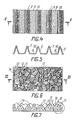
- Figure 4 illustrates an embodiment of a colourdynamic surface of a decorative material made in the form of corrugated metal sheet.
- the colourdynamic surface is formed by regularly arranged three-dimensional elements 7 (Figs. 4, 5) and sections 8 of the surface between the adjacent three-dimensional elements, while differently oriented sections 9 and 10 of the surface of each three-dimensional element including the section 8 of the surface between the adjacent three-dimensional elements 7 have at least three different colours or three different optical properties, and the similarly oriented sections of the surface of the different three-dimensional elements including those located between the adjacent elements have a similar colour or similar optical properties.
- the surface texture factor lies in the range from 1.2 to 24 and the ratio of the three-dimensional elements height to the rounding radius of their peaks lies in the range from 3 to 300.
- FIG 6 illustrates an embodiment of embodiment of a colourdynamic surface of a decorative material made in the form of concrete plate.
- the colourdynamic surface is formed by the irregularly arranged three-dimensional elements 11 (Figs. 6, 7).
- each three-dimensional element 11 has three sections 12, 13, 14 (Figs. 6, 7, 8) of the surface of an irregular shape oriented in different directions and differing in colour or optical properties, whereas the similarly oriented sections of the surface of all the three-dimensional elements 11 have a similar colour or similar optical properties.
- the surface texture factor lie in the range from 1.2 to 24.
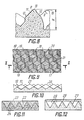
- Fig. 9 shows an embodiment of a colourdynamic surface of a decorative material having the testure made as alternating three-faceted peaks and hollows forming.
- three-faceted three-dimensional elements 16 (Figs 9, 10)
- each of the facets 17, 18, 19 made flat and differing from the two other facets in colour or optical properties, while the facets oriented in one direction, say, facets 17 (Figs 9, 10) of different three-dimensional elements have a similar colour or similar optical properties.
- the facets 17, 18, 19 (Figs 9, 10) of each three-dimensional element are separated from one another by ribs 20 meeting in one peak 21, while the sharpness of the ribs and the peak characterized by the ratio of the element height to the radius of rounding of the ribs and peak thereof lies within the range from 3 to 300.
- the surface texture factor lies in the range from 1.2 to 24.
- Figure 11 illustrates an embodiment of a decorative material provided with a translucent protective layer 22 having a smooth outer surface 23.
- the translucent layer 22 protects the colourdynamic texture surface against contamination.
- Figure 12 illustrates an embodiment of a decorative material provided with a translucent protective material made in the form of plate. There is a gap 26 defined between the layer 25 and a texture surface 27. Used as a protective plate in this version also may be a rigid or flexible film glued, fused or otherwise secured to the texture surface.
- the colourdynamic properties can be imparted practically to all the materials upon which a texture surface or relief with the three-dimensional elements of required geometrical parameters can be obtained by using an appropriate technological process.
- the absolute dimensions of these elements may vary in different materials within a considerably wide range, from a few tens of centimeters to the tenth fractions of a millimeter,
- the colourdynamic texture surface activity i.e. its capability to intensively change its colour even in case of the most insignificant changes of the angles of view, does not depend on the sizes of the texture or lattice three-dimensional elements.
- the absolute dimensions of three-dimensional elements of a variable-colour surface texture decreased 10, 100 or 1000 times retaining the geometrical similarity of the initial and decreased elements, as well as the set of the colour components and colour orientation of them, the colour changing activity of the newly obtained fine-texture surface will be identical with that of the initial coarse-texture surface.
- a method of spraying the dyes or other substances at an angle to the main surface allows obtaining not only two but three and more differently coloured coatings on differently oriented sections of the three-dimensional elements.
- a precise selection of the colour spraying modes allows depositing at least three markedly different colours on a fine-texture surface or lattice whose three-dimensional elements or cells have dimensions measuring tenth fractions of a millimeter and obtaining on the differently oriented sections of each cell or three-dimensional element the colour separation of a high purity and quality.
- the surface colour is determined not only by the observer's position but also by the light flux direction, since the brightness of the illuminated colour sections may many times exceed that of the shaded sections.
- the colours of the illuminated sections will become dominating and it is precisely these sections that will determine the main colour of the surface even in the cases when the total area of their projections will be less for the observer than that of the shaded sections having other colours.
- Colourdynamic materials may be obtained using both regular textures and lattices with linear, round, aquare, faceted and other regularly arranged cells and elements and irregular ones, for instance, the surfaces with a gravel or developed sand texture, the surfaces of various foam materials, such as foam concrete, foam glass, foam plastic, porolon, etc., the textures of many types of pile, looped and cellular cloth as well as nonvowen synthetic materials.
- the first method very universal and widely used in industry, consists in that the texture surface is formed of three-dimensional elements with the ratio of the total area of the surface of all three-dimensional elements and of the intervals between the bases of these elements to the area of the surface on which the elements are located ly lying in the range from 1.2 to 24 and the ratio of the three-dimensional elements mean height to the main rounding radius of their peaks being in the range from 3 to 300, whereupon the different colours and/or different optical properties are imparted to the differently oriented sections of the three-dimensional elements in such a way that similarly oriented sections of the different three-dimensional elements have a similar colour and/or similar optical properties.
- the second method differs from the first one by the fact that the three-dimensional texture elements are formed from the sections to which different colours or optical properties were preliminarily imparted, with the ratio of the total area of the surface of all three-dimensional elements and of the intervals between the bases of these elements to the area of the surface upon which these elements are located lying in the range from 1.2 to 24, and the ratio of the three-dimensional elements means height to the mean rounding radius of their peaks being in the range from 3 to 300 so that the similarly oriented sections of different three-dimensional elements acquire a similar colour and/or similar optical properties.
- the method may be considered as the main one since it is most universal and efficient, however, it calls for a precise selection of dye spraying modes for each particular texture and steady maintenance of these modes throughout the production process.
- a dye may be deposited both manually and with the aid of various pulverizers but it is less efficient in comparison with the previous method and is used mostly in dyeing the regular texture surfaces and lattices.
- the lines of spraying injectors are replaced with the lines of burners put into the flames of which are evaporizing metals and other depositing substances.
- an article in the vacuum chamber is positioned at an angle to the parallel stream of precipitating particles.
- a natural colour of a material for instance, red colour of the facing brick or light colour of a bleached fabric may be used as a component of the material colour in production of some colourdynamic materials.
- the second of the two proposed methods of obtaining the raster decorative colourdynamic texture surfaces consists, like the first method, of two main production operations:
- texture forming elements may be depending on the problem to be solved various parts and articles, such as small-size colour ceramic plates, preliminarily coloured metal of polymeric plates, elements of a flat colour raster, (paper raster, for instance) colour thread and other articles.
- variable colour raster surface of a safety panel may be obtained as a result of a mechanical or automated placing of ceramic colour plates against a form provided with an appropiate relief of the lower surface.
- the plates of one colour are oriented in one direction. After all the plates and necessary fittings are placed in the form, the latter is filled with concrete.
- the article extracted from the form after aquiring the necessary strength represents a panel faced with ceramic plates with a variable colour surface.
- the construction parts of the lattices may function as relief forming colour elements. Used as such elements can be metal strips painted in different colours on both sides and provided with equally spaced slots to receive differing in colour but otherwise identical metal plates at some angle during assembly. For instance, in assembly of a vertical lattice with aquare meshes, the vertical plates may be painted red and green and the horizontal ones, blue and yellow. In this case, each mesh will be represented by four colours corresponding to four sides of a square - red, yellow, green and blue.
- colour elements can be not only straight but also bent plates or individual relief elements.
- Colourdynamic surfaces may be also obtained by corrugating (crimping) or extruding the texture on per-piece, roll and sheet materials provided with a preliminarily printed colour raster.
- the colour raster may be printed by traditional in particular, typographical methods and the texture may be formed by pressing the per-piece articles with relief punches or by rolling the roll and sheet materials between texture forming shafts.
- the second method of obtaining the raster variable-colour surfaces may be of a particular importance in the production of a variety of colourdynamic fabrics, knitted goods, carpet coatings etc. because it allows obtaining a special purity of component colours provicded the manufacturing process is automated and, respectively, achieving a high productivity.
- variable-colour surface After a variable-colour surface is obtained, a wide variety of materials may be given a special translucent protective layer.
- the face of a colourdynamic ceramic of glazed concrete plate may be given a coat of a transparent glaze applied in a layer 22 ( Figure 11) which completely or partially conceals the texture of the plate.
- the coat may be, respectively, rather thin.
- the glass facing plates ( Figures 1, 2) may have a colour texture on the inside providing simultaneously a good cohesion of the plates with concrete or mortar and a smooth surface. An effect of light variation, in this case, is percepted by observing the appearance of "day light" through a transparent glass layer.
- Some decrease of the light-variation activity of such materials occuring as a result of the light refraction in the translucent layer and causing a visual flattening of the texture three-dimensional elements may be compensated for by a respective decrease of an actual texture factor of the surface being coloured.
- Such a layer can be obtained by fusing, glueing or otherwise securing the sheet translucent material to the texture surface or lattice.
- An embodiment of the present invention is presented a method in which a texture surface is formed at the beginning and then various substances including different colour dyes are deposited by spraying an an angle to the main surface of the material onto the differently oriented sections of the texture three dimensional elements.
- the main advantage of this method consists in high productivity and universality which allows obtaining the diverse colourdynamic materials with regular and chaotic textures.
- the simplest is a class of linear three-dimensional elements 7 ( Figures 4, 5), having a prismatic or any other extended shape and located parallel to each other.
- linear textures consists in the fact that in case of a vertical arrangement of extended material, the latter are much less subject to contamination in use in comparison with all other textures.
- a colour-variation effect of the linear texture surfaces is a one-coordinate and due to this principally limited.
- the vertical component is not present in the colour expansions occuring on the architectural and other forms and also on the three-dimensional forms when use is made of linear textures with vertical elements.
- the linear texture materials are limited inttheir combination potentialities since subject to the condition that the three-dimensional elements 7 ( Figures 4, 5) are vertical, only two positions of the material on the vertical surface are possible.
- the second class of the three-dimensional elements included all the diversity of non-linear elements forming both regular and chaotic texture surfaces and lattices ( Figures 1, 2, 6, 7).
- Trihedral elements 16 ( Figures 9, 10) fall into a special group of the second class of non-linear three-dimensional elements which compare favourably with all other elements by production and performance characteristics. It should be noted that the presence of three colour components is a necessary and sufficient quantity providing for a full-value two-coordinate colourdynamic effect and quite a wide range of additional colour mixings up to the full set of spectrum colours. Therefore, the textures illustrated in Figures 9 and 10 consisting of the trihedral three-dimensional elements 16 are highly competitive with the described above textures ( Figures 1, 2, 5, 7) in decorative and combination potentialities and compare favourably with them in their capacility to ensure a high quality of colour separation during deposition of dyes.
- the textures having the trihedral elements are considerably less subject to contamination in use since there exist three possible positions of the three-dimensional elements on a vertical surface which have no horizontal sections of the prone to quick contamination.
- the three-dimensional elements 1 of the texture shown in Figures 1, 2 have sections 5 inclined at 60° to the vertical plane
- the three-dimensional elements 16 of an identical texture so fas as colourydynamic activity is concerned illustrated in Figures 9 and 10 have sections 18 and 19 inclined to the vertical plane at an angle of 30°. That is, the almost horizontal sections (inclination of 60°) are replaced in the second case with the almost vertical sections (inclination of 30°).
- the texture elements of its surface should be fine enough to ensure the basic characteristics of its perception.
- the three-dimensional texture elements whose height is 10 to 12 mm and less.
- a major advantage of the second method consists in a high quality of colour separation when using the scale of gradation of component colours.
- disadvantages of this method are its relatively lower productivity and poor versatility, since each kind of material, when using this method, calls for its individual production process and, respectively, individual fixtures, appliances and equipment.
Landscapes
- Engineering & Computer Science (AREA)
- Architecture (AREA)
- Civil Engineering (AREA)
- Structural Engineering (AREA)
- Laminated Bodies (AREA)
- Nitrogen And Oxygen Or Sulfur-Condensed Heterocyclic Ring Systems (AREA)
- Finishing Walls (AREA)
Claims (12)
- Ein dekoratives Material mit einer farbveränderlichen Strukturoberfläche aus dreidimensionalen Elementen (1) der Struktur oder des Reliefs, deren unterschiedlich ausgerichtete Abschnitte verschiedene Farben haben, wobei die Strukturoberfläche aus dreidimensionalen Elementen (1) gebildet ist, wobei das Verhältnis aus dem gesamten Oberflächenbereich aller dreidimensionalen Elemente (1) und den Zwischenräumen zwischen den Basen dieser Elemente zu dem Bereich der Oberfläche, auf dem sie angeordnet sind, in dem Bereich von 1,2 bis 24 liegt, und wobei das Verhältnis aus der mittleren Höhe (H) der dreidimensionalen Element (1) zu dem mittleren Abrundungsradius (R) ihrer Spitzen in dem Bereich von 3 bis 300 ist, wobei die unterschiedlich ausgerichteten Abschnitte (2,3,4,5) der Oberfläche von jedem dreidimensionalen Elemente (1) unterschiedlich Farben und/oder unterschiedliche, optische Eigenschaften haben, während die gleich ausgerichteten (in einer Richtung) Oberflächenabschnitte unterschiedlicher dreidimensionaler Elemente eine gleiche Farbe und gleiche optische Eigenschaften in wenigstens einen Teil der dreidimensionalen Elemente (1) haben.
- Ein dekoratives Material, wie in Anspruch 1 beansprucht, dadurch gekennzeichnet, daß bei allen dreidimensionalen Elementen (1) die gleich ausgerichteten Abschnitte (2,3,4,5) der Oberflächen der unterschiedlichen, dreidimensionalen Elemente (1) eine gleiche Farbe und gleiche optische Eigenschaften haben.
- Ein dekoratives Material, wie in Anspruch 1 beansprucht, dadurch gekennzeichnet, daß die unterschiedlich ausgerichteten Abschnitte (2,3,4,5) der Oberfläche von jedem dreidimensionalen Element (1) einschließlich des Abschnittes der Oberfläche zwischen benachbarten dreidimensionalen Elementen wenigstens drei unterschiedliche Farben und/oder drei unterschiedliche, optische Eigenschaften haben.
- Ein dekoratives Material, wie in Anspruch 3 beansprucht, dadurch gekennzeichnet, daß, wenn die drei Farben für die unterschiedlich ausgerichteten Abschnitte der dreidimensionalen Elemente der Oberfläche verwendet werden, drei Hauptfarben (Rot, Blau und eine aus der Farbgruppe von Gelb, Gelbgrün und Grün) ausgewählt werden.
- Ein dekoratives Material, wie in Anspruch 1 beansprucht, dadurch gekennzeichnet, daß die Strukturoberfläche in der Form von gleichmäßig angeordneten Vorsprüngen und/oder Vertiefungen hergestellt ist, die als die dreidimensionalen Elemente (16) mit drei Seiten hergestellt sind, die bei allen dreidimensionalen Elemente gleich ausgerichtet sind, wohingegen die Seiten von jedem der dreidimensionalen Elementen durch in eine Spitze konvergierende Rippen getrennt sind, und daß die Schärfe der Rippen und Spitze durch das Verhältnis aus der Höhe des Elements zu dem Abrundungsradius seine Rippe und Spitze in dem Bereich von 3 bis 300 liegt, und wobei jede der drei Seiten eine unterschiedliche Farbe und/oder unterschiedliche optische Eigenschaften als die der zwei anderen Seiten des Elements hat.
- Ein dekoratives Material, wie in Anspruch 5 beansprucht, dadurch gekennzeichnet, daß die Strukturoberfläche in der Form von abwechselnden, dreiflächigen Projektionen und Vertiefungen hergestellt ist, wobei jede Fläche (17,18,19) flach ausgebildet ist.
- Ein dekoratives Material, wie in Anspruch 1 beansprucht, dadurch gekennzeichnet, daß es mit einer lichtdurchlässigen Schutzschicht (22) mit einer glatten Außenoberfläche versehen ist.
- Ein dekoratives Material, wie in Anspruch 7 beansprucht, dadurch gekennzeichnet, daß eine Schutzschicht (25) in der Form einer flachen, lichtdurchlässigen Platte hergestellt ist und ein Zwischenraum (26) zwischen dieser Schicht und der farbdynamischen Strukturoberfläche vorgesehen ist.
- Ein Verfahren zum Herstellen eines dekorativen Materials, das eine farbdynamische Strukturoberfläche mit einer Mehrzahl dreidimensionaler Elemente (1) hat, wobei die unterschiedlich ausgerichteten Abschnitte seiner Oberfläche unterschiedliche Farben und/oder optische Eigenschaften haben, wobei die Strukturoberfläche durch die dreidimensionalen Elemente (1) gebildet ist, wobei das Verhältnis aus dem Gesamtbereich der Oberflächen von all den dreidimensionalen Elementen und den Zwischenräumen zwischen den Basen dieser Elemente zu dem Oberflächenbereich, auf dem sie sich befinden, im Bereich von 1,2 bis 24 ist, und das Verhältnis der mittleren Höhe (H) der dreidimensionalen Elemente zu dem mittleren Abrundungsradius (R) ihrer Spitzen in dem Bereich von 3 bis 300 ist, und den unterschiedlich ausgerichteten Abschnitten (2,4,3,5) der Oberflächen der dreidimensionalen Elemente unterschiedliche Farben und/oder unterschiedliche optische Eigenschaften derart verliehen werden, daß die gleich ausgerichteten Abschnitte der Oberflächen der unterschiedlichen, dreidimensionalen Elemente eine gleiche Farbe und gleiche optische Eigenschaften haben.
- Ein Verfahren, wie in Anspruch 9 beansprucht, dadurch gekennzeichnet, daß die unterschiedlichen Farben oder unterschiedlichen, optischen Eigenschaften den unterschiedlich ausgerichteten Abschnitten der Oberflächen der dreidimensionalen Elemente durch Aufbringen verschiedener Materialien einschließlich von Farbmitteln verliehen werden, das unter einem Winkel zu der Materialoberfläche durchgeführt wird, auf dem die dreidimensionalen Elemente gebildet werden.
- Ein Verfahren, wie in Anspruch 10 beansprucht, dadurch gekennzeichnet, daß die unterschiedlichen Farben durch Aufbringen von Farbmitteln durch Sprühen erhalten werden, wobei die Achse des Sprühkegels unter einem 3 bis 5° kleinerem Winkel als der Neigungswinkel der dreidimensionalen Elemente zu der Oberfläche positioniert wird, auf der sie angeordnet sind.
- Ein Verfahren zum Herstellen von dekorativem Material, das eine farbveränderliche Strukturoberfläche mit einer Mehrzahl von dreidimensionalen Elementen (1) hat, deren unterschiedlich ausgerichtete Abschnitte unterschiedliche Farben haben, wobei die dreidimensionalen Strukturelemente durch Abschnitte der Oberfläche gebildet sind, denen die Farben und/oder die optischen Eigenschaften, die sich voneinander unterscheiden, im voraus verliehen worden sind, wobei das Verhältnis aus dem gesamten Bereich der Oberflächen aller dreidimensionaler Elemente (1) und den Zwischenräumen zwischen diesen Elementen zu dem Bereich der Oberfläche, auf dem sie angeordnet sind, in dem Bereich von 1,2 bis 24 liegt, und das Verhältnis der mittleren Höhe (H) der dreidimensionalen Elemente zu dem mittleren Abrundungsradius (R) ihre Spitzen in dem Bereich von 3 bis 300 ist, so daß gleich ausgerichtete Abschnitte der Oberflächen der unterschiedlichen, dreidimensionalen Elemente eine gleiche Farbe und gleiche optische Eigenschaften annehmen.
Priority Applications (1)
| Application Number | Priority Date | Filing Date | Title |
|---|---|---|---|
| AT89907371T ATE114124T1 (de) | 1989-03-17 | 1989-03-17 | Dekomaterial mit farbdynamischer oberfläche und verfahren zur herstellung. |
Applications Claiming Priority (2)
| Application Number | Priority Date | Filing Date | Title |
|---|---|---|---|
| PCT/SU1989/000065 WO1990011197A1 (fr) | 1989-03-17 | 1989-03-17 | Matiere decorative a surface chromodynamique et son procede d'obtention |
| CA002025388A CA2025388C (en) | 1989-03-17 | 1990-09-14 | Colourdynamic decorative materials and method of obtaining them |
Publications (3)
| Publication Number | Publication Date |
|---|---|
| EP0414896A1 EP0414896A1 (de) | 1991-03-06 |
| EP0414896A4 EP0414896A4 (en) | 1991-10-16 |
| EP0414896B1 true EP0414896B1 (de) | 1994-11-17 |
Family
ID=25674303
Family Applications (1)
| Application Number | Title | Priority Date | Filing Date |
|---|---|---|---|
| EP89907371A Expired - Lifetime EP0414896B1 (de) | 1989-03-17 | 1989-03-17 | Dekomaterial mit farbdynamischer oberfläche und verfahren zur herstellung |
Country Status (3)
| Country | Link |
|---|---|
| EP (1) | EP0414896B1 (de) |
| AU (1) | AU625647B2 (de) |
| WO (1) | WO1990011197A1 (de) |
Families Citing this family (4)
| Publication number | Priority date | Publication date | Assignee | Title |
|---|---|---|---|---|
| US5105306A (en) * | 1989-01-18 | 1992-04-14 | Ohala John J | Visual effect created by an array of reflective facets with controlled slopes |
| GB9703751D0 (en) * | 1997-02-24 | 1997-04-16 | Marlux N V | Building materials |
| ITUB20155398A1 (it) * | 2015-11-09 | 2017-05-09 | Studio Tesla S R L | Piastrella o lastra per pavimenti e rivestimenti |
| CN116931144B (zh) * | 2022-04-01 | 2024-10-11 | 比亚迪股份有限公司 | 纹理结构、盖板、移动终端以及盖板的制备方法 |
Family Cites Families (6)
| Publication number | Priority date | Publication date | Assignee | Title |
|---|---|---|---|---|
| FR2066865A1 (en) * | 1969-10-13 | 1971-08-13 | Joos Pierre | Smooth moulded panels with decorative int-renal interfaces |
| FR2106691A5 (en) * | 1970-09-21 | 1972-05-05 | Fontenille Henri | Decorative article - with transparent glass or plastic support laminated plastic films on one side of support and separate solid |
| AT334252B (de) * | 1971-06-21 | 1976-01-10 | Swarovski & Co | Vorrichtung zum hervorrufen von bewegungsbildern und verfahren zur herstellung |
| US3875716A (en) * | 1971-09-04 | 1975-04-08 | Dynamit Nobel Ag | Tile, particularly for interior decoration |
| US4126727A (en) * | 1976-06-16 | 1978-11-21 | Congoleum Corporation | Resinous polymer sheet materials having selective, decorative effects |
| US4916007A (en) * | 1985-10-18 | 1990-04-10 | Tarkett Inc. | Underprinted inlaid sheet materials having unique decorative design effects |
-
1989
- 1989-03-17 EP EP89907371A patent/EP0414896B1/de not_active Expired - Lifetime
- 1989-03-17 WO PCT/SU1989/000065 patent/WO1990011197A1/ru not_active Ceased
-
1990
- 1990-09-13 AU AU62503/90A patent/AU625647B2/en not_active Ceased
Also Published As
| Publication number | Publication date |
|---|---|
| EP0414896A1 (de) | 1991-03-06 |
| AU6250390A (en) | 1992-03-19 |
| WO1990011197A1 (fr) | 1990-10-04 |
| AU625647B2 (en) | 1992-07-16 |
| EP0414896A4 (en) | 1991-10-16 |
Similar Documents
| Publication | Publication Date | Title |
|---|---|---|
| US4546025A (en) | Multi-lateral edge unit having an asymmetrical design that extends to the lateral edges | |
| US5209282A (en) | Vertical blind with corrugated surface | |
| US4681481A (en) | Decorative, functional element for construction and the like | |
| EP1437332A1 (de) | Durch sintern von keramikpulver hergestellte platten mit dreimensionalem farbmuster | |
| AU647409B2 (en) | Colourdynamic decorative material | |
| AU625647B2 (en) | Colourdynamic decorative materials and method of obtaining them | |
| CA2025388C (en) | Colourdynamic decorative materials and method of obtaining them | |
| GB2222389A (en) | Decorative elements | |
| DE29908104U1 (de) | Glasfliese | |
| JP2000045483A (ja) | 建築板及びその施工構造 | |
| CN1153751A (zh) | 立体瓷质花岗石、大理石 | |
| JP2017141603A (ja) | 金属製外装材 | |
| CN1143147A (zh) | 变色陶瓷装饰砖的制造方法 | |
| JPH0724403A (ja) | 建築用化粧板の塗装方法 | |
| JPH07102723A (ja) | 外装板 | |
| CN100370103C (zh) | 饰面板及其制造方法 | |
| EP0364125A1 (de) | Pflaster | |
| CA2017245A1 (en) | Slab for flooring and related floor | |
| CN209813585U (zh) | 一种拼花式石材复合板和石艺品 | |
| CN2326599Y (zh) | 艺术浮雕玻璃 | |
| US2226265A (en) | Siding unit and assembly | |
| KR19990045700A (ko) | 건축용 자연석 내,외장재의 가공방법 | |
| CN1162285C (zh) | 立体仿花岗石图案玻化砖 | |
| SU1717765A1 (ru) | Способ изготовлени декоративных фактурных поверхностей | |
| EP0100954A2 (de) | Verfahren zur Herstellung von keramischen Platten mit verschiedenen Dekoren und nach diesem Verfahren hergestellte Platte |
Legal Events
| Date | Code | Title | Description |
|---|---|---|---|
| PUAI | Public reference made under article 153(3) epc to a published international application that has entered the european phase |
Free format text: ORIGINAL CODE: 0009012 |
|
| 17P | Request for examination filed |
Effective date: 19901116 |
|
| AK | Designated contracting states |
Kind code of ref document: A1 Designated state(s): AT BE CH DE FR GB IT LI NL SE |
|
| A4 | Supplementary search report drawn up and despatched |
Effective date: 19910826 |
|
| AK | Designated contracting states |
Kind code of ref document: A4 Designated state(s): AT BE CH DE FR GB IT LI NL SE |
|
| 17Q | First examination report despatched |
Effective date: 19940222 |
|
| RAP1 | Party data changed (applicant data changed or rights of an application transferred) |
Owner name: TOVARISCHESTVO S OGRANICHENNOI OTVETSTVENNOST JU N |
|
| ITF | It: translation for a ep patent filed | ||
| GRAA | (expected) grant |
Free format text: ORIGINAL CODE: 0009210 |
|
| AK | Designated contracting states |
Kind code of ref document: B1 Designated state(s): AT BE CH DE FR GB IT LI NL SE |
|
| PG25 | Lapsed in a contracting state [announced via postgrant information from national office to epo] |
Ref country code: FR Free format text: THE PATENT HAS BEEN ANNULLED BY A DECISION OF A NATIONAL AUTHORITY Effective date: 19941117 |
|
| REF | Corresponds to: |
Ref document number: 114124 Country of ref document: AT Date of ref document: 19941215 Kind code of ref document: T |
|
| ET | Fr: translation filed | ||
| REF | Corresponds to: |
Ref document number: 68919411 Country of ref document: DE Date of ref document: 19941222 |
|
| EAL | Se: european patent in force in sweden |
Ref document number: 89907371.2 |
|
| PG25 | Lapsed in a contracting state [announced via postgrant information from national office to epo] |
Ref country code: GB Effective date: 19950317 Ref country code: AT Effective date: 19950317 |
|
| PG25 | Lapsed in a contracting state [announced via postgrant information from national office to epo] |
Ref country code: SE Effective date: 19950318 |
|
| PG25 | Lapsed in a contracting state [announced via postgrant information from national office to epo] |
Ref country code: LI Effective date: 19950331 Ref country code: CH Effective date: 19950331 Ref country code: BE Effective date: 19950331 |
|
| PLBE | No opposition filed within time limit |
Free format text: ORIGINAL CODE: 0009261 |
|
| STAA | Information on the status of an ep patent application or granted ep patent |
Free format text: STATUS: NO OPPOSITION FILED WITHIN TIME LIMIT |
|
| PGFP | Annual fee paid to national office [announced via postgrant information from national office to epo] |
Ref country code: DE Payment date: 19950929 Year of fee payment: 7 |
|
| BERE | Be: lapsed |
Owner name: TOVARISCHESTVO S OGRANICHENNOI OTVETSTVENNOSTJU N Effective date: 19950331 |
|
| PG25 | Lapsed in a contracting state [announced via postgrant information from national office to epo] |
Ref country code: NL Effective date: 19951001 |
|
| 26N | No opposition filed | ||
| GBPC | Gb: european patent ceased through non-payment of renewal fee |
Effective date: 19950317 |
|
| REG | Reference to a national code |
Ref country code: CH Ref legal event code: PL |
|
| NLV4 | Nl: lapsed or anulled due to non-payment of the annual fee |
Effective date: 19951001 |
|
| EUG | Se: european patent has lapsed |
Ref document number: 89907371.2 |
|
| REG | Reference to a national code |
Ref country code: FR Ref legal event code: ST |
|
| PG25 | Lapsed in a contracting state [announced via postgrant information from national office to epo] |
Ref country code: DE Effective date: 19961203 |
|
| PG25 | Lapsed in a contracting state [announced via postgrant information from national office to epo] |
Ref country code: IT Free format text: LAPSE BECAUSE OF NON-PAYMENT OF DUE FEES;WARNING: LAPSES OF ITALIAN PATENTS WITH EFFECTIVE DATE BEFORE 2007 MAY HAVE OCCURRED AT ANY TIME BEFORE 2007. THE CORRECT EFFECTIVE DATE MAY BE DIFFERENT FROM THE ONE RECORDED. Effective date: 20050317 |